
INFT11/71-132
     Web Applications


HTML and XHTML
      Dr Michael Rees
School of Information Technology

      mrees@bond.edu.au
History of HTML

• HTML defined using SGML for the general layout of
  web pages

• HTML 4.01 – 1999

• XHTML 1.0 – 2000: HTML 4.01 defined using XML
   – Modular: Strict, Transitional, Frameset
   – Syntax can be validated at W3C

• XHTML 1.1 – 2001: Modularized 1.0, no frames

• HTML 5: to be the next standard


© 2009 Michael Rees                Web Applications   2
Hypertext Markup Language

• Text-based markup language for web pages

• Defines:
   – Page content: text, images, audio-visual, executable
     behaviour (JavaScript)
   – Page structure: different types of content (paragraphs,
     headings, lists, tables, links, and so on)
   – Page presentation: deprecated in favour of CSS

• HTML comprises:
          – Elements or tags, tag attributes, and content
          – Character entities: single special characters
          – Data types: URI, colour, ID, units, dates, encoding
© 2009 Michael Rees                 Web Applications              3
Dynamic HTML
• An old marketing term
• Browsers read (X)HTML to create an in-memory Document
  Object Model (DOM)
• JavaScript code within a web page is able to access and
  change the DOM contents
• Browsers detect DOM changes and immediately redisplay
  the content dynamically – hence the name
• Enables:
   – responsive graphical user interface controls
   – effects such as animation, drag and drop & so on
• Different browsers use different JavaScript notation for the
  DOM contents
© 2009 Michael Rees              Web Applications        4
HTML Components

• head tag
   – title (regard as mandatory)
   – styles
   – metadata—content description

• body tag—page content
   – headings
   – body paragraphs
   – lists
   – Tables

• JavaScript: in head or body
© 2009 Michael Rees              Web Applications   5
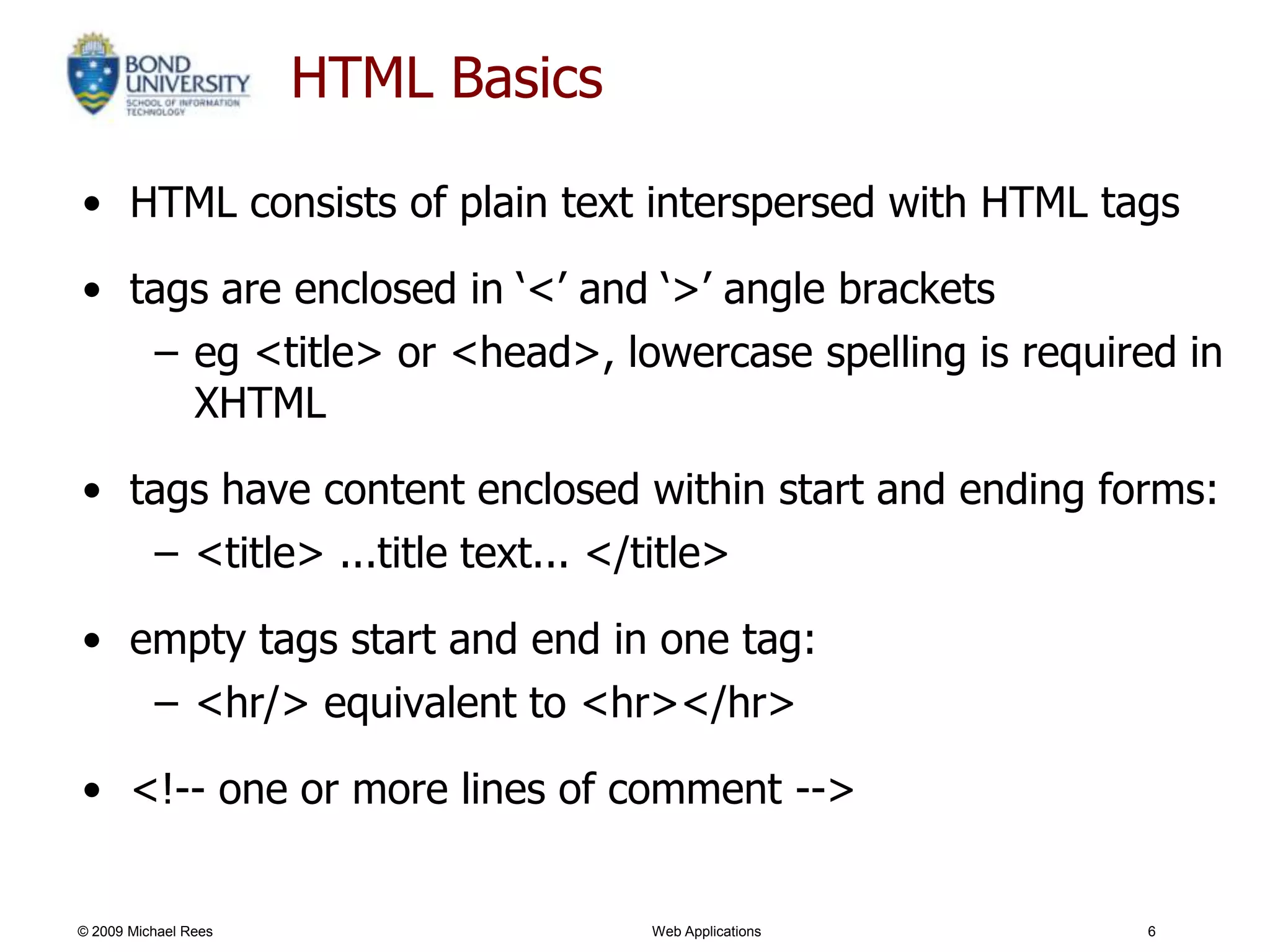
HTML Basics

• HTML consists of plain text interspersed with HTML tags

• tags are enclosed in ‗<‘ and ‗>‘ angle brackets
   – eg <title> or <head>, lowercase spelling is required in
     XHTML

• tags have content enclosed within start and ending forms:
   – <title> ...title text... </title>

• empty tags start and end in one tag:
          – <hr/> equivalent to <hr></hr>

• <!-- one or more lines of comment -->


© 2009 Michael Rees                 Web Applications    6
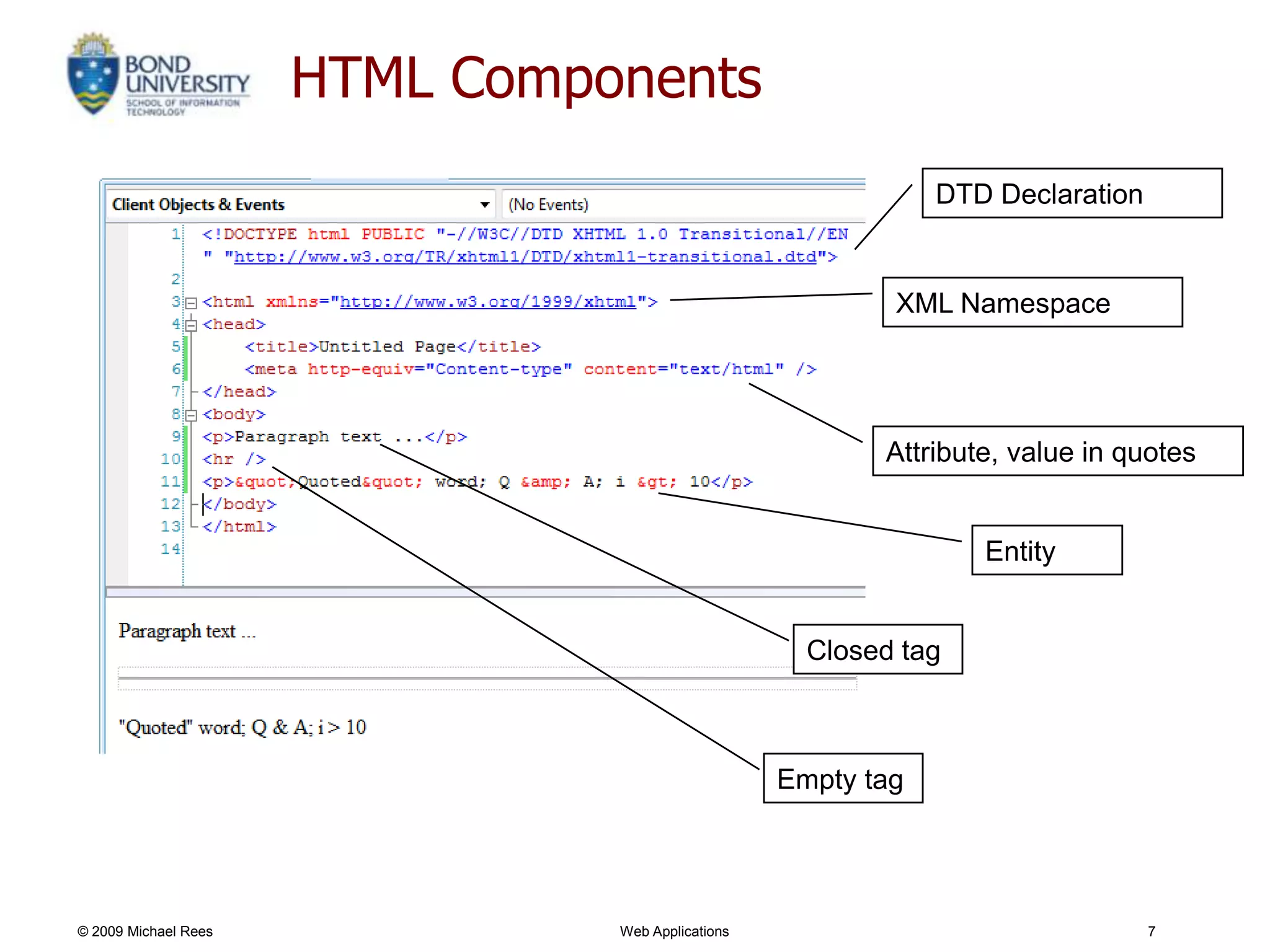
HTML Components
                                                               DTD Declaration


                                                           XML Namespace


                                                          Attribute, value in quotes


                                                                  Entity


                                                     Closed tag


                                                   Empty tag


© 2009 Michael Rees             Web Applications                                 7
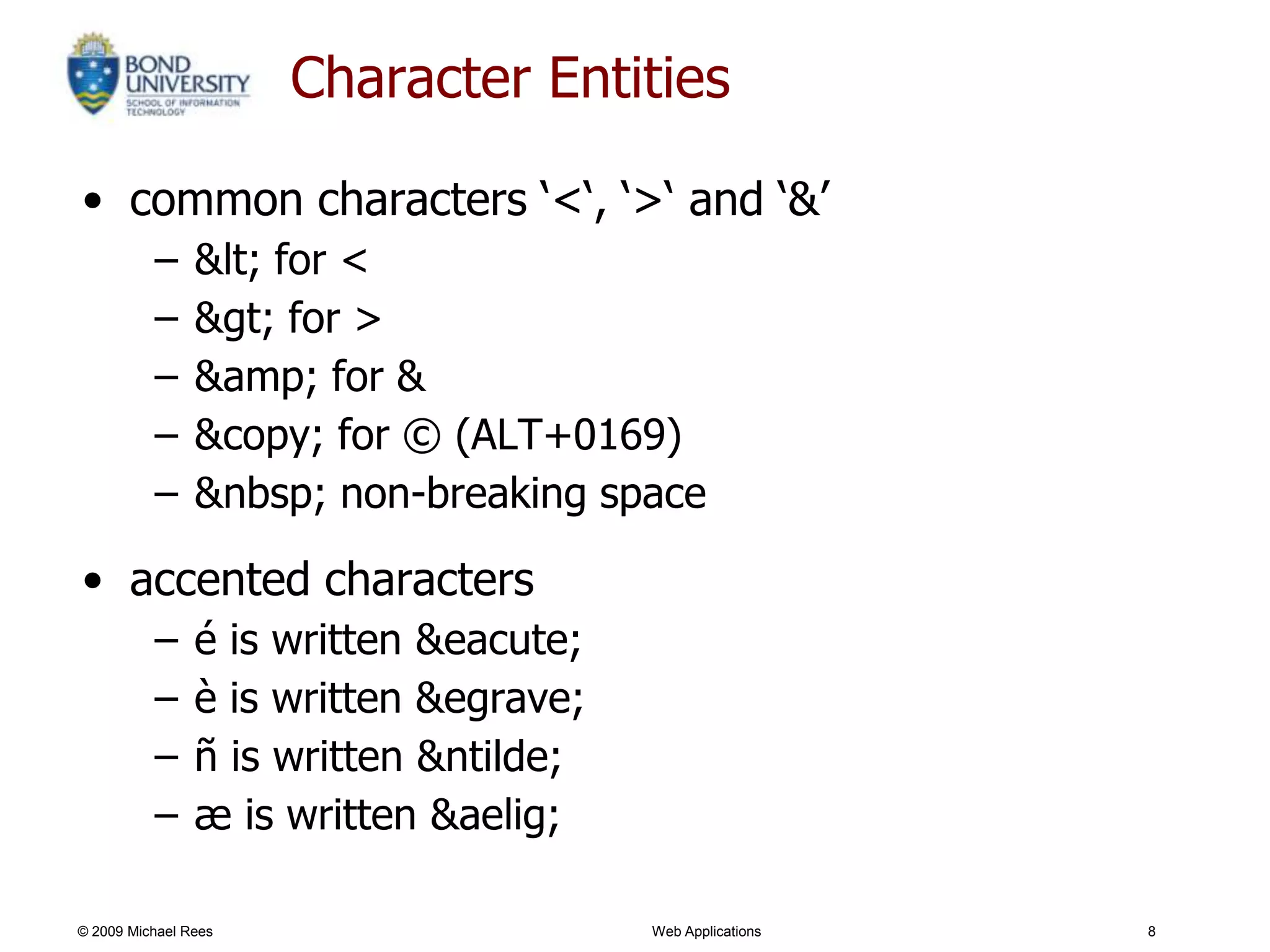
Character Entities

• common characters ‗<‗, ‗>‗ and ‗&‘
          –     &lt; for <
          –     &gt; for >
          –     &amp; for &
          –     &copy; for © (ALT+0169)
          –     &nbsp; non-breaking space

• accented characters
          –     é is written &eacute;
          –     è is written &egrave;
          –     ñ is written &ntilde;
          –     æ is written &aelig;

© 2009 Michael Rees                     Web Applications   8
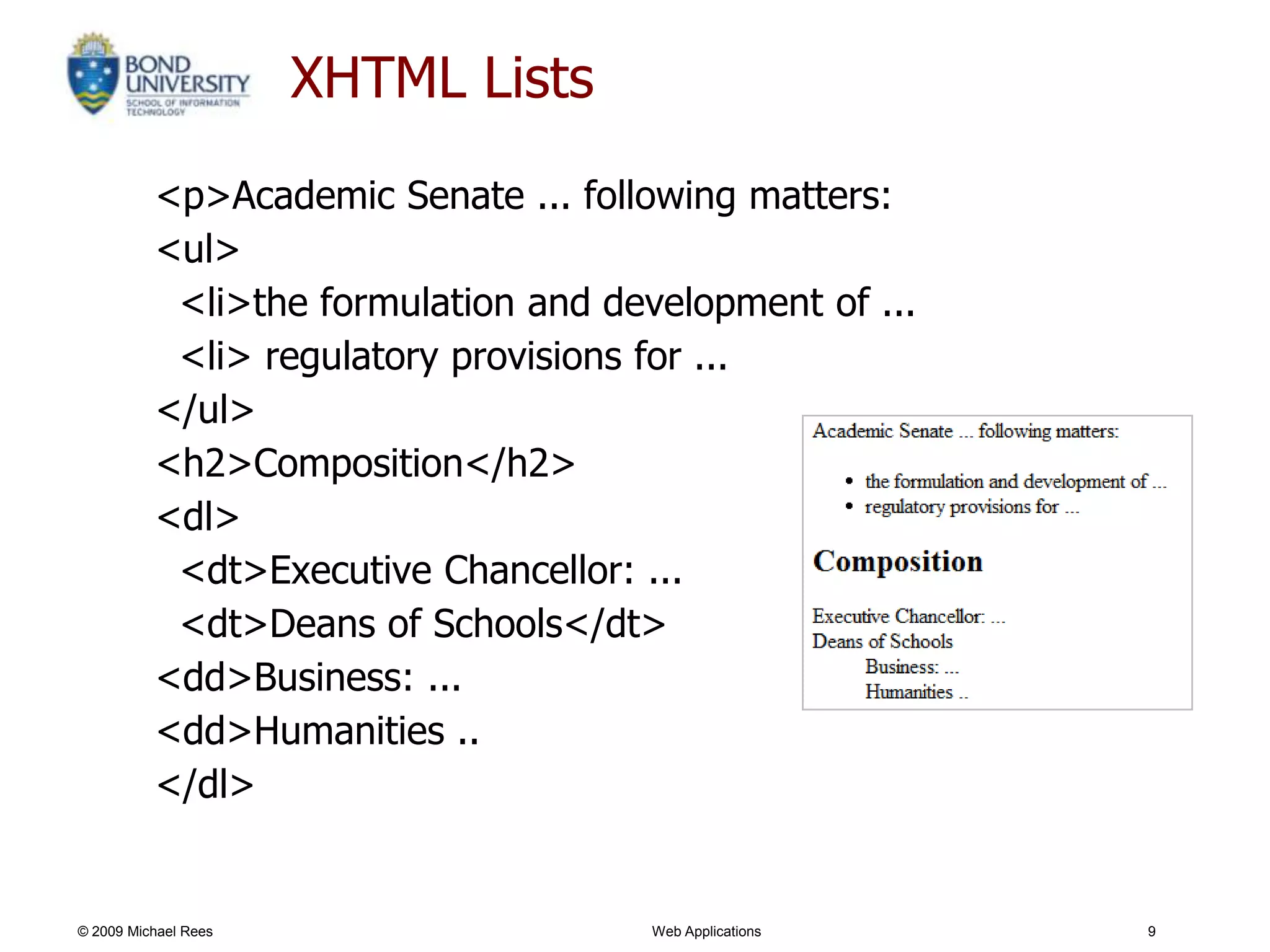
XHTML Lists
          <p>Academic Senate ... following matters:
          <ul>
           <li>the formulation and development of ...
           <li> regulatory provisions for ...
          </ul>
          <h2>Composition</h2>
          <dl>
           <dt>Executive Chancellor: ...
           <dt>Deans of Schools</dt>
          <dd>Business: ...
          <dd>Humanities ..
          </dl>


© 2009 Michael Rees                   Web Applications   9
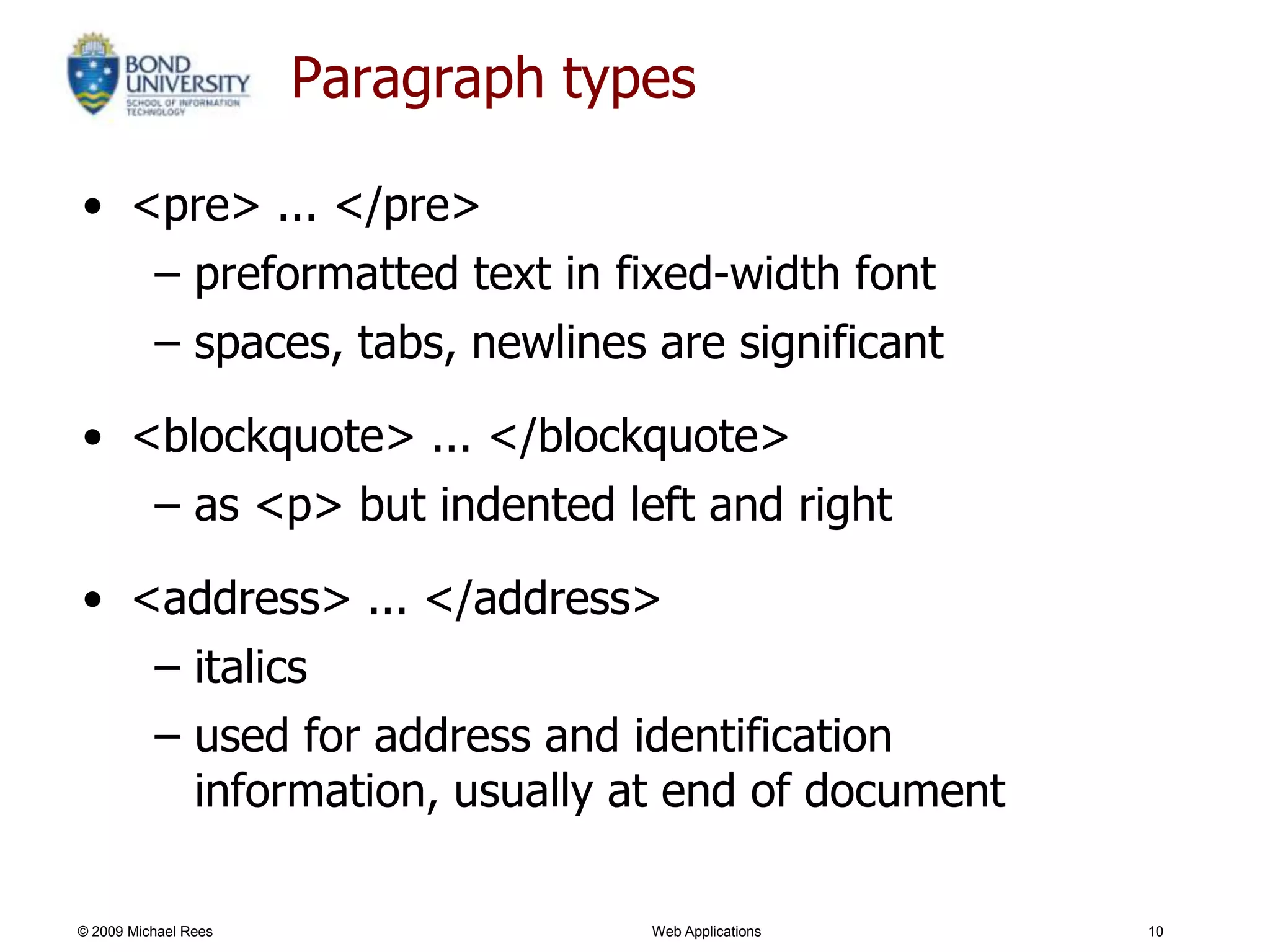
Paragraph types

• <pre> ... </pre>
   – preformatted text in fixed-width font
   – spaces, tabs, newlines are significant

• <blockquote> ... </blockquote>
   – as <p> but indented left and right

• <address> ... </address>
   – italics
   – used for address and identification
     information, usually at end of document

© 2009 Michael Rees                Web Applications   10
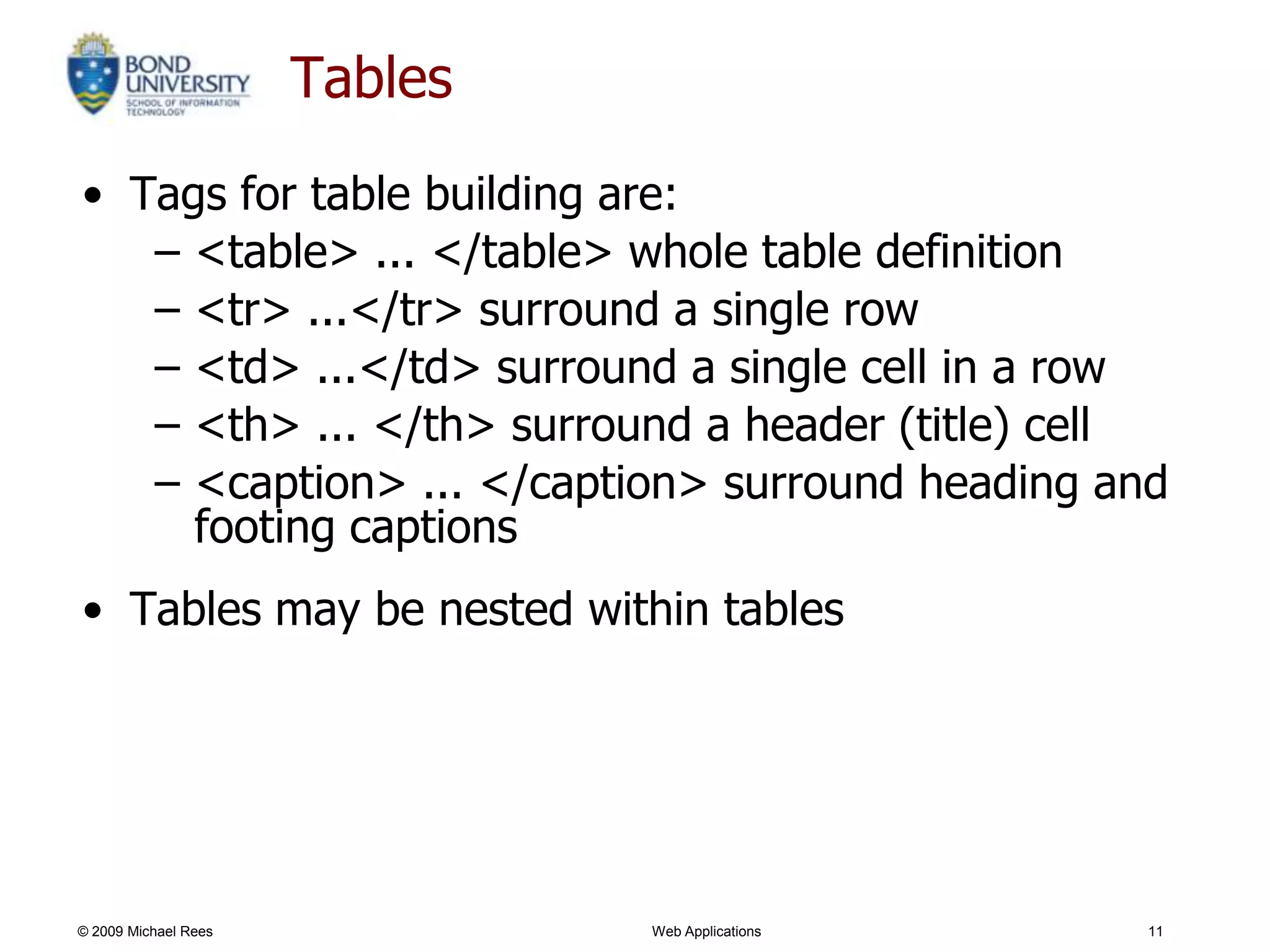
Tables
• Tags for table building are:
   – <table> ... </table> whole table definition
   – <tr> ...</tr> surround a single row
   – <td> ...</td> surround a single cell in a row
   – <th> ... </th> surround a header (title) cell
   – <caption> ... </caption> surround heading and
     footing captions
• Tables may be nested within tables


© 2009 Michael Rees            Web Applications   11
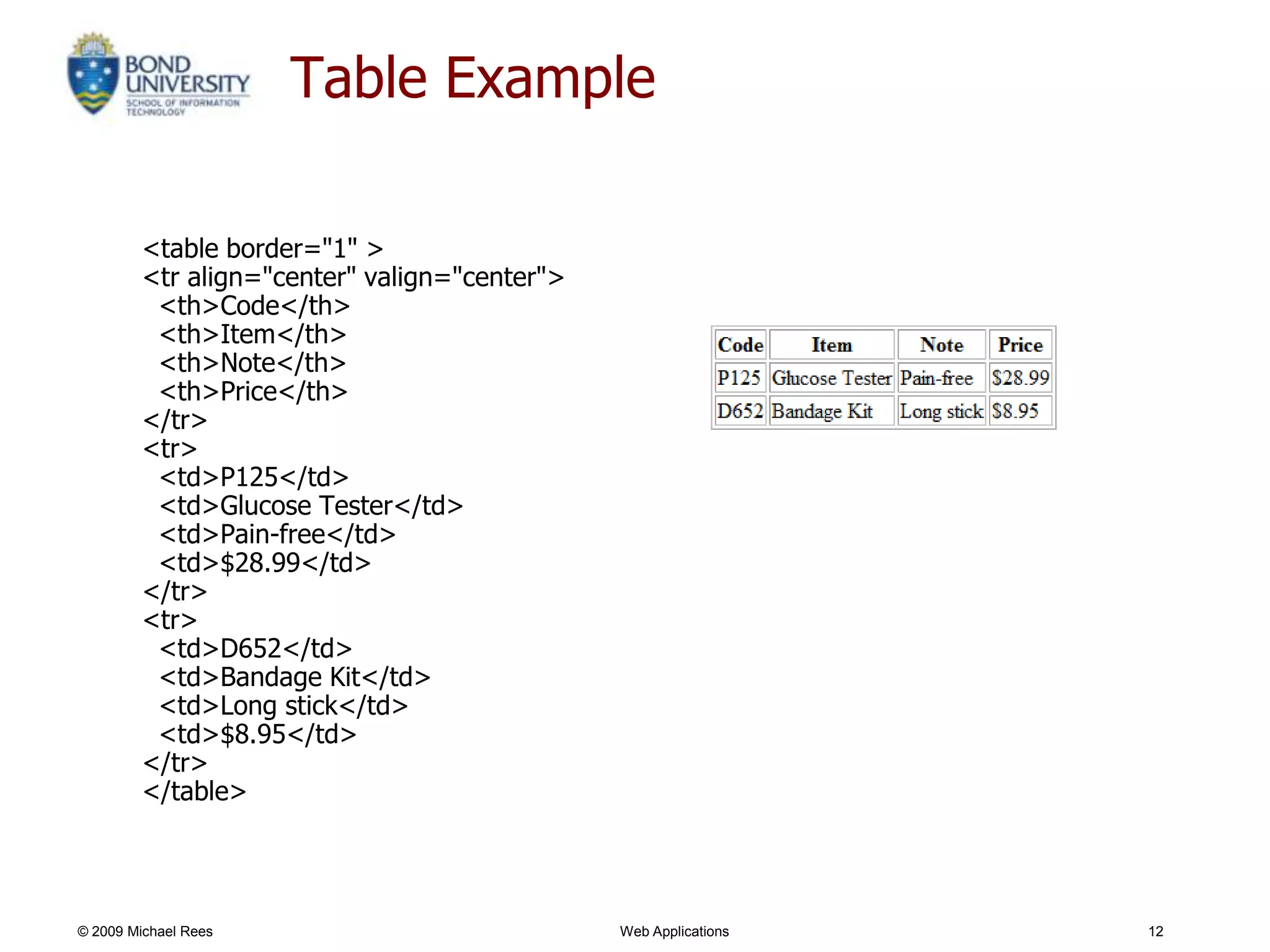
Table Example

        <table border="1" >
        <tr align="center" valign="center">
         <th>Code</th>
         <th>Item</th>
         <th>Note</th>
         <th>Price</th>
        </tr>
        <tr>
         <td>P125</td>
         <td>Glucose Tester</td>
         <td>Pain-free</td>
         <td>$28.99</td>
        </tr>
        <tr>
         <td>D652</td>
         <td>Bandage Kit</td>
         <td>Long stick</td>
         <td>$8.95</td>
        </tr>
        </table>


© 2009 Michael Rees                           Web Applications   12
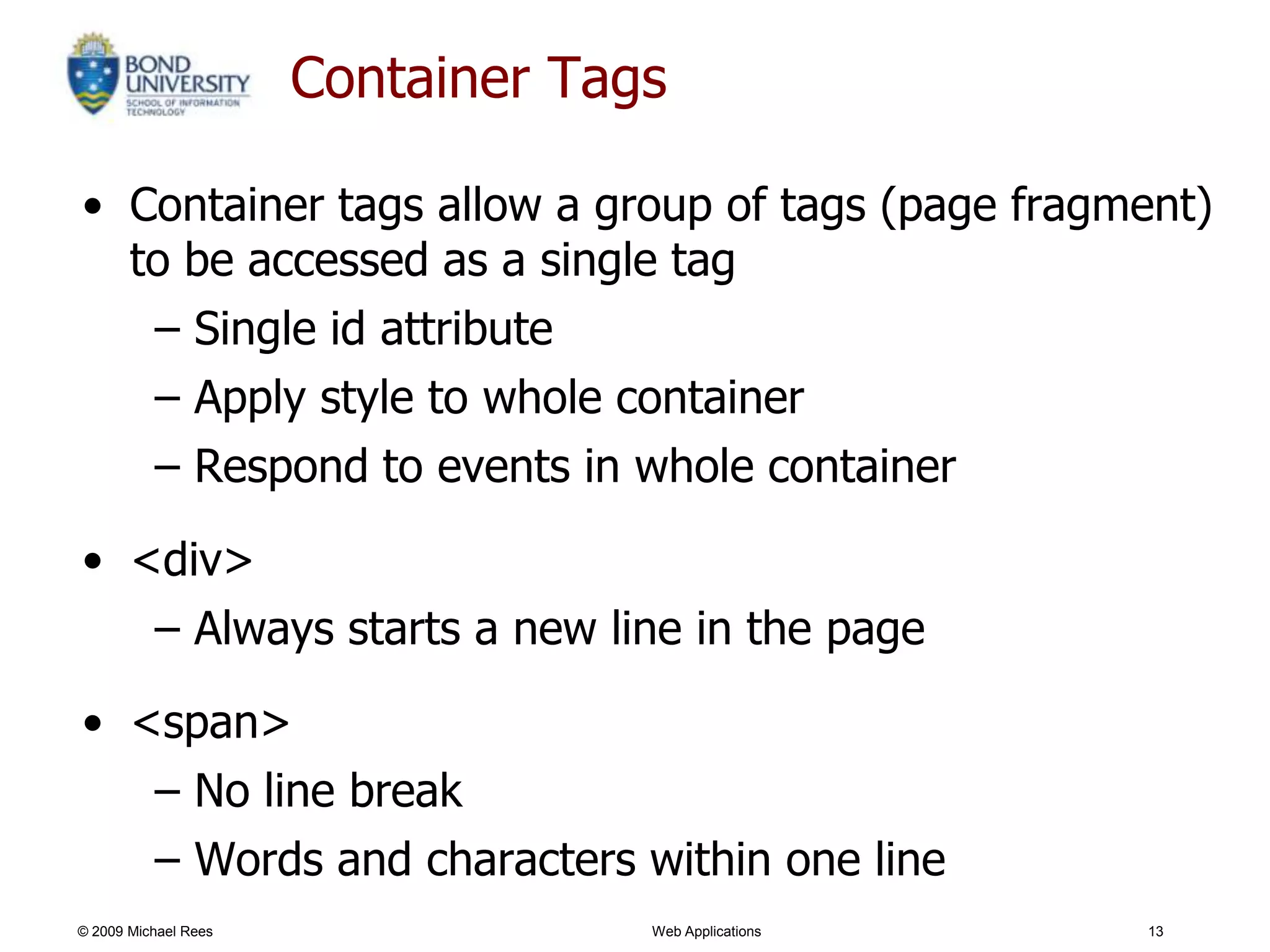
Container Tags

• Container tags allow a group of tags (page fragment)
  to be accessed as a single tag
   – Single id attribute
   – Apply style to whole container
   – Respond to events in whole container

• <div>
   – Always starts a new line in the page

• <span>
   – No line break
   – Words and characters within one line
© 2009 Michael Rees                Web Applications   13
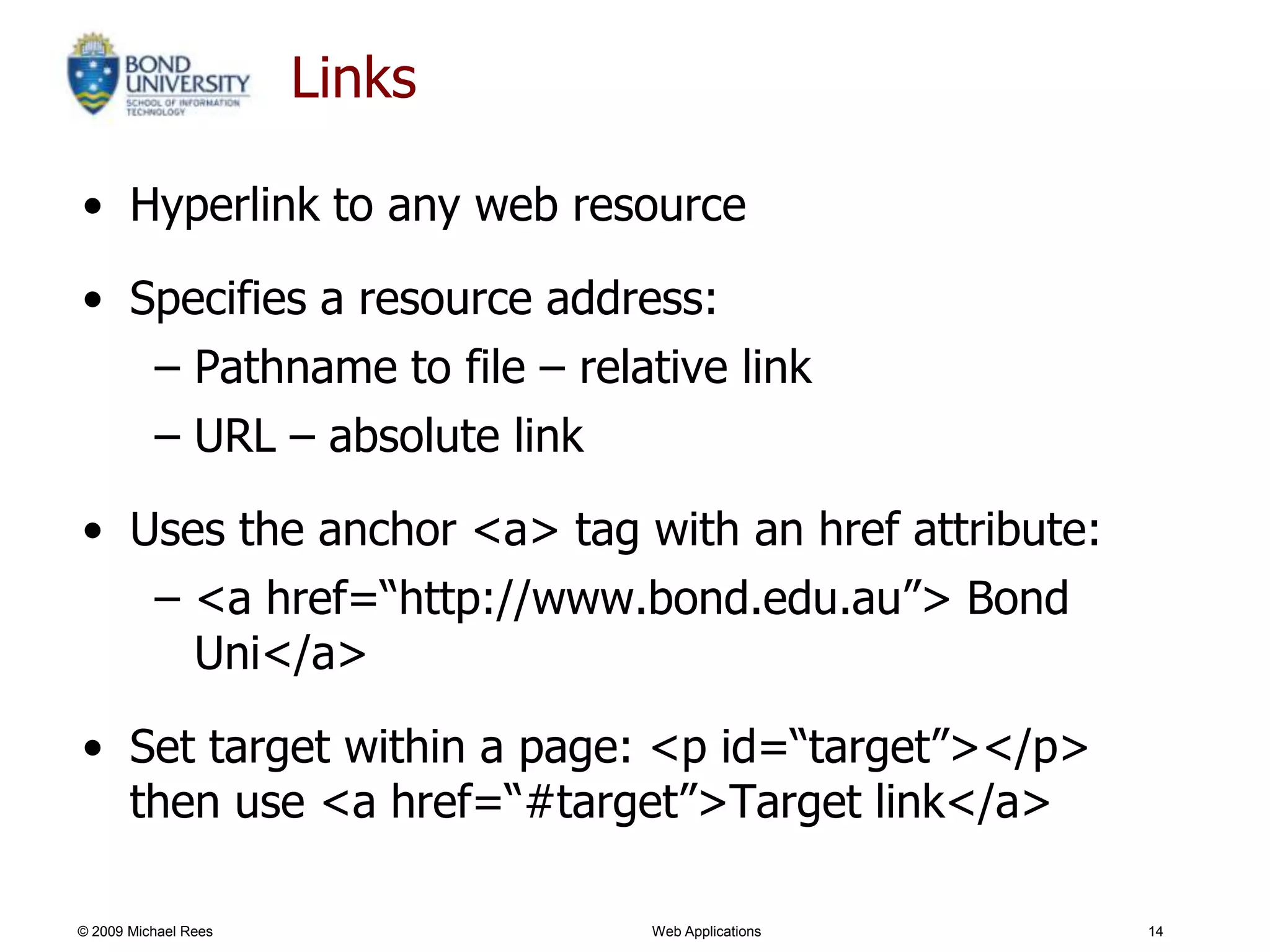
Links

• Hyperlink to any web resource

• Specifies a resource address:
   – Pathname to file – relative link
   – URL – absolute link

• Uses the anchor <a> tag with an href attribute:
   – <a href=―http://www.bond.edu.au‖> Bond
     Uni</a>

• Set target within a page: <p id=―target‖></p>
  then use <a href=―#target‖>Target link</a>

© 2009 Michael Rees           Web Applications      14
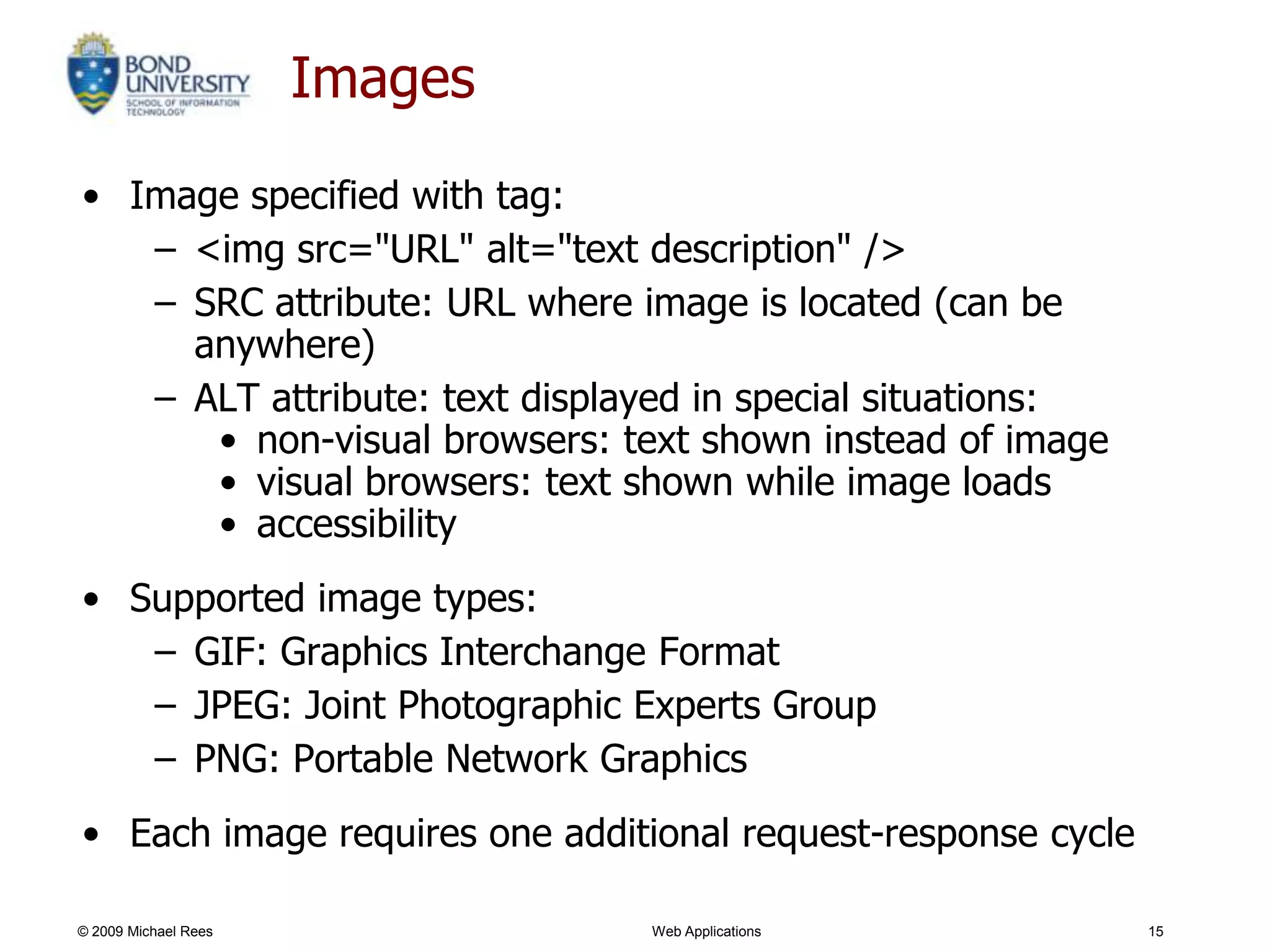
Images
• Image specified with tag:
   – <img src="URL" alt="text description" />
   – SRC attribute: URL where image is located (can be
     anywhere)
   – ALT attribute: text displayed in special situations:
      • non-visual browsers: text shown instead of image
      • visual browsers: text shown while image loads
      • accessibility
• Supported image types:
   – GIF: Graphics Interchange Format
   – JPEG: Joint Photographic Experts Group
   – PNG: Portable Network Graphics
• Each image requires one additional request-response cycle

© 2009 Michael Rees            Web Applications               15
Resources

• Read Sections 2.1 through 2.8 of textbook


© 2009 Michael Rees               Web Applications   16

INFT132 093 04 HTML and XHTML

  • 1.
    INFT11/71-132 Web Applications HTML and XHTML Dr Michael Rees School of Information Technology mrees@bond.edu.au
  • 2.
    History of HTML •HTML defined using SGML for the general layout of web pages • HTML 4.01 – 1999 • XHTML 1.0 – 2000: HTML 4.01 defined using XML – Modular: Strict, Transitional, Frameset – Syntax can be validated at W3C • XHTML 1.1 – 2001: Modularized 1.0, no frames • HTML 5: to be the next standard © 2009 Michael Rees Web Applications 2
  • 3.
    Hypertext Markup Language •Text-based markup language for web pages • Defines: – Page content: text, images, audio-visual, executable behaviour (JavaScript) – Page structure: different types of content (paragraphs, headings, lists, tables, links, and so on) – Page presentation: deprecated in favour of CSS • HTML comprises: – Elements or tags, tag attributes, and content – Character entities: single special characters – Data types: URI, colour, ID, units, dates, encoding © 2009 Michael Rees Web Applications 3
  • 4.
    Dynamic HTML • Anold marketing term • Browsers read (X)HTML to create an in-memory Document Object Model (DOM) • JavaScript code within a web page is able to access and change the DOM contents • Browsers detect DOM changes and immediately redisplay the content dynamically – hence the name • Enables: – responsive graphical user interface controls – effects such as animation, drag and drop & so on • Different browsers use different JavaScript notation for the DOM contents © 2009 Michael Rees Web Applications 4
  • 5.
    HTML Components • headtag – title (regard as mandatory) – styles – metadata—content description • body tag—page content – headings – body paragraphs – lists – Tables • JavaScript: in head or body © 2009 Michael Rees Web Applications 5
  • 6.
    HTML Basics • HTMLconsists of plain text interspersed with HTML tags • tags are enclosed in ‗<‘ and ‗>‘ angle brackets – eg <title> or <head>, lowercase spelling is required in XHTML • tags have content enclosed within start and ending forms: – <title> ...title text... </title> • empty tags start and end in one tag: – <hr/> equivalent to <hr></hr> • <!-- one or more lines of comment --> © 2009 Michael Rees Web Applications 6
  • 7.
    HTML Components DTD Declaration XML Namespace Attribute, value in quotes Entity Closed tag Empty tag © 2009 Michael Rees Web Applications 7
  • 8.
    Character Entities • commoncharacters ‗<‗, ‗>‗ and ‗&‘ – &lt; for < – &gt; for > – &amp; for & – &copy; for © (ALT+0169) – &nbsp; non-breaking space • accented characters – é is written &eacute; – è is written &egrave; – ñ is written &ntilde; – æ is written &aelig; © 2009 Michael Rees Web Applications 8
  • 9.
    XHTML Lists <p>Academic Senate ... following matters: <ul> <li>the formulation and development of ... <li> regulatory provisions for ... </ul> <h2>Composition</h2> <dl> <dt>Executive Chancellor: ... <dt>Deans of Schools</dt> <dd>Business: ... <dd>Humanities .. </dl> © 2009 Michael Rees Web Applications 9
  • 10.
    Paragraph types • <pre>... </pre> – preformatted text in fixed-width font – spaces, tabs, newlines are significant • <blockquote> ... </blockquote> – as <p> but indented left and right • <address> ... </address> – italics – used for address and identification information, usually at end of document © 2009 Michael Rees Web Applications 10
  • 11.
    Tables • Tags fortable building are: – <table> ... </table> whole table definition – <tr> ...</tr> surround a single row – <td> ...</td> surround a single cell in a row – <th> ... </th> surround a header (title) cell – <caption> ... </caption> surround heading and footing captions • Tables may be nested within tables © 2009 Michael Rees Web Applications 11
  • 12.
    Table Example <table border="1" > <tr align="center" valign="center"> <th>Code</th> <th>Item</th> <th>Note</th> <th>Price</th> </tr> <tr> <td>P125</td> <td>Glucose Tester</td> <td>Pain-free</td> <td>$28.99</td> </tr> <tr> <td>D652</td> <td>Bandage Kit</td> <td>Long stick</td> <td>$8.95</td> </tr> </table> © 2009 Michael Rees Web Applications 12
  • 13.
    Container Tags • Containertags allow a group of tags (page fragment) to be accessed as a single tag – Single id attribute – Apply style to whole container – Respond to events in whole container • <div> – Always starts a new line in the page • <span> – No line break – Words and characters within one line © 2009 Michael Rees Web Applications 13
  • 14.
    Links • Hyperlink toany web resource • Specifies a resource address: – Pathname to file – relative link – URL – absolute link • Uses the anchor <a> tag with an href attribute: – <a href=―http://www.bond.edu.au‖> Bond Uni</a> • Set target within a page: <p id=―target‖></p> then use <a href=―#target‖>Target link</a> © 2009 Michael Rees Web Applications 14
  • 15.
    Images • Image specifiedwith tag: – <img src="URL" alt="text description" /> – SRC attribute: URL where image is located (can be anywhere) – ALT attribute: text displayed in special situations: • non-visual browsers: text shown instead of image • visual browsers: text shown while image loads • accessibility • Supported image types: – GIF: Graphics Interchange Format – JPEG: Joint Photographic Experts Group – PNG: Portable Network Graphics • Each image requires one additional request-response cycle © 2009 Michael Rees Web Applications 15
  • 16.
    Resources • Read Sections2.1 through 2.8 of textbook © 2009 Michael Rees Web Applications 16