Engaging the 21st
Century Learner
November 12, 2010
Using Blogs in the Classroom
Today…
This workshop is for teachers who are interested
in becoming more familiar with Web 2.0.
Teachers will be introduced to a number of
web-based applications and how they can be
used with students for a variety of purposes.
Participants will be given the opportunity to
experiment with applications, as well as discuss
any ethical implications surrounding the use of
such technology.
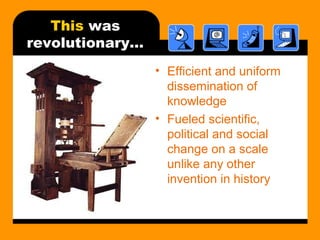
This was
revolutionary…
• Efficient and uniform
dissemination of
knowledge
• Fueled scientific,
political and social
change on a scale
unlike any other
invention in history
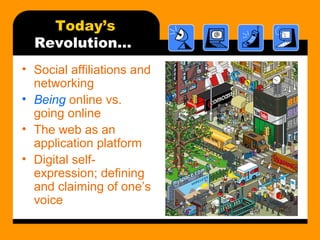
Today’s
Revolution…
• Social affiliations and
networking
• Being online vs.
going online
• The web as an
application platform
• Digital self-
expression; defining
and claiming of one’s
voice
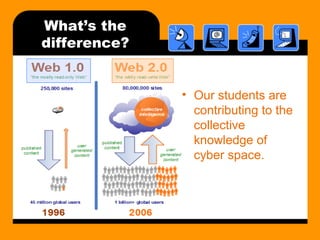
What’s the
difference?
• Our students are
contributing to the
collective
knowledge of
cyber space.
The “Read-Write”
Web… Huh?
• Contributing, collaborating, creating
• Internet as a extension of the computer
desktop
• Not only a source of reading for research
or pleasure
• “Publishing” of creative pieces – written
or visual
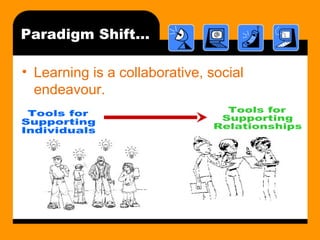
Paradigm Shift…
• Learning is a collaborative, social
endeavour.
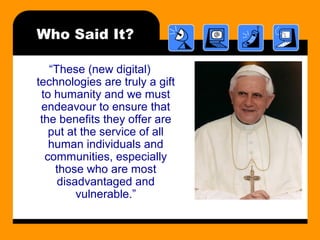
Who Said It?
“These (new digital)
technologies are truly a gift
to humanity and we must
endeavour to ensure that
the benefits they offer are
put at the service of all
human individuals and
communities, especially
those who are most
disadvantaged and
vulnerable.”
BLOGS
Blogs are powerful communication tools. Blogs are
powerful publishing tools.
But blogging (the verb) is still much more than
that to me.
Blogging, as in reading and thinking and then
writing, is connecting and learning.
Will Richardson 2006
Limited Only by
Your Imagination
• Teachers
– Content-related blog as
professional practice
– Networking and personal
knowledge sharing
– Instructional tips for
students
– Course announcements and
readings
– Annotated links
• Students
–Reflective or writing journals
–Assignment submission and
review
–Dialogue for groupwork
–E-portfolios
–Share course-related
resources
Why should
students blog?
• Encourages students to write
• Communicate through an exciting
medium that engages the learner
• Contribute to collective knowledge
• Construct knowledge
• Use a tool that students
know how to use
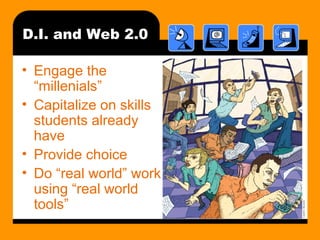
D.I. and Web 2.0
• Engage the
“millenials”
• Capitalize on skills
students already
have
• Provide choice
• Do “real world” work
using “real world
tools”
Ultimately…
• There is no need to be afraid!
• An excellent opportunity for teacher-student
collaboration
• Let students use tools they are familiar with to
the learn the content
• Develop marketable technology skills –
especially for female students
• Engage boys through hands-on learning
• Provide girls with marketable technological
skills
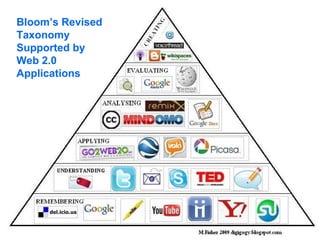
Bloom’s Revised
Taxonomy
Supported by
Web 2.0
Applications
Time to Play!
• Log on to your computer
• Visit this site:
http://blogginginfamilystudies.blogspot.com

Blogging in family studies

  • 1.
    Engaging the 21st CenturyLearner November 12, 2010 Using Blogs in the Classroom
  • 2.
    Today… This workshop isfor teachers who are interested in becoming more familiar with Web 2.0. Teachers will be introduced to a number of web-based applications and how they can be used with students for a variety of purposes. Participants will be given the opportunity to experiment with applications, as well as discuss any ethical implications surrounding the use of such technology.
  • 3.
    This was revolutionary… • Efficientand uniform dissemination of knowledge • Fueled scientific, political and social change on a scale unlike any other invention in history
  • 4.
    Today’s Revolution… • Social affiliationsand networking • Being online vs. going online • The web as an application platform • Digital self- expression; defining and claiming of one’s voice
  • 5.
    What’s the difference? • Ourstudents are contributing to the collective knowledge of cyber space.
  • 6.
    The “Read-Write” Web… Huh? •Contributing, collaborating, creating • Internet as a extension of the computer desktop • Not only a source of reading for research or pleasure • “Publishing” of creative pieces – written or visual
  • 7.
    Paradigm Shift… • Learningis a collaborative, social endeavour.
  • 8.
    Who Said It? “These(new digital) technologies are truly a gift to humanity and we must endeavour to ensure that the benefits they offer are put at the service of all human individuals and communities, especially those who are most disadvantaged and vulnerable.”
  • 9.
    BLOGS Blogs are powerfulcommunication tools. Blogs are powerful publishing tools. But blogging (the verb) is still much more than that to me. Blogging, as in reading and thinking and then writing, is connecting and learning. Will Richardson 2006
  • 10.
    Limited Only by YourImagination • Teachers – Content-related blog as professional practice – Networking and personal knowledge sharing – Instructional tips for students – Course announcements and readings – Annotated links • Students –Reflective or writing journals –Assignment submission and review –Dialogue for groupwork –E-portfolios –Share course-related resources
  • 11.
    Why should students blog? •Encourages students to write • Communicate through an exciting medium that engages the learner • Contribute to collective knowledge • Construct knowledge • Use a tool that students know how to use
  • 12.
    D.I. and Web2.0 • Engage the “millenials” • Capitalize on skills students already have • Provide choice • Do “real world” work using “real world tools”
  • 13.
    Ultimately… • There isno need to be afraid! • An excellent opportunity for teacher-student collaboration • Let students use tools they are familiar with to the learn the content • Develop marketable technology skills – especially for female students • Engage boys through hands-on learning • Provide girls with marketable technological skills
  • 14.
  • 15.
    Time to Play! •Log on to your computer • Visit this site: http://blogginginfamilystudies.blogspot.com

Editor's Notes

  • #2 Handouts: -package: metacognition sheet, Web 2.0 World mini poster, Blogging in the Classroom, Helpful Websites *place on chairs prior to participants arriving -DI handbook in French for each department head
  • #4 This was the last time the word “revolution” and “knowledge” were used in the same context. For the most part, we have been retrieving knowledge in the exact same manner ever since the advent of Guttenburg printing press. Consider… If a surgeon from the 18th were to walk into a modern-day OR, would he be able to perform any procedure? Not likely… what we know about the human body, how we have come to learn about the human body and the ways in which we treat the human body have all evolved. If a teacher from the 18th were to walk into a modern day classroom, would she still be able to teach? Probably… Have our methods really changed? Sure, some of the information is different, but that’s nothing a little bit of extra reading and research can’t fix.
  • #8 The nature of knowledge is changing. it is no longer constant it is not static it is evolving constantly being constructed, deconstructed and reconstructed
  • #9 Said by Pope Benedict XVI, 24 January 2009 *Mouse click, picture of the Pope with “fly in”; click on picture to hyperlink to www.pope2you.net emphasis on the importance of priests using new technologies -refer to issues of Professionally Speaking and Educational Leadership – articles that emphasize the importance of teaching our students the ethical use these technologies, as opposed to shying away from them
  • #11 Click on “B” in slide show mode to link to blogger.com
  • #12 Click orange “i” button to link to Le Petit Prince class blog an example of how to use a blog for a book study/extended unit of study Click yellow “i” button to link to typeit.org an online tool that helps students to easily type with accents with pre-programmed buttons vs. cumbersome accent codes; text can be copied and pasted into
  • #15 There’s an application for the various kinds of learning you want to lead students through… Bloom’s revised taxonomy and corresponding web 2.0 applications