Building a Neural
Machine
Translation System
from Scratch
Deep Learning World 2019, Munich
Natasha Latysheva, Welocalize
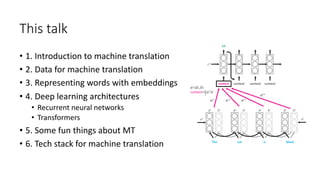
This talk
• 1. Introduction to machine translation
• 2. Data for machine translation
• 3. Representing words with embeddings
• 4. Deep learning architectures
• Recurrent neural networks
• Transformers
• 5. Some fun things about MT
• 6. Tech stack for machine translation
Intro
• Welocalize
• Language services
• 1500+ employees
• 8th largest globally, 4th largest US
• NLP engineering team
• 13 people
• Remote across US, Ireland, UK,
Germany, China
img
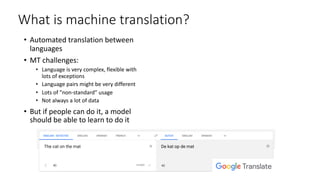
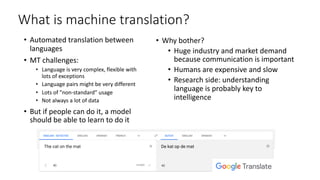
What is machine translation?
• Automated translation between
languages
• MT challenges:
• Language is very complex, flexible with
lots of exceptions
• Language pairs might be very different
• Lots of ”non-standard” usage
• Not always a lot of data
• But if people can do it, a model
should be able to learn to do it
What is machine translation?
• Automated translation between
languages
• MT challenges:
• Language is very complex, flexible with
lots of exceptions
• Language pairs might be very different
• Lots of ”non-standard” usage
• Not always a lot of data
• But if people can do it, a model
should be able to learn to do it
• Why bother?
• Huge industry and market demand
because communication is important
• Humans are expensive and slow
• Research side: understanding
language is probably key to
intelligence
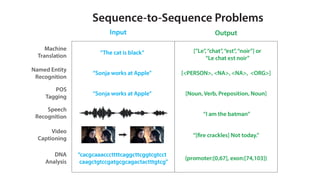
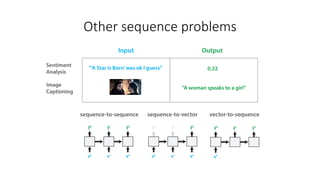
Other sequence problems
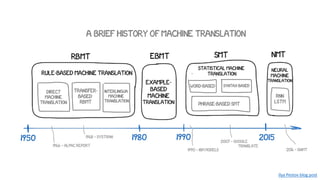
Ilya Pestov blog post
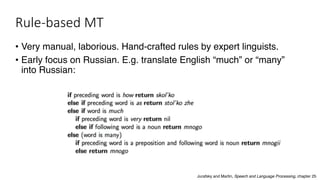
Rule-based MT
• Very manual, laborious. Hand-crafted rules by expert linguists.
• Early focus on Russian. E.g. translate English “much” or “many”
into Russian:
Jurafsky and Martin, Speech and Language Processing, chapter 25
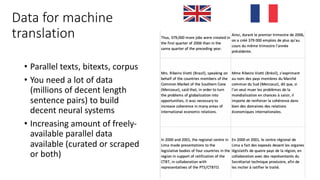
Data for machine
translation
• Parallel texts, bitexts, corpus
• You need a lot of data
(millions of decent length
sentence pairs) to build
decent neural systems
• Increasing amount of freely-
available parallel data
available (curated or scraped
or both)
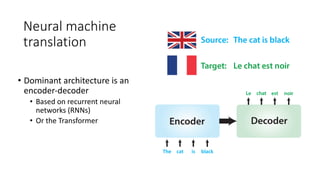
Neural machine
translation
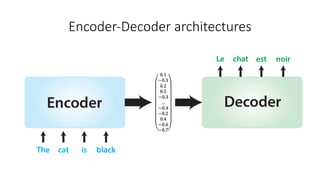
• Dominant architecture is an
encoder-decoder
• Based on recurrent neural
networks (RNNs)
• Or the Transformer
REPRESENTING WORDS
WITH EMBEDDINGS
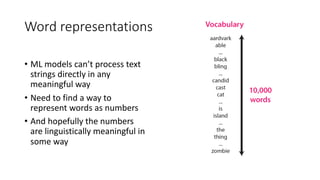
Word representations
• ML models can’t process text
strings directly in any
meaningful way
• Need to find a way to
represent words as numbers
• And hopefully the numbers
are linguistically meaningful in
some way
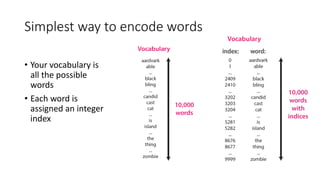
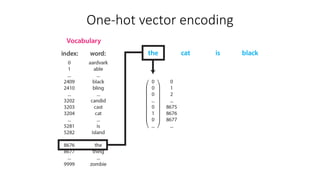
Simplest way to encode words
• Your vocabulary is
all the possible
words
• Each word is
assigned an integer
index
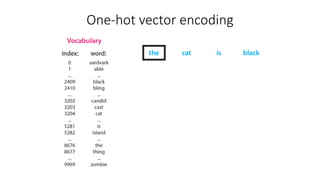
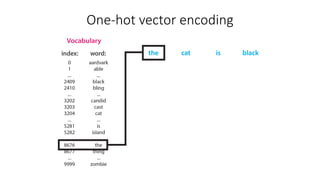
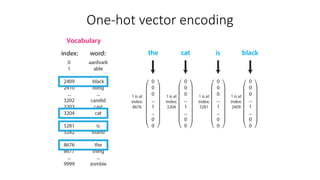
One-hot vector encoding
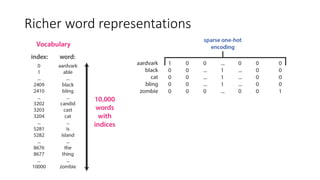
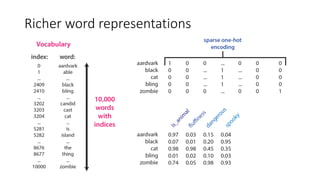
Richer word representations
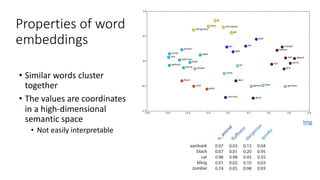
Properties of word
embeddings
• Similar words cluster
together
• The values are coordinates
in a high-dimensional
semantic space
• Not easily interpretable
Img
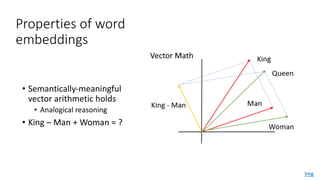
Properties of word
embeddings
• Semantically-meaningful
vector arithmetic holds
• Analogical reasoning
• King – Man + Woman = ?
Img
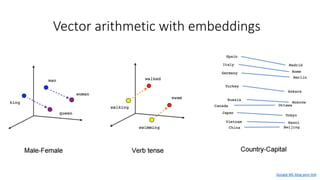
Vector arithmetic with embeddings
Google ML blog post link
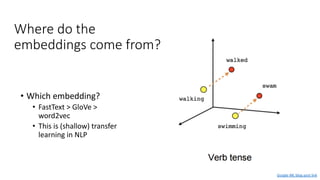
Where do the
embeddings come from?
• Which embedding?
• FastText > GloVe >
word2vec
• This is (shallow) transfer
learning in NLP
Google ML blog post link
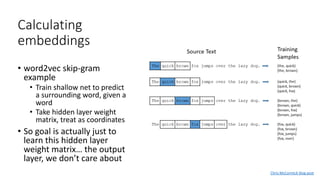
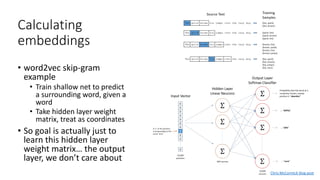
Calculating
embeddings
• word2vec skip-gram
example
• Train shallow net to predict
a surrounding word, given a
word
• Take hidden layer weight
matrix, treat as coordinates
• So goal is actually just to
learn this hidden layer
weight matrix… the output
layer, we don’t care about
Chris McCormick blog post
Calculating
embeddings
• word2vec skip-gram
example
• Train shallow net to predict
a surrounding word, given a
word
• Take hidden layer weight
matrix, treat as coordinates
• So goal is actually just to
learn this hidden layer
weight matrix… the output
layer, we don’t care about
Chris McCormick blog post
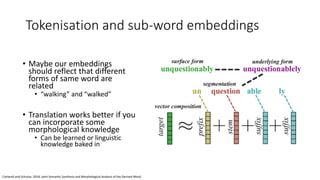
Tokenisation and sub-word embeddings
• Maybe our embeddings
should reflect that different
forms of same word are
related
• “walking” and “walked”
• Translation works better if you
can incorporate some
morphological knowledge
• Can be learned or linguistic
knowledge baked in
Cotterell and Schutze, 2018, Joint Semantic Synthesis and Morphological Analysis of the Derived Word,
RECURRENT NEURAL NETWORKS
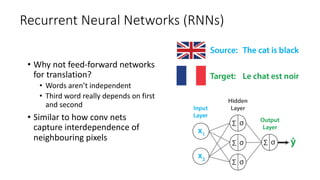
Recurrent Neural Networks (RNNs)
• Why not feed-forward networks
for translation?
• Words aren’t independent
• Third word really depends on first
and second
• Similar to how conv nets
capture interdependence of
neighbouring pixels
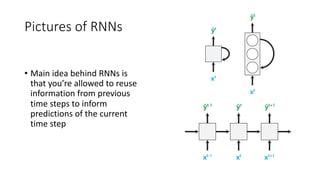
Pictures of RNNs
• Main idea behind RNNs is
that you’re allowed to reuse
information from previous
time steps to inform
predictions of the current
time step
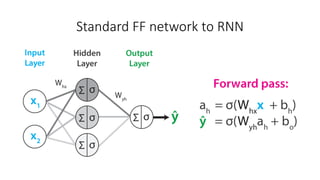
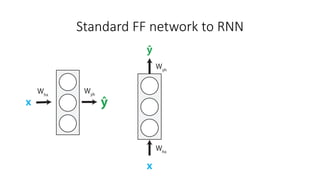
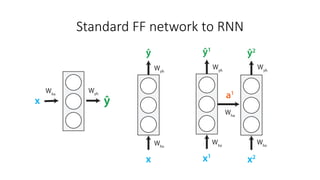
Standard FF network to RNN
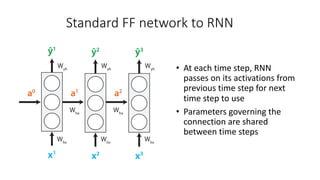
• At each time step, RNN
passes on its activations from
previous time step for next
time step to use
• Parameters governing the
connection are shared
between time steps
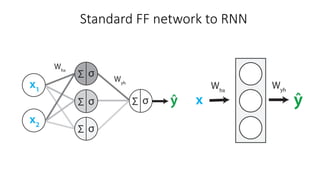
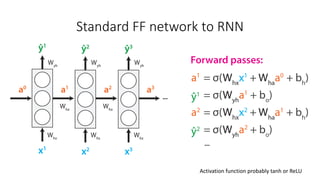
Standard FF network to RNN
Activation function probably tanh or ReLU
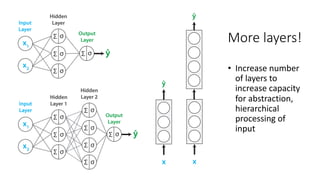
More layers!
• Increase number
of layers to
increase capacity
for abstraction,
hierarchical
processing of
input
ENCODER-DECODER MODELS
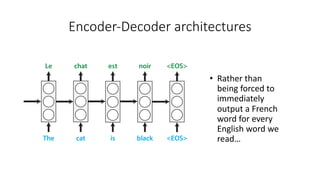
Encoder-Decoder architectures
• Rather than
being forced to
immediately
output a French
word for every
English word we
read…
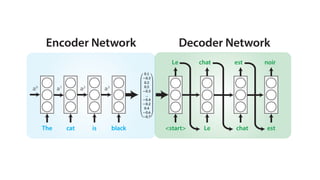
Encoder-Decoder architectures
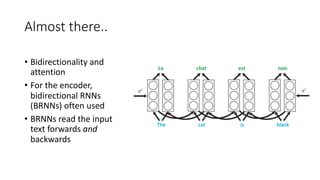
Almost there..
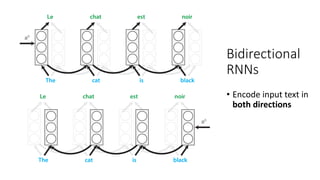
• Bidirectionality and
attention
• For the encoder,
bidirectional RNNs
(BRNNs) often used
• BRNNs read the input
text forwards and
backwards
Bidirectional
RNNs
• Encode input text in
both directions
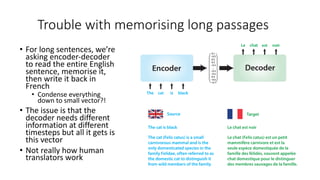
Trouble with memorising long passages
• For long sentences, we’re
asking encoder-decoder
to read the entire English
sentence, memorise it,
then write it back in
French
• Condense everything
down to small vector?!
• The issue is that the
decoder needs different
information at different
timesteps but all it gets is
this vector
• Not really how human
translators work
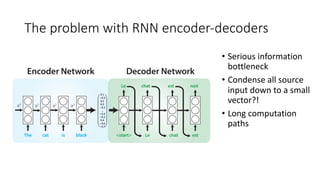
The problem with RNN encoder-decoders
• Serious information
bottleneck
• Condense all source
input down to a small
vector?!
• Long computation
paths
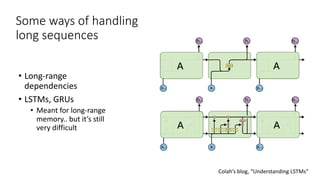
Some ways of handling
long sequences
• Long-range
dependencies
• LSTMs, GRUs
• Meant for long-range
memory.. but it’s still
very difficult
Colah’s blog, “Understanding LSTMs”
Some ways of handling
long sequences
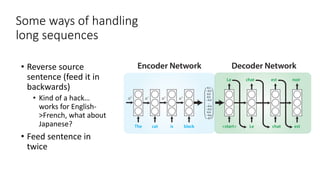
• Reverse source
sentence (feed it in
backwards)
• Kind of a hack…
works for English-
>French, what about
Japanese?
• Feed sentence in
twice
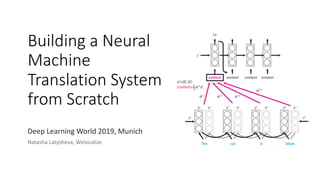
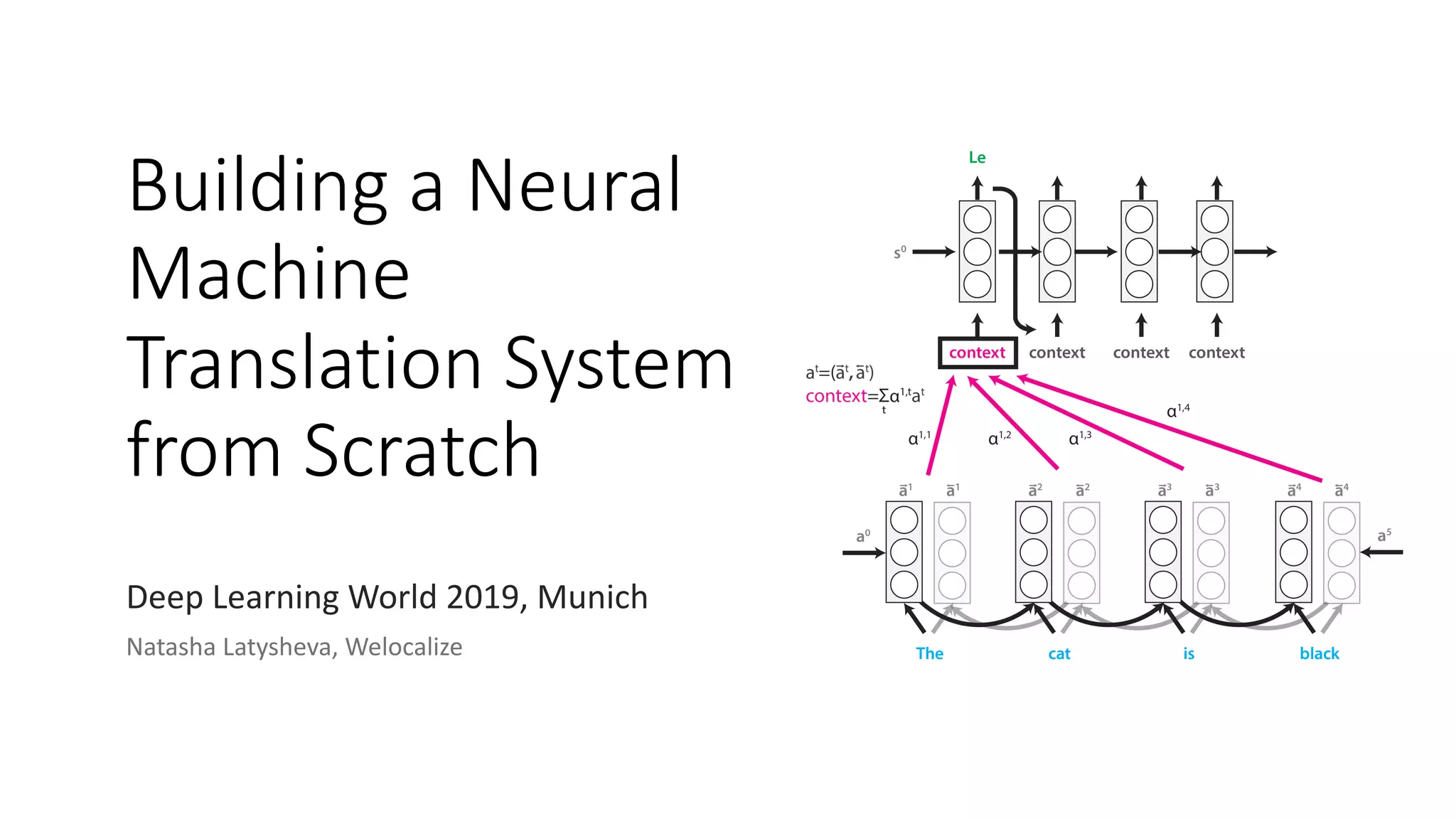
ATTENTION
Attention Idea
• Has been very influential in
deep learning
• Originally developed for MT
(Bahdanau, 2014)
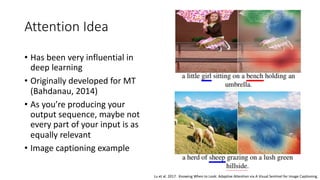
• As you’re producing your
output sequence, maybe not
every part of your input is as
equally relevant
• Image captioning example
Lu et al. 2017. Knowing When to Look: Adaptive Attention via A Visual Sentinel for Image Captioning.
Attention intuition
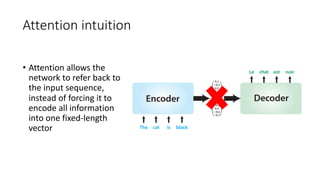
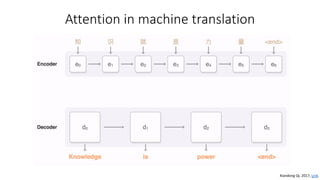
• Attention allows the
network to refer back to
the input sequence,
instead of forcing it to
encode all information
into one fixed-length
vector
Attention in machine translation
Xiandong Qi, 2017, Link.
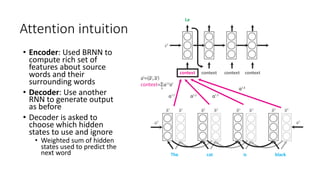
Attention intuition
• Encoder: Used BRNN to
compute rich set of
features about source
words and their
surrounding words
• Decoder: Use another
RNN to generate output
as before
• Decoder is asked to
choose which hidden
states to use and ignore
• Weighted sum of hidden
states used to predict the
next word
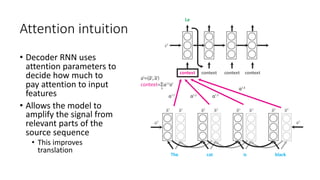
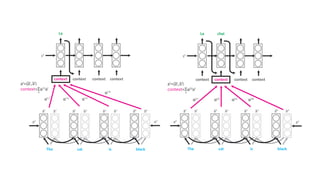
Attention intuition
• Decoder RNN uses
attention parameters to
decide how much to
pay attention to input
features
• Allows the model to
amplify the signal from
relevant parts of the
source sequence
• This improves
translation
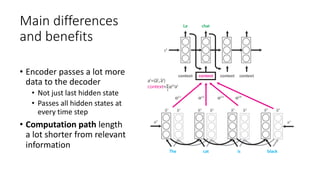
Main differences
and benefits
• Encoder passes a lot more
data to the decoder
• Not just last hidden state
• Passes all hidden states at
every time step
• Computation path length
a lot shorter from relevant
information
TRANSFORMERS
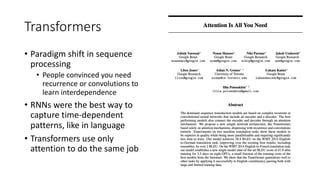
Transformers
• Paradigm shift in sequence
processing
• People convinced you need
recurrence or convolutions to
learn interdependence
• RNNs were the best way to
capture time-dependent
patterns, like in language
• Transformers use only
attention to do the same job
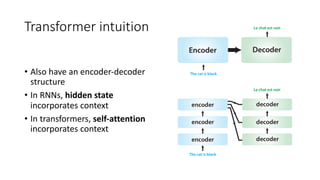
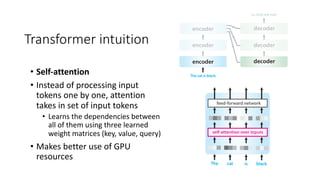
Transformer intuition
• Also have an encoder-decoder
structure
• In RNNs, hidden state
incorporates context
• In transformers, self-attention
incorporates context
Transformer intuition
• Self-attention
• Instead of processing input
tokens one by one, attention
takes in set of input tokens
• Learns the dependencies between
all of them using three learned
weight matrices (key, value, query)
• Makes better use of GPU
resources
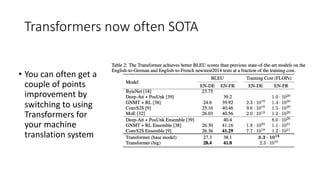
Transformers now often SOTA
• You can often get a
couple of points
improvement by
switching to using
Transformers for
your machine
translation system
TECH STACK
Standard Python Scientific Stack
Frameworks
• How low-level do you go?
• Implementing backprop and
gradient checking yourself in
numpy
• …
• Clicking ‘Train’ and ‘Deploy’ in a
GUI
• You probably want to be
somewhere in between
• Around a dozen open-source
NMT implementations around
• Nematus, OpenNMT, tensorflow-
seq2seq, Marian, fair-seq,
Tensor2Tensor
Recommendations
• Python scientific stack
• OpenNMT-tf (TensorFlow version)
• TensorBoard monitoring is great
• Good checkpointing, automatic
evaluation during training
• Get some GPUs if you can
• 3x GeForce GTX Titan X take 2-3 days
to train decent Transformer model
• AWS or GCP good but can be
expensive
• Docker containers

Building a Neural Machine Translation System From Scratch

  • 1.
    Building a Neural Machine TranslationSystem from Scratch Deep Learning World 2019, Munich Natasha Latysheva, Welocalize
  • 2.
    This talk • 1.Introduction to machine translation • 2. Data for machine translation • 3. Representing words with embeddings • 4. Deep learning architectures • Recurrent neural networks • Transformers • 5. Some fun things about MT • 6. Tech stack for machine translation
  • 3.
    Intro • Welocalize • Languageservices • 1500+ employees • 8th largest globally, 4th largest US • NLP engineering team • 13 people • Remote across US, Ireland, UK, Germany, China img
  • 4.
    What is machinetranslation? • Automated translation between languages • MT challenges: • Language is very complex, flexible with lots of exceptions • Language pairs might be very different • Lots of ”non-standard” usage • Not always a lot of data • But if people can do it, a model should be able to learn to do it
  • 5.
    What is machinetranslation? • Automated translation between languages • MT challenges: • Language is very complex, flexible with lots of exceptions • Language pairs might be very different • Lots of ”non-standard” usage • Not always a lot of data • But if people can do it, a model should be able to learn to do it • Why bother? • Huge industry and market demand because communication is important • Humans are expensive and slow • Research side: understanding language is probably key to intelligence
  • 7.
  • 8.
  • 9.
    Rule-based MT • Verymanual, laborious. Hand-crafted rules by expert linguists. • Early focus on Russian. E.g. translate English “much” or “many” into Russian: Jurafsky and Martin, Speech and Language Processing, chapter 25
  • 10.
    Data for machine translation •Parallel texts, bitexts, corpus • You need a lot of data (millions of decent length sentence pairs) to build decent neural systems • Increasing amount of freely- available parallel data available (curated or scraped or both)
  • 11.
    Neural machine translation • Dominantarchitecture is an encoder-decoder • Based on recurrent neural networks (RNNs) • Or the Transformer
  • 12.
  • 13.
    Word representations • MLmodels can’t process text strings directly in any meaningful way • Need to find a way to represent words as numbers • And hopefully the numbers are linguistically meaningful in some way
  • 14.
    Simplest way toencode words • Your vocabulary is all the possible words • Each word is assigned an integer index
  • 15.
  • 16.
  • 17.
  • 18.
  • 19.
  • 20.
  • 21.
    Properties of word embeddings •Similar words cluster together • The values are coordinates in a high-dimensional semantic space • Not easily interpretable Img
  • 22.
    Properties of word embeddings •Semantically-meaningful vector arithmetic holds • Analogical reasoning • King – Man + Woman = ? Img
  • 23.
    Vector arithmetic withembeddings Google ML blog post link
  • 24.
    Where do the embeddingscome from? • Which embedding? • FastText > GloVe > word2vec • This is (shallow) transfer learning in NLP Google ML blog post link
  • 25.
    Calculating embeddings • word2vec skip-gram example •Train shallow net to predict a surrounding word, given a word • Take hidden layer weight matrix, treat as coordinates • So goal is actually just to learn this hidden layer weight matrix… the output layer, we don’t care about Chris McCormick blog post
  • 26.
    Calculating embeddings • word2vec skip-gram example •Train shallow net to predict a surrounding word, given a word • Take hidden layer weight matrix, treat as coordinates • So goal is actually just to learn this hidden layer weight matrix… the output layer, we don’t care about Chris McCormick blog post
  • 27.
    Tokenisation and sub-wordembeddings • Maybe our embeddings should reflect that different forms of same word are related • “walking” and “walked” • Translation works better if you can incorporate some morphological knowledge • Can be learned or linguistic knowledge baked in Cotterell and Schutze, 2018, Joint Semantic Synthesis and Morphological Analysis of the Derived Word,
  • 28.
  • 29.
    Recurrent Neural Networks(RNNs) • Why not feed-forward networks for translation? • Words aren’t independent • Third word really depends on first and second • Similar to how conv nets capture interdependence of neighbouring pixels
  • 30.
    Pictures of RNNs •Main idea behind RNNs is that you’re allowed to reuse information from previous time steps to inform predictions of the current time step
  • 31.
  • 32.
  • 33.
  • 34.
  • 35.
    Standard FF networkto RNN • At each time step, RNN passes on its activations from previous time step for next time step to use • Parameters governing the connection are shared between time steps
  • 36.
    Standard FF networkto RNN Activation function probably tanh or ReLU
  • 37.
    More layers! • Increasenumber of layers to increase capacity for abstraction, hierarchical processing of input
  • 38.
  • 39.
    Encoder-Decoder architectures • Ratherthan being forced to immediately output a French word for every English word we read…
  • 40.
  • 42.
    Almost there.. • Bidirectionalityand attention • For the encoder, bidirectional RNNs (BRNNs) often used • BRNNs read the input text forwards and backwards
  • 43.
    Bidirectional RNNs • Encode inputtext in both directions
  • 44.
    Trouble with memorisinglong passages • For long sentences, we’re asking encoder-decoder to read the entire English sentence, memorise it, then write it back in French • Condense everything down to small vector?! • The issue is that the decoder needs different information at different timesteps but all it gets is this vector • Not really how human translators work
  • 45.
    The problem withRNN encoder-decoders • Serious information bottleneck • Condense all source input down to a small vector?! • Long computation paths
  • 46.
    Some ways ofhandling long sequences • Long-range dependencies • LSTMs, GRUs • Meant for long-range memory.. but it’s still very difficult Colah’s blog, “Understanding LSTMs”
  • 47.
    Some ways ofhandling long sequences • Reverse source sentence (feed it in backwards) • Kind of a hack… works for English- >French, what about Japanese? • Feed sentence in twice
  • 48.
  • 49.
    Attention Idea • Hasbeen very influential in deep learning • Originally developed for MT (Bahdanau, 2014) • As you’re producing your output sequence, maybe not every part of your input is as equally relevant • Image captioning example Lu et al. 2017. Knowing When to Look: Adaptive Attention via A Visual Sentinel for Image Captioning.
  • 50.
    Attention intuition • Attentionallows the network to refer back to the input sequence, instead of forcing it to encode all information into one fixed-length vector
  • 51.
    Attention in machinetranslation Xiandong Qi, 2017, Link.
  • 52.
    Attention intuition • Encoder:Used BRNN to compute rich set of features about source words and their surrounding words • Decoder: Use another RNN to generate output as before • Decoder is asked to choose which hidden states to use and ignore • Weighted sum of hidden states used to predict the next word
  • 53.
    Attention intuition • DecoderRNN uses attention parameters to decide how much to pay attention to input features • Allows the model to amplify the signal from relevant parts of the source sequence • This improves translation
  • 55.
    Main differences and benefits •Encoder passes a lot more data to the decoder • Not just last hidden state • Passes all hidden states at every time step • Computation path length a lot shorter from relevant information
  • 56.
  • 57.
    Transformers • Paradigm shiftin sequence processing • People convinced you need recurrence or convolutions to learn interdependence • RNNs were the best way to capture time-dependent patterns, like in language • Transformers use only attention to do the same job
  • 58.
    Transformer intuition • Alsohave an encoder-decoder structure • In RNNs, hidden state incorporates context • In transformers, self-attention incorporates context
  • 59.
    Transformer intuition • Self-attention •Instead of processing input tokens one by one, attention takes in set of input tokens • Learns the dependencies between all of them using three learned weight matrices (key, value, query) • Makes better use of GPU resources
  • 60.
    Transformers now oftenSOTA • You can often get a couple of points improvement by switching to using Transformers for your machine translation system
  • 61.
  • 62.
  • 63.
    Frameworks • How low-leveldo you go? • Implementing backprop and gradient checking yourself in numpy • … • Clicking ‘Train’ and ‘Deploy’ in a GUI • You probably want to be somewhere in between • Around a dozen open-source NMT implementations around • Nematus, OpenNMT, tensorflow- seq2seq, Marian, fair-seq, Tensor2Tensor
  • 64.
    Recommendations • Python scientificstack • OpenNMT-tf (TensorFlow version) • TensorBoard monitoring is great • Good checkpointing, automatic evaluation during training • Get some GPUs if you can • 3x GeForce GTX Titan X take 2-3 days to train decent Transformer model • AWS or GCP good but can be expensive • Docker containers