Buffers
Buffering against pH Changes
in Biological Systems
• Almost every biological process is pH
dependent
• a small change in pH produces a large change
in the rate of the process.
• Cells and organisms maintain a specific and
constant cytosolic pH, keeping biomolecules
in their optimal ionic state, usually near pH 7
Constancy of pH is achieved primarily by
biological buffers
Buffers Are Mixtures of Weak Acids and
Their Conjugate Bases
Definition of a buffer system
• Buffers are aqueous systems that tend to
resist changes in pH when small amounts of
acid (H) or base (OH) are added.
• A buffer system consists of a weak acid (the
proton donor) and its conjugate base (the
proton acceptor).
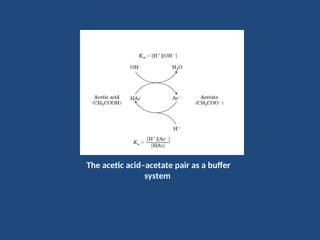
The acetic acid–acetate pair as a buffer
system
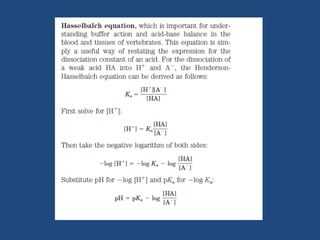
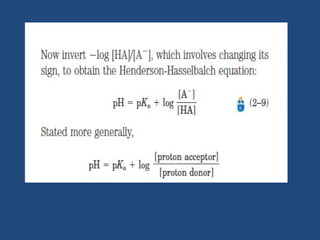
The Handerson Hasselbalch
equation
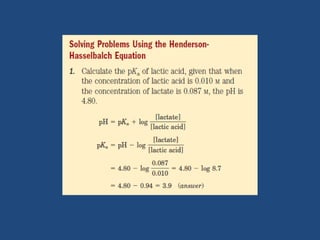
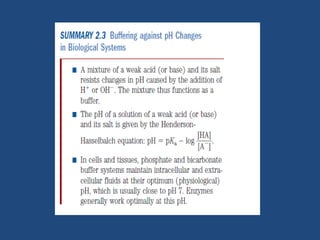
• The Henderson-Hasselbalch equation also
allows us to
(1)calculate pKa, given pH and the molar ratio of
proton donor and acceptor
(2) Calculate pH, given pKa and the molar ratio
of proton donor and acceptor
(3) calculate the molar ratio of proton donor
and acceptor, given pH and pKa.
Biological buffers
• Two especially important biological buffers
are the phosphate and bicarbonate systems
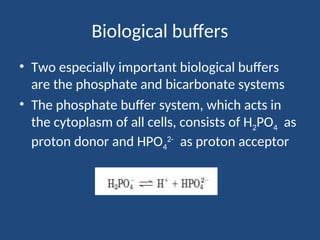
• The phosphate buffer system, which acts in
the cytoplasm of all cells, consists of H2PO4 as
proton donor and HPO4
2-
as proton acceptor
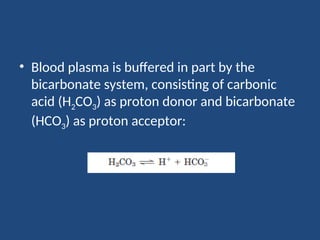
• Blood plasma is buffered in part by the
bicarbonate system, consisting of carbonic
acid (H2CO3) as proton donor and bicarbonate
(HCO3) as proton acceptor:
Buffers for biochemistry powerpoint presentation

Buffers for biochemistry powerpoint presentation

  • 1.
  • 2.
    Buffering against pHChanges in Biological Systems • Almost every biological process is pH dependent • a small change in pH produces a large change in the rate of the process. • Cells and organisms maintain a specific and constant cytosolic pH, keeping biomolecules in their optimal ionic state, usually near pH 7
  • 3.
    Constancy of pHis achieved primarily by biological buffers Buffers Are Mixtures of Weak Acids and Their Conjugate Bases
  • 4.
    Definition of abuffer system • Buffers are aqueous systems that tend to resist changes in pH when small amounts of acid (H) or base (OH) are added. • A buffer system consists of a weak acid (the proton donor) and its conjugate base (the proton acceptor).
  • 5.
    The acetic acid–acetatepair as a buffer system
  • 6.
  • 9.
    • The Henderson-Hasselbalchequation also allows us to (1)calculate pKa, given pH and the molar ratio of proton donor and acceptor (2) Calculate pH, given pKa and the molar ratio of proton donor and acceptor (3) calculate the molar ratio of proton donor and acceptor, given pH and pKa.
  • 11.
    Biological buffers • Twoespecially important biological buffers are the phosphate and bicarbonate systems • The phosphate buffer system, which acts in the cytoplasm of all cells, consists of H2PO4 as proton donor and HPO4 2- as proton acceptor
  • 12.
    • Blood plasmais buffered in part by the bicarbonate system, consisting of carbonic acid (H2CO3) as proton donor and bicarbonate (HCO3) as proton acceptor: