pH, Buffers &Biological
Significance
• Bridge Course for UG Microbiology Students
2.
Learning Objectives
• •Define pH and buffer.
• • Explain the importance of pH in biological
systems.
• • Understand the concept of buffers and how
they work.
• • Describe key biological buffer systems and
their significance.
3.
What is pH?
•• Definition: pH = -log[H+]
• • Range: 0 (acidic) to 14 (basic), with 7 being
neutral.
• • Examples:
• - Stomach acid ~ pH 1.5
• - Blood ~ pH 7.4
• - Soap ~ pH 10
4.
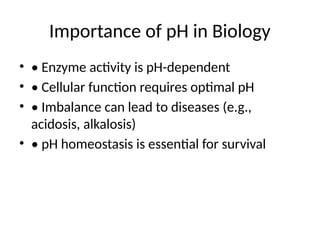
Importance of pHin Biology
• • Enzyme activity is pH-dependent
• • Cellular function requires optimal pH
• • Imbalance can lead to diseases (e.g.,
acidosis, alkalosis)
• • pH homeostasis is essential for survival
5.
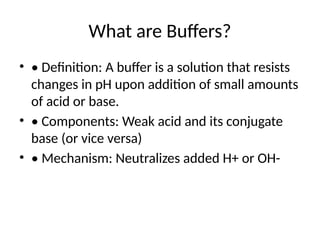
What are Buffers?
•• Definition: A buffer is a solution that resists
changes in pH upon addition of small amounts
of acid or base.
• • Components: Weak acid and its conjugate
base (or vice versa)
• • Mechanism: Neutralizes added H+ or OH-
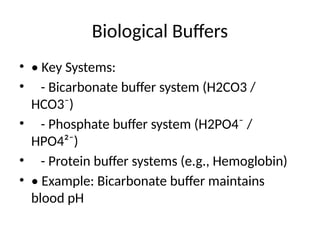
Biological Buffers
• •Key Systems:
• - Bicarbonate buffer system (H2CO3 /
HCO3⁻)
• - Phosphate buffer system (H2PO4⁻ /
HPO4²⁻)
• - Protein buffer systems (e.g., Hemoglobin)
• • Example: Bicarbonate buffer maintains
blood pH
8.
Henderson-Hasselbalch Equation
• •Equation: pH = pKa + log ([A⁻]/[HA])
• • Application: Used to calculate pH of a buffer
• • Example: pKa = 4.76, [A⁻] = 0.1M, [HA] =
0.1M
• • Answer: pH = 4.76
9.
Biological Significance ofBuffers
• • Maintain cellular and extracellular pH
• • Facilitate metabolic reactions
• • Transport of gases (e.g., CO₂ buffering in
blood)
• • Protect proteins from denaturation
10.
Recap and QuickQuiz
• Quick Questions:
• 1. What is the pH of neutral water?
• 2. Name one biological buffer system.
• 3. What happens to pH when strong acid is
added to a buffer?
11.
Activity – pHTesting Demo
• • Use pH paper or digital pH meter
• • Test substances: lemon juice, soap solution,
tap water
• • Record and compare observations
• • Discussion: Were predictions accurate?
12.
Assessment
• Short AnswerQuestions:
• • Define buffer with an example.
• • Explain how bicarbonate buffer works in the
body.
• MCQs:
• • What is the pH of blood?
• • Which of the following is a buffer?



![What is pH?
• • Definition: pH = -log[H+]
• • Range: 0 (acidic) to 14 (basic), with 7 being
neutral.
• • Examples:
• - Stomach acid ~ pH 1.5
• - Blood ~ pH 7.4
• - Soap ~ pH 10](https://image.slidesharecdn.com/day4phbuffersbiologypresentation-250706124549-e3cfd1eb/85/Day4_pH_Buffers_Biology_Presentation-pptx-3-320.jpg)
![Henderson-Hasselbalch Equation
• • Equation: pH = pKa + log ([A⁻]/[HA])
• • Application: Used to calculate pH of a buffer
• • Example: pKa = 4.76, [A⁻] = 0.1M, [HA] =
0.1M
• • Answer: pH = 4.76](https://image.slidesharecdn.com/day4phbuffersbiologypresentation-250706124549-e3cfd1eb/85/Day4_pH_Buffers_Biology_Presentation-pptx-8-320.jpg)


![ANIMAL_CELL_,_TISSUE_AND_ORGAN_CULTURE[1].pptx](https://cdn.slidesharecdn.com/ss_thumbnails/animalcelltissueandorganculture1-260204172026-4462b440-thumbnail.jpg?width=640&height=640&fit=bounds)


