Spending Plans
What is a spending plan?
 A tool used to record and track projected and
actual income and expenses over a period of
time.
 Also called a budget.
Spending Plans
 Are simply road maps the help people reach
financial goals
 Need to be flexible to change with various life stages
 Are not difficult to establish but do take time and
commitment.
 **Recommended to track spending prior to creating
a budget.
 NOTE: There should not be any money left over in a
budget. If there is, it should be put into the savings
or charitable giving column.
Benefits of Spending Plans
A spending plan can help you:
 Put aside money for savings goals
 Prepare for regular expenses
 Prepare for unexpected expenses
 Control how you spend money
 Reduce stress and increase confidence
 Provide an excuse to calm excessive
spending
Consequences of NOT Using a
Spending Plan
 No idea where money has been spent
 Bad spending habits are unidentified
 Unprepared for emergencies
 Strained relationships
 Lack of savings plan
 Wasted money
 Stress
Opportunity Cost of
Spending Plans
 Consumers may feel like having a budget is
confining or restrictive, but it actually gives
them more freedom and more options.
 By paying attention to where money is
spend, wiser choices can be made.
 With more freedom, more options, wiser
choices, more money can be spent on items
of value.
Before creating a spending plan…
 Track your spending.
– Before making a budget, spend a couple of weeks
writing down every penny you spend.
– This will help you have a better idea of where
your dollar amounts should be when making a
budget.
How do I make a spending plan?
1. Assess your personal financial situation
(needs, values, life situation).
2. Set personal and financial goals.
3. Create a budget for fixed and variable
expenses based on projected income.
4. Monitor current spending (saving, investing)
patterns.
5. Compare your budget to what you actually
spent.
6. Review financial progress and revise
budget amounts.
Sample
Earned income
Money generated from employment or
retirement funds.
Unearned income
Money received for no exchange, such
as a gift.
Fixed expenses
Occur every period and are typically
about the same amount.
Variable expenses
May or may not occur every period and
do not have a constant value.
Pay Yourself First®
The idea that savings should be a
regular part of a spending plan and
should happen before variable
expenses.
More expenses than income?
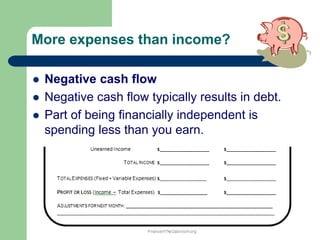
 Negative cash flow
 Negative cash flow typically results in debt.
 Part of being financially independent is
spending less than you earn.
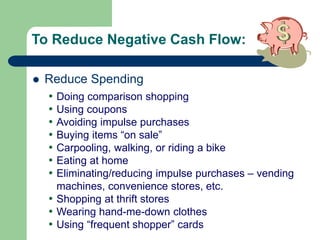
To Reduce Negative Cash Flow:
 Reduce Spending
• Doing comparison shopping
• Using coupons
• Avoiding impulse purchases
• Buying items “on sale”
• Carpooling, walking, or riding a bike
• Eating at home
• Eliminating/reducing impulse purchases – vending
machines, convenience stores, etc.
• Shopping at thrift stores
• Wearing hand-me-down clothes
• Using “frequent shopper” cards
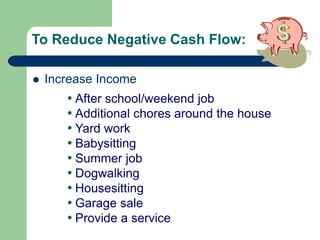
 Increase Income
To Reduce Negative Cash Flow:
• After school/weekend job
• Additional chores around the house
• Yard work
• Babysitting
• Summer job
• Dogwalking
• Housesitting
• Garage sale
• Provide a service
Guidelines for a Budget
 Housing & Utilities 30%
 Food & Household 20%
 Clothing & Personal 10%
 Transportation 10%
 Saving & Investing 10%
 Miscellaneous 20%
What tools help in budgeting?
 Envelope System
 Computer Programs
 Paper Tracking
Envelope System
 Each envelope is labeled for the category of
spending.
 Each pay period, a pre determined amount of
money is placed in each envelope for each
category.
 Each time money is spent from an envelope, the
transaction details (date, vendor, amount, etc.) is
recorded on the outside of the envelope.
 When the envelope is empty, spending ceases!
Computer Program
215 45 29
218 64 75
Fee 5 00
679 23
110 04
153 22
636 05
789 27
110 04
679 23
RECONCILE
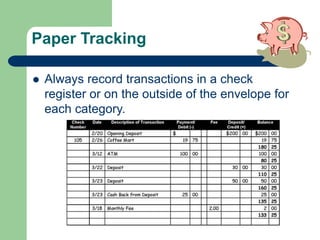
Paper Tracking
 Always record transactions in a check
register or on the outside of the envelope for
each category.
REMEMBER!!!
 It is important to remember that budgets can
and should change from time to time.
 After following a budget for a month,
re-evaluate it and make changes as
necessary.
Large purchases
 When adjusting a budget, consider future
large purchases and consider saving up for
that item and paying cash for it.
 When a home or automobile is purchased,
other budget categories, such as
entertainment and clothes, may
need to be cut back in order to
compensate for the larger
purchase.
Review
A spending plan is a tool to assist one in
tracking and monitoring income and
expenses and avoiding negative cash
flow.
Financial independence is achieved by
reducing spending, earning more, saving
more, and avoiding negative cash flow.

SpendingPlan.ppt

  • 1.
  • 2.
    What is aspending plan?  A tool used to record and track projected and actual income and expenses over a period of time.  Also called a budget.
  • 3.
    Spending Plans  Aresimply road maps the help people reach financial goals  Need to be flexible to change with various life stages  Are not difficult to establish but do take time and commitment.  **Recommended to track spending prior to creating a budget.  NOTE: There should not be any money left over in a budget. If there is, it should be put into the savings or charitable giving column.
  • 4.
    Benefits of SpendingPlans A spending plan can help you:  Put aside money for savings goals  Prepare for regular expenses  Prepare for unexpected expenses  Control how you spend money  Reduce stress and increase confidence  Provide an excuse to calm excessive spending
  • 5.
    Consequences of NOTUsing a Spending Plan  No idea where money has been spent  Bad spending habits are unidentified  Unprepared for emergencies  Strained relationships  Lack of savings plan  Wasted money  Stress
  • 6.
    Opportunity Cost of SpendingPlans  Consumers may feel like having a budget is confining or restrictive, but it actually gives them more freedom and more options.  By paying attention to where money is spend, wiser choices can be made.  With more freedom, more options, wiser choices, more money can be spent on items of value.
  • 7.
    Before creating aspending plan…  Track your spending. – Before making a budget, spend a couple of weeks writing down every penny you spend. – This will help you have a better idea of where your dollar amounts should be when making a budget.
  • 8.
    How do Imake a spending plan? 1. Assess your personal financial situation (needs, values, life situation). 2. Set personal and financial goals. 3. Create a budget for fixed and variable expenses based on projected income. 4. Monitor current spending (saving, investing) patterns. 5. Compare your budget to what you actually spent. 6. Review financial progress and revise budget amounts.
  • 9.
    Sample Earned income Money generatedfrom employment or retirement funds. Unearned income Money received for no exchange, such as a gift. Fixed expenses Occur every period and are typically about the same amount. Variable expenses May or may not occur every period and do not have a constant value. Pay Yourself First® The idea that savings should be a regular part of a spending plan and should happen before variable expenses.
  • 10.
    More expenses thanincome?  Negative cash flow  Negative cash flow typically results in debt.  Part of being financially independent is spending less than you earn.
  • 11.
    To Reduce NegativeCash Flow:  Reduce Spending • Doing comparison shopping • Using coupons • Avoiding impulse purchases • Buying items “on sale” • Carpooling, walking, or riding a bike • Eating at home • Eliminating/reducing impulse purchases – vending machines, convenience stores, etc. • Shopping at thrift stores • Wearing hand-me-down clothes • Using “frequent shopper” cards
  • 12.
     Increase Income ToReduce Negative Cash Flow: • After school/weekend job • Additional chores around the house • Yard work • Babysitting • Summer job • Dogwalking • Housesitting • Garage sale • Provide a service
  • 13.
    Guidelines for aBudget  Housing & Utilities 30%  Food & Household 20%  Clothing & Personal 10%  Transportation 10%  Saving & Investing 10%  Miscellaneous 20%
  • 14.
    What tools helpin budgeting?  Envelope System  Computer Programs  Paper Tracking
  • 15.
    Envelope System  Eachenvelope is labeled for the category of spending.  Each pay period, a pre determined amount of money is placed in each envelope for each category.  Each time money is spent from an envelope, the transaction details (date, vendor, amount, etc.) is recorded on the outside of the envelope.  When the envelope is empty, spending ceases!
  • 16.
  • 17.
    215 45 29 21864 75 Fee 5 00 679 23 110 04 153 22 636 05 789 27 110 04 679 23 RECONCILE
  • 18.
    Paper Tracking  Alwaysrecord transactions in a check register or on the outside of the envelope for each category.
  • 19.
    REMEMBER!!!  It isimportant to remember that budgets can and should change from time to time.  After following a budget for a month, re-evaluate it and make changes as necessary.
  • 20.
    Large purchases  Whenadjusting a budget, consider future large purchases and consider saving up for that item and paying cash for it.  When a home or automobile is purchased, other budget categories, such as entertainment and clothes, may need to be cut back in order to compensate for the larger purchase.
  • 21.
    Review A spending planis a tool to assist one in tracking and monitoring income and expenses and avoiding negative cash flow. Financial independence is achieved by reducing spending, earning more, saving more, and avoiding negative cash flow.