



Trident Technical College’s
   Student Support Services
The Choice is YOURS!
No matter how you have managed money in the past,
              new habits start now!

                     • Organize yourself
                     • Review your current situation
                     • Set Financial Goals
                     • Create a Budget
                     • Understand checking, savings
                       and credit accounts
                     • Create a Financial plan for
                       you!
Learn how to manage your money
           by learning about yourself.

  How do you think about money?
• What is the difference between
  your “NEEDS” and your “WANTS”?
• What are the feelings behind your
  purchases?
• What is your family’s attitude
  about money?
• Do you know where your money
  goes?
STEP 1: Organize Yourself
• Designate a place where you will conduct all your
  personal financial business
• Have the right home office tools-
   (such as a file cabinet to hold records and a shredder)
• Monitor your accounts daily
   (this helps you track your purchases and see quickly if you have
   been a victim of Identity Theft)
• Create a personal finance directory
   (This should list all your account information- this can come in
   handy if you lose your wallet, forget your password or are not
   able to do things on your own)
STEP 2: Review your finances
Think about the money you have and where it goes.
            What do you have?
               • What is your expected monthly income?
               • What is your actual monthly income?
            Know where your money goes.
               • List your expenses and debts
               • Track your spending for one month by
                 saving your receipts and then review.
                 Are you surprised at where your money
                 went?
Most of us are so focused on today that we do not prepare for
       tomorrow. Tomorrow is not going to wait for you to be ready.

    STEP 3: Settingdo you get there?
What are your dreams and how
                             a Goal


• There are 3 goal types:
   •     Short-term: you can achieve in less than one year
   •     Mid-term: you can achieve in 2-5 years
   •     Long-term: you can achieve in 5 or more years
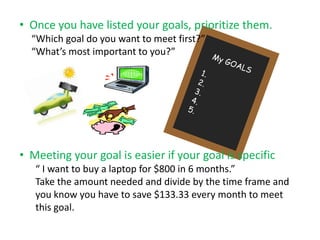
• Once you have listed your goals, prioritize them.
  “Which goal do you want to meet first?”
  “What’s most important to you?”


• Meeting your goal is easier if your goal is specific
   “ I want to buy a laptop for $800 in 6 months.”
   Take the amount needed and divide by the time frame and
   you know you have to save $133.33 every month to meet
   this goal.
A solid plan requires that your review and make changes
                to your current spending.
STEP 4: Manage your money
                  Plug Spending Leaks:
                     • Create rules regarding how you will spend
                       money
                     • Avoid in the moment spending by adopting a
                       “No, not now.” rule

           Avoid Money Traps:
              •   Check-cashing stores
              •   Payday Lenders
              •   Credit Card Debt
              •   Credit Repair companies
              •   Pawnshops and car title loans
              •   Gambling , drugs and alcohol
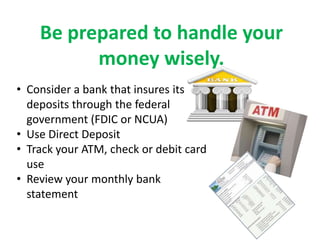
Be prepared to handle your
          money wisely.
• Consider a bank that insures its
  deposits through the federal
  government (FDIC or NCUA)
• Use Direct Deposit
• Track your ATM, check or debit card
  use
• Review your monthly bank
  statement
STEP 5: Build a BUDGET
     1. List and total your monthly income
     2. List and total your monthly expenses
     3. Subtract your expenses from your
        income
     4. Identify where you want to make
        changes
     5. Don’t forget your goals, paying
        something to yourself and savings.
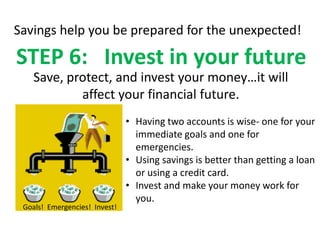
Savings help you be prepared for the unexpected!

STEP 6: Invest in your future
    Save, protect, and invest your money…it will
            affect your financial future.
                               • Having two accounts is wise- one for your
                                 immediate goals and one for
                                 emergencies.
                               • Using savings is better than getting a loan
                                 or using a credit card.
                               • Invest and make your money work for
                                 you.
 Goals! Emergencies! Invest!
Where can you get help?
1. Financial aid, scholarships, loans, grants, tuition
   reimbursement or training programs:
   • Check with your school, employer and community organizations.
     Many offer help to fund education goals.
2. Taxes:
   • Each year when you file your taxes make sure you ask for the
     educational credits available to you. This may increase your
     refund.
3. Benefits and Discounts:
   • Many local businesses offer discounts on purchases to students.
   • Examples are CARTA and Zaxby’s. It never hurts to ask!
More help…


           www.balancepro.net
            www.scfederal.org
              click on “Plan and Learn”
       www.managingmymoney.com
www.balancetrack.org/moneymanagement/index
          www.daveramsey.com
Review
Click here to answer “Money Management”
review questions.

Money Management Workshop

  • 1.
    Trident Technical College’s Student Support Services
  • 2.
    The Choice isYOURS! No matter how you have managed money in the past, new habits start now! • Organize yourself • Review your current situation • Set Financial Goals • Create a Budget • Understand checking, savings and credit accounts • Create a Financial plan for you!
  • 3.
    Learn how tomanage your money by learning about yourself. How do you think about money? • What is the difference between your “NEEDS” and your “WANTS”? • What are the feelings behind your purchases? • What is your family’s attitude about money? • Do you know where your money goes?
  • 4.
    STEP 1: OrganizeYourself • Designate a place where you will conduct all your personal financial business • Have the right home office tools- (such as a file cabinet to hold records and a shredder) • Monitor your accounts daily (this helps you track your purchases and see quickly if you have been a victim of Identity Theft) • Create a personal finance directory (This should list all your account information- this can come in handy if you lose your wallet, forget your password or are not able to do things on your own)
  • 5.
    STEP 2: Reviewyour finances Think about the money you have and where it goes. What do you have? • What is your expected monthly income? • What is your actual monthly income? Know where your money goes. • List your expenses and debts • Track your spending for one month by saving your receipts and then review. Are you surprised at where your money went?
  • 6.
    Most of usare so focused on today that we do not prepare for tomorrow. Tomorrow is not going to wait for you to be ready. STEP 3: Settingdo you get there? What are your dreams and how a Goal • There are 3 goal types: • Short-term: you can achieve in less than one year • Mid-term: you can achieve in 2-5 years • Long-term: you can achieve in 5 or more years
  • 7.
    • Once youhave listed your goals, prioritize them. “Which goal do you want to meet first?” “What’s most important to you?” • Meeting your goal is easier if your goal is specific “ I want to buy a laptop for $800 in 6 months.” Take the amount needed and divide by the time frame and you know you have to save $133.33 every month to meet this goal.
  • 8.
    A solid planrequires that your review and make changes to your current spending. STEP 4: Manage your money Plug Spending Leaks: • Create rules regarding how you will spend money • Avoid in the moment spending by adopting a “No, not now.” rule Avoid Money Traps: • Check-cashing stores • Payday Lenders • Credit Card Debt • Credit Repair companies • Pawnshops and car title loans • Gambling , drugs and alcohol
  • 9.
    Be prepared tohandle your money wisely. • Consider a bank that insures its deposits through the federal government (FDIC or NCUA) • Use Direct Deposit • Track your ATM, check or debit card use • Review your monthly bank statement
  • 10.
    STEP 5: Builda BUDGET 1. List and total your monthly income 2. List and total your monthly expenses 3. Subtract your expenses from your income 4. Identify where you want to make changes 5. Don’t forget your goals, paying something to yourself and savings.
  • 11.
    Savings help yoube prepared for the unexpected! STEP 6: Invest in your future Save, protect, and invest your money…it will affect your financial future. • Having two accounts is wise- one for your immediate goals and one for emergencies. • Using savings is better than getting a loan or using a credit card. • Invest and make your money work for you. Goals! Emergencies! Invest!
  • 12.
    Where can youget help? 1. Financial aid, scholarships, loans, grants, tuition reimbursement or training programs: • Check with your school, employer and community organizations. Many offer help to fund education goals. 2. Taxes: • Each year when you file your taxes make sure you ask for the educational credits available to you. This may increase your refund. 3. Benefits and Discounts: • Many local businesses offer discounts on purchases to students. • Examples are CARTA and Zaxby’s. It never hurts to ask!
  • 13.
    More help… www.balancepro.net www.scfederal.org click on “Plan and Learn” www.managingmymoney.com www.balancetrack.org/moneymanagement/index www.daveramsey.com
  • 14.
    Review Click here toanswer “Money Management” review questions.