PERSONAL FINANCE
Objective 1.01
Understand responsible earning, spending,
savings, borrowing.
There are Four Basic Economic
Activities of Consumers
• Earning
• Spending
• Savings
• Borrowing
Earning
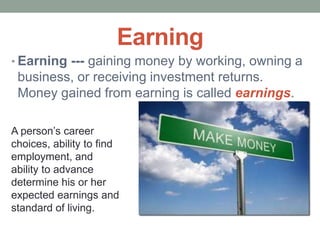
• Earning --- gaining money by working, owning a
business, or receiving investment returns.
Money gained from earning is called earnings.
A person’s career
choices, ability to find
employment, and
ability to advance
determine his or her
expected earnings and
standard of living.
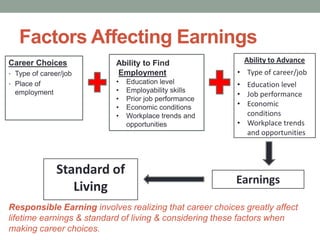
Factors Affecting Earnings
Career Choices
• Type of career/job
• Place of
employment
Ability to Find
Employment
• Education level
• Employability skills
• Prior job performance
• Economic conditions
• Workplace trends and
opportunities
Ability to Advance
• Type of career/job
• Education level
• Job performance
• Economic
conditions
• Workplace trends
and opportunities
Earnings
Standard of
Living
Responsible Earning involves realizing that career choices greatly affect
lifetime earnings & standard of living & considering these factors when
making career choices.
2.3.1.G1
© Take Charge Today – August 2013 – Invest in Yourself – Slide 5
Funded by a grant from Take Charge America, Inc. to the Norton School of Family and Consumer Sciences Take Charge America Institute at the University of Arizona
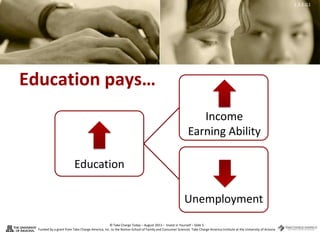
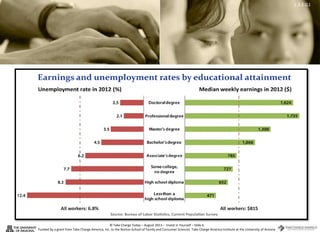
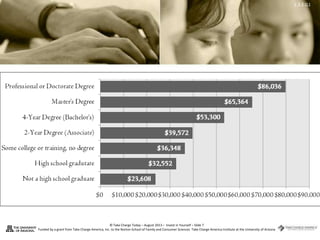
Education pays…
Education
Income
Earning Ability
Unemployment
2.3.1.G1
© Take Charge Today – August 2013 – Invest in Yourself – Slide 6
Funded by a grant from Take Charge America, Inc. to the Norton School of Family and Consumer Sciences Take Charge America Institute at the University of Arizona
2.3.1.G1
© Take Charge Today – August 2013 – Invest in Yourself – Slide 7
Funded by a grant from Take Charge America, Inc. to the Norton School of Family and Consumer Sciences Take Charge America Institute at the University of Arizona
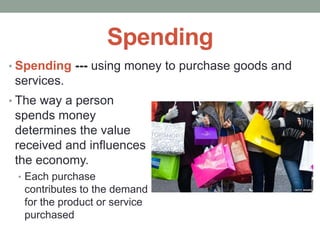
Spending
• Spending --- using money to purchase goods and
services.
• The way a person
spends money
determines the value
received and influences
the economy.
• Each purchase
contributes to the demand
for the product or service
purchased
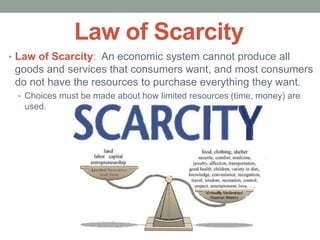
Law of Scarcity
• Law of Scarcity: An economic system cannot produce all
goods and services that consumers want, and most consumers
do not have the resources to purchase everything they want.
• Choices must be made about how limited resources (time, money) are
used.
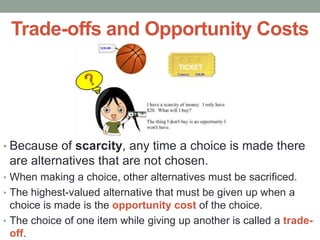
Trade-offs and Opportunity Costs
• Because of scarcity, any time a choice is made there
are alternatives that are not chosen.
• When making a choice, other alternatives must be sacrificed.
• The highest-valued alternative that must be given up when a
choice is made is the opportunity cost of the choice.
• The choice of one item while giving up another is called a trade-
off.
Responsible spending
• Responsible spending includes
researching and planning purchases
in advance and making wise choices
in light of opportunity costs and
trade-offs that apply
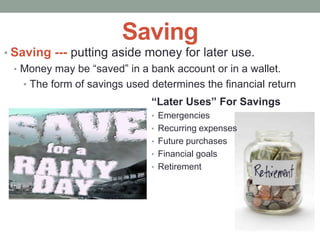
Saving
• Saving --- putting aside money for later use.
• Money may be “saved” in a bank account or in a wallet.
• The form of savings used determines the financial return
“Later Uses” For Savings
• Emergencies
• Recurring expenses
• Future purchases
• Financial goals
• Retirement
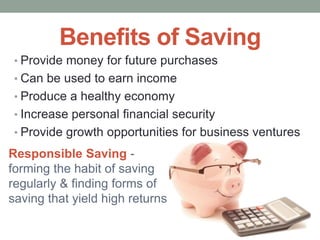
Benefits of Saving
• Provide money for future purchases
• Can be used to earn income
• Produce a healthy economy
• Increase personal financial security
• Provide growth opportunities for business ventures
Responsible Saving -
forming the habit of saving
regularly & finding forms of
saving that yield high returns
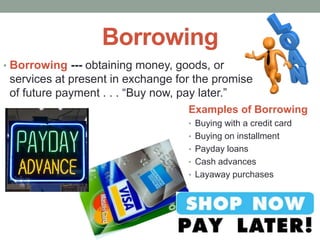
Borrowing
• Borrowing --- obtaining money, goods, or
services at present in exchange for the promise
of future payment . . . “Buy now, pay later.”
Examples of Borrowing
• Buying with a credit card
• Buying on installment
• Payday loans
• Cash advances
• Layaway purchases
Reasons for Borrowing
• Major purchases
• Emergencies
• Convenience
• Prepare for future goals
• Take advantage of good sales/offers
Responsible borrowing means borrowing only
what can be paid back when due
2.3.1.G1
© Take Charge Today – August 2013 – Invest in Yourself – Slide 16
Funded by a grant from Take Charge America, Inc. to the Norton School of Family and Consumer Sciences Take Charge America Institute at the University of Arizona
Education Tower – Education Affecting Earnings
Goal
• Build the
tallest free-
standing tower
using only the
supplies
provided
Challenge
• Each group
has a different
education
level with
certain skills
and limitations
2.3.1.G1
© Take Charge Today – August 2013 – Invest in Yourself – Slide 17
Funded by a grant from Take Charge America, Inc. to the Norton School of Family and Consumer Sciences Take Charge America Institute at the University of Arizona
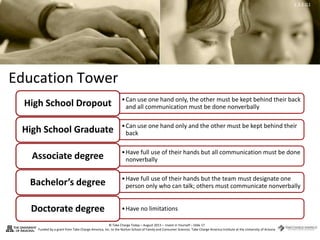
Education Tower
•Can use one hand only, the other must be kept behind their back
and all communication must be done nonverballyHigh School Dropout
•Can use one hand only and the other must be kept behind their
backHigh School Graduate
•Have full use of their hands but all communication must be done
nonverballyAssociate degree
•Have full use of their hands but the team must designate one
person only who can talk; others must communicate nonverballyBachelor’s degree
•Have no limitationsDoctorate degree
2.3.1.G1
© Take Charge Today – August 2013 – Invest in Yourself – Slide 18
Funded by a grant from Take Charge America, Inc. to the Norton School of Family and Consumer Sciences Take Charge America Institute at the University of Arizona
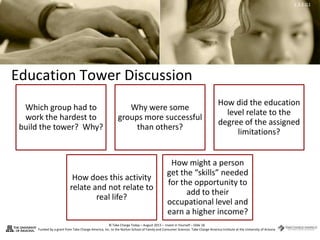
Education Tower Discussion
Which group had to
work the hardest to
build the tower? Why?
Why were some
groups more successful
than others?
How did the education
level relate to the
degree of the assigned
limitations?
How does this activity
relate and not relate to
real life?
How might a person
get the “skills” needed
for the opportunity to
add to their
occupational level and
earn a higher income?

Personal Finance 1.01 PPT

  • 1.
    PERSONAL FINANCE Objective 1.01 Understandresponsible earning, spending, savings, borrowing.
  • 2.
    There are FourBasic Economic Activities of Consumers • Earning • Spending • Savings • Borrowing
  • 3.
    Earning • Earning ---gaining money by working, owning a business, or receiving investment returns. Money gained from earning is called earnings. A person’s career choices, ability to find employment, and ability to advance determine his or her expected earnings and standard of living.
  • 4.
    Factors Affecting Earnings CareerChoices • Type of career/job • Place of employment Ability to Find Employment • Education level • Employability skills • Prior job performance • Economic conditions • Workplace trends and opportunities Ability to Advance • Type of career/job • Education level • Job performance • Economic conditions • Workplace trends and opportunities Earnings Standard of Living Responsible Earning involves realizing that career choices greatly affect lifetime earnings & standard of living & considering these factors when making career choices.
  • 5.
    2.3.1.G1 © Take ChargeToday – August 2013 – Invest in Yourself – Slide 5 Funded by a grant from Take Charge America, Inc. to the Norton School of Family and Consumer Sciences Take Charge America Institute at the University of Arizona Education pays… Education Income Earning Ability Unemployment
  • 6.
    2.3.1.G1 © Take ChargeToday – August 2013 – Invest in Yourself – Slide 6 Funded by a grant from Take Charge America, Inc. to the Norton School of Family and Consumer Sciences Take Charge America Institute at the University of Arizona
  • 7.
    2.3.1.G1 © Take ChargeToday – August 2013 – Invest in Yourself – Slide 7 Funded by a grant from Take Charge America, Inc. to the Norton School of Family and Consumer Sciences Take Charge America Institute at the University of Arizona
  • 8.
    Spending • Spending ---using money to purchase goods and services. • The way a person spends money determines the value received and influences the economy. • Each purchase contributes to the demand for the product or service purchased
  • 9.
    Law of Scarcity •Law of Scarcity: An economic system cannot produce all goods and services that consumers want, and most consumers do not have the resources to purchase everything they want. • Choices must be made about how limited resources (time, money) are used.
  • 10.
    Trade-offs and OpportunityCosts • Because of scarcity, any time a choice is made there are alternatives that are not chosen. • When making a choice, other alternatives must be sacrificed. • The highest-valued alternative that must be given up when a choice is made is the opportunity cost of the choice. • The choice of one item while giving up another is called a trade- off.
  • 11.
    Responsible spending • Responsiblespending includes researching and planning purchases in advance and making wise choices in light of opportunity costs and trade-offs that apply
  • 12.
    Saving • Saving ---putting aside money for later use. • Money may be “saved” in a bank account or in a wallet. • The form of savings used determines the financial return “Later Uses” For Savings • Emergencies • Recurring expenses • Future purchases • Financial goals • Retirement
  • 13.
    Benefits of Saving •Provide money for future purchases • Can be used to earn income • Produce a healthy economy • Increase personal financial security • Provide growth opportunities for business ventures Responsible Saving - forming the habit of saving regularly & finding forms of saving that yield high returns
  • 14.
    Borrowing • Borrowing ---obtaining money, goods, or services at present in exchange for the promise of future payment . . . “Buy now, pay later.” Examples of Borrowing • Buying with a credit card • Buying on installment • Payday loans • Cash advances • Layaway purchases
  • 15.
    Reasons for Borrowing •Major purchases • Emergencies • Convenience • Prepare for future goals • Take advantage of good sales/offers Responsible borrowing means borrowing only what can be paid back when due
  • 16.
    2.3.1.G1 © Take ChargeToday – August 2013 – Invest in Yourself – Slide 16 Funded by a grant from Take Charge America, Inc. to the Norton School of Family and Consumer Sciences Take Charge America Institute at the University of Arizona Education Tower – Education Affecting Earnings Goal • Build the tallest free- standing tower using only the supplies provided Challenge • Each group has a different education level with certain skills and limitations
  • 17.
    2.3.1.G1 © Take ChargeToday – August 2013 – Invest in Yourself – Slide 17 Funded by a grant from Take Charge America, Inc. to the Norton School of Family and Consumer Sciences Take Charge America Institute at the University of Arizona Education Tower •Can use one hand only, the other must be kept behind their back and all communication must be done nonverballyHigh School Dropout •Can use one hand only and the other must be kept behind their backHigh School Graduate •Have full use of their hands but all communication must be done nonverballyAssociate degree •Have full use of their hands but the team must designate one person only who can talk; others must communicate nonverballyBachelor’s degree •Have no limitationsDoctorate degree
  • 18.
    2.3.1.G1 © Take ChargeToday – August 2013 – Invest in Yourself – Slide 18 Funded by a grant from Take Charge America, Inc. to the Norton School of Family and Consumer Sciences Take Charge America Institute at the University of Arizona Education Tower Discussion Which group had to work the hardest to build the tower? Why? Why were some groups more successful than others? How did the education level relate to the degree of the assigned limitations? How does this activity relate and not relate to real life? How might a person get the “skills” needed for the opportunity to add to their occupational level and earn a higher income?