PROF. BALASUBRAMANIAN SATHYAMURTHY 2014 EDITION BTH – 103: GENERAL MICROBIOLOGY
Contact for your free pdf & job opportunities theimprintbiochemistry@gmail.com or 9986290201 Page 1 of 218
FOR MSC BIOTECHNOLOGY STUDENTS
2014 ONWARDS
Biochemistry scanner
THE IMPRINT
BTH – 103 GENERAL MICROBIOLOGY
(THEORY)
As per Bangalore University (CBCS) Syllabus
2014 Edition
BY: Prof. Balasubramanian Sathyamurthy
Supported By:
Ayesha Siddiqui
Kiran K.S.
THE MATERIALS FROM “THE IMPRINT (BIOCHEMISTRY SCANNER)” ARE NOT
FOR COMMERCIAL OR BRAND BUILDING. HENCE ONLY ACADEMIC CONTENT
WILL BE PRESENT INSIDE. WE THANK ALL THE CONTRIBUTORS FOR
ENCOURAGING THIS.
BE GOOD – DO GOOD & HELP OTHERS
PROF. BALASUBRAMANIAN SATHYAMURTHY 2014 EDITION BTH – 103: GENERAL MICROBIOLOGY
Contact for your free pdf & job opportunities theimprintbiochemistry@gmail.com or 9986290201 Page 2 of 218
PREFACE
Biochemistry scanner ‘THE IMPRINT’ consists of last ten years solved question paper of
Bangalore University keeping in mind the syllabus and examination pattern of the
University. The content taken from the reference books has been presented in a simple
language for better understanding.
The Author Prof. Balasubramanian Sathyamurthy has 15 years of teaching experience
and has taught in 5 Indian Universities including Bangalore University and more than
20 students has got university ranking under his guidance.
THE IMPRINT is a genuine effort by the students to help their peers with their
examinations with the strategy that has been successfully utilized by them. These final
year M.Sc students have proven their mettle in university examinations and are College
/ University rank holders.
This is truly for the students, by the students. We thank all the contributors for their
valuable suggestion in bringing out this book. We hope this will be appreciated by the
students and teachers alike. Suggestions are welcomed.
For any comments, queries, and suggestions and to get your free copy write us at
theimprintbiochemistry@gmail.com or call 9986290201
PROF. BALASUBRAMANIAN SATHYAMURTHY 2014 EDITION BTH – 103: GENERAL MICROBIOLOGY
Contact for your free pdf & job opportunities theimprintbiochemistry@gmail.com or 9986290201 Page 3 of 218
CONTRIBUTORS:
CHETAN ABBUR ANJALI TIWARI
AASHITA SINHA ASHWINI BELLATTI
BHARATH K CHAITHRA
GADIPARTHI VAMSEEKRISHNA KALYAN BANERJEE
KAMALA KISHORE
KIRAN KIRAN H.R
KRUTHI PRABAKAR KRUPA S
LATHA M MAMATA
MADHU PRAKASHHA G D MANJUNATH .B.P
NAYAB RASOOL S NAVYA KUCHARLAPATI
NEHA SHARIFF DIVYA DUBEY
NOOR AYESHA M PAYAL BANERJEE
POONAM PANCHAL PRAVEEN
PRAKASH K J M PRADEEP.R
PURSHOTHAM PUPPALA DEEPTHI
RAGHUNATH REDDY V RAMYA S
RAVI RESHMA
RUBY SHA SALMA H.
SHWETHA B S SHILPI CHOUBEY
SOUMOUNDA DAS SURENDRA N
THUMMALA MANOJ UDAYASHRE. B
DEEPIKA SHARMA
EDITION : 2013
PRINT : Bangalore
CONTACT : theimprintbiochemistry@gmail.com or 9986290201
PROF. BALASUBRAMANIAN SATHYAMURTHY 2014 EDITION BTH – 103: GENERAL MICROBIOLOGY
Contact for your free pdf & job opportunities theimprintbiochemistry@gmail.com or 9986290201 Page 4 of 218
M.SC BIOCHEMISTRY BANGALORE UNIVERSITY SYLLABUS
I SEMESTER M.Sc. BIOTECHNOLOGY
BTP -103: GENERAL MICROBIOLOGY
Unit – 1: MICROBIAL CLASSIFICATION: 12 hrs
Three domain system of classification, Phylogenetic Relationships, Code for bacterial
nomenclature and taxonomy, Criteria for microbial classification – morphological,
staining techniques, biochemical methods, serological techniques, phage typing, fatty
acid profiles, Flow cytometry, DNA base composition, DNA fingerprinting, rRNA
sequences, Nucleic acid hybridization, Numerical Taxonomy, Chemotaxonomy,
Classification of bacteria according to Bergey’s Manual of systemic Bacteriology,
Dichotomous keys, Cladograms, dendrograms, universal phylogenetic tree.
Unit – 2: PROKARYOTIC MICROORGANISM: 10 hrs
General properties, Structure, and reproduction: Domain Bacteria: Proteobacteria
(Alpha, Beta, Gamma, Delta and Epsilon Proteobacteria), Cyanobacteria, Chlorobium,
Firmicutes, Actinobacteria, Chlamydiae, Spirochaetes, Bacteroidetes, Fusobacteria.
Domain Archea: Crenarchaeota, Euryarchaeota.
Unit – 3: EUKARYOTIC MICROORGANISM: 8 hrs
General characters, Structure, and reproduction: Fungi (Saccharomyces), Algae
(Spirulina), Protozoa (Plasmodium), Slime molds (Physarum).
Unit – 4: VIRUSES, VIRIOIDS AND PRIONS (ACELLULAR ENTITIES): 10 hrs
General characters, Structure, Criteria for classification of Viruses, Viruses that affect
humans, animals and plants, Isolation, Cultivation and identification of Viruses
(Growing in Bacteria, Living Animals, embryonated eggs, Cell cultures). Viral
Multiplication (Lytic and lysogenic life cycle), Virioids and Prions – General properties
and diseases caused by virioids and prions.
Unit – 5: MICROBIAL GROWTH AND CONTROL: 6 hrs
Physical parameters (Temperature, pH, Osmotic pressure), Chemical parameters
(Carbon, Nitroge, Phosphorous, Sulphur, Trace elements, Oxygen), Growth factors,
PROF. BALASUBRAMANIAN SATHYAMURTHY 2014 EDITION BTH – 103: GENERAL MICROBIOLOGY
Contact for your free pdf & job opportunities theimprintbiochemistry@gmail.com or 9986290201 Page 5 of 218
Culture Media, Phases of Growth, Growth Measurements, Microbial growth control –
Physical methods ( Heat, Pasteurization, Filteration, Radiation, Dessication, Low
Temperature, High Pressure, Osmotic Pressure) and Chemical Methods ( Phenols,
Halogens, Alcohols, quaternary ammonium compounds).
Unit – 6: MICROBIOLOGICAL METHODS: 6 hrs
Isolation ans cultivation of microorganisms from Water, Soil, Air, Rhizoshere,
Phyllosphere and Mycorrhiza, Biochemical cycle.
References:
1. Microbiology by MJ Pelczar Jr, ECS Chan, NR Krieg 5th Edition, Pub: Tata Mcgra-Hill
Publishing Co Ltd.
2. Introductory Microbiology by Heritage Pub Heritage
3. General Microbiology by Stainer Pub; Ingraham and Wheeler (McMillan)
4. Alexander M (1977) Introduction to soil microbiology, John Wiley and Sons Inc.N.Y.
5. Atlas R.M. (1998) Microbiology, Fundamentals and applications 2nd Edition, Milan
Publishing Co.
6. Brock T.D. and Madigan M.T (1992) Biology of Microorganisms 6th Edn. Prentice Hall,
Eagle wood cliffs N.j.
7. Holt J.S. Kreig N.R., Sneath P.H.A and Williams S.T (1994) Bergey’s Manual of Systemic
Bacteriology 9th Edn. William and Wilkins, Baltimore.
8. Prescott L.M, Harley T.P and Klein D.A. (1996) Microbiology WMC. Brown publishers
PROF. BALASUBRAMANIAN SATHYAMURTHY 2014 EDITION BTH – 103: GENERAL MICROBIOLOGY
Contact for your free pdf & job opportunities theimprintbiochemistry@gmail.com or 9986290201 Page 6 of 218
UNIT – 1: MICROBIAL CLASSIFICATION
Three domain system of classification, Phylogenetic Relationships, Code for
bacterial nomenclature and taxonomy, Criteria for microbial classification –
morphological, staining techniques, biochemical methods, serological techniques,
phage typing, fatty acid profiles, Flow cytometry, DNA base composition, DNA
fingerprinting, rRNA sequences, Nucleic acid hybridization, Numerical Taxonomy,
Chemotaxonomy, Classification of bacteria according to Bergey’s Manual of
systemic Bacteriology, Dichotomous keys, Cladograms, dendrograms, universal
phylogenetic tree.
THREE DOMAIN SYSTEM OF CLASSIFICATION, PHYLOGENETIC RELATIONSHIPS
It has been estimated that our planet is about 4.6 billion years old. Fossilized remains
of procaryotic cells around 3.5 to 3.8 billion years old have been discovered in
stromatolites and sedimentary rocks.
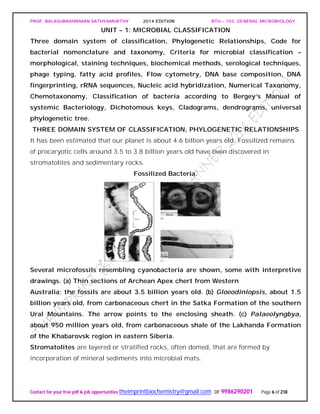
Fossilized Bacteria.
Several microfossils resembling cyanobacteria are shown, some with interpretive
drawings. (a) Thin sections of Archean Apex chert from Western
Australia; the fossils are about 3.5 billion years old. (b) Gloeodiniopsis, about 1.5
billion years old, from carbonaceous chert in the Satka Formation of the southern
Ural Mountains. The arrow points to the enclosing sheath. (c) Palaeolyngbya,
about 950 million years old, from carbonaceous shale of the Lakhanda Formation
of the Khabarovsk region in eastern Siberia.
Stromatolites are layered or stratified rocks, often domed, that are formed by
incorporation of mineral sediments into microbial mats.
PROF. BALASUBRAMANIAN SATHYAMURTHY 2014 EDITION BTH – 103: GENERAL MICROBIOLOGY
Contact for your free pdf & job opportunities theimprintbiochemistry@gmail.com or 9986290201 Page 7 of 218
Stromatolites.
These are stromatolites at Shark Bay, Western Australia. Modern stromatolites are
layered or stratified rocks formed by the incorporation of calcium sulfates,
calcium carbonates, and other minerals into microbial mats. The mats are formed
by cyanobacteria and other microorganisms.
Modern stromatolites are formed by cyanobacteria; presumably at least some fossilized
stromatolites were formed in the same way. Thus procaryotic life arose very shortly after
the earth cooled. Very likely the earliest procaryotes were anaerobic. Cyanobacteria and
oxygen-producing photosynthesis probably developed 2.5 to 3.0 billion or more years
ago. Microbial diversity increased greatly as oxygen became more plentiful.
According to the more popular endosymbiotic hypothesis, the first event was nucleus
formation in the pro-eucaryotic cell. The ancestral eucaryotic cell may have developed
from a fusion of ancient bacteria and archaea. Possibly a gram-negative bacterial host
cell that had lost its cell wall engulfed an archaeon to form an endosymbiotic
association. The archaeon subsequently lost its wall and plasma membrane, while the
host bacterium developed membrane infolds. Eventually the host genome was
transferred to the original archaeon, and a nucleus and the endoplasmic reticulum was
formed. Both bacterial and archaeal genes could be lost during formation of the
eucaryotic genome. It should be noted that many believe that the Archaea and Eucarya
are more closely related than this hypothetical scenario implies.
They propose that the eucaryotic line diverged from the Archaea and then the nucleus
formed, possibly from the Golgi apparatus. Mitochondria and chloroplasts appear to
have developed later. The free-living, fermenting ancestral eucaryote with its nucleus
established a permanent symbiotic relationship with photosynthetic bacteria, which
then evolved into chloroplasts. Cyanobacteria have been considered the most likely
PROF. BALASUBRAMANIAN SATHYAMURTHY 2014 EDITION BTH – 103: GENERAL MICROBIOLOGY
Contact for your free pdf & job opportunities theimprintbiochemistry@gmail.com or 9986290201 Page 8 of 218
ancestors of chloroplasts. More recently Prochloron has become the favorite candidate.
Prochloron lives within marine invertebrates and resembles chloroplasts in containing
both chlorophyll a and b, but not phycobilins. The existence of this bacterium suggests
that chloroplasts arose from a common ancestor of prochlorophytes and cyanobacteria.
Mitochondria arose from an endosymbiotic relationship between the free-living primitive
eucaryote and bacteria with aerobic respiration (possibly an ancestor of three modern
groups: Agrobacterium, Rhizobium, and Rickettsia). Some have proposed that aerobic
respiration actually arose before oxygenic (oxygen-producing) photosynthesis and made
use of small amounts of oxygen available at this early stage of planetary development.
The exact sequence of development is still unclear.
The endosymbiotic hypothesis has received support from the discovery of an
endosymbiotic cyanobacterium that inhabits the biflagellate protist Cyanophora
paradoxa and acts as its chloroplast. This endosymbiont, called a cyanelle, resembles
the cyanobacteria in its photosynthetic pigment system and fine structure and it is
surrounded by a peptidoglycan layer. It differs from cyanobacteria in lacking the
lipopolysaccharide outer membrane characteristic of gram-negative bacteria. The
cyanelle may be a recently established endosymbiont that is evolving into a chloroplast.
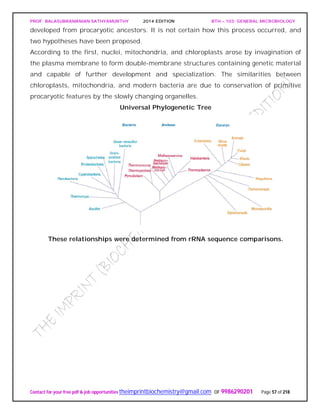
Further support is provided by rRNA trees, which locate chloroplast RNA within the
cyanobacteria. At present both hypotheses have supporters. It is possible that new data
may help resolve the issue to everyone’s satisfaction.
However, these hypotheses concern processes that occurred in the distant past and
cannot be directly observed. Thus a complete consensus on the matter may never be
reached.
CODE FOR BACTERIAL NOMENCLATURE AND TAXONOMY
In preparing a classification scheme, one places the microorganism within a small,
homogeneous group that is itself a member of larger groups in a nonoverlapping
hierarchical arrangement. A category in any rank unites groups in the level below it
based on shared properties.
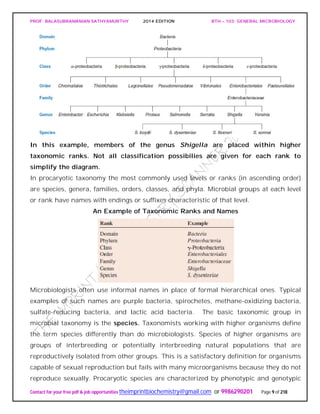
Hierarchical Arrangement in Taxonomy
PROF. BALASUBRAMANIAN SATHYAMURTHY 2014 EDITION BTH – 103: GENERAL MICROBIOLOGY
Contact for your free pdf & job opportunities theimprintbiochemistry@gmail.com or 9986290201 Page 9 of 218
In this example, members of the genus Shigella are placed within higher
taxonomic ranks. Not all classification possibilies are given for each rank to
simplify the diagram.
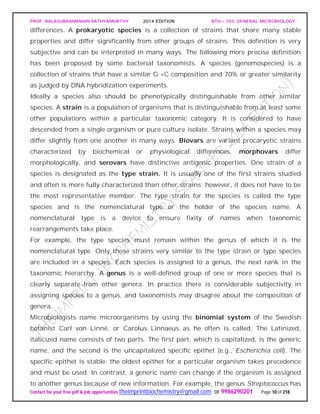
In procaryotic taxonomy the most commonly used levels or ranks (in ascending order)
are species, genera, families, orders, classes, and phyla. Microbial groups at each level
or rank have names with endings or suffixes characteristic of that level.
An Example of Taxonomic Ranks and Names
Microbiologists often use informal names in place of formal hierarchical ones. Typical
examples of such names are purple bacteria, spirochetes, methane-oxidizing bacteria,
sulfate-reducing bacteria, and lactic acid bacteria. The basic taxonomic group in
microbial taxonomy is the species. Taxonomists working with higher organisms define
the term species differently than do microbiologists. Species of higher organisms are
groups of interbreeding or potentially interbreeding natural populations that are
reproductively isolated from other groups. This is a satisfactory definition for organisms
capable of sexual reproduction but fails with many microorganisms because they do not
reproduce sexually. Procaryotic species are characterized by phenotypic and genotypic
PROF. BALASUBRAMANIAN SATHYAMURTHY 2014 EDITION BTH – 103: GENERAL MICROBIOLOGY
Contact for your free pdf & job opportunities theimprintbiochemistry@gmail.com or 9986290201 Page 10 of 218
differences. A prokaryotic species is a collection of strains that share many stable
properties and differ significantly from other groups of strains. This definition is very
subjective and can be interpreted in many ways. The following more precise definition
has been proposed by some bacterial taxonomists. A species (genomospecies) is a
collection of strains that have a similar G +C composition and 70% or greater similarity
as judged by DNA hybridization experiments.
Ideally a species also should be phenotypically distinguishable from other similar
species. A strain is a population of organisms that is distinguishable from at least some
other populations within a particular taxonomic category. It is considered to have
descended from a single organism or pure culture isolate. Strains within a species may
differ slightly from one another in many ways. Biovars are variant procaryotic strains
characterized by biochemical or physiological differences, morphovars differ
morphologically, and serovars have distinctive antigenic properties. One strain of a
species is designated as the type strain. It is usually one of the first strains studied
and often is more fully characterized than other strains; however, it does not have to be
the most representative member. The type strain for the species is called the type
species and is the nomenclatural type or the holder of the species name. A
nomenclatural type is a device to ensure fixity of names when taxonomic
rearrangements take place.
For example, the type species must remain within the genus of which it is the
nomenclatural type. Only those strains very similar to the type strain or type species
are included in a species. Each species is assigned to a genus, the next rank in the
taxonomic hierarchy. A genus is a well-defined group of one or more species that is
clearly separate from other genera. In practice there is considerable subjectivity in
assigning species to a genus, and taxonomists may disagree about the composition of
genera.
Microbiologists name microorganisms by using the binomial system of the Swedish
botanist Carl von Linné, or Carolus Linnaeus as he often is called. The Latinized,
italicized name consists of two parts. The first part, which is capitalized, is the generic
name, and the second is the uncapitalized specific epithet (e.g., Escherichia coli). The
specific epithet is stable; the oldest epithet for a particular organism takes precedence
and must be used. In contrast, a generic name can change if the organism is assigned
to another genus because of new information. For example, the genus Streptococcus has
PROF. BALASUBRAMANIAN SATHYAMURTHY 2014 EDITION BTH – 103: GENERAL MICROBIOLOGY
Contact for your free pdf & job opportunities theimprintbiochemistry@gmail.com or 9986290201 Page 11 of 218
been divided to form two new genera, Enterococcus and Lactococcus based on rRNA
analysis and other characteristics. Thus Streptococcus faecalis is now Enterococcus
faecalis. Often the name will be shortened by abbreviating the genus name with a single
capital letter, for example E. coli. Approved lists of bacterial names were published in
1980 in the International Journal of Systematic Bacteriology, and new valid names are
published periodically.
Classification Systems
Once taxonomically relevant characteristics of microorganisms have been collected,
they may be used to construct a classification system. The most desirable classification
system, called a natural classification, arranges organisms into groups whose
members share many characteristics and reflects as much as possible the biological
nature of organisms. Linnaeus developed the first natural classification, based largely
on anatomical characteristics, in the middle of the eighteenth century. It was a great
improvement over previously employed artificial systems because knowledge of an
organism’s position in the scheme provided information about many of its properties.
For example, classification of humans as mammals denotes that they have hair, self-
regulating body temperature, and milk-producing mammary glands in the female.
There are two general ways in which classification systems can be constructed.
Organisms can be grouped together based on overall similarity to form a phenetic
system or they can be grouped based on probable evolutionary relationships to produce
a phylogenetic system. Computers may be used to analyze data for the production of
phenetic classifications. The process is called numerical taxonomy. This section briefly
discusses phenetic and phylogenetic classifications, and describes numerical taxonomy.
CRITERIA FOR MICROBIAL CLASSIFICATION – MORPHOLOGICAL
Morphological features are important in microbial taxonomy for many reasons.
Morphology is easy to study and analyze, particularly in eucaryotic microorganisms and
the more complex procaryotes. In addition, morphological comparisons are valuable
because structural features depend on the expression of many genes, are usually
genetically stable, and normally (at least in eucaryotes) these do not vary greatly with
environmental changes. Thus morphological similarity often is a good indication of
phylogenetic relatedness. Many different morphological features are employed in the
classification and identification of microorganisms.
PROF. BALASUBRAMANIAN SATHYAMURTHY 2014 EDITION BTH – 103: GENERAL MICROBIOLOGY
Contact for your free pdf & job opportunities theimprintbiochemistry@gmail.com or 9986290201 Page 12 of 218
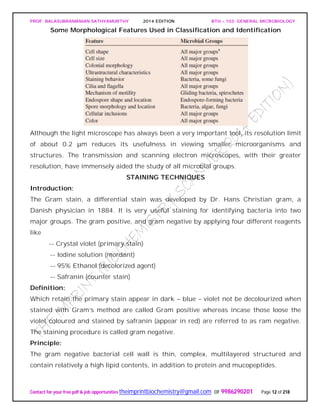
Some Morphological Features Used in Classification and Identification
Although the light microscope has always been a very important tool, its resolution limit
of about 0.2 μm reduces its usefulness in viewing smaller microorganisms and
structures. The transmission and scanning electron microscopes, with their greater
resolution, have immensely aided the study of all microbial groups.
STAINING TECHNIQUES
Introduction:
The Gram stain, a differential stain was developed by Dr. Hans Christian gram, a
Danish physician in 1884. It is very useful staining for identifying bacteria into two
major groups. The gram positive, and gram negative by applying four different reagents
like
-- Crystal violet (primary stain)
-- Iodine solution (mordant)
-- 95% Ethanol (decolorized agent)
-- Safranin (counter stain)
Definition:
Which retain the primary stain appear in dark – blue – violet not be decolourized when
stained with Gram’s method are called Gram positive whereas incase those loose the
violet coloured and stained by safranin (appear in red) are referred to as ram negative.
The staining procedure is called gram negative.
Principle:
The gram negative bacterial cell wall is thin, complex, multilayered structured and
contain relatively a high lipid contents, in addition to protein and mucopeptides.
PROF. BALASUBRAMANIAN SATHYAMURTHY 2014 EDITION BTH – 103: GENERAL MICROBIOLOGY
Contact for your free pdf & job opportunities theimprintbiochemistry@gmail.com or 9986290201 Page 13 of 218
The higher amount of lipids is easily dissolved by alcohol resulting in the formation of
large pores in the cell wall, thus facilitating the leakage of crystal violet iodine complex
(cv-1) and resulting in the decolorization of the bacterium, which later takes counter
stain and appears red, in contrast gram positive cell walls are thick and four chemically
simple composed mainly of protein and treated with alcohol it causes dehydration of
cell wall pores there by not allowing loss of complex.
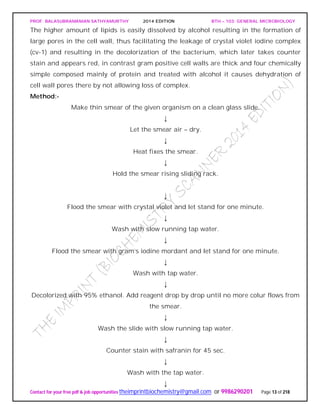
Method:-
Make thin smear of the given organism on a clean glass slide.
↓
Let the smear air – dry.
↓
Heat fixes the smear.
↓
Hold the smear rising sliding rack.
↓
Flood the smear with crystal violet and let stand for one minute.
↓
Wash with slow running tap water.
↓
Flood the smear with gram’s iodine mordant and let stand for one minute.
↓
Wash with tap water.
↓
Decolorized with 95% ethanol. Add reagent drop by drop until no more colur flows from
the smear.
↓
Wash the slide with slow running tap water.
↓
Counter stain with safranin for 45 sec.
↓
Wash with the tap water.
↓
PROF. BALASUBRAMANIAN SATHYAMURTHY 2014 EDITION BTH – 103: GENERAL MICROBIOLOGY
Contact for your free pdf & job opportunities theimprintbiochemistry@gmail.com or 9986290201 Page 14 of 218
Air dry and examine the smear under slow running tap water.
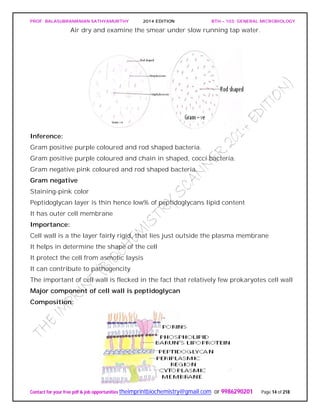
Inference:
Gram positive purple coloured and rod shaped bacteria.
Gram positive purple coloured and chain in shaped, cocci bacteria.
Gram negative pink coloured and rod shaped bacteria.
Gram negative
Staining-pink color
Peptidoglycan layer is thin hence low% of peptidoglycans lipid content
It has outer cell membrane
Importance:
Cell wall is a the layer fairly rigid, that lies just outside the plasma membrane
It helps in determine the shape of the cell
It protect the cell from asmotic laysis
It can contribute to pathogencity
The important of cell wall is flecked in the fact that relatively few prokaryotes cell wall
Major component of cell wall is peptidoglycan
Composition:
PROF. BALASUBRAMANIAN SATHYAMURTHY 2014 EDITION BTH – 103: GENERAL MICROBIOLOGY
Contact for your free pdf & job opportunities theimprintbiochemistry@gmail.com or 9986290201 Page 15 of 218
PEPTIDOGLYCAN substance present in most gram positive and gram negative
organism.
It has two parts
Glycan: It is made up of N-acetyl glucosomine and N-acetyl muramic acid linked by β-
1,4 glycosidic linkage.
NAG.............NAM [Lactyl ester of NAG]
Peptide: It consists of two parts:
Tetra peptide: It consists of various D and L form of amino acid connected to carboxyl
group of N-acetyl mumaric acid. They are:
Gram negative - L-alanine,D-glutamic acid,diamino pimelic acid,D-alanine.
Peptide linkage:
Peptide linkage is formed between D-alanine and L-lysine (in case of gram +ve) and
diamino primalic acid (in case of gram –ve)
The peptide chain (containing &amino acids) are linked to “NAM” and a peptide chain in
the two side chains.
In gram negative cell wall inter chain peptide linkage is a CO-NH linkage
In the lactyl group because of the free C=0 group (in NAM peptide) chain is attached to
it for example in gram negative cell wall
Peptidoglycan substance present in most gram positive and gram negative organism.
It has two parts
Glycan: It is made up of N-acetyl glucosomine and N-acetyl muramic acid linked by β-
1, 4 glycosidic linkages.
NAG.............NAM [Lactyl ester of NAG]
Peptide: It consists of two parts:
Tetra peptide: It consists of various D and L form of amino acid connected to carboxyl
group of N-acetyl mumaric acid. They are:-
Gram negative - L-alanine, D-glutamic acid, diamino pimelic acid,D-alanine.
Peptide linkage:
Peptide linkage is formed between D-alanine and L-lysine (in case of gram +ve) and
diamino primalic acid (in case of gram –ve)
The peptide chain (containing &amino acids) are linked to “NAM” and a peptide chain in
the two side chains.
In gram negative cell wall inter chain peptide linkage is a CO-NH linkage
PROF. BALASUBRAMANIAN SATHYAMURTHY 2014 EDITION BTH – 103: GENERAL MICROBIOLOGY
Contact for your free pdf & job opportunities theimprintbiochemistry@gmail.com or 9986290201 Page 16 of 218
In the lactyl group because of the free C=0 group (in NAM peptide) chain is attached to
it for example in gram negative cell wall
GRAM NAGATIVE CELL WALL: It has 3 major components.
Outer membrane:
BROWN’S LIPOPROTEIN
It acts as a connective line between peptidoglycan layer and the outermost layer and the
outermost layer.
It is most aboundent protein in outer membrane.
Lipo polysaccharides:
Large and complex molecules containing both lipid and carbohydrate.
It consists of three parts.
Lipid (A): It is an endotoxin because it is attached to the micro organisms.
It is glucosomes sugar with fatty acids and phosphate(or0 pyrophasphate attached.
Core polysaccharide:
Joined to lipid A
Made up of 10 different saccharide units depending on the species of bacteria.
o-polysaccharides:
Size is 600-700 Dalton
Helps information or poles for exchange or passage of small molecule like glucose and
other mono sacharides.
It is called ‘o’ antigen because it elicits an immenoresponse.
PORINS:
Size is 600-700Dalt.
Helps in formation of poles for exchange or passage of small molecules like glucose and
other monosaccharides.
Porin protein cluster together to form a trimer in outer membrane.
PERIPLASMIC SPACE:
Contain peptidoglcan in case of gram negative.
Contains periplasm having absorption, protein hydrolytic enzyme etc.
STRUCTURE OF GRAM POSITIVE CELL WALL
Gram positive bacteria usually have a much greater amount of peptidoglycan in their
cell wall than do gram negative bacteria.
Cell wall made up of 95% peptidoglycan and 10% techoic acid.
PROF. BALASUBRAMANIAN SATHYAMURTHY 2014 EDITION BTH – 103: GENERAL MICROBIOLOGY
Contact for your free pdf & job opportunities theimprintbiochemistry@gmail.com or 9986290201 Page 17 of 218
Peptidoglycan: It is made up of alternating chains of N-acetylglucosamine and N-acetyl
muramic acid molecule. These chains are cross linked by peptide chains. 80nm thick.
The space between peptidoglycan and cytoplasmic membrane is called perilasmic space.
Teichoic acid: It consists of two acids. They are lipotechoic acids and poltechoic acid.
Lipotechoic acid- polymer of glycerol phosphate
Poltechoic acid- polymer of ribitol phosphate
The cell wall of streptococcus aureus contain techoic acid (glycerol phosphate, ribitol
phosphate) covalently linked with peptidoglycan which can be extracted with cold dilute
acid.
Teichoic acid bind magnesium ions and there is some evidence that they help to protect
bacteria from thermal injury.
Lipid: The cell wall of most gram positive bacteria contain very amount of lipid.
Functions of Teichoic acid:-
Helps in attachment of bacteria to host cell.
Prevent phagocytosis.
It is highly antigenic in nature.
Function of peptidoglycan:-
Maintain osmotic balance.
Act as a barrier.
BIOCHEMICAL METHODS & SEROLOGICAL TECHNIQUES
Typically microorganisms have been identified by their particular growth patterns and
biochemical characteristics.
Some Biochemical Tests Used by Clinical Microbiologists in the Diagnosis of Bacteria
from the Patient’s Specimen.
PROF. BALASUBRAMANIAN SATHYAMURTHY 2014 EDITION BTH – 103: GENERAL MICROBIOLOGY
Contact for your free pdf & job opportunities theimprintbiochemistry@gmail.com or 9986290201 Page 18 of 218
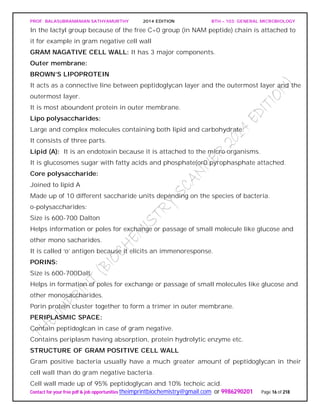
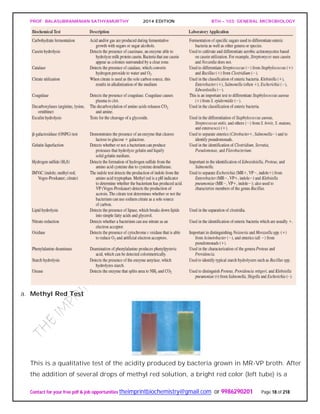
a. Methyl Red Test
This is a qualitative test of the acidity produced by bacteria grown in MR-VP broth. After
the addition of several drops of methyl red solution, a bright red color (left tube) is a
PROF. BALASUBRAMANIAN SATHYAMURTHY 2014 EDITION BTH – 103: GENERAL MICROBIOLOGY
Contact for your free pdf & job opportunities theimprintbiochemistry@gmail.com or 9986290201 Page 19 of 218
positive test; a yellow or orange color (right tube) is a negative test. Used to separate
enterics, for example E. coli is MR positive and Enterobacter aerogenes is MR negative.
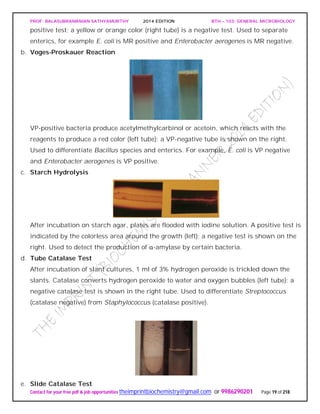
b. Voges-Proskauer Reaction
VP-positive bacteria produce acetylmethylcarbinol or acetoin, which reacts with the
reagents to produce a red color (left tube); a VP-negative tube is shown on the right.
Used to differentiate Bacillus species and enterics. For example, E. coli is VP negative
and Enterobacter aerogenes is VP positive.
c. Starch Hydrolysis
After incubation on starch agar, plates are flooded with iodine solution. A positive test is
indicated by the colorless area around the growth (left); a negative test is shown on the
right. Used to detect the production of α-amylase by certain bacteria.
d. Tube Catalase Test
After incubation of slant cultures, 1 ml of 3% hydrogen peroxide is trickled down the
slants. Catalase converts hydrogen peroxide to water and oxygen bubbles (left tube); a
negative catalase test is shown in the right tube. Used to differentiate Streptococcus
(catalase negative) from Staphylococcus (catalase positive).
e. Slide Catalase Test
PROF. BALASUBRAMANIAN SATHYAMURTHY 2014 EDITION BTH – 103: GENERAL MICROBIOLOGY
Contact for your free pdf & job opportunities theimprintbiochemistry@gmail.com or 9986290201 Page 20 of 218
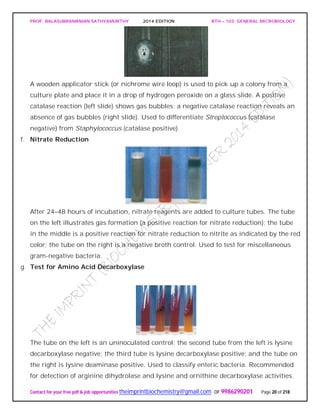
A wooden applicator stick (or nichrome wire loop) is used to pick up a colony from a
culture plate and place it in a drop of hydrogen peroxide on a glass slide. A positive
catalase reaction (left slide) shows gas bubbles; a negative catalase reaction reveals an
absence of gas bubbles (right slide). Used to differentiate Streptococcus (catalase
negative) from Staphylococcus (catalase positive).
f. Nitrate Reduction
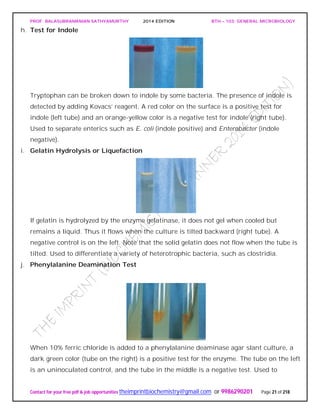
After 24–48 hours of incubation, nitrate reagents are added to culture tubes. The tube
on the left illustrates gas formation (a positive reaction for nitrate reduction); the tube
in the middle is a positive reaction for nitrate reduction to nitrite as indicated by the red
color; the tube on the right is a negative broth control. Used to test for miscellaneous
gram-negative bacteria.
g. Test for Amino Acid Decarboxylase
The tube on the left is an uninoculated control; the second tube from the left is lysine
decarboxylase negative; the third tube is lysine decarboxylase positive; and the tube on
the right is lysine deaminase positive. Used to classify enteric bacteria. Recommended
for detection of arginine dihydrolase and lysine and ornithine decarboxylase activities.
PROF. BALASUBRAMANIAN SATHYAMURTHY 2014 EDITION BTH – 103: GENERAL MICROBIOLOGY
Contact for your free pdf & job opportunities theimprintbiochemistry@gmail.com or 9986290201 Page 21 of 218
h. Test for Indole
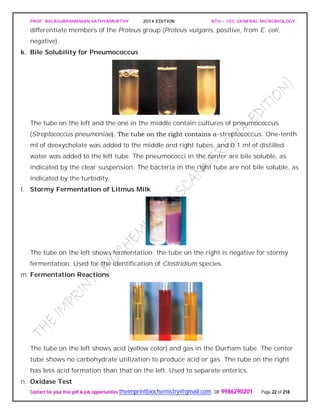
Tryptophan can be broken down to indole by some bacteria. The presence of indole is
detected by adding Kovacs’ reagent. A red color on the surface is a positive test for
indole (left tube) and an orange-yellow color is a negative test for indole (right tube).
Used to separate enterics such as E. coli (indole positive) and Enterobacter (indole
negative).
i. Gelatin Hydrolysis or Liquefaction
If gelatin is hydrolyzed by the enzyme gelatinase, it does not gel when cooled but
remains a liquid. Thus it flows when the culture is tilted backward (right tube). A
negative control is on the left. Note that the solid gelatin does not flow when the tube is
tilted. Used to differentiate a variety of heterotrophic bacteria, such as clostridia.
j. Phenylalanine Deamination Test
When 10% ferric chloride is added to a phenylalanine deaminase agar slant culture, a
dark green color (tube on the right) is a positive test for the enzyme. The tube on the left
is an uninoculated control, and the tube in the middle is a negative test. Used to
PROF. BALASUBRAMANIAN SATHYAMURTHY 2014 EDITION BTH – 103: GENERAL MICROBIOLOGY
Contact for your free pdf & job opportunities theimprintbiochemistry@gmail.com or 9986290201 Page 22 of 218
differentiate members of the Proteus group (Proteus vulgaris, positive, from E. coli,
negative).
k. Bile Solubility for Pneumococcus
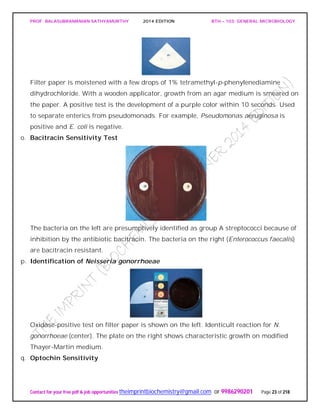
The tube on the left and the one in the middle contain cultures of pneumococcus
(Streptococcus pneumoniae). The tube on the right contains α-streptococcus. One-tenth
ml of deoxycholate was added to the middle and right tubes, and 0.1 ml of distilled
water was added to the left tube. The pneumococci in the center are bile soluble, as
indicated by the clear suspension. The bacteria in the right tube are not bile soluble, as
indicated by the turbidity.
l. Stormy Fermentation of Litmus Milk
The tube on the left shows fermentation; the tube on the right is negative for stormy
fermentation. Used for the identification of Clostridium species.
m. Fermentation Reactions
The tube on the left shows acid (yellow color) and gas in the Durham tube. The center
tube shows no carbohydrate utilization to produce acid or gas. The tube on the right
has less acid formation than that on the left. Used to separate enterics.
n. Oxidase Test
PROF. BALASUBRAMANIAN SATHYAMURTHY 2014 EDITION BTH – 103: GENERAL MICROBIOLOGY
Contact for your free pdf & job opportunities theimprintbiochemistry@gmail.com or 9986290201 Page 23 of 218
Filter paper is moistened with a few drops of 1% tetramethyl-p-phenylenediamine
dihydrochloride. With a wooden applicator, growth from an agar medium is smeared on
the paper. A positive test is the development of a purple color within 10 seconds. Used
to separate enterics from pseudomonads. For example, Pseudomonas aeruginosa is
positive and E. coli is negative.
o. Bacitracin Sensitivity Test
The bacteria on the left are presumptively identified as group A streptococci because of
inhibition by the antibiotic bacitracin. The bacteria on the right (Enterococcus faecalis)
are bacitracin resistant.
p. Identification of Neisseria gonorrhoeae
Oxidase-positive test on filter paper is shown on the left. Identicult reaction for N.
gonorrhoeae (center). The plate on the right shows characteristic growth on modified
Thayer-Martin medium.
q. Optochin Sensitivity
PROF. BALASUBRAMANIAN SATHYAMURTHY 2014 EDITION BTH – 103: GENERAL MICROBIOLOGY
Contact for your free pdf & job opportunities theimprintbiochemistry@gmail.com or 9986290201 Page 24 of 218
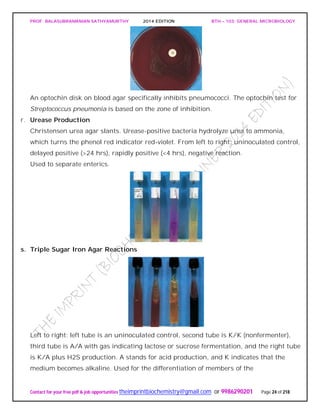
An optochin disk on blood agar specifically inhibits pneumococci. The optochin test for
Streptococcus pneumonia is based on the zone of inhibition.
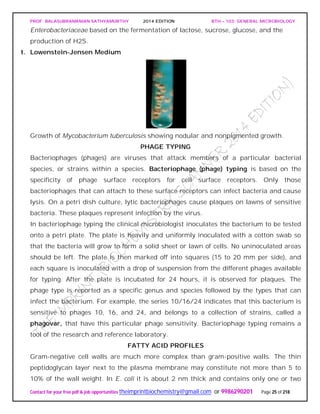
r. Urease Production
Christensen urea agar slants. Urease-positive bacteria hydrolyze urea to ammonia,
which turns the phenol red indicator red-violet. From left to right: uninoculated control,
delayed positive (>24 hrs), rapidly positive (<4 hrs), negative reaction.
Used to separate enterics.
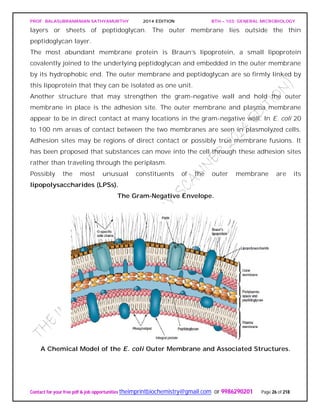
s. Triple Sugar Iron Agar Reactions
Left to right: left tube is an uninoculated control, second tube is K/K (nonfermenter),
third tube is A/A with gas indicating lactose or sucrose fermentation, and the right tube
is K/A plus H2S production. A stands for acid production, and K indicates that the
medium becomes alkaline. Used for the differentiation of members of the
PROF. BALASUBRAMANIAN SATHYAMURTHY 2014 EDITION BTH – 103: GENERAL MICROBIOLOGY
Contact for your free pdf & job opportunities theimprintbiochemistry@gmail.com or 9986290201 Page 25 of 218
Enterobacteriaceae based on the fermentation of lactose, sucrose, glucose, and the
production of H2S.
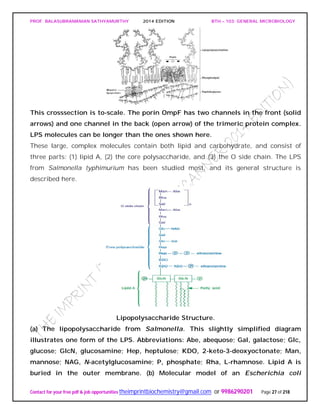
t. Lowenstein-Jensen Medium
Growth of Mycobacterium tuberculosis showing nodular and nonpigmented growth.
PHAGE TYPING
Bacteriophages (phages) are viruses that attack members of a particular bacterial
species, or strains within a species. Bacteriophage (phage) typing is based on the
specificity of phage surface receptors for cell surface receptors. Only those
bacteriophages that can attach to these surface receptors can infect bacteria and cause
lysis. On a petri dish culture, lytic bacteriophages cause plaques on lawns of sensitive
bacteria. These plaques represent infection by the virus.
In bacteriophage typing the clinical microbiologist inoculates the bacterium to be tested
onto a petri plate. The plate is heavily and uniformly inoculated with a cotton swab so
that the bacteria will grow to form a solid sheet or lawn of cells. No uninoculated areas
should be left. The plate is then marked off into squares (15 to 20 mm per side), and
each square is inoculated with a drop of suspension from the different phages available
for typing. After the plate is incubated for 24 hours, it is observed for plaques. The
phage type is reported as a specific genus and species followed by the types that can
infect the bacterium. For example, the series 10/16/24 indicates that this bacterium is
sensitive to phages 10, 16, and 24, and belongs to a collection of strains, called a
phagovar, that have this particular phage sensitivity. Bacteriophage typing remains a
tool of the research and reference laboratory.
FATTY ACID PROFILES
Gram-negative cell walls are much more complex than gram-positive walls. The thin
peptidoglycan layer next to the plasma membrane may constitute not more than 5 to
10% of the wall weight. In E. coli it is about 2 nm thick and contains only one or two
PROF. BALASUBRAMANIAN SATHYAMURTHY 2014 EDITION BTH – 103: GENERAL MICROBIOLOGY
Contact for your free pdf & job opportunities theimprintbiochemistry@gmail.com or 9986290201 Page 26 of 218
layers or sheets of peptidoglycan. The outer membrane lies outside the thin
peptidoglycan layer.
The most abundant membrane protein is Braun’s lipoprotein, a small lipoprotein
covalently joined to the underlying peptidoglycan and embedded in the outer membrane
by its hydrophobic end. The outer membrane and peptidoglycan are so firmly linked by
this lipoprotein that they can be isolated as one unit.
Another structure that may strengthen the gram-negative wall and hold the outer
membrane in place is the adhesion site. The outer membrane and plasma membrane
appear to be in direct contact at many locations in the gram-negative wall. In E. coli 20
to 100 nm areas of contact between the two membranes are seen in plasmolyzed cells.
Adhesion sites may be regions of direct contact or possibly true membrane fusions. It
has been proposed that substances can move into the cell through these adhesion sites
rather than traveling through the periplasm.
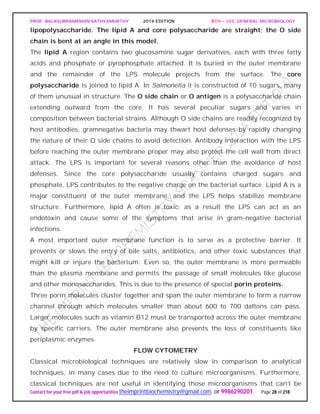
Possibly the most unusual constituents of the outer membrane are its
lipopolysaccharides (LPSs).
The Gram-Negative Envelope.
A Chemical Model of the E. coli Outer Membrane and Associated Structures.
PROF. BALASUBRAMANIAN SATHYAMURTHY 2014 EDITION BTH – 103: GENERAL MICROBIOLOGY
Contact for your free pdf & job opportunities theimprintbiochemistry@gmail.com or 9986290201 Page 27 of 218
This crosssection is to-scale. The porin OmpF has two channels in the front (solid
arrows) and one channel in the back (open arrow) of the trimeric protein complex.
LPS molecules can be longer than the ones shown here.
These large, complex molecules contain both lipid and carbohydrate, and consist of
three parts: (1) lipid A, (2) the core polysaccharide, and (3) the O side chain. The LPS
from Salmonella typhimurium has been studied most, and its general structure is
described here.
Lipopolysaccharide Structure.
(a) The lipopolysaccharide from Salmonella. This slightly simplified diagram
illustrates one form of the LPS. Abbreviations: Abe, abequose; Gal, galactose; Glc,
glucose; GlcN, glucosamine; Hep, heptulose; KDO, 2-keto-3-deoxyoctonate; Man,
mannose; NAG, N-acetylglucosamine; P, phosphate; Rha, L-rhamnose. Lipid A is
buried in the outer membrane. (b) Molecular model of an Escherichia coli
PROF. BALASUBRAMANIAN SATHYAMURTHY 2014 EDITION BTH – 103: GENERAL MICROBIOLOGY
Contact for your free pdf & job opportunities theimprintbiochemistry@gmail.com or 9986290201 Page 28 of 218
lipopolysaccharide. The lipid A and core polysaccharide are straight; the O side
chain is bent at an angle in this model.
The lipid A region contains two glucosamine sugar derivatives, each with three fatty
acids and phosphate or pyrophosphate attached. It is buried in the outer membrane
and the remainder of the LPS molecule projects from the surface. The core
polysaccharide is joined to lipid A. In Salmonella it is constructed of 10 sugars, many
of them unusual in structure. The O side chain or O antigen is a polysaccharide chain
extending outward from the core. It has several peculiar sugars and varies in
composition between bacterial strains. Although O side chains are readily recognized by
host antibodies, gramnegative bacteria may thwart host defenses by rapidly changing
the nature of their O side chains to avoid detection. Antibody interaction with the LPS
before reaching the outer membrane proper may also protect the cell wall from direct
attack. The LPS is important for several reasons other than the avoidance of host
defenses. Since the core polysaccharide usually contains charged sugars and
phosphate, LPS contributes to the negative charge on the bacterial surface. Lipid A is a
major constituent of the outer membrane, and the LPS helps stabilize membrane
structure. Furthermore, lipid A often is toxic; as a result the LPS can act as an
endotoxin and cause some of the symptoms that arise in gram-negative bacterial
infections.
A most important outer membrane function is to serve as a protective barrier. It
prevents or slows the entry of bile salts, antibiotics, and other toxic substances that
might kill or injure the bacterium. Even so, the outer membrane is more permeable
than the plasma membrane and permits the passage of small molecules like glucose
and other monosaccharides. This is due to the presence of special porin proteins.
Three porin molecules cluster together and span the outer membrane to form a narrow
channel through which molecules smaller than about 600 to 700 daltons can pass.
Larger molecules such as vitamin B12 must be transported across the outer membrane
by specific carriers. The outer membrane also prevents the loss of constituents like
periplasmic enzymes.
FLOW CYTOMETRY
Classical microbiological techniques are relatively slow in comparison to analytical
techniques, in many cases due to the need to culture microorganisms. Furthermore,
classical techniques are not useful in identifying those microorganisms that can’t be
PROF. BALASUBRAMANIAN SATHYAMURTHY 2014 EDITION BTH – 103: GENERAL MICROBIOLOGY
Contact for your free pdf & job opportunities theimprintbiochemistry@gmail.com or 9986290201 Page 29 of 218
cultured. The recent emergence of molecular biological techniques, particularly those
using antibodies and nucleic acid probes combined with amplification techniques, has
provided the clinical laboratory with rapid and very specific techniques for
microbiological diagnosis. One such new technique is flow cytometry and fluorescence.
Flow cytometry allows single- or multiple-microorganism detection in clinical samples
in an easy, reliable, fast way. In flow cytometry, microorganisms are identified on the
basis of their peculiar cytometric parameters or by means of fluorochromes that can be
used either independently or bound to specific antibodies or oligonucleotides. The flow
cytometer forces a suspension of cells through a laser beam and measures the light
they scatter or the fluorescence the cells emit as they pass through the beam. For
example, cells can be tagged with a fluorescent antibody directed against a specific
surface antigen. As the stream of cells flows past the laser beam, the fluorescent cells
can be detected, counted, and even separated from the other cells in the suspension.
The cytometer also can measure a cell’s shape, size, and content of DNA and RNA. This
technique has permitted the development of quantitative methods to access
antimicrobial susceptibility and drug cytotoxicity in a rapid, accurate, and highly
reproducible way. The most outstanding contribution of this technique is the ability to
detect the presence of heterogenous microbial populations with different responses to
antimicrobial treatments.
DNA BASE COMPOSITION
Microbial genomes can be directly compared, and taxonomic similarity can be estimated
in many ways. The first, and possibly the simplest, technique to be employed is the
determination of DNA base composition. DNA contains four purine and pyrimidine
bases: adenine (A), guanine (G), cytosine (C), and thymine (T).
In double-stranded DNA, A pairs with T, and G pairs with C. Thus the (G + C)/ (A+T)
ratio or G + C content, the percent of G + C in DNA, reflects the base sequence and
varies with sequence changes as follows:
The base composition of DNA can be determined in several ways. Although the G + C
content can be ascertained after hydrolysis of DNA and analysis of its bases with high-
performance liquid chromatography (HPLC), physical methods are easier and more
often used. The G +C content often is determined from the melting temperature (Tm)
of DNA. In double-stranded DNA three hydrogen bonds join GC base pairs, and two
bonds connect AT base pairs.
PROF. BALASUBRAMANIAN SATHYAMURTHY 2014 EDITION BTH – 103: GENERAL MICROBIOLOGY
Contact for your free pdf & job opportunities theimprintbiochemistry@gmail.com or 9986290201 Page 30 of 218
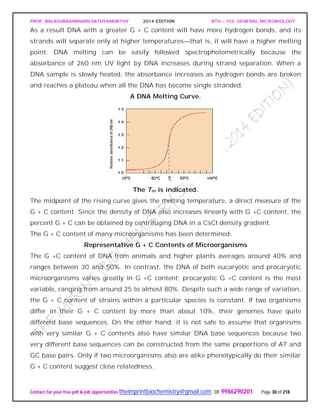
As a result DNA with a greater G + C content will have more hydrogen bonds, and its
strands will separate only at higher temperatures—that is, it will have a higher melting
point. DNA melting can be easily followed spectrophotometrically because the
absorbance of 260 nm UV light by DNA increases during strand separation. When a
DNA sample is slowly heated, the absorbance increases as hydrogen bonds are broken
and reaches a plateau when all the DNA has become single stranded.
A DNA Melting Curve.
The Tm is indicated.
The midpoint of the rising curve gives the melting temperature, a direct measure of the
G + C content. Since the density of DNA also increases linearly with G +C content, the
percent G + C can be obtained by centrifuging DNA in a CsCl density gradient.
The G + C content of many microorganisms has been determined.
Representative G + C Contents of Microorganisms
The G +C content of DNA from animals and higher plants averages around 40% and
ranges between 30 and 50%. In contrast, the DNA of both eucaryotic and procaryotic
microorganisms varies greatly in G +C content; procaryotic G +C content is the most
variable, ranging from around 25 to almost 80%. Despite such a wide range of variation,
the G + C content of strains within a particular species is constant. If two organisms
differ in their G + C content by more than about 10%, their genomes have quite
different base sequences. On the other hand, it is not safe to assume that organisms
with very similar G + C contents also have similar DNA base sequences because two
very different base sequences can be constructed from the same proportions of AT and
GC base pairs. Only if two microorganisms also are alike phenotypically do their similar
G + C content suggest close relatedness.
PROF. BALASUBRAMANIAN SATHYAMURTHY 2014 EDITION BTH – 103: GENERAL MICROBIOLOGY
Contact for your free pdf & job opportunities theimprintbiochemistry@gmail.com or 9986290201 Page 31 of 218
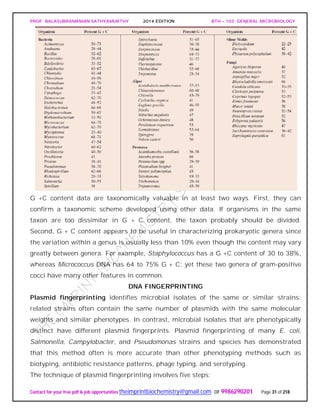
G +C content data are taxonomically valuable in at least two ways. First, they can
confirm a taxonomic scheme developed using other data. If organisms in the same
taxon are too dissimilar in G + C content, the taxon probably should be divided.
Second, G + C content appears to be useful in characterizing prokaryotic genera since
the variation within a genus is usually less than 10% even though the content may vary
greatly between genera. For example, Staphylococcus has a G +C content of 30 to 38%,
whereas Micrococcus DNA has 64 to 75% G + C; yet these two genera of gram-positive
cocci have many other features in common.
DNA FINGERPRINTING
Plasmid fingerprinting identifies microbial isolates of the same or similar strains;
related strains often contain the same number of plasmids with the same molecular
weights and similar phenotypes. In contrast, microbial isolates that are phenotypically
distinct have different plasmid fingerprints. Plasmid fingerprinting of many E. coli,
Salmonella, Campylobacter, and Pseudomonas strains and species has demonstrated
that this method often is more accurate than other phenotyping methods such as
biotyping, antibiotic resistance patterns, phage typing, and serotyping.
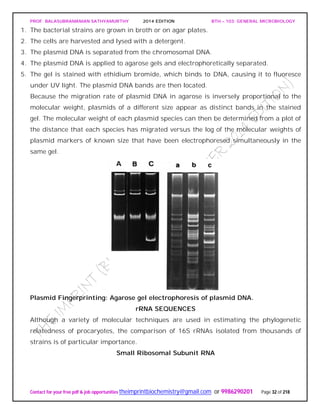
The technique of plasmid fingerprinting involves five steps:
PROF. BALASUBRAMANIAN SATHYAMURTHY 2014 EDITION BTH – 103: GENERAL MICROBIOLOGY
Contact for your free pdf & job opportunities theimprintbiochemistry@gmail.com or 9986290201 Page 32 of 218
1. The bacterial strains are grown in broth or on agar plates.
2. The cells are harvested and lysed with a detergent.
3. The plasmid DNA is separated from the chromosomal DNA.
4. The plasmid DNA is applied to agarose gels and electrophoretically separated.
5. The gel is stained with ethidium bromide, which binds to DNA, causing it to fluoresce
under UV light. The plasmid DNA bands are then located.
Because the migration rate of plasmid DNA in agarose is inversely proportional to the
molecular weight, plasmids of a different size appear as distinct bands in the stained
gel. The molecular weight of each plasmid species can then be determined from a plot of
the distance that each species has migrated versus the log of the molecular weights of
plasmid markers of known size that have been electrophoresed simultaneously in the
same gel.
Plasmid Fingerprinting: Agarose gel electrophoresis of plasmid DNA.
rRNA SEQUENCES
Although a variety of molecular techniques are used in estimating the phylogenetic
relatedness of procaryotes, the comparison of 16S rRNAs isolated from thousands of
strains is of particular importance.
Small Ribosomal Subunit RNA
PROF. BALASUBRAMANIAN SATHYAMURTHY 2014 EDITION BTH – 103: GENERAL MICROBIOLOGY
Contact for your free pdf & job opportunities theimprintbiochemistry@gmail.com or 9986290201 Page 33 of 218
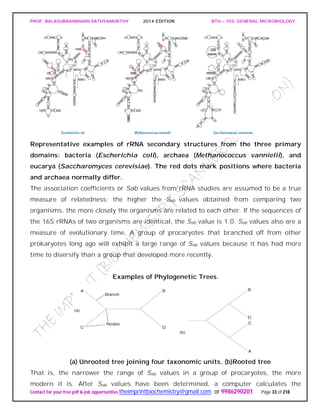
Representative examples of rRNA secondary structures from the three primary
domains: bacteria (Escherichia coli), archaea (Methanococcus vannielii), and
eucarya (Saccharomyces cerevisiae). The red dots mark positions where bacteria
and archaea normally differ.
The association coefficients or Sab values from rRNA studies are assumed to be a true
measure of relatedness; the higher the Sab values obtained from comparing two
organisms, the more closely the organisms are related to each other. If the sequences of
the 16S rRNAs of two organisms are identical, the Sab value is 1.0. Sab values also are a
measure of evolutionary time. A group of procaryotes that branched off from other
prokaryotes long ago will exhibit a large range of Sab values because it has had more
time to diversify than a group that developed more recently.
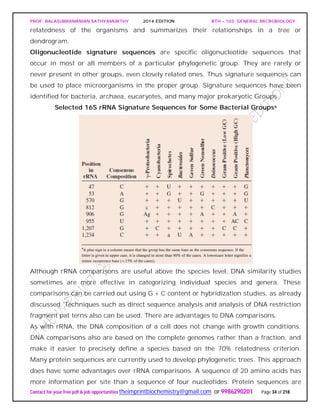
Examples of Phylogenetic Trees.
(a) Unrooted tree joining four taxonomic units. (b)Rooted tree
That is, the narrower the range of Sab values in a group of procaryotes, the more
modern it is. After Sab values have been determined, a computer calculates the
PROF. BALASUBRAMANIAN SATHYAMURTHY 2014 EDITION BTH – 103: GENERAL MICROBIOLOGY
Contact for your free pdf & job opportunities theimprintbiochemistry@gmail.com or 9986290201 Page 34 of 218
relatedness of the organisms and summarizes their relationships in a tree or
dendrogram.
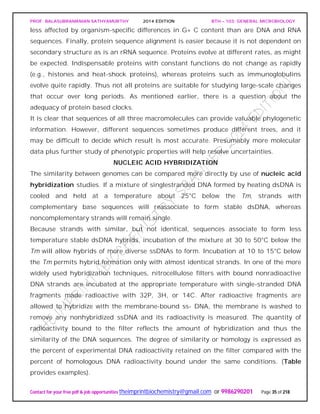
Oligonucleotide signature sequences are specific oligonucleotide sequences that
occur in most or all members of a particular phylogenetic group. They are rarely or
never present in other groups, even closely related ones. Thus signature sequences can
be used to place microorganisms in the proper group. Signature sequences have been
identified for bacteria, archaea, eucaryotes, and many major prokaryotic Groups.
Selected 16S rRNA Signature Sequences for Some Bacterial Groupsa
Although rRNA comparisons are useful above the species level, DNA similarity studies
sometimes are more effective in categorizing individual species and genera. These
comparisons can be carried out using G + C content or hybridization studies, as already
discussed. Techniques such as direct sequence analysis and analysis of DNA restriction
fragment pat terns also can be used. There are advantages to DNA comparisons.
As with rRNA, the DNA composition of a cell does not change with growth conditions.
DNA comparisons also are based on the complete genomes rather than a fraction, and
make it easier to precisely define a species based on the 70% relatedness criterion.
Many protein sequences are currently used to develop phylogenetic trees. This approach
does have some advantages over rRNA comparisons. A sequence of 20 amino acids has
more information per site than a sequence of four nucleotides. Protein sequences are
PROF. BALASUBRAMANIAN SATHYAMURTHY 2014 EDITION BTH – 103: GENERAL MICROBIOLOGY
Contact for your free pdf & job opportunities theimprintbiochemistry@gmail.com or 9986290201 Page 35 of 218
less affected by organism-specific differences in G+ C content than are DNA and RNA
sequences. Finally, protein sequence alignment is easier because it is not dependent on
secondary structure as is an rRNA sequence. Proteins evolve at different rates, as might
be expected. Indispensable proteins with constant functions do not change as rapidly
(e.g., histones and heat-shock proteins), whereas proteins such as immunoglobulins
evolve quite rapidly. Thus not all proteins are suitable for studying large-scale changes
that occur over long periods. As mentioned earlier, there is a question about the
adequacy of protein based clocks.
It is clear that sequences of all three macromolecules can provide valuable phylogenetic
information. However, different sequences sometimes produce different trees, and it
may be difficult to decide which result is most accurate. Presumably more molecular
data plus further study of phenotypic properties will help resolve uncertainties.
NUCLEIC ACID HYBRIDIZATION
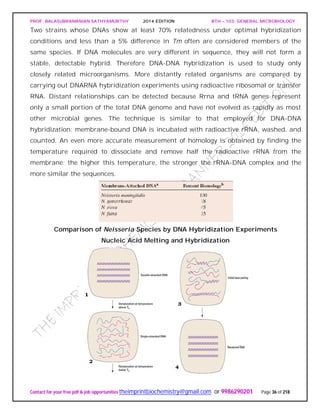
The similarity between genomes can be compared more directly by use of nucleic acid
hybridization studies. If a mixture of singlestranded DNA formed by heating dsDNA is
cooled and held at a temperature about 25°C below the Tm, strands with
complementary base sequences will reassociate to form stable dsDNA, whereas
noncomplementary strands will remain single.
Because strands with similar, but not identical, sequences associate to form less
temperature stable dsDNA hybrids, incubation of the mixture at 30 to 50°C below the
Tm will allow hybrids of more diverse ssDNAs to form. Incubation at 10 to 15°C below
the Tm permits hybrid formation only with almost identical strands. In one of the more
widely used hybridization techniques, nitrocellulose filters with bound nonradioactive
DNA strands are incubated at the appropriate temperature with single-stranded DNA
fragments made radioactive with 32P, 3H, or 14C. After radioactive fragments are
allowed to hybridize with the membrane-bound ss- DNA, the membrane is washed to
remove any nonhybridized ssDNA and its radioactivity is measured. The quantity of
radioactivity bound to the filter reflects the amount of hybridization and thus the
similarity of the DNA sequences. The degree of similarity or homology is expressed as
the percent of experimental DNA radioactivity retained on the filter compared with the
percent of homologous DNA radioactivity bound under the same conditions. (Table
provides examples).
PROF. BALASUBRAMANIAN SATHYAMURTHY 2014 EDITION BTH – 103: GENERAL MICROBIOLOGY
Contact for your free pdf & job opportunities theimprintbiochemistry@gmail.com or 9986290201 Page 36 of 218
Two strains whose DNAs show at least 70% relatedness under optimal hybridization
conditions and less than a 5% difference in Tm often are considered members of the
same species. If DNA molecules are very different in sequence, they will not form a
stable, detectable hybrid. Therefore DNA-DNA hybridization is used to study only
closely related microorganisms. More distantly related organisms are compared by
carrying out DNARNA hybridization experiments using radioactive ribosomal or transfer
RNA. Distant relationships can be detected because Rrna and tRNA genes represent
only a small portion of the total DNA genome and have not evolved as rapidly as most
other microbial genes. The technique is similar to that employed for DNA-DNA
hybridization: membrane-bound DNA is incubated with radioactive rRNA, washed, and
counted. An even more accurate measurement of homology is obtained by finding the
temperature required to dissociate and remove half the radioactive rRNA from the
membrane; the higher this temperature, the stronger the rRNA-DNA complex and the
more similar the sequences.
Comparison of Neisseria Species by DNA Hybridization Experiments
Nucleic Acid Melting and Hybridization
PROF. BALASUBRAMANIAN SATHYAMURTHY 2014 EDITION BTH – 103: GENERAL MICROBIOLOGY
Contact for your free pdf & job opportunities theimprintbiochemistry@gmail.com or 9986290201 Page 37 of 218
Complementary strands are shown in different colors.
NUMERICAL TAXONOMY
The development of computers has made possible the quantitative approach known as
numerical taxonomy. Peter H. A. Sneath and Robert Sokal have defined numerical
taxonomy as “the grouping by numerical methods of taxonomic units into taxa on the
basis of their character states.” Information about the properties of organisms is
converted into a form suitable for numerical analysis and then compared by means of a
computer. The resulting classification is based on general similarity as judged by
comparison of many characteristics, each given equal weight. This approach was not
feasible before the advent of computers because of the large number of calculations
involved. The process begins with a determination of the presence or absence of selected
characters in the group of organisms under study. A character usually is defined as an
attribute about which a single statement can be made. Many characters, at least 50
and preferably several hundred, should be compared for an accurate and reliable
classification. It is best to include many different kinds of data: morphological,
biochemical, and physiological.
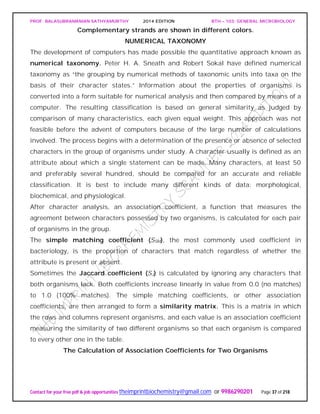
After character analysis, an association coefficient, a function that measures the
agreement between characters possessed by two organisms, is calculated for each pair
of organisms in the group.
The simple matching coefficient (SSM), the most commonly used coefficient in
bacteriology, is the proportion of characters that match regardless of whether the
attribute is present or absent.
Sometimes the Jaccard coefficient (SJ) is calculated by ignoring any characters that
both organisms lack. Both coefficients increase linearly in value from 0.0 (no matches)
to 1.0 (100% matches). The simple matching coefficients, or other association
coefficients, are then arranged to form a similarity matrix. This is a matrix in which
the rows and columns represent organisms, and each value is an association coefficient
measuring the similarity of two different organisms so that each organism is compared
to every other one in the table.
The Calculation of Association Coefficients for Two Organisms
PROF. BALASUBRAMANIAN SATHYAMURTHY 2014 EDITION BTH – 103: GENERAL MICROBIOLOGY
Contact for your free pdf & job opportunities theimprintbiochemistry@gmail.com or 9986290201 Page 38 of 218
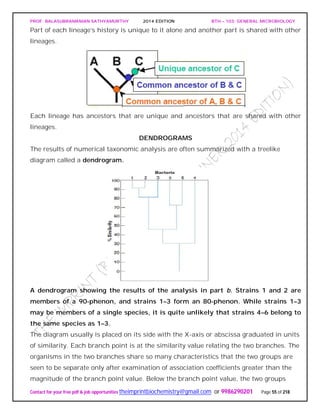
Clustering in Numerical Taxonomy.
(a) A small similarity matrix that compares six strains of bacteria. The degree of
similarity ranges from none (0.0) to complete similarity (1.0).
(b) The bacteria have been rearranged and joined to form clusters of similar
strains. For example, strains 1 and 2 are the most similar. The cluster of 1 plus 2
is fairly similar to strain 3, but not at all to strain 4
Organisms with great similarity are grouped together and separated from dissimilar
organisms; such groups of organisms are called phenons (sometimes called phenoms).
Numerical taxonomy has already proved to be a powerful tool in microbial taxonomy.
Although it often has simply reconfirmed already existing classification schemes,
sometimes accepted classifications are found wanting. Numerical taxonomic methods
also can be used to compare sequences of macromolecules such as RNA and proteins.
PROF. BALASUBRAMANIAN SATHYAMURTHY 2014 EDITION BTH – 103: GENERAL MICROBIOLOGY
Contact for your free pdf & job opportunities theimprintbiochemistry@gmail.com or 9986290201 Page 39 of 218
CHEMOTAXONOMY
Chemotaxonomy is the systematic study of chemical variation between plant taxa.
Evidence of chemical variation has essentially been used for classification purpose serve
since ' folk taxonomies’, based on certain obvious plant characteristics were
instinctively employed by mankind centuries ago. These categories, such as edibility,
taste, colour, smell and medicinal value were founded, however unknowingly, on
chemical properties. As long ago as the first century after Christ the aromatic mints had
been recognized and grouped together by Dioscorides.
Awareness of the chemical complexity of plants grew from the desires of Europeans for
exotic spices and condiments as well as investigations into their medicinal properties.
Early knowledge about the subject was summarized in herbals, and concentrated on
information about physiologically active secondary metabolite such as alkaloids and
saponins.
Dur ing the eighteenth and nineteenth century’s knowledge in the field increased, and
some taxonomists made use of several chemical characteristics in attempts to classify
plants and to demonstrate their phylogeny. However, although the chemical characters
they used were recognized, they were manifestations of processes or compounds not yet
completely identified and so their use was based on inadequate knowledge and
evidence.
Gradually the number of recognized natural plant products increased, extending to
include proteins, nucleicacids and the major polysaccharide categories. At the same
time research into plant metabolism revealed similarities and uniformities in the
chemical functioning of plants, while simultaneously highlighting biochemical peculiar
ities which might be taxonomically or phylogenetically significant.
Successful attempts were made to correlatet his variation with known classifications,
and many claims were made as to the taxonomic merit of various chemical character.
However it is only in recent decades that reasonably rapid surveys of plant extracts
have become feasible, due to improved techniques of chemical analysis and the
elucidation of the structures of many organic compounds. Technological advances,
particularly electrophoresis and chromatography, have simplified and speeded up
analyses, and also often made analysis of smaller amounts of material viable. This is
Particularly valuable when rare herbarium material must be used.
PROF. BALASUBRAMANIAN SATHYAMURTHY 2014 EDITION BTH – 103: GENERAL MICROBIOLOGY
Contact for your free pdf & job opportunities theimprintbiochemistry@gmail.com or 9986290201 Page 40 of 218
It is now generally accepted that certain compounds and related substances may be
characteristic of certain taxonomic groups, and certainly chemotaxonomic
investigations have been employed a tall levels of the taxonomic hierarchy, from sub
variety to division.
It is thought that when the groups in question differentiated, the ability to form a
chemical substance was retained by virtue of metabolic processes retained by the group
or its ancestors. By implication we see that if the pathway of chemical evolution were
established then this might of fer insight to the evolutionary history of the group, as
well as to the understanding of the present –day relationships within and between
groups.
Research has shown that there is generally an inverse relationship between the
taxonomic distribution of a compound or class of compounds and its biogenetic
complexity such that if it is biosynthetically simple and wide spread it may be assumed
to be primitive, while those more limited in their distribution and more complex to
biosynthesise may be assumed more advanced.
However these assumptions prove simplistic when phylogenetic inferences are to be
made from chemical data. Davisand Heywood indicates the following general
complications: -
Chemical compounds and/or biosynthetic pathways are not always environmentally
stable, and so their presence ma y be affected quantitatively or qualitatively by factors
such as temperature or mineral deficiencies.
Biosynthetic knowledge is inadequate about a great many of the chemical characters
used in taxonomy, so that parallelism or convergence might confuse perception of
phylogeny. A compound might arise via two or more entirely distinct biosynthetic
pathways (convergence) and its presence would thus not necessarily imply a
relationship between taxain which it occurs. Quote the case of napthoquinone which
may arise in higher plants via four different pathways).P arallelism may cause similar
end products to arise in related groups, particularly when they are derived from
ubiquitous metabolic intermediates.
In many cases it is not known whether metabolic pathways are reversible or not, and
reversal of a pathway confuses the issue of whether a character is primitive or derived
in a specific taxon.
PROF. BALASUBRAMANIAN SATHYAMURTHY 2014 EDITION BTH – 103: GENERAL MICROBIOLOGY
Contact for your free pdf & job opportunities theimprintbiochemistry@gmail.com or 9986290201 Page 41 of 218
Large and/or complex molecules are not necessarily the most advanced. Chemical
reduction may occur in plants due to metabolic changes.
Chemical and morphological features may have evolved at different speeds due to
differing selection pressures, and thus on emight find primitive chemical characters
together with advanced morphology in a taxon.
Chemical variability occurs- for example, over a geographic range, or via, chemical
mutants within species. Chemistry may also vary between ontogenetic stages of organs
analysed.
CLASSIFICATION OF BACTERIA ACCORDING TO BERGEY’S MANUAL OF
SYSTEMIC BACTERIOLOGY
Bergey’s Manual of Systematic Bacteriology
In 1923, David Bergey, professor of bacteriology at the University of Pennsylvania, and
four colleagues published a classification of bacteria that could be used for
identification of bacterial species, the Bergey’s Manual of Determinative Bacteriology.
This manual is now in its ninth edition. The first edition of Bergey’s Manual of
Systematic Bacteriology, a more detailed work that contains descriptions of all
procaryotic species currently identified, also is available.
The first volume of the second edition has been published recently. This section briefly
describes the current edition of Bergey’s Manual of Systematic Bacteriology (or Bergey’s
Manual) and then discusses at more length the new second edition.
Because it has not been possible in the past to classify procaryotes satisfactorily based
on phylogenetic relationships, the system given in the first edition of Bergey’s Manual of
Systematic Bacteriology is primarily phenetic. Each of the 33 sections in the four
volumes contains procaryotes that share a few easily determined characteristics and
bears a title that either describes these properties or provides the vernacular names of
the procaryotes included. The characteristics used to define sections are normally
features such as general shape and morphology, Gram-staining properties, oxygen
relationship, motility, the presence of endospores, the mode of energy production, and
so forth. Procaryotic groups are divided among the four volumes in the following
manner: (1) gramnegative bacteria of general, medical, or industrial importance; (2)
gram-positive bacteria other than actinomycetes; (3) gramnegative bacteria with
distinctive properties, cyanobacteria, and archaea; and (4) actinomycetes (gram-positive
filamentous bacteria).
PROF. BALASUBRAMANIAN SATHYAMURTHY 2014 EDITION BTH – 103: GENERAL MICROBIOLOGY
Contact for your free pdf & job opportunities theimprintbiochemistry@gmail.com or 9986290201 Page 42 of 218
The First Edition of Bergey’s Manual of Systematic Bacteriology
Some Characteristic Differences between Gram-Negative and Gram-Positive
Bacteria.
Gram-staining properties play a singularly important role in this phenetic classification;
they even determine the volume into which a species is placed. There are good reasons
for this significance. Gram staining usually reflects fundamental differences in bacterial
wall structure. Gram-staining properties also are correlated with many other properties
of bacteria.
Typical gram-negative bacteria, gram-positive bacteria, and mycoplasmas (bacteria
lacking walls) differ in many characteristics, as can be seen in table.
For these and other reasons, bacteria traditionally have been classified as gram positive
or gram negative. This approach is retained to some extent in more phylogenetic
classifications and is a useful way to think about bacterial diversity.
The Second Edition of Bergey’s Manual of Systematic Bacteriology
There has been enormous progress in procaryotic taxonomy since 1984, the year the
first volume of Bergey’s Manual of Systematic Bacteriology was published. In particular,
the sequencing of rRNA, DNA, and proteins has made phylogenetic analysis of
procaryotes feasible. As a consequence, the second edition of Bergey’s Manual will be
largely phylogenetic rather than phenetic and thus quite different from the first edition.
Although the new edition will not be completed for some time, it is so important that its
general features will be described here. Undoubtedly the details will change as work
progresses, but the general organization of the new Bergey’s Manual can be
summarized.
PROF. BALASUBRAMANIAN SATHYAMURTHY 2014 EDITION BTH – 103: GENERAL MICROBIOLOGY
Contact for your free pdf & job opportunities theimprintbiochemistry@gmail.com or 9986290201 Page 43 of 218
The second edition will be published in five volumes. It will have more ecological
information about individual taxa. The second edition will not group all the clinically
important procaryotes together as the first edition did. Instead, pathogenic species will
be placed phylogenetically and thus scattered throughout the following five volumes.
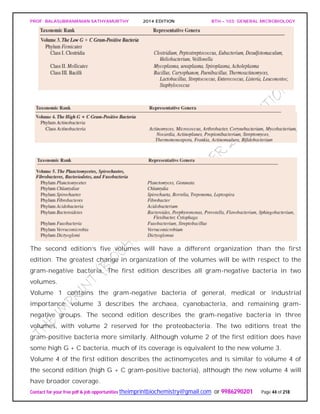
Volume 1—The Archaea, and the Deeply Branching and Phototrophic Bacteria
Volume 2—The Proteobacteria
Volume 3—The Low G + C Gram-Positive Bacteria
Volume 4—The High G + C Gram-Positive Bacteria
Volume 5—The Planctomycetes, Spirochaetes, Fibrobacteres, Bacteroidetes, and
Fusobacteria (Volume 5 also will contain a section that updates descriptions and
phylogenetic arrangements that have been revised since publication of volume 1.)
Organization of Bergey’s Manual of Systematic Bacteriology
PROF. BALASUBRAMANIAN SATHYAMURTHY 2014 EDITION BTH – 103: GENERAL MICROBIOLOGY
Contact for your free pdf & job opportunities theimprintbiochemistry@gmail.com or 9986290201 Page 44 of 218
The second edition’s five volumes will have a different organization than the first
edition. The greatest change in organization of the volumes will be with respect to the
gram-negative bacteria. The first edition describes all gram-negative bacteria in two
volumes.
Volume 1 contains the gram-negative bacteria of general, medical or industrial
importance; volume 3 describes the archaea, cyanobacteria, and remaining gram-
negative groups. The second edition describes the gram-negative bacteria in three
volumes, with volume 2 reserved for the proteobacteria. The two editions treat the
gram-positive bacteria more similarly. Although volume 2 of the first edition does have
some high G + C bacteria, much of its coverage is equivalent to the new volume 3.
Volume 4 of the first edition describes the actinomycetes and is similar to volume 4 of
the second edition (high G + C gram-positive bacteria), although the new volume 4 will
have broader coverage.
PROF. BALASUBRAMANIAN SATHYAMURTHY 2014 EDITION BTH – 103: GENERAL MICROBIOLOGY
Contact for your free pdf & job opportunities theimprintbiochemistry@gmail.com or 9986290201 Page 45 of 218
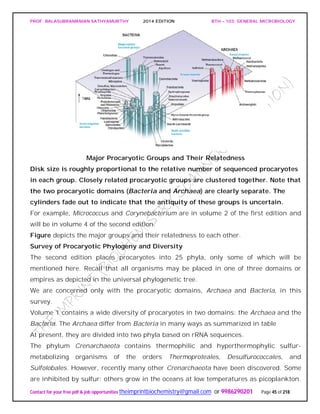
Major Procaryotic Groups and Their Relatedness
Disk size is roughly proportional to the relative number of sequenced procaryotes
in each group. Closely related procaryotic groups are clustered together. Note that
the two procaryotic domains (Bacteria and Archaea) are clearly separate. The
cylinders fade out to indicate that the antiquity of these groups is uncertain.
For example, Micrococcus and Corynebacterium are in volume 2 of the first edition and
will be in volume 4 of the second edition.
Figure depicts the major groups and their relatedness to each other.
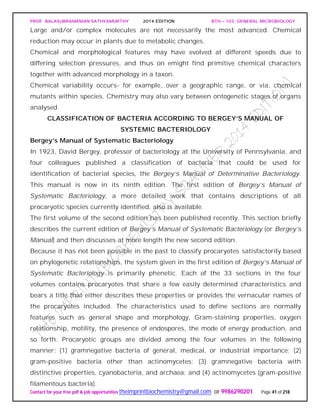
Survey of Procaryotic Phylogeny and Diversity
The second edition places procaryotes into 25 phyla, only some of which will be
mentioned here. Recall that all organisms may be placed in one of three domains or
empires as depicted in the universal phylogenetic tree.
We are concerned only with the procaryotic domains, Archaea and Bacteria, in this
survey.
Volume 1 contains a wide diversity of procaryotes in two domains: the Archaea and the
Bacteria. The Archaea differ from Bacteria in many ways as summarized in table
At present, they are divided into two phyla based on rRNA sequences.
The phylum Crenarchaeota contains thermophilic and hyperthermophylic sulfur-
metabolizing organisms of the orders Thermoproteales, Desulfurococcales, and
Sulfolobales. However, recently many other Crenarchaeota have been discovered. Some
are inhibited by sulfur; others grow in the oceans at low temperatures as picoplankton.
PROF. BALASUBRAMANIAN SATHYAMURTHY 2014 EDITION BTH – 103: GENERAL MICROBIOLOGY
Contact for your free pdf & job opportunities theimprintbiochemistry@gmail.com or 9986290201 Page 46 of 218
The phylum clearly is more diverse than first thought. The second phylum, the
Euryarchaeota, contains primarily methanogenic procaryotes and halophilic
procaryotes; thermophilic, sulfur-reducing organisms (the thermoplasmas and
thermococci) also are in this phylum.
The two phyla are divided into eight classes and 12 orders. The bacteria are an
extraordinarily diverse assemblage of procaryotes that have been divided into 23 phyla.
In volume 1 are placed deeply branching bacterial groups and phototrophic bacteria.
The more important phyla are described in the following sections.
1. Phylum Aquificae. The phylum Aquificae contains autotrophic bacteria such as Aquifex
and Hydrogenobacter that can use hydrogen for energy production. Aquifex (meaning
“water maker”) actually produces water by using hydrogen to reduce oxygen. This group
contains some of the most thermophilic organisms known and is the deepest or earliest
branch of the bacteria.
2. Phylum Thermotogae. This phylum is composed of one class and five genera.
Thermotoga and other members of the class Thermotogae are anaerobic, thermophilic,
fermentative, gram-negative bacteria that have unusual fatty acids and resemble
Aquifex with respect to their etherlinked lipids.
3. Phylum “Deinococcus Thermus.” The order Deinococcales contains bacteria that are
extraordinarily radiation resistant. The genus Deinococcus is gram positive. It has high
concentrations of carotenoid pigments, which may protect it from radiation, and unique
lipids.
4. Phylum Chloroflexi: The phylum Chloroflexi has one class and two orders. Many
members of this gram-negative group are called green nonsulfur bacteria. Chloroflexus
carries out anoxygenic photosynthesis and is a gliding bacterium; in contrast,
Herpetosiphon is a nonphotosynthetic, respiratory gliding bacterium. Both genera have
unusual peptidoglycans and lack lipopolysaccharides in their outer membranes.
5. Phylum Cyanobacteria. The oxygenic photosynthetic bacteria are placed in the phylum
Cyanobacteria, which contains the class Cyanobacteria and five subsections.
Cyanobacteria have chlorophyll a and almost all species possess phycobilins. These
bacteria can be unicellular or filamentous, either branched or unbranched. The
cyanobacteria in the subsections differ from each other in general morphological
characteristics and reproduction. Cyanobacteria incorporate CO2 photosynthetically
PROF. BALASUBRAMANIAN SATHYAMURTHY 2014 EDITION BTH – 103: GENERAL MICROBIOLOGY
Contact for your free pdf & job opportunities theimprintbiochemistry@gmail.com or 9986290201 Page 47 of 218
through use of the Calvin cycle just like plants and many purple photosynthetic
bacteria.
6. Phylum Chlorobi. The phylum Chlorobi contains anoxygenic photosynthetic bacteria
known as the green sulfur bacteria. They can incorporate CO2 through the reductive
tricarboxylic acid cycle rather than the Calvin cycle and oxidize sulfide to sulfur
granules, which accumulate outside the cell.
Volume 2 of the second edition is devoted completely to the gram-negative
proteobacteria, often called the purple bacteria. The phylum Proteobacteria is a large
and extremely complex group that currently contains over 1,300 species in 384 genera.
Even though they are all related, the group is quite diverse in morphology, physiology,
and life-style. All major nutritional types are represented: phototrophy, heterotrophy,
and chemolithotrophy of several varieties. Many species important in medicine,
industry, and biological research are proteobacteria. Obvious examples are the genera
Escherichia, Neisseria, Pseudomonas, Rhizobium, Rickettsia, Salmonella, and Vibrio. The
phylum is divided into five classes based on rRNA data. Because photosynthetic
bacteria are found in the α, β, and γ classes of the proteobacteria, many believe that the
whole phylum arose from a photosynthetic ancestor. Presumably many strains lost
photosynthesis when adapting metabolically to new ecological niches.
1. Class I—Alphaproteobacteria. The α proteobacteria includes most of the oligotrophic
forms (those capable of growing at low nutrient levels). Rhodospirillum and other purple
nonsulfur bacteria are photosynthetic. Some genera have unusual metabolic modes:
methylotrophy (e.g., Methylobacterium), chemolithotrophy (Nitrobacter), and nitrogen
fixation (Rhizobium). Rickettsia and Brucella are important pathogens. About half of the
microbes in this group have distinctive morphology such as prosthecae (Caulobacter,
Hyphomicrobium).
2. Class II—Betaproteobacteria. The β-proteobacteria overlap the α subdivision
metabolically. However the β- proteobacteria tend to use substances that diffuse from
organic decomposition in the anaerobic zone of habitats. Some of these bacteria use
such substances as hydrogen (Alcaligenes), ammonia (Nitrosomonas), methane
(Methylobacillus), or volatile fatty acids (Burkholderia).
3. Class III—Gammaproteobacteria. The γ-proteobacteria compose a large and complex
group of thirteen orders and 20 families. They often are chemoorganotrophic,
facultatively anaerobic, and fermentative. However, there is considerable diversity
PROF. BALASUBRAMANIAN SATHYAMURTHY 2014 EDITION BTH – 103: GENERAL MICROBIOLOGY
Contact for your free pdf & job opportunities theimprintbiochemistry@gmail.com or 9986290201 Page 48 of 218
among the γ-proteobacteria with respect to energy metabolism. Some important families
such as Enterobacteriaceae, Vibrionaceae, and Pasteurellaceae use the Embden-
Meyerhof pathway and the pentose phosphate pathway. Others such as the
Pseudomonadaceae and Azotobacteriaceae are aerobes and have the Entner-Doudoroff
and pentose phosphate pathways. A few are photosynthetic (e.g., Chromatium and
Ectothiorhodospira), methylotrophic (Methylococcus), or sulfur-oxidizing (Beggiatoa).
4. Class IV—Deltaproteobacteria. The -proteobacteria contain seven orders, and 17
families. Many of these bacteria can be placed in one of three groups. Some are
predators on other bacteria as the class name implies (e.g., Bdellovibrio). The order
Myxococcales contains the fruiting myxobacteria such as Myxococcus, Stigmatella, and
Polyangium. The myxobacteria often also prey on other bacteria. Finally, the class has a
variety of anaerobes that generate sulfide from sulfate and sulfur while oxidizing
organic nutrients (Desulfovibrio).
5. Class V—Epsilonproteobacteria. This section is composed of only one order,
Campylobacterales, and two families. Despite its small size two important pathogenic
genera are €-proteobacteria: Campylobacter and Helicobacter.
Volume 3 of Bergey’s Manual surveys the gram-positive bacteria with low G + C content
in their DNA, which are members of the phylum Firmicutes. The dividing line is about
50% G +C; bacteria with a mol% lower than this value are in volume 3. Most of these
bacteria are gram positive and heterotrophic. However because of their close
relationship to low G + C gram-positive bacteria, the mycoplasmas are placed here even
though they lack cell walls and stain gram negative. There is considerable variation in
morphology: some are rods, others are cocci, and mycoplasmas are pleomorphic.
Endospores may be present. The phylum contains three classes.
1. Class I—Clostridia. This class contains three orders and 11 families. Although they vary
in morphology and size, the members tend to be anaerobic. Genera such as Clostridium,
Desulfotomaculum, and Sporohalobacter form true bacterial endospores; many others do
not. Clostridium is one of the largest bacterial genera.
2. Class II—Mollicutes. The class Mollicutes contains five orders and six families. Members
of the class often are called mycoplasmas. These bacteria lack cell walls and cannot
make peptidoglycan or its precursors. Because mycoplasmas are bounded by the
plasma membrane, they are pleomorphic and vary in shape from cocci to helical or
branched filaments. They are normally nonmotile and stain gram negative because of
PROF. BALASUBRAMANIAN SATHYAMURTHY 2014 EDITION BTH – 103: GENERAL MICROBIOLOGY
Contact for your free pdf & job opportunities theimprintbiochemistry@gmail.com or 9986290201 Page 49 of 218
the absence of a cell wall. In contrast with almost all other bacteria, most species
require sterols for growth. The genera Mycoplasma and Spiroplasma contain several
important animal and plant pathogens.
3. Class III—Bacilli. This large class comprises a wide variety of gram positive, aerobic or
facultatively anaerobic, rods and cocci. The class Bacilli has two orders, Bacillales and
Lactobacillales, and 16 families. As with the members of the class Clostridia, some
genera (e.g., Bacillus, Sporosarcina, Paenibacillus, and Sporolactobacillus) form true
endospores.
The section contains many medically and industrially important genera: Bacillus,
Lactobacillus, Streptococcus, Lactococcus, Enterococcus, Listeria, and Staphylococcus.
Volume 4 is devoted to the high G +C gram positives, those bacteria with mol% values
above 50 to 55%. All bacteria in this volume are placed in the phylum Actinobacteria
and class Actinobacteria. There is enormous morphological variety among these
procaryotes. Some are cocci, others are regular or irregular rods. High G + C gram
positives called actinomycetes often form complex branching hyphae. Although none of
these bacteria produce true endospores, many genera do form a variety of asexual
spores and some have complex life cycles. There is considerable variety in cell wall
chemistry among the high G+ C gram positives.
For example, the composition of peptidoglycan varies greatly. Mycobacteria produce
large mycolic acids that distinguish their walls from those of other bacteria.
The taxonomy of these bacteria is very complex. There are five subclasses, six orders,
14 suborders, and 40 families. Genera such as Actinomyces, Arthrobacter,
Corynebacterium, Micrococcus, Mycobacterium, and Propionibacterium were placed in
volume 2 of the first edition.
They are now in the new volume 4 within the suborders Actinomycineae, Micrococcineae,
Corynebacterineae, and Propionibacterineae because rRNA studies have shown them to
be actinobacteria. The largest and most complex genus is Streptomyces, which contains
over 500 species. Volume 5 describes an assortment of nine phyla that are located here
for convenience. The inclusion of these groups in volume 5 does not imply that they are
directly related. Although they are all gram-negative bacteria, there is considerable
variation in morphology, physiology, and life cycle pattern. Several genera are of
considerable biological or medical importance. We will briefly consider four of the nine
phyla.
PROF. BALASUBRAMANIAN SATHYAMURTHY 2014 EDITION BTH – 103: GENERAL MICROBIOLOGY
Contact for your free pdf & job opportunities theimprintbiochemistry@gmail.com or 9986290201 Page 50 of 218
1. Phylum Planctomycetes. The planctomycetes are related to the chlamydias according to
their rRNA sequences. The phylum contains only one order, one family, and four
genera. Planctomycetes are coccoid to ovoid or pearshaped cells that lack
peptidoglycan. Some have a membrane-enclosed nucleoid. Although they are normally
unicellular, the genus Isosphaera will form chains. They divide by budding and may
produce nonprosthecate appendages called stalks. Planctomycetes grow in aquatic
habitats, and many move by flagella or gliding motility.
2. Phylum Chlamydiae. This small phylum contains one class, one order, and four
families. The genus Chlamydia is by far the most important genus. Chlamydia is an
obligately intracellular parasite with a unique life cycle involving two distinctive stages:
elementary bodies and reticulate bodies. These bacteria do resemble planctomycetes in
lacking peptidoglycan. They are small coccoid organisms with no appendages.
Chlamydias are important pathogens and cause many human diseases.
3. Phylum Spirochaetes. This phylum contains helically shaped, motile, gram-negative
bacteria characterized by a unique morphology and motility mechanism. The exterior
boundary is a special outer membrane that surrounds the protoplasmic cylinder, which
contains the cytoplasm and nucleoid. Periplasmic flagella lie between the protoplasmic
cylinder and the outer membrane. The flagella rotate and move the cell even though
they do not directly contact the external environment. These chemoheterotrophs can be
free living, symbiotic, or parasitic. For example, the genera Treponema and Borrelia
contain several important human pathogens. The phylum has one class, Spirochaetes,
three families, and 13 genera.
4. Phylum Bacteroidetes. This phylum has three classes (Bacteroides, Flavobacteria, and
Sphingobacteria), three orders, and 12 families. Some of the better-known genera are
Bacteroides, Flavobacterium, Flexibacter, and Cytophaga. The gliding bacteria
Flexibacter and Cytophaga are ecologically significant and will be discussed later.
Because Bergey’s Manual is the principal resource in prokaryotic taxonomy and is used
by microbiologists around the world, we will follow Bergey’s Manual in organizing the
survey of prokaryotic diversity.
In so far as possible, the organization of the second edition of Bergey’s Manual will be
employed.
Phylogenetic and organizational details may well change somewhat before publication of
each volume, but the general picture should adequately reflect the second edition.
PROF. BALASUBRAMANIAN SATHYAMURTHY 2014 EDITION BTH – 103: GENERAL MICROBIOLOGY
Contact for your free pdf & job opportunities theimprintbiochemistry@gmail.com or 9986290201 Page 51 of 218
The classification in the first and second editions of Bergey’s Manual are so different
that two appendixes are provided to help in the transition. Appendix III gives the
classification of prokaryotes according to the first edition. Appendix IV describes the
classification system the second edition of Bergey’s Manual will employ. Finally, it must
be emphasized that procaryotic nomenclature is as much in flux as classification. The
names of families and genera are fairly well established and stable in the new system (at
least in the absence of future discoveries); in fact, many family and genus names
remain unchanged in the second edition of Bergey’s Manual. In contrast, the names of
orders and higher taxa are not always completely settled in the second edition.
An excellent way of keeping up to date is through the use of the Bergey’s Manual Trust
web page (www.cme.msu.edu/Bergeys/). The web page has a variety of information
about such topics as Bergey’s Manual, microbial databases, and culture collections.
The web site also contains Bergey’s revision of the Ribosomal Database Project (RDP)
phylogenetic tree and lists of validly named procaryotic species. The phylogenetic tree
and prokaryotic species lists provide a current view of Bergey’s phylogenetic procaryotic
classification. Because the names of kingdoms, classes, and orders are still changing,
their use will be kept to the minimum necessary for consistency with the use of taxa by
the first edition, ease of communication, and student comprehension. Some higher
taxonomic names may well change in the next few years, but we will still employ them
here for the above reasons.
PROF. BALASUBRAMANIAN SATHYAMURTHY 2014 EDITION BTH – 103: GENERAL MICROBIOLOGY
Contact for your free pdf & job opportunities theimprintbiochemistry@gmail.com or 9986290201 Page 52 of 218
DICHOTOMOUS KEYS
Classic Dichotomous Keys for Clinically Important Genera.
Schematic outline for the identification of gram-positive bacteria.
PROF. BALASUBRAMANIAN SATHYAMURTHY 2014 EDITION BTH – 103: GENERAL MICROBIOLOGY
Contact for your free pdf & job opportunities theimprintbiochemistry@gmail.com or 9986290201 Page 53 of 218
Schematic outline for the identification of gram-negative bacteria.
CLADOGRAMS
Cladistics is the study of the pathway of evolution, in which the ancestor–descendant
relationship is always discussed with the topology of a rooted phylogenetic tree, called a
“cladogram”
Cladistics is a method of hypothesizing evolutionary relationships among organisms (i.e.
their phylogeny)
Cladistics was developed in 1950 by the German zoologist, Willi Hennig, but has only
become popular in the last 20-25 years.
Cladistics is based upon the analysis of traits (characters) shared by organisms
The result of a cladistic analysis is a branching tree (cladogram) that represents a
hypothesis about evolutionary relationships.
Assumptions of cladistics
Assumption 1: The characteristics of organisms change over time
Assumption 2: All organisms are related by descent from a common ancestor
Assumption 3: There is a bifurcating or branching pattern of lineage-splitting
The principle of parsimony
PROF. BALASUBRAMANIAN SATHYAMURTHY 2014 EDITION BTH – 103: GENERAL MICROBIOLOGY
Contact for your free pdf & job opportunities theimprintbiochemistry@gmail.com or 9986290201 Page 54 of 218
Cladistics is based upon the principle of parsimony
The principle of parsimony reasons that given several solutions to a problem, the
simplest one should be accepted
In cladisitics, the cladogram that requires the fewest number of evolutionary changes to
explain the distribution of inheritbale traits (characters) is the most parsimonious
The principle of parsimony does not:
– provide absolute truth
– Necessarily reveal the true phylogeny
The principle of parsimony does:
– reduce conjecture
– indicates those cladistic groupings best supported by the available data
Understanding cladograms
The root of the cladogram represents the ancestral lineage and the tips the
descendants.
Branching points in cladograms are called nodes and represent speciation events.
PROF. BALASUBRAMANIAN SATHYAMURTHY 2014 EDITION BTH – 103: GENERAL MICROBIOLOGY
Contact for your free pdf & job opportunities theimprintbiochemistry@gmail.com or 9986290201 Page 55 of 218
Part of each lineage’s history is unique to it alone and another part is shared with other
lineages.
Each lineage has ancestors that are unique and ancestors that are shared with other
lineages.
DENDROGRAMS
The results of numerical taxonomic analysis are often summarized with a treelike
diagram called a dendrogram.
A dendrogram showing the results of the analysis in part b. Strains 1 and 2 are
members of a 90-phenon, and strains 1–3 form an 80-phenon. While strains 1–3
may be members of a single species, it is quite unlikely that strains 4–6 belong to
the same species as 1–3.
The diagram usually is placed on its side with the X-axis or abscissa graduated in units
of similarity. Each branch point is at the similarity value relating the two branches. The
organisms in the two branches share so many characteristics that the two groups are
seen to be separate only after examination of association coefficients greater than the
magnitude of the branch point value. Below the branch point value, the two groups
PROF. BALASUBRAMANIAN SATHYAMURTHY 2014 EDITION BTH – 103: GENERAL MICROBIOLOGY
Contact for your free pdf & job opportunities theimprintbiochemistry@gmail.com or 9986290201 Page 56 of 218
appear to be one. The ordinate in such a dendrogram has no special significance, and
the clusters may be arranged in any convenient order.
The significance of these clusters or phenons in traditional taxonomic terms is not
always evident, and the similarity levels at which clusters are labeled species, genera,
and so on, are a matter of judgment. Sometimes groups are simply called phenons and
preceded by a number showing the similarity level above which they appear (e.g., a 70-
phenon is a phenon with 70% or greater similarity among its constituents). Phenons
formed at about 80% similarity often are equivalent to species.
UNIVERSAL PHYLOGENETIC TREE
Following the publication in 1859 of Darwin’s On the Origin of Species, biologists began
trying to develop phylogenetic or phyletic classification systems. These are systems
based on evolutionary relationships rather than general resemblance (the term
phylogeny [Greek phylon, tribe or race, and genesis, generation or origin] refers to the
evolutionary development of a species). This has proven difficult for procaryotes and
other microorganisms, primarily because of the lack of a good fossil record. The direct
comparison of genetic material and gene products such as RNA and proteins overcomes
many of these problems.
The studies of Carl Woese and his collaborators on rRNA sequences in procaryotic cells
suggest that procaryotes divided into two distinct groups very early on.
Figure depicts a universal phylogenetic tree that reflects these views. The tree is divided
into three major branches representing the three primary groups: Bacteria, Archaea,
and Eucarya. The archaea and bacteria first diverged, and then the eucaryotes
developed. These three primary groups are called domains and placed above the
phylum and kingdom levels (the traditional kingdoms are distributed among these three
domains). The domains differ markedly from one another.
Eucaryotic organisms with primarily glycerol fatty acyl diester membrane lipids and
eucaryotic rRNA belong to the Eucarya. The domain Bacteria contains procaryotic
cells with bacterial rRNA and membrane lipids that are primarily diacyl glycerol
diesters. Procaryotes having isoprenoid glycerol diether or diglycerol tetraether lipids in
their membranes and archaeal rRNA compose the third domain, Archaea.
It appears likely that modern eucaryotic cells arose from procaryotes about 1.4 billion
years ago. There has been considerable speculation about how eucaryotes might have
PROF. BALASUBRAMANIAN SATHYAMURTHY 2014 EDITION BTH – 103: GENERAL MICROBIOLOGY
Contact for your free pdf & job opportunities theimprintbiochemistry@gmail.com or 9986290201 Page 57 of 218
developed from procaryotic ancestors. It is not certain how this process occurred, and
two hypotheses have been proposed.
According to the first, nuclei, mitochondria, and chloroplasts arose by invagination of
the plasma membrane to form double-membrane structures containing genetic material
and capable of further development and specialization. The similarities between
chloroplasts, mitochondria, and modern bacteria are due to conservation of primitive
procaryotic features by the slowly changing organelles.
Universal Phylogenetic Tree
These relationships were determined from rRNA sequence comparisons.
PROF. BALASUBRAMANIAN SATHYAMURTHY 2014 EDITION BTH – 103: GENERAL MICROBIOLOGY
Contact for your free pdf & job opportunities theimprintbiochemistry@gmail.com or 9986290201 Page 58 of 218
UNIT – 2: PROKARYOTIC MICROORGANISM
General properties, Structure, and reproduction: Domain Bacteria: Proteobacteria
(Alpha, Beta, Gamma, Delta and Epsilon Proteobacteria), Cyanobacteria,
Chlorobium, Firmicutes, Actinobacteria, Chlamydiae, Spirochaetes, Bacteroidetes,
Fusobacteria. Domain Archea: Crenarchaeota, Euryarchaeota.
GENERAL PROPERTIES, STRUCTURE, AND REPRODUCTION:
DOMAIN BACTERIA: PROTEOBACTERIA - ALPHA
The α-proteobacteria includes most of the oligotrophic proteobacteria (those capable of
growing at low nutrient levels). Some have unusual metabolic modes such as
methylotrophy (Methylobacterium), chemolithotrophy (Nitrobacter), and the ability to fix
nitrogen (Rhizobium). Members of genera such as Rickettsia and Brucella are important
pathogens; in fact, Rickettsia has become an obligately intracellular parasite. Many
genera are characterized by distinctive morphology such as prosthecae. The class
Alphaproteobacteria has six orders and 18 families.
Phylogenetic Relationships Among Selected α - Proteobacteria.
The relationships of a few species based on 16S rRNA sequence data are shown
Figure illustrates the phylogenetic relationships between some typical α-proteobacteria,
and table summarizes the general characteristics of many of the bacteria.
Characteristics of Selected α – Proteobacteria
PROF. BALASUBRAMANIAN SATHYAMURTHY 2014 EDITION BTH – 103: GENERAL MICROBIOLOGY
Contact for your free pdf & job opportunities theimprintbiochemistry@gmail.com or 9986290201 Page 59 of 218
PROTEOBACTERIA –BETA
The β-proteobacteria overlaps the β-proteobacteria metabolically but tend to use
substances that diffuse from organic decomposition in the anaerobic zone of habitats.
Some of these bacteria use hydrogen, ammonia, methane, volatile fatty acids, and
similar substances. As with the β-proteobacteria, there is considerable metabolic
diversity; the β-proteobacteria may be chemoheterotrophs, photolithotrophs,
methylotrophs, and chemolithotrophs. The subgroup contains two genera with
important human pathogens: Neisseria and Bordetella.
The class Betaproteobacteria has six orders and 12 families.
Figure shows the phylogenetic relationships between some species of β-proteobacteria,
and table summarizes the general characteristics of many of the bacteria.
Phylogenetic Relationships among Selected β-Proteobacteria.
PROF. BALASUBRAMANIAN SATHYAMURTHY 2014 EDITION BTH – 103: GENERAL MICROBIOLOGY
Contact for your free pdf & job opportunities theimprintbiochemistry@gmail.com or 9986290201 Page 60 of 218
The relationships of a few species based on 16S rRNA sequence data are shown
here
Characteristics of Selected β-Proteobacteria
PROTEOBACTERIA -GAMMA
Phylogenetic Relationships among Selected γ-Proteobacteria
Characteristics of Selected γ-Proteobacteria
PROF. BALASUBRAMANIAN SATHYAMURTHY 2014 EDITION BTH – 103: GENERAL MICROBIOLOGY
Contact for your free pdf & job opportunities theimprintbiochemistry@gmail.com or 9986290201 Page 61 of 218
The γ -proteobacteria constitute the largest subgroup of proteobacteria with an
extraordinary variety of physiological types. Many important genera are
chemoorganotrophic and facultatively anaerobic. Other genera contain aerobic
chemoorganotrophs, photolithotrophs, chemolithotrophs, or methylotrophs. According
to some DNA-rRNA hybridization studies, the γ-proteobacteria is composed of several
deeply branching groups. One consists of the purple sulfur bacteria; a second includes
the intracellular parasites Legionella and Coxiella. The two largest groups contain a
wide variety of nonphotosynthetic genera. Ribosomal RNA superfamily I is represented
by the families Vibrionaceae, Enterobacteriaceae, and Pasteurellaceae. These bacteria
use the glycolytic and pentose phosphate pathways to catabolize carbohydrates. Most
are facultative anaerobes. Ribosomal RNA superfamily II contains mostly aerobes that
often use the Entner-Doudoroff and pentose phosphate pathways to catabolize many
different kinds of organic molecules.
The genera Pseudomonas, Azotobacter, Moraxella, Xanthomonas, and Acinetobacter
belong to this superfamily. The exceptional diversity of these bacteria is evident from
the fact that the second edition of Bergey’s Manual divides the class Gamma
proteobacteria into 13 orders, 20 families, and around 160 genera.
PROF. BALASUBRAMANIAN SATHYAMURTHY 2014 EDITION BTH – 103: GENERAL MICROBIOLOGY
Contact for your free pdf & job opportunities theimprintbiochemistry@gmail.com or 9986290201 Page 62 of 218
PROTEOBACTERIA –DELTA
Although the δ-proteobacteria are not a large assemblage of genera, they show
considerable morphological and physiological diversity. These bacteria can be divided
into two general groups, all of them chemoorganotrophs. Some genera are predators
such as the bdellovibrios and myxobacteria. Others are anaerobes that generate sulfide
from sulfate and sulfur while oxidizing organic nutrients. The class has seven orders
and 17 families.
Phylogenetic Relationships among Selected δ-Proteobacteria
Characteristics of Selected δ-Proteobacteria
PROTEOBACTERIA -EPSILON
The ε-proteobacteria is the smallest of the five proteobacterial classes. They all are
slender gram-negative rods, which can be straight, curved, or helical. The ε-
proteobacteria has one order, Campylobacterales, and two families, Campylobacteraceae
and Helicobacteraceae. The two most important genera, Campylobacter and
Helicobacter, are microaerophilic, motile, helical or vibrioid, gram-negative rods. Table
summarizes some of the characteristics of these two genera. The genus Campylobacter
PROF. BALASUBRAMANIAN SATHYAMURTHY 2014 EDITION BTH – 103: GENERAL MICROBIOLOGY
Contact for your free pdf & job opportunities theimprintbiochemistry@gmail.com or 9986290201 Page 63 of 218
contains both nonpathogens and species pathogenic for humans and other animals. C.
fetus causes reproductive disease and abortions in cattle and sheep. It is associated
with a variety of conditions in humans ranging from septicemia (pathogens or their
toxins in the blood) to enteritis (inflammation of the intestinal tract). C. jejuni causes
abortion in sheep and enteritis diarrhea in humans. There are at least 14 species of
Helicobacter, all isolated from the stomachs and upper intestines of humans, dogs, cats,
and other mammals.
In developing countries 70 to 90% of the population is infected; developed countries
range from 25 to 50%. Most infections are probably acquired during childhood, but the
precise mode of transmission is unclear. The major human pathogen is Helicobacter
pylori, which is the cause of gastritis and peptic ulcer disease. H. pylori produce large
quantities of urease, and urea hydrolysis appears to be associated with its virulence.
The genomes of Campylobacter jejuni and Helicobacter pylori (both about 1.6 million
base pairs in size) have been sequenced. They are now being studied and compared in
order to understand the life styles and pathogenicity of these bacteria.
CYANOBACTERIA
The cyanobacteria are the largest and most diverse group of photosynthetic bacteria.
There is little agreement about the number of cyanobacterial species. Older
classifications had as many as 2,000 or more species. In one recent system this has
been reduced to 62 species and 24 genera. The second edition of Bergey’s Manual of
Determinative Bacteriology describes 56 genera in some detail. The G +C content of the
group ranges from 35 to 71%. Although cyanobacteria are true procaryotes, their
photosynthetic system closely resembles that of the eucaryotes because they have
chlorophyll a and photosystem II, and carry out oxygenic photosynthesis. Like the red
algae, cyanobacteria use phycobiliproteins as accessory pigments. Photosynthetic
pigments and electron transport chain components are located in thylakoid membranes
lined with particles called phycobilisomes.
PROF. BALASUBRAMANIAN SATHYAMURTHY 2014 EDITION BTH – 103: GENERAL MICROBIOLOGY
Contact for your free pdf & job opportunities theimprintbiochemistry@gmail.com or 9986290201 Page 64 of 218
Cyanobacterial Thylakoids and Phycobilisomes.
Synechococcus lividus with an extensive thylakoid system. The phycobilisomes
lining these thylakoids are clearly visible as granules at location t ( X 85,000).
These contain phycobilin pigments, particularly phycocyanin, and transfer energy to
photosystem II. Carbon dioxide is assimilated through the Calvin cycle, and the reserve
carbohydrate is glycogen. Sometimes they will store extra nitrogen as polymers of
arginine or aspartic acid in cyanophycin granules. Since cyanobacteria lack the enzyme
α-ketoglutarate dehydrogenase, they do not have a fully functional citric acid cycle. The
pentose phosphate pathway plays a central role in their carbohydrate metabolism.
Although many cyanobacteria are obligate photolithoautotrophs, some can grow slowly
in the dark as chemoheterotrophs by oxidizing glucose and a few other sugars. Under
anaerobic conditions Oscillatoria limnetica oxidizes hydrogen sulfide instead of water
and carries out anoxygenic photosynthesis much like the green photosynthetic bacteria.
As these examples illustrate, cyanobacteria are capable of considerable metabolic
flexibility.ci and Nonproteobacteria Gram Negatives
Cyanobacteria also vary greatly in shape and appearance. They range in diameter from
about 1 to 10μ m and may be unicellular, exist as colonies of many shapes, or form
filaments called trichomes.
Oxygenic Photosynthetic Bacteria Representative cyanobacteria
Chroococcus turgidus, two colonies of four cells each ( X600)
PROF. BALASUBRAMANIAN SATHYAMURTHY 2014 EDITION BTH – 103: GENERAL MICROBIOLOGY
Contact for your free pdf & job opportunities theimprintbiochemistry@gmail.com or 9986290201 Page 65 of 218
Nostoc with heterocysts ( X550)
Oscillatoria trichomes seen with Nomarski interference-contrast optics (X250).
The cyanobacteria Anabaena spiroides and Microcystis aeruginosa. The spiral A.
spiroides is covered with a thick gelatinous sheath ( X 1,000).
A trichome is a row of bacterial cells that are in close contact with one another over a
large area. In contrast, adjacent cells in a simple chain (such as those commonly found
in the genus Bacillus) associate by only a small area of contact. Although most appear
blue-green because of phycocyanin, a few are red or brown in color because of the red
pigment phycoerythrin. Despite this variety, cyanobacteria have typical prokaryotic cell
structures and a normal gram-negative type cell wall.
Cyanobacterial Cell Structure
PROF. BALASUBRAMANIAN SATHYAMURTHY 2014 EDITION BTH – 103: GENERAL MICROBIOLOGY
Contact for your free pdf & job opportunities theimprintbiochemistry@gmail.com or 9986290201 Page 66 of 218
a) Schematic diagram of a vegetative cell. The insert shows an enlarged view of
the envelope with its outer membrane and peptidoglycan. (b) Thin section of
Synechocystis during division. Bar = 1μm. Many structures are visible.
They often use gas vesicles to move vertically in the water, and many filamentous
species have gliding motility.
Although cyanobacteria lack flagella, several strains of the marine genus Synechococcus
are able to move at rates of up to 25μm/second by means of an unknown mechanism.
Cyanobacteria show great diversity with respect to reproduction and employ a variety of
mechanisms: binary fission, budding, fragmentation, and multiple fission. In the last
process a cell enlarges and then divides several times to produce many smaller progeny,
which are released upon the rupture of the parental cell. Fragmentation of filamentous
cyanobacteria can generate small, motile filaments called hormogonia. Some species
develop akinetes, specialized, dormant, thick-walled resting cells that are resistant to
desiccation. Often these germinate to form new filaments.
Many filamentous cyanobacteria fix atmospheric nitrogen by means of special cells
called heterocysts.
Examples of Heterocysts and Akinetes
PROF. BALASUBRAMANIAN SATHYAMURTHY 2014 EDITION BTH – 103: GENERAL MICROBIOLOGY
Contact for your free pdf & job opportunities theimprintbiochemistry@gmail.com or 9986290201 Page 67 of 218
Cylindrospermum with terminal heterocysts (H) and subterminal akinetes (A)
(X500).
Anabaena, with heterocysts.
An electron micrograph of an Anabaena heterocyst
Bar = 1μm. Note the cell wall (W), additional outer walls (E), membrane system (M),
and a pore channel to the adjacent cell (P).
Around 5 to 10% of the cells can develop into heterocysts when cyanobacteria are
deprived of both nitrate and ammonia, their preferred nitrogen sources. When
transforming themselves into heterocysts, cyanobacterial cells synthesize a very thick
new wall, reorganize their photosynthetic membranes, discard their phycobiliproteins
and photosystem II, and synthesize the nitrogen-fixing enzyme nitrogenase.
Photosystem I is still functional and produces ATP, but no oxygen arises from noncyclic
photophosphorylation because photosystem II is absent. This inability to generate O2 is
critical because the nitrogenase is extremely oxygen sensitive.
PROF. BALASUBRAMANIAN SATHYAMURTHY 2014 EDITION BTH – 103: GENERAL MICROBIOLOGY
Contact for your free pdf & job opportunities theimprintbiochemistry@gmail.com or 9986290201 Page 68 of 218
The heterocyst wall slows or prevents O2 diffusion into the cell, and any O2 present is
consumed during respiration. The structure and physiology of the heterocyst ensures
that it will remain anaerobic; it is dedicated to nitrogen fixation. It obtains nutrients
from adjacent vegetative cells and contributes fixed nitrogen in the form of the amino
acid glutamine. It should be noted that nitrogen fixation also is carried out by
cyanobacteria that lack heterocysts. Some fix nitrogen under dark, anoxic conditions in
microbial mats. Planktonic forms such as Trichodesmium can fix nitrogen as well.
The classification of cyanobacteria is still in an unsettled state, partly due to the lack of
pure cultures. At present all taxonomic schemes must be considered tentative.
The second edition of Bergey’s Manual divides the cyanobacteria into five subsections
with 56 genera. Table briefly summarizes the major characteristics of the five
subsections. These are distinguished using colony or trichome morphology and
reproductive patterns.
Characteristics of the Cyanobacterial Subsections
Some other properties important in cyanobacterial characterization are cell morphology,
ultrastructure, genetic characteristics, physiology and biochemistry, and
habitat/ecology (preferred habitat and growth habit). The authors consider genera as
tentative and often do not provide species names.
PROF. BALASUBRAMANIAN SATHYAMURTHY 2014 EDITION BTH – 103: GENERAL MICROBIOLOGY
Contact for your free pdf & job opportunities theimprintbiochemistry@gmail.com or 9986290201 Page 69 of 218
Cyanobacterial taxonomy in the second edition of Bergey’s Manual is very similar to
that in the first edition. Probably the major difference is that the order Prochlorales is
separate from the cyanobacteria in the first edition, while in the second edition the
order is dropped and the genera are placed within the phylum Cyanobacteria.
Prochlorophytes are oxygenic phototrophic procaryotes that have both chlorophyll a
and b but lack phycobilins. Thus although they resemble other cyanobacteria with
respect to chlorophyll a, they differ in also possessing chlorophyll b, the only
prokaryotes to do so. Because prochlorophytes lack phycobilin pigments and
phycobilisomes, they are grass-green in color. They resemble chloroplasts in their
pigments and thylakoid structure, but their 5S and 16S rRNAs place them within the
cyanobacteria. The genera are located in subsections I and III.
Although the prochlorophytes have been classified separatelyin the past, the second
edition of Bergey’s Manual places them within the cyanobacteria. The three recognized
prochlorophyte genera are quite different from one another. Prochloron was first
discovered as an extracellular symbiont growing either on the surface or within the
cloacal cavity of marine colonial ascidian invertebrates.
Prochloron
A scanning electron micrograph of Prochloron cells on the surface of a Didemnum
candidum colony.
Prochloron didemni section; transmission electron micrograph (X23,500).
These bacteria are single-celled, spherical, and from 8 to 30μm in diameter. Their mol%
of G+C is 31 to 41. Prochlorothrix is free living, has cylindrical cells that form filaments,
PROF. BALASUBRAMANIAN SATHYAMURTHY 2014 EDITION BTH – 103: GENERAL MICROBIOLOGY
Contact for your free pdf & job opportunities theimprintbiochemistry@gmail.com or 9986290201 Page 70 of 218
and has been found in Dutch lakes. Its DNA has a higher G + C content (53 mol%).
Unlike Prochloron it has been cultured in the laboratory.
Prochlorococcus marinus, less than 1 μm in diameter, has recently been discovered
flourishing about 100 meters below the ocean surface. It differs from other
prochlorophytes in having divinyl chlorophyll a and β-carotene instead of chlorophyll a
and β-carotene. During the summer, it reaches concentrations of 5 X 10⁵ cells per
milliliter. It is one of the most numerous of the marine plankton and a significant
component of the marine microbial food web.
The five subsections differ in morphology and reproduction.
Subsection I contains unicellular rods or cocci that are almost always nonmotile and
reproduce by binary fission or budding. Organisms in subsection II are also unicellular,
though several individual cells may be held together in an aggregate by an outer wall.
Members of this group reproduce by multiple fission to form spherical, very small,
reproductive cells, often called baeocytes, which escape when the outer wall ruptures.
Some baeocytes disperse through gliding motility. The other three subsections contain
filamentous cyanobacteria. Usually the trichome is unbranched and often is
surrounded by a sheath or slime layer. Cyanobacteria in subsection
III form unbranched trichomes composed only of vegetative cells, whereas the other two
subsections produce heterocysts in the absence of an adequate nitrogen source (they
also may form akinetes). Heterocystous cyanobacteria are subdivided into those that
form linear filaments (subsection IV) and cyanobacteria that divide in a second plane to
produce branches or aggregates (subsection V).
Cyanobacteria are very tolerant of environmental extremes and are present in almost all
waters and soils. Thermophilic species may grow at temperatures of up to 75°C in
neutral to alkaline hot springs. Because these photoautotrophs are so hardy, they are
primary colonizers of soils and surfaces that are devoid of plant growth. Some
unicellular forms even grow in the fissures of desert rocks. In nutrient-rich warm ponds
and lakes, surface cyanobacteria such as Anacystis and Anabaena can reproduce
rapidly to form blooms.
The release of large amounts of organic matter upon the death of the bloom
microorganisms stimulates the growth of chemoheterotrophic bacteria that
subsequently depletes the available oxygen. This kills fish and other organisms.
PROF. BALASUBRAMANIAN SATHYAMURTHY 2014 EDITION BTH – 103: GENERAL MICROBIOLOGY
Contact for your free pdf & job opportunities theimprintbiochemistry@gmail.com or 9986290201 Page 71 of 218
Some species can produce toxins that kill livestock and other animals that drink the
water. Other cyanobacteria, for example, Oscillatoria, are so pollution resistant and
characteristic of freshwater with high organic matter content that they are used as
water pollution indicators.
Cyanobacteria are particularly successful in establishing symbiotic relationships with
other organisms. They are the photosynthetic partner in most lichen associations.
Cyanobacteria are symbionts with protozoa and fungi, and nitrogen-fixing species form
associations with a variety of plants (liverworts, mosses, gymnosperms, and
angiosperms).
CHLOROBIUM
The phylum Chlorobi has only one class (Chlorobia), order (Chlorobiales), and family
(Chlorobiaceae). The green sulfur bacteria are a small group of obligately anaerobic
photolithoautotrophs that use hydrogen sulfide, elemental sulfur, and hydrogen as
electron sources. The elemental sulfur produced by sulfide oxidation is deposited
outside the cell. Their photosynthetic pigments are located in ellipsoidal vesicles called
chlorosomes or chlorobium vesicles, which are attached to the plasma membrane but
are not continuous with it. The chlorosome membrane is not a normal lipid bilayer or
unit membrane.
Chloro somes contain accessory bacteriochlorophyll pigments, but the reaction center
bacteriochlorophyll is located in the plasma membrane and must be able to obtain
energy from chlorosome pigments. These bacteria flourish in the anaerobic, sulfide-rich
zones of lakes. Although they lack flagella and are nonmotile, some species have gas
vesicles to adjust their depth for optimal light and hydrogen sulfide. Those forms
without vesicles are found in sulfide-rich muds at the bottom of lakes and ponds. The
green sulfur bacteria are very diverse morphologically. They may be rods, cocci, or
vibrios; some grow singly, and others form chains and clusters.
They are either grass-green or chocolate-brown in color. Representative genera are
Chlorobium, Prosthecochloris, and Pelodictyon.
Typical Green Sulfur Bacteria
(a) An electron micrograph of P. clathratiforme (X105,000).
PROF. BALASUBRAMANIAN SATHYAMURTHY 2014 EDITION BTH – 103: GENERAL MICROBIOLOGY
Contact for your free pdf & job opportunities theimprintbiochemistry@gmail.com or 9986290201 Page 72 of 218
Note the chlorosomes (dark gray areas) and gas vesicles (light gray areas with
pointed ends).
Pelodictyon clathratiforme.
Chlorobium limicola with extracellular sulfur granules.
FIRMICUTES
The third volume of the second edition of Bergey’s Manual describes the low G +C gram-
positive bacteria. These are placed in the phylum Firmicutes and divided into three
classes: Clostridia, Mollicutes, and Bacilli. The phylum Firmicutes is large and complex;
it has 10 orders and 33 families. It differs most obviously from the classification system
of the first edition in containing the class Mollicutes. The mycoplasmas, class Mollicutes,
are now placed with the low G + C gram positives rather than with gram-negative
bacteria. Ribosomal RNA data indicate that the mycoplasmas are closely related to the
PROF. BALASUBRAMANIAN SATHYAMURTHY 2014 EDITION BTH – 103: GENERAL MICROBIOLOGY
Contact for your free pdf & job opportunities theimprintbiochemistry@gmail.com or 9986290201 Page 73 of 218
clostridia, despite their lack of cell walls. Figure shows the phylogenetic relationships
between some of the bacteria in.
Phylogenetic Relationships in the Phylum Firmicutes (Low G + C Gram Positives).
(a) The major phylogenetic groups with representative genera in parentheses. Each
tetrahedron in the tree represents a group of related organisms; its horizontal edges
show the shortest and longest branches in the group. Multiple branching at the same
level indicates that the relative branching order of the groups cannot be determined
from the data. The quotation marks around some names indicate that they are not
formally approved taxonomic names.
(b) The relationships of a few species based on 16S rRNA sequence date.
PROF. BALASUBRAMANIAN SATHYAMURTHY 2014 EDITION BTH – 103: GENERAL MICROBIOLOGY
Contact for your free pdf & job opportunities theimprintbiochemistry@gmail.com or 9986290201 Page 74 of 218
Properties of Some Members of the Class Mollicutes
Characteristics of Clostridia and Relatives
Characteristics of Members of the Class Bacilli
PROF. BALASUBRAMANIAN SATHYAMURTHY 2014 EDITION BTH – 103: GENERAL MICROBIOLOGY
Contact for your free pdf & job opportunities theimprintbiochemistry@gmail.com or 9986290201 Page 75 of 218
ACTINOBACTERIA
General Properties of the Actinomycetes
When growing on a solid substratum such as agar, the branching network of hyphae
developed by actinomycetes grows both on the surface of the substratum and into it to
form a substrate mycelium. Septa usually divide the hyphae into long cells (20 μm and
longer) containing several nucleoids. Sometimes a tissuelike mass results and may be
called a thallus. Many actinomycetes also have an aerial mycelium that extends above
the substratum and forms asexual, thin-walled spores called conidia [s., conidium] or
conidiospores on the ends of filaments.
An Actinomycete Colony.
The cross section of an actinomycete colony with living (blue-green) and dead
(white) hyphae. The substrate mycelium and aerial mycelium with chains of
conidiospores are shown.
If the spores are located in a sporangium, they are called sporangiospores. The spores
can vary greatly in shape.
Examples of Actinomycete Spores as Seen in the Scanning Electron Microscope.
Sporulating Saccharopolyspora hyphae (X3,000).
PROF. BALASUBRAMANIAN SATHYAMURTHY 2014 EDITION BTH – 103: GENERAL MICROBIOLOGY
Contact for your free pdf & job opportunities theimprintbiochemistry@gmail.com or 9986290201 Page 76 of 218
Sporangia of Pilimelia columellifera on mouse hair (X 520)
Micromonospora echinospora. Bar = 0.5μm.
A chain of hairy streptomycete spores. Bar =1.0μm.
Microbispora rosea, paired spores on hyphae.
Aerial spores of Kitasatosporia setae. Bar = 5 μm.
Actinomycete spores develop by septal formation at filament tips, usually in response to
nutrient deprivation. Most are not particularly heat resistant but do withstand
desiccation well and thus have considerable adaptive value. Most actinomycetes are not
motile. When motility is present, it is confined to flagellated spores.
PROF. BALASUBRAMANIAN SATHYAMURTHY 2014 EDITION BTH – 103: GENERAL MICROBIOLOGY
Contact for your free pdf & job opportunities theimprintbiochemistry@gmail.com or 9986290201 Page 77 of 218
Actinomycete cell wall composition varies greatly among different groups and is of
considerable taxonomic importance. Four major cell wall types can be distinguished
according to three features of peptidoglycan composition and structure: the amino acid
in tetrapeptide side chain position 3, the presence of glycine in interpeptide bridges,
and peptidoglycan sugar content.
Actinomycete Cell Wall Types
Cell extracts of actinomycetes with wall types II, III, and IV also contain characteristic
sugars that are useful in identification.
Actinomycete Whole Cell Sugar Patterns
Some other taxonomically valuable properties are the morphology and color of mycelia
and sporangia, the surface features and arrangement of conidiospores, the percent G
+C in DNA, the phospholipid composition of cell membranes, and spore heat resistance.
Newer techniques are being applied to actinomycete taxonomy. Comparison of 16S
rRNA sequences has proven valuable as we shall see. Another useful technique is the
production of large DNA fragments by restriction enzyme digestion and their separation
and comparison using pulsed-field electrophoresis.
Some Characteristics of Actinomycete Groups in the First Edition of Bergey’s
Manual
PROF. BALASUBRAMANIAN SATHYAMURTHY 2014 EDITION BTH – 103: GENERAL MICROBIOLOGY
Contact for your free pdf & job opportunities theimprintbiochemistry@gmail.com or 9986290201 Page 78 of 218
Characteristics of Actinobacteria
CHLAMYDIAE
The first edition of Bergey’s Manual places the chlamydiae with the rickettsias because
both gram-negative groups are obligately intracellular parasites: they grow and
reproduce only within host cells. Based on 16S rRNA data, the second edition moves
the chlamydiae into the phylum Chlamydiae and the rickettsias to the α-proteobacteria.
PROF. BALASUBRAMANIAN SATHYAMURTHY 2014 EDITION BTH – 103: GENERAL MICROBIOLOGY
Contact for your free pdf & job opportunities theimprintbiochemistry@gmail.com or 9986290201 Page 79 of 218
Although both chlamydiae and rickettsias are obligately intracellular parasites and not
much larger than the poxviruses, they differ from viruses in having both DNA and RNA,
a plasma membrane, functioning ribosomes, metabolic pathways, reproduction by
binary fission, and other distinctive features.
The phylum Chlamydiae has one class, one order, four families, and only five genera.
The genus Chlamydia is by far the most important and best studied; it will be the focus
of our attention.
Chlamydiae are nonmotile, coccoid, gram-negative bacteria, ranging in size from 0.2 to
1.5 μm. They can reproduce only within cytoplasmic vesicles of host cells by a unique
developmental cycle involving the formation of elementary bodies and reticulate bodies.
Although their envelope resembles that of other gram-negative bacteria, the wall differs
in lacking muramic acid and a peptidoglycan layer. The elementary bodies achieve
osmotic stability by cross-linking their outer membrane proteins, and possibly
periplasmic proteins, with disulfide bonds. Chlamydiae are extremely limited
metabolically and are obligately intracellular parasites of mammals and birds.
(However, chlamydialike bacteria have recently been isolated from spiders, clams, and
freshwater invertebrates.) The size of their genome is 4 to 6 X 10⁸ daltons, one of the
smallest of all procaryotes, and the G + C content is 41 to 44%.
Chlamydial reproduction begins with the attachment of an elementary body (EB) to
the cell surface.
The Chlamydial Elementary Body.
The infected cells glow a bright green because of the chlamydiae that are stained
with fluorescently labeled monoclonal antibodies. The small yellow green dots are
the chlamydiae.
Elementary bodies are 0.2 to 0.4 μm in diameter, contain electron-dense nuclear
material and a rigid cell wall, and are infectious.
PROF. BALASUBRAMANIAN SATHYAMURTHY 2014 EDITION BTH – 103: GENERAL MICROBIOLOGY
Contact for your free pdf & job opportunities theimprintbiochemistry@gmail.com or 9986290201 Page 80 of 218
The Chlamydial Life Cycle.
(a) An electron micrograph of a microcolony of Chlamydia trachomatis in the
cytoplasm of a host cell (X160,000). Three developmental stages are visible: the
elementary body, EB; reticulate body, RB; and intermediate body, IB, a chlamydial
cell intermediate in morphology between the first two forms.
(b) A schematic representation of the infectious cycle of chlamydiae.
The host cell phagocytoses the EB, which then prevents the fusion of lysosomes with
the phagosome and begins to reorganize itself to form a reticulate body (RB) or initial
body. The RB is specialized for reproduction rather than infection. Reticulate bodies are
0.6 to 1.5 μm in diameter and have less dense nuclear material and more ribosomes
than EBs; their walls are also more flexible. About 8 to 10 hours after infection, the
reticulate body begins to divide and RB reproduction continues until the host cell dies.
A chlamydia-filled vacuole or inclusion can become large enough to be seen in a light
microscope and even fill the host cytoplasm.
After 20 to 25 hours, RBs begin changing back into infectious EBs and continue this
process until the host cell lyses and releases the chlamydiae 48 to 72 hours after
infection. Chlamydial metabolism is very different from that of other gram-negative
bacteria. It has been thought that chlamydiae cannot catabolize carbohydrates or other
substances and synthesize ATP.
Chlamydia psittaci, one of the best-studied species, lacks both flavoprotein and
cytochrome electron transport chain carriers, but does have a membrane translocase
PROF. BALASUBRAMANIAN SATHYAMURTHY 2014 EDITION BTH – 103: GENERAL MICROBIOLOGY
Contact for your free pdf & job opportunities theimprintbiochemistry@gmail.com or 9986290201 Page 81 of 218
that acquires host ATP in exchange for ADP. Thus chlamydiae seem to be energy
parasites that are completely dependent on their hosts for ATP. However, this might not
be the complete story. The complete sequence of the C. trachomatis genome indicates
that the bacterium may be able to synthesize at least some ATP. Although there are two
genes for ATP/ADP translocases, there also are genes for substrate-level
phosphorylation, electron transport, and oxidative phosphorylation.
When supplied with precursors from the host, RBs can synthesize DNA, RNA, glycogen,
lipids, and proteins. Presumably the RBs have porins and active membrane transport
proteins, but little is known about these. They also can synthesize at least some amino
acids and coenzymes. The EBs has minimal metabolic activity and cannot take in ATP
or synthesize proteins. They seem to be dormant forms concerned exclusively with
transmission and infection.
Three chlamydial species are important pathogens of humans and other warm-blooded
animals. C. trachomatis infects humans and mice. In humans it causes trachoma,
nongonococcal urethritis, and other diseases. C. psittaci causes psittacosis in humans.
However, unlike C. trachomatis, it also infects many other animals (e.g., parrots,
turkeys, sheep, cattle, and cats) and invades the intestinal, respiratory, and genital
tracts; the placenta and fetus; the eye; and the synovial fluid of joints.
Chlamydia pneumoniae is a common cause of human pneumonia. There is now indirect
evidence that infections by C. pneumonia may be associated with the development of
atherosclerosis and that chlamydial infections may cause severe heart inflammation
and damage. Recently a fourth species, C. pecorum, has been recognized.
SPIROCHAETES
The phylum Spirochaetes [Greek spira, a coil, and chaete, hair] contains gram-negative,
chemoheterotrophic bacteria distinguished by their structure and mechanism of
motility. They are slender, long bacteria (0.1 to 3.0 μm by 5 to 250 μm) with a flexible,
helical shape.
The Spirochetes - Representative examples.
Cristispira sp. from the crystalline style of a clam; phase contrast (X2,200).
PROF. BALASUBRAMANIAN SATHYAMURTHY 2014 EDITION BTH – 103: GENERAL MICROBIOLOGY
Contact for your free pdf & job opportunities theimprintbiochemistry@gmail.com or 9986290201 Page 82 of 218
Treponema pallidum (X1, 000).
Borrelia duttonii from human blood (X 500).
Leptospira interrogans ( X 2,200).
Many species are so slim that they are only clearly visible in a light microscope by
means of phasecontrast or dark-field optics. Spirochetes differ greatly from other
bacteria with respect to motility and can move through very viscous solutions though
they lack external rotating flagella. When in contact with a solid surface, they exhibit
creeping or crawling movements. Their unique pattern of motility is due to an unusual
morphological structure called the axial filament. The distinctive features of spirochete
morphology are evident in electron micrographs.
(figure).
Spirochete Morphology.
PROF. BALASUBRAMANIAN SATHYAMURTHY 2014 EDITION BTH – 103: GENERAL MICROBIOLOGY
Contact for your free pdf & job opportunities theimprintbiochemistry@gmail.com or 9986290201 Page 83 of 218
(a1) A surface view of spirochete structure as interpreted from electron
micrographs. (a2) A longitudinal view of T. zuelzerae with axial fibrils extending
most of the cell length.
A cross section of a typical spirochete showing morphological details.
Electron micrograph of a cross section of Clevelandina from the termite
Reticulitermes flavipes showing the outer sheath, protoplasmic cylinder, and
axial fibrils ( X 70,000).
PROF. BALASUBRAMANIAN SATHYAMURTHY 2014 EDITION BTH – 103: GENERAL MICROBIOLOGY
Contact for your free pdf & job opportunities theimprintbiochemistry@gmail.com or 9986290201 Page 84 of 218
Longitudinal section of Cristispira showing the outer sheath (OS), the
protoplasmic cylinder (PC), and the axial fibrils (AF).
The central protoplasmic cylinder contains cytoplasm and the nucleoid, and is bounded
by a plasma membrane and gram-negative type cell wall. It corresponds to the body of
other gram-negative bacteria. Two to more than a hundred procaryotic flagella, called
axial fibrils, periplasmic flagella or endoflagella, extend from both ends of the cylinder
and often overlap one another in the center third of the cell.
The whole complex of periplasmic flagella, the axial filament, lies inside a flexible outer
sheath or outer membrane. The outer sheath contains lipid, protein, and carbohydrate
and varies in structure between different genera. Its precise function is unknown, but
the sheath is definitely important because spirochetes will die if it is damaged or
removed. The outer sheath of Treponema pallidum has few proteins exposed on its
surface. This allows the syphilis spirochete to avoid attack by host antibodies.
Although the way in which periplasmic flagella propel the cell has not been established,
they are responsible for motility because mutants with straight rather than curved
flagella are nonmotile. Presumably the periplasmic flagella rotate like the external
flagella of other bacteria. This could cause the corkscrew-shaped outer sheath to rotate
and move the cell through the surrounding liquid.
Spirochete Motility. A hypothetical mechanism for spirochete motility.
Flagellar rotation could also flex or bend the cell and account for the crawling
movement seen on solid surfaces. Spirochetes can be anaerobic, facultatively anaerobic,
or aerobic. Carbohydrates, amino acids, long-chain fatty acids, and long-chain fatty
alcohols may serve as carbon and energy sources.
The group is exceptionally diverse ecologically and grows in habitats ranging from mud
to the human mouth. Members of the genus Spirochaeta are free-living and often grow
in anaerobic and sulfide-rich freshwater and marine environments. Some species of the
genus Leptospira grow in aerobic water and moist soil. In contrast, many spirochetes
PROF. BALASUBRAMANIAN SATHYAMURTHY 2014 EDITION BTH – 103: GENERAL MICROBIOLOGY
Contact for your free pdf & job opportunities theimprintbiochemistry@gmail.com or 9986290201 Page 85 of 218
form symbiotic associations with other organisms and are found in a variety of
locations: the hindguts of termites and wood-eating roaches, the digestive tracts of
mollusks (Cristispira) and mammals, and the oral cavities of animals (Treponema
denticola, T. oralis). Spirochetes coat the surfaces of many protozoa from termite and
wood-eating roach hindguts.
For example, the flagellate Myxotricha paradoxa is covered with slender spirochetes
(0.15 by 10 μm in length) that are firmly attached and help move the protozoan.
Some members of the genera Treponema, Borrelia, and Leptospira are important
pathogens; for example, Treponema pallidum causes syphilis, and Borrelia burgdorferi is
responsible for Lyme disease.
The study of Treponema and its role in syphilis has been hindered by our inability to
culture the spirochete outside its human host. The T. pallidum genome has now been
sequenced; the results show that this spirochete is metabolically crippled and quite
dependent on its host. The Borrelia burgdorferi genome also has been sequenced.
Characteristics of Spirochete Genera
PROF. BALASUBRAMANIAN SATHYAMURTHY 2014 EDITION BTH – 103: GENERAL MICROBIOLOGY
Contact for your free pdf & job opportunities theimprintbiochemistry@gmail.com or 9986290201 Page 86 of 218
It contains a linear chromosome of 910,725 base pairs and at least 17 linear and
circular plasmids, which constitute another 533,000 base pairs. The plasmids have
some genes that are normally found on chromosomes, and plasmid proteins seem to be
involved in bacterial virulence.
The second edition of Bergey’s Manual divides the phylum Spirochaetes into one class,
one order (Spirochaetales), and three families (Spirochaetaceae, Serpulinaceae, and
Leptospiraceae). At present, there are 13 genera in the phylum. Table summarizes some
of the more distinctive properties of selected genera.
BACTEROIDETES
The phylum Bacteroidetes is a new addition in the second edition of Bergey’s Manual. It
is a very diverse phylum and seems most closely related to the phylum Chlorobi. The
phylum has three classes (Bacteroides, Flavobacteria, and Sphingobacteria), 12 families,
and 50 genera.
The class Bacteroides contains anaerobic, gram-negative, nonsporing, motile or
nonmotile rods of various shapes. These bacteria are chemoheterotrophic and usually
produce a mixture of organic acids as fermentation end products, but they do not
reduce sulfate or other sulfur compounds. The genera are identified according to
properties such as general shape, motility and flagellation pattern, and fermentation
end products. These bacteria grow in habitats such as the oral cavity and intestinal
tract of humans and other animals and the rumen of ruminants. Although the difficulty
of culturing these anaerobes has hindered the determination of their significance, they
are clearly widespread and important. Often they benefit their host.
Bacteroides ruminicola is a major component of the rumen flora; it ferments starch,
pectin, and other carbohydrates. About 30% of the bacteria isolated from human feces
are members of the genus Bacteroides, and these organisms may provide extra nutrition
by degrading cellulose, pectins, and other complex carbohydrates. The family also is
involved in human disease. Members of the genus Bacteroides are associated with
diseases of major organ systems, ranging from the central nervous system to the
skeletal system. B. fragilis is a particularly common anaerobic pathogen found in
abdominal, pelvic, pulmonary, and blood infections.
Another important group in the Bacteroidetes is the class Sphingobacteria. Besides the
similarity in their 16S rRNA sequences, sphingobacteria often have sphingolipids in
their cell walls. Some genera in this class are Sphingobacterium, Saprospira, Flexibacter,
PROF. BALASUBRAMANIAN SATHYAMURTHY 2014 EDITION BTH – 103: GENERAL MICROBIOLOGY
Contact for your free pdf & job opportunities theimprintbiochemistry@gmail.com or 9986290201 Page 87 of 218
Cytophaga, Sporocytophaga, and Crenothrix. The genera Cytophaga, Sporocytophaga,
and Flexibacter differ from each other in morphology, life cycle, and physiology.
Bacteria of the genus Cytophaga are slender rods, often with pointed ends.
They differ from the gliding, fruiting myxobacteria in lacking fruiting bodies and having
a low G + C ratio. Sporocytophaga is similar to Cytophaga but forms spherical resting
cells called microcysts.
Nonphotosynthetic, Nonfruiting, Gliding Bacteria. Representative members of the
order Cytophagales.
Cytophaga sp. (X 1,150).
Sporocytophaga myxococcoides, vegetative cells on agar (X 1,170).
Sporocytophaga myxococcoides, mature microcysts (X 1,750).
PROF. BALASUBRAMANIAN SATHYAMURTHY 2014 EDITION BTH – 103: GENERAL MICROBIOLOGY
Contact for your free pdf & job opportunities theimprintbiochemistry@gmail.com or 9986290201 Page 88 of 218
Long thread cells of Flexibacter elegans (X 1,100).
Flexibacter produces long, flexible threadlike cells when young and is unable to use
complex polysaccharides. Often colonies of these bacteria are colored yellow to orange
because of carotenoid or flexirubin pigments.
Some of the flexirubins are chlorinated, which is unusual for biological molecules.
Members of the genera Cytophaga and Sporocytophaga are aerobes that actively
degrade complex polysaccharides. Soil cytophagas digest cellulose; both soil and marine
forms attack chitin, pectin, and keratin. Some marine species even degrade agar.
Cytophagas play a major role in the mineralization of organic matter and can cause
great damage to exposed fishing gear and wooden structures. They also are a major
component of the bacterial population in sewage treatment plants and presumably
contribute significantly to this waste treatment process.
Although most cytophagas are free-living, some can be isolated from vertebrate hosts
and are pathogenic. Cytophaga columnaris and others cause diseases such as
columnaris disease, cold water disease, and fin rot in freshwater and marine fish.
The gliding motility so characteristic of these organisms is quite different from flagellar
motility.
Gliding motility is present in a wide diversity of taxa: fruiting and nonfruiting aerobic
chemoheterotrophs, cyanobacteria, green nonsulfur bacteria, and at least two gram-
positive genera (Heliobacterium and Desulfonema). Gliding bacteria lack flagella and are
stationary while suspended in liquid medium. When in contact with a surface, they
glide along, leaving a slime trail; the gliding mechanism is unknown. Movement can be
very rapid; some cytophagas travel 150μm in a minute, whereas filamentous gliding
bacteria may reach speeds of more than 600 μm/minute. Young organisms are the
most motile, and motility often is lost with age. Low nutrient levels usually stimulate
gliding.
PROF. BALASUBRAMANIAN SATHYAMURTHY 2014 EDITION BTH – 103: GENERAL MICROBIOLOGY
Contact for your free pdf & job opportunities theimprintbiochemistry@gmail.com or 9986290201 Page 89 of 218
Gliding motility gives a bacterium many advantages. Many aerobic chemoheterotrophic
gliding bacteria actively digest insoluble macromolecular substrates such as cellulose
and chitin, and gliding motility is ideal for searching these out. Because many of the
digestive enzymes are cell bound, the bacteria must be in contact with insoluble
nutrient sources; gliding motility makes this possible. Gliding movement is well adapted
to drier habitats and to movement within solid masses such as soil, sediments, and
rotting wood that are permeated by small channels. Finally, gliding bacteria, like
flagellated bacteria, can position themselves at optimal conditions of light intensity,
oxygen, hydrogen sulfide, temperature, and other factors that influence growth.
FUSOBACTERIA
Fusobacteria are obligately anaerobic non-sporeforming Gram-negative bacilli. Since
the first reports in the late nineteenth century, various names have been applied to
these organisms, sometimes with the same name being applied to different species.
More recently, not only have there been changes to the nomenclature, but also attempts
to differentiate between species which are believed to be either pathogenic or
commensal or both. Because of their asaccharolytic nature, and a general paucity of
positive results in routine biochemical tests, laboratory identification of the fusobacteria
has been difficult. However, the application of novel molecular biological techniques to
taxonomy has established a number of new species, together with the subspeciation
of Fusobacterium necrophorum and F. nucleatum, and provided new methods for
identification. The involvement of fusobacteria in a wide spectrum of human infections
causing tissue necrosis and septicaemia has long been recognised, and, more recently,
their importance in intra-amniotic infections, premature labour and tropical ulcers has
been reported.
Since the first reports of fusobacteria in the late nineteenth century, the variety of
species names has led to some confusion within the
generaFusobacterium and Leptotrichia. However, newer methods of investigation have
led to a better understanding of the taxonomy, with the description of several new
species of fusobacteria. Among the new species described are F. ulcerans from tropical
ulcers, and several species from the oral cavity. Subspeciation of the important
species F. necrophorum and F. nucleatum has also been possible.
DOMAIN ARCHEA:
PROF. BALASUBRAMANIAN SATHYAMURTHY 2014 EDITION BTH – 103: GENERAL MICROBIOLOGY
Contact for your free pdf & job opportunities theimprintbiochemistry@gmail.com or 9986290201 Page 90 of 218
The first edition of Bergey’s Manual divided the archaea into five major groups based on
physiological and morphological differences.
Table summarizes some the characteristics of these five groups and gives
representatives of each.
Characteristics of the Major Archaeal Groups
On the basis of rRNA data, the second edition of Bergey’s Manual will divide the
archaea into the phyla Euryarchaeota [Greek eurus, wide, and Greek archaios, ancient
or primitive] and Crenarchaeota [Greek crene, spring or fount, and archaios]. The
euryarchaeotes are given this name because they occupy many different ecological
niches and have a variety of metabolic patterns.
The phylum Euryarchaeota is very diverse with seven classes (Methanobacteria,
Methanococci, Halobacteria, Thermoplasmata, Thermococci, Archaeglobi, and
Methanopyri), nine orders, and 15 families. The methanogens, extreme halophiles,
sulfate reducers, and many extreme thermophiles with sulfur-dependent metabolism
are located in the Euryarchaeota. Methanogens are the dominant physiological group.
The crenarchaeotes are thought to resemble the ancestor of the archaea, and almost all
the well-characterized species are thermophiles or hyperthermophiles. The phylum
Crenarchaeota is divided into one class, Thermoprotei, and three orders. The order
Thermoproteales contains gram-negative anaerobic to facultative, hyperthermophilic
rods. They often grow chemolithoautotrophically by reducing sulfur to hydrogen sulfide.
Members of the order Sulfolobales are coccus-shaped thermoacidophiles. The order
Desulfurococcales contains gramnegative coccoid or disk-shaped hyperthermophiles.
They grow either chemolithotrophically by hydrogen oxidation or organotrophically by
PROF. BALASUBRAMANIAN SATHYAMURTHY 2014 EDITION BTH – 103: GENERAL MICROBIOLOGY
Contact for your free pdf & job opportunities theimprintbiochemistry@gmail.com or 9986290201 Page 91 of 218
either fermentation or respiration with sulfur as the electron acceptor. The taxonomy of
both phyla will undoubtedly undergo further revisions as more organisms are
discovered.
The Phylum Crenarchaeota
A phylogenetic tree developed with 16S rRNA data for crenarchaeotal-type
species. The three orders are indicated.
This is particularly the case with the crenarchaeotes because of the discovery of
mesophilic forms in the ocean; these crenarchaeotes may constitute a significant
fraction of the oceanic picoplankton.
CRENARCHAEOTA
As mentioned previously, most of the crenarchaeotes that have been isolated are
extremely thermophilic, and many are acidophiles and sulfur dependent. The sulfur
may be used either as an electron acceptor in anaerobic respiration or as an electron
source by lithotrophs. Almost all are strict anaerobes. They grow in geothermally heated
water or soils that contain elemental sulfur. These environments are scattered all over
the world. Examples are the sulfur-rich hot springs in Yellowstone National Park,
Wyoming, and the waters surrounding areas of submarine volcanic activity.
Such habitats are sometimes called solfatara. These archaea can be very thermophilic
and often are classified as hyperthermophiles. The most extreme example is
Pyrodictium, an archaeon isolated from geothermally heated sea floors. Pyrodictium has
PROF. BALASUBRAMANIAN SATHYAMURTHY 2014 EDITION BTH – 103: GENERAL MICROBIOLOGY
Contact for your free pdf & job opportunities theimprintbiochemistry@gmail.com or 9986290201 Page 92 of 218
a temperature minimum of 82°C, a growth optimum at 105°C, and a maximum at
110°C. Both organotrophic and lithotrophic growth occur in this group. Sulfur and H2
are the most common electron sources for lithotrophs. At present, the phylum contains
69 genera; two of the better-studied genera are Thermoproteus and Sulfolobus.
Members of the genus Sulfolobus are gram-negative, aerobic, irregularly lobed spherical
archaeons with a temperature optimum around 70 to 80°C and a pH optimum of 2 to 3.
Sulfolobus and Thermoproteus.
A thin section of Sulfolobus brierleyi. The bacterium, about 1 _m in diameter, is
surrounded by an amorphous layer (AL) instead of a well-defined cell wall; the
plasma membrane (M) is clearly visible.
A scanning electron micrograph of a colony of Sulfolobus growing on the mineral
molybdenite (MoS2) at 60°C. At pH 1.5–3, the bacterium oxidizes the sulfide
component of the mineral to sulfate and solubilizes molybdenum.
Electron micrograph of Thermoproteus tenax. Bar = 1 μm.
PROF. BALASUBRAMANIAN SATHYAMURTHY 2014 EDITION BTH – 103: GENERAL MICROBIOLOGY
Contact for your free pdf & job opportunities theimprintbiochemistry@gmail.com or 9986290201 Page 93 of 218
For this reason, they are classed as thermoacidophiles, so called because they grow
best at acid pH values and high temperatures. Their cell wall contains lipoprotein and
carbohydrate but lacks peptidoglycan. They grow lithotrophically on sulfur granules in
hot acid springs and soils while oxidizing the sulfur to sulfuric acid.
Oxygen is the normal electron acceptor, but ferric iron may be used. Sugars and amino
acids such as glutamate also serve as carbon and energy sources. Thermoproteus is a
long thin rod that can be bent or branched. Its cell wall is composed of glycoprotein.
Thermoproteus is a strict anaerobe and grows at temperatures from 70 to 97°C and pH
values between 2.5 and 6.5. It is found in hot springs and other hot aquatic habitats
rich in sulfur. It can grow organotrophically and oxidize glucose, amino acids, alcohols,
and organic acids with elemental sulfur as the electron acceptor. That is, Thermoproteus
can carry out anaerobic respiration. It will also grow chemolithotrophically using H2
and S0. Carbon monoxide or CO2 can serve as the sole carbon source.
EURYARCHAEOTA.
The Euryarchaeota is a very diverse phylum with many classes, orders, and families.
For the sake of clarity, the five major groups that comprise the euryarchaeotes will be
briefly discussed with an emphasis on their physiology and ecology.
The Methanogens
Methanogens are strict anaerobes that obtain energy by converting CO2, H2, formate,
methanol, acetate, and other compounds to either methane or methane and CO2. They
are autotrophic when growing on H2 and CO2. This is the largest group of archaea.
There are five orders (Methanobacteriales, Methanococcales, Methanomicrobiales,
Methanosarcinales, and Methanopyrales) and 26 genera, which differ greatly in overall
shape, 16S rRNA sequence, cell wall chemistry and structure, membrane lipids, and
other features.
For example, methanogens construct three different types of cell walls. Several genera
have walls with pseudomurein. Other walls contain either proteins or
heteropolysaccharides. The morphology of typical methanogens is shown in figure, and
selected properties of representative genera are presented in table.
Selected Methanogens
PROF. BALASUBRAMANIAN SATHYAMURTHY 2014 EDITION BTH – 103: GENERAL MICROBIOLOGY
Contact for your free pdf & job opportunities theimprintbiochemistry@gmail.com or 9986290201 Page 94 of 218
Methanospirillum hungatei; phase contrast ( X 2,000).
Methanobrevibacter smithii.
Methanosarcina barkeri from sewage digester; TEM (X6,000).
Methanosarcina mazei; SEM. Bar = 5 μm.
Methanobacterium bryantii; phase contrast ( X2,000).
PROF. BALASUBRAMANIAN SATHYAMURTHY 2014 EDITION BTH – 103: GENERAL MICROBIOLOGY
Contact for your free pdf & job opportunities theimprintbiochemistry@gmail.com or 9986290201 Page 95 of 218
Methanogenium marisnigri; electron micrograph (X45,000).
Selected Characteristics of Representative Genera of Methanogens
One of the most unusual methanogenic groups is the class Methanopyri. It has one
order, Methanopyrales, one family and a single genus, Methanopyrus. This extremely
thermophilic rodshaped methanogen has been isolated from a marine hydrothermal
vent. Methanopyrus kandleri has a temperature minimum at 84°C and an optimum of
98°C; it will grow up to 110°C (above the boiling point of water). Methanopyrus occupies
the deepest and most ancient branch of the euryarchaeotes. Perhaps methanogenic
archaea were among the earliest organisms. They certainly seem well adapted to living
under conditions similar to those presumed to have existed on a young Earth. As might
be inferred from the methanogens’ ability to produce methane anaerobically, their
metabolism is unusual. These procaryotes contain several unique cofactors:
tetrahydromethanopterin (H4MPT), methanofuran (MFR), coenzyme M (2-
mercaptoethanesulfonic acid), coenzyme F420, and coenzyme F430.
Methanogen Coenzymes. The portion of F420 (d) that is reversibly oxidized and
reduced is shown in color.
PROF. BALASUBRAMANIAN SATHYAMURTHY 2014 EDITION BTH – 103: GENERAL MICROBIOLOGY
Contact for your free pdf & job opportunities theimprintbiochemistry@gmail.com or 9986290201 Page 96 of 218
Carry one-carbon units during methanogenesis (MFR and MPT also participate in
the synthesis of acetyl-CoA).
The places where the carbon units are attached are in color. H4MPT carries
carbon units on nitrogens 5 and 10 in the same way as the coenzyme
tetrahydrofolate. Coenzyme F430 (e) is a coenzyme for methyl-CoM
methylreductase.
The first three cofactors bear the C1 unit when CO2 is reduced to CH4. F420 carries
electrons and hydrogens, and F430 is a nickel tetrapyrrole serving as a cofactor for the
enzyme methyl-CoM methylreductase. The pathway for methane synthesis is thought to
function as shown in figure.
Methane Synthesis.
Pathway for CH4 synthesis from CO2 in M. thermoautotrophicum. Cofactor
abbreviations: methanopterin (MPT), methanofuran (MFR), and 2-
PROF. BALASUBRAMANIAN SATHYAMURTHY 2014 EDITION BTH – 103: GENERAL MICROBIOLOGY
Contact for your free pdf & job opportunities theimprintbiochemistry@gmail.com or 9986290201 Page 97 of 218
mercaptoethanesulfonic acid or coenzyme M (CoM). The nature of the carbon-
containing intermediates leading from CO2 to CH4 are indicated in parentheses.
It appears that ATP synthesis is linked with methanogenesis by electron transport,
proton pumping, and a chemiosmotic mechanism. Some methanogens can live
autotrophically by forming acetyl-CoA from two molecules of CO2 and then converting
the acetyl-CoA to pyruvate and other products.
Methanogens thrive in anaerobic environments rich in organic matter: the rumen and
intestinal system of animals, freshwater and marine sediments, swamps and marshes,
hot springs, anaerobic sludge digesters, and even within anaerobic protozoa.
Methanogens often are of ecological significance. The rate of methane production can be
so great that bubbles of methane will sometimes rise to the surface of a lake or pond.
Rumen methanogens are so active that a cow can belch 200 to 400 liters of methane a
day.
Methanogenic archaea are potentially of great practical importance since methane is a
clean-burning fuel and an excellent energy source. For many years sewage treatment
plants have been using the methane they produce as a source of energy for heat and
electricity. Anaerobic digester microbes will degrade particulate wastes such as sewage
sludge to H2, CO2, and acetate. CO2-reducing methanogens form CH4 from CO2 and H2,
while aceticlastic methanogens cleave acetate to CO2 and CH4
(about 2/3 of the methane produced by an anaerobic digester comes from acetate). A
kilogram of organic matter can yield up to 600 liters of methane. It is quite likely that
future research will greatly increase the efficiency of methane production and make
methanogenesis an important source of pollution-free energy.
Methanogenesis also can be an ecological problem.Methane absorbs infrared radiation
and thus is a greenhouse gas. There is evidence that atmospheric methane
concentrations have been rising over the last 200 years. Methane production may
significantly promote future global warming. Recently it has been discovered that
methanogens can oxidize Fe0 and use it to produce methane and energy. This means
that methanogens growing around buried or submerged iron pipes and other objects
may contribute significantly to iron corrosion.
PROF. BALASUBRAMANIAN SATHYAMURTHY 2014 EDITION BTH – 103: GENERAL MICROBIOLOGY
Contact for your free pdf & job opportunities theimprintbiochemistry@gmail.com or 9986290201 Page 98 of 218
UNIT – 3: EUKARYOTIC MICROORGANISM
General characters, Structure, and reproduction: Fungi (Saccharomyces), Algae
(Spirulina), Protozoa (Plasmodium), Slime molds (Physarum).
GENERAL CHARACTERS, STRUCTURE, AND REPRODUCTION
FUNGI (SACCHAROMYCES)
General characteristics:
Yeast is unicellular fungi. The precise classification uses the characteristics of the cell,
ascospore and colony. Physiological characteristics are also used to identify species.
One of the more well known characteristics is the ability to ferment sugars for the
production of ethanol. Budding yeasts are true fungi of the phylum Ascomycetes, class
Hemiascomycetes. The true yeasts are separated into one main order
Saccharomycetales.
Yeasts are characterized by a wide dispersion of natural habitats. Common on plant
leaves and flowers, soil and salt water. Yeasts are also found on the skin surfaces and
in the intestinal tracts of warm-blooded animals, where they may live symbiotically or
as parasites. The common "yeast infection" is typically Candidiasis is caused by the
yeast-like fungus Candida albicans. In addition to being the causative agent in vaginal
yeast infections Candida is also a cause of diaper rash and thrush of the mouth and
throat.
Yeasts multiply as single cells that divide by budding (eg. Saccharomyces) or direct
division (fission, eg. Schizosaccharomyces), or they may grow as simple irregular
filaments (mycelium). In sexual reproduction most yeasts form asci, which contain up
to eight haploid ascospores. These ascospores may fuse with adjoining nuclei and
multiply through vegetative division or, as with certain yeasts, fuse with other
ascospores.
The awesome power of yeast genetics is partially due to the ability to quickly map a
phenotype-producing gene to a region of the S. cerevisiae genome. For the past two
decades S. cerevisiae has been the model system for much of molecular genetic research
because the basic cellular mechanics of replication, recombination, cell division and
metabolism are generally conserved between yeast and larger eukaryotes, including
mammals.
The most well-known and commercially significant yeasts are the related species and
strains of Saccharomyces cerevisiae. These organisms have long been utilized to ferment
PROF. BALASUBRAMANIAN SATHYAMURTHY 2014 EDITION BTH – 103: GENERAL MICROBIOLOGY
Contact for your free pdf & job opportunities theimprintbiochemistry@gmail.com or 9986290201 Page 99 of 218
the sugars of rice, wheat, barley, and corn to produce alcoholic beverages and in the
baking industry to expand, or raise, dough. Saccharomyces cerevisiae is commonly used
as baker's yeast and for some types of fermentation. Yeast is often taken as a vitamin
supplement because it is 50 percent protein and is a rich source of B vitamins, niacin,
and folic acid.
In brewing, Saccharomyces carlsbergensis, named after the Carlsberg Brewery in
Copenhagen, where it was first isolated in pure culture by Dr. Emile Christian Hansen
around 1888, is used in the production of several types of beers including lagers. S.
carlsbergensis is used for bottom fermentation. S. cerevisiae used for the production of
ales and conducts top fermentation, in which the yeast rise to the surface of the
brewing vessel. In modern brewing many of the original top fermentation strains have
been modified to be bottom fermenters. Currently the S. carlsbergensis designation is
not used, the S. cerevisiae classification is used instead.
The yeast's function in baking is to ferment sugars present in the flour or added to the
dough. This fermentation gives off carbon dioxide and ethanol. The carbon dioxide is
trapped within tiny bubbles and results in the dough expanding, or rising. Sourdough
bread, is not produced with baker's yeast, rather a combination of wild yeast (often
Candida milleri) and an acid-generating bacteria (Lactobacillus sanfrancisco sp. nov). It
has been reported that the ratio of wild yeast to bacteria in San Francisco sourdough
cultures is about 1:100. The C. milleri strengthens the gluten and the L. sanfrancisco
ferments the maltose.
The fermentation of wine is initiated by naturally occurring yeasts present in the
vineyards. Many wineries still use nature strains, however many use modern methods
of strain maintenance and isolation. The bubbles in sparkling wines are trapped carbon
dioxide, the result of yeast fermenting sugars in the grape juice. One yeast cell can
ferment approximately its own weight of glucose per hour. Under optimal conditions S.
cerevisiae can produce up to 18 percent, by volume, ethanol with 15 to 16 percent
being the norm. The sulfur dioxide present in commercially produced wine is actually
added just after the grapes are crushed to kill the naturally present bacteria, molds,
and yeasts.
The yeast like fungus, Candida albicans, is commonly found in the mouth, vagina, and
intestinal tract. Candida is a normal inhabitant of humans and normally causes no ill
effects. However, among infants and individuals with other illness a variety of
PROF. BALASUBRAMANIAN SATHYAMURTHY 2014 EDITION BTH – 103: GENERAL MICROBIOLOGY
Contact for your free pdf & job opportunities theimprintbiochemistry@gmail.com or 9986290201 Page 100 of 218
conditions can occur. Candidiasis of the mucous membranes of the mouth is known as
thrush. Candidiasis of the vagina is called vaginitis. Candida also causes severe disease
in persons with AIDS and chemotherapy patients.
Size and composition of yeast cells:
GROWTH AND LIFE CYCLES
Vegetative cell division of yeast characteristically occurs by budding, in which a
daughter is initiated as an out growth from the mother cell, followed by nuclear
division, cell-wall formation, and finally cell separation. The sizes of haploid and diploid
cells vary with the phase of growth and from strain to strain. Typically, diploid cells are
5 x 6 μm ellipsoids and haploid cells are 4 μm diameter spheroids.
The volumes and gross composition of yeast cells are listed in Table.
During exponential growth, haploid cultures tend to have higher numbers of cells per
cluster compared to diploid cultures. Also haploid cells have buds that appear adjacent
to the previous one (radial budding); whereas diploid cells have buds that appear at the
opposite pole (axial budding). Each mother cell usually forms no more than 20-30 buds,
and its age can be determined by the number of bud scars left on the cell wall
(calcufluor staining).
In addition, certain diploid strains of S. cerevisiae can assume a markedly different cell
and colony morphology, denoted pseudohyphae, when grown on agar medium limiting
for nitrogen sources. These pseudohyphal cells are significantly elongated, and mother-
daughter pairs remain attached to each other. This characteristic pseudohyphal growth
causes extended growth of branched chains outward from the center of the colony, and
invasive growth under the surface of agar medium.
PROF. BALASUBRAMANIAN SATHYAMURTHY 2014 EDITION BTH – 103: GENERAL MICROBIOLOGY
Contact for your free pdf & job opportunities theimprintbiochemistry@gmail.com or 9986290201 Page 101 of 218
Reproduction:
S. cerevisiae can be stably maintained as either heterothallic or homothallic strains, as
illustrated in Figure. Both heterothallic and homothallic diploid strains sporulate under
conditions of nutrient deficiency, and especially in special media, such as potassium
acetate medium. During sporulation, the diploid cell undergoes meiosis yielding four
progeny haploid cells, which become encapsulated as spores (or ascospores) within a
sac-like structure called an ascus (plural asci). The percent sporulation varies with the
particular strain, ranging from no or little sporulation to nearly 100%. Many laboratory
strains sporulate to over 50%. The majority of asci contain four haploid ascospores,
although varying proportions asci with three or less spores are also observed.
Life cycles of heterothallic and homothallic strains of S. cerevisiae.
Heterothallic strains can be stably maintained as diploids and haploids, whereas
Homothallic strains are stable only as diploids, because the transient haploid cells
Switch their mating type, and mate. Because a and α mating types are under control of
a pair of MATa/MATα heterozygous alleles, each ascus contains two MATa and two
MATα haploid cells. Upon exposure to nutrient condition, the spores germinate
vegetative growth. Commences and mating of the MATa and MATα can occur. However,
if the haploid spores are mechanically separated by micromanipulation, the haplophase
of heterothallic strains can be stably maintained, thus allowing the preparation of
haploid strains. In contrast, the presence of the HO allele in homothallic strains causes
PROF. BALASUBRAMANIAN SATHYAMURTHY 2014 EDITION BTH – 103: GENERAL MICROBIOLOGY
Contact for your free pdf & job opportunities theimprintbiochemistry@gmail.com or 9986290201 Page 102 of 218
switching of the mating type in growing haploid cells, such that MATa cells produce
MATα buds and MATα cells produce MATa buds. As a consequence, mating occurs and
there is only a transient haplophase in homothallic strains
ALGAE (SPIRULINA)
Spirulina is symbiotic, multicellular and filamentous blue-green microalgae with
symbiotic bacteria that fix nitrogen from air. Spirulina can be rod- or disk-shaped.
Their main photosynthetic pigment is phycocyanin, which is blue in colour. These
bacteria also contain chlorophyll a and carotenoids. Some contain the pigment
phycoythrin, giving the bacteria a red or pink colour. Spirulina are photosynthetic and
therefore autotrophic. Spirulina reproduce by binary fission.
The helical shape of the filaments (or trichomes) is characteristic of the genus and is
maintained only in a liquid environment or culture medium. The presence of gasfilled
vacuoles in the cells, together with the helical shape of the filaments, result in floating
mats. The trichomes have a length of 50 to 500 μm and a width of 3 to 4 μm.
However, cyanobacteria have a cell wall similar to that of Gram-negative bacteria: they
contain peptidoglucan, a lysozyme-sensitive heteropolymer that confers shape and
osmotic protection to the cell, in addition to other material not sensitive to lysozyme.
In the 1970s, sphaeroplasts, produced by disintegration of their cell wall by enzymatic
treatment, were isolated from Oscillatoria formosa, Fremyella dipplosiphon, Plectonema
calothricoides and Synecchoccus lividus, as well as from Anabaena ambique and
Anacystis nidulans. In the case of spirulina, protoplasts had been obtained by several
researchers. For example, Abo-Shady et al. (1992) succeeded in obtaining protoplasts of
Spirulina platensis with high efficiency by lysozyme treatment at the exponential phase
of algal growth at 30 °C under illumination with 1 450 lux/m2/second. The body
surface of spirulina is smooth and without covering so it easily digestible by simple
enzymatic systems.
Taxonomy
In 1827, P.J. Turpin isolated spirulina from a freshwater sample (Ciferri, 1983). In
1844, Wittrock and Nordstedt reported the presence near the city of Montevideo of
helical, septal and green-blue microalgae named Spirulina jenneri f. platensis. But it was
not until 1852 that the first taxonomic report written by Stizenberger appeared.
He gave this new genus the name Arthrospira based on the septa presence, helical form
and multicellular structure. Gomont confirmed Stizenberger’s studies in 1892.
PROF. BALASUBRAMANIAN SATHYAMURTHY 2014 EDITION BTH – 103: GENERAL MICROBIOLOGY
Contact for your free pdf & job opportunities theimprintbiochemistry@gmail.com or 9986290201 Page 103 of 218
This author attributed the aseptate form to the Spirulina genus, and the septal form to
the Arthrospira genus.
Geitler in 1932, because of the common helical morphology, reunified the members of
the two genera under the designation Spirulina without considering the septum
presence, only morphological similarity. In 1989, these micro-organisms were
separately classified into two genera Spirulina and Arthrospira; this classification is
currently accepted (Tomaselli, Palandri and Tredici, 1996; Sánchez et al., undated).
Arthrospira maxima and A. platensis are the most important species in this genus and
among these existed taxonomic differences in filaments, vacuoles and external cover or
capsule regularity of each filament (Tomaselli, 1997). The worldwide investigation on
microalgae has been carried out under the name of “spirulina”; this common
designation between scientists and consumers has proved difficult to change.
The microalgae under discussion belongs to the genus Arthrospira, but it will probably
be called Spirulina for some time. For the purpose of this report we refer to both
collectively as “spirulina”. The systematic position of cyanobacteria has been a matter of
discussion, as these photosynthetic organisms were first considered algae.
In 1962, a distinction between prokaryotes and eukaryotes was clearly established.
The main difference is based upon the presence of cell organelles enveloped by a
phospholipidic membrane in eukaryotes. Stanier and Van Neil (1962) incorporated
green-blue algae into the prokaryote kingdom and proposed to call these
microorganisms’ cyanobacteria. This designation was accepted and first published in
1974 in the Bergey's Manual of Determinative Bacteriology (Guglielmi, Rippka and
Tandeau De Marsac, 1993.
Biochemical composition
The basic biochemical composition of spirulina can be summarized as follows:
Protein: Spirulina contains unusually high amounts of protein, between 55 and 70
percent by dry weight, depending upon the source (Phang et al., 2000). It is a complete
protein, containing all essential amino acids, though with reduced amounts of
methionine, cystine, and lysine, as compared to standard proteins such as that from
meat, eggs, or milk; it is, however, superior to all standard plant protein, such as that
from legumes.
Essential fatty acids: Spirulina has a high amount of polyunsaturated fatty acids
PROF. BALASUBRAMANIAN SATHYAMURTHY 2014 EDITION BTH – 103: GENERAL MICROBIOLOGY
Contact for your free pdf & job opportunities theimprintbiochemistry@gmail.com or 9986290201 Page 104 of 218
(PUFAs), 1.5–2.0 percent of 5–6 percent total lipid. In particular spirulina is rich in γ-
linolenic acid (36 percent of total PUFAs), and also provides γ-linolenic acid (ALA),
linoleic acid (LA, 36 percent of total ), stearidonic acid (SDA), eicosapentaenoic acid
(EPA), docosahexaenoic acid (DHA) and arachidonic acid (AA).
Vitamins: Spirulina contains vitamin B1 (thiamine), B2 (riboflavin), B3 (nicotinamide),
B6 (pyridoxine), B9 (folic acid), B12 (cyanocobalamin), vitamin C, vitamin D and vitamin
E.
Minerals: Spirulina is a rich source of potassium, and also contains calcium,
chromium, copper, iron, magnesium, manganese, phosphorus, selenium, sodium and
zinc.
Photosynthetic pigments: Spirulina contains many pigments including chlorophyll a,
xanthophyll, betacarotene, echinenone, myxoxanthophyll, zeaxanthin, canthaxanthin,
diatoxanthin, 3-hydroxyechinenone, beta-cryptoxanthin, oscillaxanthin, plus the
phycobiliproteins c-phycocyanin and allophycocyanin.
Detailed biochemical composition analyses have been conducted of spirulina grown
either under laboratory conditions, collected in natural condition or in mass culture
system using different agroindustrial waste effluent. This was found to vary in response
to the salinity of the growing medium – Vonshak et al. (1996) reported that salt-adapted
cells had a modified biochemical composition with a reduced protein and chlorophyll
content, and increased carbohydrate content. However the following provides a review of
the literature on the broad composition of spirulina.
Spirulina has high quality protein content (59–65 percent), which is more than other
commonly used plant sources such as dry soybeans (35 percent), peanuts (25 percent)
or grains (8–10 percent). A special value of spirulina is that it is readily digested due to
the absence of cellulose in its cell walls (as it is the case for eukaryotic green microalgae
such as Chlorella, Ankistrodesmus, Selenastrum, Scenedesmus): after 18 hours more
than 85 percent of its protein is digested and assimilated (Sasson, 1997). The
composition of commercial spirulina powder is 60 percent protein, 20 percent
carbohydrate, 5 percent fats, 7 percent minerals, and 3– 6 percent moisture, making it
a low-fat, low calorie, cholesterol-free source of protein.
Various proximate analysis results of spirulina (% dry matter)
PROF. BALASUBRAMANIAN SATHYAMURTHY 2014 EDITION BTH – 103: GENERAL MICROBIOLOGY
Contact for your free pdf & job opportunities theimprintbiochemistry@gmail.com or 9986290201 Page 105 of 218
CULTIVATION AND PRODUCTION OF SPIRULINA
Natural production
Most commercial production systems are based on shallow raceways in which spirulina
cultures are mixed by a paddle wheel. However, there are still some examples of
spirulina being harvested commercially from naturally occurring populations. In
Mexico, following the research conducted in 1967 in collaboration with the French Oil
Institute, Sosa-Texcoco Ltd has been harvesting Spirulina maxima from an area of Lake
Texcoco, at 2 200 m above sea level, in a semi-tropical environment, in the Valley of
Mexico, with an average annual temperature of 18 ºC.
The same company used to extract soda from the lake deposits since 1936. This is the
largest single plant for the production of spirulina biomass. The so-called “seminatural”
cultivation process consists of harvesting during day and night and the algal biomass
doubles in three to four days. After filtration, the algal biomass is spray-dried after
homogenization and pasteurization (Oliguín, 1986). The first pilot plant which produced
150 tonnes of dry spirulina biomass per year started production in 1973; its production
capacity was thereafter raised to 300 tonnes of medium-grade product per year from
12.0 hectares of natural ponds. Sosa-Texcoco Ltd had invested some US$5 millions
since 1977 to solve the engineering problems arising from the increase in production
and to run the toxicological tests indispensable before marketing the product (Oliguín,
1986).
The annual value of spirulina production represented a third of the company's income
from the manufacture of powdered soda from the lake deposits. In 1995, Sosa-Texcoco
ceased production of spirulina.
Another semi-natural lake in Myanmar has been reported to be used as a production
site for spirulina. Four volcanic lakes with natural spirulina blooms were studied
beginning in 1984. Production began at Twin Taung Lake in 1988, and by 1999
PROF. BALASUBRAMANIAN SATHYAMURTHY 2014 EDITION BTH – 103: GENERAL MICROBIOLOGY
Contact for your free pdf & job opportunities theimprintbiochemistry@gmail.com or 9986290201 Page 106 of 218
increased to 100 tonnes/year. About 60 percent is harvested from boats on the surface
of the lake, and about 40 percent is grown in outdoor ponds alongside the lake. During
the blooming season in the summer, when spirulina forms thick mats on the lake,
people in boats collect a dense concentration of spirulina in buckets.
Spirulina is harvested on parallel inclined filters, washed with fresh water, dewatered
and pressed again. This paste is extruded into noodle-like filaments which are dried in
the sun on transparent plastic sheets. Dried chips are taken to a pharmaceutical
factory in Yangoon, pasteurized, and pressed into tablets.
Laboratory cultivation
Eight major environmental factors influence the productivity of spirulina: luminosity
(photo-period 12/12, 4 luxes), temperature (30 °C), inoculation size, stirring speed,
dissolved solids (10–60 g/litre), pH (8.5– 10.5), water quality, and macro and
micronutrient presence (C, N, P, K, S, Mg, Na, Cl, Ca and Fe, Zn, Cu, Ni, Co, Se).
PROTOZOA (PLASMODIUM)
The malaria parasite exhibits a complex life cycle involving an insect vector (mosquito)
and a vertebrate host (human). Four Plasmodium species infect humans: P. falciparum,
P. vivax, P. ovale and P. malariae. All four species exhibit a similar life cycle with only
minor variations.
The infection is initiated when sporozoites are injected with the saliva of a feeding
mosquito. Sporozoites are carried by the circulatory system to the liver and invade
hepatocytes (1). The intracellular parasite undergoes an asexual replication known as
exoerythrocytic schizogony within the hepatocyte (2-4). Exoerythrocytic schizogony
culminates in the production of merozoites which are released into the bloodstream
(5). A proportion of the liver-stage parasites from P. vivax and P. ovale go through a
dormant period (not shown) instead of immediately undergoing asexual replication (i.e.,
stay temporarily at step 2). These hypnozoites will reactivate several weeks to months
(or years) after the primary infection and are responsible for relapses. Merozoites invade
erythrocytes (6) and undergo a trophic period in which the parasite enlarges (7-8). The
early trophozoite is often referred to as 'ring form' because of its morphology.
Trophozoite enlargement is accompanied by an active metabolism including the
ingestion of host cytoplasm and the proteolysis of hemoglobin into amino acids. The end
of the trophic period is manifested by multiple rounds of nuclear division without
cytokinesis resulting is a schizont (9). Merozoites bud from the mature schizont, also
PROF. BALASUBRAMANIAN SATHYAMURTHY 2014 EDITION BTH – 103: GENERAL MICROBIOLOGY
Contact for your free pdf & job opportunities theimprintbiochemistry@gmail.com or 9986290201 Page 107 of 218
called a segmenter (10), and the merozoites are released following rupture of the
infected erythrocyte (11). Invasion of erythrocytes reinitiates another round of the
blood-stage replicative cycle (6-11).
The blood stage is responsible for the pathology associated with malaria. The
intermittent fever paroxyms are due to the synchronous lysis of the infected
erythrocytes. P. malariae exhibits a 72 hour periodicity, whereas the other three species
exhibit 48 hour cycles. However, P. falciparum often exhibits a continuous fever rather
than the periodic paroxyms. P. falciparum also is responsible for more morbidity and
mortality than the other species. This increase virulence is due in part to the higher
levels of parasitemia associated with P. falciparum infections. In addition, more
complications are associated with P. falciparum because of the sequestration of the
trophozoite- and schizont-infected erythrocytes in the deep tissues.
As an alternative to the asexual replicative cycle, the parasite can differentiate into
sexual forms known as macro- or microgametocytes (12). The gametocytes are large
PROF. BALASUBRAMANIAN SATHYAMURTHY 2014 EDITION BTH – 103: GENERAL MICROBIOLOGY
Contact for your free pdf & job opportunities theimprintbiochemistry@gmail.com or 9986290201 Page 108 of 218
parasites which fill up the erythrocyte, but only contain one nucleus. Ingestion of
gametocytes by the mosquito vector induces gametogenesis (i.e., the production of
gametes) and escape from the host erythrocyte. Factors which participate in the
induction of gametogenesis include: a drop in temperature, an increase in carbon
dioxide, and mosquito metabolites. Microgametes, formed by a process known as
exflagellation (13), are flagellated forms which will fertilize the macrogamete (14)
leading to a zygote (15).
The zygote develops into a motile ookinete (16) which penetrates the gut epithelial cells
and develops into an oocyst (17). The oocyst undergoes multiple rounds of asexual
replication (18) resulting in the production of sporozoites (19). Rupture of the mature
oocyst releases the sporozoites into the hemocoel (i.e., body cavity) of the mosquito (20).
The sporozoites migrate to and invade the salivary glands, thus completing the life
cycle. In summary, malaria parasites undergo three distinct asexual replicative stages
(exoerythrocytic schizogony, blood stage schizogony, and sporogony) resulting in the
production of invasive forms (merozoites and sporozoites). A sexual reproduction occurs
with the switch from vertebrate to invertebrate host and leads to the formation of the
invasive ookinete. All invasive stages are characterized by the apical organelles typical
of apicomplexan species.
SLIME MOLDS (PHYSARUM).
The slime molds and water molds resemble fungi in only appearance and life-style. In
their cellular organization, reproduction, and life cycles, they are phylogenetically
distinct.
Division Myxomycota (Acellular Slime Molds)
Under appropriate conditions plasmodial (acellular) slime molds exist as streaming
masses of colorful protoplasm that creep along in an amoeboid fashion over moist,
rotting logs, leaves, and other organic matter. Feeding is by phagocytosis. Because this
streaming mass lacks cell walls, it is called a plasmodium.
Slime Molds. Plasmodium of the slime mold Physarum; light micrograph (X175).
Reproduction in the Myxomycota
PROF. BALASUBRAMANIAN SATHYAMURTHY 2014 EDITION BTH – 103: GENERAL MICROBIOLOGY
Contact for your free pdf & job opportunities theimprintbiochemistry@gmail.com or 9986290201 Page 109 of 218
(a) The life cycle of a plasmodial slime mold. (Different parts of the life cycle are
drawn at different magnifications.) Plasmodial slime-mold fruiting bodies:
Hemitrichia (X100)
Stemonitis (X100)
PROF. BALASUBRAMANIAN SATHYAMURTHY 2014 EDITION BTH – 103: GENERAL MICROBIOLOGY
Contact for your free pdf & job opportunities theimprintbiochemistry@gmail.com or 9986290201 Page 110 of 218
Physarum polycephalum, and
Arcyria denudata.
The plasmodium contains many nuclei, and as the organism grows, the diploid nuclei
divide repeatedly. When the plasmodium matures or when food and/or moisture are
scarce, it moves into a lighted area and develops delicate ornate fruiting bodies. As the
fruiting bodies mature, they form spores with cellulose walls that are resistant to
environmental extremes. The spores germinate in the presence of adequate moisture to
release either nonflagellated amoeboid myxamoebae or flagellated swarm cells. Initially
the myxamoebae or swarm cells feed and are haploid; eventually they fuse to form a
diploid zygote. The zygote feeds, grows, and multiplies its nuclei through synchronous
mitotic division to form the multinucleate plasmodium.
Division Acrasiomycota (Cellular Slime Molds)
The vegetative stage of cellular slime molds consists of individual amoeboid cells
termed myxamoebae.
Division Acrasiomycota. Dictyostelium discoideum, a cellular slime mold. In the
free-living stage a myxamoeba resembles an irregularly shaped amoeba.
PROF. BALASUBRAMANIAN SATHYAMURTHY 2014 EDITION BTH – 103: GENERAL MICROBIOLOGY
Contact for your free pdf & job opportunities theimprintbiochemistry@gmail.com or 9986290201 Page 111 of 218
Aggregating myxamoebae become polar and begin to move in an oriented
direction due to the influence of cAMP.
Diagrammatic drawing of cell migration involved in the formation of the sorocarp
from
An initial pseudoplasmodium.
PROF. BALASUBRAMANIAN SATHYAMURTHY 2014 EDITION BTH – 103: GENERAL MICROBIOLOGY
Contact for your free pdf & job opportunities theimprintbiochemistry@gmail.com or 9986290201 Page 112 of 218
Light micrograph of a mature fruiting body (sorocarp).
Electron micrograph of a sorus showing spores ( X 1,800).
The myxamoebae feed phagocytically on bacteria and yeasts. When food is plentiful,
they divide repeatedly by mitosis and cytokinesis, producing new daughter
myxamoebae. As their food supply is exhausted, the myxamoebae begin to secrete cyclic
adenosine monophosphate (cAMP). This attracts other myxamoebae that move toward
the cAMP chemotactic source and in turn secrete more cAMP. When the individual
myxamoebae aggregate, they form a sluglike pseudoplasmodium.
The pseudoplasmodium may move around as a unit for a while, leaving a slime trail,
but it eventually becomes sedentary. In the culmination of the asexual phase,
pseudoplasmodial cells begin to differentiate into prestalk cells and prespore cells. A
fruiting body called a sorus or sorocarp forms and matures and then produces spores.
The spores are eventually released, and when conditions become favorable, they
germinate to release haploid amoebae and repeat the cycle.
Division Oomycota
Members of the division Oomycota are collectively known as oomycetes or water molds.
Oomycetes resemble true fungi only in appearance, consisting of finely branched
filaments called hyphae. However, oomycetes have cell walls of cellulose, whereas the
walls of most fungi are made of chitin. Oomycetes are also unlike the true fungi in that
they have tubular mitochondrial cristae.
Oomycota means “egg fungi,” a reference to the mode of sexual reproduction in water
molds. A relatively large egg cell (oogonium) is fertilized by either a sperm cell or a
smaller antheridium to produce a zygote. When the zygote germinates, it forms asexual
zoospores that bear flagella.
PROF. BALASUBRAMANIAN SATHYAMURTHY 2014 EDITION BTH – 103: GENERAL MICROBIOLOGY
Contact for your free pdf & job opportunities theimprintbiochemistry@gmail.com or 9986290201 Page 113 of 218
Water molds such as Saprolegnia and Achlya are saprophytes that grow as cottony
masses on dead algae and small animals, mainly in freshwater environments. They are
important decomposers in aquatic ecosystems. Some water molds are parasitic on the
gills of fish. The water mold Peronospora hyoscyami is currently responsible for the
troublesome “blue mold” of tobacco plants throughout the world. In the United States
alone, blue mold produces millions of dollars of damage yearly to tobacco crops. Other
oomycetes cause late blight of potatoes (Phytophthora infestans) and grape downy
mildew (Plasmopara viticola).
PROF. BALASUBRAMANIAN SATHYAMURTHY 2014 EDITION BTH – 103: GENERAL MICROBIOLOGY
Contact for your free pdf & job opportunities theimprintbiochemistry@gmail.com or 9986290201 Page 114 of 218
UNIT – 4: VIRUSES, VIRIOIDS AND PRIONS (ACELLULAR ENTITIES)
General characters, Structure, Criteria for classification of Viruses, Viruses that
affect humans, animals and plants, Isolation, Cultivation and identification of
Viruses (Growing in Bacteria, Living Animals, embryonated eggs, Cell cultures).
Viral Multiplication (Lytic and lysogenic life cycle), Virioids and Prions – General
properties and diseases caused by virioids and prions.
GENERAL CHARACTERS, STRUCTURE OF VIRUSES
Viruses are a unique group of infectious agents whose distinctiveness resides in their
simple, acellular organization and pattern of reproduction. A complete virus particle or
virion consists of one or more molecules of DNA or RNA enclosed in a coat of protein,
and sometimes also in other layers. These additional layers may be very complex and
contain carbohydrates, lipids, and additional proteins. Viruses can exist in two phases:
extracellular and intracellular. Virions, the extracellular phase, possess few if any
enzymes and cannot reproduce independent of living cells. In the intracellular phase,
viruses exist primarily as replicating nucleic acids that induce host metabolism to
synthesize virion components; eventually complete virus particles or virions are
released.
The Size and Morphology of Selected Viruses
PROF. BALASUBRAMANIAN SATHYAMURTHY 2014 EDITION BTH – 103: GENERAL MICROBIOLOGY
Contact for your free pdf & job opportunities theimprintbiochemistry@gmail.com or 9986290201 Page 115 of 218
The viruses are drawn to scale. A 1 μm line is provided at the bottom of the
figure.
Virion Size
Virions range in size from about 10 to 300 or 400 nm in diameter.
The smallest viruses are a little larger than ribosomes, whereas the poxviruses, like
vaccinia, are about the same size as the smallest bacteria and can be seen in the light
microscope. Most viruses, however, are too small to be visible in the light microscope
and must be viewed with the scanning and transmission electron microscopes.
General Structural Properties
All virions, even if they possess other constituents, are constructed around a
nucleocapsid core (indeed, some viruses consist only of a nucleocapsid). The
nucleocapsid is composed of a nucleic acid, either DNA or RNA, held within a protein
coat called the capsid, which protects viral genetic material and aids in its transfer
between host cells.
There are four general morphological types of capsids and virion structure.
1. Some capsids are icosahedral in shape. An icosahedron is a regular polyhedron with
20 equilateral triangular faces and 12 vertices.
These capsids appear spherical when viewed at low power in the electron microscope.
2. Other capsids are helical and shaped like hollow protein cylinders, which may be either
rigid or flexible.
3. Many viruses have an envelope, an outer membranous layer surrounding the
nucleocapsid. Enveloped viruses have a roughly spherical but somewhat variable shape
even though their nucleocapsid can be either icosahedral or helical.
4. Complex viruses have capsid symmetry that is neither purely icosahedral nor helical.
They may possess tails and other structures (e.g., many bacteriophages) or have
complex, multilayered walls surrounding the nucleic acid (e.g., poxviruses such as
vaccinia).
Both helical and icosahedral capsids are large macromolecular structures constructed
from many copies of one or a few types of protein subunits or protomers. Probably the
most important advantage of this design strategy is that the information stored in viral
genetic material is used with maximum efficiency.
For example, the tobacco mosaic virus (TMV) capsid contains a single type of small
subunit possessing 158 amino acids. Only about 474 nucleotides out of 6,000 in the
PROF. BALASUBRAMANIAN SATHYAMURTHY 2014 EDITION BTH – 103: GENERAL MICROBIOLOGY
Contact for your free pdf & job opportunities theimprintbiochemistry@gmail.com or 9986290201 Page 116 of 218
virus RNA are required to code for coat protein amino acids. Unless the same protein is
used many times in capsid construction, a large nucleic acid, such as the TMV RNA,
cannot be enclosed in a protein coat without using much or all of the available genetic
material to code for capsid proteins. If the TMV capsid were composed of six different
protomers of the same size as the TMV subunit, about 2,900 of the 6,000 nucleotides
would be required for its construction, and much less genetic material would be
available for other purposes.
Once formed and exposed to the proper conditions, protomers usually interact
specifically with each other and spontaneously associate to form the capsid. Because
the capsid is constructed without any outside aid, the process is called self-assembly.
Some more complex viruses possess genes for special factors that are not incorporated
into the virion but are required for its assembly.
Helical Capsids
Helical capsids are shaped much like hollow tubes with protein walls. The tobacco
mosaic virus provides a well-studied example of helical capsid structure.
Tobacco Mosaic Virus Structure.
(a) An electron micrograph of the negatively stained helical capsid ( X400,000).
PROF. BALASUBRAMANIAN SATHYAMURTHY 2014 EDITION BTH – 103: GENERAL MICROBIOLOGY
Contact for your free pdf & job opportunities theimprintbiochemistry@gmail.com or 9986290201 Page 117 of 218
(b) Illustration of TMV structure. Note that the nucleocapsid is composed of a
helical array of promoters with the RNA spiraling on the inside. (c) A model of
TMV.
A single type of protomer associates together in a helical or spiral arrangement to
produce a long, rigid tube, 15 to 18 nm in diameter by 300 nm long. The RNA genetic
material is wound in a spiral and positioned toward the inside of the capsid where it lies
within a groove formed by the protein subunits. Not all helical capsids are as rigid as
the TMV capsid. Influenza virus RNAs are enclosed in thin, flexible helical capsids
folded within an envelope.
(figures 16.10i and 16.12a,b).
The size of a helical capsid is influenced by both its protomers and the nucleic acid
enclosed within the capsid. The diameter of the capsid is a function of the size, shape,
and interactions of the protomers. The nucleic acid determines helical capsid length
because the capsid does not seem to extend much beyond the end of the DNA or RNA.
Icosahedral Capsids
The icosahedron is one of nature’s favorite shapes (the helix is probably most popular).
Viruses employ the icosahedral shape because it is the most efficient way to enclose a
space. A few genes, sometimes only one, can code for proteins that selfassemble to form
the capsid. In this way a small number of linear genes can specify a large three-
dimensional structure. Certain requirements must be met to construct an icosahedron.
Hexagons pack together in planes and cannot enclose a space, and therefore pentagons
must also be used. When icosahedral viruses are negatively stained and viewed in the
transmission electron microscope, a complex icosahedral capsid structure is revealed.
Examples of Icosahedral Capsids
PROF. BALASUBRAMANIAN SATHYAMURTHY 2014 EDITION BTH – 103: GENERAL MICROBIOLOGY
Contact for your free pdf & job opportunities theimprintbiochemistry@gmail.com or 9986290201 Page 118 of 218
(a) Canine parvovirus model, 12 capsomers, with the four parts of each capsid
polypeptide given different colors. (b) and (c) Poliovirus model, 32 capsomers, with
the four capsid proteins in different colors. The capsid surface is depicted
in (b) and a cross section in (c).
(d) Clusters of the human papilloma virus, 72 capsomers (X80,000).
(e) Simian virus 40 (SV-40), 72 capsomers (X340,000).
(f) Computer-simulated image of the polyomavirus, 72 capsomers, that causes a
rare demyelinating disease of the central nervous system.
(g) Adenovirus, 252 capsomers (X171, 000).
(h) Computer-simulated model of adenovirus.
The capsids are constructed from ring- or knob-shaped units called capsomers, each
usually made of five or six protomers. Pentamers (pentons) have five subunits;
hexamers (hexons) possess six. Pentamers are at the vertices of the icosahedron,
whereas hexamers form its edges and triangular faces.
The Structure of an Icosahedral Capsid
PROF. BALASUBRAMANIAN SATHYAMURTHY 2014 EDITION BTH – 103: GENERAL MICROBIOLOGY
Contact for your free pdf & job opportunities theimprintbiochemistry@gmail.com or 9986290201 Page 119 of 218
Pentons are located at the 12 vertices. Hexons form the edges and faces of the
icosahedron. This capsid contains 42 capsomers; all protomers are identical.
The icosahedron in figure is constructed of 42 capsomers; larger icosahedra are made if
more hexamers are used to form the edges and faces.
In many plant and bacterial RNA viruses, both the pentamers and hexamers of a capsid
are constructed with only one type of subunit, whereas adenovirus pentamers are
composed of different proteins than are adenovirus hexamers.
Protomers join to form capsomers through noncovalent bonding. The bonds between
proteins within pentamers and hexamers are stronger than those between separate
capsomers. Empty capsids can even dissociate into separate capsomers. Recently it has
been discovered that there is more than one way to build an icosahedral capsid.
Although most icosahedral capsids appear to contain both pentamers and hexamers,
simian virus 40 (SV-40), a small double-stranded DNA polyomavirus, has only
pentamers.
An Icosahedral Capsid Constructed of Pentamers.
PROF. BALASUBRAMANIAN SATHYAMURTHY 2014 EDITION BTH – 103: GENERAL MICROBIOLOGY
Contact for your free pdf & job opportunities theimprintbiochemistry@gmail.com or 9986290201 Page 120 of 218
(a) The simian virus 40 capsid. The 12 pentamers at the icosahedron vertices are
in white. The nonvertex pentamers are shown with each polypeptide chain in a
different color.
(b) A pentamer with extended arms.
(c) A schematic diagram of the surface structure depicted in part c. The body of
each pentamer is represented by a fivepetaled flower design. Each arm is shown as
a line or a line and cylinder (α-helix) with the same color as the rest of its
protomer. The outer protomers are numbered clockwise beginning with the one at
the vertex.
The virus is constructed of 72 cylindrical pentamers with hollow centers. Five flexible
arms extend from the edge of each pentamer.
Twelve pentamers occupy the icosahedron’s vertices and associate with five neighbors,
just as they do when hexamers also are present. Each of the 60 nonvertex pentamers
associates with its six adjacent neighbors as shown in figure 16.14c. An arm extends
toward the adjacent vertex pentamer (pentamer 1) and twists around one of its arms.
Three more arms interact in the same way with arms of other nonvertex pentamers
(pentamers 3 to 5). The fifth arm binds directly to an adjacent nonvertex pentamer
(pentamer 6) but does not attach to one of its arms. An arm does not extend from the
central pentamer to pentamer 2; other arms hold pentamer 2 in place. Thus an
icosahedral capsid is assembled without hexamers by using flexible arms as ropes to tie
the pentamers together.
Nucleic Acids
Viruses are exceptionally flexible with respect to the nature of their genetic material.
They employ all four possible nucleic acid types: single-stranded DNA, double-stranded
DNA, single-stranded RNA, and double-stranded RNA. All four types are found in
PROF. BALASUBRAMANIAN SATHYAMURTHY 2014 EDITION BTH – 103: GENERAL MICROBIOLOGY
Contact for your free pdf & job opportunities theimprintbiochemistry@gmail.com or 9986290201 Page 121 of 218
animal viruses. Plant viruses most often have single-stranded RNA genomes. Although
phages may have single-stranded DNA or single-stranded RNA, bacterial viruses usually
contain double-stranded DNA.
Table summarizes many variations seen in viral nucleic acids. The size of viral genetic
material also varies greatly. The smallest genomes (those of the MS2 and Qβ viruses)
are around 1 X10⁶ daltons, just large enough to code for three to four proteins. MS2,
Qβ, and some other viruses even save space by using overlapping genes. At the other
extreme, T-even bacteriophages, herpesvirus, and vaccinia virus have genomes of 1.0 to
1.6 X 10⁸ daltons and may be able to direct the synthesis of over 100 proteins. In the
following paragraphs the nature of each nucleic acid type is briefly summarized.
Tiny DNA viruses like φX174 and M13 bacteriophages or the parvoviruses possess
single-stranded DNA (ssDNA) genomes. Some of these viruses have linear pieces of
DNA, whereas others use a single, closed circle of DNA for their genome.
Most DNA viruses use double-stranded DNA (dsDNA) as their genetic material. Linear
dsDNA, variously modified, is found in many viruses; others have circular dsDNA. The
lambda phage has linear dsDNA with cohesive ends—single-stranded complementary
segments 12 nucleotides long—that enable it to cyclize when they base pair with each
other.
Types of Viral Nucleic Acids
PROF. BALASUBRAMANIAN SATHYAMURTHY 2014 EDITION BTH – 103: GENERAL MICROBIOLOGY
Contact for your free pdf & job opportunities theimprintbiochemistry@gmail.com or 9986290201 Page 122 of 218
Besides the normal nucleotides found in DNA, many virus DNAs contain unusual
bases. For example, the T-even phages of E. coli have 5-hydroxymethylcytosine instead
of cytosine. Glucose is usually attached to the hydroxymethyl group.
Most RNA viruses employ single-stranded RNA (ssRNA) as their genetic material. The
RNA base sequence may be identical with that of viral mRNA, in which case the RNA
strand is called the plus strand or positive strand (viral mRNA is defined as plus or
positive). However, the viral RNA genome may instead be complementary to viral mRNA,
and then it is called a minus or negative strand. Polio, tobacco mosaic, brome mosaic,
and Rous sarcoma viruses are all positive strand RNA viruses; rabies, mumps, measles,
and influenza viruses are examples of negative strand RNA viruses. Many of these RNA
genomes are segmented genomes—that is, they are divided into separate parts. It is
believed that each fragment or segment codes for one protein. Usually all segments are
probably enclosed in the same capsid even though some virus genomes may be
composed of as many as 10 to 12 segments. However, it is not necessary that all
segments be located in the same virion for successful reproduction. The brome mosaic
virus genome is composed of four segments distributed among three different virus
particles. All three of the largest segments are required for infectivity. Despite this
complex and seemingly inefficient arrangement, the different brome mosaic virions
manage to successfully infect the same host.
Plus strand viral RNA often resembles mRNA in more than the equivalence of its
nucleotide sequence. Just as eukaryotic mRNA usually has a 5′cap of 7-
methylguanosine, many plant and animal viral RNA genomes are capped. In addition,
most or all plus strand RNA animal viruses also have a poly-A stretch at the 3′end of
their genome, and thus closely resemble eukaryotic mRNA with respect to the structure
of both ends. In fact, plus strand RNAs can direct protein synthesis immediately after
entering the cell. Strangely enough, a number of single-stranded plant viral RNAs have
3′ends that resemble eucaryotic transfer RNA, and the genomes of tobacco mosaic virus
will actually accept amino acids. Capping is not seen in the RNA bacteriophages.
A few viruses have double-stranded RNA (dsRNA) genomes. All appear to be segmented;
some, such as the reoviruses, have 10 to 12 segments. These dsRNA viruses are known
to infect animals, plants, fungi, and even one bacterial species.
Viral Envelopes and Enzymes
PROF. BALASUBRAMANIAN SATHYAMURTHY 2014 EDITION BTH – 103: GENERAL MICROBIOLOGY
Contact for your free pdf & job opportunities theimprintbiochemistry@gmail.com or 9986290201 Page 123 of 218
Many animal viruses, some plant viruses, and at least one bacterial virus are bounded
by an outer membranous layer called an envelope.
Examples of Enveloped Viruses.
Human influenza virus. Note the flexibility of the envelope and the spikes
projecting from its surface (X282,000).
Diagram of the influenza virion.
Rhabdovirus particles (X250,000). This is the vesicular stomatitis virus, a relative
of the rabies virus, which is similar in appearance.
PROF. BALASUBRAMANIAN SATHYAMURTHY 2014 EDITION BTH – 103: GENERAL MICROBIOLOGY
Contact for your free pdf & job opportunities theimprintbiochemistry@gmail.com or 9986290201 Page 124 of 218
Human immunodeficiency viruses (X33,000).
Herpesviruses (X100,000).
Computer image of the Semliki Forest virus, a virus that occasionally causes
encephalitis in humans.
Animal virus envelopes usually arise from host cell nuclear or plasma membranes; their
lipids and carbohydrates are normal host constituents. In contrast, envelope proteins
are coded for by virus genes and may even project from the envelope surface as spikes
or peplomers.
These spikes may be involved in virus attachment to the host cell surface. Since they
differ among viruses, they also can be used to identify some viruses. Because the
envelope is a flexible, membranous structure, enveloped viruses frequently have a
somewhat variable shape and are called pleomorphic. However, the envelopes of viruses
like the bullet-shaped rabies virus are firmly attached to the underlying nucleocapsid
and endow the virion with a constant, characteristic shape.
In some viruses the envelope is disrupted by solvents like ether to such an extent that
lipid-mediated activities are blocked or envelope proteins are denatured and rendered
inactive. The virus is then said to be “ether sensitive.”
Influenza virus is a well-studied example of an enveloped virus. Spikes project about 10
nm from the surface at 7 to 8 nm intervals. Some spikes possess the enzyme
PROF. BALASUBRAMANIAN SATHYAMURTHY 2014 EDITION BTH – 103: GENERAL MICROBIOLOGY
Contact for your free pdf & job opportunities theimprintbiochemistry@gmail.com or 9986290201 Page 125 of 218
neuraminidase, which may aid the virus in penetrating mucous layers of the respiratory
epithelium to reach host cells. Other spikes have hemagglutinin proteins, so named
because they can bind the virions to red blood cell membranes and cause
hemagglutination. Hemagglutinins participate in virion attachment to host cells.
Proteins, like the spike proteins that are exposed on the outer envelope surface, are
generally glycoproteins— that is, the proteins have carbohydrate attached to them. A
nonglycosylated protein, the M or matrix protein, is found on the inner surface of the
envelope and helps stabilize it.
Although it was originally thought that virions had only structural capsid proteins and
lacked enzymes, this has proven not to be the case. In some instances, enzymes are
associated with the envelope or capsid (e.g., influenza neuraminidase). Most viral
enzymes are probably located within the capsid. Many of these are involved in nucleic
acid replication. For example, the influenza virus uses RNA as its genetic material and
carries an RNAdependent RNA polymerase that acts both as a replicase and as an RNA
transcriptase that synthesizes mRNA under the direction of its RNA genome. The
polymerase is associated with ribonucleoprotein. Although viruses lack true metabolism
and cannot reproduce independently of living cells, they may carry one or more
enzymes essential to the completion of their life cycles.
Viruses with Capsids of Complex Symmetry
Although most viruses have either icosahedral or helical capsids, many viruses do not
fit into either category. The poxviruses and large bacteriophages are two important
examples. The poxviruses are the largest of the animal viruses (about
400 X 240 X 200 nm in size) and can even be seen with a phasecontrast microscope or
in stained preparations. They possess an exceptionally complex internal structure with
an ovoid- to brickshaped exterior. The double-stranded DNA is associated with proteins
and contained in the nucleoid, a central structure shaped like a biconcave disk and
surrounded by a membrane.
Vaccinia Virus Morphology.
(a) Diagram of vaccinia structure.
(b) Micrograph of the virion clearly showing the nucleoid (X200,000).
(c) Vaccinia surface structure. An electron micrograph of four virions showing the
thick array of surface fibers (X150,000).
PROF. BALASUBRAMANIAN SATHYAMURTHY 2014 EDITION BTH – 103: GENERAL MICROBIOLOGY
Contact for your free pdf & job opportunities theimprintbiochemistry@gmail.com or 9986290201 Page 126 of 218
Two elliptical or lateral bodies lie between the nucleoid and its outer envelope, a
membrane and a thick layer covered by an array of tubules or fibers. Some large
bacteriophages are even more elaborate than the poxviruses. The T2, T4, and T6 phages
that infect E. coli have been intensely studied. Their head resembles an icosahedron
elongated by one or two rows of hexamers in the middle and contains the DNA genome.
The tail is composed of a collar joining it to the head, a central hollow tube, a sheath
surrounding the tube, and a complex baseplate. The sheath is made of 144 copies of
the gp18 protein arranged in 24 rings, each containing six copies. In T-even phages, the
baseplate is hexagonal and has a pin and a jointed tail fiber at each corner. The tail
fibers are responsible for virus attachment to the proper site on the bacterial surface.
T-Even Coliphages.
(a) The structure of the T4 bacteriophage.
(b) The micrograph shows the phage before injection of its DNA.
There is considerable variation in structure among the large bacteriophages, even those
infecting a single host. In contrast with the T-even phages, many coliphages have true
icosahedral heads. T1, T5, and lambda phages have sheathless tails that lack a
PROF. BALASUBRAMANIAN SATHYAMURTHY 2014 EDITION BTH – 103: GENERAL MICROBIOLOGY
Contact for your free pdf & job opportunities theimprintbiochemistry@gmail.com or 9986290201 Page 127 of 218
baseplate and terminate in rudimentary tail fibers. Coliphages T3 and T7 have short,
noncontractile tails without tail fibers.
Clearly these viruses can complete their reproductive cycles using a variety of tail
structures. Complex bacterial viruses with both heads and tails are said to have binal
symmetry because they possess a combination of icosahedral (the head) and helical
(the tail) symmetry.
CRITERIA FOR CLASSIFICATION OF VIRUSES
Principles of Virus Taxonomy
The classification of viruses is in a much less satisfactory state than that of either
bacteria or eucaryotic microorganisms. In part, this is due to a lack of knowledge of
their origin and evolutionary history. Usually viruses are separated into several large
groups based on their host preferences: animal viruses, plant viruses, bacterial viruses,
bacteriophages, and so forth. In the past virologists working with these groups were
unable to agree on a uniform system of classification and nomenclature. Beginning with
its 1971 report, the International Committee for Taxonomy of Viruses has developed a
uniform classification system and now divides viruses into three orders, 56 families, 9
subfamilies, 233 genera, and 1,550 virus species.
The committee places greatest weight on a few properties to define families: nucleic acid
type, nucleic acid strandedness, the sense (positive or negative) of ssRNA genomes,
presence or absence of an envelope, and the host. Virus family names end in viridae;
subfamily names, in virinae; and genus (and species) names, in virus. For example, the
poxviruses are in the family Poxviridae; the subfamily Chorodopoxvirinae contains
poxviruses of vertebrates. Within the subfamily are several genera that are
distinguished on the basis of immunologic characteristics and host specificity. The
genus Orthopoxvirus contains several species, among them variola major (the cause of
smallpox), vaccinia, and cowpox.
Viruses are divided into different taxonomic groups based on characteristics that are
related to the type of host used, virion structure and composition, mode of
reproduction, and the nature of any diseases caused. Some of the more important
characteristics are:
1. Nature of the host—animal, plant, bacterial, insect, fungal
PROF. BALASUBRAMANIAN SATHYAMURTHY 2014 EDITION BTH – 103: GENERAL MICROBIOLOGY
Contact for your free pdf & job opportunities theimprintbiochemistry@gmail.com or 9986290201 Page 128 of 218
2. Nucleic acid characteristics—DNA or RNA, single or double stranded, molecular weight,
segmentation and number of pieces of nucleic acid (RNA viruses), the sense of the
strand in ssRNA viruses
3. Capsid symmetry—icosahedral, helical, binal
4. Presence of an envelope and ether sensitivity
5. Diameter of the virion or nucleocapsid
6. Number of capsomers in icosahedral viruses
7. Immunologic properties
8. Gene number and genomic map
9. Intracellular location of viral replication
10. The presence or absence of a DNA intermediate (ssRNA viruses), and the presence of
reverse transcriptase
11. Type of virus release
12. Disease caused and/or special clinical features, method of transmission
VIRUSES THAT AFFECT HUMANS, ANIMALS AND PLANTS
Viruses are simple, acellular entities consisting of one or more molecules of either DNA
or RNA enclosed in a coat of protein (and sometimes, in addition, substances such as
lipids and carbohydrates). They can reproduce only within living cells and are obligatory
intracellular parasites.
Animal viruses:
1. Influenza virus:
Belongs to family orthomyxovirus.
Structure:
1. It is enveloped virus containing RNA as a genetic material.
2. It has about 8-9 segments of RNA.
3. Each RNA genetic material is covered by protein (NS1) called as Nucleo capsid.
4. The genetic material attaches with RNA polymerase.
5. There are three types of RNA polymerases i.e; PB1, PB2, PB3. Which help in
synthesizing mRNA in the host cell.
6. NS2 is the non structural protein which is away from the nuclocapsides.
Cell envelope:
1. The nucleocapsid is covered by a matrix protein called M1.
2. A cell envelope of lipid layer is also present.
PROF. BALASUBRAMANIAN SATHYAMURTHY 2014 EDITION BTH – 103: GENERAL MICROBIOLOGY
Contact for your free pdf & job opportunities theimprintbiochemistry@gmail.com or 9986290201 Page 129 of 218
3. Envelope contains haemagglutinin (HA), neuraminidase (NA) present throughout the
virus in the M1 matrix and the lipid layer.
4. Haemagglutinin spikes are triangular. While neuramidase peplomers are mushrooms
shaped in cross section.
2. Polio virus:
It belongs to family picornavirus and genus enteropvirus. The polio myelitis virus is
generally present in soil, water and as a food contaminant. It can enter through
injection/inhalation.
Structure:
It is an icosahydral virus and envelope is not present.
Each capsid is made of 16 capsomeres in the process of arrangement. There are
different protein units called VP1, VP2, VP3, VP4.
It has a single stranded RNA as a genetic material.
The viral RNA has VPg protein attached to 5’ end.
The genome encloses information’s for casid, proteases & viral RNA synthesis proteins.
During translation along polypeptide is form. Which is late on cleaved into P1, P2, P3.
P1 is the structural protein. It forms capsid. P2 is the protease enzyme, which in the
actual cleavage. P3 is protein involved in RNA synthesis.
The proteases include 2Apro, 3cpro.
PROF. BALASUBRAMANIAN SATHYAMURTHY 2014 EDITION BTH – 103: GENERAL MICROBIOLOGY
Contact for your free pdf & job opportunities theimprintbiochemistry@gmail.com or 9986290201 Page 130 of 218
3. HIV virus:
HIV is the etiological agent of AIDS, belongs to subgroup lentivirus and the family
retroviridae.
Structure:
HIV is a retro virus having RNA as the genetic material.
The core of the virus is single standard RNA identical & diploid in nature.
It is covered by nucleocapsid protein. An external capsid CA protein is present.
PROF. BALASUBRAMANIAN SATHYAMURTHY 2014 EDITION BTH – 103: GENERAL MICROBIOLOGY
Contact for your free pdf & job opportunities theimprintbiochemistry@gmail.com or 9986290201 Page 131 of 218
In the core there is presence of protease, integrase, reverse transcriptase.
It is an enveloped virus having a lipid layer present in below the matrix protein.
The outer envelope has transmembrane proteins & surface proteins. The surface
proteins include GP120, GP41 (glycoproteins).
The single stranded RNA has 5’ & 3’ ends. Both the ends have long terminal repeat
(LTR). It is a tandom repeat of bases. There are also rich with uracil bases. They are
called U5 & U3. Which can be the actual part of integration in the host DNA? Towards
the 5’ end is the genes for transcription & the 3’ end for polyadenylation.
These are 3 important genes for expression.
GAG – It express the proteins for matrix, capsid, nucleocapsid & protease enzyme.
Pol gene – expresses integrase & reverse transcriptase helping in replication.
Env gene – the transmembrane protein & the surface protein (GP120,Gp41).
The human HIV virus shows differential mRNA splicing single & multiple splicing.
Unspliced viral RNA is used for integration & maturation
ISOLATION, CULTIVATION AND IDENTIFICATION OF VIRUSES (GROWING IN
BACTERIA, LIVING ANIMALS, EMBRYONATED EGGS, CELL CULTURES)
Isolation and cultivation of bacterial viruses
Bacteriophage is viruses that infect bacteria (bacteriophage means bacteria
eater). Bacteriophages that infect E. coli sometimes are referred to coliphage.
Generally, bacteriophages are referred to simply as phage. As is true for all viruses,
phage can replicate only within host cells. In other words, coliphage can replicate only
within E. coli. Phage must attach to a receptor on the surface of a bacterial cell in order
to initiate an infection. This interaction between the phage and receptor is very specific
PROF. BALASUBRAMANIAN SATHYAMURTHY 2014 EDITION BTH – 103: GENERAL MICROBIOLOGY
Contact for your free pdf & job opportunities theimprintbiochemistry@gmail.com or 9986290201 Page 132 of 218
- a given phage type only will bind to a specific receptor molecule. Thus, all phage are
not alike.
Isolation of bacteriophage
Day 1:
Inoculate 5 mL tryptic soy broth with E. coli. Touch a sterile needle to a colony and
transfer it to the tube of broth. Incubate overnight at 37oC.
Day 2:
Inoculate another tube with 4.5mL sewage, 0.5mL of your overnight E. coli culture, and
0.5mL of 10 x tryptic soy broths.
Incubate 24-48 hours at 37oC. During this incubation, phage in the sewage sample
capable of binding to your E. coli will replicate in and eventually lyse the
bacteria. Thus, this step serves as a means of amplifying the phage that can infect
bacteria (E. coli).
Centrifuge for 10 minutes at 2500rpm.This centrifugation step should cause the
bacteria and other cell debris to form a pellet at the bottom of the tube.
Take up 3mL of the supernatent into a 5 cc syringe. Attach a 0.22 micron filter to the
base of the syringe and filter the supernatent into a sterile tube. This filter will prevent
any remaining bacteria from passing through, but will allow phage to pass
through. Label the filtrate "Enriched phage prep."
Store in the refrigerator.
Set up another overnight culture of your E. coli.
Day 3:
Transfer 100 microliters of an overnight E. coli growth onto the center of a 60 mm Petri
plate containing tryptic soy agar (these plates will be in the refrigerator). With a bent
glass rod, spread the bacteria over the plate. Next, place 10 microliters of your enriched
phage prep in the center of the plate. Incubate at 37oC overnight.
Day 4:
Examine your plate. Because we added thousands of bacteria to the plate, we will not
see isolated colonies. Rather a confluent lawn of bacteria will cover the agar. The
phage, though, will infect and kill the bacteria in the center of the plate, creating a
visible region of no bacteria - a plaque. This simple experiment demonstrates that you
have isolated phage capable of infecting your strain of E. coli.
The methods of culturing animal viruses
PROF. BALASUBRAMANIAN SATHYAMURTHY 2014 EDITION BTH – 103: GENERAL MICROBIOLOGY
Contact for your free pdf & job opportunities theimprintbiochemistry@gmail.com or 9986290201 Page 133 of 218
Viruses differ from living cells in at least three ways: (1) their simple, acellular
organization; (2) the presence of either DNA or RNA, but not both, in almost all virions
(human cytomegalovirus has a DNA genome and four mRNAs); and (3) their inability to
reproduce independent of cells and carry out cell division as procaryotes and eucaryotes
do. Although bacteria such as Chlamydia and rickettsia are obligately intracellular
parasites like viruses, they do not meet the first two criteria.
The Cultivation of Viruses
Because they are unable to reproduce independent of living cells, viruses cannot be
cultured in the same way as bacteria and eukaryotic microorganisms. For many years
researchers have cultivated animal viruses by inoculating suitable host animals or
embryonated eggs—fertilized chicken eggs incubated about 6 to 8 days after laying
(figure).
Virus Cultivation Using an Embryonated Egg
Two sites that are often used to grow animal viruses are the chorioallantoic
membrane and the allantoic cavity. The diagram shows a 9 day chicken embryo.
To prepare the egg for virus cultivation, the shell surface is first disinfected with iodine
and penetrated with a small sterile drill. After inoculation, the drill hole is sealed with
gelatin and the egg incubated. Viruses may be able to reproduce only in certain parts of
the embryo; consequently they must be injected into the proper region. For example,
the myxoma virus grows well on the chorioallantoic membrane, whereas the mumps
PROF. BALASUBRAMANIAN SATHYAMURTHY 2014 EDITION BTH – 103: GENERAL MICROBIOLOGY
Contact for your free pdf & job opportunities theimprintbiochemistry@gmail.com or 9986290201 Page 134 of 218
virus prefers the allantoic cavity. The infection may produce a local tissue lesion known
as a pock, whose appearance often is characteristic of the virus.
More recently animal viruses have been grown in tissue (cell) culture on monolayers of
animal cells. This technique is made possible by the development of growth media for
animal cells and by the advent of antibiotics that can prevent bacterial and fungal
contamination. A layer of animal cells in a specially prepared petri dish is covered with
a virus inoculum, and the viruses are allowed time to settle and attach to the cells. The
cells are then covered with a thin layer of agar to limit virion spread so that only
adjacent cells are infected by newly produced virions. As a result localized areas of
cellular destruction and lysis called plaques often are formed and may be detected if
stained with dyes, such as neutral red or trypan blue that can distinguish living from
dead cells. Viral growth does not always result in the lysis of cells to form a plaque.
Animal viruses, in particular, can cause microscopic or macroscopic degenerative
changes or abnormalities in host cells and in tissues called cytopathic effects.
Cytopathic effects may be lethal, but plaque formation from cell lysis does not always
occur. Bacterial viruses or bacteriophages (phages for short) are cultivated in either
broth or agar cultures of young, actively growing bacterial cells. So many host cells are
destroyed that turbid bacterial cultures may clear rapidly because of cell lysis. Agar
cultures are prepared by mixing the bacteriophage sample with cool, liquid agar and a
suitable bacterial culture. The mixture is quickly poured into a petri dish containing a
bottom layer of sterile agar. After hardening, bacteria in the layer of top agar grow and
reproduce, forming a continuous, opaque layer or “lawn.” Wherever a virion comes to
rest in the top agar, the virus infects an adjacent cell and reproduces. Eventually,
bacterial lysis generates a plaque or clearing in the lawn
Phage Plaques
Plaques produced on a lawn of E. coli by some of the T coliphages. Note the large
differences in plaque appearance. The photographs are about 1/3 full size.
Bacterial viruses or bacteriophages (phages for short) are cultivated in either broth or
agar cultures of young, actively growing bacterial cells. So many host cells are destroyed
that turbid bacterial cultures may clear rapidly because of cell lysis. Agar cultures are
prepared by mixing the bacteriophage sample with cool, liquid agar and a suitable
bacterial culture. The mixture is quickly poured into a petri dish containing a bottom
layer of sterile agar. After hardening, bacteria in the layer of top agar grow and
PROF. BALASUBRAMANIAN SATHYAMURTHY 2014 EDITION BTH – 103: GENERAL MICROBIOLOGY
Contact for your free pdf & job opportunities theimprintbiochemistry@gmail.com or 9986290201 Page 135 of 218
reproduce, forming a continuous, opaque layer or “lawn.” Wherever a virion comes to
rest in the top agar, the virus infects an adjacent cell and reproduces. Eventually,
bacterial lysis generates a plaque or clearing in the lawn.
As can be seen in figure, plaque appearance often is characteristic of the phage being
cultivated. Plant viruses are cultivated in a variety of ways. Plant tissue cultures,
cultures of separated cells, or cultures of protoplasts may be used. Viruses also can be
grown in whole plants. Leaves are mechanically inoculated when rubbed with a mixture
of viruses and an abrasive such as carborundum. When the cell walls are broken by the
abrasive, the viruses directly contact the plasma membrane and infect the exposed host
cells. (The role of the abrasive is frequently filled by insects that suck or crush plant
leaves and thus transmit viruses.) A localized necrotic lesion often develops due to the
rapid death of cells in the infected area.
Necrotic Lesions on Plant Leaves
PROF. BALASUBRAMANIAN SATHYAMURTHY 2014 EDITION BTH – 103: GENERAL MICROBIOLOGY
Contact for your free pdf & job opportunities theimprintbiochemistry@gmail.com or 9986290201 Page 136 of 218
Tobacco mosaic virus on Nicotiana glutinosa.
Tobacco mosaic virus infection of an orchid showing leaf color changes.
Even when lesions do not occur, the infected plant may show symptoms such as
changes in pigmentation or leaf shape. Some plant viruses can be transmitted only if a
diseased part is grafted onto a healthy plant.
VIRAL MULTIPLICATION (LYTIC AND LYSOGENIC LIFE CYCLE)
A phage life cycle that culminates with the host cell bursting and releasing virions is
called a lytic cycle.
Adsorption:
The first step in infection of a host bacterial cell by a phage is adsorption.
The kip of the virus tail becomes attached to the cell via specific receptor sites on the
cell surface.
Attachment is specific in that certain viruses and susceptible bacteria have
complementary molecular configuration at their opposing receptor sites.
In some cases, the specific receptor of the bacterium is part of the bacterial
lipopolysaccharide, although any surface structure can function as a specific phage
receptor, including flagella, pili, carbohydrate, and proteins in the membrane or cell
wall.
As an example, the adsorption of phage T4 to its host cell by means of the interaction of
the tip of the phage core (tail tube within the sheath) and the cytoplasmic membrane of
the host spheroplast.
Penetration:
The actual penetration of phage into the host cell is mechanical but it may be facilitated
by localized digestion of certain cell structures either by phage enzymes (E.g. Lysozyme)
PROF. BALASUBRAMANIAN SATHYAMURTHY 2014 EDITION BTH – 103: GENERAL MICROBIOLOGY
Contact for your free pdf & job opportunities theimprintbiochemistry@gmail.com or 9986290201 Page 137 of 218
carried on the tail of the phage or by viral activation of host digestive enzymes.
In the T – even phages, penetration is achieved when:
The tail fibers of the virus attach to the cell and hold the tail firmly against the cell wall.
The sheath contracts, driving the tail core into the cell through the cell wall and
membrane.
The virus injects its DNA the way a syringe injects a vaccine.
Transcription:
Transcription occurs in several stages leading to the formation of immediate early,
delayed early and late gene products.
Bacterial mRNA and bacterial proteins stop being synthesized within a few minutes
after entry of phage DNA.
Bacterial DNA is quickly degraded to small fragments and the nucleoid region of the
bacterium becomes dispersed.
Some phage mRNA is made immediately after infection.
Virion specific proteins appear somewhat later, followed by appearance of organized
capsid precursors and resulting in the formation of mature infectious capsids.
Immediately early phage genes are transcribed using existing bacterial RNA polymerase.
For the most part, those genes code for nucleases that breakdown host DNA and for
enzyme that it will preferentially transcribe delayed early phage genes.
Delayed early genes code for phage enzymes which produce unique phage
DNA constituents such as 5 – hydroxyl methylcytosines which destroy precursors of
cytosine de oxynucleotide so that no bacterial cytosine will be incorporated into phage
DNA.
Delayed early genes also code for polymerases and ligases that play a specific role in
phage DNA replication and recombination.
Late gene products include the structural components of new phage particles such as
head, tails and fibers and also include a phage lysozyme which will lyse bacterial cell
wall and release the mature virions.
Assembly and release:
About 25min after initial infection, some 200 new bacteriophages have been assembled
and the bacterial cell bursts, releasing the new phages to infect other bacteria and
begin the cycle over again.
PROF. BALASUBRAMANIAN SATHYAMURTHY 2014 EDITION BTH – 103: GENERAL MICROBIOLOGY
Contact for your free pdf & job opportunities theimprintbiochemistry@gmail.com or 9986290201 Page 138 of 218
LYSOGENCY:
Bacterial viruses or bacteriophages participate in the third mode of bacterial gene
transfer. These viruses have relatively simple structures in which virus genetic material
is enclosed within an outer coat, composed mainly or solely of protein. The coat protects
the genome and transmits it between host cells.
Nevertheless, it is necessary to briefly describe the life cycle here as background for a
consideration of the bacteriophage’s role in gene transfer.
After infecting the host cell, a bacteriophage (phage for short) often takes control and
forces the host to make many copies of the virus. Eventually the host bacterium bursts
or lyses and releases new phages. This reproductive cycle is called a lytic cycle because
it ends in lysis of the host. The cycle has four phases
Lytic versus Lysogenic Infection by Phage Lambda. (a) Lytic infection. (b)
Lysogenic infection. Viral and prophage DNA are in red.
PROF. BALASUBRAMANIAN SATHYAMURTHY 2014 EDITION BTH – 103: GENERAL MICROBIOLOGY
Contact for your free pdf & job opportunities theimprintbiochemistry@gmail.com or 9986290201 Page 139 of 218
First, the virus particle attaches to a specific receptor site on the bacterial surface. The
genetic material, which is often double-stranded DNA, then enters the cell. After
adsorption and penetration, the virus chromosome forces the bacterium to make virus
nucleic acids and proteins. The third stage begins after the synthesis of virus
components. Phages are assembled from these components. The assembly process may
be complex, but in all cases phage nucleic acid is packed within the virus’s protein coat.
Finally, the mature viruses are released by cell lysis.
Bacterial viruses that reproduce using a lytic cycle often are called virulent
bacteriophages because they destroy the host cell. Many DNA phages, such as the
lambda phage, are also capable of a different relationship with their host.
After adsorption and penetration, the viral genome does not take control of its host and
destroy it while producing new phages. Instead the genome remains within the host cell
and is reproduced along with the bacterial chromosome. A clone of infected cells arises
and may grow for long periods while appearing perfectly normal. Each of these infected
bacteria can produce phages and lyse under appropriate environmental conditions. This
relationship between the phage and its host is called lysogeny.
Bacteria that can produce phage particles under some conditions are said to be
lysogens or lysogenic, and phages able to establish this relationship are temperate
phages. The latent form of the virus genome that remains within the host without
destroying it is called the prophage. The prophage usually is integrated into the
PROF. BALASUBRAMANIAN SATHYAMURTHY 2014 EDITION BTH – 103: GENERAL MICROBIOLOGY
Contact for your free pdf & job opportunities theimprintbiochemistry@gmail.com or 9986290201 Page 140 of 218
bacterial genome. Sometimes phage reproduction is triggered in a lysogenized culture
by exposure to UV radiation or other factors. The lysogens are then destroyed and new
phages released. This phenomenon is called induction.
VIRIOIDS – GENERAL PROPERTIES
Viroid classification (Flores et al., 1998).
Viroids are small (about 300 nucleotides), single-stranded, circular, non-encapsidated
pathogenic RNA molecules. They do not code for proteins and thus depend on plant
host enzymes for their replication and other functions. They induce plant diseases by
direct interaction with host factors but the mechanism of pathogenicity is still
unknown. They can alter the expression of selected plant genes important for growth
and development. Viroids belong to two families, the Avsunviroidae and the
PROF. BALASUBRAMANIAN SATHYAMURTHY 2014 EDITION BTH – 103: GENERAL MICROBIOLOGY
Contact for your free pdf & job opportunities theimprintbiochemistry@gmail.com or 9986290201 Page 141 of 218
Pospiviroidae. Viroids of the Avsunviroidae family adopt a branched or quasi rod-like
secondary structure in their native state. Members of the Pospiviroidae family adopt a
rod-like secondary structure. In such native structures five structural/ functional
domains have been identified: central (C), pathogenicity, variable and two terminal
domains. The central conserved region (CCR) within the C domain
characterizes viroids of the Pospiviroidae. Specific secondary structures of this region
play an important role in viroid replication and processing. Viroids of the Avsunviroidae
family lack a CCR but possess self-cleaving properties by forming hammerhead
ribozyme structures; they accumulate and replicate in chloroplasts, whereas members
of the Pospiviroidae family have a nuclear localization. Viroid replication occurs via a
rolling circle mechanism using either a symmetric or asymmetric pathway in three
steps, RNA transcription, processing and ligation.
Schematic models of viroid structures.
A) Rod-like secondary structure proposed for PSTVd, the type member of family
Pospiviroidae. (B) Quasi rod-like secondary structure proposed for ASBVd, the
type member of family Avsunviroidae. (C) Complex branched conformation
proposed for PLMVd.
PRIONS – GENERAL PROPERTIES
There is evidence that an infectious agent different from both viruses and viroids can
cause disease in livestock and humans. The agent has been called a prion (for
proteinaceous infectious particle). The best studied of these prions causes a
degenerative disorder of the central nervous system in sheep and goats; this disorder is
named scrapie. Afflicted animals lose coordination of their movements, tend to scrape
or rub their skin, and eventually cannot walk. No nucleic acid has yet been detected in
the agent. It seems to be a 33 to 35 kDa hydrophobic membrane protein, often called
PrP (for prion protein). The PrP gene is present in many normal vertebrates and
PROF. BALASUBRAMANIAN SATHYAMURTHY 2014 EDITION BTH – 103: GENERAL MICROBIOLOGY
Contact for your free pdf & job opportunities theimprintbiochemistry@gmail.com or 9986290201 Page 142 of 218
invertebrates, and the prion protein is bound to the surface of neurons. Presumably an
altered PrP is at least partly responsible for the disease.
Despite the isolation of PrP, the mechanism of prion diseases continues to stir
controversy. Most researchers are convinced that prion diseases are transmitted by the
PrP alone. They believe that the infective pathogen is an abnormal PrP (PrPSc; Sc,
scrapieassociated), a protein that has either been changed in conformation or
chemically modified. When PrPSc enters a normal brain, it might bind to the normal
cellular PrP (PrPC) and induce it to fold into the abnormal conformation. The newly
produced PrPSc mo ecule could then convert more normal PrPC proteins to the PrPSc
form. Alternatively, PrPSc could activate enzymes that modify PrP structure. Prions with
different amino acid sequences and conformations convert PrpC molecules to PrPSc in
other hosts.
More support for the “protein-only” hypothesis has been supplied by studies on the
yeast protein Sup35, which aids in the termination of protein synthesis in
Saccharomyces cerevisiae. Because Sup35 acts much like mammalian prions, it has
been called a yeast prion. Sup35 exists in an inactive form in [PSI_] cells, and the
phenotype can be passed on to daughter cells. The inactive, insoluble
form of Sup35 aggregates and translation does not terminate properly. There is
evidence that the [PSI_] phenotype proliferates in yeast when the inactive prion form of
Sup35 interacts with normal, soluble Sup35 and induces a self-propagating
conformational change of active Sup35 to the inactive form.
A minority think that the “protein-only” hypothesis is inadequate. They are concerned
about the existence of prion strains, which they believe are genetic, and about the
problem of how genetic information can be transmitted between hosts by a protein.
Doubters note that proteins have never been known to carry genetic information. It
could be that prions somehow either directly aid an infectious agent such as an
unknown virus or increase susceptibility to the agent. Possibly the real agent is a tiny
nucleic acid that is coated with PrP and interacts with host cells to cause disease. This
hypothesis is consistent with the finding that many strains of the scrapie agent have
been isolated. There is also some evidence that a strain can change or mutate.
Supporters of the “protein-only” hypothesis reply that strain characteristics are simply
due to structural differences in the PrP molecule.
PROF. BALASUBRAMANIAN SATHYAMURTHY 2014 EDITION BTH – 103: GENERAL MICROBIOLOGY
Contact for your free pdf & job opportunities theimprintbiochemistry@gmail.com or 9986290201 Page 143 of 218
DISEASES CAUSED BY VIRIOIDS
Despite their small size and lack of Mrna activity, viroids can induce disease symptoms
similar to those induced by plant viruses, and their interference with cell functions
must stem from interaction between the viroid and certain host constituents. Targets
for such interactions may be assigned to either host proteins or nucleic acids. Based on
the sequence similarity between (+) and (–) viroid strands and various cellular RNAs
such as U1 snRNA, U3B snRNA and U5 snRNA, it was proposed that viroids may
interfere with mRNA splicing or pre-rRNA processing (Diener, 1987).
Similarly, the signal recognition particle (SRP) RNA from tomato shows a notable
sequence similarity with a fragment of the P domain of PSTVd (nucleotides 277–309;
reviewed in Diener, 2001). Together with six polypeptides, SRP RNA (also termed 7S
RNA) forms the cytoplasmic SRP directing membrane-bound and soluble proteins into
or across the membranes of the endoplasmic reticulum.
Potential hybrid formation between PSTVd RNA and SRP RNA suggests that viroids may
interfere with the SRP-dependent intracellular protein transport in an ‘antisense- like’
manner. It was shown that PSTVd binds to a 43 kDa protein present in nuclear extracts
of healthy and infected plants. A similar complex is formed in vivo in nuclei of infected
cells but its biological significance is still unclear (Diener, 2001).
Hiddinga et al. (1988) identified a host-encoded 68 kDa protein phosphorylated to
different extents in extracts from PSTVd-infected and mock-inoculated tissues.
Preliminary evidence suggests that the protein is immunologically related to the
mammalian P68 protein, a serine/threonine kinase induced by interferon and activated
by dsRNA. Activation of P68 triggers a chain of reactions that culminates by impeding
the initiation of protein synthesis. In an in vitro system, mammalian
P68 was activated by autophosphorylation in the presence of purified PSTVd and the
activation potential was higher for viroid strains inducing severe or intermediate
symptoms than for a strain inducing mild symptoms (Diener et al., 1993).
More recently during a study of the molecular basis of the response of tomato cv.
Rutgers to PSTVd infection, a specific protein kinase gene pkv was identified (Hammond
& Zhao, 2000). This gene is transcriptionally activated in plants infected with either
intermediate or severe strains of PSTVd. In plants inoculated with a mild strain the
activation is lower and in the case of mock-inoculated plants activation of the pkv gene
is not detectable. A full-length copy of this gene encoding a 55 kDa viroid-induced
PROF. BALASUBRAMANIAN SATHYAMURTHY 2014 EDITION BTH – 103: GENERAL MICROBIOLOGY
Contact for your free pdf & job opportunities theimprintbiochemistry@gmail.com or 9986290201 Page 144 of 218
protein kinase reveales significant homologies to cyclic nucleotide-dependent protein
kinases.
DISEASES CAUSED BY PRIONS
Prions are a special class of infectious agents causing incurable neurodegenerative
diseases in humans and animals. They differ from other pathogenic agents (viruses,
bacteria, etc.) by the absence of any DNA or RNA genome, while their infectivity is
related to protein. The unique feature of the prion diseases is that besides infectious
transfer, they may be inherited or appear sporadically, these ways being combined with
infectious transfer.
The clinical phenomenon of the prion diseases has been known for a long time, but
their nature was discovered only about 15 years ago, when a prion protein was
described and the term .prion. was introduced. Four human diseases caused by prions
are known at present. They are usually characterized by a long incubation period
lasting for years or even decades and are rather rare, about one case per million in the
human population per year. However, one of the prion diseases, kuru, described for the
natives of New Guinea and probably related to ritual cannibalism was epidemic at the
beginning of the 20th century. This disease gradually disappeared following the
disappearance of cannibalism.
Creutzfeld.Jacob disease (CJD) is primarily a sporadic disease, but some cases of its
transfer through medical procedures (iatrogenic CJD) have been described. Inherited
CJD, syndrome of Gerstmann. Straussler.Scheinker, and fatal familial insomnia are
dominantly inherited prion diseases related to the mutations of the prion gene.
The interest in prion diseases has sharply increased recently in relation to the epidemic
of bovine transmissible spongiform encephalopathy (.mad cow disease.) in
Britain, which is caused by a prion and may be transferred from cows to humans.
At present about 40 cases of this new variant of CJD (nvCJD) have been recorded in
Britain. Contrary to the ordinary CJD, this disease develops at a young age; brain
pathohistology of deceased patients has shown similarity to that of the cows with
spongiform encephalopathy. Recently, the identity of the prion strains has been
reported for humans with nvCJD and for cows with transmissible spongiform
encephalopathy. These data show the danger of prion infection transfer to humans by
consumption of meat from animals with prion diseases.
PROF. BALASUBRAMANIAN SATHYAMURTHY 2014 EDITION BTH – 103: GENERAL MICROBIOLOGY
Contact for your free pdf & job opportunities theimprintbiochemistry@gmail.com or 9986290201 Page 145 of 218
UNIT – 5: MICROBIAL GROWTH AND CONTROL
Physical parameters (Temperature, pH, Osmotic pressure), Chemical parameters
(Carbon, Nitrogen, Phosphorous, Sulphur, Trace elements, Oxygen), Growth
factors, Culture Media, Phases of Growth, Growth Measurements, Microbial growth
control – Physical methods ( Heat, Pasteurization, Filteration, Radiation,
Dessication, Low Temperature, High Pressure, Osmotic Pressure) and Chemical
Methods ( Phenols, Halogens, Alcohols, quaternary ammonium compounds).
PHYSICAL PARAMETERS (TEMPERATURE, pH, OSMOTIC PRESSURE)
The ability of some microorganisms to adapt to extreme and inhospitable environments
is truly remarkable. Procaryotes are present anywhere life can exist. Many habitats in
which prokaryotes thrive would kill most other organisms. Procaryotes such as Bacillus
infernus even seem able to live over 1.5 miles below the Earth’s surface, without oxygen
and at temperatures above 60°C. Microorganisms that grow in such harsh conditions
are often called extremophiles.
Major emphasis will be given to solutes and water activity, pH, temperature, oxygen
level, pressure, and radiation.
PROF. BALASUBRAMANIAN SATHYAMURTHY 2014 EDITION BTH – 103: GENERAL MICROBIOLOGY
Contact for your free pdf & job opportunities theimprintbiochemistry@gmail.com or 9986290201 Page 146 of 218
Table summarizes the way in which microorganisms are categorized in terms of their
response to these factors.
Solutes and Water Activity
Because a selectively permeable plasma membrane separates microorganisms from
their environment, they can be affected by changes in the osmotic concentration of their
surroundings. If a microorganism is placed in a hypotonic solution (one with a lower
osmotic concentration), water will enter the cell and cause it to burst unless something
is done to prevent the influx. The osmotic concentration of the cytoplasm can be
reduced by use of inclusion bodies. Procaryotes also can contain pressure-sensitive
channels that open to allow solute escape when the osmolarity of the environment
becomes much lower than that of the cytoplasm.
Most bacteria, algae, and fungi have rigid cell walls that maintain the shape and
integrity of the cell. When microorganisms with rigid cell walls are placed in a
hypertonic environment, water leaves and the plasma membrane shrinks away from the
wall, a process known as plasmolysis. This dehydrates the cell and may damage the
plasma membrane; the cell usually becomes metabolically inactive and ceases to grow.
Many microorganisms keep the osmotic concentration of their protoplasm somewhat
above that of the habitat by the use of compatible solutes, so that the plasma
membrane is always pressed firmly against their cell wall. Compatible solutes are
solutes that are compatible with metabolism and growth when at high intracellular
concentrations. Most procaryotes increase their internal osmotic concentration in a
hypertonic environment through the synthesis or uptake of choline, betaine, proline,
glutamic acid, and other amino acids; elevated levels of potassium ions are also
involved to some extent. Algae and fungi employ sucrose and polyols—for example,
arabitol, glycerol, and mannitol— for the same purpose. Polyols and amino acids are
ideal solutes for this function because they normally do not disrupt enzyme structure
and function. A few procaryotes like Halobacterium salinarium raise their osmotic
concentration with potassium ions (sodium ions are also elevated but not as much as
potassium). Halobacterium’s enzymes have been altered so that they actually require
high salt concentrations for normal activity. Since protozoa do not have a cell wall, they
must use contractile vacuoles to eliminate excess water when living in hypotonic
environments.
PROF. BALASUBRAMANIAN SATHYAMURTHY 2014 EDITION BTH – 103: GENERAL MICROBIOLOGY
Contact for your free pdf & job opportunities theimprintbiochemistry@gmail.com or 9986290201 Page 147 of 218
The amount of water available to microorganisms can be reduced by interaction with
solute molecules (the osmotic effect) or by adsorption to the surfaces of solids (the
matric effect). Because the osmotic concentration of a habitat has such profound effects
on microorganisms, it is useful to be able to express quantitatively the degree of water
availability. Microbiologists generally use water activity (aw) for this purpose (water
availability also may be expressed as water potential, which is related to aw). The water
activity of a solution is 1/100 the relative humidity of the solution (when expressed as a
percent). It is also equivalent to the ratio of the solution’s vapor pressure (Psoln) to that
of pure water (Pwater).
aw = Psoln / Pwater
The water activity of a solution or solid can be determined by sealing it in a chamber
and measuring the relative humidity after the system has come to equilibrium. Suppose
after a sample is treated in this way, the air above it is 95% saturated—that is, the air
contains 95% of the moisture it would have when equilibrated at the same temperature
with a sample of pure water. The relative humidity would be 95% and the sample’s
water activity, 0.95. Water activity is inversely related to osmotic pressure; if a solution
has high osmotic pressure, its aw is low.
Microorganisms differ greatly in their ability to adapt to habitats with low water activity.
A microorganism must expend extra effort to grow in a habitat with a low aw value
because it must maintain a high internal solute concentration to retain water. Some
microorganisms can do this and are osmotolerant; they will grow over wide ranges of
PROF. BALASUBRAMANIAN SATHYAMURTHY 2014 EDITION BTH – 103: GENERAL MICROBIOLOGY
Contact for your free pdf & job opportunities theimprintbiochemistry@gmail.com or 9986290201 Page 148 of 218
water activity or osmotic concentration. For example, Staphylococcus aureus can be
cultured in media containing any sodium chloride concentration up to about 3 M. It is
well adapted for growth on the skin. The yeast Saccharomyces rouxii will grow in sugar
solutions with aw values as low as 0.6. The alga Dunaliella viridis tolerates sodium
chloride concentrations from 1.7 M to a saturated solution. Although a few
microorganisms are truly osmotolerant, most only grow well at water activities around
0.98 (the approximate aw for seawater) or higher. This is why drying food or adding
large quantities of salt and sugar is so effective in preventing food spoilage.
Halophiles have adapted so completely to hypertonic, saline conditions that they
require high levels of sodium chloride to grow, concentrations between about 2.8 M and
saturation (about 6.2 M) for extreme halophilic bacteria. The archaeon Halobacterium
can be isolated from the Dead Sea (a salt lake between Israel and Jordan and the lowest
lake in the world), the Great Salt Lake in Utah, and other aquatic habitats with salt
concentrations approaching saturation. Halobacterium and other extremely halophilic
bacteria have significantly modified the structure of their proteins and membranes
rather than simply increasing the intracellular concentrations of solutes, the approach
used by most osmotolerant microorganisms. These extreme halophiles accumulate
enormous quantities of potassium in order to remain hypertonic to their environment;
the internal potassium concentration may reach 4 to 7 M. The enzymes, ribosomes, and
transport proteins of these bacteria require high levels of potassium for stability and
activity. In addition, the plasma membrane and cell wall of Halobacterium are stabilized
by high concentrations of sodium ion. If the sodium concentration decreases too much,
the wall and plasma membrane literally disintegrate. Extreme halophilic bacteria have
successfully adapted to environmental conditions that would destroy most organisms.
In the process they have become so specialized that they have lost ecological flexibility
and can prosper only in a few extreme habitats.
pH
pH is a measure of the hydrogen ion activity of a solution and is defined as the negative
logarithm of the hydrogen ion concentration (expressed in terms of molarity).
pH = - log [H+] = log(1/[H+])
The pH scale extends from pH 0.0 (1.0 M H+) to pH 14.0 (1.0 X 10⁻¹⁴ M H+), and each
pH unit represents a tenfold change in hydrogen ion concentration.
PROF. BALASUBRAMANIAN SATHYAMURTHY 2014 EDITION BTH – 103: GENERAL MICROBIOLOGY
Contact for your free pdf & job opportunities theimprintbiochemistry@gmail.com or 9986290201 Page 149 of 218
Figure shows that the habitats in which microorganisms grow vary widely—from pH 1
to 2 at the acid end to alkaline lakes and soil that may have pH values between
9 and 10. It is not surprising that pH dramatically affects microbial growth. Each
species has a definite pH growth range and Ph growth optimum. Acidophiles have their
growth optimum between pH 0 and 5.5; neutrophiles, between pH 5.5 and 8.0; and
alkalophiles prefer the pH range of 8.5 to 11.5. Extreme alkalophiles have growth
optima at pH 10 or higher. In general, different microbial groups have characteristic pH
preferences. Most bacteria and protozoa are neutrophiles. Most fungi prefer slightly acid
surroundings, about pH 4 to 6; algae also seem to favor slight acidity. There are many
exceptions to these generalizations. For example, the alga Cyanidium caldarium and the
archaeon Sulfolobus acidocaldarius are common inhabitants of acidic hot springs; both
PROF. BALASUBRAMANIAN SATHYAMURTHY 2014 EDITION BTH – 103: GENERAL MICROBIOLOGY
Contact for your free pdf & job opportunities theimprintbiochemistry@gmail.com or 9986290201 Page 150 of 218
grow well around pH 1 to 3 and at high temperatures. The Archaea Ferroplasma
acidarmanus and Picrophilus oshimae can actually grow at pH 0, or very close to it.
Although microorganisms will often grow over wide ranges of pH and far from their
optima, there are limits to their tolerance. Drastic variations in cytoplasmic pH can
harm microorganisms by disrupting the plasma membrane or inhibiting the activity of
enzymes and membrane transport proteins. Procaryotes die if the internal pH drops
much below 5.0 to 5.5. Changes in the external pH also might alter the ionization of
nutrient molecules and thus reduce their availability to the organism.
Several mechanisms for the maintenance of a neutral cytoplasmic pH have been
proposed. The plasma membrane may be relatively impermeable to protons.
Neutrophiles appear to exchange potassium for protons using an antiport transport
system.Extreme alkalophiles like Bacillus alcalophilus maintain their internal pH closer
to neutrality by exchanging internal sodium ions for external protons. Internal buffering
also may contribute to pH homeostasis.
Microorganisms often must adapt to environmental pH changes to survive. In bacteria,
potassium/proton and sodium/proton antiport systems probably correct small
variations in pH. If the pH becomes too acidic, other mechanisms come into play. When
the pH drops below about 5.5 to 6.0, Salmonella typhimurium and E. coli synthesize an
array of new proteins as part of what has been called their acidic tolerance response. A
proton-translocating ATPase contributes to this protective response, either by making
more ATP or by pumping protons out of the cell. If the external pH decreases to 4.5 or
lower, chaperones such as acid shock proteins and heat shock proteins are synthesized.
Presumably these prevent the acid denaturation of proteins and aid in the refolding of
denatured proteins.
Microorganisms frequently change the pH of their own habitat by producing acidic or
basic metabolic waste products. Fermentative microorganisms form organic acids from
carbohydrates, whereas chemolithotrophs like Thiobacillus oxidize reduced sulfur
components to sulfuric acid. Other microorganisms make their environment more
alkaline by generating ammonia through amino acid degradation.
Temperature
Environmental temperature profoundly affects microorganisms, like all other
organisms. Indeed, microorganisms are particularly susceptible because they are
usually unicellular and their temperature varies with that of the external environment.
PROF. BALASUBRAMANIAN SATHYAMURTHY 2014 EDITION BTH – 103: GENERAL MICROBIOLOGY
Contact for your free pdf & job opportunities theimprintbiochemistry@gmail.com or 9986290201 Page 151 of 218
For these reasons, microbial cell temperature directly reflects that of the cell’s
surroundings. A most important factor influencing the effect of temperature on growth
is the temperature sensitivity of enzymecatalyzed reactions. At low temperatures a
temperature rise increases the growth rate because the velocity of an enzyme-catalyzed
reaction, like that of any chemical reaction, will roughly double for every 10°C rise in
temperature. Because the rate of each reaction increases, metabolism as a whole is
more active at higher temperatures, and the microorganism grows faster. Beyond a
certain point further increases actually slow growth, and sufficiently high temperatures
are lethal. High temperatures damage microorganisms by denaturing enzymes,
transport carriers, and other proteins. Microbial membranes are also disrupted by
temperature extremes; the lipid bilayer simply melts and disintegrates.
Thus, although functional enzymes operate more rapidly at higher temperatures, the
microorganism may be damaged to such an extent that growth is inhibited because the
damage cannot be repaired. At very low temperatures, membranes solidify and enzymes
don’t work rapidly. In summary, when organisms are above the optimum temperature,
both function and cell structure is affected. If temperatures are very low, function is
affected but not necessarily cell chemical composition and structure.
Because of these opposing temperature influences, microbial growth has a fairly
characteristic temperature dependence with distinct cardinal temperatures—
minimum, optimum, and maximum growth temperatures.
Although the shape of the temperature dependence curve can vary, the temperature
optimum is always closer to the maximum than to the minimum. The cardinal
temperatures for a particular species are not rigidly fixed but often depend to some
extent on other environmental factors such as pH and the available nutrients. For
example, Crithidia fasciculata, a flagellated protozoan living in the gut of mosquitos, will
PROF. BALASUBRAMANIAN SATHYAMURTHY 2014 EDITION BTH – 103: GENERAL MICROBIOLOGY
Contact for your free pdf & job opportunities theimprintbiochemistry@gmail.com or 9986290201 Page 152 of 218
grow in a simple medium at 22 to 27°C. However, it cannot be cultured at 33 to 34°C
without the addition of extra metals, amino acids, vitamins, and lipids.
The cardinal temperatures vary greatly between microorganisms. Optima normally
range from 0°C to as high as 75°C, whereas microbial growth occurs at temperatures
extending from -20°C to over 100°C. The major factor determining this growth range
seems to be water. Even at the most extreme temperatures, microorganisms need liquid
water to grow. The growth temperature range for a particular microorganism usually
spans about 30 degrees. Some species (e.g., Neisseria gonorrhoeae) have a small range;
others, like Enterococcus faecalis, will grow over a wide range of temperatures. The
major microbial groups differ from one another regarding their maximum growth
temperature.
The upper limit for protozoa is around 50°C. Some algae and fungi can grow at
temperatures as high as 55 to 60°C. Procaryotes have been found growing at or close to
100°C, the boiling point of water at sea level.
Clearly, procaryoticorganisms can grow at much higher temperatures than eucaryotes.
It has been suggested that eucaryotes are not able to manufacture organellar
membranes that are stable and functional at temperatures above 60°C. The
photosynthetic apparatus also appears to be relatively unstable because photosynthetic
organisms are not found growing at very high temperatures.
Microorganisms can be placed in one of five classes based on their temperature ranges
for growth
Temperature Ranges for Microbial Growth.
PROF. BALASUBRAMANIAN SATHYAMURTHY 2014 EDITION BTH – 103: GENERAL MICROBIOLOGY
Contact for your free pdf & job opportunities theimprintbiochemistry@gmail.com or 9986290201 Page 153 of 218
Microorganisms can be placed in different classes based on their temperature
ranges for growth. They are ranked in order of increasing growth temperature
range as psychrophiles, psychrotrophs, mesophiles, thermophiles, and
hyperthermophiles. Representative ranges and optima for these five types are
illustrated here.
Psychrophiles grow well at 0°C and have an optimum growth temperature of 15°C or
lower; the maximum is around 20°C. They are readily isolated from Arctic and Antarctic
habitats; because 90% of the ocean is 5°C or colder, it constitutes an enormous habitat
for psychrophiles. The psychrophilic alga Chlamydomonas nivalis can actually turn a
snowfield or glacier pink with its bright red spores. Psychrophiles are widespread
among bacterial taxa and found in such genera as Pseudomonas,
Vibrio, Alcaligenes, Bacillus, Arthrobacter, Moritella, Photobacterium, and Shewanella.
The psychrophilic archaeon Methanogenium has recently been isolated from Ace Lake in
Antarctica. Psychrophilic microorganisms have adapted to their environment in several
ways. Their enzymes, transport systems, and protein synthetic mechanisms function
well at low temperatures. The cell membranes of psychrophilic microorganisms have
high levels of unsaturated fatty acids and remain semifluid when cold. Indeed, many
psychrophiles begin to leak cellular constituents at temperatures higher than 20°C
because of cell membrane disruption.
Many species can grow at 0 to 7°C even though they have optima between 20 and 30°C,
and maxima at about 35°C. These are called psychrotrophs or facultative
psychrophiles. Psychrotrophic bacteria and fungi are major factors in the spoilage of
refrigerated foods.
Mesophiles are microorganisms with growth optima around 20 to 45°C; they often have
a temperature minimum of 15 to 20°C. Their maximum is about 45°C or lower. Most
microorganisms probably fall within this category. Almost all human pathogens are
mesophiles, as might be expected since their environment is a fairly constant 37°C.
Some microorganisms are thermophiles; they can grow at temperatures of 55°C or
higher. Their growth minimum is usually around 45°C and they often have optima
between 55 and 65°C. The vast majority are procaryotes although a few algae and fungi
are thermophilic. These organisms flourish in many habitats including composts, self-
heating hay stacks, hot water lines, and hot springs. Thermophiles differ from
mesophiles in having much more heat-stable enzymes and protein synthesis systems
PROF. BALASUBRAMANIAN SATHYAMURTHY 2014 EDITION BTH – 103: GENERAL MICROBIOLOGY
Contact for your free pdf & job opportunities theimprintbiochemistry@gmail.com or 9986290201 Page 154 of 218
able to function at high temperatures. Their membrane lipids are also more saturated
than those of mesophiles and have higher melting points; therefore thermophile
membranes remain intact at higher temperatures.
As mentioned previously, a few thermophiles can grow at 90°C or above and some have
maxima above 100°C.
Procaryotes that have growth optima between 80°C and about 113°C are called
hyperthermophiles. They usually do not grow well below 55°C. Pyrococcus abyssi and
Pyrodictium occultum are examples of marine hyperthermophiles found in hot areas of
the seafloor.
Oxygen Concentration
An organism able to grow in the presence of atmospheric O2 is an aerobe, whereas one
that can grow in its absence is an anaerobe. Almost all multicellular organisms are
completely dependent on atmospheric O2 for growth—that is, they are obligate
aerobes.
Oxygen serves as the terminal electron acceptor for the electron- transport chain in
aerobic respiration. In addition, aerobic eucaryotes employ O2 in the synthesis of sterols
and unsaturated fatty acids. Facultative anaerobes do not require O2 for growth but
do grow better in its presence. In the presence of oxygen they will use aerobic
respiration. Aerotolerant anaerobes such as Enterococcus faecalis simply ignore O2
and grow equally well whether it is present or not. In contrast, strict or obligate
anaerobes (e.g., Bacteroides, Fusobacterium, Clostridium pasteurianum, Methanococcus)
do not tolerate O2 at all and die in its presence. Aerotolerant and strict anaerobes
cannot generate energy through respiration and must employ fermentation or anaerobic
respiration pathways for this purpose. Finally, there are aerobes such as
Campylobacter, called microaerophiles, that are damaged by the normal atmospheric
level of O2 (20%) and require O2 levels below the range of 2 to 10% for growth. The
nature of bacterial O2 responses can be readily determined by growing the bacteria in
culture tubes filled with a solid culture medium or a special medium like thioglycollate
broth, which contains a reducing agent to lower O2 levels
PROF. BALASUBRAMANIAN SATHYAMURTHY 2014 EDITION BTH – 103: GENERAL MICROBIOLOGY
Contact for your free pdf & job opportunities theimprintbiochemistry@gmail.com or 9986290201 Page 155 of 218
Oxygen and Bacterial Growth.
An illustration of the growth of bacteria with varying responses to oxygen. Each
dot represents an individual bacterial colony within the agar or on its surface. The
surface, which is directly exposed to atmospheric oxygen, will be aerobic. The
oxygen content of the medium decreases with depth until the medium becomes
anaerobic toward the bottom of the tube. The presence and absence of the
enzymes superoxide dismutase (SOD) and catalase for each type are shown.
A microbial group may show more than one type of relationship to O2. All five types are
found among the procaryotes and protozoa. Fungi are normally aerobic, but a number
of species— particularly among the yeasts—are facultative anaerobes. Algae are almost
always obligate aerobes. It should be noted that the ability to grow in both aerobic and
anaerobic environments provides considerable flexibility and is an ecological advantage.
Although strict anaerobes are killed by O2, they may be recovered from habitats that
appear to be aerobic. In such cases they associate with facultative anaerobes that use
up the available O2 and thus make the growth of strict anaerobes possible. For example,
the strict anaerobe Bacteroides gingivalis lives in the mouth where it grows in the
anaerobic crevices around the teeth.
These different relationships with O2 appear due to several factors, including the
inactivation of proteins and the effect of toxic O2 derivatives. Enzymes can be
inactivated when sensitive groups like sulfhydryls are oxidized. A notable example is the
nitrogen- fixation enzyme nitrogenase, which is very oxygen sensitive.
PROF. BALASUBRAMANIAN SATHYAMURTHY 2014 EDITION BTH – 103: GENERAL MICROBIOLOGY
Contact for your free pdf & job opportunities theimprintbiochemistry@gmail.com or 9986290201 Page 156 of 218
Oxygen accepts electrons and is readily reduced because its two outer orbital electrons
are unpaired. Flavoproteins, several other cell constituents, and radiation promote
oxygen reduction. The result is usually some combination of the reduction products
superoxide radical, hydrogen peroxide, and hydroxyl radical.
O2 + e- → O2 (superoxide radical)
O2 – + e - + 2H+ → H2O2 (hydrogen peroxide)
H2O2 + e - + 2H+ → H2O + OH˚ (hydroxyl radical)
These products of oxygen reduction are extremely toxic because they are powerful
oxidizing agents and rapidly destroy cellular constituents. A microorganism must be
able to protect itself against such oxygen products or it will be killed. Neutrophils and
macrophages use these toxic oxygen products to destroy invading pathogens.
Many microorganisms possess enzymes that afford protection against toxic O2
products. Obligate aerobes and facultative anaerobes usually contain the enzymes
superoxide dismutase (SOD) and catalase, which catalyze the destruction of
superoxide radical and hydrogen peroxide, respectively. Peroxidase also can be used to
destroy hydrogen peroxide.
Aerotolerant microorganisms may lack catalase but almost always have superoxide
dismutase. The aerotolerant Lactobacillus plantarum uses manganous ions instead of
superoxide dismutase to destroy the superoxide radical. All strict anaerobes lack both
enzymes or have them in very low concentrations and therefore cannot tolerate O2.
Because aerobes need O2 and anaerobes are killed by it, radically different approaches
must be used when growing the two types of microorganisms. When large volumes of
aerobic microorganisms are cultured, either the culture vessel is shaken to aerate the
medium or sterile air must be pumped through the culture vessel. Precisely the
opposite problem arises with anaerobes; all O2 must be excluded. This can be
accomplished in several ways. (1) Special anaerobic media containing reducing agents
such as thioglycollate or cysteine may be used. The medium is boiled during
preparation to dissolve its components; boiling also drives off oxygen very effectively.
PROF. BALASUBRAMANIAN SATHYAMURTHY 2014 EDITION BTH – 103: GENERAL MICROBIOLOGY
Contact for your free pdf & job opportunities theimprintbiochemistry@gmail.com or 9986290201 Page 157 of 218
The reducing agents will eliminate any dissolved O2 remaining within the medium so
that anaerobes can grow beneath its surface. (2) Oxygen also may be eliminated from
an anaerobic system by removing air with a vacuum pump and flushing out residual O2
with nitrogen gas.
Often CO2 as well as nitrogen is added to the chamber since many anaerobes require a
small amount of CO2 for best growth. (3) One of the most popular ways of culturing
small numbers of anaerobes is by use of a Gas- Pak jar.
In this procedure the environment is made anaerobic by using hydrogen and a
palladium catalyst to remo O2 through the formation of water. The reducing agents in
anaerobic agar also remove oxygen, as mentioned previously. (4) Plastic bags or
pouches make convenient containers when only a few samples are to be incubated
anaerobically. These have a catalyst and calcium carbonate to produce an anaerobic,
carbondioxide rich atmosphere. A special solution is added to the pouch’s reagent
compartment; petri dishes or other containers are placed in the pouch; it then is
clamped shut and placed in an incubator. A laboratory may make use of all these
techniques since each is best suited for different purposes.
Hydrogen and carbon dioxide are generated by a GasPak envelope. The palladium
catalyst in the chamber lid catalyzes the formation of water from hydrogen and
oxygen, thereby removing oxygen from the sealed chamber.
The GasPak Anaerobic System
Pressure
PROF. BALASUBRAMANIAN SATHYAMURTHY 2014 EDITION BTH – 103: GENERAL MICROBIOLOGY
Contact for your free pdf & job opportunities theimprintbiochemistry@gmail.com or 9986290201 Page 158 of 218
Most organisms spend their lives on land or on the surface of water, always subjected to
a pressure of 1 atmosphere (atm), and are never affected significantly by pressure. Yet
the deep sea (ocean of 1,000 m or more in depth) is 75% of the total ocean volume. The
hydrostatic pressure can reach 600 to 1,100 atm in the deep sea, while the temperature
is about 2 to 3°C. Despite these extremes, bacteria survive and adapt. Many are
barotolerant: increased pressure does adversely affect them but not as much as it does
nontolerant bacteria. Some bacteria in the gut of deep-sea invertebrates such as
amphipods and holothurians are truly barophilic—they grow more rapidly at high
pressures. These gut bacteria may play an important role in nutrient recycling in the
deep sea. One barophile has been recovered from the Mariana trench near the
Philippines (depth about 10,500 m) that is actually unable to grow at pressures below
about 400 to 500 atm when incubated at 2°C. Thus far, barophiles have been found
among several bacterial genera (e.g., Photobacterium, Shewanella, Colwellia). Some
members of the Archaea are thermobarophiles (e.g., Pyrococcus spp., Methanococcus
jannaschii).
CHEMICAL PARAMETERS (CARBON, NITROGEN, PHOSPHOROUS, SULPHUR,
TRACE ELEMENTS, OXYGEN)
Analysis of microbial cell composition shows that over 95% of cell dry weight is made up
of a few major elements: carbon, oxygen, hydrogen, nitrogen, sulfur, phosphorus,
potassium, calcium, magnesium, and iron. These are called macroelements or
macronutrients because they are required by microorganisms in relatively large
amounts. The first six (C, O, H, N, S, and P) are components of carbohydrates, lipids,
proteins, and nucleic acids. The remaining four macroelements exist in the cell as
cations and play a variety of roles.
For example, potassium (K+) is required for activity by a number of enzymes, including
some of those involved in protein synthesis. Calcium (Ca2+), among other functions,
contributes to the heat resistance of bacterial endospores. Magnesium (Mg2+) serves as
a cofactor for many enzymes, complexes with ATP, and stabilizes ribosomes and cell
membranes. Iron (Fe2+ and Fe3+) is a part of cytochromes and a cofactor for enzymes
and electron-carrying proteins. All organisms, including microorganisms, require
several micronutrients or trace elements besides macroelements.
The micronutrients—manganese, zinc, cobalt, molybdenum, nickel, and copper—are
needed by most cells. However, cells require such small amounts that contaminants in
PROF. BALASUBRAMANIAN SATHYAMURTHY 2014 EDITION BTH – 103: GENERAL MICROBIOLOGY
Contact for your free pdf & job opportunities theimprintbiochemistry@gmail.com or 9986290201 Page 159 of 218
water, glassware, and regular media components often are adequate for growth.
Therefore it is very difficult to demonstrate a micronutrient requirement.
In nature, micronutrients are ubiquitous and probably do not usually limit growth.
Micronutrients are normally a part of enzymes and cofactors, and they aid in the
catalysis of reactions and maintenance of protein structure. For example, zinc (Zn2+) is
present at the active site of some enzymes but is also involved in the association of
regulatory and catalytic subunits in E. coli aspartate carbamoyltransferase.
Manganese (Mn2+) aids many enzymes catalyzing the transfer of phosphate groups.
Molybdenum (Mo2+) is required for nitrogen fixation, and cobalt (Co2+) is a component
of vitamin B12. Electron carriers and enzymes.
Besides the common macroelements and trace elements, microorganisms may have
particular requirements that reflect the special nature of their morphology or
environment.
Diatoms need silicic acid (H4SiO4) to construct their beautiful cell walls of silica
[(SiO2)n]. Although most bacteria do not require large amounts of sodium, many
bacteria growing in saline lakes and oceans depend on the presence of high
concentrations of sodium ion (Na+).
Finally, it must be emphasized that microorganisms require a balanced mixture of
nutrients. If an essential nutrient is in short supply, microbial growth will be limited
regardless of the concentrations of other nutrients.
Requirements for Carbon, Hydrogen, and Oxygen
The requirements for carbon, hydrogen, and oxygen often are satisfied together. Carbon
is needed for the skeleton or backbone of all organic molecules, and molecules serving
as carbon sources normally also contribute both oxygen and hydrogen atoms. They are
the source of all three elements. Because these organic nutrients are almost always
reduced and have electrons that they can donate to other molecules, they also can serve
as energy sources.
Indeed, the more reduced organic molecules are, the higher their energy content (e.g.,
lipids have higher energy content than carbohydrates). This is because, as we shall see
later, electron transfers release energy when the electrons move from reduced donors
with more negative reduction potentials to oxidized electron acceptors with more
positive potentials. Thus carbon sources frequently also serve as energy sources,
although they don’t have to.
PROF. BALASUBRAMANIAN SATHYAMURTHY 2014 EDITION BTH – 103: GENERAL MICROBIOLOGY
Contact for your free pdf & job opportunities theimprintbiochemistry@gmail.com or 9986290201 Page 160 of 218
One important carbon source that does not supply hydrogen or energy is carbon dioxide
(CO2). This is because CO2 is oxidized and lacks hydrogen. Probably all microorganisms
can fix CO2—that is, reduce it and incorporate it into organic molecules.
However, by definition, only autotrophs can use CO2 as their sole or principal source of
carbon. Many microorganisms are autotrophic, and most of these carry out
photosynthesis and use light as their energy source. Some autotrophs oxidize inorganic
molecules and derive energy from electron transfers. The reduction of CO2 is a very
energy-expensive process. Thus many microorganisms cannot use CO2 as their sole
carbon source but must rely on the presence of more reduced, complex molecules such
as glucose for a supply of carbon. Organisms that use reduced, preformed organic
molecules as carbon sources are heterotrophs (these preformed molecules normally
come from other organisms). As mentioned previously, most heterotrophs use reduced
organic compounds as sources of both carbon and energy.
For example, the glycolytic pathway produces carbon skeletons for use in biosynthesis
and also releases energy as ATP and NADH.
A most remarkable nutritional characteristic of microorganisms is their extraordinary
flexibility with respect to carbon sources. Laboratory experiments indicate that there is
no natu rally occurring organic molecule that cannot be used by some microorganism.
Actinomycetes will degrade amyl alcohol, paraffin, and even rubber. Some bacteria
seem able to employ almost anything as a carbon source; for example, Burkholderia
cepacia can use over 100 different carbon compounds. In contrast to these bacterial
omnivores, some bacteria are exceedingly fastidious and catabolize only a few carbon
compounds. Cultures of methylotrophic bacteria metabolize methane, methanol, carbon
monoxide, formic acid, and related one-carbon molecules. Parasitic members of the
genus Leptospira use only long-chain fatty acids as their major source of carbon and
energy.
It appears that in natural environments complex populations of microorganisms often
will metabolize even relatively indigestible human-made substances such as pesticides.
Indigestible molecules sometimes are oxidized and degraded in the presence of a
growthpromoting nutrient that is metabolized at the same time, a process called
cometabolism. The products of this breakdown process can then be used as nutrients
by other microorganisms.
Nutritional Types of Microorganisms
PROF. BALASUBRAMANIAN SATHYAMURTHY 2014 EDITION BTH – 103: GENERAL MICROBIOLOGY
Contact for your free pdf & job opportunities theimprintbiochemistry@gmail.com or 9986290201 Page 161 of 218
In addition to the need for carbon, hydrogen, and oxygen, all organisms require sources
of energy and electrons for growth to take place. Microorganisms can be grouped into
nutritional classes based on how they satisfy all these requirements.
There are only two sources of energy available to organisms: (1) light energy, and (2) the
energy derived from oxidizing organic or inorganic molecules.
Phototrophs use light as their energy source; chemotrophs obtain energy from the
oxidation of chemical compounds (either organic or inorganic). Microorganisms also
have only two sources for electrons. Lithotrophs (i.e., “rock-eaters”) use reduced
inorganic substances as their electron source, whereas organotrophs extract electrons
from organic compounds.
Despite the great metabolic diversity seen in microorganisms, most may be placed in
one of four nutritional classes based on their primary sources of carbon, energy, and
electrons.
PROF. BALASUBRAMANIAN SATHYAMURTHY 2014 EDITION BTH – 103: GENERAL MICROBIOLOGY
Contact for your free pdf & job opportunities theimprintbiochemistry@gmail.com or 9986290201 Page 162 of 218
The large majority of microorganisms thus far studied are either photolithotrophic
autotrophs or chemoorganotrophic heterotrophs.
Photolithotrophic autotrophs (often called photoautotrophs or photolithoautotrophs)
use light energy and have CO2 as their carbon source. Eucaryotic algae and
cyanobacteria employ water as the electron donor and release oxygen. Purple and green
sulfur bacteria cannot oxidize water but extract electrons from inorganic donors like
hydrogen, hydrogen sulfide, and elemental sulfur.
Chemoorganotrophic heterotrophs (often called chemoheterotrophs,
chemoorganoheterotrophs, or even heterotrophs) use organic compounds as sources of
energy, hydrogen, electrons, and carbon. Frequently the same organic nutrient will
satisfy all these requirements. It should be noted that essentially all pathogenic
microorganisms are chemoheterotrophs.
The other two nutritional classes have fewer microorganisms but often are very
important ecologically. Some purple and green bacteria are photosynthetic and use
organic matter as their electron donor and carbon source. These photoorganotrophic
heterotrophs (photoorganoheterotrophs) are common inhabitants of polluted lakes and
streams. Some of these bacteria also can grow as photoautotrophs with molecular
hydrogen as an electron donor. The fourth group, the chemolithotrophic autotrophs
(chemolithoautotrophs), oxidizes reduced inorganic compounds such as iron, nitrogen,
or sulfur molecules to derive both energy and electrons for biosynthesis. Carbon dioxide
is the carbon source.
A few chemolithotrophs can derive their carbon from organic sources and thus are
heterotrophic. Chemolithotrophs contribute greatly to the chemical transformations of
elements (e.g., the conversion of ammonia to nitrate or sulfur to sulfate) that
continually occur in the ecosystem.
Although a particular species usually belongs in only one of the four nutritional classes,
some show great metabolic flexibility and alter their metabolic patterns in response to
environmental changes. For example, many purple nonsulfur bacteria act as
photoorganotrophic heterotrophs in the absence of oxygen but oxidize organic
molecules and function chemotrophically at normal oxygen levels. When oxygen is low,
photosynthesis and oxidative metabolism may function simultaneously.
Another example is provided by bacteria such as Beggiatoa that rely on inorganic
energy sources and organic (or sometimes CO2) carbon sources. These microbes are
PROF. BALASUBRAMANIAN SATHYAMURTHY 2014 EDITION BTH – 103: GENERAL MICROBIOLOGY
Contact for your free pdf & job opportunities theimprintbiochemistry@gmail.com or 9986290201 Page 163 of 218
sometimes called mixotrophic because they combine chemolithoautotrophic and
heterotrophic metabolic processes. This sort of flexibility seems complex and confusing,
yet it gives its possessor a definite advantage if environmental conditions
frequently change.
Requirements for Nitrogen, Phosphorus, and Sulfur
To grow, a microorganism must be able to incorporate large quantities of nitrogen,
phosphorus, and sulfur. Although these elements may be acquired from the same
nutrients that supply carbon, microorganisms usually employ inorganic sources as
well. Nitrogen is needed for the synthesis of amino acids, purines, pyrimidines, some
carbohydrates and lipids, enzyme cofactors, and other substances. Many
microorganisms can use the nitrogen in amino acids, and ammonia often is directly
incorporated through the action of such enzymes as glutamate dehydrogenase or
glutamine synthetase and glutamate synthase.
Most phototrophs and many nonphotosynthetic microorganisms reduce nitrate to
ammonia and incorporate the ammonia in assimilatory nitrate reduction. A variety of
bacteria (e.g., many cyanobacteria and the symbiotic bacterium Rhizobium) can reduce
and assimilate atmospheric nitrogen using the nitrogenase system.
Phosphorus is present in nucleic acids, phospholipids, nucleotides like ATP, several
cofactors, some proteins, and other cell components. Almost all microorganisms use
inorganic phosphate as their phosphorus source and incorporate it directly.
Low phosphate levels actually limit microbial growth in many aquatic environments.
Phosphate uptake by E. coli has been intensively studied. This bacterium can use both
organic and inorganic phosphate. Some organophosphates such as hexose
6-phosphates can be taken up directly by transport proteins.
Other organophosphates are often hydrolyzed in the periplasm by the enzyme alkaline
phosphatase to produce inorganic phosphate, which then is transported across the
plasma membrane.
When inorganic phosphate is outside the bacterium, it crosses the outer membrane by
the use of a porin protein channel. One of two transport systems subsequently moves
the phosphate across the plasma membrane. At high phosphate concentrations,
transport probably is due to the Pit system. When phosphate concentrations are low,
the PST, (phosphate-specific transport) system is more important. The PST system has
PROF. BALASUBRAMANIAN SATHYAMURTHY 2014 EDITION BTH – 103: GENERAL MICROBIOLOGY
Contact for your free pdf & job opportunities theimprintbiochemistry@gmail.com or 9986290201 Page 164 of 218
higher affinity for phosphate; it is an ABC transporter and uses a periplasmic binding
protein.
Sulfur is needed for the synthesis of substances like the amino acids cysteine and
methionine, some carbohydrates, biotin, and thiamine. Most microorganisms use
sulfate as a source of sulfur and reduce it by assimilatory sulfate reduction; a few
require a reduced form of sulfur such as cysteine.
GROWTH FACTORS
Microorganisms often grow and reproduce when minerals and sources of energy,
carbon, nitrogen, phosphorus, and sulfur are supplied. These organisms have the
enzymes and pathways nec- essary to synthesize all cell components required for their
wellbeing.
Many microorganisms, on the other hand, lack one or more essential enzymes.
Therefore they cannot manufacture all indispensable constituents but must obtain
them or their precursors from the environment. Organic compounds required because
they are essential cell components or precursors of such components and cannot be
synthesized by the organism are called growth factors.
There are three major classes of growth factors: (1) amino acids, (2) purines and
pyrimidines, and (3) vitamins. Amino acids are needed for protein synthesis, purines
and pyrimidines for nucleic acid synthesis.
Vitamins are small organic molecules that usually make up all or part of enzyme
cofactors, and only very small amounts sustain growth. The functions of selected
vitamins, and examples of microorganisms requiring them, are given.
Some microorganisms require many vitamins; for example, Enterococcus faecalis needs
eight different vitamins for growth. Other growth factors are also seen; heme (from
hemoglobin or cytochromes) is required by Haemophilus influenzae, and some
mycoplasmas need cholesterol. Knowledge of the specific growth factor requirements of
many microorganisms makes possible quantitative growth response assays for a variety
of substances. For example, species from the bacterial genera Lactobacillus and
Streptococcus can be used in microbiological assays of most vitamins and amino acids.
The appropriate bacterium is grown in a series of culture vessels, each containing
medium with an excess amount of all required components except the growth factor to
be assayed. A different amount of growth factor is added to each vessel. The standard
curve is prepared by plotting the growth factor quantity or concentration against the
PROF. BALASUBRAMANIAN SATHYAMURTHY 2014 EDITION BTH – 103: GENERAL MICROBIOLOGY
Contact for your free pdf & job opportunities theimprintbiochemistry@gmail.com or 9986290201 Page 165 of 218
total extent of bacterial growth. Ideally the amount of growth resulting is directly
proportional to the quantity of growth factor present; if the growth factor concentration
doubles, the final extent of bacterial growth doubles. The quantity of the growth factor
in a test sample is determined by comparing the extent of growth caused by the
unknown sample with that resulting from the standards. Microbiological assays are
specific, sensitive, and simple. They still are used in the assay of substances like
vitamin B12 and biotin, despite advances in chemical assay techniques.
The observation that many microorganisms can synthesize large quantities of vitamins
has led to their use in industry. Several water-soluble and fat-soluble vitamins are
produced partly or completely using industrial fermentations. Good examples of such
vitamins and the microorganisms that synthesize them are riboflavin (Clostridium,
Candida, Ashbya, and Eremothecium), coenzyme A (Brevibacterium), vitamin B12
(Streptomyces, Propionibacterium, Pseudomonas), vitamin C (Gluconobacter, Erwinia,
Corynebacterium), β-carotene (Dunaliella), and vitamin D (Saccharomyces). Current
research focuses on improving yields and finding microorganisms that can produce
large quantities of other vitamins.
PROF. BALASUBRAMANIAN SATHYAMURTHY 2014 EDITION BTH – 103: GENERAL MICROBIOLOGY
Contact for your free pdf & job opportunities theimprintbiochemistry@gmail.com or 9986290201 Page 166 of 218
CULTURE MEDIA
Much of the study of microbiology depends on the ability to grow and maintain
microorganisms in the laboratory, and this is possible only if suitable culture media are
available. A culture medium is a solid or liquid preparation used to grow, transport, and
store microorganisms. To be effective, the medium must contain all the nutrients the
microorganism requires for growth. Specialized media are essential in the isolation and
identification of microorganisms, the testing of antibiotic sensitivities, water and food
analysis, industrial microbiology, and other activities.
Although all microorganisms need sources of energy, carbon, nitrogen, phosphorus,
sulfur, and various minerals, the precise composition of a satisfactory medium will
depend on the species one is trying to cultivate because nutritional requirements vary
so greatly. Knowledge of a microorganism’s normal habitat often is useful in selecting
an appropriate culture medium because its nutrient requirements reflect its natural
surroundings.
Frequently a medium is used to select and grow specific microorganisms or to help
identify a particular species. In such cases the function of the medium also will
determine its composition.
Synthetic or Defined Media
Some microorganisms, particularly photolithotrophic autotrophs such as cyanobacteria
and eucaryotic algae, can be grown on relatively simple media containing CO2 as a
PROF. BALASUBRAMANIAN SATHYAMURTHY 2014 EDITION BTH – 103: GENERAL MICROBIOLOGY
Contact for your free pdf & job opportunities theimprintbiochemistry@gmail.com or 9986290201 Page 167 of 218
carbon source (often added as sodium carbonate or bicarbonate), nitrate or ammonia as
a nitrogen source, sulfate, phosphate, and a variety of minerals.
Such a medium in which all components are known is a defined medium or synthetic
medium. Many chemoorganotrophic heterotrophs also can be grown in defined media
with glucose as a carbon source and an ammonium salt as a nitrogen source. Not all
defined media are as simple as the examples in table but may be constructed from
dozens of components. Defined media are used widely in research, as it is often
desirable to know what the experimental microorganism is metabolizing.
Complex Media
Media that contain some ingredients of unknown chemical composition are complex
media. Such media are very useful, as a single complex medium may be sufficiently
rich and complete to meet the nutritional requirements of many different
microorganisms.
In addition, complex media often are needed because the nutritional requirements of a
particular microorganism are unknown, and thus a defined medium cannot be
constructed. This is the situation with many fastidious bacteria, some of which may
even require a medium containing blood or serum. Complex media contain undefined
components like peptones, meat extract, and yeast extract. Peptones are protein
hydrolysates prepared by partial proteolytic digestion of meat, casein, soya meal,
gelatin, and other protein sources. They serve as sources of carbon, energy, and
nitrogen. Beef extract and yeast extract are aqueous extracts of lean beef and brewer’s
yeast, respectively.
Beef extract contains amino acids, peptides, nucleotides, organic acids, vitamins, and
minerals. Yeast extract is an excellent source of B vitamins as well as nitrogen and
carbon compounds. Three commonly used complex media are (1) nutrient broth, (2)
tryptic soy broth, and (3) MacConkey agar.
If a solid medium is needed for surface cultivation of microorganisms, liquid media can
be solidified with the addition of 1.0 to 2.0% agar; most commonly 1.5% is used. Agar is
a sulfated polymer composed mainly of D-galactose, 3,6-anhydro-L-galactose, and D-
glucuronic acid.
PROF. BALASUBRAMANIAN SATHYAMURTHY 2014 EDITION BTH – 103: GENERAL MICROBIOLOGY
Contact for your free pdf & job opportunities theimprintbiochemistry@gmail.com or 9986290201 Page 168 of 218
It usually is extracted from red algae. Agar is well suited as a solidifying agent because
after it has been melted in boiling water, it can be cooled to about 40 to 42°C before
hardening and will not melt again until the temperature rises to about 80 to 90°C. Agar
is also an excellent hardening agent because most microorganisms cannot degrade it.
Other solidifying agents are sometimes employed. For example, silica gel is used to grow
autotrophic bacteria on solid media in the absence of organic substances and to
determine carbon sources for heterotrophic bacteria by supplementing the medium with
various organic compounds.
Types of Media
Media such as tryptic soy broth and tryptic soy agar are called general purpose media
because they support the growth of many microorganisms. Blood and other special
nutrients may be added to general purpose media to encourage the growth of fastidious
heterotrophs. These specially fortified media (e.g., blood agar) are called enriched media.
Selective media favor the growth of particular microorganisms. Bile salts or dyes like
basic fuchsin and crystal violet favor the growth of gram-negative bacteria by inhibiting
the growth of gram-positive bacteria without affecting gram-negative organisms. Endo
agar, eosin methylene blue agar, and MacConkey agar, three media widely used for the
detection of E. coli and related bacteria in water supplies and elsewhere contain dyes
PROF. BALASUBRAMANIAN SATHYAMURTHY 2014 EDITION BTH – 103: GENERAL MICROBIOLOGY
Contact for your free pdf & job opportunities theimprintbiochemistry@gmail.com or 9986290201 Page 169 of 218
that suppress gram-positive bacterial growth. MacConkey agar also contains bile salts.
Bacteria also may be selected by incubation with nutrients that they specifically can
use. A medium containing only cellulose as a carbon and energy source is quite
effective in the isolation of cellulose-digesting bacteria. The possibilities for selection are
endless, and there are dozens of special selective media in use.
Differential media are media that distinguish between different groups of bacteria and
even permit tentative identification of microorganisms based on their biological
characteristics. Blood agar is both a differential medium and an enriched one. It
distinguishes between hemolytic and nonhemolytic bacteria. Hemolytic bacteria (e.g.,
many streptococci and staphylococci isolated from throats) produce clear zones around
their colonies because of red blood cell destruction. MacConkey agar is both differential
and selective. Since it contains lactose and neutral red dye, lactose-fermenting colonies
appear pink to red in color and are easily distinguished from colonies of nonfermenters.
PHASES OF GROWTH
Growth may be defined as an increase in cellular constituents. It leads to a rise in cell
number when microorganisms reproduce by processes like budding or binary fission. In
the latter, individual cells enlarge and divide to yield two progeny of approximately
equal size. Growth also results when cells simply become longer or larger. If the
microorganism is coenocytic—that is, a multinucleate organism in which nuclear
divisions are not accompanied by cell divisions— growth results in an increase in cell
size but not cell number. It is usually not convenient to investigate the growth and
reproduction of individual microorganisms because of their small size. Therefore, when
studying growth, microbiologists normally follow changes in the total population
number.
The Growth Curve
Population growth is studied by analyzing the growth curve of a microbial culture.
When microorganisms are cultivated in liquid medium, they usually are grown in a
batch culture or closed system— that is, they are incubated in a closed culture vessel
with a single batch of medium. Because no fresh medium is provided during
incubation, nutrient concentrations decline and concentrations of wastes increase. The
growth of microorganisms reproducing by binary fission can be plotted as the logarithm
of the number of viable cells versus the incubation time. The resulting curve has four
distinct phases.
PROF. BALASUBRAMANIAN SATHYAMURTHY 2014 EDITION BTH – 103: GENERAL MICROBIOLOGY
Contact for your free pdf & job opportunities theimprintbiochemistry@gmail.com or 9986290201 Page 170 of 218
Lag Phase
When microorganisms are introduced into fresh culture medium, usually no immediate
increase in cell number occurs, and therefore this period is called the lag phase.
Although cell division does not take place right away and there is no net increase in
mass, the cell is synthesizing new components. A lag phase prior to the start of cell
division can be necessary for a variety of reasons. The cells may be old and depleted of
ATP, essential cofactors, and ribosomes; these must be synthesized before growth can
begin. The medium may be different from the one the microorganism was growing in
previously. Here new enzymes would be needed to use different nutrients. Possibly the
microorganisms have been injured and require time to recover. Whatever the causes,
eventually the cells retool, replicate their DNA, begin to increase in mass, and finally
divide.
The lag phase varies considerably in length with the condition of the microorganisms
and the nature of the medium. This phase may be quite long if the inoculum is from an
old culture or one that has been refrigerated. Inoculation of a culture into a chemically
different medium also results in a longer lag phase.
On the other hand, when a young, vigorously growing exponential phase culture is
transferred to fresh medium of the same composition, the lag phase will be short or
absent.
Exponential Phase
During the exponential or log phase, microorganisms are growing and dividing at the
maximal rate possible given their genetic potential, the nature of the medium, and the
conditions under which they are growing. Their rate of growth is constant during the
exponential phase; that is, the microorganisms are dividing and doubling in number at
regular intervals. Because each individual divides at a slightly different moment, the
growth curve rises smoothly rather than in discrete jumps.
PROF. BALASUBRAMANIAN SATHYAMURTHY 2014 EDITION BTH – 103: GENERAL MICROBIOLOGY
Contact for your free pdf & job opportunities theimprintbiochemistry@gmail.com or 9986290201 Page 171 of 218
The population is most uniform in terms of chemical and physiological properties
during this phase; therefore exponential phase cultures are usually used in biochemical
and physiological studies.
Exponential growth is balanced growth. That is, all cellular constituents are
manufactured at constant rates relative to each other. If nutrient levels or other
environmental conditions change, unbalanced growth results. This is growth during
which the rates of synthesis of cell components vary relative to one another until a new
balanced state is reached. This response is readily observed in a shift-up experiment in
which bacteria are transferred from a nutritionally poor medium to a richer one. The
cells first construct new ribosomes to enhance their capacity for protein synthesis. This
is followed by increases in protein and DNA synthesis.
Finally, the expected rise in reproductive rate takes place.
Unbalanced growth also results when a bacterial population is shifted down from a rich
medium to a poor one. The organisms may previously have been able to obtain many
cell components directly from the medium. When shifted to a nutritionally inadequate
medium, they need time to make the enzymes required for the biosynthesis of
unavailable nutrients. Consequently cell division and DNA replication continue after the
shift-down, but net protein and RNA synthesis slow. The cells become smaller and
reorganize themselves metabolically until they are able to grow again. Then balanced
growth is resumed and the culture enters the exponential phase.
These shift-up and shift-down experiments demonstrate that microbial growth is under
precise, coordinated control and responds quickly to changes in environmental
conditions. When microbial growth is limited by the low concentration of a required
nutrient, the final net growth or yield of cells increases with the initial amount of the
limiting nutrient present.
PROF. BALASUBRAMANIAN SATHYAMURTHY 2014 EDITION BTH – 103: GENERAL MICROBIOLOGY
Contact for your free pdf & job opportunities theimprintbiochemistry@gmail.com or 9986290201 Page 172 of 218
This is the basis of microbiological assays for vitamins and other growth factors. The
rate of growth also increases with nutrient concentration, but in a hyperbolic manner
much like that seen with many enzymes.The shape of the curve seems to reflect the rate
of nutrient uptake by microbial transport proteins. At sufficiently high nutrient levels
the transport systems are saturated, and the growth rate does not rise further with
increasing nutrient concentration.
Stationary Phase
Eventually population growth ceases and the growth curve becomes horizontal. This
stationary phase usually is attained by bacteria at a population level of around 109
cells per ml. Other microorganisms normally do not reach such high population
densities, protozoan and algal cultures often having maximum concentrations of about
106 cells per ml. Of course final population size depends on nutrient availability and
other factors, as well as the type of microorganism being cultured. In the stationary
phase the total number of viable microorganisms remains constant. This may result
from a balance between cell division and cell death, or the population may simply cease
to divide though remaining metabolically active.
Microbial populations enter the stationary phase for several reasons. One obvious factor
is nutrient limitation; if an essential nutrient is severely depleted, population growth
will slow. Aerobic organisms often are limited by O2 availability. Oxygen is not very
soluble and may be depleted so quickly that only the surface of a culture will have an
O2 concentration adequate for growth. The cells beneath the surface will not be able to
grow unless the culture is shaken or aerated in another way. Population growth also
may cease due to the accumulation of toxic waste products.
This factor seems to limit the growth of many anaerobic cultures (cultures growing in
the absence of O2). For example, streptococci can produce so much lactic acid and other
organic acids from sugar fermentation that their medium becomes acidic and growth is
inhibited. Streptococcal cultures also can enter the stationary phase due to depletion of
their sugar supply. Finally, there is some evidence that growth may cease when a
critical population level is reached. Thus entrance into the stationary phase may result
from several factors operating in concert.
As we have seen, bacteria in a batch culture may enter stationary phase in response to
starvation. This probably often occurs in nature as well because many environments
have quite low nutrient levels. Starvation can be a positive experience for bacteria.
PROF. BALASUBRAMANIAN SATHYAMURTHY 2014 EDITION BTH – 103: GENERAL MICROBIOLOGY
Contact for your free pdf & job opportunities theimprintbiochemistry@gmail.com or 9986290201 Page 173 of 218
Many do not respond with obvious morphological changes such as endospore
formation, but only decrease somewhat in overall size, often accompanied by protoplast
shrinkage and nucleoid condensation. The more important changes are in gene
expression and physiology. Starving bacteria frequently produce a variety of starvation
proteins, which make the cell much more resistant to damage in a variety of ways.
They increase peptidoglycan cross-linking and cell wall strength. The Dps (DNA-binding
protein from starved cells) protein protects DNA. Chaperones prevent protein
denaturation and renature damaged proteins. As a result of these and many other
mechanisms, the starved cells become harder to kill and more resistant to starvation
itself, damaging temperature changes, oxidative and osmotic damage, and toxic
chemicals such as chlorine. These changes are so effective that some bacteria can
survive starvation for years. Clearly, these considerations are of great practical
importance in medical and industrial microbiology. There is even evidence that
Salmonella typhimurium and some other bacterial pathogens become more virulent
when starved.
Death Phase
Detrimental environmental changes like nutrient deprivation and the buildup of toxic
wastes lead to the decline in the number of viable cells characteristic of the death
phase. The death of a microbial population, like its growth during the exponential
phase, is usually logarithmic (that is, a constant proportion of cells dies every hour).
This pattern in viable cell count holds even when the total cell number remains
constant because the cells simply fail to lyse after dying. Often the only way of deciding
whether a bacterial cell is viable is by incubating it in fresh medium; if it does not grow
and reproduce, it is assumed to be dead. That is, death is defined to be the irreversible
loss of the ability to reproduce.
Although most of a microbial population usually dies in a logarithmic fashion, the death
rate may decrease after the population has been drastically reduced. This is due to the
extended survival of particularly resistant cells. For this and other reasons, the death
phase curve may be complex.
The Mathematics of Growth
Knowledge of microbial growth rates during the exponential phase is indispensable to
microbiologists. Growth rate studies contribute to basic physiological and ecological
PROF. BALASUBRAMANIAN SATHYAMURTHY 2014 EDITION BTH – 103: GENERAL MICROBIOLOGY
Contact for your free pdf & job opportunities theimprintbiochemistry@gmail.com or 9986290201 Page 174 of 218
research and the solution of applied problems in industry. Therefore the quantitative
aspects of exponential phase growth will be discussed.
During the exponential phase each microorganism is dividing at constant intervals.
Thus the population will double in number during a specific length of time called the
generation time or doubling time. This situation can be illustrated with a simple
example. Suppose that a culture tube is inoculated with one cell that divides every 20
minutes.
The population will be 2 cells after 20 minutes, 4 cells after 40 minutes, and so forth.
Because the population is doubling every generation, the increase in population is
always 2n where n is the number of generations. The resulting population increase is
exponential or logarithmic.
These observations can be expressed as equations for the generation time.
Let
N0 = the initial population number
PROF. BALASUBRAMANIAN SATHYAMURTHY 2014 EDITION BTH – 103: GENERAL MICROBIOLOGY
Contact for your free pdf & job opportunities theimprintbiochemistry@gmail.com or 9986290201 Page 175 of 218
Nt = the population at time t
n = the number of generations in time t
Then inspection of the results in table will show that
Nt = N0 X 2n.
Solving for n, the number of generations, where all logarithms are to the base 10,
log Nt = log N0 + n · log 2, and
n = log Nt - log N0 / log 2 = log Nt - log N0 / 0.3010
The rate of growth during the exponential phase in a batch culture can be expressed in
terms of the mean growth rate constant (k).
This is the number of generations per unit time, often expressed as the generations per
hour.
k = n/t = log Nt - log N0 / 0.3010t
The time it takes a population to double in size—that is, the mean generation time or
mean doubling time (g), can now be calculated. If the population doubles (t = g), then Nt
= 2 N0.
Substitute 2N0 into the mean growth rate equation and solve for k.
k = log (2N0) - log N0 /0.301g = log 2 + log N0 - log N0 /0.301g
k = 1/ g
The mean generation time is the reciprocal of the mean growth rate constant.
g = 1/k
The mean generation time (g) can be determined directly from a semilogarithmic plot of
the growth data and the growth rate constant calculated from the g value.
The generation time also may be calculated directly from the previous equations. For
example, suppose that a bacterial population increases from 103 cells to 109 cells in 10
hours.
k = log 109 - log 103 / (0.301) (10 hr) = 9 – 3 / 3.01 hr = 2.0 generations/hr
g = 1/ 2.0 gen. /hr = 0.5 hr/gen. or 30 min/gen.
Generation times vary markedly with the species of microorganism and environmental
conditions. They range from less than 10 minutes (0.17 hours) for a few bacteria to
several days with some eucaryotic microorganisms. Generation times in nature are
usually much longer than in culture.
PROF. BALASUBRAMANIAN SATHYAMURTHY 2014 EDITION BTH – 103: GENERAL MICROBIOLOGY
Contact for your free pdf & job opportunities theimprintbiochemistry@gmail.com or 9986290201 Page 176 of 218
GROWTH MEASUREMENTS
There are many ways to measure microbial growth to determine growth rates and
generation times. Either population mass or number may be followed because growth
PROF. BALASUBRAMANIAN SATHYAMURTHY 2014 EDITION BTH – 103: GENERAL MICROBIOLOGY
Contact for your free pdf & job opportunities theimprintbiochemistry@gmail.com or 9986290201 Page 177 of 218
leads to increases in both. The most commonly employed techniques for growth
measurement are examined briefly and the advantages and disadvantages of each
noted. No single technique is always best; the most appropriate approach will depend
on the experimental situation.
Measurement of Cell Numbers
The most obvious way to determine microbial numbers is through direct counting.
Using a counting chamber is easy, inexpensive, and relatively quick; it also gives
information about the size and morphology of microorganisms. Petroff-Hausser
counting chambers can be used for counting procaryotes; hemocytometers can be used
for both procaryotes and eucaryotes.
Procaryotes are more easily counted in these chambers if they are stained, or when a
phase-contrast or a fluorescence microscope is employed. These specially designed
slides have chambers of known depth with an etched grid on the chamber bottom.
The Petroff-Hausser Counting Chamber.
(a) Side view of the chamber showing the cover glass and the space beneath it that
holds a bacterial suspension.
(b) A top view of the chamber. The grid is located in the center of the slide.
PROF. BALASUBRAMANIAN SATHYAMURTHY 2014 EDITION BTH – 103: GENERAL MICROBIOLOGY
Contact for your free pdf & job opportunities theimprintbiochemistry@gmail.com or 9986290201 Page 178 of 218
(c) An enlarged view of the grid. The bacteria in several of the central squares are
counted, usually at X 400 to X 500 magnification. The average number of bacteria
in these squares is used to calculate the concentration of cells in the original
sample. Since there are 25 squares covering an area of 1 mm2, the total number of
bacteria in 1 mm2 of the chamber is (number/square)(25 squares). The chamber is
0.02 mm deep and therefore, bacteria/mm3 = (bacteria/square)(25 squares)(50).
The number of bacteria per cm3 is 103 times this value. For example, suppose the
average count per square is 28 bacteria: bacteria/cm3 = (28 bacteria) (25
squares)(50)(103) = 3.5 × 10⁷.
The number of microorganisms in a sample can be calculated by taking into account
the chamber’s volume and any sample dilutions required. There are some
disadvantages to the technique. The microbial population must be fairly large for
accuracy because such a small volume is sampled. It is also difficult to distinguish
between living and dead cells in counting chambers without special techniques.
Larger microorganisms such as protozoa, algae, and nonfilamentous yeasts can be
directly counted with electronic counters such as the Coulter Counter. The microbial
suspension is forced through a small hole or orifice. An electrical current flows through
the hole, and electrodes placed on both sides of the orifice measure its electrical
resistance. Every time a microbial cell passes through the orifice, electrical resistance
increases (or the conductivity drops) and the cell is counted. The Coulter Counter gives
accurate results with larger cells and is extensively used in hospital laboratories to
count red and white blood cells. It is not as useful in counting bacteria because of
interference by small debris particles, the formation of filaments, and other problems.
Counting chambers and electronic counters yield counts of all cells, whether alive or
dead. There are also several viable counting techniques, procedures specific for cells
able to grow and reproduce. In most viable counting procedures, a diluted sample of
bacteria or other microorganisms is dispersed over a solid agar surface. Each
microorganism or group of microorganisms develops into a distinct colony. The original
number of viable microorganisms in the sample can be calculated from the number of
colonies formed and the sample dilution.
For example, if 1.0 ml of a 1 X 10⁻⁶ dilution yielded 150 colonies, the original sample
contained around 1.5 X 10⁸ cells per ml. Usually the count is made more accurate by
use of a special colony counter.
PROF. BALASUBRAMANIAN SATHYAMURTHY 2014 EDITION BTH – 103: GENERAL MICROBIOLOGY
Contact for your free pdf & job opportunities theimprintbiochemistry@gmail.com or 9986290201 Page 179 of 218
In this way the spread-plate and pour-plate techniques may be used to find the number
of microorganisms in a sample. Plating techniques are simple, sensitive, and widely
used for viable counts of bacteria and other microorganisms in samples of food, water,
and soil. Several problems, however, can lead to inaccurate counts. Low counts will
result if clumps of cells are not broken up and the microorganisms well dispersed.
Because it is not possible to be absolutely certain that each colony arose from an
individual cell, the results are often expressed in terms of colony forming units (CFU)
rather than the number of microorganisms.
The samples should yield between 30 and 300 colonies for best results. Of course the
counts will also be low if the agar medium employed cannot support growth of all the
viable microorganisms present. The hot agar used in the pour-plate technique may
injure or kill sensitive cells; thus spread plates sometimes give higher counts than pour
plates.
Microbial numbers are frequently determined from counts of colonies growing on
special membrane filters having pores small enough to trap bacteria. In the membrane
filter technique, a sample is drawn through a special membrane filter.
The Membrane Filtration Procedure
Membranes with different pore sizes are used to trap different microorganisms.
Incubation times for membranes also vary with the medium and microorganism.
The filter is then placed on an agar medium or on a pad soaked with liquid media and
incubated until each cell forms a separate colony. A colony count gives the number of
microorganisms in the filtered sample, and special media can be used to select for
specific microorganisms.
PROF. BALASUBRAMANIAN SATHYAMURTHY 2014 EDITION BTH – 103: GENERAL MICROBIOLOGY
Contact for your free pdf & job opportunities theimprintbiochemistry@gmail.com or 9986290201 Page 180 of 218
Colonies on Membrane Filters
Membrane-filtered samples grown on a variety of media. (a) Standard nutrient
media for a total bacterial count. An indicator colors colonies red for easy
counting. (b) Fecal coliform medium for detecting fecal coliforms that form blue
colonies. (c) m-Endo agar for detecting E. coli and other coliforms that produce
colonies with a green sheen. (d) Wort agar for the culture of yeasts and molds.
This technique is especially useful in analyzing aquatic samples.
Membrane filters also are used to count bacteria directly. The sample is first filtered
through a black polycarbonate membrane filter to provide a good background for
observing fluorescent objects. The bacteria then are stained with a fluorescent dye such
as acridine orange or DAPI and observed microscopically. Acridine orange–stained
microorganisms glow orange or green and are easily counted with an epifluorescence
microscope.Usually the counts obtained with this approach are much higher than those
from culture techniques because some of the bacteria are dead. Commercial kits that
use fluorescent reagents to stain live and dead cells differently are now available. This
makes it possible to directly count the number of live and dead microorganisms in a
sample.
Measurement of Cell Mass
Increases in the total cell mass, as well as in cell numbers, accompany population
growth. Therefore techniques for measuring changes in cell mass can be used in
following growth. The most direct approach is the determination of microbial dry weight.
Cells growing in liquid medium are collected by centrifugation, washed, dried in an
oven, and weighed. This is an especially useful technique for measuring the growth of
fungi. It is time consuming, however, and not very sensitive. Because bacteria weigh so
little, it may be necessary to centrifuge several hundred milliliters of culture to collect a
sufficient quantity. More rapid, sensitive techniques depend on the fact that microbial
PROF. BALASUBRAMANIAN SATHYAMURTHY 2014 EDITION BTH – 103: GENERAL MICROBIOLOGY
Contact for your free pdf & job opportunities theimprintbiochemistry@gmail.com or 9986290201 Page 181 of 218
cells scatter light striking them. Because microbial cells in a population are of roughly
constant size, the amount of scattering is directly proportional to the biomass of cells
present and indirectly related to cell number. When the concentration of bacteria
reaches about 10 million cells (107) per ml, the medium appears slightly cloudy or
turbid. Further increases in concentration result in greater turbidity and less light is
transmitted through the medium. The extent of light scattering can be measured by a
spectrophotometer and is almost linearly related to bacterial concentration at low
absorbance levels.
Turbidity and Microbial Mass Measurement.
Determination of microbial mass by measurement of light absorption. As the
population and turbidity increase, more light is scattered and the absorbance
reading given by the spectrophotometer increases. The spectrophotometer meter
has two scales. The bottom scale displays absorbance and the top scale, percent
transmittance. Absorbance increases as percent transmittance decreases.
Thus population growth can be easily measured spectrophotometrically as long as the
population is high enough to give detectable turbidity. If the amount of a substance in
each cell is constant, the total quantity of that cell constituent is directly related to the
total microbial cell mass. For example, a sample of washed cells collected from a known
volume of medium can be analyzed for total protein or nitrogen. An increase in the
microbial population will be reflected in higher total protein levels. Similarly, chlorophyll
PROF. BALASUBRAMANIAN SATHYAMURTHY 2014 EDITION BTH – 103: GENERAL MICROBIOLOGY
Contact for your free pdf & job opportunities theimprintbiochemistry@gmail.com or 9986290201 Page 182 of 218
determinations can be used to measure algal populations, and the quantity of ATP can
be used to estimate the amount of living microbial mass.
MICROBIAL GROWTH CONTROL - PHYSICAL METHODS
Heat and other physical agents are normally used to control microbial growth and
sterilize objects, as can be seen from the continual operation of the autoclave in every
microbiology laboratory. The four most frequently employed physical agents are heat,
low temperatures, filtration, and radiation.
HEAT
Fire and boiling water have been used for sterilization and disinfection since the time of
the Greeks, and heating is still one of the most popular ways to destroy
microorganisms. Either moist or dry heat may be applied.
Moist heat readily kills viruses, bacteria, and fungi.
Approximate Conditions for Moist Heat Killing
Exposure to boiling water for 10 minutes is sufficient to destroy vegetative cells and
eucaryotic spores. Unfortunately the temperature of boiling water (100°C or 212°F) is
not high enough to destroy bacterial endospores that may survive hours of boiling.
Therefore boiling can be used for disinfection of drinking water and objects not harmed
by water, but boiling does not sterilize. Because heat is so useful in controlling
microorganisms, it is essential to have a precise measure of the heat-killing efficiency.
Initially effectiveness was expressed in terms of thermal death point (TDP), the lowest
temperature at which a microbial suspension is killed in 10 minutes. Because TDP
implies that a certain temperature is immediately lethal despite the conditions, thermal
death time (TDT) is now more commonly used. This is the shortest time needed to kill
all organisms in a microbial suspension at a specific temperature and under defined
conditions. However, such destruction is logarithmic, and it is theoretically not possible
to “completely destroy” microorganisms in a sample, even with extended heating.
Therefore an even more precise figure, the decimal reduction time (D) or D value has
PROF. BALASUBRAMANIAN SATHYAMURTHY 2014 EDITION BTH – 103: GENERAL MICROBIOLOGY
Contact for your free pdf & job opportunities theimprintbiochemistry@gmail.com or 9986290201 Page 183 of 218
gained wide acceptance. The decimal reduction time is the time required to kill 90% of
the microorganisms or spores in a sample at a specified temperature.
The Pattern of Microbial Death.
An exponential plot of the survivors versus the minutes of exposure to heating at
121°C. In this example the D121 value is 1 minute. The data are from table
In a semilogarithmic plot of the population remaining versus the time of heating, the D
value is the time required for the line to drop by one log cycle or tenfold. The D value is
usually written with a subscript, indicating the temperature for which it applies. D
values are used to estimate the relative resistance of a microorganism to different
temperatures through calculation of the z value. The z value is the increase in
temperature required to reduce D to 1/10 its value or to reduce it by one log cycle when
log D is plotted against temperature.
PROF. BALASUBRAMANIAN SATHYAMURTHY 2014 EDITION BTH – 103: GENERAL MICROBIOLOGY
Contact for your free pdf & job opportunities theimprintbiochemistry@gmail.com or 9986290201 Page 184 of 218
z Value Calculation.
The z value used in calculation of time-temperature relationships for survival of a
test microorganism based on D value responses at various temperatures. The z
value is the increase in temperature needed to reduce the decimal reduction time
(D) to 10% of the original value. For this homogeneous sample of a test
microorganism the z value is 10.5°. The D values are plotted on a logarithmic
scale.
Another way to describe heating effectiveness is with the F value. The F value is the
time in minutes at a specific temperature (usually 250°F or 121.1°C) needed to kill a
population of cells or spores.
The food processing industry makes extensive use of D and z values. After a food has
been canned, it must be heated to eliminate the risk of botulism arising from
Clostridium botulinum spores. Heat treatment is carried out long enough to reduce a
population of 1012 C. botulinum spores to 100 (one spore); thus there is a very small
chance of any can having a viable spore. The D value for these spores at 121°C is 0.204
minutes. Therefore it would take 12D or 2.5 minutes to reduce 1012 spores to one spore
by heating at 121°C. The z value for C. botulinum spores is 10°C—that is, it takes a
10°C change in temperature to alter the D value tenfold. If the cans were to be
processed at 111°C rather than at 121°C, the D value would increase by tenfold to 2.04
minutes and the 12D value to 24.5 minutes. D values and z values for some common
food-borne pathogens are given in table. Three D values are included for Staphylococcus
PROF. BALASUBRAMANIAN SATHYAMURTHY 2014 EDITION BTH – 103: GENERAL MICROBIOLOGY
Contact for your free pdf & job opportunities theimprintbiochemistry@gmail.com or 9986290201 Page 185 of 218
aureus to illustrate the variation of killing rate with environment and the protective
effect of organic material.
D Values and z Values for Some Food-Borne Pathogens:
Moist heat sterilization must be carried out at temperatures above 100°C in order to
destroy bacterial endospores, and this requires the use of saturated steam under
pressure. Steam sterilization is carried out with an autoclave, a device somewhat like a
fancy pressure cooker.
The development of the autoclave by Chamberland in 1884 tremendously stimulated
the growth of microbiology. Water is boiled to produce steam, which is released through
the jacket and into the autoclave’s chamber. The air initially present in the chamber is
forced out until the chamber is filled with saturated steam and the outlets are closed.
Hot, saturated steam continues to enter until the chamber reaches the desired
temperature and pressure, usually 121°C and 15 pounds of pressure.
At this temperature saturated steam destroys all vegetative cells and endospores in a
small volume of liquid within 10 to 12 minutes. Treatment is continued for about 15
minutes to provide a margin of safety. Of course, larger containers of liquid such as
flasks and carboys will require much longer treatment times. Moist heat is thought to
kill so effectively by degrading nucleic acids and by denaturing enzymes and other
essential proteins. It also may disrupt cell membranes. Autoclaving must be carried out
properly or the processed materials will not be sterile. If all air has not been flushed out
of the chamber, it will not reach 121°C even though it may reach a pressure of 15
pounds. The chamber should not be packed too tightly because the steam needs to
circulate freely and contact everything in the autoclave. Bacterial endospores will be
killed only if they are kept at 121°C for 10 to 12 minutes. When a large volume of liquid
must be sterilized, an extended sterilization time will be needed because it will take
longer for the center of the liquid to reach 121°C; 5 liters of liquid may require about 70
minutes.
PROF. BALASUBRAMANIAN SATHYAMURTHY 2014 EDITION BTH – 103: GENERAL MICROBIOLOGY
Contact for your free pdf & job opportunities theimprintbiochemistry@gmail.com or 9986290201 Page 186 of 218
In view of these potential difficulties, a biological indicator is often autoclaved along
with other material. This indicator commonly consists of a culture tube containing a
sterile ampule of medium and a paper strip covered with spores of Bacillus
stearothermophilus or Clostridium PA3679. After autoclaving, the ampule is aseptically
broken and the culture incubated for several days. If the test bacterium does not grow
in the medium, the sterilization run has been successful. Sometimes either special tape
that spells out the word sterile or a paper indicator strip that changes color upon
sufficient heating is autoclaved with a load of material. If the word appears on the tape
or if the color changes after autoclaving, the material is supposed to be sterile.
These approaches are convenient and save time but are not as reliable as the use of
bacterial endospores.
PASTEURIZATION
Many substances, such as milk, are treated with controlled heating at temperatures
well below boiling, a process known as pasteurization in honor of its developer Louis
Pasteur. In the 1860s the French wine industry was plagued by the problem of wine
PROF. BALASUBRAMANIAN SATHYAMURTHY 2014 EDITION BTH – 103: GENERAL MICROBIOLOGY
Contact for your free pdf & job opportunities theimprintbiochemistry@gmail.com or 9986290201 Page 187 of 218
spoilage, which made wine storage and shipping difficult. Pasteur examined spoiled
wine under the microscope and detected microorganisms that looked like the bacteria
responsible for lactic acid and acetic acid fermentations. He then discovered that a brief
heating at 55 to 60°C would destroy these microorganisms and preserve wine for long
periods. In 1886 the German chemists V. H. and F. Soxhlet adapted the technique for
preserving milk and reducing milktransmissible diseases. Milk pasteurization was
introduced into the United States in 1889. Milk, beer, and many other beverages are
now pasteurized. Pasteurization does not sterilize a beverage, but it does kill any
pathogens present and drastically slows spoilage by reducing the level of nonpathogenic
spoilage microorganisms.
Milk can be pasteurized in two ways. In the older method the milk is held at 63°C for 30
minutes. Large quantities of milk are now usually subjected to flash pasteurization or
high-temperature short-term (HTST) pasteurization, which consists of quick heating to
about 72°C for 15 seconds, then rapid cooling. The dairy industry also sometimes uses
ultrahigh-temperature (UHT) sterilization. Milk and milk products are heated at 140
to 150°C for 1 to 3 seconds. UHT-processed milk does not require refrigeration and can
be stored at room temperature for about 2 months without flavor changes. The small
coffee creamer portions provided by restaurants often are prepared using UHT
sterilization.
Many objects are best sterilized in the absence of water by dry heat sterilization. The
items to be sterilized are placed in an oven at 160 to 170°C for 2 to 3 hours. Microbial
death apparently results from the oxidation of cell constituents and denaturation of
proteins. Although dry air heat is less effective than moist heat—
Clostridium botulinum spores are killed in 5 minutes at 121°C by moist heat but only
after 2 hours at 160°C with dry heat—it has some definite advantages. Dry heat does
not corrode glassware and metal instruments as moist heat does, and it can be used to
sterilize powders, oils, and similar items. Most laboratories sterilize glass petri dishes
and pipettes with dry heat. Despite these advantages, dry heat sterilization is slow and
not suitable for heatsensitive materials like many plastic and rubber items.
FILTERATION
Filtration is an excellent way to reduce the microbial population in solutions of heat-
sensitive material, and sometimes it can be used to sterilize solutions. Rather than
PROF. BALASUBRAMANIAN SATHYAMURTHY 2014 EDITION BTH – 103: GENERAL MICROBIOLOGY
Contact for your free pdf & job opportunities theimprintbiochemistry@gmail.com or 9986290201 Page 188 of 218
directly destroying contaminating microorganisms, the filter simply removes them.
There are two types of filters.
Depth filters consist of fibrous or granular materials that have been bonded into a
thick layer filled with twisting channels of small diameter. The solution containing
microorganisms is sucked through this layer under vacuum, and microbial cells are
removed by physical screening or entrapment and also by adsorption to the surface of
the filter material. Depth filters are made of diatomaceous earth (Berkefield filters),
unglazed porcelain (Chamberlain filters), asbestos, or other similar materials.
Membrane filters have replaced depth filters for many purposes. These circular filters
are porous membranes, a little over 0.1 mm thick, made of cellulose acetate, cellulose
nitrate, polycarbonate, polyvinylidene fluoride, or other synthetic materials.
Although a wide variety of pore sizes are available, membranes with pores about 0.2 μm
in diameter are used to remove most vegetative cells, but not viruses, from solutions
ranging in volume from 1 ml to many liters. The membranes are held in special holders
and often preceded by depth filters made of glass fibers to remove larger particles that
might clog the membrane filter.
Membrane Filter Sterilization
A membrane filter outfit for sterilizing medium volumes of solution. (a) Cross
section of the membrane filtering unit. Several membranes are used to increase
capacity. (b) A complete filtering setup. The solution to be sterilized is kept in the
Erlenmeyer flask, 1, and forced through the filter by a peristaltic pump, 2. The
solution is sterilized by flowing through a membrane filter unit, 3, and into a
PROF. BALASUBRAMANIAN SATHYAMURTHY 2014 EDITION BTH – 103: GENERAL MICROBIOLOGY
Contact for your free pdf & job opportunities theimprintbiochemistry@gmail.com or 9986290201 Page 189 of 218
sterile container. A wide variety of other kinds of filtering outfits are also
available.
The solution is pulled or forced through the filter with a vacuum or with pressure from
a syringe, peristaltic pump, or nitrogen gas bottle, and collected in previously sterilized
containers. Membrane filters remove microorganisms by screening them out much as a
sieve separates large sand particles from small ones.
These filters are used to sterilize pharmaceuticals, ophthalmic solutions, culture media,
oils, antibiotics, and other heat-sensitive solutions.
Air also can be sterilized by filtration. Two common examples are surgical masks and
cotton plugs on culture vessels that let air in but keep microorganisms out. Laminar
flow biological safety cabinets employing high-efficiency particulate air (HEPA)
filters, which remove 99.97% of 0.3 μm particles, are one of the most important air
filtration systems. Laminar flow biological safety cabinets force air through HEPA filters,
then project a vertical curtain of sterile air across the cabinet opening. This protects a
worker from microorganisms being handled within the cabinet and prevents
contamination of the room.
A person uses these cabinets when working with dangerous agents such as
Mycobacterium tuberculosis, tumor viruses, and recombinant DNA. They are also
employed in research labs and industries, such as the pharmaceutical industry, when a
sterile working surface is needed for conducting assays, preparing media, examining
tissue cultures, and the like.
A Laminar Flow Biological Safety Cabinet
A schematic diagram showing the airflow pattern.
PROF. BALASUBRAMANIAN SATHYAMURTHY 2014 EDITION BTH – 103: GENERAL MICROBIOLOGY
Contact for your free pdf & job opportunities theimprintbiochemistry@gmail.com or 9986290201 Page 190 of 218
RADIATION
The types of radiation and the ways in which radiation damages or destroys
microorganisms have already been discussed. The practical uses of ultraviolet and
ionizing radiation in sterilizing objects are briefly described next.
Ultraviolet (UV) radiation around 260 nm is quite lethal but does not penetrate glass,
dirt films, water, and other substances very effectively. Because of this disadvantage,UV
radiation is used as a sterilizing agent only in a few specific situations. UV lamps are
sometimes placed on the ceilings of rooms or in biological safety cabinets to sterilize the
air and any exposed surfaces. Because UV radiation burns the skin and damages eyes,
people working in such areas must be certain the UV lamps are off when the areas are
in use. Commercial UV units are available for water treatment. Pathogens and other
microorganisms are destroyed when a thin layer of water is passed under the lamps.
Ionizing radiation is an excellent sterilizing agent and penetrates deep into objects. It
will destroy bacterial endospores and vegetative cells, both procaryotic and eucaryotic;
however, ionizing radiation is not always as effective against viruses. Gamma radiation
from a cobalt 60 source is used in the cold sterilization of antibiotics, hormones,
sutures, and plastic disposable supplies such as syringes. Gamma radiation has also
been used to sterilize and “pasteurize” meat and other food. Irradiation can eliminate
the threat of such pathogens as Escherichia coli O157:H7, Staphylococcus aureus, and
Campylobacter jejuni. Both the Food and Drug
Administration and the World Health Organization have approved food irradiation and
declared it safe. A commercial irradiation plant operates near Tampa, Florida. However,
this process has not yet been widely employed in the United States because of the cost
and concerns about the effects of gamma radiation on food. The U.S. government
currently approves the use of radiation to treat poultry, beef, pork, veal, lamb, fruits,
vegetables, and spices. It will probably be more extensively employed in the future.
LOW TEMPERATURE
Although our emphasis is on the destruction of microorganisms, often the most
convenient control technique is to inhibit their growth and reproduction by the use of
either freezing or refrigeration. This approach is particularly important in food
microbiology. Freezing items at -20°C or lower stops microbial growth because of the
low temperature and the absence of liquid water. Some microorganisms will be killed by
ice crystal disruption of cell membranes, but freezing does not destroy contaminating
PROF. BALASUBRAMANIAN SATHYAMURTHY 2014 EDITION BTH – 103: GENERAL MICROBIOLOGY
Contact for your free pdf & job opportunities theimprintbiochemistry@gmail.com or 9986290201 Page 191 of 218
microbes. In fact, freezing is a very good method for long-term storage of microbial
samples when carried out properly, and many laboratories have a low-temperature
freezer for culture storage at -30 or -70°C. Because frozen food can contain many
microorganisms, it should be prepared and consumed promptly after thawing in order
to avoid spoilage and pathogen growth.
Refrigeration greatly slows microbial growth and reproduction, but does not halt it
completely. Fortunately most pathogens are mesophilic and do not grow well at
temperatures around 4°C. Refrigerated items may be ruined by growth of psychrophilic
and psychrotrophic microorganisms, particularly if water is present.
Thus refrigeration is a good technique only for shorter-term storage of food and other
items.
CHEMICAL METHODS
Although objects are sometimes disinfected with physical agents, chemicals are more
often employed in disinfection and antisepsis. Many factors influence the effectiveness
of chemical disinfectants and antiseptics as previously discussed. Factors such as the
kinds of microorganisms potentially present, the concentration and nature of the
disinfectant to be used, and the length of treatment should be considered. Dirty
surfaces must be cleaned before a disinfectant or antiseptic is applied. The proper use
of chemical agents is essential to laboratory and hospital safety.
It should be noted that chemicals also are employed to prevent microbial growth in
food. Many different chemicals are available for use as disinfectants, and each has its
own advantages and disadvantages. In selecting an agent, it is important to keep in
mind the characteristics of a desirable disinfectant. Ideally the disinfectant must be
effective against a wide variety of infectious agents (gram-positive and gram-negative
bacteria, acid-fast bacteria, bacterial endospores, fungi, and viruses) at high dilutions
and in the presence of organic matter. Although the chemical must be toxic for
infectious agents, it should not be toxic to people or corrosive for common materials. In
practice, this balance between effectiveness and low toxicity for animals is hard to
achieve. Some chemicals are used despite their low effectiveness because they are
relatively nontoxic. The disinfectant should be stable upon storage, odorless or with a
pleasant odor, soluble in water and lipids for penetration into microorganisms, and
have a low surface tension so that it can enter cracks in surfaces. If possible the
disinfectant should be relatively inexpensive.
PROF. BALASUBRAMANIAN SATHYAMURTHY 2014 EDITION BTH – 103: GENERAL MICROBIOLOGY
Contact for your free pdf & job opportunities theimprintbiochemistry@gmail.com or 9986290201 Page 192 of 218
One potentially serious problem is the overuse of triclosan and other germicides. This
antibacterial agent is now found in products such as deodorants, mouthwashes, soaps,
cutting boards, and baby toys. Triclosan seems to be everywhere. Unfortunately we are
already seeing the emergence of triclosan-resistant bacteria.
Pseudomonas aeruginosa actively pumps the antiseptic out the cell. Bacteria seem to be
responding to antiseptic overuse in the same way as they reacted to antibiotic overuse.
There is now some evidence that extensive use of triclosan also increases the frequency
of antibiotic resistance in bacteria. Thus overuse of antiseptics can have unintended
harmful consequences.
The properties and uses of several groups of common disinfectants and antiseptics are
surveyed next. Many of their characteristics are summarized in tables
Activity Levels of Selected Germicides
Relative Efficacy of Commonly Used Disinfectants and Antiseptics
PROF. BALASUBRAMANIAN SATHYAMURTHY 2014 EDITION BTH – 103: GENERAL MICROBIOLOGY
Contact for your free pdf & job opportunities theimprintbiochemistry@gmail.com or 9986290201 Page 193 of 218
PHENOLS
Phenol was the first widely used antiseptic and disinfectant. In 1867 Joseph Lister
employed it to reduce the risk of infection during operations. Today phenol and
phenolics (phenol derivatives) such as cresols, xylenols, and orthophenylphenol are
used as disinfectants in laboratories and hospitals. The commercial disinfectant Lysol is
made of a mixture of phenolics. Phenolics act by denaturing proteins and disrupting cell
membranes. They have some real advantages as disinfectants: phenolics are
tuberculocidal, effective in the presence of organic material, and remain active on
surfaces long after application. However, they do have a disagreeable odor and can
cause skin irritation.
Hexachlorophene has been one of the most popular antiseptics because it persists on
the skin once applied and reduces skin bacteria for long periods. However, it can cause
brain damage and is now used in hospital nurseries only in response to a
staphylococcal outbreak.
HALOGENS
PROF. BALASUBRAMANIAN SATHYAMURTHY 2014 EDITION BTH – 103: GENERAL MICROBIOLOGY
Contact for your free pdf & job opportunities theimprintbiochemistry@gmail.com or 9986290201 Page 194 of 218
A halogen is any of the five elements (fluorine, chlorine, bromine, iodine, and astatine)
in group VIIA of the periodic table. They exist as diatomic molecules in the free state
and form saltlike compounds with sodium and most other metals. The halogens iodine
and chlorine are important antimicrobial agents. Iodine is used as a skin antiseptic and
kills by oxidizing cell constituents and iodinating cell proteins. At higher
concentrations, it may even kill some spores. Iodine often has been applied as tincture
of iodine, 2% or more iodine in a water-ethanol solution of potassium iodide. Although it
is an effective antiseptic, the skin may be damaged, a stain is left, and iodine allergies
can result. More recently iodine has been complexed with an organic carrier to form an
iodophor. Iodophors are water soluble, stable, and nonstaining, and release iodine
slowly to minimize skin burns and irritation. They are used in hospitals for preoperative
skin degerming and in hospitals and laboratories for disinfecting. Some popular brands
are Wescodyne for skin and laboratory disinfection and Betadine for wounds.
Chlorine is the usual disinfectant for municipal water supplies and swimming pools and
is also employed in the dairy and food industries. It may be applied as chlorine gas,
sodium hypochlorite, or calcium hypochlorite, all of which yield hypochlorous acid
(HClO) and then atomic oxygen. The result is oxidation of cellular materials and
destruction of vegetative bacteria and fungi, although not spores.
Death of almost all microorganisms usually occurs within 30 minutes. Since organic
material interferes with chlorine action by reacting with chlorine and its products, an
excess of chlorine is added to ensure microbial destruction. One potential problem is
that chlorine reacts with organic compounds to form carcinogenic trihalomethanes,
which must be monitored in drinking water. Ozone sometimes has been used
successfully as an alternative to chlorination in Europe and Canada.
Chlorine is also an excellent disinfectant for individual use because it is effective,
inexpensive, and easy to employ. Small quantities of drinking water can be disinfected
with halazone tablets. Halazone (parasulfone dichloramidobenzoic acid) slowly releases
PROF. BALASUBRAMANIAN SATHYAMURTHY 2014 EDITION BTH – 103: GENERAL MICROBIOLOGY
Contact for your free pdf & job opportunities theimprintbiochemistry@gmail.com or 9986290201 Page 195 of 218
chloride when added to water and disinfects it in about a half hour. It is frequently used
by campers lacking access to uncontaminated drinking water.
Chlorine solutions make very effective laboratory and household disinfectants. An
excellent disinfectant-detergent combination can be prepared if a 1/100 dilution of
household bleach (e.g., 1.3 fl oz of Clorox or Purex bleach in 1 gal or 10 ml/liter) is
combined with sufficient nonionic detergent (about 1 oz/gal or 7.8 ml/liter) to give a
0.8% detergent concentration. This mixture will remove both dirt and bacteria.
ALCOHOLS
Alcohols are among the most widely used disinfectants and antiseptics. They are
bactericidal and fungicidal but not sporicidal; some lipid-containing viruses are also
destroyed. The two most popular alcohol germicides are ethanol and isopropanol,
usually used in about 70 to 80% concentration. They act by denaturing proteins and
possibly by dissolving membrane lipids. A 10 to 15 minute soaking is sufficient to
disinfect thermometers and small instruments.
QUATERNARY AMMONIUM COMPOUNDS
Detergents [Latin detergere, to wipe off or away] are organic molecules that serve as
wetting agents and emulsifiers because they have both polar hydrophilic and nonpolar
hydrophobic ends. Due to their amphipathic nature, detergents solubilize otherwise
insoluble residues and are very effective cleansing agents. They are different than
soaps, which are derived from fats. Although anionic detergents have some
antimicrobial properties, only cationic detergents are effective disinfectants.
PROF. BALASUBRAMANIAN SATHYAMURTHY 2014 EDITION BTH – 103: GENERAL MICROBIOLOGY
Contact for your free pdf & job opportunities theimprintbiochemistry@gmail.com or 9986290201 Page 196 of 218
The most popular of these disinfectants are quaternary ammonium compounds
characterized by positively charged quaternary nitrogen and a long hydrophobic
aliphatic chain. They disrupt microbial membranes and may also denature proteins.
Cationic detergents like benzalkonium chloride and cetylpyridinium chloride kill most
bacteria but not M. tuberculosis or endospores. They do have the advantages of being
stable, nontoxic, and bland but they are inactivated by hard water and soap. Cationic
detergents are often used as disinfectants for food utensils and small instruments and
as skin antiseptics. Several brands are on the market. Zephiran contains benzalkonium
chloride and Ceepryn, cetylpyridinium chloride.
PROF. BALASUBRAMANIAN SATHYAMURTHY 2014 EDITION BTH – 103: GENERAL MICROBIOLOGY
Contact for your free pdf & job opportunities theimprintbiochemistry@gmail.com or 9986290201 Page 197 of 218
UNIT – 6: MICROBIOLOGICAL METHODS
Isolation and cultivation of microorganisms from Water, Soil, Air, Rhizoshere,
Phyllosphere and Mycorrhiza, Biochemical cycle.
ISOLATION AND CULTIVATION OF MICROORGANISMS
WATER
Water provides an environment for a wide variety of microorganisms to survive and
function.
Important Procaryotic Genera Found Primarily in Marine and Freshwater
Environments
Microbial diversity depends on available nutrients, their varied concentrations (ranging
from extremely low to very high levels), the transitions from aerobic to anaerobic zones,
and the mixing of oxidants and reductants in this dynamic environment. In addition,
the penetration of light into many anaerobic zones creates environments for certain
types of photosynthetic microorganisms.
PROF. BALASUBRAMANIAN SATHYAMURTHY 2014 EDITION BTH – 103: GENERAL MICROBIOLOGY
Contact for your free pdf & job opportunities theimprintbiochemistry@gmail.com or 9986290201 Page 198 of 218
One of the most exciting findings in the last few years is the presence of extremely high
levels of ultramicrobacteria or nanobacteria in aquatic environments, particularly the
genus Sphingomonas, which easily can pass through a 0.2 μm membrane filter.
These cells, which have a volume of less than 0.08 μm3, have been found to be the
dominant bacteria in marine systems; they may approach 1012 to 1013 cells per gram or
milliliter of material. They can make up the dominant microbial biovolume in many
environments, as has been shown in the northern Pacific Ocean region. These
ultramicrobacteria are so small that they are not grazed as efficiently by heterotrophic
nanoflagellates, giving them a unique survival advantage.
Another unusual marine microbe, found off the coast of Namibia on the west coast of
Africa, is Thiomargarita namibiensis, which means the “sulfur pearl of Namibia.” This
microorganism is considered to be the world’s largest bacterium! The individual cells
are usually 100 to 300 μm in diameter (750μm cells occasionally occur) and sulfide
and nitrate are used as the reductant and oxidant, respectively. In this case the nitrate,
from the overlying seawater, penetrates the anaerobic sulfide-containing muds only
during storms. When this short-term mixing occurs, the Thiomargarita takes up and
stores the nitrate in a huge internal vacuole, which can take up 98% of the organism’s
volume. The vacuolar nitrate can approach a concentration of 800 mM. The elemental
sulfur granules appear near the cell edge in a thin layer of cytoplasm. Between the
storms, the organism lives using the stored nitrate as an oxidant. These unique bacteria
are important in sulfur and nitrogen cycling in these environments.
A critical adaptation of microorganisms in aquatic systems is the ability to link and use
resources that are in separate locations, or that are available at the same location only
for short intervals such as during storms. One of the most interesting bacteria linking
widely separated resources is Thioploca spp., which lives in bundles surrounded by a
common sheath.
Thioploca the “Spaghetti Bacterium.”
Thioploca (sulfur braid) is an unusual microorganism that links separated
resources of sulfide from the mud and nitrate from the overlying water. (a)
Bundles that join the aerobic surface and the lower anaerobic mud. (b) An
individual Thioploca, showing the elemental sulfur globules and tapered ends. Bar
~ 40μm.
PROF. BALASUBRAMANIAN SATHYAMURTHY 2014 EDITION BTH – 103: GENERAL MICROBIOLOGY
Contact for your free pdf & job opportunities theimprintbiochemistry@gmail.com or 9986290201 Page 199 of 218
These microbes are found in upwelling areas along the coast of Chile, where oxygen-
poor but nitrate-rich waters are in contact with sulfide-rich bottom muds. The
individual cells are 15 to 40 μm in diameter and many centimeters long, making them
one of the largest bacteria known. They form filamentous sheathed structures, and the
individual cells can glide 5 to 15 cm deep into the sulfide-rich sediments. These unique
microorganisms are found in vast fields off the coast of Chile and are “the largest
communities of visible bacteria in the world.”
Other microorganisms take advantage of surfaces in aquatic systems. These include
sessile microorganisms of the genera Sphaerotilus and Leucothrix and the prosthecate
and budding bacteria of the genera Caulobacter and Hyphomicrobium. There are also a
wide range of aerobic gliding bacteria such as the genera Flexithrix and Flexibacter,
which move over surfaces where organic matter is adsorbed. These organisms are
characterized by their exploitation of surfaces and nutrient gradients. They are obligate
aerobes, although sometimes they can carry out denitrification, as occurs in the genus
Hyphomicrobium. In addition, bacteria may be primarily colonizers of submerged
surfaces, allowing subsequent development of a more complex biofilm.
Microscopic fungi, which usually are thought to be terrestrial organisms living in soils
and on fruits and other foods, also grow in freshwater and marine environments.
Zoosporic fungi that are adapted to an aquatic existence include both the oomycetes,
which have motile asexual reproductive spores with two flagella, and the chytrids,
which have motile asexual reproductive spores with a single whiplash flagellum.
Most chytrids are important because of their role in decomposing dead organic matter,
but they also cause potato wart disease and parasitize invertebrates, particularly
nematodes and mosquitoes. In addition, many chytrids attack algae.
PROF. BALASUBRAMANIAN SATHYAMURTHY 2014 EDITION BTH – 103: GENERAL MICROBIOLOGY
Contact for your free pdf & job opportunities theimprintbiochemistry@gmail.com or 9986290201 Page 200 of 218
Chytrids and Aquatic Environments
Chytrids play important roles in aquatic environments. (a) The infection of the
diatom by the chytrid Rhizophydium is shown in the photograph, and (b) in the
illustration showing details of the parasitism process.
Recently chytrids have been reported to live in the skin cells of amphibians, and these
have been associated with die-offs of frogs and toads in many parts of the world,
including the United States, Australia, and Central America. The chytrid
Batrachochytrium dendrobatidis is one of the major zoosporic fungi that has been
associated with amphibian mortalities.
Another important group includes filamentous fungi that can sporulate under water.
These hypomycetes include the Ingoldian fungi, named after C. T. Ingold. In 1942
Ingold discovered fungi that produce unique tetraradiate forms.
Ingoldian Fungi
These fungi, named after C. T. Ingold, are capable of sporulation under water.
These aquatic fungi play important roles in the processing of complex organic
matter, such as leaves, which fall into streams and lakes. These microbes include
types with tetraradiate conidia (a). The tetraradiate conidia are produced as aerial
structures (b) from the mycelium, which is growing inside the decomposing leaf.
The new tetraradiate conidium then can be released and attaches to a leaf
surface, repeating the process and accelerating leaf decomposition.
PROF. BALASUBRAMANIAN SATHYAMURTHY 2014 EDITION BTH – 103: GENERAL MICROBIOLOGY
Contact for your free pdf & job opportunities theimprintbiochemistry@gmail.com or 9986290201 Page 201 of 218
The ecology of these aquatic fungi is very interesting. The tetraradiate conidium forms
on a vegetative mycelium, which grows inside decomposing leaves. Released tetraradiate
conidia are transported by the water and often are present in surface foam. When they
contact leaves, the conidia attach and establish new centers of growth. These uniquely
adapted fungi contribute significantly to the processing of organic matter, especially
leaves. Often aquatic insects will feed only on leaves that contain fungi. Without fungal
processing, the insects are not interested! One of the most interesting recent discoveries
regarding the marine environment is the presence of large numbers of archaea. By use
of rRNA sequence comparisons, it has been determined that approximately 1/3 of the
oceanic picoplankton (cells smaller than 2 μm) are archaea, particularly crenarchaeans,
organisms normally associated with hostile environments (hot springs, deep marine
“black smoker” areas, saline and thermoacidophilic regions).
Planktonic archaea and bacteria are present in both freshwater and marine
environments, and deep in the ocean. Using fluorochrome labeled probes in a
fluorescent in situ hybridization (FISH) technique, it is possible to detect these different
microbial groups in the same sample by the use of different exciting wavelengths.
Bacterial concentrations are higher in the surface zone, but below 100 meters archaea
form a greater portion of the total population.
Archaea Are Plentiful in Ocean Depths
PROF. BALASUBRAMANIAN SATHYAMURTHY 2014 EDITION BTH – 103: GENERAL MICROBIOLOGY
Contact for your free pdf & job opportunities theimprintbiochemistry@gmail.com or 9986290201 Page 202 of 218
The distribution of group I archaea and bacteria, together with an estimate of
total procaryotes, over a depth of 3,400 meters are shown at a Pacific Ocean
location. These results indicate that archaea make up a significant part of the
observable picoplankton below the surface zone.
More than 90% of the cells react to the stains and can be detected by the use of
different probes and wavelengths. Aquatic environments also harbor large populations
of viruses. These are present at 10-fold higher concentrations than the bacteria, and
most are bacteriophages. These virioplankton are an important part of the aquatic
microbial community. They may influence the functioning of the microbial loop, be
involved in horizontal gene transfer between procaryotes, and control microbial
community diversity.
Microorganisms are constantly mixing and being added to waters. Aquatic
microorganisms are released to the atmosphere and returned to other aquatic locations
by air movement, a part of aerobiology. In rivers, microorganisms can be moved
thousands of miles from high mountain areas to the ocean; in lakes, flushing and
PROF. BALASUBRAMANIAN SATHYAMURTHY 2014 EDITION BTH – 103: GENERAL MICROBIOLOGY
Contact for your free pdf & job opportunities theimprintbiochemistry@gmail.com or 9986290201 Page 203 of 218
turnover can occur; and in marine environments, movement and cycling of waters can
occur over centuries. Microorganisms associated with detritus, animals, and fish
carcasses also move with their substratum. Occasionally, carcasses of large animals
such as whales will drop to the ocean floor over thousands of meters of water depth.
The carcass of a dead whale lands on the ocean floor, creating new opportunities for
scavengers and microorganisms.
The Fate of a Whale Carcass in the Ocean Deep.
Materials can move great distances in aquatic environments and transfer
nutrients and microorganisms to areas where they do not normally occur,
creating oases with altered microbial communities. (a) The mobile scavenger
phase (0 to 6 months). (b) The sulfophilic state, lasting 1 to 2 years, where
chemoautotrophic microorganisms develop. (c) The enrichment opportunist stage.
The mobile scavenger stage lasts 0- 6 months; the sulfophilic state lasts 1 to 2 years,
with sulfides released from bones allowing chemoautotrophic microbial growth; and
finally after 2 to 3 years, the enrichment opportunist stage occurs. These transfers
result in the continuous inoculation of oceans, especially, with microorganisms from
other regions of the Earth.
Dust and sediment from distant terrestrial areas also continually fall on all waters and
ice-covered regions, due to wind and storms, another important part of aerobiological
processes.
Through these atmospheric transport processes, microorganisms are constantly being
mixed across all regions of the Earth. In this regard, recent studies indicate that
microorganisms cultured from sediments at the bottom of the deep ocean are similar to
those from surface soils. Another example is airborne dust from the sub-
PROF. BALASUBRAMANIAN SATHYAMURTHY 2014 EDITION BTH – 103: GENERAL MICROBIOLOGY
Contact for your free pdf & job opportunities theimprintbiochemistry@gmail.com or 9986290201 Page 204 of 218
Saharan region of Africa, which has been linked to the massive die-off of corals in the
Caribbean due to fungi and algae contained in soils that have drifted around the world
in the atmosphere.
Marine Environments
In terms of sheer volume, the marine environment represents a major portion of the
biosphere and contains 97% of the Earth’s water. Much of this is in the deep sea at a
depth greater than 1,000 meters, representing 75% of the ocean’s volume. The ocean
has been called a “high-pressure refrigerator,” with most of the volume below 100
meters at a constant 3°C temperature. The ocean, at its greatest depth, is slightly more
than 11,000 meters deep or equivalent to almost 29 Empire State Buildings (each 1,250
feet or 381 meters in height) stacked on top of one another! The pressure in the marine
environment increases approximately 1 atm/10 meters in depth, and pressures are in
the vicinity of 1,000 atm at the greatest ocean depths.
The Deep Marine Environment.
Microorganisms with specialized pressure relationships are found at various
depths. The relative activity and depth relationships of barotolerant, moderate
barophilic, and extreme barophilic microorganisms are noted schematically. The
pressure can approach 1,100 atmospheres at the deepest ocean depths. The
PROF. BALASUBRAMANIAN SATHYAMURTHY 2014 EDITION BTH – 103: GENERAL MICROBIOLOGY
Contact for your free pdf & job opportunities theimprintbiochemistry@gmail.com or 9986290201 Page 205 of 218
depths are given in meters and “stacked” Empire State Buildings for perspective.
Light penetrates only into a relatively shallow surface layer, creating the photic
zone.
A series of pressure relationships is observed among the bacteria growing in this
vertically differentiated system. Some bacteria are barotolerant and grow between 0 and
400 atm, but best at normal atmospheric pressure. Many other bacteria are barophiles
[Greek, baro, weight and philein, to love] and prefer higher pressures. Moderate
barophiles grow optimally at 400 atm, but still grow at 1 atm; extreme barophiles grow
only at higher pressures. Pressure differences influence many biological processes
including cell division, flagellar assembly, DNA replication, membrane transport, and
protein synthesis. Porins, outer membrane proteins that form channels for diffusion of
materials into the periplasm, also function most effectively at specific pressures.
Most nutrient cycling in oceans occurs in the top 300 meters where light penetrates.
Light allows phytoplankton to grow and fall as a “marine snow” to the seabed. This
“trip” can take a month or longer. Most of the organic matter that falls below the 300
meter zone is decomposed, and only 1% of photosynthetically derived material reaches
the deep-sea floor unaltered. Because low inputs of organic matter occur in the deep
sea, the ability of microorganisms to grow under oligotrophic conditions becomes
important.
Freshwater Environments
Most fresh water that is not locked up in ice sheets, glaciers, or groundwaters is found
in lakes and rivers. These provide microbial environments that are different from the
larger oceanic systems in many important ways. For example, in lakes, mixing and
water exchange can be limited. This creates vertical gradients over much shorter
distances. Changes in rivers occur over distance and/or time as water flows through
river channels.
Lakes
Lakes vary in nutrient status. Some are oligotrophic or nutrient poor, others are
eutrophic or nutrient-rich.(figureb).
Nutrient-poor lakes remain aerobic throughout the year, and seasonal temperature
shifts do not result in distinct oxygen stratification. In contrast, nutrient-rich lakes
usually have bottom sediments that contain organic matter. In thermally stratified lakes
the epilimnion (warm, upper layer) is aerobic, while the hypolimnion (deeper, colder,
PROF. BALASUBRAMANIAN SATHYAMURTHY 2014 EDITION BTH – 103: GENERAL MICROBIOLOGY
Contact for your free pdf & job opportunities theimprintbiochemistry@gmail.com or 9986290201 Page 206 of 218
bottom layer) often is anaerobic (particularly if the lake is nutrient-rich). The epilimnion
and hypolimnion are separated by a zone of rapid temperature decrease called the
thermocline, and there is little mixing of water between the two layers. In the spring
and fall, the aerobic surface water and the anaerobic subsurface water will turn over as
the result of differences in temperature and specific gravity. After such mixing occurs,
motile bacteria and algae migrate within the water column to again find their most
suitable environment.
When sufficiently large amounts of nutrients are added to water, eutrophication
(nutrient enrichment) takes place and stimulates the growth of plants, algae, and
bacteria.
Because nitrogen and phosphorus frequently limit microbial growth in freshwater
habitats, the addition of nitrogen and phosphorus compounds has a particularly large
impact on freshwater systems. Depending on the body of water and the rate of nutrient
addition, eutrophication may either require many centuries or occur very rapidly. If
phosphorus is added to oligotrophic fresh water, cyanobacteria play the major role in
nutrient accumulation, even in the absence of extra nitrogen. Several genera, notably
Anabaena, Nostoc, and Cylindrospermum, can fix nitrogen under aerobic conditions. The
genus Oscillatoria, using hydrogen sulfide as an electron donor for photosynthesis, can
fix nitrogen under anaerobic conditions. Even with both nitrogen and phosphorus
present, cyanobacteria still can compete with algae. Cyanobacteria function more
efficiently with higher pH conditions (8.5 to 9.5) and higher temperatures (30 to 35°C).
Eucaryotic algae, in comparison, generally prefer a more neutral pH and have lower
optimum temperatures.
By using CO2 at rapid rates, cyanobacteria also increase the pH, making the
environment less suitable for eucaryotic algae.
Cyanobacteria have additional competitive advantages. Many produce hydroxamates,
which bind iron, making this important trace nutrient less available for the eucaryotic
algae. Cyanobacteria also often resist predation because of their production of toxins. In
addition, some synthesize odor-producing compounds that affect the quality of drinking
water.
Both cyanobacteria and algae can contribute to massive blooms in strongly eutrophied
lakes. This problem may continue for many years, until the nutrients are eventually lost
from the lake by normal water passage or by precipitation of nutrients in bottom
PROF. BALASUBRAMANIAN SATHYAMURTHY 2014 EDITION BTH – 103: GENERAL MICROBIOLOGY
Contact for your free pdf & job opportunities theimprintbiochemistry@gmail.com or 9986290201 Page 207 of 218
sediments. Lake management can improve the situation by removing or sealing bottom
sediments or adding coagulating agents to speed sedimentation.
Streams and Rivers
Streams and rivers present a different situation from lakes in that there is sufficient
horizontal water movement to minimize vertical stratification; in addition, most of the
functional microbial biomass is attached to surfaces. Only in the largest rivers will a
greater relative portion of the microbial biomass be suspended in the water. Depending
on the size of the stream or river, the source of nutrients may vary. The source may be
in-stream production based on photosynthetic microorganisms.
Organic Matter Sources for Lakes and Rivers.
Organic matter used by microorganisms in lakes and rivers can be synthesized in
the water, or can be added to the water from outside. (a)Within-stream sources of
organic matter, primarily photosynthesis, and (b) sources of organic matter which
enter streams and rivers from outside the water. Stream cross sections are shown.
Nutrients also may come from outside the stream, including runoff sediment from
riparian areas (the edge of a river), or leaves and other organic matter falling directly
into the water.
Chemoorganotrophic microorganisms metabolize the available organic material and
provide an energy base for the ecosystem. Under most conditions the amounts of
organic matter added to streams and rivers will not exceed the system’s oxidative
capacity, and productive, aesthetically pleasing streams and rivers will be maintained.
The capacity of streams and rivers to process such added organic matter is, however,
limited. If too much organic matter is added, the water may become anaerobic. This is
especially the case with urban and agricultural areas located adjacent to streams and
rivers. The release of inadequately treated municipal wastes and other materials from a
PROF. BALASUBRAMANIAN SATHYAMURTHY 2014 EDITION BTH – 103: GENERAL MICROBIOLOGY
Contact for your free pdf & job opportunities theimprintbiochemistry@gmail.com or 9986290201 Page 208 of 218
specific location along a river or stream represents a point source of pollution. Such
point source additions of organic matter can produce distinct and predictable changes
in the microbial community and available oxygen, creating an oxygen sag curve.
The Dissolved Oxygen Sag Curve.
Microorganisms and their activities can create gradients over distance and time
when nutrients are added to rivers. An excellent example is the dissolved oxygen
sag curve, caused when organic wastes are added to a clean river system. During
the later stages of self-purification, the phototrophic community will again
become dominant, resulting in diurnal changes in river oxygen levels.
Runoff from fields and feedlots, which causes algal blooms in eutrophic water bodies, is
an example of a nonpoint source of pollution. When the amount of organic matter
added is not excessive, the algae will grow using the minerals released from the organic
matter. This leads to the production of O2 during the daylight hours, and respiration
will occur at night farther down the river, resulting in diurnal oxygen shifts.
Eventually the O2 level approaches saturation, completing the self-purification process.
Along with the stresses of added nutrients, removal of silicon from rivers by the
construction of dams and trapping of sediments causes major ecological disturbances.
For example, construction of the dam at the “iron gates” on the Danube (600 miles
above the Black Sea) has led to a decrease in silicon to 1/60th of the previous
concentration. This decreased silicon availability then inhibits the growth of diatoms
PROF. BALASUBRAMANIAN SATHYAMURTHY 2014 EDITION BTH – 103: GENERAL MICROBIOLOGY
Contact for your free pdf & job opportunities theimprintbiochemistry@gmail.com or 9986290201 Page 209 of 218
because the ratio of silicon to nitrate has been altered (silicon is required for diatom
frustule formation).
With this shift in resources, Black Sea diatoms are not able to grow and immobilize
nutrients. The result has been a 600-fold increase in nitrate levels and a massive
development of toxic algae. Thus the delicate balance of rivers can be altered in
unexpected ways by dams (there are over 36,000 dams in the world, and more being
built, including in China), leading to effects on aquatic microbiological processes and
whole ecosystems.
With the damaging effects of dams now being recognized, there is a growing trend to
attempt to breach these structures to restore normal water and sediment movements,
and to allow fish migration into upper regions of rivers where they often have been
excluded for decades.
Microorganisms in Freshwater Ice
Fresh waters include glaciers, as well as vast ice sheets in the Arctic and Antarctic polar
regions. These regions, although far away from most people, are important as habitats
for microorganisms. Of particular interest are deep frozen lakes in the Antarctic region.
An excellent example is the McMurdo Dry Valley Lakes, which have 3 to 6 meter thick
ice layers with windblown sediments occupying various levels in the ice profile. In the
summer, melting of the ice in these sediment-containing zones provides an opportunity
for microbial growth. There is interest in studying ice-inhabiting microorganisms from
the north and south poles. Are they isolated and different populations? Do some of
them show biogeographic distribution? One of the most interesting deep-frozen habitats
lies above Lake Vostok in the Antarctic, where cores have been taken to a depth of
3,600 meters (11,800 feet) in ice that has been frozen for over 420,000 years. The actual
Lake Vostok lies below another 120 meters of ice. The lake itself has a size similar to
that of Lake Ontario, but it is deeper, being 500 meters in depth. Scientists are actively
searching for microorganisms in these unique older freshwater frozen environments. It
is hoped that it will be possible to link microbial communities and the time of their
deposition.
SOIL
Soils form under various environmental conditions. When newly exposed geologic
materials begin to weather, as after a volcanic event or a simple soil disturbance,
microbial colonization occurs. If only subsurface materials are available, phosphorus
PROF. BALASUBRAMANIAN SATHYAMURTHY 2014 EDITION BTH – 103: GENERAL MICROBIOLOGY
Contact for your free pdf & job opportunities theimprintbiochemistry@gmail.com or 9986290201 Page 210 of 218
may be present, but nitrogen and carbon must be imported by physical or biological
processes. Under these circumstances many cyanobacteria, which can fix atmospheric
nitrogen and carbon, are active in pioneer-stage nutrient accumulation.
Once they are formed, most soils are rich sources of nutrients. Nutrients are found in
organic matter, microorganisms, soil insects, and other animals. Plants grow, senesce,
and die—and at each of these phases, they provide nutrients for soil organisms.
Different plant parts vary in their nutrient content and biomasses. In addition, the
turnover times for the various plant parts are quite different. The components in the
plant-soil system with the lowest carbon-nitrogen ratios (most nutrient-rich) are soil
organic matter, microorganisms, soil insects, and other soil animals. The soil organic
matter contains the greatest portion of the carbon and nitrogen in a typical soil, but
with its slow turnover time (100 to 1,000 years and longer), most of this nutrient
resource is not immediately available for plant or microbial use.
The major types of soils that can be formed are shown in figure.
Tropical and Temperate Region Soils
In moist tropical soils, with their higher mean temperatures, organic matter is
decomposed very quickly, and the mobile inorganic nutrients can be leached out of the
surface soil environment, causing a rapid loss of fertility. To limit nutrient loss, many
tropical plants have root systems that penetrate the rapidly decomposing litter layer. As
soon as organic material and minerals are released during decomposition, the roots can
take them up to avoid losses in leaching. Thus it is possible to “recycle” nutrients before
they are lost with water movement through the soil.
With deforestation, the nutrients are not recycled, leading to their loss from the soil and
decreased soil fertility. Tropical plant-soil communities are often used in slash-andburn
agriculture. The vegetation on a site is chopped down and burned to release the
trapped nutrients. For a few years, until the minerals are washed from the soils, crops
can be grown. When the minerals are lost from these low organic matter soils, the
farmer must move to a new area and start over by again cutting and burning the native
plant community. This cycle of slash-and-burn agriculture is stable if there is sufficient
time for the plant community to regenerate before it is again cut and burned. If the
cycle is too short, as can occur with overpopulation, rapid and almost irreversible
degradation of the soil can occur.
Examples of Tropical and Temperate Region Plant-Soil Systems
PROF. BALASUBRAMANIAN SATHYAMURTHY 2014 EDITION BTH – 103: GENERAL MICROBIOLOGY
Contact for your free pdf & job opportunities theimprintbiochemistry@gmail.com or 9986290201 Page 211 of 218
Climate, parent material, plants, topography, and microorganisms interact over
time to form different plant-soil systems. In these figures the characteristics of (a)
tropical, (b) temperate grassland, (c) temperate coniferous forest, and (d) bog soils
are illustrated.
In many temperate region soils, in contrast, the decomposition rates are less than that
of primary production, leading to litter accumulation. Deep root penetration in
temperate grasslands results in the formation of fertile soils, which provide a valuable
resource for the growth of crops in intensive agriculture.
The soils in many cooler coniferous forest environments suffer from an excessive
accumulation of organic matter as plant litter.
In winter, when moisture is available, the soils are cool, and this limits decomposition.
In summer, when the soils are warm, water is not as available for decomposition.
Organic acids are produced in the cool, moist litter layer, and they leach into the
underlying soil. These acids solubilize soil components such as aluminum and iron,
and a bleached zone may form. Litter continues to accumulate, and fire becomes the
major means by which nutrient cycling is maintained. Controlled burns are becoming a
more important part of environmental management in this type of plant-soil system.
Bog soils provide a unique set of conditions for microbial growth.
In these soils the decomposition rate is slowed by the waterlogged, predominantly
anoxic conditions, which lead to peat accumulation. When such areas are drained, they
PROF. BALASUBRAMANIAN SATHYAMURTHY 2014 EDITION BTH – 103: GENERAL MICROBIOLOGY
Contact for your free pdf & job opportunities theimprintbiochemistry@gmail.com or 9986290201 Page 212 of 218
become more aerobic and the soil organic matter is degraded, resulting in soil
subsidence. Under aerobic conditions the lignin-cellulose complexes of the accumulated
organic matter are more susceptible to decomposition by the filamentous fungi.
Cold Moist Area Soils
Soils in cold environments, whether in Arctic, Antarctic, or alpine regions, are of
extreme interest because of their wide distribution and impacts on global-level
processes. The colder mean soil temperatures at these sites decrease the rates of both
decomposition and plant growth. In these cases soil organic matter accumulates, and
plant growth can become limited due to the immobilization of nutrients in soil organic
matter. Often, below the plant growth zone, these soils are permanently frozen. These
permafrost soils hold 11% of the Earth’s soil carbon and 95% of its organically bound
nutrients. These soils are very sensitive to physical disturbance and pollution, and the
widespread exploration of such areas for oil and minerals can have long-term effects on
their structure and function. When plants are covered by snow, plant diseases are
caused by snow molds, which can grow and attack plants at -5°C. These fungi produce
special antifreeze proteins (AFP) that enable them to function under these harsh
conditions. In water-saturated bog areas, bacteria are more important than fungi in
decomposition processes, and there is decreased degradation of lignified materials. As
in other soils, the nutrient cycling processes of nitrification, denitrification, nitrogen
fixation, and methane synthesis and utilization, although occurring at slower rates, can
have major impacts on global gaseous cycles.
Desert Soils
Soils of hot and cold arid and semiarid deserts are dependent on periodic and
infrequent rainfall. When these rainfalls occur, water can puddle in low areas and be
retained on the soil surface by microbial communities called desert crusts. These
consist of cyanobacteria and associated commensalistic microbes, including Anabaena,
Microcoleus, Nostoc, and Scytonema. The depth of the photosynthetic layer is perhaps 1
mm, and the cyanobacterial filaments and slimes link the sand particles, which change
the surface soil albedo, water infiltration rate, and susceptibility to erosion. These
crusts are quite fragile, and vehicle damage can be evident for decades. After a rainfall,
nitrogen fixation will begin within approximately 25 to 30 hours, and when the rain has
evaporated or drained into the soil, the crust will dry up and nitrogen will be released
for use by other microorganisms and the plant community.
PROF. BALASUBRAMANIAN SATHYAMURTHY 2014 EDITION BTH – 103: GENERAL MICROBIOLOGY
Contact for your free pdf & job opportunities theimprintbiochemistry@gmail.com or 9986290201 Page 213 of 218
A Desert Crust as Observed with the Scanning Electron Microscope.
The crust has been disturbed to show the extracellular sheaths and filaments of
the cyanobacterium Microcoleus vaginatus. The sand grains are linked by these
filamentous growths, creating a unique ecological structure.
RHIZOSHERE
Plant roots release a wide variety of materials to their surrounding soil, including
various alcohols, ethylene, sugars, amino and organic acids, vitamins, nucleotides,
polysaccharides, and enzymes as shown in table ( microorganism in free wheat root)
These materials create unique en vironments for the soil microorganisms. These
environments include the rhizosphere, first described by Lorenz Hiltner in 1904, the
volume of soil around the root influenced by the materials released from the root. The
plant root surface, termed the rhizoplane, also provides a unique environment for
microorganisms, as these gaseous, soluble, and particulate materials move from the
plant to the soil. The rhizosphere and rhizoplane microorganisms not only increase
their numbers when these newly available substrates become available, but their
composition and function also change. Rhizosphere and rhizoplane microorganisms, as
they respond to these released materials, also serve as labile sources of nutrients for
other organisms, thus creating a soil microbial loop in addition to playing critical roles
in organic matter synthesis and degradation.
PROF. BALASUBRAMANIAN SATHYAMURTHY 2014 EDITION BTH – 103: GENERAL MICROBIOLOGY
Contact for your free pdf & job opportunities theimprintbiochemistry@gmail.com or 9986290201 Page 214 of 218
A wide range of bacteria in the rhizosphere can promote plant growth, orchestrated by
rhizosphere bacteria that communicate with the plant using complex chemical signals.
These chemical signal compounds, including auxins, gibberellins, glycolipids, and
cytokinins, are only now beginning to be fully appreciated in terms of their
biotechnological potential. Plant growth/promoting rhizobacteria include the genera
Pseudomonas and Achromobacter. These can be added to the plant, even in the seed
stage, if the bacteria have the required attachment surface proteins. The genes that
control the expression of these attachment proteins are still being identified. A critical
process that occurs on the surface of the plant, and particularly in the root zone, is
associative nitrogen fixation, in which the nitrogen-fixing microorganism is on the
surface of the plant root, the rhizoplane, as well as in the rhizosphere. This process is
carried out by representatives of the genera Azotobacter, Azospirillum and Acetobacter.
These bacteria contribute to nitrogen accumulation by tropical grasses. Recent evidence
suggests that their major contribution may not be in nitrogen fixation but in production
of growthpromoting hormones that increase root hair development and thus greater
ability of the plant to take up nutrients. This is an area of research that is particularly
important in tropical agricultural areas.
Root Surface Microorganisms.
Plant roots release nutrients that allow intensive development of bacteria and
fungi on and near the plant root surface, the rhizoplane. A scanning electron
micrograph shows bacteria and fungi growing on a root surface.
PHYLLOSPHERE
A wide variety of microorganisms are found on and in the aerial surfaces of plants,
called the phyllosphere. These include microorganisms that have complex interactions
with the plant at various stages of development. The plant leaves and stems release
organic compounds, and this can lead to massive development of microbes. The genera
PROF. BALASUBRAMANIAN SATHYAMURTHY 2014 EDITION BTH – 103: GENERAL MICROBIOLOGY
Contact for your free pdf & job opportunities theimprintbiochemistry@gmail.com or 9986290201 Page 215 of 218
present on plant leaves and stems include Sphingomonas, which is especially equipped
to survive with the high levels of UV irradiation occurring on these plant surfaces. This
bacterium, also common in soils and waters, can occur at 108 cells per gram of plant
tissue. Sphingomonas often represents a majority of the culturable species.
Phyllosphere microorganisms play important roles in protection and possibly harm to
the plant.
MYCORRHIZA
Mycorrhizae are fungus-root associations, first discovered by Albert Bernhard Frank in
1885. The term “mycorrhizae” comes from the Greek words meaning fungus and roots.
These microorganisms contribute to plant functioning in natural environments,
agriculture, and reclamation. The roots of about 95% of all kinds of vascular plants are
normally involved in symbiotic associations with mycorrhizae.
Five mycorrhizal associations have been described.
These include both nonseptate and septate fungi. As noted in figure, there are
endophytic arbuscular mycorrhizae (AM) that form arbuscules and sometimes vesicles,
septate types associated with orchids, and those that form endomycorrhizal
relationships with ericoid plants such as blueberries.
In the endophytic mycorrhizae shown in figure, the fungus penetrates the plant cells
where it forms characteristic structures, including arbuscules and coils. Vesicles are
not consistently observed. In addition, ectendomycorrhizae are formed by
basidiomycetes. These have sheaths and intracellular coils.
Finally, the ectomycorrhizae form a sheath, and the fungus grows between the plant
cells, producing the “Hartig net.” Such ectomycorrhizae, including Cennococcum,
Pisolithus and Amanita, form irregular structures that are easy to recognize.
Fungi can establish mutually beneficial relationships with plant roots, called
mycorrhizae. Root cross sections illustrate different mycorrhizal relationships.
Mycorrhizae
PROF. BALASUBRAMANIAN SATHYAMURTHY 2014 EDITION BTH – 103: GENERAL MICROBIOLOGY
Contact for your free pdf & job opportunities theimprintbiochemistry@gmail.com or 9986290201 Page 216 of 218
Ectomycorrhizae as Found on Roots of a Pine Tree.
Typical irregular branching of the white, smooth mycorrhizae is evident.
Bacteria also have relations with the mycorrhizal fungi. As the external hyphal network
radiates out into the soil, a mycorrhizosphere is formed due to the flow of carbon from
the plant into the mycorrhizal hyphal network and then into the surrounding soil. In
addition, “mycorrhization helper bacteria” (MHB) can play a role in the development of
the mycorrhizal relationships with the ectomycorrhizal fungus. Bacterial symbionts also
are found in the cytoplasm of AM fungi, as shown in figure.
Stained bacterial endosymbionts in unfixed spores of the AM fungus Gigaspora
margarita. Living bacteria fluoresce bright yellow-green; lipids and fungal nuclei
(N) appear as diffuse masses. Bar = 7 μm.
Mycorrhization Helper Bacteria
PROF. BALASUBRAMANIAN SATHYAMURTHY 2014 EDITION BTH – 103: GENERAL MICROBIOLOGY
Contact for your free pdf & job opportunities theimprintbiochemistry@gmail.com or 9986290201 Page 217 of 218
By using PCR, such bacterialike organisms (BLOs) appear to berelated to Burkholderia
cepacia. What is the possible function of these symbionts? It has been suggested that
these “trapped” bacteria contribute to the nitrogen metabolism of the plant-fungal
complex by assisting with the synthesis of essential amino acids. More than 5,000
species of fungi, predominantly basidiomycetes, are involved in ectomycorrhizal
symbiotic relationships. Their extensive mycelia extend far out into the soil and greatly
aid the transfer of nutrients to the plant. One of the more important ectomycorrhizal
fungi is Pisolithus tinctorius. This fungus can be grown in mass culture, with small
Styrofoam beads acting as a physical support. The fungal inoculum is then mixed with
rooting soil, resulting in improved plant establishment and growth.
Endomycorrhizae are of particular interest, as it has not been possible to grow these
fungi, usually members of the zygomycetes, without the plant. In this association the
fungal hyphae penetrate the outer cortical cells of the plant root, where they grow
intracellularly and form coils, swellings, or minute branches. Endotrophic mycorrhizae
are found in wheat, corn, beans, tomatoes, apples, oranges, and many other
commercial crops, as well as most pasture and rangeland grasses. A characteristic
intracellular structure is the arbuscule, and thus endomycorrhizae often are called
arbuscular mycorrhizal or AM fungi. Recent studies show that plant flavonoids may
stimulate spore germination, and this could lead to the development of plant-free
cultures of these mycorrhizae.
PROF. BALASUBRAMANIAN SATHYAMURTHY 2014 EDITION BTH – 103: GENERAL MICROBIOLOGY
Contact for your free pdf & job opportunities theimprintbiochemistry@gmail.com or 9986290201 Page 218 of 218
Endomycorrhizae
Endomycorrhizae, or arbuscular mycorrhizae, form characteristic structures
within roots. These can be observed with a microscope after the roots are cleared
and stained. The arbuscules of Gigaspora margarita can be seen inside the root
cortex cells of cotton.
Depending on the environment of the plant, mycorrhizae can increase a plant’s
competitiveness. In wet environments they increase the availability of nutrients,
especially phosphorus. In arid environments, where nutrients do not limit plant
functioning to the same degree, the mycorrhizae aid in water uptake, allowing increased
transpiration rates in comparison with nonmycorrhizal plants. These benefits have
distinct energy costs for the plant in the form of photosynthate required to support the
plant’s “mycorrhizal habit.” Under certain conditions the plant is apparently willing to
trade photosynthate—produced with the increased water acquisition—for water.
Mycorrhizal and endophytic fungal communities have been found to influence the
development of plant communities. The mycorrhizal fungi also can make it possible to
share resources such as carbon minerals and water between different plants.
All the best
- THE IMPRINT TEAM

Bth 103 general microbiology

  • 1.
    PROF. BALASUBRAMANIAN SATHYAMURTHY2014 EDITION BTH – 103: GENERAL MICROBIOLOGY Contact for your free pdf & job opportunities theimprintbiochemistry@gmail.com or 9986290201 Page 1 of 218 FOR MSC BIOTECHNOLOGY STUDENTS 2014 ONWARDS Biochemistry scanner THE IMPRINT BTH – 103 GENERAL MICROBIOLOGY (THEORY) As per Bangalore University (CBCS) Syllabus 2014 Edition BY: Prof. Balasubramanian Sathyamurthy Supported By: Ayesha Siddiqui Kiran K.S. THE MATERIALS FROM “THE IMPRINT (BIOCHEMISTRY SCANNER)” ARE NOT FOR COMMERCIAL OR BRAND BUILDING. HENCE ONLY ACADEMIC CONTENT WILL BE PRESENT INSIDE. WE THANK ALL THE CONTRIBUTORS FOR ENCOURAGING THIS. BE GOOD – DO GOOD & HELP OTHERS
  • 2.
    PROF. BALASUBRAMANIAN SATHYAMURTHY2014 EDITION BTH – 103: GENERAL MICROBIOLOGY Contact for your free pdf & job opportunities theimprintbiochemistry@gmail.com or 9986290201 Page 2 of 218 PREFACE Biochemistry scanner ‘THE IMPRINT’ consists of last ten years solved question paper of Bangalore University keeping in mind the syllabus and examination pattern of the University. The content taken from the reference books has been presented in a simple language for better understanding. The Author Prof. Balasubramanian Sathyamurthy has 15 years of teaching experience and has taught in 5 Indian Universities including Bangalore University and more than 20 students has got university ranking under his guidance. THE IMPRINT is a genuine effort by the students to help their peers with their examinations with the strategy that has been successfully utilized by them. These final year M.Sc students have proven their mettle in university examinations and are College / University rank holders. This is truly for the students, by the students. We thank all the contributors for their valuable suggestion in bringing out this book. We hope this will be appreciated by the students and teachers alike. Suggestions are welcomed. For any comments, queries, and suggestions and to get your free copy write us at theimprintbiochemistry@gmail.com or call 9986290201
  • 3.
    PROF. BALASUBRAMANIAN SATHYAMURTHY2014 EDITION BTH – 103: GENERAL MICROBIOLOGY Contact for your free pdf & job opportunities theimprintbiochemistry@gmail.com or 9986290201 Page 3 of 218 CONTRIBUTORS: CHETAN ABBUR ANJALI TIWARI AASHITA SINHA ASHWINI BELLATTI BHARATH K CHAITHRA GADIPARTHI VAMSEEKRISHNA KALYAN BANERJEE KAMALA KISHORE KIRAN KIRAN H.R KRUTHI PRABAKAR KRUPA S LATHA M MAMATA MADHU PRAKASHHA G D MANJUNATH .B.P NAYAB RASOOL S NAVYA KUCHARLAPATI NEHA SHARIFF DIVYA DUBEY NOOR AYESHA M PAYAL BANERJEE POONAM PANCHAL PRAVEEN PRAKASH K J M PRADEEP.R PURSHOTHAM PUPPALA DEEPTHI RAGHUNATH REDDY V RAMYA S RAVI RESHMA RUBY SHA SALMA H. SHWETHA B S SHILPI CHOUBEY SOUMOUNDA DAS SURENDRA N THUMMALA MANOJ UDAYASHRE. B DEEPIKA SHARMA EDITION : 2013 PRINT : Bangalore CONTACT : theimprintbiochemistry@gmail.com or 9986290201
  • 4.
    PROF. BALASUBRAMANIAN SATHYAMURTHY2014 EDITION BTH – 103: GENERAL MICROBIOLOGY Contact for your free pdf & job opportunities theimprintbiochemistry@gmail.com or 9986290201 Page 4 of 218 M.SC BIOCHEMISTRY BANGALORE UNIVERSITY SYLLABUS I SEMESTER M.Sc. BIOTECHNOLOGY BTP -103: GENERAL MICROBIOLOGY Unit – 1: MICROBIAL CLASSIFICATION: 12 hrs Three domain system of classification, Phylogenetic Relationships, Code for bacterial nomenclature and taxonomy, Criteria for microbial classification – morphological, staining techniques, biochemical methods, serological techniques, phage typing, fatty acid profiles, Flow cytometry, DNA base composition, DNA fingerprinting, rRNA sequences, Nucleic acid hybridization, Numerical Taxonomy, Chemotaxonomy, Classification of bacteria according to Bergey’s Manual of systemic Bacteriology, Dichotomous keys, Cladograms, dendrograms, universal phylogenetic tree. Unit – 2: PROKARYOTIC MICROORGANISM: 10 hrs General properties, Structure, and reproduction: Domain Bacteria: Proteobacteria (Alpha, Beta, Gamma, Delta and Epsilon Proteobacteria), Cyanobacteria, Chlorobium, Firmicutes, Actinobacteria, Chlamydiae, Spirochaetes, Bacteroidetes, Fusobacteria. Domain Archea: Crenarchaeota, Euryarchaeota. Unit – 3: EUKARYOTIC MICROORGANISM: 8 hrs General characters, Structure, and reproduction: Fungi (Saccharomyces), Algae (Spirulina), Protozoa (Plasmodium), Slime molds (Physarum). Unit – 4: VIRUSES, VIRIOIDS AND PRIONS (ACELLULAR ENTITIES): 10 hrs General characters, Structure, Criteria for classification of Viruses, Viruses that affect humans, animals and plants, Isolation, Cultivation and identification of Viruses (Growing in Bacteria, Living Animals, embryonated eggs, Cell cultures). Viral Multiplication (Lytic and lysogenic life cycle), Virioids and Prions – General properties and diseases caused by virioids and prions. Unit – 5: MICROBIAL GROWTH AND CONTROL: 6 hrs Physical parameters (Temperature, pH, Osmotic pressure), Chemical parameters (Carbon, Nitroge, Phosphorous, Sulphur, Trace elements, Oxygen), Growth factors,
  • 5.
    PROF. BALASUBRAMANIAN SATHYAMURTHY2014 EDITION BTH – 103: GENERAL MICROBIOLOGY Contact for your free pdf & job opportunities theimprintbiochemistry@gmail.com or 9986290201 Page 5 of 218 Culture Media, Phases of Growth, Growth Measurements, Microbial growth control – Physical methods ( Heat, Pasteurization, Filteration, Radiation, Dessication, Low Temperature, High Pressure, Osmotic Pressure) and Chemical Methods ( Phenols, Halogens, Alcohols, quaternary ammonium compounds). Unit – 6: MICROBIOLOGICAL METHODS: 6 hrs Isolation ans cultivation of microorganisms from Water, Soil, Air, Rhizoshere, Phyllosphere and Mycorrhiza, Biochemical cycle. References: 1. Microbiology by MJ Pelczar Jr, ECS Chan, NR Krieg 5th Edition, Pub: Tata Mcgra-Hill Publishing Co Ltd. 2. Introductory Microbiology by Heritage Pub Heritage 3. General Microbiology by Stainer Pub; Ingraham and Wheeler (McMillan) 4. Alexander M (1977) Introduction to soil microbiology, John Wiley and Sons Inc.N.Y. 5. Atlas R.M. (1998) Microbiology, Fundamentals and applications 2nd Edition, Milan Publishing Co. 6. Brock T.D. and Madigan M.T (1992) Biology of Microorganisms 6th Edn. Prentice Hall, Eagle wood cliffs N.j. 7. Holt J.S. Kreig N.R., Sneath P.H.A and Williams S.T (1994) Bergey’s Manual of Systemic Bacteriology 9th Edn. William and Wilkins, Baltimore. 8. Prescott L.M, Harley T.P and Klein D.A. (1996) Microbiology WMC. Brown publishers
  • 6.
    PROF. BALASUBRAMANIAN SATHYAMURTHY2014 EDITION BTH – 103: GENERAL MICROBIOLOGY Contact for your free pdf & job opportunities theimprintbiochemistry@gmail.com or 9986290201 Page 6 of 218 UNIT – 1: MICROBIAL CLASSIFICATION Three domain system of classification, Phylogenetic Relationships, Code for bacterial nomenclature and taxonomy, Criteria for microbial classification – morphological, staining techniques, biochemical methods, serological techniques, phage typing, fatty acid profiles, Flow cytometry, DNA base composition, DNA fingerprinting, rRNA sequences, Nucleic acid hybridization, Numerical Taxonomy, Chemotaxonomy, Classification of bacteria according to Bergey’s Manual of systemic Bacteriology, Dichotomous keys, Cladograms, dendrograms, universal phylogenetic tree. THREE DOMAIN SYSTEM OF CLASSIFICATION, PHYLOGENETIC RELATIONSHIPS It has been estimated that our planet is about 4.6 billion years old. Fossilized remains of procaryotic cells around 3.5 to 3.8 billion years old have been discovered in stromatolites and sedimentary rocks. Fossilized Bacteria. Several microfossils resembling cyanobacteria are shown, some with interpretive drawings. (a) Thin sections of Archean Apex chert from Western Australia; the fossils are about 3.5 billion years old. (b) Gloeodiniopsis, about 1.5 billion years old, from carbonaceous chert in the Satka Formation of the southern Ural Mountains. The arrow points to the enclosing sheath. (c) Palaeolyngbya, about 950 million years old, from carbonaceous shale of the Lakhanda Formation of the Khabarovsk region in eastern Siberia. Stromatolites are layered or stratified rocks, often domed, that are formed by incorporation of mineral sediments into microbial mats.
  • 7.
    PROF. BALASUBRAMANIAN SATHYAMURTHY2014 EDITION BTH – 103: GENERAL MICROBIOLOGY Contact for your free pdf & job opportunities theimprintbiochemistry@gmail.com or 9986290201 Page 7 of 218 Stromatolites. These are stromatolites at Shark Bay, Western Australia. Modern stromatolites are layered or stratified rocks formed by the incorporation of calcium sulfates, calcium carbonates, and other minerals into microbial mats. The mats are formed by cyanobacteria and other microorganisms. Modern stromatolites are formed by cyanobacteria; presumably at least some fossilized stromatolites were formed in the same way. Thus procaryotic life arose very shortly after the earth cooled. Very likely the earliest procaryotes were anaerobic. Cyanobacteria and oxygen-producing photosynthesis probably developed 2.5 to 3.0 billion or more years ago. Microbial diversity increased greatly as oxygen became more plentiful. According to the more popular endosymbiotic hypothesis, the first event was nucleus formation in the pro-eucaryotic cell. The ancestral eucaryotic cell may have developed from a fusion of ancient bacteria and archaea. Possibly a gram-negative bacterial host cell that had lost its cell wall engulfed an archaeon to form an endosymbiotic association. The archaeon subsequently lost its wall and plasma membrane, while the host bacterium developed membrane infolds. Eventually the host genome was transferred to the original archaeon, and a nucleus and the endoplasmic reticulum was formed. Both bacterial and archaeal genes could be lost during formation of the eucaryotic genome. It should be noted that many believe that the Archaea and Eucarya are more closely related than this hypothetical scenario implies. They propose that the eucaryotic line diverged from the Archaea and then the nucleus formed, possibly from the Golgi apparatus. Mitochondria and chloroplasts appear to have developed later. The free-living, fermenting ancestral eucaryote with its nucleus established a permanent symbiotic relationship with photosynthetic bacteria, which then evolved into chloroplasts. Cyanobacteria have been considered the most likely
  • 8.
    PROF. BALASUBRAMANIAN SATHYAMURTHY2014 EDITION BTH – 103: GENERAL MICROBIOLOGY Contact for your free pdf & job opportunities theimprintbiochemistry@gmail.com or 9986290201 Page 8 of 218 ancestors of chloroplasts. More recently Prochloron has become the favorite candidate. Prochloron lives within marine invertebrates and resembles chloroplasts in containing both chlorophyll a and b, but not phycobilins. The existence of this bacterium suggests that chloroplasts arose from a common ancestor of prochlorophytes and cyanobacteria. Mitochondria arose from an endosymbiotic relationship between the free-living primitive eucaryote and bacteria with aerobic respiration (possibly an ancestor of three modern groups: Agrobacterium, Rhizobium, and Rickettsia). Some have proposed that aerobic respiration actually arose before oxygenic (oxygen-producing) photosynthesis and made use of small amounts of oxygen available at this early stage of planetary development. The exact sequence of development is still unclear. The endosymbiotic hypothesis has received support from the discovery of an endosymbiotic cyanobacterium that inhabits the biflagellate protist Cyanophora paradoxa and acts as its chloroplast. This endosymbiont, called a cyanelle, resembles the cyanobacteria in its photosynthetic pigment system and fine structure and it is surrounded by a peptidoglycan layer. It differs from cyanobacteria in lacking the lipopolysaccharide outer membrane characteristic of gram-negative bacteria. The cyanelle may be a recently established endosymbiont that is evolving into a chloroplast. Further support is provided by rRNA trees, which locate chloroplast RNA within the cyanobacteria. At present both hypotheses have supporters. It is possible that new data may help resolve the issue to everyone’s satisfaction. However, these hypotheses concern processes that occurred in the distant past and cannot be directly observed. Thus a complete consensus on the matter may never be reached. CODE FOR BACTERIAL NOMENCLATURE AND TAXONOMY In preparing a classification scheme, one places the microorganism within a small, homogeneous group that is itself a member of larger groups in a nonoverlapping hierarchical arrangement. A category in any rank unites groups in the level below it based on shared properties. Hierarchical Arrangement in Taxonomy
  • 9.
    PROF. BALASUBRAMANIAN SATHYAMURTHY2014 EDITION BTH – 103: GENERAL MICROBIOLOGY Contact for your free pdf & job opportunities theimprintbiochemistry@gmail.com or 9986290201 Page 9 of 218 In this example, members of the genus Shigella are placed within higher taxonomic ranks. Not all classification possibilies are given for each rank to simplify the diagram. In procaryotic taxonomy the most commonly used levels or ranks (in ascending order) are species, genera, families, orders, classes, and phyla. Microbial groups at each level or rank have names with endings or suffixes characteristic of that level. An Example of Taxonomic Ranks and Names Microbiologists often use informal names in place of formal hierarchical ones. Typical examples of such names are purple bacteria, spirochetes, methane-oxidizing bacteria, sulfate-reducing bacteria, and lactic acid bacteria. The basic taxonomic group in microbial taxonomy is the species. Taxonomists working with higher organisms define the term species differently than do microbiologists. Species of higher organisms are groups of interbreeding or potentially interbreeding natural populations that are reproductively isolated from other groups. This is a satisfactory definition for organisms capable of sexual reproduction but fails with many microorganisms because they do not reproduce sexually. Procaryotic species are characterized by phenotypic and genotypic
  • 10.
    PROF. BALASUBRAMANIAN SATHYAMURTHY2014 EDITION BTH – 103: GENERAL MICROBIOLOGY Contact for your free pdf & job opportunities theimprintbiochemistry@gmail.com or 9986290201 Page 10 of 218 differences. A prokaryotic species is a collection of strains that share many stable properties and differ significantly from other groups of strains. This definition is very subjective and can be interpreted in many ways. The following more precise definition has been proposed by some bacterial taxonomists. A species (genomospecies) is a collection of strains that have a similar G +C composition and 70% or greater similarity as judged by DNA hybridization experiments. Ideally a species also should be phenotypically distinguishable from other similar species. A strain is a population of organisms that is distinguishable from at least some other populations within a particular taxonomic category. It is considered to have descended from a single organism or pure culture isolate. Strains within a species may differ slightly from one another in many ways. Biovars are variant procaryotic strains characterized by biochemical or physiological differences, morphovars differ morphologically, and serovars have distinctive antigenic properties. One strain of a species is designated as the type strain. It is usually one of the first strains studied and often is more fully characterized than other strains; however, it does not have to be the most representative member. The type strain for the species is called the type species and is the nomenclatural type or the holder of the species name. A nomenclatural type is a device to ensure fixity of names when taxonomic rearrangements take place. For example, the type species must remain within the genus of which it is the nomenclatural type. Only those strains very similar to the type strain or type species are included in a species. Each species is assigned to a genus, the next rank in the taxonomic hierarchy. A genus is a well-defined group of one or more species that is clearly separate from other genera. In practice there is considerable subjectivity in assigning species to a genus, and taxonomists may disagree about the composition of genera. Microbiologists name microorganisms by using the binomial system of the Swedish botanist Carl von Linné, or Carolus Linnaeus as he often is called. The Latinized, italicized name consists of two parts. The first part, which is capitalized, is the generic name, and the second is the uncapitalized specific epithet (e.g., Escherichia coli). The specific epithet is stable; the oldest epithet for a particular organism takes precedence and must be used. In contrast, a generic name can change if the organism is assigned to another genus because of new information. For example, the genus Streptococcus has
  • 11.
    PROF. BALASUBRAMANIAN SATHYAMURTHY2014 EDITION BTH – 103: GENERAL MICROBIOLOGY Contact for your free pdf & job opportunities theimprintbiochemistry@gmail.com or 9986290201 Page 11 of 218 been divided to form two new genera, Enterococcus and Lactococcus based on rRNA analysis and other characteristics. Thus Streptococcus faecalis is now Enterococcus faecalis. Often the name will be shortened by abbreviating the genus name with a single capital letter, for example E. coli. Approved lists of bacterial names were published in 1980 in the International Journal of Systematic Bacteriology, and new valid names are published periodically. Classification Systems Once taxonomically relevant characteristics of microorganisms have been collected, they may be used to construct a classification system. The most desirable classification system, called a natural classification, arranges organisms into groups whose members share many characteristics and reflects as much as possible the biological nature of organisms. Linnaeus developed the first natural classification, based largely on anatomical characteristics, in the middle of the eighteenth century. It was a great improvement over previously employed artificial systems because knowledge of an organism’s position in the scheme provided information about many of its properties. For example, classification of humans as mammals denotes that they have hair, self- regulating body temperature, and milk-producing mammary glands in the female. There are two general ways in which classification systems can be constructed. Organisms can be grouped together based on overall similarity to form a phenetic system or they can be grouped based on probable evolutionary relationships to produce a phylogenetic system. Computers may be used to analyze data for the production of phenetic classifications. The process is called numerical taxonomy. This section briefly discusses phenetic and phylogenetic classifications, and describes numerical taxonomy. CRITERIA FOR MICROBIAL CLASSIFICATION – MORPHOLOGICAL Morphological features are important in microbial taxonomy for many reasons. Morphology is easy to study and analyze, particularly in eucaryotic microorganisms and the more complex procaryotes. In addition, morphological comparisons are valuable because structural features depend on the expression of many genes, are usually genetically stable, and normally (at least in eucaryotes) these do not vary greatly with environmental changes. Thus morphological similarity often is a good indication of phylogenetic relatedness. Many different morphological features are employed in the classification and identification of microorganisms.
  • 12.
    PROF. BALASUBRAMANIAN SATHYAMURTHY2014 EDITION BTH – 103: GENERAL MICROBIOLOGY Contact for your free pdf & job opportunities theimprintbiochemistry@gmail.com or 9986290201 Page 12 of 218 Some Morphological Features Used in Classification and Identification Although the light microscope has always been a very important tool, its resolution limit of about 0.2 μm reduces its usefulness in viewing smaller microorganisms and structures. The transmission and scanning electron microscopes, with their greater resolution, have immensely aided the study of all microbial groups. STAINING TECHNIQUES Introduction: The Gram stain, a differential stain was developed by Dr. Hans Christian gram, a Danish physician in 1884. It is very useful staining for identifying bacteria into two major groups. The gram positive, and gram negative by applying four different reagents like -- Crystal violet (primary stain) -- Iodine solution (mordant) -- 95% Ethanol (decolorized agent) -- Safranin (counter stain) Definition: Which retain the primary stain appear in dark – blue – violet not be decolourized when stained with Gram’s method are called Gram positive whereas incase those loose the violet coloured and stained by safranin (appear in red) are referred to as ram negative. The staining procedure is called gram negative. Principle: The gram negative bacterial cell wall is thin, complex, multilayered structured and contain relatively a high lipid contents, in addition to protein and mucopeptides.
  • 13.
    PROF. BALASUBRAMANIAN SATHYAMURTHY2014 EDITION BTH – 103: GENERAL MICROBIOLOGY Contact for your free pdf & job opportunities theimprintbiochemistry@gmail.com or 9986290201 Page 13 of 218 The higher amount of lipids is easily dissolved by alcohol resulting in the formation of large pores in the cell wall, thus facilitating the leakage of crystal violet iodine complex (cv-1) and resulting in the decolorization of the bacterium, which later takes counter stain and appears red, in contrast gram positive cell walls are thick and four chemically simple composed mainly of protein and treated with alcohol it causes dehydration of cell wall pores there by not allowing loss of complex. Method:- Make thin smear of the given organism on a clean glass slide. ↓ Let the smear air – dry. ↓ Heat fixes the smear. ↓ Hold the smear rising sliding rack. ↓ Flood the smear with crystal violet and let stand for one minute. ↓ Wash with slow running tap water. ↓ Flood the smear with gram’s iodine mordant and let stand for one minute. ↓ Wash with tap water. ↓ Decolorized with 95% ethanol. Add reagent drop by drop until no more colur flows from the smear. ↓ Wash the slide with slow running tap water. ↓ Counter stain with safranin for 45 sec. ↓ Wash with the tap water. ↓
  • 14.
    PROF. BALASUBRAMANIAN SATHYAMURTHY2014 EDITION BTH – 103: GENERAL MICROBIOLOGY Contact for your free pdf & job opportunities theimprintbiochemistry@gmail.com or 9986290201 Page 14 of 218 Air dry and examine the smear under slow running tap water. Inference: Gram positive purple coloured and rod shaped bacteria. Gram positive purple coloured and chain in shaped, cocci bacteria. Gram negative pink coloured and rod shaped bacteria. Gram negative Staining-pink color Peptidoglycan layer is thin hence low% of peptidoglycans lipid content It has outer cell membrane Importance: Cell wall is a the layer fairly rigid, that lies just outside the plasma membrane It helps in determine the shape of the cell It protect the cell from asmotic laysis It can contribute to pathogencity The important of cell wall is flecked in the fact that relatively few prokaryotes cell wall Major component of cell wall is peptidoglycan Composition:
  • 15.
    PROF. BALASUBRAMANIAN SATHYAMURTHY2014 EDITION BTH – 103: GENERAL MICROBIOLOGY Contact for your free pdf & job opportunities theimprintbiochemistry@gmail.com or 9986290201 Page 15 of 218 PEPTIDOGLYCAN substance present in most gram positive and gram negative organism. It has two parts Glycan: It is made up of N-acetyl glucosomine and N-acetyl muramic acid linked by β- 1,4 glycosidic linkage. NAG.............NAM [Lactyl ester of NAG] Peptide: It consists of two parts: Tetra peptide: It consists of various D and L form of amino acid connected to carboxyl group of N-acetyl mumaric acid. They are: Gram negative - L-alanine,D-glutamic acid,diamino pimelic acid,D-alanine. Peptide linkage: Peptide linkage is formed between D-alanine and L-lysine (in case of gram +ve) and diamino primalic acid (in case of gram –ve) The peptide chain (containing &amino acids) are linked to “NAM” and a peptide chain in the two side chains. In gram negative cell wall inter chain peptide linkage is a CO-NH linkage In the lactyl group because of the free C=0 group (in NAM peptide) chain is attached to it for example in gram negative cell wall Peptidoglycan substance present in most gram positive and gram negative organism. It has two parts Glycan: It is made up of N-acetyl glucosomine and N-acetyl muramic acid linked by β- 1, 4 glycosidic linkages. NAG.............NAM [Lactyl ester of NAG] Peptide: It consists of two parts: Tetra peptide: It consists of various D and L form of amino acid connected to carboxyl group of N-acetyl mumaric acid. They are:- Gram negative - L-alanine, D-glutamic acid, diamino pimelic acid,D-alanine. Peptide linkage: Peptide linkage is formed between D-alanine and L-lysine (in case of gram +ve) and diamino primalic acid (in case of gram –ve) The peptide chain (containing &amino acids) are linked to “NAM” and a peptide chain in the two side chains. In gram negative cell wall inter chain peptide linkage is a CO-NH linkage
  • 16.
    PROF. BALASUBRAMANIAN SATHYAMURTHY2014 EDITION BTH – 103: GENERAL MICROBIOLOGY Contact for your free pdf & job opportunities theimprintbiochemistry@gmail.com or 9986290201 Page 16 of 218 In the lactyl group because of the free C=0 group (in NAM peptide) chain is attached to it for example in gram negative cell wall GRAM NAGATIVE CELL WALL: It has 3 major components. Outer membrane: BROWN’S LIPOPROTEIN It acts as a connective line between peptidoglycan layer and the outermost layer and the outermost layer. It is most aboundent protein in outer membrane. Lipo polysaccharides: Large and complex molecules containing both lipid and carbohydrate. It consists of three parts. Lipid (A): It is an endotoxin because it is attached to the micro organisms. It is glucosomes sugar with fatty acids and phosphate(or0 pyrophasphate attached. Core polysaccharide: Joined to lipid A Made up of 10 different saccharide units depending on the species of bacteria. o-polysaccharides: Size is 600-700 Dalton Helps information or poles for exchange or passage of small molecule like glucose and other mono sacharides. It is called ‘o’ antigen because it elicits an immenoresponse. PORINS: Size is 600-700Dalt. Helps in formation of poles for exchange or passage of small molecules like glucose and other monosaccharides. Porin protein cluster together to form a trimer in outer membrane. PERIPLASMIC SPACE: Contain peptidoglcan in case of gram negative. Contains periplasm having absorption, protein hydrolytic enzyme etc. STRUCTURE OF GRAM POSITIVE CELL WALL Gram positive bacteria usually have a much greater amount of peptidoglycan in their cell wall than do gram negative bacteria. Cell wall made up of 95% peptidoglycan and 10% techoic acid.
  • 17.
    PROF. BALASUBRAMANIAN SATHYAMURTHY2014 EDITION BTH – 103: GENERAL MICROBIOLOGY Contact for your free pdf & job opportunities theimprintbiochemistry@gmail.com or 9986290201 Page 17 of 218 Peptidoglycan: It is made up of alternating chains of N-acetylglucosamine and N-acetyl muramic acid molecule. These chains are cross linked by peptide chains. 80nm thick. The space between peptidoglycan and cytoplasmic membrane is called perilasmic space. Teichoic acid: It consists of two acids. They are lipotechoic acids and poltechoic acid. Lipotechoic acid- polymer of glycerol phosphate Poltechoic acid- polymer of ribitol phosphate The cell wall of streptococcus aureus contain techoic acid (glycerol phosphate, ribitol phosphate) covalently linked with peptidoglycan which can be extracted with cold dilute acid. Teichoic acid bind magnesium ions and there is some evidence that they help to protect bacteria from thermal injury. Lipid: The cell wall of most gram positive bacteria contain very amount of lipid. Functions of Teichoic acid:- Helps in attachment of bacteria to host cell. Prevent phagocytosis. It is highly antigenic in nature. Function of peptidoglycan:- Maintain osmotic balance. Act as a barrier. BIOCHEMICAL METHODS & SEROLOGICAL TECHNIQUES Typically microorganisms have been identified by their particular growth patterns and biochemical characteristics. Some Biochemical Tests Used by Clinical Microbiologists in the Diagnosis of Bacteria from the Patient’s Specimen.
  • 18.
    PROF. BALASUBRAMANIAN SATHYAMURTHY2014 EDITION BTH – 103: GENERAL MICROBIOLOGY Contact for your free pdf & job opportunities theimprintbiochemistry@gmail.com or 9986290201 Page 18 of 218 a. Methyl Red Test This is a qualitative test of the acidity produced by bacteria grown in MR-VP broth. After the addition of several drops of methyl red solution, a bright red color (left tube) is a
  • 19.
    PROF. BALASUBRAMANIAN SATHYAMURTHY2014 EDITION BTH – 103: GENERAL MICROBIOLOGY Contact for your free pdf & job opportunities theimprintbiochemistry@gmail.com or 9986290201 Page 19 of 218 positive test; a yellow or orange color (right tube) is a negative test. Used to separate enterics, for example E. coli is MR positive and Enterobacter aerogenes is MR negative. b. Voges-Proskauer Reaction VP-positive bacteria produce acetylmethylcarbinol or acetoin, which reacts with the reagents to produce a red color (left tube); a VP-negative tube is shown on the right. Used to differentiate Bacillus species and enterics. For example, E. coli is VP negative and Enterobacter aerogenes is VP positive. c. Starch Hydrolysis After incubation on starch agar, plates are flooded with iodine solution. A positive test is indicated by the colorless area around the growth (left); a negative test is shown on the right. Used to detect the production of α-amylase by certain bacteria. d. Tube Catalase Test After incubation of slant cultures, 1 ml of 3% hydrogen peroxide is trickled down the slants. Catalase converts hydrogen peroxide to water and oxygen bubbles (left tube); a negative catalase test is shown in the right tube. Used to differentiate Streptococcus (catalase negative) from Staphylococcus (catalase positive). e. Slide Catalase Test
  • 20.
    PROF. BALASUBRAMANIAN SATHYAMURTHY2014 EDITION BTH – 103: GENERAL MICROBIOLOGY Contact for your free pdf & job opportunities theimprintbiochemistry@gmail.com or 9986290201 Page 20 of 218 A wooden applicator stick (or nichrome wire loop) is used to pick up a colony from a culture plate and place it in a drop of hydrogen peroxide on a glass slide. A positive catalase reaction (left slide) shows gas bubbles; a negative catalase reaction reveals an absence of gas bubbles (right slide). Used to differentiate Streptococcus (catalase negative) from Staphylococcus (catalase positive). f. Nitrate Reduction After 24–48 hours of incubation, nitrate reagents are added to culture tubes. The tube on the left illustrates gas formation (a positive reaction for nitrate reduction); the tube in the middle is a positive reaction for nitrate reduction to nitrite as indicated by the red color; the tube on the right is a negative broth control. Used to test for miscellaneous gram-negative bacteria. g. Test for Amino Acid Decarboxylase The tube on the left is an uninoculated control; the second tube from the left is lysine decarboxylase negative; the third tube is lysine decarboxylase positive; and the tube on the right is lysine deaminase positive. Used to classify enteric bacteria. Recommended for detection of arginine dihydrolase and lysine and ornithine decarboxylase activities.
  • 21.
    PROF. BALASUBRAMANIAN SATHYAMURTHY2014 EDITION BTH – 103: GENERAL MICROBIOLOGY Contact for your free pdf & job opportunities theimprintbiochemistry@gmail.com or 9986290201 Page 21 of 218 h. Test for Indole Tryptophan can be broken down to indole by some bacteria. The presence of indole is detected by adding Kovacs’ reagent. A red color on the surface is a positive test for indole (left tube) and an orange-yellow color is a negative test for indole (right tube). Used to separate enterics such as E. coli (indole positive) and Enterobacter (indole negative). i. Gelatin Hydrolysis or Liquefaction If gelatin is hydrolyzed by the enzyme gelatinase, it does not gel when cooled but remains a liquid. Thus it flows when the culture is tilted backward (right tube). A negative control is on the left. Note that the solid gelatin does not flow when the tube is tilted. Used to differentiate a variety of heterotrophic bacteria, such as clostridia. j. Phenylalanine Deamination Test When 10% ferric chloride is added to a phenylalanine deaminase agar slant culture, a dark green color (tube on the right) is a positive test for the enzyme. The tube on the left is an uninoculated control, and the tube in the middle is a negative test. Used to
  • 22.
    PROF. BALASUBRAMANIAN SATHYAMURTHY2014 EDITION BTH – 103: GENERAL MICROBIOLOGY Contact for your free pdf & job opportunities theimprintbiochemistry@gmail.com or 9986290201 Page 22 of 218 differentiate members of the Proteus group (Proteus vulgaris, positive, from E. coli, negative). k. Bile Solubility for Pneumococcus The tube on the left and the one in the middle contain cultures of pneumococcus (Streptococcus pneumoniae). The tube on the right contains α-streptococcus. One-tenth ml of deoxycholate was added to the middle and right tubes, and 0.1 ml of distilled water was added to the left tube. The pneumococci in the center are bile soluble, as indicated by the clear suspension. The bacteria in the right tube are not bile soluble, as indicated by the turbidity. l. Stormy Fermentation of Litmus Milk The tube on the left shows fermentation; the tube on the right is negative for stormy fermentation. Used for the identification of Clostridium species. m. Fermentation Reactions The tube on the left shows acid (yellow color) and gas in the Durham tube. The center tube shows no carbohydrate utilization to produce acid or gas. The tube on the right has less acid formation than that on the left. Used to separate enterics. n. Oxidase Test
  • 23.
    PROF. BALASUBRAMANIAN SATHYAMURTHY2014 EDITION BTH – 103: GENERAL MICROBIOLOGY Contact for your free pdf & job opportunities theimprintbiochemistry@gmail.com or 9986290201 Page 23 of 218 Filter paper is moistened with a few drops of 1% tetramethyl-p-phenylenediamine dihydrochloride. With a wooden applicator, growth from an agar medium is smeared on the paper. A positive test is the development of a purple color within 10 seconds. Used to separate enterics from pseudomonads. For example, Pseudomonas aeruginosa is positive and E. coli is negative. o. Bacitracin Sensitivity Test The bacteria on the left are presumptively identified as group A streptococci because of inhibition by the antibiotic bacitracin. The bacteria on the right (Enterococcus faecalis) are bacitracin resistant. p. Identification of Neisseria gonorrhoeae Oxidase-positive test on filter paper is shown on the left. Identicult reaction for N. gonorrhoeae (center). The plate on the right shows characteristic growth on modified Thayer-Martin medium. q. Optochin Sensitivity
  • 24.
    PROF. BALASUBRAMANIAN SATHYAMURTHY2014 EDITION BTH – 103: GENERAL MICROBIOLOGY Contact for your free pdf & job opportunities theimprintbiochemistry@gmail.com or 9986290201 Page 24 of 218 An optochin disk on blood agar specifically inhibits pneumococci. The optochin test for Streptococcus pneumonia is based on the zone of inhibition. r. Urease Production Christensen urea agar slants. Urease-positive bacteria hydrolyze urea to ammonia, which turns the phenol red indicator red-violet. From left to right: uninoculated control, delayed positive (>24 hrs), rapidly positive (<4 hrs), negative reaction. Used to separate enterics. s. Triple Sugar Iron Agar Reactions Left to right: left tube is an uninoculated control, second tube is K/K (nonfermenter), third tube is A/A with gas indicating lactose or sucrose fermentation, and the right tube is K/A plus H2S production. A stands for acid production, and K indicates that the medium becomes alkaline. Used for the differentiation of members of the
  • 25.
    PROF. BALASUBRAMANIAN SATHYAMURTHY2014 EDITION BTH – 103: GENERAL MICROBIOLOGY Contact for your free pdf & job opportunities theimprintbiochemistry@gmail.com or 9986290201 Page 25 of 218 Enterobacteriaceae based on the fermentation of lactose, sucrose, glucose, and the production of H2S. t. Lowenstein-Jensen Medium Growth of Mycobacterium tuberculosis showing nodular and nonpigmented growth. PHAGE TYPING Bacteriophages (phages) are viruses that attack members of a particular bacterial species, or strains within a species. Bacteriophage (phage) typing is based on the specificity of phage surface receptors for cell surface receptors. Only those bacteriophages that can attach to these surface receptors can infect bacteria and cause lysis. On a petri dish culture, lytic bacteriophages cause plaques on lawns of sensitive bacteria. These plaques represent infection by the virus. In bacteriophage typing the clinical microbiologist inoculates the bacterium to be tested onto a petri plate. The plate is heavily and uniformly inoculated with a cotton swab so that the bacteria will grow to form a solid sheet or lawn of cells. No uninoculated areas should be left. The plate is then marked off into squares (15 to 20 mm per side), and each square is inoculated with a drop of suspension from the different phages available for typing. After the plate is incubated for 24 hours, it is observed for plaques. The phage type is reported as a specific genus and species followed by the types that can infect the bacterium. For example, the series 10/16/24 indicates that this bacterium is sensitive to phages 10, 16, and 24, and belongs to a collection of strains, called a phagovar, that have this particular phage sensitivity. Bacteriophage typing remains a tool of the research and reference laboratory. FATTY ACID PROFILES Gram-negative cell walls are much more complex than gram-positive walls. The thin peptidoglycan layer next to the plasma membrane may constitute not more than 5 to 10% of the wall weight. In E. coli it is about 2 nm thick and contains only one or two
  • 26.
    PROF. BALASUBRAMANIAN SATHYAMURTHY2014 EDITION BTH – 103: GENERAL MICROBIOLOGY Contact for your free pdf & job opportunities theimprintbiochemistry@gmail.com or 9986290201 Page 26 of 218 layers or sheets of peptidoglycan. The outer membrane lies outside the thin peptidoglycan layer. The most abundant membrane protein is Braun’s lipoprotein, a small lipoprotein covalently joined to the underlying peptidoglycan and embedded in the outer membrane by its hydrophobic end. The outer membrane and peptidoglycan are so firmly linked by this lipoprotein that they can be isolated as one unit. Another structure that may strengthen the gram-negative wall and hold the outer membrane in place is the adhesion site. The outer membrane and plasma membrane appear to be in direct contact at many locations in the gram-negative wall. In E. coli 20 to 100 nm areas of contact between the two membranes are seen in plasmolyzed cells. Adhesion sites may be regions of direct contact or possibly true membrane fusions. It has been proposed that substances can move into the cell through these adhesion sites rather than traveling through the periplasm. Possibly the most unusual constituents of the outer membrane are its lipopolysaccharides (LPSs). The Gram-Negative Envelope. A Chemical Model of the E. coli Outer Membrane and Associated Structures.
  • 27.
    PROF. BALASUBRAMANIAN SATHYAMURTHY2014 EDITION BTH – 103: GENERAL MICROBIOLOGY Contact for your free pdf & job opportunities theimprintbiochemistry@gmail.com or 9986290201 Page 27 of 218 This crosssection is to-scale. The porin OmpF has two channels in the front (solid arrows) and one channel in the back (open arrow) of the trimeric protein complex. LPS molecules can be longer than the ones shown here. These large, complex molecules contain both lipid and carbohydrate, and consist of three parts: (1) lipid A, (2) the core polysaccharide, and (3) the O side chain. The LPS from Salmonella typhimurium has been studied most, and its general structure is described here. Lipopolysaccharide Structure. (a) The lipopolysaccharide from Salmonella. This slightly simplified diagram illustrates one form of the LPS. Abbreviations: Abe, abequose; Gal, galactose; Glc, glucose; GlcN, glucosamine; Hep, heptulose; KDO, 2-keto-3-deoxyoctonate; Man, mannose; NAG, N-acetylglucosamine; P, phosphate; Rha, L-rhamnose. Lipid A is buried in the outer membrane. (b) Molecular model of an Escherichia coli
  • 28.
    PROF. BALASUBRAMANIAN SATHYAMURTHY2014 EDITION BTH – 103: GENERAL MICROBIOLOGY Contact for your free pdf & job opportunities theimprintbiochemistry@gmail.com or 9986290201 Page 28 of 218 lipopolysaccharide. The lipid A and core polysaccharide are straight; the O side chain is bent at an angle in this model. The lipid A region contains two glucosamine sugar derivatives, each with three fatty acids and phosphate or pyrophosphate attached. It is buried in the outer membrane and the remainder of the LPS molecule projects from the surface. The core polysaccharide is joined to lipid A. In Salmonella it is constructed of 10 sugars, many of them unusual in structure. The O side chain or O antigen is a polysaccharide chain extending outward from the core. It has several peculiar sugars and varies in composition between bacterial strains. Although O side chains are readily recognized by host antibodies, gramnegative bacteria may thwart host defenses by rapidly changing the nature of their O side chains to avoid detection. Antibody interaction with the LPS before reaching the outer membrane proper may also protect the cell wall from direct attack. The LPS is important for several reasons other than the avoidance of host defenses. Since the core polysaccharide usually contains charged sugars and phosphate, LPS contributes to the negative charge on the bacterial surface. Lipid A is a major constituent of the outer membrane, and the LPS helps stabilize membrane structure. Furthermore, lipid A often is toxic; as a result the LPS can act as an endotoxin and cause some of the symptoms that arise in gram-negative bacterial infections. A most important outer membrane function is to serve as a protective barrier. It prevents or slows the entry of bile salts, antibiotics, and other toxic substances that might kill or injure the bacterium. Even so, the outer membrane is more permeable than the plasma membrane and permits the passage of small molecules like glucose and other monosaccharides. This is due to the presence of special porin proteins. Three porin molecules cluster together and span the outer membrane to form a narrow channel through which molecules smaller than about 600 to 700 daltons can pass. Larger molecules such as vitamin B12 must be transported across the outer membrane by specific carriers. The outer membrane also prevents the loss of constituents like periplasmic enzymes. FLOW CYTOMETRY Classical microbiological techniques are relatively slow in comparison to analytical techniques, in many cases due to the need to culture microorganisms. Furthermore, classical techniques are not useful in identifying those microorganisms that can’t be
  • 29.
    PROF. BALASUBRAMANIAN SATHYAMURTHY2014 EDITION BTH – 103: GENERAL MICROBIOLOGY Contact for your free pdf & job opportunities theimprintbiochemistry@gmail.com or 9986290201 Page 29 of 218 cultured. The recent emergence of molecular biological techniques, particularly those using antibodies and nucleic acid probes combined with amplification techniques, has provided the clinical laboratory with rapid and very specific techniques for microbiological diagnosis. One such new technique is flow cytometry and fluorescence. Flow cytometry allows single- or multiple-microorganism detection in clinical samples in an easy, reliable, fast way. In flow cytometry, microorganisms are identified on the basis of their peculiar cytometric parameters or by means of fluorochromes that can be used either independently or bound to specific antibodies or oligonucleotides. The flow cytometer forces a suspension of cells through a laser beam and measures the light they scatter or the fluorescence the cells emit as they pass through the beam. For example, cells can be tagged with a fluorescent antibody directed against a specific surface antigen. As the stream of cells flows past the laser beam, the fluorescent cells can be detected, counted, and even separated from the other cells in the suspension. The cytometer also can measure a cell’s shape, size, and content of DNA and RNA. This technique has permitted the development of quantitative methods to access antimicrobial susceptibility and drug cytotoxicity in a rapid, accurate, and highly reproducible way. The most outstanding contribution of this technique is the ability to detect the presence of heterogenous microbial populations with different responses to antimicrobial treatments. DNA BASE COMPOSITION Microbial genomes can be directly compared, and taxonomic similarity can be estimated in many ways. The first, and possibly the simplest, technique to be employed is the determination of DNA base composition. DNA contains four purine and pyrimidine bases: adenine (A), guanine (G), cytosine (C), and thymine (T). In double-stranded DNA, A pairs with T, and G pairs with C. Thus the (G + C)/ (A+T) ratio or G + C content, the percent of G + C in DNA, reflects the base sequence and varies with sequence changes as follows: The base composition of DNA can be determined in several ways. Although the G + C content can be ascertained after hydrolysis of DNA and analysis of its bases with high- performance liquid chromatography (HPLC), physical methods are easier and more often used. The G +C content often is determined from the melting temperature (Tm) of DNA. In double-stranded DNA three hydrogen bonds join GC base pairs, and two bonds connect AT base pairs.
  • 30.
    PROF. BALASUBRAMANIAN SATHYAMURTHY2014 EDITION BTH – 103: GENERAL MICROBIOLOGY Contact for your free pdf & job opportunities theimprintbiochemistry@gmail.com or 9986290201 Page 30 of 218 As a result DNA with a greater G + C content will have more hydrogen bonds, and its strands will separate only at higher temperatures—that is, it will have a higher melting point. DNA melting can be easily followed spectrophotometrically because the absorbance of 260 nm UV light by DNA increases during strand separation. When a DNA sample is slowly heated, the absorbance increases as hydrogen bonds are broken and reaches a plateau when all the DNA has become single stranded. A DNA Melting Curve. The Tm is indicated. The midpoint of the rising curve gives the melting temperature, a direct measure of the G + C content. Since the density of DNA also increases linearly with G +C content, the percent G + C can be obtained by centrifuging DNA in a CsCl density gradient. The G + C content of many microorganisms has been determined. Representative G + C Contents of Microorganisms The G +C content of DNA from animals and higher plants averages around 40% and ranges between 30 and 50%. In contrast, the DNA of both eucaryotic and procaryotic microorganisms varies greatly in G +C content; procaryotic G +C content is the most variable, ranging from around 25 to almost 80%. Despite such a wide range of variation, the G + C content of strains within a particular species is constant. If two organisms differ in their G + C content by more than about 10%, their genomes have quite different base sequences. On the other hand, it is not safe to assume that organisms with very similar G + C contents also have similar DNA base sequences because two very different base sequences can be constructed from the same proportions of AT and GC base pairs. Only if two microorganisms also are alike phenotypically do their similar G + C content suggest close relatedness.
  • 31.
    PROF. BALASUBRAMANIAN SATHYAMURTHY2014 EDITION BTH – 103: GENERAL MICROBIOLOGY Contact for your free pdf & job opportunities theimprintbiochemistry@gmail.com or 9986290201 Page 31 of 218 G +C content data are taxonomically valuable in at least two ways. First, they can confirm a taxonomic scheme developed using other data. If organisms in the same taxon are too dissimilar in G + C content, the taxon probably should be divided. Second, G + C content appears to be useful in characterizing prokaryotic genera since the variation within a genus is usually less than 10% even though the content may vary greatly between genera. For example, Staphylococcus has a G +C content of 30 to 38%, whereas Micrococcus DNA has 64 to 75% G + C; yet these two genera of gram-positive cocci have many other features in common. DNA FINGERPRINTING Plasmid fingerprinting identifies microbial isolates of the same or similar strains; related strains often contain the same number of plasmids with the same molecular weights and similar phenotypes. In contrast, microbial isolates that are phenotypically distinct have different plasmid fingerprints. Plasmid fingerprinting of many E. coli, Salmonella, Campylobacter, and Pseudomonas strains and species has demonstrated that this method often is more accurate than other phenotyping methods such as biotyping, antibiotic resistance patterns, phage typing, and serotyping. The technique of plasmid fingerprinting involves five steps:
  • 32.
    PROF. BALASUBRAMANIAN SATHYAMURTHY2014 EDITION BTH – 103: GENERAL MICROBIOLOGY Contact for your free pdf & job opportunities theimprintbiochemistry@gmail.com or 9986290201 Page 32 of 218 1. The bacterial strains are grown in broth or on agar plates. 2. The cells are harvested and lysed with a detergent. 3. The plasmid DNA is separated from the chromosomal DNA. 4. The plasmid DNA is applied to agarose gels and electrophoretically separated. 5. The gel is stained with ethidium bromide, which binds to DNA, causing it to fluoresce under UV light. The plasmid DNA bands are then located. Because the migration rate of plasmid DNA in agarose is inversely proportional to the molecular weight, plasmids of a different size appear as distinct bands in the stained gel. The molecular weight of each plasmid species can then be determined from a plot of the distance that each species has migrated versus the log of the molecular weights of plasmid markers of known size that have been electrophoresed simultaneously in the same gel. Plasmid Fingerprinting: Agarose gel electrophoresis of plasmid DNA. rRNA SEQUENCES Although a variety of molecular techniques are used in estimating the phylogenetic relatedness of procaryotes, the comparison of 16S rRNAs isolated from thousands of strains is of particular importance. Small Ribosomal Subunit RNA
  • 33.
    PROF. BALASUBRAMANIAN SATHYAMURTHY2014 EDITION BTH – 103: GENERAL MICROBIOLOGY Contact for your free pdf & job opportunities theimprintbiochemistry@gmail.com or 9986290201 Page 33 of 218 Representative examples of rRNA secondary structures from the three primary domains: bacteria (Escherichia coli), archaea (Methanococcus vannielii), and eucarya (Saccharomyces cerevisiae). The red dots mark positions where bacteria and archaea normally differ. The association coefficients or Sab values from rRNA studies are assumed to be a true measure of relatedness; the higher the Sab values obtained from comparing two organisms, the more closely the organisms are related to each other. If the sequences of the 16S rRNAs of two organisms are identical, the Sab value is 1.0. Sab values also are a measure of evolutionary time. A group of procaryotes that branched off from other prokaryotes long ago will exhibit a large range of Sab values because it has had more time to diversify than a group that developed more recently. Examples of Phylogenetic Trees. (a) Unrooted tree joining four taxonomic units. (b)Rooted tree That is, the narrower the range of Sab values in a group of procaryotes, the more modern it is. After Sab values have been determined, a computer calculates the
  • 34.
    PROF. BALASUBRAMANIAN SATHYAMURTHY2014 EDITION BTH – 103: GENERAL MICROBIOLOGY Contact for your free pdf & job opportunities theimprintbiochemistry@gmail.com or 9986290201 Page 34 of 218 relatedness of the organisms and summarizes their relationships in a tree or dendrogram. Oligonucleotide signature sequences are specific oligonucleotide sequences that occur in most or all members of a particular phylogenetic group. They are rarely or never present in other groups, even closely related ones. Thus signature sequences can be used to place microorganisms in the proper group. Signature sequences have been identified for bacteria, archaea, eucaryotes, and many major prokaryotic Groups. Selected 16S rRNA Signature Sequences for Some Bacterial Groupsa Although rRNA comparisons are useful above the species level, DNA similarity studies sometimes are more effective in categorizing individual species and genera. These comparisons can be carried out using G + C content or hybridization studies, as already discussed. Techniques such as direct sequence analysis and analysis of DNA restriction fragment pat terns also can be used. There are advantages to DNA comparisons. As with rRNA, the DNA composition of a cell does not change with growth conditions. DNA comparisons also are based on the complete genomes rather than a fraction, and make it easier to precisely define a species based on the 70% relatedness criterion. Many protein sequences are currently used to develop phylogenetic trees. This approach does have some advantages over rRNA comparisons. A sequence of 20 amino acids has more information per site than a sequence of four nucleotides. Protein sequences are
  • 35.
    PROF. BALASUBRAMANIAN SATHYAMURTHY2014 EDITION BTH – 103: GENERAL MICROBIOLOGY Contact for your free pdf & job opportunities theimprintbiochemistry@gmail.com or 9986290201 Page 35 of 218 less affected by organism-specific differences in G+ C content than are DNA and RNA sequences. Finally, protein sequence alignment is easier because it is not dependent on secondary structure as is an rRNA sequence. Proteins evolve at different rates, as might be expected. Indispensable proteins with constant functions do not change as rapidly (e.g., histones and heat-shock proteins), whereas proteins such as immunoglobulins evolve quite rapidly. Thus not all proteins are suitable for studying large-scale changes that occur over long periods. As mentioned earlier, there is a question about the adequacy of protein based clocks. It is clear that sequences of all three macromolecules can provide valuable phylogenetic information. However, different sequences sometimes produce different trees, and it may be difficult to decide which result is most accurate. Presumably more molecular data plus further study of phenotypic properties will help resolve uncertainties. NUCLEIC ACID HYBRIDIZATION The similarity between genomes can be compared more directly by use of nucleic acid hybridization studies. If a mixture of singlestranded DNA formed by heating dsDNA is cooled and held at a temperature about 25°C below the Tm, strands with complementary base sequences will reassociate to form stable dsDNA, whereas noncomplementary strands will remain single. Because strands with similar, but not identical, sequences associate to form less temperature stable dsDNA hybrids, incubation of the mixture at 30 to 50°C below the Tm will allow hybrids of more diverse ssDNAs to form. Incubation at 10 to 15°C below the Tm permits hybrid formation only with almost identical strands. In one of the more widely used hybridization techniques, nitrocellulose filters with bound nonradioactive DNA strands are incubated at the appropriate temperature with single-stranded DNA fragments made radioactive with 32P, 3H, or 14C. After radioactive fragments are allowed to hybridize with the membrane-bound ss- DNA, the membrane is washed to remove any nonhybridized ssDNA and its radioactivity is measured. The quantity of radioactivity bound to the filter reflects the amount of hybridization and thus the similarity of the DNA sequences. The degree of similarity or homology is expressed as the percent of experimental DNA radioactivity retained on the filter compared with the percent of homologous DNA radioactivity bound under the same conditions. (Table provides examples).
  • 36.
    PROF. BALASUBRAMANIAN SATHYAMURTHY2014 EDITION BTH – 103: GENERAL MICROBIOLOGY Contact for your free pdf & job opportunities theimprintbiochemistry@gmail.com or 9986290201 Page 36 of 218 Two strains whose DNAs show at least 70% relatedness under optimal hybridization conditions and less than a 5% difference in Tm often are considered members of the same species. If DNA molecules are very different in sequence, they will not form a stable, detectable hybrid. Therefore DNA-DNA hybridization is used to study only closely related microorganisms. More distantly related organisms are compared by carrying out DNARNA hybridization experiments using radioactive ribosomal or transfer RNA. Distant relationships can be detected because Rrna and tRNA genes represent only a small portion of the total DNA genome and have not evolved as rapidly as most other microbial genes. The technique is similar to that employed for DNA-DNA hybridization: membrane-bound DNA is incubated with radioactive rRNA, washed, and counted. An even more accurate measurement of homology is obtained by finding the temperature required to dissociate and remove half the radioactive rRNA from the membrane; the higher this temperature, the stronger the rRNA-DNA complex and the more similar the sequences. Comparison of Neisseria Species by DNA Hybridization Experiments Nucleic Acid Melting and Hybridization
  • 37.
    PROF. BALASUBRAMANIAN SATHYAMURTHY2014 EDITION BTH – 103: GENERAL MICROBIOLOGY Contact for your free pdf & job opportunities theimprintbiochemistry@gmail.com or 9986290201 Page 37 of 218 Complementary strands are shown in different colors. NUMERICAL TAXONOMY The development of computers has made possible the quantitative approach known as numerical taxonomy. Peter H. A. Sneath and Robert Sokal have defined numerical taxonomy as “the grouping by numerical methods of taxonomic units into taxa on the basis of their character states.” Information about the properties of organisms is converted into a form suitable for numerical analysis and then compared by means of a computer. The resulting classification is based on general similarity as judged by comparison of many characteristics, each given equal weight. This approach was not feasible before the advent of computers because of the large number of calculations involved. The process begins with a determination of the presence or absence of selected characters in the group of organisms under study. A character usually is defined as an attribute about which a single statement can be made. Many characters, at least 50 and preferably several hundred, should be compared for an accurate and reliable classification. It is best to include many different kinds of data: morphological, biochemical, and physiological. After character analysis, an association coefficient, a function that measures the agreement between characters possessed by two organisms, is calculated for each pair of organisms in the group. The simple matching coefficient (SSM), the most commonly used coefficient in bacteriology, is the proportion of characters that match regardless of whether the attribute is present or absent. Sometimes the Jaccard coefficient (SJ) is calculated by ignoring any characters that both organisms lack. Both coefficients increase linearly in value from 0.0 (no matches) to 1.0 (100% matches). The simple matching coefficients, or other association coefficients, are then arranged to form a similarity matrix. This is a matrix in which the rows and columns represent organisms, and each value is an association coefficient measuring the similarity of two different organisms so that each organism is compared to every other one in the table. The Calculation of Association Coefficients for Two Organisms
  • 38.
    PROF. BALASUBRAMANIAN SATHYAMURTHY2014 EDITION BTH – 103: GENERAL MICROBIOLOGY Contact for your free pdf & job opportunities theimprintbiochemistry@gmail.com or 9986290201 Page 38 of 218 Clustering in Numerical Taxonomy. (a) A small similarity matrix that compares six strains of bacteria. The degree of similarity ranges from none (0.0) to complete similarity (1.0). (b) The bacteria have been rearranged and joined to form clusters of similar strains. For example, strains 1 and 2 are the most similar. The cluster of 1 plus 2 is fairly similar to strain 3, but not at all to strain 4 Organisms with great similarity are grouped together and separated from dissimilar organisms; such groups of organisms are called phenons (sometimes called phenoms). Numerical taxonomy has already proved to be a powerful tool in microbial taxonomy. Although it often has simply reconfirmed already existing classification schemes, sometimes accepted classifications are found wanting. Numerical taxonomic methods also can be used to compare sequences of macromolecules such as RNA and proteins.
  • 39.
    PROF. BALASUBRAMANIAN SATHYAMURTHY2014 EDITION BTH – 103: GENERAL MICROBIOLOGY Contact for your free pdf & job opportunities theimprintbiochemistry@gmail.com or 9986290201 Page 39 of 218 CHEMOTAXONOMY Chemotaxonomy is the systematic study of chemical variation between plant taxa. Evidence of chemical variation has essentially been used for classification purpose serve since ' folk taxonomies’, based on certain obvious plant characteristics were instinctively employed by mankind centuries ago. These categories, such as edibility, taste, colour, smell and medicinal value were founded, however unknowingly, on chemical properties. As long ago as the first century after Christ the aromatic mints had been recognized and grouped together by Dioscorides. Awareness of the chemical complexity of plants grew from the desires of Europeans for exotic spices and condiments as well as investigations into their medicinal properties. Early knowledge about the subject was summarized in herbals, and concentrated on information about physiologically active secondary metabolite such as alkaloids and saponins. Dur ing the eighteenth and nineteenth century’s knowledge in the field increased, and some taxonomists made use of several chemical characteristics in attempts to classify plants and to demonstrate their phylogeny. However, although the chemical characters they used were recognized, they were manifestations of processes or compounds not yet completely identified and so their use was based on inadequate knowledge and evidence. Gradually the number of recognized natural plant products increased, extending to include proteins, nucleicacids and the major polysaccharide categories. At the same time research into plant metabolism revealed similarities and uniformities in the chemical functioning of plants, while simultaneously highlighting biochemical peculiar ities which might be taxonomically or phylogenetically significant. Successful attempts were made to correlatet his variation with known classifications, and many claims were made as to the taxonomic merit of various chemical character. However it is only in recent decades that reasonably rapid surveys of plant extracts have become feasible, due to improved techniques of chemical analysis and the elucidation of the structures of many organic compounds. Technological advances, particularly electrophoresis and chromatography, have simplified and speeded up analyses, and also often made analysis of smaller amounts of material viable. This is Particularly valuable when rare herbarium material must be used.
  • 40.
    PROF. BALASUBRAMANIAN SATHYAMURTHY2014 EDITION BTH – 103: GENERAL MICROBIOLOGY Contact for your free pdf & job opportunities theimprintbiochemistry@gmail.com or 9986290201 Page 40 of 218 It is now generally accepted that certain compounds and related substances may be characteristic of certain taxonomic groups, and certainly chemotaxonomic investigations have been employed a tall levels of the taxonomic hierarchy, from sub variety to division. It is thought that when the groups in question differentiated, the ability to form a chemical substance was retained by virtue of metabolic processes retained by the group or its ancestors. By implication we see that if the pathway of chemical evolution were established then this might of fer insight to the evolutionary history of the group, as well as to the understanding of the present –day relationships within and between groups. Research has shown that there is generally an inverse relationship between the taxonomic distribution of a compound or class of compounds and its biogenetic complexity such that if it is biosynthetically simple and wide spread it may be assumed to be primitive, while those more limited in their distribution and more complex to biosynthesise may be assumed more advanced. However these assumptions prove simplistic when phylogenetic inferences are to be made from chemical data. Davisand Heywood indicates the following general complications: - Chemical compounds and/or biosynthetic pathways are not always environmentally stable, and so their presence ma y be affected quantitatively or qualitatively by factors such as temperature or mineral deficiencies. Biosynthetic knowledge is inadequate about a great many of the chemical characters used in taxonomy, so that parallelism or convergence might confuse perception of phylogeny. A compound might arise via two or more entirely distinct biosynthetic pathways (convergence) and its presence would thus not necessarily imply a relationship between taxain which it occurs. Quote the case of napthoquinone which may arise in higher plants via four different pathways).P arallelism may cause similar end products to arise in related groups, particularly when they are derived from ubiquitous metabolic intermediates. In many cases it is not known whether metabolic pathways are reversible or not, and reversal of a pathway confuses the issue of whether a character is primitive or derived in a specific taxon.
  • 41.
    PROF. BALASUBRAMANIAN SATHYAMURTHY2014 EDITION BTH – 103: GENERAL MICROBIOLOGY Contact for your free pdf & job opportunities theimprintbiochemistry@gmail.com or 9986290201 Page 41 of 218 Large and/or complex molecules are not necessarily the most advanced. Chemical reduction may occur in plants due to metabolic changes. Chemical and morphological features may have evolved at different speeds due to differing selection pressures, and thus on emight find primitive chemical characters together with advanced morphology in a taxon. Chemical variability occurs- for example, over a geographic range, or via, chemical mutants within species. Chemistry may also vary between ontogenetic stages of organs analysed. CLASSIFICATION OF BACTERIA ACCORDING TO BERGEY’S MANUAL OF SYSTEMIC BACTERIOLOGY Bergey’s Manual of Systematic Bacteriology In 1923, David Bergey, professor of bacteriology at the University of Pennsylvania, and four colleagues published a classification of bacteria that could be used for identification of bacterial species, the Bergey’s Manual of Determinative Bacteriology. This manual is now in its ninth edition. The first edition of Bergey’s Manual of Systematic Bacteriology, a more detailed work that contains descriptions of all procaryotic species currently identified, also is available. The first volume of the second edition has been published recently. This section briefly describes the current edition of Bergey’s Manual of Systematic Bacteriology (or Bergey’s Manual) and then discusses at more length the new second edition. Because it has not been possible in the past to classify procaryotes satisfactorily based on phylogenetic relationships, the system given in the first edition of Bergey’s Manual of Systematic Bacteriology is primarily phenetic. Each of the 33 sections in the four volumes contains procaryotes that share a few easily determined characteristics and bears a title that either describes these properties or provides the vernacular names of the procaryotes included. The characteristics used to define sections are normally features such as general shape and morphology, Gram-staining properties, oxygen relationship, motility, the presence of endospores, the mode of energy production, and so forth. Procaryotic groups are divided among the four volumes in the following manner: (1) gramnegative bacteria of general, medical, or industrial importance; (2) gram-positive bacteria other than actinomycetes; (3) gramnegative bacteria with distinctive properties, cyanobacteria, and archaea; and (4) actinomycetes (gram-positive filamentous bacteria).
  • 42.
    PROF. BALASUBRAMANIAN SATHYAMURTHY2014 EDITION BTH – 103: GENERAL MICROBIOLOGY Contact for your free pdf & job opportunities theimprintbiochemistry@gmail.com or 9986290201 Page 42 of 218 The First Edition of Bergey’s Manual of Systematic Bacteriology Some Characteristic Differences between Gram-Negative and Gram-Positive Bacteria. Gram-staining properties play a singularly important role in this phenetic classification; they even determine the volume into which a species is placed. There are good reasons for this significance. Gram staining usually reflects fundamental differences in bacterial wall structure. Gram-staining properties also are correlated with many other properties of bacteria. Typical gram-negative bacteria, gram-positive bacteria, and mycoplasmas (bacteria lacking walls) differ in many characteristics, as can be seen in table. For these and other reasons, bacteria traditionally have been classified as gram positive or gram negative. This approach is retained to some extent in more phylogenetic classifications and is a useful way to think about bacterial diversity. The Second Edition of Bergey’s Manual of Systematic Bacteriology There has been enormous progress in procaryotic taxonomy since 1984, the year the first volume of Bergey’s Manual of Systematic Bacteriology was published. In particular, the sequencing of rRNA, DNA, and proteins has made phylogenetic analysis of procaryotes feasible. As a consequence, the second edition of Bergey’s Manual will be largely phylogenetic rather than phenetic and thus quite different from the first edition. Although the new edition will not be completed for some time, it is so important that its general features will be described here. Undoubtedly the details will change as work progresses, but the general organization of the new Bergey’s Manual can be summarized.
  • 43.
    PROF. BALASUBRAMANIAN SATHYAMURTHY2014 EDITION BTH – 103: GENERAL MICROBIOLOGY Contact for your free pdf & job opportunities theimprintbiochemistry@gmail.com or 9986290201 Page 43 of 218 The second edition will be published in five volumes. It will have more ecological information about individual taxa. The second edition will not group all the clinically important procaryotes together as the first edition did. Instead, pathogenic species will be placed phylogenetically and thus scattered throughout the following five volumes. Volume 1—The Archaea, and the Deeply Branching and Phototrophic Bacteria Volume 2—The Proteobacteria Volume 3—The Low G + C Gram-Positive Bacteria Volume 4—The High G + C Gram-Positive Bacteria Volume 5—The Planctomycetes, Spirochaetes, Fibrobacteres, Bacteroidetes, and Fusobacteria (Volume 5 also will contain a section that updates descriptions and phylogenetic arrangements that have been revised since publication of volume 1.) Organization of Bergey’s Manual of Systematic Bacteriology
  • 44.
    PROF. BALASUBRAMANIAN SATHYAMURTHY2014 EDITION BTH – 103: GENERAL MICROBIOLOGY Contact for your free pdf & job opportunities theimprintbiochemistry@gmail.com or 9986290201 Page 44 of 218 The second edition’s five volumes will have a different organization than the first edition. The greatest change in organization of the volumes will be with respect to the gram-negative bacteria. The first edition describes all gram-negative bacteria in two volumes. Volume 1 contains the gram-negative bacteria of general, medical or industrial importance; volume 3 describes the archaea, cyanobacteria, and remaining gram- negative groups. The second edition describes the gram-negative bacteria in three volumes, with volume 2 reserved for the proteobacteria. The two editions treat the gram-positive bacteria more similarly. Although volume 2 of the first edition does have some high G + C bacteria, much of its coverage is equivalent to the new volume 3. Volume 4 of the first edition describes the actinomycetes and is similar to volume 4 of the second edition (high G + C gram-positive bacteria), although the new volume 4 will have broader coverage.
  • 45.
    PROF. BALASUBRAMANIAN SATHYAMURTHY2014 EDITION BTH – 103: GENERAL MICROBIOLOGY Contact for your free pdf & job opportunities theimprintbiochemistry@gmail.com or 9986290201 Page 45 of 218 Major Procaryotic Groups and Their Relatedness Disk size is roughly proportional to the relative number of sequenced procaryotes in each group. Closely related procaryotic groups are clustered together. Note that the two procaryotic domains (Bacteria and Archaea) are clearly separate. The cylinders fade out to indicate that the antiquity of these groups is uncertain. For example, Micrococcus and Corynebacterium are in volume 2 of the first edition and will be in volume 4 of the second edition. Figure depicts the major groups and their relatedness to each other. Survey of Procaryotic Phylogeny and Diversity The second edition places procaryotes into 25 phyla, only some of which will be mentioned here. Recall that all organisms may be placed in one of three domains or empires as depicted in the universal phylogenetic tree. We are concerned only with the procaryotic domains, Archaea and Bacteria, in this survey. Volume 1 contains a wide diversity of procaryotes in two domains: the Archaea and the Bacteria. The Archaea differ from Bacteria in many ways as summarized in table At present, they are divided into two phyla based on rRNA sequences. The phylum Crenarchaeota contains thermophilic and hyperthermophylic sulfur- metabolizing organisms of the orders Thermoproteales, Desulfurococcales, and Sulfolobales. However, recently many other Crenarchaeota have been discovered. Some are inhibited by sulfur; others grow in the oceans at low temperatures as picoplankton.
  • 46.
    PROF. BALASUBRAMANIAN SATHYAMURTHY2014 EDITION BTH – 103: GENERAL MICROBIOLOGY Contact for your free pdf & job opportunities theimprintbiochemistry@gmail.com or 9986290201 Page 46 of 218 The phylum clearly is more diverse than first thought. The second phylum, the Euryarchaeota, contains primarily methanogenic procaryotes and halophilic procaryotes; thermophilic, sulfur-reducing organisms (the thermoplasmas and thermococci) also are in this phylum. The two phyla are divided into eight classes and 12 orders. The bacteria are an extraordinarily diverse assemblage of procaryotes that have been divided into 23 phyla. In volume 1 are placed deeply branching bacterial groups and phototrophic bacteria. The more important phyla are described in the following sections. 1. Phylum Aquificae. The phylum Aquificae contains autotrophic bacteria such as Aquifex and Hydrogenobacter that can use hydrogen for energy production. Aquifex (meaning “water maker”) actually produces water by using hydrogen to reduce oxygen. This group contains some of the most thermophilic organisms known and is the deepest or earliest branch of the bacteria. 2. Phylum Thermotogae. This phylum is composed of one class and five genera. Thermotoga and other members of the class Thermotogae are anaerobic, thermophilic, fermentative, gram-negative bacteria that have unusual fatty acids and resemble Aquifex with respect to their etherlinked lipids. 3. Phylum “Deinococcus Thermus.” The order Deinococcales contains bacteria that are extraordinarily radiation resistant. The genus Deinococcus is gram positive. It has high concentrations of carotenoid pigments, which may protect it from radiation, and unique lipids. 4. Phylum Chloroflexi: The phylum Chloroflexi has one class and two orders. Many members of this gram-negative group are called green nonsulfur bacteria. Chloroflexus carries out anoxygenic photosynthesis and is a gliding bacterium; in contrast, Herpetosiphon is a nonphotosynthetic, respiratory gliding bacterium. Both genera have unusual peptidoglycans and lack lipopolysaccharides in their outer membranes. 5. Phylum Cyanobacteria. The oxygenic photosynthetic bacteria are placed in the phylum Cyanobacteria, which contains the class Cyanobacteria and five subsections. Cyanobacteria have chlorophyll a and almost all species possess phycobilins. These bacteria can be unicellular or filamentous, either branched or unbranched. The cyanobacteria in the subsections differ from each other in general morphological characteristics and reproduction. Cyanobacteria incorporate CO2 photosynthetically
  • 47.
    PROF. BALASUBRAMANIAN SATHYAMURTHY2014 EDITION BTH – 103: GENERAL MICROBIOLOGY Contact for your free pdf & job opportunities theimprintbiochemistry@gmail.com or 9986290201 Page 47 of 218 through use of the Calvin cycle just like plants and many purple photosynthetic bacteria. 6. Phylum Chlorobi. The phylum Chlorobi contains anoxygenic photosynthetic bacteria known as the green sulfur bacteria. They can incorporate CO2 through the reductive tricarboxylic acid cycle rather than the Calvin cycle and oxidize sulfide to sulfur granules, which accumulate outside the cell. Volume 2 of the second edition is devoted completely to the gram-negative proteobacteria, often called the purple bacteria. The phylum Proteobacteria is a large and extremely complex group that currently contains over 1,300 species in 384 genera. Even though they are all related, the group is quite diverse in morphology, physiology, and life-style. All major nutritional types are represented: phototrophy, heterotrophy, and chemolithotrophy of several varieties. Many species important in medicine, industry, and biological research are proteobacteria. Obvious examples are the genera Escherichia, Neisseria, Pseudomonas, Rhizobium, Rickettsia, Salmonella, and Vibrio. The phylum is divided into five classes based on rRNA data. Because photosynthetic bacteria are found in the α, β, and γ classes of the proteobacteria, many believe that the whole phylum arose from a photosynthetic ancestor. Presumably many strains lost photosynthesis when adapting metabolically to new ecological niches. 1. Class I—Alphaproteobacteria. The α proteobacteria includes most of the oligotrophic forms (those capable of growing at low nutrient levels). Rhodospirillum and other purple nonsulfur bacteria are photosynthetic. Some genera have unusual metabolic modes: methylotrophy (e.g., Methylobacterium), chemolithotrophy (Nitrobacter), and nitrogen fixation (Rhizobium). Rickettsia and Brucella are important pathogens. About half of the microbes in this group have distinctive morphology such as prosthecae (Caulobacter, Hyphomicrobium). 2. Class II—Betaproteobacteria. The β-proteobacteria overlap the α subdivision metabolically. However the β- proteobacteria tend to use substances that diffuse from organic decomposition in the anaerobic zone of habitats. Some of these bacteria use such substances as hydrogen (Alcaligenes), ammonia (Nitrosomonas), methane (Methylobacillus), or volatile fatty acids (Burkholderia). 3. Class III—Gammaproteobacteria. The γ-proteobacteria compose a large and complex group of thirteen orders and 20 families. They often are chemoorganotrophic, facultatively anaerobic, and fermentative. However, there is considerable diversity
  • 48.
    PROF. BALASUBRAMANIAN SATHYAMURTHY2014 EDITION BTH – 103: GENERAL MICROBIOLOGY Contact for your free pdf & job opportunities theimprintbiochemistry@gmail.com or 9986290201 Page 48 of 218 among the γ-proteobacteria with respect to energy metabolism. Some important families such as Enterobacteriaceae, Vibrionaceae, and Pasteurellaceae use the Embden- Meyerhof pathway and the pentose phosphate pathway. Others such as the Pseudomonadaceae and Azotobacteriaceae are aerobes and have the Entner-Doudoroff and pentose phosphate pathways. A few are photosynthetic (e.g., Chromatium and Ectothiorhodospira), methylotrophic (Methylococcus), or sulfur-oxidizing (Beggiatoa). 4. Class IV—Deltaproteobacteria. The -proteobacteria contain seven orders, and 17 families. Many of these bacteria can be placed in one of three groups. Some are predators on other bacteria as the class name implies (e.g., Bdellovibrio). The order Myxococcales contains the fruiting myxobacteria such as Myxococcus, Stigmatella, and Polyangium. The myxobacteria often also prey on other bacteria. Finally, the class has a variety of anaerobes that generate sulfide from sulfate and sulfur while oxidizing organic nutrients (Desulfovibrio). 5. Class V—Epsilonproteobacteria. This section is composed of only one order, Campylobacterales, and two families. Despite its small size two important pathogenic genera are €-proteobacteria: Campylobacter and Helicobacter. Volume 3 of Bergey’s Manual surveys the gram-positive bacteria with low G + C content in their DNA, which are members of the phylum Firmicutes. The dividing line is about 50% G +C; bacteria with a mol% lower than this value are in volume 3. Most of these bacteria are gram positive and heterotrophic. However because of their close relationship to low G + C gram-positive bacteria, the mycoplasmas are placed here even though they lack cell walls and stain gram negative. There is considerable variation in morphology: some are rods, others are cocci, and mycoplasmas are pleomorphic. Endospores may be present. The phylum contains three classes. 1. Class I—Clostridia. This class contains three orders and 11 families. Although they vary in morphology and size, the members tend to be anaerobic. Genera such as Clostridium, Desulfotomaculum, and Sporohalobacter form true bacterial endospores; many others do not. Clostridium is one of the largest bacterial genera. 2. Class II—Mollicutes. The class Mollicutes contains five orders and six families. Members of the class often are called mycoplasmas. These bacteria lack cell walls and cannot make peptidoglycan or its precursors. Because mycoplasmas are bounded by the plasma membrane, they are pleomorphic and vary in shape from cocci to helical or branched filaments. They are normally nonmotile and stain gram negative because of
  • 49.
    PROF. BALASUBRAMANIAN SATHYAMURTHY2014 EDITION BTH – 103: GENERAL MICROBIOLOGY Contact for your free pdf & job opportunities theimprintbiochemistry@gmail.com or 9986290201 Page 49 of 218 the absence of a cell wall. In contrast with almost all other bacteria, most species require sterols for growth. The genera Mycoplasma and Spiroplasma contain several important animal and plant pathogens. 3. Class III—Bacilli. This large class comprises a wide variety of gram positive, aerobic or facultatively anaerobic, rods and cocci. The class Bacilli has two orders, Bacillales and Lactobacillales, and 16 families. As with the members of the class Clostridia, some genera (e.g., Bacillus, Sporosarcina, Paenibacillus, and Sporolactobacillus) form true endospores. The section contains many medically and industrially important genera: Bacillus, Lactobacillus, Streptococcus, Lactococcus, Enterococcus, Listeria, and Staphylococcus. Volume 4 is devoted to the high G +C gram positives, those bacteria with mol% values above 50 to 55%. All bacteria in this volume are placed in the phylum Actinobacteria and class Actinobacteria. There is enormous morphological variety among these procaryotes. Some are cocci, others are regular or irregular rods. High G + C gram positives called actinomycetes often form complex branching hyphae. Although none of these bacteria produce true endospores, many genera do form a variety of asexual spores and some have complex life cycles. There is considerable variety in cell wall chemistry among the high G+ C gram positives. For example, the composition of peptidoglycan varies greatly. Mycobacteria produce large mycolic acids that distinguish their walls from those of other bacteria. The taxonomy of these bacteria is very complex. There are five subclasses, six orders, 14 suborders, and 40 families. Genera such as Actinomyces, Arthrobacter, Corynebacterium, Micrococcus, Mycobacterium, and Propionibacterium were placed in volume 2 of the first edition. They are now in the new volume 4 within the suborders Actinomycineae, Micrococcineae, Corynebacterineae, and Propionibacterineae because rRNA studies have shown them to be actinobacteria. The largest and most complex genus is Streptomyces, which contains over 500 species. Volume 5 describes an assortment of nine phyla that are located here for convenience. The inclusion of these groups in volume 5 does not imply that they are directly related. Although they are all gram-negative bacteria, there is considerable variation in morphology, physiology, and life cycle pattern. Several genera are of considerable biological or medical importance. We will briefly consider four of the nine phyla.
  • 50.
    PROF. BALASUBRAMANIAN SATHYAMURTHY2014 EDITION BTH – 103: GENERAL MICROBIOLOGY Contact for your free pdf & job opportunities theimprintbiochemistry@gmail.com or 9986290201 Page 50 of 218 1. Phylum Planctomycetes. The planctomycetes are related to the chlamydias according to their rRNA sequences. The phylum contains only one order, one family, and four genera. Planctomycetes are coccoid to ovoid or pearshaped cells that lack peptidoglycan. Some have a membrane-enclosed nucleoid. Although they are normally unicellular, the genus Isosphaera will form chains. They divide by budding and may produce nonprosthecate appendages called stalks. Planctomycetes grow in aquatic habitats, and many move by flagella or gliding motility. 2. Phylum Chlamydiae. This small phylum contains one class, one order, and four families. The genus Chlamydia is by far the most important genus. Chlamydia is an obligately intracellular parasite with a unique life cycle involving two distinctive stages: elementary bodies and reticulate bodies. These bacteria do resemble planctomycetes in lacking peptidoglycan. They are small coccoid organisms with no appendages. Chlamydias are important pathogens and cause many human diseases. 3. Phylum Spirochaetes. This phylum contains helically shaped, motile, gram-negative bacteria characterized by a unique morphology and motility mechanism. The exterior boundary is a special outer membrane that surrounds the protoplasmic cylinder, which contains the cytoplasm and nucleoid. Periplasmic flagella lie between the protoplasmic cylinder and the outer membrane. The flagella rotate and move the cell even though they do not directly contact the external environment. These chemoheterotrophs can be free living, symbiotic, or parasitic. For example, the genera Treponema and Borrelia contain several important human pathogens. The phylum has one class, Spirochaetes, three families, and 13 genera. 4. Phylum Bacteroidetes. This phylum has three classes (Bacteroides, Flavobacteria, and Sphingobacteria), three orders, and 12 families. Some of the better-known genera are Bacteroides, Flavobacterium, Flexibacter, and Cytophaga. The gliding bacteria Flexibacter and Cytophaga are ecologically significant and will be discussed later. Because Bergey’s Manual is the principal resource in prokaryotic taxonomy and is used by microbiologists around the world, we will follow Bergey’s Manual in organizing the survey of prokaryotic diversity. In so far as possible, the organization of the second edition of Bergey’s Manual will be employed. Phylogenetic and organizational details may well change somewhat before publication of each volume, but the general picture should adequately reflect the second edition.
  • 51.
    PROF. BALASUBRAMANIAN SATHYAMURTHY2014 EDITION BTH – 103: GENERAL MICROBIOLOGY Contact for your free pdf & job opportunities theimprintbiochemistry@gmail.com or 9986290201 Page 51 of 218 The classification in the first and second editions of Bergey’s Manual are so different that two appendixes are provided to help in the transition. Appendix III gives the classification of prokaryotes according to the first edition. Appendix IV describes the classification system the second edition of Bergey’s Manual will employ. Finally, it must be emphasized that procaryotic nomenclature is as much in flux as classification. The names of families and genera are fairly well established and stable in the new system (at least in the absence of future discoveries); in fact, many family and genus names remain unchanged in the second edition of Bergey’s Manual. In contrast, the names of orders and higher taxa are not always completely settled in the second edition. An excellent way of keeping up to date is through the use of the Bergey’s Manual Trust web page (www.cme.msu.edu/Bergeys/). The web page has a variety of information about such topics as Bergey’s Manual, microbial databases, and culture collections. The web site also contains Bergey’s revision of the Ribosomal Database Project (RDP) phylogenetic tree and lists of validly named procaryotic species. The phylogenetic tree and prokaryotic species lists provide a current view of Bergey’s phylogenetic procaryotic classification. Because the names of kingdoms, classes, and orders are still changing, their use will be kept to the minimum necessary for consistency with the use of taxa by the first edition, ease of communication, and student comprehension. Some higher taxonomic names may well change in the next few years, but we will still employ them here for the above reasons.
  • 52.
    PROF. BALASUBRAMANIAN SATHYAMURTHY2014 EDITION BTH – 103: GENERAL MICROBIOLOGY Contact for your free pdf & job opportunities theimprintbiochemistry@gmail.com or 9986290201 Page 52 of 218 DICHOTOMOUS KEYS Classic Dichotomous Keys for Clinically Important Genera. Schematic outline for the identification of gram-positive bacteria.
  • 53.
    PROF. BALASUBRAMANIAN SATHYAMURTHY2014 EDITION BTH – 103: GENERAL MICROBIOLOGY Contact for your free pdf & job opportunities theimprintbiochemistry@gmail.com or 9986290201 Page 53 of 218 Schematic outline for the identification of gram-negative bacteria. CLADOGRAMS Cladistics is the study of the pathway of evolution, in which the ancestor–descendant relationship is always discussed with the topology of a rooted phylogenetic tree, called a “cladogram” Cladistics is a method of hypothesizing evolutionary relationships among organisms (i.e. their phylogeny) Cladistics was developed in 1950 by the German zoologist, Willi Hennig, but has only become popular in the last 20-25 years. Cladistics is based upon the analysis of traits (characters) shared by organisms The result of a cladistic analysis is a branching tree (cladogram) that represents a hypothesis about evolutionary relationships. Assumptions of cladistics Assumption 1: The characteristics of organisms change over time Assumption 2: All organisms are related by descent from a common ancestor Assumption 3: There is a bifurcating or branching pattern of lineage-splitting The principle of parsimony
  • 54.
    PROF. BALASUBRAMANIAN SATHYAMURTHY2014 EDITION BTH – 103: GENERAL MICROBIOLOGY Contact for your free pdf & job opportunities theimprintbiochemistry@gmail.com or 9986290201 Page 54 of 218 Cladistics is based upon the principle of parsimony The principle of parsimony reasons that given several solutions to a problem, the simplest one should be accepted In cladisitics, the cladogram that requires the fewest number of evolutionary changes to explain the distribution of inheritbale traits (characters) is the most parsimonious The principle of parsimony does not: – provide absolute truth – Necessarily reveal the true phylogeny The principle of parsimony does: – reduce conjecture – indicates those cladistic groupings best supported by the available data Understanding cladograms The root of the cladogram represents the ancestral lineage and the tips the descendants. Branching points in cladograms are called nodes and represent speciation events.
  • 55.
    PROF. BALASUBRAMANIAN SATHYAMURTHY2014 EDITION BTH – 103: GENERAL MICROBIOLOGY Contact for your free pdf & job opportunities theimprintbiochemistry@gmail.com or 9986290201 Page 55 of 218 Part of each lineage’s history is unique to it alone and another part is shared with other lineages. Each lineage has ancestors that are unique and ancestors that are shared with other lineages. DENDROGRAMS The results of numerical taxonomic analysis are often summarized with a treelike diagram called a dendrogram. A dendrogram showing the results of the analysis in part b. Strains 1 and 2 are members of a 90-phenon, and strains 1–3 form an 80-phenon. While strains 1–3 may be members of a single species, it is quite unlikely that strains 4–6 belong to the same species as 1–3. The diagram usually is placed on its side with the X-axis or abscissa graduated in units of similarity. Each branch point is at the similarity value relating the two branches. The organisms in the two branches share so many characteristics that the two groups are seen to be separate only after examination of association coefficients greater than the magnitude of the branch point value. Below the branch point value, the two groups
  • 56.
    PROF. BALASUBRAMANIAN SATHYAMURTHY2014 EDITION BTH – 103: GENERAL MICROBIOLOGY Contact for your free pdf & job opportunities theimprintbiochemistry@gmail.com or 9986290201 Page 56 of 218 appear to be one. The ordinate in such a dendrogram has no special significance, and the clusters may be arranged in any convenient order. The significance of these clusters or phenons in traditional taxonomic terms is not always evident, and the similarity levels at which clusters are labeled species, genera, and so on, are a matter of judgment. Sometimes groups are simply called phenons and preceded by a number showing the similarity level above which they appear (e.g., a 70- phenon is a phenon with 70% or greater similarity among its constituents). Phenons formed at about 80% similarity often are equivalent to species. UNIVERSAL PHYLOGENETIC TREE Following the publication in 1859 of Darwin’s On the Origin of Species, biologists began trying to develop phylogenetic or phyletic classification systems. These are systems based on evolutionary relationships rather than general resemblance (the term phylogeny [Greek phylon, tribe or race, and genesis, generation or origin] refers to the evolutionary development of a species). This has proven difficult for procaryotes and other microorganisms, primarily because of the lack of a good fossil record. The direct comparison of genetic material and gene products such as RNA and proteins overcomes many of these problems. The studies of Carl Woese and his collaborators on rRNA sequences in procaryotic cells suggest that procaryotes divided into two distinct groups very early on. Figure depicts a universal phylogenetic tree that reflects these views. The tree is divided into three major branches representing the three primary groups: Bacteria, Archaea, and Eucarya. The archaea and bacteria first diverged, and then the eucaryotes developed. These three primary groups are called domains and placed above the phylum and kingdom levels (the traditional kingdoms are distributed among these three domains). The domains differ markedly from one another. Eucaryotic organisms with primarily glycerol fatty acyl diester membrane lipids and eucaryotic rRNA belong to the Eucarya. The domain Bacteria contains procaryotic cells with bacterial rRNA and membrane lipids that are primarily diacyl glycerol diesters. Procaryotes having isoprenoid glycerol diether or diglycerol tetraether lipids in their membranes and archaeal rRNA compose the third domain, Archaea. It appears likely that modern eucaryotic cells arose from procaryotes about 1.4 billion years ago. There has been considerable speculation about how eucaryotes might have
  • 57.
    PROF. BALASUBRAMANIAN SATHYAMURTHY2014 EDITION BTH – 103: GENERAL MICROBIOLOGY Contact for your free pdf & job opportunities theimprintbiochemistry@gmail.com or 9986290201 Page 57 of 218 developed from procaryotic ancestors. It is not certain how this process occurred, and two hypotheses have been proposed. According to the first, nuclei, mitochondria, and chloroplasts arose by invagination of the plasma membrane to form double-membrane structures containing genetic material and capable of further development and specialization. The similarities between chloroplasts, mitochondria, and modern bacteria are due to conservation of primitive procaryotic features by the slowly changing organelles. Universal Phylogenetic Tree These relationships were determined from rRNA sequence comparisons.
  • 58.
    PROF. BALASUBRAMANIAN SATHYAMURTHY2014 EDITION BTH – 103: GENERAL MICROBIOLOGY Contact for your free pdf & job opportunities theimprintbiochemistry@gmail.com or 9986290201 Page 58 of 218 UNIT – 2: PROKARYOTIC MICROORGANISM General properties, Structure, and reproduction: Domain Bacteria: Proteobacteria (Alpha, Beta, Gamma, Delta and Epsilon Proteobacteria), Cyanobacteria, Chlorobium, Firmicutes, Actinobacteria, Chlamydiae, Spirochaetes, Bacteroidetes, Fusobacteria. Domain Archea: Crenarchaeota, Euryarchaeota. GENERAL PROPERTIES, STRUCTURE, AND REPRODUCTION: DOMAIN BACTERIA: PROTEOBACTERIA - ALPHA The α-proteobacteria includes most of the oligotrophic proteobacteria (those capable of growing at low nutrient levels). Some have unusual metabolic modes such as methylotrophy (Methylobacterium), chemolithotrophy (Nitrobacter), and the ability to fix nitrogen (Rhizobium). Members of genera such as Rickettsia and Brucella are important pathogens; in fact, Rickettsia has become an obligately intracellular parasite. Many genera are characterized by distinctive morphology such as prosthecae. The class Alphaproteobacteria has six orders and 18 families. Phylogenetic Relationships Among Selected α - Proteobacteria. The relationships of a few species based on 16S rRNA sequence data are shown Figure illustrates the phylogenetic relationships between some typical α-proteobacteria, and table summarizes the general characteristics of many of the bacteria. Characteristics of Selected α – Proteobacteria
  • 59.
    PROF. BALASUBRAMANIAN SATHYAMURTHY2014 EDITION BTH – 103: GENERAL MICROBIOLOGY Contact for your free pdf & job opportunities theimprintbiochemistry@gmail.com or 9986290201 Page 59 of 218 PROTEOBACTERIA –BETA The β-proteobacteria overlaps the β-proteobacteria metabolically but tend to use substances that diffuse from organic decomposition in the anaerobic zone of habitats. Some of these bacteria use hydrogen, ammonia, methane, volatile fatty acids, and similar substances. As with the β-proteobacteria, there is considerable metabolic diversity; the β-proteobacteria may be chemoheterotrophs, photolithotrophs, methylotrophs, and chemolithotrophs. The subgroup contains two genera with important human pathogens: Neisseria and Bordetella. The class Betaproteobacteria has six orders and 12 families. Figure shows the phylogenetic relationships between some species of β-proteobacteria, and table summarizes the general characteristics of many of the bacteria. Phylogenetic Relationships among Selected β-Proteobacteria.
  • 60.
    PROF. BALASUBRAMANIAN SATHYAMURTHY2014 EDITION BTH – 103: GENERAL MICROBIOLOGY Contact for your free pdf & job opportunities theimprintbiochemistry@gmail.com or 9986290201 Page 60 of 218 The relationships of a few species based on 16S rRNA sequence data are shown here Characteristics of Selected β-Proteobacteria PROTEOBACTERIA -GAMMA Phylogenetic Relationships among Selected γ-Proteobacteria Characteristics of Selected γ-Proteobacteria
  • 61.
    PROF. BALASUBRAMANIAN SATHYAMURTHY2014 EDITION BTH – 103: GENERAL MICROBIOLOGY Contact for your free pdf & job opportunities theimprintbiochemistry@gmail.com or 9986290201 Page 61 of 218 The γ -proteobacteria constitute the largest subgroup of proteobacteria with an extraordinary variety of physiological types. Many important genera are chemoorganotrophic and facultatively anaerobic. Other genera contain aerobic chemoorganotrophs, photolithotrophs, chemolithotrophs, or methylotrophs. According to some DNA-rRNA hybridization studies, the γ-proteobacteria is composed of several deeply branching groups. One consists of the purple sulfur bacteria; a second includes the intracellular parasites Legionella and Coxiella. The two largest groups contain a wide variety of nonphotosynthetic genera. Ribosomal RNA superfamily I is represented by the families Vibrionaceae, Enterobacteriaceae, and Pasteurellaceae. These bacteria use the glycolytic and pentose phosphate pathways to catabolize carbohydrates. Most are facultative anaerobes. Ribosomal RNA superfamily II contains mostly aerobes that often use the Entner-Doudoroff and pentose phosphate pathways to catabolize many different kinds of organic molecules. The genera Pseudomonas, Azotobacter, Moraxella, Xanthomonas, and Acinetobacter belong to this superfamily. The exceptional diversity of these bacteria is evident from the fact that the second edition of Bergey’s Manual divides the class Gamma proteobacteria into 13 orders, 20 families, and around 160 genera.
  • 62.
    PROF. BALASUBRAMANIAN SATHYAMURTHY2014 EDITION BTH – 103: GENERAL MICROBIOLOGY Contact for your free pdf & job opportunities theimprintbiochemistry@gmail.com or 9986290201 Page 62 of 218 PROTEOBACTERIA –DELTA Although the δ-proteobacteria are not a large assemblage of genera, they show considerable morphological and physiological diversity. These bacteria can be divided into two general groups, all of them chemoorganotrophs. Some genera are predators such as the bdellovibrios and myxobacteria. Others are anaerobes that generate sulfide from sulfate and sulfur while oxidizing organic nutrients. The class has seven orders and 17 families. Phylogenetic Relationships among Selected δ-Proteobacteria Characteristics of Selected δ-Proteobacteria PROTEOBACTERIA -EPSILON The ε-proteobacteria is the smallest of the five proteobacterial classes. They all are slender gram-negative rods, which can be straight, curved, or helical. The ε- proteobacteria has one order, Campylobacterales, and two families, Campylobacteraceae and Helicobacteraceae. The two most important genera, Campylobacter and Helicobacter, are microaerophilic, motile, helical or vibrioid, gram-negative rods. Table summarizes some of the characteristics of these two genera. The genus Campylobacter
  • 63.
    PROF. BALASUBRAMANIAN SATHYAMURTHY2014 EDITION BTH – 103: GENERAL MICROBIOLOGY Contact for your free pdf & job opportunities theimprintbiochemistry@gmail.com or 9986290201 Page 63 of 218 contains both nonpathogens and species pathogenic for humans and other animals. C. fetus causes reproductive disease and abortions in cattle and sheep. It is associated with a variety of conditions in humans ranging from septicemia (pathogens or their toxins in the blood) to enteritis (inflammation of the intestinal tract). C. jejuni causes abortion in sheep and enteritis diarrhea in humans. There are at least 14 species of Helicobacter, all isolated from the stomachs and upper intestines of humans, dogs, cats, and other mammals. In developing countries 70 to 90% of the population is infected; developed countries range from 25 to 50%. Most infections are probably acquired during childhood, but the precise mode of transmission is unclear. The major human pathogen is Helicobacter pylori, which is the cause of gastritis and peptic ulcer disease. H. pylori produce large quantities of urease, and urea hydrolysis appears to be associated with its virulence. The genomes of Campylobacter jejuni and Helicobacter pylori (both about 1.6 million base pairs in size) have been sequenced. They are now being studied and compared in order to understand the life styles and pathogenicity of these bacteria. CYANOBACTERIA The cyanobacteria are the largest and most diverse group of photosynthetic bacteria. There is little agreement about the number of cyanobacterial species. Older classifications had as many as 2,000 or more species. In one recent system this has been reduced to 62 species and 24 genera. The second edition of Bergey’s Manual of Determinative Bacteriology describes 56 genera in some detail. The G +C content of the group ranges from 35 to 71%. Although cyanobacteria are true procaryotes, their photosynthetic system closely resembles that of the eucaryotes because they have chlorophyll a and photosystem II, and carry out oxygenic photosynthesis. Like the red algae, cyanobacteria use phycobiliproteins as accessory pigments. Photosynthetic pigments and electron transport chain components are located in thylakoid membranes lined with particles called phycobilisomes.
  • 64.
    PROF. BALASUBRAMANIAN SATHYAMURTHY2014 EDITION BTH – 103: GENERAL MICROBIOLOGY Contact for your free pdf & job opportunities theimprintbiochemistry@gmail.com or 9986290201 Page 64 of 218 Cyanobacterial Thylakoids and Phycobilisomes. Synechococcus lividus with an extensive thylakoid system. The phycobilisomes lining these thylakoids are clearly visible as granules at location t ( X 85,000). These contain phycobilin pigments, particularly phycocyanin, and transfer energy to photosystem II. Carbon dioxide is assimilated through the Calvin cycle, and the reserve carbohydrate is glycogen. Sometimes they will store extra nitrogen as polymers of arginine or aspartic acid in cyanophycin granules. Since cyanobacteria lack the enzyme α-ketoglutarate dehydrogenase, they do not have a fully functional citric acid cycle. The pentose phosphate pathway plays a central role in their carbohydrate metabolism. Although many cyanobacteria are obligate photolithoautotrophs, some can grow slowly in the dark as chemoheterotrophs by oxidizing glucose and a few other sugars. Under anaerobic conditions Oscillatoria limnetica oxidizes hydrogen sulfide instead of water and carries out anoxygenic photosynthesis much like the green photosynthetic bacteria. As these examples illustrate, cyanobacteria are capable of considerable metabolic flexibility.ci and Nonproteobacteria Gram Negatives Cyanobacteria also vary greatly in shape and appearance. They range in diameter from about 1 to 10μ m and may be unicellular, exist as colonies of many shapes, or form filaments called trichomes. Oxygenic Photosynthetic Bacteria Representative cyanobacteria Chroococcus turgidus, two colonies of four cells each ( X600)
  • 65.
    PROF. BALASUBRAMANIAN SATHYAMURTHY2014 EDITION BTH – 103: GENERAL MICROBIOLOGY Contact for your free pdf & job opportunities theimprintbiochemistry@gmail.com or 9986290201 Page 65 of 218 Nostoc with heterocysts ( X550) Oscillatoria trichomes seen with Nomarski interference-contrast optics (X250). The cyanobacteria Anabaena spiroides and Microcystis aeruginosa. The spiral A. spiroides is covered with a thick gelatinous sheath ( X 1,000). A trichome is a row of bacterial cells that are in close contact with one another over a large area. In contrast, adjacent cells in a simple chain (such as those commonly found in the genus Bacillus) associate by only a small area of contact. Although most appear blue-green because of phycocyanin, a few are red or brown in color because of the red pigment phycoerythrin. Despite this variety, cyanobacteria have typical prokaryotic cell structures and a normal gram-negative type cell wall. Cyanobacterial Cell Structure
  • 66.
    PROF. BALASUBRAMANIAN SATHYAMURTHY2014 EDITION BTH – 103: GENERAL MICROBIOLOGY Contact for your free pdf & job opportunities theimprintbiochemistry@gmail.com or 9986290201 Page 66 of 218 a) Schematic diagram of a vegetative cell. The insert shows an enlarged view of the envelope with its outer membrane and peptidoglycan. (b) Thin section of Synechocystis during division. Bar = 1μm. Many structures are visible. They often use gas vesicles to move vertically in the water, and many filamentous species have gliding motility. Although cyanobacteria lack flagella, several strains of the marine genus Synechococcus are able to move at rates of up to 25μm/second by means of an unknown mechanism. Cyanobacteria show great diversity with respect to reproduction and employ a variety of mechanisms: binary fission, budding, fragmentation, and multiple fission. In the last process a cell enlarges and then divides several times to produce many smaller progeny, which are released upon the rupture of the parental cell. Fragmentation of filamentous cyanobacteria can generate small, motile filaments called hormogonia. Some species develop akinetes, specialized, dormant, thick-walled resting cells that are resistant to desiccation. Often these germinate to form new filaments. Many filamentous cyanobacteria fix atmospheric nitrogen by means of special cells called heterocysts. Examples of Heterocysts and Akinetes
  • 67.
    PROF. BALASUBRAMANIAN SATHYAMURTHY2014 EDITION BTH – 103: GENERAL MICROBIOLOGY Contact for your free pdf & job opportunities theimprintbiochemistry@gmail.com or 9986290201 Page 67 of 218 Cylindrospermum with terminal heterocysts (H) and subterminal akinetes (A) (X500). Anabaena, with heterocysts. An electron micrograph of an Anabaena heterocyst Bar = 1μm. Note the cell wall (W), additional outer walls (E), membrane system (M), and a pore channel to the adjacent cell (P). Around 5 to 10% of the cells can develop into heterocysts when cyanobacteria are deprived of both nitrate and ammonia, their preferred nitrogen sources. When transforming themselves into heterocysts, cyanobacterial cells synthesize a very thick new wall, reorganize their photosynthetic membranes, discard their phycobiliproteins and photosystem II, and synthesize the nitrogen-fixing enzyme nitrogenase. Photosystem I is still functional and produces ATP, but no oxygen arises from noncyclic photophosphorylation because photosystem II is absent. This inability to generate O2 is critical because the nitrogenase is extremely oxygen sensitive.
  • 68.
    PROF. BALASUBRAMANIAN SATHYAMURTHY2014 EDITION BTH – 103: GENERAL MICROBIOLOGY Contact for your free pdf & job opportunities theimprintbiochemistry@gmail.com or 9986290201 Page 68 of 218 The heterocyst wall slows or prevents O2 diffusion into the cell, and any O2 present is consumed during respiration. The structure and physiology of the heterocyst ensures that it will remain anaerobic; it is dedicated to nitrogen fixation. It obtains nutrients from adjacent vegetative cells and contributes fixed nitrogen in the form of the amino acid glutamine. It should be noted that nitrogen fixation also is carried out by cyanobacteria that lack heterocysts. Some fix nitrogen under dark, anoxic conditions in microbial mats. Planktonic forms such as Trichodesmium can fix nitrogen as well. The classification of cyanobacteria is still in an unsettled state, partly due to the lack of pure cultures. At present all taxonomic schemes must be considered tentative. The second edition of Bergey’s Manual divides the cyanobacteria into five subsections with 56 genera. Table briefly summarizes the major characteristics of the five subsections. These are distinguished using colony or trichome morphology and reproductive patterns. Characteristics of the Cyanobacterial Subsections Some other properties important in cyanobacterial characterization are cell morphology, ultrastructure, genetic characteristics, physiology and biochemistry, and habitat/ecology (preferred habitat and growth habit). The authors consider genera as tentative and often do not provide species names.
  • 69.
    PROF. BALASUBRAMANIAN SATHYAMURTHY2014 EDITION BTH – 103: GENERAL MICROBIOLOGY Contact for your free pdf & job opportunities theimprintbiochemistry@gmail.com or 9986290201 Page 69 of 218 Cyanobacterial taxonomy in the second edition of Bergey’s Manual is very similar to that in the first edition. Probably the major difference is that the order Prochlorales is separate from the cyanobacteria in the first edition, while in the second edition the order is dropped and the genera are placed within the phylum Cyanobacteria. Prochlorophytes are oxygenic phototrophic procaryotes that have both chlorophyll a and b but lack phycobilins. Thus although they resemble other cyanobacteria with respect to chlorophyll a, they differ in also possessing chlorophyll b, the only prokaryotes to do so. Because prochlorophytes lack phycobilin pigments and phycobilisomes, they are grass-green in color. They resemble chloroplasts in their pigments and thylakoid structure, but their 5S and 16S rRNAs place them within the cyanobacteria. The genera are located in subsections I and III. Although the prochlorophytes have been classified separatelyin the past, the second edition of Bergey’s Manual places them within the cyanobacteria. The three recognized prochlorophyte genera are quite different from one another. Prochloron was first discovered as an extracellular symbiont growing either on the surface or within the cloacal cavity of marine colonial ascidian invertebrates. Prochloron A scanning electron micrograph of Prochloron cells on the surface of a Didemnum candidum colony. Prochloron didemni section; transmission electron micrograph (X23,500). These bacteria are single-celled, spherical, and from 8 to 30μm in diameter. Their mol% of G+C is 31 to 41. Prochlorothrix is free living, has cylindrical cells that form filaments,
  • 70.
    PROF. BALASUBRAMANIAN SATHYAMURTHY2014 EDITION BTH – 103: GENERAL MICROBIOLOGY Contact for your free pdf & job opportunities theimprintbiochemistry@gmail.com or 9986290201 Page 70 of 218 and has been found in Dutch lakes. Its DNA has a higher G + C content (53 mol%). Unlike Prochloron it has been cultured in the laboratory. Prochlorococcus marinus, less than 1 μm in diameter, has recently been discovered flourishing about 100 meters below the ocean surface. It differs from other prochlorophytes in having divinyl chlorophyll a and β-carotene instead of chlorophyll a and β-carotene. During the summer, it reaches concentrations of 5 X 10⁵ cells per milliliter. It is one of the most numerous of the marine plankton and a significant component of the marine microbial food web. The five subsections differ in morphology and reproduction. Subsection I contains unicellular rods or cocci that are almost always nonmotile and reproduce by binary fission or budding. Organisms in subsection II are also unicellular, though several individual cells may be held together in an aggregate by an outer wall. Members of this group reproduce by multiple fission to form spherical, very small, reproductive cells, often called baeocytes, which escape when the outer wall ruptures. Some baeocytes disperse through gliding motility. The other three subsections contain filamentous cyanobacteria. Usually the trichome is unbranched and often is surrounded by a sheath or slime layer. Cyanobacteria in subsection III form unbranched trichomes composed only of vegetative cells, whereas the other two subsections produce heterocysts in the absence of an adequate nitrogen source (they also may form akinetes). Heterocystous cyanobacteria are subdivided into those that form linear filaments (subsection IV) and cyanobacteria that divide in a second plane to produce branches or aggregates (subsection V). Cyanobacteria are very tolerant of environmental extremes and are present in almost all waters and soils. Thermophilic species may grow at temperatures of up to 75°C in neutral to alkaline hot springs. Because these photoautotrophs are so hardy, they are primary colonizers of soils and surfaces that are devoid of plant growth. Some unicellular forms even grow in the fissures of desert rocks. In nutrient-rich warm ponds and lakes, surface cyanobacteria such as Anacystis and Anabaena can reproduce rapidly to form blooms. The release of large amounts of organic matter upon the death of the bloom microorganisms stimulates the growth of chemoheterotrophic bacteria that subsequently depletes the available oxygen. This kills fish and other organisms.
  • 71.
    PROF. BALASUBRAMANIAN SATHYAMURTHY2014 EDITION BTH – 103: GENERAL MICROBIOLOGY Contact for your free pdf & job opportunities theimprintbiochemistry@gmail.com or 9986290201 Page 71 of 218 Some species can produce toxins that kill livestock and other animals that drink the water. Other cyanobacteria, for example, Oscillatoria, are so pollution resistant and characteristic of freshwater with high organic matter content that they are used as water pollution indicators. Cyanobacteria are particularly successful in establishing symbiotic relationships with other organisms. They are the photosynthetic partner in most lichen associations. Cyanobacteria are symbionts with protozoa and fungi, and nitrogen-fixing species form associations with a variety of plants (liverworts, mosses, gymnosperms, and angiosperms). CHLOROBIUM The phylum Chlorobi has only one class (Chlorobia), order (Chlorobiales), and family (Chlorobiaceae). The green sulfur bacteria are a small group of obligately anaerobic photolithoautotrophs that use hydrogen sulfide, elemental sulfur, and hydrogen as electron sources. The elemental sulfur produced by sulfide oxidation is deposited outside the cell. Their photosynthetic pigments are located in ellipsoidal vesicles called chlorosomes or chlorobium vesicles, which are attached to the plasma membrane but are not continuous with it. The chlorosome membrane is not a normal lipid bilayer or unit membrane. Chloro somes contain accessory bacteriochlorophyll pigments, but the reaction center bacteriochlorophyll is located in the plasma membrane and must be able to obtain energy from chlorosome pigments. These bacteria flourish in the anaerobic, sulfide-rich zones of lakes. Although they lack flagella and are nonmotile, some species have gas vesicles to adjust their depth for optimal light and hydrogen sulfide. Those forms without vesicles are found in sulfide-rich muds at the bottom of lakes and ponds. The green sulfur bacteria are very diverse morphologically. They may be rods, cocci, or vibrios; some grow singly, and others form chains and clusters. They are either grass-green or chocolate-brown in color. Representative genera are Chlorobium, Prosthecochloris, and Pelodictyon. Typical Green Sulfur Bacteria (a) An electron micrograph of P. clathratiforme (X105,000).
  • 72.
    PROF. BALASUBRAMANIAN SATHYAMURTHY2014 EDITION BTH – 103: GENERAL MICROBIOLOGY Contact for your free pdf & job opportunities theimprintbiochemistry@gmail.com or 9986290201 Page 72 of 218 Note the chlorosomes (dark gray areas) and gas vesicles (light gray areas with pointed ends). Pelodictyon clathratiforme. Chlorobium limicola with extracellular sulfur granules. FIRMICUTES The third volume of the second edition of Bergey’s Manual describes the low G +C gram- positive bacteria. These are placed in the phylum Firmicutes and divided into three classes: Clostridia, Mollicutes, and Bacilli. The phylum Firmicutes is large and complex; it has 10 orders and 33 families. It differs most obviously from the classification system of the first edition in containing the class Mollicutes. The mycoplasmas, class Mollicutes, are now placed with the low G + C gram positives rather than with gram-negative bacteria. Ribosomal RNA data indicate that the mycoplasmas are closely related to the
  • 73.
    PROF. BALASUBRAMANIAN SATHYAMURTHY2014 EDITION BTH – 103: GENERAL MICROBIOLOGY Contact for your free pdf & job opportunities theimprintbiochemistry@gmail.com or 9986290201 Page 73 of 218 clostridia, despite their lack of cell walls. Figure shows the phylogenetic relationships between some of the bacteria in. Phylogenetic Relationships in the Phylum Firmicutes (Low G + C Gram Positives). (a) The major phylogenetic groups with representative genera in parentheses. Each tetrahedron in the tree represents a group of related organisms; its horizontal edges show the shortest and longest branches in the group. Multiple branching at the same level indicates that the relative branching order of the groups cannot be determined from the data. The quotation marks around some names indicate that they are not formally approved taxonomic names. (b) The relationships of a few species based on 16S rRNA sequence date.
  • 74.
    PROF. BALASUBRAMANIAN SATHYAMURTHY2014 EDITION BTH – 103: GENERAL MICROBIOLOGY Contact for your free pdf & job opportunities theimprintbiochemistry@gmail.com or 9986290201 Page 74 of 218 Properties of Some Members of the Class Mollicutes Characteristics of Clostridia and Relatives Characteristics of Members of the Class Bacilli
  • 75.
    PROF. BALASUBRAMANIAN SATHYAMURTHY2014 EDITION BTH – 103: GENERAL MICROBIOLOGY Contact for your free pdf & job opportunities theimprintbiochemistry@gmail.com or 9986290201 Page 75 of 218 ACTINOBACTERIA General Properties of the Actinomycetes When growing on a solid substratum such as agar, the branching network of hyphae developed by actinomycetes grows both on the surface of the substratum and into it to form a substrate mycelium. Septa usually divide the hyphae into long cells (20 μm and longer) containing several nucleoids. Sometimes a tissuelike mass results and may be called a thallus. Many actinomycetes also have an aerial mycelium that extends above the substratum and forms asexual, thin-walled spores called conidia [s., conidium] or conidiospores on the ends of filaments. An Actinomycete Colony. The cross section of an actinomycete colony with living (blue-green) and dead (white) hyphae. The substrate mycelium and aerial mycelium with chains of conidiospores are shown. If the spores are located in a sporangium, they are called sporangiospores. The spores can vary greatly in shape. Examples of Actinomycete Spores as Seen in the Scanning Electron Microscope. Sporulating Saccharopolyspora hyphae (X3,000).
  • 76.
    PROF. BALASUBRAMANIAN SATHYAMURTHY2014 EDITION BTH – 103: GENERAL MICROBIOLOGY Contact for your free pdf & job opportunities theimprintbiochemistry@gmail.com or 9986290201 Page 76 of 218 Sporangia of Pilimelia columellifera on mouse hair (X 520) Micromonospora echinospora. Bar = 0.5μm. A chain of hairy streptomycete spores. Bar =1.0μm. Microbispora rosea, paired spores on hyphae. Aerial spores of Kitasatosporia setae. Bar = 5 μm. Actinomycete spores develop by septal formation at filament tips, usually in response to nutrient deprivation. Most are not particularly heat resistant but do withstand desiccation well and thus have considerable adaptive value. Most actinomycetes are not motile. When motility is present, it is confined to flagellated spores.
  • 77.
    PROF. BALASUBRAMANIAN SATHYAMURTHY2014 EDITION BTH – 103: GENERAL MICROBIOLOGY Contact for your free pdf & job opportunities theimprintbiochemistry@gmail.com or 9986290201 Page 77 of 218 Actinomycete cell wall composition varies greatly among different groups and is of considerable taxonomic importance. Four major cell wall types can be distinguished according to three features of peptidoglycan composition and structure: the amino acid in tetrapeptide side chain position 3, the presence of glycine in interpeptide bridges, and peptidoglycan sugar content. Actinomycete Cell Wall Types Cell extracts of actinomycetes with wall types II, III, and IV also contain characteristic sugars that are useful in identification. Actinomycete Whole Cell Sugar Patterns Some other taxonomically valuable properties are the morphology and color of mycelia and sporangia, the surface features and arrangement of conidiospores, the percent G +C in DNA, the phospholipid composition of cell membranes, and spore heat resistance. Newer techniques are being applied to actinomycete taxonomy. Comparison of 16S rRNA sequences has proven valuable as we shall see. Another useful technique is the production of large DNA fragments by restriction enzyme digestion and their separation and comparison using pulsed-field electrophoresis. Some Characteristics of Actinomycete Groups in the First Edition of Bergey’s Manual
  • 78.
    PROF. BALASUBRAMANIAN SATHYAMURTHY2014 EDITION BTH – 103: GENERAL MICROBIOLOGY Contact for your free pdf & job opportunities theimprintbiochemistry@gmail.com or 9986290201 Page 78 of 218 Characteristics of Actinobacteria CHLAMYDIAE The first edition of Bergey’s Manual places the chlamydiae with the rickettsias because both gram-negative groups are obligately intracellular parasites: they grow and reproduce only within host cells. Based on 16S rRNA data, the second edition moves the chlamydiae into the phylum Chlamydiae and the rickettsias to the α-proteobacteria.
  • 79.
    PROF. BALASUBRAMANIAN SATHYAMURTHY2014 EDITION BTH – 103: GENERAL MICROBIOLOGY Contact for your free pdf & job opportunities theimprintbiochemistry@gmail.com or 9986290201 Page 79 of 218 Although both chlamydiae and rickettsias are obligately intracellular parasites and not much larger than the poxviruses, they differ from viruses in having both DNA and RNA, a plasma membrane, functioning ribosomes, metabolic pathways, reproduction by binary fission, and other distinctive features. The phylum Chlamydiae has one class, one order, four families, and only five genera. The genus Chlamydia is by far the most important and best studied; it will be the focus of our attention. Chlamydiae are nonmotile, coccoid, gram-negative bacteria, ranging in size from 0.2 to 1.5 μm. They can reproduce only within cytoplasmic vesicles of host cells by a unique developmental cycle involving the formation of elementary bodies and reticulate bodies. Although their envelope resembles that of other gram-negative bacteria, the wall differs in lacking muramic acid and a peptidoglycan layer. The elementary bodies achieve osmotic stability by cross-linking their outer membrane proteins, and possibly periplasmic proteins, with disulfide bonds. Chlamydiae are extremely limited metabolically and are obligately intracellular parasites of mammals and birds. (However, chlamydialike bacteria have recently been isolated from spiders, clams, and freshwater invertebrates.) The size of their genome is 4 to 6 X 10⁸ daltons, one of the smallest of all procaryotes, and the G + C content is 41 to 44%. Chlamydial reproduction begins with the attachment of an elementary body (EB) to the cell surface. The Chlamydial Elementary Body. The infected cells glow a bright green because of the chlamydiae that are stained with fluorescently labeled monoclonal antibodies. The small yellow green dots are the chlamydiae. Elementary bodies are 0.2 to 0.4 μm in diameter, contain electron-dense nuclear material and a rigid cell wall, and are infectious.
  • 80.
    PROF. BALASUBRAMANIAN SATHYAMURTHY2014 EDITION BTH – 103: GENERAL MICROBIOLOGY Contact for your free pdf & job opportunities theimprintbiochemistry@gmail.com or 9986290201 Page 80 of 218 The Chlamydial Life Cycle. (a) An electron micrograph of a microcolony of Chlamydia trachomatis in the cytoplasm of a host cell (X160,000). Three developmental stages are visible: the elementary body, EB; reticulate body, RB; and intermediate body, IB, a chlamydial cell intermediate in morphology between the first two forms. (b) A schematic representation of the infectious cycle of chlamydiae. The host cell phagocytoses the EB, which then prevents the fusion of lysosomes with the phagosome and begins to reorganize itself to form a reticulate body (RB) or initial body. The RB is specialized for reproduction rather than infection. Reticulate bodies are 0.6 to 1.5 μm in diameter and have less dense nuclear material and more ribosomes than EBs; their walls are also more flexible. About 8 to 10 hours after infection, the reticulate body begins to divide and RB reproduction continues until the host cell dies. A chlamydia-filled vacuole or inclusion can become large enough to be seen in a light microscope and even fill the host cytoplasm. After 20 to 25 hours, RBs begin changing back into infectious EBs and continue this process until the host cell lyses and releases the chlamydiae 48 to 72 hours after infection. Chlamydial metabolism is very different from that of other gram-negative bacteria. It has been thought that chlamydiae cannot catabolize carbohydrates or other substances and synthesize ATP. Chlamydia psittaci, one of the best-studied species, lacks both flavoprotein and cytochrome electron transport chain carriers, but does have a membrane translocase
  • 81.
    PROF. BALASUBRAMANIAN SATHYAMURTHY2014 EDITION BTH – 103: GENERAL MICROBIOLOGY Contact for your free pdf & job opportunities theimprintbiochemistry@gmail.com or 9986290201 Page 81 of 218 that acquires host ATP in exchange for ADP. Thus chlamydiae seem to be energy parasites that are completely dependent on their hosts for ATP. However, this might not be the complete story. The complete sequence of the C. trachomatis genome indicates that the bacterium may be able to synthesize at least some ATP. Although there are two genes for ATP/ADP translocases, there also are genes for substrate-level phosphorylation, electron transport, and oxidative phosphorylation. When supplied with precursors from the host, RBs can synthesize DNA, RNA, glycogen, lipids, and proteins. Presumably the RBs have porins and active membrane transport proteins, but little is known about these. They also can synthesize at least some amino acids and coenzymes. The EBs has minimal metabolic activity and cannot take in ATP or synthesize proteins. They seem to be dormant forms concerned exclusively with transmission and infection. Three chlamydial species are important pathogens of humans and other warm-blooded animals. C. trachomatis infects humans and mice. In humans it causes trachoma, nongonococcal urethritis, and other diseases. C. psittaci causes psittacosis in humans. However, unlike C. trachomatis, it also infects many other animals (e.g., parrots, turkeys, sheep, cattle, and cats) and invades the intestinal, respiratory, and genital tracts; the placenta and fetus; the eye; and the synovial fluid of joints. Chlamydia pneumoniae is a common cause of human pneumonia. There is now indirect evidence that infections by C. pneumonia may be associated with the development of atherosclerosis and that chlamydial infections may cause severe heart inflammation and damage. Recently a fourth species, C. pecorum, has been recognized. SPIROCHAETES The phylum Spirochaetes [Greek spira, a coil, and chaete, hair] contains gram-negative, chemoheterotrophic bacteria distinguished by their structure and mechanism of motility. They are slender, long bacteria (0.1 to 3.0 μm by 5 to 250 μm) with a flexible, helical shape. The Spirochetes - Representative examples. Cristispira sp. from the crystalline style of a clam; phase contrast (X2,200).
  • 82.
    PROF. BALASUBRAMANIAN SATHYAMURTHY2014 EDITION BTH – 103: GENERAL MICROBIOLOGY Contact for your free pdf & job opportunities theimprintbiochemistry@gmail.com or 9986290201 Page 82 of 218 Treponema pallidum (X1, 000). Borrelia duttonii from human blood (X 500). Leptospira interrogans ( X 2,200). Many species are so slim that they are only clearly visible in a light microscope by means of phasecontrast or dark-field optics. Spirochetes differ greatly from other bacteria with respect to motility and can move through very viscous solutions though they lack external rotating flagella. When in contact with a solid surface, they exhibit creeping or crawling movements. Their unique pattern of motility is due to an unusual morphological structure called the axial filament. The distinctive features of spirochete morphology are evident in electron micrographs. (figure). Spirochete Morphology.
  • 83.
    PROF. BALASUBRAMANIAN SATHYAMURTHY2014 EDITION BTH – 103: GENERAL MICROBIOLOGY Contact for your free pdf & job opportunities theimprintbiochemistry@gmail.com or 9986290201 Page 83 of 218 (a1) A surface view of spirochete structure as interpreted from electron micrographs. (a2) A longitudinal view of T. zuelzerae with axial fibrils extending most of the cell length. A cross section of a typical spirochete showing morphological details. Electron micrograph of a cross section of Clevelandina from the termite Reticulitermes flavipes showing the outer sheath, protoplasmic cylinder, and axial fibrils ( X 70,000).
  • 84.
    PROF. BALASUBRAMANIAN SATHYAMURTHY2014 EDITION BTH – 103: GENERAL MICROBIOLOGY Contact for your free pdf & job opportunities theimprintbiochemistry@gmail.com or 9986290201 Page 84 of 218 Longitudinal section of Cristispira showing the outer sheath (OS), the protoplasmic cylinder (PC), and the axial fibrils (AF). The central protoplasmic cylinder contains cytoplasm and the nucleoid, and is bounded by a plasma membrane and gram-negative type cell wall. It corresponds to the body of other gram-negative bacteria. Two to more than a hundred procaryotic flagella, called axial fibrils, periplasmic flagella or endoflagella, extend from both ends of the cylinder and often overlap one another in the center third of the cell. The whole complex of periplasmic flagella, the axial filament, lies inside a flexible outer sheath or outer membrane. The outer sheath contains lipid, protein, and carbohydrate and varies in structure between different genera. Its precise function is unknown, but the sheath is definitely important because spirochetes will die if it is damaged or removed. The outer sheath of Treponema pallidum has few proteins exposed on its surface. This allows the syphilis spirochete to avoid attack by host antibodies. Although the way in which periplasmic flagella propel the cell has not been established, they are responsible for motility because mutants with straight rather than curved flagella are nonmotile. Presumably the periplasmic flagella rotate like the external flagella of other bacteria. This could cause the corkscrew-shaped outer sheath to rotate and move the cell through the surrounding liquid. Spirochete Motility. A hypothetical mechanism for spirochete motility. Flagellar rotation could also flex or bend the cell and account for the crawling movement seen on solid surfaces. Spirochetes can be anaerobic, facultatively anaerobic, or aerobic. Carbohydrates, amino acids, long-chain fatty acids, and long-chain fatty alcohols may serve as carbon and energy sources. The group is exceptionally diverse ecologically and grows in habitats ranging from mud to the human mouth. Members of the genus Spirochaeta are free-living and often grow in anaerobic and sulfide-rich freshwater and marine environments. Some species of the genus Leptospira grow in aerobic water and moist soil. In contrast, many spirochetes
  • 85.
    PROF. BALASUBRAMANIAN SATHYAMURTHY2014 EDITION BTH – 103: GENERAL MICROBIOLOGY Contact for your free pdf & job opportunities theimprintbiochemistry@gmail.com or 9986290201 Page 85 of 218 form symbiotic associations with other organisms and are found in a variety of locations: the hindguts of termites and wood-eating roaches, the digestive tracts of mollusks (Cristispira) and mammals, and the oral cavities of animals (Treponema denticola, T. oralis). Spirochetes coat the surfaces of many protozoa from termite and wood-eating roach hindguts. For example, the flagellate Myxotricha paradoxa is covered with slender spirochetes (0.15 by 10 μm in length) that are firmly attached and help move the protozoan. Some members of the genera Treponema, Borrelia, and Leptospira are important pathogens; for example, Treponema pallidum causes syphilis, and Borrelia burgdorferi is responsible for Lyme disease. The study of Treponema and its role in syphilis has been hindered by our inability to culture the spirochete outside its human host. The T. pallidum genome has now been sequenced; the results show that this spirochete is metabolically crippled and quite dependent on its host. The Borrelia burgdorferi genome also has been sequenced. Characteristics of Spirochete Genera
  • 86.
    PROF. BALASUBRAMANIAN SATHYAMURTHY2014 EDITION BTH – 103: GENERAL MICROBIOLOGY Contact for your free pdf & job opportunities theimprintbiochemistry@gmail.com or 9986290201 Page 86 of 218 It contains a linear chromosome of 910,725 base pairs and at least 17 linear and circular plasmids, which constitute another 533,000 base pairs. The plasmids have some genes that are normally found on chromosomes, and plasmid proteins seem to be involved in bacterial virulence. The second edition of Bergey’s Manual divides the phylum Spirochaetes into one class, one order (Spirochaetales), and three families (Spirochaetaceae, Serpulinaceae, and Leptospiraceae). At present, there are 13 genera in the phylum. Table summarizes some of the more distinctive properties of selected genera. BACTEROIDETES The phylum Bacteroidetes is a new addition in the second edition of Bergey’s Manual. It is a very diverse phylum and seems most closely related to the phylum Chlorobi. The phylum has three classes (Bacteroides, Flavobacteria, and Sphingobacteria), 12 families, and 50 genera. The class Bacteroides contains anaerobic, gram-negative, nonsporing, motile or nonmotile rods of various shapes. These bacteria are chemoheterotrophic and usually produce a mixture of organic acids as fermentation end products, but they do not reduce sulfate or other sulfur compounds. The genera are identified according to properties such as general shape, motility and flagellation pattern, and fermentation end products. These bacteria grow in habitats such as the oral cavity and intestinal tract of humans and other animals and the rumen of ruminants. Although the difficulty of culturing these anaerobes has hindered the determination of their significance, they are clearly widespread and important. Often they benefit their host. Bacteroides ruminicola is a major component of the rumen flora; it ferments starch, pectin, and other carbohydrates. About 30% of the bacteria isolated from human feces are members of the genus Bacteroides, and these organisms may provide extra nutrition by degrading cellulose, pectins, and other complex carbohydrates. The family also is involved in human disease. Members of the genus Bacteroides are associated with diseases of major organ systems, ranging from the central nervous system to the skeletal system. B. fragilis is a particularly common anaerobic pathogen found in abdominal, pelvic, pulmonary, and blood infections. Another important group in the Bacteroidetes is the class Sphingobacteria. Besides the similarity in their 16S rRNA sequences, sphingobacteria often have sphingolipids in their cell walls. Some genera in this class are Sphingobacterium, Saprospira, Flexibacter,
  • 87.
    PROF. BALASUBRAMANIAN SATHYAMURTHY2014 EDITION BTH – 103: GENERAL MICROBIOLOGY Contact for your free pdf & job opportunities theimprintbiochemistry@gmail.com or 9986290201 Page 87 of 218 Cytophaga, Sporocytophaga, and Crenothrix. The genera Cytophaga, Sporocytophaga, and Flexibacter differ from each other in morphology, life cycle, and physiology. Bacteria of the genus Cytophaga are slender rods, often with pointed ends. They differ from the gliding, fruiting myxobacteria in lacking fruiting bodies and having a low G + C ratio. Sporocytophaga is similar to Cytophaga but forms spherical resting cells called microcysts. Nonphotosynthetic, Nonfruiting, Gliding Bacteria. Representative members of the order Cytophagales. Cytophaga sp. (X 1,150). Sporocytophaga myxococcoides, vegetative cells on agar (X 1,170). Sporocytophaga myxococcoides, mature microcysts (X 1,750).
  • 88.
    PROF. BALASUBRAMANIAN SATHYAMURTHY2014 EDITION BTH – 103: GENERAL MICROBIOLOGY Contact for your free pdf & job opportunities theimprintbiochemistry@gmail.com or 9986290201 Page 88 of 218 Long thread cells of Flexibacter elegans (X 1,100). Flexibacter produces long, flexible threadlike cells when young and is unable to use complex polysaccharides. Often colonies of these bacteria are colored yellow to orange because of carotenoid or flexirubin pigments. Some of the flexirubins are chlorinated, which is unusual for biological molecules. Members of the genera Cytophaga and Sporocytophaga are aerobes that actively degrade complex polysaccharides. Soil cytophagas digest cellulose; both soil and marine forms attack chitin, pectin, and keratin. Some marine species even degrade agar. Cytophagas play a major role in the mineralization of organic matter and can cause great damage to exposed fishing gear and wooden structures. They also are a major component of the bacterial population in sewage treatment plants and presumably contribute significantly to this waste treatment process. Although most cytophagas are free-living, some can be isolated from vertebrate hosts and are pathogenic. Cytophaga columnaris and others cause diseases such as columnaris disease, cold water disease, and fin rot in freshwater and marine fish. The gliding motility so characteristic of these organisms is quite different from flagellar motility. Gliding motility is present in a wide diversity of taxa: fruiting and nonfruiting aerobic chemoheterotrophs, cyanobacteria, green nonsulfur bacteria, and at least two gram- positive genera (Heliobacterium and Desulfonema). Gliding bacteria lack flagella and are stationary while suspended in liquid medium. When in contact with a surface, they glide along, leaving a slime trail; the gliding mechanism is unknown. Movement can be very rapid; some cytophagas travel 150μm in a minute, whereas filamentous gliding bacteria may reach speeds of more than 600 μm/minute. Young organisms are the most motile, and motility often is lost with age. Low nutrient levels usually stimulate gliding.
  • 89.
    PROF. BALASUBRAMANIAN SATHYAMURTHY2014 EDITION BTH – 103: GENERAL MICROBIOLOGY Contact for your free pdf & job opportunities theimprintbiochemistry@gmail.com or 9986290201 Page 89 of 218 Gliding motility gives a bacterium many advantages. Many aerobic chemoheterotrophic gliding bacteria actively digest insoluble macromolecular substrates such as cellulose and chitin, and gliding motility is ideal for searching these out. Because many of the digestive enzymes are cell bound, the bacteria must be in contact with insoluble nutrient sources; gliding motility makes this possible. Gliding movement is well adapted to drier habitats and to movement within solid masses such as soil, sediments, and rotting wood that are permeated by small channels. Finally, gliding bacteria, like flagellated bacteria, can position themselves at optimal conditions of light intensity, oxygen, hydrogen sulfide, temperature, and other factors that influence growth. FUSOBACTERIA Fusobacteria are obligately anaerobic non-sporeforming Gram-negative bacilli. Since the first reports in the late nineteenth century, various names have been applied to these organisms, sometimes with the same name being applied to different species. More recently, not only have there been changes to the nomenclature, but also attempts to differentiate between species which are believed to be either pathogenic or commensal or both. Because of their asaccharolytic nature, and a general paucity of positive results in routine biochemical tests, laboratory identification of the fusobacteria has been difficult. However, the application of novel molecular biological techniques to taxonomy has established a number of new species, together with the subspeciation of Fusobacterium necrophorum and F. nucleatum, and provided new methods for identification. The involvement of fusobacteria in a wide spectrum of human infections causing tissue necrosis and septicaemia has long been recognised, and, more recently, their importance in intra-amniotic infections, premature labour and tropical ulcers has been reported. Since the first reports of fusobacteria in the late nineteenth century, the variety of species names has led to some confusion within the generaFusobacterium and Leptotrichia. However, newer methods of investigation have led to a better understanding of the taxonomy, with the description of several new species of fusobacteria. Among the new species described are F. ulcerans from tropical ulcers, and several species from the oral cavity. Subspeciation of the important species F. necrophorum and F. nucleatum has also been possible. DOMAIN ARCHEA:
  • 90.
    PROF. BALASUBRAMANIAN SATHYAMURTHY2014 EDITION BTH – 103: GENERAL MICROBIOLOGY Contact for your free pdf & job opportunities theimprintbiochemistry@gmail.com or 9986290201 Page 90 of 218 The first edition of Bergey’s Manual divided the archaea into five major groups based on physiological and morphological differences. Table summarizes some the characteristics of these five groups and gives representatives of each. Characteristics of the Major Archaeal Groups On the basis of rRNA data, the second edition of Bergey’s Manual will divide the archaea into the phyla Euryarchaeota [Greek eurus, wide, and Greek archaios, ancient or primitive] and Crenarchaeota [Greek crene, spring or fount, and archaios]. The euryarchaeotes are given this name because they occupy many different ecological niches and have a variety of metabolic patterns. The phylum Euryarchaeota is very diverse with seven classes (Methanobacteria, Methanococci, Halobacteria, Thermoplasmata, Thermococci, Archaeglobi, and Methanopyri), nine orders, and 15 families. The methanogens, extreme halophiles, sulfate reducers, and many extreme thermophiles with sulfur-dependent metabolism are located in the Euryarchaeota. Methanogens are the dominant physiological group. The crenarchaeotes are thought to resemble the ancestor of the archaea, and almost all the well-characterized species are thermophiles or hyperthermophiles. The phylum Crenarchaeota is divided into one class, Thermoprotei, and three orders. The order Thermoproteales contains gram-negative anaerobic to facultative, hyperthermophilic rods. They often grow chemolithoautotrophically by reducing sulfur to hydrogen sulfide. Members of the order Sulfolobales are coccus-shaped thermoacidophiles. The order Desulfurococcales contains gramnegative coccoid or disk-shaped hyperthermophiles. They grow either chemolithotrophically by hydrogen oxidation or organotrophically by
  • 91.
    PROF. BALASUBRAMANIAN SATHYAMURTHY2014 EDITION BTH – 103: GENERAL MICROBIOLOGY Contact for your free pdf & job opportunities theimprintbiochemistry@gmail.com or 9986290201 Page 91 of 218 either fermentation or respiration with sulfur as the electron acceptor. The taxonomy of both phyla will undoubtedly undergo further revisions as more organisms are discovered. The Phylum Crenarchaeota A phylogenetic tree developed with 16S rRNA data for crenarchaeotal-type species. The three orders are indicated. This is particularly the case with the crenarchaeotes because of the discovery of mesophilic forms in the ocean; these crenarchaeotes may constitute a significant fraction of the oceanic picoplankton. CRENARCHAEOTA As mentioned previously, most of the crenarchaeotes that have been isolated are extremely thermophilic, and many are acidophiles and sulfur dependent. The sulfur may be used either as an electron acceptor in anaerobic respiration or as an electron source by lithotrophs. Almost all are strict anaerobes. They grow in geothermally heated water or soils that contain elemental sulfur. These environments are scattered all over the world. Examples are the sulfur-rich hot springs in Yellowstone National Park, Wyoming, and the waters surrounding areas of submarine volcanic activity. Such habitats are sometimes called solfatara. These archaea can be very thermophilic and often are classified as hyperthermophiles. The most extreme example is Pyrodictium, an archaeon isolated from geothermally heated sea floors. Pyrodictium has
  • 92.
    PROF. BALASUBRAMANIAN SATHYAMURTHY2014 EDITION BTH – 103: GENERAL MICROBIOLOGY Contact for your free pdf & job opportunities theimprintbiochemistry@gmail.com or 9986290201 Page 92 of 218 a temperature minimum of 82°C, a growth optimum at 105°C, and a maximum at 110°C. Both organotrophic and lithotrophic growth occur in this group. Sulfur and H2 are the most common electron sources for lithotrophs. At present, the phylum contains 69 genera; two of the better-studied genera are Thermoproteus and Sulfolobus. Members of the genus Sulfolobus are gram-negative, aerobic, irregularly lobed spherical archaeons with a temperature optimum around 70 to 80°C and a pH optimum of 2 to 3. Sulfolobus and Thermoproteus. A thin section of Sulfolobus brierleyi. The bacterium, about 1 _m in diameter, is surrounded by an amorphous layer (AL) instead of a well-defined cell wall; the plasma membrane (M) is clearly visible. A scanning electron micrograph of a colony of Sulfolobus growing on the mineral molybdenite (MoS2) at 60°C. At pH 1.5–3, the bacterium oxidizes the sulfide component of the mineral to sulfate and solubilizes molybdenum. Electron micrograph of Thermoproteus tenax. Bar = 1 μm.
  • 93.
    PROF. BALASUBRAMANIAN SATHYAMURTHY2014 EDITION BTH – 103: GENERAL MICROBIOLOGY Contact for your free pdf & job opportunities theimprintbiochemistry@gmail.com or 9986290201 Page 93 of 218 For this reason, they are classed as thermoacidophiles, so called because they grow best at acid pH values and high temperatures. Their cell wall contains lipoprotein and carbohydrate but lacks peptidoglycan. They grow lithotrophically on sulfur granules in hot acid springs and soils while oxidizing the sulfur to sulfuric acid. Oxygen is the normal electron acceptor, but ferric iron may be used. Sugars and amino acids such as glutamate also serve as carbon and energy sources. Thermoproteus is a long thin rod that can be bent or branched. Its cell wall is composed of glycoprotein. Thermoproteus is a strict anaerobe and grows at temperatures from 70 to 97°C and pH values between 2.5 and 6.5. It is found in hot springs and other hot aquatic habitats rich in sulfur. It can grow organotrophically and oxidize glucose, amino acids, alcohols, and organic acids with elemental sulfur as the electron acceptor. That is, Thermoproteus can carry out anaerobic respiration. It will also grow chemolithotrophically using H2 and S0. Carbon monoxide or CO2 can serve as the sole carbon source. EURYARCHAEOTA. The Euryarchaeota is a very diverse phylum with many classes, orders, and families. For the sake of clarity, the five major groups that comprise the euryarchaeotes will be briefly discussed with an emphasis on their physiology and ecology. The Methanogens Methanogens are strict anaerobes that obtain energy by converting CO2, H2, formate, methanol, acetate, and other compounds to either methane or methane and CO2. They are autotrophic when growing on H2 and CO2. This is the largest group of archaea. There are five orders (Methanobacteriales, Methanococcales, Methanomicrobiales, Methanosarcinales, and Methanopyrales) and 26 genera, which differ greatly in overall shape, 16S rRNA sequence, cell wall chemistry and structure, membrane lipids, and other features. For example, methanogens construct three different types of cell walls. Several genera have walls with pseudomurein. Other walls contain either proteins or heteropolysaccharides. The morphology of typical methanogens is shown in figure, and selected properties of representative genera are presented in table. Selected Methanogens
  • 94.
    PROF. BALASUBRAMANIAN SATHYAMURTHY2014 EDITION BTH – 103: GENERAL MICROBIOLOGY Contact for your free pdf & job opportunities theimprintbiochemistry@gmail.com or 9986290201 Page 94 of 218 Methanospirillum hungatei; phase contrast ( X 2,000). Methanobrevibacter smithii. Methanosarcina barkeri from sewage digester; TEM (X6,000). Methanosarcina mazei; SEM. Bar = 5 μm. Methanobacterium bryantii; phase contrast ( X2,000).
  • 95.
    PROF. BALASUBRAMANIAN SATHYAMURTHY2014 EDITION BTH – 103: GENERAL MICROBIOLOGY Contact for your free pdf & job opportunities theimprintbiochemistry@gmail.com or 9986290201 Page 95 of 218 Methanogenium marisnigri; electron micrograph (X45,000). Selected Characteristics of Representative Genera of Methanogens One of the most unusual methanogenic groups is the class Methanopyri. It has one order, Methanopyrales, one family and a single genus, Methanopyrus. This extremely thermophilic rodshaped methanogen has been isolated from a marine hydrothermal vent. Methanopyrus kandleri has a temperature minimum at 84°C and an optimum of 98°C; it will grow up to 110°C (above the boiling point of water). Methanopyrus occupies the deepest and most ancient branch of the euryarchaeotes. Perhaps methanogenic archaea were among the earliest organisms. They certainly seem well adapted to living under conditions similar to those presumed to have existed on a young Earth. As might be inferred from the methanogens’ ability to produce methane anaerobically, their metabolism is unusual. These procaryotes contain several unique cofactors: tetrahydromethanopterin (H4MPT), methanofuran (MFR), coenzyme M (2- mercaptoethanesulfonic acid), coenzyme F420, and coenzyme F430. Methanogen Coenzymes. The portion of F420 (d) that is reversibly oxidized and reduced is shown in color.
  • 96.
    PROF. BALASUBRAMANIAN SATHYAMURTHY2014 EDITION BTH – 103: GENERAL MICROBIOLOGY Contact for your free pdf & job opportunities theimprintbiochemistry@gmail.com or 9986290201 Page 96 of 218 Carry one-carbon units during methanogenesis (MFR and MPT also participate in the synthesis of acetyl-CoA). The places where the carbon units are attached are in color. H4MPT carries carbon units on nitrogens 5 and 10 in the same way as the coenzyme tetrahydrofolate. Coenzyme F430 (e) is a coenzyme for methyl-CoM methylreductase. The first three cofactors bear the C1 unit when CO2 is reduced to CH4. F420 carries electrons and hydrogens, and F430 is a nickel tetrapyrrole serving as a cofactor for the enzyme methyl-CoM methylreductase. The pathway for methane synthesis is thought to function as shown in figure. Methane Synthesis. Pathway for CH4 synthesis from CO2 in M. thermoautotrophicum. Cofactor abbreviations: methanopterin (MPT), methanofuran (MFR), and 2-
  • 97.
    PROF. BALASUBRAMANIAN SATHYAMURTHY2014 EDITION BTH – 103: GENERAL MICROBIOLOGY Contact for your free pdf & job opportunities theimprintbiochemistry@gmail.com or 9986290201 Page 97 of 218 mercaptoethanesulfonic acid or coenzyme M (CoM). The nature of the carbon- containing intermediates leading from CO2 to CH4 are indicated in parentheses. It appears that ATP synthesis is linked with methanogenesis by electron transport, proton pumping, and a chemiosmotic mechanism. Some methanogens can live autotrophically by forming acetyl-CoA from two molecules of CO2 and then converting the acetyl-CoA to pyruvate and other products. Methanogens thrive in anaerobic environments rich in organic matter: the rumen and intestinal system of animals, freshwater and marine sediments, swamps and marshes, hot springs, anaerobic sludge digesters, and even within anaerobic protozoa. Methanogens often are of ecological significance. The rate of methane production can be so great that bubbles of methane will sometimes rise to the surface of a lake or pond. Rumen methanogens are so active that a cow can belch 200 to 400 liters of methane a day. Methanogenic archaea are potentially of great practical importance since methane is a clean-burning fuel and an excellent energy source. For many years sewage treatment plants have been using the methane they produce as a source of energy for heat and electricity. Anaerobic digester microbes will degrade particulate wastes such as sewage sludge to H2, CO2, and acetate. CO2-reducing methanogens form CH4 from CO2 and H2, while aceticlastic methanogens cleave acetate to CO2 and CH4 (about 2/3 of the methane produced by an anaerobic digester comes from acetate). A kilogram of organic matter can yield up to 600 liters of methane. It is quite likely that future research will greatly increase the efficiency of methane production and make methanogenesis an important source of pollution-free energy. Methanogenesis also can be an ecological problem.Methane absorbs infrared radiation and thus is a greenhouse gas. There is evidence that atmospheric methane concentrations have been rising over the last 200 years. Methane production may significantly promote future global warming. Recently it has been discovered that methanogens can oxidize Fe0 and use it to produce methane and energy. This means that methanogens growing around buried or submerged iron pipes and other objects may contribute significantly to iron corrosion.
  • 98.
    PROF. BALASUBRAMANIAN SATHYAMURTHY2014 EDITION BTH – 103: GENERAL MICROBIOLOGY Contact for your free pdf & job opportunities theimprintbiochemistry@gmail.com or 9986290201 Page 98 of 218 UNIT – 3: EUKARYOTIC MICROORGANISM General characters, Structure, and reproduction: Fungi (Saccharomyces), Algae (Spirulina), Protozoa (Plasmodium), Slime molds (Physarum). GENERAL CHARACTERS, STRUCTURE, AND REPRODUCTION FUNGI (SACCHAROMYCES) General characteristics: Yeast is unicellular fungi. The precise classification uses the characteristics of the cell, ascospore and colony. Physiological characteristics are also used to identify species. One of the more well known characteristics is the ability to ferment sugars for the production of ethanol. Budding yeasts are true fungi of the phylum Ascomycetes, class Hemiascomycetes. The true yeasts are separated into one main order Saccharomycetales. Yeasts are characterized by a wide dispersion of natural habitats. Common on plant leaves and flowers, soil and salt water. Yeasts are also found on the skin surfaces and in the intestinal tracts of warm-blooded animals, where they may live symbiotically or as parasites. The common "yeast infection" is typically Candidiasis is caused by the yeast-like fungus Candida albicans. In addition to being the causative agent in vaginal yeast infections Candida is also a cause of diaper rash and thrush of the mouth and throat. Yeasts multiply as single cells that divide by budding (eg. Saccharomyces) or direct division (fission, eg. Schizosaccharomyces), or they may grow as simple irregular filaments (mycelium). In sexual reproduction most yeasts form asci, which contain up to eight haploid ascospores. These ascospores may fuse with adjoining nuclei and multiply through vegetative division or, as with certain yeasts, fuse with other ascospores. The awesome power of yeast genetics is partially due to the ability to quickly map a phenotype-producing gene to a region of the S. cerevisiae genome. For the past two decades S. cerevisiae has been the model system for much of molecular genetic research because the basic cellular mechanics of replication, recombination, cell division and metabolism are generally conserved between yeast and larger eukaryotes, including mammals. The most well-known and commercially significant yeasts are the related species and strains of Saccharomyces cerevisiae. These organisms have long been utilized to ferment
  • 99.
    PROF. BALASUBRAMANIAN SATHYAMURTHY2014 EDITION BTH – 103: GENERAL MICROBIOLOGY Contact for your free pdf & job opportunities theimprintbiochemistry@gmail.com or 9986290201 Page 99 of 218 the sugars of rice, wheat, barley, and corn to produce alcoholic beverages and in the baking industry to expand, or raise, dough. Saccharomyces cerevisiae is commonly used as baker's yeast and for some types of fermentation. Yeast is often taken as a vitamin supplement because it is 50 percent protein and is a rich source of B vitamins, niacin, and folic acid. In brewing, Saccharomyces carlsbergensis, named after the Carlsberg Brewery in Copenhagen, where it was first isolated in pure culture by Dr. Emile Christian Hansen around 1888, is used in the production of several types of beers including lagers. S. carlsbergensis is used for bottom fermentation. S. cerevisiae used for the production of ales and conducts top fermentation, in which the yeast rise to the surface of the brewing vessel. In modern brewing many of the original top fermentation strains have been modified to be bottom fermenters. Currently the S. carlsbergensis designation is not used, the S. cerevisiae classification is used instead. The yeast's function in baking is to ferment sugars present in the flour or added to the dough. This fermentation gives off carbon dioxide and ethanol. The carbon dioxide is trapped within tiny bubbles and results in the dough expanding, or rising. Sourdough bread, is not produced with baker's yeast, rather a combination of wild yeast (often Candida milleri) and an acid-generating bacteria (Lactobacillus sanfrancisco sp. nov). It has been reported that the ratio of wild yeast to bacteria in San Francisco sourdough cultures is about 1:100. The C. milleri strengthens the gluten and the L. sanfrancisco ferments the maltose. The fermentation of wine is initiated by naturally occurring yeasts present in the vineyards. Many wineries still use nature strains, however many use modern methods of strain maintenance and isolation. The bubbles in sparkling wines are trapped carbon dioxide, the result of yeast fermenting sugars in the grape juice. One yeast cell can ferment approximately its own weight of glucose per hour. Under optimal conditions S. cerevisiae can produce up to 18 percent, by volume, ethanol with 15 to 16 percent being the norm. The sulfur dioxide present in commercially produced wine is actually added just after the grapes are crushed to kill the naturally present bacteria, molds, and yeasts. The yeast like fungus, Candida albicans, is commonly found in the mouth, vagina, and intestinal tract. Candida is a normal inhabitant of humans and normally causes no ill effects. However, among infants and individuals with other illness a variety of
  • 100.
    PROF. BALASUBRAMANIAN SATHYAMURTHY2014 EDITION BTH – 103: GENERAL MICROBIOLOGY Contact for your free pdf & job opportunities theimprintbiochemistry@gmail.com or 9986290201 Page 100 of 218 conditions can occur. Candidiasis of the mucous membranes of the mouth is known as thrush. Candidiasis of the vagina is called vaginitis. Candida also causes severe disease in persons with AIDS and chemotherapy patients. Size and composition of yeast cells: GROWTH AND LIFE CYCLES Vegetative cell division of yeast characteristically occurs by budding, in which a daughter is initiated as an out growth from the mother cell, followed by nuclear division, cell-wall formation, and finally cell separation. The sizes of haploid and diploid cells vary with the phase of growth and from strain to strain. Typically, diploid cells are 5 x 6 μm ellipsoids and haploid cells are 4 μm diameter spheroids. The volumes and gross composition of yeast cells are listed in Table. During exponential growth, haploid cultures tend to have higher numbers of cells per cluster compared to diploid cultures. Also haploid cells have buds that appear adjacent to the previous one (radial budding); whereas diploid cells have buds that appear at the opposite pole (axial budding). Each mother cell usually forms no more than 20-30 buds, and its age can be determined by the number of bud scars left on the cell wall (calcufluor staining). In addition, certain diploid strains of S. cerevisiae can assume a markedly different cell and colony morphology, denoted pseudohyphae, when grown on agar medium limiting for nitrogen sources. These pseudohyphal cells are significantly elongated, and mother- daughter pairs remain attached to each other. This characteristic pseudohyphal growth causes extended growth of branched chains outward from the center of the colony, and invasive growth under the surface of agar medium.
  • 101.
    PROF. BALASUBRAMANIAN SATHYAMURTHY2014 EDITION BTH – 103: GENERAL MICROBIOLOGY Contact for your free pdf & job opportunities theimprintbiochemistry@gmail.com or 9986290201 Page 101 of 218 Reproduction: S. cerevisiae can be stably maintained as either heterothallic or homothallic strains, as illustrated in Figure. Both heterothallic and homothallic diploid strains sporulate under conditions of nutrient deficiency, and especially in special media, such as potassium acetate medium. During sporulation, the diploid cell undergoes meiosis yielding four progeny haploid cells, which become encapsulated as spores (or ascospores) within a sac-like structure called an ascus (plural asci). The percent sporulation varies with the particular strain, ranging from no or little sporulation to nearly 100%. Many laboratory strains sporulate to over 50%. The majority of asci contain four haploid ascospores, although varying proportions asci with three or less spores are also observed. Life cycles of heterothallic and homothallic strains of S. cerevisiae. Heterothallic strains can be stably maintained as diploids and haploids, whereas Homothallic strains are stable only as diploids, because the transient haploid cells Switch their mating type, and mate. Because a and α mating types are under control of a pair of MATa/MATα heterozygous alleles, each ascus contains two MATa and two MATα haploid cells. Upon exposure to nutrient condition, the spores germinate vegetative growth. Commences and mating of the MATa and MATα can occur. However, if the haploid spores are mechanically separated by micromanipulation, the haplophase of heterothallic strains can be stably maintained, thus allowing the preparation of haploid strains. In contrast, the presence of the HO allele in homothallic strains causes
  • 102.
    PROF. BALASUBRAMANIAN SATHYAMURTHY2014 EDITION BTH – 103: GENERAL MICROBIOLOGY Contact for your free pdf & job opportunities theimprintbiochemistry@gmail.com or 9986290201 Page 102 of 218 switching of the mating type in growing haploid cells, such that MATa cells produce MATα buds and MATα cells produce MATa buds. As a consequence, mating occurs and there is only a transient haplophase in homothallic strains ALGAE (SPIRULINA) Spirulina is symbiotic, multicellular and filamentous blue-green microalgae with symbiotic bacteria that fix nitrogen from air. Spirulina can be rod- or disk-shaped. Their main photosynthetic pigment is phycocyanin, which is blue in colour. These bacteria also contain chlorophyll a and carotenoids. Some contain the pigment phycoythrin, giving the bacteria a red or pink colour. Spirulina are photosynthetic and therefore autotrophic. Spirulina reproduce by binary fission. The helical shape of the filaments (or trichomes) is characteristic of the genus and is maintained only in a liquid environment or culture medium. The presence of gasfilled vacuoles in the cells, together with the helical shape of the filaments, result in floating mats. The trichomes have a length of 50 to 500 μm and a width of 3 to 4 μm. However, cyanobacteria have a cell wall similar to that of Gram-negative bacteria: they contain peptidoglucan, a lysozyme-sensitive heteropolymer that confers shape and osmotic protection to the cell, in addition to other material not sensitive to lysozyme. In the 1970s, sphaeroplasts, produced by disintegration of their cell wall by enzymatic treatment, were isolated from Oscillatoria formosa, Fremyella dipplosiphon, Plectonema calothricoides and Synecchoccus lividus, as well as from Anabaena ambique and Anacystis nidulans. In the case of spirulina, protoplasts had been obtained by several researchers. For example, Abo-Shady et al. (1992) succeeded in obtaining protoplasts of Spirulina platensis with high efficiency by lysozyme treatment at the exponential phase of algal growth at 30 °C under illumination with 1 450 lux/m2/second. The body surface of spirulina is smooth and without covering so it easily digestible by simple enzymatic systems. Taxonomy In 1827, P.J. Turpin isolated spirulina from a freshwater sample (Ciferri, 1983). In 1844, Wittrock and Nordstedt reported the presence near the city of Montevideo of helical, septal and green-blue microalgae named Spirulina jenneri f. platensis. But it was not until 1852 that the first taxonomic report written by Stizenberger appeared. He gave this new genus the name Arthrospira based on the septa presence, helical form and multicellular structure. Gomont confirmed Stizenberger’s studies in 1892.
  • 103.
    PROF. BALASUBRAMANIAN SATHYAMURTHY2014 EDITION BTH – 103: GENERAL MICROBIOLOGY Contact for your free pdf & job opportunities theimprintbiochemistry@gmail.com or 9986290201 Page 103 of 218 This author attributed the aseptate form to the Spirulina genus, and the septal form to the Arthrospira genus. Geitler in 1932, because of the common helical morphology, reunified the members of the two genera under the designation Spirulina without considering the septum presence, only morphological similarity. In 1989, these micro-organisms were separately classified into two genera Spirulina and Arthrospira; this classification is currently accepted (Tomaselli, Palandri and Tredici, 1996; Sánchez et al., undated). Arthrospira maxima and A. platensis are the most important species in this genus and among these existed taxonomic differences in filaments, vacuoles and external cover or capsule regularity of each filament (Tomaselli, 1997). The worldwide investigation on microalgae has been carried out under the name of “spirulina”; this common designation between scientists and consumers has proved difficult to change. The microalgae under discussion belongs to the genus Arthrospira, but it will probably be called Spirulina for some time. For the purpose of this report we refer to both collectively as “spirulina”. The systematic position of cyanobacteria has been a matter of discussion, as these photosynthetic organisms were first considered algae. In 1962, a distinction between prokaryotes and eukaryotes was clearly established. The main difference is based upon the presence of cell organelles enveloped by a phospholipidic membrane in eukaryotes. Stanier and Van Neil (1962) incorporated green-blue algae into the prokaryote kingdom and proposed to call these microorganisms’ cyanobacteria. This designation was accepted and first published in 1974 in the Bergey's Manual of Determinative Bacteriology (Guglielmi, Rippka and Tandeau De Marsac, 1993. Biochemical composition The basic biochemical composition of spirulina can be summarized as follows: Protein: Spirulina contains unusually high amounts of protein, between 55 and 70 percent by dry weight, depending upon the source (Phang et al., 2000). It is a complete protein, containing all essential amino acids, though with reduced amounts of methionine, cystine, and lysine, as compared to standard proteins such as that from meat, eggs, or milk; it is, however, superior to all standard plant protein, such as that from legumes. Essential fatty acids: Spirulina has a high amount of polyunsaturated fatty acids
  • 104.
    PROF. BALASUBRAMANIAN SATHYAMURTHY2014 EDITION BTH – 103: GENERAL MICROBIOLOGY Contact for your free pdf & job opportunities theimprintbiochemistry@gmail.com or 9986290201 Page 104 of 218 (PUFAs), 1.5–2.0 percent of 5–6 percent total lipid. In particular spirulina is rich in γ- linolenic acid (36 percent of total PUFAs), and also provides γ-linolenic acid (ALA), linoleic acid (LA, 36 percent of total ), stearidonic acid (SDA), eicosapentaenoic acid (EPA), docosahexaenoic acid (DHA) and arachidonic acid (AA). Vitamins: Spirulina contains vitamin B1 (thiamine), B2 (riboflavin), B3 (nicotinamide), B6 (pyridoxine), B9 (folic acid), B12 (cyanocobalamin), vitamin C, vitamin D and vitamin E. Minerals: Spirulina is a rich source of potassium, and also contains calcium, chromium, copper, iron, magnesium, manganese, phosphorus, selenium, sodium and zinc. Photosynthetic pigments: Spirulina contains many pigments including chlorophyll a, xanthophyll, betacarotene, echinenone, myxoxanthophyll, zeaxanthin, canthaxanthin, diatoxanthin, 3-hydroxyechinenone, beta-cryptoxanthin, oscillaxanthin, plus the phycobiliproteins c-phycocyanin and allophycocyanin. Detailed biochemical composition analyses have been conducted of spirulina grown either under laboratory conditions, collected in natural condition or in mass culture system using different agroindustrial waste effluent. This was found to vary in response to the salinity of the growing medium – Vonshak et al. (1996) reported that salt-adapted cells had a modified biochemical composition with a reduced protein and chlorophyll content, and increased carbohydrate content. However the following provides a review of the literature on the broad composition of spirulina. Spirulina has high quality protein content (59–65 percent), which is more than other commonly used plant sources such as dry soybeans (35 percent), peanuts (25 percent) or grains (8–10 percent). A special value of spirulina is that it is readily digested due to the absence of cellulose in its cell walls (as it is the case for eukaryotic green microalgae such as Chlorella, Ankistrodesmus, Selenastrum, Scenedesmus): after 18 hours more than 85 percent of its protein is digested and assimilated (Sasson, 1997). The composition of commercial spirulina powder is 60 percent protein, 20 percent carbohydrate, 5 percent fats, 7 percent minerals, and 3– 6 percent moisture, making it a low-fat, low calorie, cholesterol-free source of protein. Various proximate analysis results of spirulina (% dry matter)
  • 105.
    PROF. BALASUBRAMANIAN SATHYAMURTHY2014 EDITION BTH – 103: GENERAL MICROBIOLOGY Contact for your free pdf & job opportunities theimprintbiochemistry@gmail.com or 9986290201 Page 105 of 218 CULTIVATION AND PRODUCTION OF SPIRULINA Natural production Most commercial production systems are based on shallow raceways in which spirulina cultures are mixed by a paddle wheel. However, there are still some examples of spirulina being harvested commercially from naturally occurring populations. In Mexico, following the research conducted in 1967 in collaboration with the French Oil Institute, Sosa-Texcoco Ltd has been harvesting Spirulina maxima from an area of Lake Texcoco, at 2 200 m above sea level, in a semi-tropical environment, in the Valley of Mexico, with an average annual temperature of 18 ºC. The same company used to extract soda from the lake deposits since 1936. This is the largest single plant for the production of spirulina biomass. The so-called “seminatural” cultivation process consists of harvesting during day and night and the algal biomass doubles in three to four days. After filtration, the algal biomass is spray-dried after homogenization and pasteurization (Oliguín, 1986). The first pilot plant which produced 150 tonnes of dry spirulina biomass per year started production in 1973; its production capacity was thereafter raised to 300 tonnes of medium-grade product per year from 12.0 hectares of natural ponds. Sosa-Texcoco Ltd had invested some US$5 millions since 1977 to solve the engineering problems arising from the increase in production and to run the toxicological tests indispensable before marketing the product (Oliguín, 1986). The annual value of spirulina production represented a third of the company's income from the manufacture of powdered soda from the lake deposits. In 1995, Sosa-Texcoco ceased production of spirulina. Another semi-natural lake in Myanmar has been reported to be used as a production site for spirulina. Four volcanic lakes with natural spirulina blooms were studied beginning in 1984. Production began at Twin Taung Lake in 1988, and by 1999
  • 106.
    PROF. BALASUBRAMANIAN SATHYAMURTHY2014 EDITION BTH – 103: GENERAL MICROBIOLOGY Contact for your free pdf & job opportunities theimprintbiochemistry@gmail.com or 9986290201 Page 106 of 218 increased to 100 tonnes/year. About 60 percent is harvested from boats on the surface of the lake, and about 40 percent is grown in outdoor ponds alongside the lake. During the blooming season in the summer, when spirulina forms thick mats on the lake, people in boats collect a dense concentration of spirulina in buckets. Spirulina is harvested on parallel inclined filters, washed with fresh water, dewatered and pressed again. This paste is extruded into noodle-like filaments which are dried in the sun on transparent plastic sheets. Dried chips are taken to a pharmaceutical factory in Yangoon, pasteurized, and pressed into tablets. Laboratory cultivation Eight major environmental factors influence the productivity of spirulina: luminosity (photo-period 12/12, 4 luxes), temperature (30 °C), inoculation size, stirring speed, dissolved solids (10–60 g/litre), pH (8.5– 10.5), water quality, and macro and micronutrient presence (C, N, P, K, S, Mg, Na, Cl, Ca and Fe, Zn, Cu, Ni, Co, Se). PROTOZOA (PLASMODIUM) The malaria parasite exhibits a complex life cycle involving an insect vector (mosquito) and a vertebrate host (human). Four Plasmodium species infect humans: P. falciparum, P. vivax, P. ovale and P. malariae. All four species exhibit a similar life cycle with only minor variations. The infection is initiated when sporozoites are injected with the saliva of a feeding mosquito. Sporozoites are carried by the circulatory system to the liver and invade hepatocytes (1). The intracellular parasite undergoes an asexual replication known as exoerythrocytic schizogony within the hepatocyte (2-4). Exoerythrocytic schizogony culminates in the production of merozoites which are released into the bloodstream (5). A proportion of the liver-stage parasites from P. vivax and P. ovale go through a dormant period (not shown) instead of immediately undergoing asexual replication (i.e., stay temporarily at step 2). These hypnozoites will reactivate several weeks to months (or years) after the primary infection and are responsible for relapses. Merozoites invade erythrocytes (6) and undergo a trophic period in which the parasite enlarges (7-8). The early trophozoite is often referred to as 'ring form' because of its morphology. Trophozoite enlargement is accompanied by an active metabolism including the ingestion of host cytoplasm and the proteolysis of hemoglobin into amino acids. The end of the trophic period is manifested by multiple rounds of nuclear division without cytokinesis resulting is a schizont (9). Merozoites bud from the mature schizont, also
  • 107.
    PROF. BALASUBRAMANIAN SATHYAMURTHY2014 EDITION BTH – 103: GENERAL MICROBIOLOGY Contact for your free pdf & job opportunities theimprintbiochemistry@gmail.com or 9986290201 Page 107 of 218 called a segmenter (10), and the merozoites are released following rupture of the infected erythrocyte (11). Invasion of erythrocytes reinitiates another round of the blood-stage replicative cycle (6-11). The blood stage is responsible for the pathology associated with malaria. The intermittent fever paroxyms are due to the synchronous lysis of the infected erythrocytes. P. malariae exhibits a 72 hour periodicity, whereas the other three species exhibit 48 hour cycles. However, P. falciparum often exhibits a continuous fever rather than the periodic paroxyms. P. falciparum also is responsible for more morbidity and mortality than the other species. This increase virulence is due in part to the higher levels of parasitemia associated with P. falciparum infections. In addition, more complications are associated with P. falciparum because of the sequestration of the trophozoite- and schizont-infected erythrocytes in the deep tissues. As an alternative to the asexual replicative cycle, the parasite can differentiate into sexual forms known as macro- or microgametocytes (12). The gametocytes are large
  • 108.
    PROF. BALASUBRAMANIAN SATHYAMURTHY2014 EDITION BTH – 103: GENERAL MICROBIOLOGY Contact for your free pdf & job opportunities theimprintbiochemistry@gmail.com or 9986290201 Page 108 of 218 parasites which fill up the erythrocyte, but only contain one nucleus. Ingestion of gametocytes by the mosquito vector induces gametogenesis (i.e., the production of gametes) and escape from the host erythrocyte. Factors which participate in the induction of gametogenesis include: a drop in temperature, an increase in carbon dioxide, and mosquito metabolites. Microgametes, formed by a process known as exflagellation (13), are flagellated forms which will fertilize the macrogamete (14) leading to a zygote (15). The zygote develops into a motile ookinete (16) which penetrates the gut epithelial cells and develops into an oocyst (17). The oocyst undergoes multiple rounds of asexual replication (18) resulting in the production of sporozoites (19). Rupture of the mature oocyst releases the sporozoites into the hemocoel (i.e., body cavity) of the mosquito (20). The sporozoites migrate to and invade the salivary glands, thus completing the life cycle. In summary, malaria parasites undergo three distinct asexual replicative stages (exoerythrocytic schizogony, blood stage schizogony, and sporogony) resulting in the production of invasive forms (merozoites and sporozoites). A sexual reproduction occurs with the switch from vertebrate to invertebrate host and leads to the formation of the invasive ookinete. All invasive stages are characterized by the apical organelles typical of apicomplexan species. SLIME MOLDS (PHYSARUM). The slime molds and water molds resemble fungi in only appearance and life-style. In their cellular organization, reproduction, and life cycles, they are phylogenetically distinct. Division Myxomycota (Acellular Slime Molds) Under appropriate conditions plasmodial (acellular) slime molds exist as streaming masses of colorful protoplasm that creep along in an amoeboid fashion over moist, rotting logs, leaves, and other organic matter. Feeding is by phagocytosis. Because this streaming mass lacks cell walls, it is called a plasmodium. Slime Molds. Plasmodium of the slime mold Physarum; light micrograph (X175). Reproduction in the Myxomycota
  • 109.
    PROF. BALASUBRAMANIAN SATHYAMURTHY2014 EDITION BTH – 103: GENERAL MICROBIOLOGY Contact for your free pdf & job opportunities theimprintbiochemistry@gmail.com or 9986290201 Page 109 of 218 (a) The life cycle of a plasmodial slime mold. (Different parts of the life cycle are drawn at different magnifications.) Plasmodial slime-mold fruiting bodies: Hemitrichia (X100) Stemonitis (X100)
  • 110.
    PROF. BALASUBRAMANIAN SATHYAMURTHY2014 EDITION BTH – 103: GENERAL MICROBIOLOGY Contact for your free pdf & job opportunities theimprintbiochemistry@gmail.com or 9986290201 Page 110 of 218 Physarum polycephalum, and Arcyria denudata. The plasmodium contains many nuclei, and as the organism grows, the diploid nuclei divide repeatedly. When the plasmodium matures or when food and/or moisture are scarce, it moves into a lighted area and develops delicate ornate fruiting bodies. As the fruiting bodies mature, they form spores with cellulose walls that are resistant to environmental extremes. The spores germinate in the presence of adequate moisture to release either nonflagellated amoeboid myxamoebae or flagellated swarm cells. Initially the myxamoebae or swarm cells feed and are haploid; eventually they fuse to form a diploid zygote. The zygote feeds, grows, and multiplies its nuclei through synchronous mitotic division to form the multinucleate plasmodium. Division Acrasiomycota (Cellular Slime Molds) The vegetative stage of cellular slime molds consists of individual amoeboid cells termed myxamoebae. Division Acrasiomycota. Dictyostelium discoideum, a cellular slime mold. In the free-living stage a myxamoeba resembles an irregularly shaped amoeba.
  • 111.
    PROF. BALASUBRAMANIAN SATHYAMURTHY2014 EDITION BTH – 103: GENERAL MICROBIOLOGY Contact for your free pdf & job opportunities theimprintbiochemistry@gmail.com or 9986290201 Page 111 of 218 Aggregating myxamoebae become polar and begin to move in an oriented direction due to the influence of cAMP. Diagrammatic drawing of cell migration involved in the formation of the sorocarp from An initial pseudoplasmodium.
  • 112.
    PROF. BALASUBRAMANIAN SATHYAMURTHY2014 EDITION BTH – 103: GENERAL MICROBIOLOGY Contact for your free pdf & job opportunities theimprintbiochemistry@gmail.com or 9986290201 Page 112 of 218 Light micrograph of a mature fruiting body (sorocarp). Electron micrograph of a sorus showing spores ( X 1,800). The myxamoebae feed phagocytically on bacteria and yeasts. When food is plentiful, they divide repeatedly by mitosis and cytokinesis, producing new daughter myxamoebae. As their food supply is exhausted, the myxamoebae begin to secrete cyclic adenosine monophosphate (cAMP). This attracts other myxamoebae that move toward the cAMP chemotactic source and in turn secrete more cAMP. When the individual myxamoebae aggregate, they form a sluglike pseudoplasmodium. The pseudoplasmodium may move around as a unit for a while, leaving a slime trail, but it eventually becomes sedentary. In the culmination of the asexual phase, pseudoplasmodial cells begin to differentiate into prestalk cells and prespore cells. A fruiting body called a sorus or sorocarp forms and matures and then produces spores. The spores are eventually released, and when conditions become favorable, they germinate to release haploid amoebae and repeat the cycle. Division Oomycota Members of the division Oomycota are collectively known as oomycetes or water molds. Oomycetes resemble true fungi only in appearance, consisting of finely branched filaments called hyphae. However, oomycetes have cell walls of cellulose, whereas the walls of most fungi are made of chitin. Oomycetes are also unlike the true fungi in that they have tubular mitochondrial cristae. Oomycota means “egg fungi,” a reference to the mode of sexual reproduction in water molds. A relatively large egg cell (oogonium) is fertilized by either a sperm cell or a smaller antheridium to produce a zygote. When the zygote germinates, it forms asexual zoospores that bear flagella.
  • 113.
    PROF. BALASUBRAMANIAN SATHYAMURTHY2014 EDITION BTH – 103: GENERAL MICROBIOLOGY Contact for your free pdf & job opportunities theimprintbiochemistry@gmail.com or 9986290201 Page 113 of 218 Water molds such as Saprolegnia and Achlya are saprophytes that grow as cottony masses on dead algae and small animals, mainly in freshwater environments. They are important decomposers in aquatic ecosystems. Some water molds are parasitic on the gills of fish. The water mold Peronospora hyoscyami is currently responsible for the troublesome “blue mold” of tobacco plants throughout the world. In the United States alone, blue mold produces millions of dollars of damage yearly to tobacco crops. Other oomycetes cause late blight of potatoes (Phytophthora infestans) and grape downy mildew (Plasmopara viticola).
  • 114.
    PROF. BALASUBRAMANIAN SATHYAMURTHY2014 EDITION BTH – 103: GENERAL MICROBIOLOGY Contact for your free pdf & job opportunities theimprintbiochemistry@gmail.com or 9986290201 Page 114 of 218 UNIT – 4: VIRUSES, VIRIOIDS AND PRIONS (ACELLULAR ENTITIES) General characters, Structure, Criteria for classification of Viruses, Viruses that affect humans, animals and plants, Isolation, Cultivation and identification of Viruses (Growing in Bacteria, Living Animals, embryonated eggs, Cell cultures). Viral Multiplication (Lytic and lysogenic life cycle), Virioids and Prions – General properties and diseases caused by virioids and prions. GENERAL CHARACTERS, STRUCTURE OF VIRUSES Viruses are a unique group of infectious agents whose distinctiveness resides in their simple, acellular organization and pattern of reproduction. A complete virus particle or virion consists of one or more molecules of DNA or RNA enclosed in a coat of protein, and sometimes also in other layers. These additional layers may be very complex and contain carbohydrates, lipids, and additional proteins. Viruses can exist in two phases: extracellular and intracellular. Virions, the extracellular phase, possess few if any enzymes and cannot reproduce independent of living cells. In the intracellular phase, viruses exist primarily as replicating nucleic acids that induce host metabolism to synthesize virion components; eventually complete virus particles or virions are released. The Size and Morphology of Selected Viruses
  • 115.
    PROF. BALASUBRAMANIAN SATHYAMURTHY2014 EDITION BTH – 103: GENERAL MICROBIOLOGY Contact for your free pdf & job opportunities theimprintbiochemistry@gmail.com or 9986290201 Page 115 of 218 The viruses are drawn to scale. A 1 μm line is provided at the bottom of the figure. Virion Size Virions range in size from about 10 to 300 or 400 nm in diameter. The smallest viruses are a little larger than ribosomes, whereas the poxviruses, like vaccinia, are about the same size as the smallest bacteria and can be seen in the light microscope. Most viruses, however, are too small to be visible in the light microscope and must be viewed with the scanning and transmission electron microscopes. General Structural Properties All virions, even if they possess other constituents, are constructed around a nucleocapsid core (indeed, some viruses consist only of a nucleocapsid). The nucleocapsid is composed of a nucleic acid, either DNA or RNA, held within a protein coat called the capsid, which protects viral genetic material and aids in its transfer between host cells. There are four general morphological types of capsids and virion structure. 1. Some capsids are icosahedral in shape. An icosahedron is a regular polyhedron with 20 equilateral triangular faces and 12 vertices. These capsids appear spherical when viewed at low power in the electron microscope. 2. Other capsids are helical and shaped like hollow protein cylinders, which may be either rigid or flexible. 3. Many viruses have an envelope, an outer membranous layer surrounding the nucleocapsid. Enveloped viruses have a roughly spherical but somewhat variable shape even though their nucleocapsid can be either icosahedral or helical. 4. Complex viruses have capsid symmetry that is neither purely icosahedral nor helical. They may possess tails and other structures (e.g., many bacteriophages) or have complex, multilayered walls surrounding the nucleic acid (e.g., poxviruses such as vaccinia). Both helical and icosahedral capsids are large macromolecular structures constructed from many copies of one or a few types of protein subunits or protomers. Probably the most important advantage of this design strategy is that the information stored in viral genetic material is used with maximum efficiency. For example, the tobacco mosaic virus (TMV) capsid contains a single type of small subunit possessing 158 amino acids. Only about 474 nucleotides out of 6,000 in the
  • 116.
    PROF. BALASUBRAMANIAN SATHYAMURTHY2014 EDITION BTH – 103: GENERAL MICROBIOLOGY Contact for your free pdf & job opportunities theimprintbiochemistry@gmail.com or 9986290201 Page 116 of 218 virus RNA are required to code for coat protein amino acids. Unless the same protein is used many times in capsid construction, a large nucleic acid, such as the TMV RNA, cannot be enclosed in a protein coat without using much or all of the available genetic material to code for capsid proteins. If the TMV capsid were composed of six different protomers of the same size as the TMV subunit, about 2,900 of the 6,000 nucleotides would be required for its construction, and much less genetic material would be available for other purposes. Once formed and exposed to the proper conditions, protomers usually interact specifically with each other and spontaneously associate to form the capsid. Because the capsid is constructed without any outside aid, the process is called self-assembly. Some more complex viruses possess genes for special factors that are not incorporated into the virion but are required for its assembly. Helical Capsids Helical capsids are shaped much like hollow tubes with protein walls. The tobacco mosaic virus provides a well-studied example of helical capsid structure. Tobacco Mosaic Virus Structure. (a) An electron micrograph of the negatively stained helical capsid ( X400,000).
  • 117.
    PROF. BALASUBRAMANIAN SATHYAMURTHY2014 EDITION BTH – 103: GENERAL MICROBIOLOGY Contact for your free pdf & job opportunities theimprintbiochemistry@gmail.com or 9986290201 Page 117 of 218 (b) Illustration of TMV structure. Note that the nucleocapsid is composed of a helical array of promoters with the RNA spiraling on the inside. (c) A model of TMV. A single type of protomer associates together in a helical or spiral arrangement to produce a long, rigid tube, 15 to 18 nm in diameter by 300 nm long. The RNA genetic material is wound in a spiral and positioned toward the inside of the capsid where it lies within a groove formed by the protein subunits. Not all helical capsids are as rigid as the TMV capsid. Influenza virus RNAs are enclosed in thin, flexible helical capsids folded within an envelope. (figures 16.10i and 16.12a,b). The size of a helical capsid is influenced by both its protomers and the nucleic acid enclosed within the capsid. The diameter of the capsid is a function of the size, shape, and interactions of the protomers. The nucleic acid determines helical capsid length because the capsid does not seem to extend much beyond the end of the DNA or RNA. Icosahedral Capsids The icosahedron is one of nature’s favorite shapes (the helix is probably most popular). Viruses employ the icosahedral shape because it is the most efficient way to enclose a space. A few genes, sometimes only one, can code for proteins that selfassemble to form the capsid. In this way a small number of linear genes can specify a large three- dimensional structure. Certain requirements must be met to construct an icosahedron. Hexagons pack together in planes and cannot enclose a space, and therefore pentagons must also be used. When icosahedral viruses are negatively stained and viewed in the transmission electron microscope, a complex icosahedral capsid structure is revealed. Examples of Icosahedral Capsids
  • 118.
    PROF. BALASUBRAMANIAN SATHYAMURTHY2014 EDITION BTH – 103: GENERAL MICROBIOLOGY Contact for your free pdf & job opportunities theimprintbiochemistry@gmail.com or 9986290201 Page 118 of 218 (a) Canine parvovirus model, 12 capsomers, with the four parts of each capsid polypeptide given different colors. (b) and (c) Poliovirus model, 32 capsomers, with the four capsid proteins in different colors. The capsid surface is depicted in (b) and a cross section in (c). (d) Clusters of the human papilloma virus, 72 capsomers (X80,000). (e) Simian virus 40 (SV-40), 72 capsomers (X340,000). (f) Computer-simulated image of the polyomavirus, 72 capsomers, that causes a rare demyelinating disease of the central nervous system. (g) Adenovirus, 252 capsomers (X171, 000). (h) Computer-simulated model of adenovirus. The capsids are constructed from ring- or knob-shaped units called capsomers, each usually made of five or six protomers. Pentamers (pentons) have five subunits; hexamers (hexons) possess six. Pentamers are at the vertices of the icosahedron, whereas hexamers form its edges and triangular faces. The Structure of an Icosahedral Capsid
  • 119.
    PROF. BALASUBRAMANIAN SATHYAMURTHY2014 EDITION BTH – 103: GENERAL MICROBIOLOGY Contact for your free pdf & job opportunities theimprintbiochemistry@gmail.com or 9986290201 Page 119 of 218 Pentons are located at the 12 vertices. Hexons form the edges and faces of the icosahedron. This capsid contains 42 capsomers; all protomers are identical. The icosahedron in figure is constructed of 42 capsomers; larger icosahedra are made if more hexamers are used to form the edges and faces. In many plant and bacterial RNA viruses, both the pentamers and hexamers of a capsid are constructed with only one type of subunit, whereas adenovirus pentamers are composed of different proteins than are adenovirus hexamers. Protomers join to form capsomers through noncovalent bonding. The bonds between proteins within pentamers and hexamers are stronger than those between separate capsomers. Empty capsids can even dissociate into separate capsomers. Recently it has been discovered that there is more than one way to build an icosahedral capsid. Although most icosahedral capsids appear to contain both pentamers and hexamers, simian virus 40 (SV-40), a small double-stranded DNA polyomavirus, has only pentamers. An Icosahedral Capsid Constructed of Pentamers.
  • 120.
    PROF. BALASUBRAMANIAN SATHYAMURTHY2014 EDITION BTH – 103: GENERAL MICROBIOLOGY Contact for your free pdf & job opportunities theimprintbiochemistry@gmail.com or 9986290201 Page 120 of 218 (a) The simian virus 40 capsid. The 12 pentamers at the icosahedron vertices are in white. The nonvertex pentamers are shown with each polypeptide chain in a different color. (b) A pentamer with extended arms. (c) A schematic diagram of the surface structure depicted in part c. The body of each pentamer is represented by a fivepetaled flower design. Each arm is shown as a line or a line and cylinder (α-helix) with the same color as the rest of its protomer. The outer protomers are numbered clockwise beginning with the one at the vertex. The virus is constructed of 72 cylindrical pentamers with hollow centers. Five flexible arms extend from the edge of each pentamer. Twelve pentamers occupy the icosahedron’s vertices and associate with five neighbors, just as they do when hexamers also are present. Each of the 60 nonvertex pentamers associates with its six adjacent neighbors as shown in figure 16.14c. An arm extends toward the adjacent vertex pentamer (pentamer 1) and twists around one of its arms. Three more arms interact in the same way with arms of other nonvertex pentamers (pentamers 3 to 5). The fifth arm binds directly to an adjacent nonvertex pentamer (pentamer 6) but does not attach to one of its arms. An arm does not extend from the central pentamer to pentamer 2; other arms hold pentamer 2 in place. Thus an icosahedral capsid is assembled without hexamers by using flexible arms as ropes to tie the pentamers together. Nucleic Acids Viruses are exceptionally flexible with respect to the nature of their genetic material. They employ all four possible nucleic acid types: single-stranded DNA, double-stranded DNA, single-stranded RNA, and double-stranded RNA. All four types are found in
  • 121.
    PROF. BALASUBRAMANIAN SATHYAMURTHY2014 EDITION BTH – 103: GENERAL MICROBIOLOGY Contact for your free pdf & job opportunities theimprintbiochemistry@gmail.com or 9986290201 Page 121 of 218 animal viruses. Plant viruses most often have single-stranded RNA genomes. Although phages may have single-stranded DNA or single-stranded RNA, bacterial viruses usually contain double-stranded DNA. Table summarizes many variations seen in viral nucleic acids. The size of viral genetic material also varies greatly. The smallest genomes (those of the MS2 and Qβ viruses) are around 1 X10⁶ daltons, just large enough to code for three to four proteins. MS2, Qβ, and some other viruses even save space by using overlapping genes. At the other extreme, T-even bacteriophages, herpesvirus, and vaccinia virus have genomes of 1.0 to 1.6 X 10⁸ daltons and may be able to direct the synthesis of over 100 proteins. In the following paragraphs the nature of each nucleic acid type is briefly summarized. Tiny DNA viruses like φX174 and M13 bacteriophages or the parvoviruses possess single-stranded DNA (ssDNA) genomes. Some of these viruses have linear pieces of DNA, whereas others use a single, closed circle of DNA for their genome. Most DNA viruses use double-stranded DNA (dsDNA) as their genetic material. Linear dsDNA, variously modified, is found in many viruses; others have circular dsDNA. The lambda phage has linear dsDNA with cohesive ends—single-stranded complementary segments 12 nucleotides long—that enable it to cyclize when they base pair with each other. Types of Viral Nucleic Acids
  • 122.
    PROF. BALASUBRAMANIAN SATHYAMURTHY2014 EDITION BTH – 103: GENERAL MICROBIOLOGY Contact for your free pdf & job opportunities theimprintbiochemistry@gmail.com or 9986290201 Page 122 of 218 Besides the normal nucleotides found in DNA, many virus DNAs contain unusual bases. For example, the T-even phages of E. coli have 5-hydroxymethylcytosine instead of cytosine. Glucose is usually attached to the hydroxymethyl group. Most RNA viruses employ single-stranded RNA (ssRNA) as their genetic material. The RNA base sequence may be identical with that of viral mRNA, in which case the RNA strand is called the plus strand or positive strand (viral mRNA is defined as plus or positive). However, the viral RNA genome may instead be complementary to viral mRNA, and then it is called a minus or negative strand. Polio, tobacco mosaic, brome mosaic, and Rous sarcoma viruses are all positive strand RNA viruses; rabies, mumps, measles, and influenza viruses are examples of negative strand RNA viruses. Many of these RNA genomes are segmented genomes—that is, they are divided into separate parts. It is believed that each fragment or segment codes for one protein. Usually all segments are probably enclosed in the same capsid even though some virus genomes may be composed of as many as 10 to 12 segments. However, it is not necessary that all segments be located in the same virion for successful reproduction. The brome mosaic virus genome is composed of four segments distributed among three different virus particles. All three of the largest segments are required for infectivity. Despite this complex and seemingly inefficient arrangement, the different brome mosaic virions manage to successfully infect the same host. Plus strand viral RNA often resembles mRNA in more than the equivalence of its nucleotide sequence. Just as eukaryotic mRNA usually has a 5′cap of 7- methylguanosine, many plant and animal viral RNA genomes are capped. In addition, most or all plus strand RNA animal viruses also have a poly-A stretch at the 3′end of their genome, and thus closely resemble eukaryotic mRNA with respect to the structure of both ends. In fact, plus strand RNAs can direct protein synthesis immediately after entering the cell. Strangely enough, a number of single-stranded plant viral RNAs have 3′ends that resemble eucaryotic transfer RNA, and the genomes of tobacco mosaic virus will actually accept amino acids. Capping is not seen in the RNA bacteriophages. A few viruses have double-stranded RNA (dsRNA) genomes. All appear to be segmented; some, such as the reoviruses, have 10 to 12 segments. These dsRNA viruses are known to infect animals, plants, fungi, and even one bacterial species. Viral Envelopes and Enzymes
  • 123.
    PROF. BALASUBRAMANIAN SATHYAMURTHY2014 EDITION BTH – 103: GENERAL MICROBIOLOGY Contact for your free pdf & job opportunities theimprintbiochemistry@gmail.com or 9986290201 Page 123 of 218 Many animal viruses, some plant viruses, and at least one bacterial virus are bounded by an outer membranous layer called an envelope. Examples of Enveloped Viruses. Human influenza virus. Note the flexibility of the envelope and the spikes projecting from its surface (X282,000). Diagram of the influenza virion. Rhabdovirus particles (X250,000). This is the vesicular stomatitis virus, a relative of the rabies virus, which is similar in appearance.
  • 124.
    PROF. BALASUBRAMANIAN SATHYAMURTHY2014 EDITION BTH – 103: GENERAL MICROBIOLOGY Contact for your free pdf & job opportunities theimprintbiochemistry@gmail.com or 9986290201 Page 124 of 218 Human immunodeficiency viruses (X33,000). Herpesviruses (X100,000). Computer image of the Semliki Forest virus, a virus that occasionally causes encephalitis in humans. Animal virus envelopes usually arise from host cell nuclear or plasma membranes; their lipids and carbohydrates are normal host constituents. In contrast, envelope proteins are coded for by virus genes and may even project from the envelope surface as spikes or peplomers. These spikes may be involved in virus attachment to the host cell surface. Since they differ among viruses, they also can be used to identify some viruses. Because the envelope is a flexible, membranous structure, enveloped viruses frequently have a somewhat variable shape and are called pleomorphic. However, the envelopes of viruses like the bullet-shaped rabies virus are firmly attached to the underlying nucleocapsid and endow the virion with a constant, characteristic shape. In some viruses the envelope is disrupted by solvents like ether to such an extent that lipid-mediated activities are blocked or envelope proteins are denatured and rendered inactive. The virus is then said to be “ether sensitive.” Influenza virus is a well-studied example of an enveloped virus. Spikes project about 10 nm from the surface at 7 to 8 nm intervals. Some spikes possess the enzyme
  • 125.
    PROF. BALASUBRAMANIAN SATHYAMURTHY2014 EDITION BTH – 103: GENERAL MICROBIOLOGY Contact for your free pdf & job opportunities theimprintbiochemistry@gmail.com or 9986290201 Page 125 of 218 neuraminidase, which may aid the virus in penetrating mucous layers of the respiratory epithelium to reach host cells. Other spikes have hemagglutinin proteins, so named because they can bind the virions to red blood cell membranes and cause hemagglutination. Hemagglutinins participate in virion attachment to host cells. Proteins, like the spike proteins that are exposed on the outer envelope surface, are generally glycoproteins— that is, the proteins have carbohydrate attached to them. A nonglycosylated protein, the M or matrix protein, is found on the inner surface of the envelope and helps stabilize it. Although it was originally thought that virions had only structural capsid proteins and lacked enzymes, this has proven not to be the case. In some instances, enzymes are associated with the envelope or capsid (e.g., influenza neuraminidase). Most viral enzymes are probably located within the capsid. Many of these are involved in nucleic acid replication. For example, the influenza virus uses RNA as its genetic material and carries an RNAdependent RNA polymerase that acts both as a replicase and as an RNA transcriptase that synthesizes mRNA under the direction of its RNA genome. The polymerase is associated with ribonucleoprotein. Although viruses lack true metabolism and cannot reproduce independently of living cells, they may carry one or more enzymes essential to the completion of their life cycles. Viruses with Capsids of Complex Symmetry Although most viruses have either icosahedral or helical capsids, many viruses do not fit into either category. The poxviruses and large bacteriophages are two important examples. The poxviruses are the largest of the animal viruses (about 400 X 240 X 200 nm in size) and can even be seen with a phasecontrast microscope or in stained preparations. They possess an exceptionally complex internal structure with an ovoid- to brickshaped exterior. The double-stranded DNA is associated with proteins and contained in the nucleoid, a central structure shaped like a biconcave disk and surrounded by a membrane. Vaccinia Virus Morphology. (a) Diagram of vaccinia structure. (b) Micrograph of the virion clearly showing the nucleoid (X200,000). (c) Vaccinia surface structure. An electron micrograph of four virions showing the thick array of surface fibers (X150,000).
  • 126.
    PROF. BALASUBRAMANIAN SATHYAMURTHY2014 EDITION BTH – 103: GENERAL MICROBIOLOGY Contact for your free pdf & job opportunities theimprintbiochemistry@gmail.com or 9986290201 Page 126 of 218 Two elliptical or lateral bodies lie between the nucleoid and its outer envelope, a membrane and a thick layer covered by an array of tubules or fibers. Some large bacteriophages are even more elaborate than the poxviruses. The T2, T4, and T6 phages that infect E. coli have been intensely studied. Their head resembles an icosahedron elongated by one or two rows of hexamers in the middle and contains the DNA genome. The tail is composed of a collar joining it to the head, a central hollow tube, a sheath surrounding the tube, and a complex baseplate. The sheath is made of 144 copies of the gp18 protein arranged in 24 rings, each containing six copies. In T-even phages, the baseplate is hexagonal and has a pin and a jointed tail fiber at each corner. The tail fibers are responsible for virus attachment to the proper site on the bacterial surface. T-Even Coliphages. (a) The structure of the T4 bacteriophage. (b) The micrograph shows the phage before injection of its DNA. There is considerable variation in structure among the large bacteriophages, even those infecting a single host. In contrast with the T-even phages, many coliphages have true icosahedral heads. T1, T5, and lambda phages have sheathless tails that lack a
  • 127.
    PROF. BALASUBRAMANIAN SATHYAMURTHY2014 EDITION BTH – 103: GENERAL MICROBIOLOGY Contact for your free pdf & job opportunities theimprintbiochemistry@gmail.com or 9986290201 Page 127 of 218 baseplate and terminate in rudimentary tail fibers. Coliphages T3 and T7 have short, noncontractile tails without tail fibers. Clearly these viruses can complete their reproductive cycles using a variety of tail structures. Complex bacterial viruses with both heads and tails are said to have binal symmetry because they possess a combination of icosahedral (the head) and helical (the tail) symmetry. CRITERIA FOR CLASSIFICATION OF VIRUSES Principles of Virus Taxonomy The classification of viruses is in a much less satisfactory state than that of either bacteria or eucaryotic microorganisms. In part, this is due to a lack of knowledge of their origin and evolutionary history. Usually viruses are separated into several large groups based on their host preferences: animal viruses, plant viruses, bacterial viruses, bacteriophages, and so forth. In the past virologists working with these groups were unable to agree on a uniform system of classification and nomenclature. Beginning with its 1971 report, the International Committee for Taxonomy of Viruses has developed a uniform classification system and now divides viruses into three orders, 56 families, 9 subfamilies, 233 genera, and 1,550 virus species. The committee places greatest weight on a few properties to define families: nucleic acid type, nucleic acid strandedness, the sense (positive or negative) of ssRNA genomes, presence or absence of an envelope, and the host. Virus family names end in viridae; subfamily names, in virinae; and genus (and species) names, in virus. For example, the poxviruses are in the family Poxviridae; the subfamily Chorodopoxvirinae contains poxviruses of vertebrates. Within the subfamily are several genera that are distinguished on the basis of immunologic characteristics and host specificity. The genus Orthopoxvirus contains several species, among them variola major (the cause of smallpox), vaccinia, and cowpox. Viruses are divided into different taxonomic groups based on characteristics that are related to the type of host used, virion structure and composition, mode of reproduction, and the nature of any diseases caused. Some of the more important characteristics are: 1. Nature of the host—animal, plant, bacterial, insect, fungal
  • 128.
    PROF. BALASUBRAMANIAN SATHYAMURTHY2014 EDITION BTH – 103: GENERAL MICROBIOLOGY Contact for your free pdf & job opportunities theimprintbiochemistry@gmail.com or 9986290201 Page 128 of 218 2. Nucleic acid characteristics—DNA or RNA, single or double stranded, molecular weight, segmentation and number of pieces of nucleic acid (RNA viruses), the sense of the strand in ssRNA viruses 3. Capsid symmetry—icosahedral, helical, binal 4. Presence of an envelope and ether sensitivity 5. Diameter of the virion or nucleocapsid 6. Number of capsomers in icosahedral viruses 7. Immunologic properties 8. Gene number and genomic map 9. Intracellular location of viral replication 10. The presence or absence of a DNA intermediate (ssRNA viruses), and the presence of reverse transcriptase 11. Type of virus release 12. Disease caused and/or special clinical features, method of transmission VIRUSES THAT AFFECT HUMANS, ANIMALS AND PLANTS Viruses are simple, acellular entities consisting of one or more molecules of either DNA or RNA enclosed in a coat of protein (and sometimes, in addition, substances such as lipids and carbohydrates). They can reproduce only within living cells and are obligatory intracellular parasites. Animal viruses: 1. Influenza virus: Belongs to family orthomyxovirus. Structure: 1. It is enveloped virus containing RNA as a genetic material. 2. It has about 8-9 segments of RNA. 3. Each RNA genetic material is covered by protein (NS1) called as Nucleo capsid. 4. The genetic material attaches with RNA polymerase. 5. There are three types of RNA polymerases i.e; PB1, PB2, PB3. Which help in synthesizing mRNA in the host cell. 6. NS2 is the non structural protein which is away from the nuclocapsides. Cell envelope: 1. The nucleocapsid is covered by a matrix protein called M1. 2. A cell envelope of lipid layer is also present.
  • 129.
    PROF. BALASUBRAMANIAN SATHYAMURTHY2014 EDITION BTH – 103: GENERAL MICROBIOLOGY Contact for your free pdf & job opportunities theimprintbiochemistry@gmail.com or 9986290201 Page 129 of 218 3. Envelope contains haemagglutinin (HA), neuraminidase (NA) present throughout the virus in the M1 matrix and the lipid layer. 4. Haemagglutinin spikes are triangular. While neuramidase peplomers are mushrooms shaped in cross section. 2. Polio virus: It belongs to family picornavirus and genus enteropvirus. The polio myelitis virus is generally present in soil, water and as a food contaminant. It can enter through injection/inhalation. Structure: It is an icosahydral virus and envelope is not present. Each capsid is made of 16 capsomeres in the process of arrangement. There are different protein units called VP1, VP2, VP3, VP4. It has a single stranded RNA as a genetic material. The viral RNA has VPg protein attached to 5’ end. The genome encloses information’s for casid, proteases & viral RNA synthesis proteins. During translation along polypeptide is form. Which is late on cleaved into P1, P2, P3. P1 is the structural protein. It forms capsid. P2 is the protease enzyme, which in the actual cleavage. P3 is protein involved in RNA synthesis. The proteases include 2Apro, 3cpro.
  • 130.
    PROF. BALASUBRAMANIAN SATHYAMURTHY2014 EDITION BTH – 103: GENERAL MICROBIOLOGY Contact for your free pdf & job opportunities theimprintbiochemistry@gmail.com or 9986290201 Page 130 of 218 3. HIV virus: HIV is the etiological agent of AIDS, belongs to subgroup lentivirus and the family retroviridae. Structure: HIV is a retro virus having RNA as the genetic material. The core of the virus is single standard RNA identical & diploid in nature. It is covered by nucleocapsid protein. An external capsid CA protein is present.
  • 131.
    PROF. BALASUBRAMANIAN SATHYAMURTHY2014 EDITION BTH – 103: GENERAL MICROBIOLOGY Contact for your free pdf & job opportunities theimprintbiochemistry@gmail.com or 9986290201 Page 131 of 218 In the core there is presence of protease, integrase, reverse transcriptase. It is an enveloped virus having a lipid layer present in below the matrix protein. The outer envelope has transmembrane proteins & surface proteins. The surface proteins include GP120, GP41 (glycoproteins). The single stranded RNA has 5’ & 3’ ends. Both the ends have long terminal repeat (LTR). It is a tandom repeat of bases. There are also rich with uracil bases. They are called U5 & U3. Which can be the actual part of integration in the host DNA? Towards the 5’ end is the genes for transcription & the 3’ end for polyadenylation. These are 3 important genes for expression. GAG – It express the proteins for matrix, capsid, nucleocapsid & protease enzyme. Pol gene – expresses integrase & reverse transcriptase helping in replication. Env gene – the transmembrane protein & the surface protein (GP120,Gp41). The human HIV virus shows differential mRNA splicing single & multiple splicing. Unspliced viral RNA is used for integration & maturation ISOLATION, CULTIVATION AND IDENTIFICATION OF VIRUSES (GROWING IN BACTERIA, LIVING ANIMALS, EMBRYONATED EGGS, CELL CULTURES) Isolation and cultivation of bacterial viruses Bacteriophage is viruses that infect bacteria (bacteriophage means bacteria eater). Bacteriophages that infect E. coli sometimes are referred to coliphage. Generally, bacteriophages are referred to simply as phage. As is true for all viruses, phage can replicate only within host cells. In other words, coliphage can replicate only within E. coli. Phage must attach to a receptor on the surface of a bacterial cell in order to initiate an infection. This interaction between the phage and receptor is very specific
  • 132.
    PROF. BALASUBRAMANIAN SATHYAMURTHY2014 EDITION BTH – 103: GENERAL MICROBIOLOGY Contact for your free pdf & job opportunities theimprintbiochemistry@gmail.com or 9986290201 Page 132 of 218 - a given phage type only will bind to a specific receptor molecule. Thus, all phage are not alike. Isolation of bacteriophage Day 1: Inoculate 5 mL tryptic soy broth with E. coli. Touch a sterile needle to a colony and transfer it to the tube of broth. Incubate overnight at 37oC. Day 2: Inoculate another tube with 4.5mL sewage, 0.5mL of your overnight E. coli culture, and 0.5mL of 10 x tryptic soy broths. Incubate 24-48 hours at 37oC. During this incubation, phage in the sewage sample capable of binding to your E. coli will replicate in and eventually lyse the bacteria. Thus, this step serves as a means of amplifying the phage that can infect bacteria (E. coli). Centrifuge for 10 minutes at 2500rpm.This centrifugation step should cause the bacteria and other cell debris to form a pellet at the bottom of the tube. Take up 3mL of the supernatent into a 5 cc syringe. Attach a 0.22 micron filter to the base of the syringe and filter the supernatent into a sterile tube. This filter will prevent any remaining bacteria from passing through, but will allow phage to pass through. Label the filtrate "Enriched phage prep." Store in the refrigerator. Set up another overnight culture of your E. coli. Day 3: Transfer 100 microliters of an overnight E. coli growth onto the center of a 60 mm Petri plate containing tryptic soy agar (these plates will be in the refrigerator). With a bent glass rod, spread the bacteria over the plate. Next, place 10 microliters of your enriched phage prep in the center of the plate. Incubate at 37oC overnight. Day 4: Examine your plate. Because we added thousands of bacteria to the plate, we will not see isolated colonies. Rather a confluent lawn of bacteria will cover the agar. The phage, though, will infect and kill the bacteria in the center of the plate, creating a visible region of no bacteria - a plaque. This simple experiment demonstrates that you have isolated phage capable of infecting your strain of E. coli. The methods of culturing animal viruses
  • 133.
    PROF. BALASUBRAMANIAN SATHYAMURTHY2014 EDITION BTH – 103: GENERAL MICROBIOLOGY Contact for your free pdf & job opportunities theimprintbiochemistry@gmail.com or 9986290201 Page 133 of 218 Viruses differ from living cells in at least three ways: (1) their simple, acellular organization; (2) the presence of either DNA or RNA, but not both, in almost all virions (human cytomegalovirus has a DNA genome and four mRNAs); and (3) their inability to reproduce independent of cells and carry out cell division as procaryotes and eucaryotes do. Although bacteria such as Chlamydia and rickettsia are obligately intracellular parasites like viruses, they do not meet the first two criteria. The Cultivation of Viruses Because they are unable to reproduce independent of living cells, viruses cannot be cultured in the same way as bacteria and eukaryotic microorganisms. For many years researchers have cultivated animal viruses by inoculating suitable host animals or embryonated eggs—fertilized chicken eggs incubated about 6 to 8 days after laying (figure). Virus Cultivation Using an Embryonated Egg Two sites that are often used to grow animal viruses are the chorioallantoic membrane and the allantoic cavity. The diagram shows a 9 day chicken embryo. To prepare the egg for virus cultivation, the shell surface is first disinfected with iodine and penetrated with a small sterile drill. After inoculation, the drill hole is sealed with gelatin and the egg incubated. Viruses may be able to reproduce only in certain parts of the embryo; consequently they must be injected into the proper region. For example, the myxoma virus grows well on the chorioallantoic membrane, whereas the mumps
  • 134.
    PROF. BALASUBRAMANIAN SATHYAMURTHY2014 EDITION BTH – 103: GENERAL MICROBIOLOGY Contact for your free pdf & job opportunities theimprintbiochemistry@gmail.com or 9986290201 Page 134 of 218 virus prefers the allantoic cavity. The infection may produce a local tissue lesion known as a pock, whose appearance often is characteristic of the virus. More recently animal viruses have been grown in tissue (cell) culture on monolayers of animal cells. This technique is made possible by the development of growth media for animal cells and by the advent of antibiotics that can prevent bacterial and fungal contamination. A layer of animal cells in a specially prepared petri dish is covered with a virus inoculum, and the viruses are allowed time to settle and attach to the cells. The cells are then covered with a thin layer of agar to limit virion spread so that only adjacent cells are infected by newly produced virions. As a result localized areas of cellular destruction and lysis called plaques often are formed and may be detected if stained with dyes, such as neutral red or trypan blue that can distinguish living from dead cells. Viral growth does not always result in the lysis of cells to form a plaque. Animal viruses, in particular, can cause microscopic or macroscopic degenerative changes or abnormalities in host cells and in tissues called cytopathic effects. Cytopathic effects may be lethal, but plaque formation from cell lysis does not always occur. Bacterial viruses or bacteriophages (phages for short) are cultivated in either broth or agar cultures of young, actively growing bacterial cells. So many host cells are destroyed that turbid bacterial cultures may clear rapidly because of cell lysis. Agar cultures are prepared by mixing the bacteriophage sample with cool, liquid agar and a suitable bacterial culture. The mixture is quickly poured into a petri dish containing a bottom layer of sterile agar. After hardening, bacteria in the layer of top agar grow and reproduce, forming a continuous, opaque layer or “lawn.” Wherever a virion comes to rest in the top agar, the virus infects an adjacent cell and reproduces. Eventually, bacterial lysis generates a plaque or clearing in the lawn Phage Plaques Plaques produced on a lawn of E. coli by some of the T coliphages. Note the large differences in plaque appearance. The photographs are about 1/3 full size. Bacterial viruses or bacteriophages (phages for short) are cultivated in either broth or agar cultures of young, actively growing bacterial cells. So many host cells are destroyed that turbid bacterial cultures may clear rapidly because of cell lysis. Agar cultures are prepared by mixing the bacteriophage sample with cool, liquid agar and a suitable bacterial culture. The mixture is quickly poured into a petri dish containing a bottom layer of sterile agar. After hardening, bacteria in the layer of top agar grow and
  • 135.
    PROF. BALASUBRAMANIAN SATHYAMURTHY2014 EDITION BTH – 103: GENERAL MICROBIOLOGY Contact for your free pdf & job opportunities theimprintbiochemistry@gmail.com or 9986290201 Page 135 of 218 reproduce, forming a continuous, opaque layer or “lawn.” Wherever a virion comes to rest in the top agar, the virus infects an adjacent cell and reproduces. Eventually, bacterial lysis generates a plaque or clearing in the lawn. As can be seen in figure, plaque appearance often is characteristic of the phage being cultivated. Plant viruses are cultivated in a variety of ways. Plant tissue cultures, cultures of separated cells, or cultures of protoplasts may be used. Viruses also can be grown in whole plants. Leaves are mechanically inoculated when rubbed with a mixture of viruses and an abrasive such as carborundum. When the cell walls are broken by the abrasive, the viruses directly contact the plasma membrane and infect the exposed host cells. (The role of the abrasive is frequently filled by insects that suck or crush plant leaves and thus transmit viruses.) A localized necrotic lesion often develops due to the rapid death of cells in the infected area. Necrotic Lesions on Plant Leaves
  • 136.
    PROF. BALASUBRAMANIAN SATHYAMURTHY2014 EDITION BTH – 103: GENERAL MICROBIOLOGY Contact for your free pdf & job opportunities theimprintbiochemistry@gmail.com or 9986290201 Page 136 of 218 Tobacco mosaic virus on Nicotiana glutinosa. Tobacco mosaic virus infection of an orchid showing leaf color changes. Even when lesions do not occur, the infected plant may show symptoms such as changes in pigmentation or leaf shape. Some plant viruses can be transmitted only if a diseased part is grafted onto a healthy plant. VIRAL MULTIPLICATION (LYTIC AND LYSOGENIC LIFE CYCLE) A phage life cycle that culminates with the host cell bursting and releasing virions is called a lytic cycle. Adsorption: The first step in infection of a host bacterial cell by a phage is adsorption. The kip of the virus tail becomes attached to the cell via specific receptor sites on the cell surface. Attachment is specific in that certain viruses and susceptible bacteria have complementary molecular configuration at their opposing receptor sites. In some cases, the specific receptor of the bacterium is part of the bacterial lipopolysaccharide, although any surface structure can function as a specific phage receptor, including flagella, pili, carbohydrate, and proteins in the membrane or cell wall. As an example, the adsorption of phage T4 to its host cell by means of the interaction of the tip of the phage core (tail tube within the sheath) and the cytoplasmic membrane of the host spheroplast. Penetration: The actual penetration of phage into the host cell is mechanical but it may be facilitated by localized digestion of certain cell structures either by phage enzymes (E.g. Lysozyme)
  • 137.
    PROF. BALASUBRAMANIAN SATHYAMURTHY2014 EDITION BTH – 103: GENERAL MICROBIOLOGY Contact for your free pdf & job opportunities theimprintbiochemistry@gmail.com or 9986290201 Page 137 of 218 carried on the tail of the phage or by viral activation of host digestive enzymes. In the T – even phages, penetration is achieved when: The tail fibers of the virus attach to the cell and hold the tail firmly against the cell wall. The sheath contracts, driving the tail core into the cell through the cell wall and membrane. The virus injects its DNA the way a syringe injects a vaccine. Transcription: Transcription occurs in several stages leading to the formation of immediate early, delayed early and late gene products. Bacterial mRNA and bacterial proteins stop being synthesized within a few minutes after entry of phage DNA. Bacterial DNA is quickly degraded to small fragments and the nucleoid region of the bacterium becomes dispersed. Some phage mRNA is made immediately after infection. Virion specific proteins appear somewhat later, followed by appearance of organized capsid precursors and resulting in the formation of mature infectious capsids. Immediately early phage genes are transcribed using existing bacterial RNA polymerase. For the most part, those genes code for nucleases that breakdown host DNA and for enzyme that it will preferentially transcribe delayed early phage genes. Delayed early genes code for phage enzymes which produce unique phage DNA constituents such as 5 – hydroxyl methylcytosines which destroy precursors of cytosine de oxynucleotide so that no bacterial cytosine will be incorporated into phage DNA. Delayed early genes also code for polymerases and ligases that play a specific role in phage DNA replication and recombination. Late gene products include the structural components of new phage particles such as head, tails and fibers and also include a phage lysozyme which will lyse bacterial cell wall and release the mature virions. Assembly and release: About 25min after initial infection, some 200 new bacteriophages have been assembled and the bacterial cell bursts, releasing the new phages to infect other bacteria and begin the cycle over again.
  • 138.
    PROF. BALASUBRAMANIAN SATHYAMURTHY2014 EDITION BTH – 103: GENERAL MICROBIOLOGY Contact for your free pdf & job opportunities theimprintbiochemistry@gmail.com or 9986290201 Page 138 of 218 LYSOGENCY: Bacterial viruses or bacteriophages participate in the third mode of bacterial gene transfer. These viruses have relatively simple structures in which virus genetic material is enclosed within an outer coat, composed mainly or solely of protein. The coat protects the genome and transmits it between host cells. Nevertheless, it is necessary to briefly describe the life cycle here as background for a consideration of the bacteriophage’s role in gene transfer. After infecting the host cell, a bacteriophage (phage for short) often takes control and forces the host to make many copies of the virus. Eventually the host bacterium bursts or lyses and releases new phages. This reproductive cycle is called a lytic cycle because it ends in lysis of the host. The cycle has four phases Lytic versus Lysogenic Infection by Phage Lambda. (a) Lytic infection. (b) Lysogenic infection. Viral and prophage DNA are in red.
  • 139.
    PROF. BALASUBRAMANIAN SATHYAMURTHY2014 EDITION BTH – 103: GENERAL MICROBIOLOGY Contact for your free pdf & job opportunities theimprintbiochemistry@gmail.com or 9986290201 Page 139 of 218 First, the virus particle attaches to a specific receptor site on the bacterial surface. The genetic material, which is often double-stranded DNA, then enters the cell. After adsorption and penetration, the virus chromosome forces the bacterium to make virus nucleic acids and proteins. The third stage begins after the synthesis of virus components. Phages are assembled from these components. The assembly process may be complex, but in all cases phage nucleic acid is packed within the virus’s protein coat. Finally, the mature viruses are released by cell lysis. Bacterial viruses that reproduce using a lytic cycle often are called virulent bacteriophages because they destroy the host cell. Many DNA phages, such as the lambda phage, are also capable of a different relationship with their host. After adsorption and penetration, the viral genome does not take control of its host and destroy it while producing new phages. Instead the genome remains within the host cell and is reproduced along with the bacterial chromosome. A clone of infected cells arises and may grow for long periods while appearing perfectly normal. Each of these infected bacteria can produce phages and lyse under appropriate environmental conditions. This relationship between the phage and its host is called lysogeny. Bacteria that can produce phage particles under some conditions are said to be lysogens or lysogenic, and phages able to establish this relationship are temperate phages. The latent form of the virus genome that remains within the host without destroying it is called the prophage. The prophage usually is integrated into the
  • 140.
    PROF. BALASUBRAMANIAN SATHYAMURTHY2014 EDITION BTH – 103: GENERAL MICROBIOLOGY Contact for your free pdf & job opportunities theimprintbiochemistry@gmail.com or 9986290201 Page 140 of 218 bacterial genome. Sometimes phage reproduction is triggered in a lysogenized culture by exposure to UV radiation or other factors. The lysogens are then destroyed and new phages released. This phenomenon is called induction. VIRIOIDS – GENERAL PROPERTIES Viroid classification (Flores et al., 1998). Viroids are small (about 300 nucleotides), single-stranded, circular, non-encapsidated pathogenic RNA molecules. They do not code for proteins and thus depend on plant host enzymes for their replication and other functions. They induce plant diseases by direct interaction with host factors but the mechanism of pathogenicity is still unknown. They can alter the expression of selected plant genes important for growth and development. Viroids belong to two families, the Avsunviroidae and the
  • 141.
    PROF. BALASUBRAMANIAN SATHYAMURTHY2014 EDITION BTH – 103: GENERAL MICROBIOLOGY Contact for your free pdf & job opportunities theimprintbiochemistry@gmail.com or 9986290201 Page 141 of 218 Pospiviroidae. Viroids of the Avsunviroidae family adopt a branched or quasi rod-like secondary structure in their native state. Members of the Pospiviroidae family adopt a rod-like secondary structure. In such native structures five structural/ functional domains have been identified: central (C), pathogenicity, variable and two terminal domains. The central conserved region (CCR) within the C domain characterizes viroids of the Pospiviroidae. Specific secondary structures of this region play an important role in viroid replication and processing. Viroids of the Avsunviroidae family lack a CCR but possess self-cleaving properties by forming hammerhead ribozyme structures; they accumulate and replicate in chloroplasts, whereas members of the Pospiviroidae family have a nuclear localization. Viroid replication occurs via a rolling circle mechanism using either a symmetric or asymmetric pathway in three steps, RNA transcription, processing and ligation. Schematic models of viroid structures. A) Rod-like secondary structure proposed for PSTVd, the type member of family Pospiviroidae. (B) Quasi rod-like secondary structure proposed for ASBVd, the type member of family Avsunviroidae. (C) Complex branched conformation proposed for PLMVd. PRIONS – GENERAL PROPERTIES There is evidence that an infectious agent different from both viruses and viroids can cause disease in livestock and humans. The agent has been called a prion (for proteinaceous infectious particle). The best studied of these prions causes a degenerative disorder of the central nervous system in sheep and goats; this disorder is named scrapie. Afflicted animals lose coordination of their movements, tend to scrape or rub their skin, and eventually cannot walk. No nucleic acid has yet been detected in the agent. It seems to be a 33 to 35 kDa hydrophobic membrane protein, often called PrP (for prion protein). The PrP gene is present in many normal vertebrates and
  • 142.
    PROF. BALASUBRAMANIAN SATHYAMURTHY2014 EDITION BTH – 103: GENERAL MICROBIOLOGY Contact for your free pdf & job opportunities theimprintbiochemistry@gmail.com or 9986290201 Page 142 of 218 invertebrates, and the prion protein is bound to the surface of neurons. Presumably an altered PrP is at least partly responsible for the disease. Despite the isolation of PrP, the mechanism of prion diseases continues to stir controversy. Most researchers are convinced that prion diseases are transmitted by the PrP alone. They believe that the infective pathogen is an abnormal PrP (PrPSc; Sc, scrapieassociated), a protein that has either been changed in conformation or chemically modified. When PrPSc enters a normal brain, it might bind to the normal cellular PrP (PrPC) and induce it to fold into the abnormal conformation. The newly produced PrPSc mo ecule could then convert more normal PrPC proteins to the PrPSc form. Alternatively, PrPSc could activate enzymes that modify PrP structure. Prions with different amino acid sequences and conformations convert PrpC molecules to PrPSc in other hosts. More support for the “protein-only” hypothesis has been supplied by studies on the yeast protein Sup35, which aids in the termination of protein synthesis in Saccharomyces cerevisiae. Because Sup35 acts much like mammalian prions, it has been called a yeast prion. Sup35 exists in an inactive form in [PSI_] cells, and the phenotype can be passed on to daughter cells. The inactive, insoluble form of Sup35 aggregates and translation does not terminate properly. There is evidence that the [PSI_] phenotype proliferates in yeast when the inactive prion form of Sup35 interacts with normal, soluble Sup35 and induces a self-propagating conformational change of active Sup35 to the inactive form. A minority think that the “protein-only” hypothesis is inadequate. They are concerned about the existence of prion strains, which they believe are genetic, and about the problem of how genetic information can be transmitted between hosts by a protein. Doubters note that proteins have never been known to carry genetic information. It could be that prions somehow either directly aid an infectious agent such as an unknown virus or increase susceptibility to the agent. Possibly the real agent is a tiny nucleic acid that is coated with PrP and interacts with host cells to cause disease. This hypothesis is consistent with the finding that many strains of the scrapie agent have been isolated. There is also some evidence that a strain can change or mutate. Supporters of the “protein-only” hypothesis reply that strain characteristics are simply due to structural differences in the PrP molecule.
  • 143.
    PROF. BALASUBRAMANIAN SATHYAMURTHY2014 EDITION BTH – 103: GENERAL MICROBIOLOGY Contact for your free pdf & job opportunities theimprintbiochemistry@gmail.com or 9986290201 Page 143 of 218 DISEASES CAUSED BY VIRIOIDS Despite their small size and lack of Mrna activity, viroids can induce disease symptoms similar to those induced by plant viruses, and their interference with cell functions must stem from interaction between the viroid and certain host constituents. Targets for such interactions may be assigned to either host proteins or nucleic acids. Based on the sequence similarity between (+) and (–) viroid strands and various cellular RNAs such as U1 snRNA, U3B snRNA and U5 snRNA, it was proposed that viroids may interfere with mRNA splicing or pre-rRNA processing (Diener, 1987). Similarly, the signal recognition particle (SRP) RNA from tomato shows a notable sequence similarity with a fragment of the P domain of PSTVd (nucleotides 277–309; reviewed in Diener, 2001). Together with six polypeptides, SRP RNA (also termed 7S RNA) forms the cytoplasmic SRP directing membrane-bound and soluble proteins into or across the membranes of the endoplasmic reticulum. Potential hybrid formation between PSTVd RNA and SRP RNA suggests that viroids may interfere with the SRP-dependent intracellular protein transport in an ‘antisense- like’ manner. It was shown that PSTVd binds to a 43 kDa protein present in nuclear extracts of healthy and infected plants. A similar complex is formed in vivo in nuclei of infected cells but its biological significance is still unclear (Diener, 2001). Hiddinga et al. (1988) identified a host-encoded 68 kDa protein phosphorylated to different extents in extracts from PSTVd-infected and mock-inoculated tissues. Preliminary evidence suggests that the protein is immunologically related to the mammalian P68 protein, a serine/threonine kinase induced by interferon and activated by dsRNA. Activation of P68 triggers a chain of reactions that culminates by impeding the initiation of protein synthesis. In an in vitro system, mammalian P68 was activated by autophosphorylation in the presence of purified PSTVd and the activation potential was higher for viroid strains inducing severe or intermediate symptoms than for a strain inducing mild symptoms (Diener et al., 1993). More recently during a study of the molecular basis of the response of tomato cv. Rutgers to PSTVd infection, a specific protein kinase gene pkv was identified (Hammond & Zhao, 2000). This gene is transcriptionally activated in plants infected with either intermediate or severe strains of PSTVd. In plants inoculated with a mild strain the activation is lower and in the case of mock-inoculated plants activation of the pkv gene is not detectable. A full-length copy of this gene encoding a 55 kDa viroid-induced
  • 144.
    PROF. BALASUBRAMANIAN SATHYAMURTHY2014 EDITION BTH – 103: GENERAL MICROBIOLOGY Contact for your free pdf & job opportunities theimprintbiochemistry@gmail.com or 9986290201 Page 144 of 218 protein kinase reveales significant homologies to cyclic nucleotide-dependent protein kinases. DISEASES CAUSED BY PRIONS Prions are a special class of infectious agents causing incurable neurodegenerative diseases in humans and animals. They differ from other pathogenic agents (viruses, bacteria, etc.) by the absence of any DNA or RNA genome, while their infectivity is related to protein. The unique feature of the prion diseases is that besides infectious transfer, they may be inherited or appear sporadically, these ways being combined with infectious transfer. The clinical phenomenon of the prion diseases has been known for a long time, but their nature was discovered only about 15 years ago, when a prion protein was described and the term .prion. was introduced. Four human diseases caused by prions are known at present. They are usually characterized by a long incubation period lasting for years or even decades and are rather rare, about one case per million in the human population per year. However, one of the prion diseases, kuru, described for the natives of New Guinea and probably related to ritual cannibalism was epidemic at the beginning of the 20th century. This disease gradually disappeared following the disappearance of cannibalism. Creutzfeld.Jacob disease (CJD) is primarily a sporadic disease, but some cases of its transfer through medical procedures (iatrogenic CJD) have been described. Inherited CJD, syndrome of Gerstmann. Straussler.Scheinker, and fatal familial insomnia are dominantly inherited prion diseases related to the mutations of the prion gene. The interest in prion diseases has sharply increased recently in relation to the epidemic of bovine transmissible spongiform encephalopathy (.mad cow disease.) in Britain, which is caused by a prion and may be transferred from cows to humans. At present about 40 cases of this new variant of CJD (nvCJD) have been recorded in Britain. Contrary to the ordinary CJD, this disease develops at a young age; brain pathohistology of deceased patients has shown similarity to that of the cows with spongiform encephalopathy. Recently, the identity of the prion strains has been reported for humans with nvCJD and for cows with transmissible spongiform encephalopathy. These data show the danger of prion infection transfer to humans by consumption of meat from animals with prion diseases.
  • 145.
    PROF. BALASUBRAMANIAN SATHYAMURTHY2014 EDITION BTH – 103: GENERAL MICROBIOLOGY Contact for your free pdf & job opportunities theimprintbiochemistry@gmail.com or 9986290201 Page 145 of 218 UNIT – 5: MICROBIAL GROWTH AND CONTROL Physical parameters (Temperature, pH, Osmotic pressure), Chemical parameters (Carbon, Nitrogen, Phosphorous, Sulphur, Trace elements, Oxygen), Growth factors, Culture Media, Phases of Growth, Growth Measurements, Microbial growth control – Physical methods ( Heat, Pasteurization, Filteration, Radiation, Dessication, Low Temperature, High Pressure, Osmotic Pressure) and Chemical Methods ( Phenols, Halogens, Alcohols, quaternary ammonium compounds). PHYSICAL PARAMETERS (TEMPERATURE, pH, OSMOTIC PRESSURE) The ability of some microorganisms to adapt to extreme and inhospitable environments is truly remarkable. Procaryotes are present anywhere life can exist. Many habitats in which prokaryotes thrive would kill most other organisms. Procaryotes such as Bacillus infernus even seem able to live over 1.5 miles below the Earth’s surface, without oxygen and at temperatures above 60°C. Microorganisms that grow in such harsh conditions are often called extremophiles. Major emphasis will be given to solutes and water activity, pH, temperature, oxygen level, pressure, and radiation.
  • 146.
    PROF. BALASUBRAMANIAN SATHYAMURTHY2014 EDITION BTH – 103: GENERAL MICROBIOLOGY Contact for your free pdf & job opportunities theimprintbiochemistry@gmail.com or 9986290201 Page 146 of 218 Table summarizes the way in which microorganisms are categorized in terms of their response to these factors. Solutes and Water Activity Because a selectively permeable plasma membrane separates microorganisms from their environment, they can be affected by changes in the osmotic concentration of their surroundings. If a microorganism is placed in a hypotonic solution (one with a lower osmotic concentration), water will enter the cell and cause it to burst unless something is done to prevent the influx. The osmotic concentration of the cytoplasm can be reduced by use of inclusion bodies. Procaryotes also can contain pressure-sensitive channels that open to allow solute escape when the osmolarity of the environment becomes much lower than that of the cytoplasm. Most bacteria, algae, and fungi have rigid cell walls that maintain the shape and integrity of the cell. When microorganisms with rigid cell walls are placed in a hypertonic environment, water leaves and the plasma membrane shrinks away from the wall, a process known as plasmolysis. This dehydrates the cell and may damage the plasma membrane; the cell usually becomes metabolically inactive and ceases to grow. Many microorganisms keep the osmotic concentration of their protoplasm somewhat above that of the habitat by the use of compatible solutes, so that the plasma membrane is always pressed firmly against their cell wall. Compatible solutes are solutes that are compatible with metabolism and growth when at high intracellular concentrations. Most procaryotes increase their internal osmotic concentration in a hypertonic environment through the synthesis or uptake of choline, betaine, proline, glutamic acid, and other amino acids; elevated levels of potassium ions are also involved to some extent. Algae and fungi employ sucrose and polyols—for example, arabitol, glycerol, and mannitol— for the same purpose. Polyols and amino acids are ideal solutes for this function because they normally do not disrupt enzyme structure and function. A few procaryotes like Halobacterium salinarium raise their osmotic concentration with potassium ions (sodium ions are also elevated but not as much as potassium). Halobacterium’s enzymes have been altered so that they actually require high salt concentrations for normal activity. Since protozoa do not have a cell wall, they must use contractile vacuoles to eliminate excess water when living in hypotonic environments.
  • 147.
    PROF. BALASUBRAMANIAN SATHYAMURTHY2014 EDITION BTH – 103: GENERAL MICROBIOLOGY Contact for your free pdf & job opportunities theimprintbiochemistry@gmail.com or 9986290201 Page 147 of 218 The amount of water available to microorganisms can be reduced by interaction with solute molecules (the osmotic effect) or by adsorption to the surfaces of solids (the matric effect). Because the osmotic concentration of a habitat has such profound effects on microorganisms, it is useful to be able to express quantitatively the degree of water availability. Microbiologists generally use water activity (aw) for this purpose (water availability also may be expressed as water potential, which is related to aw). The water activity of a solution is 1/100 the relative humidity of the solution (when expressed as a percent). It is also equivalent to the ratio of the solution’s vapor pressure (Psoln) to that of pure water (Pwater). aw = Psoln / Pwater The water activity of a solution or solid can be determined by sealing it in a chamber and measuring the relative humidity after the system has come to equilibrium. Suppose after a sample is treated in this way, the air above it is 95% saturated—that is, the air contains 95% of the moisture it would have when equilibrated at the same temperature with a sample of pure water. The relative humidity would be 95% and the sample’s water activity, 0.95. Water activity is inversely related to osmotic pressure; if a solution has high osmotic pressure, its aw is low. Microorganisms differ greatly in their ability to adapt to habitats with low water activity. A microorganism must expend extra effort to grow in a habitat with a low aw value because it must maintain a high internal solute concentration to retain water. Some microorganisms can do this and are osmotolerant; they will grow over wide ranges of
  • 148.
    PROF. BALASUBRAMANIAN SATHYAMURTHY2014 EDITION BTH – 103: GENERAL MICROBIOLOGY Contact for your free pdf & job opportunities theimprintbiochemistry@gmail.com or 9986290201 Page 148 of 218 water activity or osmotic concentration. For example, Staphylococcus aureus can be cultured in media containing any sodium chloride concentration up to about 3 M. It is well adapted for growth on the skin. The yeast Saccharomyces rouxii will grow in sugar solutions with aw values as low as 0.6. The alga Dunaliella viridis tolerates sodium chloride concentrations from 1.7 M to a saturated solution. Although a few microorganisms are truly osmotolerant, most only grow well at water activities around 0.98 (the approximate aw for seawater) or higher. This is why drying food or adding large quantities of salt and sugar is so effective in preventing food spoilage. Halophiles have adapted so completely to hypertonic, saline conditions that they require high levels of sodium chloride to grow, concentrations between about 2.8 M and saturation (about 6.2 M) for extreme halophilic bacteria. The archaeon Halobacterium can be isolated from the Dead Sea (a salt lake between Israel and Jordan and the lowest lake in the world), the Great Salt Lake in Utah, and other aquatic habitats with salt concentrations approaching saturation. Halobacterium and other extremely halophilic bacteria have significantly modified the structure of their proteins and membranes rather than simply increasing the intracellular concentrations of solutes, the approach used by most osmotolerant microorganisms. These extreme halophiles accumulate enormous quantities of potassium in order to remain hypertonic to their environment; the internal potassium concentration may reach 4 to 7 M. The enzymes, ribosomes, and transport proteins of these bacteria require high levels of potassium for stability and activity. In addition, the plasma membrane and cell wall of Halobacterium are stabilized by high concentrations of sodium ion. If the sodium concentration decreases too much, the wall and plasma membrane literally disintegrate. Extreme halophilic bacteria have successfully adapted to environmental conditions that would destroy most organisms. In the process they have become so specialized that they have lost ecological flexibility and can prosper only in a few extreme habitats. pH pH is a measure of the hydrogen ion activity of a solution and is defined as the negative logarithm of the hydrogen ion concentration (expressed in terms of molarity). pH = - log [H+] = log(1/[H+]) The pH scale extends from pH 0.0 (1.0 M H+) to pH 14.0 (1.0 X 10⁻¹⁴ M H+), and each pH unit represents a tenfold change in hydrogen ion concentration.
  • 149.
    PROF. BALASUBRAMANIAN SATHYAMURTHY2014 EDITION BTH – 103: GENERAL MICROBIOLOGY Contact for your free pdf & job opportunities theimprintbiochemistry@gmail.com or 9986290201 Page 149 of 218 Figure shows that the habitats in which microorganisms grow vary widely—from pH 1 to 2 at the acid end to alkaline lakes and soil that may have pH values between 9 and 10. It is not surprising that pH dramatically affects microbial growth. Each species has a definite pH growth range and Ph growth optimum. Acidophiles have their growth optimum between pH 0 and 5.5; neutrophiles, between pH 5.5 and 8.0; and alkalophiles prefer the pH range of 8.5 to 11.5. Extreme alkalophiles have growth optima at pH 10 or higher. In general, different microbial groups have characteristic pH preferences. Most bacteria and protozoa are neutrophiles. Most fungi prefer slightly acid surroundings, about pH 4 to 6; algae also seem to favor slight acidity. There are many exceptions to these generalizations. For example, the alga Cyanidium caldarium and the archaeon Sulfolobus acidocaldarius are common inhabitants of acidic hot springs; both
  • 150.
    PROF. BALASUBRAMANIAN SATHYAMURTHY2014 EDITION BTH – 103: GENERAL MICROBIOLOGY Contact for your free pdf & job opportunities theimprintbiochemistry@gmail.com or 9986290201 Page 150 of 218 grow well around pH 1 to 3 and at high temperatures. The Archaea Ferroplasma acidarmanus and Picrophilus oshimae can actually grow at pH 0, or very close to it. Although microorganisms will often grow over wide ranges of pH and far from their optima, there are limits to their tolerance. Drastic variations in cytoplasmic pH can harm microorganisms by disrupting the plasma membrane or inhibiting the activity of enzymes and membrane transport proteins. Procaryotes die if the internal pH drops much below 5.0 to 5.5. Changes in the external pH also might alter the ionization of nutrient molecules and thus reduce their availability to the organism. Several mechanisms for the maintenance of a neutral cytoplasmic pH have been proposed. The plasma membrane may be relatively impermeable to protons. Neutrophiles appear to exchange potassium for protons using an antiport transport system.Extreme alkalophiles like Bacillus alcalophilus maintain their internal pH closer to neutrality by exchanging internal sodium ions for external protons. Internal buffering also may contribute to pH homeostasis. Microorganisms often must adapt to environmental pH changes to survive. In bacteria, potassium/proton and sodium/proton antiport systems probably correct small variations in pH. If the pH becomes too acidic, other mechanisms come into play. When the pH drops below about 5.5 to 6.0, Salmonella typhimurium and E. coli synthesize an array of new proteins as part of what has been called their acidic tolerance response. A proton-translocating ATPase contributes to this protective response, either by making more ATP or by pumping protons out of the cell. If the external pH decreases to 4.5 or lower, chaperones such as acid shock proteins and heat shock proteins are synthesized. Presumably these prevent the acid denaturation of proteins and aid in the refolding of denatured proteins. Microorganisms frequently change the pH of their own habitat by producing acidic or basic metabolic waste products. Fermentative microorganisms form organic acids from carbohydrates, whereas chemolithotrophs like Thiobacillus oxidize reduced sulfur components to sulfuric acid. Other microorganisms make their environment more alkaline by generating ammonia through amino acid degradation. Temperature Environmental temperature profoundly affects microorganisms, like all other organisms. Indeed, microorganisms are particularly susceptible because they are usually unicellular and their temperature varies with that of the external environment.
  • 151.
    PROF. BALASUBRAMANIAN SATHYAMURTHY2014 EDITION BTH – 103: GENERAL MICROBIOLOGY Contact for your free pdf & job opportunities theimprintbiochemistry@gmail.com or 9986290201 Page 151 of 218 For these reasons, microbial cell temperature directly reflects that of the cell’s surroundings. A most important factor influencing the effect of temperature on growth is the temperature sensitivity of enzymecatalyzed reactions. At low temperatures a temperature rise increases the growth rate because the velocity of an enzyme-catalyzed reaction, like that of any chemical reaction, will roughly double for every 10°C rise in temperature. Because the rate of each reaction increases, metabolism as a whole is more active at higher temperatures, and the microorganism grows faster. Beyond a certain point further increases actually slow growth, and sufficiently high temperatures are lethal. High temperatures damage microorganisms by denaturing enzymes, transport carriers, and other proteins. Microbial membranes are also disrupted by temperature extremes; the lipid bilayer simply melts and disintegrates. Thus, although functional enzymes operate more rapidly at higher temperatures, the microorganism may be damaged to such an extent that growth is inhibited because the damage cannot be repaired. At very low temperatures, membranes solidify and enzymes don’t work rapidly. In summary, when organisms are above the optimum temperature, both function and cell structure is affected. If temperatures are very low, function is affected but not necessarily cell chemical composition and structure. Because of these opposing temperature influences, microbial growth has a fairly characteristic temperature dependence with distinct cardinal temperatures— minimum, optimum, and maximum growth temperatures. Although the shape of the temperature dependence curve can vary, the temperature optimum is always closer to the maximum than to the minimum. The cardinal temperatures for a particular species are not rigidly fixed but often depend to some extent on other environmental factors such as pH and the available nutrients. For example, Crithidia fasciculata, a flagellated protozoan living in the gut of mosquitos, will
  • 152.
    PROF. BALASUBRAMANIAN SATHYAMURTHY2014 EDITION BTH – 103: GENERAL MICROBIOLOGY Contact for your free pdf & job opportunities theimprintbiochemistry@gmail.com or 9986290201 Page 152 of 218 grow in a simple medium at 22 to 27°C. However, it cannot be cultured at 33 to 34°C without the addition of extra metals, amino acids, vitamins, and lipids. The cardinal temperatures vary greatly between microorganisms. Optima normally range from 0°C to as high as 75°C, whereas microbial growth occurs at temperatures extending from -20°C to over 100°C. The major factor determining this growth range seems to be water. Even at the most extreme temperatures, microorganisms need liquid water to grow. The growth temperature range for a particular microorganism usually spans about 30 degrees. Some species (e.g., Neisseria gonorrhoeae) have a small range; others, like Enterococcus faecalis, will grow over a wide range of temperatures. The major microbial groups differ from one another regarding their maximum growth temperature. The upper limit for protozoa is around 50°C. Some algae and fungi can grow at temperatures as high as 55 to 60°C. Procaryotes have been found growing at or close to 100°C, the boiling point of water at sea level. Clearly, procaryoticorganisms can grow at much higher temperatures than eucaryotes. It has been suggested that eucaryotes are not able to manufacture organellar membranes that are stable and functional at temperatures above 60°C. The photosynthetic apparatus also appears to be relatively unstable because photosynthetic organisms are not found growing at very high temperatures. Microorganisms can be placed in one of five classes based on their temperature ranges for growth Temperature Ranges for Microbial Growth.
  • 153.
    PROF. BALASUBRAMANIAN SATHYAMURTHY2014 EDITION BTH – 103: GENERAL MICROBIOLOGY Contact for your free pdf & job opportunities theimprintbiochemistry@gmail.com or 9986290201 Page 153 of 218 Microorganisms can be placed in different classes based on their temperature ranges for growth. They are ranked in order of increasing growth temperature range as psychrophiles, psychrotrophs, mesophiles, thermophiles, and hyperthermophiles. Representative ranges and optima for these five types are illustrated here. Psychrophiles grow well at 0°C and have an optimum growth temperature of 15°C or lower; the maximum is around 20°C. They are readily isolated from Arctic and Antarctic habitats; because 90% of the ocean is 5°C or colder, it constitutes an enormous habitat for psychrophiles. The psychrophilic alga Chlamydomonas nivalis can actually turn a snowfield or glacier pink with its bright red spores. Psychrophiles are widespread among bacterial taxa and found in such genera as Pseudomonas, Vibrio, Alcaligenes, Bacillus, Arthrobacter, Moritella, Photobacterium, and Shewanella. The psychrophilic archaeon Methanogenium has recently been isolated from Ace Lake in Antarctica. Psychrophilic microorganisms have adapted to their environment in several ways. Their enzymes, transport systems, and protein synthetic mechanisms function well at low temperatures. The cell membranes of psychrophilic microorganisms have high levels of unsaturated fatty acids and remain semifluid when cold. Indeed, many psychrophiles begin to leak cellular constituents at temperatures higher than 20°C because of cell membrane disruption. Many species can grow at 0 to 7°C even though they have optima between 20 and 30°C, and maxima at about 35°C. These are called psychrotrophs or facultative psychrophiles. Psychrotrophic bacteria and fungi are major factors in the spoilage of refrigerated foods. Mesophiles are microorganisms with growth optima around 20 to 45°C; they often have a temperature minimum of 15 to 20°C. Their maximum is about 45°C or lower. Most microorganisms probably fall within this category. Almost all human pathogens are mesophiles, as might be expected since their environment is a fairly constant 37°C. Some microorganisms are thermophiles; they can grow at temperatures of 55°C or higher. Their growth minimum is usually around 45°C and they often have optima between 55 and 65°C. The vast majority are procaryotes although a few algae and fungi are thermophilic. These organisms flourish in many habitats including composts, self- heating hay stacks, hot water lines, and hot springs. Thermophiles differ from mesophiles in having much more heat-stable enzymes and protein synthesis systems
  • 154.
    PROF. BALASUBRAMANIAN SATHYAMURTHY2014 EDITION BTH – 103: GENERAL MICROBIOLOGY Contact for your free pdf & job opportunities theimprintbiochemistry@gmail.com or 9986290201 Page 154 of 218 able to function at high temperatures. Their membrane lipids are also more saturated than those of mesophiles and have higher melting points; therefore thermophile membranes remain intact at higher temperatures. As mentioned previously, a few thermophiles can grow at 90°C or above and some have maxima above 100°C. Procaryotes that have growth optima between 80°C and about 113°C are called hyperthermophiles. They usually do not grow well below 55°C. Pyrococcus abyssi and Pyrodictium occultum are examples of marine hyperthermophiles found in hot areas of the seafloor. Oxygen Concentration An organism able to grow in the presence of atmospheric O2 is an aerobe, whereas one that can grow in its absence is an anaerobe. Almost all multicellular organisms are completely dependent on atmospheric O2 for growth—that is, they are obligate aerobes. Oxygen serves as the terminal electron acceptor for the electron- transport chain in aerobic respiration. In addition, aerobic eucaryotes employ O2 in the synthesis of sterols and unsaturated fatty acids. Facultative anaerobes do not require O2 for growth but do grow better in its presence. In the presence of oxygen they will use aerobic respiration. Aerotolerant anaerobes such as Enterococcus faecalis simply ignore O2 and grow equally well whether it is present or not. In contrast, strict or obligate anaerobes (e.g., Bacteroides, Fusobacterium, Clostridium pasteurianum, Methanococcus) do not tolerate O2 at all and die in its presence. Aerotolerant and strict anaerobes cannot generate energy through respiration and must employ fermentation or anaerobic respiration pathways for this purpose. Finally, there are aerobes such as Campylobacter, called microaerophiles, that are damaged by the normal atmospheric level of O2 (20%) and require O2 levels below the range of 2 to 10% for growth. The nature of bacterial O2 responses can be readily determined by growing the bacteria in culture tubes filled with a solid culture medium or a special medium like thioglycollate broth, which contains a reducing agent to lower O2 levels
  • 155.
    PROF. BALASUBRAMANIAN SATHYAMURTHY2014 EDITION BTH – 103: GENERAL MICROBIOLOGY Contact for your free pdf & job opportunities theimprintbiochemistry@gmail.com or 9986290201 Page 155 of 218 Oxygen and Bacterial Growth. An illustration of the growth of bacteria with varying responses to oxygen. Each dot represents an individual bacterial colony within the agar or on its surface. The surface, which is directly exposed to atmospheric oxygen, will be aerobic. The oxygen content of the medium decreases with depth until the medium becomes anaerobic toward the bottom of the tube. The presence and absence of the enzymes superoxide dismutase (SOD) and catalase for each type are shown. A microbial group may show more than one type of relationship to O2. All five types are found among the procaryotes and protozoa. Fungi are normally aerobic, but a number of species— particularly among the yeasts—are facultative anaerobes. Algae are almost always obligate aerobes. It should be noted that the ability to grow in both aerobic and anaerobic environments provides considerable flexibility and is an ecological advantage. Although strict anaerobes are killed by O2, they may be recovered from habitats that appear to be aerobic. In such cases they associate with facultative anaerobes that use up the available O2 and thus make the growth of strict anaerobes possible. For example, the strict anaerobe Bacteroides gingivalis lives in the mouth where it grows in the anaerobic crevices around the teeth. These different relationships with O2 appear due to several factors, including the inactivation of proteins and the effect of toxic O2 derivatives. Enzymes can be inactivated when sensitive groups like sulfhydryls are oxidized. A notable example is the nitrogen- fixation enzyme nitrogenase, which is very oxygen sensitive.
  • 156.
    PROF. BALASUBRAMANIAN SATHYAMURTHY2014 EDITION BTH – 103: GENERAL MICROBIOLOGY Contact for your free pdf & job opportunities theimprintbiochemistry@gmail.com or 9986290201 Page 156 of 218 Oxygen accepts electrons and is readily reduced because its two outer orbital electrons are unpaired. Flavoproteins, several other cell constituents, and radiation promote oxygen reduction. The result is usually some combination of the reduction products superoxide radical, hydrogen peroxide, and hydroxyl radical. O2 + e- → O2 (superoxide radical) O2 – + e - + 2H+ → H2O2 (hydrogen peroxide) H2O2 + e - + 2H+ → H2O + OH˚ (hydroxyl radical) These products of oxygen reduction are extremely toxic because they are powerful oxidizing agents and rapidly destroy cellular constituents. A microorganism must be able to protect itself against such oxygen products or it will be killed. Neutrophils and macrophages use these toxic oxygen products to destroy invading pathogens. Many microorganisms possess enzymes that afford protection against toxic O2 products. Obligate aerobes and facultative anaerobes usually contain the enzymes superoxide dismutase (SOD) and catalase, which catalyze the destruction of superoxide radical and hydrogen peroxide, respectively. Peroxidase also can be used to destroy hydrogen peroxide. Aerotolerant microorganisms may lack catalase but almost always have superoxide dismutase. The aerotolerant Lactobacillus plantarum uses manganous ions instead of superoxide dismutase to destroy the superoxide radical. All strict anaerobes lack both enzymes or have them in very low concentrations and therefore cannot tolerate O2. Because aerobes need O2 and anaerobes are killed by it, radically different approaches must be used when growing the two types of microorganisms. When large volumes of aerobic microorganisms are cultured, either the culture vessel is shaken to aerate the medium or sterile air must be pumped through the culture vessel. Precisely the opposite problem arises with anaerobes; all O2 must be excluded. This can be accomplished in several ways. (1) Special anaerobic media containing reducing agents such as thioglycollate or cysteine may be used. The medium is boiled during preparation to dissolve its components; boiling also drives off oxygen very effectively.
  • 157.
    PROF. BALASUBRAMANIAN SATHYAMURTHY2014 EDITION BTH – 103: GENERAL MICROBIOLOGY Contact for your free pdf & job opportunities theimprintbiochemistry@gmail.com or 9986290201 Page 157 of 218 The reducing agents will eliminate any dissolved O2 remaining within the medium so that anaerobes can grow beneath its surface. (2) Oxygen also may be eliminated from an anaerobic system by removing air with a vacuum pump and flushing out residual O2 with nitrogen gas. Often CO2 as well as nitrogen is added to the chamber since many anaerobes require a small amount of CO2 for best growth. (3) One of the most popular ways of culturing small numbers of anaerobes is by use of a Gas- Pak jar. In this procedure the environment is made anaerobic by using hydrogen and a palladium catalyst to remo O2 through the formation of water. The reducing agents in anaerobic agar also remove oxygen, as mentioned previously. (4) Plastic bags or pouches make convenient containers when only a few samples are to be incubated anaerobically. These have a catalyst and calcium carbonate to produce an anaerobic, carbondioxide rich atmosphere. A special solution is added to the pouch’s reagent compartment; petri dishes or other containers are placed in the pouch; it then is clamped shut and placed in an incubator. A laboratory may make use of all these techniques since each is best suited for different purposes. Hydrogen and carbon dioxide are generated by a GasPak envelope. The palladium catalyst in the chamber lid catalyzes the formation of water from hydrogen and oxygen, thereby removing oxygen from the sealed chamber. The GasPak Anaerobic System Pressure
  • 158.
    PROF. BALASUBRAMANIAN SATHYAMURTHY2014 EDITION BTH – 103: GENERAL MICROBIOLOGY Contact for your free pdf & job opportunities theimprintbiochemistry@gmail.com or 9986290201 Page 158 of 218 Most organisms spend their lives on land or on the surface of water, always subjected to a pressure of 1 atmosphere (atm), and are never affected significantly by pressure. Yet the deep sea (ocean of 1,000 m or more in depth) is 75% of the total ocean volume. The hydrostatic pressure can reach 600 to 1,100 atm in the deep sea, while the temperature is about 2 to 3°C. Despite these extremes, bacteria survive and adapt. Many are barotolerant: increased pressure does adversely affect them but not as much as it does nontolerant bacteria. Some bacteria in the gut of deep-sea invertebrates such as amphipods and holothurians are truly barophilic—they grow more rapidly at high pressures. These gut bacteria may play an important role in nutrient recycling in the deep sea. One barophile has been recovered from the Mariana trench near the Philippines (depth about 10,500 m) that is actually unable to grow at pressures below about 400 to 500 atm when incubated at 2°C. Thus far, barophiles have been found among several bacterial genera (e.g., Photobacterium, Shewanella, Colwellia). Some members of the Archaea are thermobarophiles (e.g., Pyrococcus spp., Methanococcus jannaschii). CHEMICAL PARAMETERS (CARBON, NITROGEN, PHOSPHOROUS, SULPHUR, TRACE ELEMENTS, OXYGEN) Analysis of microbial cell composition shows that over 95% of cell dry weight is made up of a few major elements: carbon, oxygen, hydrogen, nitrogen, sulfur, phosphorus, potassium, calcium, magnesium, and iron. These are called macroelements or macronutrients because they are required by microorganisms in relatively large amounts. The first six (C, O, H, N, S, and P) are components of carbohydrates, lipids, proteins, and nucleic acids. The remaining four macroelements exist in the cell as cations and play a variety of roles. For example, potassium (K+) is required for activity by a number of enzymes, including some of those involved in protein synthesis. Calcium (Ca2+), among other functions, contributes to the heat resistance of bacterial endospores. Magnesium (Mg2+) serves as a cofactor for many enzymes, complexes with ATP, and stabilizes ribosomes and cell membranes. Iron (Fe2+ and Fe3+) is a part of cytochromes and a cofactor for enzymes and electron-carrying proteins. All organisms, including microorganisms, require several micronutrients or trace elements besides macroelements. The micronutrients—manganese, zinc, cobalt, molybdenum, nickel, and copper—are needed by most cells. However, cells require such small amounts that contaminants in
  • 159.
    PROF. BALASUBRAMANIAN SATHYAMURTHY2014 EDITION BTH – 103: GENERAL MICROBIOLOGY Contact for your free pdf & job opportunities theimprintbiochemistry@gmail.com or 9986290201 Page 159 of 218 water, glassware, and regular media components often are adequate for growth. Therefore it is very difficult to demonstrate a micronutrient requirement. In nature, micronutrients are ubiquitous and probably do not usually limit growth. Micronutrients are normally a part of enzymes and cofactors, and they aid in the catalysis of reactions and maintenance of protein structure. For example, zinc (Zn2+) is present at the active site of some enzymes but is also involved in the association of regulatory and catalytic subunits in E. coli aspartate carbamoyltransferase. Manganese (Mn2+) aids many enzymes catalyzing the transfer of phosphate groups. Molybdenum (Mo2+) is required for nitrogen fixation, and cobalt (Co2+) is a component of vitamin B12. Electron carriers and enzymes. Besides the common macroelements and trace elements, microorganisms may have particular requirements that reflect the special nature of their morphology or environment. Diatoms need silicic acid (H4SiO4) to construct their beautiful cell walls of silica [(SiO2)n]. Although most bacteria do not require large amounts of sodium, many bacteria growing in saline lakes and oceans depend on the presence of high concentrations of sodium ion (Na+). Finally, it must be emphasized that microorganisms require a balanced mixture of nutrients. If an essential nutrient is in short supply, microbial growth will be limited regardless of the concentrations of other nutrients. Requirements for Carbon, Hydrogen, and Oxygen The requirements for carbon, hydrogen, and oxygen often are satisfied together. Carbon is needed for the skeleton or backbone of all organic molecules, and molecules serving as carbon sources normally also contribute both oxygen and hydrogen atoms. They are the source of all three elements. Because these organic nutrients are almost always reduced and have electrons that they can donate to other molecules, they also can serve as energy sources. Indeed, the more reduced organic molecules are, the higher their energy content (e.g., lipids have higher energy content than carbohydrates). This is because, as we shall see later, electron transfers release energy when the electrons move from reduced donors with more negative reduction potentials to oxidized electron acceptors with more positive potentials. Thus carbon sources frequently also serve as energy sources, although they don’t have to.
  • 160.
    PROF. BALASUBRAMANIAN SATHYAMURTHY2014 EDITION BTH – 103: GENERAL MICROBIOLOGY Contact for your free pdf & job opportunities theimprintbiochemistry@gmail.com or 9986290201 Page 160 of 218 One important carbon source that does not supply hydrogen or energy is carbon dioxide (CO2). This is because CO2 is oxidized and lacks hydrogen. Probably all microorganisms can fix CO2—that is, reduce it and incorporate it into organic molecules. However, by definition, only autotrophs can use CO2 as their sole or principal source of carbon. Many microorganisms are autotrophic, and most of these carry out photosynthesis and use light as their energy source. Some autotrophs oxidize inorganic molecules and derive energy from electron transfers. The reduction of CO2 is a very energy-expensive process. Thus many microorganisms cannot use CO2 as their sole carbon source but must rely on the presence of more reduced, complex molecules such as glucose for a supply of carbon. Organisms that use reduced, preformed organic molecules as carbon sources are heterotrophs (these preformed molecules normally come from other organisms). As mentioned previously, most heterotrophs use reduced organic compounds as sources of both carbon and energy. For example, the glycolytic pathway produces carbon skeletons for use in biosynthesis and also releases energy as ATP and NADH. A most remarkable nutritional characteristic of microorganisms is their extraordinary flexibility with respect to carbon sources. Laboratory experiments indicate that there is no natu rally occurring organic molecule that cannot be used by some microorganism. Actinomycetes will degrade amyl alcohol, paraffin, and even rubber. Some bacteria seem able to employ almost anything as a carbon source; for example, Burkholderia cepacia can use over 100 different carbon compounds. In contrast to these bacterial omnivores, some bacteria are exceedingly fastidious and catabolize only a few carbon compounds. Cultures of methylotrophic bacteria metabolize methane, methanol, carbon monoxide, formic acid, and related one-carbon molecules. Parasitic members of the genus Leptospira use only long-chain fatty acids as their major source of carbon and energy. It appears that in natural environments complex populations of microorganisms often will metabolize even relatively indigestible human-made substances such as pesticides. Indigestible molecules sometimes are oxidized and degraded in the presence of a growthpromoting nutrient that is metabolized at the same time, a process called cometabolism. The products of this breakdown process can then be used as nutrients by other microorganisms. Nutritional Types of Microorganisms
  • 161.
    PROF. BALASUBRAMANIAN SATHYAMURTHY2014 EDITION BTH – 103: GENERAL MICROBIOLOGY Contact for your free pdf & job opportunities theimprintbiochemistry@gmail.com or 9986290201 Page 161 of 218 In addition to the need for carbon, hydrogen, and oxygen, all organisms require sources of energy and electrons for growth to take place. Microorganisms can be grouped into nutritional classes based on how they satisfy all these requirements. There are only two sources of energy available to organisms: (1) light energy, and (2) the energy derived from oxidizing organic or inorganic molecules. Phototrophs use light as their energy source; chemotrophs obtain energy from the oxidation of chemical compounds (either organic or inorganic). Microorganisms also have only two sources for electrons. Lithotrophs (i.e., “rock-eaters”) use reduced inorganic substances as their electron source, whereas organotrophs extract electrons from organic compounds. Despite the great metabolic diversity seen in microorganisms, most may be placed in one of four nutritional classes based on their primary sources of carbon, energy, and electrons.
  • 162.
    PROF. BALASUBRAMANIAN SATHYAMURTHY2014 EDITION BTH – 103: GENERAL MICROBIOLOGY Contact for your free pdf & job opportunities theimprintbiochemistry@gmail.com or 9986290201 Page 162 of 218 The large majority of microorganisms thus far studied are either photolithotrophic autotrophs or chemoorganotrophic heterotrophs. Photolithotrophic autotrophs (often called photoautotrophs or photolithoautotrophs) use light energy and have CO2 as their carbon source. Eucaryotic algae and cyanobacteria employ water as the electron donor and release oxygen. Purple and green sulfur bacteria cannot oxidize water but extract electrons from inorganic donors like hydrogen, hydrogen sulfide, and elemental sulfur. Chemoorganotrophic heterotrophs (often called chemoheterotrophs, chemoorganoheterotrophs, or even heterotrophs) use organic compounds as sources of energy, hydrogen, electrons, and carbon. Frequently the same organic nutrient will satisfy all these requirements. It should be noted that essentially all pathogenic microorganisms are chemoheterotrophs. The other two nutritional classes have fewer microorganisms but often are very important ecologically. Some purple and green bacteria are photosynthetic and use organic matter as their electron donor and carbon source. These photoorganotrophic heterotrophs (photoorganoheterotrophs) are common inhabitants of polluted lakes and streams. Some of these bacteria also can grow as photoautotrophs with molecular hydrogen as an electron donor. The fourth group, the chemolithotrophic autotrophs (chemolithoautotrophs), oxidizes reduced inorganic compounds such as iron, nitrogen, or sulfur molecules to derive both energy and electrons for biosynthesis. Carbon dioxide is the carbon source. A few chemolithotrophs can derive their carbon from organic sources and thus are heterotrophic. Chemolithotrophs contribute greatly to the chemical transformations of elements (e.g., the conversion of ammonia to nitrate or sulfur to sulfate) that continually occur in the ecosystem. Although a particular species usually belongs in only one of the four nutritional classes, some show great metabolic flexibility and alter their metabolic patterns in response to environmental changes. For example, many purple nonsulfur bacteria act as photoorganotrophic heterotrophs in the absence of oxygen but oxidize organic molecules and function chemotrophically at normal oxygen levels. When oxygen is low, photosynthesis and oxidative metabolism may function simultaneously. Another example is provided by bacteria such as Beggiatoa that rely on inorganic energy sources and organic (or sometimes CO2) carbon sources. These microbes are
  • 163.
    PROF. BALASUBRAMANIAN SATHYAMURTHY2014 EDITION BTH – 103: GENERAL MICROBIOLOGY Contact for your free pdf & job opportunities theimprintbiochemistry@gmail.com or 9986290201 Page 163 of 218 sometimes called mixotrophic because they combine chemolithoautotrophic and heterotrophic metabolic processes. This sort of flexibility seems complex and confusing, yet it gives its possessor a definite advantage if environmental conditions frequently change. Requirements for Nitrogen, Phosphorus, and Sulfur To grow, a microorganism must be able to incorporate large quantities of nitrogen, phosphorus, and sulfur. Although these elements may be acquired from the same nutrients that supply carbon, microorganisms usually employ inorganic sources as well. Nitrogen is needed for the synthesis of amino acids, purines, pyrimidines, some carbohydrates and lipids, enzyme cofactors, and other substances. Many microorganisms can use the nitrogen in amino acids, and ammonia often is directly incorporated through the action of such enzymes as glutamate dehydrogenase or glutamine synthetase and glutamate synthase. Most phototrophs and many nonphotosynthetic microorganisms reduce nitrate to ammonia and incorporate the ammonia in assimilatory nitrate reduction. A variety of bacteria (e.g., many cyanobacteria and the symbiotic bacterium Rhizobium) can reduce and assimilate atmospheric nitrogen using the nitrogenase system. Phosphorus is present in nucleic acids, phospholipids, nucleotides like ATP, several cofactors, some proteins, and other cell components. Almost all microorganisms use inorganic phosphate as their phosphorus source and incorporate it directly. Low phosphate levels actually limit microbial growth in many aquatic environments. Phosphate uptake by E. coli has been intensively studied. This bacterium can use both organic and inorganic phosphate. Some organophosphates such as hexose 6-phosphates can be taken up directly by transport proteins. Other organophosphates are often hydrolyzed in the periplasm by the enzyme alkaline phosphatase to produce inorganic phosphate, which then is transported across the plasma membrane. When inorganic phosphate is outside the bacterium, it crosses the outer membrane by the use of a porin protein channel. One of two transport systems subsequently moves the phosphate across the plasma membrane. At high phosphate concentrations, transport probably is due to the Pit system. When phosphate concentrations are low, the PST, (phosphate-specific transport) system is more important. The PST system has
  • 164.
    PROF. BALASUBRAMANIAN SATHYAMURTHY2014 EDITION BTH – 103: GENERAL MICROBIOLOGY Contact for your free pdf & job opportunities theimprintbiochemistry@gmail.com or 9986290201 Page 164 of 218 higher affinity for phosphate; it is an ABC transporter and uses a periplasmic binding protein. Sulfur is needed for the synthesis of substances like the amino acids cysteine and methionine, some carbohydrates, biotin, and thiamine. Most microorganisms use sulfate as a source of sulfur and reduce it by assimilatory sulfate reduction; a few require a reduced form of sulfur such as cysteine. GROWTH FACTORS Microorganisms often grow and reproduce when minerals and sources of energy, carbon, nitrogen, phosphorus, and sulfur are supplied. These organisms have the enzymes and pathways nec- essary to synthesize all cell components required for their wellbeing. Many microorganisms, on the other hand, lack one or more essential enzymes. Therefore they cannot manufacture all indispensable constituents but must obtain them or their precursors from the environment. Organic compounds required because they are essential cell components or precursors of such components and cannot be synthesized by the organism are called growth factors. There are three major classes of growth factors: (1) amino acids, (2) purines and pyrimidines, and (3) vitamins. Amino acids are needed for protein synthesis, purines and pyrimidines for nucleic acid synthesis. Vitamins are small organic molecules that usually make up all or part of enzyme cofactors, and only very small amounts sustain growth. The functions of selected vitamins, and examples of microorganisms requiring them, are given. Some microorganisms require many vitamins; for example, Enterococcus faecalis needs eight different vitamins for growth. Other growth factors are also seen; heme (from hemoglobin or cytochromes) is required by Haemophilus influenzae, and some mycoplasmas need cholesterol. Knowledge of the specific growth factor requirements of many microorganisms makes possible quantitative growth response assays for a variety of substances. For example, species from the bacterial genera Lactobacillus and Streptococcus can be used in microbiological assays of most vitamins and amino acids. The appropriate bacterium is grown in a series of culture vessels, each containing medium with an excess amount of all required components except the growth factor to be assayed. A different amount of growth factor is added to each vessel. The standard curve is prepared by plotting the growth factor quantity or concentration against the
  • 165.
    PROF. BALASUBRAMANIAN SATHYAMURTHY2014 EDITION BTH – 103: GENERAL MICROBIOLOGY Contact for your free pdf & job opportunities theimprintbiochemistry@gmail.com or 9986290201 Page 165 of 218 total extent of bacterial growth. Ideally the amount of growth resulting is directly proportional to the quantity of growth factor present; if the growth factor concentration doubles, the final extent of bacterial growth doubles. The quantity of the growth factor in a test sample is determined by comparing the extent of growth caused by the unknown sample with that resulting from the standards. Microbiological assays are specific, sensitive, and simple. They still are used in the assay of substances like vitamin B12 and biotin, despite advances in chemical assay techniques. The observation that many microorganisms can synthesize large quantities of vitamins has led to their use in industry. Several water-soluble and fat-soluble vitamins are produced partly or completely using industrial fermentations. Good examples of such vitamins and the microorganisms that synthesize them are riboflavin (Clostridium, Candida, Ashbya, and Eremothecium), coenzyme A (Brevibacterium), vitamin B12 (Streptomyces, Propionibacterium, Pseudomonas), vitamin C (Gluconobacter, Erwinia, Corynebacterium), β-carotene (Dunaliella), and vitamin D (Saccharomyces). Current research focuses on improving yields and finding microorganisms that can produce large quantities of other vitamins.
  • 166.
    PROF. BALASUBRAMANIAN SATHYAMURTHY2014 EDITION BTH – 103: GENERAL MICROBIOLOGY Contact for your free pdf & job opportunities theimprintbiochemistry@gmail.com or 9986290201 Page 166 of 218 CULTURE MEDIA Much of the study of microbiology depends on the ability to grow and maintain microorganisms in the laboratory, and this is possible only if suitable culture media are available. A culture medium is a solid or liquid preparation used to grow, transport, and store microorganisms. To be effective, the medium must contain all the nutrients the microorganism requires for growth. Specialized media are essential in the isolation and identification of microorganisms, the testing of antibiotic sensitivities, water and food analysis, industrial microbiology, and other activities. Although all microorganisms need sources of energy, carbon, nitrogen, phosphorus, sulfur, and various minerals, the precise composition of a satisfactory medium will depend on the species one is trying to cultivate because nutritional requirements vary so greatly. Knowledge of a microorganism’s normal habitat often is useful in selecting an appropriate culture medium because its nutrient requirements reflect its natural surroundings. Frequently a medium is used to select and grow specific microorganisms or to help identify a particular species. In such cases the function of the medium also will determine its composition. Synthetic or Defined Media Some microorganisms, particularly photolithotrophic autotrophs such as cyanobacteria and eucaryotic algae, can be grown on relatively simple media containing CO2 as a
  • 167.
    PROF. BALASUBRAMANIAN SATHYAMURTHY2014 EDITION BTH – 103: GENERAL MICROBIOLOGY Contact for your free pdf & job opportunities theimprintbiochemistry@gmail.com or 9986290201 Page 167 of 218 carbon source (often added as sodium carbonate or bicarbonate), nitrate or ammonia as a nitrogen source, sulfate, phosphate, and a variety of minerals. Such a medium in which all components are known is a defined medium or synthetic medium. Many chemoorganotrophic heterotrophs also can be grown in defined media with glucose as a carbon source and an ammonium salt as a nitrogen source. Not all defined media are as simple as the examples in table but may be constructed from dozens of components. Defined media are used widely in research, as it is often desirable to know what the experimental microorganism is metabolizing. Complex Media Media that contain some ingredients of unknown chemical composition are complex media. Such media are very useful, as a single complex medium may be sufficiently rich and complete to meet the nutritional requirements of many different microorganisms. In addition, complex media often are needed because the nutritional requirements of a particular microorganism are unknown, and thus a defined medium cannot be constructed. This is the situation with many fastidious bacteria, some of which may even require a medium containing blood or serum. Complex media contain undefined components like peptones, meat extract, and yeast extract. Peptones are protein hydrolysates prepared by partial proteolytic digestion of meat, casein, soya meal, gelatin, and other protein sources. They serve as sources of carbon, energy, and nitrogen. Beef extract and yeast extract are aqueous extracts of lean beef and brewer’s yeast, respectively. Beef extract contains amino acids, peptides, nucleotides, organic acids, vitamins, and minerals. Yeast extract is an excellent source of B vitamins as well as nitrogen and carbon compounds. Three commonly used complex media are (1) nutrient broth, (2) tryptic soy broth, and (3) MacConkey agar. If a solid medium is needed for surface cultivation of microorganisms, liquid media can be solidified with the addition of 1.0 to 2.0% agar; most commonly 1.5% is used. Agar is a sulfated polymer composed mainly of D-galactose, 3,6-anhydro-L-galactose, and D- glucuronic acid.
  • 168.
    PROF. BALASUBRAMANIAN SATHYAMURTHY2014 EDITION BTH – 103: GENERAL MICROBIOLOGY Contact for your free pdf & job opportunities theimprintbiochemistry@gmail.com or 9986290201 Page 168 of 218 It usually is extracted from red algae. Agar is well suited as a solidifying agent because after it has been melted in boiling water, it can be cooled to about 40 to 42°C before hardening and will not melt again until the temperature rises to about 80 to 90°C. Agar is also an excellent hardening agent because most microorganisms cannot degrade it. Other solidifying agents are sometimes employed. For example, silica gel is used to grow autotrophic bacteria on solid media in the absence of organic substances and to determine carbon sources for heterotrophic bacteria by supplementing the medium with various organic compounds. Types of Media Media such as tryptic soy broth and tryptic soy agar are called general purpose media because they support the growth of many microorganisms. Blood and other special nutrients may be added to general purpose media to encourage the growth of fastidious heterotrophs. These specially fortified media (e.g., blood agar) are called enriched media. Selective media favor the growth of particular microorganisms. Bile salts or dyes like basic fuchsin and crystal violet favor the growth of gram-negative bacteria by inhibiting the growth of gram-positive bacteria without affecting gram-negative organisms. Endo agar, eosin methylene blue agar, and MacConkey agar, three media widely used for the detection of E. coli and related bacteria in water supplies and elsewhere contain dyes
  • 169.
    PROF. BALASUBRAMANIAN SATHYAMURTHY2014 EDITION BTH – 103: GENERAL MICROBIOLOGY Contact for your free pdf & job opportunities theimprintbiochemistry@gmail.com or 9986290201 Page 169 of 218 that suppress gram-positive bacterial growth. MacConkey agar also contains bile salts. Bacteria also may be selected by incubation with nutrients that they specifically can use. A medium containing only cellulose as a carbon and energy source is quite effective in the isolation of cellulose-digesting bacteria. The possibilities for selection are endless, and there are dozens of special selective media in use. Differential media are media that distinguish between different groups of bacteria and even permit tentative identification of microorganisms based on their biological characteristics. Blood agar is both a differential medium and an enriched one. It distinguishes between hemolytic and nonhemolytic bacteria. Hemolytic bacteria (e.g., many streptococci and staphylococci isolated from throats) produce clear zones around their colonies because of red blood cell destruction. MacConkey agar is both differential and selective. Since it contains lactose and neutral red dye, lactose-fermenting colonies appear pink to red in color and are easily distinguished from colonies of nonfermenters. PHASES OF GROWTH Growth may be defined as an increase in cellular constituents. It leads to a rise in cell number when microorganisms reproduce by processes like budding or binary fission. In the latter, individual cells enlarge and divide to yield two progeny of approximately equal size. Growth also results when cells simply become longer or larger. If the microorganism is coenocytic—that is, a multinucleate organism in which nuclear divisions are not accompanied by cell divisions— growth results in an increase in cell size but not cell number. It is usually not convenient to investigate the growth and reproduction of individual microorganisms because of their small size. Therefore, when studying growth, microbiologists normally follow changes in the total population number. The Growth Curve Population growth is studied by analyzing the growth curve of a microbial culture. When microorganisms are cultivated in liquid medium, they usually are grown in a batch culture or closed system— that is, they are incubated in a closed culture vessel with a single batch of medium. Because no fresh medium is provided during incubation, nutrient concentrations decline and concentrations of wastes increase. The growth of microorganisms reproducing by binary fission can be plotted as the logarithm of the number of viable cells versus the incubation time. The resulting curve has four distinct phases.
  • 170.
    PROF. BALASUBRAMANIAN SATHYAMURTHY2014 EDITION BTH – 103: GENERAL MICROBIOLOGY Contact for your free pdf & job opportunities theimprintbiochemistry@gmail.com or 9986290201 Page 170 of 218 Lag Phase When microorganisms are introduced into fresh culture medium, usually no immediate increase in cell number occurs, and therefore this period is called the lag phase. Although cell division does not take place right away and there is no net increase in mass, the cell is synthesizing new components. A lag phase prior to the start of cell division can be necessary for a variety of reasons. The cells may be old and depleted of ATP, essential cofactors, and ribosomes; these must be synthesized before growth can begin. The medium may be different from the one the microorganism was growing in previously. Here new enzymes would be needed to use different nutrients. Possibly the microorganisms have been injured and require time to recover. Whatever the causes, eventually the cells retool, replicate their DNA, begin to increase in mass, and finally divide. The lag phase varies considerably in length with the condition of the microorganisms and the nature of the medium. This phase may be quite long if the inoculum is from an old culture or one that has been refrigerated. Inoculation of a culture into a chemically different medium also results in a longer lag phase. On the other hand, when a young, vigorously growing exponential phase culture is transferred to fresh medium of the same composition, the lag phase will be short or absent. Exponential Phase During the exponential or log phase, microorganisms are growing and dividing at the maximal rate possible given their genetic potential, the nature of the medium, and the conditions under which they are growing. Their rate of growth is constant during the exponential phase; that is, the microorganisms are dividing and doubling in number at regular intervals. Because each individual divides at a slightly different moment, the growth curve rises smoothly rather than in discrete jumps.
  • 171.
    PROF. BALASUBRAMANIAN SATHYAMURTHY2014 EDITION BTH – 103: GENERAL MICROBIOLOGY Contact for your free pdf & job opportunities theimprintbiochemistry@gmail.com or 9986290201 Page 171 of 218 The population is most uniform in terms of chemical and physiological properties during this phase; therefore exponential phase cultures are usually used in biochemical and physiological studies. Exponential growth is balanced growth. That is, all cellular constituents are manufactured at constant rates relative to each other. If nutrient levels or other environmental conditions change, unbalanced growth results. This is growth during which the rates of synthesis of cell components vary relative to one another until a new balanced state is reached. This response is readily observed in a shift-up experiment in which bacteria are transferred from a nutritionally poor medium to a richer one. The cells first construct new ribosomes to enhance their capacity for protein synthesis. This is followed by increases in protein and DNA synthesis. Finally, the expected rise in reproductive rate takes place. Unbalanced growth also results when a bacterial population is shifted down from a rich medium to a poor one. The organisms may previously have been able to obtain many cell components directly from the medium. When shifted to a nutritionally inadequate medium, they need time to make the enzymes required for the biosynthesis of unavailable nutrients. Consequently cell division and DNA replication continue after the shift-down, but net protein and RNA synthesis slow. The cells become smaller and reorganize themselves metabolically until they are able to grow again. Then balanced growth is resumed and the culture enters the exponential phase. These shift-up and shift-down experiments demonstrate that microbial growth is under precise, coordinated control and responds quickly to changes in environmental conditions. When microbial growth is limited by the low concentration of a required nutrient, the final net growth or yield of cells increases with the initial amount of the limiting nutrient present.
  • 172.
    PROF. BALASUBRAMANIAN SATHYAMURTHY2014 EDITION BTH – 103: GENERAL MICROBIOLOGY Contact for your free pdf & job opportunities theimprintbiochemistry@gmail.com or 9986290201 Page 172 of 218 This is the basis of microbiological assays for vitamins and other growth factors. The rate of growth also increases with nutrient concentration, but in a hyperbolic manner much like that seen with many enzymes.The shape of the curve seems to reflect the rate of nutrient uptake by microbial transport proteins. At sufficiently high nutrient levels the transport systems are saturated, and the growth rate does not rise further with increasing nutrient concentration. Stationary Phase Eventually population growth ceases and the growth curve becomes horizontal. This stationary phase usually is attained by bacteria at a population level of around 109 cells per ml. Other microorganisms normally do not reach such high population densities, protozoan and algal cultures often having maximum concentrations of about 106 cells per ml. Of course final population size depends on nutrient availability and other factors, as well as the type of microorganism being cultured. In the stationary phase the total number of viable microorganisms remains constant. This may result from a balance between cell division and cell death, or the population may simply cease to divide though remaining metabolically active. Microbial populations enter the stationary phase for several reasons. One obvious factor is nutrient limitation; if an essential nutrient is severely depleted, population growth will slow. Aerobic organisms often are limited by O2 availability. Oxygen is not very soluble and may be depleted so quickly that only the surface of a culture will have an O2 concentration adequate for growth. The cells beneath the surface will not be able to grow unless the culture is shaken or aerated in another way. Population growth also may cease due to the accumulation of toxic waste products. This factor seems to limit the growth of many anaerobic cultures (cultures growing in the absence of O2). For example, streptococci can produce so much lactic acid and other organic acids from sugar fermentation that their medium becomes acidic and growth is inhibited. Streptococcal cultures also can enter the stationary phase due to depletion of their sugar supply. Finally, there is some evidence that growth may cease when a critical population level is reached. Thus entrance into the stationary phase may result from several factors operating in concert. As we have seen, bacteria in a batch culture may enter stationary phase in response to starvation. This probably often occurs in nature as well because many environments have quite low nutrient levels. Starvation can be a positive experience for bacteria.
  • 173.
    PROF. BALASUBRAMANIAN SATHYAMURTHY2014 EDITION BTH – 103: GENERAL MICROBIOLOGY Contact for your free pdf & job opportunities theimprintbiochemistry@gmail.com or 9986290201 Page 173 of 218 Many do not respond with obvious morphological changes such as endospore formation, but only decrease somewhat in overall size, often accompanied by protoplast shrinkage and nucleoid condensation. The more important changes are in gene expression and physiology. Starving bacteria frequently produce a variety of starvation proteins, which make the cell much more resistant to damage in a variety of ways. They increase peptidoglycan cross-linking and cell wall strength. The Dps (DNA-binding protein from starved cells) protein protects DNA. Chaperones prevent protein denaturation and renature damaged proteins. As a result of these and many other mechanisms, the starved cells become harder to kill and more resistant to starvation itself, damaging temperature changes, oxidative and osmotic damage, and toxic chemicals such as chlorine. These changes are so effective that some bacteria can survive starvation for years. Clearly, these considerations are of great practical importance in medical and industrial microbiology. There is even evidence that Salmonella typhimurium and some other bacterial pathogens become more virulent when starved. Death Phase Detrimental environmental changes like nutrient deprivation and the buildup of toxic wastes lead to the decline in the number of viable cells characteristic of the death phase. The death of a microbial population, like its growth during the exponential phase, is usually logarithmic (that is, a constant proportion of cells dies every hour). This pattern in viable cell count holds even when the total cell number remains constant because the cells simply fail to lyse after dying. Often the only way of deciding whether a bacterial cell is viable is by incubating it in fresh medium; if it does not grow and reproduce, it is assumed to be dead. That is, death is defined to be the irreversible loss of the ability to reproduce. Although most of a microbial population usually dies in a logarithmic fashion, the death rate may decrease after the population has been drastically reduced. This is due to the extended survival of particularly resistant cells. For this and other reasons, the death phase curve may be complex. The Mathematics of Growth Knowledge of microbial growth rates during the exponential phase is indispensable to microbiologists. Growth rate studies contribute to basic physiological and ecological
  • 174.
    PROF. BALASUBRAMANIAN SATHYAMURTHY2014 EDITION BTH – 103: GENERAL MICROBIOLOGY Contact for your free pdf & job opportunities theimprintbiochemistry@gmail.com or 9986290201 Page 174 of 218 research and the solution of applied problems in industry. Therefore the quantitative aspects of exponential phase growth will be discussed. During the exponential phase each microorganism is dividing at constant intervals. Thus the population will double in number during a specific length of time called the generation time or doubling time. This situation can be illustrated with a simple example. Suppose that a culture tube is inoculated with one cell that divides every 20 minutes. The population will be 2 cells after 20 minutes, 4 cells after 40 minutes, and so forth. Because the population is doubling every generation, the increase in population is always 2n where n is the number of generations. The resulting population increase is exponential or logarithmic. These observations can be expressed as equations for the generation time. Let N0 = the initial population number
  • 175.
    PROF. BALASUBRAMANIAN SATHYAMURTHY2014 EDITION BTH – 103: GENERAL MICROBIOLOGY Contact for your free pdf & job opportunities theimprintbiochemistry@gmail.com or 9986290201 Page 175 of 218 Nt = the population at time t n = the number of generations in time t Then inspection of the results in table will show that Nt = N0 X 2n. Solving for n, the number of generations, where all logarithms are to the base 10, log Nt = log N0 + n · log 2, and n = log Nt - log N0 / log 2 = log Nt - log N0 / 0.3010 The rate of growth during the exponential phase in a batch culture can be expressed in terms of the mean growth rate constant (k). This is the number of generations per unit time, often expressed as the generations per hour. k = n/t = log Nt - log N0 / 0.3010t The time it takes a population to double in size—that is, the mean generation time or mean doubling time (g), can now be calculated. If the population doubles (t = g), then Nt = 2 N0. Substitute 2N0 into the mean growth rate equation and solve for k. k = log (2N0) - log N0 /0.301g = log 2 + log N0 - log N0 /0.301g k = 1/ g The mean generation time is the reciprocal of the mean growth rate constant. g = 1/k The mean generation time (g) can be determined directly from a semilogarithmic plot of the growth data and the growth rate constant calculated from the g value. The generation time also may be calculated directly from the previous equations. For example, suppose that a bacterial population increases from 103 cells to 109 cells in 10 hours. k = log 109 - log 103 / (0.301) (10 hr) = 9 – 3 / 3.01 hr = 2.0 generations/hr g = 1/ 2.0 gen. /hr = 0.5 hr/gen. or 30 min/gen. Generation times vary markedly with the species of microorganism and environmental conditions. They range from less than 10 minutes (0.17 hours) for a few bacteria to several days with some eucaryotic microorganisms. Generation times in nature are usually much longer than in culture.
  • 176.
    PROF. BALASUBRAMANIAN SATHYAMURTHY2014 EDITION BTH – 103: GENERAL MICROBIOLOGY Contact for your free pdf & job opportunities theimprintbiochemistry@gmail.com or 9986290201 Page 176 of 218 GROWTH MEASUREMENTS There are many ways to measure microbial growth to determine growth rates and generation times. Either population mass or number may be followed because growth
  • 177.
    PROF. BALASUBRAMANIAN SATHYAMURTHY2014 EDITION BTH – 103: GENERAL MICROBIOLOGY Contact for your free pdf & job opportunities theimprintbiochemistry@gmail.com or 9986290201 Page 177 of 218 leads to increases in both. The most commonly employed techniques for growth measurement are examined briefly and the advantages and disadvantages of each noted. No single technique is always best; the most appropriate approach will depend on the experimental situation. Measurement of Cell Numbers The most obvious way to determine microbial numbers is through direct counting. Using a counting chamber is easy, inexpensive, and relatively quick; it also gives information about the size and morphology of microorganisms. Petroff-Hausser counting chambers can be used for counting procaryotes; hemocytometers can be used for both procaryotes and eucaryotes. Procaryotes are more easily counted in these chambers if they are stained, or when a phase-contrast or a fluorescence microscope is employed. These specially designed slides have chambers of known depth with an etched grid on the chamber bottom. The Petroff-Hausser Counting Chamber. (a) Side view of the chamber showing the cover glass and the space beneath it that holds a bacterial suspension. (b) A top view of the chamber. The grid is located in the center of the slide.
  • 178.
    PROF. BALASUBRAMANIAN SATHYAMURTHY2014 EDITION BTH – 103: GENERAL MICROBIOLOGY Contact for your free pdf & job opportunities theimprintbiochemistry@gmail.com or 9986290201 Page 178 of 218 (c) An enlarged view of the grid. The bacteria in several of the central squares are counted, usually at X 400 to X 500 magnification. The average number of bacteria in these squares is used to calculate the concentration of cells in the original sample. Since there are 25 squares covering an area of 1 mm2, the total number of bacteria in 1 mm2 of the chamber is (number/square)(25 squares). The chamber is 0.02 mm deep and therefore, bacteria/mm3 = (bacteria/square)(25 squares)(50). The number of bacteria per cm3 is 103 times this value. For example, suppose the average count per square is 28 bacteria: bacteria/cm3 = (28 bacteria) (25 squares)(50)(103) = 3.5 × 10⁷. The number of microorganisms in a sample can be calculated by taking into account the chamber’s volume and any sample dilutions required. There are some disadvantages to the technique. The microbial population must be fairly large for accuracy because such a small volume is sampled. It is also difficult to distinguish between living and dead cells in counting chambers without special techniques. Larger microorganisms such as protozoa, algae, and nonfilamentous yeasts can be directly counted with electronic counters such as the Coulter Counter. The microbial suspension is forced through a small hole or orifice. An electrical current flows through the hole, and electrodes placed on both sides of the orifice measure its electrical resistance. Every time a microbial cell passes through the orifice, electrical resistance increases (or the conductivity drops) and the cell is counted. The Coulter Counter gives accurate results with larger cells and is extensively used in hospital laboratories to count red and white blood cells. It is not as useful in counting bacteria because of interference by small debris particles, the formation of filaments, and other problems. Counting chambers and electronic counters yield counts of all cells, whether alive or dead. There are also several viable counting techniques, procedures specific for cells able to grow and reproduce. In most viable counting procedures, a diluted sample of bacteria or other microorganisms is dispersed over a solid agar surface. Each microorganism or group of microorganisms develops into a distinct colony. The original number of viable microorganisms in the sample can be calculated from the number of colonies formed and the sample dilution. For example, if 1.0 ml of a 1 X 10⁻⁶ dilution yielded 150 colonies, the original sample contained around 1.5 X 10⁸ cells per ml. Usually the count is made more accurate by use of a special colony counter.
  • 179.
    PROF. BALASUBRAMANIAN SATHYAMURTHY2014 EDITION BTH – 103: GENERAL MICROBIOLOGY Contact for your free pdf & job opportunities theimprintbiochemistry@gmail.com or 9986290201 Page 179 of 218 In this way the spread-plate and pour-plate techniques may be used to find the number of microorganisms in a sample. Plating techniques are simple, sensitive, and widely used for viable counts of bacteria and other microorganisms in samples of food, water, and soil. Several problems, however, can lead to inaccurate counts. Low counts will result if clumps of cells are not broken up and the microorganisms well dispersed. Because it is not possible to be absolutely certain that each colony arose from an individual cell, the results are often expressed in terms of colony forming units (CFU) rather than the number of microorganisms. The samples should yield between 30 and 300 colonies for best results. Of course the counts will also be low if the agar medium employed cannot support growth of all the viable microorganisms present. The hot agar used in the pour-plate technique may injure or kill sensitive cells; thus spread plates sometimes give higher counts than pour plates. Microbial numbers are frequently determined from counts of colonies growing on special membrane filters having pores small enough to trap bacteria. In the membrane filter technique, a sample is drawn through a special membrane filter. The Membrane Filtration Procedure Membranes with different pore sizes are used to trap different microorganisms. Incubation times for membranes also vary with the medium and microorganism. The filter is then placed on an agar medium or on a pad soaked with liquid media and incubated until each cell forms a separate colony. A colony count gives the number of microorganisms in the filtered sample, and special media can be used to select for specific microorganisms.
  • 180.
    PROF. BALASUBRAMANIAN SATHYAMURTHY2014 EDITION BTH – 103: GENERAL MICROBIOLOGY Contact for your free pdf & job opportunities theimprintbiochemistry@gmail.com or 9986290201 Page 180 of 218 Colonies on Membrane Filters Membrane-filtered samples grown on a variety of media. (a) Standard nutrient media for a total bacterial count. An indicator colors colonies red for easy counting. (b) Fecal coliform medium for detecting fecal coliforms that form blue colonies. (c) m-Endo agar for detecting E. coli and other coliforms that produce colonies with a green sheen. (d) Wort agar for the culture of yeasts and molds. This technique is especially useful in analyzing aquatic samples. Membrane filters also are used to count bacteria directly. The sample is first filtered through a black polycarbonate membrane filter to provide a good background for observing fluorescent objects. The bacteria then are stained with a fluorescent dye such as acridine orange or DAPI and observed microscopically. Acridine orange–stained microorganisms glow orange or green and are easily counted with an epifluorescence microscope.Usually the counts obtained with this approach are much higher than those from culture techniques because some of the bacteria are dead. Commercial kits that use fluorescent reagents to stain live and dead cells differently are now available. This makes it possible to directly count the number of live and dead microorganisms in a sample. Measurement of Cell Mass Increases in the total cell mass, as well as in cell numbers, accompany population growth. Therefore techniques for measuring changes in cell mass can be used in following growth. The most direct approach is the determination of microbial dry weight. Cells growing in liquid medium are collected by centrifugation, washed, dried in an oven, and weighed. This is an especially useful technique for measuring the growth of fungi. It is time consuming, however, and not very sensitive. Because bacteria weigh so little, it may be necessary to centrifuge several hundred milliliters of culture to collect a sufficient quantity. More rapid, sensitive techniques depend on the fact that microbial
  • 181.
    PROF. BALASUBRAMANIAN SATHYAMURTHY2014 EDITION BTH – 103: GENERAL MICROBIOLOGY Contact for your free pdf & job opportunities theimprintbiochemistry@gmail.com or 9986290201 Page 181 of 218 cells scatter light striking them. Because microbial cells in a population are of roughly constant size, the amount of scattering is directly proportional to the biomass of cells present and indirectly related to cell number. When the concentration of bacteria reaches about 10 million cells (107) per ml, the medium appears slightly cloudy or turbid. Further increases in concentration result in greater turbidity and less light is transmitted through the medium. The extent of light scattering can be measured by a spectrophotometer and is almost linearly related to bacterial concentration at low absorbance levels. Turbidity and Microbial Mass Measurement. Determination of microbial mass by measurement of light absorption. As the population and turbidity increase, more light is scattered and the absorbance reading given by the spectrophotometer increases. The spectrophotometer meter has two scales. The bottom scale displays absorbance and the top scale, percent transmittance. Absorbance increases as percent transmittance decreases. Thus population growth can be easily measured spectrophotometrically as long as the population is high enough to give detectable turbidity. If the amount of a substance in each cell is constant, the total quantity of that cell constituent is directly related to the total microbial cell mass. For example, a sample of washed cells collected from a known volume of medium can be analyzed for total protein or nitrogen. An increase in the microbial population will be reflected in higher total protein levels. Similarly, chlorophyll
  • 182.
    PROF. BALASUBRAMANIAN SATHYAMURTHY2014 EDITION BTH – 103: GENERAL MICROBIOLOGY Contact for your free pdf & job opportunities theimprintbiochemistry@gmail.com or 9986290201 Page 182 of 218 determinations can be used to measure algal populations, and the quantity of ATP can be used to estimate the amount of living microbial mass. MICROBIAL GROWTH CONTROL - PHYSICAL METHODS Heat and other physical agents are normally used to control microbial growth and sterilize objects, as can be seen from the continual operation of the autoclave in every microbiology laboratory. The four most frequently employed physical agents are heat, low temperatures, filtration, and radiation. HEAT Fire and boiling water have been used for sterilization and disinfection since the time of the Greeks, and heating is still one of the most popular ways to destroy microorganisms. Either moist or dry heat may be applied. Moist heat readily kills viruses, bacteria, and fungi. Approximate Conditions for Moist Heat Killing Exposure to boiling water for 10 minutes is sufficient to destroy vegetative cells and eucaryotic spores. Unfortunately the temperature of boiling water (100°C or 212°F) is not high enough to destroy bacterial endospores that may survive hours of boiling. Therefore boiling can be used for disinfection of drinking water and objects not harmed by water, but boiling does not sterilize. Because heat is so useful in controlling microorganisms, it is essential to have a precise measure of the heat-killing efficiency. Initially effectiveness was expressed in terms of thermal death point (TDP), the lowest temperature at which a microbial suspension is killed in 10 minutes. Because TDP implies that a certain temperature is immediately lethal despite the conditions, thermal death time (TDT) is now more commonly used. This is the shortest time needed to kill all organisms in a microbial suspension at a specific temperature and under defined conditions. However, such destruction is logarithmic, and it is theoretically not possible to “completely destroy” microorganisms in a sample, even with extended heating. Therefore an even more precise figure, the decimal reduction time (D) or D value has
  • 183.
    PROF. BALASUBRAMANIAN SATHYAMURTHY2014 EDITION BTH – 103: GENERAL MICROBIOLOGY Contact for your free pdf & job opportunities theimprintbiochemistry@gmail.com or 9986290201 Page 183 of 218 gained wide acceptance. The decimal reduction time is the time required to kill 90% of the microorganisms or spores in a sample at a specified temperature. The Pattern of Microbial Death. An exponential plot of the survivors versus the minutes of exposure to heating at 121°C. In this example the D121 value is 1 minute. The data are from table In a semilogarithmic plot of the population remaining versus the time of heating, the D value is the time required for the line to drop by one log cycle or tenfold. The D value is usually written with a subscript, indicating the temperature for which it applies. D values are used to estimate the relative resistance of a microorganism to different temperatures through calculation of the z value. The z value is the increase in temperature required to reduce D to 1/10 its value or to reduce it by one log cycle when log D is plotted against temperature.
  • 184.
    PROF. BALASUBRAMANIAN SATHYAMURTHY2014 EDITION BTH – 103: GENERAL MICROBIOLOGY Contact for your free pdf & job opportunities theimprintbiochemistry@gmail.com or 9986290201 Page 184 of 218 z Value Calculation. The z value used in calculation of time-temperature relationships for survival of a test microorganism based on D value responses at various temperatures. The z value is the increase in temperature needed to reduce the decimal reduction time (D) to 10% of the original value. For this homogeneous sample of a test microorganism the z value is 10.5°. The D values are plotted on a logarithmic scale. Another way to describe heating effectiveness is with the F value. The F value is the time in minutes at a specific temperature (usually 250°F or 121.1°C) needed to kill a population of cells or spores. The food processing industry makes extensive use of D and z values. After a food has been canned, it must be heated to eliminate the risk of botulism arising from Clostridium botulinum spores. Heat treatment is carried out long enough to reduce a population of 1012 C. botulinum spores to 100 (one spore); thus there is a very small chance of any can having a viable spore. The D value for these spores at 121°C is 0.204 minutes. Therefore it would take 12D or 2.5 minutes to reduce 1012 spores to one spore by heating at 121°C. The z value for C. botulinum spores is 10°C—that is, it takes a 10°C change in temperature to alter the D value tenfold. If the cans were to be processed at 111°C rather than at 121°C, the D value would increase by tenfold to 2.04 minutes and the 12D value to 24.5 minutes. D values and z values for some common food-borne pathogens are given in table. Three D values are included for Staphylococcus
  • 185.
    PROF. BALASUBRAMANIAN SATHYAMURTHY2014 EDITION BTH – 103: GENERAL MICROBIOLOGY Contact for your free pdf & job opportunities theimprintbiochemistry@gmail.com or 9986290201 Page 185 of 218 aureus to illustrate the variation of killing rate with environment and the protective effect of organic material. D Values and z Values for Some Food-Borne Pathogens: Moist heat sterilization must be carried out at temperatures above 100°C in order to destroy bacterial endospores, and this requires the use of saturated steam under pressure. Steam sterilization is carried out with an autoclave, a device somewhat like a fancy pressure cooker. The development of the autoclave by Chamberland in 1884 tremendously stimulated the growth of microbiology. Water is boiled to produce steam, which is released through the jacket and into the autoclave’s chamber. The air initially present in the chamber is forced out until the chamber is filled with saturated steam and the outlets are closed. Hot, saturated steam continues to enter until the chamber reaches the desired temperature and pressure, usually 121°C and 15 pounds of pressure. At this temperature saturated steam destroys all vegetative cells and endospores in a small volume of liquid within 10 to 12 minutes. Treatment is continued for about 15 minutes to provide a margin of safety. Of course, larger containers of liquid such as flasks and carboys will require much longer treatment times. Moist heat is thought to kill so effectively by degrading nucleic acids and by denaturing enzymes and other essential proteins. It also may disrupt cell membranes. Autoclaving must be carried out properly or the processed materials will not be sterile. If all air has not been flushed out of the chamber, it will not reach 121°C even though it may reach a pressure of 15 pounds. The chamber should not be packed too tightly because the steam needs to circulate freely and contact everything in the autoclave. Bacterial endospores will be killed only if they are kept at 121°C for 10 to 12 minutes. When a large volume of liquid must be sterilized, an extended sterilization time will be needed because it will take longer for the center of the liquid to reach 121°C; 5 liters of liquid may require about 70 minutes.
  • 186.
    PROF. BALASUBRAMANIAN SATHYAMURTHY2014 EDITION BTH – 103: GENERAL MICROBIOLOGY Contact for your free pdf & job opportunities theimprintbiochemistry@gmail.com or 9986290201 Page 186 of 218 In view of these potential difficulties, a biological indicator is often autoclaved along with other material. This indicator commonly consists of a culture tube containing a sterile ampule of medium and a paper strip covered with spores of Bacillus stearothermophilus or Clostridium PA3679. After autoclaving, the ampule is aseptically broken and the culture incubated for several days. If the test bacterium does not grow in the medium, the sterilization run has been successful. Sometimes either special tape that spells out the word sterile or a paper indicator strip that changes color upon sufficient heating is autoclaved with a load of material. If the word appears on the tape or if the color changes after autoclaving, the material is supposed to be sterile. These approaches are convenient and save time but are not as reliable as the use of bacterial endospores. PASTEURIZATION Many substances, such as milk, are treated with controlled heating at temperatures well below boiling, a process known as pasteurization in honor of its developer Louis Pasteur. In the 1860s the French wine industry was plagued by the problem of wine
  • 187.
    PROF. BALASUBRAMANIAN SATHYAMURTHY2014 EDITION BTH – 103: GENERAL MICROBIOLOGY Contact for your free pdf & job opportunities theimprintbiochemistry@gmail.com or 9986290201 Page 187 of 218 spoilage, which made wine storage and shipping difficult. Pasteur examined spoiled wine under the microscope and detected microorganisms that looked like the bacteria responsible for lactic acid and acetic acid fermentations. He then discovered that a brief heating at 55 to 60°C would destroy these microorganisms and preserve wine for long periods. In 1886 the German chemists V. H. and F. Soxhlet adapted the technique for preserving milk and reducing milktransmissible diseases. Milk pasteurization was introduced into the United States in 1889. Milk, beer, and many other beverages are now pasteurized. Pasteurization does not sterilize a beverage, but it does kill any pathogens present and drastically slows spoilage by reducing the level of nonpathogenic spoilage microorganisms. Milk can be pasteurized in two ways. In the older method the milk is held at 63°C for 30 minutes. Large quantities of milk are now usually subjected to flash pasteurization or high-temperature short-term (HTST) pasteurization, which consists of quick heating to about 72°C for 15 seconds, then rapid cooling. The dairy industry also sometimes uses ultrahigh-temperature (UHT) sterilization. Milk and milk products are heated at 140 to 150°C for 1 to 3 seconds. UHT-processed milk does not require refrigeration and can be stored at room temperature for about 2 months without flavor changes. The small coffee creamer portions provided by restaurants often are prepared using UHT sterilization. Many objects are best sterilized in the absence of water by dry heat sterilization. The items to be sterilized are placed in an oven at 160 to 170°C for 2 to 3 hours. Microbial death apparently results from the oxidation of cell constituents and denaturation of proteins. Although dry air heat is less effective than moist heat— Clostridium botulinum spores are killed in 5 minutes at 121°C by moist heat but only after 2 hours at 160°C with dry heat—it has some definite advantages. Dry heat does not corrode glassware and metal instruments as moist heat does, and it can be used to sterilize powders, oils, and similar items. Most laboratories sterilize glass petri dishes and pipettes with dry heat. Despite these advantages, dry heat sterilization is slow and not suitable for heatsensitive materials like many plastic and rubber items. FILTERATION Filtration is an excellent way to reduce the microbial population in solutions of heat- sensitive material, and sometimes it can be used to sterilize solutions. Rather than
  • 188.
    PROF. BALASUBRAMANIAN SATHYAMURTHY2014 EDITION BTH – 103: GENERAL MICROBIOLOGY Contact for your free pdf & job opportunities theimprintbiochemistry@gmail.com or 9986290201 Page 188 of 218 directly destroying contaminating microorganisms, the filter simply removes them. There are two types of filters. Depth filters consist of fibrous or granular materials that have been bonded into a thick layer filled with twisting channels of small diameter. The solution containing microorganisms is sucked through this layer under vacuum, and microbial cells are removed by physical screening or entrapment and also by adsorption to the surface of the filter material. Depth filters are made of diatomaceous earth (Berkefield filters), unglazed porcelain (Chamberlain filters), asbestos, or other similar materials. Membrane filters have replaced depth filters for many purposes. These circular filters are porous membranes, a little over 0.1 mm thick, made of cellulose acetate, cellulose nitrate, polycarbonate, polyvinylidene fluoride, or other synthetic materials. Although a wide variety of pore sizes are available, membranes with pores about 0.2 μm in diameter are used to remove most vegetative cells, but not viruses, from solutions ranging in volume from 1 ml to many liters. The membranes are held in special holders and often preceded by depth filters made of glass fibers to remove larger particles that might clog the membrane filter. Membrane Filter Sterilization A membrane filter outfit for sterilizing medium volumes of solution. (a) Cross section of the membrane filtering unit. Several membranes are used to increase capacity. (b) A complete filtering setup. The solution to be sterilized is kept in the Erlenmeyer flask, 1, and forced through the filter by a peristaltic pump, 2. The solution is sterilized by flowing through a membrane filter unit, 3, and into a
  • 189.
    PROF. BALASUBRAMANIAN SATHYAMURTHY2014 EDITION BTH – 103: GENERAL MICROBIOLOGY Contact for your free pdf & job opportunities theimprintbiochemistry@gmail.com or 9986290201 Page 189 of 218 sterile container. A wide variety of other kinds of filtering outfits are also available. The solution is pulled or forced through the filter with a vacuum or with pressure from a syringe, peristaltic pump, or nitrogen gas bottle, and collected in previously sterilized containers. Membrane filters remove microorganisms by screening them out much as a sieve separates large sand particles from small ones. These filters are used to sterilize pharmaceuticals, ophthalmic solutions, culture media, oils, antibiotics, and other heat-sensitive solutions. Air also can be sterilized by filtration. Two common examples are surgical masks and cotton plugs on culture vessels that let air in but keep microorganisms out. Laminar flow biological safety cabinets employing high-efficiency particulate air (HEPA) filters, which remove 99.97% of 0.3 μm particles, are one of the most important air filtration systems. Laminar flow biological safety cabinets force air through HEPA filters, then project a vertical curtain of sterile air across the cabinet opening. This protects a worker from microorganisms being handled within the cabinet and prevents contamination of the room. A person uses these cabinets when working with dangerous agents such as Mycobacterium tuberculosis, tumor viruses, and recombinant DNA. They are also employed in research labs and industries, such as the pharmaceutical industry, when a sterile working surface is needed for conducting assays, preparing media, examining tissue cultures, and the like. A Laminar Flow Biological Safety Cabinet A schematic diagram showing the airflow pattern.
  • 190.
    PROF. BALASUBRAMANIAN SATHYAMURTHY2014 EDITION BTH – 103: GENERAL MICROBIOLOGY Contact for your free pdf & job opportunities theimprintbiochemistry@gmail.com or 9986290201 Page 190 of 218 RADIATION The types of radiation and the ways in which radiation damages or destroys microorganisms have already been discussed. The practical uses of ultraviolet and ionizing radiation in sterilizing objects are briefly described next. Ultraviolet (UV) radiation around 260 nm is quite lethal but does not penetrate glass, dirt films, water, and other substances very effectively. Because of this disadvantage,UV radiation is used as a sterilizing agent only in a few specific situations. UV lamps are sometimes placed on the ceilings of rooms or in biological safety cabinets to sterilize the air and any exposed surfaces. Because UV radiation burns the skin and damages eyes, people working in such areas must be certain the UV lamps are off when the areas are in use. Commercial UV units are available for water treatment. Pathogens and other microorganisms are destroyed when a thin layer of water is passed under the lamps. Ionizing radiation is an excellent sterilizing agent and penetrates deep into objects. It will destroy bacterial endospores and vegetative cells, both procaryotic and eucaryotic; however, ionizing radiation is not always as effective against viruses. Gamma radiation from a cobalt 60 source is used in the cold sterilization of antibiotics, hormones, sutures, and plastic disposable supplies such as syringes. Gamma radiation has also been used to sterilize and “pasteurize” meat and other food. Irradiation can eliminate the threat of such pathogens as Escherichia coli O157:H7, Staphylococcus aureus, and Campylobacter jejuni. Both the Food and Drug Administration and the World Health Organization have approved food irradiation and declared it safe. A commercial irradiation plant operates near Tampa, Florida. However, this process has not yet been widely employed in the United States because of the cost and concerns about the effects of gamma radiation on food. The U.S. government currently approves the use of radiation to treat poultry, beef, pork, veal, lamb, fruits, vegetables, and spices. It will probably be more extensively employed in the future. LOW TEMPERATURE Although our emphasis is on the destruction of microorganisms, often the most convenient control technique is to inhibit their growth and reproduction by the use of either freezing or refrigeration. This approach is particularly important in food microbiology. Freezing items at -20°C or lower stops microbial growth because of the low temperature and the absence of liquid water. Some microorganisms will be killed by ice crystal disruption of cell membranes, but freezing does not destroy contaminating
  • 191.
    PROF. BALASUBRAMANIAN SATHYAMURTHY2014 EDITION BTH – 103: GENERAL MICROBIOLOGY Contact for your free pdf & job opportunities theimprintbiochemistry@gmail.com or 9986290201 Page 191 of 218 microbes. In fact, freezing is a very good method for long-term storage of microbial samples when carried out properly, and many laboratories have a low-temperature freezer for culture storage at -30 or -70°C. Because frozen food can contain many microorganisms, it should be prepared and consumed promptly after thawing in order to avoid spoilage and pathogen growth. Refrigeration greatly slows microbial growth and reproduction, but does not halt it completely. Fortunately most pathogens are mesophilic and do not grow well at temperatures around 4°C. Refrigerated items may be ruined by growth of psychrophilic and psychrotrophic microorganisms, particularly if water is present. Thus refrigeration is a good technique only for shorter-term storage of food and other items. CHEMICAL METHODS Although objects are sometimes disinfected with physical agents, chemicals are more often employed in disinfection and antisepsis. Many factors influence the effectiveness of chemical disinfectants and antiseptics as previously discussed. Factors such as the kinds of microorganisms potentially present, the concentration and nature of the disinfectant to be used, and the length of treatment should be considered. Dirty surfaces must be cleaned before a disinfectant or antiseptic is applied. The proper use of chemical agents is essential to laboratory and hospital safety. It should be noted that chemicals also are employed to prevent microbial growth in food. Many different chemicals are available for use as disinfectants, and each has its own advantages and disadvantages. In selecting an agent, it is important to keep in mind the characteristics of a desirable disinfectant. Ideally the disinfectant must be effective against a wide variety of infectious agents (gram-positive and gram-negative bacteria, acid-fast bacteria, bacterial endospores, fungi, and viruses) at high dilutions and in the presence of organic matter. Although the chemical must be toxic for infectious agents, it should not be toxic to people or corrosive for common materials. In practice, this balance between effectiveness and low toxicity for animals is hard to achieve. Some chemicals are used despite their low effectiveness because they are relatively nontoxic. The disinfectant should be stable upon storage, odorless or with a pleasant odor, soluble in water and lipids for penetration into microorganisms, and have a low surface tension so that it can enter cracks in surfaces. If possible the disinfectant should be relatively inexpensive.
  • 192.
    PROF. BALASUBRAMANIAN SATHYAMURTHY2014 EDITION BTH – 103: GENERAL MICROBIOLOGY Contact for your free pdf & job opportunities theimprintbiochemistry@gmail.com or 9986290201 Page 192 of 218 One potentially serious problem is the overuse of triclosan and other germicides. This antibacterial agent is now found in products such as deodorants, mouthwashes, soaps, cutting boards, and baby toys. Triclosan seems to be everywhere. Unfortunately we are already seeing the emergence of triclosan-resistant bacteria. Pseudomonas aeruginosa actively pumps the antiseptic out the cell. Bacteria seem to be responding to antiseptic overuse in the same way as they reacted to antibiotic overuse. There is now some evidence that extensive use of triclosan also increases the frequency of antibiotic resistance in bacteria. Thus overuse of antiseptics can have unintended harmful consequences. The properties and uses of several groups of common disinfectants and antiseptics are surveyed next. Many of their characteristics are summarized in tables Activity Levels of Selected Germicides Relative Efficacy of Commonly Used Disinfectants and Antiseptics
  • 193.
    PROF. BALASUBRAMANIAN SATHYAMURTHY2014 EDITION BTH – 103: GENERAL MICROBIOLOGY Contact for your free pdf & job opportunities theimprintbiochemistry@gmail.com or 9986290201 Page 193 of 218 PHENOLS Phenol was the first widely used antiseptic and disinfectant. In 1867 Joseph Lister employed it to reduce the risk of infection during operations. Today phenol and phenolics (phenol derivatives) such as cresols, xylenols, and orthophenylphenol are used as disinfectants in laboratories and hospitals. The commercial disinfectant Lysol is made of a mixture of phenolics. Phenolics act by denaturing proteins and disrupting cell membranes. They have some real advantages as disinfectants: phenolics are tuberculocidal, effective in the presence of organic material, and remain active on surfaces long after application. However, they do have a disagreeable odor and can cause skin irritation. Hexachlorophene has been one of the most popular antiseptics because it persists on the skin once applied and reduces skin bacteria for long periods. However, it can cause brain damage and is now used in hospital nurseries only in response to a staphylococcal outbreak. HALOGENS
  • 194.
    PROF. BALASUBRAMANIAN SATHYAMURTHY2014 EDITION BTH – 103: GENERAL MICROBIOLOGY Contact for your free pdf & job opportunities theimprintbiochemistry@gmail.com or 9986290201 Page 194 of 218 A halogen is any of the five elements (fluorine, chlorine, bromine, iodine, and astatine) in group VIIA of the periodic table. They exist as diatomic molecules in the free state and form saltlike compounds with sodium and most other metals. The halogens iodine and chlorine are important antimicrobial agents. Iodine is used as a skin antiseptic and kills by oxidizing cell constituents and iodinating cell proteins. At higher concentrations, it may even kill some spores. Iodine often has been applied as tincture of iodine, 2% or more iodine in a water-ethanol solution of potassium iodide. Although it is an effective antiseptic, the skin may be damaged, a stain is left, and iodine allergies can result. More recently iodine has been complexed with an organic carrier to form an iodophor. Iodophors are water soluble, stable, and nonstaining, and release iodine slowly to minimize skin burns and irritation. They are used in hospitals for preoperative skin degerming and in hospitals and laboratories for disinfecting. Some popular brands are Wescodyne for skin and laboratory disinfection and Betadine for wounds. Chlorine is the usual disinfectant for municipal water supplies and swimming pools and is also employed in the dairy and food industries. It may be applied as chlorine gas, sodium hypochlorite, or calcium hypochlorite, all of which yield hypochlorous acid (HClO) and then atomic oxygen. The result is oxidation of cellular materials and destruction of vegetative bacteria and fungi, although not spores. Death of almost all microorganisms usually occurs within 30 minutes. Since organic material interferes with chlorine action by reacting with chlorine and its products, an excess of chlorine is added to ensure microbial destruction. One potential problem is that chlorine reacts with organic compounds to form carcinogenic trihalomethanes, which must be monitored in drinking water. Ozone sometimes has been used successfully as an alternative to chlorination in Europe and Canada. Chlorine is also an excellent disinfectant for individual use because it is effective, inexpensive, and easy to employ. Small quantities of drinking water can be disinfected with halazone tablets. Halazone (parasulfone dichloramidobenzoic acid) slowly releases
  • 195.
    PROF. BALASUBRAMANIAN SATHYAMURTHY2014 EDITION BTH – 103: GENERAL MICROBIOLOGY Contact for your free pdf & job opportunities theimprintbiochemistry@gmail.com or 9986290201 Page 195 of 218 chloride when added to water and disinfects it in about a half hour. It is frequently used by campers lacking access to uncontaminated drinking water. Chlorine solutions make very effective laboratory and household disinfectants. An excellent disinfectant-detergent combination can be prepared if a 1/100 dilution of household bleach (e.g., 1.3 fl oz of Clorox or Purex bleach in 1 gal or 10 ml/liter) is combined with sufficient nonionic detergent (about 1 oz/gal or 7.8 ml/liter) to give a 0.8% detergent concentration. This mixture will remove both dirt and bacteria. ALCOHOLS Alcohols are among the most widely used disinfectants and antiseptics. They are bactericidal and fungicidal but not sporicidal; some lipid-containing viruses are also destroyed. The two most popular alcohol germicides are ethanol and isopropanol, usually used in about 70 to 80% concentration. They act by denaturing proteins and possibly by dissolving membrane lipids. A 10 to 15 minute soaking is sufficient to disinfect thermometers and small instruments. QUATERNARY AMMONIUM COMPOUNDS Detergents [Latin detergere, to wipe off or away] are organic molecules that serve as wetting agents and emulsifiers because they have both polar hydrophilic and nonpolar hydrophobic ends. Due to their amphipathic nature, detergents solubilize otherwise insoluble residues and are very effective cleansing agents. They are different than soaps, which are derived from fats. Although anionic detergents have some antimicrobial properties, only cationic detergents are effective disinfectants.
  • 196.
    PROF. BALASUBRAMANIAN SATHYAMURTHY2014 EDITION BTH – 103: GENERAL MICROBIOLOGY Contact for your free pdf & job opportunities theimprintbiochemistry@gmail.com or 9986290201 Page 196 of 218 The most popular of these disinfectants are quaternary ammonium compounds characterized by positively charged quaternary nitrogen and a long hydrophobic aliphatic chain. They disrupt microbial membranes and may also denature proteins. Cationic detergents like benzalkonium chloride and cetylpyridinium chloride kill most bacteria but not M. tuberculosis or endospores. They do have the advantages of being stable, nontoxic, and bland but they are inactivated by hard water and soap. Cationic detergents are often used as disinfectants for food utensils and small instruments and as skin antiseptics. Several brands are on the market. Zephiran contains benzalkonium chloride and Ceepryn, cetylpyridinium chloride.
  • 197.
    PROF. BALASUBRAMANIAN SATHYAMURTHY2014 EDITION BTH – 103: GENERAL MICROBIOLOGY Contact for your free pdf & job opportunities theimprintbiochemistry@gmail.com or 9986290201 Page 197 of 218 UNIT – 6: MICROBIOLOGICAL METHODS Isolation and cultivation of microorganisms from Water, Soil, Air, Rhizoshere, Phyllosphere and Mycorrhiza, Biochemical cycle. ISOLATION AND CULTIVATION OF MICROORGANISMS WATER Water provides an environment for a wide variety of microorganisms to survive and function. Important Procaryotic Genera Found Primarily in Marine and Freshwater Environments Microbial diversity depends on available nutrients, their varied concentrations (ranging from extremely low to very high levels), the transitions from aerobic to anaerobic zones, and the mixing of oxidants and reductants in this dynamic environment. In addition, the penetration of light into many anaerobic zones creates environments for certain types of photosynthetic microorganisms.
  • 198.
    PROF. BALASUBRAMANIAN SATHYAMURTHY2014 EDITION BTH – 103: GENERAL MICROBIOLOGY Contact for your free pdf & job opportunities theimprintbiochemistry@gmail.com or 9986290201 Page 198 of 218 One of the most exciting findings in the last few years is the presence of extremely high levels of ultramicrobacteria or nanobacteria in aquatic environments, particularly the genus Sphingomonas, which easily can pass through a 0.2 μm membrane filter. These cells, which have a volume of less than 0.08 μm3, have been found to be the dominant bacteria in marine systems; they may approach 1012 to 1013 cells per gram or milliliter of material. They can make up the dominant microbial biovolume in many environments, as has been shown in the northern Pacific Ocean region. These ultramicrobacteria are so small that they are not grazed as efficiently by heterotrophic nanoflagellates, giving them a unique survival advantage. Another unusual marine microbe, found off the coast of Namibia on the west coast of Africa, is Thiomargarita namibiensis, which means the “sulfur pearl of Namibia.” This microorganism is considered to be the world’s largest bacterium! The individual cells are usually 100 to 300 μm in diameter (750μm cells occasionally occur) and sulfide and nitrate are used as the reductant and oxidant, respectively. In this case the nitrate, from the overlying seawater, penetrates the anaerobic sulfide-containing muds only during storms. When this short-term mixing occurs, the Thiomargarita takes up and stores the nitrate in a huge internal vacuole, which can take up 98% of the organism’s volume. The vacuolar nitrate can approach a concentration of 800 mM. The elemental sulfur granules appear near the cell edge in a thin layer of cytoplasm. Between the storms, the organism lives using the stored nitrate as an oxidant. These unique bacteria are important in sulfur and nitrogen cycling in these environments. A critical adaptation of microorganisms in aquatic systems is the ability to link and use resources that are in separate locations, or that are available at the same location only for short intervals such as during storms. One of the most interesting bacteria linking widely separated resources is Thioploca spp., which lives in bundles surrounded by a common sheath. Thioploca the “Spaghetti Bacterium.” Thioploca (sulfur braid) is an unusual microorganism that links separated resources of sulfide from the mud and nitrate from the overlying water. (a) Bundles that join the aerobic surface and the lower anaerobic mud. (b) An individual Thioploca, showing the elemental sulfur globules and tapered ends. Bar ~ 40μm.
  • 199.
    PROF. BALASUBRAMANIAN SATHYAMURTHY2014 EDITION BTH – 103: GENERAL MICROBIOLOGY Contact for your free pdf & job opportunities theimprintbiochemistry@gmail.com or 9986290201 Page 199 of 218 These microbes are found in upwelling areas along the coast of Chile, where oxygen- poor but nitrate-rich waters are in contact with sulfide-rich bottom muds. The individual cells are 15 to 40 μm in diameter and many centimeters long, making them one of the largest bacteria known. They form filamentous sheathed structures, and the individual cells can glide 5 to 15 cm deep into the sulfide-rich sediments. These unique microorganisms are found in vast fields off the coast of Chile and are “the largest communities of visible bacteria in the world.” Other microorganisms take advantage of surfaces in aquatic systems. These include sessile microorganisms of the genera Sphaerotilus and Leucothrix and the prosthecate and budding bacteria of the genera Caulobacter and Hyphomicrobium. There are also a wide range of aerobic gliding bacteria such as the genera Flexithrix and Flexibacter, which move over surfaces where organic matter is adsorbed. These organisms are characterized by their exploitation of surfaces and nutrient gradients. They are obligate aerobes, although sometimes they can carry out denitrification, as occurs in the genus Hyphomicrobium. In addition, bacteria may be primarily colonizers of submerged surfaces, allowing subsequent development of a more complex biofilm. Microscopic fungi, which usually are thought to be terrestrial organisms living in soils and on fruits and other foods, also grow in freshwater and marine environments. Zoosporic fungi that are adapted to an aquatic existence include both the oomycetes, which have motile asexual reproductive spores with two flagella, and the chytrids, which have motile asexual reproductive spores with a single whiplash flagellum. Most chytrids are important because of their role in decomposing dead organic matter, but they also cause potato wart disease and parasitize invertebrates, particularly nematodes and mosquitoes. In addition, many chytrids attack algae.
  • 200.
    PROF. BALASUBRAMANIAN SATHYAMURTHY2014 EDITION BTH – 103: GENERAL MICROBIOLOGY Contact for your free pdf & job opportunities theimprintbiochemistry@gmail.com or 9986290201 Page 200 of 218 Chytrids and Aquatic Environments Chytrids play important roles in aquatic environments. (a) The infection of the diatom by the chytrid Rhizophydium is shown in the photograph, and (b) in the illustration showing details of the parasitism process. Recently chytrids have been reported to live in the skin cells of amphibians, and these have been associated with die-offs of frogs and toads in many parts of the world, including the United States, Australia, and Central America. The chytrid Batrachochytrium dendrobatidis is one of the major zoosporic fungi that has been associated with amphibian mortalities. Another important group includes filamentous fungi that can sporulate under water. These hypomycetes include the Ingoldian fungi, named after C. T. Ingold. In 1942 Ingold discovered fungi that produce unique tetraradiate forms. Ingoldian Fungi These fungi, named after C. T. Ingold, are capable of sporulation under water. These aquatic fungi play important roles in the processing of complex organic matter, such as leaves, which fall into streams and lakes. These microbes include types with tetraradiate conidia (a). The tetraradiate conidia are produced as aerial structures (b) from the mycelium, which is growing inside the decomposing leaf. The new tetraradiate conidium then can be released and attaches to a leaf surface, repeating the process and accelerating leaf decomposition.
  • 201.
    PROF. BALASUBRAMANIAN SATHYAMURTHY2014 EDITION BTH – 103: GENERAL MICROBIOLOGY Contact for your free pdf & job opportunities theimprintbiochemistry@gmail.com or 9986290201 Page 201 of 218 The ecology of these aquatic fungi is very interesting. The tetraradiate conidium forms on a vegetative mycelium, which grows inside decomposing leaves. Released tetraradiate conidia are transported by the water and often are present in surface foam. When they contact leaves, the conidia attach and establish new centers of growth. These uniquely adapted fungi contribute significantly to the processing of organic matter, especially leaves. Often aquatic insects will feed only on leaves that contain fungi. Without fungal processing, the insects are not interested! One of the most interesting recent discoveries regarding the marine environment is the presence of large numbers of archaea. By use of rRNA sequence comparisons, it has been determined that approximately 1/3 of the oceanic picoplankton (cells smaller than 2 μm) are archaea, particularly crenarchaeans, organisms normally associated with hostile environments (hot springs, deep marine “black smoker” areas, saline and thermoacidophilic regions). Planktonic archaea and bacteria are present in both freshwater and marine environments, and deep in the ocean. Using fluorochrome labeled probes in a fluorescent in situ hybridization (FISH) technique, it is possible to detect these different microbial groups in the same sample by the use of different exciting wavelengths. Bacterial concentrations are higher in the surface zone, but below 100 meters archaea form a greater portion of the total population. Archaea Are Plentiful in Ocean Depths
  • 202.
    PROF. BALASUBRAMANIAN SATHYAMURTHY2014 EDITION BTH – 103: GENERAL MICROBIOLOGY Contact for your free pdf & job opportunities theimprintbiochemistry@gmail.com or 9986290201 Page 202 of 218 The distribution of group I archaea and bacteria, together with an estimate of total procaryotes, over a depth of 3,400 meters are shown at a Pacific Ocean location. These results indicate that archaea make up a significant part of the observable picoplankton below the surface zone. More than 90% of the cells react to the stains and can be detected by the use of different probes and wavelengths. Aquatic environments also harbor large populations of viruses. These are present at 10-fold higher concentrations than the bacteria, and most are bacteriophages. These virioplankton are an important part of the aquatic microbial community. They may influence the functioning of the microbial loop, be involved in horizontal gene transfer between procaryotes, and control microbial community diversity. Microorganisms are constantly mixing and being added to waters. Aquatic microorganisms are released to the atmosphere and returned to other aquatic locations by air movement, a part of aerobiology. In rivers, microorganisms can be moved thousands of miles from high mountain areas to the ocean; in lakes, flushing and
  • 203.
    PROF. BALASUBRAMANIAN SATHYAMURTHY2014 EDITION BTH – 103: GENERAL MICROBIOLOGY Contact for your free pdf & job opportunities theimprintbiochemistry@gmail.com or 9986290201 Page 203 of 218 turnover can occur; and in marine environments, movement and cycling of waters can occur over centuries. Microorganisms associated with detritus, animals, and fish carcasses also move with their substratum. Occasionally, carcasses of large animals such as whales will drop to the ocean floor over thousands of meters of water depth. The carcass of a dead whale lands on the ocean floor, creating new opportunities for scavengers and microorganisms. The Fate of a Whale Carcass in the Ocean Deep. Materials can move great distances in aquatic environments and transfer nutrients and microorganisms to areas where they do not normally occur, creating oases with altered microbial communities. (a) The mobile scavenger phase (0 to 6 months). (b) The sulfophilic state, lasting 1 to 2 years, where chemoautotrophic microorganisms develop. (c) The enrichment opportunist stage. The mobile scavenger stage lasts 0- 6 months; the sulfophilic state lasts 1 to 2 years, with sulfides released from bones allowing chemoautotrophic microbial growth; and finally after 2 to 3 years, the enrichment opportunist stage occurs. These transfers result in the continuous inoculation of oceans, especially, with microorganisms from other regions of the Earth. Dust and sediment from distant terrestrial areas also continually fall on all waters and ice-covered regions, due to wind and storms, another important part of aerobiological processes. Through these atmospheric transport processes, microorganisms are constantly being mixed across all regions of the Earth. In this regard, recent studies indicate that microorganisms cultured from sediments at the bottom of the deep ocean are similar to those from surface soils. Another example is airborne dust from the sub-
  • 204.
    PROF. BALASUBRAMANIAN SATHYAMURTHY2014 EDITION BTH – 103: GENERAL MICROBIOLOGY Contact for your free pdf & job opportunities theimprintbiochemistry@gmail.com or 9986290201 Page 204 of 218 Saharan region of Africa, which has been linked to the massive die-off of corals in the Caribbean due to fungi and algae contained in soils that have drifted around the world in the atmosphere. Marine Environments In terms of sheer volume, the marine environment represents a major portion of the biosphere and contains 97% of the Earth’s water. Much of this is in the deep sea at a depth greater than 1,000 meters, representing 75% of the ocean’s volume. The ocean has been called a “high-pressure refrigerator,” with most of the volume below 100 meters at a constant 3°C temperature. The ocean, at its greatest depth, is slightly more than 11,000 meters deep or equivalent to almost 29 Empire State Buildings (each 1,250 feet or 381 meters in height) stacked on top of one another! The pressure in the marine environment increases approximately 1 atm/10 meters in depth, and pressures are in the vicinity of 1,000 atm at the greatest ocean depths. The Deep Marine Environment. Microorganisms with specialized pressure relationships are found at various depths. The relative activity and depth relationships of barotolerant, moderate barophilic, and extreme barophilic microorganisms are noted schematically. The pressure can approach 1,100 atmospheres at the deepest ocean depths. The
  • 205.
    PROF. BALASUBRAMANIAN SATHYAMURTHY2014 EDITION BTH – 103: GENERAL MICROBIOLOGY Contact for your free pdf & job opportunities theimprintbiochemistry@gmail.com or 9986290201 Page 205 of 218 depths are given in meters and “stacked” Empire State Buildings for perspective. Light penetrates only into a relatively shallow surface layer, creating the photic zone. A series of pressure relationships is observed among the bacteria growing in this vertically differentiated system. Some bacteria are barotolerant and grow between 0 and 400 atm, but best at normal atmospheric pressure. Many other bacteria are barophiles [Greek, baro, weight and philein, to love] and prefer higher pressures. Moderate barophiles grow optimally at 400 atm, but still grow at 1 atm; extreme barophiles grow only at higher pressures. Pressure differences influence many biological processes including cell division, flagellar assembly, DNA replication, membrane transport, and protein synthesis. Porins, outer membrane proteins that form channels for diffusion of materials into the periplasm, also function most effectively at specific pressures. Most nutrient cycling in oceans occurs in the top 300 meters where light penetrates. Light allows phytoplankton to grow and fall as a “marine snow” to the seabed. This “trip” can take a month or longer. Most of the organic matter that falls below the 300 meter zone is decomposed, and only 1% of photosynthetically derived material reaches the deep-sea floor unaltered. Because low inputs of organic matter occur in the deep sea, the ability of microorganisms to grow under oligotrophic conditions becomes important. Freshwater Environments Most fresh water that is not locked up in ice sheets, glaciers, or groundwaters is found in lakes and rivers. These provide microbial environments that are different from the larger oceanic systems in many important ways. For example, in lakes, mixing and water exchange can be limited. This creates vertical gradients over much shorter distances. Changes in rivers occur over distance and/or time as water flows through river channels. Lakes Lakes vary in nutrient status. Some are oligotrophic or nutrient poor, others are eutrophic or nutrient-rich.(figureb). Nutrient-poor lakes remain aerobic throughout the year, and seasonal temperature shifts do not result in distinct oxygen stratification. In contrast, nutrient-rich lakes usually have bottom sediments that contain organic matter. In thermally stratified lakes the epilimnion (warm, upper layer) is aerobic, while the hypolimnion (deeper, colder,
  • 206.
    PROF. BALASUBRAMANIAN SATHYAMURTHY2014 EDITION BTH – 103: GENERAL MICROBIOLOGY Contact for your free pdf & job opportunities theimprintbiochemistry@gmail.com or 9986290201 Page 206 of 218 bottom layer) often is anaerobic (particularly if the lake is nutrient-rich). The epilimnion and hypolimnion are separated by a zone of rapid temperature decrease called the thermocline, and there is little mixing of water between the two layers. In the spring and fall, the aerobic surface water and the anaerobic subsurface water will turn over as the result of differences in temperature and specific gravity. After such mixing occurs, motile bacteria and algae migrate within the water column to again find their most suitable environment. When sufficiently large amounts of nutrients are added to water, eutrophication (nutrient enrichment) takes place and stimulates the growth of plants, algae, and bacteria. Because nitrogen and phosphorus frequently limit microbial growth in freshwater habitats, the addition of nitrogen and phosphorus compounds has a particularly large impact on freshwater systems. Depending on the body of water and the rate of nutrient addition, eutrophication may either require many centuries or occur very rapidly. If phosphorus is added to oligotrophic fresh water, cyanobacteria play the major role in nutrient accumulation, even in the absence of extra nitrogen. Several genera, notably Anabaena, Nostoc, and Cylindrospermum, can fix nitrogen under aerobic conditions. The genus Oscillatoria, using hydrogen sulfide as an electron donor for photosynthesis, can fix nitrogen under anaerobic conditions. Even with both nitrogen and phosphorus present, cyanobacteria still can compete with algae. Cyanobacteria function more efficiently with higher pH conditions (8.5 to 9.5) and higher temperatures (30 to 35°C). Eucaryotic algae, in comparison, generally prefer a more neutral pH and have lower optimum temperatures. By using CO2 at rapid rates, cyanobacteria also increase the pH, making the environment less suitable for eucaryotic algae. Cyanobacteria have additional competitive advantages. Many produce hydroxamates, which bind iron, making this important trace nutrient less available for the eucaryotic algae. Cyanobacteria also often resist predation because of their production of toxins. In addition, some synthesize odor-producing compounds that affect the quality of drinking water. Both cyanobacteria and algae can contribute to massive blooms in strongly eutrophied lakes. This problem may continue for many years, until the nutrients are eventually lost from the lake by normal water passage or by precipitation of nutrients in bottom
  • 207.
    PROF. BALASUBRAMANIAN SATHYAMURTHY2014 EDITION BTH – 103: GENERAL MICROBIOLOGY Contact for your free pdf & job opportunities theimprintbiochemistry@gmail.com or 9986290201 Page 207 of 218 sediments. Lake management can improve the situation by removing or sealing bottom sediments or adding coagulating agents to speed sedimentation. Streams and Rivers Streams and rivers present a different situation from lakes in that there is sufficient horizontal water movement to minimize vertical stratification; in addition, most of the functional microbial biomass is attached to surfaces. Only in the largest rivers will a greater relative portion of the microbial biomass be suspended in the water. Depending on the size of the stream or river, the source of nutrients may vary. The source may be in-stream production based on photosynthetic microorganisms. Organic Matter Sources for Lakes and Rivers. Organic matter used by microorganisms in lakes and rivers can be synthesized in the water, or can be added to the water from outside. (a)Within-stream sources of organic matter, primarily photosynthesis, and (b) sources of organic matter which enter streams and rivers from outside the water. Stream cross sections are shown. Nutrients also may come from outside the stream, including runoff sediment from riparian areas (the edge of a river), or leaves and other organic matter falling directly into the water. Chemoorganotrophic microorganisms metabolize the available organic material and provide an energy base for the ecosystem. Under most conditions the amounts of organic matter added to streams and rivers will not exceed the system’s oxidative capacity, and productive, aesthetically pleasing streams and rivers will be maintained. The capacity of streams and rivers to process such added organic matter is, however, limited. If too much organic matter is added, the water may become anaerobic. This is especially the case with urban and agricultural areas located adjacent to streams and rivers. The release of inadequately treated municipal wastes and other materials from a
  • 208.
    PROF. BALASUBRAMANIAN SATHYAMURTHY2014 EDITION BTH – 103: GENERAL MICROBIOLOGY Contact for your free pdf & job opportunities theimprintbiochemistry@gmail.com or 9986290201 Page 208 of 218 specific location along a river or stream represents a point source of pollution. Such point source additions of organic matter can produce distinct and predictable changes in the microbial community and available oxygen, creating an oxygen sag curve. The Dissolved Oxygen Sag Curve. Microorganisms and their activities can create gradients over distance and time when nutrients are added to rivers. An excellent example is the dissolved oxygen sag curve, caused when organic wastes are added to a clean river system. During the later stages of self-purification, the phototrophic community will again become dominant, resulting in diurnal changes in river oxygen levels. Runoff from fields and feedlots, which causes algal blooms in eutrophic water bodies, is an example of a nonpoint source of pollution. When the amount of organic matter added is not excessive, the algae will grow using the minerals released from the organic matter. This leads to the production of O2 during the daylight hours, and respiration will occur at night farther down the river, resulting in diurnal oxygen shifts. Eventually the O2 level approaches saturation, completing the self-purification process. Along with the stresses of added nutrients, removal of silicon from rivers by the construction of dams and trapping of sediments causes major ecological disturbances. For example, construction of the dam at the “iron gates” on the Danube (600 miles above the Black Sea) has led to a decrease in silicon to 1/60th of the previous concentration. This decreased silicon availability then inhibits the growth of diatoms
  • 209.
    PROF. BALASUBRAMANIAN SATHYAMURTHY2014 EDITION BTH – 103: GENERAL MICROBIOLOGY Contact for your free pdf & job opportunities theimprintbiochemistry@gmail.com or 9986290201 Page 209 of 218 because the ratio of silicon to nitrate has been altered (silicon is required for diatom frustule formation). With this shift in resources, Black Sea diatoms are not able to grow and immobilize nutrients. The result has been a 600-fold increase in nitrate levels and a massive development of toxic algae. Thus the delicate balance of rivers can be altered in unexpected ways by dams (there are over 36,000 dams in the world, and more being built, including in China), leading to effects on aquatic microbiological processes and whole ecosystems. With the damaging effects of dams now being recognized, there is a growing trend to attempt to breach these structures to restore normal water and sediment movements, and to allow fish migration into upper regions of rivers where they often have been excluded for decades. Microorganisms in Freshwater Ice Fresh waters include glaciers, as well as vast ice sheets in the Arctic and Antarctic polar regions. These regions, although far away from most people, are important as habitats for microorganisms. Of particular interest are deep frozen lakes in the Antarctic region. An excellent example is the McMurdo Dry Valley Lakes, which have 3 to 6 meter thick ice layers with windblown sediments occupying various levels in the ice profile. In the summer, melting of the ice in these sediment-containing zones provides an opportunity for microbial growth. There is interest in studying ice-inhabiting microorganisms from the north and south poles. Are they isolated and different populations? Do some of them show biogeographic distribution? One of the most interesting deep-frozen habitats lies above Lake Vostok in the Antarctic, where cores have been taken to a depth of 3,600 meters (11,800 feet) in ice that has been frozen for over 420,000 years. The actual Lake Vostok lies below another 120 meters of ice. The lake itself has a size similar to that of Lake Ontario, but it is deeper, being 500 meters in depth. Scientists are actively searching for microorganisms in these unique older freshwater frozen environments. It is hoped that it will be possible to link microbial communities and the time of their deposition. SOIL Soils form under various environmental conditions. When newly exposed geologic materials begin to weather, as after a volcanic event or a simple soil disturbance, microbial colonization occurs. If only subsurface materials are available, phosphorus
  • 210.
    PROF. BALASUBRAMANIAN SATHYAMURTHY2014 EDITION BTH – 103: GENERAL MICROBIOLOGY Contact for your free pdf & job opportunities theimprintbiochemistry@gmail.com or 9986290201 Page 210 of 218 may be present, but nitrogen and carbon must be imported by physical or biological processes. Under these circumstances many cyanobacteria, which can fix atmospheric nitrogen and carbon, are active in pioneer-stage nutrient accumulation. Once they are formed, most soils are rich sources of nutrients. Nutrients are found in organic matter, microorganisms, soil insects, and other animals. Plants grow, senesce, and die—and at each of these phases, they provide nutrients for soil organisms. Different plant parts vary in their nutrient content and biomasses. In addition, the turnover times for the various plant parts are quite different. The components in the plant-soil system with the lowest carbon-nitrogen ratios (most nutrient-rich) are soil organic matter, microorganisms, soil insects, and other soil animals. The soil organic matter contains the greatest portion of the carbon and nitrogen in a typical soil, but with its slow turnover time (100 to 1,000 years and longer), most of this nutrient resource is not immediately available for plant or microbial use. The major types of soils that can be formed are shown in figure. Tropical and Temperate Region Soils In moist tropical soils, with their higher mean temperatures, organic matter is decomposed very quickly, and the mobile inorganic nutrients can be leached out of the surface soil environment, causing a rapid loss of fertility. To limit nutrient loss, many tropical plants have root systems that penetrate the rapidly decomposing litter layer. As soon as organic material and minerals are released during decomposition, the roots can take them up to avoid losses in leaching. Thus it is possible to “recycle” nutrients before they are lost with water movement through the soil. With deforestation, the nutrients are not recycled, leading to their loss from the soil and decreased soil fertility. Tropical plant-soil communities are often used in slash-andburn agriculture. The vegetation on a site is chopped down and burned to release the trapped nutrients. For a few years, until the minerals are washed from the soils, crops can be grown. When the minerals are lost from these low organic matter soils, the farmer must move to a new area and start over by again cutting and burning the native plant community. This cycle of slash-and-burn agriculture is stable if there is sufficient time for the plant community to regenerate before it is again cut and burned. If the cycle is too short, as can occur with overpopulation, rapid and almost irreversible degradation of the soil can occur. Examples of Tropical and Temperate Region Plant-Soil Systems
  • 211.
    PROF. BALASUBRAMANIAN SATHYAMURTHY2014 EDITION BTH – 103: GENERAL MICROBIOLOGY Contact for your free pdf & job opportunities theimprintbiochemistry@gmail.com or 9986290201 Page 211 of 218 Climate, parent material, plants, topography, and microorganisms interact over time to form different plant-soil systems. In these figures the characteristics of (a) tropical, (b) temperate grassland, (c) temperate coniferous forest, and (d) bog soils are illustrated. In many temperate region soils, in contrast, the decomposition rates are less than that of primary production, leading to litter accumulation. Deep root penetration in temperate grasslands results in the formation of fertile soils, which provide a valuable resource for the growth of crops in intensive agriculture. The soils in many cooler coniferous forest environments suffer from an excessive accumulation of organic matter as plant litter. In winter, when moisture is available, the soils are cool, and this limits decomposition. In summer, when the soils are warm, water is not as available for decomposition. Organic acids are produced in the cool, moist litter layer, and they leach into the underlying soil. These acids solubilize soil components such as aluminum and iron, and a bleached zone may form. Litter continues to accumulate, and fire becomes the major means by which nutrient cycling is maintained. Controlled burns are becoming a more important part of environmental management in this type of plant-soil system. Bog soils provide a unique set of conditions for microbial growth. In these soils the decomposition rate is slowed by the waterlogged, predominantly anoxic conditions, which lead to peat accumulation. When such areas are drained, they
  • 212.
    PROF. BALASUBRAMANIAN SATHYAMURTHY2014 EDITION BTH – 103: GENERAL MICROBIOLOGY Contact for your free pdf & job opportunities theimprintbiochemistry@gmail.com or 9986290201 Page 212 of 218 become more aerobic and the soil organic matter is degraded, resulting in soil subsidence. Under aerobic conditions the lignin-cellulose complexes of the accumulated organic matter are more susceptible to decomposition by the filamentous fungi. Cold Moist Area Soils Soils in cold environments, whether in Arctic, Antarctic, or alpine regions, are of extreme interest because of their wide distribution and impacts on global-level processes. The colder mean soil temperatures at these sites decrease the rates of both decomposition and plant growth. In these cases soil organic matter accumulates, and plant growth can become limited due to the immobilization of nutrients in soil organic matter. Often, below the plant growth zone, these soils are permanently frozen. These permafrost soils hold 11% of the Earth’s soil carbon and 95% of its organically bound nutrients. These soils are very sensitive to physical disturbance and pollution, and the widespread exploration of such areas for oil and minerals can have long-term effects on their structure and function. When plants are covered by snow, plant diseases are caused by snow molds, which can grow and attack plants at -5°C. These fungi produce special antifreeze proteins (AFP) that enable them to function under these harsh conditions. In water-saturated bog areas, bacteria are more important than fungi in decomposition processes, and there is decreased degradation of lignified materials. As in other soils, the nutrient cycling processes of nitrification, denitrification, nitrogen fixation, and methane synthesis and utilization, although occurring at slower rates, can have major impacts on global gaseous cycles. Desert Soils Soils of hot and cold arid and semiarid deserts are dependent on periodic and infrequent rainfall. When these rainfalls occur, water can puddle in low areas and be retained on the soil surface by microbial communities called desert crusts. These consist of cyanobacteria and associated commensalistic microbes, including Anabaena, Microcoleus, Nostoc, and Scytonema. The depth of the photosynthetic layer is perhaps 1 mm, and the cyanobacterial filaments and slimes link the sand particles, which change the surface soil albedo, water infiltration rate, and susceptibility to erosion. These crusts are quite fragile, and vehicle damage can be evident for decades. After a rainfall, nitrogen fixation will begin within approximately 25 to 30 hours, and when the rain has evaporated or drained into the soil, the crust will dry up and nitrogen will be released for use by other microorganisms and the plant community.
  • 213.
    PROF. BALASUBRAMANIAN SATHYAMURTHY2014 EDITION BTH – 103: GENERAL MICROBIOLOGY Contact for your free pdf & job opportunities theimprintbiochemistry@gmail.com or 9986290201 Page 213 of 218 A Desert Crust as Observed with the Scanning Electron Microscope. The crust has been disturbed to show the extracellular sheaths and filaments of the cyanobacterium Microcoleus vaginatus. The sand grains are linked by these filamentous growths, creating a unique ecological structure. RHIZOSHERE Plant roots release a wide variety of materials to their surrounding soil, including various alcohols, ethylene, sugars, amino and organic acids, vitamins, nucleotides, polysaccharides, and enzymes as shown in table ( microorganism in free wheat root) These materials create unique en vironments for the soil microorganisms. These environments include the rhizosphere, first described by Lorenz Hiltner in 1904, the volume of soil around the root influenced by the materials released from the root. The plant root surface, termed the rhizoplane, also provides a unique environment for microorganisms, as these gaseous, soluble, and particulate materials move from the plant to the soil. The rhizosphere and rhizoplane microorganisms not only increase their numbers when these newly available substrates become available, but their composition and function also change. Rhizosphere and rhizoplane microorganisms, as they respond to these released materials, also serve as labile sources of nutrients for other organisms, thus creating a soil microbial loop in addition to playing critical roles in organic matter synthesis and degradation.
  • 214.
    PROF. BALASUBRAMANIAN SATHYAMURTHY2014 EDITION BTH – 103: GENERAL MICROBIOLOGY Contact for your free pdf & job opportunities theimprintbiochemistry@gmail.com or 9986290201 Page 214 of 218 A wide range of bacteria in the rhizosphere can promote plant growth, orchestrated by rhizosphere bacteria that communicate with the plant using complex chemical signals. These chemical signal compounds, including auxins, gibberellins, glycolipids, and cytokinins, are only now beginning to be fully appreciated in terms of their biotechnological potential. Plant growth/promoting rhizobacteria include the genera Pseudomonas and Achromobacter. These can be added to the plant, even in the seed stage, if the bacteria have the required attachment surface proteins. The genes that control the expression of these attachment proteins are still being identified. A critical process that occurs on the surface of the plant, and particularly in the root zone, is associative nitrogen fixation, in which the nitrogen-fixing microorganism is on the surface of the plant root, the rhizoplane, as well as in the rhizosphere. This process is carried out by representatives of the genera Azotobacter, Azospirillum and Acetobacter. These bacteria contribute to nitrogen accumulation by tropical grasses. Recent evidence suggests that their major contribution may not be in nitrogen fixation but in production of growthpromoting hormones that increase root hair development and thus greater ability of the plant to take up nutrients. This is an area of research that is particularly important in tropical agricultural areas. Root Surface Microorganisms. Plant roots release nutrients that allow intensive development of bacteria and fungi on and near the plant root surface, the rhizoplane. A scanning electron micrograph shows bacteria and fungi growing on a root surface. PHYLLOSPHERE A wide variety of microorganisms are found on and in the aerial surfaces of plants, called the phyllosphere. These include microorganisms that have complex interactions with the plant at various stages of development. The plant leaves and stems release organic compounds, and this can lead to massive development of microbes. The genera
  • 215.
    PROF. BALASUBRAMANIAN SATHYAMURTHY2014 EDITION BTH – 103: GENERAL MICROBIOLOGY Contact for your free pdf & job opportunities theimprintbiochemistry@gmail.com or 9986290201 Page 215 of 218 present on plant leaves and stems include Sphingomonas, which is especially equipped to survive with the high levels of UV irradiation occurring on these plant surfaces. This bacterium, also common in soils and waters, can occur at 108 cells per gram of plant tissue. Sphingomonas often represents a majority of the culturable species. Phyllosphere microorganisms play important roles in protection and possibly harm to the plant. MYCORRHIZA Mycorrhizae are fungus-root associations, first discovered by Albert Bernhard Frank in 1885. The term “mycorrhizae” comes from the Greek words meaning fungus and roots. These microorganisms contribute to plant functioning in natural environments, agriculture, and reclamation. The roots of about 95% of all kinds of vascular plants are normally involved in symbiotic associations with mycorrhizae. Five mycorrhizal associations have been described. These include both nonseptate and septate fungi. As noted in figure, there are endophytic arbuscular mycorrhizae (AM) that form arbuscules and sometimes vesicles, septate types associated with orchids, and those that form endomycorrhizal relationships with ericoid plants such as blueberries. In the endophytic mycorrhizae shown in figure, the fungus penetrates the plant cells where it forms characteristic structures, including arbuscules and coils. Vesicles are not consistently observed. In addition, ectendomycorrhizae are formed by basidiomycetes. These have sheaths and intracellular coils. Finally, the ectomycorrhizae form a sheath, and the fungus grows between the plant cells, producing the “Hartig net.” Such ectomycorrhizae, including Cennococcum, Pisolithus and Amanita, form irregular structures that are easy to recognize. Fungi can establish mutually beneficial relationships with plant roots, called mycorrhizae. Root cross sections illustrate different mycorrhizal relationships. Mycorrhizae
  • 216.
    PROF. BALASUBRAMANIAN SATHYAMURTHY2014 EDITION BTH – 103: GENERAL MICROBIOLOGY Contact for your free pdf & job opportunities theimprintbiochemistry@gmail.com or 9986290201 Page 216 of 218 Ectomycorrhizae as Found on Roots of a Pine Tree. Typical irregular branching of the white, smooth mycorrhizae is evident. Bacteria also have relations with the mycorrhizal fungi. As the external hyphal network radiates out into the soil, a mycorrhizosphere is formed due to the flow of carbon from the plant into the mycorrhizal hyphal network and then into the surrounding soil. In addition, “mycorrhization helper bacteria” (MHB) can play a role in the development of the mycorrhizal relationships with the ectomycorrhizal fungus. Bacterial symbionts also are found in the cytoplasm of AM fungi, as shown in figure. Stained bacterial endosymbionts in unfixed spores of the AM fungus Gigaspora margarita. Living bacteria fluoresce bright yellow-green; lipids and fungal nuclei (N) appear as diffuse masses. Bar = 7 μm. Mycorrhization Helper Bacteria
  • 217.
    PROF. BALASUBRAMANIAN SATHYAMURTHY2014 EDITION BTH – 103: GENERAL MICROBIOLOGY Contact for your free pdf & job opportunities theimprintbiochemistry@gmail.com or 9986290201 Page 217 of 218 By using PCR, such bacterialike organisms (BLOs) appear to berelated to Burkholderia cepacia. What is the possible function of these symbionts? It has been suggested that these “trapped” bacteria contribute to the nitrogen metabolism of the plant-fungal complex by assisting with the synthesis of essential amino acids. More than 5,000 species of fungi, predominantly basidiomycetes, are involved in ectomycorrhizal symbiotic relationships. Their extensive mycelia extend far out into the soil and greatly aid the transfer of nutrients to the plant. One of the more important ectomycorrhizal fungi is Pisolithus tinctorius. This fungus can be grown in mass culture, with small Styrofoam beads acting as a physical support. The fungal inoculum is then mixed with rooting soil, resulting in improved plant establishment and growth. Endomycorrhizae are of particular interest, as it has not been possible to grow these fungi, usually members of the zygomycetes, without the plant. In this association the fungal hyphae penetrate the outer cortical cells of the plant root, where they grow intracellularly and form coils, swellings, or minute branches. Endotrophic mycorrhizae are found in wheat, corn, beans, tomatoes, apples, oranges, and many other commercial crops, as well as most pasture and rangeland grasses. A characteristic intracellular structure is the arbuscule, and thus endomycorrhizae often are called arbuscular mycorrhizal or AM fungi. Recent studies show that plant flavonoids may stimulate spore germination, and this could lead to the development of plant-free cultures of these mycorrhizae.
  • 218.
    PROF. BALASUBRAMANIAN SATHYAMURTHY2014 EDITION BTH – 103: GENERAL MICROBIOLOGY Contact for your free pdf & job opportunities theimprintbiochemistry@gmail.com or 9986290201 Page 218 of 218 Endomycorrhizae Endomycorrhizae, or arbuscular mycorrhizae, form characteristic structures within roots. These can be observed with a microscope after the roots are cleared and stained. The arbuscules of Gigaspora margarita can be seen inside the root cortex cells of cotton. Depending on the environment of the plant, mycorrhizae can increase a plant’s competitiveness. In wet environments they increase the availability of nutrients, especially phosphorus. In arid environments, where nutrients do not limit plant functioning to the same degree, the mycorrhizae aid in water uptake, allowing increased transpiration rates in comparison with nonmycorrhizal plants. These benefits have distinct energy costs for the plant in the form of photosynthate required to support the plant’s “mycorrhizal habit.” Under certain conditions the plant is apparently willing to trade photosynthate—produced with the increased water acquisition—for water. Mycorrhizal and endophytic fungal communities have been found to influence the development of plant communities. The mycorrhizal fungi also can make it possible to share resources such as carbon minerals and water between different plants. All the best - THE IMPRINT TEAM