Seminar on
ENTREPRENEURSHIP
Presented by:
Zamran Khan
M.Sc 4th SEM
The Oxford College Of Science
What is an Entrepreneur?
• An Entrepreneur is a person who organizes and
manages a business undertaking, assuming the
risk for the sake of profit. Any person (any age)
who starts and operates a business is an
entrepreneur.
• Entrepreneurship – It is a philosophy or process
through which an entrepreneur seeks innovation and
employment.
Entrepreneurship Theories
• 1600 – French verb – Entreprendre – to undertake.
• 1700 – Person bearing Risk or Profit in a fixed price
contract (Risk)
• 1725 – Richard Cantillon – Person bearing risks is
different from Capital Supplier (Risk)
• 1803 – J. B. Say – Shifts economic resources out from an
area of lower to higher
• productivity & greater yields (Value Addition)
• 1934 – Joseph Schumpeter – Innovator and develops
untried technology (Productivity & Innovation)
• 1961 – David McClelland – Highly motivated,
energetic, moderate risk taker (Need for achievement)
• 1964 – Peter Drucker – Searches for change, responds
to it & exploits as opportunity (Opportunity Focused)
• 1980 – Karl Vesper – Behaviour Perceptions–
Economists, Psychologists, Businessmen, Politicians
(Environment)
• 1983 – Gifford Pinchot – Intrapreneur
• 1985 – Robert Hisrich – Creating something different
with value, devoting time & effort, assuming risks
(FPS); results– rewards and satisfaction (Leadership &
Vision).
• Please note that key word in Entrepreneurship is RISK. Any
venture where risk is mitigated due to any reason does not
qualify to be called entrepreneurship.
• Entrepreneurs are people who create new business activity
in the economy and bear considerable business risk in the
process. This is often done by starting new companies.
• But they can also create new business activity by
introducing a new product or creating a new market
Standard (New) Definition
• Entrepreneurship is the process of creating
something different with value by devoting the
necessary time and effort, assuming the
accompanying financial, psychic, social risks and
receiving the resulting rewards of monetary and
personal satisfaction and independence.
• Word “Entrepreneur” stems from French Verb
Entreprendre – means between; taker or go between
New Definition involves four aspects
• The creation process
• Devotion of time and efforts
• Assumption of risks
• Rewards of independence, satisfaction,
money.
Advantages of Entrepreneurship
To an Individual:
• Provides Self Employment for the entrepreneur
• Entrepreneur can provide employment for near & dear one
as well
• Entrepreneurship often provides an employment and
livelihood for next generations as well.
• Freedom to use own ideas – Innovation and creativity
• Unlimited income / higher retained income – Bill Gates has
risen to become richest in
• the world in a single life time through entrepreneurship
• Independence
• Satisfaction
• To the nation
• Provides larger employment – Entrepreneurs provide
employment for self as well as
• other people and is source of employment creation.
• Results in wider distribution of wealth – This is a
logical sequel of above issue. Higher
• the employment, greater the distribution of wealth
• Mobilizes local resources, skills and savings
• Accelerates the pace of economic development –
Entrepreneurship is the govt’s one of
• the most trusted vehicles for economic development
• Stimulates innovation & efficiency
Factors Favouring Entrepreneurship
• Developed Infrastructure Facilities – Availability of infrastructure
reduces the cost & efforts and improves viability of projects through
higher profit margins.
• Financial Assistance – Easy availability of cheap funds is vital for
promoting entrepreneurship.
• Protective and Promotional Policies – Most of the entrepreneurship
projects start very small and have no resilience. They are extremely
vulnerable to competitors, market, money markets, etc, for
considerable time. Favourable Govt policies shelter them from such
vagaries.
• Growth of Education – Science, Technology & Management –
Growth of education is believed to be promoting entrepreneurship.
However, there are enough examples to suggest otherwise.
• A very large proportion of first generation entrepreneurs are low
educated.
• Risk Taking Abilities – Risk taking ability is one of the pillars of
entrepreneurial spirits.
• Hunger for Success (Capitalistic View) – Fire in the belly and dreams
of riches is what drives most entrepreneurs on this risky path. Any
person content with what he has would take the easier route of salaries
job.
• Environment/Culture Impact – Entrepreneurship is contagious.
Communities like Punjabies and Marwaries are historically
entrepreneurial. They are known for seeking and exploiting business
opportunities in most remote areas. It is a culture that propels them.
• Social Security – Social security acts as a safety net against failure of
enterprise. Social security guarantees basic ‘roti, kapada aur makan’
in case of failure.
• Entrepreneurial spirit of United States is born partly out of this
security.
• Technical/Industrial Training Facilities – Industrial
Training facilities on one hand generate skilled manpower
so vitally required for setting up enterprises while on the
other hand they are also nursery for future entrepreneurs.
Among the educated entrepreneurs, a majority is product of
technical institutes from IIT to ITI.
• Globalization – Globalization has provided another avenue
for business. Many dare devils have taken a head– along
plunge into this uncharted water and have written new
success stories.
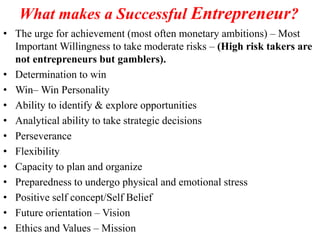
• The urge for achievement (most often monetary ambitions) – Most
Important Willingness to take moderate risks – (High risk takers are
not entrepreneurs but gamblers).
• Determination to win
• Win– Win Personality
• Ability to identify & explore opportunities
• Analytical ability to take strategic decisions
• Perseverance
• Flexibility
• Capacity to plan and organize
• Preparedness to undergo physical and emotional stress
• Positive self concept/Self Belief
• Future orientation – Vision
• Ethics and Values – Mission
What makes a Successful Entrepreneur?
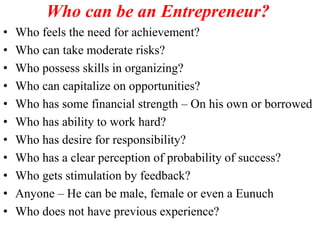
Who can be an Entrepreneur?
• Who feels the need for achievement?
• Who can take moderate risks?
• Who possess skills in organizing?
• Who can capitalize on opportunities?
• Who has some financial strength – On his own or borrowed
• Who has ability to work hard?
• Who has desire for responsibility?
• Who has a clear perception of probability of success?
• Who gets stimulation by feedback?
• Anyone – He can be male, female or even a Eunuch
• Who does not have previous experience?
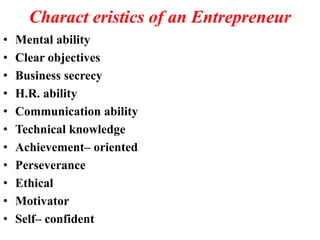
Charact eristics of an Entrepreneur
• Mental ability
• Clear objectives
• Business secrecy
• H.R. ability
• Communication ability
• Technical knowledge
• Achievement– oriented
• Perseverance
• Ethical
• Motivator
• Self– confident
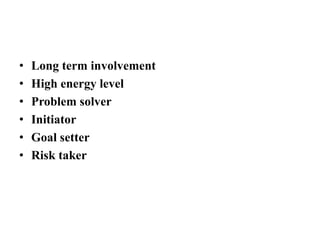
• Long term involvement
• High energy level
• Problem solver
• Initiator
• Goal setter
• Risk taker
POTENTIAL ENTREPRENEURSHIPACTIVITIES IN
BIOTECHNOLOGY
• Biotech parks are promoted in our country to help the entrepreneurs
andtechnopreneurs for starting their own ventures in biotechnology.
• These are essentially built-up structures where common facilities are
available for smooth initiation and conduct of business. It is specially
suited for technopreneurs who have a technology with them but have
no idea on the commercial viability of that technology.
• The presence of the core-shared facility would help in reducing capital
costs for the clients in the
• Park as they would be able to use state of the art equipment in the
facility without
• having to invest on their own in various fields. The biotech parks will
also have an incubation centre and business facilitation centre to help
create economic value.
Concept of Biotechnology Park
• Biotechnology parks are science and technology parks with a special
emphasis on biotechnology development. The broad concept is that of
a facility, where the interface of research with commerce and industry
is facilitated for better utilization of the technology.
• The UK Science Parks Association (UKSPA) defines a science park
as a business support and technology transfer initiative, which:
Encourages and supports the startup and integration of innovation led
high-growth, knowledge-based business.
• Provides an environment where larger and international businesses
can develop specific and close interactions with a particular center of
knowledge creation for their mutual benefit.
• Has formal and operational links with centers of knowledge creation,
such as universities, higher education institutes and research
organizations.
• There is also an increasing trend to set up startup companies by
technocrats based on technology leads. Moreover a number of first
generation entrepreneurs and established companies operating in other
areas are showing interest in investment in biotechnologies developed
indigenously or sourced from other countries. This has led to increase
in corporate research activities.
 The major constraints faced by such entrepreneurs, which has retarded
the pace of investments, include the following:
• Large requirement of funds and long gestation period for developing
the inventions into
• commercial projects.
• Difficulty in obtaining financial support for commercialization,
particularly venture
• capital for innovative inventions,
• High-risk perception and lack of adequate incentives necessary to
cover such risk and
• encourage such investment.
• Poor public private interaction and partnership due to lack of
information about technologies, technical capabilities,
infrastructure availability in institutes and mechanisms and
incentives to promote such interactions.

• High rate of technology obsolescence coupled with difficulty in
accessing proprietary
• technologies and intellectual property which are concentrated in
the private sector of
• industrialized nations.
• Cumbersome regulatory protocols in different countries based on
diverse biosafety regulations are often difficult and costly to
implement.
• Scarcity of appropriately skilled manpower.
• Inadequate information sources resulting in poor regional and
inter regional interactions for technology collaborations and
market access.
• Weakness in specialized areas such as IPR and biosafety
resulting in delays and inability to gear up to rapid global
technological advancements.
• To promote biotech investments, biotech parks in India should
be modeled to promote
• technology incubation and scale up as well as manufacturing
activities by providing
• infrastructure support, facilities and incentives so as to
minimize the above constraints and make it a preferred location
for investments.
Functions
• Biotechnology parks could perform the functions as encouraging
and supporting incubation and development of biotech innovations
• The facilities in the incubator could include physical facilities in the
form of office space, dry and wet laboratories, specialized
equipment and instrumentation facilities, pilot plant and scale up
units and good communication network.
• In addition, the park should provide developed land a cost effective
rate for carrying out manufacturing activity.
• The park should establish close formal linkages with a local
universities and research institutions, specializing in biotechnology.
• These centers could become a primary source for the basic
technologies for incubation and development into commercial
ventures, particularly catering to the needs of small and startup
enterprises.
• They can also be assisted through consultancy assistance in
technology up gradation, troubleshooting, contract research etc.
Linkage with a research institution of repute will
• also attract research and development activities of major
industries to the park.
• Consultancy and networking for advice on IPR protection,
regulatory issues, project management and sourcing of funds
from venture capitalists etc. is also critical for success of park.
Facilities/services & incentives at
Biotech parks
• Biotech parks are equipped with state-of-the-art
facilities, along with which it comprise the
following:
Technology incubation center (TIC)
Specialized facilities
Common facilities
Business support facilities (BSF)
Business enterprise zone (BEZ)
Technology incubation center (TIC)
• TIC would consist of laboratory modules, specialized facilities and
a well-equipped instrumentation facility. The laboratory space could
be leased out to the tenant for specified periods.
• TIC would enable the tenants to translate their research ideas into
commercialisable technologies as well as upgradation of existing
technologies without making huge investments on buildings,
equipment etc.
• This facility would be useful for technically competent small and
medium scale enterprises (SME) and entrepreneurial scientist with
limited financial resources particularly because of non-availability
of financial assistance for R & D projects under conventional
funding schemes.
• This facility could also be used for small scale manufacturing of the
biotech products by SMEs.
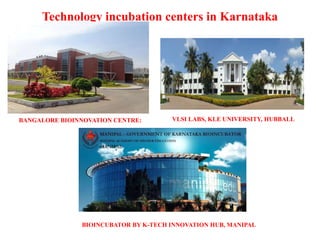
Technology incubation centers in Karnataka
BANGALORE BIOINNOVATION CENTRE: VLSI LABS, KLE UNIVERSITY, HUBBALL
BIOINCUBATOR BY K-TECH INNOVATION HUB, MANIPAL
Specialized facilities
• These would consist of fully equipped laboratories in the areas of
commercial importance and of relevance to the state.
• The new quality control norms and certification system demands
proper testing and validation of bio products (biofertilizers,
biopesticides, tissue cultured plants etc) and so the facilities
proposed in the park can help the tenants in the initial phase to meet
the quality standards.
• These facilities could be leased out to companies, contract research
organizations or contract manufacturing organizations for facilitating
cost effective development of technologies/products and
manufacturing.
• In the first phase of the park the following for facilities are proposed
to be set up.
• It consists of facilities for Plant Tissue Culture, animal Testing,
Medicinal plant extraction facility, biopesticides & biofertilizer
production etc.
Common facilities
• The common facilities in the park are cold storages and warehouses to
facilitate smallscale companies to store their finished goods and raw
materials.
• Other facility includes the common effluent treatment plant to ensure
elimination of harmful live microorganisms, as bacteria, will be
carried out by the units in the parks themselves.
• Some parks specializing in medical biotechnology will have a
common secondary effluent treatment plant that will collect all the
bacteria killed in effluent from the primary effluent plants of
individual units for further treatment and disposal.
Business support facilities (BSF)
• This facility consists of Administrative office consisting of
management, and other linked departments responsible for park’s
administration.
• Biotechnology InformationCentre (BIC), a bioinformatics facility for
accessing all the on line journals and other IT tools.
• Meeting rooms for making presentations etc., would be equipped
with state of the art equipment such as LCD/digital projector, slide
projector, overhead projector, public address system etc.
• Apart from these amenities the park is also equipped with a
Consultancy cell to encourage biotech consultants specialized in
providing the following services by offering space initially at
concessional rates such as.
 Technology transfer assistance.
 Fund syndication.
 Project assistance.
 Marketing assistance.
 Single window clearance.
 Facilitation of regulatory approvals
• Besides these facilities the park also consists of commercial
shops, cafeteria, parking space for tenants and PFUs would be
dealing in items such as stationery, raw materials, laboratory
consumables and lab ware etc. as required by the tenants.
• These shops could be leased/ purchased by stationery sellers
and other service providers including biotech consultants.
Business enterprise zone (BEZ)
• The Business Enterprise Zone would consist of developed plots,
roads, water supply &
• sewerages, effluent treatment facility, telecom network and power
supply.
• The developed plots would be required by medium and large-scale
enterprises.
• These plots would be leased out to the tenants.
Refrences
• Hine, D. and Kapeleris, J., 2007. Innovation And
Entrepreneurship In Biotechnology, An International
Perspective. Cheltenham: Edward Elgar, pg.8-10.
• Colin Ratledge and Bjorn Kristiansen, Basic
Biotechnology (2nd Ed.).Cambridge University
Press. 2002.pg.255-260
THANK YOU

Seminar on entreprenship

  • 1.
    Seminar on ENTREPRENEURSHIP Presented by: ZamranKhan M.Sc 4th SEM The Oxford College Of Science
  • 2.
    What is anEntrepreneur? • An Entrepreneur is a person who organizes and manages a business undertaking, assuming the risk for the sake of profit. Any person (any age) who starts and operates a business is an entrepreneur. • Entrepreneurship – It is a philosophy or process through which an entrepreneur seeks innovation and employment.
  • 3.
    Entrepreneurship Theories • 1600– French verb – Entreprendre – to undertake. • 1700 – Person bearing Risk or Profit in a fixed price contract (Risk) • 1725 – Richard Cantillon – Person bearing risks is different from Capital Supplier (Risk) • 1803 – J. B. Say – Shifts economic resources out from an area of lower to higher • productivity & greater yields (Value Addition) • 1934 – Joseph Schumpeter – Innovator and develops untried technology (Productivity & Innovation)
  • 4.
    • 1961 –David McClelland – Highly motivated, energetic, moderate risk taker (Need for achievement) • 1964 – Peter Drucker – Searches for change, responds to it & exploits as opportunity (Opportunity Focused) • 1980 – Karl Vesper – Behaviour Perceptions– Economists, Psychologists, Businessmen, Politicians (Environment) • 1983 – Gifford Pinchot – Intrapreneur • 1985 – Robert Hisrich – Creating something different with value, devoting time & effort, assuming risks (FPS); results– rewards and satisfaction (Leadership & Vision).
  • 5.
    • Please notethat key word in Entrepreneurship is RISK. Any venture where risk is mitigated due to any reason does not qualify to be called entrepreneurship. • Entrepreneurs are people who create new business activity in the economy and bear considerable business risk in the process. This is often done by starting new companies. • But they can also create new business activity by introducing a new product or creating a new market
  • 6.
    Standard (New) Definition •Entrepreneurship is the process of creating something different with value by devoting the necessary time and effort, assuming the accompanying financial, psychic, social risks and receiving the resulting rewards of monetary and personal satisfaction and independence. • Word “Entrepreneur” stems from French Verb Entreprendre – means between; taker or go between
  • 7.
    New Definition involvesfour aspects • The creation process • Devotion of time and efforts • Assumption of risks • Rewards of independence, satisfaction, money.
  • 8.
    Advantages of Entrepreneurship Toan Individual: • Provides Self Employment for the entrepreneur • Entrepreneur can provide employment for near & dear one as well • Entrepreneurship often provides an employment and livelihood for next generations as well. • Freedom to use own ideas – Innovation and creativity • Unlimited income / higher retained income – Bill Gates has risen to become richest in • the world in a single life time through entrepreneurship • Independence • Satisfaction
  • 9.
    • To thenation • Provides larger employment – Entrepreneurs provide employment for self as well as • other people and is source of employment creation. • Results in wider distribution of wealth – This is a logical sequel of above issue. Higher • the employment, greater the distribution of wealth • Mobilizes local resources, skills and savings • Accelerates the pace of economic development – Entrepreneurship is the govt’s one of • the most trusted vehicles for economic development • Stimulates innovation & efficiency
  • 10.
    Factors Favouring Entrepreneurship •Developed Infrastructure Facilities – Availability of infrastructure reduces the cost & efforts and improves viability of projects through higher profit margins. • Financial Assistance – Easy availability of cheap funds is vital for promoting entrepreneurship. • Protective and Promotional Policies – Most of the entrepreneurship projects start very small and have no resilience. They are extremely vulnerable to competitors, market, money markets, etc, for considerable time. Favourable Govt policies shelter them from such vagaries. • Growth of Education – Science, Technology & Management – Growth of education is believed to be promoting entrepreneurship. However, there are enough examples to suggest otherwise. • A very large proportion of first generation entrepreneurs are low educated.
  • 11.
    • Risk TakingAbilities – Risk taking ability is one of the pillars of entrepreneurial spirits. • Hunger for Success (Capitalistic View) – Fire in the belly and dreams of riches is what drives most entrepreneurs on this risky path. Any person content with what he has would take the easier route of salaries job. • Environment/Culture Impact – Entrepreneurship is contagious. Communities like Punjabies and Marwaries are historically entrepreneurial. They are known for seeking and exploiting business opportunities in most remote areas. It is a culture that propels them. • Social Security – Social security acts as a safety net against failure of enterprise. Social security guarantees basic ‘roti, kapada aur makan’ in case of failure. • Entrepreneurial spirit of United States is born partly out of this security.
  • 12.
    • Technical/Industrial TrainingFacilities – Industrial Training facilities on one hand generate skilled manpower so vitally required for setting up enterprises while on the other hand they are also nursery for future entrepreneurs. Among the educated entrepreneurs, a majority is product of technical institutes from IIT to ITI. • Globalization – Globalization has provided another avenue for business. Many dare devils have taken a head– along plunge into this uncharted water and have written new success stories.
  • 13.
    • The urgefor achievement (most often monetary ambitions) – Most Important Willingness to take moderate risks – (High risk takers are not entrepreneurs but gamblers). • Determination to win • Win– Win Personality • Ability to identify & explore opportunities • Analytical ability to take strategic decisions • Perseverance • Flexibility • Capacity to plan and organize • Preparedness to undergo physical and emotional stress • Positive self concept/Self Belief • Future orientation – Vision • Ethics and Values – Mission What makes a Successful Entrepreneur?
  • 14.
    Who can bean Entrepreneur? • Who feels the need for achievement? • Who can take moderate risks? • Who possess skills in organizing? • Who can capitalize on opportunities? • Who has some financial strength – On his own or borrowed • Who has ability to work hard? • Who has desire for responsibility? • Who has a clear perception of probability of success? • Who gets stimulation by feedback? • Anyone – He can be male, female or even a Eunuch • Who does not have previous experience?
  • 15.
    Charact eristics ofan Entrepreneur • Mental ability • Clear objectives • Business secrecy • H.R. ability • Communication ability • Technical knowledge • Achievement– oriented • Perseverance • Ethical • Motivator • Self– confident
  • 16.
    • Long terminvolvement • High energy level • Problem solver • Initiator • Goal setter • Risk taker
  • 17.
    POTENTIAL ENTREPRENEURSHIPACTIVITIES IN BIOTECHNOLOGY •Biotech parks are promoted in our country to help the entrepreneurs andtechnopreneurs for starting their own ventures in biotechnology. • These are essentially built-up structures where common facilities are available for smooth initiation and conduct of business. It is specially suited for technopreneurs who have a technology with them but have no idea on the commercial viability of that technology. • The presence of the core-shared facility would help in reducing capital costs for the clients in the • Park as they would be able to use state of the art equipment in the facility without • having to invest on their own in various fields. The biotech parks will also have an incubation centre and business facilitation centre to help create economic value.
  • 18.
    Concept of BiotechnologyPark • Biotechnology parks are science and technology parks with a special emphasis on biotechnology development. The broad concept is that of a facility, where the interface of research with commerce and industry is facilitated for better utilization of the technology. • The UK Science Parks Association (UKSPA) defines a science park as a business support and technology transfer initiative, which: Encourages and supports the startup and integration of innovation led high-growth, knowledge-based business. • Provides an environment where larger and international businesses can develop specific and close interactions with a particular center of knowledge creation for their mutual benefit. • Has formal and operational links with centers of knowledge creation, such as universities, higher education institutes and research organizations.
  • 19.
    • There isalso an increasing trend to set up startup companies by technocrats based on technology leads. Moreover a number of first generation entrepreneurs and established companies operating in other areas are showing interest in investment in biotechnologies developed indigenously or sourced from other countries. This has led to increase in corporate research activities.  The major constraints faced by such entrepreneurs, which has retarded the pace of investments, include the following: • Large requirement of funds and long gestation period for developing the inventions into • commercial projects. • Difficulty in obtaining financial support for commercialization, particularly venture • capital for innovative inventions, • High-risk perception and lack of adequate incentives necessary to cover such risk and
  • 20.
    • encourage suchinvestment. • Poor public private interaction and partnership due to lack of information about technologies, technical capabilities, infrastructure availability in institutes and mechanisms and incentives to promote such interactions. • High rate of technology obsolescence coupled with difficulty in accessing proprietary • technologies and intellectual property which are concentrated in the private sector of • industrialized nations. • Cumbersome regulatory protocols in different countries based on diverse biosafety regulations are often difficult and costly to implement. • Scarcity of appropriately skilled manpower. • Inadequate information sources resulting in poor regional and inter regional interactions for technology collaborations and market access.
  • 21.
    • Weakness inspecialized areas such as IPR and biosafety resulting in delays and inability to gear up to rapid global technological advancements. • To promote biotech investments, biotech parks in India should be modeled to promote • technology incubation and scale up as well as manufacturing activities by providing • infrastructure support, facilities and incentives so as to minimize the above constraints and make it a preferred location for investments.
  • 22.
    Functions • Biotechnology parkscould perform the functions as encouraging and supporting incubation and development of biotech innovations • The facilities in the incubator could include physical facilities in the form of office space, dry and wet laboratories, specialized equipment and instrumentation facilities, pilot plant and scale up units and good communication network. • In addition, the park should provide developed land a cost effective rate for carrying out manufacturing activity. • The park should establish close formal linkages with a local universities and research institutions, specializing in biotechnology. • These centers could become a primary source for the basic technologies for incubation and development into commercial ventures, particularly catering to the needs of small and startup enterprises.
  • 23.
    • They canalso be assisted through consultancy assistance in technology up gradation, troubleshooting, contract research etc. Linkage with a research institution of repute will • also attract research and development activities of major industries to the park. • Consultancy and networking for advice on IPR protection, regulatory issues, project management and sourcing of funds from venture capitalists etc. is also critical for success of park.
  • 24.
    Facilities/services & incentivesat Biotech parks • Biotech parks are equipped with state-of-the-art facilities, along with which it comprise the following: Technology incubation center (TIC) Specialized facilities Common facilities Business support facilities (BSF) Business enterprise zone (BEZ)
  • 25.
    Technology incubation center(TIC) • TIC would consist of laboratory modules, specialized facilities and a well-equipped instrumentation facility. The laboratory space could be leased out to the tenant for specified periods. • TIC would enable the tenants to translate their research ideas into commercialisable technologies as well as upgradation of existing technologies without making huge investments on buildings, equipment etc. • This facility would be useful for technically competent small and medium scale enterprises (SME) and entrepreneurial scientist with limited financial resources particularly because of non-availability of financial assistance for R & D projects under conventional funding schemes. • This facility could also be used for small scale manufacturing of the biotech products by SMEs.
  • 26.
    Technology incubation centersin Karnataka BANGALORE BIOINNOVATION CENTRE: VLSI LABS, KLE UNIVERSITY, HUBBALL BIOINCUBATOR BY K-TECH INNOVATION HUB, MANIPAL
  • 27.
    Specialized facilities • Thesewould consist of fully equipped laboratories in the areas of commercial importance and of relevance to the state. • The new quality control norms and certification system demands proper testing and validation of bio products (biofertilizers, biopesticides, tissue cultured plants etc) and so the facilities proposed in the park can help the tenants in the initial phase to meet the quality standards. • These facilities could be leased out to companies, contract research organizations or contract manufacturing organizations for facilitating cost effective development of technologies/products and manufacturing. • In the first phase of the park the following for facilities are proposed to be set up. • It consists of facilities for Plant Tissue Culture, animal Testing, Medicinal plant extraction facility, biopesticides & biofertilizer production etc.
  • 28.
    Common facilities • Thecommon facilities in the park are cold storages and warehouses to facilitate smallscale companies to store their finished goods and raw materials. • Other facility includes the common effluent treatment plant to ensure elimination of harmful live microorganisms, as bacteria, will be carried out by the units in the parks themselves. • Some parks specializing in medical biotechnology will have a common secondary effluent treatment plant that will collect all the bacteria killed in effluent from the primary effluent plants of individual units for further treatment and disposal.
  • 30.
    Business support facilities(BSF) • This facility consists of Administrative office consisting of management, and other linked departments responsible for park’s administration. • Biotechnology InformationCentre (BIC), a bioinformatics facility for accessing all the on line journals and other IT tools. • Meeting rooms for making presentations etc., would be equipped with state of the art equipment such as LCD/digital projector, slide projector, overhead projector, public address system etc. • Apart from these amenities the park is also equipped with a Consultancy cell to encourage biotech consultants specialized in providing the following services by offering space initially at concessional rates such as.  Technology transfer assistance.  Fund syndication.
  • 31.
     Project assistance. Marketing assistance.  Single window clearance.  Facilitation of regulatory approvals • Besides these facilities the park also consists of commercial shops, cafeteria, parking space for tenants and PFUs would be dealing in items such as stationery, raw materials, laboratory consumables and lab ware etc. as required by the tenants. • These shops could be leased/ purchased by stationery sellers and other service providers including biotech consultants.
  • 32.
    Business enterprise zone(BEZ) • The Business Enterprise Zone would consist of developed plots, roads, water supply & • sewerages, effluent treatment facility, telecom network and power supply. • The developed plots would be required by medium and large-scale enterprises. • These plots would be leased out to the tenants.
  • 33.
    Refrences • Hine, D.and Kapeleris, J., 2007. Innovation And Entrepreneurship In Biotechnology, An International Perspective. Cheltenham: Edward Elgar, pg.8-10. • Colin Ratledge and Bjorn Kristiansen, Basic Biotechnology (2nd Ed.).Cambridge University Press. 2002.pg.255-260
  • 34.