CONTENTS
SI.NO. Description Page No.
1 Philosophy ……………………………………………….. 1
2. Aims and Objectives .........................................................
3. Admission Requirements …………………………………… 4
4. Course Duration ……………………………………………. 6
5. Scheme of Examination …………………………………….. 11
6. English ……………………………………………………… 24
7. Anatomy …………………………………………………… 26
8. Physiology …………………………………………………. 29
9. Nutrition …………………………………………………… 33
10. Biochemistry ……………………………………………… 37
11. Nursing Foundations ……………………………………… 40
12. Nursing Foundations – Practical …..……………………… 54
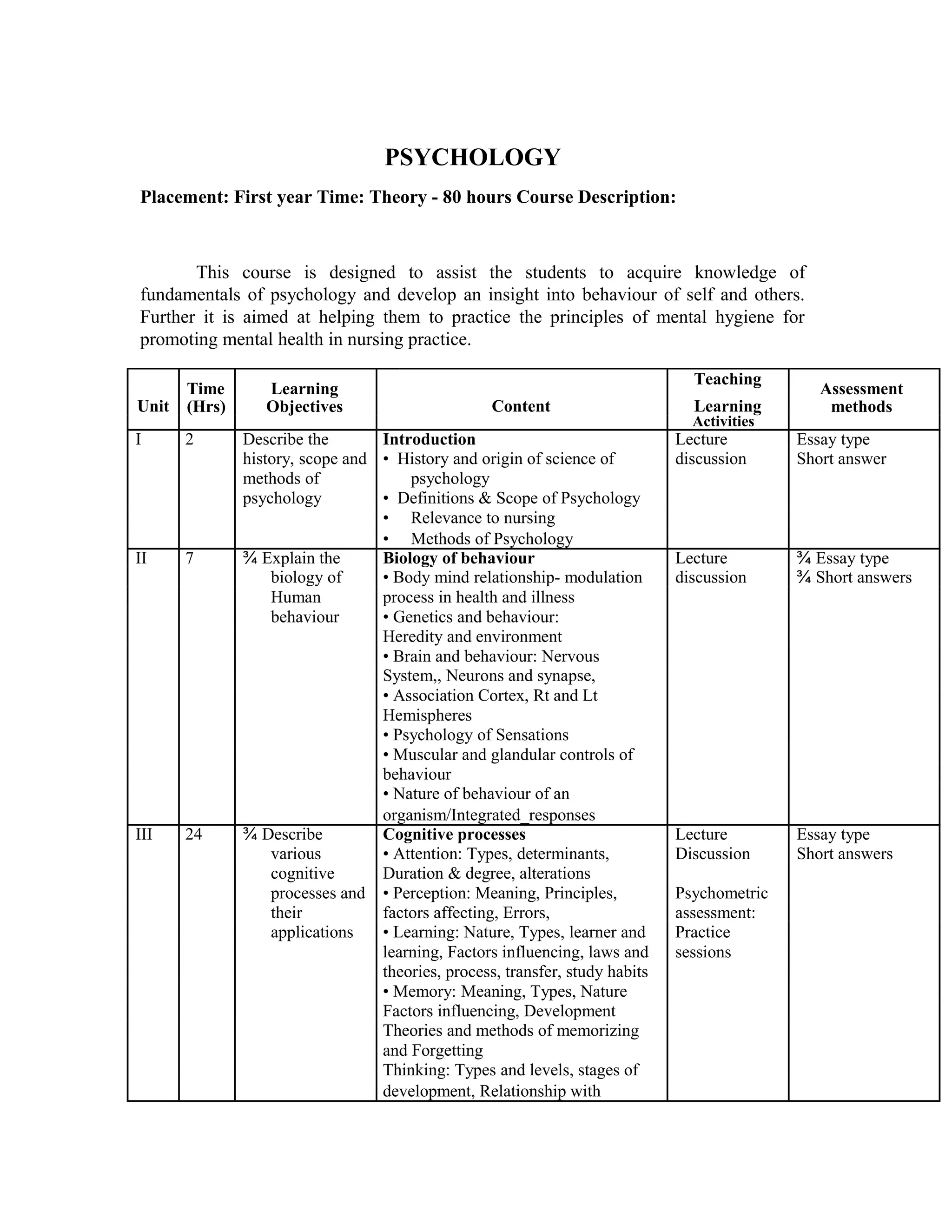
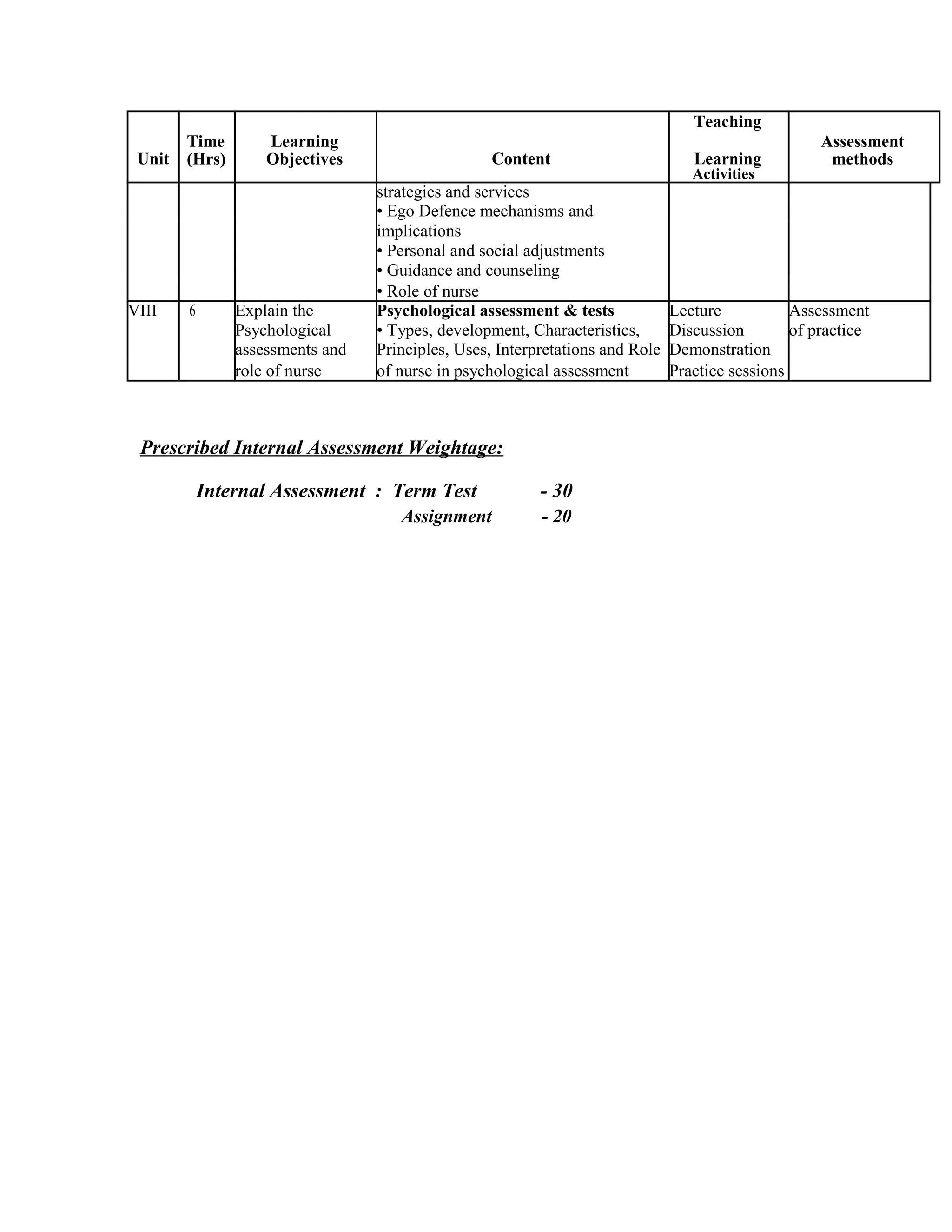
13. Psychology ……………………………………………….. 60
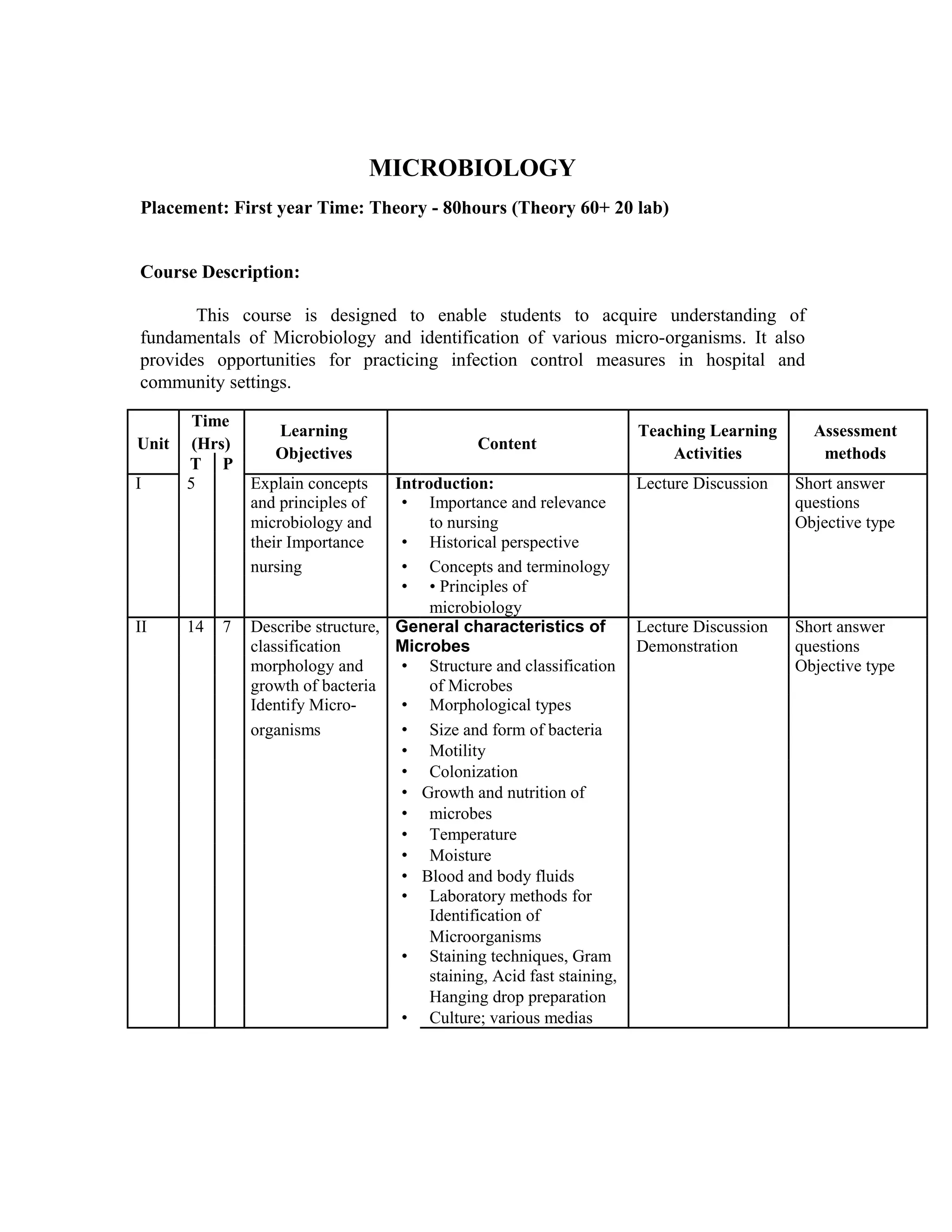
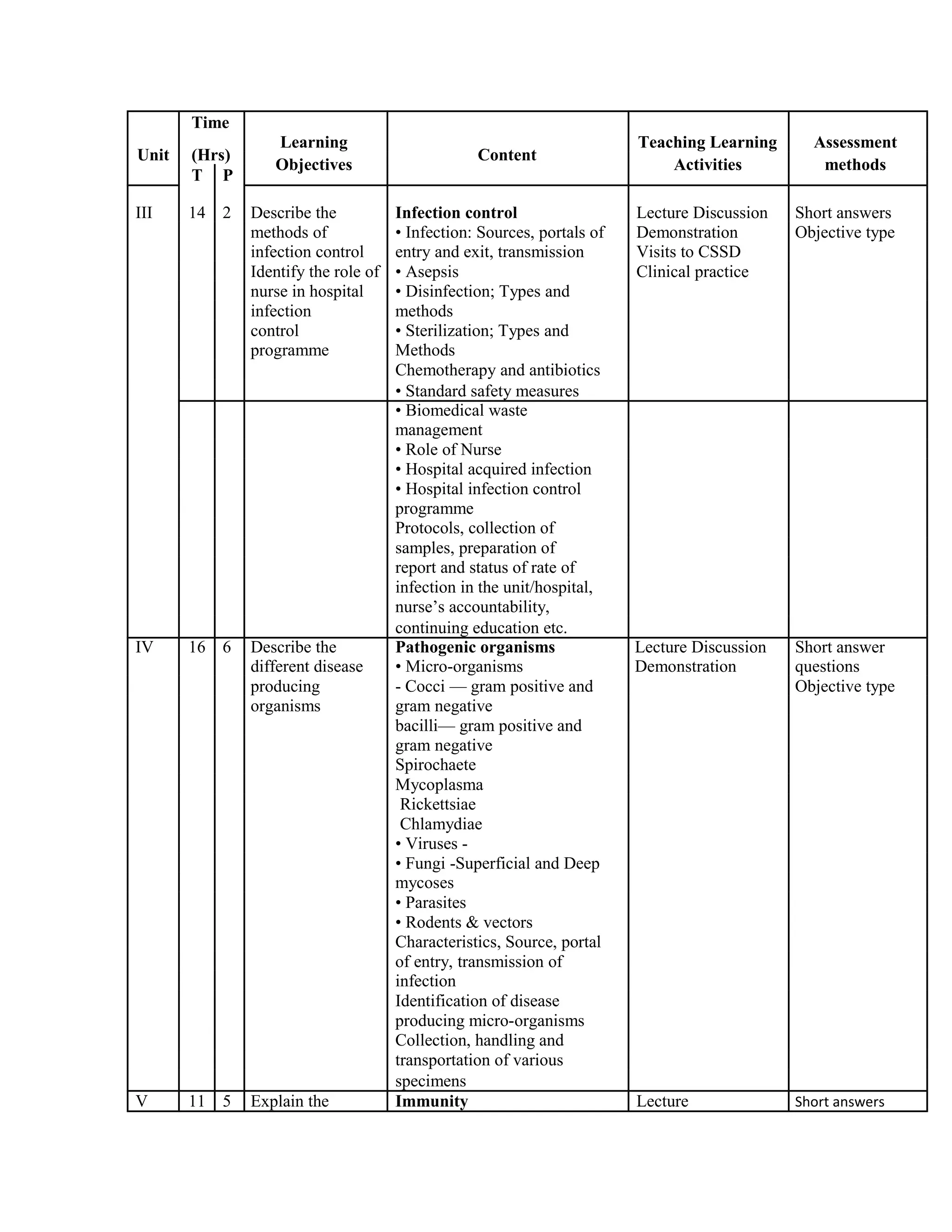
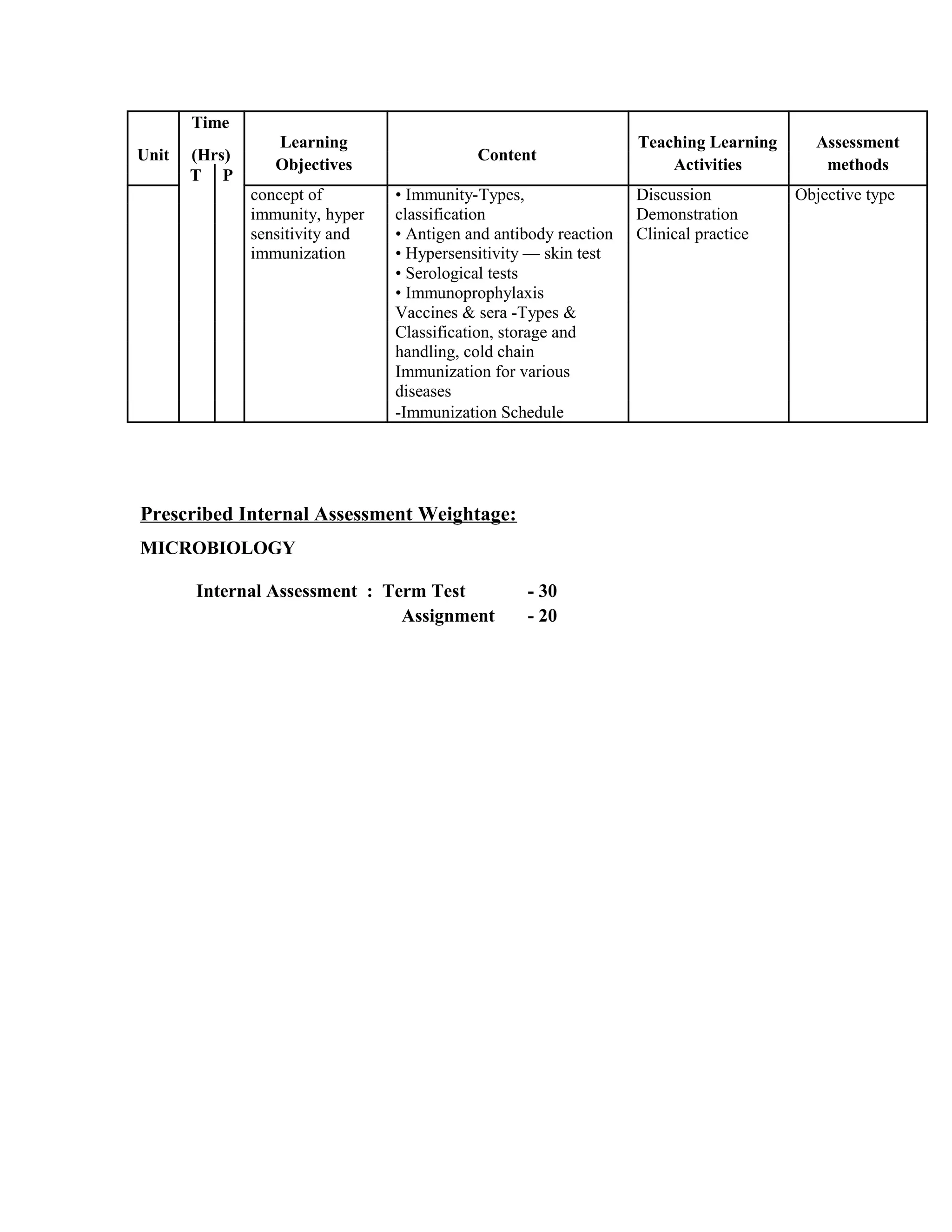
14. Microbiology …………………………………………… 63
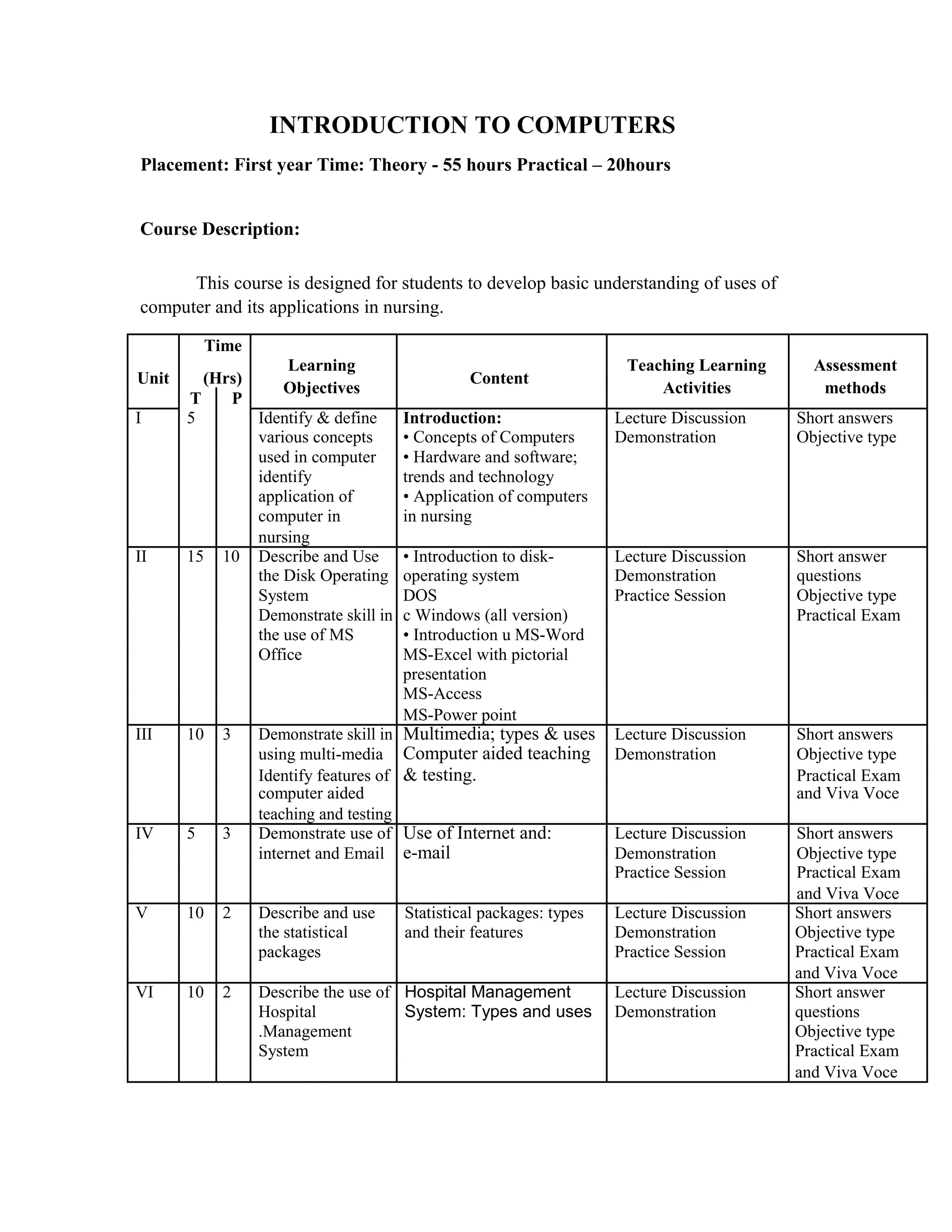
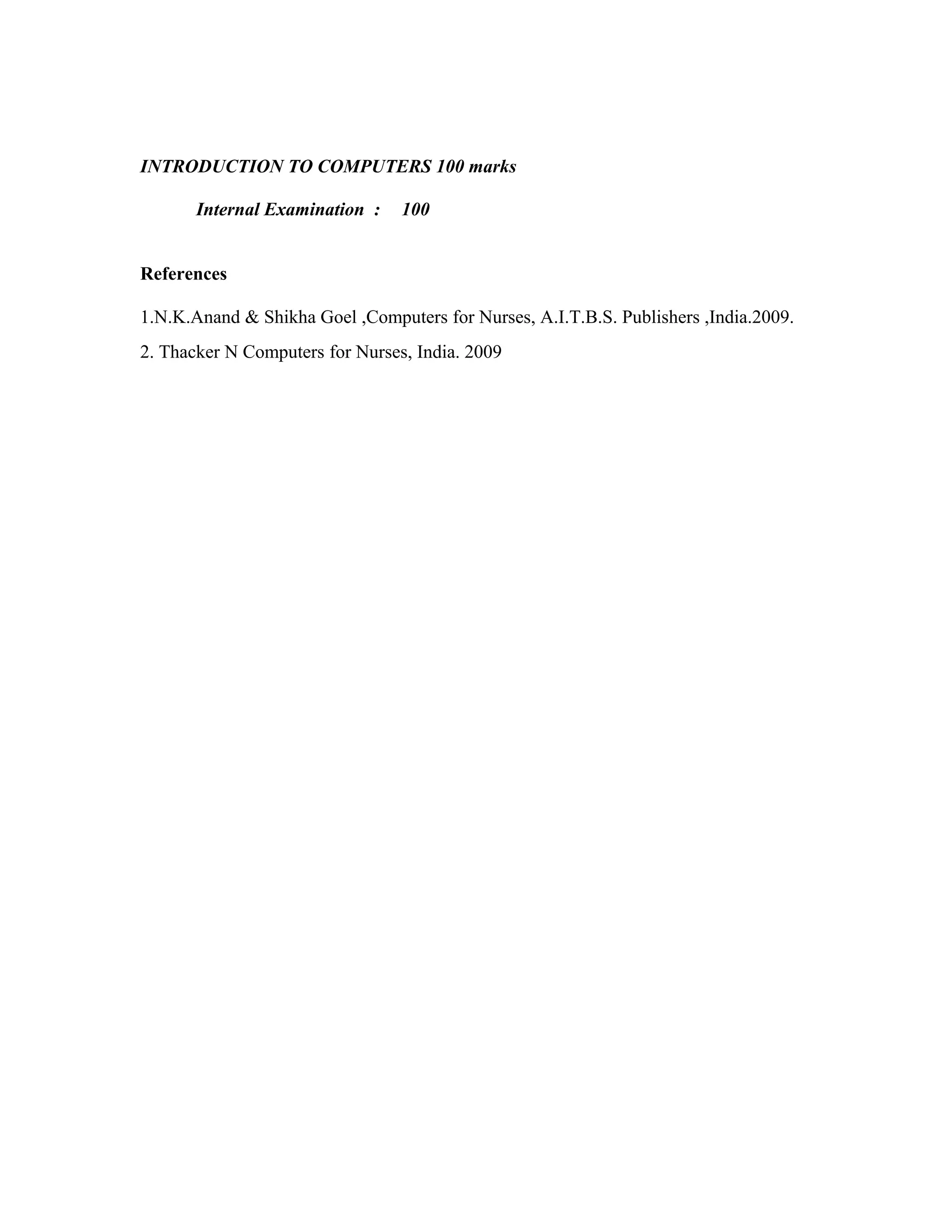
15. Introduction to Computer ………………………………… 66
16. Sociology …………………………………………………. 67
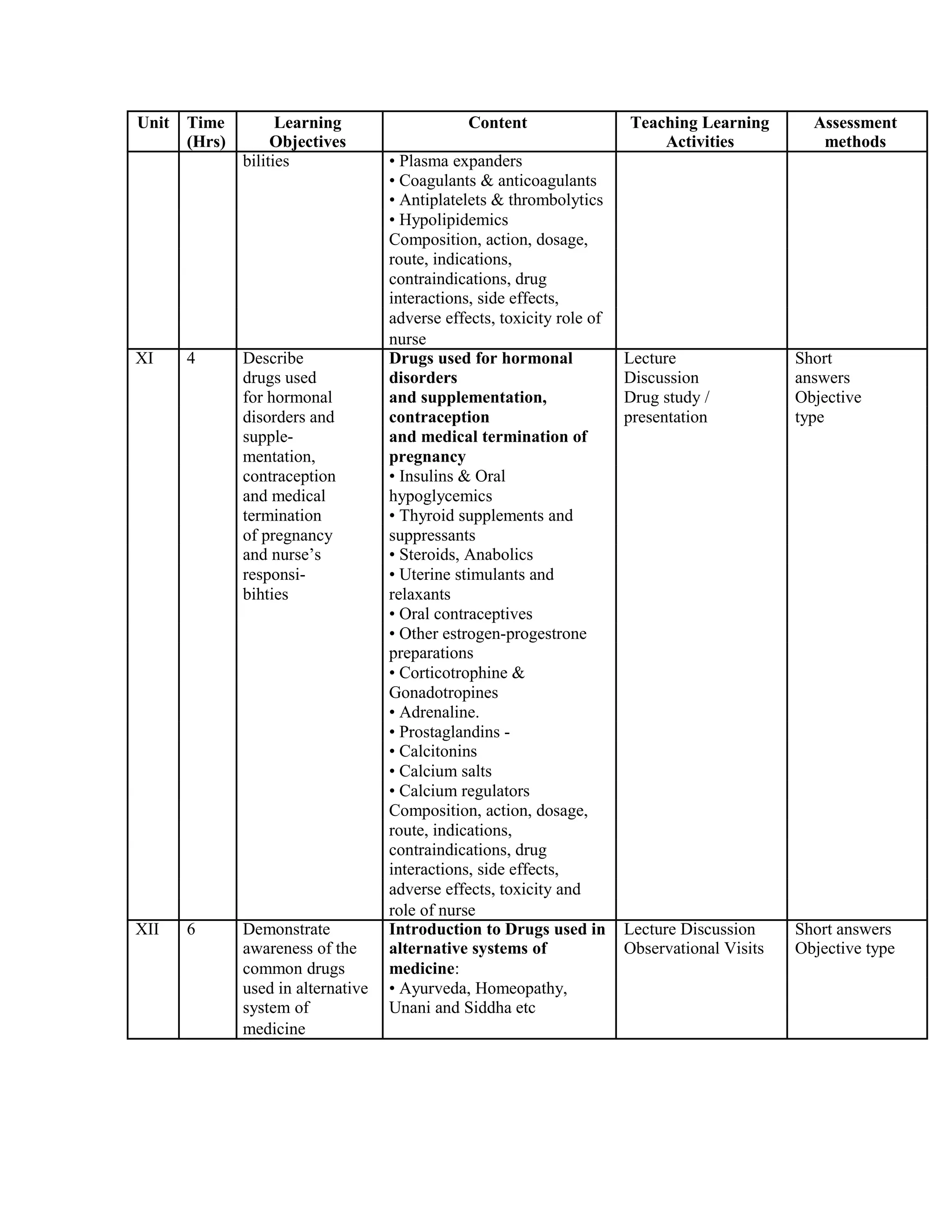
17. Pharmacology..…………………………………………… 72
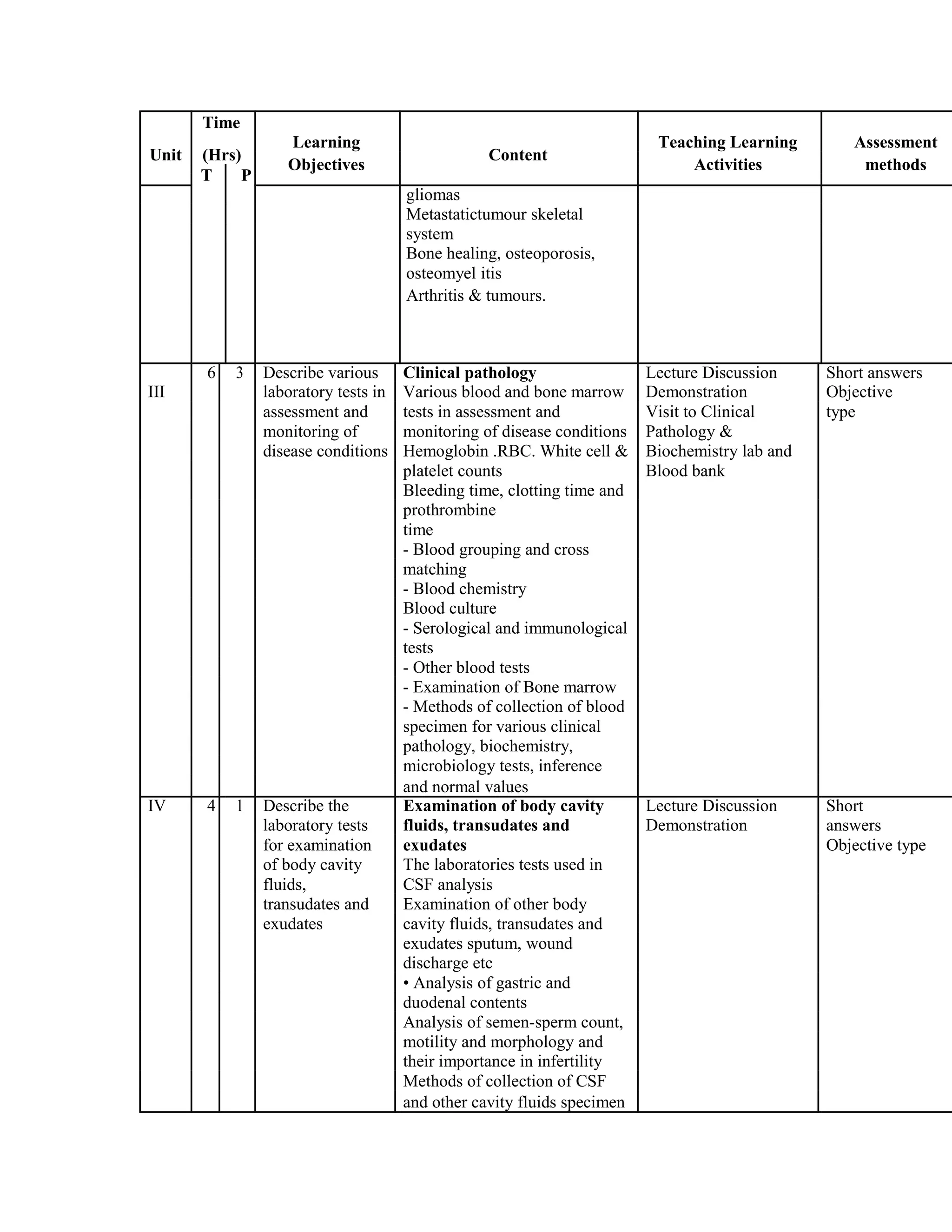
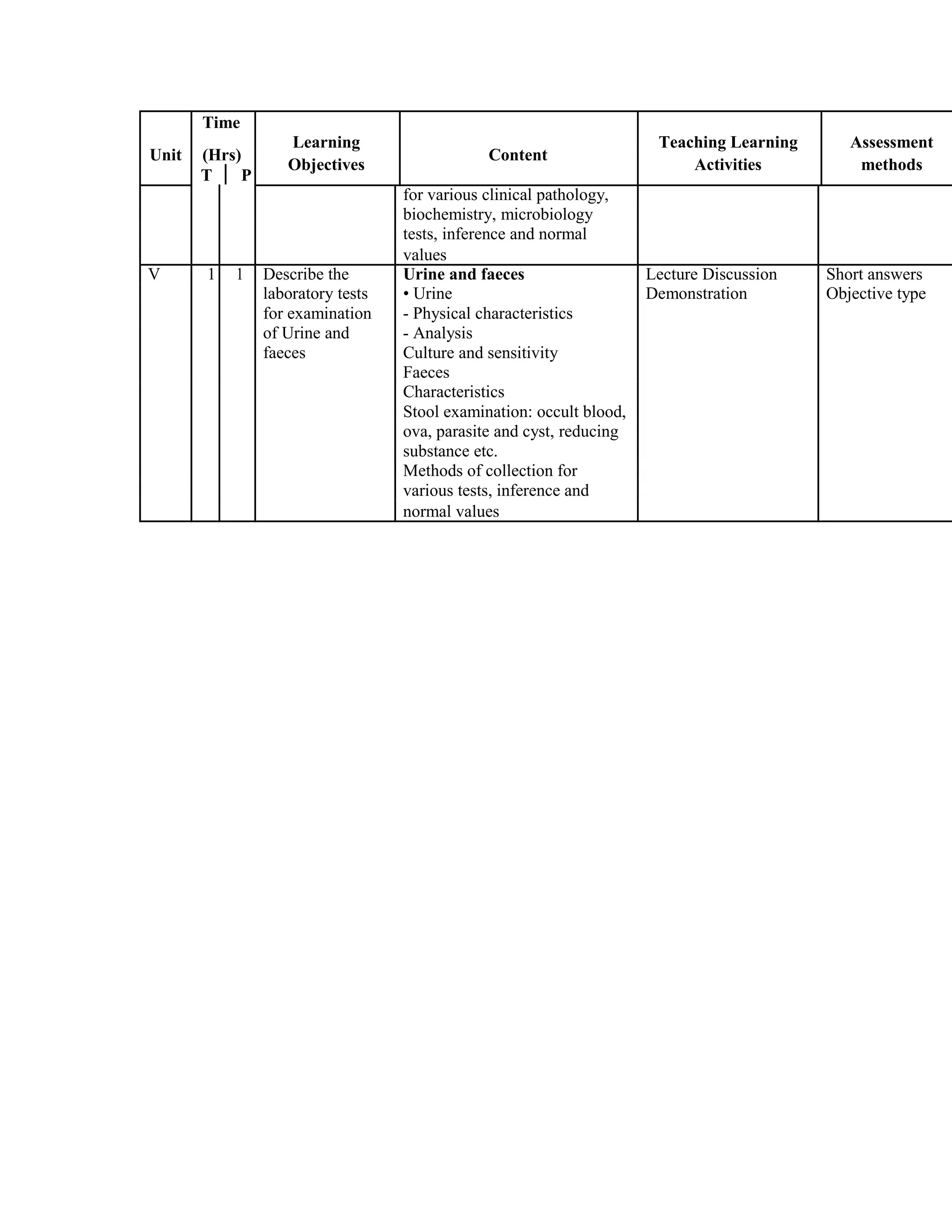
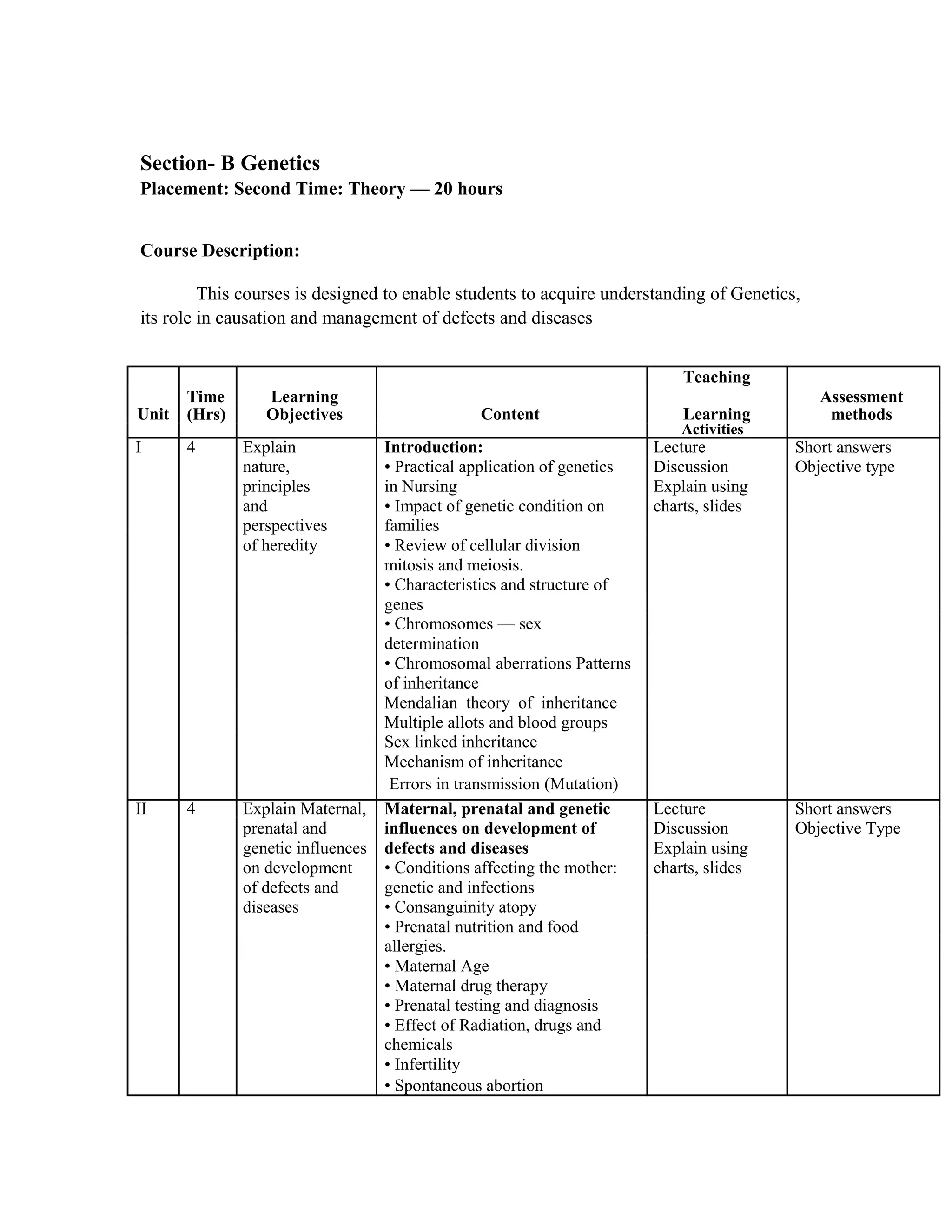
18. Pathology & Genetics..……………………………………
Section A – Pathology ………………………………… 77
Section B – Genetics…………………………………… 81
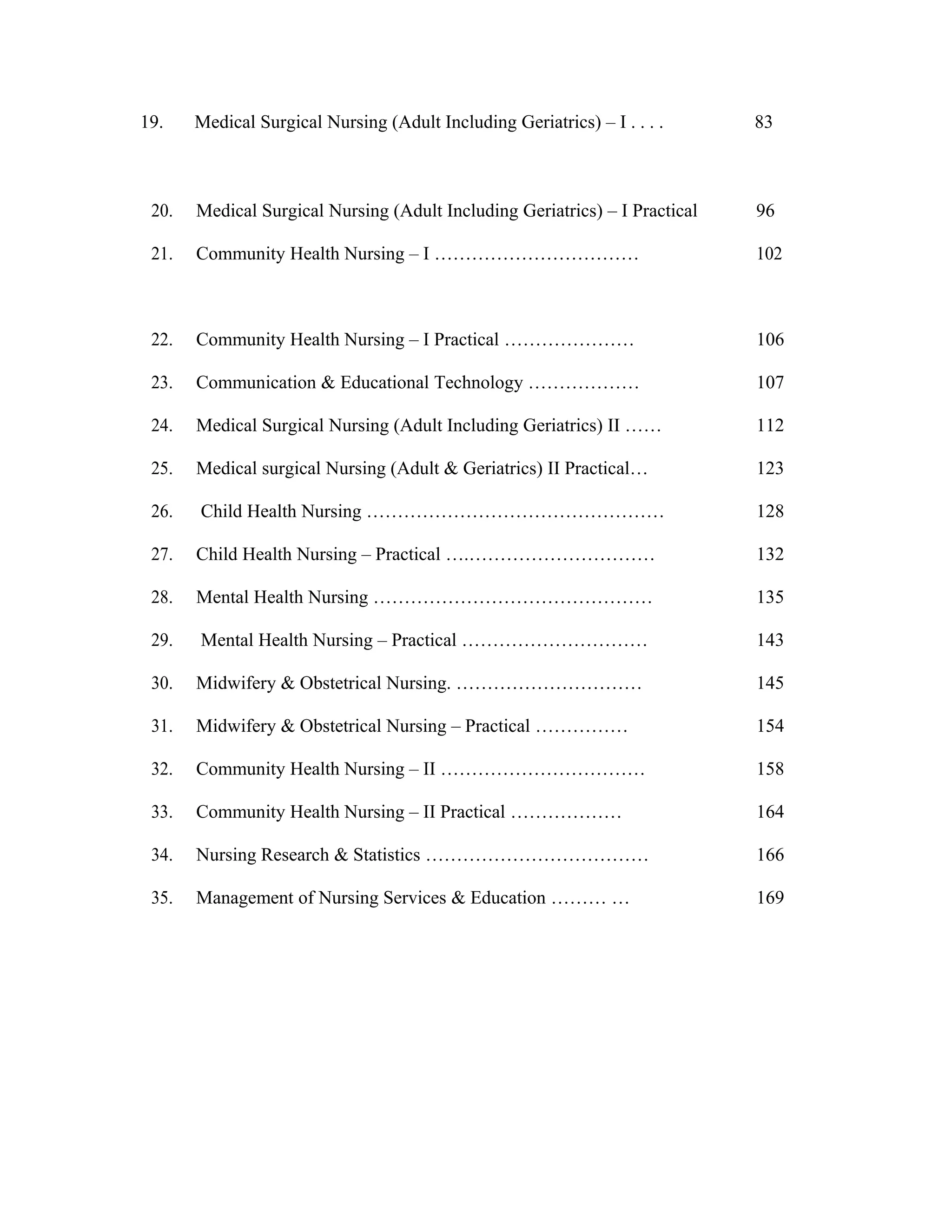
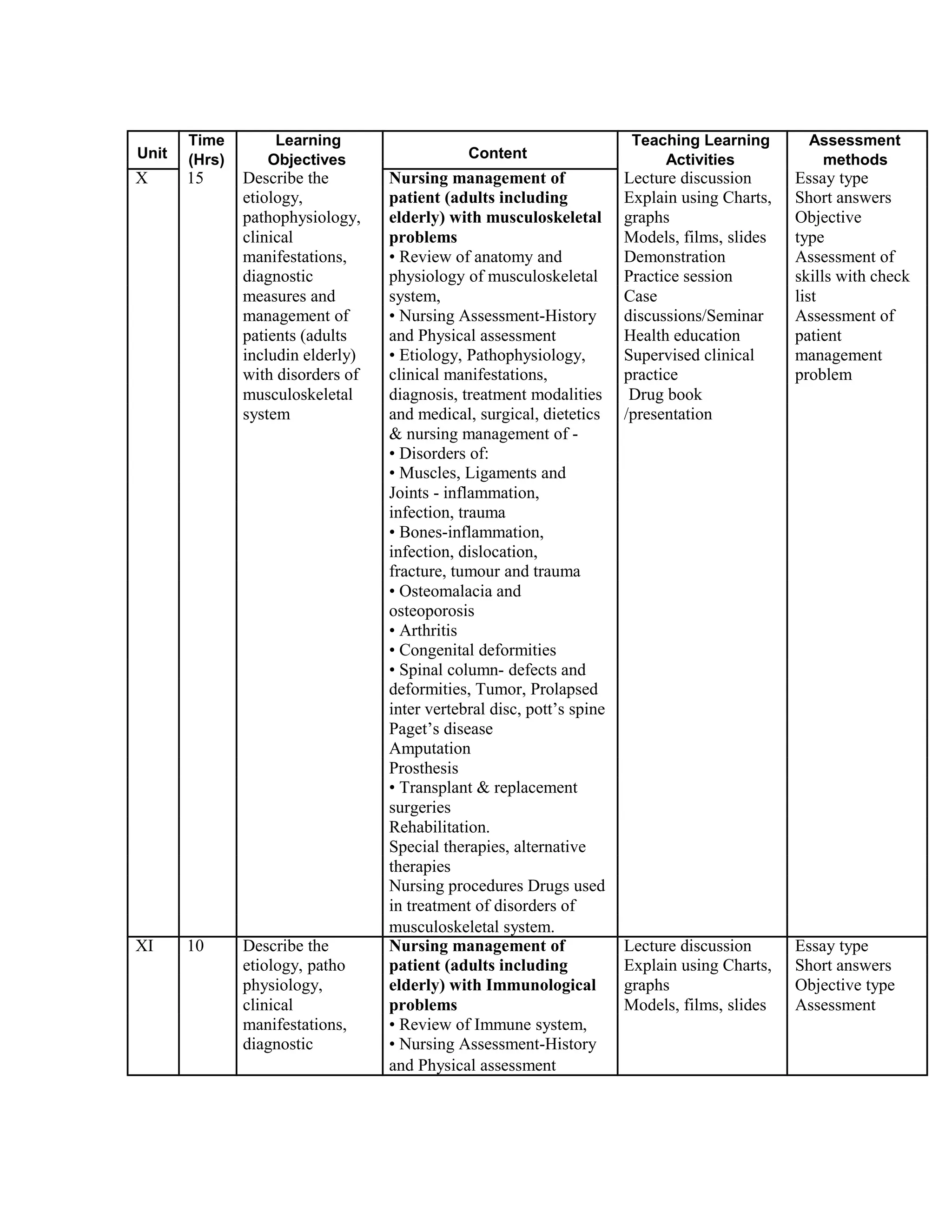
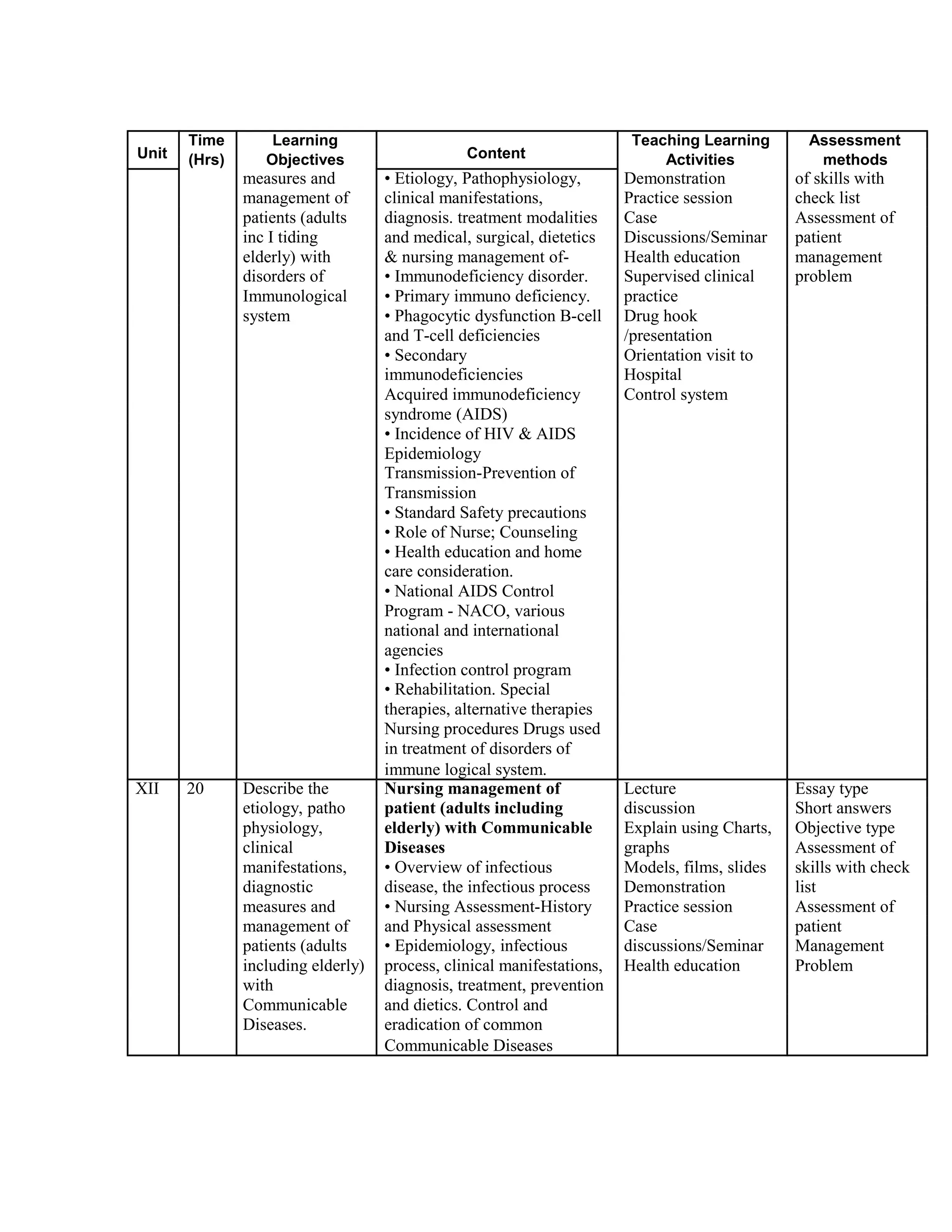
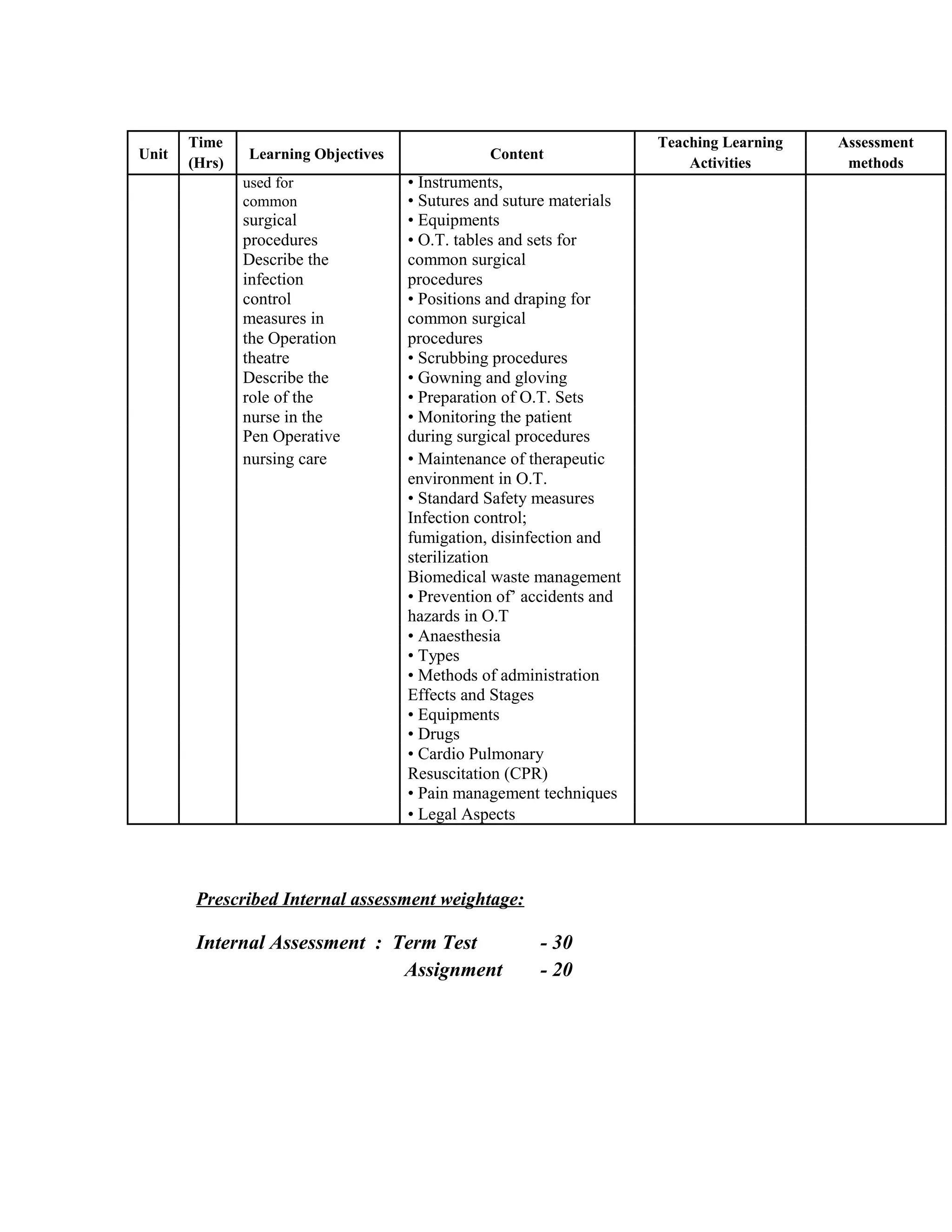
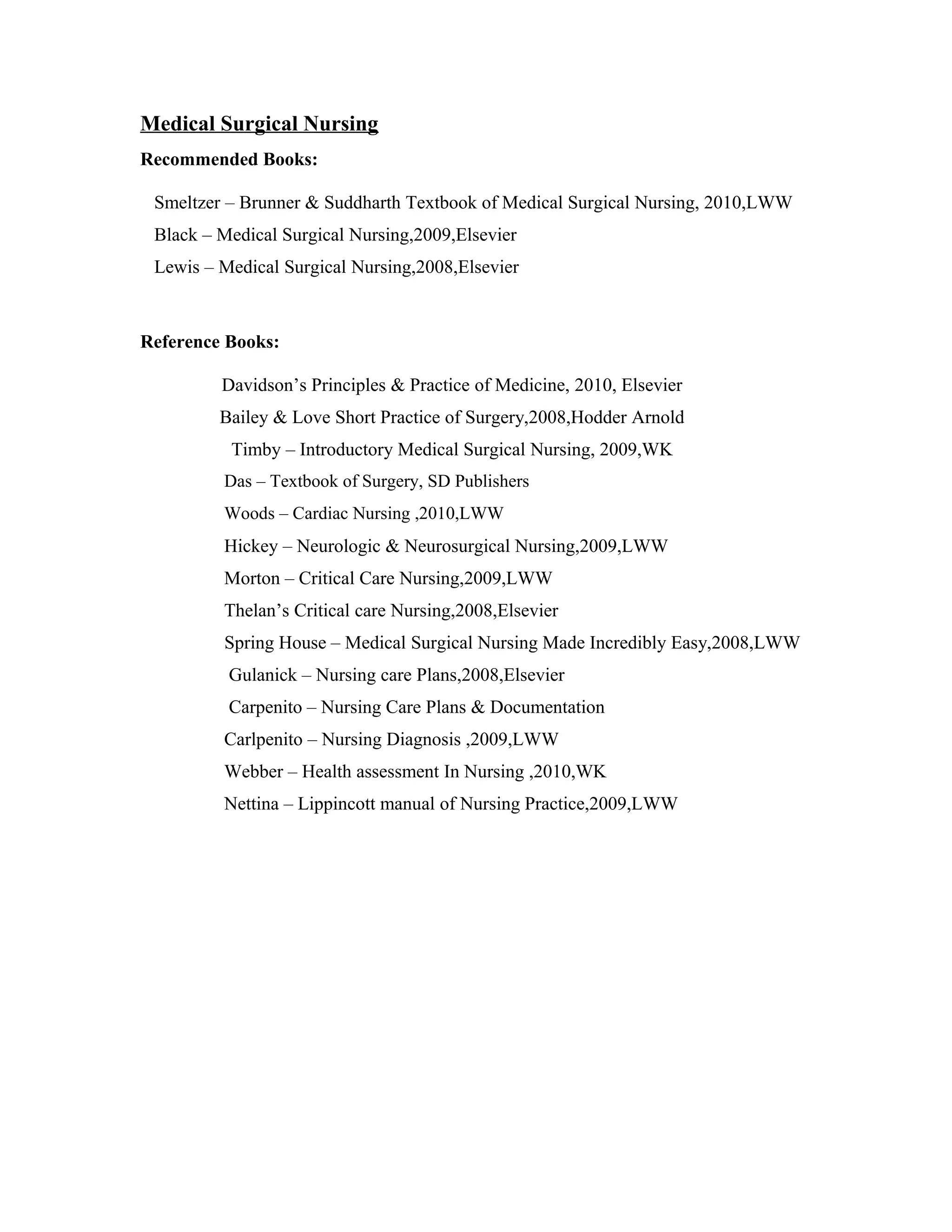
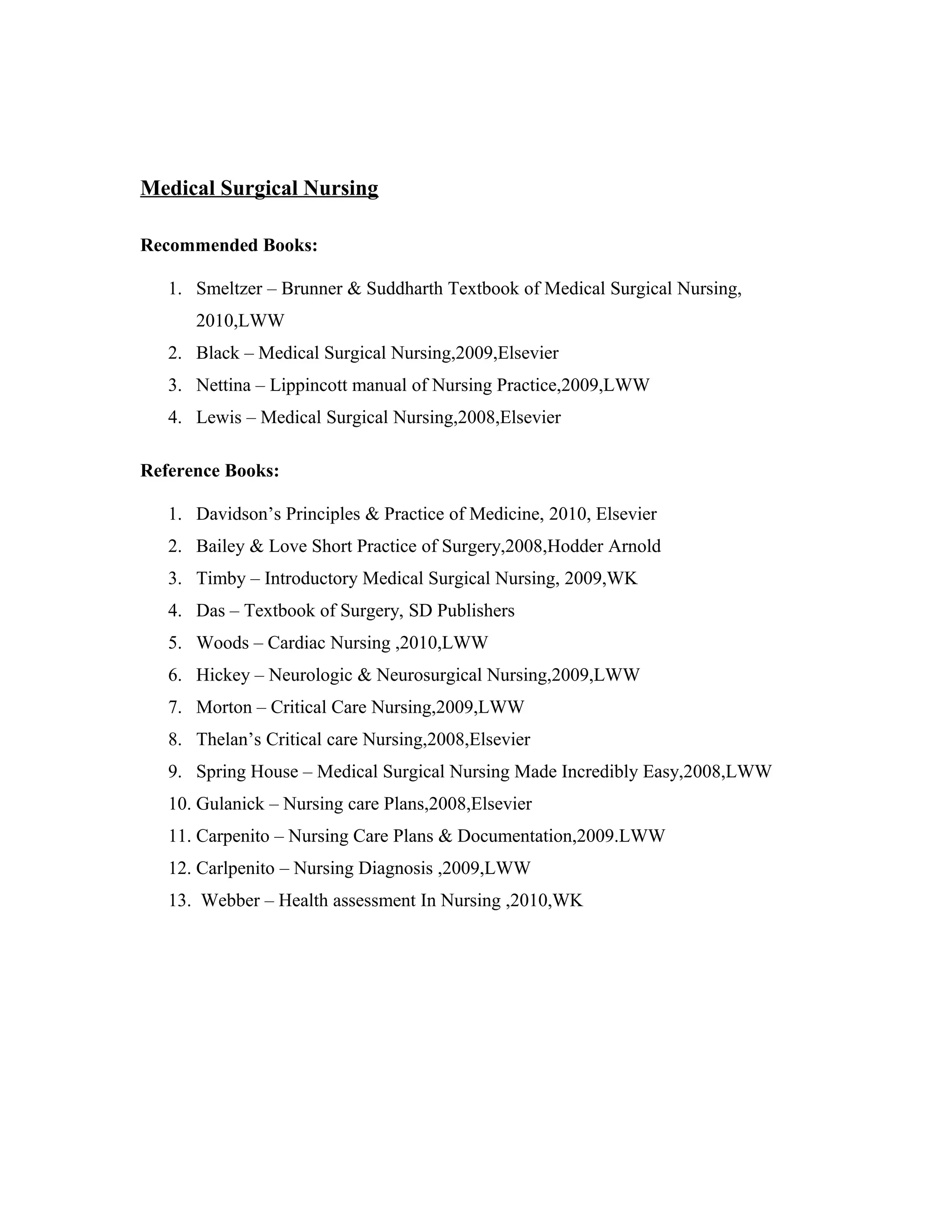
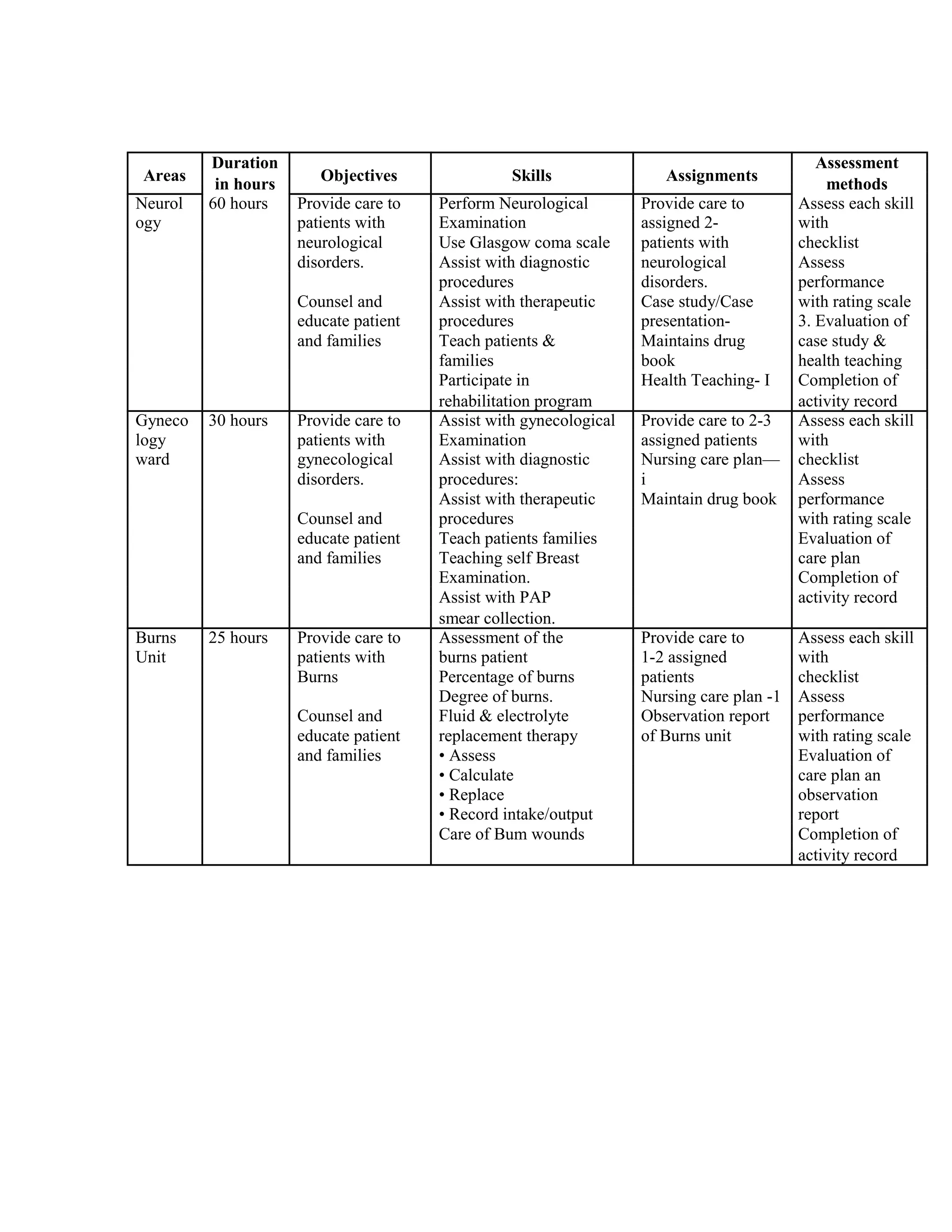
19. Medical Surgical Nursing (Adult Including Geriatrics) – I . . . . 83
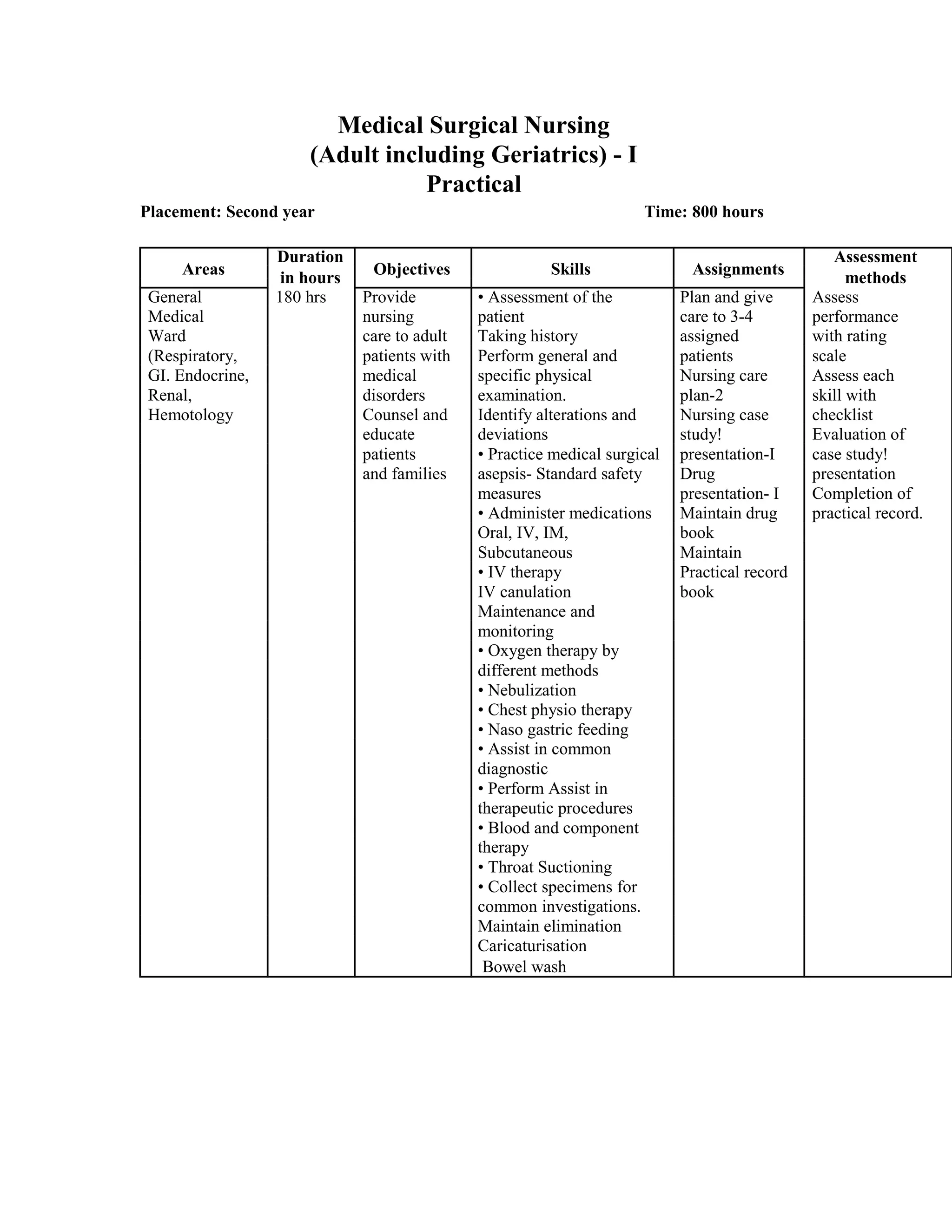
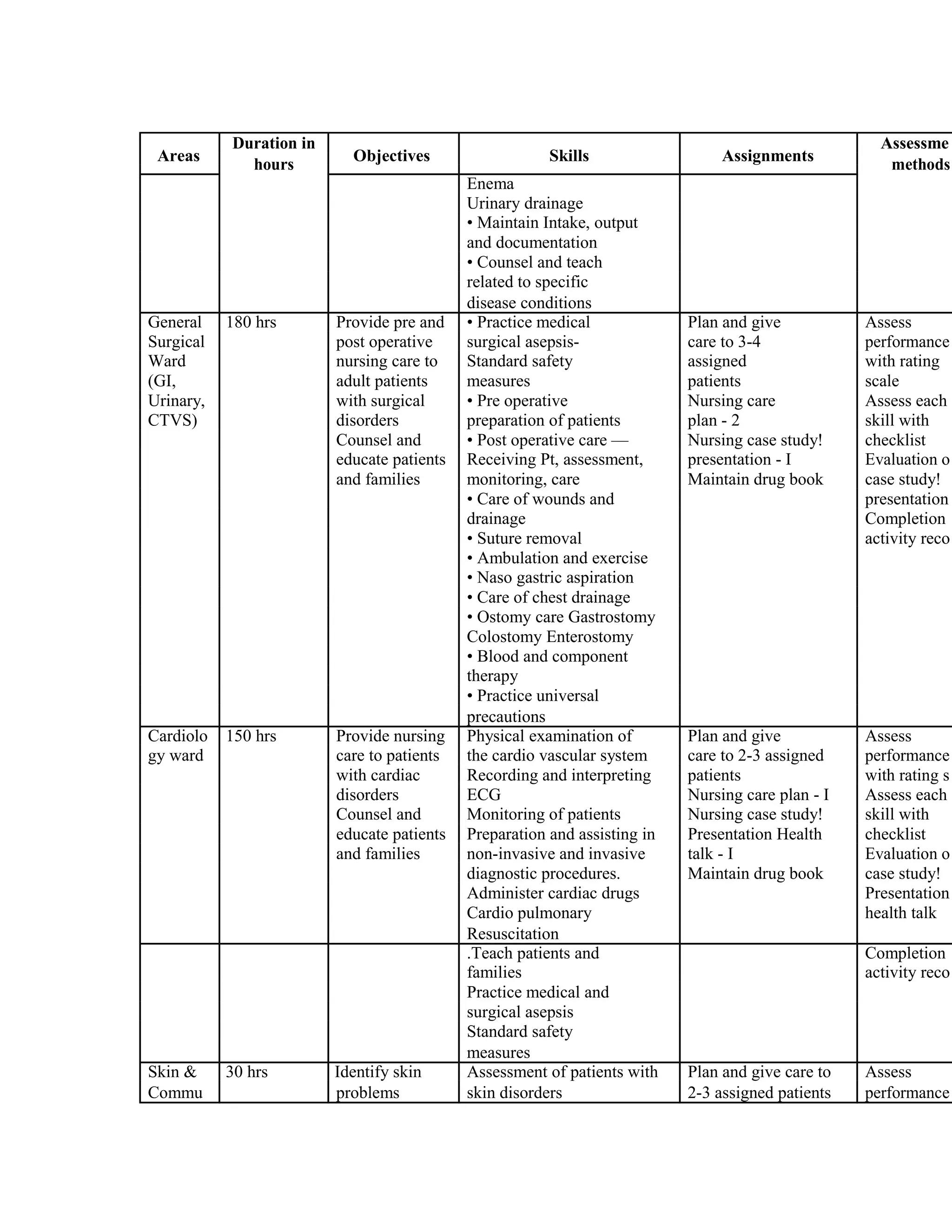
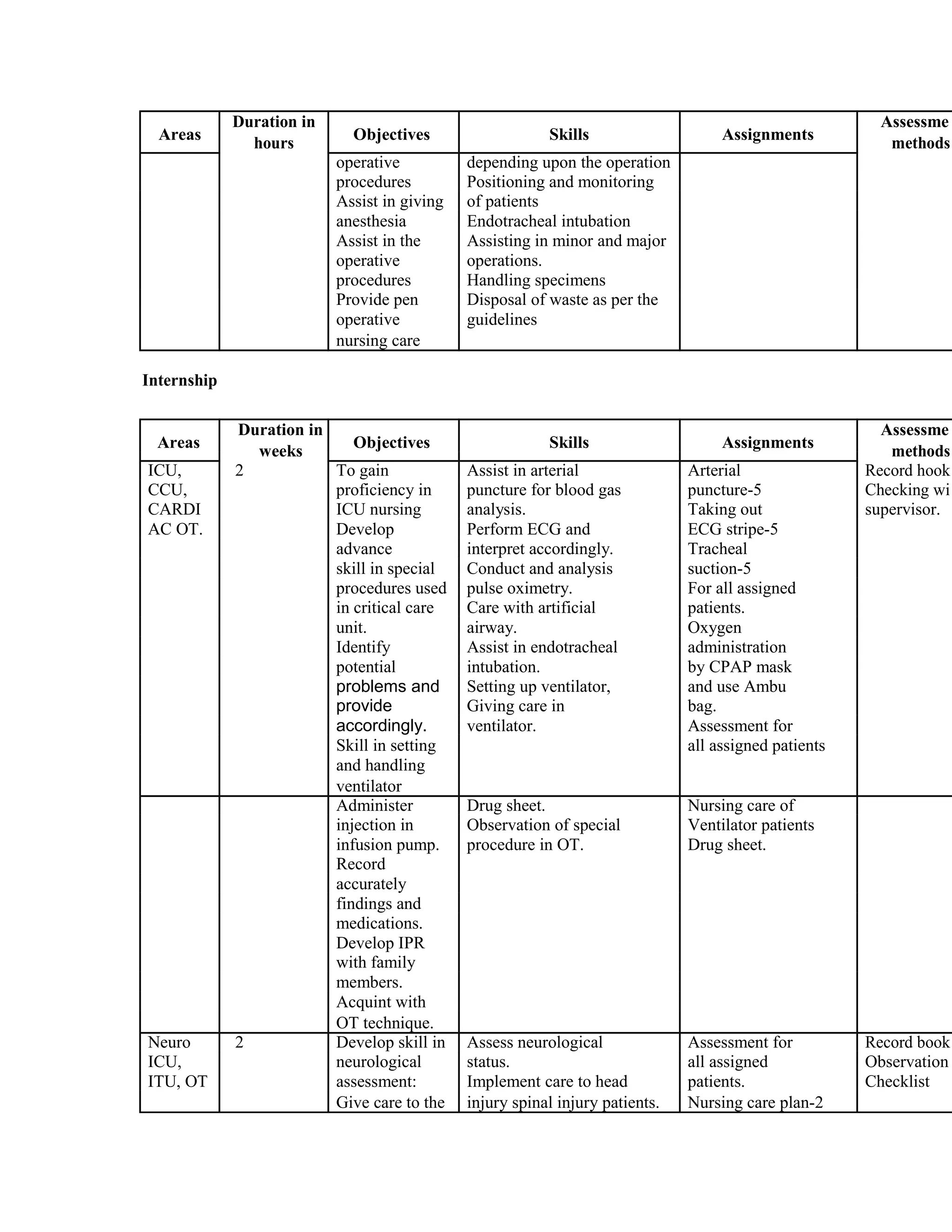
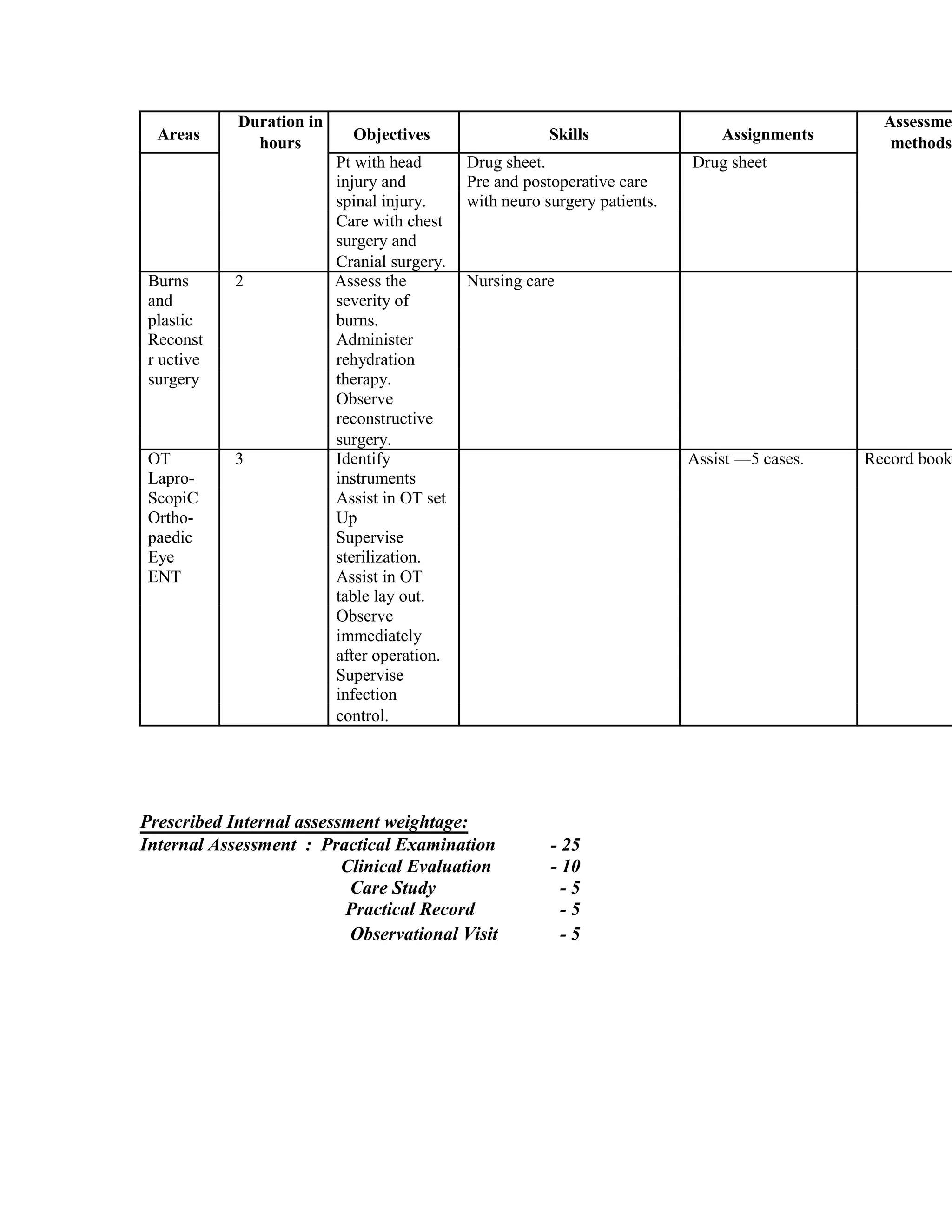
20. Medical Surgical Nursing (Adult Including Geriatrics) – I Practical 96
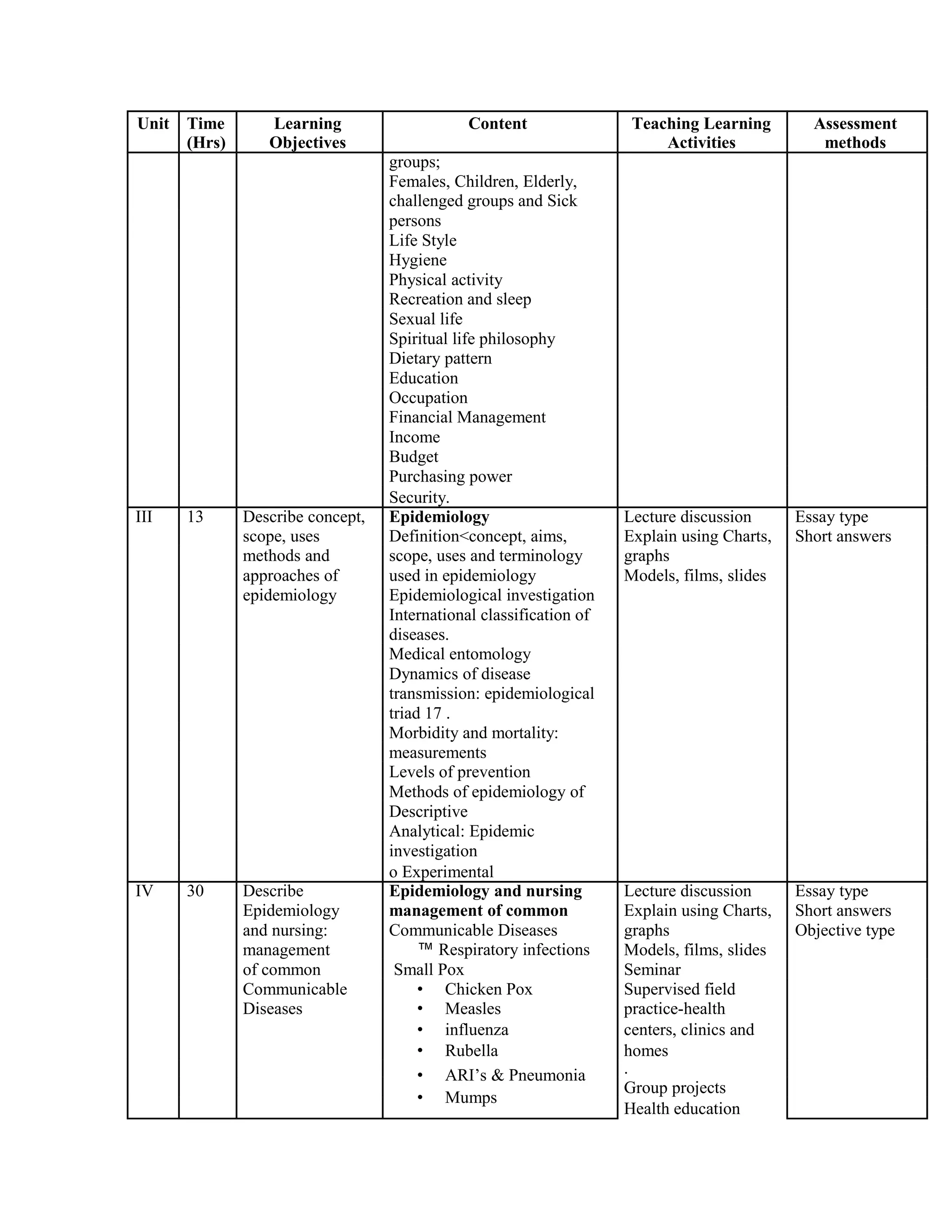
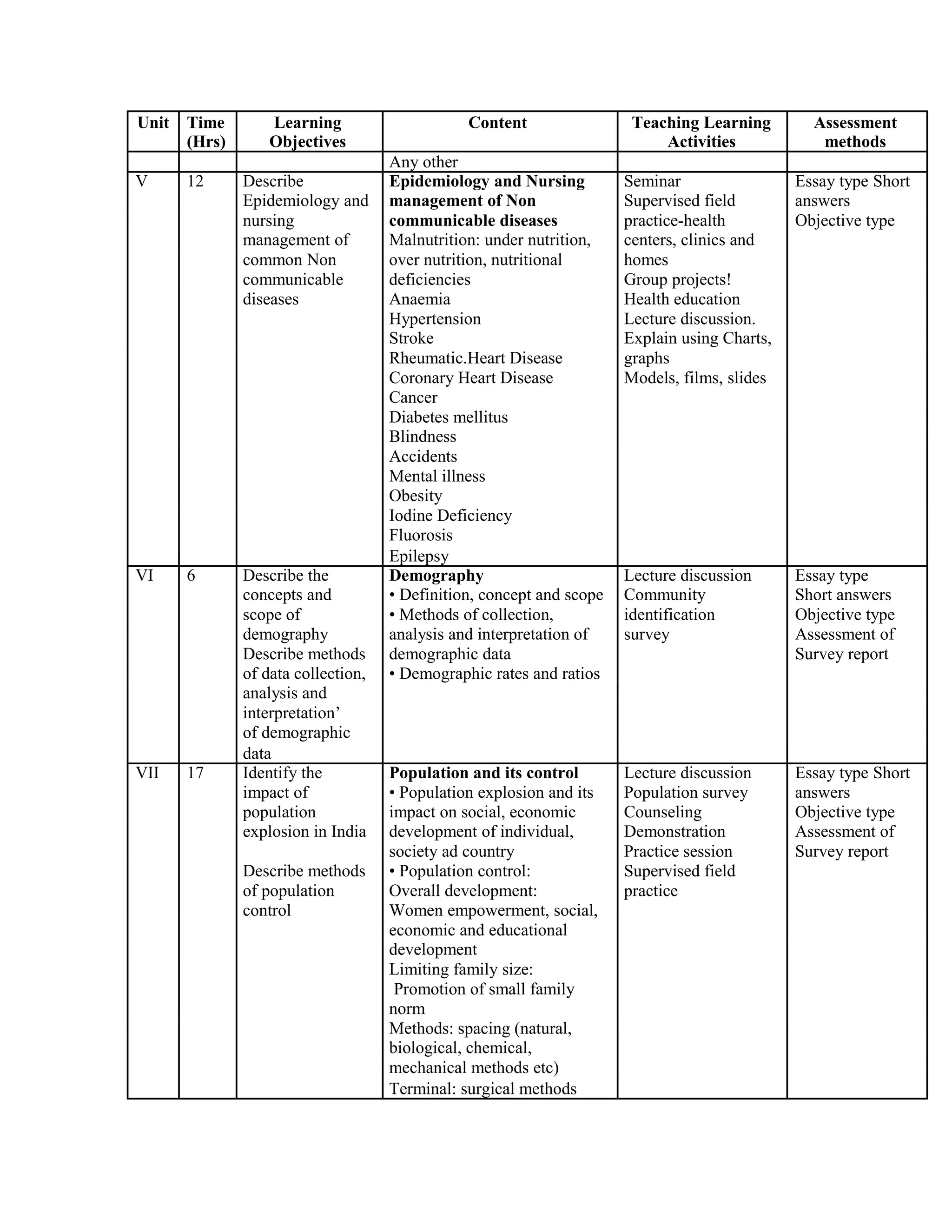
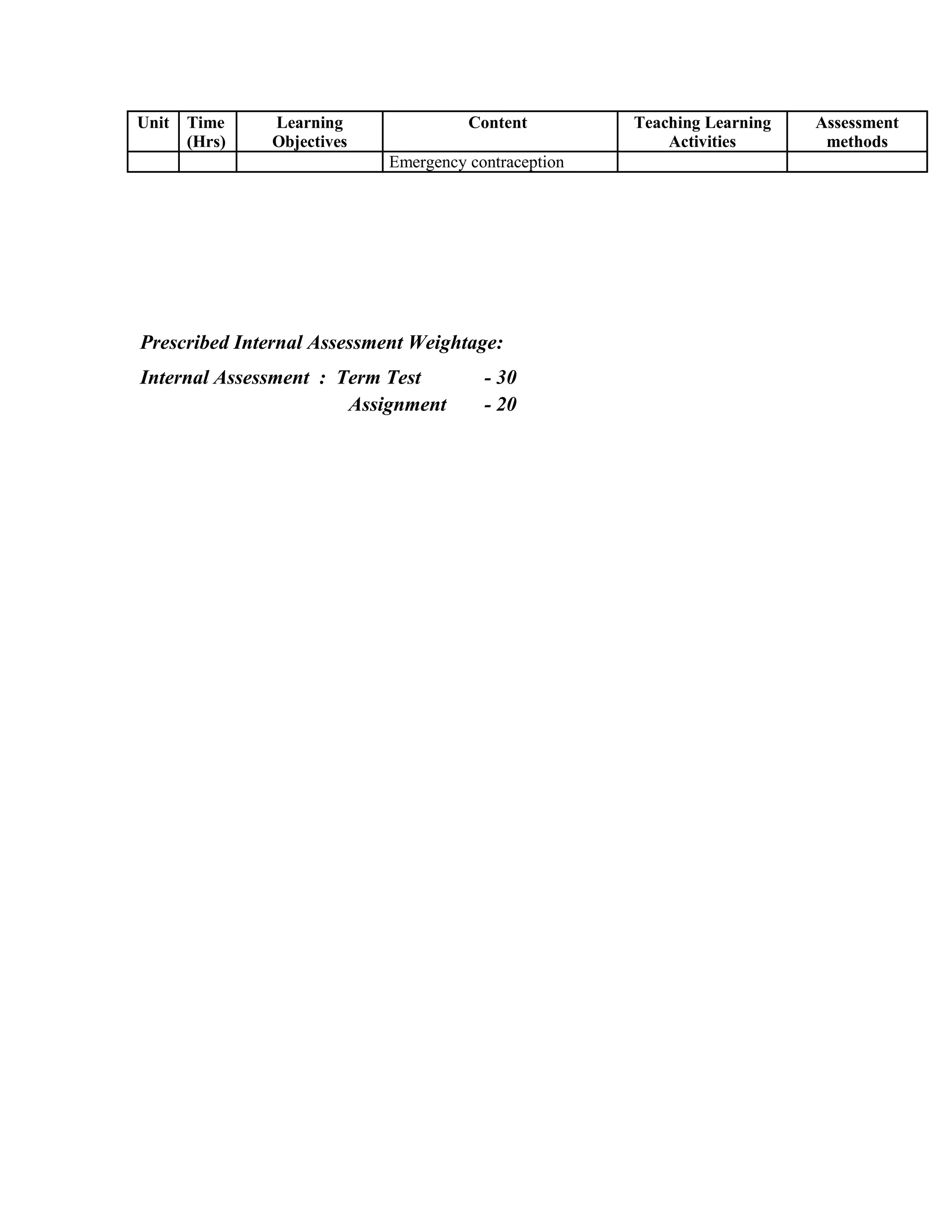
21. Community Health Nursing – I …………………………… 102
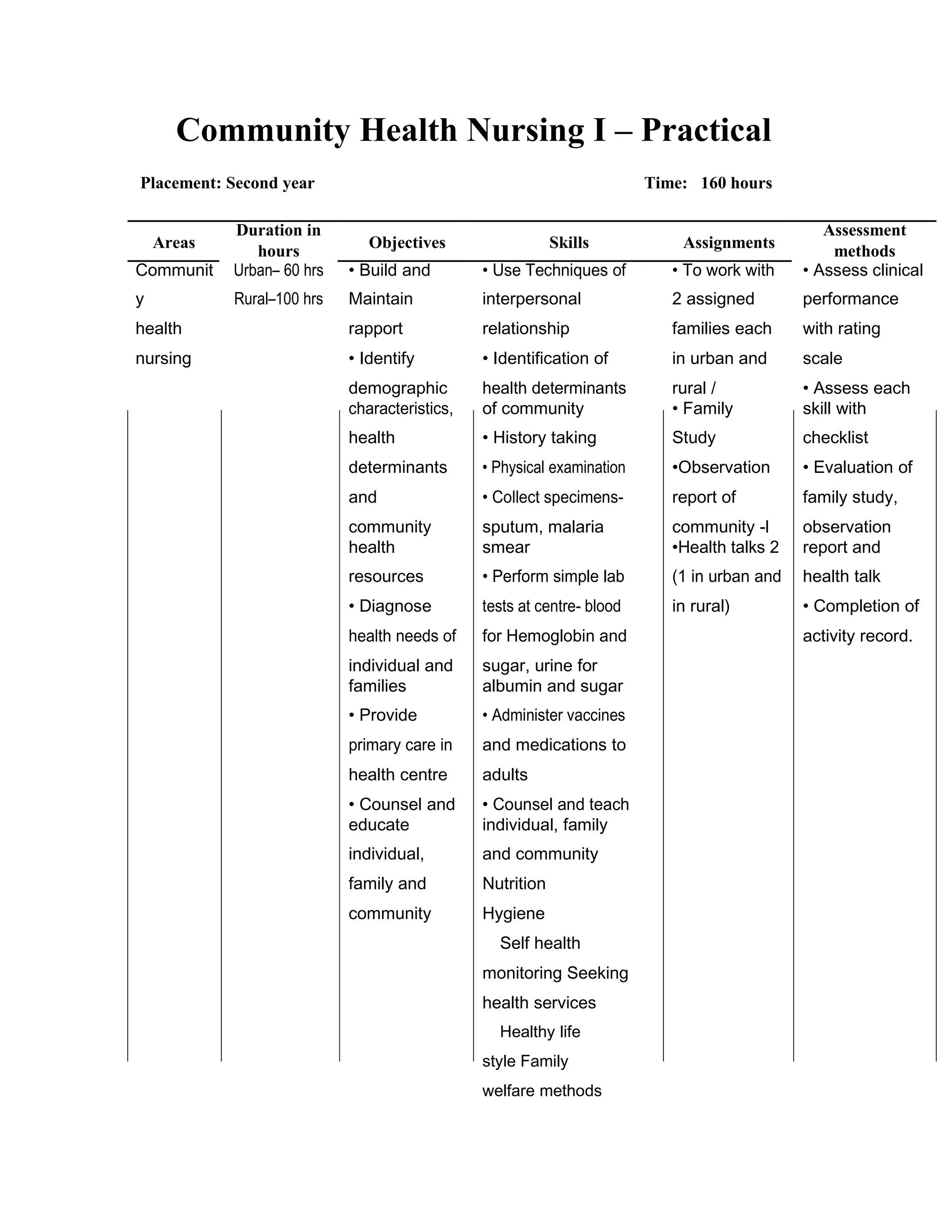
22. Community Health Nursing – I Practical ………………… 106
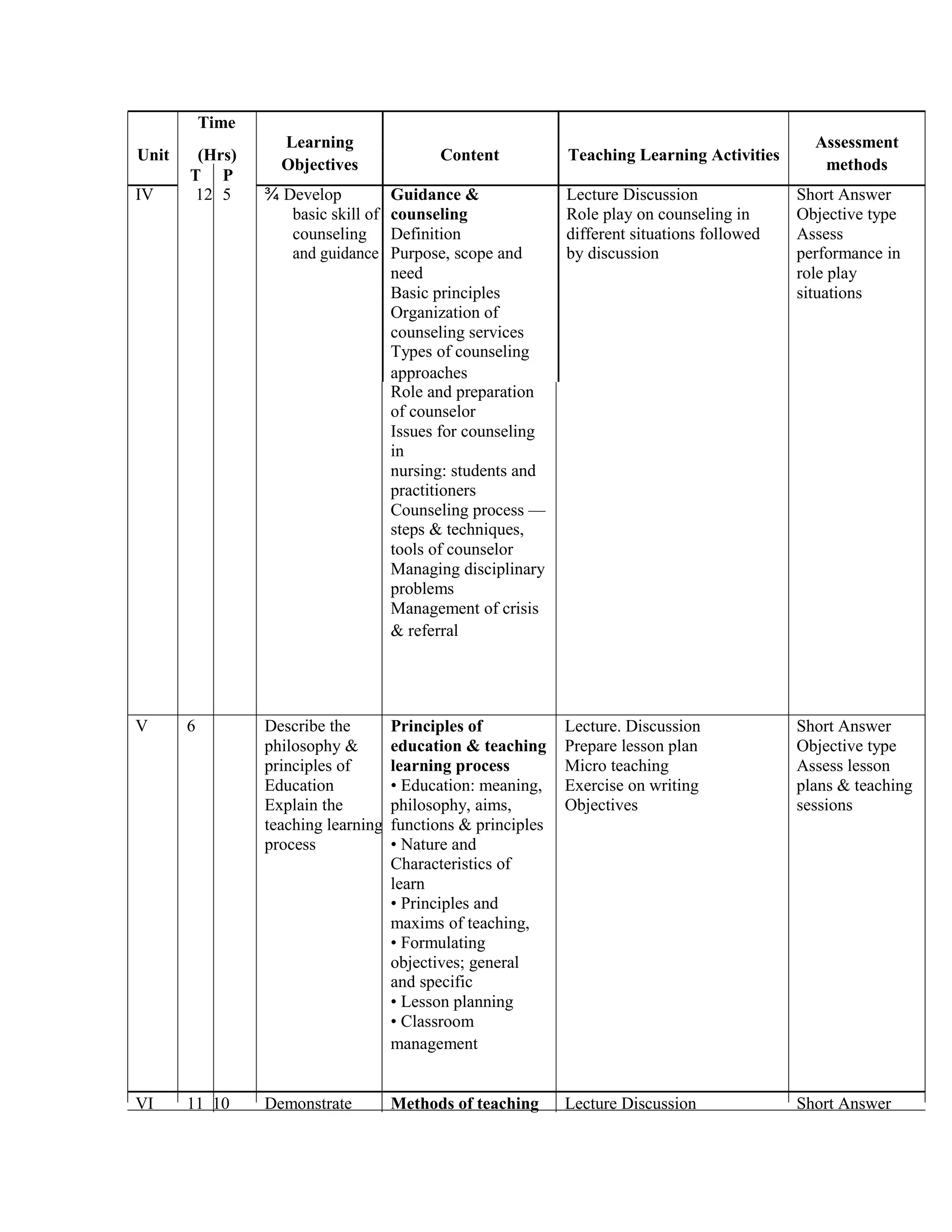
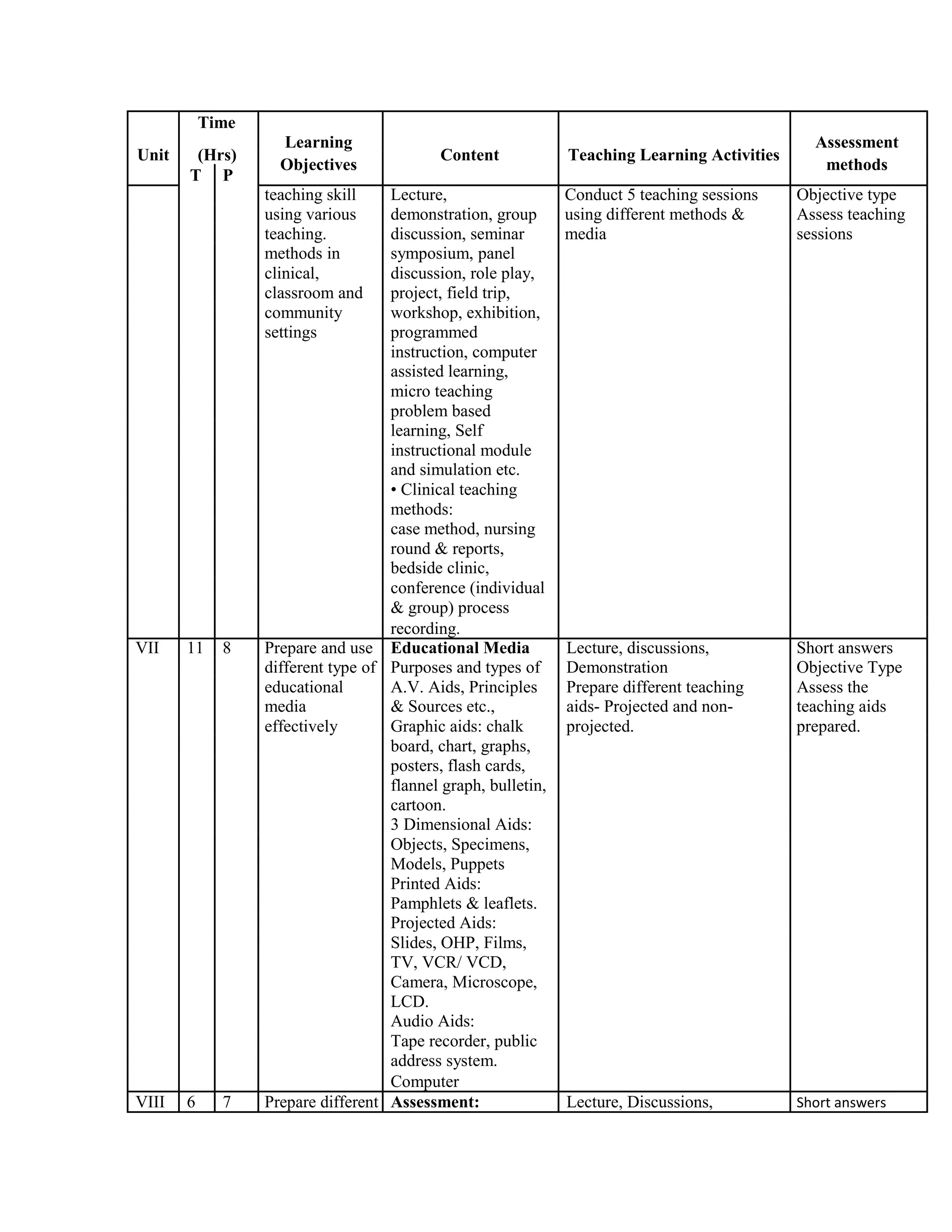
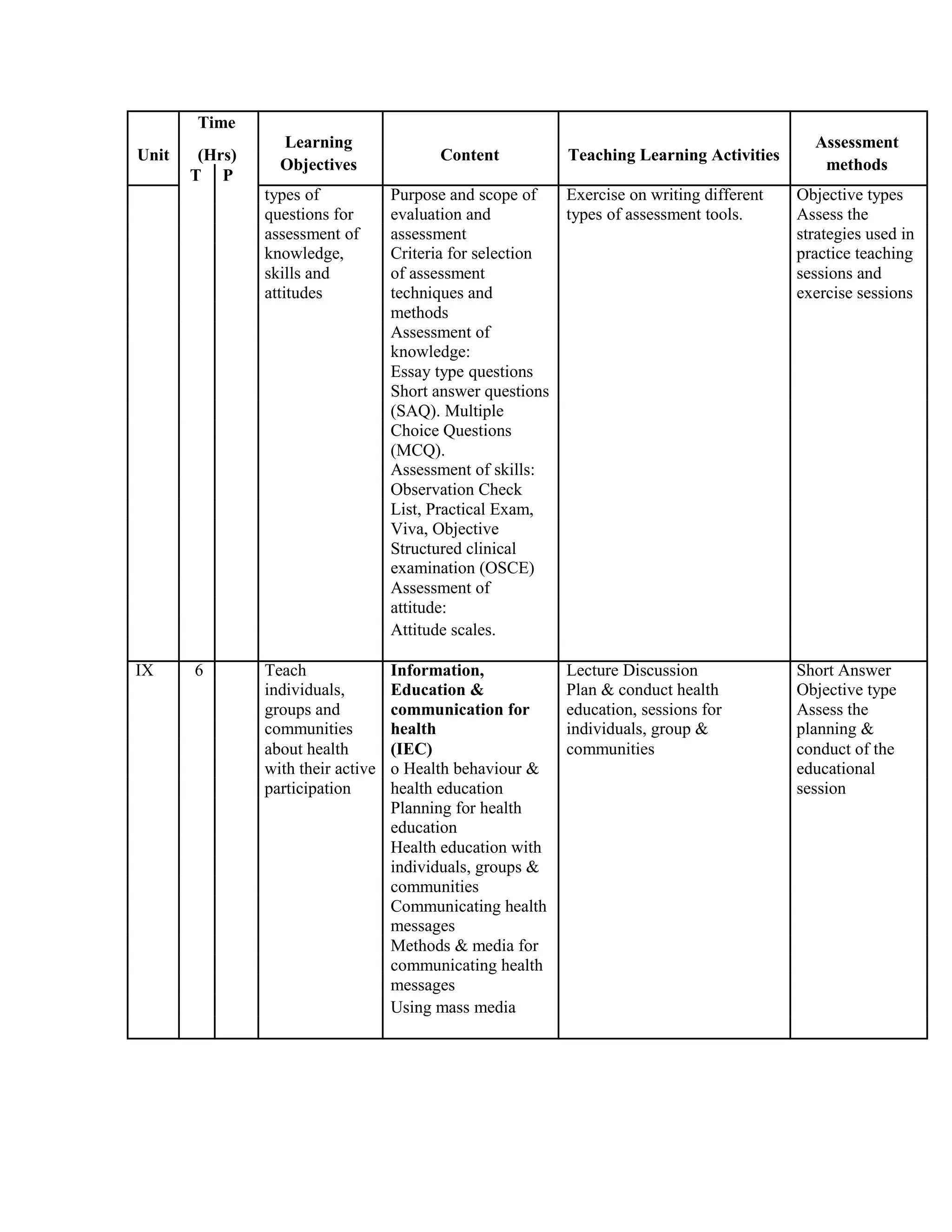
23. Communication & Educational Technology ……………… 107
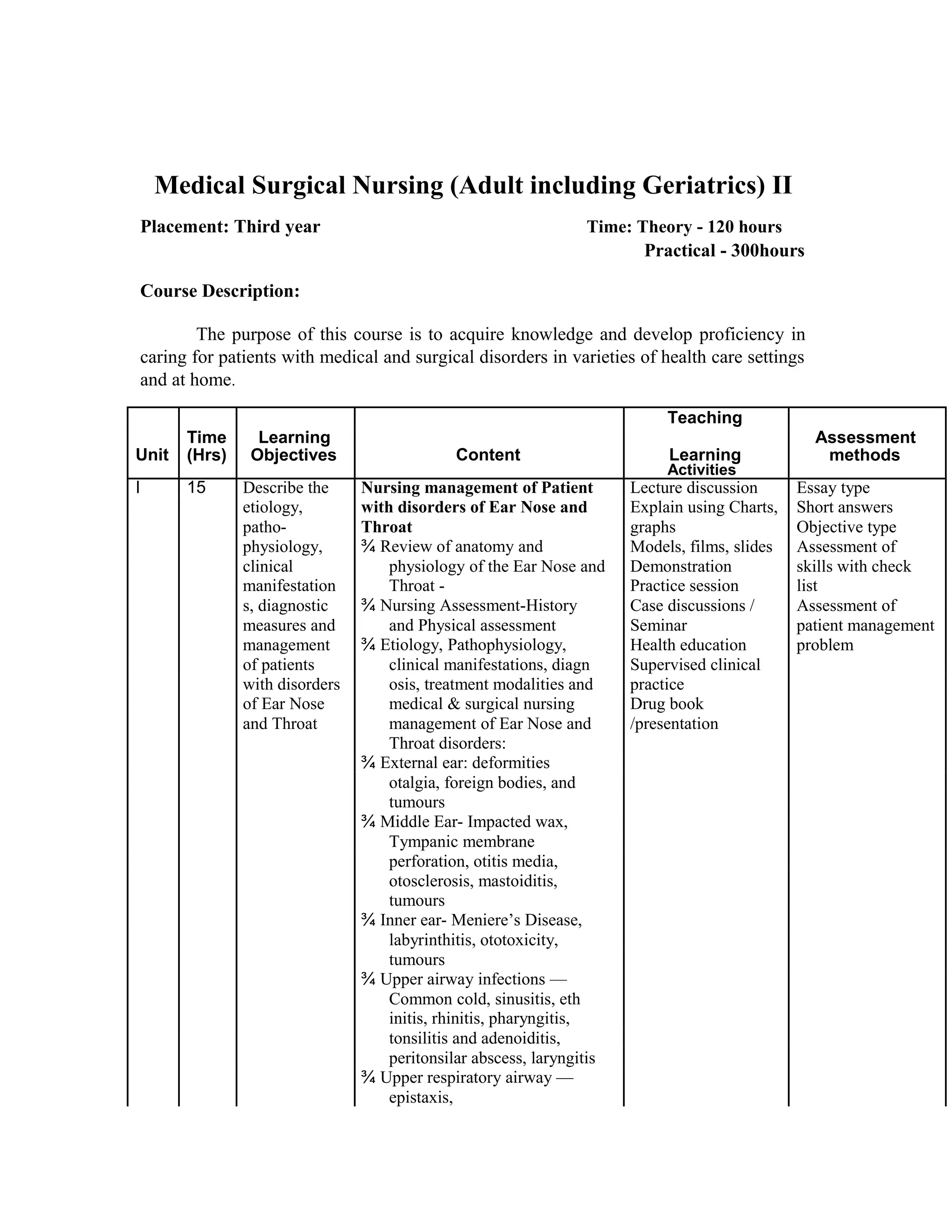
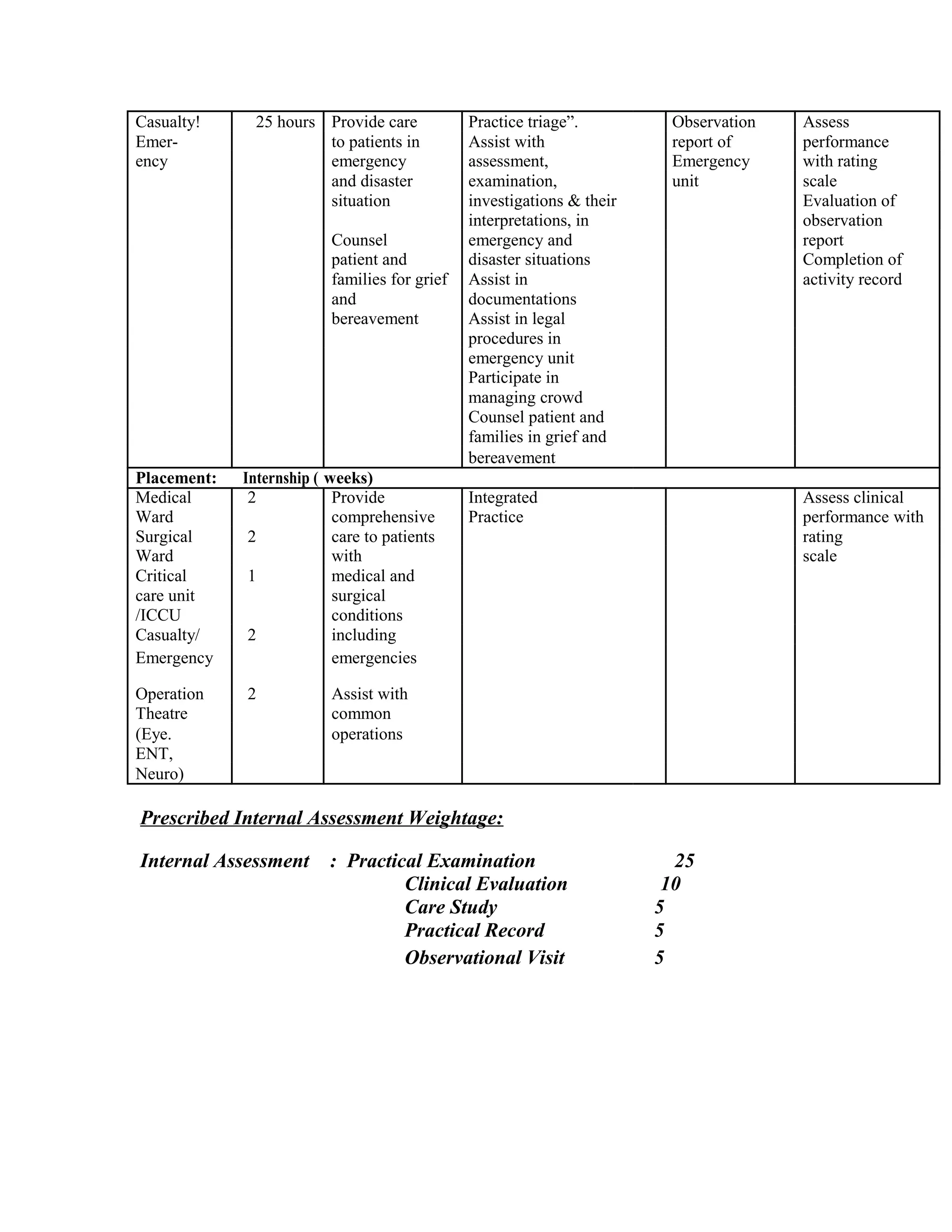
24. Medical Surgical Nursing (Adult Including Geriatrics) II …… 112
25. Medical surgical Nursing (Adult & Geriatrics) II Practical… 123
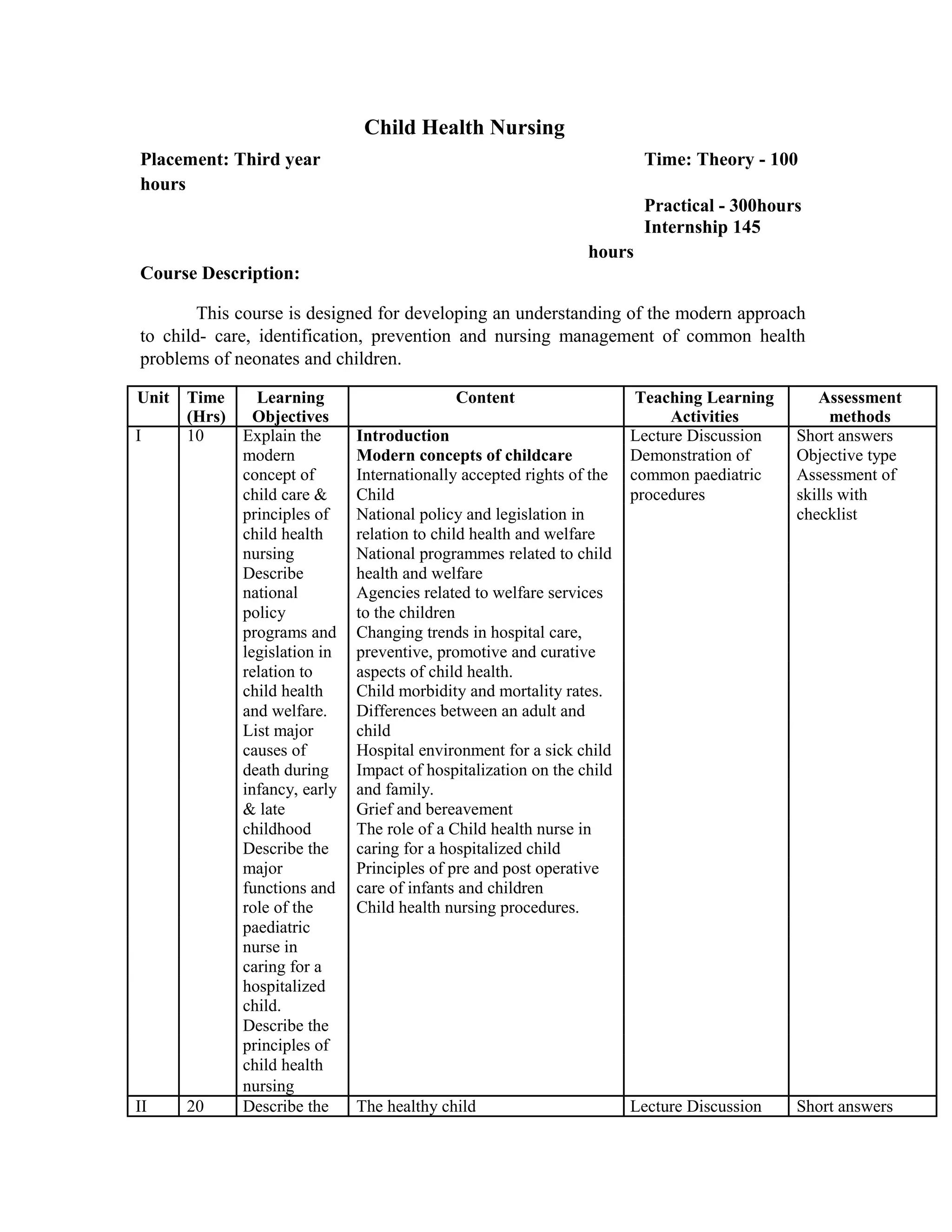
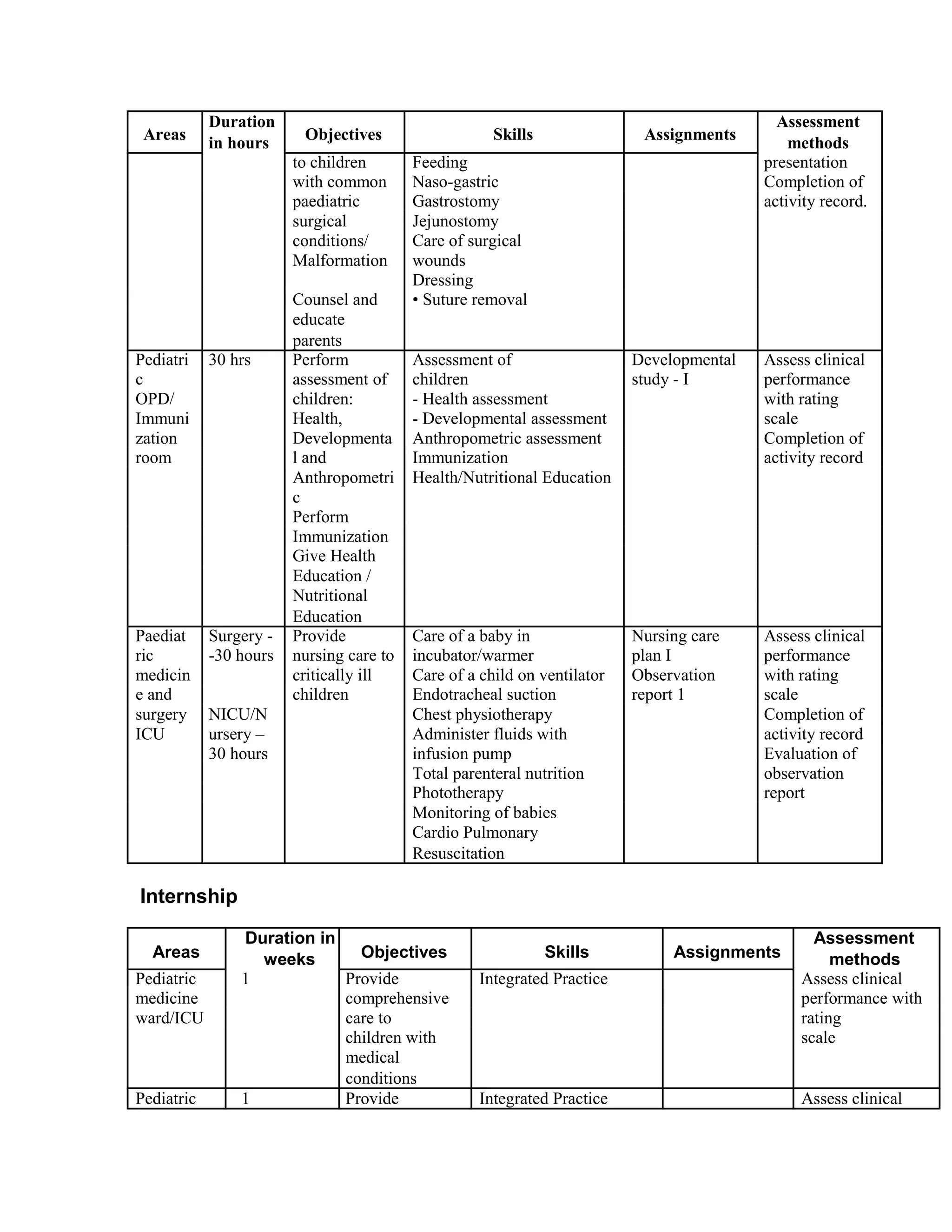
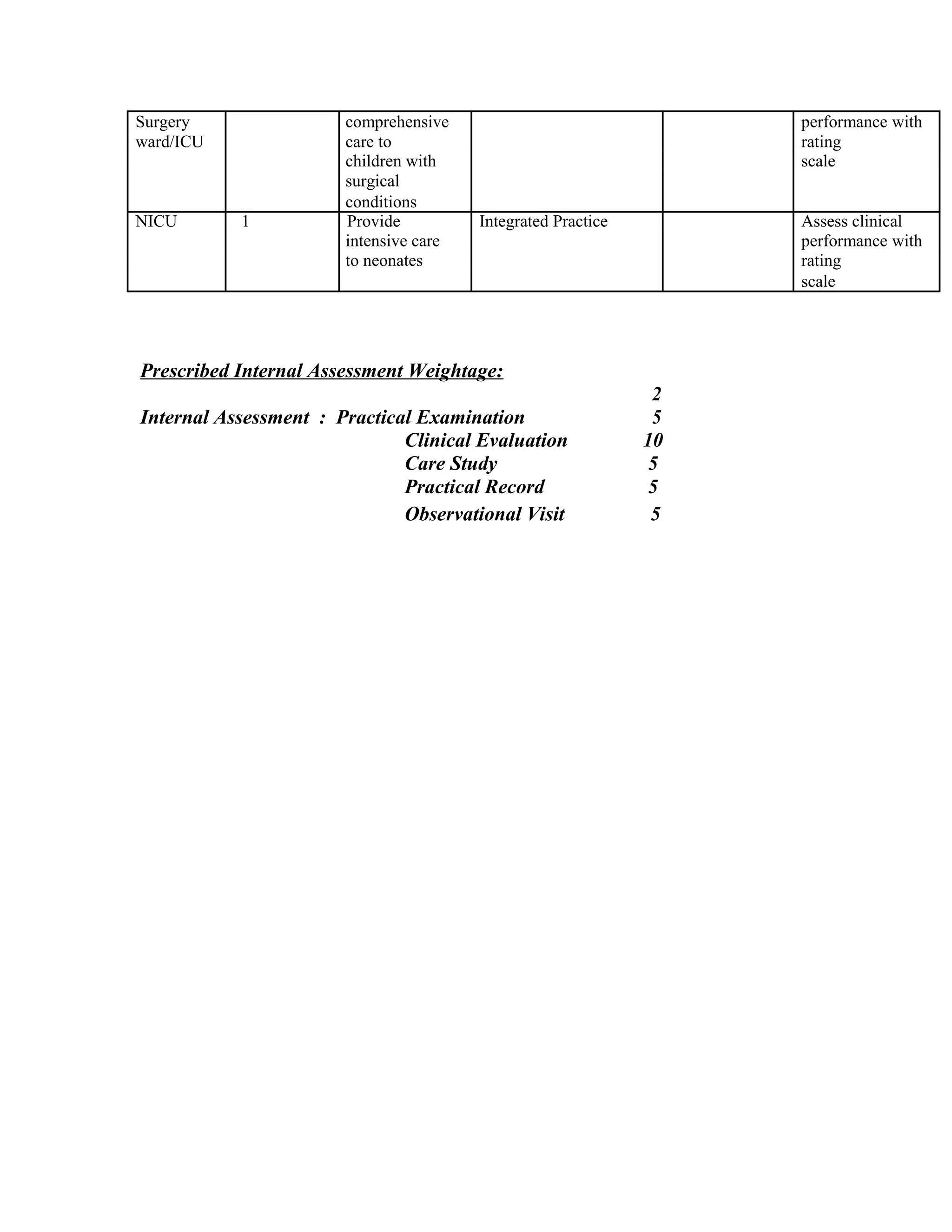
26. Child Health Nursing ………………………………………… 128
27. Child Health Nursing – Practical ….………………………… 132
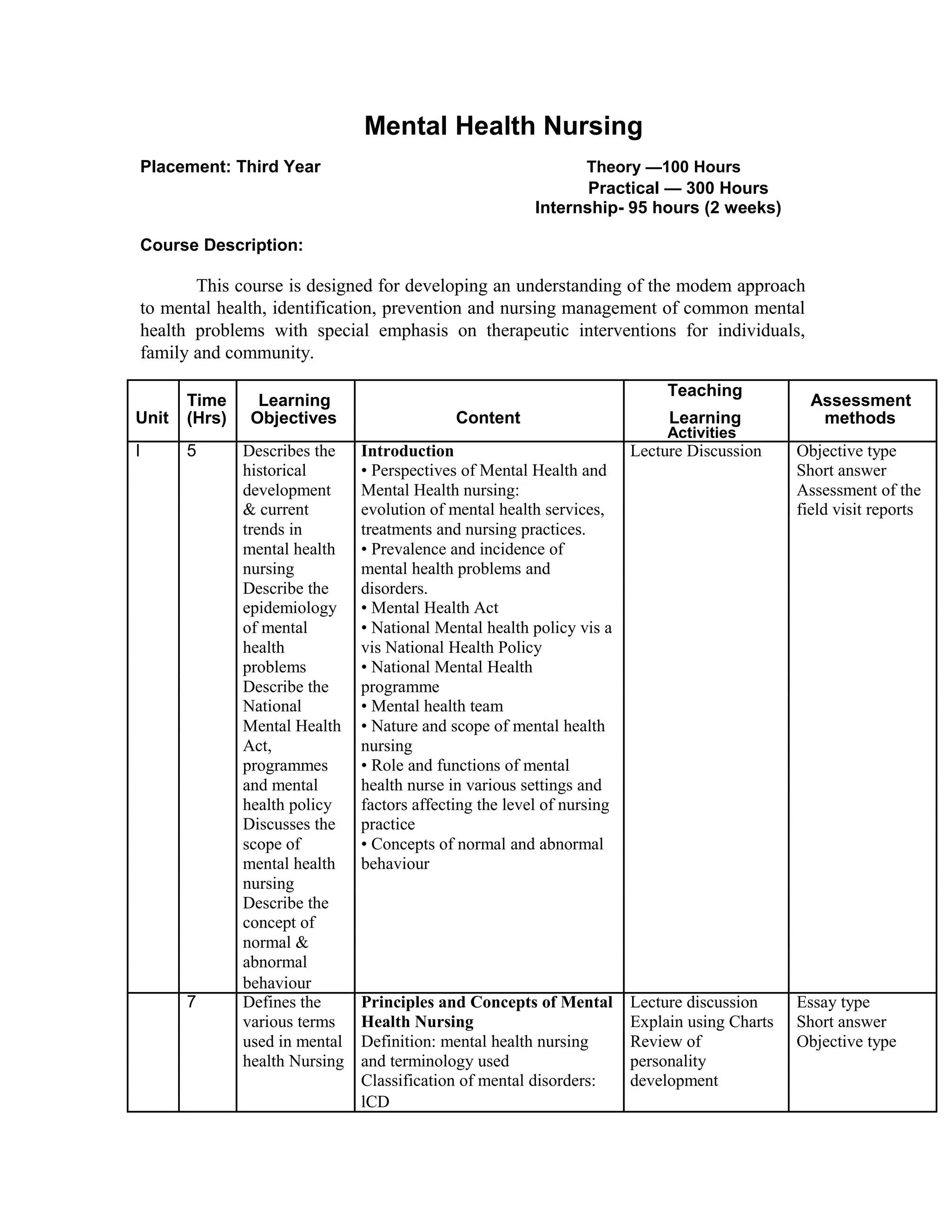
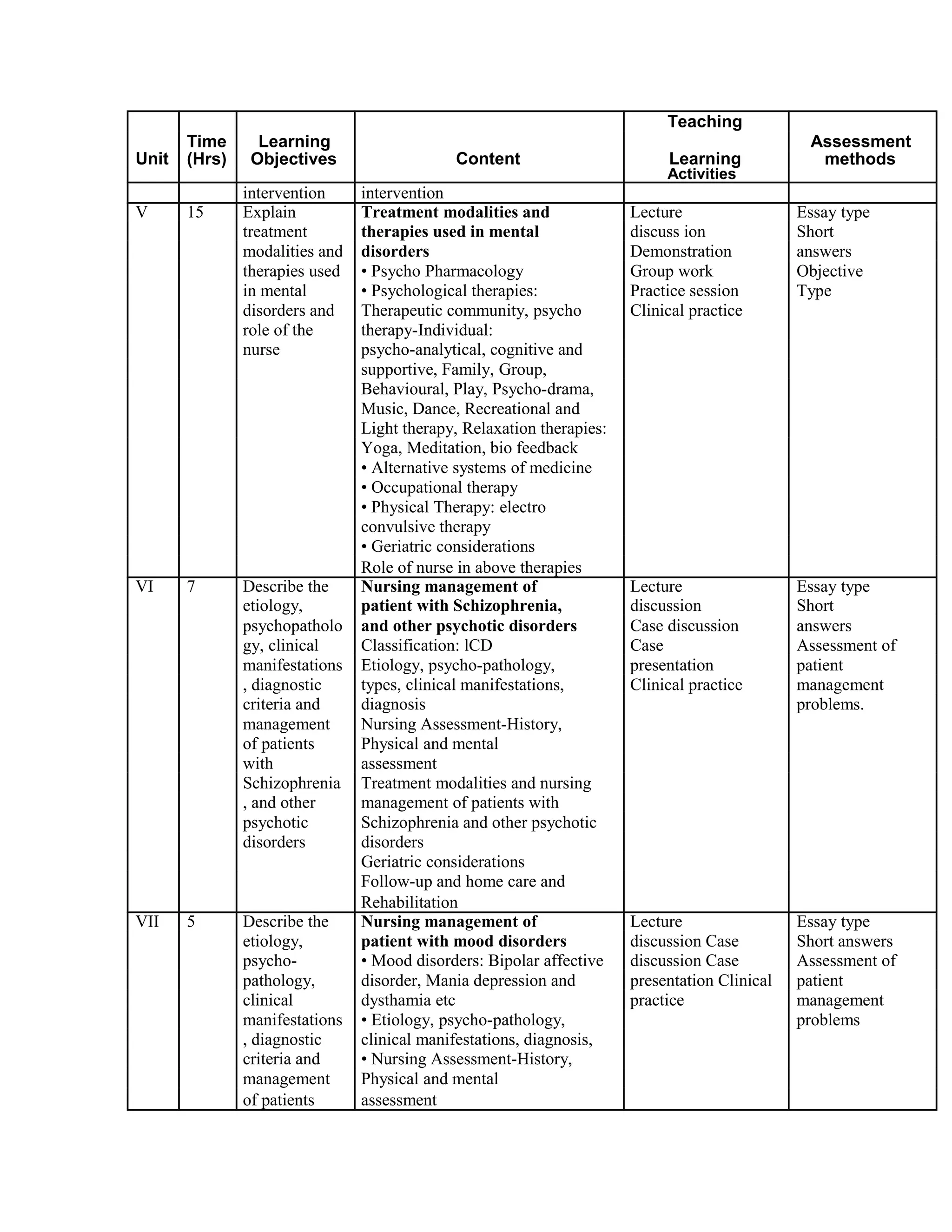
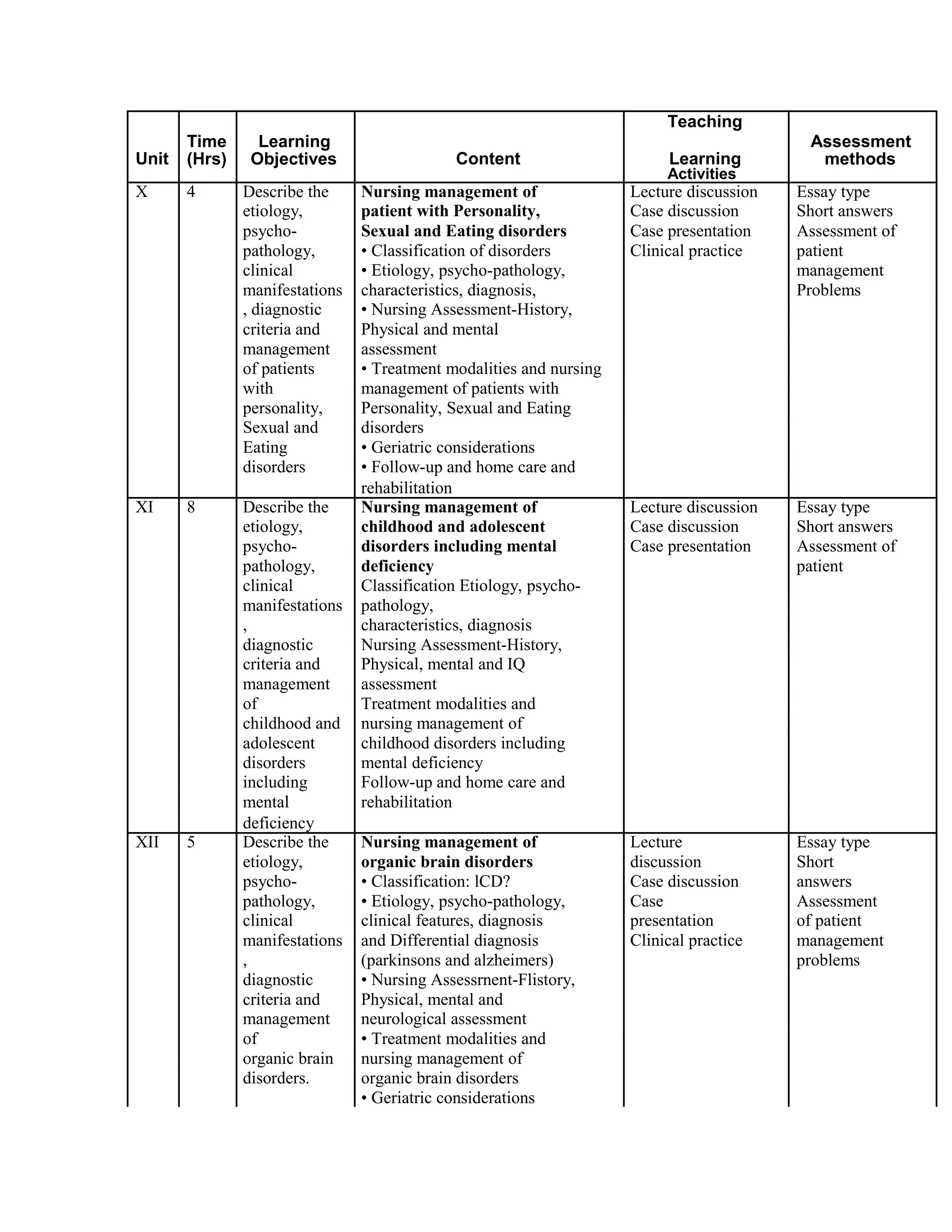
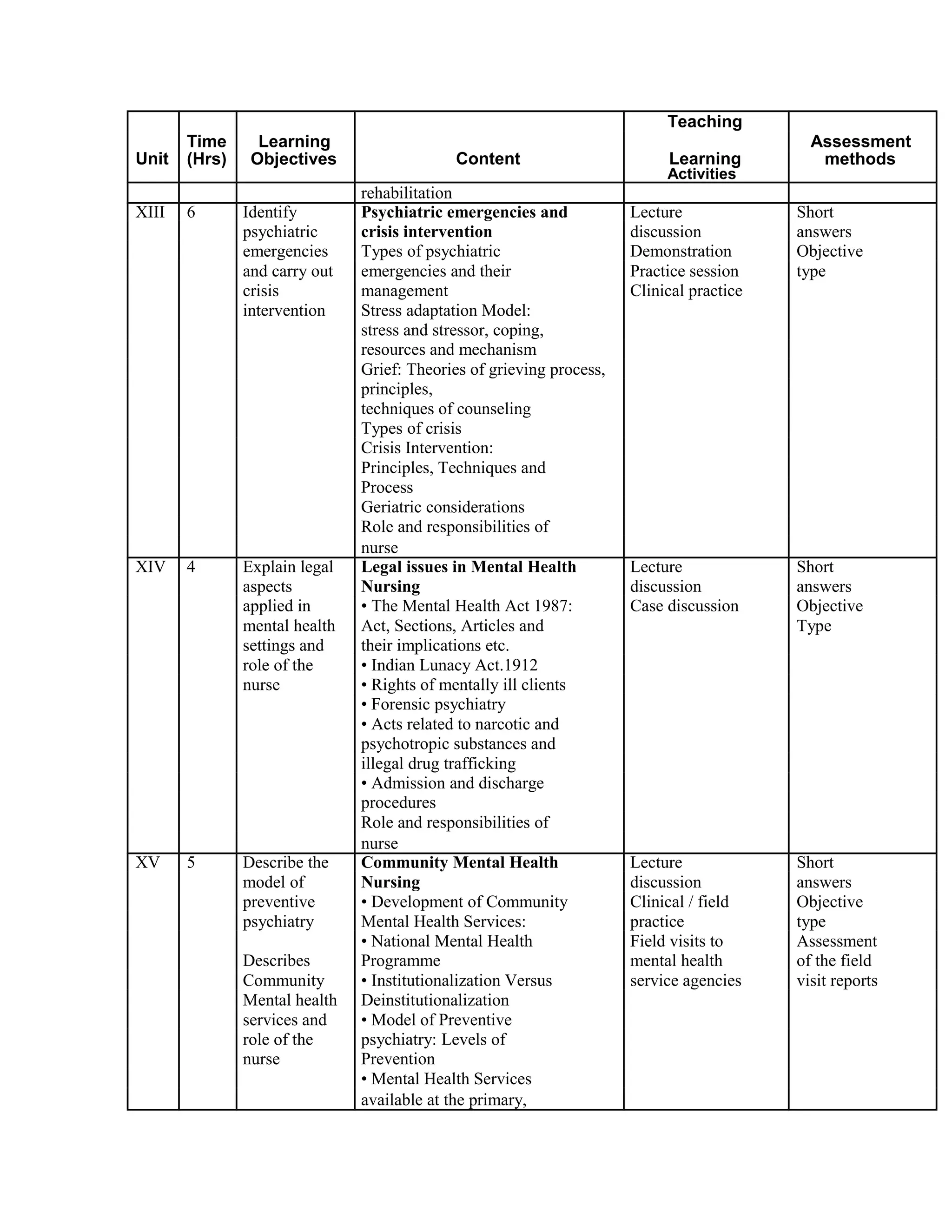
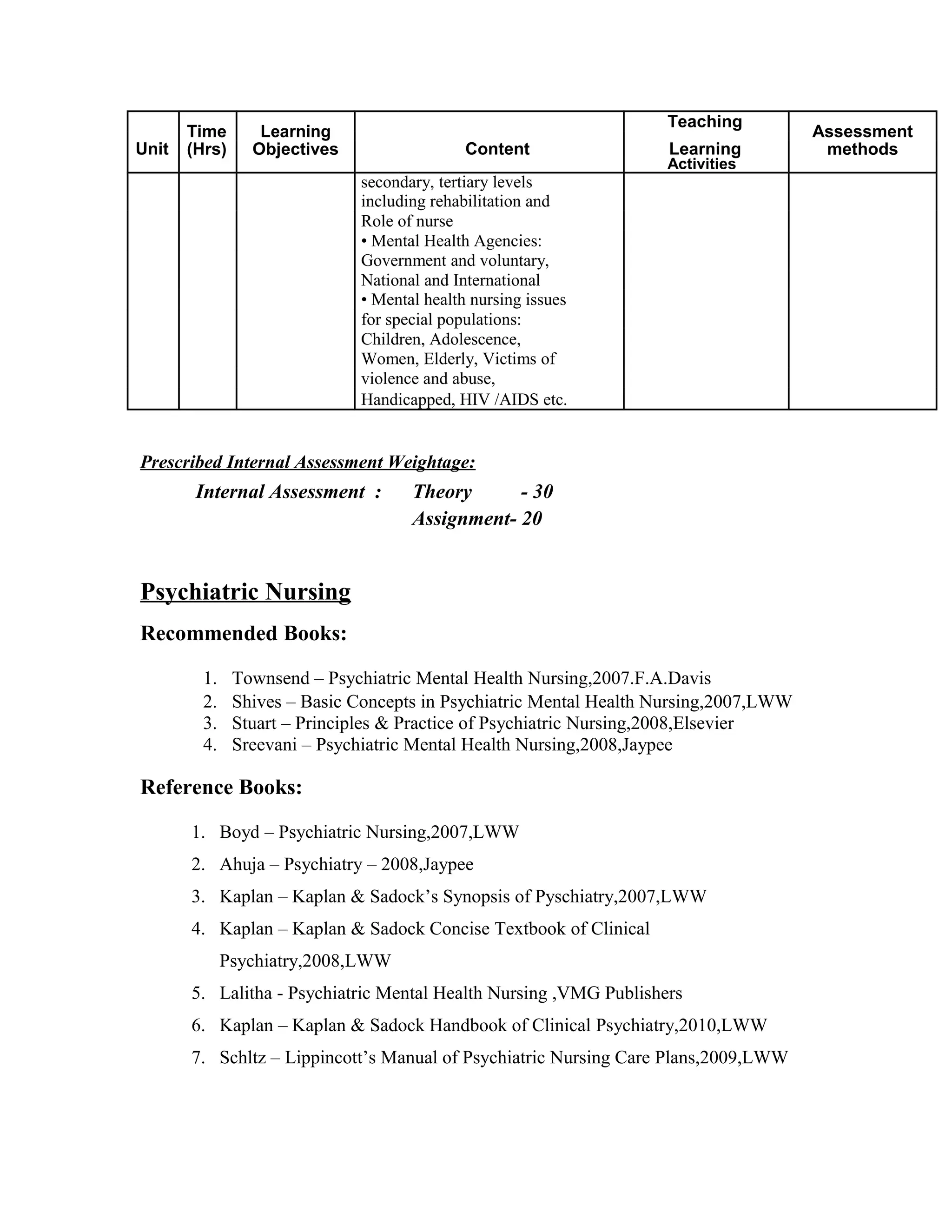
28. Mental Health Nursing ……………………………………… 135
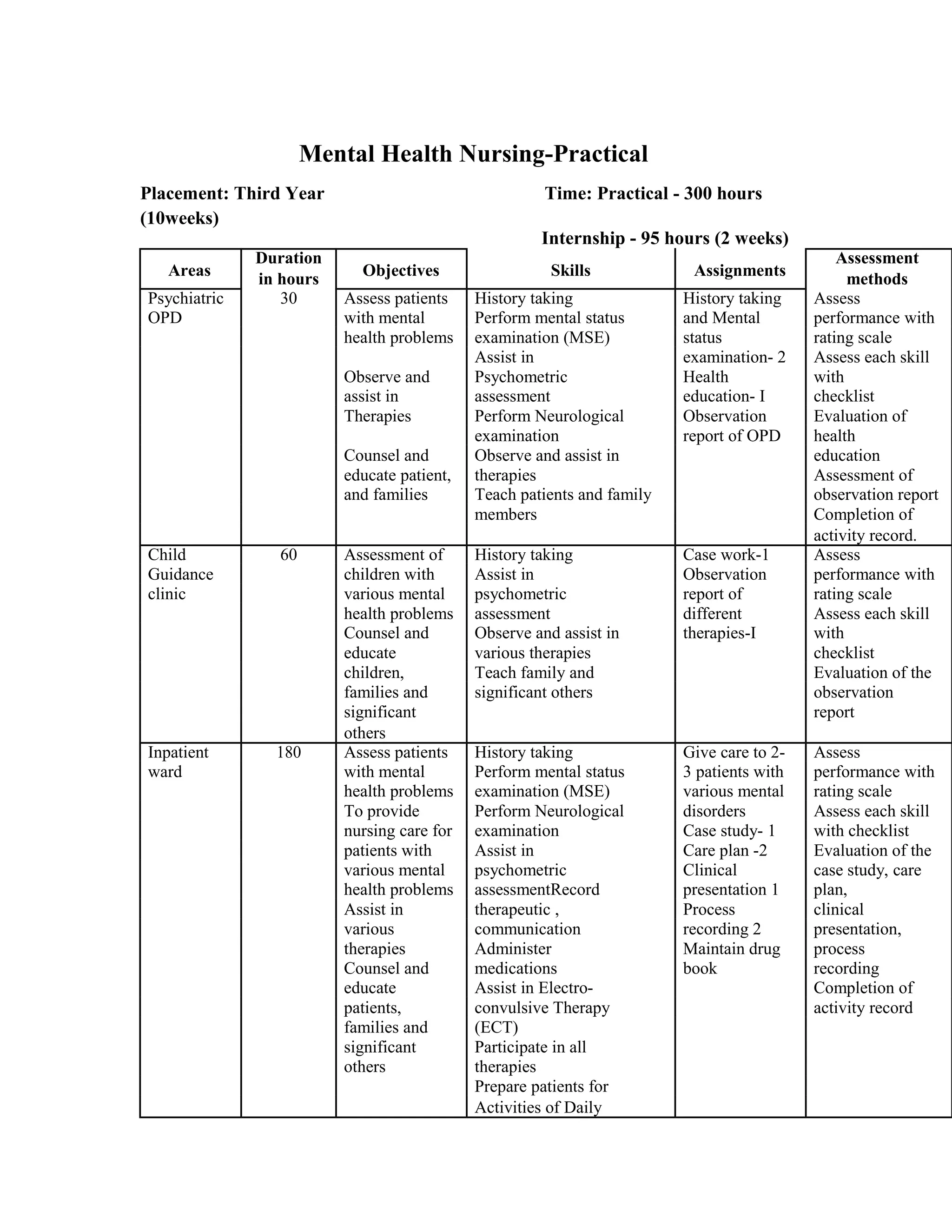
29. Mental Health Nursing – Practical ………………………… 143
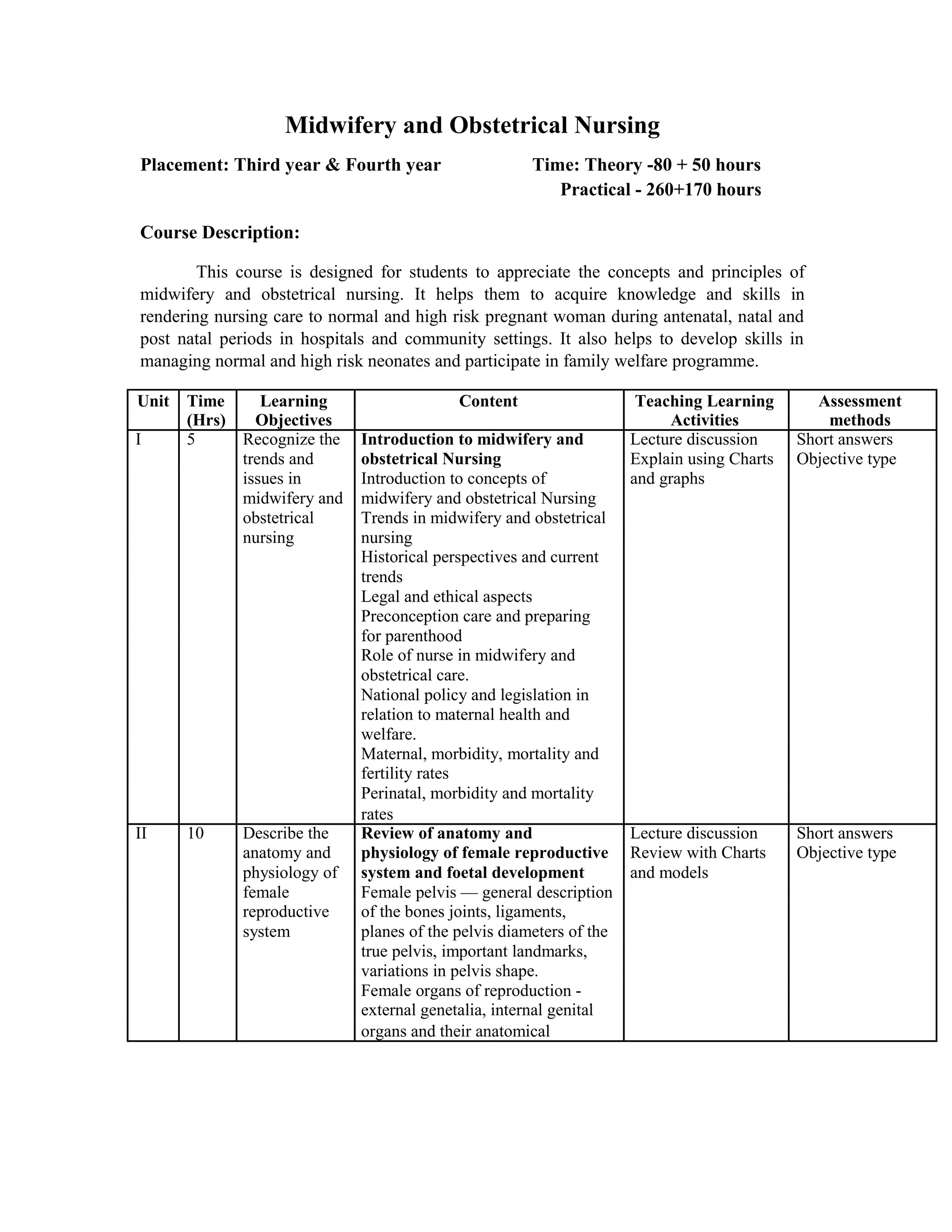
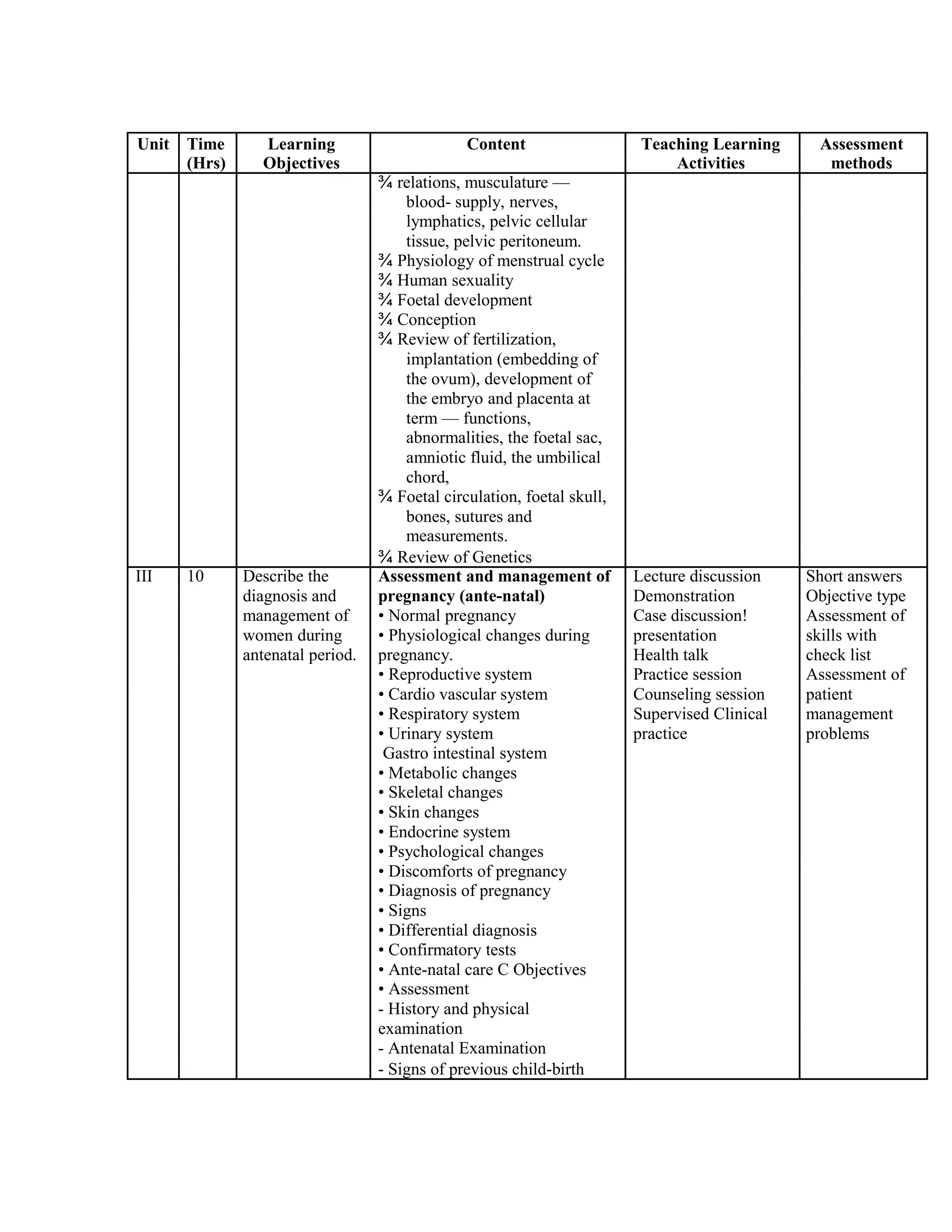
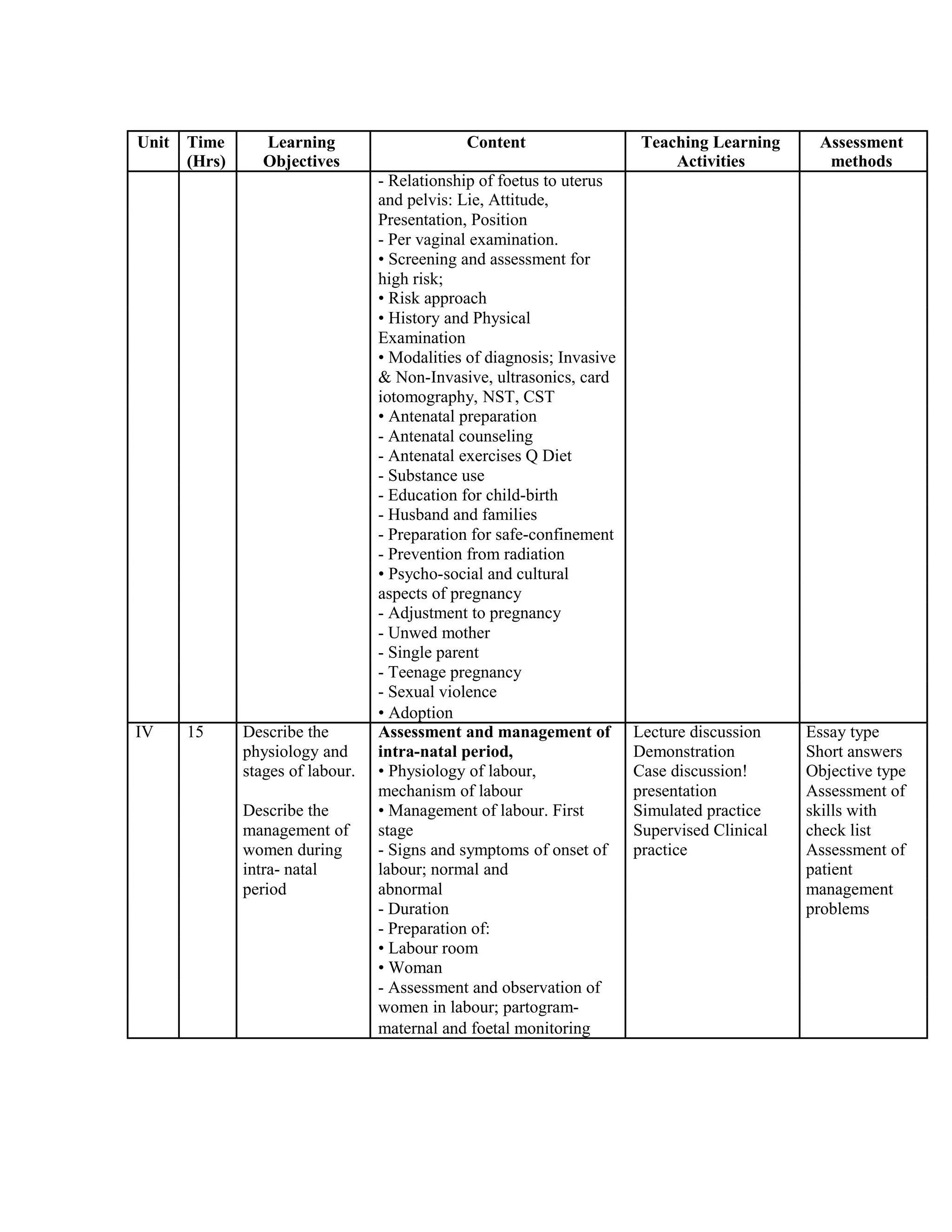
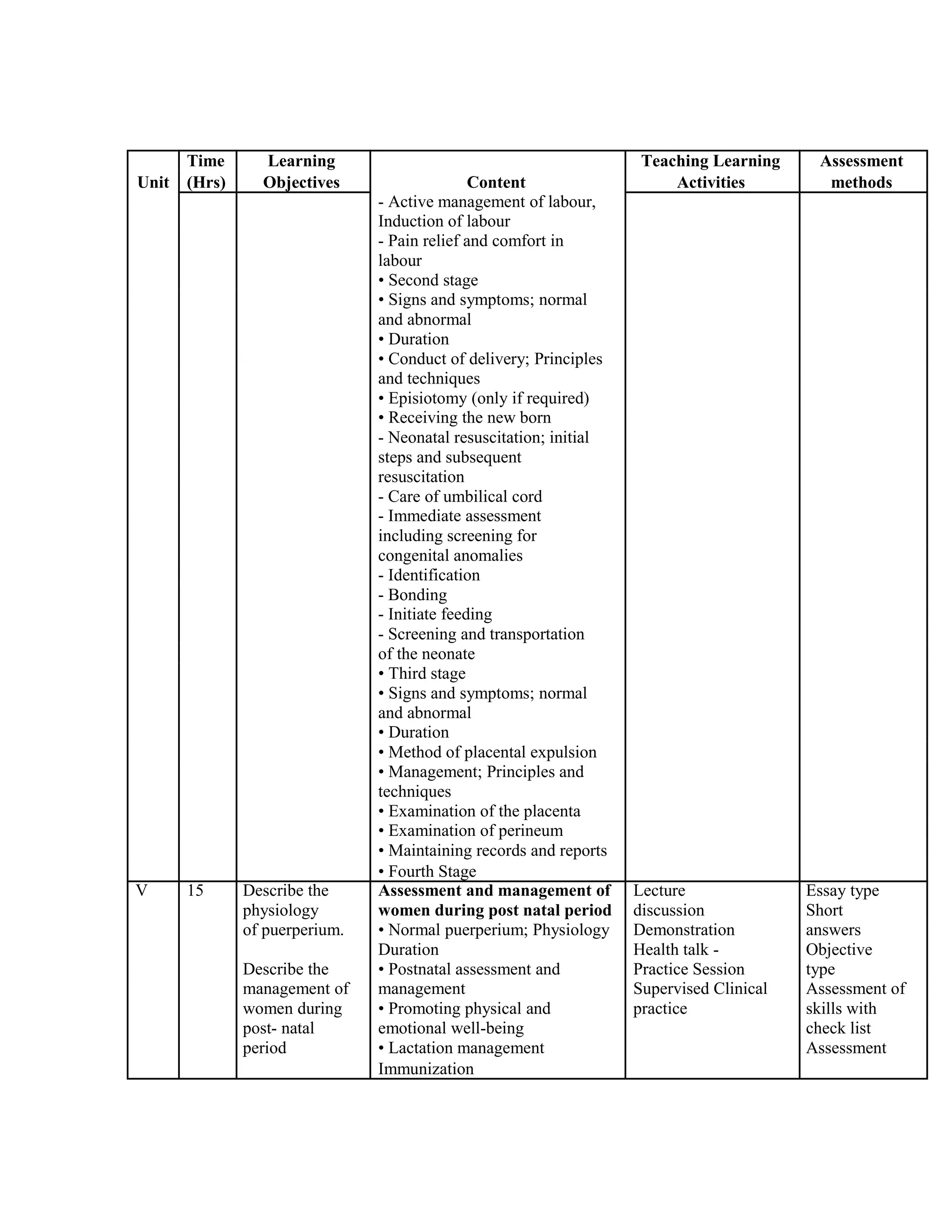
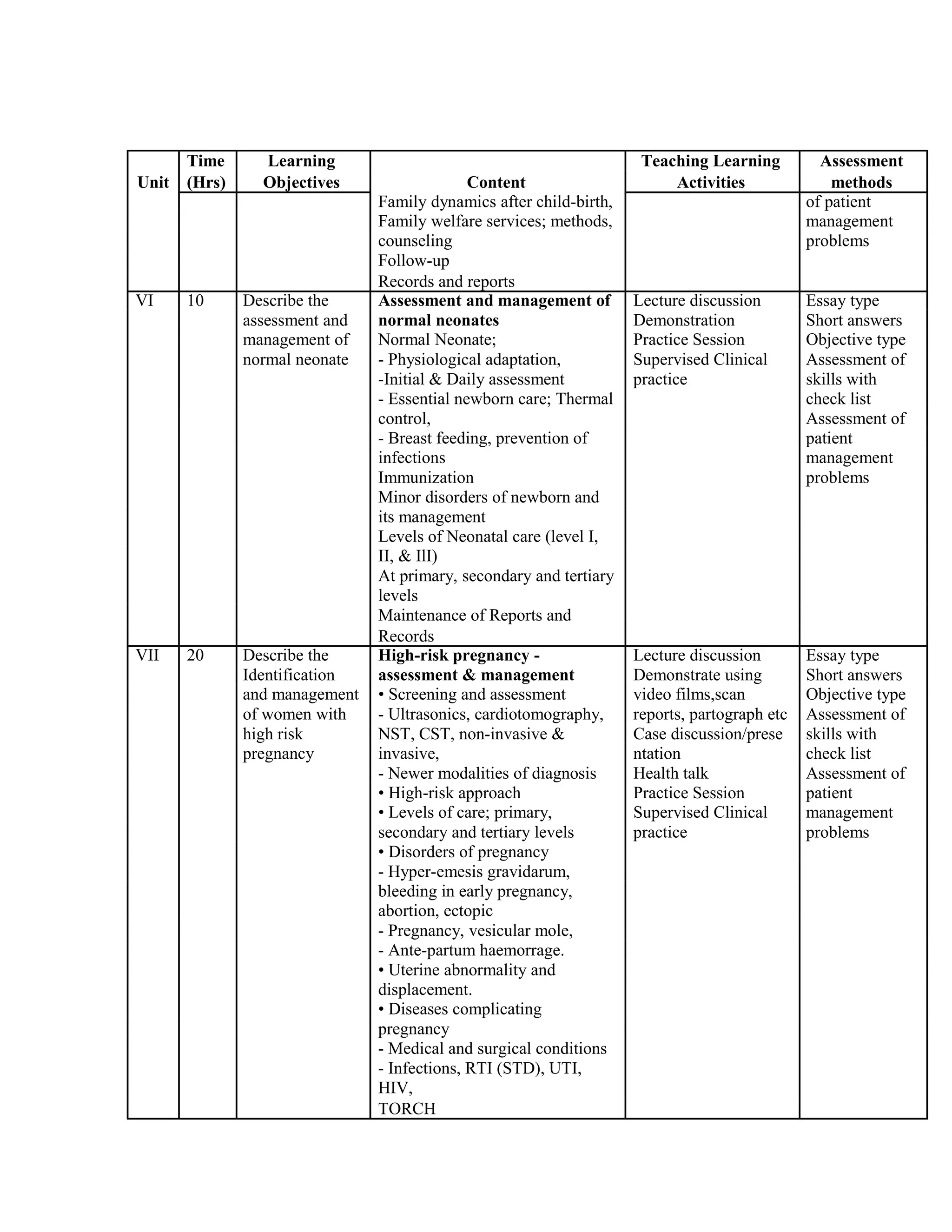
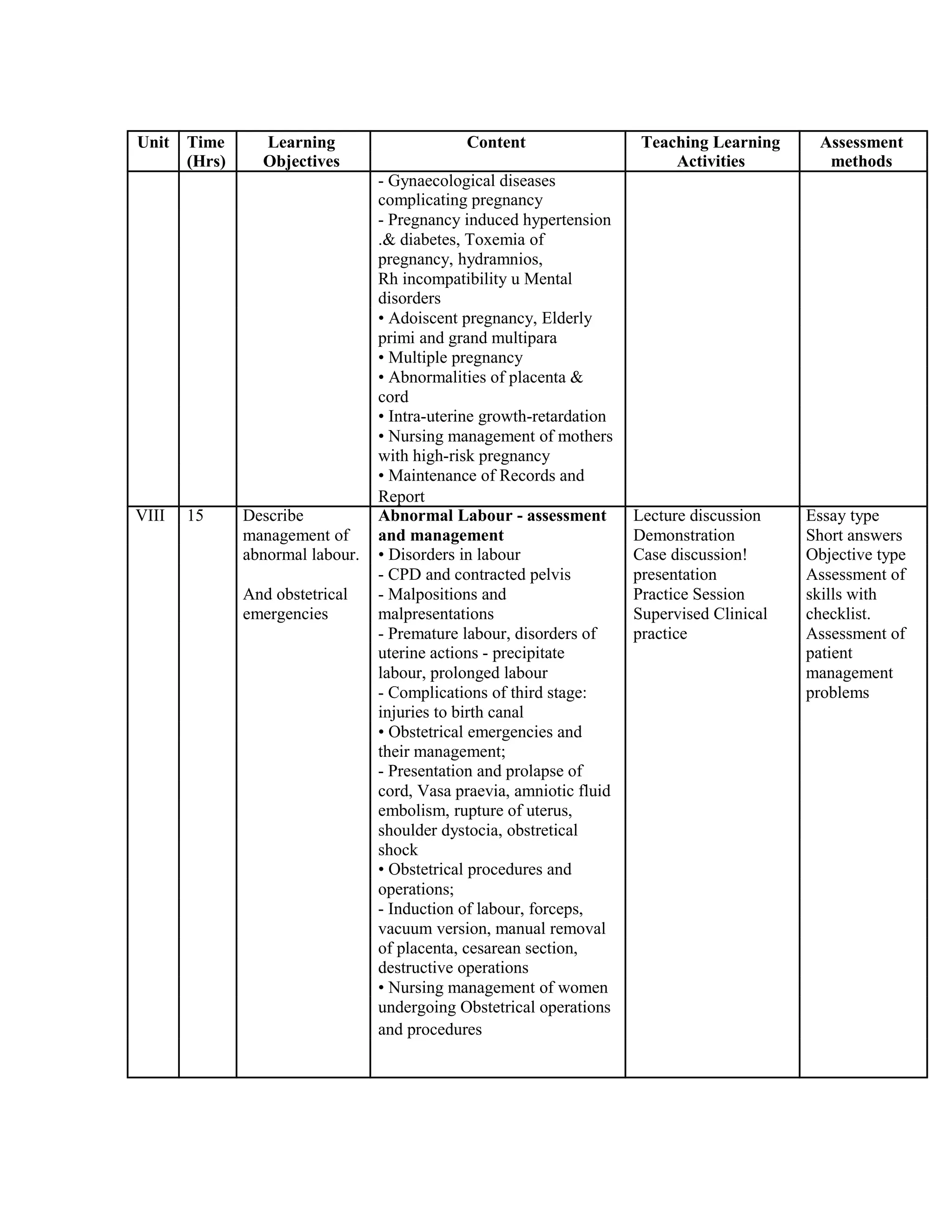
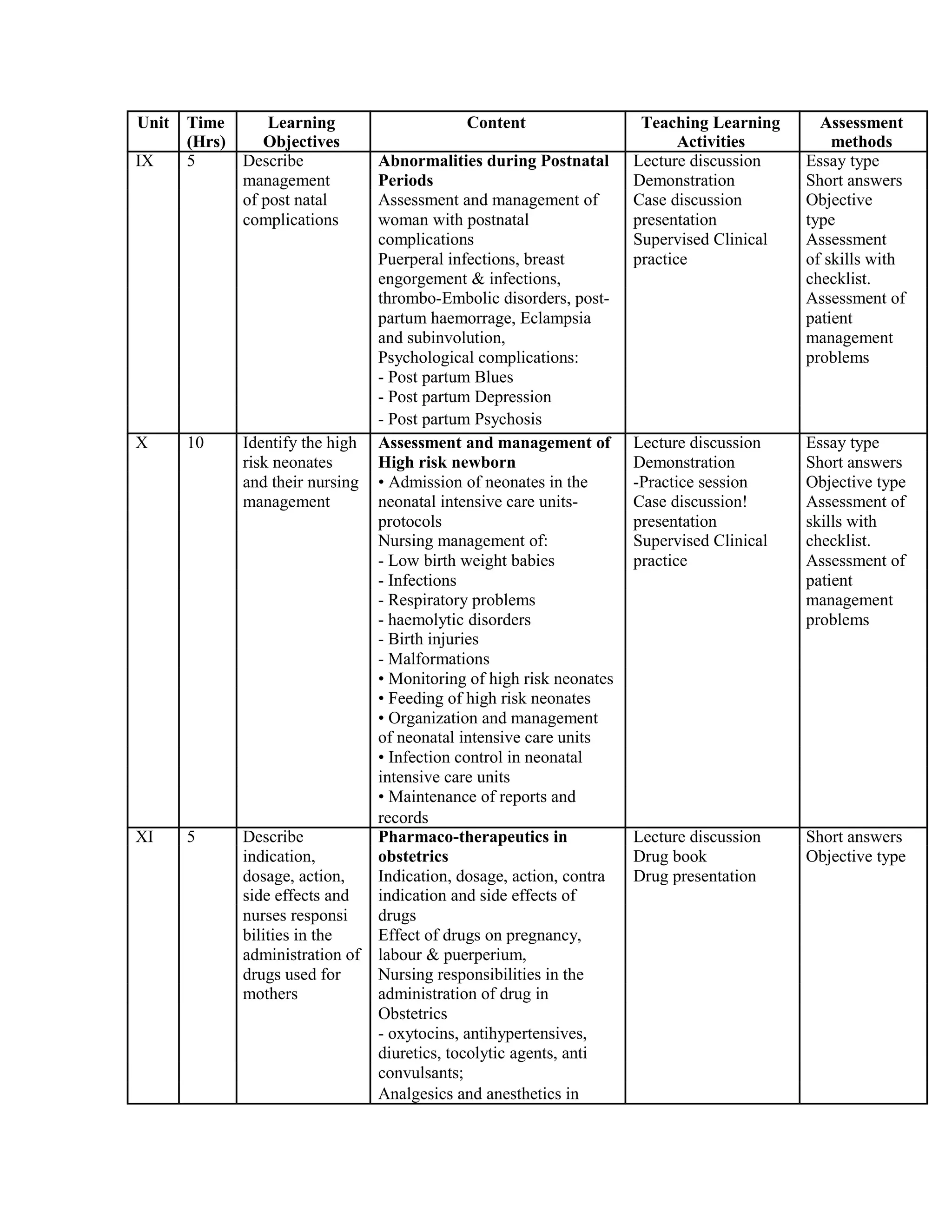
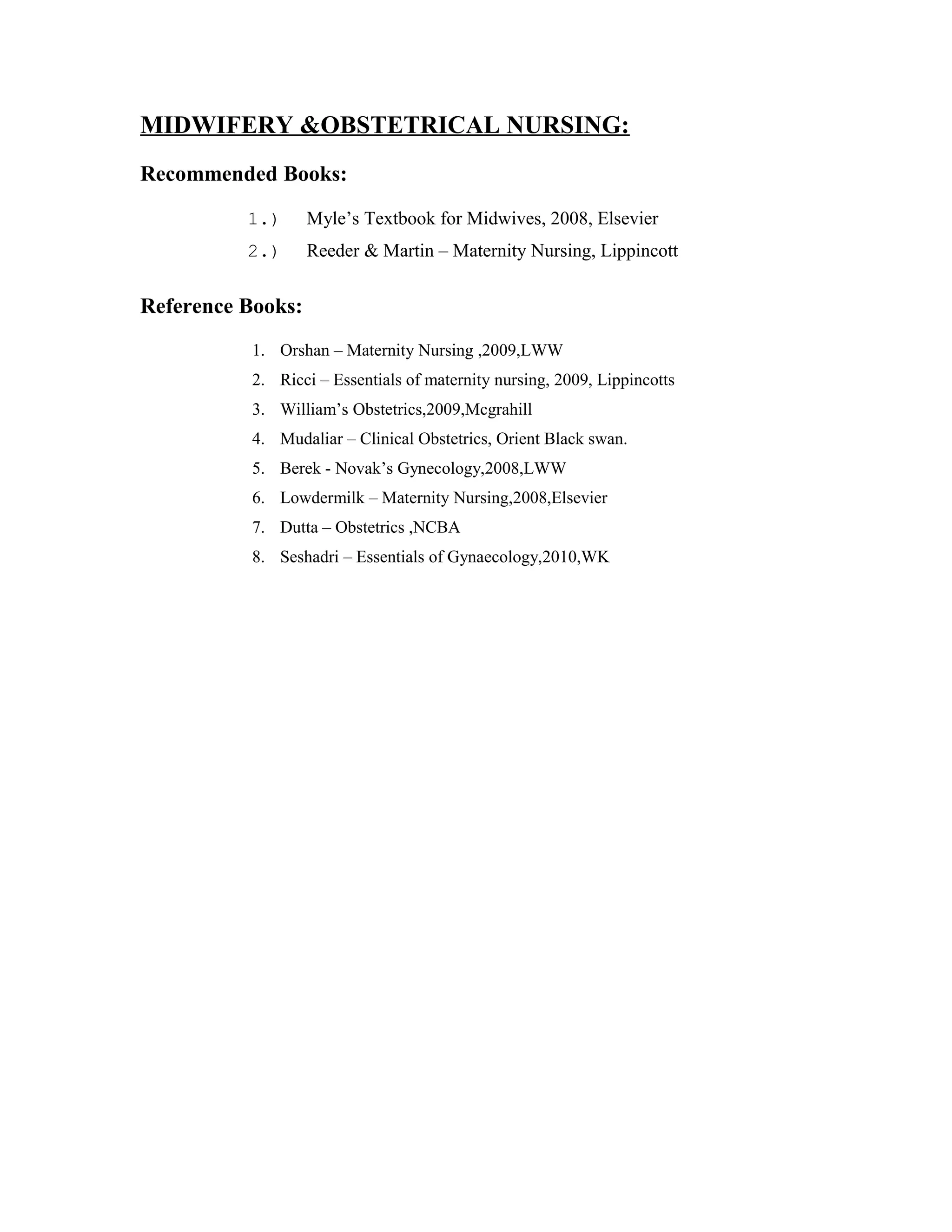
30. Midwifery & Obstetrical Nursing. ………………………… 145
31. Midwifery & Obstetrical Nursing – Practical …………… 154
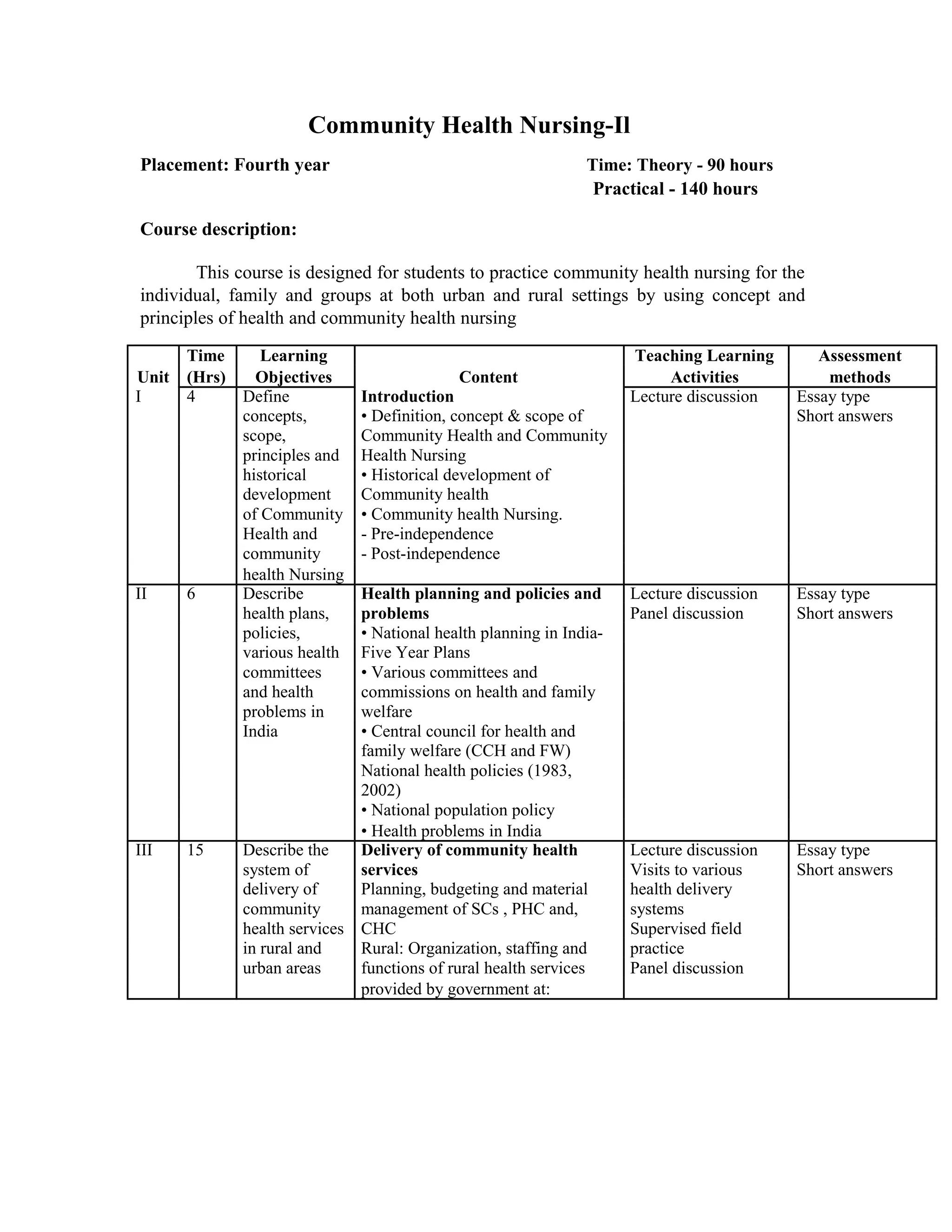
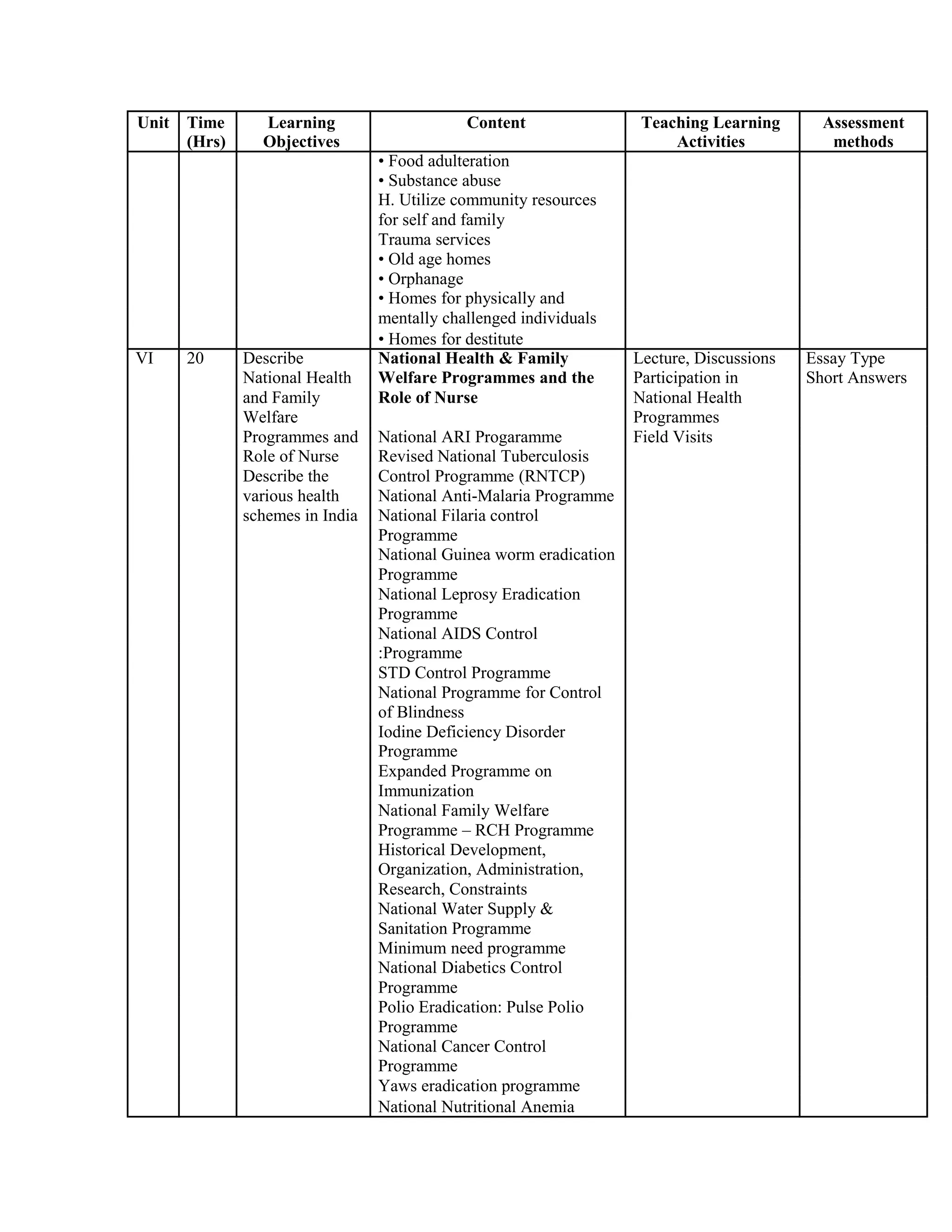
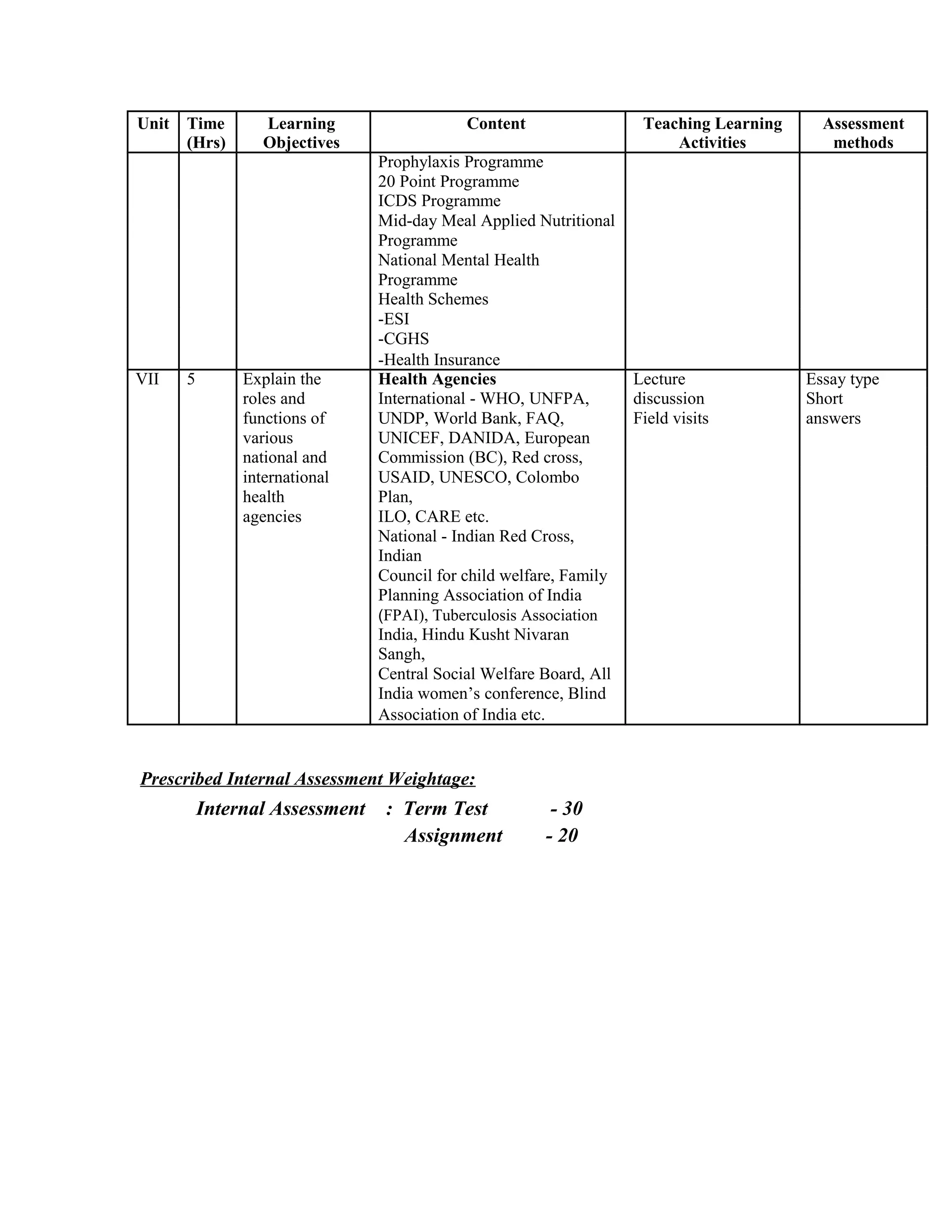
32. Community Health Nursing – II …………………………… 158
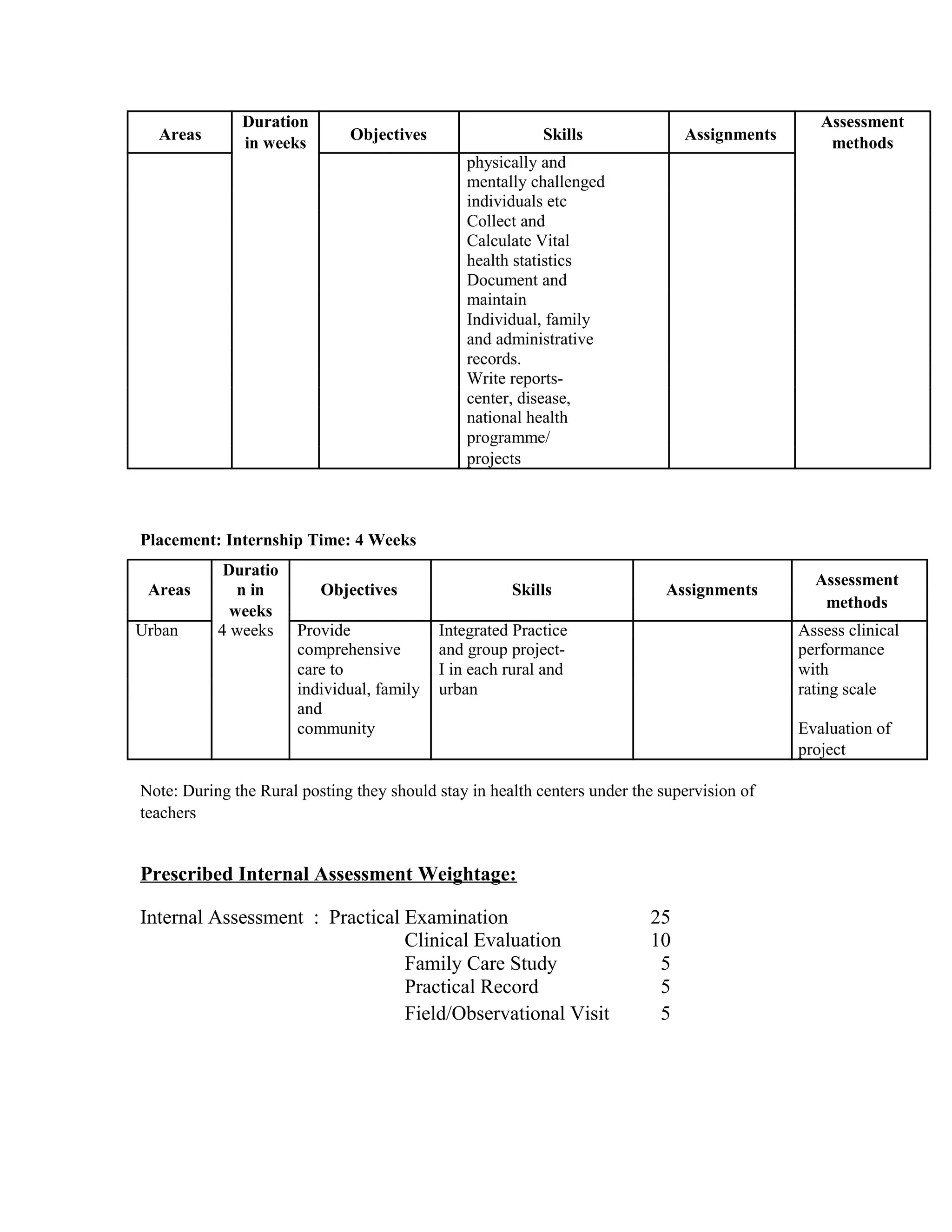
33. Community Health Nursing – II Practical ……………… 164
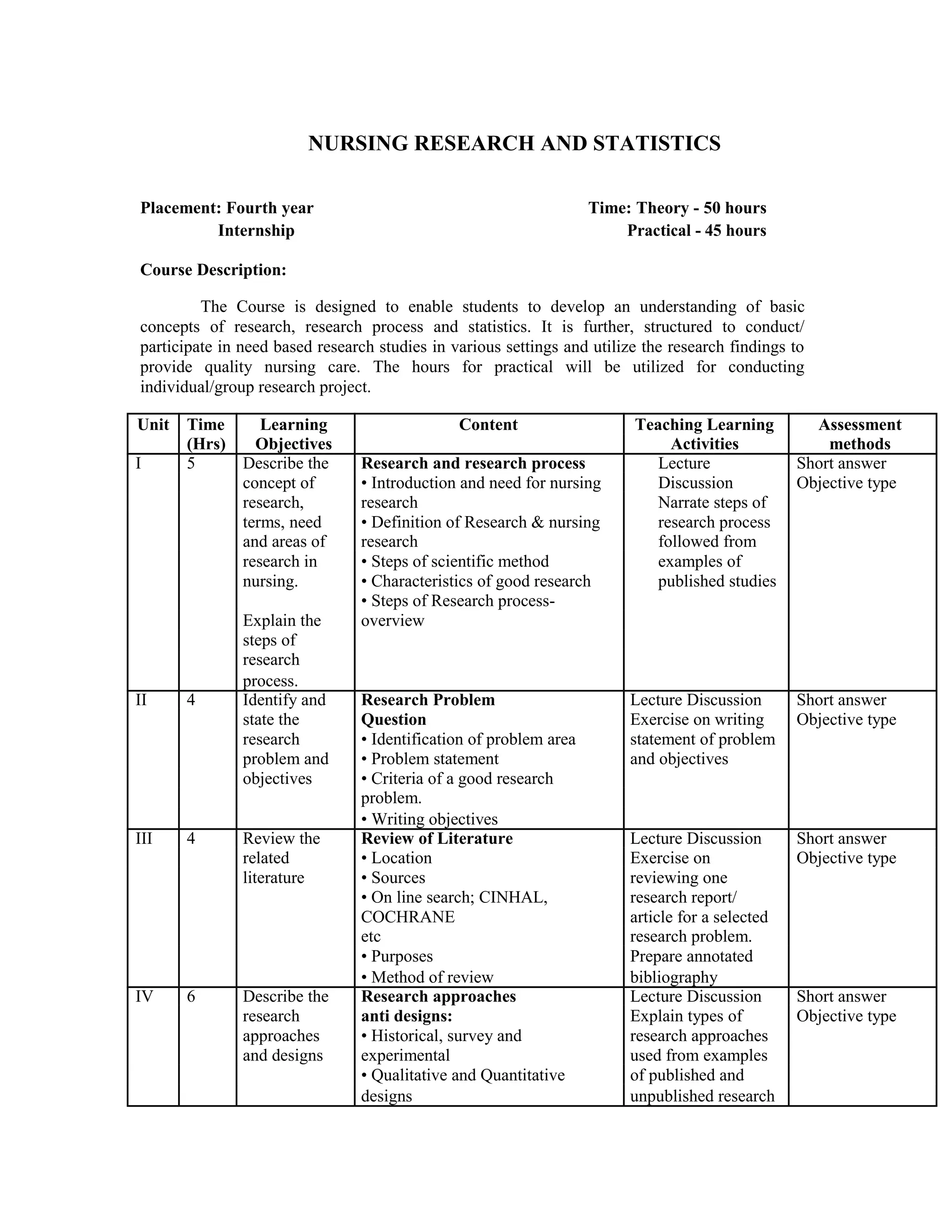
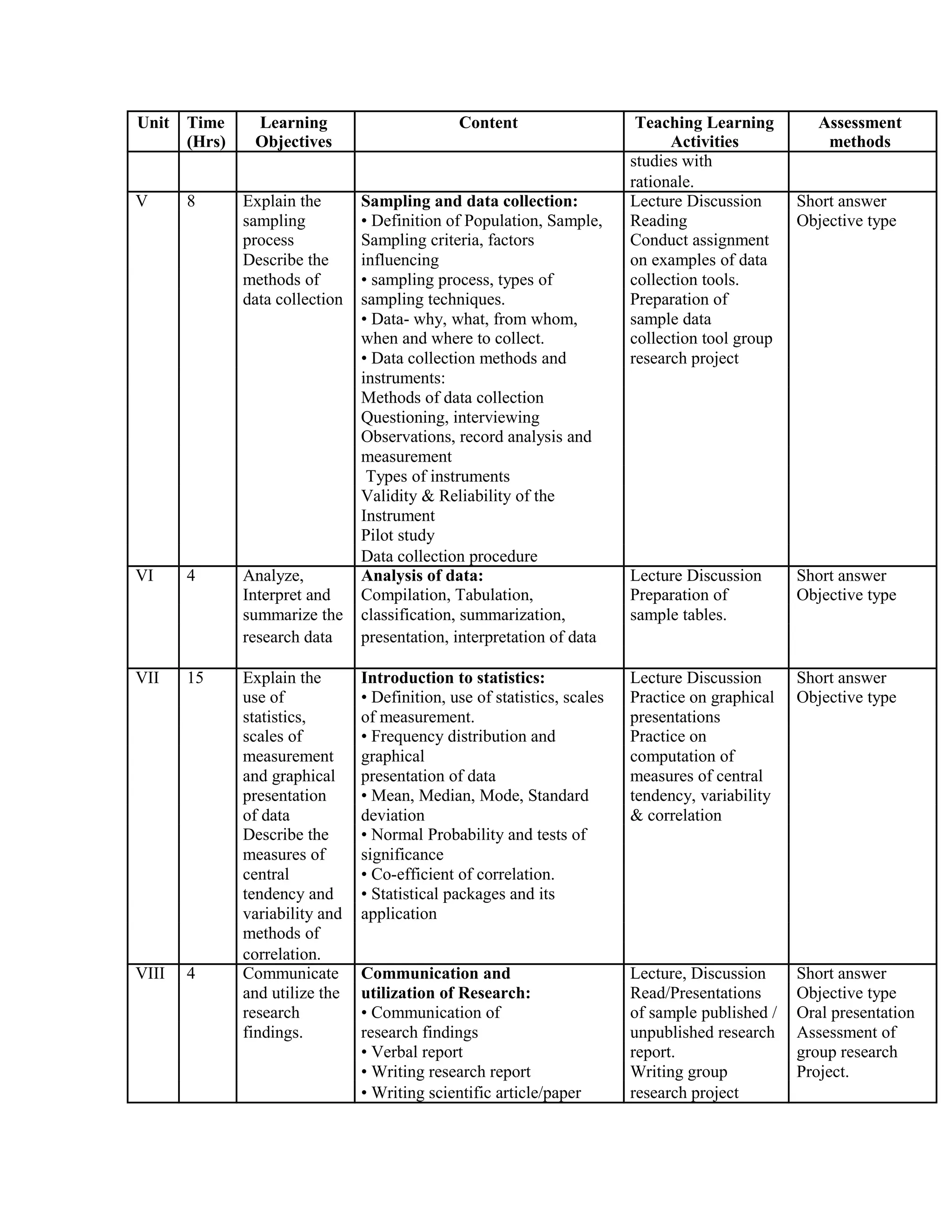
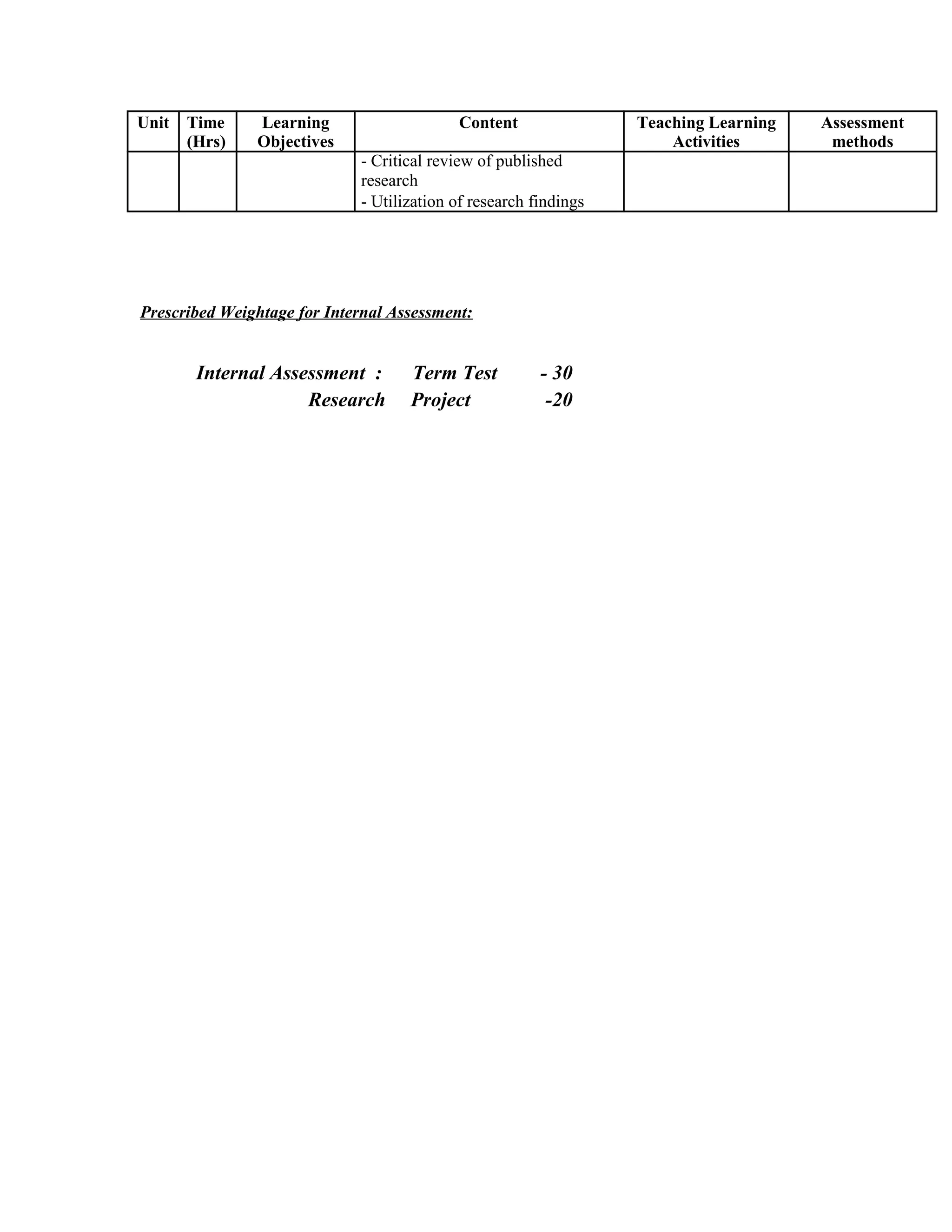
34. Nursing Research & Statistics ……………………………… 166
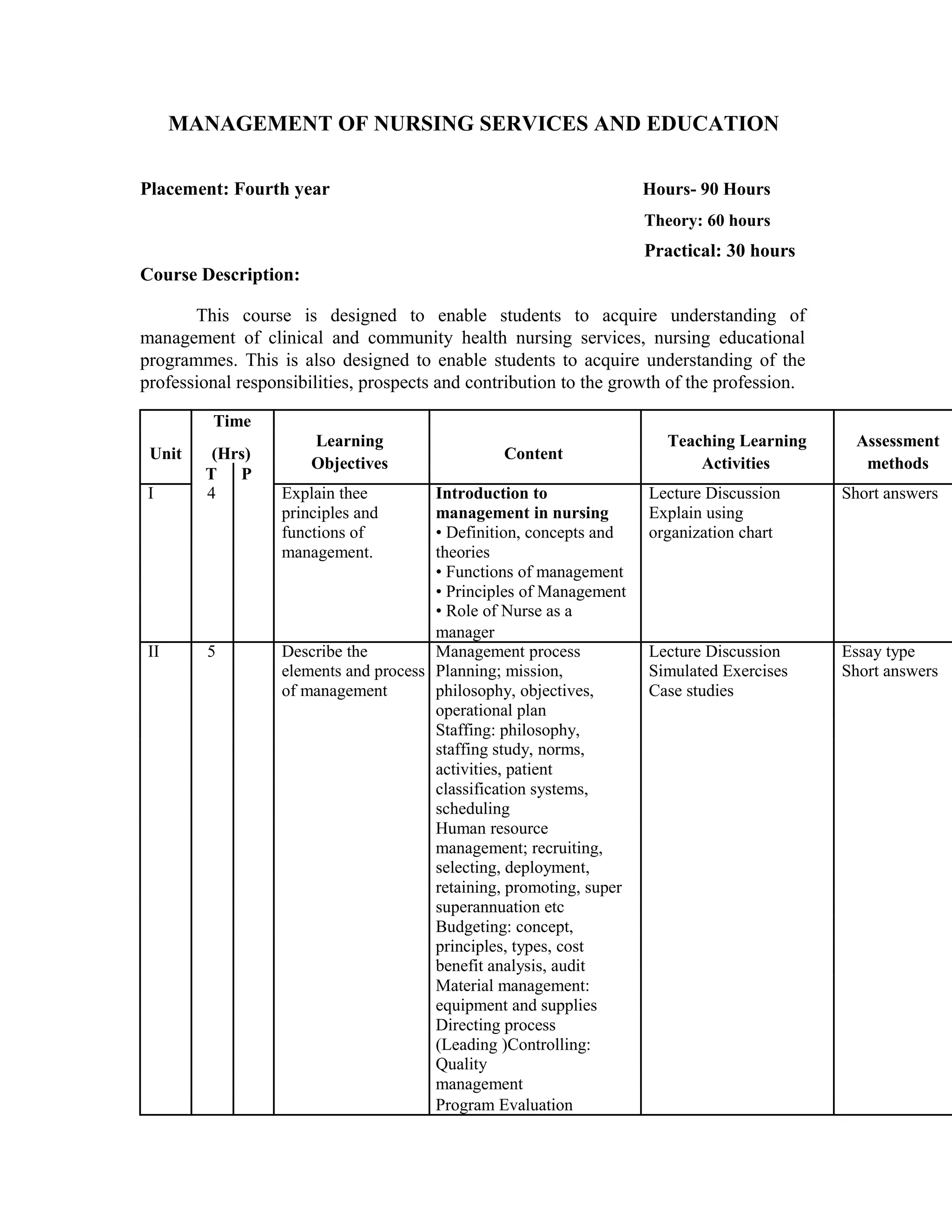
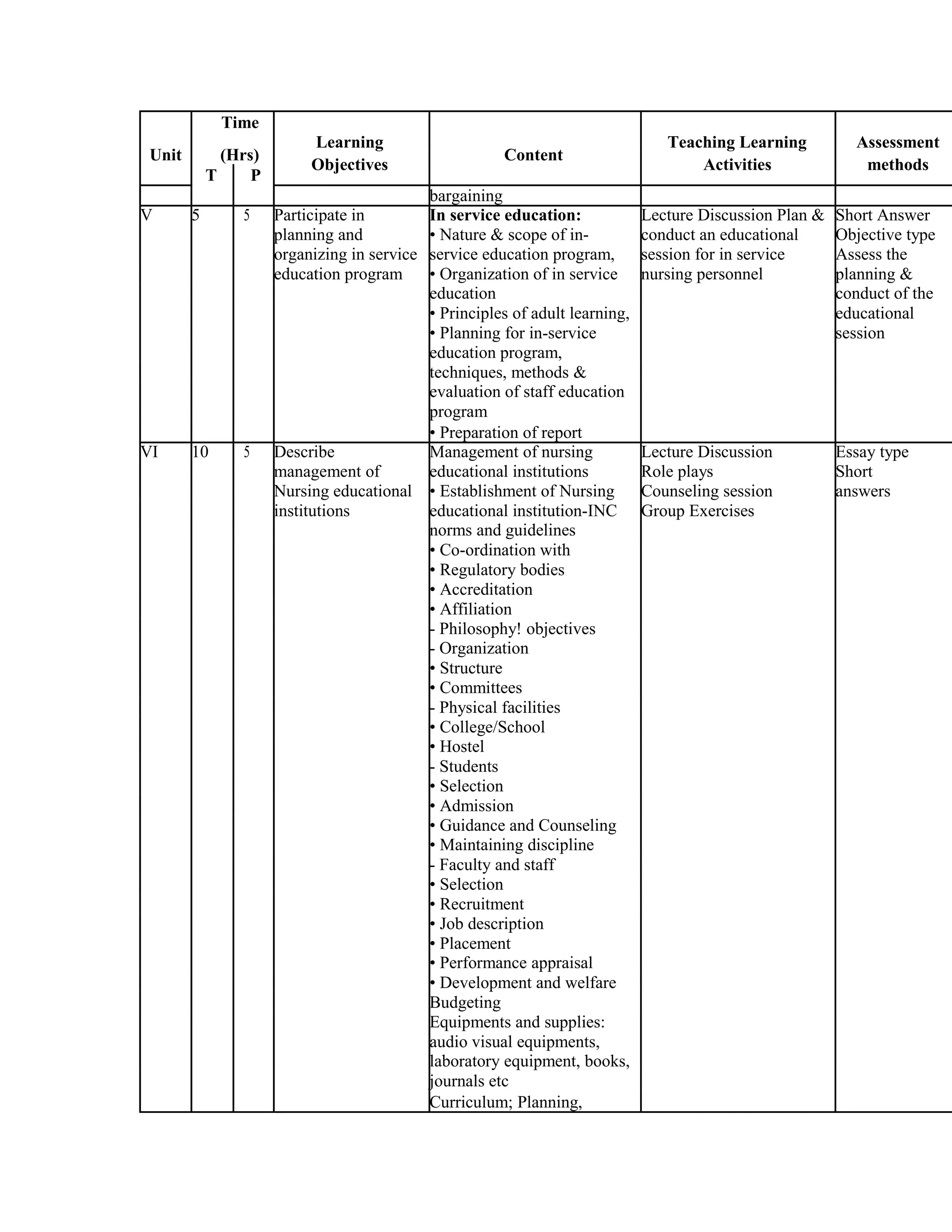
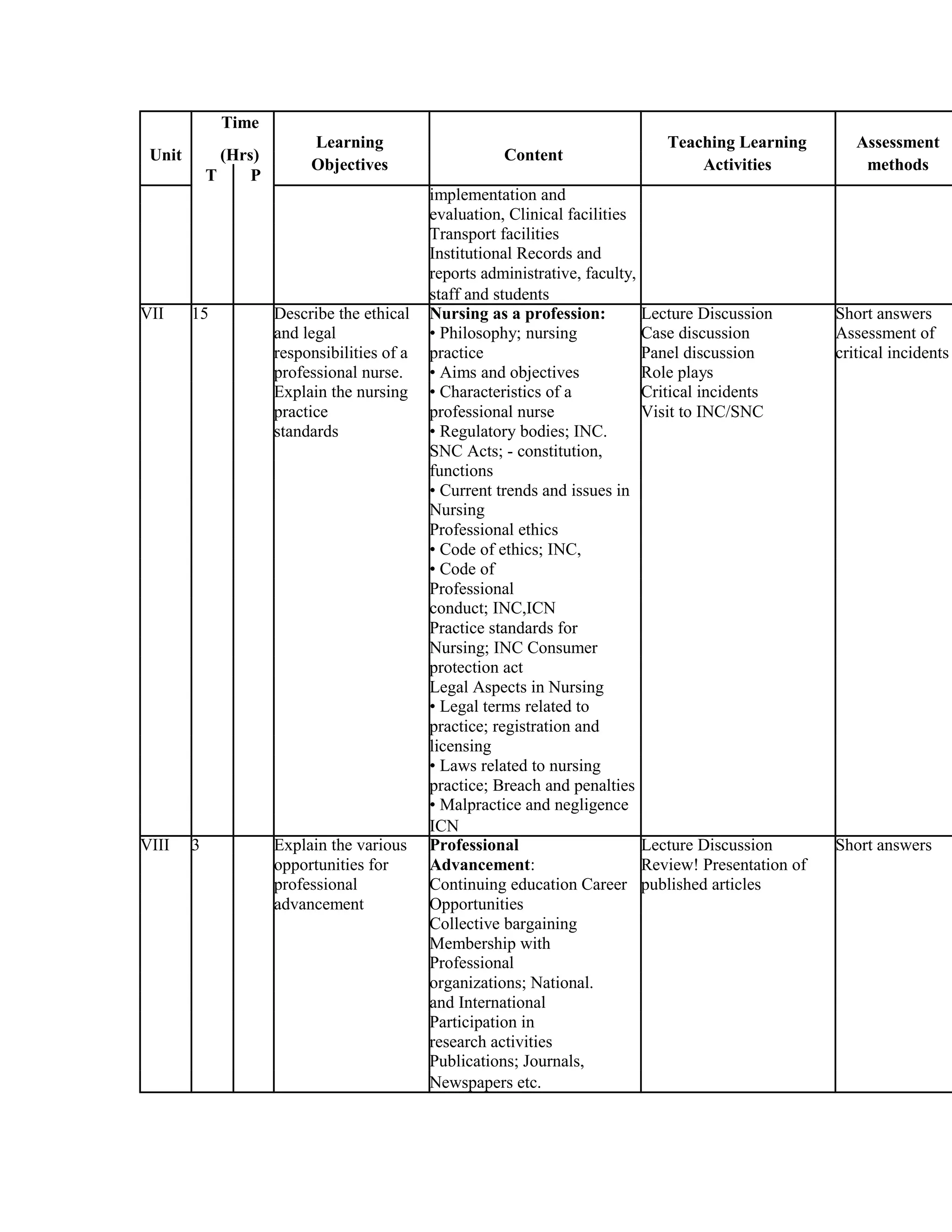
35. Management of Nursing Services & Education ……… … 169
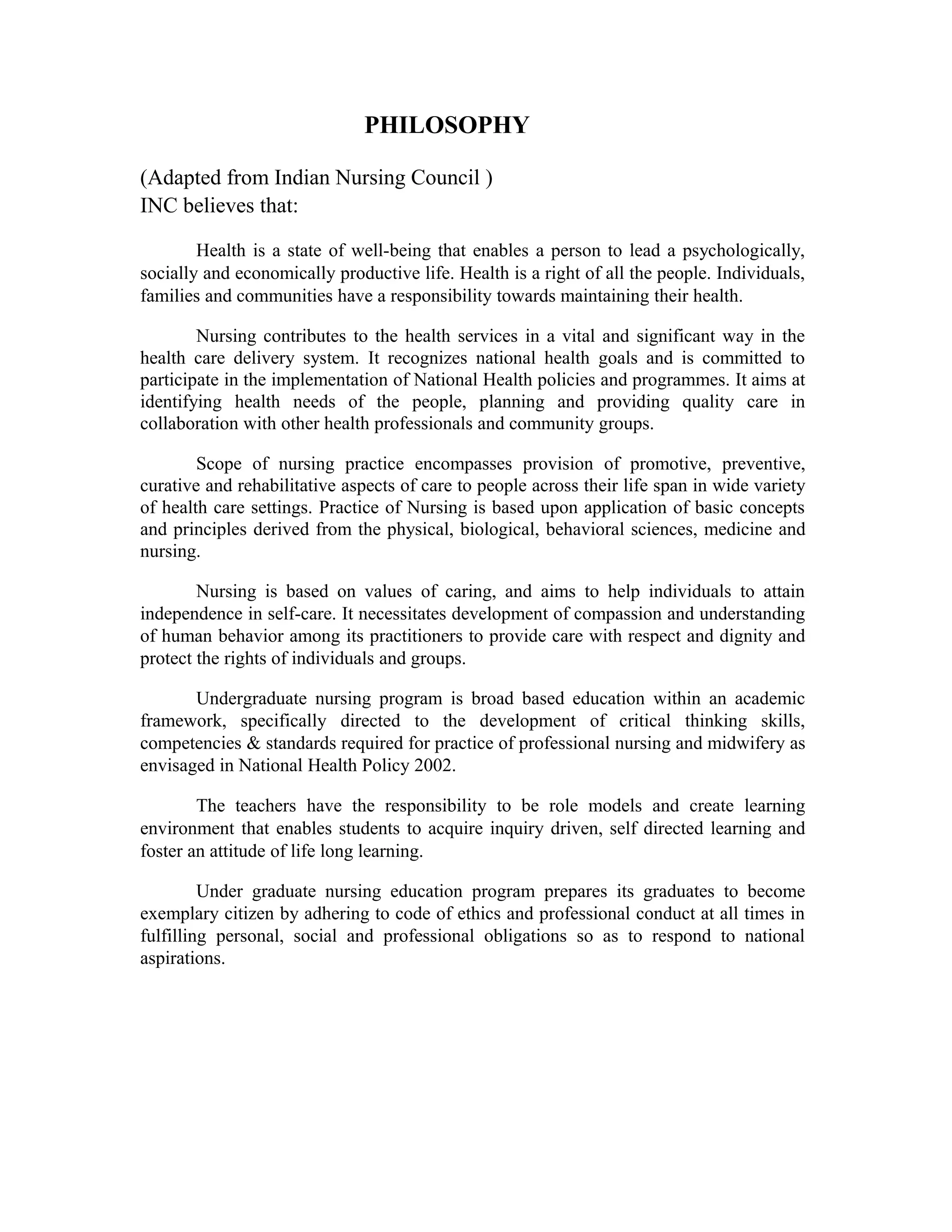
PHILOSOPHY
(Adapted from Indian Nursing Council )
INC believes that:
Health is a state of well-being that enables a person to lead a psychologically,
socially and economically productive life. Health is a right of all the people. Individuals,
families and communities have a responsibility towards maintaining their health.
Nursing contributes to the health services in a vital and significant way in the
health care delivery system. It recognizes national health goals and is committed to
participate in the implementation of National Health policies and programmes. It aims at
identifying health needs of the people, planning and providing quality care in
collaboration with other health professionals and community groups.
Scope of nursing practice encompasses provision of promotive, preventive,
curative and rehabilitative aspects of care to people across their life span in wide variety
of health care settings. Practice of Nursing is based upon application of basic concepts
and principles derived from the physical, biological, behavioral sciences, medicine and
nursing.
Nursing is based on values of caring, and aims to help individuals to attain
independence in self-care. It necessitates development of compassion and understanding
of human behavior among its practitioners to provide care with respect and dignity and
protect the rights of individuals and groups.
Undergraduate nursing program is broad based education within an academic
framework, specifically directed to the development of critical thinking skills,
competencies & standards required for practice of professional nursing and midwifery as
envisaged in National Health Policy 2002.
The teachers have the responsibility to be role models and create learning
environment that enables students to acquire inquiry driven, self directed learning and
foster an attitude of life long learning.
Under graduate nursing education program prepares its graduates to become
exemplary citizen by adhering to code of ethics and professional conduct at all times in
fulfilling personal, social and professional obligations so as to respond to national
aspirations.
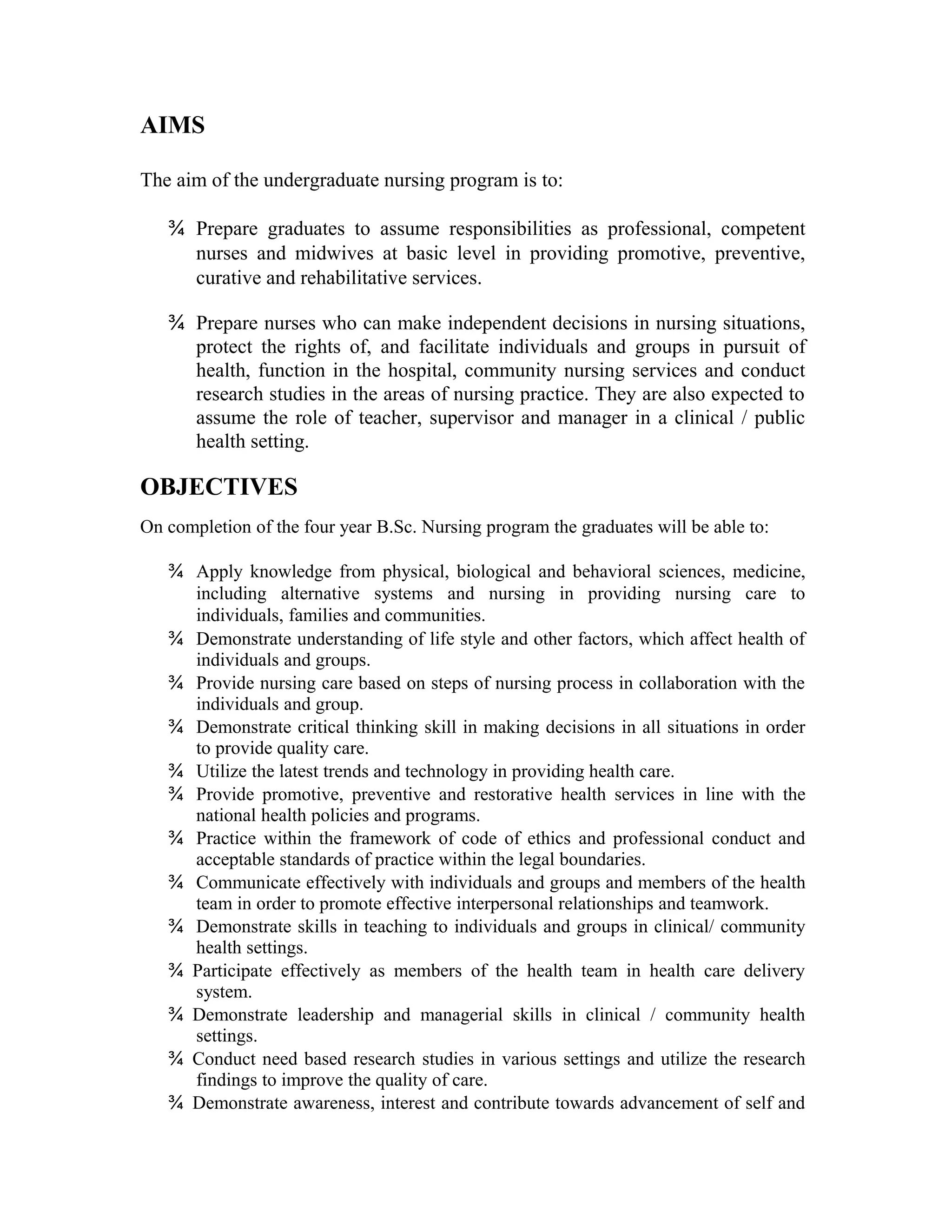
AIMS
The aim of the undergraduate nursing program is to:
¾ Prepare graduates to assume responsibilities as professional, competent
nurses and midwives at basic level in providing promotive, preventive,
curative and rehabilitative services.
¾ Prepare nurses who can make independent decisions in nursing situations,
protect the rights of, and facilitate individuals and groups in pursuit of
health, function in the hospital, community nursing services and conduct
research studies in the areas of nursing practice. They are also expected to
assume the role of teacher, supervisor and manager in a clinical / public
health setting.
OBJECTIVES
On completion of the four year B.Sc. Nursing program the graduates will be able to:
¾ Apply knowledge from physical, biological and behavioral sciences, medicine,
including alternative systems and nursing in providing nursing care to
individuals, families and communities.
¾ Demonstrate understanding of life style and other factors, which affect health of
individuals and groups.
¾ Provide nursing care based on steps of nursing process in collaboration with the
individuals and group.
¾ Demonstrate critical thinking skill in making decisions in all situations in order
to provide quality care.
¾ Utilize the latest trends and technology in providing health care.
¾ Provide promotive, preventive and restorative health services in line with the
national health policies and programs.
¾ Practice within the framework of code of ethics and professional conduct and
acceptable standards of practice within the legal boundaries.
¾ Communicate effectively with individuals and groups and members of the health
team in order to promote effective interpersonal relationships and teamwork.
¾ Demonstrate skills in teaching to individuals and groups in clinical/ community
health settings.
¾ Participate effectively as members of the health team in health care delivery
system.
¾ Demonstrate leadership and managerial skills in clinical / community health
settings.
¾ Conduct need based research studies in various settings and utilize the research
findings to improve the quality of care.
¾ Demonstrate awareness, interest and contribute towards advancement of self and
of the profession.
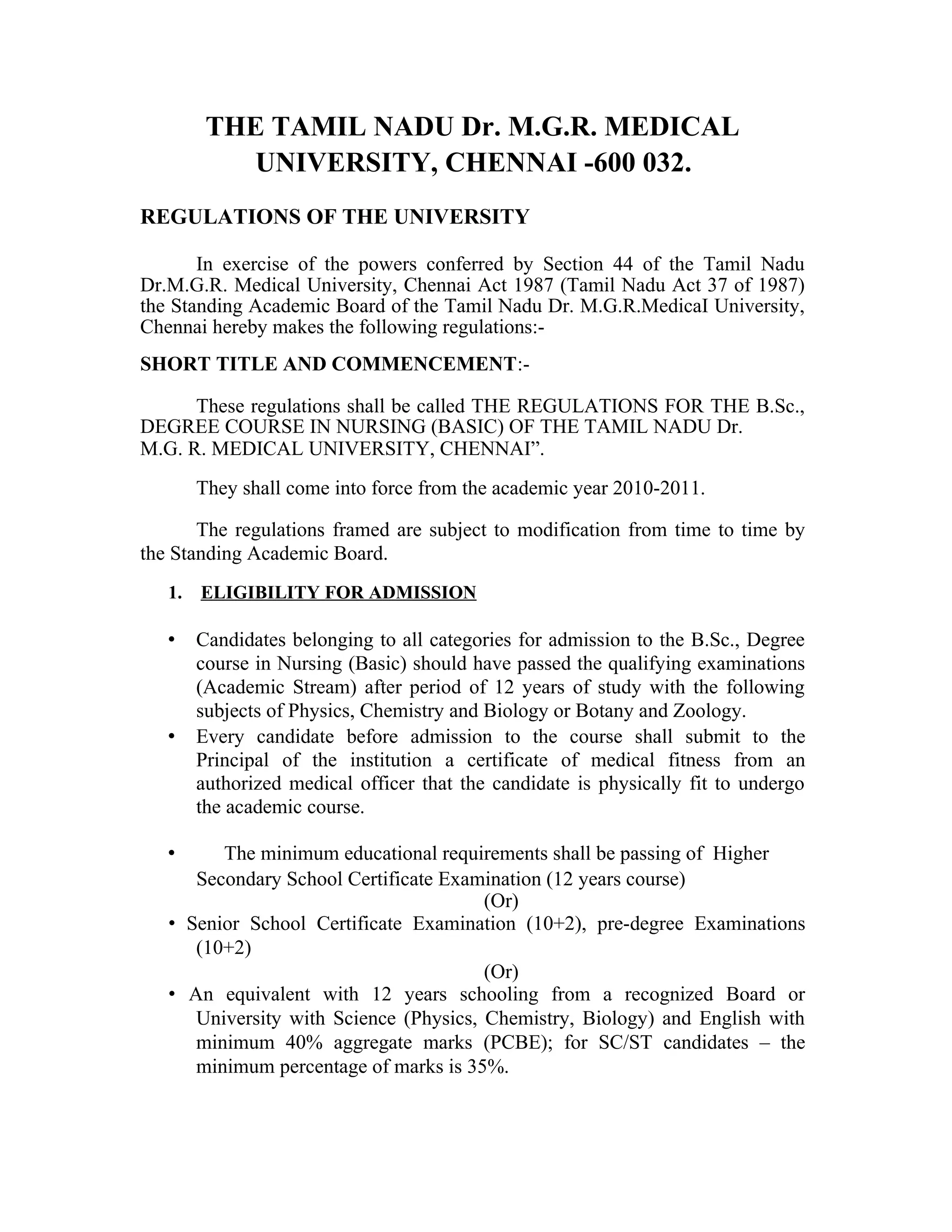
THE TAMIL NADU Dr. M.G.R. MEDICAL
UNIVERSITY, CHENNAI -600 032.
REGULATIONS OF THE UNIVERSITY
In exercise of the powers conferred by Section 44 of the Tamil Nadu
Dr.M.G.R. Medical University, Chennai Act 1987 (Tamil Nadu Act 37 of 1987)
the Standing Academic Board of the Tamil Nadu Dr. M.G.R.MedicaI University,
Chennai hereby makes the following regulations:-
SHORT TITLE AND COMMENCEMENT:-
These regulations shall be called THE REGULATIONS FOR THE B.Sc.,
DEGREE COURSE IN NURSING (BASIC) OF THE TAMIL NADU Dr.
M.G. R. MEDICAL UNIVERSITY, CHENNAI”.
They shall come into force from the academic year 2010-2011.
The regulations framed are subject to modification from time to time by
the Standing Academic Board.
1. ELIGIBILITY FOR ADMISSION
• Candidates belonging to all categories for admission to the B.Sc., Degree
course in Nursing (Basic) should have passed the qualifying examinations
(Academic Stream) after period of 12 years of study with the following
subjects of Physics, Chemistry and Biology or Botany and Zoology.
• Every candidate before admission to the course shall submit to the
Principal of the institution a certificate of medical fitness from an
authorized medical officer that the candidate is physically fit to undergo
the academic course.
• The minimum educational requirements shall be passing of Higher
Secondary School Certificate Examination (12 years course)
(Or)
• Senior School Certificate Examination (10+2), pre-degree Examinations
(10+2)
(Or)
• An equivalent with 12 years schooling from a recognized Board or
University with Science (Physics, Chemistry, Biology) and English with
minimum 40% aggregate marks (PCBE); for SC/ST candidates – the
minimum percentage of marks is 35%.
2. AGE LIMIT FOR ADMISSION:
A candidate should have completed the age of 17 years at the time
of admission or would complete the said age on or before 31
st
December
of the year of admission to the B.Sc. (Nursing) degree course.
3. ELIGIBILITY CERTIFICATE:
The candidate who has passed any qualifying examinations other
than the Higher Secondary Course Examination conducted by the
Government of Tamil Nadu, before seeking admission to any one of the
affiliated institutions shall obtain an Eligibility Certificate from the
University by remitting the prescribed fees along with application form
which shall be downloaded from the University website (www.tnmmu.ac.in)
4. REGISTRATION:
A Candidate admitted in the B.Sc. Degree Course in Nursing
(Basic) in any one of the affiliated institutions of this University shall
register his / her name with this university by submitting the prescribed
application form for registration duly filled, along with the prescribed fee
and a declaration in the format to the Academic Officer of this University
through the affiliated institution within 60 days from the cut-off date
prescribed for the course for admission. The applications should have date
of admission of the course.
5. MIGRATION/TRANSFER OF CANDIDATE:
(a) A student studying in B.Sc. Nursing (Basic) Course can be allowed
to migrate/transfer to another Nursing College under same or another
University.
(b) The University concerned can allow the migration/transfer within
three months after passing the first year B.Sc. Nursing (Basic) degree
course examination, as a rule.
(c) The number of students migrating/transferring from one college to
another college during one year will be kept to the minimum so that the
training of the regular students of the college is not adversely affected. The
number of students migrating/transferring to/from any college should not
exceed the limit of 5% of its intake subject to a maximum of 5 students in
any one of the Nursing Colleges in one year. If any student is migrated
from one institution to another, it should be informed immediately to the
University.
6. DURATION OF THE COURSE:
The duration of certified study for the B.Sc. Degree course in
Nursing (Basic) shall extend over a period of four academic years
including integrated practice (Internship 24 weeks).
7. COMMENCEMENT OF THE COURSE:
The course shall commence from 1
st
August of the academic year.
8. MEDIUM OF INSTRUCTION:
English shall be the Medium of instruction for all the subjects of
study and for examinations of the Bachelor of Science Degree Course in
Nursing (Basic).
9. CURRICULUM:
The Curriculum and the syllabus for the course shall be as
prescribed in these regulations and are subject to modifications by the
Standing Academic Board from time to time.
10. RE-ADMISSION AFTER BREAK OF STUDY:
The regulations for re-admission are as per the University Common
Regulation for Re-admission after break of study for all courses.
11. WORKING DAYS IN THE ACADEMIC YEAR:
Each academic year shall consist of not less than 270 working days.
12. ATTENDANCE REQUIRED FOR ADMISSION TO EXAMINATION:
(a) No candidate shall be permitted to appear in any one of the parts of
B.Sc. in Nursing Degree course (Basic) Examinations unless he/she
has attended the course in the subject for the prescribed period in an
affiliated institution recognized by this University and produce the
necessary certificate of study attendance, satisfactory conduct and
progress from the Head of the institution.
(b)A candidate is required to put in a minimum of 90% of attendance in
both theory and practical separately in each subject before admission
to the examinations.
(c) The classes for Under Graduate students will commence from 1
st
August of every year and the University examination will commence
from 1
st
August of the subsequent year. Therefore, the attendance will
be calculated for the Under Graduate students from 1
st
August of the
same year to 31
st
July of the next year including examination period.
(d) If the candidate is lacking attendance in any one of the subject(s),
he/she will be detained for the subject(s) in which the candidate lacks
attendance but will be permitted to appear for the rest of the subjects
in which the candidate is having minimum required percentage of
attendance.
(e) A candidate must have 100% attendance in each of the practical areas
before award of Degree.
13. CONDONATION OF LACK OF ATTENDANCE:
There shall be No condonation of lack of attendance.( There
shall be no condonation of any leave for any reason including Pregnancy,
Child Birth, Medical conditions of any nature ).
14. VACATION:
The Heads of Institutions shall declare 3 (three) weeks of vacation
in an academic year to the students. The period(s) of vacation can be
decided by the Head of the Institution.
15. INTERNAL ASSESSMENT MARKS:
The Internal Assessment should consist of the following points for
evaluation:-
1. Theory
2. Practical & oral
WEIGHTAGE OF MARKS
THEORY 50 MARKS (common to all subjects)
• Term test 30 marks
• Assignment 20marks
PRACTICAL 50 MARKS (common to all practical)
• Practical Examination 25 marks
• Clinical Evaluation 10 marks
• Case study/case book 5 marks
• Practical record 5 marks
• Observational /field visit 5 marks
100 Marks each for English and Introduction to computer science
which are internal subjects to be conducted at the institution level and the
marks to be sent to the University.
• Regular periodic assessment shall be conducted throughout the course. A
minimum of three written examinations shall be conducted in each subject
during a year. The written examination preceding the University
examination may be similar to the pattern of University examination. The
average marks of the three performances shall be taken into consideration
for the award of internal assessment marks.
• A minimum of one practical examination shall be conducted in each
subject (wherever practical have been included in the curriculum) and
grades of ongoing clinical evaluation to be considered for the award of
internal assessment marks.
• A failed candidate in any subject should be provided an opportunity to
improve her/his internal assessment marks by conducting a minimum of
two examinations in theory and practical separately and the average may
be considered for improvement.
• If a failed candidate does not appear for any “Improvement Mark
Examinations” in the failed subject(s) the internal marks awarded for the
previous examination shall be carried over for his/her subsequent
appearance(s).
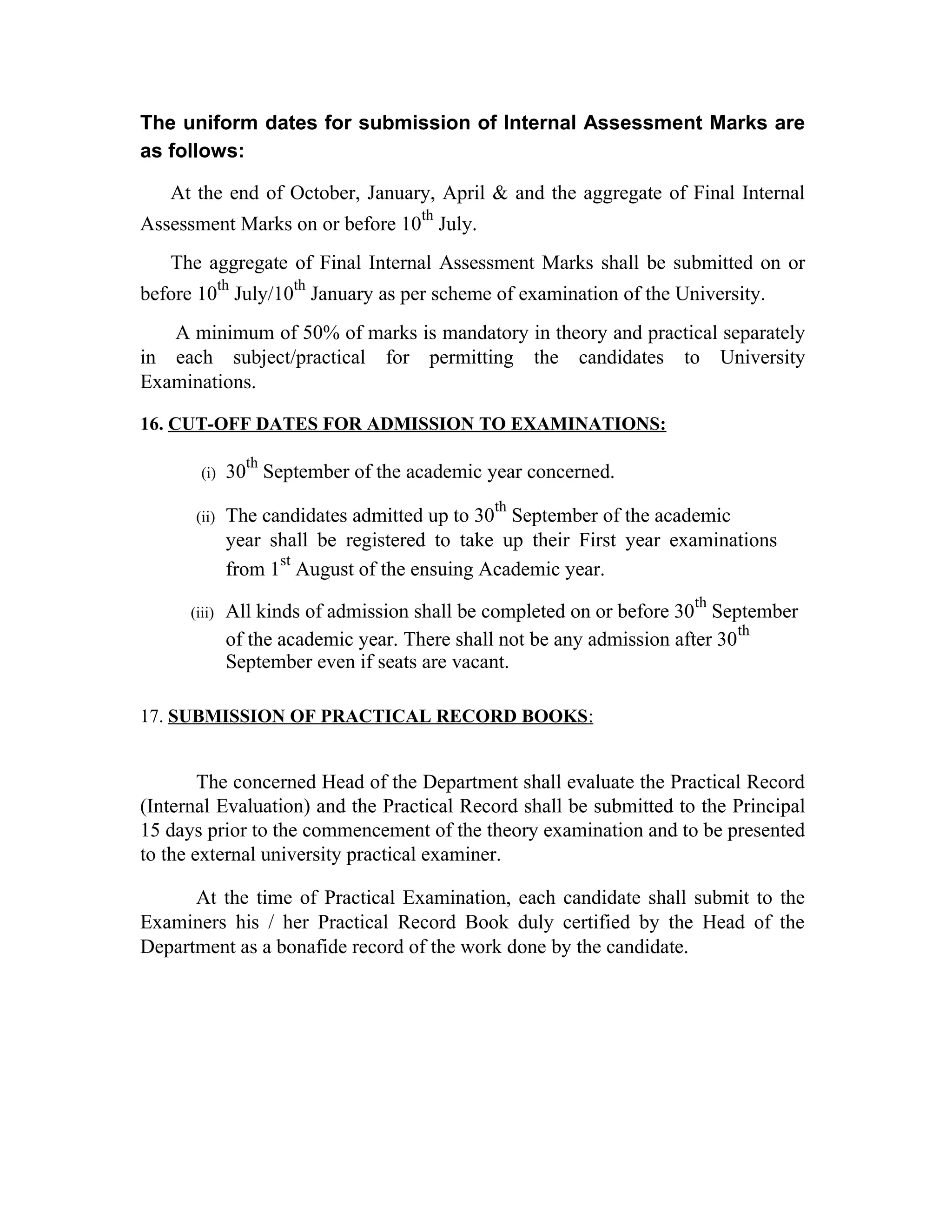
The uniform dates for submission of Internal Assessment Marks are
as follows:
At the end of October, January, April & and the aggregate of Final Internal
Assessment Marks on or before 10
th
July.
The aggregate of Final Internal Assessment Marks shall be submitted on or
before 10
th
July/10
th
January as per scheme of examination of the University.
A minimum of 50% of marks is mandatory in theory and practical separately
in each subject/practical for permitting the candidates to University
Examinations.
16. CUT-OFF DATES FOR ADMISSION TO EXAMINATIONS:
(i) 30
th
September of the academic year concerned.
(ii) The candidates admitted up to 30
th
September of the academic
year shall be registered to take up their First year examinations
from 1
st
August of the ensuing Academic year.
(iii) All kinds of admission shall be completed on or before 30
th
September
of the academic year. There shall not be any admission after 30
th
September even if seats are vacant.
17. SUBMISSION OF PRACTICAL RECORD BOOKS:
The concerned Head of the Department shall evaluate the Practical Record
(Internal Evaluation) and the Practical Record shall be submitted to the Principal
15 days prior to the commencement of the theory examination and to be presented
to the external university practical examiner.
At the time of Practical Examination, each candidate shall submit to the
Examiners his / her Practical Record Book duly certified by the Head of the
Department as a bonafide record of the work done by the candidate.
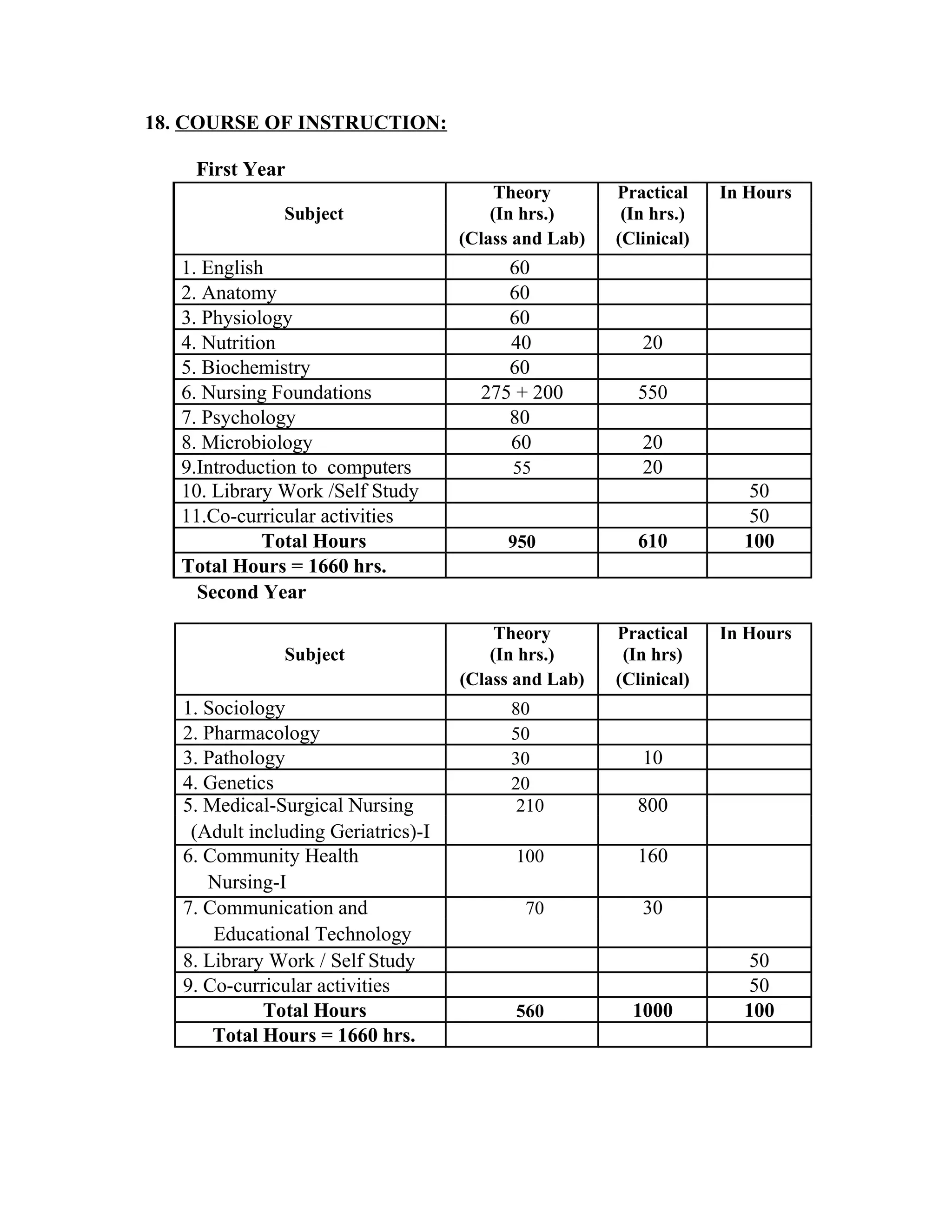
18. COURSE OF INSTRUCTION:
First Year
Theory Practical In Hours
Subject (In hrs.) (In hrs.)
(Class and Lab) (Clinical)
1. English 60
2. Anatomy 60
3. Physiology 60
4. Nutrition 40 20
5. Biochemistry 60
6. Nursing Foundations 275 + 200 550
7. Psychology 80
8. Microbiology 60 20
9.Introduction to computers 55 20
10. Library Work /Self Study 50
11.Co-curricular activities 50
Total Hours 950 610 100
Total Hours = 1660 hrs.
Second Year
Theory Practical In Hours
Subject (In hrs.) (In hrs)
(Class and Lab) (Clinical)
1. Sociology 80
2. Pharmacology 50
3. Pathology 30 10
4. Genetics 20
5. Medical-Surgical Nursing 210 800
(Adult including Geriatrics)-I
6. Community Health 100 160
Nursing-I
7. Communication and 70 30
Educational Technology
8. Library Work / Self Study 50
9. Co-curricular activities 50
Total Hours 560 1000 100
Total Hours = 1660 hrs.
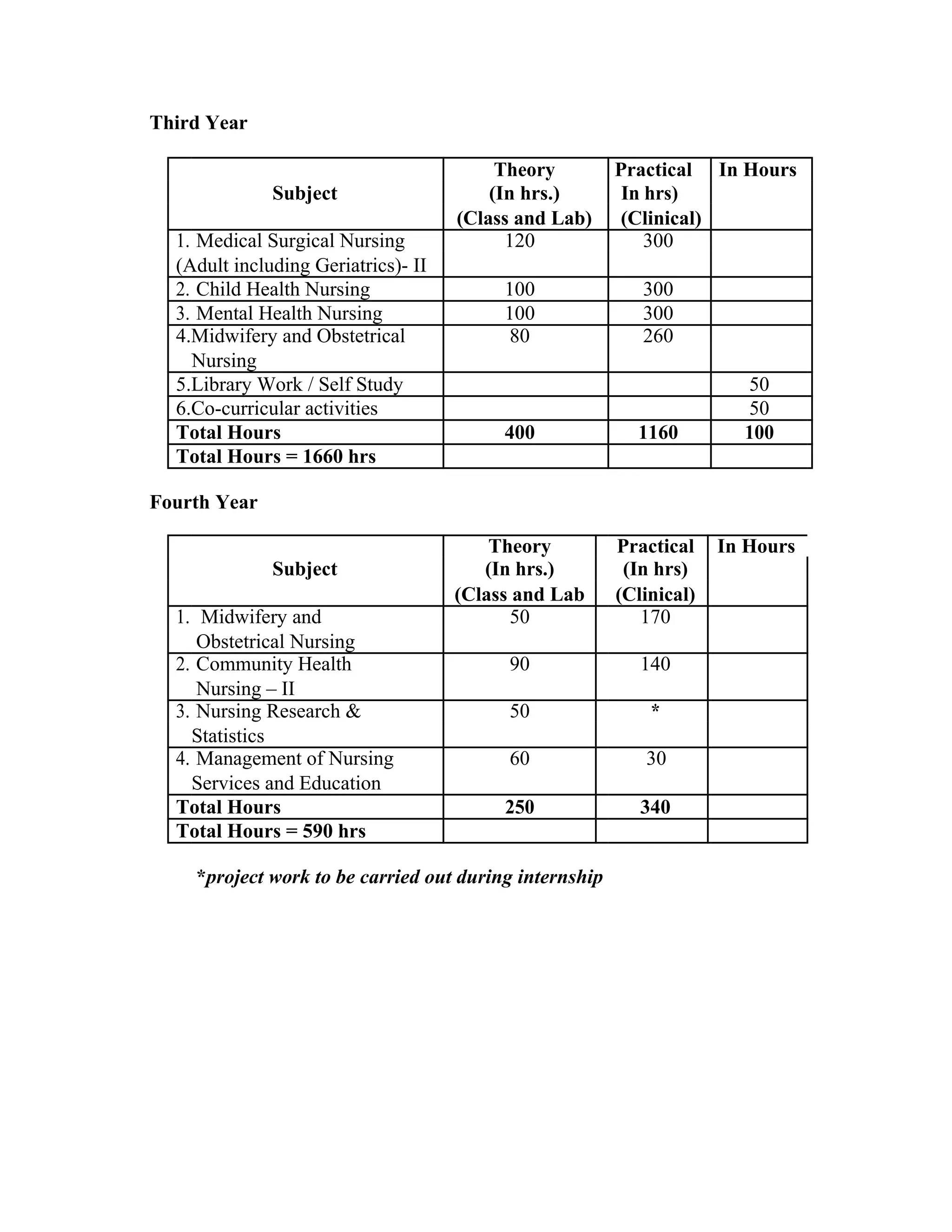
Third Year
Theory Practical In Hours
Subject (In hrs.) In hrs)
(Class and Lab) (Clinical)
1. Medical Surgical Nursing 120 300
(Adult including Geriatrics)- II
2. Child Health Nursing 100 300
3. Mental Health Nursing 100 300
4.Midwifery and Obstetrical 80 260
Nursing
5.Library Work / Self Study 50
6.Co-curricular activities 50
Total Hours 400 1160 100
Total Hours = 1660 hrs
Fourth Year
Theory Practical In Hours
Subject (In hrs.) (In hrs)
(Class and Lab (Clinical)
1. Midwifery and 50 170
Obstetrical Nursing
2. Community Health 90 140
Nursing – II
3. Nursing Research & 50 *
Statistics
4. Management of Nursing 60 30
Services and Education
Total Hours 250 340
Total Hours = 590 hrs
*project work to be carried out during internship
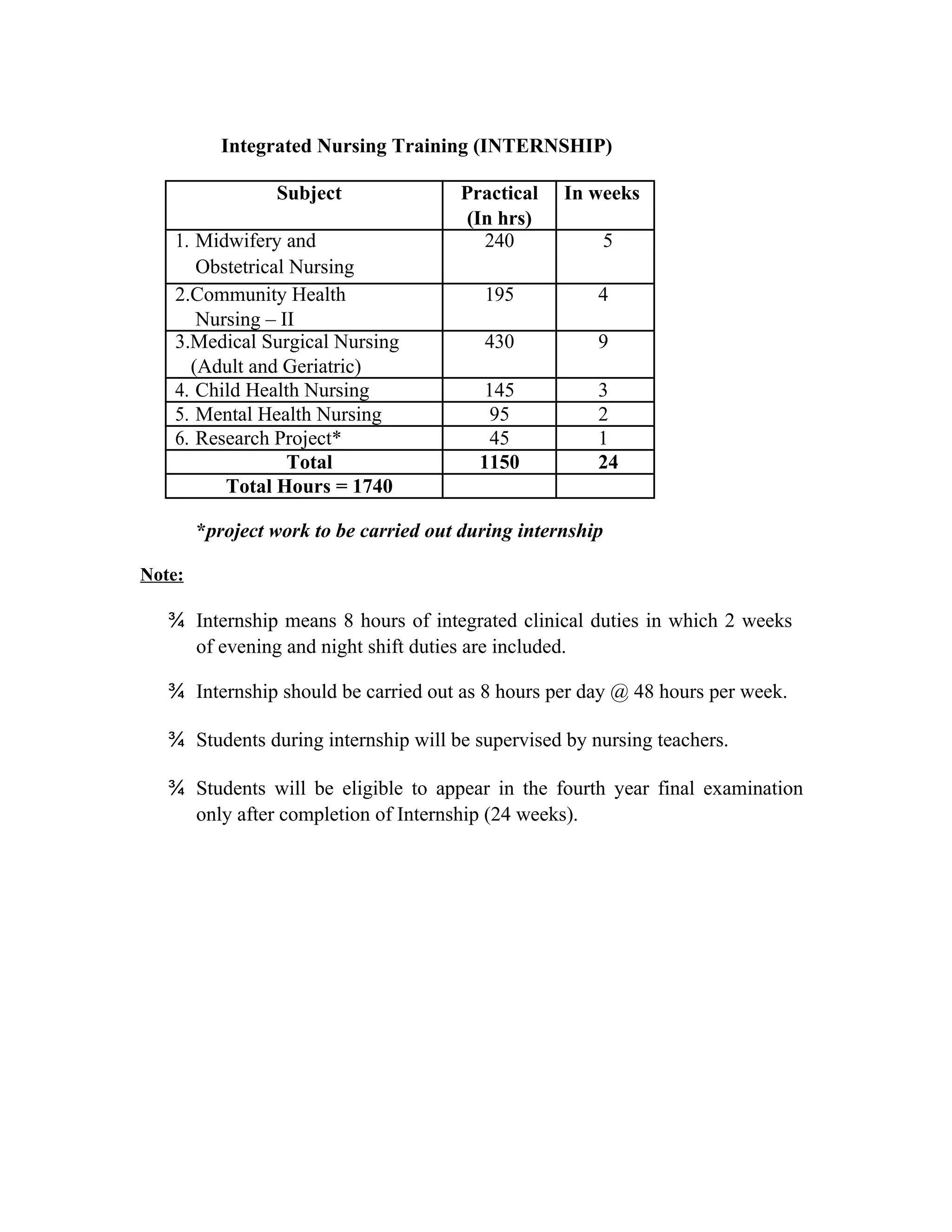
Integrated Nursing Training (INTERNSHIP)
Subject Practical In weeks
(In hrs)
1. Midwifery and 240 5
Obstetrical Nursing
2.Community Health 195 4
Nursing – II
3.Medical Surgical Nursing 430 9
(Adult and Geriatric)
4. Child Health Nursing 145 3
5. Mental Health Nursing 95 2
6. Research Project* 45 1
Total 1150 24
Total Hours = 1740
*project work to be carried out during internship
Note:
¾ Internship means 8 hours of integrated clinical duties in which 2 weeks
of evening and night shift duties are included.
¾ Internship should be carried out as 8 hours per day @ 48 hours per week.
¾ Students during internship will be supervised by nursing teachers.
¾ Students will be eligible to appear in the fourth year final examination
only after completion of Internship (24 weeks).
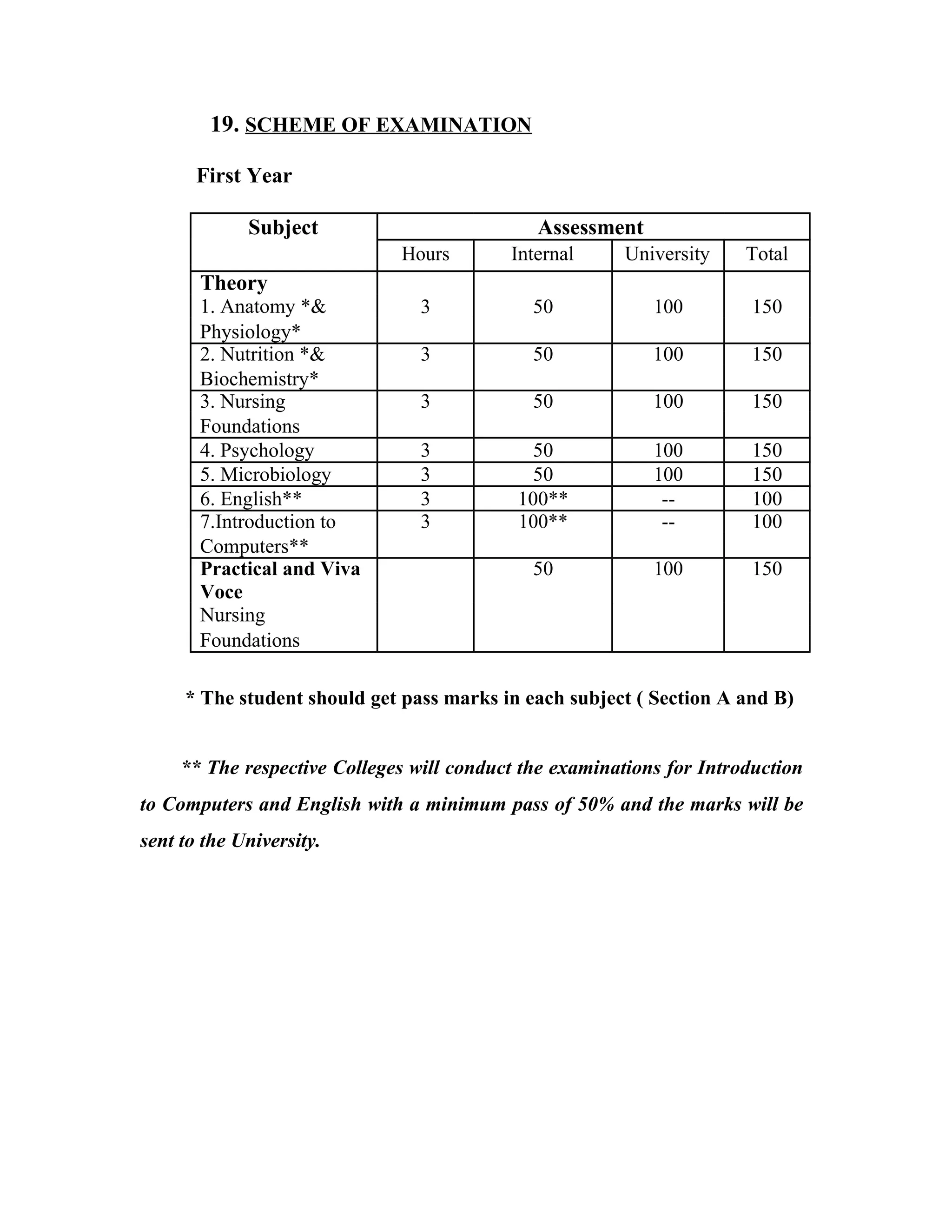
19. SCHEME OF EXAMINATION
First Year
Subject Assessment
Hours Internal University Total
Theory
3 50 100 1501. Anatomy *&
Physiology*
2. Nutrition *& 3 50 100 150
Biochemistry*
3. Nursing 3 50 100 150
Foundations
4. Psychology 3 50 100 150
5. Microbiology 3 50 100 150
6. English** 3 100** -- 100
7.Introduction to 3 100** -- 100
Computers**
Practical and Viva 50 100 150
Voce
Nursing
Foundations
* The student should get pass marks in each subject ( Section A and B)
** The respective Colleges will conduct the examinations for Introduction
to Computers and English with a minimum pass of 50% and the marks will be
sent to the University.
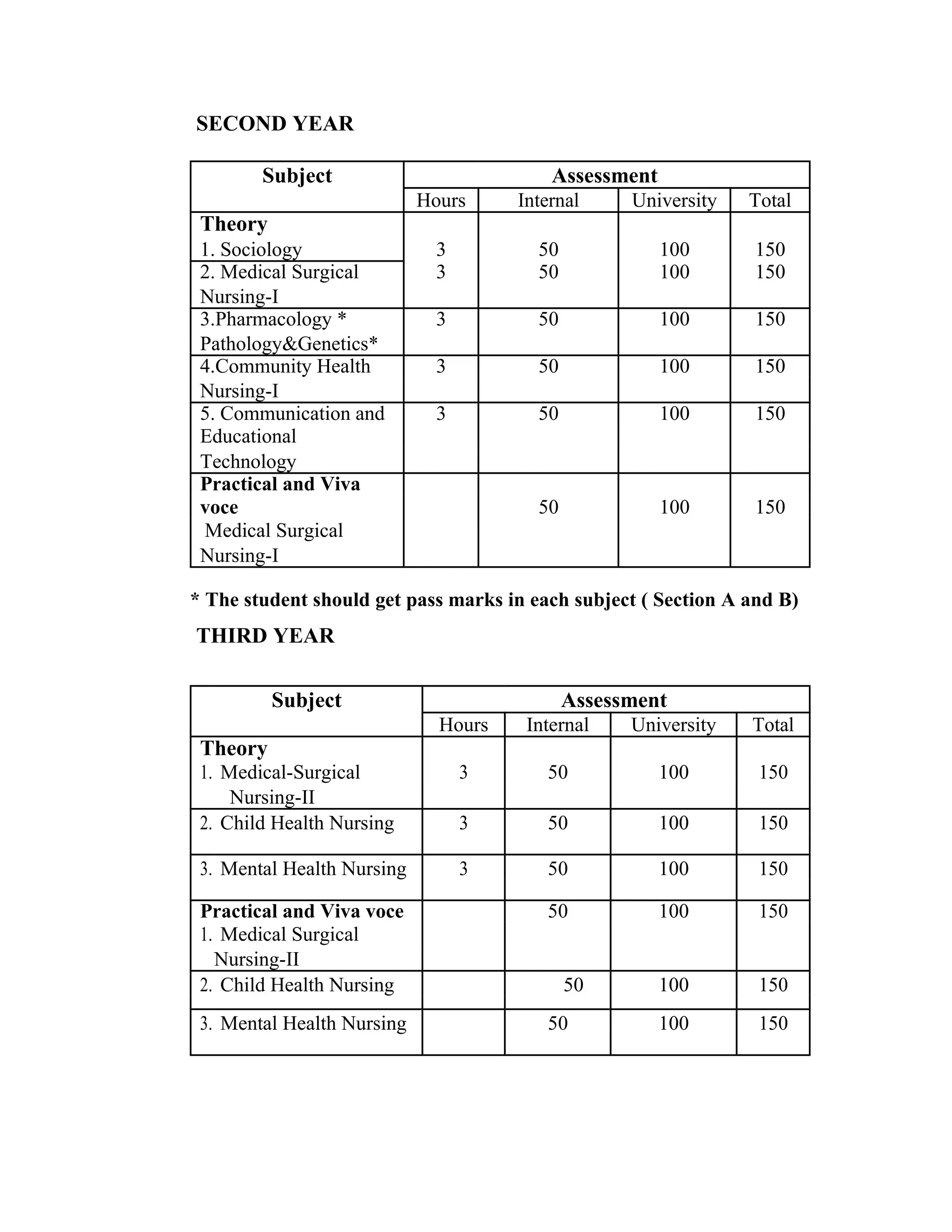
SECOND YEAR
Subject Assessment
Hours Internal University Total
Theory
3 50 100 1501. Sociology
2. Medical Surgical 3 50 100 150
Nursing-I
3.Pharmacology * 3 50 100 150
Pathology&Genetics*
4.Community Health 3 50 100 150
Nursing-I
5. Communication and 3 50 100 150
Educational
Technology
Practical and Viva
voce 50 100 150
Medical Surgical
Nursing-I
* The student should get pass marks in each subject ( Section A and B)
THIRD YEAR
Subject Assessment
Hours Internal University Total
Theory
3 50 100 1501. Medical-Surgical
Nursing-II
2. Child Health Nursing 3 50 100 150
3. Mental Health Nursing 3 50 100 150
Practical and Viva voce 50 100 150
1. Medical Surgical
Nursing-II
2. Child Health Nursing 50 100 150
3. Mental Health Nursing 50 100 150
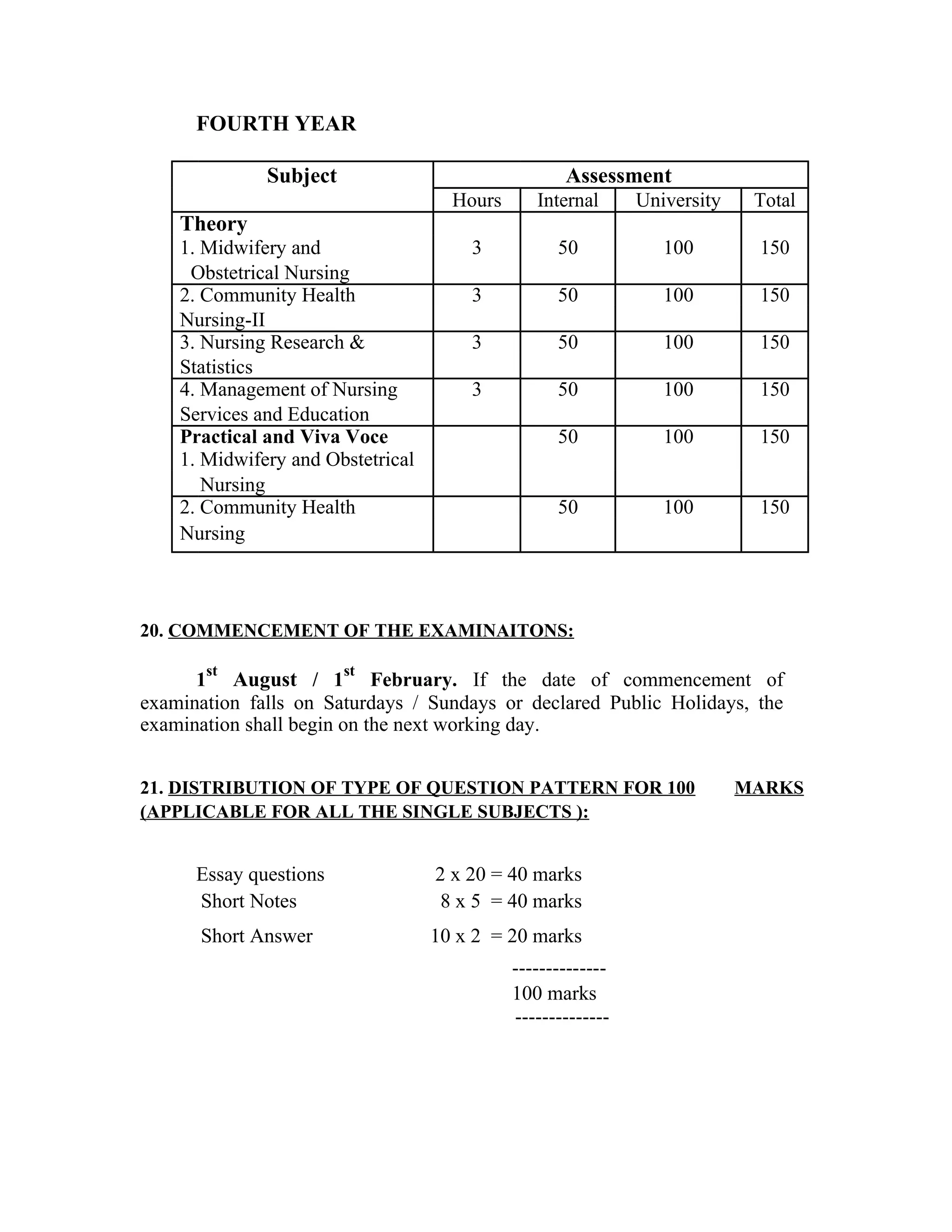
FOURTH YEAR
Subject Assessment
Hours Internal University Total
Theory
3 50 100 1501. Midwifery and
Obstetrical Nursing
2. Community Health 3 50 100 150
Nursing-II
3. Nursing Research & 3 50 100 150
Statistics
4. Management of Nursing 3 50 100 150
Services and Education
Practical and Viva Voce 50 100 150
1. Midwifery and Obstetrical
Nursing
2. Community Health 50 100 150
Nursing
20. COMMENCEMENT OF THE EXAMINAITONS:
1
st
August / 1
st
February. If the date of commencement of
examination falls on Saturdays / Sundays or declared Public Holidays, the
examination shall begin on the next working day.
21. DISTRIBUTION OF TYPE OF QUESTION PATTERN FOR 100 MARKS
(APPLICABLE FOR ALL THE SINGLE SUBJECTS ):
Essay questions 2 x 20 = 40 marks
Short Notes 8 x 5 = 40 marks
Short Answer 10 x 2 = 20 marks
--------------
100 marks
--------------
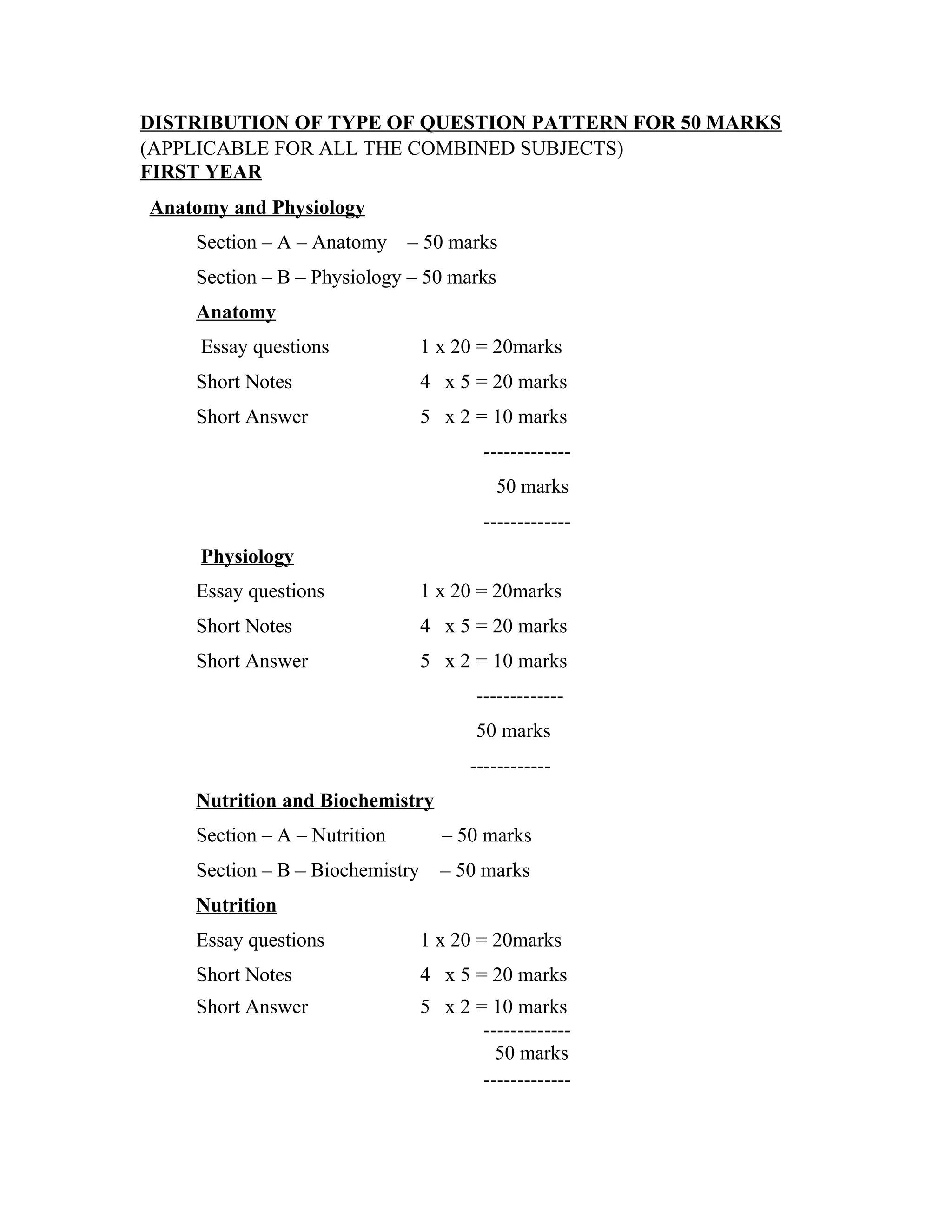
DISTRIBUTION OF TYPE OF QUESTION PATTERN FOR 50 MARKS
(APPLICABLE FOR ALL THE COMBINED SUBJECTS)
FIRST YEAR
Anatomy and Physiology
Section – A – Anatomy – 50 marks
Section – B – Physiology – 50 marks
Anatomy
Essay questions 1 x 20 = 20marks
Short Notes 4 x 5 = 20 marks
Short Answer 5 x 2 = 10 marks
-------------
50 marks
-------------
Physiology
Essay questions 1 x 20 = 20marks
Short Notes 4 x 5 = 20 marks
Short Answer 5 x 2 = 10 marks
-------------
50 marks
------------
Nutrition and Biochemistry
Section – A – Nutrition – 50 marks
Section – B – Biochemistry – 50 marks
Nutrition
Essay questions 1 x 20 = 20marks
Short Notes 4 x 5 = 20 marks
Short Answer 5 x 2 = 10 marks
-------------
50 marks
-------------
Biochemistry
Essay questions 1 x 20 = 20marks
Short Notes 4 x 5 = 20 marks
Short Answer 5 x 2 = 10 marks
-------------
50 marks
-------------
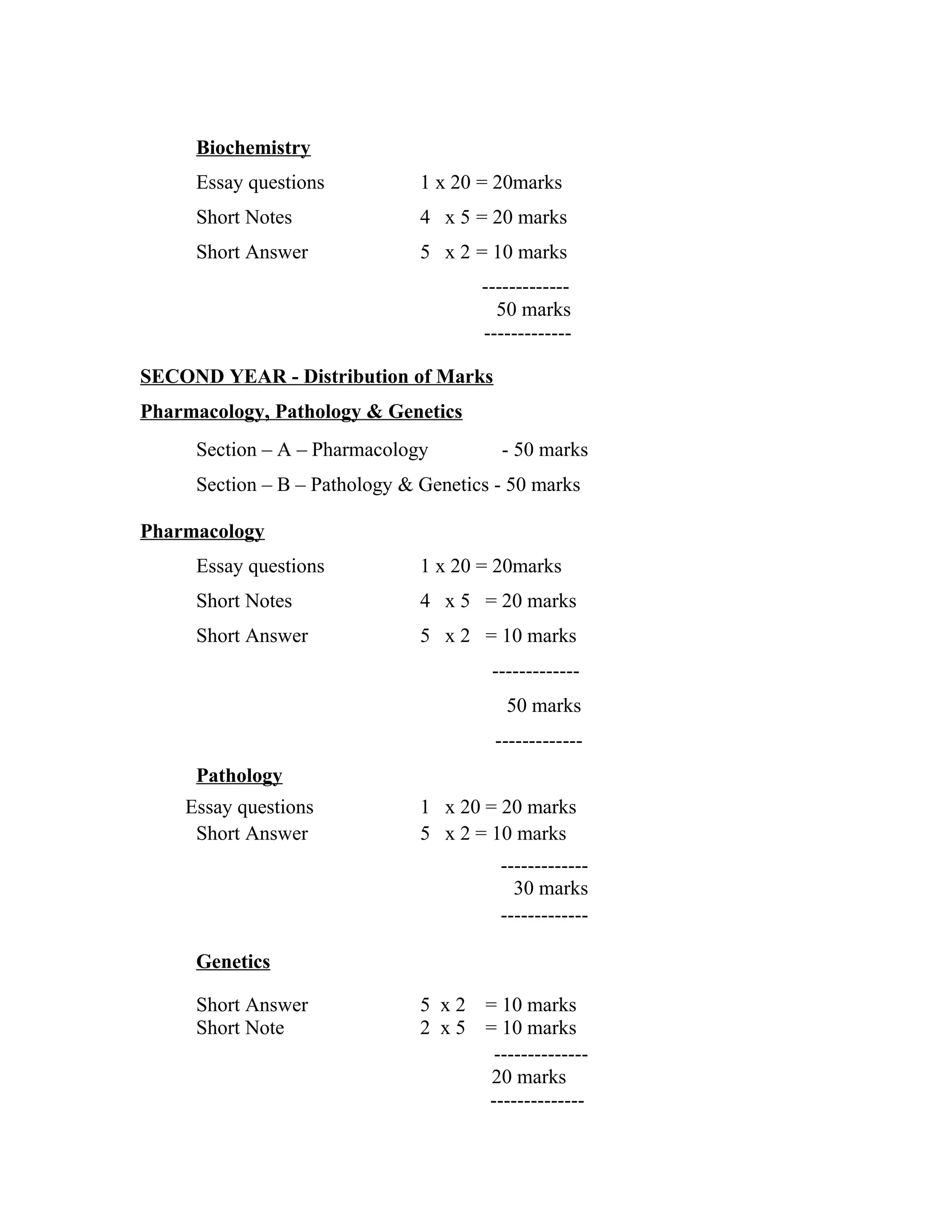
SECOND YEAR - Distribution of Marks
Pharmacology, Pathology & Genetics
Section – A – Pharmacology - 50 marks
Section – B – Pathology & Genetics - 50 marks
Pharmacology
Essay questions 1 x 20 = 20marks
Short Notes 4 x 5 = 20 marks
Short Answer 5 x 2 = 10 marks
-------------
50 marks
-------------
Pathology
Essay questions 1 x 20 = 20 marks
Short Answer 5 x 2 = 10 marks
-------------
30 marks
-------------
Genetics
Short Answer 5 x 2 = 10 marks
Short Note 2 x 5 = 10 marks
--------------
20 marks
--------------
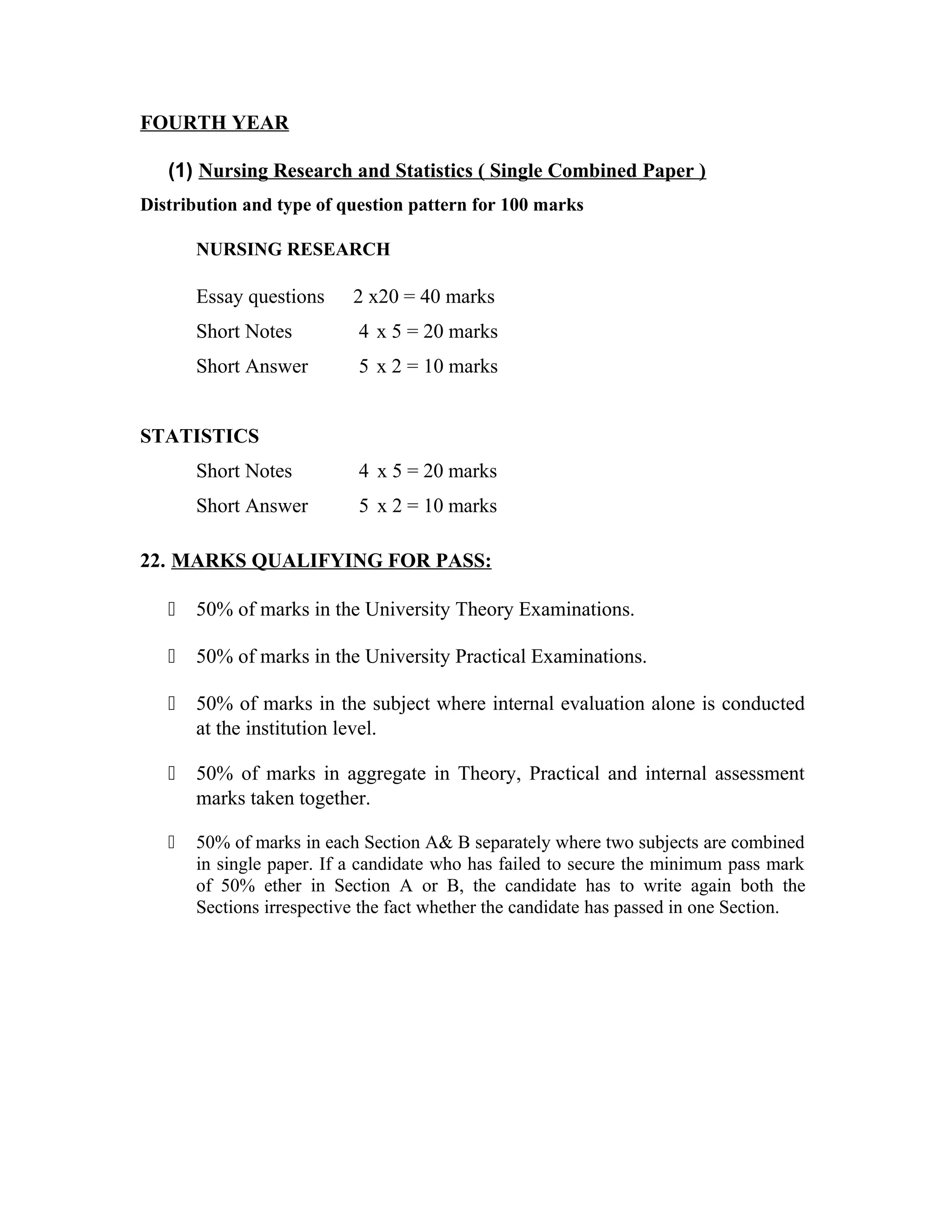
FOURTH YEAR
(1) Nursing Research and Statistics ( Single Combined Paper )
Distribution and type of question pattern for 100 marks
NURSING RESEARCH
Essay questions 2 x20 = 40 marks
Short Notes 4 x 5 = 20 marks
Short Answer 5 x 2 = 10 marks
STATISTICS
Short Notes 4 x 5 = 20 marks
Short Answer 5 x 2 = 10 marks
22. MARKS QUALIFYING FOR PASS:
ƒ 50% of marks in the University Theory Examinations.
ƒ 50% of marks in the University Practical Examinations.
ƒ 50% of marks in the subject where internal evaluation alone is conducted
at the institution level.
ƒ 50% of marks in aggregate in Theory, Practical and internal assessment
marks taken together.
ƒ 50% of marks in each Section A& B separately where two subjects are combined
in single paper. If a candidate who has failed to secure the minimum pass mark
of 50% ether in Section A or B, the candidate has to write again both the
Sections irrespective the fact whether the candidate has passed in one Section.
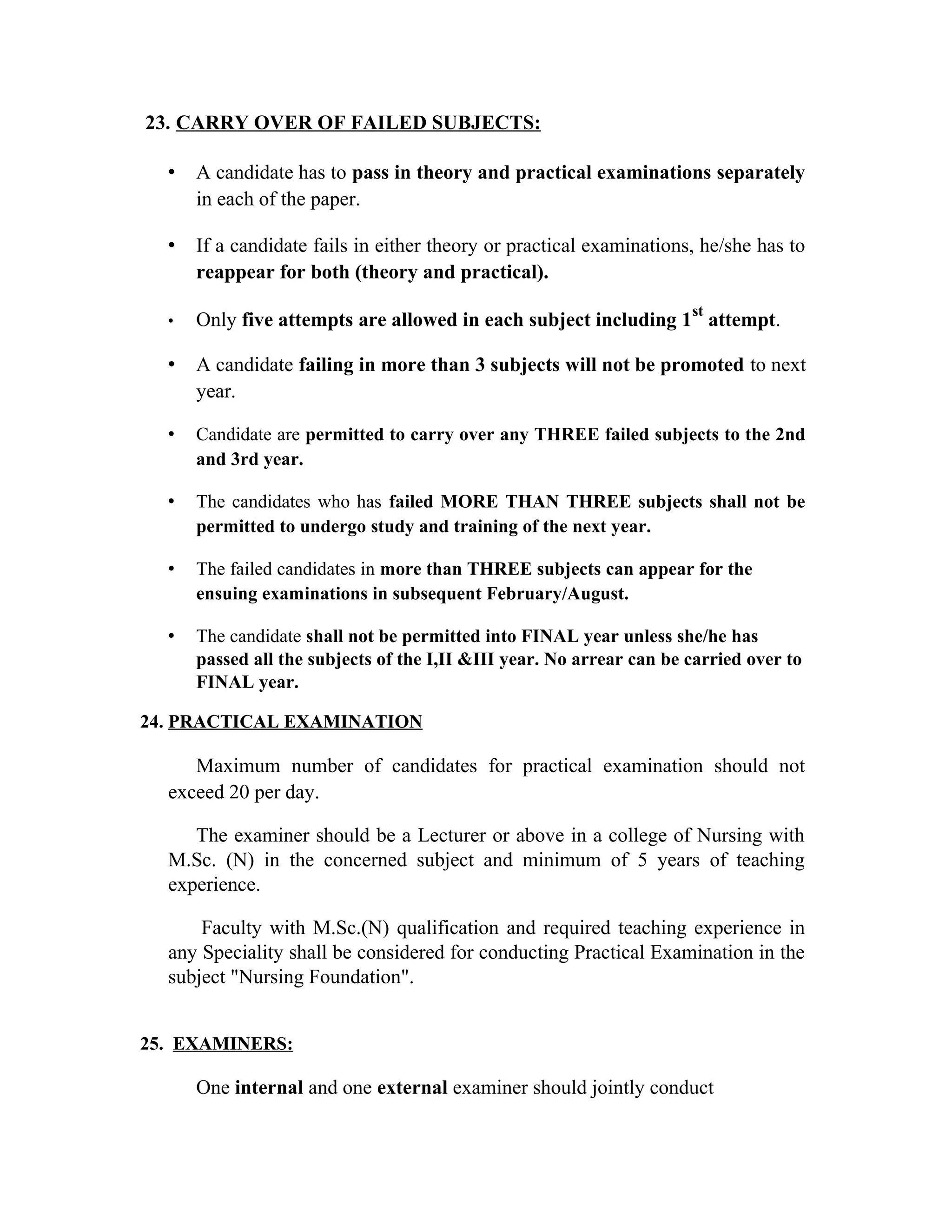
23. CARRY OVER OF FAILED SUBJECTS:
• A candidate has to pass in theory and practical examinations separately
in each of the paper.
• If a candidate fails in either theory or practical examinations, he/she has to
reappear for both (theory and practical).
• Only five attempts are allowed in each subject including 1
st
attempt.
• A candidate failing in more than 3 subjects will not be promoted to next
year.
• Candidate are permitted to carry over any THREE failed subjects to the 2nd
and 3rd year.
• The candidates who has failed MORE THAN THREE subjects shall not be
permitted to undergo study and training of the next year.
• The failed candidates in more than THREE subjects can appear for the
ensuing examinations in subsequent February/August.
• The candidate shall not be permitted into FINAL year unless she/he has
passed all the subjects of the I,II &III year. No arrear can be carried over to
FINAL year.
24. PRACTICAL EXAMINATION
Maximum number of candidates for practical examination should not
exceed 20 per day.
The examiner should be a Lecturer or above in a college of Nursing with
M.Sc. (N) in the concerned subject and minimum of 5 years of teaching
experience.
Faculty with M.Sc.(N) qualification and required teaching experience in
any Speciality shall be considered for conducting Practical Examination in the
subject "Nursing Foundation".
25. EXAMINERS:
One internal and one external examiner should jointly conduct
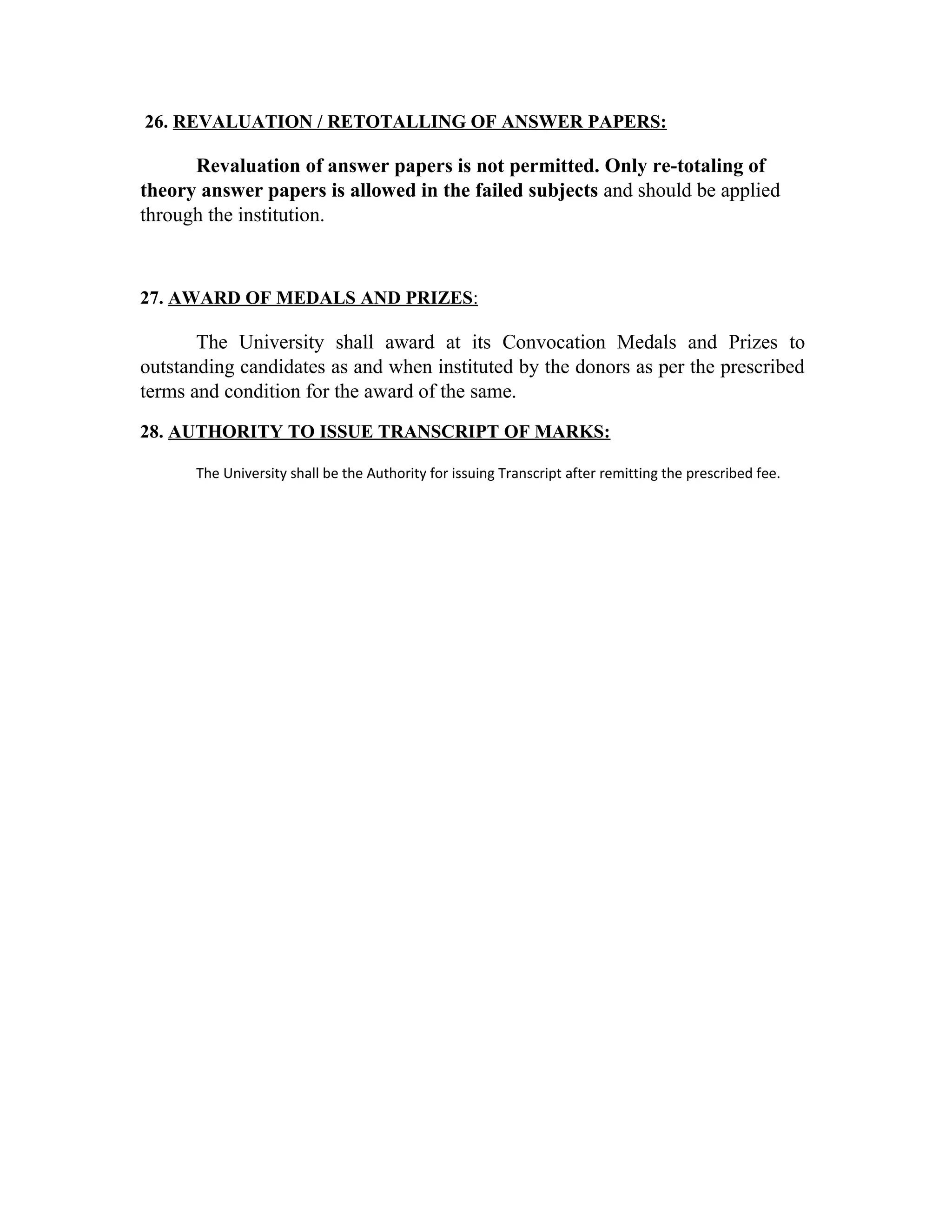
practical/oral examination for each student.
26. REVALUATION / RETOTALLING OF ANSWER PAPERS:
Revaluation of answer papers is not permitted. Only re-totaling of
theory answer papers is allowed in the failed subjects and should be applied
through the institution.
27. AWARD OF MEDALS AND PRIZES:
The University shall award at its Convocation Medals and Prizes to
outstanding candidates as and when instituted by the donors as per the prescribed
terms and condition for the award of the same.
28. AUTHORITY TO ISSUE TRANSCRIPT OF MARKS:
The University shall be the Authority for issuing Transcript after remitting the prescribed fee.
ANNEXURE-I
DECLARARTION
I ---------------------------------------------------------- Son of / Daughter of -------------------
----------------------Residing at ------------------------------------------------------------------
and admitted to in I year of -------------------------------------------------------------
(Name of the Course ) at --------------------------------------------------------------- (Name
of the College) do hereby solemnly affirm and sincerely state as follows.
I declare that I shall abide by the rules and regulations prescribed by the Tamil
Nadu Dr. M.G.R Medical University, Chennai for the -----------------------------
(course) including regulations for re-admission after the break of study.
Date: signature of candidate
/counter Signed/
(Official date seal)
Dean/Principal/ Director
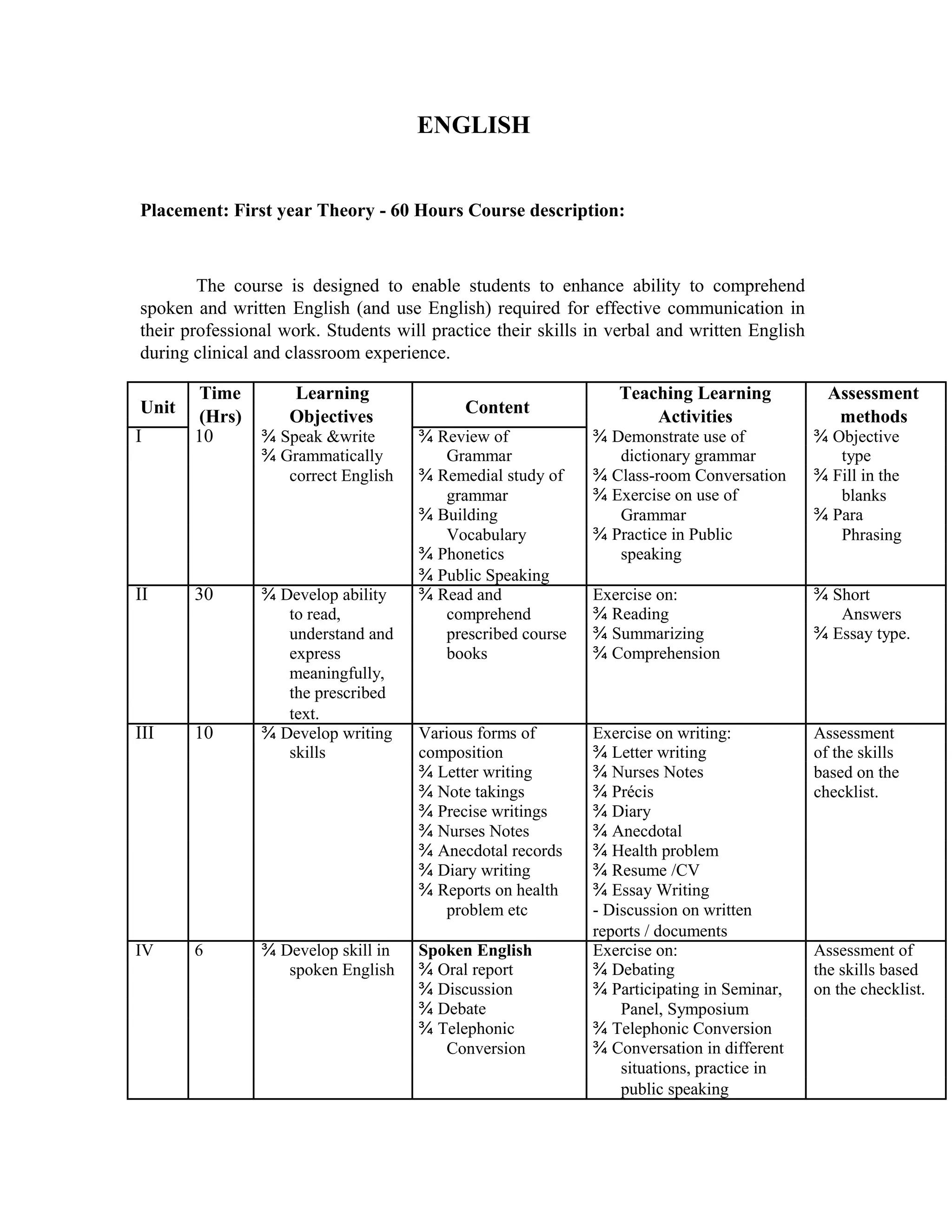
ENGLISH
Placement: First year Theory - 60 Hours Course description:
The course is designed to enable students to enhance ability to comprehend
spoken and written English (and use English) required for effective communication in
their professional work. Students will practice their skills in verbal and written English
during clinical and classroom experience.
Unit
Time Learning
Content
Teaching Learning Assessment
(Hrs) Objectives Activities methods
I 10 ¾ Speak &write ¾ Review of ¾ Demonstrate use of ¾ Objective
¾ Grammatically Grammar dictionary grammar type
correct English ¾ Remedial study of ¾ Class-room Conversation ¾ Fill in the
grammar ¾ Exercise on use of blanks
¾ Building Grammar ¾ Para
Vocabulary ¾ Practice in Public Phrasing
¾ Phonetics speaking
¾ Public Speaking
II 30 ¾ Develop ability ¾ Read and Exercise on: ¾ Short
to read, comprehend ¾ Reading Answers
understand and prescribed course ¾ Summarizing ¾ Essay type.
express books ¾ Comprehension
meaningfully,
the prescribed
text.
III 10 ¾ Develop writing Various forms of Exercise on writing: Assessment
skills composition ¾ Letter writing of the skills
¾ Letter writing ¾ Nurses Notes based on the
¾ Note takings ¾ Précis checklist.
¾ Precise writings ¾ Diary
¾ Nurses Notes ¾ Anecdotal
¾ Anecdotal records ¾ Health problem
¾ Diary writing ¾ Resume /CV
¾ Reports on health ¾ Essay Writing
problem etc - Discussion on written
reports / documents
IV 6 ¾ Develop skill in Spoken English Exercise on: Assessment of
spoken English ¾ Oral report ¾ Debating the skills based
¾ Discussion ¾ Participating in Seminar, on the checklist.
¾ Debate Panel, Symposium
¾ Telephonic ¾ Telephonic Conversion
Conversion ¾ Conversation in different
situations, practice in
public speaking
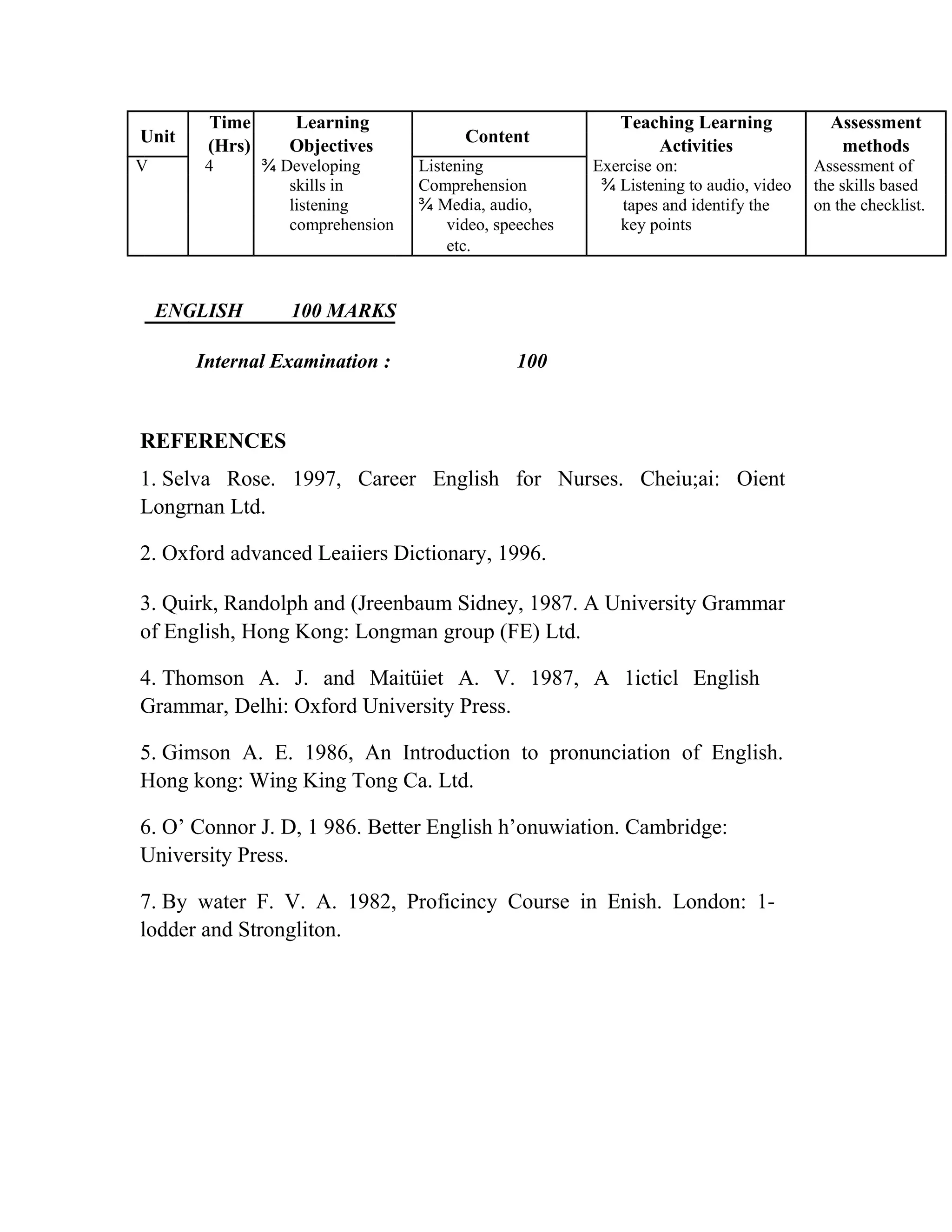
Unit
Time Learning
Content
Teaching Learning Assessment
(Hrs) Objectives Activities methods
V 4 ¾ Developing Listening Exercise on: Assessment of
skills in Comprehension ¾ Listening to audio, video the skills based
listening ¾ Media, audio, tapes and identify the on the checklist.
comprehension video, speeches key points
etc.
ENGLISH 100 MARKS
Internal Examination : 100
REFERENCES
1. Selva Rose. 1997, Career English for Nurses. Cheiu;ai: Oient
Longrnan Ltd.
2. Oxford advanced Leaiiers Dictionary, 1996.
3. Quirk, Randolph and (Jreenbaum Sidney, 1987. A University Grammar
of English, Hong Kong: Longman group (FE) Ltd.
4. Thomson A. J. and Maitüiet A. V. 1987, A 1icticl English
Grammar, Delhi: Oxford University Press.
5. Gimson A. E. 1986, An Introduction to pronunciation of English.
Hong kong: Wing King Tong Ca. Ltd.
6. O’ Connor J. D, 1 986. Better English h’onuwiation. Cambridge:
University Press.
7. By water F. V. A. 1982, Proficincy Course in Enish. London: 1-
lodder and Strongliton.
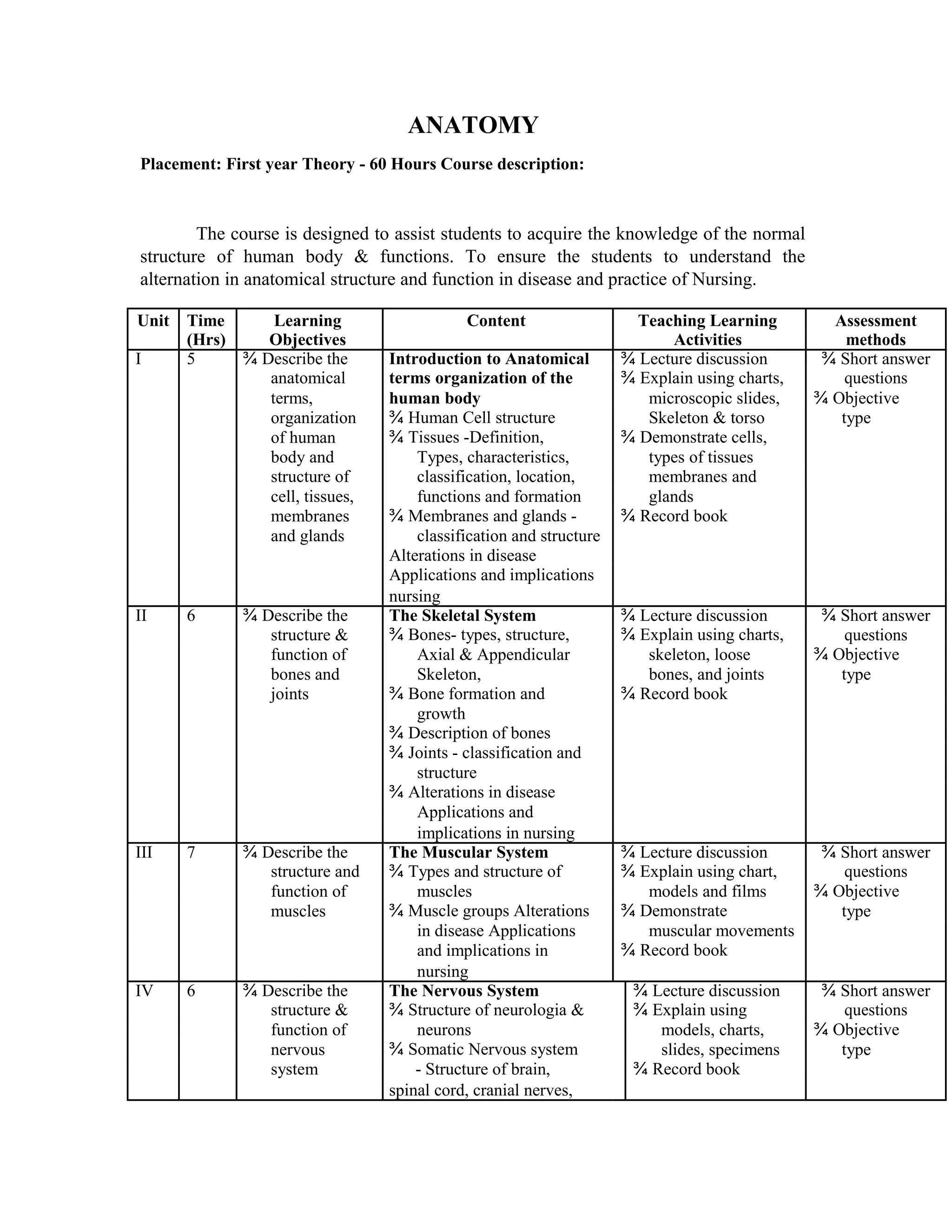
ANATOMY
Placement: First year Theory - 60 Hours Course description:
The course is designed to assist students to acquire the knowledge of the normal
structure of human body & functions. To ensure the students to understand the
alternation in anatomical structure and function in disease and practice of Nursing.
Unit Time Learning Content Teaching Learning Assessment
(Hrs) Objectives Activities methods
I 5 ¾ Describe the Introduction to Anatomical ¾ Lecture discussion ¾ Short answer
anatomical terms organization of the ¾ Explain using charts, questions
terms, human body microscopic slides, ¾ Objective
organization ¾ Human Cell structure Skeleton & torso type
of human ¾ Tissues -Definition, ¾ Demonstrate cells,
body and Types, characteristics, types of tissues
structure of classification, location, membranes and
cell, tissues, functions and formation glands
membranes ¾ Membranes and glands - ¾ Record book
and glands classification and structure
Alterations in disease
Applications and implications
nursing
II 6 ¾ Describe the The Skeletal System ¾ Lecture discussion ¾ Short answer
structure & ¾ Bones- types, structure, ¾ Explain using charts, questions
function of Axial & Appendicular skeleton, loose ¾ Objective
bones and Skeleton, bones, and joints type
joints ¾ Bone formation and ¾ Record book
growth
¾ Description of bones
¾ Joints - classification and
structure
¾ Alterations in disease
Applications and
implications in nursing
III 7 ¾ Describe the The Muscular System ¾ Lecture discussion ¾ Short answer
structure and ¾ Types and structure of ¾ Explain using chart, questions
function of muscles models and films ¾ Objective
muscles ¾ Muscle groups Alterations ¾ Demonstrate type
in disease Applications muscular movements
and implications in ¾ Record book
nursing
IV 6 ¾ Describe the The Nervous System ¾ Lecture discussion ¾ Short answer
structure & ¾ Structure of neurologia & ¾ Explain using questions
function of neurons models, charts, ¾ Objective
nervous ¾ Somatic Nervous system slides, specimens type
system - Structure of brain, ¾ Record book
spinal cord, cranial nerves,
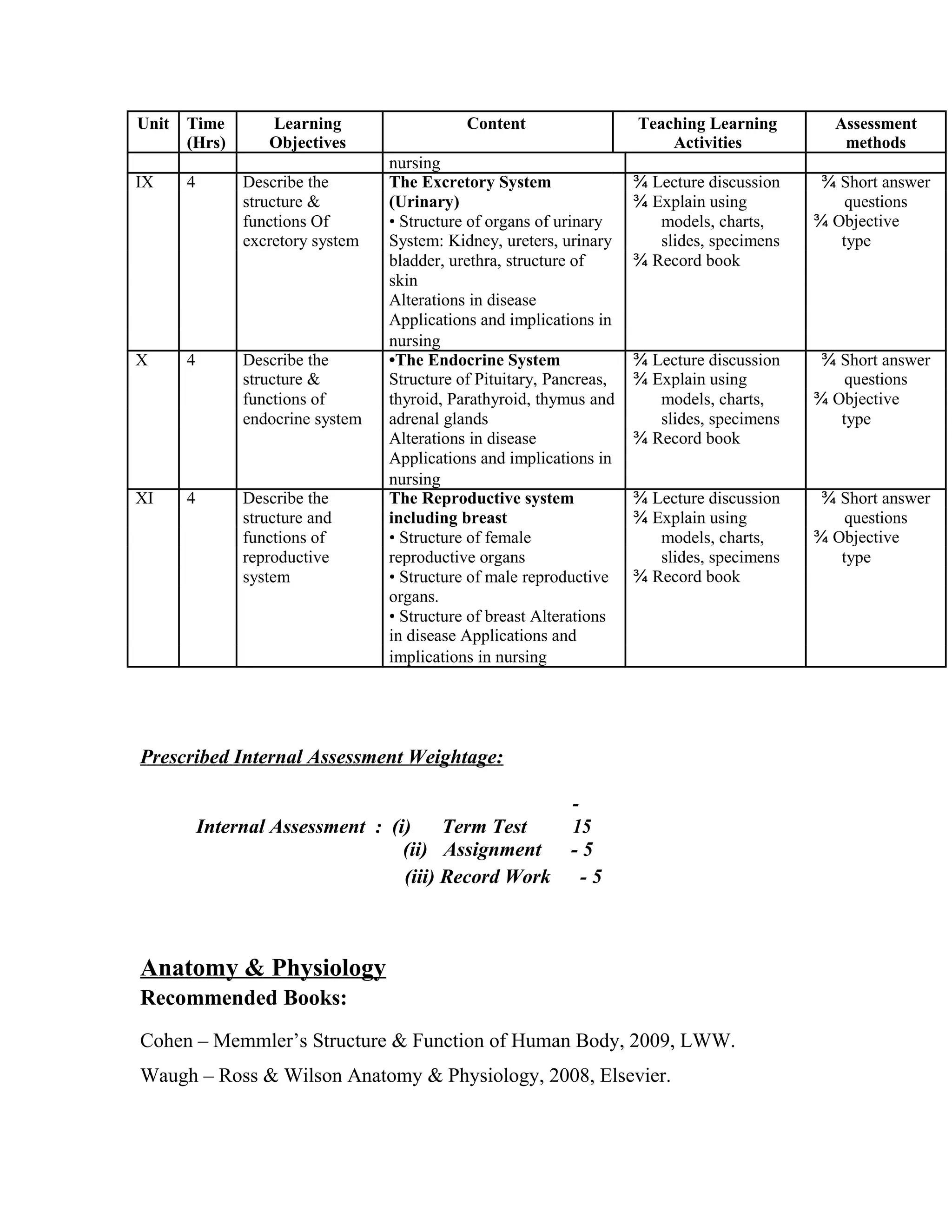
Unit Time Learning Content Teaching Learning Assessment
(Hrs) Objectives Activities methods
spinal nerves, peripheral nerves
¾ Autonomic Nervous System
— sympathetic,
parasympathetic
- Structure, location Alterations
in disease
Applications and implications in
nursing
V 6 Explain the The Sensory Organs ¾ Lecture discussion ¾ Short answer
structure & ¾ Structure of skin, eye, ear, ¾ Explain using questions
functions of nose, tongue, (Auditory and models, charts, ¾ Objective
sensory organs olfactory apparatus) slides, specimens type
Alterations in disease ¾ Record book
Applications and implications in
nursing
VI 7 Describe the Circulatory and lymphatic ¾ Lecture discussion ¾ Short answer
structure & system ¾ Explain using questions
function of. ¾ The Circulatory System models, charts, ¾ Objective
circulatory and - Blood — Microscopic structure slides, specimens type
lymphatic system - Structure of Heart ¾ Record book
Structure of blood vessels —
Arterial & Venous System,
- Circulation: systemic,
pulmonary, coronary
Lymphatic system
- Lymphatic vessels and lymph
- Lymphatic tissues
- Thymus gland
- Lymph nodes
- Spleen
- Lymphatic nodules
Alterations in disease
Applications and implications in
nursing
VII 5 ¾ Describe the The Respiratory System ¾ Lecture discussion ¾ Short answer
structure & • Structure of the organs of ¾ Explain using questions
functions of respiration models, charts, ¾ Objective
respiratory • Muscles of respiration: slides, specimens type
system Intercostal and Diaphragm ¾ Record book
Alterations in disease
Applications and implications in
nursing
VIII 6 Describe the The Digestive System ¾ Lecture discussion ¾ Short answer
structure & • Structure of Alimentary tract ¾ Explain using questions
functions of and accessory organs of models, charts, ¾ Objective
digestive system digestion slides, specimens type
Alterations in disease ¾ Record book
Applications and implications in
Unit Time Learning Content Teaching Learning Assessment
(Hrs) Objectives Activities methods
nursing
IX 4 Describe the The Excretory System ¾ Lecture discussion ¾ Short answer
structure & (Urinary) ¾ Explain using questions
functions Of • Structure of organs of urinary models, charts, ¾ Objective
excretory system System: Kidney, ureters, urinary slides, specimens type
bladder, urethra, structure of ¾ Record book
skin
Alterations in disease
Applications and implications in
nursing
X 4 Describe the •The Endocrine System ¾ Lecture discussion ¾ Short answer
structure & Structure of Pituitary, Pancreas, ¾ Explain using questions
functions of thyroid, Parathyroid, thymus and models, charts, ¾ Objective
endocrine system adrenal glands slides, specimens type
Alterations in disease ¾ Record book
Applications and implications in
nursing
XI 4 Describe the The Reproductive system ¾ Lecture discussion ¾ Short answer
structure and including breast ¾ Explain using questions
functions of • Structure of female models, charts, ¾ Objective
reproductive reproductive organs slides, specimens type
system • Structure of male reproductive ¾ Record book
organs.
• Structure of breast Alterations
in disease Applications and
implications in nursing
Prescribed Internal Assessment Weightage:
Internal Assessment : (i) Term Test
-
15
(ii) Assignment - 5
(iii) Record Work - 5
Anatomy & Physiology
Recommended Books:
Cohen – Memmler’s Structure & Function of Human Body, 2009, LWW.
Waugh – Ross & Wilson Anatomy & Physiology, 2008, Elsevier.
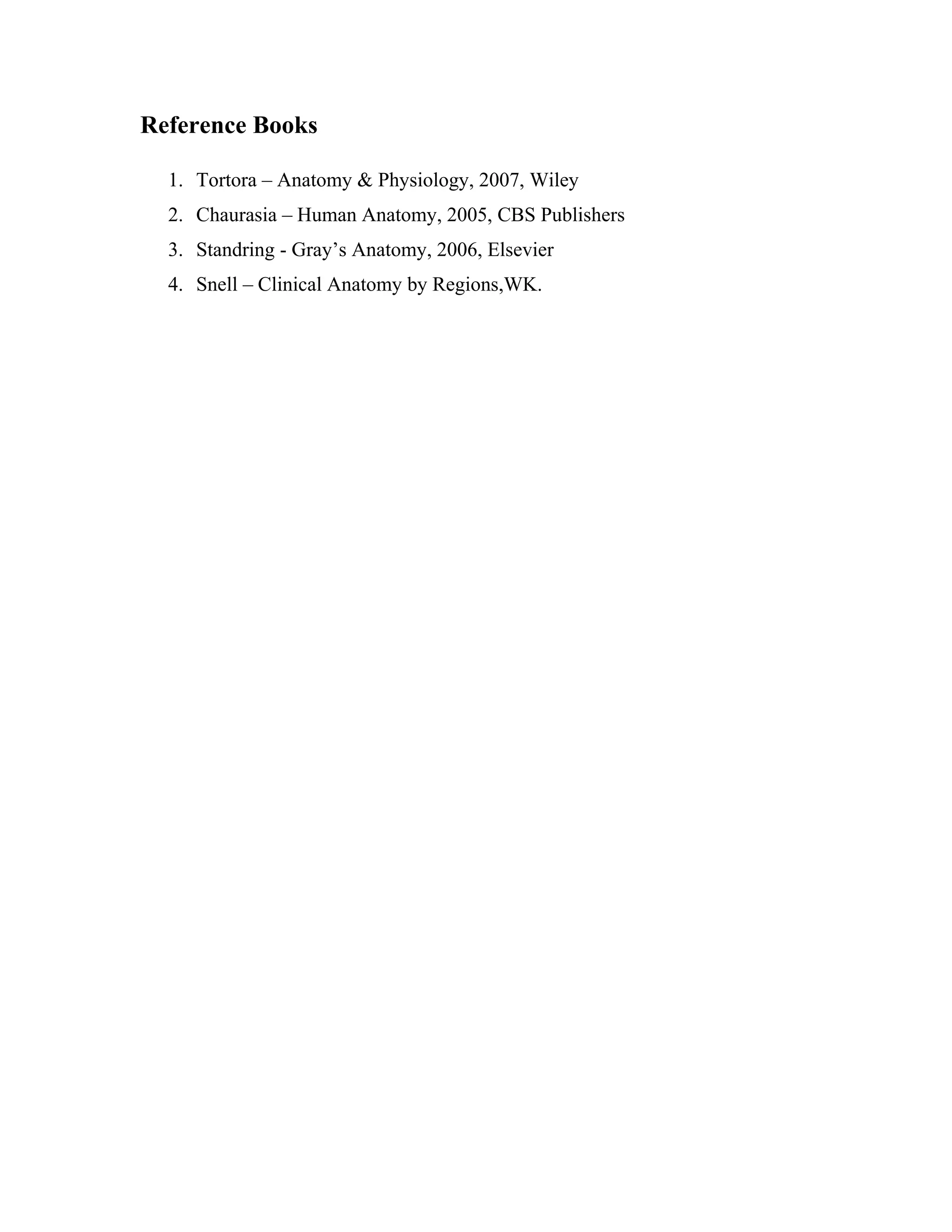
Reference Books
1. Tortora – Anatomy & Physiology, 2007, Wiley
2. Chaurasia – Human Anatomy, 2005, CBS Publishers
3. Standring - Gray’s Anatomy, 2006, Elsevier
4. Snell – Clinical Anatomy by Regions,WK.
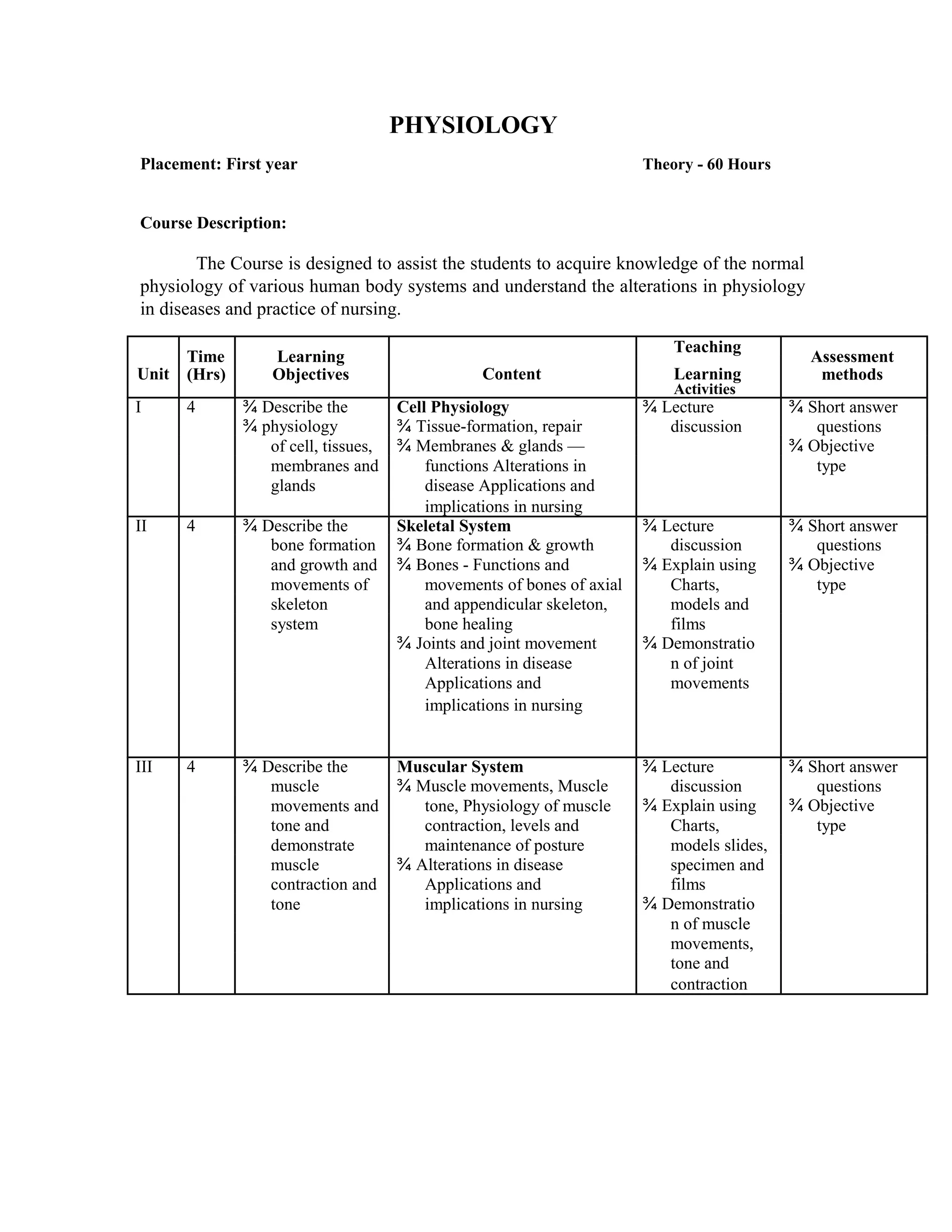
PHYSIOLOGY
Placement: First year Theory - 60 Hours
Course Description:
The Course is designed to assist the students to acquire knowledge of the normal
physiology of various human body systems and understand the alterations in physiology
in diseases and practice of nursing.
Unit
Time Learning
Content
Teaching
Assessment
Learning(Hrs) Objectives methods
Activities
I 4 ¾ Describe the Cell Physiology ¾ Lecture ¾ Short answer
¾ physiology ¾ Tissue-formation, repair discussion questions
of cell, tissues, ¾ Membranes & glands — ¾ Objective
membranes and functions Alterations in type
glands disease Applications and
implications in nursing
II 4 ¾ Describe the Skeletal System ¾ Lecture ¾ Short answer
bone formation ¾ Bone formation & growth discussion questions
and growth and ¾ Bones - Functions and ¾ Explain using ¾ Objective
movements of movements of bones of axial Charts, type
skeleton and appendicular skeleton, models and
system bone healing films
¾ Joints and joint movement ¾ Demonstratio
Alterations in disease n of joint
Applications and movements
implications in nursing
III 4 ¾ Describe the Muscular System ¾ Lecture ¾ Short answer
muscle ¾ Muscle movements, Muscle discussion questions
movements and tone, Physiology of muscle ¾ Explain using ¾ Objective
tone and contraction, levels and Charts, type
demonstrate maintenance of posture models slides,
muscle ¾ Alterations in disease specimen and
contraction and Applications and films
tone implications in nursing ¾ Demonstratio
n of muscle
movements,
tone and
contraction
Time Learning
Teaching
Assessment
Unit Content Learning(Hrs) Objectives methods
Activities
IV 7 ¾ Describe the Nervous System ¾ Lecture ¾ Short answer
physiology of ¾ Functions of Neurolgia & discussion questions
nerve stimulus, neurons ¾ Explain using, ¾ Objective
reflexes, brain, ¾ Stimulus & nerve-impulse- Charts, type
cranial and definitions and mechanism models and
spinal nerves ¾ Functions of brain, spinal films
¾ Demonstrate cord, cranial and spinal ¾ Demonstrate
reflex action nerves nerve
and stimulus ¾ Cerebrospinal fluid- stimulus,
Composition, circulation and reflex action,
function reflexes
¾ Reflex arc, Reflex action and
reflexes
Autonomic functions—
Pain: somatic, visceral, and
referred
Autonomic learning and
biofeedback
Alternations in disease
Applications and implications in
nursing.
V 8 Describe the Circulatory System ¾ Lecture ¾ Short answer
physiology ¾ Blood formation, discussion questions
blood and composition, blood groups, ¾ Explain using ¾ Objective
functions of blood coagulation Charts, films type
Heart ¾ Hemoglobin: Structure, ¾ Demonstratio
Demonstrate Synthesis and breakdown, n of Blood
blood cell count, Variation of molecules, cell count,
coagulation, estimation coagulation,
grouping, ¾ Functions of Heart, grouping,
Hb: BP and Pulse Conduction, Cardiac cycle, Hemoglobin
monitoring circulation— Principles, estimation,
Control, factors influencing Heart
BP and Pulse conduction
¾ Alternations in disease system.
Applications and implications in ¾ Measurement
nursing. of pulse, BP
VI 6 • Describe the The Respiratory System ¾ Lecture ¾ Short answer
physiology and ¾ Functions of respiratory discussion questions
mechanisms of organs ¾ Explain using ¾ Objective
respiration ¾ Physiology of respiration Charts, films type
• Demonstrates ¾ Pulmonary ventilation, ¾ Demonstratio
spirometry Volume n of
¾ Mechanics of respiration spirometry
¾ Gaseous exchange in lungs
¾ Carriage of oxygen &
carbon-dioxide Exchange of
Time Learning
Teaching
Assessment
Unit Content Learning(Hrs) Objectives methods
Activities
gases in tissues
¾ Regulation of respiration.
¾ Alterations in disease
Applications and implications in
nursing.
VII 6 • Describes the The Digestive System ¾ Lecture ¾ Short answer
physiology of • Functions of organs of discussion questions
digestive digestive tract. Movements of ¾ Explain using ¾ Objective
system alimentary tract, Digestion in Charts, Films type
• Demonstrates mouth, stomach, small intestines,
BMR Large intestines, Absorption of
food. Functions of liver, gall
bladder and pancreas
• Metabolism of carbohydrates,
protein and fat
Applications and implications in
nursing.
VIII 5 Describe the The Excretory System ¾ Lecture ¾ Short answer
physiology of • Functions of kidneys, ureters, discussion questions
Excretory urinary bladder & urethra ¾ Explain using
System • Composition of urine
Charts films
¾ Objective
• Mechanism of urine formation type
• Functions of skin
• Regulation of body temperature
• Fluid and electrolyte balance.
Alterations in disease
Applications and implications in
nursing.
IX 4 • Describe the The Sensory Organ ¾ Lecture ¾ Short answer
physiology of • Functions of skin, eye, ear, discussion questions
sensory organs nose, tongue, ¾ Explain using ¾ Objective
• Alterations in disease Charts, films type
Applications and
implications in nursing
X 5 Describe the The Endocrine System ¾ Lecture ¾ Short answer
physiology of • Functions of Pituitary, pineal discussion questions
endocrine glands body, thymus, Thyroid, ¾ Explain using ¾ Objective
parathyroid, pancreas, Supra Charts, films type
renal, Placenta and ovaries & ¾ Demonstratio
Testes n of BMR
Alterations in disease
Applications and implications in
nursing
XI 5 Describe the The Reproductive System ¾ Lecture ¾ Short answer
physiology of male • Reproduction of cells — DNA, discussion questions
and female Mitosis, Meiosis, ¾ Explain using ¾ Objective
reproductive spermatogenesis, oogenesis. Charts, films, type
Time Learning
Teaching
Assessment
Unit Content Learning(Hrs) Objectives methods
Activities
system • Functions of female models,
reproductive organs; Functions specimens
of breast, Female sexual cycle.
• Introduction to embryology.
• Functions of male reproductive
organs, Male function in
reproduction, Male fertility
system, Alterations in disease
Applications and implications in
nursing.
XII 2 Describe the Lymphatic and Immunological ¾ Lecture ¾ Short answer
physiology of System discussion questions
Lymphatic and • Circulation of lymph ¾ Explain using ¾ Objective
Immunological • Immunity Charts, films type
System Formation of T-cells and cells
Types of Immune response
Antigens
Cytokines
Antibodies
Applications and implications in
nursing.
Prescribed Internal Assessment Weightage:
Internal Assessment : Term Test - 15
Assignment - 5
Record Work - 5
Anatomy & Physiology
Recommended Books:
1. Cohen – Memmler’s Structure & Function of Human Body, 2009, LWW.
2. Waugh – Ross & Wilson Anatomy & Physiology, 2008, Elsevier.
3. Venkatesh – Basic Medical Physiology for Nursing ,2009 ,LWW
Reference Books:
Venkatesh – Basic Medical Physiology, 2009, LWW
Guyton – Medical Physiology, 2007, Elsevier.
West – Best& Taylor Physiologic Basis of Disease, Waverly.
NUTRITION
Placement: First year Theory - 60 Hours
Course Description:
The Course is designed to assist the students to acquire knowledge of nutrition
for maintenance of optimum health at different stages of life and its application for
practice of nursing.
Time
Teaching Learning Assessment
Unit (Hrs) Learning Objectives Content
Activities methods
T P
I 4 ¾ Describe the Introduction ¾ Lecture Discussion ¾ Short answer
relationship • Nutrition: ¾ Explaining using questions
between nutrition - History charts ¾ Objective
& Health. - Concepts ¾ Panel discussion type
• Role of nutrition in
maintaining health
• Nutritional problems in
India
• National nutritional
policy
• Factors affecting food
and nutrition: socio-
economic, cultural,
tradition, production,
system of distribution, life
style and food habits etc
• Role of food and its
medicinal value
• Classification of foods
• Food standards
• Elements of nutrition:
macro and micro
• Calorie, BMR
II 2 ¾ Describe the Carbohydrates ¾ Lecture Discussion ¾ Short answer
classification, • Classification ¾ Explaining using questions
functions, sources • Caloric value charts ¾ Objective
and recommended • Recommended daily type
daily allowances allowances
(RDA) of • Dietary sources.
carbohydrates • Functions
• Digestion, absorption
and storage, metabolism
of carbohydrates
• Malnutrition:
Deficiencies and Over
Time
Teaching Learning Assessment
Unit (Hrs) Learning Objectives Content
Activities methods
T P
consumption
III 2 ¾ Describe the Fats ¾ Lecture Discussion ¾ Short answer
classification, • Classification ¾ Explaining using questions
functions, • Caloric value charts ¾ Objective
sources and • Recommended daily type
recommended allowances
daily allowances • Dietary sources.
(RDA) of Fats • Functions.
• Digestion, absorption
and storage, metabolism
• Malnutrition:
Deficiencies and Over
consumption
IV 2 ¾ Describe the Proteins ¾ Lecture Discussion ¾ Short answer
classification, • Classification ¾ Explaining using questions
functions, sources • Caloric value charts ¾ Objective
and recommended • Recommended daily type
daily allowances allowances
(RDA) of Proteins • Dietary sources.
• Functions.
• Digestion, absorption,
metabolism and storage
• Malnutrition:
Deficiencies and Over
consumption
V 3 ¾ Describe the daily Energy ¾ Lecture Discussion ¾ Short answer
calorie requiremen • Unit of Energy - Kcal ¾ Explaining using questions
for different • Energy requirements of charts ¾ Objective
categories of different categories of ¾ Exercise type
people people. ¾ Demonstration
• Measurements of
energy.
• Body Mass Index (BMI)
and basic metabolism
• Basal Metabolic Rate
(BMR) - determination
and factors affecting
VI 4 ¾ Describe the Vitamins ¾ Lecture Discussion ¾ Short answer
classification, • Classification ¾ Explaining using questions
functions, sources • Recommended daily charts ¾ Objective
and recommended allowances type
daily allowances • Dietary sources.
(RDA) of Vitamins • Functions.
• Absorption, synthesis,
• metabolism storage
and excretion
¾ Deficiencies
Time
Teaching Learning Assessment
Unit (Hrs) Learning Objectives Content
Activities methods
T P
¾ Hypervitaminosis
Time
Learning Teaching Learning Assessment
Unit (Hrs) Content
Objectives Activities methods
T P
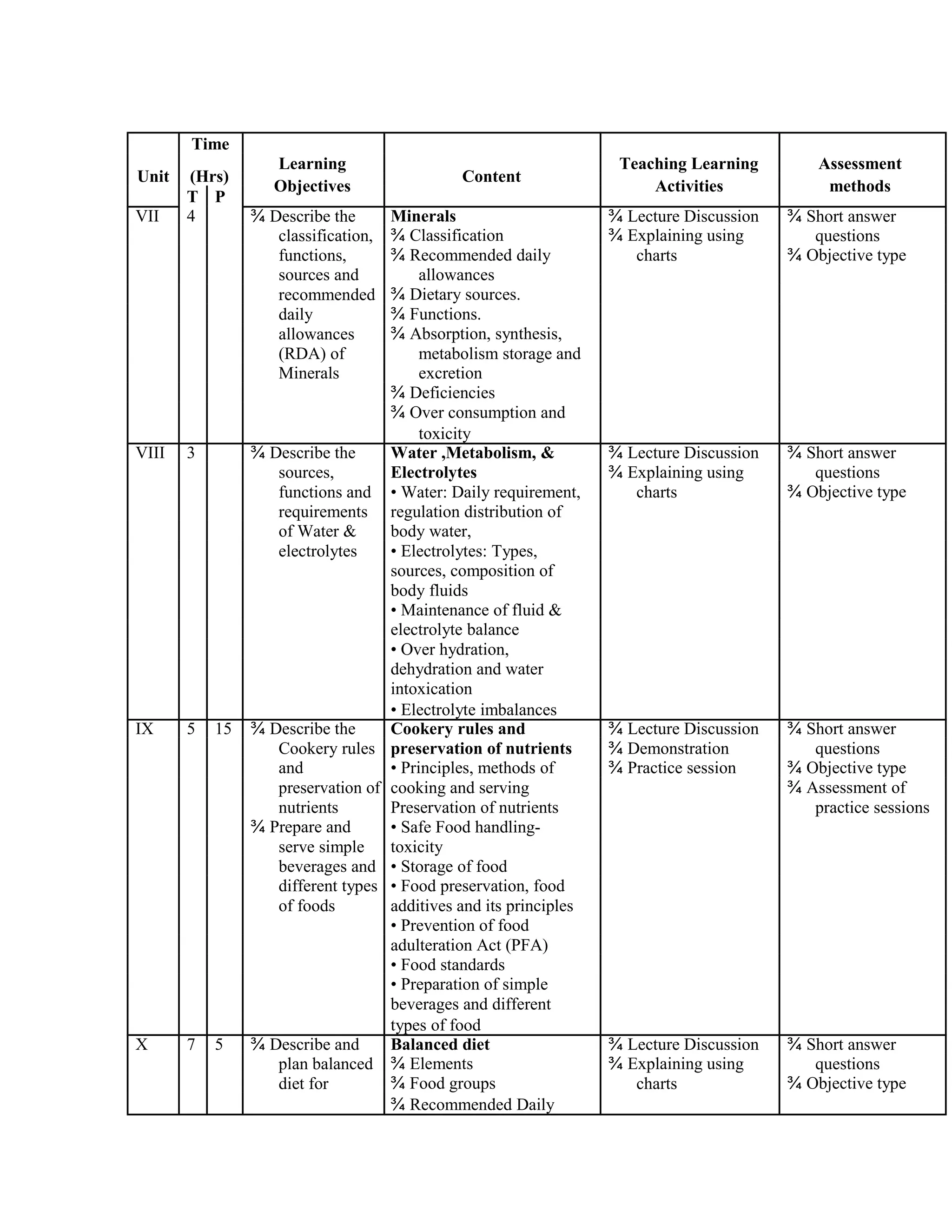
VII 4 ¾ Describe the Minerals ¾ Lecture Discussion ¾ Short answer
classification, ¾ Classification ¾ Explaining using questions
functions, ¾ Recommended daily charts ¾ Objective type
sources and allowances
recommended ¾ Dietary sources.
daily ¾ Functions.
allowances ¾ Absorption, synthesis,
(RDA) of metabolism storage and
Minerals excretion
¾ Deficiencies
¾ Over consumption and
toxicity
VIII 3 ¾ Describe the Water ,Metabolism, & ¾ Lecture Discussion ¾ Short answer
sources, Electrolytes ¾ Explaining using questions
functions and • Water: Daily requirement, charts ¾ Objective type
requirements regulation distribution of
of Water & body water,
electrolytes • Electrolytes: Types,
sources, composition of
body fluids
• Maintenance of fluid &
electrolyte balance
• Over hydration,
dehydration and water
intoxication
• Electrolyte imbalances
IX 5 15 ¾ Describe the Cookery rules and ¾ Lecture Discussion ¾ Short answer
Cookery rules preservation of nutrients ¾ Demonstration questions
and • Principles, methods of ¾ Practice session ¾ Objective type
preservation of cooking and serving ¾ Assessment of
nutrients Preservation of nutrients practice sessions
¾ Prepare and • Safe Food handling-
serve simple toxicity
beverages and • Storage of food
different types • Food preservation, food
of foods additives and its principles
• Prevention of food
adulteration Act (PFA)
• Food standards
• Preparation of simple
beverages and different
types of food
X 7 5 ¾ Describe and Balanced diet ¾ Lecture Discussion ¾ Short answer
plan balanced ¾ Elements ¾ Explaining using questions
diet for ¾ Food groups charts ¾ Objective type
¾ Recommended Daily
different categories Allowance ¾ Practice session ¾ Exercise on
of people • Nutritive value of foods ¾ Meal planning menu
• Calculation of balanced diet Planning
for different categories of
people
Planning menu Budgeting of
food Introduction to therapeutic
diets: Naturopathy --Diet
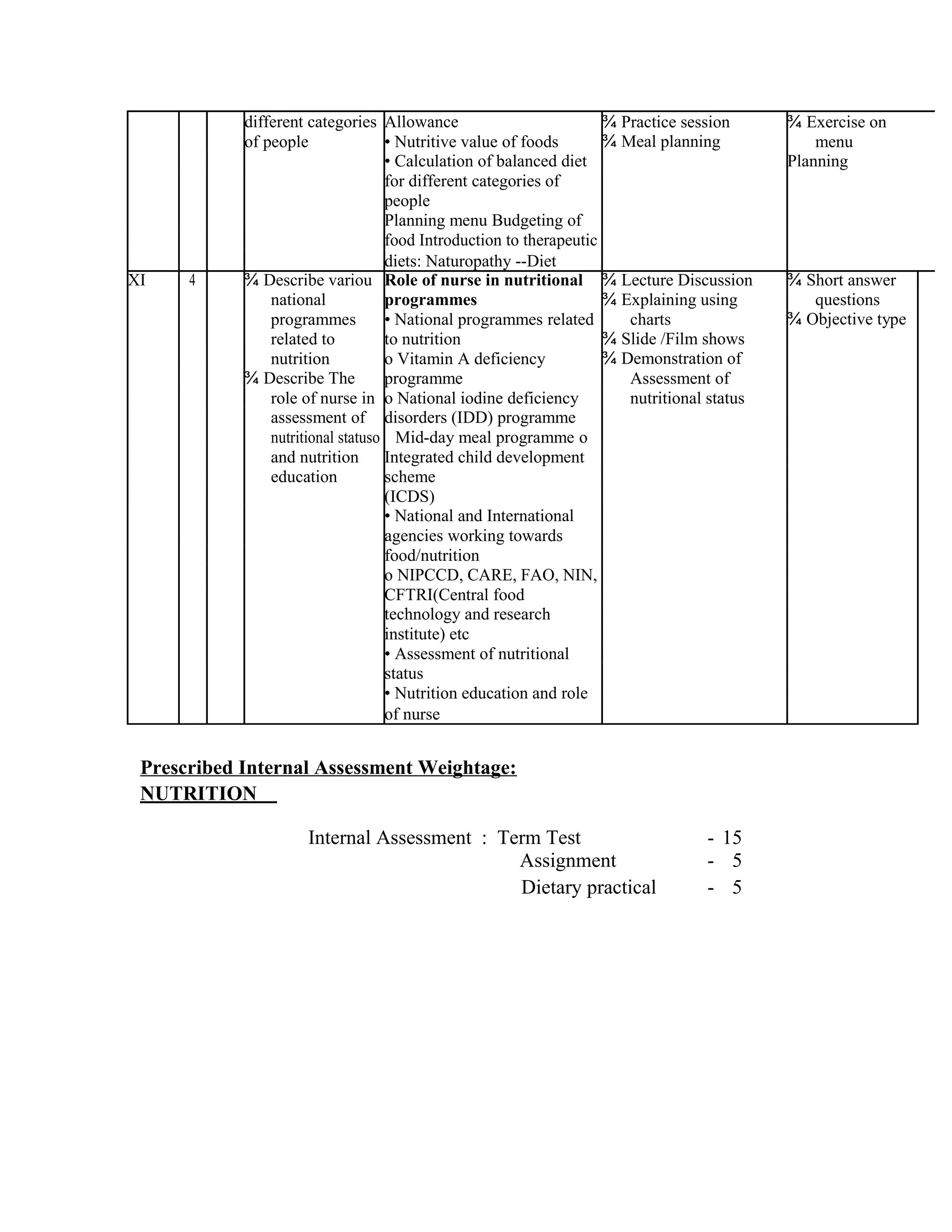
XI 4 ¾ Describe variou Role of nurse in nutritional ¾ Lecture Discussion ¾ Short answer
national programmes ¾ Explaining using questions
programmes • National programmes related charts ¾ Objective type
related to to nutrition ¾ Slide /Film shows
nutrition o Vitamin A deficiency ¾ Demonstration of
¾ Describe The programme Assessment of
role of nurse in o National iodine deficiency nutritional status
assessment of disorders (IDD) programme
nutritional statuso Mid-day meal programme o
and nutrition Integrated child development
education scheme
(ICDS)
• National and International
agencies working towards
food/nutrition
o NIPCCD, CARE, FAO, NIN,
CFTRI(Central food
technology and research
institute) etc
• Assessment of nutritional
status
• Nutrition education and role
of nurse
Prescribed Internal Assessment Weightage:
NUTRITION
Internal Assessment : Term Test - 15
Assignment - 5
Dietary practical - 5
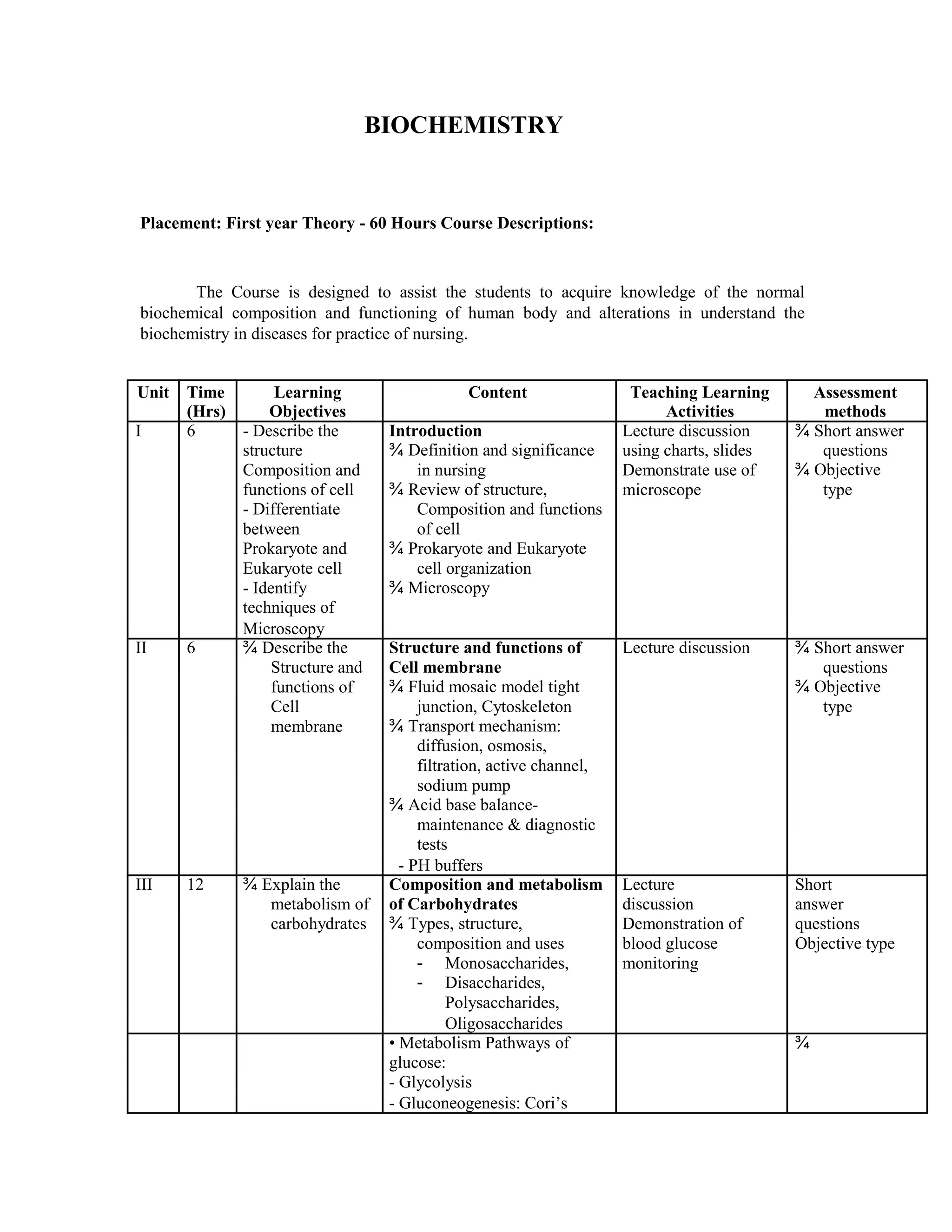
BIOCHEMISTRY
Placement: First year Theory - 60 Hours Course Descriptions:
The Course is designed to assist the students to acquire knowledge of the normal
biochemical composition and functioning of human body and alterations in understand the
biochemistry in diseases for practice of nursing.
Unit Time Learning Content Teaching Learning Assessment
(Hrs) Objectives Activities methods
I 6 - Describe the Introduction Lecture discussion ¾ Short answer
structure ¾ Definition and significance using charts, slides questions
Composition and in nursing Demonstrate use of ¾ Objective
functions of cell ¾ Review of structure, microscope type
- Differentiate Composition and functions
between of cell
Prokaryote and ¾ Prokaryote and Eukaryote
Eukaryote cell cell organization
- Identify ¾ Microscopy
techniques of
Microscopy
II 6 ¾ Describe the Structure and functions of Lecture discussion ¾ Short answer
Structure and Cell membrane questions
functions of ¾ Fluid mosaic model tight ¾ Objective
Cell junction, Cytoskeleton type
membrane ¾ Transport mechanism:
diffusion, osmosis,
filtration, active channel,
sodium pump
¾ Acid base balance-
maintenance & diagnostic
tests
- PH buffers
III 12 ¾ Explain the Composition and metabolism Lecture Short
metabolism of of Carbohydrates discussion answer
carbohydrates ¾ Types, structure, Demonstration of questions
composition and uses blood glucose Objective type
- Monosaccharides, monitoring
- Disaccharides,
Polysaccharides,
Oligosaccharides
• Metabolism Pathways of ¾
glucose:
- Glycolysis
- Gluconeogenesis: Cori’s
Unit Time Learning Content Teaching Learning Assessment
(Hrs) Objectives Activities methods
cycle,Tricarboxylic
acid(TCA) cycle
- Glycogenolysis
- Pentose phosphate
pathways (Hexose mono
phosphate)
Regulation of blood glucose
level
Investigations and their
Interpretations
IV 10 ¾ Explain the Composition and metabolism Lecture Short
metabolism of of Lipids Discussion using answer
Lipids • Types, structure, composition charts questions
and Demonstration Objective type
uses of fatty acids of laboratory
- Nomenclature, Roles and tests
Prostaglandins
• Metabolism of fatty acid
- Breakdown
- Synthesis
• Metabolism of
triacylglycerols
• Cholesterol metabolism
- Biosynthesis and its
Regulation
- Bile salts and bilirubin
- Vitamin D
- Steroid hormones
• Lipoproteins and their
functions:
- VLDLs- IDLs, LDLs and
HDLs
- Transport of lipids
- Atherosclerosis,
Investigations and their
interpretations
V 11 ¾ Explain the Composition and metabolism Lecture Short
metabolism of of Amino acids and Proteins Discussion using answer
Amino acids • Types, structure, charts questions
and Proteins composition Demonstration Objective type
• and uses of Amino acids of laboratory
and Proteins tests
• Metabolism of Amino
acids and Proteins
Protein synthesis, targeting and
glycosylation
- Chromatography
- Electrophoresis
Unit Time Learning Content Teaching Learning Assessment
(Hrs) Objectives Activities methods
- Sequencing
Metabolism of Nitrogen
- Fixation and Assimilation
- Urea Cycle
- Hemes and chlorophylls
Enzymes and co-enzymes
- Classification
Properties
- Kinetics and inhibition
- Control
Investigations and their
interpretations
VI 7 ¾ Describe Composition of Vitamins and Lecture Short
types, minerals Discussion answer
composition • Vitamins and minerals: Demonstrate questions
and utilization - Structure laboratory Objective type
of Vitamins & - Classification tests
minerals - Properties
- Absorption
- Storage & transportation
- Normal concentration
Investigations and their
interpretations
VII 8 ¾ Describe Immuno chemistry Lecture Short
Immuno- • Immune response, Discussion Answer
chemistry • Structure and classification of Demonstrate questions
immunoglobins laboratory Objective type
• Mechanism of antibody tests
production
• Antigens: HLA typing.
• Free radical and
Antioxidants.
• Specialised Protein:
Collagen, Elastin, Keratin,
Myosin, Lens Protein.
• Electrophoretic and
Quantitative determination of
immunoglobins
— ELISA etc. Investigations
and their
interpretations
Prescribed Internal Assessment Weightage:
Internal Assessment : Term Test - 15
Laboratory - 5
Assignment - 5
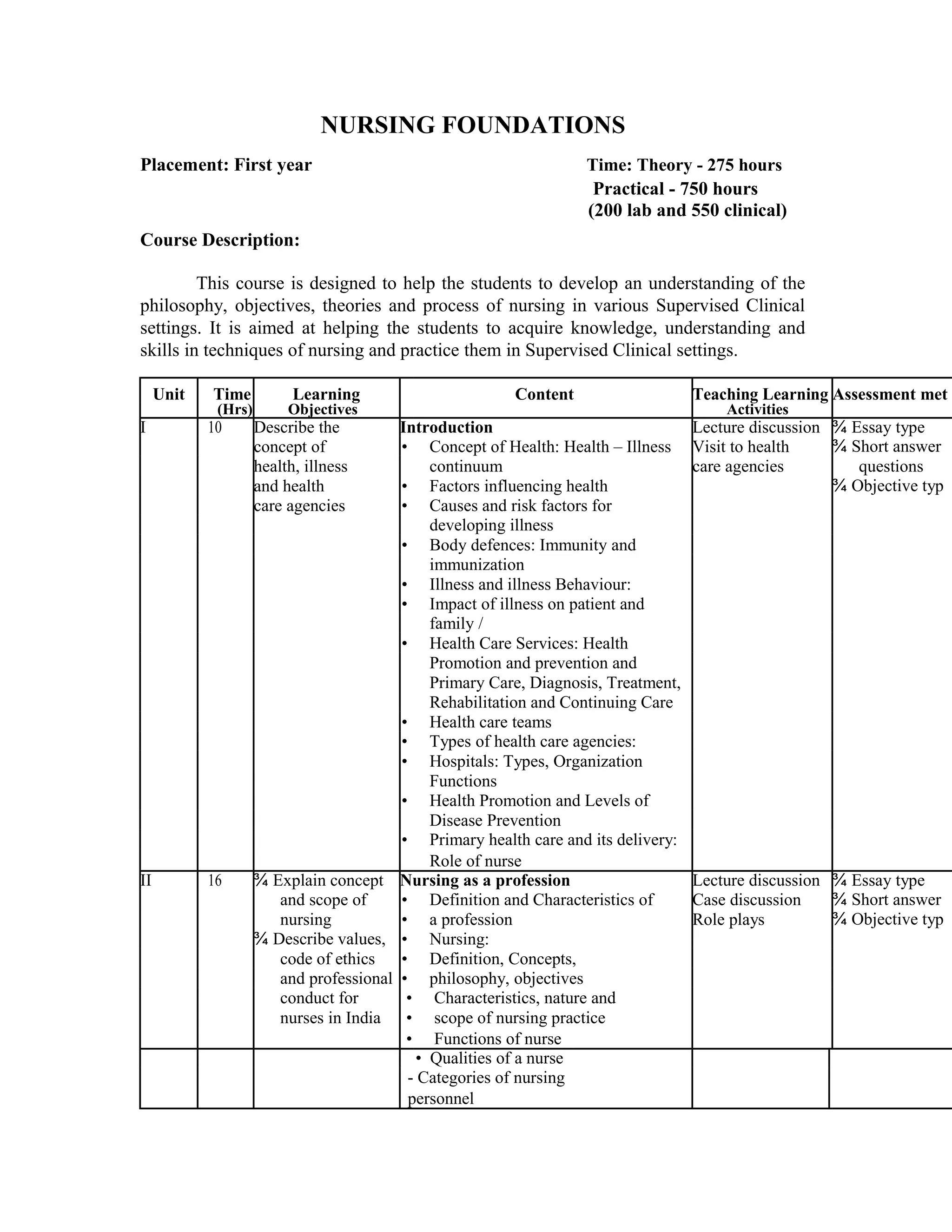
NURSING FOUNDATIONS
Placement: First year Time: Theory - 275 hours
Practical - 750 hours
(200 lab and 550 clinical)
Course Description:
This course is designed to help the students to develop an understanding of the
philosophy, objectives, theories and process of nursing in various Supervised Clinical
settings. It is aimed at helping the students to acquire knowledge, understanding and
skills in techniques of nursing and practice them in Supervised Clinical settings.
Unit Time Learning Content Teaching Learning Assessment met
(Hrs) Objectives Activities
I 10 Describe the Introduction Lecture discussion ¾ Essay type
concept of • Concept of Health: Health – Illness Visit to health ¾ Short answer
health, illness continuum care agencies questions
and health • Factors influencing health ¾ Objective typ
care agencies • Causes and risk factors for
developing illness
• Body defences: Immunity and
immunization
• Illness and illness Behaviour:
• Impact of illness on patient and
family /
• Health Care Services: Health
Promotion and prevention and
Primary Care, Diagnosis, Treatment,
Rehabilitation and Continuing Care
• Health care teams
• Types of health care agencies:
• Hospitals: Types, Organization
Functions
• Health Promotion and Levels of
Disease Prevention
• Primary health care and its delivery:
Role of nurse
II 16 ¾ Explain concept Nursing as a profession Lecture discussion ¾ Essay type
and scope of • Definition and Characteristics of Case discussion ¾ Short answer
nursing • a profession Role plays ¾ Objective typ
¾ Describe values, • Nursing:
code of ethics • Definition, Concepts,
and professional • philosophy, objectives
conduct for • Characteristics, nature and
nurses in India • scope of nursing practice
• Functions of nurse
• Qualities of a nurse
- Categories of nursing
personnel
Unit Time Learning Content Teaching Learning Assessment met
(Hrs) Objectives Activities
- Nursing as a Profession
- History of Nursing in India
Values: Definition, Types, Values
Clarification and values in professional
Nursing: Caring and Advocacy
Ethics:
- Definition and Ethical Principles
- Code of ethics and
professional conduct for
nurses
III 4 ¾ Explain the Hospital admission and Lecture Essay type
admission and discharge discussion Short answers
discharge • Admission to the hospital Demonstration Objective type
procedure - Unit and its preparation Lab Practice Assess skills wit
¾ Performs -admission bed Supervised check list
admission and - Admission procedure Clinical practice Clinical practical
discharge - Special considerations examination
procedure - Medico-legal issues
- Roles and Responsibilities of the
nurse
• Discharge from the hospital
- Types: Planned discharge,
LAMA and abscond, Referrals and
transfers
- Discharge Planning
- Discharge procedure
- Special considerations
- Medico--legal issues
- Roles and Responsibilities of the
nurse
- Care of the unit after discharge
IV 10 Communicate Communication and Nurse patient Lecture Essay type
effectively with relationship discussion Short answers
patient, families • Communication: Levels, Elements, Role play and Objective type
and team member Types, Modes, Process, Factors video film on the
and maintain influencing Communication nurses interacting
effective human - Methods of Effective Communication, with the patient
- Attending skills Practice session
on patient
Time Learning
Teaching
Assessment
Unit Content Learning
(Hrs) Objectives methods
Activities
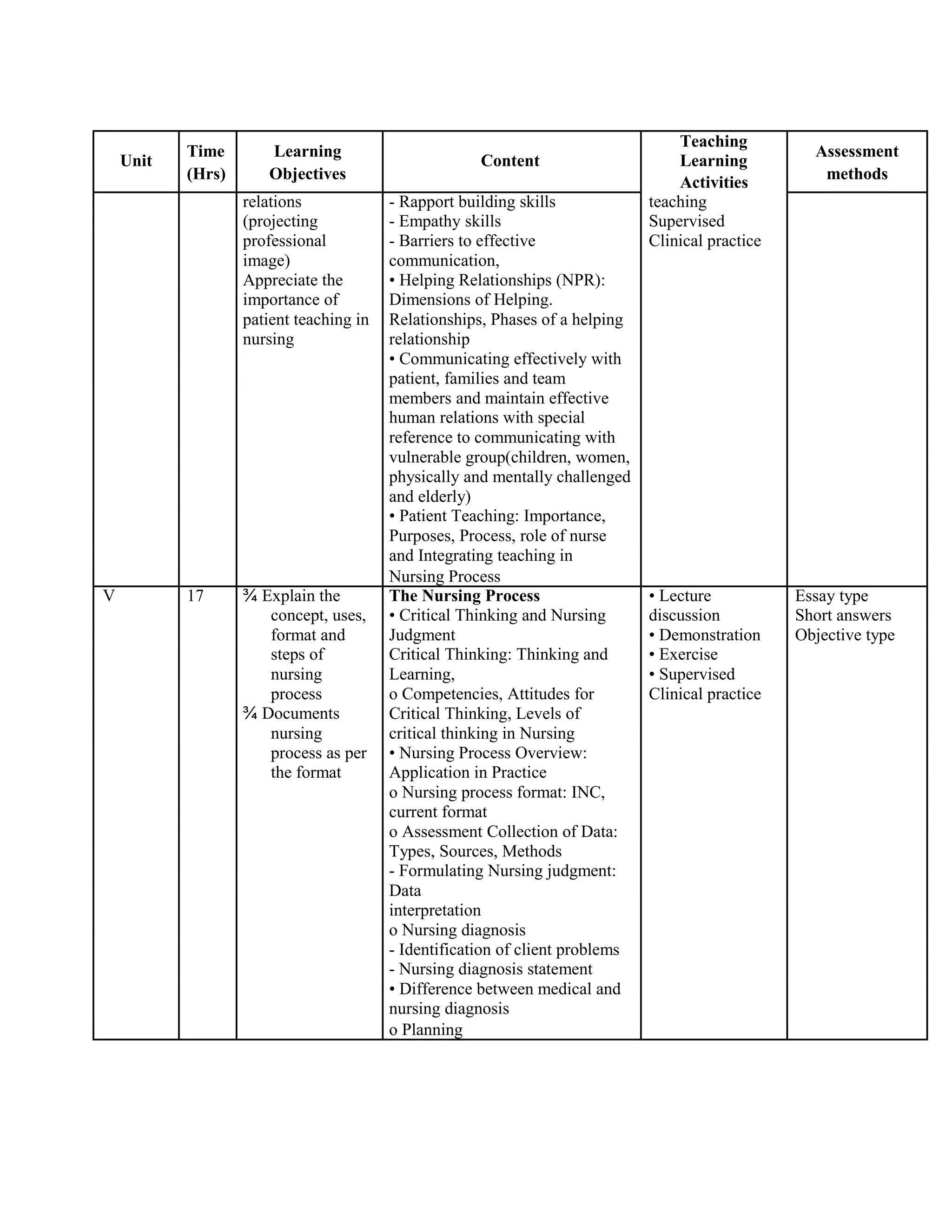
relations - Rapport building skills teaching
(projecting - Empathy skills Supervised
professional - Barriers to effective Clinical practice
image) communication,
Appreciate the • Helping Relationships (NPR):
importance of Dimensions of Helping.
patient teaching in Relationships, Phases of a helping
nursing relationship
• Communicating effectively with
patient, families and team
members and maintain effective
human relations with special
reference to communicating with
vulnerable group(children, women,
physically and mentally challenged
and elderly)
• Patient Teaching: Importance,
Purposes, Process, role of nurse
and Integrating teaching in
Nursing Process
V 17 ¾ Explain the The Nursing Process • Lecture Essay type
concept, uses, • Critical Thinking and Nursing discussion Short answers
format and Judgment • Demonstration Objective type
steps of Critical Thinking: Thinking and • Exercise
nursing Learning, • Supervised
process o Competencies, Attitudes for Clinical practice
¾ Documents Critical Thinking, Levels of
nursing critical thinking in Nursing
process as per • Nursing Process Overview:
the format Application in Practice
o Nursing process format: INC,
current format
o Assessment Collection of Data:
Types, Sources, Methods
- Formulating Nursing judgment:
Data
interpretation
o Nursing diagnosis
- Identification of client problems
- Nursing diagnosis statement
• Difference between medical and
nursing diagnosis
o Planning
Time Learning
Teaching
Assessment
Unit Content Learning(Hrs) Objectives methods
Activities
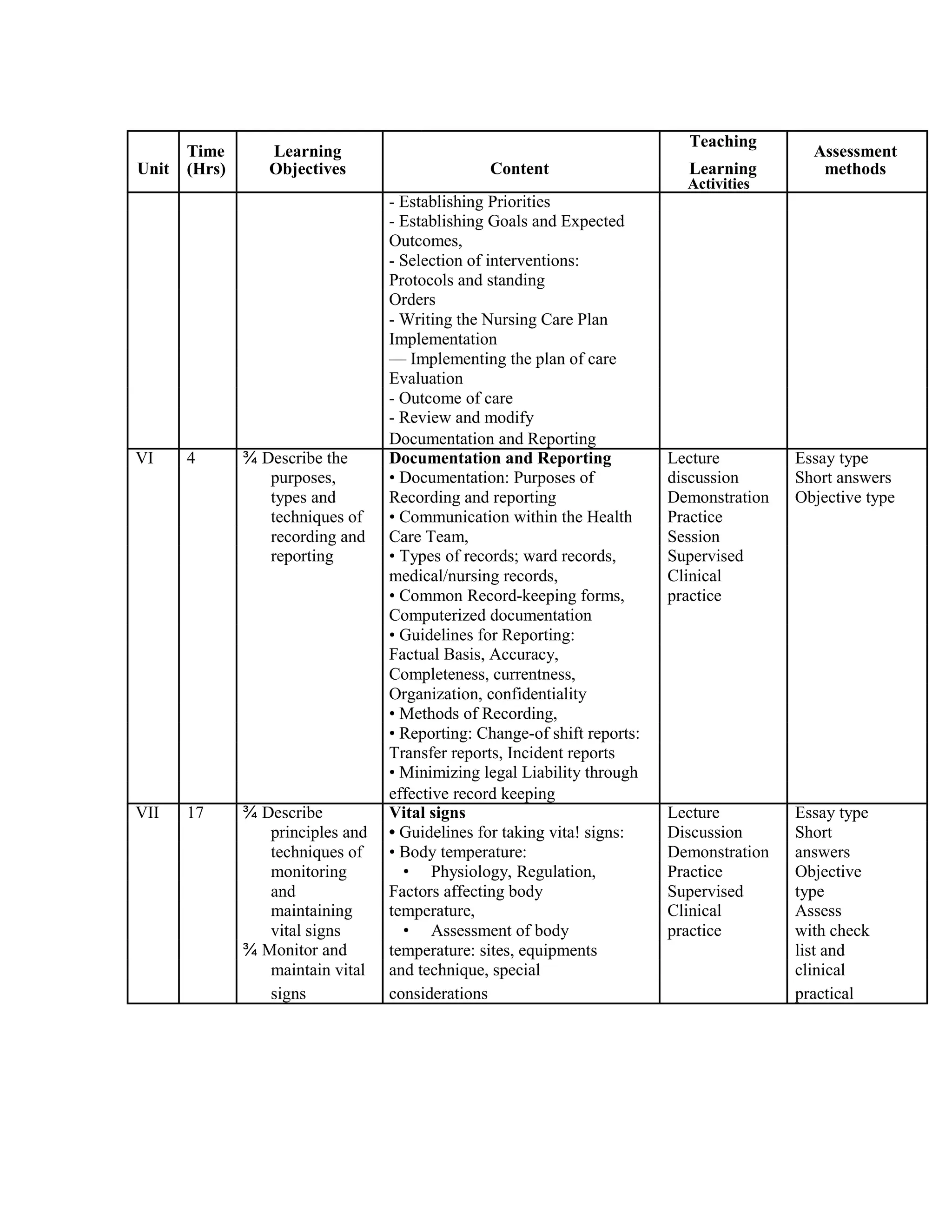
- Establishing Priorities
- Establishing Goals and Expected
Outcomes,
- Selection of interventions:
Protocols and standing
Orders
- Writing the Nursing Care Plan
Implementation
— Implementing the plan of care
Evaluation
- Outcome of care
- Review and modify
Documentation and Reporting
VI 4 ¾ Describe the Documentation and Reporting Lecture Essay type
purposes, • Documentation: Purposes of discussion Short answers
types and Recording and reporting Demonstration Objective type
techniques of • Communication within the Health Practice
recording and Care Team, Session
reporting • Types of records; ward records, Supervised
medical/nursing records, Clinical
• Common Record-keeping forms, practice
Computerized documentation
• Guidelines for Reporting:
Factual Basis, Accuracy,
Completeness, currentness,
Organization, confidentiality
• Methods of Recording,
• Reporting: Change-of shift reports:
Transfer reports, Incident reports
• Minimizing legal Liability through
effective record keeping
VII 17 ¾ Describe Vital signs Lecture Essay type
principles and • Guidelines for taking vita! signs: Discussion Short
techniques of • Body temperature: Demonstration answers
monitoring • Physiology, Regulation, Practice Objective
and Factors affecting body Supervised type
maintaining temperature, Clinical Assess
vital signs • Assessment of body practice with check
¾ Monitor and temperature: sites, equipments list and
maintain vital and technique, special clinical
signs considerations practical
Time Learning
Teaching
Assessment
Unit Content Learning(Hrs) Objectives methods
Activities
- Temperature alterations:
Heatstroke, Hypothermia
Hot and cold applications
Pulse:
- Physiology and Regulation,
Characteristics of the pulse,
Factors affecting pulse
- Assessment of pulse: sites,
location, equipments and
technique, special
considerations
- Alterations in pulse:
Respiration:
- Physiology and Regulation,
Mechanics of breathing
Characteristics of the respiration,
Factors affecting respiration
- Assessment of respirations:
technique, special considerations
- Alterations in respiration
Blood pressure:
- Physiology and Regulation,
Characteristics of the blood
pressure, Factors affecting blood
pressure
- Assessment of blood pressure:
sites, equipments and technique,
special
considerations
- Alterations in blood pressure
Recording of vital signs
VIII 30 ¾ Describe purpose Health assessment ¾ Lecture Essay type
and process of • Purposes discussion Short
health • Process of Health assessment ¾ Demonstration answers
assessment - Health history ¾ Practice on Objective
¾ Describe the - Physical examination: simulators Type
health - Methods- inspection, ¾ Supervised
assessment each Palpation, Percussion, Clinical
body system Auscultation, Olfaction practice
¾ Perform Preparation for examination:
health patient and unit.
assessment of General assessment
each body system Assessment of each body
System
Recording of health assessment.
IX 5 ¾ Identifies the Machinery, Equipment and ¾ Lecture ¾ Essay type
various linen discussion ¾ Short
Unit
Time Learning
Content
Teaching
Assessment
Learning(Hrs) Objectives methods
Activities
machinery, Types: Disposables and ¾ Demonstration answers
equipment and re-usables- Linen, rubber goods, ¾ Objective
linen and their glass ware, metal, plastics, type
care furniture, machinery
Introduction :
- Indent
- Maintenance
- Inventory
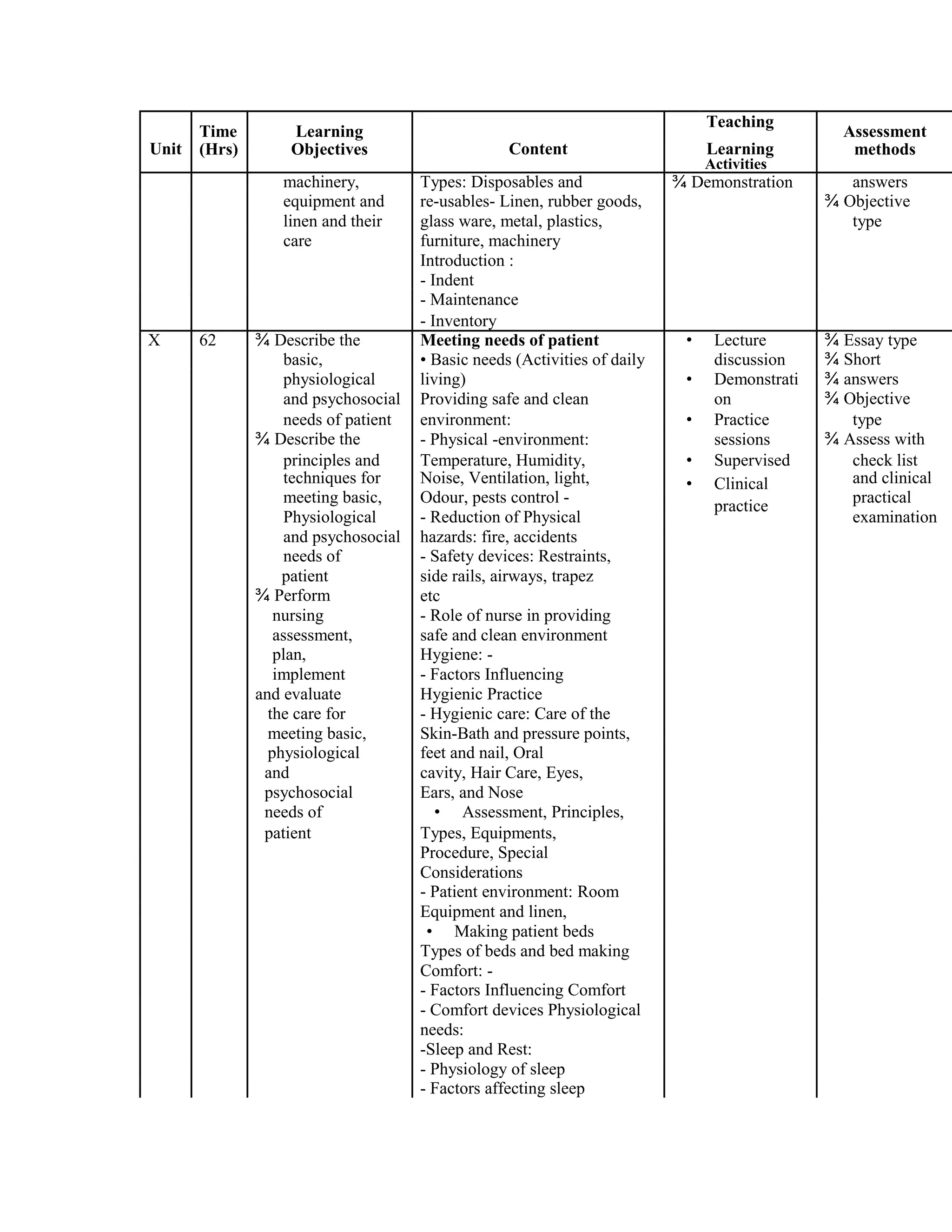
X 62 ¾ Describe the Meeting needs of patient • Lecture ¾ Essay type
basic, • Basic needs (Activities of daily discussion ¾ Short
physiological living) • Demonstrati ¾ answers
and psychosocial Providing safe and clean on ¾ Objective
needs of patient environment: • Practice type
¾ Describe the - Physical -environment: sessions ¾ Assess with
principles and Temperature, Humidity, • Supervised check list
techniques for Noise, Ventilation, light, • Clinical and clinical
meeting basic, Odour, pests control - practical
practice
Physiological - Reduction of Physical examination
and psychosocial hazards: fire, accidents
needs of - Safety devices: Restraints,
patient side rails, airways, trapez
¾ Perform etc
nursing - Role of nurse in providing
assessment, safe and clean environment
plan, Hygiene: -
implement - Factors Influencing
and evaluate Hygienic Practice
the care for - Hygienic care: Care of the
meeting basic, Skin-Bath and pressure points,
physiological feet and nail, Oral
and cavity, Hair Care, Eyes,
psychosocial Ears, and Nose
needs of • Assessment, Principles,
patient Types, Equipments,
Procedure, Special
Considerations
- Patient environment: Room
Equipment and linen,
• Making patient beds
Types of beds and bed making
Comfort: -
- Factors Influencing Comfort
- Comfort devices Physiological
needs:
-Sleep and Rest:
- Physiology of sleep
- Factors affecting sleep
- Promoting Rest and sleep
Time Learning
Teaching
Assessment
Unit Content Learning(Hrs) Objectives methods
Activities
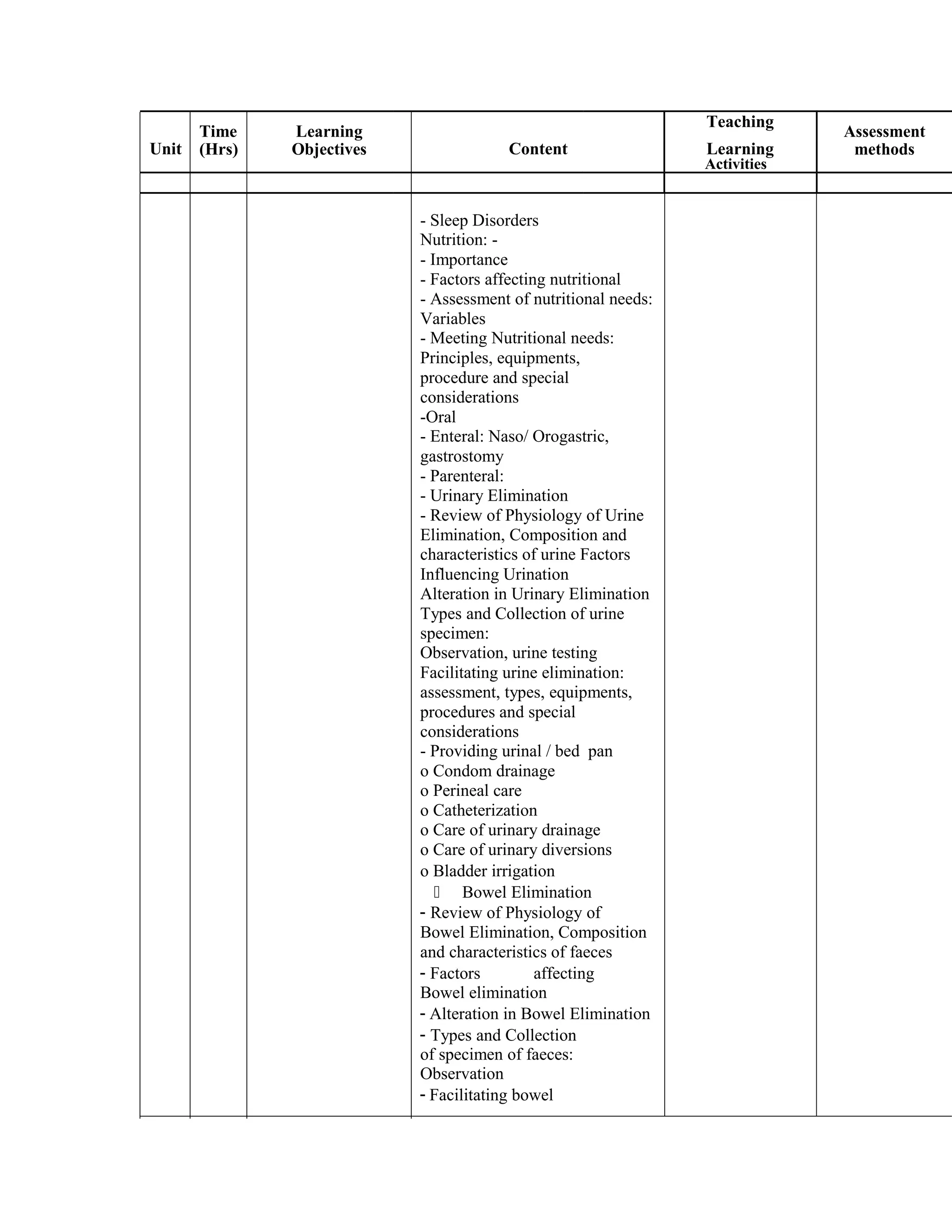
- Sleep Disorders
Nutrition: -
- Importance
- Factors affecting nutritional
- Assessment of nutritional needs:
Variables
- Meeting Nutritional needs:
Principles, equipments,
procedure and special
considerations
-Oral
- Enteral: Naso/ Orogastric,
gastrostomy
- Parenteral:
- Urinary Elimination
- Review of Physiology of Urine
Elimination, Composition and
characteristics of urine Factors
Influencing Urination
Alteration in Urinary Elimination
Types and Collection of urine
specimen:
Observation, urine testing
Facilitating urine elimination:
assessment, types, equipments,
procedures and special
considerations
- Providing urinal / bed pan
o Condom drainage
o Perineal care
o Catheterization
o Care of urinary drainage
o Care of urinary diversions
o Bladder irrigation
ƒ Bowel Elimination
- Review of Physiology of
Bowel Elimination, Composition
and characteristics of faeces
- Factors affecting
Bowel elimination
- Alteration in Bowel Elimination
- Types and Collection
of specimen of faeces:
Observation
- Facilitating bowel
elimination: assessment,
Time Learning
Teaching
Assessment
Unit Content Learning(Hrs) Objectives methods
Activities
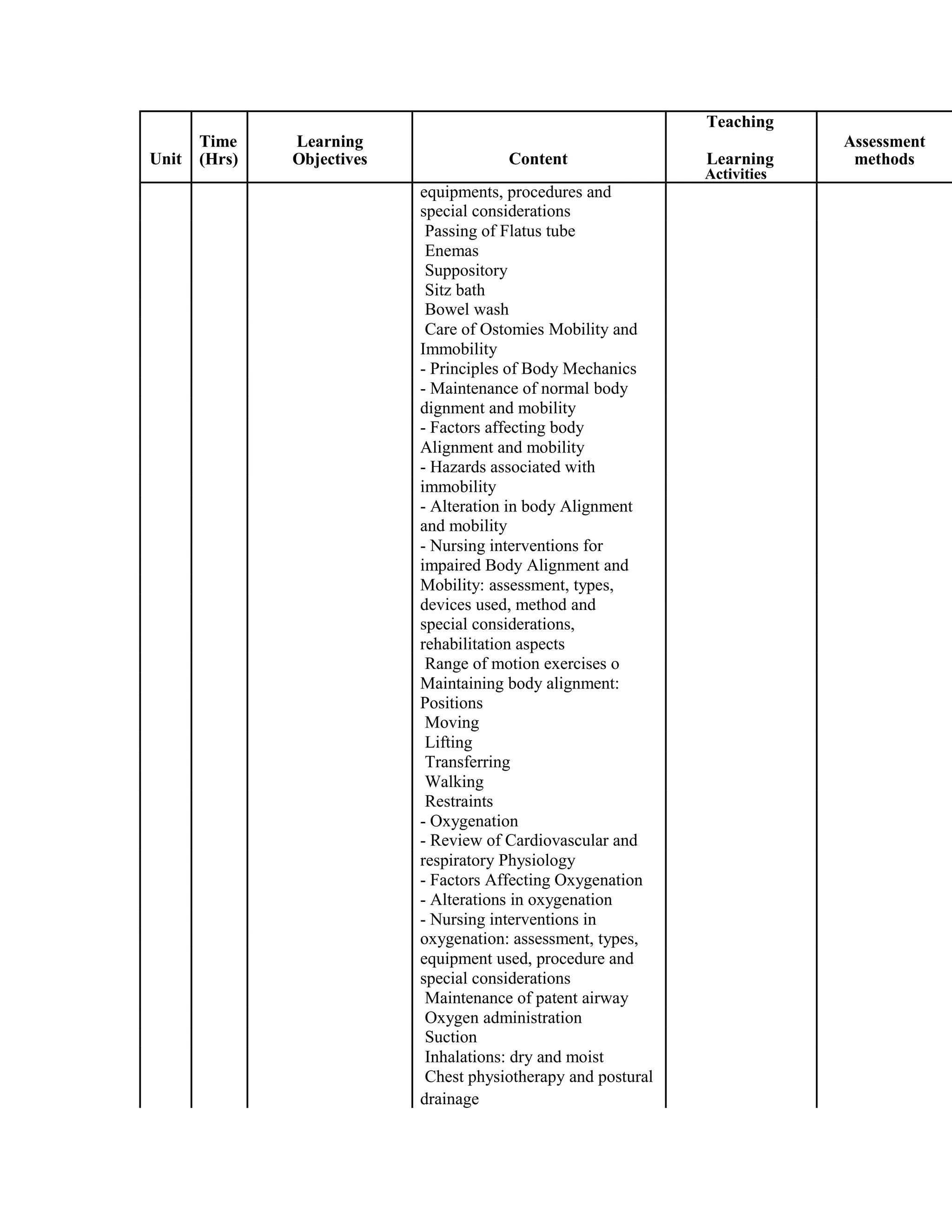
equipments, procedures and
special considerations
Passing of Flatus tube
Enemas
Suppository
Sitz bath
Bowel wash
Care of Ostomies Mobility and
Immobility
- Principles of Body Mechanics
- Maintenance of normal body
dignment and mobility
- Factors affecting body
Alignment and mobility
- Hazards associated with
immobility
- Alteration in body Alignment
and mobility
- Nursing interventions for
impaired Body Alignment and
Mobility: assessment, types,
devices used, method and
special considerations,
rehabilitation aspects
Range of motion exercises o
Maintaining body alignment:
Positions
Moving
Lifting
Transferring
Walking
Restraints
- Oxygenation
- Review of Cardiovascular and
respiratory Physiology
- Factors Affecting Oxygenation
- Alterations in oxygenation
- Nursing interventions in
oxygenation: assessment, types,
equipment used, procedure and
special considerations
Maintenance of patent airway
Oxygen administration
Suction
Inhalations: dry and moist
Chest physiotherapy and postural
drainage
Time Learning
Teaching
Assessment
Unit Content Learning(Hrs) Objectives methods
Activities
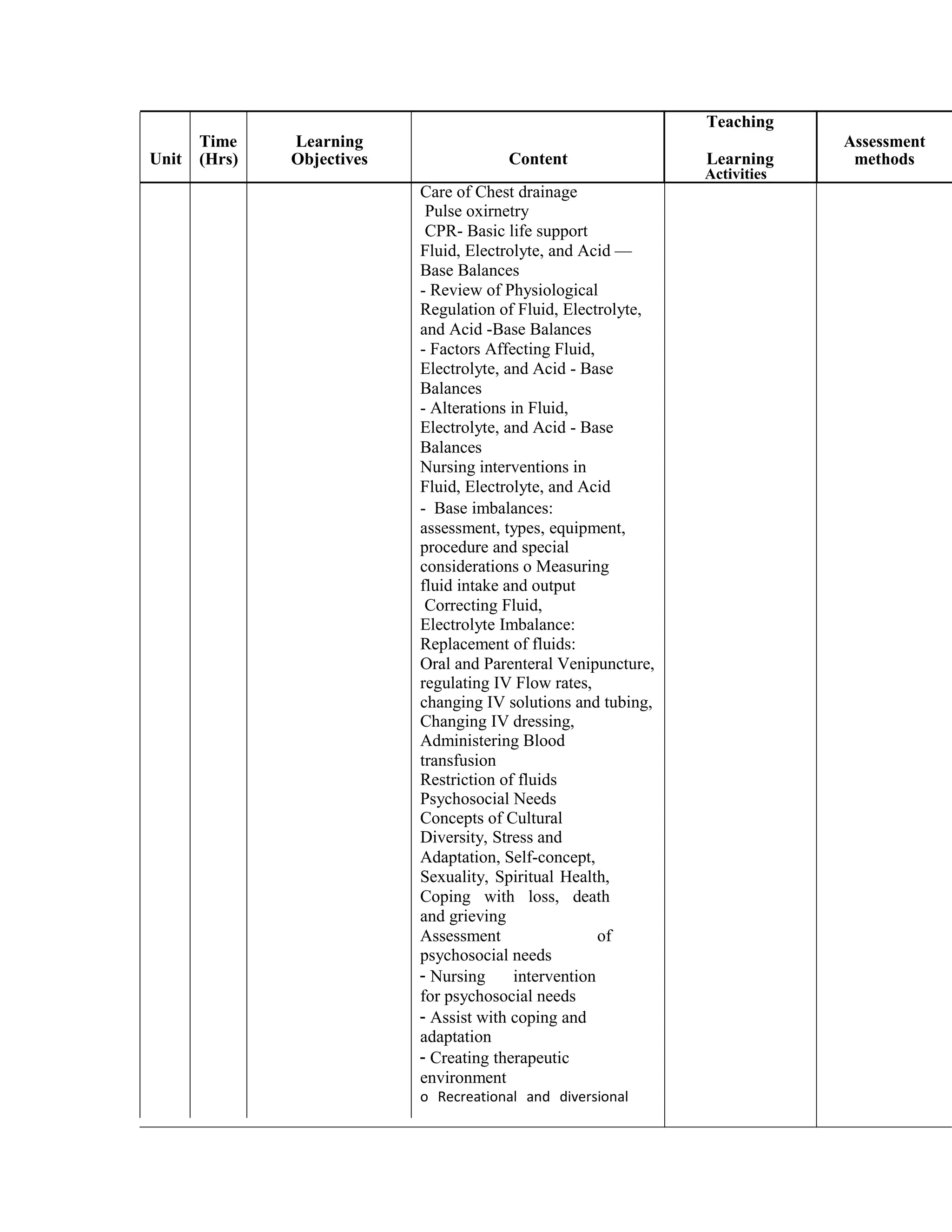
Care of Chest drainage
Pulse oxirnetry
CPR- Basic life support
Fluid, Electrolyte, and Acid —
Base Balances
- Review of Physiological
Regulation of Fluid, Electrolyte,
and Acid -Base Balances
- Factors Affecting Fluid,
Electrolyte, and Acid - Base
Balances
- Alterations in Fluid,
Electrolyte, and Acid - Base
Balances
Nursing interventions in
Fluid, Electrolyte, and Acid
- Base imbalances:
assessment, types, equipment,
procedure and special
considerations o Measuring
fluid intake and output
Correcting Fluid,
Electrolyte Imbalance:
Replacement of fluids:
Oral and Parenteral Venipuncture,
regulating IV Flow rates,
changing IV solutions and tubing,
Changing IV dressing,
Administering Blood
transfusion
Restriction of fluids
Psychosocial Needs
Concepts of Cultural
Diversity, Stress and
Adaptation, Self-concept,
Sexuality, Spiritual Health,
Coping with loss, death
and grieving
Assessment of
psychosocial needs
- Nursing intervention
for psychosocial needs
- Assist with coping and
adaptation
- Creating therapeutic
environment
o Recreational and diversional
therapies.
Time Learning
Teaching
Assessment
Unit Content Learning(Hrs) Objectives methods
Activities
XI 22 Describe Infection control in Clinical Lecture
principles and settings discussion
techniques for • Infection control Demonstration
infection Nature of infection Practice session
control and Chain of infection transmission Supervised Clinical
biomedical waste Defenses against infection: practice
management natural and acquired
in Supervised Hospital acquired infection
Clinical settings (Nosocomial infection)
• Concept of asepsis: medical
asepsis, and surgical asepsis
Isolation precautions (Barrier
nursing):
- Hand washing: simple, hand
antisepsis and surgical
antisepsis (scrub)
- Isolation: source and
protective
- Personal protecting equipments:
types, uses and technique of
wearing and removing
- Decontamination of equipment
and unit
- Transportation of infected
patients
- Standard safety precautions
(Universal precautions)
- Transmission based
precautions
• Biomedical waste management:
- Importance
- Types of hospital waste
- Hazards associated with hospital
waste
- Decontamination of hospital
waste
- Segregation and
Transportation and disposal
XII 42 Explain the Admintration of Medications: .Essay type
principles, routes, • General Short answers
effects of -Principles / consideration Objective type
administration of -Purposes of Medication Assess with
medications -Principles: 5 rights; special check list and
Calculate consideration; Presciptions; clinical practical
conversions of drugs Safety in Adminstering examination
and dosages within
Time Learning
Teaching
Assessment
Unit Content Learning(Hrs) Objectives methods
Activities
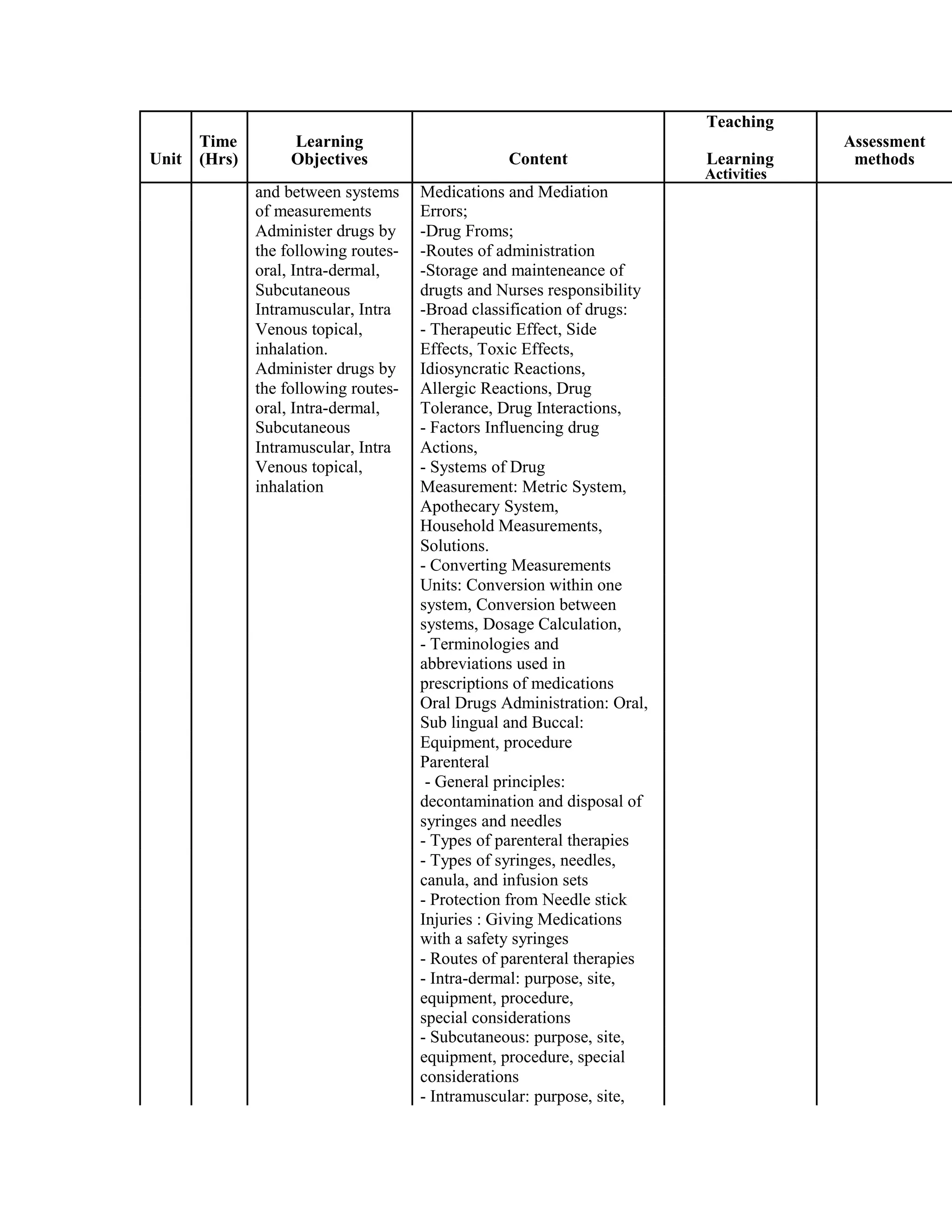
and between systems Medications and Mediation
of measurements Errors;
Administer drugs by -Drug Froms;
the following routes- -Routes of administration
oral, Intra-dermal, -Storage and mainteneance of
Subcutaneous drugts and Nurses responsibility
Intramuscular, Intra -Broad classification of drugs:
Venous topical, - Therapeutic Effect, Side
inhalation. Effects, Toxic Effects,
Administer drugs by Idiosyncratic Reactions,
the following routes- Allergic Reactions, Drug
oral, Intra-dermal, Tolerance, Drug Interactions,
Subcutaneous - Factors Influencing drug
Intramuscular, Intra Actions,
Venous topical, - Systems of Drug
inhalation Measurement: Metric System,
Apothecary System,
Household Measurements,
Solutions.
- Converting Measurements
Units: Conversion within one
system, Conversion between
systems, Dosage Calculation,
- Terminologies and
abbreviations used in
prescriptions of medications
Oral Drugs Administration: Oral,
Sub lingual and Buccal:
Equipment, procedure
Parenteral
- General principles:
decontamination and disposal of
syringes and needles
- Types of parenteral therapies
- Types of syringes, needles,
canula, and infusion sets
- Protection from Needle stick
Injuries : Giving Medications
with a safety syringes
- Routes of parenteral therapies
- Intra-dermal: purpose, site,
equipment, procedure,
special considerations
- Subcutaneous: purpose, site,
equipment, procedure, special
considerations
- Intramuscular: purpose, site,
equipment, procedure, special
Time Learning
Teaching
Assessment
Unit Content Learning(Hrs) Objectives methods
Activities
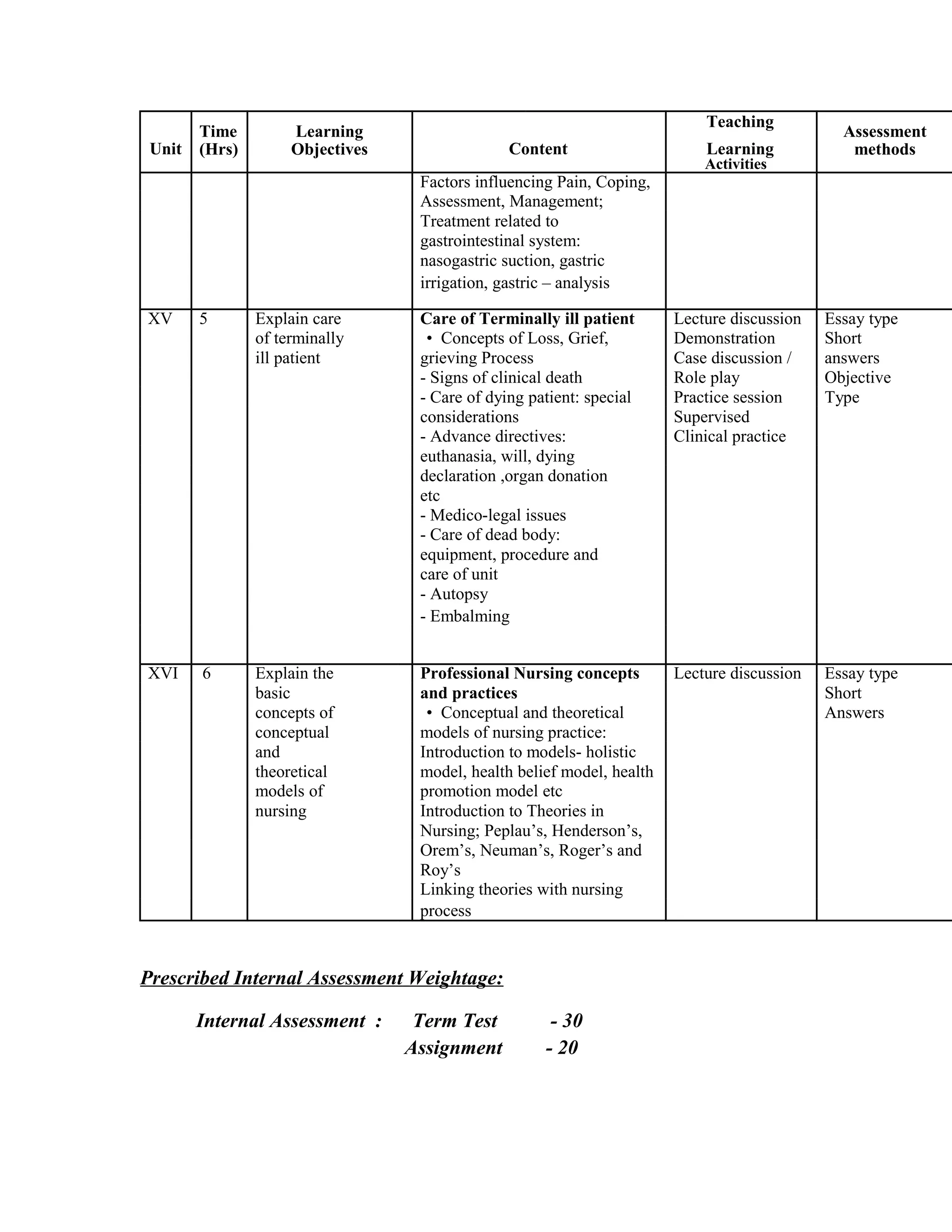
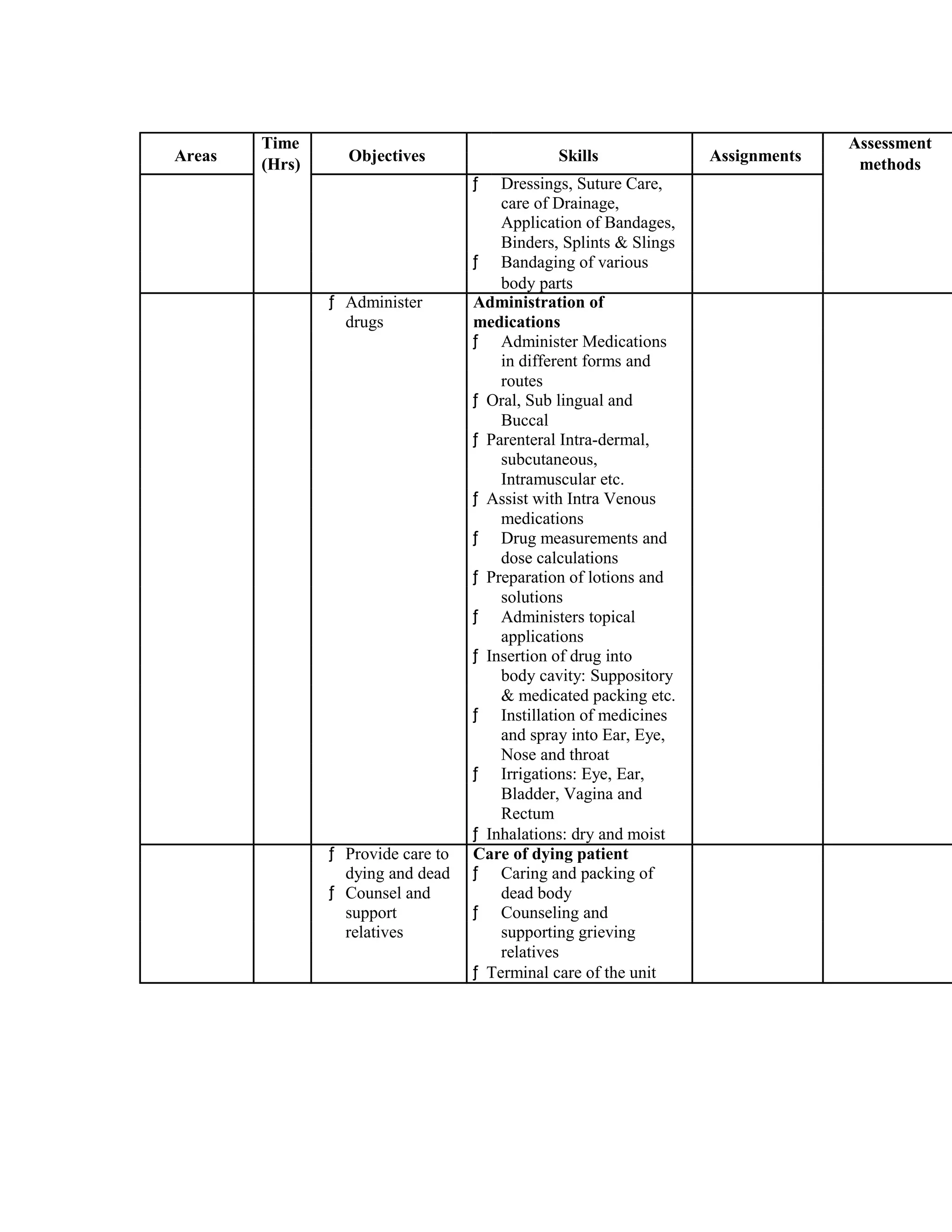
considerations
- Intra Venous: purpose,site,
equipment, procedure,
special considerations
- Advanced techniques:
epidural, intra-thecal,
intra-osseous, intra-peritonial,
intra-plural, intra-arterial-
Role of nurse
Topical Administration:
purposes, site, equipment,
procedure, special considerations
for
Application to Skin
Application to mucous
membrane
- Direct application of
liquids-Gargle and
swabbing the throat
- Insertion of Drug into
body cavity: Suppository,
medicated packing in
rectum/vagina
- Instillations:, Ear, Eye,
Nasal, Bladder, and
Rectal
- Irrigations: Eye, Ear,
Bladder, Vaginal and
Rectal
- Spraying: Nose and throat
Inhalation: Nasal, oral,
endotracheal (steam,
oxygen and medications)
purposes, types, equipment,
procedure, special considerations
- Recording and reporting of
medications administered
XIII 10 Describe the Meeting needs of Peri operative Lecture Essay type
pre and post patients discussion Short
operative care • Definition and concept of Demonstration answers
of patients Peri operative Nursing Practice session Objective
Explain the Preoperative Phase Supervised type
process of - Preparation of patient for Clinical practice Assess
wound surgery with check
healing Intra-operative list and
Explain the Operation theatre Set up and clinical
principles and environment practical
Time Learning
Teaching
Assessment
Unit Content Learning(Hrs) Objectives methods
Activities
techniques of - Role of nurse examination
care Postoperative Phase
Perform care - Recovery unit
of wounds - Post operative unit
- Postoperative care,
Wounds: types, Classifications,
wound Healing Process, Factors
affecting Wound, Complications
of Wound Healing
Surgical asepsis
Care of the wound: types,
equipments, procedure and
special considerations
- Dressings, Suture Care,
- Care of Drainage
- Application of Bandages,
Binders, Splints & Slings
- Heat and Cold Therapy
XIV 15 Explain care Meeting special needs of the Lecture Essay type
of patients patient discussion Short
having • Care of patients having Case discussions answers
alterations in alteration in: Supervised Objective
body - Temperature (hyper and clinical practice Type
functioning hypothermia); Types,
Assessment, Management
- Sensorium (Unconsciousness);
Assessment, Management
- Urinary Elimination (retention
and incontinence);
Assessment, Management
- Functioning of sensory organs:
( Visual &hearing impairment)
- Assessment of Self-Care ability
- Communication Methods and
special considerations
- Mobility (physically challenged,
cast), assessment
of Self-Care ability:
Communication Methods and
special considerations
- Mental state (mentally
challenged), assessment of Self-
Care ability;
- Communication Methods and
special considerations
- Respiration (distress); Types,
Assessment, Management
Comfort - (Pain) - Nature, Types,
Time Learning
Teaching
Assessment
Unit Content Learning(Hrs) Objectives methods
Activities
Factors influencing Pain, Coping,
Assessment, Management;
Treatment related to
gastrointestinal system:
nasogastric suction, gastric
irrigation, gastric – analysis
XV 5 Explain care Care of Terminally ill patient Lecture discussion Essay type
of terminally • Concepts of Loss, Grief, Demonstration Short
ill patient grieving Process Case discussion / answers
- Signs of clinical death Role play Objective
- Care of dying patient: special Practice session Type
considerations Supervised
- Advance directives: Clinical practice
euthanasia, will, dying
declaration ,organ donation
etc
- Medico-legal issues
- Care of dead body:
equipment, procedure and
care of unit
- Autopsy
- Embalming
XVI 6 Explain the Professional Nursing concepts Lecture discussion Essay type
basic and practices Short
concepts of • Conceptual and theoretical Answers
conceptual models of nursing practice:
and Introduction to models- holistic
theoretical model, health belief model, health
models of promotion model etc
nursing Introduction to Theories in
Nursing; Peplau’s, Henderson’s,
Orem’s, Neuman’s, Roger’s and
Roy’s
Linking theories with nursing
process
Prescribed Internal Assessment Weightage:
Internal Assessment : Term Test - 30
Assignment - 20
Fundamentals of Nursing
Recommended Books:
1. Taylor – Fundamentals of Nursing, 2007, LWW
2. Kozier – Fundamentals of Nursing ,2007,Pearson
3. Potter – Basic Nursing ,2008,Elsevier
4. Lynn – Taylor’s Clinical Nursing Skills,2008,LWW
Reference Books:
1. Craven – Fundamentals of Nursing ,2010,LWW
2. Potter – Fundamentals of Nursing ,2009,Elsevier’s
3. St John’s Ambulance – First AID, 2007,St John’s Ambulance Association.
4. LWW – Lippincott’s Nursing Procedure, 2008, LWW.
5. Jacob – Clinical Nursing Skills & Procedures ,2008,Jaypee
6. Carpenito – Understanding Nursing Process,2007,LWW
NURSING FOUNDATIONS- PRACTICAL
Placement: First year Time: Practical -
750 hours
(200 lab and 550
clinical)
Course Description:
This course is designed to help the students to develop an understanding the
philosophy, objectives, theories and process of nursing in various clinical settings. It is
aimed helping the students to acquire knowledge, understanding and skills techniques of
nursing and practice them in clinical settings.
Areas
Time
Objectives Skills Assignments
Assessment
(Hrs) methods
Demonstration 200 Performs Hospital admission and Practice in Unit Evaluate with
Lab General 550 admission and discharge (III) Hospital checklist
Medical and Minimum discharge • Admission Write nursing Assessment of
surgery ward practice procedure • Prepare Unit for new process records clinical
time in patient of patient performance with
clinical • Prepare admission bed Simulated - rating scale
area • Performs admission Actual - Completion of
procedure Practical record
• New patient Assessment of
• Transfer in Prepare nursing process
patient records records with
• Discharge/Transfer checklist
out Assessment of
• Gives discharge actual care given
counseling with rating scale
• Perform discharge
procedure (Planned
discharge, LAMA and
abscond, Referrals and
transfers)
• Prepare records of
discharge/transfer
• Dismantle, and
disinfect unit and
equipment after
• discharge/transfer
Prepares nursing Perform assessment:
care plan as per • History taking, Nursing
the nursing diagnosis, problem list,
process format Prioritization, Goals &
Expected Outcomes,
selection of interventions
• Write Nursing Care Plan
Areas
Time
Objectives Skills Assignments
Assessment
(Hrs) methods
• Gives care as per the plan
Communicate Communication Role-plays in Assess role plays
effectively with Use verbal and non verbal simulated with the check-
patient, and team communication techniques situations on list on comm.-
members and Prepare a plan for communi- unication
Maintain patient teaching session cation techniques
effective human
Write patient report
techniques-I Assess health talk
relations Healthtalk-I with the checklist
Develops plan Change-of shift reports Assess-ment of
for patient Transfer reports comm-unication
teaching Incident reports etc. tech-niques by
Presents patient report rating scale
Assess-ment of
Prepare patient Write nurses
perfor -mance
with rating scale
reports notes and
Presents reports present the
patient report
of 2-3 assigned
patient
Monitor vital Vital signs Lab practice Assessment of
signs • Measure, Records and Measure Vital each skill with
interpret alterations in signs of checklist
body temperature, pulse assigned Completion of
respiration and blood patient activity record
pressure
Perform health Health assessment
assessment of 6. Health history
each body taking
system 7. Perform
assessment:
- General
- Body systems
8. Use various
methods of
physical
examination
9. Inspection,
Palpation,
10. Percussion,
Auscultation,
11. Olfaction
12. Identification
of system wise
deviations
Provide basic Prepare Patient’s unit: Practice in lab Assessment of
nursing care to ƒ Prepare beds: & hospital each skill with
Areas
Time
Objectives Skills Assignments
Assessment
(Hrs) methods
patients ƒ Open, closed, Simulated rating scale
occupied, exercise on Completion of
ƒ Operation, CPR manikin activity record
amputation,
ƒ Cardiac, fracture,
burn, divided &
Fowlers bed
ƒ Pain assessment and
provision for comfort
Use comfort devices
Hygienic care:
ƒ Oral hygiene:
ƒ Baths and care of
pressure points
ƒ Hair wash,
Pediculosis treatment
Feeding:
ƒ Oral, Enteral, Naso /
Orogastric,
gastrostomy and
Parenteral feeding
ƒ Naso-gastric insertion,
suction, and irrigation
Assisting patient in
urinary elimination
ƒ Provides urinal/bed
pan
ƒ Condom drainage
ƒ Perineal care
ƒ Catheterization
ƒ Care of urinary
drainage
Bladder irrigation
Assisting bowel
Elimination:
ƒ Insertion of Flatus
tube
ƒ Enemas
ƒ Insertion of
Suppository
Bowel wash
Body Alignment and
Mobility:
ƒ Range of motion
exercises
ƒ Positioning:
Recumbent, Lateral
(rt/It), Fowlers, Sims,
Lithotomy, Prone,
Areas
Time
Objectives Skills Assignments
Assessment
(Hrs) methods
Trendelenburg
position
Areas
Time
Objectives Skills Assignments
Assessment
(Hrs) methods
ƒ Assist patient in Moving,
lifting, transferring,
walking
ƒ Restraints
Oxygen administration
Suctioning: oropharyngeal,
nasopharyngeal
Chest physiotherapy and
postural drainage
Care of Chest drainage
CPR- Basic life support
Intravenous therapy
Blood and blood component
therapy
Collect/assist for collection
of specimens for
investigations Urine,
sputum, faeces, vomitus,
blood and other body fluids
Perform lab tests:
ƒ Urine: sugar, -albumin,
acetone
ƒ Blood: sugar (with strip
glucometer)
Hot and cold applications:
local and general Sitz bath
Communicating and
assisting with self-care of
visually & hearing impaired
patients
Communicating and
assisting with self-care of
mentally
challenged/disturbed
patients
Areas
Time
Objectives Skills Assignments
Assessme
(Hrs) methods
Recreational and diversional
therapies
Caring of patient with
alteration in sensorium
Perform Infection control Observation Assess
infection Perform following procedures: study -2 observation
control ƒ Hand washing techniques Department of study with
procedures ƒ (Simple, hand antisepsis and Infection checklist
surgical antisepsis (scrub) control & Evaluate
ƒ Prepare isolation unit in CSSD all
lab/ward Visits CSSD procedures
ƒ Practice technique of write with checkli
wearing and removing observation
Personal protective report
equipment (PPE) Collection of
ƒ Practice Standard safety samples for
precautions (Universal culture
precautions) Do clinical
posting in
infection
Decontamination of equipment control
and unit: - department
Surgical asepsis: and write
ƒ Sterilization report
ƒ Handling sterilized Practice in
equipment lab/ward
ƒ Calculate strengths of lotions,
ƒ Prepare lotions
ƒ Care of articles
Provide Pre and post operative care:
care to pre ƒ Skin preparations for surgery:
and post Local
operative patients ƒ Preparation of Post operative
Perform unit
procedures ƒ Pre & post operative teaching
for care of and counseling
wounds ƒ Pre and post operative
monitoring
ƒ Care of the wound
Areas
Time
Objectives Skills Assignments
Assessment
(Hrs) methods
ƒ Dressings, Suture Care,
care of Drainage,
Application of Bandages,
Binders, Splints & Slings
ƒ Bandaging of various
body parts
ƒ Administer Administration of
drugs medications
ƒ Administer Medications
in different forms and
routes
ƒ Oral, Sub lingual and
Buccal
ƒ Parenteral Intra-dermal,
subcutaneous,
Intramuscular etc.
ƒ Assist with Intra Venous
medications
ƒ Drug measurements and
dose calculations
ƒ Preparation of lotions and
solutions
ƒ Administers topical
applications
ƒ Insertion of drug into
body cavity: Suppository
& medicated packing etc.
ƒ Instillation of medicines
and spray into Ear, Eye,
Nose and throat
ƒ Irrigations: Eye, Ear,
Bladder, Vagina and
Rectum
ƒ Inhalations: dry and moist
ƒ Provide care to Care of dying patient
dying and dead ƒ Caring and packing of
ƒ Counsel and dead body
support ƒ Counseling and
relatives supporting grieving
relatives
ƒ Terminal care of the unit
Prescribed Internal Assessment Weightage:
NURSING FOUNDATIONS – PRACTICAL
Internal Assessment : Practical Examination - 25
Clinical Evaluation -10
Procedural Demonstration - 5
Practical Record - 5
Observational Study - 5
PSYCHOLOGY
Placement: First year Time: Theory - 80 hours Course Description:
This course is designed to assist the students to acquire knowledge of
fundamentals of psychology and develop an insight into behaviour of self and others.
Further it is aimed at helping them to practice the principles of mental hygiene for
promoting mental health in nursing practice.
Time Learning
Teaching
Assessment
Unit Content Learning(Hrs) Objectives methods
Activities
I 2 Describe the Introduction Lecture Essay type
history, scope and • History and origin of science of discussion Short answer
methods of psychology
psychology • Definitions & Scope of Psychology
• Relevance to nursing
• Methods of Psychology
II 7 ¾ Explain the Biology of behaviour Lecture ¾ Essay type
biology of • Body mind relationship- modulation discussion ¾ Short answers
Human process in health and illness
behaviour • Genetics and behaviour:
Heredity and environment
• Brain and behaviour: Nervous
System,, Neurons and synapse,
• Association Cortex, Rt and Lt
Hemispheres
• Psychology of Sensations
• Muscular and glandular controls of
behaviour
• Nature of behaviour of an
organism/Integrated_responses
III 24 ¾ Describe Cognitive processes Lecture Essay type
various • Attention: Types, determinants, Discussion Short answers
cognitive Duration & degree, alterations
processes and • Perception: Meaning, Principles, Psychometric
their factors affecting, Errors, assessment:
applications • Learning: Nature, Types, learner and Practice
learning, Factors influencing, laws and sessions
theories, process, transfer, study habits
• Memory: Meaning, Types, Nature
Factors influencing, Development
Theories and methods of memorizing
and Forgetting
Thinking: Types and levels, stages of
development, Relationship with
Time Learning
Teaching
Assessment
Unit Content Learning(Hrs) Objectives methods
Activities
language and communication
Intelligence: Meaning, classification, uses,
theories
Aptitude: Concept, types, Individual
differences and variability
Psychometric assessments of cognitive
processes
Alterations in cognitive processes
Applications
IV 12 ¾ Describe Motivation and Emotional Lecture Essay type
motivation, Processes: Discussion Short answers
emotions, • Motivation: Meaning, Concepts, Types, Role plays
stress, attitudes Theories, Motives and behaviour, Case Discussion
and their Conflicts and frustration, conflict Demonstration
influence on resolution
behaviour • Emotions & stress Emotion: Definition,
components, Changes in emotions,
theories emotional adjustments, emotions
in health and illness
Stress: stressors, cycle, effect, adaptation
& coping
• Attitude: Meaning, nature,
development, factors affecting,
Behaviour and attitudes
Attitudinal change
• Psychometric assessments of emotions
and attitudes
• Alterations in emotions
Applications
V 9 Explain the Personality Lecture Essay type
concepts of Definitions, topography, types, Theories discussion Short answers
personality and its Psychometric assessments of personality Demonstration
influence on Alterations in personality
behaviour Applications
VI 9 Describe Developmental Psychology Lecture Essay type
psychology of • Psychology of people at different ages Discussion Short answers
people during the from infancy to old age Case Discussion
life cycle • Psychology of vulnerable individuals-
challenged, women, sick, etc
Psychology of groups
VII 11 Describe the Mental hygiene and mental Health Lecture Essay type
characteristics of • Concepts of mental hygiene and mental Discussion Short answers
Mentally healthy health Case Discussion
Person • Characteristics of mentally healthy Role play
Explain ego defence
person Demonstration
• Warning signs of poor mental health
mechanisms • Promotive and Preventive mental health-
Time Learning
Teaching
Assessment
Unit Content Learning(Hrs) Objectives methods
Activities
strategies and services
• Ego Defence mechanisms and
implications
• Personal and social adjustments
• Guidance and counseling
• Role of nurse
VIII 6 Explain the Psychological assessment & tests Lecture Assessment
Psychological • Types, development, Characteristics, Discussion of practice
assessments and Principles, Uses, Interpretations and Role Demonstration
role of nurse of nurse in psychological assessment Practice sessions
Prescribed Internal Assessment Weightage:
Internal Assessment : Term Test - 30
Assignment - 20
MICROBIOLOGY
Placement: First year Time: Theory - 80hours (Theory 60+ 20 lab)
Course Description:
This course is designed to enable students to acquire understanding of
fundamentals of Microbiology and identification of various micro-organisms. It also
provides opportunities for practicing infection control measures in hospital and
community settings.
Time
Learning Teaching Learning Assessment
Unit (Hrs) Content
Objectives Activities methods
T P
I 5 Explain concepts Introduction: Lecture Discussion Short answer
and principles of • Importance and relevance questions
microbiology and to nursing Objective type
their Importance • Historical perspective
nursing • Concepts and terminology
• • Principles of
microbiology
II 14 7 Describe structure, General characteristics of Lecture Discussion Short answer
classification Microbes Demonstration questions
morphology and • Structure and classification Objective type
growth of bacteria of Microbes
Identify Micro- • Morphological types
organisms • Size and form of bacteria
• Motility
• Colonization
• Growth and nutrition of
• microbes
• Temperature
• Moisture
• Blood and body fluids
• Laboratory methods for
Identification of
•
Microorganisms
Staining techniques, Gram
staining, Acid fast staining,
•
Hanging drop preparation
Culture; various medias
Time
Learning
Content
Teaching Learning Assessment
Unit (Hrs)
Objectives Activities methods
T P
III 14 2 Describe the Infection control Lecture Discussion Short answers
methods of • Infection: Sources, portals of Demonstration Objective type
infection control entry and exit, transmission Visits to CSSD
Identify the role of • Asepsis Clinical practice
nurse in hospital • Disinfection; Types and
infection methods
control • Sterilization; Types and
programme Methods
Chemotherapy and antibiotics
• Standard safety measures
• Biomedical waste
management
• Role of Nurse
• Hospital acquired infection
• Hospital infection control
programme
Protocols, collection of
samples, preparation of
report and status of rate of
infection in the unit/hospital,
nurse’s accountability,
continuing education etc.
IV 16 6 Describe the Pathogenic organisms Lecture Discussion Short answer
different disease • Micro-organisms Demonstration questions
producing - Cocci — gram positive and Objective type
organisms gram negative
bacilli— gram positive and
gram negative
Spirochaete
Mycoplasma
Rickettsiae
Chlamydiae
• Viruses -
• Fungi -Superficial and Deep
mycoses
• Parasites
• Rodents & vectors
Characteristics, Source, portal
of entry, transmission of
infection
Identification of disease
producing micro-organisms
Collection, handling and
transportation of various
specimens
V 11 5 Explain the Immunity Lecture Short answers
Time
Learning
Content
Teaching Learning Assessment
Unit (Hrs)
Objectives Activities methods
T P
concept of • Immunity-Types, Discussion Objective type
immunity, hyper classification Demonstration
sensitivity and • Antigen and antibody reaction Clinical practice
immunization • Hypersensitivity — skin test
• Serological tests
• Immunoprophylaxis
Vaccines & sera -Types &
Classification, storage and
handling, cold chain
Immunization for various
diseases
-Immunization Schedule
Prescribed Internal Assessment Weightage:
MICROBIOLOGY
Internal Assessment : Term Test - 30
Assignment - 20
INTRODUCTION TO COMPUTERS
Placement: First year Time: Theory - 55 hours Practical – 20hours
Course Description:
This course is designed for students to develop basic understanding of uses of
computer and its applications in nursing.
Time
Learning Teaching Learning Assessment
Unit (Hrs) Content
Objectives Activities methods
T P
I 5 Identify & define Introduction: Lecture Discussion Short answers
various concepts • Concepts of Computers Demonstration Objective type
used in computer • Hardware and software;
identify trends and technology
application of • Application of computers
computer in in nursing
nursing
II 15 10 Describe and Use • Introduction to disk- Lecture Discussion Short answer
the Disk Operating operating system Demonstration questions
System DOS Practice Session Objective type
Demonstrate skill in c Windows (all version) Practical Exam
the use of MS • Introduction u MS-Word
Office MS-Excel with pictorial
presentation
MS-Access
MS-Power point
III 10 3 Demonstrate skill in Multimedia; types & uses Lecture Discussion Short answers
using multi-media Computer aided teaching Demonstration Objective type
Identify features of & testing. Practical Exam
computer aided and Viva Voce
teaching and testing
IV 5 3 Demonstrate use of Use of Internet and: Lecture Discussion Short answers
internet and Email e-mail Demonstration Objective type
Practice Session Practical Exam
and Viva Voce
V 10 2 Describe and use Statistical packages: types Lecture Discussion Short answers
the statistical and their features Demonstration Objective type
packages Practice Session Practical Exam
and Viva Voce
VI 10 2 Describe the use of Hospital Management Lecture Discussion Short answer
Hospital System: Types and uses Demonstration questions
.Management Objective type
System Practical Exam
and Viva Voce
INTRODUCTION TO COMPUTERS 100 marks
Internal Examination : 100
References
1.N.K.Anand & Shikha Goel ,Computers for Nurses, A.I.T.B.S. Publishers ,India.2009.
2. Thacker N Computers for Nurses, India. 2009
SOCIOLOGY
Placement: Second year Theory- 80 Hours Course Description:
This course is designed to introduce the concepts of sociology related to
community and social institutions in India and its relationship with health, illness and
nursing.
Uni Time Learning
Content
Teaching Learning Assessment
t (Hrs) Objectives Activities methods
I 1 ¾ State the Introduction ¾ Lecture ¾ Essay type
importance ¾ Definition of Sociology Discussion ¾ Short
of sociology ¾ Nature and Scope of answers
in Nursing the discipline
¾ Importance and
application of
Sociology in Nursing
II 3 ¾ Describe the Individual & Society ¾ Lecture ¾ Essay type
inter- ¾ Society and Discussion ¾ Short
relationship Community answers
of individual ¾ Nature of Society
in society ¾ Difference between
and Society and
community Community
¾ Process of
Socialization and
individualization
¾ Personal
disorganization
III 5 ¾ Describe the Culture Lecture Discussion Essay type
influence of • Nature of culture Panel Discussion Short answers
culture and • Evolution of culture
on health and • Diversity and uniformity
disease of culture
• Culture and socialization
• Transcultural society
• Influence on health and
disease
IV 6 ¾ Identify Social groups and Lecture Essay type
various Processes Discussion Short answers
social groups The meaning and
and their classification of groups
interactions Primary & Secondary
Uni Time Learning
Content
Teaching Learning Assessment
t (Hrs) Objectives Activities methods
Group
In-group V/s. Out-group,
Class Tribe, Caste
Economic, Political,
Religious groups, Mob,
Crowd, Public and
Audience Interaction &
Social Processes
Co-operation, Competition,
Conflict
Accommodation,
Assimilation & Isolation
V 8 Explain the Population Lecture Essay type
growth of • Society and population Discussion Short answers
population in • Population distribution in Community Assessment of
India and its India- Demographic identification report on
impact on health characteristics community
• Malthusian theory of identification
Populations
• Population explosion in
India and its impact on
health status
• Family welfare
programmes
VI 7 Describe the Family and Marriage Lecture Essay type
institutions of • Family- Functions Discussion Short answers
family and • Types-Joint, Nuclear, Family Case study Assessment of
marriage in India Blended and extended family
family: case study
Characteristics
• The Modern Family —
Changes, Problems-Dowry
etc., welfare Services
• Changes & legislations
on family and marriage in
India - marriage acts
• Marriage: Forms and
functions of marriage,
• Marriage and family
problems in India
• Family, marriage and
their influence on health
and health practices
VII 9 Describe the Social Stratification Lecture Essay type
Uni Time Learning
Content
Teaching Learning Assessment
t (Hrs) Objectives Activities methods
class and Meaning & types of Discussion Short answers
caste system and social stratification Community survey Assessment of
their influence The Indian Caste System- report on
on health and origin & features community
health practices Features of Caste in India survey
Today
• Social Class system and
status
• Social Mobility-Meaning
& Types
• Race as a biological
concept, criteria of racial
classification
• Salient features of
Primary races- Racism
• Influence of Class, Caste
and Race on health and
health practices
VIII 8 Describe the Types of Communities in Lecture Essay type
types of India Discussion Short answers
communities (Rural, Urban and Visits to rural and Assessment of’
in India, their Regional) urban report on
practices and the Features of village community community
impact on health community& Community survey survey
Characteristics of Indian
villages- Panchayat
system, social dynamics
Community Development
project & planning
Changes in Indian Rural
Life
Availability of health
facilities in rural and its
impact on health and
health practices
Urban Communityfeatures
The growth of cities:
Urban isation and its
impact on health and
health practices
Major Urban problems-
Urban Slums
Region: Problems and
impact on Health
Uni Time Learning
Content
Teaching Learning Assessment
t (Hrs) Objectives Activities methods
IX 6 Explain the Social Change Lecture Discussion Essay type
process of Social • Nature and process of Short answers
Change Social Change
• Factors influencing
Social change: cultural
change, Cultural lag.
• Introduction to Theories
of social change: Linear,
Cyclical, Marxian,
Functional
Role of nurse-Change
agents
X 6 Explain the Social organization and Lecture Discussion Essay type
process of Social social system Short answers
Change • Social organization: Observation visits
elements, types Assessment of
• Democratic and visit reports
authoritarian modes of
participation,
• Voluntary associations
• Social system: Definition
and Types of social system
• Role and Status as
structural elements of
social system
Inter-relationship of
institutions
XI 4 Explain the Social Control Lecture Discussion Essay type
nature and • Nature and process of Community survey Short answers
process of social social control
control • Political, Legal, Assessment of
Religious, Educational, report on
Economic, community
Industrial and
survey.
Technological systems,
Norms & Values-
Folkways & Mores
Customs, Laws and
Fashion
Role of Nurse.
XII 17 Describe the role Social Problems Lecture Essay type
of the nurse in • Social disorganization Discussion Short
Uni Time Learning
Content
Teaching Learning Assessment
t (Hrs) Objectives Activities methods
dealing with • Control & planning: Institutional visits Answers
social problems poverty,
in India housing, illiteracy, food Assessment of
supplies, prostitution, visit
rights of women & reports
children, vulnerable
groups:
Elderly, handicapped,
minority groups and other
marginalized
groups, child labour, child
abuse, delinquency and
crime, substance abuse,
HI0V/AIDS.
• Social Welfare
programmes in India
Role of nurse
Prescribed Internal assessment weightage:
Internal Assessment : Term Test - 30
Assignment - 20
PHARMACOLOGY
Placement: Second year Theory- 50 Hours
Course Description:
Objectives: To enable the students to acquire understanding of
Pharmacodynamics, Pharmacokinetics and Principles of Therapeutics and Nursing
implications.
Unit Time Learning Content Teaching Learning Assessment
(Hrs) Objectives Activities methods
I 8 Describe Introduction to Lecture Discussion Short answers
pharmaco- pharmacology Objective type
dynamics, • Definitions
pharmaco- • Sources
kinetics, • Terminology used
classification and • Types: Classification
the principles of • Pharmacodynamies:
drug Actions, therapeutic,
administration • Adverse, toxic
• Pharmacokinetics:
absorption, distribution,
metabolism, interaction,
excretion
• Review: Routes and
principles of
administration of drugs
• Indian pharmacopoeia:
Legal issues
• Rational use of drugs
• Principles of therapeutics
II 6 Explain Chemotherapy Lecture Discussion Short answers
chemotherapy of • Pharmacology of Drug Objective type
specific infections commonly used; study/presentation
and infestations • Penicillin
and nurse’s • Cephalosporins.
responsibilities • Aminoglycosides
• Macrolide & Broad
Spectrum Antibiotics
• Sulfonamides
• Quinolones.
• Antiamoebic
• Antimalarials
• AntheImintics
• Antiscabies agents
• Antiviral & anti-fungal
agents.
Unit Time Learning Content Teaching Learning Assessment
(Hrs) Objectives Activities methods
• Antitubercular drugs
• Anti leprosy drugs
• Anticancer drugs
• Immuno-suppressants
Composition, action, dosage,
route, indications,
contraindications, drug
interactions, side effects,
adverse effects, toxicity and
role of nurse
III 2 Describe Pharmacology of commonly Lecture Discussion Short
Antiseptics, used antiseptics, disinfectants Drug study / answers
disinfectants, and insecticides presentation Objective type
insecticides and • Antiseptics;
nurse’s Composition, action, dosage,
responsibilities route, indications,
contraindications, drug
interactions, side effects,
adverse effects, toxicity and
role of nurse
• Disinfectants
• Insecticides
IV 2 Describe Drugs acting on G.I. system Lecture Discussion Short
Drugs acting on • Pharmacology of commonly Drug answers
Gastro Intestinal used- study/presentation Objective type
system and - Antiemetics,
nurse’s - Emetics
responsibilities - Purgatives
- Antacids
- Cholinergic
- Anticholinergics
- Fluid and electrolyte therapy
- Anti diarrhoeals
- Histamines Composition,
action, dosage, route,
indications, contraindications,
drug interactions, side effects,
adverse effects, toxicity and
role of nurse
V 2 Describe Drugs Drugs used on Respiratory Lecture Discussion Short answers
used on Systems Drug Objective type
Respiratory • Pharmacology of commonly study/presentation
Systems and used-
nurse’s - Antiasthmatics
responsibilities Mucolytics
Decongestants
Expectorants
Antitussives
Unit Time Learning Content Teaching Learning Assessment
(Hrs) Objectives Activities methods
Bronchodilators
Broncho constrictors
Antihistamines
Composition, action, dosage,
route,
indications, contraindications,
drug
interactions, side effects,
adverse
effects, toxicity and role of
nurse
VI 2 Describe Drugs Drugs used on Urinary Lecture Discussion Short’ answers
used on Urinary System Drug Objective type
System and Pharmacology of commonly study/presentation
nurse’s used-
responsibilities • Diuretics and antidiuretics
• Urinary antiseptics
• Cholinergic and
•
anticholinergics
Acidifiers and alkalanizeis
• Composition, action,
•
dosage, route,
indications,
•
contraindications, drug
interactions, side effects,
adverse
• effects, toxicity and role of
nurse
VII 4 Describe Miscellaneous Lecture Short
Drugs used in • Drugs used in de-addiction Discussion answers
De-addiction, • Drugs used in CPR and Drug Objective
emergency, emergency study / presentation type
deficiency of • Vitamins and minerals
vitamins & • Immunosuppressant
rninerals, • Antidotes
poisoning, for • Antivenom
immunization • Vaccines and sera
and immuno
suppression
and nurse’s
responsibilities
VIII 1 Describe Drugs used on skin and Lecture Short
Drugs used mucous Discussion, answers
on skin and membranes Drug study / Objective
mucous • Topical applications for skin, presentation Type
membranes eye,
and nurse’s ear, nose and buccal cavity
responsi- Antipruritics
Unit Time Learning Content Teaching Learning Assessment
(Hrs) Objectives Activities methods
bilities Composition, action, dosage,
route,
indications, contraindications,
drug
interactions, side effects,
adverse
effects, toxicity and role of
nurse
IX 8 Describe Drugs acting on Nervous Lecture Short
Drugs used system Discussion, answers
on Nervous Basic & applied pharmacology Drug study / Objective type
System and of commonly used: /) Presentation
nurses Analgesics and Anaesthetics
responsibilities Analgesics
- Non steroidal anti
Inflammatory (NSAID) drugs
Antipyretics
Hypnotics and Sedatives
- Opioids
- Non-Opioids
- Tranquilizers
- General l & local anesthetics
- Gases: oxygen,
nitrousoxide,carbon dioxide
Cholinergicc and anti-
cholinergic:
Musclerelaxants
Major tranquilizers
Anti-psychotics
Antidepressants
Anticonvulsants.
Adrenergics
Noradregenics
Mood stabilizers
Acetylcholine
Stimulants
Composition, action, dosage,
route, indications,
contraindications, drug
interactions, side effects,
adverse effects, toxicity and
role of nurse
X 5 Describe Cardiovascular drugs Lecture Short
Drugs used • Haematinics Discussion answers
on Cardio- • Cardiotonics, Drug study Objective
vascular • Anti anginals Presentation Type
System and • Anti-hypertensives &
nurse’s• Vasodilators
respons- • Anti-arrhythmics
Unit Time Learning Content Teaching Learning Assessment
(Hrs) Objectives Activities methods
bilities • Plasma expanders
• Coagulants & anticoagulants
• Antiplatelets & thrombolytics
• Hypolipidemics
Composition, action, dosage,
route, indications,
contraindications, drug
interactions, side effects,
adverse effects, toxicity role of
nurse
XI 4 Describe Drugs used for hormonal Lecture Short
drugs used disorders Discussion answers
for hormonal and supplementation, Drug study / Objective
disorders and contraception presentation type
supple- and medical termination of
mentation, pregnancy
contraception • Insulins & Oral
and medical hypoglycemics
termination • Thyroid supplements and
of pregnancy suppressants
and nurse’s • Steroids, Anabolics
responsi- • Uterine stimulants and
bihties relaxants
• Oral contraceptives
• Other estrogen-progestrone
preparations
• Corticotrophine &
Gonadotropines
• Adrenaline.
• Prostaglandins -
• Calcitonins
• Calcium salts
• Calcium regulators
Composition, action, dosage,
route, indications,
contraindications, drug
interactions, side effects,
adverse effects, toxicity and
role of nurse
XII 6 Demonstrate Introduction to Drugs used in Lecture Discussion Short answers
awareness of the alternative systems of Observational Visits Objective type
common drugs medicine:
used in alternative • Ayurveda, Homeopathy,
system of Unani and Siddha etc
medicine
Prescribed Internal assessment weightage:
Internal Assessment : Term Test - 15
Assignment - 10
PATHOLOGY AND GENETICS
Placement: Second year Time: Theory — 60 hours
Section A- Pathology Pathology: 40 hrs (Theory 30 and Practical 10)
Course Description:
This course is designed to enable students to acquire knowledge of pathology of
various disease conditions and apply this knowledge in practice of nursing.
Time
Learning Teaching Learning Assessment
Unit (Hrs) Content
Objectives Activities methods
T P
I 5 Define the Introduction Lecture Discussion Short answer
common terms • Importance of the study of Explain using Charts questions
used in pathology. pathology Objective type
Appreciate the • Definition of terms
deviations from • Methods and techniques
normal to • Cellular and Tissue changes
abnormal • Infiltration and regeneration
structure and • Inflammations and
functions of the
Infections
body system. • Wound healing
• Vascular changes
• Cellular growth, Neoplasms
• Normal and Cancer cell
• Benign and Malignant
•
growths
In situ carcinoma
Disturbances of fluid and
electrolyte imbalance.
II 14 5 Explain Special pathology Lecture Discussion Short answer
Pathological • Pathological changes in Explain using Charts, Objective type
changes in disease disease conditions of various slides, specimen, X-
conditions of systems: rays and Scans
various systems • Respiratory tract Visit to Pathology lab,
- Tuberculosis, Bronchitis, endoscopy unit and OT
Pleural effusion and
pneumonia,
- Lung abscess,
emphysema, bronchiectasis,
Bronchial asthma, Chronic
obstructive Pulmonary
disease & tumours
Time
Learning
Content
Teaching Learning Assessment
Unit (Hrs)
Objectives Activities methods
T P
Cardiovascular system
Pericardial effusion
- Rheumatic heart disease
- Infective endocarditis,
atherosclerosis,
- Ischemia, infarction &
aneurysm
Gastro Intestinal Tract
- Peptic ulcer, typhoid
- Carcinoma of GI tract -
buccal, Esophageal,
- Gastric & intestinal
Liver,Gall bladder &
pancreas
- Hepatitis, Chronic liver
abscess, cirrhosis
- Tumours of liver, gall bladder
and pancreas,
- Cholecystitis
- Kidneys & Urinary tract
- Glomerulonephritis,
pyelonephritis
- Calculi, renal failure, renal
carcinoma & cystitis
- Male genital systems
Cryptorchidism testicular
atrophy
- Prostatic hyperplasia,
Carcinoma Penis &
prostate
• Female genital system.
Fibroids
Carcinoma cervix and
Endometri
- Vesicular mole,
choriocarcinoma
- Ectopic gestation
- Ovarian cyst & tumours
Cancer Bre
Central Nervous system
Hydrocephalus,
Meningitis, encephalitis,
Vascular disorders
thrombosis, embolism
- Stroke, paraplegia,
quadriplegia
- Tumours, meningiomas
Time
Learning
Content
Teaching Learning Assessment
Unit (Hrs)
Objectives Activities methods
T P
gliomas
Metastatictumour skeletal
system
Bone healing, osteoporosis,
osteomyel itis
Arthritis & tumours.
6 3 Describe various Clinical pathology Lecture Discussion Short answers
III laboratory tests in Various blood and bone marrow Demonstration Objective
assessment and tests in assessment and Visit to Clinical type
monitoring of monitoring of disease conditions Pathology &
disease conditions Hemoglobin .RBC. White cell & Biochemistry lab and
platelet counts Blood bank
Bleeding time, clotting time and
prothrombine
time
- Blood grouping and cross
matching
- Blood chemistry
Blood culture
- Serological and immunological
tests
- Other blood tests
- Examination of Bone marrow
- Methods of collection of blood
specimen for various clinical
pathology, biochemistry,
microbiology tests, inference
and normal values
IV 4 1 Describe the Examination of body cavity Lecture Discussion Short
laboratory tests fluids, transudates and Demonstration answers
for examination exudates Objective type
of body cavity The laboratories tests used in
fluids, CSF analysis
transudates and Examination of other body
exudates cavity fluids, transudates and
exudates sputum, wound
discharge etc
• Analysis of gastric and
duodenal contents
Analysis of semen-sperm count,
motility and morphology and
their importance in infertility
Methods of collection of CSF
and other cavity fluids specimen
Time
Learning
Content
Teaching Learning Assessment
Unit (Hrs)
Objectives Activities methods
T P
for various clinical pathology,
biochemistry, microbiology
tests, inference and normal
values
V 1 1 Describe the Urine and faeces Lecture Discussion Short answers
laboratory tests • Urine Demonstration Objective type
for examination - Physical characteristics
of Urine and - Analysis
faeces Culture and sensitivity
Faeces
Characteristics
Stool examination: occult blood,
ova, parasite and cyst, reducing
substance etc.
Methods of collection for
various tests, inference and
normal values
Section- B Genetics
Placement: Second Time: Theory — 20 hours
Course Description:
This courses is designed to enable students to acquire understanding of Genetics,
its role in causation and management of defects and diseases
Time Learning
Teaching
Assessment
Unit Content Learning(Hrs) Objectives methods
Activities
I 4 Explain Introduction: Lecture Short answers
nature, • Practical application of genetics Discussion Objective type
principles in Nursing Explain using
and • Impact of genetic condition on charts, slides
perspectives families
of heredity • Review of cellular division
mitosis and meiosis.
• Characteristics and structure of
genes
• Chromosomes — sex
determination
• Chromosomal aberrations Patterns
of inheritance
Mendalian theory of inheritance
Multiple allots and blood groups
Sex linked inheritance
Mechanism of inheritance
Errors in transmission (Mutation)
II 4 Explain Maternal, Maternal, prenatal and genetic Lecture Short answers
prenatal and influences on development of Discussion Objective Type
genetic influences defects and diseases Explain using
on development • Conditions affecting the mother: charts, slides
of defects and genetic and infections
diseases • Consanguinity atopy
• Prenatal nutrition and food
allergies.
• Maternal Age
• Maternal drug therapy
• Prenatal testing and diagnosis
• Effect of Radiation, drugs and
chemicals
• Infertility
• Spontaneous abortion
Time Learning
Teaching
Assessment
Unit Content Learning(Hrs) Objectives methods
Activities
Neural Tube Defects and the role of
folic acid in lowering the risks
Down syndrome (Trisomy 21)
III 3 Explain the Genetic testing in the neonates Lecture Short Answers
screening and children Discussion Objective type
methods for • Screening for Explain using
genetic defects - Congenital abnormalities charts, slides
and diseases in - Developmental delay
neonates and - Dysmorphism
children
IV 3 Identify Genetic conditions of adolescents Lecture Short
genetic disorders and adults Discussion answers
in adolescents • Cancer genetics — Familial Explain using Objective
and adults Cancer charts, slides Type
• Inborn errors of metabolism
• Blood group alleles and
haematological disorder
• Genetic haemochromoatosis
• Huntington’s disease
• Mental illness
V 6 Describe the Services related to Genetics Lecture Short
role of nurse in . Genetic testing Discussion answers
genetic services • Human genome project Objective
and counselling • Gene therapy Type
• The Eugenics movement
• Genetic Counselling
Legal and Ethical issues
Role of nurse
Prescribed Internal Assessment Weightage:
Internal Assessment : Term Test - 15
Assignment - 10
MEDICAL SURGICAL NURSING
(ADULT INCLUDING GERIATRICS)-I
Placement: Second year Theory - 210 Hours
Practical - 800 hours
Course Description:
The purpose of this course is to acquire knowledge and develop proficiency in caring for
patients with medical and surgical disorders in varieties of health care settings and at home.
Unit
Time Learning
Content
Teaching
Assessmen
Learning
(Hrs) Objectives methodsActivities
I 15 Appreciate the Introduction: Lecture discussion Short answers
trends in medical • Introduction to medical surgical Demonstration Objective Type
and surgical nursing- Evolution and trends Practice session Assessment of
nursing. of medical and surgical nursing Supervised clinical skills with chec
Describe the role • Review of Concepts of Health practice list
of a nurse in and illness Disease-concepts,
caring for adult causations, classification-
patient in hospital International Classification
and community. Diseases (lCD- 10 or later
Describe the version), Acute illness Chronic
concepts of illness & Terminal illness, stages of
Medical Surgical illness
asepsis • Review of concepts of
comprehensive nursing care in
medical surgical conditions based on
nursing process.
• Role of Nurse, patient and family in
care of adult patient
• Role and responsibilities of a nurse
in medical surgical settings:
- Outpatient department.
- In-patient unit
- Intensive care unit.
- Home and Community
settings
Introduction to Medical
Surgical asepsis
- Inflammation and Infection
- Immunity
- Wound healing
Care of Surgical Patient
-Pre-operative
-Intra operative
-Post Operative
Time Learning
Teaching
Assessmen
Unit Content Learning
(Hrs) Objectives methodsActivities
II 15 Describe the Common signs and symptoms Lecture discussion Short answers
common signs, and management Seminar Objective Typ
symptoms, • Fluid and electrolyte imbalance. Case discussion
problems and their • Vomiting
Specific nursing • Dyspnea and cough,
interventions
•
respiratory obstruction
Fever
• Shock
• Unconsciousness,
•
Syncope
Pain
• Incontinence
• Edema
• Age related problems-
geriatric
III 20 Describe the Nursing management of Lecture discussion Essay type
etiology, patho- patients (adults including Explain using Charts, Short answers
physiology, elderly) with respiratory graphs Objective type
clinical problems Models, films, slides Assessment of
manifestations, • Review of anatomy and Demonstration skills with che
diagnostic physiology of respiratory system, Practice session list
measures and • Nursing Assessment-History Case Assessment of
management of and Physical assessment discussions/Seminar patient
patients (adults • Etiology, Pathophysiology, Health education management
including elderly) clinical manifestations, diagnosis, Supervised clinical problem
with disorders of treatment modalities and medical, practice
respiratory surgical, dietetics & nursing book /presentation
systems management of adults including
elderly with –
Upper Respirator’ that infection
Bronchitis
Asthma
Emphysema
Empyema
Atelectasis
Chronic Obstructive Pulmonary
Diseases (COPD)
Bronchiectasis
Pneumonia
Unit
Time Learning
Content
Teaching Learning Assessment
(Hrs) Objectives Activities methods
• Pulmonary tuberculosis
• Lung abscess
• Pleural effusion
• Cysts and Tumours
• Chest injuries
• Respiratory arrest and
insufficiency
• Pulmonary embolism
special therapies, alternative
therapies
Nursing procedures
Drugs used in treatment of
respiratory disorders
IV 30 Describe the Nursing management of Lecture discussion Essay type
etiology, patient (adults including Explain using Charts, Short answers
pathophysiology, elderly) with disorders of graphs Objective type
clinical digestive system Models, films, slides Assessment of
manifestations, • Review of anatomy and Demonstration skills with check
diagnostic physiology of digestive system Practice session list
measures and • Nursing Assessment-History Case Assessment of
management of and Physical assessment discussions/Seminar patient
patients (adults • Etiology, Pathophysiology, Health education management
including elderly) clinical manifestations, Supervised clinical problem
with disorders of diagnosis, treatment modalities practice
digestive systems and medical, surgical, dietetics Drug book
& nursing management /presentation
• Disorders of
• Oral cavity- lips, gums, and
teeth
• Oesophagus —inflammation?
stricture, obstruction, bleeding
and tumours
• Stomach and deudenumhiatus
hernia, gastritis, peptic
and deudenal ulcer, bleeding,
tumours, pyloric stenosis
• Small intestinal disorders
inflammation and infection,
entritis, malabsorption,
obstruction, tumour and
perforation
• Large intestinal disorders-
Colitis, inflammation and
infection, obstruction and
tumour and lump
Unit
Time Learning
Content
Teaching Learning Assessment
(Hrs) Objectives Activities methods
Hernias
• Appendix-inflammation,
mass, abscess, rupture
• Anal & Rectum;
hemorrhoids, fissures, Fistulas
• Peritonitis/acute abdomen
Pancreas; inflammation, cyst,
abscess and tumours
• Liver; inflammation, cyst,
abscess, cirrhosis, portal
hypertension, hepatic failure,
tumours
Gall Bladder; inflammation,
obstruction, stones and tumours
Special therapies, alternative
therapies
Nursing procedures Drugs used
in treatment of disorders of
digestive system
V 30 Describe the Nursing management of Lecture discussion Essay type
etiology, patho patient (adults including Explain using Charts, Short answers
physiology, elderly) with blood and graphs Objective type
clinical cardio vascular problems Models, films, slides Assessment of
manifestations, • Review of anatomy and Demonstration skills with check
diagnostic physiology of blood and cardio Practice session list
measures and vascular system, Case discussions / Assessment of
management of • Nursing Assessment-History Seminar patient
patients (adults and Physical assessment Health education management
including • Etiology, Pathophysiology, Supervised clinical problem
elderly) with clinical manifestations, practice
blood and diagnosis, treatment modalities Drug book
cardiovascular and medical, surgical, dietetics /presentation
problems & nursing management of- Visit to blood bank
Describes the • Vascular system Participation in blood
vascular - Hypertension, Hypotension donation camps
conditions - Artherio sclerosis Counseling
and its - Raynaud’s disease
nursing - Aneurism and Peripheral
management vascular disorders
Heart
• Coronary artery diseases
• Ischemic Heart Disease
• Cornory atherosclerosis
Unit
Time Learning
Content
Teaching Learning Assessment
(Hrs) Objectives Activities methods
• Angina pectoris
• Myocardial infarction
• Valvular disorders of the
heart
- Congenital and acquired
- Rheumatic Heart diseases
• Endocarditis, Pericarditis
Myocarditis
• Cardio Myopathies
• Cardiac dysrhythmias, Heart
Block
• Congestive cardiac failure
Cor-pulmonale, pulmonary
edema, cardiogenic shock,
cardiac tamponade
• Cardiac emergencies and
arrest
• Cardio Pulmonary
Resuscitation (CPR)
• Blood
• Anaemias
• Polycythemia
• Bleeding disorders; clotting
factor defects and platelets
defects
• Thalassemia
• Leukaemias
• Leukopenias and
agranulocytosis
• Lymphornas
• Myelornas
• Special therapies
• Blood transfusion, safety
checks, procedure and
requirements, management
of adverse transfusion
reactions:, records for blood
transfusion.
• Management and counseling
of blood donors, phlebotomy
procedure, and post donation
management. Blood hank
functioning and hospital
transfusion committee. Bio-
safety and waste management
in relation to blood transfusion
Unit
Time Learning
Content
Teaching Learning Assessment
(Hrs) Objectives Activities methods
• Role of a nurse in Organ
donation, retrieval and
banking
Alternative therapies
Nursing procedures
Drugs used in treatment of
blood and cardio vascular
disorders
VI 10 Describe the Nursing management of Lecture Essay type
etiology, patho patient (adults including discussion Short
physiology, elderly) with genito-urinary Explain using answers
clinical problems Charts, graphs Objective
manifestations, • Review of anatomy and Models, films, type
diagnostic physiology of genito-urinary slides Assessment
measures and system Demonstration of skills
management • Nursing Assessment-History Practice session with check
of patients and Physical assessment Case list
(adults • Etiology, Pathophysiology, discussions/Seminar Assessment
including elderly) clinical manifestations, Health education of patient
with disorders of diagnosis, treatment modalities Supervised clinical management
genito-urinary and medical, surgical, dietetics practice problem
system & nursing management of- Drug book
• Nephritis /presentation
• Nephrotic syndrome
• Nephrosis
• Renal calculus
• Tumours
• Acute renal failure
• Chronic renal failure
• End stage renal disease
• Dialysis, renal transplant
• Congenital disorders, urinary
infections
• Benign prostate hypertrophy.
• Disorders of ureter, urinary
bladder and urethera
inflammation, infection,
stricture, obstruction, tumour,
prostrate
Special therapies, alternative
therapies
Nursing procedures
Drugs used in treatment of
genitourinary disorders.
VII 5 Describe the Nursing Management of Lecture discussion Essay type
etiology, disorders of male(adults Explain using Short answers
pathophysiology, including elderly)
reproductive system
clinical • Review of anatomy and Charts, graphs Objective
manifestations, physiology of male Models, films, slides type
diagnostic reproductive system Demonstration Assessment of
measures and • Nursing Assessment-History Practice session skills with check
management of and Physical assessment Case list
patients (adults • Etiology, Pathophysiology, discussions/Seminar Assessment of
including elderly) clinical manifestations, Health education patient
with disorders of diagnosis, treatment modalities Supervised management
male reproductive and medical, surgical, dietetics clinical practice problem
system & nursing management of Drug book /
disorders of male reproductive presentation
system
• Congenital malformations;
Hypospadiasis
•A1ospadiasis, Epispadiasis
• Infections
• Testis and adjacent structures
Penis
• Prostate: inflammation,
infection, hypertrophy, tumour
• Sexual Dysfunction
Infertility
• Contraception
• Breast; gynecomastia, tumour
• Climacteric changes Special
therapies, alternative therapies
Nursing procedures Drugs used
in treatment of disorders of
male reproductive system.
VIII 10 Describe the Nursing management of Lecture Essay type
etiology, patho patient(adults including discussion Short answers
physiology, elderly) with disorders of Explain using Charts, Objective type
clinical endocrine system graphs Assessment of
manifestations, • Review of anatomy and Models, films, slides skills with check
diagnostic physiology of endocrine Demonstration list
measures and system Practice session Assessment of
management of • Nursing Assessment-History Case discussions / patient
patients (adults and Physical assessment Seminar management
including elderly) • Etiology, Pathophysiology, Health education problem
with disorders of clinical manifestations, Supervised clinical
endocrine system diagnosis, treatment modalities practice
and medical, surgical, dietetics
& nursing management of-
Unit
Time Learning
Content
Teaching Learning Assessment
(Hrs) Objectives Activities methods
• Disorders of Thyroid and
Parathyroid
• Diabetes mellitus
• Diabetes insipidus
• Adrenal tumour
• Pituitary disorders.
Special therapies, alternative’
therapies
Nursing procedures Drugs used
in treatment of disorders of
endocrine system.
IX 10 Describe the Nursing management of Lecture discussion Essay type
etiology, patho- patient (adults including Explain using Charts. Short answers
physiology, elderly) with disorders of graphs Models, films, Objective type
clinical Integumentary system slides Assessment of
manifestations, • Review of anatomy and Demonstration skills with check
diagnostic physiology of Skin and its Practice session list
measures and appendages Case discussions / Assessment of
management of • Nursing Assessment-History Seminar patient
patients (adults and Physical assessment Health education management
including elderly) • Etiology, Pathophysiology, Supervised clinical problem
with disorders of clinical manifestations, practice
Skin diagnosis, treatment modalities Drug book /
and medical, surgical, dietetics presentation
& nursing management of
disorders of skin and its
appendages –
• Lesions and abrasions
• Infection and infestations;
Dermititis
• Dermatoses; infect mis and
Non infectious
“inflammatory dermatoses”
• Acne Vulgaris
• Allergies and Eczema
• Psoriasis
• Malignant melanoma
• Alopecia
Special therapies, alternative
therapies
Nursing procedures Drugs used
in treatment of disorders of
Integumentary system.
Unit
Time Learning
Content
Teaching Learning Assessment
(Hrs) Objectives Activities methods
X 15 Describe the Nursing management of Lecture discussion Essay type
etiology, patient (adults including Explain using Charts, Short answers
pathophysiology, elderly) with musculoskeletal graphs Objective
clinical problems Models, films, slides type
manifestations, • Review of anatomy and Demonstration Assessment of
diagnostic physiology of musculoskeletal Practice session skills with check
measures and system, Case list
management of • Nursing Assessment-History discussions/Seminar Assessment of
patients (adults and Physical assessment Health education patient
includin elderly) • Etiology, Pathophysiology, Supervised clinical management
with disorders of clinical manifestations, practice problem
musculoskeletal diagnosis, treatment modalities Drug book
system and medical, surgical, dietetics /presentation
& nursing management of -
• Disorders of:
• Muscles, Ligaments and
Joints - inflammation,
infection, trauma
• Bones-inflammation,
infection, dislocation,
fracture, tumour and trauma
• Osteomalacia and
osteoporosis
• Arthritis
• Congenital deformities
• Spinal column- defects and
deformities, Tumor, Prolapsed
inter vertebral disc, pott’s spine
Paget’s disease
Amputation
Prosthesis
• Transplant & replacement
surgeries
Rehabilitation.
Special therapies, alternative
therapies
Nursing procedures Drugs used
in treatment of disorders of
musculoskeletal system.
XI 10 Describe the Nursing management of Lecture discussion Essay type
etiology, patho patient (adults including Explain using Charts, Short answers
physiology, elderly) with Immunological graphs Objective type
clinical problems Models, films, slides Assessment
manifestations, • Review of Immune system,
diagnostic • Nursing Assessment-History
and Physical assessment
Unit
Time Learning
Content
Teaching Learning Assessment
(Hrs) Objectives Activities methods
measures and • Etiology, Pathophysiology, Demonstration of skills with
management of clinical manifestations, Practice session check list
patients (adults diagnosis. treatment modalities Case Assessment of
inc I tiding and medical, surgical, dietetics Discussions/Seminar patient
elderly) with & nursing management of- Health education management
disorders of • Immunodeficiency disorder. Supervised clinical problem
Immunological • Primary immuno deficiency. practice
system • Phagocytic dysfunction B-cell Drug hook
and T-cell deficiencies /presentation
• Secondary Orientation visit to
immunodeficiencies Hospital
Acquired immunodeficiency Control system
syndrome (AIDS)
• Incidence of HIV & AIDS
Epidemiology
Transmission-Prevention of
Transmission
• Standard Safety precautions
• Role of Nurse; Counseling
• Health education and home
care consideration.
• National AIDS Control
Program - NACO, various
national and international
agencies
• Infection control program
• Rehabilitation. Special
therapies, alternative therapies
Nursing procedures Drugs used
in treatment of disorders of
immune logical system.
XII 20 Describe the Nursing management of Lecture Essay type
etiology, patho patient (adults including discussion Short answers
physiology, elderly) with Communicable Explain using Charts, Objective type
clinical Diseases graphs Assessment of
manifestations, • Overview of infectious Models, films, slides skills with check
diagnostic disease, the infectious process Demonstration list
measures and • Nursing Assessment-History Practice session Assessment of
management of and Physical assessment Case patient
patients (adults • Epidemiology, infectious discussions/Seminar Management
including elderly) process, clinical manifestations, Health education Problem
with diagnosis, treatment, prevention
Communicable and dietics. Control and
Diseases. eradication of common
Communicable Diseases
Unit
Time Learning
Content
Teaching Learning Assessment
(Hrs) Objectives Activities methods
• Tuberculosis Supervised problem
• diarrhoeal diseases clinical practice
hepatitis A - E Drug book
• herpes /presentation
• chickenpox
• smallpox
• typhoid
• meningitis
• gas gangrene
• leprosy.
• Dengue
• Plague
• Malaria
• Diptheria
• Pertussis
• Poliomyelitis
• Measles
• Mumps
• Influenza
• Tetanus
• Yellow fever
• Filariasis
• HIV, AIDS
• Reproductive Tract Infections
• Special infection control
measures: Notification,
Isolation, Quarantine,
Immunization, Infectious
Disease Hospitals
Special therapies, alternative
therapies
Nursing procedures Drugs used
in treatment of Communicable
diseases.
XIII 20 Describe the Peri operative nursing: Lecture discussion Essay type
Organization and • Organization and Physical set Explain using Charts, Short answers
physical set up of up of the Operation Theatre graphs Objective
operation theatre (OT): Models, films, slides type
Identify the - Classifications Demonstration Assessment of
various - O.T. DESIGN Practice session skills with check
instruments and - Staffing Supervised clinical list
equipments used - Members of the OT team. practice
for - Duties and responsibilities of Drug book
nurse in O.T. /presentation
- Principles of Health and
operating room attire.
Unit
Time
Learning Objectives Content
Teaching Learning Assessment
(Hrs) Activities methods
used for • Instruments,
common • Sutures and suture materials
surgical • Equipments
procedures • O.T. tables and sets for
Describe the common surgical
infection procedures
control • Positions and draping for
measures in common surgical
the Operation procedures
theatre • Scrubbing procedures
Describe the • Gowning and gloving
role of the • Preparation of O.T. Sets
nurse in the • Monitoring the patient
Pen Operative during surgical procedures
nursing care • Maintenance of therapeutic
environment in O.T.
• Standard Safety measures
Infection control;
fumigation, disinfection and
sterilization
Biomedical waste management
• Prevention of’ accidents and
hazards in O.T
• Anaesthesia
• Types
• Methods of administration
Effects and Stages
• Equipments
• Drugs
• Cardio Pulmonary
Resuscitation (CPR)
• Pain management techniques
• Legal Aspects
Prescribed Internal assessment weightage:
Internal Assessment : Term Test - 30
Assignment - 20
Medical Surgical Nursing
Recommended Books:
Smeltzer – Brunner & Suddharth Textbook of Medical Surgical Nursing, 2010,LWW
Black – Medical Surgical Nursing,2009,Elsevier
Lewis – Medical Surgical Nursing,2008,Elsevier
Reference Books:
Davidson’s Principles & Practice of Medicine, 2010, Elsevier
Bailey & Love Short Practice of Surgery,2008,Hodder Arnold
Timby – Introductory Medical Surgical Nursing, 2009,WK
Das – Textbook of Surgery, SD Publishers
Woods – Cardiac Nursing ,2010,LWW
Hickey – Neurologic & Neurosurgical Nursing,2009,LWW
Morton – Critical Care Nursing,2009,LWW
Thelan’s Critical care Nursing,2008,Elsevier
Spring House – Medical Surgical Nursing Made Incredibly Easy,2008,LWW
Gulanick – Nursing care Plans,2008,Elsevier
Carpenito – Nursing Care Plans & Documentation
Carlpenito – Nursing Diagnosis ,2009,LWW
Webber – Health assessment In Nursing ,2010,WK
Nettina – Lippincott manual of Nursing Practice,2009,LWW
Medical Surgical Nursing
(Adult including Geriatrics) - I
Practical
Placement: Second year Time: 800 hours
Areas
Duration
Objectives Skills Assignments
Assessment
in hours methods
General 180 hrs Provide • Assessment of the Plan and give Assess
Medical nursing patient care to 3-4 performance
Ward care to adult Taking history assigned with rating
(Respiratory, patients with Perform general and patients scale
GI. Endocrine, medical specific physical Nursing care Assess each
Renal, disorders examination. plan-2 skill with
Hemotology Counsel and Identify alterations and Nursing case checklist
educate deviations study! Evaluation of
patients • Practice medical surgical presentation-I case study!
and families asepsis- Standard safety Drug presentation
measures presentation- I Completion of
• Administer medications Maintain drug practical record.
Oral, IV, IM, book
Subcutaneous Maintain
• IV therapy Practical record
IV canulation book
Maintenance and
monitoring
• Oxygen therapy by
different methods
• Nebulization
• Chest physio therapy
• Naso gastric feeding
• Assist in common
diagnostic
• Perform Assist in
therapeutic procedures
• Blood and component
therapy
• Throat Suctioning
• Collect specimens for
common investigations.
Maintain elimination
Caricaturisation
Bowel wash
Areas
Duration in
Objectives Skills Assignments
Assessme
hours methods
Enema
Urinary drainage
• Maintain Intake, output
and documentation
• Counsel and teach
related to specific
disease conditions
General 180 hrs Provide pre and • Practice medical Plan and give Assess
Surgical post operative surgical asepsis- care to 3-4 performance
Ward nursing care to Standard safety assigned with rating
(GI, adult patients measures patients scale
Urinary, with surgical • Pre operative Nursing care Assess each
CTVS) disorders preparation of patients plan - 2 skill with
Counsel and • Post operative care — Nursing case study! checklist
educate patients Receiving Pt, assessment, presentation - I Evaluation o
and families monitoring, care Maintain drug book case study!
• Care of wounds and presentation
drainage Completion
• Suture removal activity reco
• Ambulation and exercise
• Naso gastric aspiration
• Care of chest drainage
• Ostomy care Gastrostomy
Colostomy Enterostomy
• Blood and component
therapy
• Practice universal
precautions
Cardiolo 150 hrs Provide nursing Physical examination of Plan and give Assess
gy ward care to patients the cardio vascular system care to 2-3 assigned performance
with cardiac Recording and interpreting patients with rating s
disorders ECG Nursing care plan - I Assess each
Counsel and Monitoring of patients Nursing case study! skill with
educate patients Preparation and assisting in Presentation Health checklist
and families non-invasive and invasive talk - I Evaluation o
diagnostic procedures. Maintain drug book case study!
Administer cardiac drugs Presentation
Cardio pulmonary health talk
Resuscitation
.Teach patients and Completion
families activity reco
Practice medical and
surgical asepsis
Standard safety
measures
Skin & 30 hrs Identify skin Assessment of patients with Plan and give care to Assess
Commu problems skin disorders 2-3 assigned patients performance
Areas
Duration in
Objectives Skills Assignments
Assessme
hours methods
nicable Provide nursing Assist in diagnostic and Health talk with rating s
diseases care to patients therapeutic procedures Counseling HIV Evaluation
Ward with Skin Administer topical positive patients and health
disorders & medication families -1 talk/Counsel
Communicable Practice medical surgical Maintain drug book session
diseases asepsis - Standard safety Completion
Counsel and. measures activity reco
educate patients Use of personal protective
and families equipment
(PPE)
Give Medicated baths
Counseling HIV positive
patients
Teach prevention of
infectious diseases.
Orthopa 80 hrs Provide nursing Assessment of orthopaedic Plan and give care to Assess
edic care to patients patients 2-3 assigned patients performance
ward with musculo Assist in application of Nursing care plan—I with rating s
skeletal plaster cast and removal of Nursing case study! Evaluation o
disorders cast presentation - 1 Nursing care
Counsel and Apply skin traction- buck’s Maintain drug book plan and
educate patients extension Nursing case
and families traction. study!
Assist in application and presentation
removal of prosthesis Completion
Physiotherapy-Range of activity reco
motion exercises (ROM),
muscle strengthening
exercises
Crutch maneuvering
technique.
Activities of daily living
Ambulation
Teach and counsel patients
and families
Operatio 180 hrs Identify Scrubbing, gowning, Assist as a Assess
n instruments gloving circulatory performance
Theatre used in Identify instruments, nurse in with rating
common suturing materials for Major cases — scale
operations common operations 10 Completion
Participate in Disinfection, Minor cases-5 activity reco
Infection Carbolization, Assist as a
control fumigation scrub nurse in
practice in the Preparation of instrument Major cases-lO
Operation sets for Minor cases-5.
Theatre common operations Maintain drug book
Set-up the table/ Sterilization of sharps
trolleys for and other instruments
common Prepare the OT table
Areas
Duration in
Objectives Skills Assignments
Assessme
hours methods
operative depending upon the operation
procedures Positioning and monitoring
Assist in giving of patients
anesthesia Endotracheal intubation
Assist in the Assisting in minor and major
operative operations.
procedures Handling specimens
Provide pen Disposal of waste as per the
operative guidelines
nursing care
Internship
Areas
Duration in
Objectives Skills Assignments
Assessme
weeks methods
ICU, 2 To gain Assist in arterial Arterial Record hook
CCU, proficiency in puncture for blood gas puncture-5 Checking wi
CARDI ICU nursing analysis. Taking out supervisor.
AC OT. Develop Perform ECG and ECG stripe-5
advance interpret accordingly. Tracheal
skill in special Conduct and analysis suction-5
procedures used pulse oximetry. For all assigned
in critical care Care with artificial patients.
unit. airway. Oxygen
Identify Assist in endotracheal administration
potential intubation. by CPAP mask
problems and Setting up ventilator, and use Ambu
provide Giving care in bag.
accordingly. ventilator. Assessment for
Skill in setting all assigned patients
and handling
ventilator
Administer Drug sheet. Nursing care of
injection in Observation of special Ventilator patients
infusion pump. procedure in OT. Drug sheet.
Record
accurately
findings and
medications.
Develop IPR
with family
members.
Acquint with
OT technique.
Neuro 2 Develop skill in Assess neurological Assessment for Record book
ICU, neurological status. all assigned Observation
ITU, OT assessment: Implement care to head patients. Checklist
Give care to the injury spinal injury patients. Nursing care plan-2
Areas
Duration in
Objectives Skills Assignments
Assessme
hours methods
Pt with head Drug sheet. Drug sheet
injury and Pre and postoperative care
spinal injury. with neuro surgery patients.
Care with chest
surgery and
Cranial surgery.
Burns 2 Assess the Nursing care
and severity of
plastic burns.
Reconst Administer
r uctive rehydration
surgery therapy.
Observe
reconstructive
surgery.
OT 3 Identify Assist —5 cases. Record book
Lapro- instruments
ScopiC Assist in OT set
Ortho- Up
paedic Supervise
Eye sterilization.
ENT Assist in OT
table lay out.
Observe
immediately
after operation.
Supervise
infection
control.
Prescribed Internal assessment weightage:
- 25Internal Assessment : Practical Examination
Clinical Evaluation - 10
Care Study - 5
Practical Record - 5
Observational Visit - 5
Community Health Nursing - I
Placement: Second year Theory - 100 Hours
Practical -160 hours
Course description:
This course is designed for students to appreciate the principles of
prevention, promotion and maintenance of health for individuals, families and
community.
Unit Time Learning Content Teaching Learning Assessment
(Hrs) Objectives Activities methods
I 2 Describe concept Introduction Lecture discussion Short answers
and dimensions of •community health nursing
health definition, concept and
dimensions of health
emotion of health
Measurement of health
&diseases , vital statistics
ƒ Maintenance of health
II 20 Describe Determinants of health Lecture discussion Essay type
determinants of • Eugenics Explain using Charts, Short answers
health • Environment: graphs, Models, films, Objective type
Physical: Air, light, ventilation, slides
Water, Housing, Visits to water
Sanitation; disposal of waste supply, sewage
disposal of dead bodies, disposal milk plant
Forestation, Noise, Climate, house etc
communication
infrastructure facilities arid
Linkages
Acts regulating the
environment: National
Pollution control board
Bacterial & viral: Agents,
host carriers and immunity
Arthopods and Rodents ,
Food hygiene: Production,
Preservation, Purchase,
preparation, consumption Acts
regulating food hygiene-
Prevention of food adulteration
act, Drugs and cosmetic act
Sociocultural Customs,taboos
“Marriage system family
structure of Status of special
Unit Time Learning Content Teaching Learning Assessment
(Hrs) Objectives Activities methods
groups;
Females, Children, Elderly,
challenged groups and Sick
persons
Life Style
Hygiene
Physical activity
Recreation and sleep
Sexual life
Spiritual life philosophy
Dietary pattern
Education
Occupation
Financial Management
Income
Budget
Purchasing power
Security.
III 13 Describe concept, Epidemiology Lecture discussion Essay type
scope, uses Definition<concept, aims, Explain using Charts, Short answers
methods and scope, uses and terminology graphs
approaches of used in epidemiology Models, films, slides
epidemiology Epidemiological investigation
International classification of
diseases.
Medical entomology
Dynamics of disease
transmission: epidemiological
triad 17 .
Morbidity and mortality:
measurements
Levels of prevention
Methods of epidemiology of
Descriptive
Analytical: Epidemic
investigation
o Experimental
IV 30 Describe Epidemiology and nursing Lecture discussion Essay type
Epidemiology management of common Explain using Charts, Short answers
and nursing: Communicable Diseases graphs Objective type
management ™ Respiratory infections Models, films, slides
of common Small Pox Seminar
Communicable • Chicken Pox Supervised field
Diseases • Measles practice-health
• influenza centers, clinics and
• Rubella homes
• ARI’s & Pneumonia .
Group projects
• Mumps
Health education
Unit Time Learning Content Teaching Learning Assessment
(Hrs) Objectives Activities methods
• Whooping cough
• Meningococcal
• meningitis u.
• Tuberculosis
• SARS
Intestinal Infections
Poliomyelitis Viral Hepatitis
Cholera
Diarrhoeal diseases
Typhoid Fever
Food poisoning
Amoebiasis
Hook worm infection
Ascariasis
Dracunculiasis
Arthropod infections
Dengue
Malaria
Filariasis
Zoonoses
Viral
Rabies
Yellow fever
Japanese encephalitis
• Kyasnur Forest Disease
• Bacterial
• Brucellosis
• Plague
• Human Salmonellosis
• Anthrax
• Leptospirosis
• Rickettsial diseases
• U Rickettsial Zoonoses
• Scrub typhus
• Murine typhus.
• Tick typhus
• fever
• Parasitic zoonoses
• Taeniasis
• Hydatid disease
• Leishmaniasis
• Surface infection
• Trachoma
• Tetanus
• Leprosy
• STD & RTI
• Yaws
HIV/AIDS
Unit Time Learning Content Teaching Learning Assessment
(Hrs) Objectives Activities methods
Any other
V 12 Describe Epidemiology and Nursing Seminar Essay type Short
Epidemiology and management of Non Supervised field answers
nursing communicable diseases practice-health Objective type
management of Malnutrition: under nutrition, centers, clinics and
common Non over nutrition, nutritional homes
communicable deficiencies Group projects!
diseases Anaemia Health education
Hypertension Lecture discussion.
Stroke Explain using Charts,
Rheumatic.Heart Disease graphs
Coronary Heart Disease Models, films, slides
Cancer
Diabetes mellitus
Blindness
Accidents
Mental illness
Obesity
Iodine Deficiency
Fluorosis
Epilepsy
VI 6 Describe the Demography Lecture discussion Essay type
concepts and • Definition, concept and scope Community Short answers
scope of • Methods of collection, identification Objective type
demography analysis and interpretation of survey Assessment of
Describe methods demographic data Survey report
of data collection, • Demographic rates and ratios
analysis and
interpretation’
of demographic
data
VII 17 Identify the Population and its control Lecture discussion Essay type Short
impact of • Population explosion and its Population survey answers
population impact on social, economic Counseling Objective type
explosion in India development of individual, Demonstration Assessment of
society ad country Practice session Survey report
Describe methods • Population control: Supervised field
of population Overall development: practice
control Women empowerment, social,
economic and educational
development
Limiting family size:
Promotion of small family
norm
Methods: spacing (natural,
biological, chemical,
mechanical methods etc)
Terminal: surgical methods
Unit Time Learning Content Teaching Learning Assessment
(Hrs) Objectives Activities methods
Emergency contraception
Prescribed Internal Assessment Weightage:
Internal Assessment : Term Test - 30
Assignment - 20
Community Health Nursing I – Practical
Placement: Second year Time: 160 hours
Areas
Duration in
Objectives Skills Assignments
Assessment
hours methods
Communit Urban– 60 hrs • Build and • Use Techniques of • To work with • Assess clinical
y Rural–100 hrs Maintain interpersonal 2 assigned performance
health rapport relationship families each with rating
nursing • Identify • Identification of in urban and scale
demographic health determinants rural / • Assess each
characteristics, of community • Family skill with
health • History taking Study checklist
determinants • Physical examination •Observation • Evaluation of
and • Collect specimens- report of family study,
community sputum, malaria community -l observation
health smear •Health talks 2 report and
resources • Perform simple lab (1 in urban and health talk
• Diagnose tests at centre- blood in rural) • Completion of
health needs of for Hemoglobin and activity record.
individual and sugar, urine for
families albumin and sugar
• Provide • Administer vaccines
primary care in and medications to
health centre adults
• Counsel and • Counsel and teach
educate individual, family
individual, and community
family and Nutrition
community Hygiene
Self health
monitoring Seeking
health services
Healthy life
style Family
welfare methods
Health promotion
Prescribed Internal Assessment Weightage
Practical Internal Assessment :Practical Examination 25
Clinical Evaluation 10
Family Care study 5
Practical Record 5
Field Visit 5
Communication & Educational Technology
Placement: Second year Hours – 100 hrs Theory - 70 Hours
Practice Teaching - 30 hours
Course Description:
This course is designed to help the students acquire an understanding of the principles
and methods of communication and teaching. It helps to develop skill in communicating
effectively, maintaining effective interpersonal relations, teaching individuals and groups in
clinical, community health and educational settings.
Time
Learning Assessment
Unit (Hrs) Content Teaching Learning Activities
Objectives methods
T P
1 6 ¾ Describe Review of ¾ Lecture Discussion ¾ Respond to
the Communication ¾ Role plays critical
communica Process ¾ Exercises with audio/video incidents
tion Process; elements And tapes ¾ Short
process channel answers
identify Facilitators ¾ Objective
techniques Barriers and methods type
of effective of overcoming
communica Techniques
tion
II 6 ¾ Establish Interpersonal Lecture Discussion Short Answer
effective relations Role Plays Objective type
inter- Purpose & types Exercises with audio/video
personal Phases tapes
relations Barriers & methods of Process recording
with overcoming
patients, Johari Window
families &
co-workers
III 6 ¾ Develop Human relations Lecture Discussion Short Answer
effective • Understanding self Sociometry Objective type
human • Social behaviour, Group games Respond to test
relations in motivation, social Psychometric exercise based on critical
context of attitudes followed by discussion incidents
nursing • Individual and
groups
• Groups & individual
• Human relations in
context of nursing
• Group dynamics
Team work
Time
Learning
Content Teaching Learning Activities
Assessment
Unit (Hrs)
Objectives methods
T P
IV 12 5 ¾ Develop Guidance & Lecture Discussion Short Answer
basic skill of counseling Role play on counseling in Objective type
counseling Definition different situations followed Assess
and guidance Purpose, scope and by discussion performance in
need role play
Basic principles situations
Organization of
counseling services
Types of counseling
approaches
Role and preparation
of counselor
Issues for counseling
in
nursing: students and
practitioners
Counseling process —
steps & techniques,
tools of counselor
Managing disciplinary
problems
Management of crisis
& referral
V 6 Describe the Principles of Lecture. Discussion Short Answer
philosophy & education & teaching Prepare lesson plan Objective type
principles of learning process Micro teaching Assess lesson
Education • Education: meaning, Exercise on writing plans & teaching
Explain the philosophy, aims, Objectives sessions
teaching learning functions & principles
process • Nature and
Characteristics of
learn
• Principles and
maxims of teaching,
• Formulating
objectives; general
and specific
• Lesson planning
• Classroom
management
VI 11 10 Demonstrate Methods of teaching Lecture Discussion Short Answer
Time
Learning
Content Teaching Learning Activities
Assessment
Unit (Hrs)
Objectives methods
T P
teaching skill Lecture, Conduct 5 teaching sessions Objective type
using various demonstration, group using different methods & Assess teaching
teaching. discussion, seminar media sessions
methods in symposium, panel
clinical, discussion, role play,
classroom and project, field trip,
community workshop, exhibition,
settings programmed
instruction, computer
assisted learning,
micro teaching
problem based
learning, Self
instructional module
and simulation etc.
• Clinical teaching
methods:
case method, nursing
round & reports,
bedside clinic,
conference (individual
& group) process
recording.
VII 11 8 Prepare and use Educational Media Lecture, discussions, Short answers
different type of Purposes and types of Demonstration Objective Type
educational A.V. Aids, Principles Prepare different teaching Assess the
media & Sources etc., aids- Projected and non- teaching aids
effectively Graphic aids: chalk projected. prepared.
board, chart, graphs,
posters, flash cards,
flannel graph, bulletin,
cartoon.
3 Dimensional Aids:
Objects, Specimens,
Models, Puppets
Printed Aids:
Pamphlets & leaflets.
Projected Aids:
Slides, OHP, Films,
TV, VCR/ VCD,
Camera, Microscope,
LCD.
Audio Aids:
Tape recorder, public
address system.
Computer
VIII 6 7 Prepare different Assessment: Lecture, Discussions, Short answers
Time
Learning
Content Teaching Learning Activities
Assessment
Unit (Hrs)
Objectives methods
T P
types of Purpose and scope of Exercise on writing different Objective types
questions for evaluation and types of assessment tools. Assess the
assessment of assessment strategies used in
knowledge, Criteria for selection practice teaching
skills and of assessment sessions and
attitudes techniques and exercise sessions
methods
Assessment of
knowledge:
Essay type questions
Short answer questions
(SAQ). Multiple
Choice Questions
(MCQ).
Assessment of skills:
Observation Check
List, Practical Exam,
Viva, Objective
Structured clinical
examination (OSCE)
Assessment of
attitude:
Attitude scales.
IX 6 Teach Information, Lecture Discussion Short Answer
individuals, Education & Plan & conduct health Objective type
groups and communication for education, sessions for Assess the
communities health individuals, group & planning &
about health (IEC) communities conduct of the
with their active o Health behaviour & educational
participation health education session
Planning for health
education
Health education with
individuals, groups &
communities
Communicating health
messages
Methods & media for
communicating health
messages
Using mass media
Prescribed Internal Assessment Weightage:
Internal Assessment : Term Test - 30
Practice Teaching/Assignment - 20
Nursing Education
Recommended Books:
1. Sankar Narayanan – Education & Communication Technology, 2007,
Brainfill
2. Young – Teaching Nursing, 2008, LWW
3. Neeraja – Nursing Education, 2008, Jaypee
Reference Books:-
1. Bosek – Ethical Component of Nursing Education , LWW
2. Mariner – Teaching Nursing ,2008,Elsevier
3. Smith - The Legal, Professional and Ethical Dimensions of
Higher Education,Kluwer in
4. Keating – Curriculum Development Nursing ,WoltersKluwer.
Medical Surgical Nursing (Adult including Geriatrics) II
Placement: Third year Time: Theory - 120 hours
Practical - 300hours
Course Description:
The purpose of this course is to acquire knowledge and develop proficiency in
caring for patients with medical and surgical disorders in varieties of health care settings
and at home.
Time Learning
Teaching
Assessment
Unit Content Learning(Hrs) Objectives methods
Activities
I 15 Describe the Nursing management of Patient Lecture discussion Essay type
etiology, with disorders of Ear Nose and Explain using Charts, Short answers
patho- Throat graphs Objective type
physiology, ¾ Review of anatomy and Models, films, slides Assessment of
clinical physiology of the Ear Nose and Demonstration skills with check
manifestation Throat - Practice session list
s, diagnostic ¾ Nursing Assessment-History Case discussions / Assessment of
measures and and Physical assessment Seminar patient management
management ¾ Etiology, Pathophysiology, Health education problem
of patients clinical manifestations, diagn Supervised clinical
with disorders osis, treatment modalities and practice
of Ear Nose medical & surgical nursing Drug book
and Throat management of Ear Nose and /presentation
Throat disorders:
¾ External ear: deformities
otalgia, foreign bodies, and
tumours
¾ Middle Ear- Impacted wax,
Tympanic membrane
perforation, otitis media,
otosclerosis, mastoiditis,
tumours
¾ Inner ear- Meniere’s Disease,
labyrinthitis, ototoxicity,
tumours
¾ Upper airway infections —
Common cold, sinusitis, eth
initis, rhinitis, pharyngitis,
tonsilitis and adenoiditis,
peritonsilar abscess, laryngitis
¾ Upper respiratory airway —
epistaxis,
¾ Nasal obstruction, laryngeal
Time Learning
Teaching
Assessment
Unit Content Learning(Hrs) Objectives methods
Activities
obstruction, cancer of the larynx
¾ Cancer of the oral cavity
¾ Speech defects and speech therapy
¾ Deafness -
¾ Prevention, control and
rehabilitation
¾ Hearing Aids, implanted hearing
devices
¾ Special therapies nursing
procedures Drugs used in
treatment of disorders of Ear Nose
and Throat Role of nurse
Communicating with hearing
impaired and muteness.
II 15 Describe the Nursing management of patient with Lecture discussion Essay type
Etiology, disorders of eye Explain using Charts, Short answers
Patho ¾ Review of anatomy and graphs Objective type
physiology, physiology of the eye- Models, films, slides Assessment of
clinical ¾ Nursing Assessment-History and Demonstration skills with check
manifestations Physical assessment Practice session list
diagnostic ¾ Etiology, Pathophysiology, clinical Case discussions / Assessment of
measures and manifestations, diagnosis, Seminar patient
management of treatment modalities and medical Health education management
patients with & surgical nursing management of Supervised clinical problem
disorders of eye. eye disorders: practice
¾ Refractive errors Drug book /presentation
¾ Eyelids-infection, tumours and Visit to eye bank
deformities Participation in eye-
¾ Conjunctiva- inflammation and camps
infection, bleeding
¾ Cornea- inflammation and
infection
¾ Lens-Cataracts
¾ Glaucoma
¾ Disorder of the urinary tract,
¾ Ocular tumours
¾ Disorders of posterior chamber and
retina: Retinal and vitreous
problems.
¾ Retinal detachment
¾ Ocular emergencies and
their prevention
¾ Blindness
¾ National blindness control.
Program Eye Banking
¾ Eye prostheses and Rehabilitation
Role of a nurse- Communication with
visually impaired Patient, Eye camps
Time Learning
Teaching
Assessment
Unit Content Learning(Hrs) Objectives methods
Activities
Special therapies Nursing procedures
Drugs used in treatment of disorders of
eye.
III 16 Describe the Nursing management of patient • Lecture discussion Essay type
etiology, patho with neurological disorders • Explain using Charts, Short
physiology, • Review of anatomy and physiology graphs answers
clinical of the neurological system • Models, films, slides Objective
manifestations • Nursing Assessment-History and • Demonstration type
diagnostic Physical and neurological • Practice session Assessment
measures and assessment and Glasgow coma scale • Case discussions / of skills
nursing • Etiology, Pathophysiology, clinical Seminar with check
management manifestations, diagnosis, treatment • Health education list
of patients modalities and medical & surgical • Supervised Assessment
with nursing management of clinical practice of patient
neurological neurological disorders • Drug book management
disorders • Congenital malformations / presentation problem
Headache • Visit to rehabilitation
Head Injuries centre.
Spinal Injuries:
Paraplegia
Hemiplegia
- Quadraplegia
Spinal cord compression- herniation of
intervertebral disc
Tumors of the brain & spinal cord
Intra cranial and cerebral aneurysms
Infections:
- Meningitis, Encephalitis, Brain
abscess, neurocysticercosis
Movement disorders
- Chorea
- Seizures
- Epilepsies
Cerebro Vascular Accidents (CVA)
Cranial, Spinal Neuropathies — Bell’s
palsy, trigeminal neuralgia
Peripheral Neuropathies;
GuillainBarr’e Syndrome
Myasthenia gravis
Multiple sclerosis
Degenerative diseases
Unit
Time Learning
Content
Teaching Learning Assessment
(Hrs) Objectives Activities methods
Delirium
- Dementia
- Alzheimer’s disease
- Parkinson’s disease
• Management of unconscious
Time Learning
Teaching
Assessment
Unit Content Learning(Hrs) Objectives methods
Activities
patients and patients with stroke
• Role of the nurse in
communicating with patient having
neurological deficit
• Rehabilitation of patients with
neurological deficit
Role of nurse in long stay facility
(institutions) and at home Special
therapies Nursing procedures Drugs
used in treatment of neurological
disorders
IV 16 Describe the Nursing management of patients Practice session Essay type
etiology, with disorders of female Case Short answers
pathophysiology, reproductive system Discussions / Seminar Objective type
clinical Review of anatomy and physiology Health education Assessment of
manifestations of the female reproductive system Supervised skills with check
diagnostic Nursing Assessment-History and clinical practice list
measures and Physical assessment Drug book Assessment of
nursing Breast Self Examination /presentation patient
management of Etiology, Pathophysiology, clinical Lecture discussion management
patients with manifestations, diagnosis, treatment Explain using Charts, problem
disorders of female modalities and medical & surgical graphs
reproductive nursing management disorder of Models, films, slides
system female reproductive system Demonstration
Congenital abnormalities of female
Describe concepts reproductive system
of reproductive Sexuality and Reproductive Health
health and family Sexual Health Assessment
welfare Menstrual Disorders; Dysmenorrhea,
programme Amenorrhea, Premenstrual
Syndrome
Abnormal Uterine Bleeding;
Menorrhagia, Metrorrhagia
Pelvic Inflammatory Disease-
Ovarian and fallopian tube
disorders; infections, cysts, tumours
Uterine and cervical disorders;
Endometriosis, polyps, Fibroids,
Cervical and uterine tumours,
uterine displacement,
Cystocele/UrethrocelelRectocele
• Vaginal disorders; Infections and
Discharges,Fistu las
• Vulvur disorders; Infections, cysts,
tumours
• Diseases of breasts; Deformities,
Infections, Cysts and Tumours
• Menopause and Hormonal
Time Learning
Teaching
Assessment
Unit Content Learning(Hrs) Objectives methods
Activities
Replacement Therapy
• Infertility
• Contraception;Types Methods,
Risk and effectiveness
Spacing Methods
- Barrier methods, Intra Uterine
Devices, Hormonal, Post
Conceptional Methods,
Terminal methods
- Sterilization
• Emergency Contraception methods
• Abortion -Natural, Medical and
surgical abortion - MTP Act
• Toxic Shock Syndrome
• Injuries and Trauma; Sexual
violence
Special therapies Nursing
procedures Drugs used in treatment
of gynaecological disorders National
family welfare programme etc
V 10 Describe the Nursing management of patients Lecture discussion Essay type
etiology, with Burns, reconstructive and Explain using Short answers
pathophysiology, cosmetic surgery •Charts, graphs Objective type
clinical • Review of anatomy and physiology Models, films, slides Assessment of
manifestations, of the skin and connective tissues Demonstration skills with check
diagnostic and various deformities Practice session list
measures and • Nursing Assessment-History and Case discussions! Assessment of
nursing Physical assessment and Assessment Seminar patient
management of of burns and fluid and electrolyte Health education management
patients with loss Supervised clinical problem
Burns, • Etiology, Classification, practice
reconstructive and Pathophysiology, clinical
cosmetic surgery manifestations, diagnosis, treatment
modalities and medical & surgical
nursing management of Burns and Re- Drug book
constructive and Cosmetic /presentation
surgery;
• Types of Re-constructive and
Cosmetic surgery; for
burns, congenital deformities,
injuries and cosmetic purposes
Role of Nurse
Legal aspects
Rehabilitation
Special therapies
Q Psycho social aspects
Nursing procedures
Drugs used in treatment of Bums,
Time Learning
Teaching
Assessment
Unit Content Learning(Hrs) Objectives methods
Activities
re constructive and cosmetic surgery
VI 10 Describe the Nursing management of patients Lecture Essay type
etiology, patho with oncological conditions discussion Short
physiology, • Structure & characteristics of Explain using answers
clinical normal & cancer cells Charts, graphs Objective
manifestations, • Nursing Assessment-History and Models, films, type
diagnostic Physical assessment slides Assessment
measures and • Prevention, Screening, Early Demonstration of skills
nursing detection, Warning signs of cancer Practice session with check
management • Epidemiology, Etiology, Case list
of patients Classification, Pathophysiology, Discussions / Seminar Assessment
with oncology Staging, clinical manifestations, Health education of patient
diagnosis, treatment modalities and Supervised management
medical & surgical nursing clinical practice problem
management of oncological Drug book
conditions /presentation
• Common malignancies of various
body systems; Oral, larynx, lung,
Stomach and Colon, Liver,
Leukemias and lymphomas,
Breast,Cervix, Ovary, Uterus,
Sarcoma,
Brain, Renal, Bladder, Prostate etc
Oncological emergences
• Modalities of treatment
Immunotherapy
c Chemotherapy
Radiotherapy
c Surgical Interventions
Stem cell and Bone marrow
transplants
Gene therapy
Other forms of treatment
• Psychosocial aspects of cancer.
• Rehabilitation
Time Learning
Teaching
Assessment
Unit Content Learning(Hrs) Objectives methods
Activities
• Palliative care Symptom and Pain
Management, Nutritional support
• Home care
• Hospice care
Stoma Therapy
• Special therapies
Psycho social aspects
• Nursing procedures
VII 10 Describe Nursing management of patient in Lecture discussion Essay type
organization of EMERGENCY & DISASTER Explain using Charts, Short answers
emergency and situations graphs Objective type
disaster care Disaster Nursing: Models, films, slides Assessment of skills
services Demonstration with check list
Concepts and principles of Disaster Practice session Assessment of
Describe the role Nursing Case discussions / patient
of nurse in Causes and Types of Disaster: Seminar Management
disaster Natural and Man-made education problem
management Earthquakes, Floods, Epidemics, Supervised clinical
Describe the role
Cyclones practice
Fire, Explosion, Accidents Violence, Disaster management
of nurse in Terrorism; bio- chemical, War Drills
management of Policies related to emergency/disaster Drug book
common management; International, national, /presentation
Emergencies state, institutional
Disaster preparedness:
Team, Guidelines, protocols,
Equipments ,Resources
Coordination and involvement of;
Community, various govt. departments,
non-Governement. organizations and
International agencies
Role of nurse: working
Legal Aspects of Disaster Nursing
Impact on Health and after effects; Post
Traumatic Stress Disorder
Rehabilitation; physical, psychosocial,
Financial, Relocation
Emergency Nursing
Concept, priorities, principles and
Scope of emergency nursing
Organization of emergency services:
physical setup, staffing, equipment and
supplies, protocols, Concepts of triage
and role of triage nurse
Coordination and involvement of
different departments and facilities
Nursing Assessment-History and
Physical assessment
Time Learning
Teaching
Assessment
Unit Content Learning(Hrs) Objectives methods
Activities
Etiology, Pathophysiology, clinical
manifestations, diagnosis, treatment
modalities and medical & surgical
nursing management of patient with
medical and surgical Emergency
Principles of emergency
management
Common Emergencies;
Respiratory Emergencies
Cardiac Emergencies
Shock and Haemorrhage
Pain
Poly-Trauma, road accidents, crush
injuries, wound
Bites
Poisoning; Food, Gas, Drugs &
chemical poisoning
Seizures
Thermal Emergencies; Heat stroke
& Cold injuries
Pediatric Emergencies
Psychiatric Emergencies
Obstetrical Emergencies
Violence, Abuse, Sexual assault
Cardio Pulmonary Resuscitation
Crisis Intervention
Role of the nurse; Communication
and Inter Personal Relations
•Medico-Legal Aspects
VIII 10 Explain the Nursing care of the elderly Lecture Essay type
concept and • Nursing Assessment-History and discussion Short
problems of Physical assessment Explain using answers
aging Aging; Charts, graphs Objective
• Demography; Myths and realities Models, films, type
• Concepts and theories of aging slides Assessment
Describe nursing Cognitive Aspects of Aging Demonstration of skills with check
care of the Normal biological aging Practice session list Assessment of
elderly Age related body systems changes Case patient management
Psychosocial Aspects of Aging discussions/Seminar problem
Medications and elderly Health education
Stress & coping in older adults Supervised clinical
Common Health Problems & Nursing practice
Management; Drug book
Cardiovascular, Respiratory, /presentation
Musculoskeletal, Visit to old age home
Endocrine, genito-urinary,
gastrointestinal
Neurological, Skin and other
Time Learning
Teaching
Assessment
Unit Content Learning(Hrs) Objectives methods
Activities
Sensory organs
Psychosocial and Sexual
c Abuse of elderly
Role of nurse for care of elderly:
ambulation, nutritional,
communicational, psychosocial and
spiritual
Role of nurse for caregivers of elderly
Role of family and formal and non
formal caregivers
Use of aids and prosthesis (hearing
aids, dentures,
Legal & Ethical Issues
Provisions and Programmes for
elderly; privileges, Community
Programs and health services;
Home and institutional care
IX 10 Describe Nursing management of patient in Lecture discussion Assessment of
organization of critical care units Explain using Charts, patient management
critical care units • Nursing Assessment-History and graphs problem
Physical assessment Models, films, slides Essay type
Describe the role • Classification Demonstration Short answers
of nurse in • Principles of critical care nursing Role plays Objective type
management of • Organization; Physical setup, Counseling Assessment of skills
patients critical Policies, staffing norms, Practice session with check list
care units • Protocols, equipment and supplies Case discussions/
• Special equipments; ventilators, Seminar
cardiac monitors, defibrillator,
• Resuscitation equipments
• Infection Control Protocols
Unit
Time Learning
Content
Teaching Learning Assessment
(Hrs) Objectives Activities methods
Nursing management of critically Health education
ill patient; Supervised
Monitoring of critically ill patient clinical practice
CPR-Advance Cardiac Life Drug book /
support presentation
Treatments and procedures.
Transitional care
Ethical and Legal Aspects
Communication with patient and
family
Intensive care records
Crisis Intervention
Death and Dying-coping with
Drugs used in critical
X 8 Describe the Nursing management of
etiology, patho- patients adults including elderly
physiology, with Occupational and
clinical Industrial Disorders
manifestations,
Nursing Assessment-History andassessment,
diagnostic Physical assessment
measures and Etiology, Pathophysiology,
management of clinical
patients with manifestations, diagnosis,
occupational diagnosis, treatment modalities
and industrial and
health disorder medical & surgical nursing
management of occupational and
industrial health disorders
Role of nurse
Special therapies, alternative
therapies
Nursing procedures
Drugs used in treatment of
Occupational and Industrial
disorders
Prescribed Internal Assessment Weightage:
Internal Assessment : Term Test - 30
Assignment - 20
Medical Surgical Nursing
Recommended Books:
1. Smeltzer – Brunner & Suddharth Textbook of Medical Surgical Nursing,
2010,LWW
2. Black – Medical Surgical Nursing,2009,Elsevier
3. Nettina – Lippincott manual of Nursing Practice,2009,LWW
4. Lewis – Medical Surgical Nursing,2008,Elsevier
Reference Books:
1. Davidson’s Principles & Practice of Medicine, 2010, Elsevier
2. Bailey & Love Short Practice of Surgery,2008,Hodder Arnold
3. Timby – Introductory Medical Surgical Nursing, 2009,WK
4. Das – Textbook of Surgery, SD Publishers
5. Woods – Cardiac Nursing ,2010,LWW
6. Hickey – Neurologic & Neurosurgical Nursing,2009,LWW
7. Morton – Critical Care Nursing,2009,LWW
8. Thelan’s Critical care Nursing,2008,Elsevier
9. Spring House – Medical Surgical Nursing Made Incredibly Easy,2008,LWW
10. Gulanick – Nursing care Plans,2008,Elsevier
11. Carpenito – Nursing Care Plans & Documentation,2009.LWW
12. Carlpenito – Nursing Diagnosis ,2009,LWW
13. Webber – Health assessment In Nursing ,2010,WK
Medical Surgical Nursing
(Adult including Geriatrics) - II
Practical
Placement: Third Year Time: Theory- 120hrs
Practical - 300 hrs
Internship- 430 hrs
Areas
Duration
Objectives Skills Assignments
Assessment
in hours methods
ENT 30 hrs Provide care to Perform examination of ear, Provide care to Assess each skill
patients with nose and throat 2-3 assigned with checklist
ENT disorders Assist with diagnostic patients Assess
procedures Nursing care performance with
Counsel and Assist with therapeutic plan — I rating scale
educate patient procedures Observation Evaluation of
and families Instillation of drops reports of observation report
Perform/assist with OPD of OPD
irrigations. Maintain drug Completion of
Apply ear bandage book. activity record
Perform tracheotomy care
Teach patients and families
Ophtha- 30 hours Provide care Perform examination Provide care Assess each
mology to patients with of eye to 2-3 skill with
Eye disorders Assist with diagnostic assigned checklist
procedures patients Assess
Counsel and Assist with Nursing care performance
educate patient therapeutic plan — 1 with rating
and families procedures Observation scale
Perform/assist with reports of Evaluation of
Irrigations. OPD & Eye observation
Apply eye bandage bank report of
Apply eye drops! Maintain drug OPD/Eye
ointments book bank
Assist with foreign Completion of
body removal. activity record
Teach patients and families
Areas
Duration
Objectives Skills Assignments
Assessment
in hours methods
Neurol 60 hours Provide care to Perform Neurological Provide care to Assess each skill
ogy patients with Examination assigned 2- with
neurological Use Glasgow coma scale patients with checklist
disorders. Assist with diagnostic neurological Assess
procedures disorders. performance
Counsel and Assist with therapeutic Case study/Case with rating scale
educate patient procedures presentation- 3. Evaluation of
and families Teach patients & Maintains drug case study &
families book health teaching
Participate in Health Teaching- I Completion of
rehabilitation program activity record
Gyneco 30 hours Provide care to Assist with gynecological Provide care to 2-3 Assess each skill
logy patients with Examination assigned patients with
ward gynecological Assist with diagnostic Nursing care plan— checklist
disorders. procedures: i Assess
Assist with therapeutic Maintain drug book performance
Counsel and procedures with rating scale
educate patient Teach patients families Evaluation of
and families Teaching self Breast care plan
Examination. Completion of
Assist with PAP activity record
smear collection.
Burns 25 hours Provide care to Assessment of the Provide care to Assess each skill
Unit patients with burns patient 1-2 assigned with
Burns Percentage of burns patients checklist
Degree of burns. Nursing care plan -1 Assess
Counsel and Fluid & electrolyte Observation report performance
educate patient replacement therapy of Burns unit with rating scale
and families • Assess Evaluation of
• Calculate care plan an
• Replace observation
• Record intake/output report
Care of Bum wounds Completion of
activity record
Areas
Duration in
Objectives Skills Assignments
Assessment
hours methods
• Bathing
• Dressing
Perform active & passive
exercises
Practice medical &
surgical asepsis
Counsel & Teach patients
and families
Participate in
rehabilitation program
Oncology 50 hours Provide care Screen for common Provide care to Assess each
Unit to patients cancers-TNM 2-3 assigned skill with
with cancer Classification patients checklist
Assist with diagnostic Nursing care Assess
Counsel and Procedures plan 1 performance with
educate Biopsies Observation rating scale
patient and Pap smear report of Evaluation of care
families Bone-marrow aspiration cancer unit plan and
Breast examination observation report
Assist with therapeutic Completion of
procedures activity record
Participates in various
modalities of
treatment
• Chemotherapy
• Radiotherapy
• Pain management
Stoma therapy
• Hormonal therapy
Immunotherapy
• Gene therapy
• Alternative therapy
Participate in palliative
care
Counsel and teach patients
families
Areas
Duration
Objectives Skills Assignments
Assessment
in hours methods
- Self Breast
Examination
- Warning signs
• Participate in rehabilitation
program
Critical 50 hours Provide care to Chest physiotherapy Provide care to I Assess each skill
care unit critically ill Perform active & passive assigned with
patients exercises patient checklist
Counsel Monitoring of patients in Observation Assess
patient and ICU report of performance with
families for grief Maintain flow sheet Critical care rating scale
and bereavement Care of patient on ventilators unit Evaluation of
Perform Endotracheal Drugs book. observation report
suction Completion of
-Demonstrates use of activity record
ventilators, cardiac monitors
etc.
Collect specimens and
interprets ABG
analysis
Assist with arterial puncture
Maintain CVP line
Pulse oximetry
CPR-ALS
Defibrillator
Pace makers
Bag-mask ventilation
Emergency tray/ Crash Cart
Administration of
drugs
• Infusion pump
• Epidural
Intrathecal
Intra cardiac
Total parenteral therapy
Areas
Duration
Objectives Skills Assignments
Assessment
in weeks methods
Chest physiotherapy
Perform active &passive
exercises
Counsel the patient
and family in dealing
with grieving and
bereavement
Casualty! 25 hours Provide care Practice triage”. Observation Assess
Emer- to patients in Assist with report of performance
ency emergency assessment, Emergency with rating
and disaster examination, unit scale
situation investigations & their Evaluation of
interpretations, in observation
Counsel emergency and report
patient and disaster situations Completion of
families for grief Assist in activity record
and documentations
bereavement Assist in legal
procedures in
emergency unit
Participate in
managing crowd
Counsel patient and
families in grief and
bereavement
Placement: Internship ( weeks)
Medical 2 Provide Integrated Assess clinical
Ward comprehensive Practice performance with
Surgical 2 care to patients rating
Ward with scale
Critical 1 medical and
care unit surgical
/ICCU conditions
Casualty/ 2 including
Emergency emergencies
Operation 2 Assist with
Theatre common
(Eye. operations
ENT,
Neuro)
Prescribed Internal Assessment Weightage:
Internal Assessment : Practical Examination 25
Clinical Evaluation 10
Care Study 5
Practical Record 5
Observational Visit 5
Child Health Nursing
Placement: Third year Time: Theory - 100
hours
Practical - 300hours
Internship 145
Course Description:
hours
This course is designed for developing an understanding of the modern approach
to child- care, identification, prevention and nursing management of common health
problems of neonates and children.
Unit Time Learning Content Teaching Learning Assessment
(Hrs) Objectives Activities methods
I 10 Explain the Introduction Lecture Discussion Short answers
modern Modern concepts of childcare Demonstration of Objective type
concept of Internationally accepted rights of the common paediatric Assessment of
child care & Child procedures skills with
principles of National policy and legislation in checklist
child health relation to child health and welfare
nursing National programmes related to child
Describe health and welfare
national Agencies related to welfare services
policy to the children
programs and Changing trends in hospital care,
legislation in preventive, promotive and curative
relation to aspects of child health.
child health Child morbidity and mortality rates.
and welfare. Differences between an adult and
List major child
causes of Hospital environment for a sick child
death during Impact of hospitalization on the child
infancy, early and family.
& late Grief and bereavement
childhood The role of a Child health nurse in
Describe the caring for a hospitalized child
major Principles of pre and post operative
functions and care of infants and children
role of the Child health nursing procedures.
paediatric
nurse in
caring for a
hospitalized
child.
Describe the
principles of
child health
nursing
II 20 Describe the The healthy child Lecture Discussion Short answers
Unit Time Learning Content Teaching Learning Assessment
(Hrs) Objectives Activities methods
normal • Principles of growth and Developmental study Objective type
growth & development of infant and children Assessment of
development • Factors affecting growth & Observation study of field visits and
of children at development normal and sick child developmental
different ages • Growth and development from Field visit to study reports
Identify the birth to adolescence Anganwadi, child
needs of • The needs of normal children guidance clinic
children at through the stages of develop- Film show on breast
different ages mental and parental guidance feeding
& provide • Nutritional needs of children & Clinical practice/field
parental infants: breast feeding, exclusive
guidance breast feeding supplementary!
Identify the artificial feeding and weaning,
nutritional Baby friendly hospital concept
needs of Accidents: causes and prevention
children at Value of play and selection of play
different ages material
and ways of Preventive immunization,
meeting the immunization programme and cold
neeus chain
Appreciate Preventive paediatrics
the role of Care of under five & under five
play for clinics/ well baby clinics
normal &
sick children.
Appreciate
the
preventive
measures and
strategies for
children
III 12 Provide care Nursing care of a neonate Lecture Discussion
Short answersto normal & Workshop on -
high risk Nursing care of a normal neonatal Objective type
neonates newborn/Essential newborn care resuscitation Assessment of
Perform Neonatal resuscitation Demonstration skills with
neonatal Nursing management of a low birth Practice session checklist
resuscitation. weight baby. Clinical practice
Recognize Kangaroo mother care
and manage Nursing management of common
common neonatal disorders Organization of
neonatal neonatal unit.
problems Identification & nursing management
of common congenital
malformations.
IV 08 Integrated management of
neonatal and childhood illnesses
(IMNCI)
Unit Time Learning Content Teaching Learning Assessment
(Hrs) Objectives Activities methods
V 43 Identify Nursing management in common Lecture Objective type
measures to childhood diseases Discussion Assessment of
prevent Demonstration skills with
common Nutritional deficiency disorders Practice session checklist
childhood Respiratory disorders and infections Clinical practice Short
diseases Gastrointestinal infections, answers
including infestations and congenital disorders
immunization Cardio vascular problem:
congenital defects and rheumatic
Provide fever, rheumatic heart disease
nursing care Genito- urinary disorders: acute
in common glomerulo nephritis, Nephrotic
childhood syndrome, Wilms’ tumor, infection
diseases and congenital disorders.
Neurological infections and
disorders: convulsions, epilepsy,
meningitis, hydrocephalus, spina-
bifida.
Hematological disorders:
Anemias, thalassemia, ITP,
Leukemia, hemophilia
Endocrine disorders: Juvenile
Diabetes Mellitus -
Orthopedic.disorders: club feet, hip
dislocation and fracture.
Disorders of skin, eye, and ears
Common communicable diseases in
children, their identification, nursing
management in hospital and home
and prevention.
Child health emergencies:
poisoning, foreign bodies,
hemorrhage, burns and drowning.
Nursing care of infant and children
with HIV / AlDS.
VI 07 Manage the Management of behavioral & Lecture discussion Short answers
child with social problems in children Field visits to child Objective type
behavioral • Management of common guidance clinics, Assessment of
social behavioral disorders school for mentally & field
problems • Management of common physically, socially Reports
psychiatric problems challenged
Identify the • Management of challenged
social & children: Mentally, Physically, &
welfare Socially challenged
services for • Welfare services for challenged
challenged children in India.
children Child guidance clinics
Prescribed Internal Assessment Weightage:
Internal Assessment : Theory - 30
Assignment- 20
Pediatric Nursing
Recommended Books:
1. Kyle – Essentials of Pediatric Nursing,2009,LWW
2. Marlow – Textbook of Pediatric Nursing,1996,Elsevier
3. Hockenberry – Essentials of Pediatric Nursing,2008,Elsevier
4. Potts – Pediatric Nursing ,2007,Thomson Learning
5. Bowden – Pediatric Nursing Procedure ,2009,LWW
Reference Books:
1. Hockenberry – Wong’s Nursing Care of the Infants & Children,2007,Elsevier
2. Ricci – Maternal & pediatric nursing, 2009, LWW
3. Hatfield – Broadribb’s Introductory Pediatric Nursing,2007,LWW
4. Lakshmana’s – Clinical Pediatrics,Lakshmana Publications
5. Bowden – Children and Their Families ,2010,LWW
6. Nelson – Textbook of Pediatrics, 2007, Elsevier.
7. Ghai – Essentials of Pediatrics ,2009,CBS
8. Avery’s Neonatology ,2006,LWW
9. Fleisher – Pediatric emergency Medicine,2006,
10. Achar’s Textbook of Pediatrics, 2009, Orient Black Swan.
Child Health Nursing Practical
Placement: Third Year Time: 300 hrs (9 weeks)
Fourth Year Internship- 145 hrs (3 weeks)
Areas
Duration
Objectives Skills Assignments
Assessment
in hours methods
Paediat 120 Provide Taking Paediatric History’ Give care to Assess clinical
ric hours nursing care to Physical examination and three assigned performance
Medici children with assessment of children paediatric with rating
ne various Administer of oral, patients scale
Ward medical J/M & IV Nursing Care Assess each
disorders medicine/fluids Plan -l skill with
Calculation of fluid Case study/ checklist
Counsel and requirements presentation - I OSCE/OSPE
educate Prepare different strengths of Health Talk -l Evaluation of
parents. I. V. fluids case study!
Apply restraints presentation
Administer 02 inhalation by and Health
different methods education
Give baby bath session
Feed children by Katori Completion of
spoon, etc. activity record.
Collect specimens for
common
investigations
Assist with common
diagnostic procedures
Teach mothers/parents
Malnutrition Oral
rehydration therapy
• Feeding & Weaning
Immunization schedule
• Play therapy
• Specific Disease conditions
Pediatri 90 hrs Recognize Calculate, prepare and Give care to Assess clinical
c different administer I/V fluids three assigned performance
Surgery pediatric • bowel wash paediatric with rating
Ward surgical Care for ostomies: surgical patients scale
conditions/ • Colostomy irrigation Nursing Care Assess each
Malformations Ureterostomy Plan - 1 skill with
u Gastrostomy Case study / checklist
Provide pre Enterostomy Presentation - 1 OSCE/OSPE
and post Urinary catheterization and Evaluation of
operative care drainage case study!
Areas
Duration
Objectives Skills Assignments
Assessment
in hours methods
to children Feeding presentation
with common Naso-gastric Completion of
paediatric Gastrostomy activity record.
surgical Jejunostomy
conditions/ Care of surgical
Malformation wounds
Dressing
Counsel and • Suture removal
educate
parents
Pediatri 30 hrs Perform Assessment of Developmental Assess clinical
c assessment of children study - I performance
OPD/ children: - Health assessment with rating
Immuni Health, - Developmental assessment scale
zation Developmenta Anthropometric assessment Completion of
room l and Immunization activity record
Anthropometri Health/Nutritional Education
c
Perform
Immunization
Give Health
Education /
Nutritional
Education
Paediat Surgery - Provide Care of a baby in Nursing care Assess clinical
ric -30 hours nursing care to incubator/warmer plan I performance
medicin critically ill Care of a child on ventilator Observation with rating
e and children Endotracheal suction report 1 scale
surgery NICU/N Chest physiotherapy Completion of
ICU ursery – Administer fluids with activity record
30 hours infusion pump Evaluation of
Total parenteral nutrition observation
Phototherapy report
Monitoring of babies
Cardio Pulmonary
Resuscitation
Internship
Areas
Duration in
Objectives Skills Assignments
Assessment
weeks methods
Pediatric 1 Provide Integrated Practice Assess clinical
medicine comprehensive performance with
ward/ICU care to rating
children with scale
medical
conditions
Pediatric 1 Provide Integrated Practice Assess clinical
Surgery comprehensive performance with
ward/ICU care to rating
children with scale
surgical
conditions
NICU 1 Provide Integrated Practice Assess clinical
intensive care performance with
to neonates rating
scale
Prescribed Internal Assessment Weightage:
Internal Assessment : Practical Examination
2
5
Clinical Evaluation 10
Care Study 5
Practical Record 5
Observational Visit 5
Mental Health Nursing
Placement: Third Year Theory —100 Hours
Practical — 300 Hours
Internship- 95 hours (2 weeks)
Course Description:
This course is designed for developing an understanding of the modem approach
to mental health, identification, prevention and nursing management of common mental
health problems with special emphasis on therapeutic interventions for individuals,
family and community.
Unit
Time Learning
Content
Teaching
Assessment
Learning(Hrs) Objectives methods
Activities
I 5 Describes the Introduction Lecture Discussion Objective type
historical • Perspectives of Mental Health and Short answer
development Mental Health nursing: Assessment of the
& current evolution of mental health services, field visit reports
trends in treatments and nursing practices.
mental health • Prevalence and incidence of
nursing mental health problems and
Describe the disorders.
epidemiology • Mental Health Act
of mental • National Mental health policy vis a
health vis National Health Policy
problems • National Mental Health
Describe the programme
National • Mental health team
Mental Health • Nature and scope of mental health
Act, nursing
programmes • Role and functions of mental
and mental health nurse in various settings and
health policy factors affecting the level of nursing
Discusses the practice
scope of • Concepts of normal and abnormal
mental health behaviour
nursing
Describe the
concept of
normal &
abnormal
behaviour
7 Defines the Principles and Concepts of Mental Lecture discussion Essay type
various terms Health Nursing Explain using Charts Short answer
used in mental Definition: mental health nursing Review of Objective type
health Nursing and terminology used personality
Classification of mental disorders: development
lCD
Time Learning
Teaching
Assessment
Unit Content Learning(Hrs) Objectives methods
Activities
Explains the Review of personality development,
classification defense
of mental mechanisms
disorders Maladaptive behaviour of
Explain individuals and groups: stress, crisis
psycho and disaster(s)
dynamics of Etiology: bio- psycho-social factors
maladaptive Psychopathology of mental
behaviour disorders: review of structure and
Discuss the function of brain, limbic system arid
etiological abnormal neuro transmission
factors, Principles of Mental health Nursing
psychopatholo Standards of Mental health Nursing
gy of mental practice
disorders Conceptual models and the
Explain the role of nurse:
Principles and • Existential Model
standards of • Psycho-analytical models
Mental health • Behavioural model
Nursing • Interpersonal model
Describe the
conceptual
models of
mental health
nursing
III 8 Describe Assessment of mental health Lecture discussion Short answer
nature, status Demonstration Objective type
purpose and • History taking Practice session Assessment of
process of • Mental status examination Clinical practice skills with check
assessment of • Mini mental status examination list
mental health • Neurological examination:
status Review
• Investigations: Related Blood
• chemistry, EEG, CT & MRI
• Psychological tests Role and
responsibilities of nurse
IV 8 Identify Therapeutic communication Lecture discussion Short
therapeutic and nurse-patient relationship Demonstration answer
communicatio • Therapeutic communication: Role play Objective
n Types, techniques, characteristics Process recording Type
techniques Types of relationship,
Describe Ethics and responsibilities
therapeutic Elements of nurse patient contract
relationship Review of technique of IPR-Johari
Describe Window
therapeutic Goals, phases, tasks, therapeutic
impasse and techniques
its Therapeutic impasse and its
Time Learning
Teaching
Assessment
Unit Content Learning(Hrs) Objectives methods
Activities
intervention intervention
V 15 Explain Treatment modalities and Lecture Essay type
treatment therapies used in mental discuss ion Short
modalities and disorders Demonstration answers
therapies used • Psycho Pharmacology Group work Objective
in mental • Psychological therapies: Practice session Type
disorders and Therapeutic community, psycho Clinical practice
role of the therapy-Individual:
nurse psycho-analytical, cognitive and
supportive, Family, Group,
Behavioural, Play, Psycho-drama,
Music, Dance, Recreational and
Light therapy, Relaxation therapies:
Yoga, Meditation, bio feedback
• Alternative systems of medicine
• Occupational therapy
• Physical Therapy: electro
convulsive therapy
• Geriatric considerations
Role of nurse in above therapies
VI 7 Describe the Nursing management of Lecture Essay type
etiology, patient with Schizophrenia, discussion Short
psychopatholo and other psychotic disorders Case discussion answers
gy, clinical Classification: lCD Case Assessment of
manifestations Etiology, psycho-pathology, presentation patient
, diagnostic types, clinical manifestations, Clinical practice management
criteria and diagnosis problems.
management Nursing Assessment-History,
of patients Physical and mental
with assessment
Schizophrenia Treatment modalities and nursing
, and other management of patients with
psychotic Schizophrenia and other psychotic
disorders disorders
Geriatric considerations
Follow-up and home care and
Rehabilitation
VII 5 Describe the Nursing management of Lecture Essay type
etiology, patient with mood disorders discussion Case Short answers
psycho- • Mood disorders: Bipolar affective discussion Case Assessment of
pathology, disorder, Mania depression and presentation Clinical patient
clinical dysthamia etc practice management
manifestations • Etiology, psycho-pathology, problems
, diagnostic clinical manifestations, diagnosis,
criteria and • Nursing Assessment-History,
management Physical and mental
of patients assessment
Time Learning
Teaching
Assessment
Unit Content Learning(Hrs) Objectives methods
Activities
with mood • Treatment modalities and nursing
disorders management of patients with mood
disorders
• Geriatric considerations
• Follow-up and home care and
rehabilitation
VIII 8 Describe the Nursing management of patient Lecture discussion Essay type
etiology, with neurotic, stress related and Case discussion Case Short answers
psycho- somatization disorders presentation Clinical Assessment of
pathology, Anxiety disorder, Phobias, practice patient
clinical Dissociation and Conversion management
manifestations disorder, Obsessive compulsive problems
, diagnostic disorder, somatoform disorders,
criteria and Post
management traumatic stress disorder
of patients Etiology, psycho-pathology, clinical
with manifestations, diagnosis
neurotic,stress Nursing Assessment-History,
related and Physical and mental
somatization assessment
disorders Treatment modalities and nursing
management of patients with
neurotic, stress related and
somatization disorders
Geriatric considerations
Follow-up and home care and
rehabilitation
IX 5 Describe the Nursing management of patient Lecture discussion Essay type
etiology, with Substance use disorders Case discussion Short answers
psycho- Commonly, used psychotropic Case presentation Assessment of
pathology, substance: Classification, forms, Clinical practice patient
clinical routes, action, intoxication and management
manifestations withdrawal problems
, diagnostic Etiology of dependence:
criteria and tolerance, psychological and
management physical dependence, withdrawal
of patients syndrome, diagnosis,
with substance Nursing Assessment-History,
use disorders Physical, mental assessment and
drug assay.
Treatment (detoxification, anti
abuse and narcotic antagonist
therapy and harm reduction) and
nursing management of patients
with substance use disorders
Geriatric considerations
Follow-tip and home care and
rehabilitation
Time Learning
Teaching
Assessment
Unit Content Learning(Hrs) Objectives methods
Activities
X 4 Describe the Nursing management of Lecture discussion Essay type
etiology, patient with Personality, Case discussion Short answers
psycho- Sexual and Eating disorders Case presentation Assessment of
pathology, • Classification of disorders Clinical practice patient
clinical • Etiology, psycho-pathology, management
manifestations characteristics, diagnosis, Problems
, diagnostic • Nursing Assessment-History,
criteria and Physical and mental
management assessment
of patients • Treatment modalities and nursing
with management of patients with
personality, Personality, Sexual and Eating
Sexual and disorders
Eating • Geriatric considerations
disorders • Follow-up and home care and
rehabilitation
XI 8 Describe the Nursing management of Lecture discussion Essay type
etiology, childhood and adolescent Case discussion Short answers
psycho- disorders including mental Case presentation Assessment of
pathology, deficiency patient
clinical Classification Etiology, psycho-
manifestations pathology,
, characteristics, diagnosis
diagnostic Nursing Assessment-History,
criteria and Physical, mental and IQ
management assessment
of Treatment modalities and
childhood and nursing management of
adolescent childhood disorders including
disorders mental deficiency
including Follow-up and home care and
mental rehabilitation
deficiency
XII 5 Describe the Nursing management of Lecture Essay type
etiology, organic brain disorders discussion Short
psycho- • Classification: lCD? Case discussion answers
pathology, • Etiology, psycho-pathology, Case Assessment
clinical clinical features, diagnosis presentation of patient
manifestations and Differential diagnosis Clinical practice management
, (parkinsons and alzheimers) problems
diagnostic • Nursing Assessrnent-Flistory,
criteria and Physical, mental and
management neurological assessment
of • Treatment modalities and
organic brain nursing management of
disorders. organic brain disorders
• Geriatric considerations
• Follow-up and home care and
Time Learning
Teaching
Assessment
Unit Content Learning(Hrs) Objectives methods
Activities
rehabilitation
XIII 6 Identify Psychiatric emergencies and Lecture Short
psychiatric crisis intervention discussion answers
emergencies Types of psychiatric Demonstration Objective
and carry out emergencies and their Practice session type
crisis management Clinical practice
intervention Stress adaptation Model:
stress and stressor, coping,
resources and mechanism
Grief: Theories of grieving process,
principles,
techniques of counseling
Types of crisis
Crisis Intervention:
Principles, Techniques and
Process
Geriatric considerations
Role and responsibilities of
nurse
XIV 4 Explain legal Legal issues in Mental Health Lecture Short
aspects Nursing discussion answers
applied in • The Mental Health Act 1987: Case discussion Objective
mental health Act, Sections, Articles and Type
settings and their implications etc.
role of the • Indian Lunacy Act.1912
nurse • Rights of mentally ill clients
• Forensic psychiatry
• Acts related to narcotic and
psychotropic substances and
illegal drug trafficking
• Admission and discharge
procedures
Role and responsibilities of
nurse
XV 5 Describe the Community Mental Health Lecture Short
model of Nursing discussion answers
preventive • Development of Community Clinical / field Objective
psychiatry Mental Health Services: practice type
• National Mental Health Field visits to Assessment
Describes Programme mental health of the field
Community • Institutionalization Versus service agencies visit reports
Mental health Deinstitutionalization
services and • Model of Preventive
role of the psychiatry: Levels of
nurse Prevention
• Mental Health Services
available at the primary,
Time Learning
Teaching
Assessment
Unit Content Learning(Hrs) Objectives methods
Activities
secondary, tertiary levels
including rehabilitation and
Role of nurse
• Mental Health Agencies:
Government and voluntary,
National and International
• Mental health nursing issues
for special populations:
Children, Adolescence,
Women, Elderly, Victims of
violence and abuse,
Handicapped, HIV /AIDS etc.
Prescribed Internal Assessment Weightage:
Internal Assessment : Theory - 30
Assignment- 20
Psychiatric Nursing
Recommended Books:
1. Townsend – Psychiatric Mental Health Nursing,2007.F.A.Davis
2. Shives – Basic Concepts in Psychiatric Mental Health Nursing,2007,LWW
3. Stuart – Principles & Practice of Psychiatric Nursing,2008,Elsevier
4. Sreevani – Psychiatric Mental Health Nursing,2008,Jaypee
Reference Books:
1. Boyd – Psychiatric Nursing,2007,LWW
2. Ahuja – Psychiatry – 2008,Jaypee
3. Kaplan – Kaplan & Sadock’s Synopsis of Pyschiatry,2007,LWW
4. Kaplan – Kaplan & Sadock Concise Textbook of Clinical
Psychiatry,2008,LWW
5. Lalitha - Psychiatric Mental Health Nursing ,VMG Publishers
6. Kaplan – Kaplan & Sadock Handbook of Clinical Psychiatry,2010,LWW
7. Schltz – Lippincott’s Manual of Psychiatric Nursing Care Plans,2009,LWW
Mental Health Nursing-Practical
Placement: Third Year Time: Practical - 300 hours
(10weeks)
Internship - 95 hours (2 weeks)
Areas
Duration
Objectives Skills Assignments
Assessment
in hours methods
Psychiatric 30 Assess patients History taking History taking Assess
OPD with mental Perform mental status and Mental performance with
health problems examination (MSE) status rating scale
Assist in examination- 2 Assess each skill
Observe and Psychometric Health with
assist in assessment education- I checklist
Therapies Perform Neurological Observation Evaluation of
examination report of OPD health
Counsel and Observe and assist in education
educate patient, therapies Assessment of
and families Teach patients and family observation report
members Completion of
activity record.
Child 60 Assessment of History taking Case work-1 Assess
Guidance children with Assist in Observation performance with
clinic various mental psychometric report of rating scale
health problems assessment different Assess each skill
Counsel and Observe and assist in therapies-I with
educate various therapies checklist
children, Teach family and Evaluation of the
families and significant others observation
significant report
others
Inpatient 180 Assess patients History taking Give care to 2- Assess
ward with mental Perform mental status 3 patients with performance with
health problems examination (MSE) various mental rating scale
To provide Perform Neurological disorders Assess each skill
nursing care for examination Case study- 1 with checklist
patients with Assist in Care plan -2 Evaluation of the
various mental psychometric Clinical case study, care
health problems assessmentRecord presentation 1 plan,
Assist in therapeutic , Process clinical
various communication recording 2 presentation,
therapies Administer Maintain drug process
Counsel and medications book recording
educate Assist in Electro- Completion of
patients, convulsive Therapy activity record
families and (ECT)
significant Participate in all
others therapies
Prepare patients for
Activities of Daily
Areas
Duration
Objectives Skills Assignments
Assessment
in hours methods
living (ADL)
Conduct admission
and discharge
counseling
Counsel and teach
patients and families
Community 30 To identify’ Conduct case work Case work-l • Assess
Psychiatry patients with Identify individuals Observation performance
various mental with mental health report on field with rating
disorders problems visits scale
To motivate Assists in mental • Evaluation of
patients for health camps and case work and
early treatment clinics observation
and follow up Counsel and Teach report
To assist’ in family members, • Completion of
follow up patients and activity record
clinic community
Counsel and
educate
patient, family
and
community
Internship
Areas
Duration
Objectives Skills Assignments
Assessment
in hours methods
Psychiatry 2 weeks Provide Integrated Assess clinical
ward comprehensive Practice performance
care to with rating scale
patients with
mental health
problems
Prescribed Internal Assessment Weightage:
Internal Assessment : Practical Examination 25
Clinical Evaluation 10
Care Study 5
Practical Record 5
Observational Visit 5
Midwifery and Obstetrical Nursing
Placement: Third year & Fourth year Time: Theory -80 + 50 hours
Practical - 260+170 hours
Course Description:
This course is designed for students to appreciate the concepts and principles of
midwifery and obstetrical nursing. It helps them to acquire knowledge and skills in
rendering nursing care to normal and high risk pregnant woman during antenatal, natal and
post natal periods in hospitals and community settings. It also helps to develop skills in
managing normal and high risk neonates and participate in family welfare programme.
Unit Time Learning Content Teaching Learning Assessment
(Hrs) Objectives Activities methods
I 5 Recognize the Introduction to midwifery and Lecture discussion Short answers
trends and obstetrical Nursing Explain using Charts Objective type
issues in Introduction to concepts of and graphs
midwifery and midwifery and obstetrical Nursing
obstetrical Trends in midwifery and obstetrical
nursing nursing
Historical perspectives and current
trends
Legal and ethical aspects
Preconception care and preparing
for parenthood
Role of nurse in midwifery and
obstetrical care.
National policy and legislation in
relation to maternal health and
welfare.
Maternal, morbidity, mortality and
fertility rates
Perinatal, morbidity and mortality
rates
II 10 Describe the Review of anatomy and Lecture discussion Short answers
anatomy and physiology of female reproductive Review with Charts Objective type
physiology of system and foetal development and models
female Female pelvis — general description
reproductive of the bones joints, ligaments,
system planes of the pelvis diameters of the
true pelvis, important landmarks,
variations in pelvis shape.
Female organs of reproduction -
external genetalia, internal genital
organs and their anatomical
Unit Time Learning Content Teaching Learning Assessment
(Hrs) Objectives Activities methods
¾ relations, musculature —
blood- supply, nerves,
lymphatics, pelvic cellular
tissue, pelvic peritoneum.
¾ Physiology of menstrual cycle
¾ Human sexuality
¾ Foetal development
¾ Conception
¾ Review of fertilization,
implantation (embedding of
the ovum), development of
the embryo and placenta at
term — functions,
abnormalities, the foetal sac,
amniotic fluid, the umbilical
chord,
¾ Foetal circulation, foetal skull,
bones, sutures and
measurements.
¾ Review of Genetics
III 10 Describe the Assessment and management of Lecture discussion Short answers
diagnosis and pregnancy (ante-natal) Demonstration Objective type
management of • Normal pregnancy Case discussion! Assessment of
women during • Physiological changes during presentation skills with
antenatal period. pregnancy. Health talk check list
• Reproductive system Practice session Assessment of
• Cardio vascular system Counseling session patient
• Respiratory system Supervised Clinical management
• Urinary system practice problems
Gastro intestinal system
• Metabolic changes
• Skeletal changes
• Skin changes
• Endocrine system
• Psychological changes
• Discomforts of pregnancy
• Diagnosis of pregnancy
• Signs
• Differential diagnosis
• Confirmatory tests
• Ante-natal care C Objectives
• Assessment
- History and physical
examination
- Antenatal Examination
- Signs of previous child-birth
Unit Time Learning Content Teaching Learning Assessment
(Hrs) Objectives Activities methods
- Relationship of foetus to uterus
and pelvis: Lie, Attitude,
Presentation, Position
- Per vaginal examination.
• Screening and assessment for
high risk;
• Risk approach
• History and Physical
Examination
• Modalities of diagnosis; Invasive
& Non-Invasive, ultrasonics, card
iotomography, NST, CST
• Antenatal preparation
- Antenatal counseling
- Antenatal exercises Q Diet
- Substance use
- Education for child-birth
- Husband and families
- Preparation for safe-confinement
- Prevention from radiation
• Psycho-social and cultural
aspects of pregnancy
- Adjustment to pregnancy
- Unwed mother
- Single parent
- Teenage pregnancy
- Sexual violence
• Adoption
IV 15 Describe the Assessment and management of Lecture discussion Essay type
physiology and intra-natal period, Demonstration Short answers
stages of labour. • Physiology of labour, Case discussion! Objective type
mechanism of labour presentation Assessment of
Describe the • Management of labour. First Simulated practice skills with
management of stage Supervised Clinical check list
women during - Signs and symptoms of onset of practice Assessment of
intra- natal labour; normal and patient
period abnormal management
- Duration problems
- Preparation of:
• Labour room
• Woman
- Assessment and observation of
women in labour; partogram-
maternal and foetal monitoring
Unit
Time Learning
Content
Teaching Learning Assessment
(Hrs) Objectives Activities methods
- Active management of labour,
Induction of labour
- Pain relief and comfort in
labour
• Second stage
• Signs and symptoms; normal
and abnormal
• Duration
• Conduct of delivery; Principles
and techniques
• Episiotomy (only if required)
• Receiving the new born
- Neonatal resuscitation; initial
steps and subsequent
resuscitation
- Care of umbilical cord
- Immediate assessment
including screening for
congenital anomalies
- Identification
- Bonding
- Initiate feeding
- Screening and transportation
of the neonate
• Third stage
• Signs and symptoms; normal
and abnormal
• Duration
• Method of placental expulsion
• Management; Principles and
techniques
• Examination of the placenta
• Examination of perineum
• Maintaining records and reports
• Fourth Stage
V 15 Describe the Assessment and management of Lecture Essay type
physiology women during post natal period discussion Short
of puerperium. • Normal puerperium; Physiology Demonstration answers
Duration Health talk - Objective
Describe the • Postnatal assessment and Practice Session type
management of management Supervised Clinical Assessment of
women during • Promoting physical and practice skills with
post- natal emotional well-being check list
period • Lactation management Assessment
Immunization
Unit
Time Learning
Content
Teaching Learning Assessment
(Hrs) Objectives Activities methods
Family dynamics after child-birth, of patient
Family welfare services; methods, management
counseling problems
Follow-up
Records and reports
VI 10 Describe the Assessment and management of Lecture discussion Essay type
assessment and normal neonates Demonstration Short answers
management of Normal Neonate; Practice Session Objective type
normal neonate - Physiological adaptation, Supervised Clinical Assessment of
-Initial & Daily assessment practice skills with
- Essential newborn care; Thermal check list
control, Assessment of
- Breast feeding, prevention of patient
infections management
Immunization problems
Minor disorders of newborn and
its management
Levels of Neonatal care (level I,
II, & IlI)
At primary, secondary and tertiary
levels
Maintenance of Reports and
Records
VII 20 Describe the High-risk pregnancy - Lecture discussion Essay type
Identification assessment & management Demonstrate using Short answers
and management • Screening and assessment video films,scan Objective type
of women with - Ultrasonics, cardiotomography, reports, partograph etc Assessment of
high risk NST, CST, non-invasive & Case discussion/prese skills with
pregnancy invasive, ntation check list
- Newer modalities of diagnosis Health talk Assessment of
• High-risk approach Practice Session patient
• Levels of care; primary, Supervised Clinical management
secondary and tertiary levels practice problems
• Disorders of pregnancy
- Hyper-emesis gravidarum,
bleeding in early pregnancy,
abortion, ectopic
- Pregnancy, vesicular mole,
- Ante-partum haemorrage.
• Uterine abnormality and
displacement.
• Diseases complicating
pregnancy
- Medical and surgical conditions
- Infections, RTI (STD), UTI,
HIV,
TORCH
Unit Time Learning Content Teaching Learning Assessment
(Hrs) Objectives Activities methods
- Gynaecological diseases
complicating pregnancy
- Pregnancy induced hypertension
.& diabetes, Toxemia of
pregnancy, hydramnios,
Rh incompatibility u Mental
disorders
• Adoiscent pregnancy, Elderly
primi and grand multipara
• Multiple pregnancy
• Abnormalities of placenta &
cord
• Intra-uterine growth-retardation
• Nursing management of mothers
with high-risk pregnancy
• Maintenance of Records and
Report
VIII 15 Describe Abnormal Labour - assessment Lecture discussion Essay type
management of and management Demonstration Short answers
abnormal labour. • Disorders in labour Case discussion! Objective type
- CPD and contracted pelvis presentation Assessment of
And obstetrical - Malpositions and Practice Session skills with
emergencies malpresentations Supervised Clinical checklist.
- Premature labour, disorders of practice Assessment of
uterine actions - precipitate patient
labour, prolonged labour management
- Complications of third stage: problems
injuries to birth canal
• Obstetrical emergencies and
their management;
- Presentation and prolapse of
cord, Vasa praevia, amniotic fluid
embolism, rupture of uterus,
shoulder dystocia, obstretical
shock
• Obstetrical procedures and
operations;
- Induction of labour, forceps,
vacuum version, manual removal
of placenta, cesarean section,
destructive operations
• Nursing management of women
undergoing Obstetrical operations
and procedures
Unit Time Learning Content Teaching Learning Assessment
(Hrs) Objectives Activities methods
IX 5 Describe Abnormalities during Postnatal Lecture discussion Essay type
management Periods Demonstration Short answers
of post natal Assessment and management of Case discussion Objective
complications woman with postnatal presentation type
complications Supervised Clinical Assessment
Puerperal infections, breast practice of skills with
engorgement & infections, checklist.
thrombo-Embolic disorders, post- Assessment of
partum haemorrage, Eclampsia patient
and subinvolution, management
Psychological complications: problems
- Post partum Blues
- Post partum Depression
- Post partum Psychosis
X 10 Identify the high Assessment and management of Lecture discussion Essay type
risk neonates High risk newborn Demonstration Short answers
and their nursing • Admission of neonates in the -Practice session Objective type
management neonatal intensive care units- Case discussion! Assessment of
protocols presentation skills with
Nursing management of: Supervised Clinical checklist.
- Low birth weight babies practice Assessment of
- Infections patient
- Respiratory problems management
- haemolytic disorders problems
- Birth injuries
- Malformations
• Monitoring of high risk neonates
• Feeding of high risk neonates
• Organization and management
of neonatal intensive care units
• Infection control in neonatal
intensive care units
• Maintenance of reports and
records
XI 5 Describe Pharmaco-therapeutics in Lecture discussion Short answers
indication, obstetrics Drug book Objective type
dosage, action, Indication, dosage, action, contra Drug presentation
side effects and indication and side effects of
nurses responsi drugs
bilities in the Effect of drugs on pregnancy,
administration of labour & puerperium,
drugs used for Nursing responsibilities in the
mothers administration of drug in
Obstetrics
- oxytocins, antihypertensives,
diuretics, tocolytic agents, anti
convulsants;
Analgesics and anesthetics in
Unit Time Learning Content Teaching Learning Assessment
(Hrs) Objectives Activities methods
obstetrics.
Effects of maternal medication on
foetus and neonate
XII 10 Appreciate the Family Welfare Programme Lecture discussion Essay type
importance of • Population trends and problems Demonstration Short answers
family welfare in India Practice session Objective type
programme • Concepts, aims, importance and Supervised Assessment of
history of family welfare practice Group project skills with
Describe the programme Counseling session check list,
methods of • National Population: dynamics, Field visits project and
contraception policy and education field visits
and role of nurse • National family welfare reports
in family welfare programme; RCH, ICDS, MCH.
programme Safe motherhood
• Organization and administration;
at national, state, district, block
and village levels
• Methods of contraception;
spacing, temporary and
permanent, Emergency
contraception
• Infertility and its management
• Counseling for family welfare
• Latest research in contraception
• Maintenance of vital statistics
• Role of national, international
and voluntary organizations
• Role of a nurse in family welfare
programme
• Training / Supervision /
Collaboration with other
functionaries in community like
ANMs. LHVs, Anganwadi
workers, TBAs (Traditional birth
attendant - Dai)
Prescribed Internal Assessment Weightage:
Internal Assessment : Term Test - 30
Assignment - 20
MIDWIFERY &OBSTETRICAL NURSING:
Recommended Books:
1.) Myle’s Textbook for Midwives, 2008, Elsevier
2.) Reeder & Martin – Maternity Nursing, Lippincott
Reference Books:
1. Orshan – Maternity Nursing ,2009,LWW
2. Ricci – Essentials of maternity nursing, 2009, Lippincotts
3. William’s Obstetrics,2009,Mcgrahill
4. Mudaliar – Clinical Obstetrics, Orient Black swan.
5. Berek - Novak’s Gynecology,2008,LWW
6. Lowdermilk – Maternity Nursing,2008,Elsevier
7. Dutta – Obstetrics ,NCBA
8. Seshadri – Essentials of Gynaecology,2010,WK
Midwifery and Obstetrical Nursing- Practical
Placement: Third Year &Fourth year Practical: 260 hours (Third year)
170 hours (Fourth year)
Areas
Duration
Objectives Skills Assignments
Assessment
in hours methods
Antenatal 60 hours Assessment of Antenatal history taking *Conduct Verification of
clinic/ pregnant women Physical examination Antenatal findings of
OPD Recording of Weight & B.P Examinations Antenatal
Hb.& Urine testing for 30 examinations
sugar and Health talk - I Completion of
albumin Case book casebook
Antenatal examination- recordings recordings
abdomen and breast
Immunization
Assessment of risk status
Teaching antenatal mothers
Maintenance of Antenatal
records
Labour 150 hours Assess woman Assessment of Woman in *Conduct Assessment of
room in labour normal clinical
O.T. labour Per vaginal examinations deliveries - 20 perfonTiance with
Carry out per- and interpretation *Per vaginal rating scale
vaginal Monitoring and caring of examinations Assessment of
examinations woman in labour 5 each skill With
Conduct normal Maintenance of partograph *Perform and checklists
deliveries Conduct normal delivery Suture the Completion of
Perform Newborn assessment and episiotomies - 5 Case book
episiotomy and immediate care *Resuscitate recordings
suture it Resuscitation of newborns newborns - 5
Resuscitate *Assist with
newborns Caesarean
Assist with Sections - 2
Cesarean *Witness
Sections, abnormal
deliveries - 5
Areas
Duratio
Objectives Skills Assignments
Assessment
n in
methods
hours
MTP and Assessment of risk Assist with
other surgical status of newborn MTP and other
procedures Episiotomy aid Surgical
suturing procedures -
Maintenance of Case book
labour and birth recordings
records
Arrange for and
assist with
Cesarean section
and care for
woman& baby
during Cesarean
Arrange for and
assist with MTP
and other surgical
procedures
Post 120 Provide nursing Examination and Case presentation - Assessment of
natal hours care to post natal assessment of I clinical
ward mother and baby mother and Baby Case book performance
Identification of deviations recordings Assessment of
Counsel and Care of postnatal mother *Give care to Post each skill With
teach mother and and baby natal - mothers - 20 checklists
family for parent Perineal care Health talks-I Completion of
hood Lactation. management Case study — Case book
Breast feeding recording
Babybath Evaluation of
Immunization, case study and
Teaching postnatal presentation and
mother: health education
Mother craft sessions
Post natal care &
Exercises
Immunization
Newborn 70 hours Provide Newborn Case study-1 Assessment
nursery nursing care to assessment Observation of clinical
newborn at risk Admission of neonates Study – I performance
Feeding of at neonates Assessment of
risk each skill With
checklists
Evaluation
Areas
Duratio
Objectives Skills Assignments
Assessment
n in
methods
hours
• Katori spoon, of and
paladi, tube feeding, total observation study
parenteral
nutrition
• Thermal management of
neonates-kangaroo mother
care, care of baby in
incubator
• Monitoring and care of
neonates
• Administering
medications
. Intravenous therapy
• Assisting with diagnostic
procedure
Assisting with exchange
transfusion
• Care of baby on
ventilator
• Phototherapy
• Infection control
protocols in the nursery
Teaching and counseling
of
parents
Maintenance of
Neonatal records
Family Rotati Counsel for Counseling * IUD insertion-5 Assessment
Planning on and provide technique Observation Study-i of each skill
Clinic from family welfare Insertion of IUD Counseling- 2 With checklists
post services Teaching on use of family Simulation exercise Evaluation of
natal planning methods on recording and and observation
ward – Arrange for and Assist reporting - 1 study
30 hours with family planning
operations
Maintenance of
records and reports
* Essential Requirements for registration as midwife
* Antenatal examination 30
* Conducting normal deliveries in
Hospital/home/health centre 20
* Vagina! Examination 5
* Episiotomy and suturing 5
* Neonatal resuscitation 5
* Assist with Cesarean Section 2
* Witness/Assist abnormal deliveries 5
* Postnatal cases nursed in hospital/home/health centre 20
* Insertion of IUD 5
Note: All casebooks must be certified by teacher on completion of essential requirements
Internship Obstetrical Nursing
Duration- 5 weeks
Areas
Durati
Objectives Skills Assignments
Assessment
on in
methods
weeks
Labour 2 Provide integrated Completion of Assess clinical
Ward comprehensive Practice other essential performance
care to mothers requirements with rating
Neonatal 1 and neonates Case book scale
intensive recordings Completion of
care unit case book
NICU recordings
Antenatal 2
Prescribed Internal Assessment Weightage:
Internal Assessment : Practical Examination 25
Clinical Evaluation 10
Care Study/Case book 5
Practical Record 5
Observational Visit 5
Community Health Nursing-Il
Placement: Fourth year Time: Theory - 90 hours
Practical - 140 hours
Course description:
This course is designed for students to practice community health nursing for the
individual, family and groups at both urban and rural settings by using concept and
principles of health and community health nursing
Unit
Time Learning
Content
Teaching Learning Assessment
(Hrs) Objectives Activities methods
I 4 Define Introduction Lecture discussion Essay type
concepts, • Definition, concept & scope of Short answers
scope, Community Health and Community
principles and Health Nursing
historical • Historical development of
development Community health
of Community • Community health Nursing.
Health and - Pre-independence
community - Post-independence
health Nursing
II 6 Describe Health planning and policies and Lecture discussion Essay type
health plans, problems Panel discussion Short answers
policies, • National health planning in India-
various health Five Year Plans
committees • Various committees and
and health commissions on health and family
problems in welfare
India • Central council for health and
family welfare (CCH and FW)
National health policies (1983,
2002)
• National population policy
• Health problems in India
III 15 Describe the Delivery of community health Lecture discussion Essay type
system of services Visits to various Short answers
delivery of Planning, budgeting and material health delivery
community management of SCs , PHC and, systems
health services CHC Supervised field
in rural and Rural: Organization, staffing and practice
urban areas functions of rural health services Panel discussion
provided by government at:
Unit Time Learning Content Teaching Learning Assessment
(Hrs) Objectives Activities methods
List the • Village ¾
functions of • Sub centre
various levels • Primary health centre
and their staffing • Community health center /
pattern sub divisional
Explain the • Hospitals
components of • District
health services • State
Describe • Center
alternative • Urban: Organization, staffing
systems of and functions of urban health
health promotion services provided by government
and health at:
maintenance. • Slums
Describe the • Dispensaries
chain of referral • Maternal and child health
system centers
• Special Clinics • Hospitals
• Corporation / Municipality /
Board
• Components of health services
• Environmental sanitation
• Health education
• Vital statistics
• M.C.H.-antenatal, natal,
postnatal, MTP Act, female
foeticide act, child adoption act
• Family Welfare
• National health programmes
• School health services
• Occupational health
• Defence services
• Institutional services
• Systems of medicine and health
care
• Allopathy
• Indian System of Medicine
and Homeopathy
• Alternative health care
systems like yoga, meditation,
social and spiritual healing etc
• Referral system
Unit Time Learning Content Teaching Learning Assessment
(Hrs) Objectives Activities methods
IV 25 Describe Community health nursing Lecture discussion Essay type
Community approaches, concepts and roles Demonstration Short
health Nursing and responsibilities of nursing Practice session answers
approaches and personnel Supervised field
concepts • Approaches practice
Describe the • Nursing theories And Nursing Participation in camps
roles and process Group Project
responsibilities • Epidemiological approach
of Community • Problem solving approach
health nursing • Evidence based approach
personnel • Empowering people to care for
themselves
• Concepts of Primary Health
Care:
• Equitable distribution
• Community participation
• Focus on prevention
• Use of appropriate technology
• Multi-sectoral approach
• Roles and responsibilities of
Community health nursing
personnel in
• Family health services
• Information Education
Communication (IEC)
• Management Information
System (Mis): Maintenance of
Records & reports
• Training arid supervision of
various categories of health
workers
• National Health Programmes
• Environmental sanitation
• Maternal and child health and
Family welfare
• Treatment of Minor ailments
• School Health Services
• Occupational Health
• Organization of clinics, camps:
Types, Preparation, planning,
conduct and evaluation
• Waste management in the center,
clinics etc.
Home visit: Concept, Principles,
Process, Techniques: Bag
technique home visit
Qualities of Community Health
Nurse
Unit Time Learning Content Teaching Learning Assessment
(Hrs) Objectives Activities methods
Job Description of Community
health nursing personnel
V 15 Describe and Assisting individuals and groups Lecture discussion Essay type
appreciate the to promote and maintain their Demonstration Short
activities of health Practice session answers
community Empowerment for self care of Supervised field
health nurse in individuals, families and groups in practice
assisting Individual
individuals and A. Assessment of self and family group/family
groups to • Monitoring growth and community
promote and development health education
maintain their Mile stones
health Weight measurement
Social development
• Temperature and Blood pressure
monitoring
• Menstrual cycle
• Breast self examination and
testicles
• Warning Signs of various
diseases
• Tests : Urine for sugar and
albumin, blood sugar
B. Seek health services for
• Routine checkup
• Immunization
• Counseling
• Diagnosis
• Treatment
• Follow up
• Maintenance of health records
for self and family
• Continue medical care and
follow up in community for
various diseases and disabilities
E. Carryout therapeutic
procedures as prescribed! required
for self and family
F. Waste Management
• Collection and disposable of
waste at home and community
G. Sensitize and handle social
issues affecting health and
development for self and family
• Women Empowerment
• Women and child abuse
• Abuse of elders
• Female Foeticide
• Commercial sex workers
Unit Time Learning Content Teaching Learning Assessment
(Hrs) Objectives Activities methods
• Food adulteration
• Substance abuse
H. Utilize community resources
for self and family
Trauma services
• Old age homes
• Orphanage
• Homes for physically and
mentally challenged individuals
• Homes for destitute
VI 20 Describe National Health & Family Lecture, Discussions Essay Type
National Health Welfare Programmes and the Participation in Short Answers
and Family Role of Nurse National Health
Welfare Programmes
Programmes and National ARI Progaramme Field Visits
Role of Nurse Revised National Tuberculosis
Describe the Control Programme (RNTCP)
various health National Anti-Malaria Programme
schemes in India National Filaria control
Programme
National Guinea worm eradication
Programme
National Leprosy Eradication
Programme
National AIDS Control
:Programme
STD Control Programme
National Programme for Control
of Blindness
Iodine Deficiency Disorder
Programme
Expanded Programme on
Immunization
National Family Welfare
Programme – RCH Programme
Historical Development,
Organization, Administration,
Research, Constraints
National Water Supply &
Sanitation Programme
Minimum need programme
National Diabetics Control
Programme
Polio Eradication: Pulse Polio
Programme
National Cancer Control
Programme
Yaws eradication programme
National Nutritional Anemia
Unit Time Learning Content Teaching Learning Assessment
(Hrs) Objectives Activities methods
Prophylaxis Programme
20 Point Programme
ICDS Programme
Mid-day Meal Applied Nutritional
Programme
National Mental Health
Programme
Health Schemes
-ESI
-CGHS
-Health Insurance
VII 5 Explain the Health Agencies Lecture Essay type
roles and International - WHO, UNFPA, discussion Short
functions of UNDP, World Bank, FAQ, Field visits answers
various UNICEF, DANIDA, European
national and Commission (BC), Red cross,
international USAID, UNESCO, Colombo
health Plan,
agencies ILO, CARE etc.
National - Indian Red Cross,
Indian
Council for child welfare, Family
Planning Association of India
(FPAI), Tuberculosis Association
India, Hindu Kusht Nivaran
Sangh,
Central Social Welfare Board, All
India women’s conference, Blind
Association of India etc.
Prescribed Internal Assessment Weightage:
Internal Assessment : Term Test - 30
Assignment - 20
Community Health Nursing
Recommended Books
Park – Social and Preventive Medicine ,Bannott Publishers
Reference Books
1. Allender – Community Health Nursing,2009,LWW
2. Stanhope – Community Health Nursing,2008,Elsevier
3. Anderson – Community as Partner,2009,LWW
4. Deim – Community Health Projects,2006,Lippincott
Community Health Nursing-Il Practical
Placement: Fourth year Time: Practical — 140 hours
Internship- 195 hours
Areas
Duration
Objectives Skills Assignments
Assessment
in weeks methods
Community Urban – Identify Community health Community Assess clinical
health 40 hours community survey survey report-I performance
nursing profile Community diagnosis Family care with rating scale
Rural – Identify Family care: Home study- I Evaluation of
100 hours prevalent adaptation of Project-I community
communicable common procedures Health talk-I survey report,
and non- Home visit: Bag technique Case book family care
communicable Organize and conduct recording study, project
diseases clinics- antenatal, post and health talk
Diagnose health natal, well baby clinic, Completion of
needs of camps etc activity record.
Individual, Screen manage and Completion of
families and referrals for: case book
community Plan, High risk mothers and recording
provide and neonates
evaluate care Accidents and emergencies
Participate in Illnesses: Physical and
school health mental
program Disabilities
Participate in Conduct delivery at
national health centre/home:
programs episiotomy and
Organize group suturing
for self help and Resuscitate newborn
involve clients in School Health programme
their own health Screen, manage, refer
activities children
Provide family Collaborate with health and
welfare services allied agencies Train and
Counsel and Supervise
educate health workers
individual, Provide family
family and welfare services:
community insertion of IUD
Collect Vital Counsel and teach
health individual, family
statistics and community
Maintain about: HIV, TB,
Records & Diabetes,
Reports hypertension,
Mental health,
adolescents,
elderly health,
Areas
Duration
Objectives Skills Assignments
Assessment
in weeks methods
physically and
mentally challenged
individuals etc
Collect and
Calculate Vital
health statistics
Document and
maintain
Individual, family
and administrative
records.
Write reports-
center, disease,
national health
programme/
projects
Placement: Internship Time: 4 Weeks
Areas
Duratio
Objectives Skills Assignments
Assessment
n in
methods
weeks
Urban 4 weeks Provide Integrated Practice Assess clinical
comprehensive and group project- performance
care to I in each rural and with
individual, family urban rating scale
and
Evaluation ofcommunity
project
Note: During the Rural posting they should stay in health centers under the supervision of
teachers
Prescribed Internal Assessment Weightage:
Internal Assessment : Practical Examination 25
Clinical Evaluation 10
Family Care Study 5
Practical Record 5
Field/Observational Visit 5
NURSING RESEARCH AND STATISTICS
Placement: Fourth year Time: Theory - 50 hours
Internship Practical - 45 hours
Course Description:
The Course is designed to enable students to develop an understanding of basic
concepts of research, research process and statistics. It is further, structured to conduct/
participate in need based research studies in various settings and utilize the research findings to
provide quality nursing care. The hours for practical will be utilized for conducting
individual/group research project.
Unit Time Learning Content Teaching Learning Assessment
(Hrs) Objectives Activities methods
I 5 Describe the Research and research process Lecture Short answer
concept of • Introduction and need for nursing Discussion Objective type
research, research Narrate steps of
terms, need • Definition of Research & nursing research process
and areas of research followed from
research in • Steps of scientific method examples of
nursing. • Characteristics of good research published studies
• Steps of Research process-
Explain the overview
steps of
research
process.
II 4 Identify and Research Problem Lecture Discussion Short answer
state the Question Exercise on writing Objective type
research • Identification of problem area statement of problem
problem and • Problem statement and objectives
objectives • Criteria of a good research
problem.
• Writing objectives
III 4 Review the Review of Literature Lecture Discussion Short answer
related • Location Exercise on Objective type
literature • Sources reviewing one
• On line search; CINHAL, research report/
COCHRANE article for a selected
etc research problem.
• Purposes Prepare annotated
• Method of review bibliography
IV 6 Describe the Research approaches Lecture Discussion Short answer
research anti designs: Explain types of Objective type
approaches • Historical, survey and research approaches
and designs experimental used from examples
• Qualitative and Quantitative of published and
designs unpublished research
Unit Time Learning Content Teaching Learning Assessment
(Hrs) Objectives Activities methods
studies with
rationale.
V 8 Explain the Sampling and data collection: Lecture Discussion Short answer
sampling • Definition of Population, Sample, Reading Objective type
process Sampling criteria, factors Conduct assignment
Describe the influencing on examples of data
methods of • sampling process, types of collection tools.
data collection sampling techniques. Preparation of
• Data- why, what, from whom, sample data
when and where to collect. collection tool group
• Data collection methods and research project
instruments:
Methods of data collection
Questioning, interviewing
Observations, record analysis and
measurement
Types of instruments
Validity & Reliability of the
Instrument
Pilot study
Data collection procedure
VI 4 Analyze, Analysis of data: Lecture Discussion Short answer
Interpret and Compilation, Tabulation, Preparation of Objective type
summarize the classification, summarization, sample tables.
research data presentation, interpretation of data
VII 15 Explain the Introduction to statistics: Lecture Discussion Short answer
use of • Definition, use of statistics, scales Practice on graphical Objective type
statistics, of measurement. presentations
scales of • Frequency distribution and Practice on
measurement graphical computation of
and graphical presentation of data measures of central
presentation • Mean, Median, Mode, Standard tendency, variability
of data deviation & correlation
Describe the • Normal Probability and tests of
measures of significance
central • Co-efficient of correlation.
tendency and • Statistical packages and its
variability and application
methods of
correlation.
VIII 4 Communicate Communication and Lecture, Discussion Short answer
and utilize the utilization of Research: Read/Presentations Objective type
research • Communication of of sample published / Oral presentation
findings. research findings unpublished research Assessment of
• Verbal report report. group research
• Writing research report Writing group Project.
• Writing scientific article/paper research project
Unit Time Learning Content Teaching Learning Assessment
(Hrs) Objectives Activities methods
- Critical review of published
research
- Utilization of research findings
Prescribed Weightage for Internal Assessment:
Internal Assessment : Term Test - 30
Research Project -20
Nursing Research & Statistics
Recommended Books:
Polit – Nursing Research ,2007,LWW
Polit – Essentials of Nursing Research ,2009,LWW
Basvanthappa – Nursing Research, Jaypee Publications
Reference Books:
Kothari – Research Methodology,2007,Newage Publishers
Jagadeesh – Bio Medical Research, 2009, WoltersKluwer.
Macnee – Understanding Nursing Research,2007,LWW
Burns – Practice of Nursing Research ,2009,Elsevier
Plitcha – Statistics for Nursing & allied Health Sciences, Lippincott.
Munro – Statistical Method for Health care Research ,2006
Stubert – Qualitative Research in nursing , 2010, LWW.
MANAGEMENT OF NURSING SERVICES AND EDUCATION
Placement: Fourth year Hours- 90 Hours
Theory: 60 hours
Practical: 30 hours
Course Description:
This course is designed to enable students to acquire understanding of
management of clinical and community health nursing services, nursing educational
programmes. This is also designed to enable students to acquire understanding of the
professional responsibilities, prospects and contribution to the growth of the profession.
Time
Learning Teaching Learning Assessment
Unit (Hrs) Content
Objectives Activities methods
T P
I 4 Explain thee Introduction to Lecture Discussion Short answers
principles and management in nursing Explain using
functions of • Definition, concepts and organization chart
management. theories
• Functions of management
• Principles of Management
• Role of Nurse as a
manager
II 5 Describe the Management process Lecture Discussion Essay type
elements and process Planning; mission, Simulated Exercises Short answers
of management philosophy, objectives, Case studies
operational plan
Staffing: philosophy,
staffing study, norms,
activities, patient
classification systems,
scheduling
Human resource
management; recruiting,
selecting, deployment,
retaining, promoting, super
superannuation etc
Budgeting: concept,
principles, types, cost
benefit analysis, audit
Material management:
equipment and supplies
Directing process
(Leading )Controlling:
Quality
management
Program Evaluation
Time
Learning
Content
Teaching Learning Assessment
Unit (Hrs)
Objectives Activities methods
T P
Review Technique
(PERT), Bench
marking, Activity Plan
(Gantt Chart),
III 8 20 Describe the Management of nursing Lecture Discussion Essay type
Management services in the hospital Demonstration Short
of nursing and Community: Simulated Exercises answers
services in the • Planning: Case studies Assessment
hospital and Hospital and patientss Supervised practice of problem
Community care units including in ward- writing solving
ward management indents, preparing exercises,
Emergency and duty roaster, ward Assessment
disaster supervision of the
management Assignment on assignments
• Human resource duties and Performance
management: responsibilities of evaluation
Recruiting, ward sister by ward
selecting, Writing report sister with
deployment, rating scale
retaining,
promoting,
superannuation etc
• Categories of
nursing personnel
including job
description of all
levels
• Patient/population
classification
systems
Patients/population
assignment and
Nursing care
responsibilities
• Staff development
and welfare
Budgeting: proposal,
projecting requirements for
staff, equipments and
supplies for 1-hospital and
patient care units
• Emergency and
disaster management
Material Management;
procurement,
inventory
Time
Learning
Content
Teaching Learning Assessment
Unit (Hrs)
Objectives Activities methods
T P
control, auditing and
maintenance in
Hospital and patient care units
• Emergency and disaster
management
Directing and leading:
delegation,
participatory
management
• Assignments, rotations,
delegations
• Supervision & guidance
• Implement Standards,
policies, procedures and
practices
• Staff development and
welfare
• Maintenance of discipline
Controlling / Evaluation:
• Nursing
Rounds/Visits, Nursing
protocols, Manuals
Quality Assurance Model,
documentation - a Records
and reports
Performance appraisal
IV 10 Describe the Organizational behaviour Lecture Discussion Essay type
concepts, theories and and human relations: Role plays Short answers
techniques of • Concepts and theories of Group games Assessment of
Organizational organizational Self assessment problem solving
behaviour and human behaviours Case discussion
relations • Review of Channels of Practice Session
communication
• Leadership styles
• Review of Motivation;
concepts and theories
• Group dynamics
• Techniques of
Communication;
• Interpersonal relationships
• Human relations;
• Public relations in context of
nursing
• Relations with professional
associations and employee
unions and Collective
Time
Learning
Content
Teaching Learning Assessment
Unit (Hrs)
Objectives Activities methods
T P
bargaining
V 5 5 Participate in In service education: Lecture Discussion Plan & Short Answer
planning and • Nature & scope of in- conduct an educational Objective type
organizing in service service education program, session for in service Assess the
education program • Organization of in service nursing personnel planning &
education conduct of the
• Principles of adult learning, educational
• Planning for in-service session
education program,
techniques, methods &
evaluation of staff education
program
• Preparation of report
VI 10 5 Describe Management of nursing Lecture Discussion Essay type
management of educational institutions Role plays Short
Nursing educational • Establishment of Nursing Counseling session answers
institutions educational institution-INC Group Exercises
norms and guidelines
• Co-ordination with
• Regulatory bodies
• Accreditation
• Affiliation
- Philosophy! objectives
- Organization
• Structure
• Committees
- Physical facilities
• College/School
• Hostel
- Students
• Selection
• Admission
• Guidance and Counseling
• Maintaining discipline
- Faculty and staff
• Selection
• Recruitment
• Job description
• Placement
• Performance appraisal
• Development and welfare
Budgeting
Equipments and supplies:
audio visual equipments,
laboratory equipment, books,
journals etc
Curriculum; Planning,
Time
Learning
Content
Teaching Learning Assessment
Unit (Hrs)
Objectives Activities methods
T P
implementation and
evaluation, Clinical facilities
Transport facilities
Institutional Records and
reports administrative, faculty,
staff and students
VII 15 Describe the ethical Nursing as a profession: Lecture Discussion Short answers
and legal • Philosophy; nursing Case discussion Assessment of
responsibilities of a practice Panel discussion critical incidents
professional nurse. • Aims and objectives Role plays
Explain the nursing • Characteristics of a Critical incidents
practice professional nurse Visit to INC/SNC
standards • Regulatory bodies; INC.
SNC Acts; - constitution,
functions
• Current trends and issues in
Nursing
Professional ethics
• Code of ethics; INC,
• Code of
Professional
conduct; INC,ICN
Practice standards for
Nursing; INC Consumer
protection act
Legal Aspects in Nursing
• Legal terms related to
practice; registration and
licensing
• Laws related to nursing
practice; Breach and penalties
• Malpractice and negligence
ICN
VIII 3 Explain the various Professional Lecture Discussion Short answers
opportunities for Advancement: Review! Presentation of
professional Continuing education Career published articles
advancement Opportunities
Collective bargaining
Membership with
Professional
organizations; National.
and International
Participation in
research activities
Publications; Journals,
Newspapers etc.
Prescribed Weightage for Internal Assessment:
Internal Assessment : Term Test - 30
Assignment - 10
Observational visit - 10
Nursing Management
Recommended Books:
1.) Barrett – Ward Management and Teaching, 1995, Konark Publishing.
2.) Marquis – Leadership Roles & Management Functions in Nursing, 2008, LWW 3.) Basavanthappa –
Nursing Administration, 2009, Jaypee.
Reference Books:
Huber – Nursing Management & Leadership ,2008,Elsevier
Marriner – Guide to Nursing management ,2008,Elsevier
Powell – Case Management,2009,LWW
Ellis – Managing and coordinating Nursing,2009,WK

Bsc syllabus

  • 2.
    CONTENTS SI.NO. Description PageNo. 1 Philosophy ……………………………………………….. 1 2. Aims and Objectives ......................................................... 3. Admission Requirements …………………………………… 4 4. Course Duration ……………………………………………. 6 5. Scheme of Examination …………………………………….. 11 6. English ……………………………………………………… 24 7. Anatomy …………………………………………………… 26 8. Physiology …………………………………………………. 29 9. Nutrition …………………………………………………… 33 10. Biochemistry ……………………………………………… 37 11. Nursing Foundations ……………………………………… 40 12. Nursing Foundations – Practical …..……………………… 54 13. Psychology ……………………………………………….. 60 14. Microbiology …………………………………………… 63 15. Introduction to Computer ………………………………… 66 16. Sociology …………………………………………………. 67 17. Pharmacology..…………………………………………… 72 18. Pathology & Genetics..…………………………………… Section A – Pathology ………………………………… 77 Section B – Genetics…………………………………… 81
  • 3.
    19. Medical SurgicalNursing (Adult Including Geriatrics) – I . . . . 83 20. Medical Surgical Nursing (Adult Including Geriatrics) – I Practical 96 21. Community Health Nursing – I …………………………… 102 22. Community Health Nursing – I Practical ………………… 106 23. Communication & Educational Technology ……………… 107 24. Medical Surgical Nursing (Adult Including Geriatrics) II …… 112 25. Medical surgical Nursing (Adult & Geriatrics) II Practical… 123 26. Child Health Nursing ………………………………………… 128 27. Child Health Nursing – Practical ….………………………… 132 28. Mental Health Nursing ……………………………………… 135 29. Mental Health Nursing – Practical ………………………… 143 30. Midwifery & Obstetrical Nursing. ………………………… 145 31. Midwifery & Obstetrical Nursing – Practical …………… 154 32. Community Health Nursing – II …………………………… 158 33. Community Health Nursing – II Practical ……………… 164 34. Nursing Research & Statistics ……………………………… 166 35. Management of Nursing Services & Education ……… … 169
  • 4.
    PHILOSOPHY (Adapted from IndianNursing Council ) INC believes that: Health is a state of well-being that enables a person to lead a psychologically, socially and economically productive life. Health is a right of all the people. Individuals, families and communities have a responsibility towards maintaining their health. Nursing contributes to the health services in a vital and significant way in the health care delivery system. It recognizes national health goals and is committed to participate in the implementation of National Health policies and programmes. It aims at identifying health needs of the people, planning and providing quality care in collaboration with other health professionals and community groups. Scope of nursing practice encompasses provision of promotive, preventive, curative and rehabilitative aspects of care to people across their life span in wide variety of health care settings. Practice of Nursing is based upon application of basic concepts and principles derived from the physical, biological, behavioral sciences, medicine and nursing. Nursing is based on values of caring, and aims to help individuals to attain independence in self-care. It necessitates development of compassion and understanding of human behavior among its practitioners to provide care with respect and dignity and protect the rights of individuals and groups. Undergraduate nursing program is broad based education within an academic framework, specifically directed to the development of critical thinking skills, competencies & standards required for practice of professional nursing and midwifery as envisaged in National Health Policy 2002. The teachers have the responsibility to be role models and create learning environment that enables students to acquire inquiry driven, self directed learning and foster an attitude of life long learning. Under graduate nursing education program prepares its graduates to become exemplary citizen by adhering to code of ethics and professional conduct at all times in fulfilling personal, social and professional obligations so as to respond to national aspirations.

  • 5.
    AIMS The aim ofthe undergraduate nursing program is to: ¾ Prepare graduates to assume responsibilities as professional, competent nurses and midwives at basic level in providing promotive, preventive, curative and rehabilitative services. ¾ Prepare nurses who can make independent decisions in nursing situations, protect the rights of, and facilitate individuals and groups in pursuit of health, function in the hospital, community nursing services and conduct research studies in the areas of nursing practice. They are also expected to assume the role of teacher, supervisor and manager in a clinical / public health setting. OBJECTIVES On completion of the four year B.Sc. Nursing program the graduates will be able to: ¾ Apply knowledge from physical, biological and behavioral sciences, medicine, including alternative systems and nursing in providing nursing care to individuals, families and communities. ¾ Demonstrate understanding of life style and other factors, which affect health of individuals and groups. ¾ Provide nursing care based on steps of nursing process in collaboration with the individuals and group. ¾ Demonstrate critical thinking skill in making decisions in all situations in order to provide quality care. ¾ Utilize the latest trends and technology in providing health care. ¾ Provide promotive, preventive and restorative health services in line with the national health policies and programs. ¾ Practice within the framework of code of ethics and professional conduct and acceptable standards of practice within the legal boundaries. ¾ Communicate effectively with individuals and groups and members of the health team in order to promote effective interpersonal relationships and teamwork. ¾ Demonstrate skills in teaching to individuals and groups in clinical/ community health settings. ¾ Participate effectively as members of the health team in health care delivery system. ¾ Demonstrate leadership and managerial skills in clinical / community health settings. ¾ Conduct need based research studies in various settings and utilize the research findings to improve the quality of care. ¾ Demonstrate awareness, interest and contribute towards advancement of self and
  • 6.
  • 7.
    THE TAMIL NADUDr. M.G.R. MEDICAL UNIVERSITY, CHENNAI -600 032. REGULATIONS OF THE UNIVERSITY In exercise of the powers conferred by Section 44 of the Tamil Nadu Dr.M.G.R. Medical University, Chennai Act 1987 (Tamil Nadu Act 37 of 1987) the Standing Academic Board of the Tamil Nadu Dr. M.G.R.MedicaI University, Chennai hereby makes the following regulations:- SHORT TITLE AND COMMENCEMENT:- These regulations shall be called THE REGULATIONS FOR THE B.Sc., DEGREE COURSE IN NURSING (BASIC) OF THE TAMIL NADU Dr. M.G. R. MEDICAL UNIVERSITY, CHENNAI”. They shall come into force from the academic year 2010-2011. The regulations framed are subject to modification from time to time by the Standing Academic Board. 1. ELIGIBILITY FOR ADMISSION • Candidates belonging to all categories for admission to the B.Sc., Degree course in Nursing (Basic) should have passed the qualifying examinations (Academic Stream) after period of 12 years of study with the following subjects of Physics, Chemistry and Biology or Botany and Zoology. • Every candidate before admission to the course shall submit to the Principal of the institution a certificate of medical fitness from an authorized medical officer that the candidate is physically fit to undergo the academic course. • The minimum educational requirements shall be passing of Higher Secondary School Certificate Examination (12 years course) (Or) • Senior School Certificate Examination (10+2), pre-degree Examinations (10+2) (Or) • An equivalent with 12 years schooling from a recognized Board or University with Science (Physics, Chemistry, Biology) and English with minimum 40% aggregate marks (PCBE); for SC/ST candidates – the minimum percentage of marks is 35%.
  • 8.
    2. AGE LIMITFOR ADMISSION: A candidate should have completed the age of 17 years at the time of admission or would complete the said age on or before 31 st December of the year of admission to the B.Sc. (Nursing) degree course. 3. ELIGIBILITY CERTIFICATE: The candidate who has passed any qualifying examinations other than the Higher Secondary Course Examination conducted by the Government of Tamil Nadu, before seeking admission to any one of the affiliated institutions shall obtain an Eligibility Certificate from the University by remitting the prescribed fees along with application form which shall be downloaded from the University website (www.tnmmu.ac.in) 4. REGISTRATION: A Candidate admitted in the B.Sc. Degree Course in Nursing (Basic) in any one of the affiliated institutions of this University shall register his / her name with this university by submitting the prescribed application form for registration duly filled, along with the prescribed fee and a declaration in the format to the Academic Officer of this University through the affiliated institution within 60 days from the cut-off date prescribed for the course for admission. The applications should have date of admission of the course. 5. MIGRATION/TRANSFER OF CANDIDATE: (a) A student studying in B.Sc. Nursing (Basic) Course can be allowed to migrate/transfer to another Nursing College under same or another University. (b) The University concerned can allow the migration/transfer within three months after passing the first year B.Sc. Nursing (Basic) degree course examination, as a rule. (c) The number of students migrating/transferring from one college to another college during one year will be kept to the minimum so that the training of the regular students of the college is not adversely affected. The number of students migrating/transferring to/from any college should not exceed the limit of 5% of its intake subject to a maximum of 5 students in any one of the Nursing Colleges in one year. If any student is migrated from one institution to another, it should be informed immediately to the University.
  • 9.
    6. DURATION OFTHE COURSE: The duration of certified study for the B.Sc. Degree course in Nursing (Basic) shall extend over a period of four academic years including integrated practice (Internship 24 weeks). 7. COMMENCEMENT OF THE COURSE: The course shall commence from 1 st August of the academic year. 8. MEDIUM OF INSTRUCTION: English shall be the Medium of instruction for all the subjects of study and for examinations of the Bachelor of Science Degree Course in Nursing (Basic). 9. CURRICULUM: The Curriculum and the syllabus for the course shall be as prescribed in these regulations and are subject to modifications by the Standing Academic Board from time to time. 10. RE-ADMISSION AFTER BREAK OF STUDY: The regulations for re-admission are as per the University Common Regulation for Re-admission after break of study for all courses. 11. WORKING DAYS IN THE ACADEMIC YEAR: Each academic year shall consist of not less than 270 working days. 12. ATTENDANCE REQUIRED FOR ADMISSION TO EXAMINATION: (a) No candidate shall be permitted to appear in any one of the parts of B.Sc. in Nursing Degree course (Basic) Examinations unless he/she has attended the course in the subject for the prescribed period in an affiliated institution recognized by this University and produce the necessary certificate of study attendance, satisfactory conduct and progress from the Head of the institution. (b)A candidate is required to put in a minimum of 90% of attendance in both theory and practical separately in each subject before admission to the examinations.
  • 10.
    (c) The classesfor Under Graduate students will commence from 1 st August of every year and the University examination will commence from 1 st August of the subsequent year. Therefore, the attendance will be calculated for the Under Graduate students from 1 st August of the same year to 31 st July of the next year including examination period. (d) If the candidate is lacking attendance in any one of the subject(s), he/she will be detained for the subject(s) in which the candidate lacks attendance but will be permitted to appear for the rest of the subjects in which the candidate is having minimum required percentage of attendance. (e) A candidate must have 100% attendance in each of the practical areas before award of Degree. 13. CONDONATION OF LACK OF ATTENDANCE: There shall be No condonation of lack of attendance.( There shall be no condonation of any leave for any reason including Pregnancy, Child Birth, Medical conditions of any nature ). 14. VACATION: The Heads of Institutions shall declare 3 (three) weeks of vacation in an academic year to the students. The period(s) of vacation can be decided by the Head of the Institution. 15. INTERNAL ASSESSMENT MARKS: The Internal Assessment should consist of the following points for evaluation:- 1. Theory 2. Practical & oral
  • 11.
    WEIGHTAGE OF MARKS THEORY50 MARKS (common to all subjects) • Term test 30 marks • Assignment 20marks PRACTICAL 50 MARKS (common to all practical) • Practical Examination 25 marks • Clinical Evaluation 10 marks • Case study/case book 5 marks • Practical record 5 marks • Observational /field visit 5 marks 100 Marks each for English and Introduction to computer science which are internal subjects to be conducted at the institution level and the marks to be sent to the University. • Regular periodic assessment shall be conducted throughout the course. A minimum of three written examinations shall be conducted in each subject during a year. The written examination preceding the University examination may be similar to the pattern of University examination. The average marks of the three performances shall be taken into consideration for the award of internal assessment marks. • A minimum of one practical examination shall be conducted in each subject (wherever practical have been included in the curriculum) and grades of ongoing clinical evaluation to be considered for the award of internal assessment marks. • A failed candidate in any subject should be provided an opportunity to improve her/his internal assessment marks by conducting a minimum of two examinations in theory and practical separately and the average may be considered for improvement. • If a failed candidate does not appear for any “Improvement Mark Examinations” in the failed subject(s) the internal marks awarded for the previous examination shall be carried over for his/her subsequent appearance(s).
  • 12.
    The uniform datesfor submission of Internal Assessment Marks are as follows: At the end of October, January, April & and the aggregate of Final Internal Assessment Marks on or before 10 th July. The aggregate of Final Internal Assessment Marks shall be submitted on or before 10 th July/10 th January as per scheme of examination of the University. A minimum of 50% of marks is mandatory in theory and practical separately in each subject/practical for permitting the candidates to University Examinations. 16. CUT-OFF DATES FOR ADMISSION TO EXAMINATIONS: (i) 30 th September of the academic year concerned. (ii) The candidates admitted up to 30 th September of the academic year shall be registered to take up their First year examinations from 1 st August of the ensuing Academic year. (iii) All kinds of admission shall be completed on or before 30 th September of the academic year. There shall not be any admission after 30 th September even if seats are vacant. 17. SUBMISSION OF PRACTICAL RECORD BOOKS: The concerned Head of the Department shall evaluate the Practical Record (Internal Evaluation) and the Practical Record shall be submitted to the Principal 15 days prior to the commencement of the theory examination and to be presented to the external university practical examiner. At the time of Practical Examination, each candidate shall submit to the Examiners his / her Practical Record Book duly certified by the Head of the Department as a bonafide record of the work done by the candidate.
  • 13.
    18. COURSE OFINSTRUCTION: First Year Theory Practical In Hours Subject (In hrs.) (In hrs.) (Class and Lab) (Clinical) 1. English 60 2. Anatomy 60 3. Physiology 60 4. Nutrition 40 20 5. Biochemistry 60 6. Nursing Foundations 275 + 200 550 7. Psychology 80 8. Microbiology 60 20 9.Introduction to computers 55 20 10. Library Work /Self Study 50 11.Co-curricular activities 50 Total Hours 950 610 100 Total Hours = 1660 hrs. Second Year Theory Practical In Hours Subject (In hrs.) (In hrs) (Class and Lab) (Clinical) 1. Sociology 80 2. Pharmacology 50 3. Pathology 30 10 4. Genetics 20 5. Medical-Surgical Nursing 210 800 (Adult including Geriatrics)-I 6. Community Health 100 160 Nursing-I 7. Communication and 70 30 Educational Technology 8. Library Work / Self Study 50 9. Co-curricular activities 50 Total Hours 560 1000 100 Total Hours = 1660 hrs.
  • 14.
    Third Year Theory PracticalIn Hours Subject (In hrs.) In hrs) (Class and Lab) (Clinical) 1. Medical Surgical Nursing 120 300 (Adult including Geriatrics)- II 2. Child Health Nursing 100 300 3. Mental Health Nursing 100 300 4.Midwifery and Obstetrical 80 260 Nursing 5.Library Work / Self Study 50 6.Co-curricular activities 50 Total Hours 400 1160 100 Total Hours = 1660 hrs Fourth Year Theory Practical In Hours Subject (In hrs.) (In hrs) (Class and Lab (Clinical) 1. Midwifery and 50 170 Obstetrical Nursing 2. Community Health 90 140 Nursing – II 3. Nursing Research & 50 * Statistics 4. Management of Nursing 60 30 Services and Education Total Hours 250 340 Total Hours = 590 hrs *project work to be carried out during internship
  • 15.
    Integrated Nursing Training(INTERNSHIP) Subject Practical In weeks (In hrs) 1. Midwifery and 240 5 Obstetrical Nursing 2.Community Health 195 4 Nursing – II 3.Medical Surgical Nursing 430 9 (Adult and Geriatric) 4. Child Health Nursing 145 3 5. Mental Health Nursing 95 2 6. Research Project* 45 1 Total 1150 24 Total Hours = 1740 *project work to be carried out during internship Note: ¾ Internship means 8 hours of integrated clinical duties in which 2 weeks of evening and night shift duties are included. ¾ Internship should be carried out as 8 hours per day @ 48 hours per week. ¾ Students during internship will be supervised by nursing teachers. ¾ Students will be eligible to appear in the fourth year final examination only after completion of Internship (24 weeks).
  • 16.
    19. SCHEME OFEXAMINATION First Year Subject Assessment Hours Internal University Total Theory 3 50 100 1501. Anatomy *& Physiology* 2. Nutrition *& 3 50 100 150 Biochemistry* 3. Nursing 3 50 100 150 Foundations 4. Psychology 3 50 100 150 5. Microbiology 3 50 100 150 6. English** 3 100** -- 100 7.Introduction to 3 100** -- 100 Computers** Practical and Viva 50 100 150 Voce Nursing Foundations * The student should get pass marks in each subject ( Section A and B) ** The respective Colleges will conduct the examinations for Introduction to Computers and English with a minimum pass of 50% and the marks will be sent to the University.
  • 17.
    SECOND YEAR Subject Assessment HoursInternal University Total Theory 3 50 100 1501. Sociology 2. Medical Surgical 3 50 100 150 Nursing-I 3.Pharmacology * 3 50 100 150 Pathology&Genetics* 4.Community Health 3 50 100 150 Nursing-I 5. Communication and 3 50 100 150 Educational Technology Practical and Viva voce 50 100 150 Medical Surgical Nursing-I * The student should get pass marks in each subject ( Section A and B) THIRD YEAR Subject Assessment Hours Internal University Total Theory 3 50 100 1501. Medical-Surgical Nursing-II 2. Child Health Nursing 3 50 100 150 3. Mental Health Nursing 3 50 100 150 Practical and Viva voce 50 100 150 1. Medical Surgical Nursing-II 2. Child Health Nursing 50 100 150 3. Mental Health Nursing 50 100 150
  • 18.
    FOURTH YEAR Subject Assessment HoursInternal University Total Theory 3 50 100 1501. Midwifery and Obstetrical Nursing 2. Community Health 3 50 100 150 Nursing-II 3. Nursing Research & 3 50 100 150 Statistics 4. Management of Nursing 3 50 100 150 Services and Education Practical and Viva Voce 50 100 150 1. Midwifery and Obstetrical Nursing 2. Community Health 50 100 150 Nursing 20. COMMENCEMENT OF THE EXAMINAITONS: 1 st August / 1 st February. If the date of commencement of examination falls on Saturdays / Sundays or declared Public Holidays, the examination shall begin on the next working day. 21. DISTRIBUTION OF TYPE OF QUESTION PATTERN FOR 100 MARKS (APPLICABLE FOR ALL THE SINGLE SUBJECTS ): Essay questions 2 x 20 = 40 marks Short Notes 8 x 5 = 40 marks Short Answer 10 x 2 = 20 marks -------------- 100 marks --------------
  • 19.
    DISTRIBUTION OF TYPEOF QUESTION PATTERN FOR 50 MARKS (APPLICABLE FOR ALL THE COMBINED SUBJECTS) FIRST YEAR Anatomy and Physiology Section – A – Anatomy – 50 marks Section – B – Physiology – 50 marks Anatomy Essay questions 1 x 20 = 20marks Short Notes 4 x 5 = 20 marks Short Answer 5 x 2 = 10 marks ------------- 50 marks ------------- Physiology Essay questions 1 x 20 = 20marks Short Notes 4 x 5 = 20 marks Short Answer 5 x 2 = 10 marks ------------- 50 marks ------------ Nutrition and Biochemistry Section – A – Nutrition – 50 marks Section – B – Biochemistry – 50 marks Nutrition Essay questions 1 x 20 = 20marks Short Notes 4 x 5 = 20 marks Short Answer 5 x 2 = 10 marks ------------- 50 marks -------------
  • 20.
    Biochemistry Essay questions 1x 20 = 20marks Short Notes 4 x 5 = 20 marks Short Answer 5 x 2 = 10 marks ------------- 50 marks ------------- SECOND YEAR - Distribution of Marks Pharmacology, Pathology & Genetics Section – A – Pharmacology - 50 marks Section – B – Pathology & Genetics - 50 marks Pharmacology Essay questions 1 x 20 = 20marks Short Notes 4 x 5 = 20 marks Short Answer 5 x 2 = 10 marks ------------- 50 marks ------------- Pathology Essay questions 1 x 20 = 20 marks Short Answer 5 x 2 = 10 marks ------------- 30 marks ------------- Genetics Short Answer 5 x 2 = 10 marks Short Note 2 x 5 = 10 marks -------------- 20 marks --------------
  • 21.
    FOURTH YEAR (1) NursingResearch and Statistics ( Single Combined Paper ) Distribution and type of question pattern for 100 marks NURSING RESEARCH Essay questions 2 x20 = 40 marks Short Notes 4 x 5 = 20 marks Short Answer 5 x 2 = 10 marks STATISTICS Short Notes 4 x 5 = 20 marks Short Answer 5 x 2 = 10 marks 22. MARKS QUALIFYING FOR PASS: ƒ 50% of marks in the University Theory Examinations. ƒ 50% of marks in the University Practical Examinations. ƒ 50% of marks in the subject where internal evaluation alone is conducted at the institution level. ƒ 50% of marks in aggregate in Theory, Practical and internal assessment marks taken together. ƒ 50% of marks in each Section A& B separately where two subjects are combined in single paper. If a candidate who has failed to secure the minimum pass mark of 50% ether in Section A or B, the candidate has to write again both the Sections irrespective the fact whether the candidate has passed in one Section.
  • 22.
    23. CARRY OVEROF FAILED SUBJECTS: • A candidate has to pass in theory and practical examinations separately in each of the paper. • If a candidate fails in either theory or practical examinations, he/she has to reappear for both (theory and practical). • Only five attempts are allowed in each subject including 1 st attempt. • A candidate failing in more than 3 subjects will not be promoted to next year. • Candidate are permitted to carry over any THREE failed subjects to the 2nd and 3rd year. • The candidates who has failed MORE THAN THREE subjects shall not be permitted to undergo study and training of the next year. • The failed candidates in more than THREE subjects can appear for the ensuing examinations in subsequent February/August. • The candidate shall not be permitted into FINAL year unless she/he has passed all the subjects of the I,II &III year. No arrear can be carried over to FINAL year. 24. PRACTICAL EXAMINATION Maximum number of candidates for practical examination should not exceed 20 per day. The examiner should be a Lecturer or above in a college of Nursing with M.Sc. (N) in the concerned subject and minimum of 5 years of teaching experience. Faculty with M.Sc.(N) qualification and required teaching experience in any Speciality shall be considered for conducting Practical Examination in the subject "Nursing Foundation". 25. EXAMINERS: One internal and one external examiner should jointly conduct
  • 23.
  • 24.
    26. REVALUATION /RETOTALLING OF ANSWER PAPERS: Revaluation of answer papers is not permitted. Only re-totaling of theory answer papers is allowed in the failed subjects and should be applied through the institution. 27. AWARD OF MEDALS AND PRIZES: The University shall award at its Convocation Medals and Prizes to outstanding candidates as and when instituted by the donors as per the prescribed terms and condition for the award of the same. 28. AUTHORITY TO ISSUE TRANSCRIPT OF MARKS: The University shall be the Authority for issuing Transcript after remitting the prescribed fee.
  • 25.
    ANNEXURE-I DECLARARTION I ---------------------------------------------------------- Sonof / Daughter of ------------------- ----------------------Residing at ------------------------------------------------------------------ and admitted to in I year of ------------------------------------------------------------- (Name of the Course ) at --------------------------------------------------------------- (Name of the College) do hereby solemnly affirm and sincerely state as follows. I declare that I shall abide by the rules and regulations prescribed by the Tamil Nadu Dr. M.G.R Medical University, Chennai for the ----------------------------- (course) including regulations for re-admission after the break of study. Date: signature of candidate /counter Signed/ (Official date seal) Dean/Principal/ Director
  • 26.
    ENGLISH Placement: First yearTheory - 60 Hours Course description: The course is designed to enable students to enhance ability to comprehend spoken and written English (and use English) required for effective communication in their professional work. Students will practice their skills in verbal and written English during clinical and classroom experience. Unit Time Learning Content Teaching Learning Assessment (Hrs) Objectives Activities methods I 10 ¾ Speak &write ¾ Review of ¾ Demonstrate use of ¾ Objective ¾ Grammatically Grammar dictionary grammar type correct English ¾ Remedial study of ¾ Class-room Conversation ¾ Fill in the grammar ¾ Exercise on use of blanks ¾ Building Grammar ¾ Para Vocabulary ¾ Practice in Public Phrasing ¾ Phonetics speaking ¾ Public Speaking II 30 ¾ Develop ability ¾ Read and Exercise on: ¾ Short to read, comprehend ¾ Reading Answers understand and prescribed course ¾ Summarizing ¾ Essay type. express books ¾ Comprehension meaningfully, the prescribed text. III 10 ¾ Develop writing Various forms of Exercise on writing: Assessment skills composition ¾ Letter writing of the skills ¾ Letter writing ¾ Nurses Notes based on the ¾ Note takings ¾ Précis checklist. ¾ Precise writings ¾ Diary ¾ Nurses Notes ¾ Anecdotal ¾ Anecdotal records ¾ Health problem ¾ Diary writing ¾ Resume /CV ¾ Reports on health ¾ Essay Writing problem etc - Discussion on written reports / documents IV 6 ¾ Develop skill in Spoken English Exercise on: Assessment of spoken English ¾ Oral report ¾ Debating the skills based ¾ Discussion ¾ Participating in Seminar, on the checklist. ¾ Debate Panel, Symposium ¾ Telephonic ¾ Telephonic Conversion Conversion ¾ Conversation in different situations, practice in public speaking
  • 27.
    Unit Time Learning Content Teaching LearningAssessment (Hrs) Objectives Activities methods V 4 ¾ Developing Listening Exercise on: Assessment of skills in Comprehension ¾ Listening to audio, video the skills based listening ¾ Media, audio, tapes and identify the on the checklist. comprehension video, speeches key points etc. ENGLISH 100 MARKS Internal Examination : 100 REFERENCES 1. Selva Rose. 1997, Career English for Nurses. Cheiu;ai: Oient Longrnan Ltd. 2. Oxford advanced Leaiiers Dictionary, 1996. 3. Quirk, Randolph and (Jreenbaum Sidney, 1987. A University Grammar of English, Hong Kong: Longman group (FE) Ltd. 4. Thomson A. J. and Maitüiet A. V. 1987, A 1icticl English Grammar, Delhi: Oxford University Press. 5. Gimson A. E. 1986, An Introduction to pronunciation of English. Hong kong: Wing King Tong Ca. Ltd. 6. O’ Connor J. D, 1 986. Better English h’onuwiation. Cambridge: University Press. 7. By water F. V. A. 1982, Proficincy Course in Enish. London: 1- lodder and Strongliton.
  • 28.
    ANATOMY Placement: First yearTheory - 60 Hours Course description: The course is designed to assist students to acquire the knowledge of the normal structure of human body & functions. To ensure the students to understand the alternation in anatomical structure and function in disease and practice of Nursing. Unit Time Learning Content Teaching Learning Assessment (Hrs) Objectives Activities methods I 5 ¾ Describe the Introduction to Anatomical ¾ Lecture discussion ¾ Short answer anatomical terms organization of the ¾ Explain using charts, questions terms, human body microscopic slides, ¾ Objective organization ¾ Human Cell structure Skeleton & torso type of human ¾ Tissues -Definition, ¾ Demonstrate cells, body and Types, characteristics, types of tissues structure of classification, location, membranes and cell, tissues, functions and formation glands membranes ¾ Membranes and glands - ¾ Record book and glands classification and structure Alterations in disease Applications and implications nursing II 6 ¾ Describe the The Skeletal System ¾ Lecture discussion ¾ Short answer structure & ¾ Bones- types, structure, ¾ Explain using charts, questions function of Axial & Appendicular skeleton, loose ¾ Objective bones and Skeleton, bones, and joints type joints ¾ Bone formation and ¾ Record book growth ¾ Description of bones ¾ Joints - classification and structure ¾ Alterations in disease Applications and implications in nursing III 7 ¾ Describe the The Muscular System ¾ Lecture discussion ¾ Short answer structure and ¾ Types and structure of ¾ Explain using chart, questions function of muscles models and films ¾ Objective muscles ¾ Muscle groups Alterations ¾ Demonstrate type in disease Applications muscular movements and implications in ¾ Record book nursing IV 6 ¾ Describe the The Nervous System ¾ Lecture discussion ¾ Short answer structure & ¾ Structure of neurologia & ¾ Explain using questions function of neurons models, charts, ¾ Objective nervous ¾ Somatic Nervous system slides, specimens type system - Structure of brain, ¾ Record book spinal cord, cranial nerves,
  • 29.
    Unit Time LearningContent Teaching Learning Assessment (Hrs) Objectives Activities methods spinal nerves, peripheral nerves ¾ Autonomic Nervous System — sympathetic, parasympathetic - Structure, location Alterations in disease Applications and implications in nursing V 6 Explain the The Sensory Organs ¾ Lecture discussion ¾ Short answer structure & ¾ Structure of skin, eye, ear, ¾ Explain using questions functions of nose, tongue, (Auditory and models, charts, ¾ Objective sensory organs olfactory apparatus) slides, specimens type Alterations in disease ¾ Record book Applications and implications in nursing VI 7 Describe the Circulatory and lymphatic ¾ Lecture discussion ¾ Short answer structure & system ¾ Explain using questions function of. ¾ The Circulatory System models, charts, ¾ Objective circulatory and - Blood — Microscopic structure slides, specimens type lymphatic system - Structure of Heart ¾ Record book Structure of blood vessels — Arterial & Venous System, - Circulation: systemic, pulmonary, coronary Lymphatic system - Lymphatic vessels and lymph - Lymphatic tissues - Thymus gland - Lymph nodes - Spleen - Lymphatic nodules Alterations in disease Applications and implications in nursing VII 5 ¾ Describe the The Respiratory System ¾ Lecture discussion ¾ Short answer structure & • Structure of the organs of ¾ Explain using questions functions of respiration models, charts, ¾ Objective respiratory • Muscles of respiration: slides, specimens type system Intercostal and Diaphragm ¾ Record book Alterations in disease Applications and implications in nursing VIII 6 Describe the The Digestive System ¾ Lecture discussion ¾ Short answer structure & • Structure of Alimentary tract ¾ Explain using questions functions of and accessory organs of models, charts, ¾ Objective digestive system digestion slides, specimens type Alterations in disease ¾ Record book Applications and implications in
  • 30.
    Unit Time LearningContent Teaching Learning Assessment (Hrs) Objectives Activities methods nursing IX 4 Describe the The Excretory System ¾ Lecture discussion ¾ Short answer structure & (Urinary) ¾ Explain using questions functions Of • Structure of organs of urinary models, charts, ¾ Objective excretory system System: Kidney, ureters, urinary slides, specimens type bladder, urethra, structure of ¾ Record book skin Alterations in disease Applications and implications in nursing X 4 Describe the •The Endocrine System ¾ Lecture discussion ¾ Short answer structure & Structure of Pituitary, Pancreas, ¾ Explain using questions functions of thyroid, Parathyroid, thymus and models, charts, ¾ Objective endocrine system adrenal glands slides, specimens type Alterations in disease ¾ Record book Applications and implications in nursing XI 4 Describe the The Reproductive system ¾ Lecture discussion ¾ Short answer structure and including breast ¾ Explain using questions functions of • Structure of female models, charts, ¾ Objective reproductive reproductive organs slides, specimens type system • Structure of male reproductive ¾ Record book organs. • Structure of breast Alterations in disease Applications and implications in nursing Prescribed Internal Assessment Weightage: Internal Assessment : (i) Term Test - 15 (ii) Assignment - 5 (iii) Record Work - 5 Anatomy & Physiology Recommended Books: Cohen – Memmler’s Structure & Function of Human Body, 2009, LWW. Waugh – Ross & Wilson Anatomy & Physiology, 2008, Elsevier.
  • 31.
    Reference Books 1. Tortora– Anatomy & Physiology, 2007, Wiley 2. Chaurasia – Human Anatomy, 2005, CBS Publishers 3. Standring - Gray’s Anatomy, 2006, Elsevier 4. Snell – Clinical Anatomy by Regions,WK.
  • 32.
    PHYSIOLOGY Placement: First yearTheory - 60 Hours Course Description: The Course is designed to assist the students to acquire knowledge of the normal physiology of various human body systems and understand the alterations in physiology in diseases and practice of nursing. Unit Time Learning Content Teaching Assessment Learning(Hrs) Objectives methods Activities I 4 ¾ Describe the Cell Physiology ¾ Lecture ¾ Short answer ¾ physiology ¾ Tissue-formation, repair discussion questions of cell, tissues, ¾ Membranes & glands — ¾ Objective membranes and functions Alterations in type glands disease Applications and implications in nursing II 4 ¾ Describe the Skeletal System ¾ Lecture ¾ Short answer bone formation ¾ Bone formation & growth discussion questions and growth and ¾ Bones - Functions and ¾ Explain using ¾ Objective movements of movements of bones of axial Charts, type skeleton and appendicular skeleton, models and system bone healing films ¾ Joints and joint movement ¾ Demonstratio Alterations in disease n of joint Applications and movements implications in nursing III 4 ¾ Describe the Muscular System ¾ Lecture ¾ Short answer muscle ¾ Muscle movements, Muscle discussion questions movements and tone, Physiology of muscle ¾ Explain using ¾ Objective tone and contraction, levels and Charts, type demonstrate maintenance of posture models slides, muscle ¾ Alterations in disease specimen and contraction and Applications and films tone implications in nursing ¾ Demonstratio n of muscle movements, tone and contraction
  • 33.
    Time Learning Teaching Assessment Unit ContentLearning(Hrs) Objectives methods Activities IV 7 ¾ Describe the Nervous System ¾ Lecture ¾ Short answer physiology of ¾ Functions of Neurolgia & discussion questions nerve stimulus, neurons ¾ Explain using, ¾ Objective reflexes, brain, ¾ Stimulus & nerve-impulse- Charts, type cranial and definitions and mechanism models and spinal nerves ¾ Functions of brain, spinal films ¾ Demonstrate cord, cranial and spinal ¾ Demonstrate reflex action nerves nerve and stimulus ¾ Cerebrospinal fluid- stimulus, Composition, circulation and reflex action, function reflexes ¾ Reflex arc, Reflex action and reflexes Autonomic functions— Pain: somatic, visceral, and referred Autonomic learning and biofeedback Alternations in disease Applications and implications in nursing. V 8 Describe the Circulatory System ¾ Lecture ¾ Short answer physiology ¾ Blood formation, discussion questions blood and composition, blood groups, ¾ Explain using ¾ Objective functions of blood coagulation Charts, films type Heart ¾ Hemoglobin: Structure, ¾ Demonstratio Demonstrate Synthesis and breakdown, n of Blood blood cell count, Variation of molecules, cell count, coagulation, estimation coagulation, grouping, ¾ Functions of Heart, grouping, Hb: BP and Pulse Conduction, Cardiac cycle, Hemoglobin monitoring circulation— Principles, estimation, Control, factors influencing Heart BP and Pulse conduction ¾ Alternations in disease system. Applications and implications in ¾ Measurement nursing. of pulse, BP VI 6 • Describe the The Respiratory System ¾ Lecture ¾ Short answer physiology and ¾ Functions of respiratory discussion questions mechanisms of organs ¾ Explain using ¾ Objective respiration ¾ Physiology of respiration Charts, films type • Demonstrates ¾ Pulmonary ventilation, ¾ Demonstratio spirometry Volume n of ¾ Mechanics of respiration spirometry ¾ Gaseous exchange in lungs ¾ Carriage of oxygen & carbon-dioxide Exchange of
  • 34.
    Time Learning Teaching Assessment Unit ContentLearning(Hrs) Objectives methods Activities gases in tissues ¾ Regulation of respiration. ¾ Alterations in disease Applications and implications in nursing. VII 6 • Describes the The Digestive System ¾ Lecture ¾ Short answer physiology of • Functions of organs of discussion questions digestive digestive tract. Movements of ¾ Explain using ¾ Objective system alimentary tract, Digestion in Charts, Films type • Demonstrates mouth, stomach, small intestines, BMR Large intestines, Absorption of food. Functions of liver, gall bladder and pancreas • Metabolism of carbohydrates, protein and fat Applications and implications in nursing. VIII 5 Describe the The Excretory System ¾ Lecture ¾ Short answer physiology of • Functions of kidneys, ureters, discussion questions Excretory urinary bladder & urethra ¾ Explain using System • Composition of urine Charts films ¾ Objective • Mechanism of urine formation type • Functions of skin • Regulation of body temperature • Fluid and electrolyte balance. Alterations in disease Applications and implications in nursing. IX 4 • Describe the The Sensory Organ ¾ Lecture ¾ Short answer physiology of • Functions of skin, eye, ear, discussion questions sensory organs nose, tongue, ¾ Explain using ¾ Objective • Alterations in disease Charts, films type Applications and implications in nursing X 5 Describe the The Endocrine System ¾ Lecture ¾ Short answer physiology of • Functions of Pituitary, pineal discussion questions endocrine glands body, thymus, Thyroid, ¾ Explain using ¾ Objective parathyroid, pancreas, Supra Charts, films type renal, Placenta and ovaries & ¾ Demonstratio Testes n of BMR Alterations in disease Applications and implications in nursing XI 5 Describe the The Reproductive System ¾ Lecture ¾ Short answer physiology of male • Reproduction of cells — DNA, discussion questions and female Mitosis, Meiosis, ¾ Explain using ¾ Objective
  • 35.
  • 36.
    Time Learning Teaching Assessment Unit ContentLearning(Hrs) Objectives methods Activities system • Functions of female models, reproductive organs; Functions specimens of breast, Female sexual cycle. • Introduction to embryology. • Functions of male reproductive organs, Male function in reproduction, Male fertility system, Alterations in disease Applications and implications in nursing. XII 2 Describe the Lymphatic and Immunological ¾ Lecture ¾ Short answer physiology of System discussion questions Lymphatic and • Circulation of lymph ¾ Explain using ¾ Objective Immunological • Immunity Charts, films type System Formation of T-cells and cells Types of Immune response Antigens Cytokines Antibodies Applications and implications in nursing. Prescribed Internal Assessment Weightage: Internal Assessment : Term Test - 15 Assignment - 5 Record Work - 5 Anatomy & Physiology Recommended Books: 1. Cohen – Memmler’s Structure & Function of Human Body, 2009, LWW. 2. Waugh – Ross & Wilson Anatomy & Physiology, 2008, Elsevier. 3. Venkatesh – Basic Medical Physiology for Nursing ,2009 ,LWW Reference Books: Venkatesh – Basic Medical Physiology, 2009, LWW Guyton – Medical Physiology, 2007, Elsevier. West – Best& Taylor Physiologic Basis of Disease, Waverly.
  • 37.
    NUTRITION Placement: First yearTheory - 60 Hours Course Description: The Course is designed to assist the students to acquire knowledge of nutrition for maintenance of optimum health at different stages of life and its application for practice of nursing. Time Teaching Learning Assessment Unit (Hrs) Learning Objectives Content Activities methods T P I 4 ¾ Describe the Introduction ¾ Lecture Discussion ¾ Short answer relationship • Nutrition: ¾ Explaining using questions between nutrition - History charts ¾ Objective & Health. - Concepts ¾ Panel discussion type • Role of nutrition in maintaining health • Nutritional problems in India • National nutritional policy • Factors affecting food and nutrition: socio- economic, cultural, tradition, production, system of distribution, life style and food habits etc • Role of food and its medicinal value • Classification of foods • Food standards • Elements of nutrition: macro and micro • Calorie, BMR II 2 ¾ Describe the Carbohydrates ¾ Lecture Discussion ¾ Short answer classification, • Classification ¾ Explaining using questions functions, sources • Caloric value charts ¾ Objective and recommended • Recommended daily type daily allowances allowances (RDA) of • Dietary sources. carbohydrates • Functions • Digestion, absorption and storage, metabolism of carbohydrates • Malnutrition: Deficiencies and Over
  • 38.
    Time Teaching Learning Assessment Unit(Hrs) Learning Objectives Content Activities methods T P consumption III 2 ¾ Describe the Fats ¾ Lecture Discussion ¾ Short answer classification, • Classification ¾ Explaining using questions functions, • Caloric value charts ¾ Objective sources and • Recommended daily type recommended allowances daily allowances • Dietary sources. (RDA) of Fats • Functions. • Digestion, absorption and storage, metabolism • Malnutrition: Deficiencies and Over consumption IV 2 ¾ Describe the Proteins ¾ Lecture Discussion ¾ Short answer classification, • Classification ¾ Explaining using questions functions, sources • Caloric value charts ¾ Objective and recommended • Recommended daily type daily allowances allowances (RDA) of Proteins • Dietary sources. • Functions. • Digestion, absorption, metabolism and storage • Malnutrition: Deficiencies and Over consumption V 3 ¾ Describe the daily Energy ¾ Lecture Discussion ¾ Short answer calorie requiremen • Unit of Energy - Kcal ¾ Explaining using questions for different • Energy requirements of charts ¾ Objective categories of different categories of ¾ Exercise type people people. ¾ Demonstration • Measurements of energy. • Body Mass Index (BMI) and basic metabolism • Basal Metabolic Rate (BMR) - determination and factors affecting VI 4 ¾ Describe the Vitamins ¾ Lecture Discussion ¾ Short answer classification, • Classification ¾ Explaining using questions functions, sources • Recommended daily charts ¾ Objective and recommended allowances type daily allowances • Dietary sources. (RDA) of Vitamins • Functions. • Absorption, synthesis, • metabolism storage and excretion ¾ Deficiencies
  • 39.
    Time Teaching Learning Assessment Unit(Hrs) Learning Objectives Content Activities methods T P ¾ Hypervitaminosis
  • 40.
    Time Learning Teaching LearningAssessment Unit (Hrs) Content Objectives Activities methods T P VII 4 ¾ Describe the Minerals ¾ Lecture Discussion ¾ Short answer classification, ¾ Classification ¾ Explaining using questions functions, ¾ Recommended daily charts ¾ Objective type sources and allowances recommended ¾ Dietary sources. daily ¾ Functions. allowances ¾ Absorption, synthesis, (RDA) of metabolism storage and Minerals excretion ¾ Deficiencies ¾ Over consumption and toxicity VIII 3 ¾ Describe the Water ,Metabolism, & ¾ Lecture Discussion ¾ Short answer sources, Electrolytes ¾ Explaining using questions functions and • Water: Daily requirement, charts ¾ Objective type requirements regulation distribution of of Water & body water, electrolytes • Electrolytes: Types, sources, composition of body fluids • Maintenance of fluid & electrolyte balance • Over hydration, dehydration and water intoxication • Electrolyte imbalances IX 5 15 ¾ Describe the Cookery rules and ¾ Lecture Discussion ¾ Short answer Cookery rules preservation of nutrients ¾ Demonstration questions and • Principles, methods of ¾ Practice session ¾ Objective type preservation of cooking and serving ¾ Assessment of nutrients Preservation of nutrients practice sessions ¾ Prepare and • Safe Food handling- serve simple toxicity beverages and • Storage of food different types • Food preservation, food of foods additives and its principles • Prevention of food adulteration Act (PFA) • Food standards • Preparation of simple beverages and different types of food X 7 5 ¾ Describe and Balanced diet ¾ Lecture Discussion ¾ Short answer plan balanced ¾ Elements ¾ Explaining using questions diet for ¾ Food groups charts ¾ Objective type ¾ Recommended Daily
  • 41.
    different categories Allowance¾ Practice session ¾ Exercise on of people • Nutritive value of foods ¾ Meal planning menu • Calculation of balanced diet Planning for different categories of people Planning menu Budgeting of food Introduction to therapeutic diets: Naturopathy --Diet XI 4 ¾ Describe variou Role of nurse in nutritional ¾ Lecture Discussion ¾ Short answer national programmes ¾ Explaining using questions programmes • National programmes related charts ¾ Objective type related to to nutrition ¾ Slide /Film shows nutrition o Vitamin A deficiency ¾ Demonstration of ¾ Describe The programme Assessment of role of nurse in o National iodine deficiency nutritional status assessment of disorders (IDD) programme nutritional statuso Mid-day meal programme o and nutrition Integrated child development education scheme (ICDS) • National and International agencies working towards food/nutrition o NIPCCD, CARE, FAO, NIN, CFTRI(Central food technology and research institute) etc • Assessment of nutritional status • Nutrition education and role of nurse Prescribed Internal Assessment Weightage: NUTRITION Internal Assessment : Term Test - 15 Assignment - 5 Dietary practical - 5
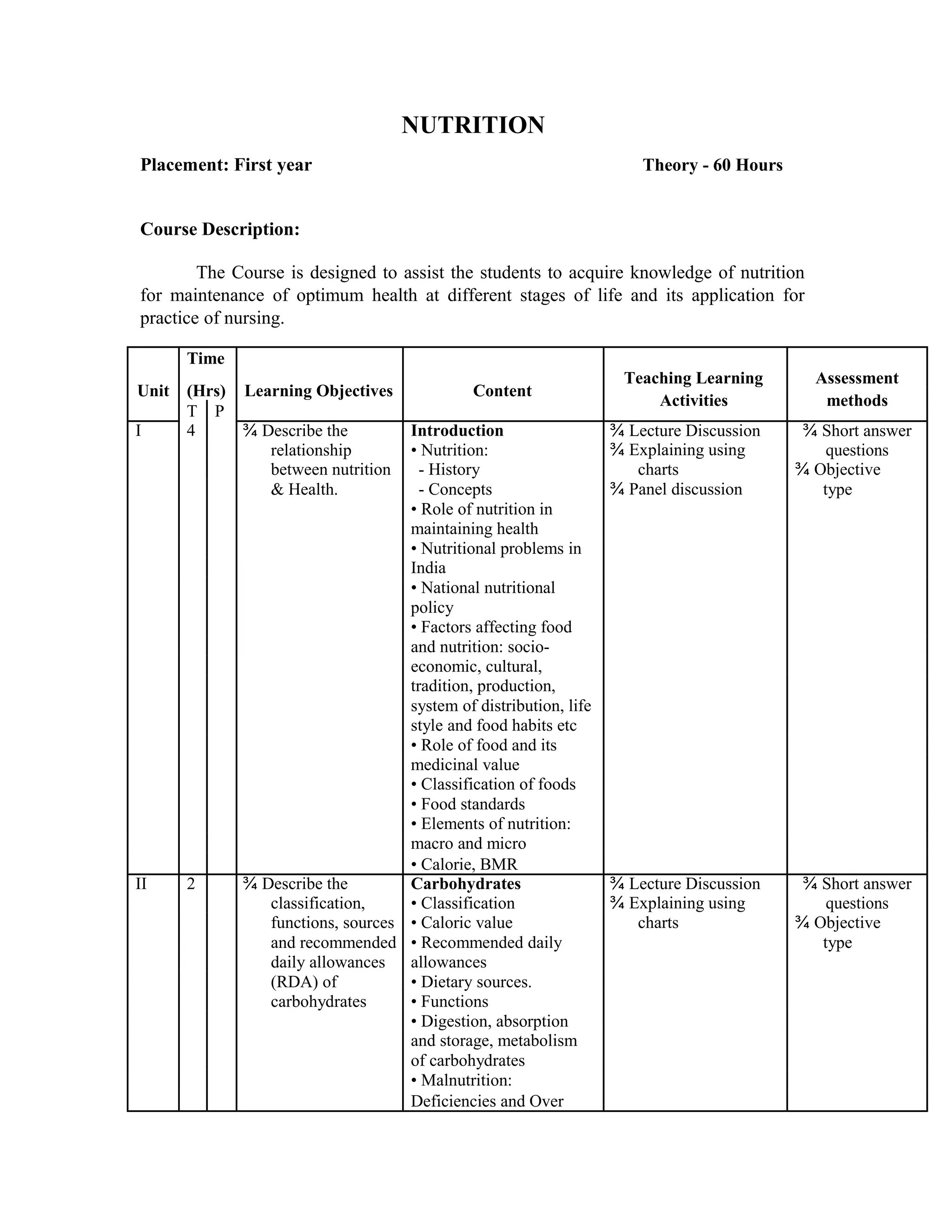
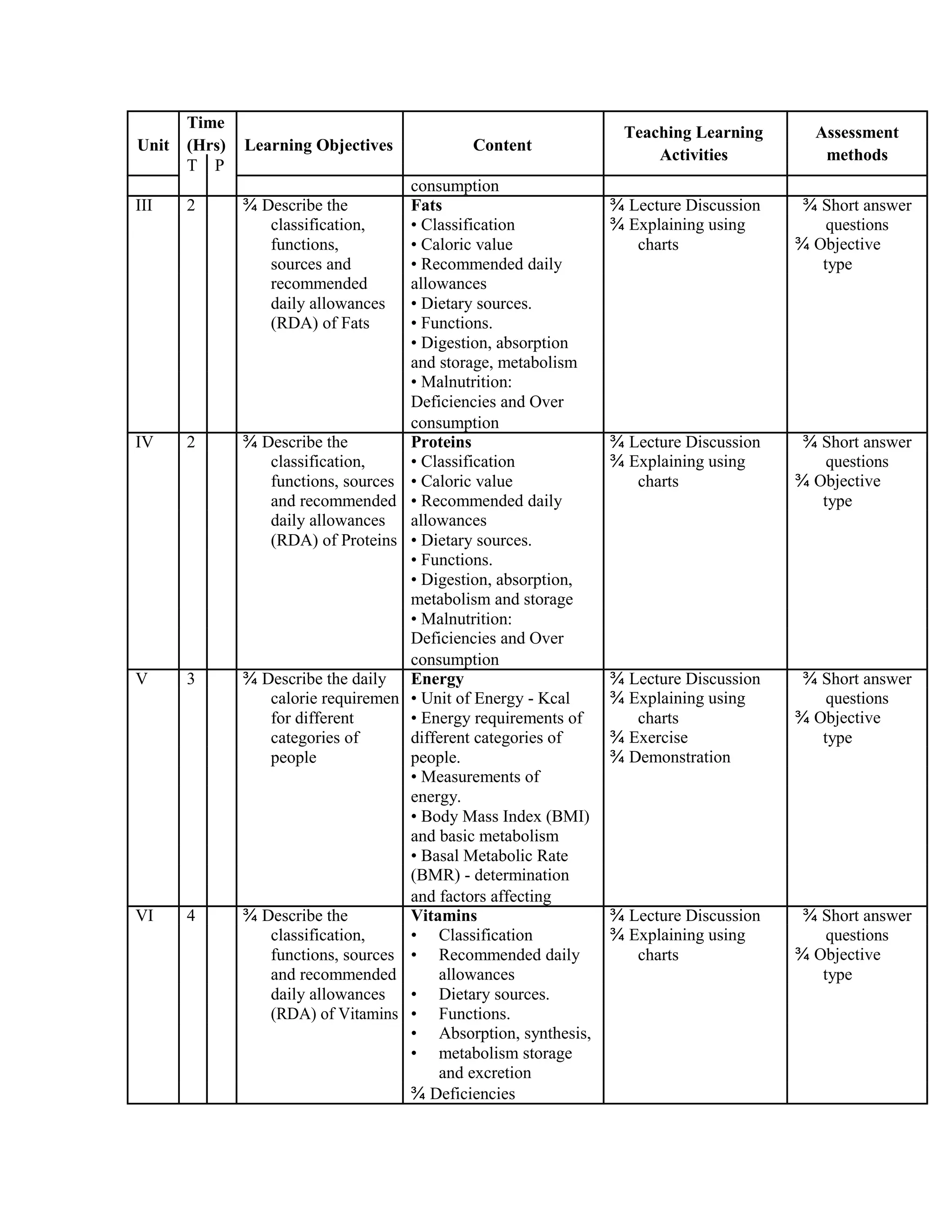
  • 42.
    BIOCHEMISTRY Placement: First yearTheory - 60 Hours Course Descriptions: The Course is designed to assist the students to acquire knowledge of the normal biochemical composition and functioning of human body and alterations in understand the biochemistry in diseases for practice of nursing. Unit Time Learning Content Teaching Learning Assessment (Hrs) Objectives Activities methods I 6 - Describe the Introduction Lecture discussion ¾ Short answer structure ¾ Definition and significance using charts, slides questions Composition and in nursing Demonstrate use of ¾ Objective functions of cell ¾ Review of structure, microscope type - Differentiate Composition and functions between of cell Prokaryote and ¾ Prokaryote and Eukaryote Eukaryote cell cell organization - Identify ¾ Microscopy techniques of Microscopy II 6 ¾ Describe the Structure and functions of Lecture discussion ¾ Short answer Structure and Cell membrane questions functions of ¾ Fluid mosaic model tight ¾ Objective Cell junction, Cytoskeleton type membrane ¾ Transport mechanism: diffusion, osmosis, filtration, active channel, sodium pump ¾ Acid base balance- maintenance & diagnostic tests - PH buffers III 12 ¾ Explain the Composition and metabolism Lecture Short metabolism of of Carbohydrates discussion answer carbohydrates ¾ Types, structure, Demonstration of questions composition and uses blood glucose Objective type - Monosaccharides, monitoring - Disaccharides, Polysaccharides, Oligosaccharides • Metabolism Pathways of ¾ glucose: - Glycolysis - Gluconeogenesis: Cori’s
  • 43.
    Unit Time LearningContent Teaching Learning Assessment (Hrs) Objectives Activities methods cycle,Tricarboxylic acid(TCA) cycle - Glycogenolysis - Pentose phosphate pathways (Hexose mono phosphate) Regulation of blood glucose level Investigations and their Interpretations IV 10 ¾ Explain the Composition and metabolism Lecture Short metabolism of of Lipids Discussion using answer Lipids • Types, structure, composition charts questions and Demonstration Objective type uses of fatty acids of laboratory - Nomenclature, Roles and tests Prostaglandins • Metabolism of fatty acid - Breakdown - Synthesis • Metabolism of triacylglycerols • Cholesterol metabolism - Biosynthesis and its Regulation - Bile salts and bilirubin - Vitamin D - Steroid hormones • Lipoproteins and their functions: - VLDLs- IDLs, LDLs and HDLs - Transport of lipids - Atherosclerosis, Investigations and their interpretations V 11 ¾ Explain the Composition and metabolism Lecture Short metabolism of of Amino acids and Proteins Discussion using answer Amino acids • Types, structure, charts questions and Proteins composition Demonstration Objective type • and uses of Amino acids of laboratory and Proteins tests • Metabolism of Amino acids and Proteins Protein synthesis, targeting and glycosylation - Chromatography - Electrophoresis
  • 44.
    Unit Time LearningContent Teaching Learning Assessment (Hrs) Objectives Activities methods - Sequencing Metabolism of Nitrogen - Fixation and Assimilation - Urea Cycle - Hemes and chlorophylls Enzymes and co-enzymes - Classification Properties - Kinetics and inhibition - Control Investigations and their interpretations VI 7 ¾ Describe Composition of Vitamins and Lecture Short types, minerals Discussion answer composition • Vitamins and minerals: Demonstrate questions and utilization - Structure laboratory Objective type of Vitamins & - Classification tests minerals - Properties - Absorption - Storage & transportation - Normal concentration Investigations and their interpretations VII 8 ¾ Describe Immuno chemistry Lecture Short Immuno- • Immune response, Discussion Answer chemistry • Structure and classification of Demonstrate questions immunoglobins laboratory Objective type • Mechanism of antibody tests production • Antigens: HLA typing. • Free radical and Antioxidants. • Specialised Protein: Collagen, Elastin, Keratin, Myosin, Lens Protein. • Electrophoretic and Quantitative determination of immunoglobins — ELISA etc. Investigations and their interpretations Prescribed Internal Assessment Weightage: Internal Assessment : Term Test - 15 Laboratory - 5 Assignment - 5
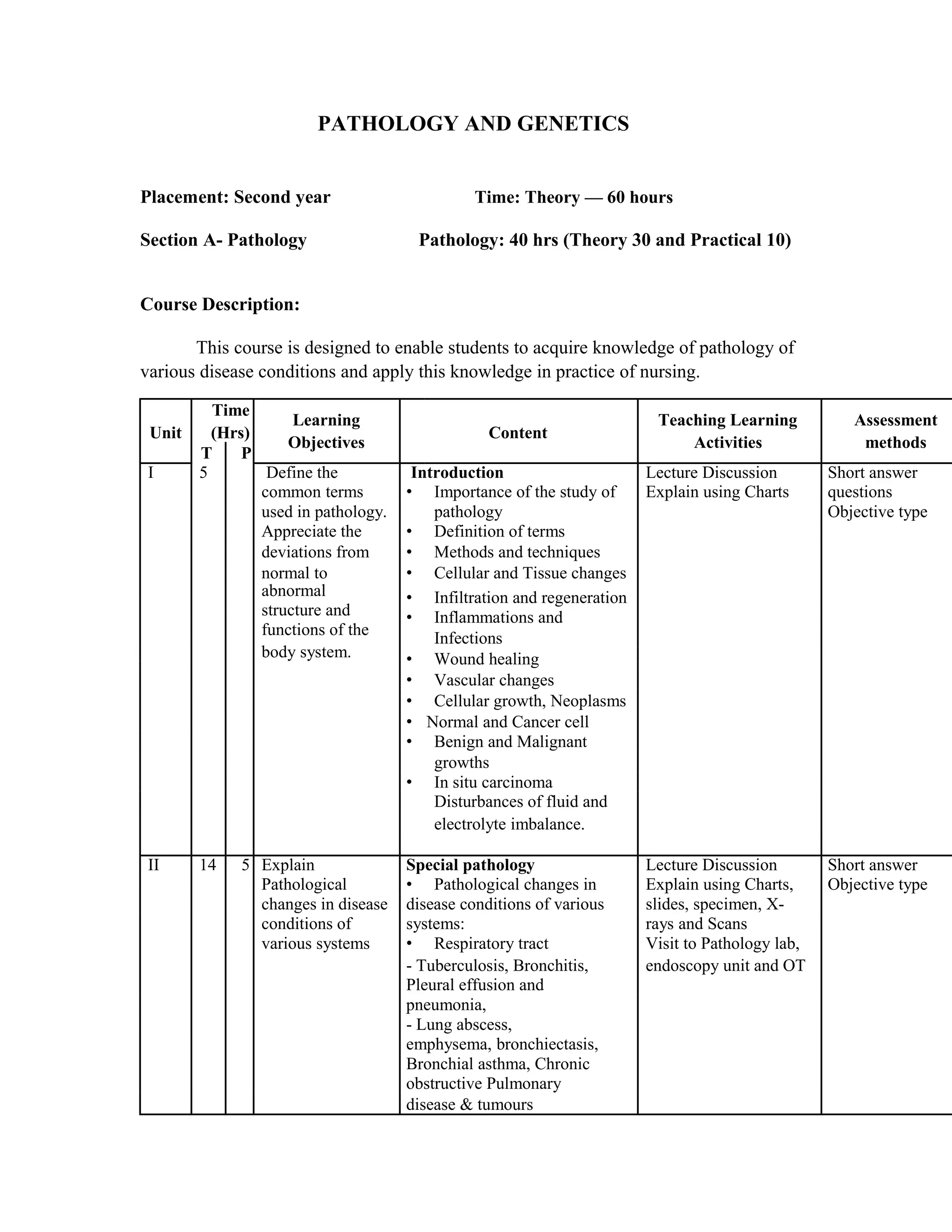
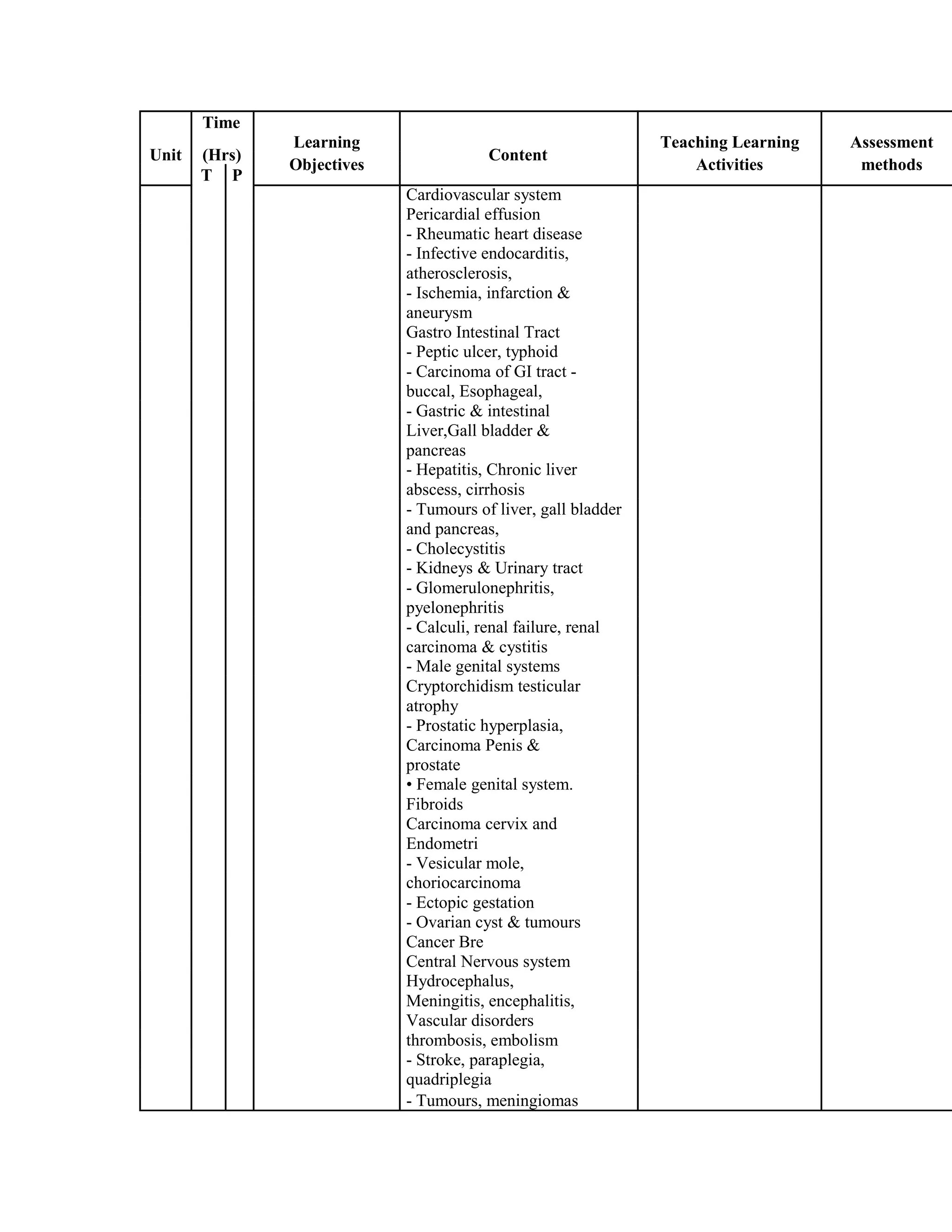
  • 45.
    NURSING FOUNDATIONS Placement: Firstyear Time: Theory - 275 hours Practical - 750 hours (200 lab and 550 clinical) Course Description: This course is designed to help the students to develop an understanding of the philosophy, objectives, theories and process of nursing in various Supervised Clinical settings. It is aimed at helping the students to acquire knowledge, understanding and skills in techniques of nursing and practice them in Supervised Clinical settings. Unit Time Learning Content Teaching Learning Assessment met (Hrs) Objectives Activities I 10 Describe the Introduction Lecture discussion ¾ Essay type concept of • Concept of Health: Health – Illness Visit to health ¾ Short answer health, illness continuum care agencies questions and health • Factors influencing health ¾ Objective typ care agencies • Causes and risk factors for developing illness • Body defences: Immunity and immunization • Illness and illness Behaviour: • Impact of illness on patient and family / • Health Care Services: Health Promotion and prevention and Primary Care, Diagnosis, Treatment, Rehabilitation and Continuing Care • Health care teams • Types of health care agencies: • Hospitals: Types, Organization Functions • Health Promotion and Levels of Disease Prevention • Primary health care and its delivery: Role of nurse II 16 ¾ Explain concept Nursing as a profession Lecture discussion ¾ Essay type and scope of • Definition and Characteristics of Case discussion ¾ Short answer nursing • a profession Role plays ¾ Objective typ ¾ Describe values, • Nursing: code of ethics • Definition, Concepts, and professional • philosophy, objectives conduct for • Characteristics, nature and nurses in India • scope of nursing practice • Functions of nurse • Qualities of a nurse - Categories of nursing personnel
  • 46.
    Unit Time LearningContent Teaching Learning Assessment met (Hrs) Objectives Activities - Nursing as a Profession - History of Nursing in India Values: Definition, Types, Values Clarification and values in professional Nursing: Caring and Advocacy Ethics: - Definition and Ethical Principles - Code of ethics and professional conduct for nurses III 4 ¾ Explain the Hospital admission and Lecture Essay type admission and discharge discussion Short answers discharge • Admission to the hospital Demonstration Objective type procedure - Unit and its preparation Lab Practice Assess skills wit ¾ Performs -admission bed Supervised check list admission and - Admission procedure Clinical practice Clinical practical discharge - Special considerations examination procedure - Medico-legal issues - Roles and Responsibilities of the nurse • Discharge from the hospital - Types: Planned discharge, LAMA and abscond, Referrals and transfers - Discharge Planning - Discharge procedure - Special considerations - Medico--legal issues - Roles and Responsibilities of the nurse - Care of the unit after discharge IV 10 Communicate Communication and Nurse patient Lecture Essay type effectively with relationship discussion Short answers patient, families • Communication: Levels, Elements, Role play and Objective type and team member Types, Modes, Process, Factors video film on the and maintain influencing Communication nurses interacting effective human - Methods of Effective Communication, with the patient - Attending skills Practice session on patient
  • 47.
    Time Learning Teaching Assessment Unit ContentLearning (Hrs) Objectives methods Activities relations - Rapport building skills teaching (projecting - Empathy skills Supervised professional - Barriers to effective Clinical practice image) communication, Appreciate the • Helping Relationships (NPR): importance of Dimensions of Helping. patient teaching in Relationships, Phases of a helping nursing relationship • Communicating effectively with patient, families and team members and maintain effective human relations with special reference to communicating with vulnerable group(children, women, physically and mentally challenged and elderly) • Patient Teaching: Importance, Purposes, Process, role of nurse and Integrating teaching in Nursing Process V 17 ¾ Explain the The Nursing Process • Lecture Essay type concept, uses, • Critical Thinking and Nursing discussion Short answers format and Judgment • Demonstration Objective type steps of Critical Thinking: Thinking and • Exercise nursing Learning, • Supervised process o Competencies, Attitudes for Clinical practice ¾ Documents Critical Thinking, Levels of nursing critical thinking in Nursing process as per • Nursing Process Overview: the format Application in Practice o Nursing process format: INC, current format o Assessment Collection of Data: Types, Sources, Methods - Formulating Nursing judgment: Data interpretation o Nursing diagnosis - Identification of client problems - Nursing diagnosis statement • Difference between medical and nursing diagnosis o Planning
  • 48.
    Time Learning Teaching Assessment Unit ContentLearning(Hrs) Objectives methods Activities - Establishing Priorities - Establishing Goals and Expected Outcomes, - Selection of interventions: Protocols and standing Orders - Writing the Nursing Care Plan Implementation — Implementing the plan of care Evaluation - Outcome of care - Review and modify Documentation and Reporting VI 4 ¾ Describe the Documentation and Reporting Lecture Essay type purposes, • Documentation: Purposes of discussion Short answers types and Recording and reporting Demonstration Objective type techniques of • Communication within the Health Practice recording and Care Team, Session reporting • Types of records; ward records, Supervised medical/nursing records, Clinical • Common Record-keeping forms, practice Computerized documentation • Guidelines for Reporting: Factual Basis, Accuracy, Completeness, currentness, Organization, confidentiality • Methods of Recording, • Reporting: Change-of shift reports: Transfer reports, Incident reports • Minimizing legal Liability through effective record keeping VII 17 ¾ Describe Vital signs Lecture Essay type principles and • Guidelines for taking vita! signs: Discussion Short techniques of • Body temperature: Demonstration answers monitoring • Physiology, Regulation, Practice Objective and Factors affecting body Supervised type maintaining temperature, Clinical Assess vital signs • Assessment of body practice with check ¾ Monitor and temperature: sites, equipments list and maintain vital and technique, special clinical signs considerations practical
  • 49.
    Time Learning Teaching Assessment Unit ContentLearning(Hrs) Objectives methods Activities - Temperature alterations: Heatstroke, Hypothermia Hot and cold applications Pulse: - Physiology and Regulation, Characteristics of the pulse, Factors affecting pulse - Assessment of pulse: sites, location, equipments and technique, special considerations - Alterations in pulse: Respiration: - Physiology and Regulation, Mechanics of breathing Characteristics of the respiration, Factors affecting respiration - Assessment of respirations: technique, special considerations - Alterations in respiration Blood pressure: - Physiology and Regulation, Characteristics of the blood pressure, Factors affecting blood pressure - Assessment of blood pressure: sites, equipments and technique, special considerations - Alterations in blood pressure Recording of vital signs VIII 30 ¾ Describe purpose Health assessment ¾ Lecture Essay type and process of • Purposes discussion Short health • Process of Health assessment ¾ Demonstration answers assessment - Health history ¾ Practice on Objective ¾ Describe the - Physical examination: simulators Type health - Methods- inspection, ¾ Supervised assessment each Palpation, Percussion, Clinical body system Auscultation, Olfaction practice ¾ Perform Preparation for examination: health patient and unit. assessment of General assessment each body system Assessment of each body System Recording of health assessment. IX 5 ¾ Identifies the Machinery, Equipment and ¾ Lecture ¾ Essay type
  • 50.
  • 51.
    Unit Time Learning Content Teaching Assessment Learning(Hrs) Objectivesmethods Activities machinery, Types: Disposables and ¾ Demonstration answers equipment and re-usables- Linen, rubber goods, ¾ Objective linen and their glass ware, metal, plastics, type care furniture, machinery Introduction : - Indent - Maintenance - Inventory X 62 ¾ Describe the Meeting needs of patient • Lecture ¾ Essay type basic, • Basic needs (Activities of daily discussion ¾ Short physiological living) • Demonstrati ¾ answers and psychosocial Providing safe and clean on ¾ Objective needs of patient environment: • Practice type ¾ Describe the - Physical -environment: sessions ¾ Assess with principles and Temperature, Humidity, • Supervised check list techniques for Noise, Ventilation, light, • Clinical and clinical meeting basic, Odour, pests control - practical practice Physiological - Reduction of Physical examination and psychosocial hazards: fire, accidents needs of - Safety devices: Restraints, patient side rails, airways, trapez ¾ Perform etc nursing - Role of nurse in providing assessment, safe and clean environment plan, Hygiene: - implement - Factors Influencing and evaluate Hygienic Practice the care for - Hygienic care: Care of the meeting basic, Skin-Bath and pressure points, physiological feet and nail, Oral and cavity, Hair Care, Eyes, psychosocial Ears, and Nose needs of • Assessment, Principles, patient Types, Equipments, Procedure, Special Considerations - Patient environment: Room Equipment and linen, • Making patient beds Types of beds and bed making Comfort: - - Factors Influencing Comfort - Comfort devices Physiological needs: -Sleep and Rest: - Physiology of sleep - Factors affecting sleep
  • 52.
  • 53.
    Time Learning Teaching Assessment Unit ContentLearning(Hrs) Objectives methods Activities - Sleep Disorders Nutrition: - - Importance - Factors affecting nutritional - Assessment of nutritional needs: Variables - Meeting Nutritional needs: Principles, equipments, procedure and special considerations -Oral - Enteral: Naso/ Orogastric, gastrostomy - Parenteral: - Urinary Elimination - Review of Physiology of Urine Elimination, Composition and characteristics of urine Factors Influencing Urination Alteration in Urinary Elimination Types and Collection of urine specimen: Observation, urine testing Facilitating urine elimination: assessment, types, equipments, procedures and special considerations - Providing urinal / bed pan o Condom drainage o Perineal care o Catheterization o Care of urinary drainage o Care of urinary diversions o Bladder irrigation ƒ Bowel Elimination - Review of Physiology of Bowel Elimination, Composition and characteristics of faeces - Factors affecting Bowel elimination - Alteration in Bowel Elimination - Types and Collection of specimen of faeces: Observation - Facilitating bowel
  • 54.
  • 55.
    Time Learning Teaching Assessment Unit ContentLearning(Hrs) Objectives methods Activities equipments, procedures and special considerations Passing of Flatus tube Enemas Suppository Sitz bath Bowel wash Care of Ostomies Mobility and Immobility - Principles of Body Mechanics - Maintenance of normal body dignment and mobility - Factors affecting body Alignment and mobility - Hazards associated with immobility - Alteration in body Alignment and mobility - Nursing interventions for impaired Body Alignment and Mobility: assessment, types, devices used, method and special considerations, rehabilitation aspects Range of motion exercises o Maintaining body alignment: Positions Moving Lifting Transferring Walking Restraints - Oxygenation - Review of Cardiovascular and respiratory Physiology - Factors Affecting Oxygenation - Alterations in oxygenation - Nursing interventions in oxygenation: assessment, types, equipment used, procedure and special considerations Maintenance of patent airway Oxygen administration Suction Inhalations: dry and moist Chest physiotherapy and postural drainage
  • 57.
    Time Learning Teaching Assessment Unit ContentLearning(Hrs) Objectives methods Activities Care of Chest drainage Pulse oxirnetry CPR- Basic life support Fluid, Electrolyte, and Acid — Base Balances - Review of Physiological Regulation of Fluid, Electrolyte, and Acid -Base Balances - Factors Affecting Fluid, Electrolyte, and Acid - Base Balances - Alterations in Fluid, Electrolyte, and Acid - Base Balances Nursing interventions in Fluid, Electrolyte, and Acid - Base imbalances: assessment, types, equipment, procedure and special considerations o Measuring fluid intake and output Correcting Fluid, Electrolyte Imbalance: Replacement of fluids: Oral and Parenteral Venipuncture, regulating IV Flow rates, changing IV solutions and tubing, Changing IV dressing, Administering Blood transfusion Restriction of fluids Psychosocial Needs Concepts of Cultural Diversity, Stress and Adaptation, Self-concept, Sexuality, Spiritual Health, Coping with loss, death and grieving Assessment of psychosocial needs - Nursing intervention for psychosocial needs - Assist with coping and adaptation - Creating therapeutic environment o Recreational and diversional
  • 58.
  • 59.
    Time Learning Teaching Assessment Unit ContentLearning(Hrs) Objectives methods Activities XI 22 Describe Infection control in Clinical Lecture principles and settings discussion techniques for • Infection control Demonstration infection Nature of infection Practice session control and Chain of infection transmission Supervised Clinical biomedical waste Defenses against infection: practice management natural and acquired in Supervised Hospital acquired infection Clinical settings (Nosocomial infection) • Concept of asepsis: medical asepsis, and surgical asepsis Isolation precautions (Barrier nursing): - Hand washing: simple, hand antisepsis and surgical antisepsis (scrub) - Isolation: source and protective - Personal protecting equipments: types, uses and technique of wearing and removing - Decontamination of equipment and unit - Transportation of infected patients - Standard safety precautions (Universal precautions) - Transmission based precautions • Biomedical waste management: - Importance - Types of hospital waste - Hazards associated with hospital waste - Decontamination of hospital waste - Segregation and Transportation and disposal XII 42 Explain the Admintration of Medications: .Essay type principles, routes, • General Short answers effects of -Principles / consideration Objective type administration of -Purposes of Medication Assess with medications -Principles: 5 rights; special check list and Calculate consideration; Presciptions; clinical practical conversions of drugs Safety in Adminstering examination
  • 60.
  • 61.
    Time Learning Teaching Assessment Unit ContentLearning(Hrs) Objectives methods Activities and between systems Medications and Mediation of measurements Errors; Administer drugs by -Drug Froms; the following routes- -Routes of administration oral, Intra-dermal, -Storage and mainteneance of Subcutaneous drugts and Nurses responsibility Intramuscular, Intra -Broad classification of drugs: Venous topical, - Therapeutic Effect, Side inhalation. Effects, Toxic Effects, Administer drugs by Idiosyncratic Reactions, the following routes- Allergic Reactions, Drug oral, Intra-dermal, Tolerance, Drug Interactions, Subcutaneous - Factors Influencing drug Intramuscular, Intra Actions, Venous topical, - Systems of Drug inhalation Measurement: Metric System, Apothecary System, Household Measurements, Solutions. - Converting Measurements Units: Conversion within one system, Conversion between systems, Dosage Calculation, - Terminologies and abbreviations used in prescriptions of medications Oral Drugs Administration: Oral, Sub lingual and Buccal: Equipment, procedure Parenteral - General principles: decontamination and disposal of syringes and needles - Types of parenteral therapies - Types of syringes, needles, canula, and infusion sets - Protection from Needle stick Injuries : Giving Medications with a safety syringes - Routes of parenteral therapies - Intra-dermal: purpose, site, equipment, procedure, special considerations - Subcutaneous: purpose, site, equipment, procedure, special considerations - Intramuscular: purpose, site,
  • 62.
  • 63.
    Time Learning Teaching Assessment Unit ContentLearning(Hrs) Objectives methods Activities considerations - Intra Venous: purpose,site, equipment, procedure, special considerations - Advanced techniques: epidural, intra-thecal, intra-osseous, intra-peritonial, intra-plural, intra-arterial- Role of nurse Topical Administration: purposes, site, equipment, procedure, special considerations for Application to Skin Application to mucous membrane - Direct application of liquids-Gargle and swabbing the throat - Insertion of Drug into body cavity: Suppository, medicated packing in rectum/vagina - Instillations:, Ear, Eye, Nasal, Bladder, and Rectal - Irrigations: Eye, Ear, Bladder, Vaginal and Rectal - Spraying: Nose and throat Inhalation: Nasal, oral, endotracheal (steam, oxygen and medications) purposes, types, equipment, procedure, special considerations - Recording and reporting of medications administered XIII 10 Describe the Meeting needs of Peri operative Lecture Essay type pre and post patients discussion Short operative care • Definition and concept of Demonstration answers of patients Peri operative Nursing Practice session Objective Explain the Preoperative Phase Supervised type process of - Preparation of patient for Clinical practice Assess wound surgery with check healing Intra-operative list and Explain the Operation theatre Set up and clinical
  • 64.
  • 65.
    Time Learning Teaching Assessment Unit ContentLearning(Hrs) Objectives methods Activities techniques of - Role of nurse examination care Postoperative Phase Perform care - Recovery unit of wounds - Post operative unit - Postoperative care, Wounds: types, Classifications, wound Healing Process, Factors affecting Wound, Complications of Wound Healing Surgical asepsis Care of the wound: types, equipments, procedure and special considerations - Dressings, Suture Care, - Care of Drainage - Application of Bandages, Binders, Splints & Slings - Heat and Cold Therapy XIV 15 Explain care Meeting special needs of the Lecture Essay type of patients patient discussion Short having • Care of patients having Case discussions answers alterations in alteration in: Supervised Objective body - Temperature (hyper and clinical practice Type functioning hypothermia); Types, Assessment, Management - Sensorium (Unconsciousness); Assessment, Management - Urinary Elimination (retention and incontinence); Assessment, Management - Functioning of sensory organs: ( Visual &hearing impairment) - Assessment of Self-Care ability - Communication Methods and special considerations - Mobility (physically challenged, cast), assessment of Self-Care ability: Communication Methods and special considerations - Mental state (mentally challenged), assessment of Self- Care ability; - Communication Methods and special considerations - Respiration (distress); Types, Assessment, Management
  • 66.
    Comfort - (Pain)- Nature, Types,
  • 67.
    Time Learning Teaching Assessment Unit ContentLearning(Hrs) Objectives methods Activities Factors influencing Pain, Coping, Assessment, Management; Treatment related to gastrointestinal system: nasogastric suction, gastric irrigation, gastric – analysis XV 5 Explain care Care of Terminally ill patient Lecture discussion Essay type of terminally • Concepts of Loss, Grief, Demonstration Short ill patient grieving Process Case discussion / answers - Signs of clinical death Role play Objective - Care of dying patient: special Practice session Type considerations Supervised - Advance directives: Clinical practice euthanasia, will, dying declaration ,organ donation etc - Medico-legal issues - Care of dead body: equipment, procedure and care of unit - Autopsy - Embalming XVI 6 Explain the Professional Nursing concepts Lecture discussion Essay type basic and practices Short concepts of • Conceptual and theoretical Answers conceptual models of nursing practice: and Introduction to models- holistic theoretical model, health belief model, health models of promotion model etc nursing Introduction to Theories in Nursing; Peplau’s, Henderson’s, Orem’s, Neuman’s, Roger’s and Roy’s Linking theories with nursing process Prescribed Internal Assessment Weightage: Internal Assessment : Term Test - 30 Assignment - 20
  • 68.
    Fundamentals of Nursing RecommendedBooks: 1. Taylor – Fundamentals of Nursing, 2007, LWW 2. Kozier – Fundamentals of Nursing ,2007,Pearson 3. Potter – Basic Nursing ,2008,Elsevier 4. Lynn – Taylor’s Clinical Nursing Skills,2008,LWW Reference Books: 1. Craven – Fundamentals of Nursing ,2010,LWW 2. Potter – Fundamentals of Nursing ,2009,Elsevier’s 3. St John’s Ambulance – First AID, 2007,St John’s Ambulance Association. 4. LWW – Lippincott’s Nursing Procedure, 2008, LWW. 5. Jacob – Clinical Nursing Skills & Procedures ,2008,Jaypee 6. Carpenito – Understanding Nursing Process,2007,LWW
  • 69.
    NURSING FOUNDATIONS- PRACTICAL Placement:First year Time: Practical - 750 hours (200 lab and 550 clinical) Course Description: This course is designed to help the students to develop an understanding the philosophy, objectives, theories and process of nursing in various clinical settings. It is aimed helping the students to acquire knowledge, understanding and skills techniques of nursing and practice them in clinical settings. Areas Time Objectives Skills Assignments Assessment (Hrs) methods Demonstration 200 Performs Hospital admission and Practice in Unit Evaluate with Lab General 550 admission and discharge (III) Hospital checklist Medical and Minimum discharge • Admission Write nursing Assessment of surgery ward practice procedure • Prepare Unit for new process records clinical time in patient of patient performance with clinical • Prepare admission bed Simulated - rating scale area • Performs admission Actual - Completion of procedure Practical record • New patient Assessment of • Transfer in Prepare nursing process patient records records with • Discharge/Transfer checklist out Assessment of • Gives discharge actual care given counseling with rating scale • Perform discharge procedure (Planned discharge, LAMA and abscond, Referrals and transfers) • Prepare records of discharge/transfer • Dismantle, and disinfect unit and equipment after • discharge/transfer Prepares nursing Perform assessment: care plan as per • History taking, Nursing the nursing diagnosis, problem list, process format Prioritization, Goals & Expected Outcomes, selection of interventions • Write Nursing Care Plan
  • 70.
    Areas Time Objectives Skills Assignments Assessment (Hrs)methods • Gives care as per the plan Communicate Communication Role-plays in Assess role plays effectively with Use verbal and non verbal simulated with the check- patient, and team communication techniques situations on list on comm.- members and Prepare a plan for communi- unication Maintain patient teaching session cation techniques effective human Write patient report techniques-I Assess health talk relations Healthtalk-I with the checklist Develops plan Change-of shift reports Assess-ment of for patient Transfer reports comm-unication teaching Incident reports etc. tech-niques by Presents patient report rating scale Assess-ment of Prepare patient Write nurses perfor -mance with rating scale reports notes and Presents reports present the patient report of 2-3 assigned patient Monitor vital Vital signs Lab practice Assessment of signs • Measure, Records and Measure Vital each skill with interpret alterations in signs of checklist body temperature, pulse assigned Completion of respiration and blood patient activity record pressure Perform health Health assessment assessment of 6. Health history each body taking system 7. Perform assessment: - General - Body systems 8. Use various methods of physical examination 9. Inspection, Palpation, 10. Percussion, Auscultation, 11. Olfaction 12. Identification of system wise deviations Provide basic Prepare Patient’s unit: Practice in lab Assessment of nursing care to ƒ Prepare beds: & hospital each skill with
  • 71.
    Areas Time Objectives Skills Assignments Assessment (Hrs)methods patients ƒ Open, closed, Simulated rating scale occupied, exercise on Completion of ƒ Operation, CPR manikin activity record amputation, ƒ Cardiac, fracture, burn, divided & Fowlers bed ƒ Pain assessment and provision for comfort Use comfort devices Hygienic care: ƒ Oral hygiene: ƒ Baths and care of pressure points ƒ Hair wash, Pediculosis treatment Feeding: ƒ Oral, Enteral, Naso / Orogastric, gastrostomy and Parenteral feeding ƒ Naso-gastric insertion, suction, and irrigation Assisting patient in urinary elimination ƒ Provides urinal/bed pan ƒ Condom drainage ƒ Perineal care ƒ Catheterization ƒ Care of urinary drainage Bladder irrigation Assisting bowel Elimination: ƒ Insertion of Flatus tube ƒ Enemas ƒ Insertion of Suppository Bowel wash Body Alignment and Mobility: ƒ Range of motion exercises ƒ Positioning: Recumbent, Lateral (rt/It), Fowlers, Sims,
  • 72.
  • 73.
  • 74.
    Areas Time Objectives Skills Assignments Assessment (Hrs)methods ƒ Assist patient in Moving, lifting, transferring, walking ƒ Restraints Oxygen administration Suctioning: oropharyngeal, nasopharyngeal Chest physiotherapy and postural drainage Care of Chest drainage CPR- Basic life support Intravenous therapy Blood and blood component therapy Collect/assist for collection of specimens for investigations Urine, sputum, faeces, vomitus, blood and other body fluids Perform lab tests: ƒ Urine: sugar, -albumin, acetone ƒ Blood: sugar (with strip glucometer) Hot and cold applications: local and general Sitz bath Communicating and assisting with self-care of visually & hearing impaired patients Communicating and assisting with self-care of mentally challenged/disturbed patients
  • 75.
    Areas Time Objectives Skills Assignments Assessme (Hrs)methods Recreational and diversional therapies Caring of patient with alteration in sensorium Perform Infection control Observation Assess infection Perform following procedures: study -2 observation control ƒ Hand washing techniques Department of study with procedures ƒ (Simple, hand antisepsis and Infection checklist surgical antisepsis (scrub) control & Evaluate ƒ Prepare isolation unit in CSSD all lab/ward Visits CSSD procedures ƒ Practice technique of write with checkli wearing and removing observation Personal protective report equipment (PPE) Collection of ƒ Practice Standard safety samples for precautions (Universal culture precautions) Do clinical posting in infection Decontamination of equipment control and unit: - department Surgical asepsis: and write ƒ Sterilization report ƒ Handling sterilized Practice in equipment lab/ward ƒ Calculate strengths of lotions, ƒ Prepare lotions ƒ Care of articles Provide Pre and post operative care: care to pre ƒ Skin preparations for surgery: and post Local operative patients ƒ Preparation of Post operative Perform unit procedures ƒ Pre & post operative teaching for care of and counseling wounds ƒ Pre and post operative monitoring ƒ Care of the wound
  • 76.
    Areas Time Objectives Skills Assignments Assessment (Hrs)methods ƒ Dressings, Suture Care, care of Drainage, Application of Bandages, Binders, Splints & Slings ƒ Bandaging of various body parts ƒ Administer Administration of drugs medications ƒ Administer Medications in different forms and routes ƒ Oral, Sub lingual and Buccal ƒ Parenteral Intra-dermal, subcutaneous, Intramuscular etc. ƒ Assist with Intra Venous medications ƒ Drug measurements and dose calculations ƒ Preparation of lotions and solutions ƒ Administers topical applications ƒ Insertion of drug into body cavity: Suppository & medicated packing etc. ƒ Instillation of medicines and spray into Ear, Eye, Nose and throat ƒ Irrigations: Eye, Ear, Bladder, Vagina and Rectum ƒ Inhalations: dry and moist ƒ Provide care to Care of dying patient dying and dead ƒ Caring and packing of ƒ Counsel and dead body support ƒ Counseling and relatives supporting grieving relatives ƒ Terminal care of the unit
  • 77.
    Prescribed Internal AssessmentWeightage: NURSING FOUNDATIONS – PRACTICAL Internal Assessment : Practical Examination - 25 Clinical Evaluation -10 Procedural Demonstration - 5 Practical Record - 5 Observational Study - 5
  • 78.
    PSYCHOLOGY Placement: First yearTime: Theory - 80 hours Course Description: This course is designed to assist the students to acquire knowledge of fundamentals of psychology and develop an insight into behaviour of self and others. Further it is aimed at helping them to practice the principles of mental hygiene for promoting mental health in nursing practice. Time Learning Teaching Assessment Unit Content Learning(Hrs) Objectives methods Activities I 2 Describe the Introduction Lecture Essay type history, scope and • History and origin of science of discussion Short answer methods of psychology psychology • Definitions & Scope of Psychology • Relevance to nursing • Methods of Psychology II 7 ¾ Explain the Biology of behaviour Lecture ¾ Essay type biology of • Body mind relationship- modulation discussion ¾ Short answers Human process in health and illness behaviour • Genetics and behaviour: Heredity and environment • Brain and behaviour: Nervous System,, Neurons and synapse, • Association Cortex, Rt and Lt Hemispheres • Psychology of Sensations • Muscular and glandular controls of behaviour • Nature of behaviour of an organism/Integrated_responses III 24 ¾ Describe Cognitive processes Lecture Essay type various • Attention: Types, determinants, Discussion Short answers cognitive Duration & degree, alterations processes and • Perception: Meaning, Principles, Psychometric their factors affecting, Errors, assessment: applications • Learning: Nature, Types, learner and Practice learning, Factors influencing, laws and sessions theories, process, transfer, study habits • Memory: Meaning, Types, Nature Factors influencing, Development Theories and methods of memorizing and Forgetting Thinking: Types and levels, stages of development, Relationship with
  • 79.
    Time Learning Teaching Assessment Unit ContentLearning(Hrs) Objectives methods Activities language and communication Intelligence: Meaning, classification, uses, theories Aptitude: Concept, types, Individual differences and variability Psychometric assessments of cognitive processes Alterations in cognitive processes Applications IV 12 ¾ Describe Motivation and Emotional Lecture Essay type motivation, Processes: Discussion Short answers emotions, • Motivation: Meaning, Concepts, Types, Role plays stress, attitudes Theories, Motives and behaviour, Case Discussion and their Conflicts and frustration, conflict Demonstration influence on resolution behaviour • Emotions & stress Emotion: Definition, components, Changes in emotions, theories emotional adjustments, emotions in health and illness Stress: stressors, cycle, effect, adaptation & coping • Attitude: Meaning, nature, development, factors affecting, Behaviour and attitudes Attitudinal change • Psychometric assessments of emotions and attitudes • Alterations in emotions Applications V 9 Explain the Personality Lecture Essay type concepts of Definitions, topography, types, Theories discussion Short answers personality and its Psychometric assessments of personality Demonstration influence on Alterations in personality behaviour Applications VI 9 Describe Developmental Psychology Lecture Essay type psychology of • Psychology of people at different ages Discussion Short answers people during the from infancy to old age Case Discussion life cycle • Psychology of vulnerable individuals- challenged, women, sick, etc Psychology of groups VII 11 Describe the Mental hygiene and mental Health Lecture Essay type characteristics of • Concepts of mental hygiene and mental Discussion Short answers Mentally healthy health Case Discussion Person • Characteristics of mentally healthy Role play Explain ego defence person Demonstration • Warning signs of poor mental health mechanisms • Promotive and Preventive mental health-
  • 80.
    Time Learning Teaching Assessment Unit ContentLearning(Hrs) Objectives methods Activities strategies and services • Ego Defence mechanisms and implications • Personal and social adjustments • Guidance and counseling • Role of nurse VIII 6 Explain the Psychological assessment & tests Lecture Assessment Psychological • Types, development, Characteristics, Discussion of practice assessments and Principles, Uses, Interpretations and Role Demonstration role of nurse of nurse in psychological assessment Practice sessions Prescribed Internal Assessment Weightage: Internal Assessment : Term Test - 30 Assignment - 20
  • 81.
    MICROBIOLOGY Placement: First yearTime: Theory - 80hours (Theory 60+ 20 lab) Course Description: This course is designed to enable students to acquire understanding of fundamentals of Microbiology and identification of various micro-organisms. It also provides opportunities for practicing infection control measures in hospital and community settings. Time Learning Teaching Learning Assessment Unit (Hrs) Content Objectives Activities methods T P I 5 Explain concepts Introduction: Lecture Discussion Short answer and principles of • Importance and relevance questions microbiology and to nursing Objective type their Importance • Historical perspective nursing • Concepts and terminology • • Principles of microbiology II 14 7 Describe structure, General characteristics of Lecture Discussion Short answer classification Microbes Demonstration questions morphology and • Structure and classification Objective type growth of bacteria of Microbes Identify Micro- • Morphological types organisms • Size and form of bacteria • Motility • Colonization • Growth and nutrition of • microbes • Temperature • Moisture • Blood and body fluids • Laboratory methods for Identification of • Microorganisms Staining techniques, Gram staining, Acid fast staining, • Hanging drop preparation Culture; various medias
  • 82.
    Time Learning Content Teaching Learning Assessment Unit(Hrs) Objectives Activities methods T P III 14 2 Describe the Infection control Lecture Discussion Short answers methods of • Infection: Sources, portals of Demonstration Objective type infection control entry and exit, transmission Visits to CSSD Identify the role of • Asepsis Clinical practice nurse in hospital • Disinfection; Types and infection methods control • Sterilization; Types and programme Methods Chemotherapy and antibiotics • Standard safety measures • Biomedical waste management • Role of Nurse • Hospital acquired infection • Hospital infection control programme Protocols, collection of samples, preparation of report and status of rate of infection in the unit/hospital, nurse’s accountability, continuing education etc. IV 16 6 Describe the Pathogenic organisms Lecture Discussion Short answer different disease • Micro-organisms Demonstration questions producing - Cocci — gram positive and Objective type organisms gram negative bacilli— gram positive and gram negative Spirochaete Mycoplasma Rickettsiae Chlamydiae • Viruses - • Fungi -Superficial and Deep mycoses • Parasites • Rodents & vectors Characteristics, Source, portal of entry, transmission of infection Identification of disease producing micro-organisms Collection, handling and transportation of various specimens V 11 5 Explain the Immunity Lecture Short answers
  • 83.
    Time Learning Content Teaching Learning Assessment Unit(Hrs) Objectives Activities methods T P concept of • Immunity-Types, Discussion Objective type immunity, hyper classification Demonstration sensitivity and • Antigen and antibody reaction Clinical practice immunization • Hypersensitivity — skin test • Serological tests • Immunoprophylaxis Vaccines & sera -Types & Classification, storage and handling, cold chain Immunization for various diseases -Immunization Schedule Prescribed Internal Assessment Weightage: MICROBIOLOGY Internal Assessment : Term Test - 30 Assignment - 20
  • 84.
    INTRODUCTION TO COMPUTERS Placement:First year Time: Theory - 55 hours Practical – 20hours Course Description: This course is designed for students to develop basic understanding of uses of computer and its applications in nursing. Time Learning Teaching Learning Assessment Unit (Hrs) Content Objectives Activities methods T P I 5 Identify & define Introduction: Lecture Discussion Short answers various concepts • Concepts of Computers Demonstration Objective type used in computer • Hardware and software; identify trends and technology application of • Application of computers computer in in nursing nursing II 15 10 Describe and Use • Introduction to disk- Lecture Discussion Short answer the Disk Operating operating system Demonstration questions System DOS Practice Session Objective type Demonstrate skill in c Windows (all version) Practical Exam the use of MS • Introduction u MS-Word Office MS-Excel with pictorial presentation MS-Access MS-Power point III 10 3 Demonstrate skill in Multimedia; types & uses Lecture Discussion Short answers using multi-media Computer aided teaching Demonstration Objective type Identify features of & testing. Practical Exam computer aided and Viva Voce teaching and testing IV 5 3 Demonstrate use of Use of Internet and: Lecture Discussion Short answers internet and Email e-mail Demonstration Objective type Practice Session Practical Exam and Viva Voce V 10 2 Describe and use Statistical packages: types Lecture Discussion Short answers the statistical and their features Demonstration Objective type packages Practice Session Practical Exam and Viva Voce VI 10 2 Describe the use of Hospital Management Lecture Discussion Short answer Hospital System: Types and uses Demonstration questions .Management Objective type System Practical Exam and Viva Voce
  • 85.
    INTRODUCTION TO COMPUTERS100 marks Internal Examination : 100 References 1.N.K.Anand & Shikha Goel ,Computers for Nurses, A.I.T.B.S. Publishers ,India.2009. 2. Thacker N Computers for Nurses, India. 2009
  • 86.
    SOCIOLOGY Placement: Second yearTheory- 80 Hours Course Description: This course is designed to introduce the concepts of sociology related to community and social institutions in India and its relationship with health, illness and nursing. Uni Time Learning Content Teaching Learning Assessment t (Hrs) Objectives Activities methods I 1 ¾ State the Introduction ¾ Lecture ¾ Essay type importance ¾ Definition of Sociology Discussion ¾ Short of sociology ¾ Nature and Scope of answers in Nursing the discipline ¾ Importance and application of Sociology in Nursing II 3 ¾ Describe the Individual & Society ¾ Lecture ¾ Essay type inter- ¾ Society and Discussion ¾ Short relationship Community answers of individual ¾ Nature of Society in society ¾ Difference between and Society and community Community ¾ Process of Socialization and individualization ¾ Personal disorganization III 5 ¾ Describe the Culture Lecture Discussion Essay type influence of • Nature of culture Panel Discussion Short answers culture and • Evolution of culture on health and • Diversity and uniformity disease of culture • Culture and socialization • Transcultural society • Influence on health and disease IV 6 ¾ Identify Social groups and Lecture Essay type various Processes Discussion Short answers social groups The meaning and and their classification of groups
  • 87.
  • 88.
    Uni Time Learning Content TeachingLearning Assessment t (Hrs) Objectives Activities methods Group In-group V/s. Out-group, Class Tribe, Caste Economic, Political, Religious groups, Mob, Crowd, Public and Audience Interaction & Social Processes Co-operation, Competition, Conflict Accommodation, Assimilation & Isolation V 8 Explain the Population Lecture Essay type growth of • Society and population Discussion Short answers population in • Population distribution in Community Assessment of India and its India- Demographic identification report on impact on health characteristics community • Malthusian theory of identification Populations • Population explosion in India and its impact on health status • Family welfare programmes VI 7 Describe the Family and Marriage Lecture Essay type institutions of • Family- Functions Discussion Short answers family and • Types-Joint, Nuclear, Family Case study Assessment of marriage in India Blended and extended family family: case study Characteristics • The Modern Family — Changes, Problems-Dowry etc., welfare Services • Changes & legislations on family and marriage in India - marriage acts • Marriage: Forms and functions of marriage, • Marriage and family problems in India • Family, marriage and their influence on health and health practices VII 9 Describe the Social Stratification Lecture Essay type
  • 89.
    Uni Time Learning Content TeachingLearning Assessment t (Hrs) Objectives Activities methods class and Meaning & types of Discussion Short answers caste system and social stratification Community survey Assessment of their influence The Indian Caste System- report on on health and origin & features community health practices Features of Caste in India survey Today • Social Class system and status • Social Mobility-Meaning & Types • Race as a biological concept, criteria of racial classification • Salient features of Primary races- Racism • Influence of Class, Caste and Race on health and health practices VIII 8 Describe the Types of Communities in Lecture Essay type types of India Discussion Short answers communities (Rural, Urban and Visits to rural and Assessment of’ in India, their Regional) urban report on practices and the Features of village community community impact on health community& Community survey survey Characteristics of Indian villages- Panchayat system, social dynamics Community Development project & planning Changes in Indian Rural Life Availability of health facilities in rural and its impact on health and health practices Urban Communityfeatures The growth of cities: Urban isation and its impact on health and health practices Major Urban problems- Urban Slums Region: Problems and impact on Health
  • 90.
    Uni Time Learning Content TeachingLearning Assessment t (Hrs) Objectives Activities methods IX 6 Explain the Social Change Lecture Discussion Essay type process of Social • Nature and process of Short answers Change Social Change • Factors influencing Social change: cultural change, Cultural lag. • Introduction to Theories of social change: Linear, Cyclical, Marxian, Functional Role of nurse-Change agents X 6 Explain the Social organization and Lecture Discussion Essay type process of Social social system Short answers Change • Social organization: Observation visits elements, types Assessment of • Democratic and visit reports authoritarian modes of participation, • Voluntary associations • Social system: Definition and Types of social system • Role and Status as structural elements of social system Inter-relationship of institutions XI 4 Explain the Social Control Lecture Discussion Essay type nature and • Nature and process of Community survey Short answers process of social social control control • Political, Legal, Assessment of Religious, Educational, report on Economic, community Industrial and survey. Technological systems, Norms & Values- Folkways & Mores Customs, Laws and Fashion Role of Nurse. XII 17 Describe the role Social Problems Lecture Essay type of the nurse in • Social disorganization Discussion Short
  • 91.
    Uni Time Learning Content TeachingLearning Assessment t (Hrs) Objectives Activities methods dealing with • Control & planning: Institutional visits Answers social problems poverty, in India housing, illiteracy, food Assessment of supplies, prostitution, visit rights of women & reports children, vulnerable groups: Elderly, handicapped, minority groups and other marginalized groups, child labour, child abuse, delinquency and crime, substance abuse, HI0V/AIDS. • Social Welfare programmes in India Role of nurse Prescribed Internal assessment weightage: Internal Assessment : Term Test - 30 Assignment - 20
  • 92.
    PHARMACOLOGY Placement: Second yearTheory- 50 Hours Course Description: Objectives: To enable the students to acquire understanding of Pharmacodynamics, Pharmacokinetics and Principles of Therapeutics and Nursing implications. Unit Time Learning Content Teaching Learning Assessment (Hrs) Objectives Activities methods I 8 Describe Introduction to Lecture Discussion Short answers pharmaco- pharmacology Objective type dynamics, • Definitions pharmaco- • Sources kinetics, • Terminology used classification and • Types: Classification the principles of • Pharmacodynamies: drug Actions, therapeutic, administration • Adverse, toxic • Pharmacokinetics: absorption, distribution, metabolism, interaction, excretion • Review: Routes and principles of administration of drugs • Indian pharmacopoeia: Legal issues • Rational use of drugs • Principles of therapeutics II 6 Explain Chemotherapy Lecture Discussion Short answers chemotherapy of • Pharmacology of Drug Objective type specific infections commonly used; study/presentation and infestations • Penicillin and nurse’s • Cephalosporins. responsibilities • Aminoglycosides • Macrolide & Broad Spectrum Antibiotics • Sulfonamides • Quinolones. • Antiamoebic • Antimalarials • AntheImintics • Antiscabies agents • Antiviral & anti-fungal agents.
  • 93.
    Unit Time LearningContent Teaching Learning Assessment (Hrs) Objectives Activities methods • Antitubercular drugs • Anti leprosy drugs • Anticancer drugs • Immuno-suppressants Composition, action, dosage, route, indications, contraindications, drug interactions, side effects, adverse effects, toxicity and role of nurse III 2 Describe Pharmacology of commonly Lecture Discussion Short Antiseptics, used antiseptics, disinfectants Drug study / answers disinfectants, and insecticides presentation Objective type insecticides and • Antiseptics; nurse’s Composition, action, dosage, responsibilities route, indications, contraindications, drug interactions, side effects, adverse effects, toxicity and role of nurse • Disinfectants • Insecticides IV 2 Describe Drugs acting on G.I. system Lecture Discussion Short Drugs acting on • Pharmacology of commonly Drug answers Gastro Intestinal used- study/presentation Objective type system and - Antiemetics, nurse’s - Emetics responsibilities - Purgatives - Antacids - Cholinergic - Anticholinergics - Fluid and electrolyte therapy - Anti diarrhoeals - Histamines Composition, action, dosage, route, indications, contraindications, drug interactions, side effects, adverse effects, toxicity and role of nurse V 2 Describe Drugs Drugs used on Respiratory Lecture Discussion Short answers used on Systems Drug Objective type Respiratory • Pharmacology of commonly study/presentation Systems and used- nurse’s - Antiasthmatics responsibilities Mucolytics Decongestants Expectorants Antitussives
  • 94.
    Unit Time LearningContent Teaching Learning Assessment (Hrs) Objectives Activities methods Bronchodilators Broncho constrictors Antihistamines Composition, action, dosage, route, indications, contraindications, drug interactions, side effects, adverse effects, toxicity and role of nurse VI 2 Describe Drugs Drugs used on Urinary Lecture Discussion Short’ answers used on Urinary System Drug Objective type System and Pharmacology of commonly study/presentation nurse’s used- responsibilities • Diuretics and antidiuretics • Urinary antiseptics • Cholinergic and • anticholinergics Acidifiers and alkalanizeis • Composition, action, • dosage, route, indications, • contraindications, drug interactions, side effects, adverse • effects, toxicity and role of nurse VII 4 Describe Miscellaneous Lecture Short Drugs used in • Drugs used in de-addiction Discussion answers De-addiction, • Drugs used in CPR and Drug Objective emergency, emergency study / presentation type deficiency of • Vitamins and minerals vitamins & • Immunosuppressant rninerals, • Antidotes poisoning, for • Antivenom immunization • Vaccines and sera and immuno suppression and nurse’s responsibilities VIII 1 Describe Drugs used on skin and Lecture Short Drugs used mucous Discussion, answers on skin and membranes Drug study / Objective mucous • Topical applications for skin, presentation Type membranes eye, and nurse’s ear, nose and buccal cavity responsi- Antipruritics
  • 95.
    Unit Time LearningContent Teaching Learning Assessment (Hrs) Objectives Activities methods bilities Composition, action, dosage, route, indications, contraindications, drug interactions, side effects, adverse effects, toxicity and role of nurse IX 8 Describe Drugs acting on Nervous Lecture Short Drugs used system Discussion, answers on Nervous Basic & applied pharmacology Drug study / Objective type System and of commonly used: /) Presentation nurses Analgesics and Anaesthetics responsibilities Analgesics - Non steroidal anti Inflammatory (NSAID) drugs Antipyretics Hypnotics and Sedatives - Opioids - Non-Opioids - Tranquilizers - General l & local anesthetics - Gases: oxygen, nitrousoxide,carbon dioxide Cholinergicc and anti- cholinergic: Musclerelaxants Major tranquilizers Anti-psychotics Antidepressants Anticonvulsants. Adrenergics Noradregenics Mood stabilizers Acetylcholine Stimulants Composition, action, dosage, route, indications, contraindications, drug interactions, side effects, adverse effects, toxicity and role of nurse X 5 Describe Cardiovascular drugs Lecture Short Drugs used • Haematinics Discussion answers on Cardio- • Cardiotonics, Drug study Objective vascular • Anti anginals Presentation Type System and • Anti-hypertensives & nurse’s• Vasodilators respons- • Anti-arrhythmics
  • 96.
    Unit Time LearningContent Teaching Learning Assessment (Hrs) Objectives Activities methods bilities • Plasma expanders • Coagulants & anticoagulants • Antiplatelets & thrombolytics • Hypolipidemics Composition, action, dosage, route, indications, contraindications, drug interactions, side effects, adverse effects, toxicity role of nurse XI 4 Describe Drugs used for hormonal Lecture Short drugs used disorders Discussion answers for hormonal and supplementation, Drug study / Objective disorders and contraception presentation type supple- and medical termination of mentation, pregnancy contraception • Insulins & Oral and medical hypoglycemics termination • Thyroid supplements and of pregnancy suppressants and nurse’s • Steroids, Anabolics responsi- • Uterine stimulants and bihties relaxants • Oral contraceptives • Other estrogen-progestrone preparations • Corticotrophine & Gonadotropines • Adrenaline. • Prostaglandins - • Calcitonins • Calcium salts • Calcium regulators Composition, action, dosage, route, indications, contraindications, drug interactions, side effects, adverse effects, toxicity and role of nurse XII 6 Demonstrate Introduction to Drugs used in Lecture Discussion Short answers awareness of the alternative systems of Observational Visits Objective type common drugs medicine: used in alternative • Ayurveda, Homeopathy, system of Unani and Siddha etc medicine
  • 97.
    Prescribed Internal assessmentweightage: Internal Assessment : Term Test - 15 Assignment - 10
  • 98.
    PATHOLOGY AND GENETICS Placement:Second year Time: Theory — 60 hours Section A- Pathology Pathology: 40 hrs (Theory 30 and Practical 10) Course Description: This course is designed to enable students to acquire knowledge of pathology of various disease conditions and apply this knowledge in practice of nursing. Time Learning Teaching Learning Assessment Unit (Hrs) Content Objectives Activities methods T P I 5 Define the Introduction Lecture Discussion Short answer common terms • Importance of the study of Explain using Charts questions used in pathology. pathology Objective type Appreciate the • Definition of terms deviations from • Methods and techniques normal to • Cellular and Tissue changes abnormal • Infiltration and regeneration structure and • Inflammations and functions of the Infections body system. • Wound healing • Vascular changes • Cellular growth, Neoplasms • Normal and Cancer cell • Benign and Malignant • growths In situ carcinoma Disturbances of fluid and electrolyte imbalance. II 14 5 Explain Special pathology Lecture Discussion Short answer Pathological • Pathological changes in Explain using Charts, Objective type changes in disease disease conditions of various slides, specimen, X- conditions of systems: rays and Scans various systems • Respiratory tract Visit to Pathology lab, - Tuberculosis, Bronchitis, endoscopy unit and OT Pleural effusion and pneumonia, - Lung abscess, emphysema, bronchiectasis, Bronchial asthma, Chronic obstructive Pulmonary disease & tumours
  • 99.
    Time Learning Content Teaching Learning Assessment Unit(Hrs) Objectives Activities methods T P Cardiovascular system Pericardial effusion - Rheumatic heart disease - Infective endocarditis, atherosclerosis, - Ischemia, infarction & aneurysm Gastro Intestinal Tract - Peptic ulcer, typhoid - Carcinoma of GI tract - buccal, Esophageal, - Gastric & intestinal Liver,Gall bladder & pancreas - Hepatitis, Chronic liver abscess, cirrhosis - Tumours of liver, gall bladder and pancreas, - Cholecystitis - Kidneys & Urinary tract - Glomerulonephritis, pyelonephritis - Calculi, renal failure, renal carcinoma & cystitis - Male genital systems Cryptorchidism testicular atrophy - Prostatic hyperplasia, Carcinoma Penis & prostate • Female genital system. Fibroids Carcinoma cervix and Endometri - Vesicular mole, choriocarcinoma - Ectopic gestation - Ovarian cyst & tumours Cancer Bre Central Nervous system Hydrocephalus, Meningitis, encephalitis, Vascular disorders thrombosis, embolism - Stroke, paraplegia, quadriplegia - Tumours, meningiomas
  • 100.
    Time Learning Content Teaching Learning Assessment Unit(Hrs) Objectives Activities methods T P gliomas Metastatictumour skeletal system Bone healing, osteoporosis, osteomyel itis Arthritis & tumours. 6 3 Describe various Clinical pathology Lecture Discussion Short answers III laboratory tests in Various blood and bone marrow Demonstration Objective assessment and tests in assessment and Visit to Clinical type monitoring of monitoring of disease conditions Pathology & disease conditions Hemoglobin .RBC. White cell & Biochemistry lab and platelet counts Blood bank Bleeding time, clotting time and prothrombine time - Blood grouping and cross matching - Blood chemistry Blood culture - Serological and immunological tests - Other blood tests - Examination of Bone marrow - Methods of collection of blood specimen for various clinical pathology, biochemistry, microbiology tests, inference and normal values IV 4 1 Describe the Examination of body cavity Lecture Discussion Short laboratory tests fluids, transudates and Demonstration answers for examination exudates Objective type of body cavity The laboratories tests used in fluids, CSF analysis transudates and Examination of other body exudates cavity fluids, transudates and exudates sputum, wound discharge etc • Analysis of gastric and duodenal contents Analysis of semen-sperm count, motility and morphology and their importance in infertility Methods of collection of CSF and other cavity fluids specimen
  • 101.
    Time Learning Content Teaching Learning Assessment Unit(Hrs) Objectives Activities methods T P for various clinical pathology, biochemistry, microbiology tests, inference and normal values V 1 1 Describe the Urine and faeces Lecture Discussion Short answers laboratory tests • Urine Demonstration Objective type for examination - Physical characteristics of Urine and - Analysis faeces Culture and sensitivity Faeces Characteristics Stool examination: occult blood, ova, parasite and cyst, reducing substance etc. Methods of collection for various tests, inference and normal values
  • 102.
    Section- B Genetics Placement:Second Time: Theory — 20 hours Course Description: This courses is designed to enable students to acquire understanding of Genetics, its role in causation and management of defects and diseases Time Learning Teaching Assessment Unit Content Learning(Hrs) Objectives methods Activities I 4 Explain Introduction: Lecture Short answers nature, • Practical application of genetics Discussion Objective type principles in Nursing Explain using and • Impact of genetic condition on charts, slides perspectives families of heredity • Review of cellular division mitosis and meiosis. • Characteristics and structure of genes • Chromosomes — sex determination • Chromosomal aberrations Patterns of inheritance Mendalian theory of inheritance Multiple allots and blood groups Sex linked inheritance Mechanism of inheritance Errors in transmission (Mutation) II 4 Explain Maternal, Maternal, prenatal and genetic Lecture Short answers prenatal and influences on development of Discussion Objective Type genetic influences defects and diseases Explain using on development • Conditions affecting the mother: charts, slides of defects and genetic and infections diseases • Consanguinity atopy • Prenatal nutrition and food allergies. • Maternal Age • Maternal drug therapy • Prenatal testing and diagnosis • Effect of Radiation, drugs and chemicals • Infertility • Spontaneous abortion
  • 103.
    Time Learning Teaching Assessment Unit ContentLearning(Hrs) Objectives methods Activities Neural Tube Defects and the role of folic acid in lowering the risks Down syndrome (Trisomy 21) III 3 Explain the Genetic testing in the neonates Lecture Short Answers screening and children Discussion Objective type methods for • Screening for Explain using genetic defects - Congenital abnormalities charts, slides and diseases in - Developmental delay neonates and - Dysmorphism children IV 3 Identify Genetic conditions of adolescents Lecture Short genetic disorders and adults Discussion answers in adolescents • Cancer genetics — Familial Explain using Objective and adults Cancer charts, slides Type • Inborn errors of metabolism • Blood group alleles and haematological disorder • Genetic haemochromoatosis • Huntington’s disease • Mental illness V 6 Describe the Services related to Genetics Lecture Short role of nurse in . Genetic testing Discussion answers genetic services • Human genome project Objective and counselling • Gene therapy Type • The Eugenics movement • Genetic Counselling Legal and Ethical issues Role of nurse Prescribed Internal Assessment Weightage: Internal Assessment : Term Test - 15 Assignment - 10
  • 104.
    MEDICAL SURGICAL NURSING (ADULTINCLUDING GERIATRICS)-I Placement: Second year Theory - 210 Hours Practical - 800 hours Course Description: The purpose of this course is to acquire knowledge and develop proficiency in caring for patients with medical and surgical disorders in varieties of health care settings and at home. Unit Time Learning Content Teaching Assessmen Learning (Hrs) Objectives methodsActivities I 15 Appreciate the Introduction: Lecture discussion Short answers trends in medical • Introduction to medical surgical Demonstration Objective Type and surgical nursing- Evolution and trends Practice session Assessment of nursing. of medical and surgical nursing Supervised clinical skills with chec Describe the role • Review of Concepts of Health practice list of a nurse in and illness Disease-concepts, caring for adult causations, classification- patient in hospital International Classification and community. Diseases (lCD- 10 or later Describe the version), Acute illness Chronic concepts of illness & Terminal illness, stages of Medical Surgical illness asepsis • Review of concepts of comprehensive nursing care in medical surgical conditions based on nursing process. • Role of Nurse, patient and family in care of adult patient • Role and responsibilities of a nurse in medical surgical settings: - Outpatient department. - In-patient unit - Intensive care unit. - Home and Community settings Introduction to Medical Surgical asepsis - Inflammation and Infection - Immunity - Wound healing Care of Surgical Patient -Pre-operative -Intra operative -Post Operative
  • 105.
    Time Learning Teaching Assessmen Unit ContentLearning (Hrs) Objectives methodsActivities II 15 Describe the Common signs and symptoms Lecture discussion Short answers common signs, and management Seminar Objective Typ symptoms, • Fluid and electrolyte imbalance. Case discussion problems and their • Vomiting Specific nursing • Dyspnea and cough, interventions • respiratory obstruction Fever • Shock • Unconsciousness, • Syncope Pain • Incontinence • Edema • Age related problems- geriatric III 20 Describe the Nursing management of Lecture discussion Essay type etiology, patho- patients (adults including Explain using Charts, Short answers physiology, elderly) with respiratory graphs Objective type clinical problems Models, films, slides Assessment of manifestations, • Review of anatomy and Demonstration skills with che diagnostic physiology of respiratory system, Practice session list measures and • Nursing Assessment-History Case Assessment of management of and Physical assessment discussions/Seminar patient patients (adults • Etiology, Pathophysiology, Health education management including elderly) clinical manifestations, diagnosis, Supervised clinical problem with disorders of treatment modalities and medical, practice respiratory surgical, dietetics & nursing book /presentation systems management of adults including elderly with – Upper Respirator’ that infection Bronchitis Asthma Emphysema Empyema Atelectasis Chronic Obstructive Pulmonary Diseases (COPD) Bronchiectasis Pneumonia
  • 106.
    Unit Time Learning Content Teaching LearningAssessment (Hrs) Objectives Activities methods • Pulmonary tuberculosis • Lung abscess • Pleural effusion • Cysts and Tumours • Chest injuries • Respiratory arrest and insufficiency • Pulmonary embolism special therapies, alternative therapies Nursing procedures Drugs used in treatment of respiratory disorders IV 30 Describe the Nursing management of Lecture discussion Essay type etiology, patient (adults including Explain using Charts, Short answers pathophysiology, elderly) with disorders of graphs Objective type clinical digestive system Models, films, slides Assessment of manifestations, • Review of anatomy and Demonstration skills with check diagnostic physiology of digestive system Practice session list measures and • Nursing Assessment-History Case Assessment of management of and Physical assessment discussions/Seminar patient patients (adults • Etiology, Pathophysiology, Health education management including elderly) clinical manifestations, Supervised clinical problem with disorders of diagnosis, treatment modalities practice digestive systems and medical, surgical, dietetics Drug book & nursing management /presentation • Disorders of • Oral cavity- lips, gums, and teeth • Oesophagus —inflammation? stricture, obstruction, bleeding and tumours • Stomach and deudenumhiatus hernia, gastritis, peptic and deudenal ulcer, bleeding, tumours, pyloric stenosis • Small intestinal disorders inflammation and infection, entritis, malabsorption, obstruction, tumour and perforation • Large intestinal disorders- Colitis, inflammation and infection, obstruction and tumour and lump
  • 107.
    Unit Time Learning Content Teaching LearningAssessment (Hrs) Objectives Activities methods Hernias • Appendix-inflammation, mass, abscess, rupture • Anal & Rectum; hemorrhoids, fissures, Fistulas • Peritonitis/acute abdomen Pancreas; inflammation, cyst, abscess and tumours • Liver; inflammation, cyst, abscess, cirrhosis, portal hypertension, hepatic failure, tumours Gall Bladder; inflammation, obstruction, stones and tumours Special therapies, alternative therapies Nursing procedures Drugs used in treatment of disorders of digestive system V 30 Describe the Nursing management of Lecture discussion Essay type etiology, patho patient (adults including Explain using Charts, Short answers physiology, elderly) with blood and graphs Objective type clinical cardio vascular problems Models, films, slides Assessment of manifestations, • Review of anatomy and Demonstration skills with check diagnostic physiology of blood and cardio Practice session list measures and vascular system, Case discussions / Assessment of management of • Nursing Assessment-History Seminar patient patients (adults and Physical assessment Health education management including • Etiology, Pathophysiology, Supervised clinical problem elderly) with clinical manifestations, practice blood and diagnosis, treatment modalities Drug book cardiovascular and medical, surgical, dietetics /presentation problems & nursing management of- Visit to blood bank Describes the • Vascular system Participation in blood vascular - Hypertension, Hypotension donation camps conditions - Artherio sclerosis Counseling and its - Raynaud’s disease nursing - Aneurism and Peripheral management vascular disorders Heart • Coronary artery diseases • Ischemic Heart Disease • Cornory atherosclerosis
  • 108.
    Unit Time Learning Content Teaching LearningAssessment (Hrs) Objectives Activities methods • Angina pectoris • Myocardial infarction • Valvular disorders of the heart - Congenital and acquired - Rheumatic Heart diseases • Endocarditis, Pericarditis Myocarditis • Cardio Myopathies • Cardiac dysrhythmias, Heart Block • Congestive cardiac failure Cor-pulmonale, pulmonary edema, cardiogenic shock, cardiac tamponade • Cardiac emergencies and arrest • Cardio Pulmonary Resuscitation (CPR) • Blood • Anaemias • Polycythemia • Bleeding disorders; clotting factor defects and platelets defects • Thalassemia • Leukaemias • Leukopenias and agranulocytosis • Lymphornas • Myelornas • Special therapies • Blood transfusion, safety checks, procedure and requirements, management of adverse transfusion reactions:, records for blood transfusion. • Management and counseling of blood donors, phlebotomy procedure, and post donation management. Blood hank functioning and hospital transfusion committee. Bio- safety and waste management in relation to blood transfusion
  • 109.
    Unit Time Learning Content Teaching LearningAssessment (Hrs) Objectives Activities methods • Role of a nurse in Organ donation, retrieval and banking Alternative therapies Nursing procedures Drugs used in treatment of blood and cardio vascular disorders VI 10 Describe the Nursing management of Lecture Essay type etiology, patho patient (adults including discussion Short physiology, elderly) with genito-urinary Explain using answers clinical problems Charts, graphs Objective manifestations, • Review of anatomy and Models, films, type diagnostic physiology of genito-urinary slides Assessment measures and system Demonstration of skills management • Nursing Assessment-History Practice session with check of patients and Physical assessment Case list (adults • Etiology, Pathophysiology, discussions/Seminar Assessment including elderly) clinical manifestations, Health education of patient with disorders of diagnosis, treatment modalities Supervised clinical management genito-urinary and medical, surgical, dietetics practice problem system & nursing management of- Drug book • Nephritis /presentation • Nephrotic syndrome • Nephrosis • Renal calculus • Tumours • Acute renal failure • Chronic renal failure • End stage renal disease • Dialysis, renal transplant • Congenital disorders, urinary infections • Benign prostate hypertrophy. • Disorders of ureter, urinary bladder and urethera inflammation, infection, stricture, obstruction, tumour, prostrate Special therapies, alternative therapies Nursing procedures Drugs used in treatment of genitourinary disorders.
  • 110.
    VII 5 Describethe Nursing Management of Lecture discussion Essay type etiology, disorders of male(adults Explain using Short answers pathophysiology, including elderly) reproductive system clinical • Review of anatomy and Charts, graphs Objective manifestations, physiology of male Models, films, slides type diagnostic reproductive system Demonstration Assessment of measures and • Nursing Assessment-History Practice session skills with check management of and Physical assessment Case list patients (adults • Etiology, Pathophysiology, discussions/Seminar Assessment of including elderly) clinical manifestations, Health education patient with disorders of diagnosis, treatment modalities Supervised management male reproductive and medical, surgical, dietetics clinical practice problem system & nursing management of Drug book / disorders of male reproductive presentation system • Congenital malformations; Hypospadiasis •A1ospadiasis, Epispadiasis • Infections • Testis and adjacent structures Penis • Prostate: inflammation, infection, hypertrophy, tumour • Sexual Dysfunction Infertility • Contraception • Breast; gynecomastia, tumour • Climacteric changes Special therapies, alternative therapies Nursing procedures Drugs used in treatment of disorders of male reproductive system. VIII 10 Describe the Nursing management of Lecture Essay type etiology, patho patient(adults including discussion Short answers physiology, elderly) with disorders of Explain using Charts, Objective type clinical endocrine system graphs Assessment of manifestations, • Review of anatomy and Models, films, slides skills with check diagnostic physiology of endocrine Demonstration list measures and system Practice session Assessment of management of • Nursing Assessment-History Case discussions / patient patients (adults and Physical assessment Seminar management including elderly) • Etiology, Pathophysiology, Health education problem with disorders of clinical manifestations, Supervised clinical endocrine system diagnosis, treatment modalities practice and medical, surgical, dietetics & nursing management of-
  • 111.
    Unit Time Learning Content Teaching LearningAssessment (Hrs) Objectives Activities methods • Disorders of Thyroid and Parathyroid • Diabetes mellitus • Diabetes insipidus • Adrenal tumour • Pituitary disorders. Special therapies, alternative’ therapies Nursing procedures Drugs used in treatment of disorders of endocrine system. IX 10 Describe the Nursing management of Lecture discussion Essay type etiology, patho- patient (adults including Explain using Charts. Short answers physiology, elderly) with disorders of graphs Models, films, Objective type clinical Integumentary system slides Assessment of manifestations, • Review of anatomy and Demonstration skills with check diagnostic physiology of Skin and its Practice session list measures and appendages Case discussions / Assessment of management of • Nursing Assessment-History Seminar patient patients (adults and Physical assessment Health education management including elderly) • Etiology, Pathophysiology, Supervised clinical problem with disorders of clinical manifestations, practice Skin diagnosis, treatment modalities Drug book / and medical, surgical, dietetics presentation & nursing management of disorders of skin and its appendages – • Lesions and abrasions • Infection and infestations; Dermititis • Dermatoses; infect mis and Non infectious “inflammatory dermatoses” • Acne Vulgaris • Allergies and Eczema • Psoriasis • Malignant melanoma • Alopecia Special therapies, alternative therapies Nursing procedures Drugs used in treatment of disorders of Integumentary system.
  • 112.
    Unit Time Learning Content Teaching LearningAssessment (Hrs) Objectives Activities methods X 15 Describe the Nursing management of Lecture discussion Essay type etiology, patient (adults including Explain using Charts, Short answers pathophysiology, elderly) with musculoskeletal graphs Objective clinical problems Models, films, slides type manifestations, • Review of anatomy and Demonstration Assessment of diagnostic physiology of musculoskeletal Practice session skills with check measures and system, Case list management of • Nursing Assessment-History discussions/Seminar Assessment of patients (adults and Physical assessment Health education patient includin elderly) • Etiology, Pathophysiology, Supervised clinical management with disorders of clinical manifestations, practice problem musculoskeletal diagnosis, treatment modalities Drug book system and medical, surgical, dietetics /presentation & nursing management of - • Disorders of: • Muscles, Ligaments and Joints - inflammation, infection, trauma • Bones-inflammation, infection, dislocation, fracture, tumour and trauma • Osteomalacia and osteoporosis • Arthritis • Congenital deformities • Spinal column- defects and deformities, Tumor, Prolapsed inter vertebral disc, pott’s spine Paget’s disease Amputation Prosthesis • Transplant & replacement surgeries Rehabilitation. Special therapies, alternative therapies Nursing procedures Drugs used in treatment of disorders of musculoskeletal system. XI 10 Describe the Nursing management of Lecture discussion Essay type etiology, patho patient (adults including Explain using Charts, Short answers physiology, elderly) with Immunological graphs Objective type clinical problems Models, films, slides Assessment manifestations, • Review of Immune system, diagnostic • Nursing Assessment-History and Physical assessment
  • 113.
    Unit Time Learning Content Teaching LearningAssessment (Hrs) Objectives Activities methods measures and • Etiology, Pathophysiology, Demonstration of skills with management of clinical manifestations, Practice session check list patients (adults diagnosis. treatment modalities Case Assessment of inc I tiding and medical, surgical, dietetics Discussions/Seminar patient elderly) with & nursing management of- Health education management disorders of • Immunodeficiency disorder. Supervised clinical problem Immunological • Primary immuno deficiency. practice system • Phagocytic dysfunction B-cell Drug hook and T-cell deficiencies /presentation • Secondary Orientation visit to immunodeficiencies Hospital Acquired immunodeficiency Control system syndrome (AIDS) • Incidence of HIV & AIDS Epidemiology Transmission-Prevention of Transmission • Standard Safety precautions • Role of Nurse; Counseling • Health education and home care consideration. • National AIDS Control Program - NACO, various national and international agencies • Infection control program • Rehabilitation. Special therapies, alternative therapies Nursing procedures Drugs used in treatment of disorders of immune logical system. XII 20 Describe the Nursing management of Lecture Essay type etiology, patho patient (adults including discussion Short answers physiology, elderly) with Communicable Explain using Charts, Objective type clinical Diseases graphs Assessment of manifestations, • Overview of infectious Models, films, slides skills with check diagnostic disease, the infectious process Demonstration list measures and • Nursing Assessment-History Practice session Assessment of management of and Physical assessment Case patient patients (adults • Epidemiology, infectious discussions/Seminar Management including elderly) process, clinical manifestations, Health education Problem with diagnosis, treatment, prevention Communicable and dietics. Control and Diseases. eradication of common Communicable Diseases
  • 114.
    Unit Time Learning Content Teaching LearningAssessment (Hrs) Objectives Activities methods • Tuberculosis Supervised problem • diarrhoeal diseases clinical practice hepatitis A - E Drug book • herpes /presentation • chickenpox • smallpox • typhoid • meningitis • gas gangrene • leprosy. • Dengue • Plague • Malaria • Diptheria • Pertussis • Poliomyelitis • Measles • Mumps • Influenza • Tetanus • Yellow fever • Filariasis • HIV, AIDS • Reproductive Tract Infections • Special infection control measures: Notification, Isolation, Quarantine, Immunization, Infectious Disease Hospitals Special therapies, alternative therapies Nursing procedures Drugs used in treatment of Communicable diseases. XIII 20 Describe the Peri operative nursing: Lecture discussion Essay type Organization and • Organization and Physical set Explain using Charts, Short answers physical set up of up of the Operation Theatre graphs Objective operation theatre (OT): Models, films, slides type Identify the - Classifications Demonstration Assessment of various - O.T. DESIGN Practice session skills with check instruments and - Staffing Supervised clinical list equipments used - Members of the OT team. practice for - Duties and responsibilities of Drug book nurse in O.T. /presentation - Principles of Health and operating room attire.
  • 115.
    Unit Time Learning Objectives Content TeachingLearning Assessment (Hrs) Activities methods used for • Instruments, common • Sutures and suture materials surgical • Equipments procedures • O.T. tables and sets for Describe the common surgical infection procedures control • Positions and draping for measures in common surgical the Operation procedures theatre • Scrubbing procedures Describe the • Gowning and gloving role of the • Preparation of O.T. Sets nurse in the • Monitoring the patient Pen Operative during surgical procedures nursing care • Maintenance of therapeutic environment in O.T. • Standard Safety measures Infection control; fumigation, disinfection and sterilization Biomedical waste management • Prevention of’ accidents and hazards in O.T • Anaesthesia • Types • Methods of administration Effects and Stages • Equipments • Drugs • Cardio Pulmonary Resuscitation (CPR) • Pain management techniques • Legal Aspects Prescribed Internal assessment weightage: Internal Assessment : Term Test - 30 Assignment - 20
  • 116.
    Medical Surgical Nursing RecommendedBooks: Smeltzer – Brunner & Suddharth Textbook of Medical Surgical Nursing, 2010,LWW Black – Medical Surgical Nursing,2009,Elsevier Lewis – Medical Surgical Nursing,2008,Elsevier Reference Books: Davidson’s Principles & Practice of Medicine, 2010, Elsevier Bailey & Love Short Practice of Surgery,2008,Hodder Arnold Timby – Introductory Medical Surgical Nursing, 2009,WK Das – Textbook of Surgery, SD Publishers Woods – Cardiac Nursing ,2010,LWW Hickey – Neurologic & Neurosurgical Nursing,2009,LWW Morton – Critical Care Nursing,2009,LWW Thelan’s Critical care Nursing,2008,Elsevier Spring House – Medical Surgical Nursing Made Incredibly Easy,2008,LWW Gulanick – Nursing care Plans,2008,Elsevier Carpenito – Nursing Care Plans & Documentation Carlpenito – Nursing Diagnosis ,2009,LWW Webber – Health assessment In Nursing ,2010,WK Nettina – Lippincott manual of Nursing Practice,2009,LWW
  • 117.
    Medical Surgical Nursing (Adultincluding Geriatrics) - I Practical Placement: Second year Time: 800 hours Areas Duration Objectives Skills Assignments Assessment in hours methods General 180 hrs Provide • Assessment of the Plan and give Assess Medical nursing patient care to 3-4 performance Ward care to adult Taking history assigned with rating (Respiratory, patients with Perform general and patients scale GI. Endocrine, medical specific physical Nursing care Assess each Renal, disorders examination. plan-2 skill with Hemotology Counsel and Identify alterations and Nursing case checklist educate deviations study! Evaluation of patients • Practice medical surgical presentation-I case study! and families asepsis- Standard safety Drug presentation measures presentation- I Completion of • Administer medications Maintain drug practical record. Oral, IV, IM, book Subcutaneous Maintain • IV therapy Practical record IV canulation book Maintenance and monitoring • Oxygen therapy by different methods • Nebulization • Chest physio therapy • Naso gastric feeding • Assist in common diagnostic • Perform Assist in therapeutic procedures • Blood and component therapy • Throat Suctioning • Collect specimens for common investigations. Maintain elimination Caricaturisation Bowel wash
  • 118.
    Areas Duration in Objectives SkillsAssignments Assessme hours methods Enema Urinary drainage • Maintain Intake, output and documentation • Counsel and teach related to specific disease conditions General 180 hrs Provide pre and • Practice medical Plan and give Assess Surgical post operative surgical asepsis- care to 3-4 performance Ward nursing care to Standard safety assigned with rating (GI, adult patients measures patients scale Urinary, with surgical • Pre operative Nursing care Assess each CTVS) disorders preparation of patients plan - 2 skill with Counsel and • Post operative care — Nursing case study! checklist educate patients Receiving Pt, assessment, presentation - I Evaluation o and families monitoring, care Maintain drug book case study! • Care of wounds and presentation drainage Completion • Suture removal activity reco • Ambulation and exercise • Naso gastric aspiration • Care of chest drainage • Ostomy care Gastrostomy Colostomy Enterostomy • Blood and component therapy • Practice universal precautions Cardiolo 150 hrs Provide nursing Physical examination of Plan and give Assess gy ward care to patients the cardio vascular system care to 2-3 assigned performance with cardiac Recording and interpreting patients with rating s disorders ECG Nursing care plan - I Assess each Counsel and Monitoring of patients Nursing case study! skill with educate patients Preparation and assisting in Presentation Health checklist and families non-invasive and invasive talk - I Evaluation o diagnostic procedures. Maintain drug book case study! Administer cardiac drugs Presentation Cardio pulmonary health talk Resuscitation .Teach patients and Completion families activity reco Practice medical and surgical asepsis Standard safety measures Skin & 30 hrs Identify skin Assessment of patients with Plan and give care to Assess Commu problems skin disorders 2-3 assigned patients performance
  • 119.
    Areas Duration in Objectives SkillsAssignments Assessme hours methods nicable Provide nursing Assist in diagnostic and Health talk with rating s diseases care to patients therapeutic procedures Counseling HIV Evaluation Ward with Skin Administer topical positive patients and health disorders & medication families -1 talk/Counsel Communicable Practice medical surgical Maintain drug book session diseases asepsis - Standard safety Completion Counsel and. measures activity reco educate patients Use of personal protective and families equipment (PPE) Give Medicated baths Counseling HIV positive patients Teach prevention of infectious diseases. Orthopa 80 hrs Provide nursing Assessment of orthopaedic Plan and give care to Assess edic care to patients patients 2-3 assigned patients performance ward with musculo Assist in application of Nursing care plan—I with rating s skeletal plaster cast and removal of Nursing case study! Evaluation o disorders cast presentation - 1 Nursing care Counsel and Apply skin traction- buck’s Maintain drug book plan and educate patients extension Nursing case and families traction. study! Assist in application and presentation removal of prosthesis Completion Physiotherapy-Range of activity reco motion exercises (ROM), muscle strengthening exercises Crutch maneuvering technique. Activities of daily living Ambulation Teach and counsel patients and families Operatio 180 hrs Identify Scrubbing, gowning, Assist as a Assess n instruments gloving circulatory performance Theatre used in Identify instruments, nurse in with rating common suturing materials for Major cases — scale operations common operations 10 Completion Participate in Disinfection, Minor cases-5 activity reco Infection Carbolization, Assist as a control fumigation scrub nurse in practice in the Preparation of instrument Major cases-lO Operation sets for Minor cases-5. Theatre common operations Maintain drug book Set-up the table/ Sterilization of sharps trolleys for and other instruments common Prepare the OT table
  • 120.
    Areas Duration in Objectives SkillsAssignments Assessme hours methods operative depending upon the operation procedures Positioning and monitoring Assist in giving of patients anesthesia Endotracheal intubation Assist in the Assisting in minor and major operative operations. procedures Handling specimens Provide pen Disposal of waste as per the operative guidelines nursing care Internship Areas Duration in Objectives Skills Assignments Assessme weeks methods ICU, 2 To gain Assist in arterial Arterial Record hook CCU, proficiency in puncture for blood gas puncture-5 Checking wi CARDI ICU nursing analysis. Taking out supervisor. AC OT. Develop Perform ECG and ECG stripe-5 advance interpret accordingly. Tracheal skill in special Conduct and analysis suction-5 procedures used pulse oximetry. For all assigned in critical care Care with artificial patients. unit. airway. Oxygen Identify Assist in endotracheal administration potential intubation. by CPAP mask problems and Setting up ventilator, and use Ambu provide Giving care in bag. accordingly. ventilator. Assessment for Skill in setting all assigned patients and handling ventilator Administer Drug sheet. Nursing care of injection in Observation of special Ventilator patients infusion pump. procedure in OT. Drug sheet. Record accurately findings and medications. Develop IPR with family members. Acquint with OT technique. Neuro 2 Develop skill in Assess neurological Assessment for Record book ICU, neurological status. all assigned Observation ITU, OT assessment: Implement care to head patients. Checklist Give care to the injury spinal injury patients. Nursing care plan-2
  • 121.
    Areas Duration in Objectives SkillsAssignments Assessme hours methods Pt with head Drug sheet. Drug sheet injury and Pre and postoperative care spinal injury. with neuro surgery patients. Care with chest surgery and Cranial surgery. Burns 2 Assess the Nursing care and severity of plastic burns. Reconst Administer r uctive rehydration surgery therapy. Observe reconstructive surgery. OT 3 Identify Assist —5 cases. Record book Lapro- instruments ScopiC Assist in OT set Ortho- Up paedic Supervise Eye sterilization. ENT Assist in OT table lay out. Observe immediately after operation. Supervise infection control. Prescribed Internal assessment weightage: - 25Internal Assessment : Practical Examination Clinical Evaluation - 10 Care Study - 5 Practical Record - 5 Observational Visit - 5
  • 122.
    Community Health Nursing- I Placement: Second year Theory - 100 Hours Practical -160 hours Course description: This course is designed for students to appreciate the principles of prevention, promotion and maintenance of health for individuals, families and community. Unit Time Learning Content Teaching Learning Assessment (Hrs) Objectives Activities methods I 2 Describe concept Introduction Lecture discussion Short answers and dimensions of •community health nursing health definition, concept and dimensions of health emotion of health Measurement of health &diseases , vital statistics ƒ Maintenance of health II 20 Describe Determinants of health Lecture discussion Essay type determinants of • Eugenics Explain using Charts, Short answers health • Environment: graphs, Models, films, Objective type Physical: Air, light, ventilation, slides Water, Housing, Visits to water Sanitation; disposal of waste supply, sewage disposal of dead bodies, disposal milk plant Forestation, Noise, Climate, house etc communication infrastructure facilities arid Linkages Acts regulating the environment: National Pollution control board Bacterial & viral: Agents, host carriers and immunity Arthopods and Rodents , Food hygiene: Production, Preservation, Purchase, preparation, consumption Acts regulating food hygiene- Prevention of food adulteration act, Drugs and cosmetic act Sociocultural Customs,taboos “Marriage system family structure of Status of special
  • 123.
    Unit Time LearningContent Teaching Learning Assessment (Hrs) Objectives Activities methods groups; Females, Children, Elderly, challenged groups and Sick persons Life Style Hygiene Physical activity Recreation and sleep Sexual life Spiritual life philosophy Dietary pattern Education Occupation Financial Management Income Budget Purchasing power Security. III 13 Describe concept, Epidemiology Lecture discussion Essay type scope, uses Definition<concept, aims, Explain using Charts, Short answers methods and scope, uses and terminology graphs approaches of used in epidemiology Models, films, slides epidemiology Epidemiological investigation International classification of diseases. Medical entomology Dynamics of disease transmission: epidemiological triad 17 . Morbidity and mortality: measurements Levels of prevention Methods of epidemiology of Descriptive Analytical: Epidemic investigation o Experimental IV 30 Describe Epidemiology and nursing Lecture discussion Essay type Epidemiology management of common Explain using Charts, Short answers and nursing: Communicable Diseases graphs Objective type management ™ Respiratory infections Models, films, slides of common Small Pox Seminar Communicable • Chicken Pox Supervised field Diseases • Measles practice-health • influenza centers, clinics and • Rubella homes • ARI’s & Pneumonia . Group projects • Mumps Health education
  • 124.
    Unit Time LearningContent Teaching Learning Assessment (Hrs) Objectives Activities methods • Whooping cough • Meningococcal • meningitis u. • Tuberculosis • SARS Intestinal Infections Poliomyelitis Viral Hepatitis Cholera Diarrhoeal diseases Typhoid Fever Food poisoning Amoebiasis Hook worm infection Ascariasis Dracunculiasis Arthropod infections Dengue Malaria Filariasis Zoonoses Viral Rabies Yellow fever Japanese encephalitis • Kyasnur Forest Disease • Bacterial • Brucellosis • Plague • Human Salmonellosis • Anthrax • Leptospirosis • Rickettsial diseases • U Rickettsial Zoonoses • Scrub typhus • Murine typhus. • Tick typhus • fever • Parasitic zoonoses • Taeniasis • Hydatid disease • Leishmaniasis • Surface infection • Trachoma • Tetanus • Leprosy • STD & RTI
  • 125.
  • 126.
    Unit Time LearningContent Teaching Learning Assessment (Hrs) Objectives Activities methods Any other V 12 Describe Epidemiology and Nursing Seminar Essay type Short Epidemiology and management of Non Supervised field answers nursing communicable diseases practice-health Objective type management of Malnutrition: under nutrition, centers, clinics and common Non over nutrition, nutritional homes communicable deficiencies Group projects! diseases Anaemia Health education Hypertension Lecture discussion. Stroke Explain using Charts, Rheumatic.Heart Disease graphs Coronary Heart Disease Models, films, slides Cancer Diabetes mellitus Blindness Accidents Mental illness Obesity Iodine Deficiency Fluorosis Epilepsy VI 6 Describe the Demography Lecture discussion Essay type concepts and • Definition, concept and scope Community Short answers scope of • Methods of collection, identification Objective type demography analysis and interpretation of survey Assessment of Describe methods demographic data Survey report of data collection, • Demographic rates and ratios analysis and interpretation’ of demographic data VII 17 Identify the Population and its control Lecture discussion Essay type Short impact of • Population explosion and its Population survey answers population impact on social, economic Counseling Objective type explosion in India development of individual, Demonstration Assessment of society ad country Practice session Survey report Describe methods • Population control: Supervised field of population Overall development: practice control Women empowerment, social, economic and educational development Limiting family size: Promotion of small family norm Methods: spacing (natural, biological, chemical, mechanical methods etc) Terminal: surgical methods
  • 127.
    Unit Time LearningContent Teaching Learning Assessment (Hrs) Objectives Activities methods Emergency contraception Prescribed Internal Assessment Weightage: Internal Assessment : Term Test - 30 Assignment - 20
  • 128.
    Community Health NursingI – Practical Placement: Second year Time: 160 hours Areas Duration in Objectives Skills Assignments Assessment hours methods Communit Urban– 60 hrs • Build and • Use Techniques of • To work with • Assess clinical y Rural–100 hrs Maintain interpersonal 2 assigned performance health rapport relationship families each with rating nursing • Identify • Identification of in urban and scale demographic health determinants rural / • Assess each characteristics, of community • Family skill with health • History taking Study checklist determinants • Physical examination •Observation • Evaluation of and • Collect specimens- report of family study, community sputum, malaria community -l observation health smear •Health talks 2 report and resources • Perform simple lab (1 in urban and health talk • Diagnose tests at centre- blood in rural) • Completion of health needs of for Hemoglobin and activity record. individual and sugar, urine for families albumin and sugar • Provide • Administer vaccines primary care in and medications to health centre adults • Counsel and • Counsel and teach educate individual, family individual, and community family and Nutrition community Hygiene Self health monitoring Seeking health services Healthy life style Family welfare methods
  • 129.
    Health promotion Prescribed InternalAssessment Weightage Practical Internal Assessment :Practical Examination 25 Clinical Evaluation 10 Family Care study 5 Practical Record 5 Field Visit 5
  • 130.
    Communication & EducationalTechnology Placement: Second year Hours – 100 hrs Theory - 70 Hours Practice Teaching - 30 hours Course Description: This course is designed to help the students acquire an understanding of the principles and methods of communication and teaching. It helps to develop skill in communicating effectively, maintaining effective interpersonal relations, teaching individuals and groups in clinical, community health and educational settings. Time Learning Assessment Unit (Hrs) Content Teaching Learning Activities Objectives methods T P 1 6 ¾ Describe Review of ¾ Lecture Discussion ¾ Respond to the Communication ¾ Role plays critical communica Process ¾ Exercises with audio/video incidents tion Process; elements And tapes ¾ Short process channel answers identify Facilitators ¾ Objective techniques Barriers and methods type of effective of overcoming communica Techniques tion II 6 ¾ Establish Interpersonal Lecture Discussion Short Answer effective relations Role Plays Objective type inter- Purpose & types Exercises with audio/video personal Phases tapes relations Barriers & methods of Process recording with overcoming patients, Johari Window families & co-workers III 6 ¾ Develop Human relations Lecture Discussion Short Answer effective • Understanding self Sociometry Objective type human • Social behaviour, Group games Respond to test relations in motivation, social Psychometric exercise based on critical context of attitudes followed by discussion incidents nursing • Individual and groups • Groups & individual • Human relations in context of nursing • Group dynamics Team work
  • 131.
    Time Learning Content Teaching LearningActivities Assessment Unit (Hrs) Objectives methods T P IV 12 5 ¾ Develop Guidance & Lecture Discussion Short Answer basic skill of counseling Role play on counseling in Objective type counseling Definition different situations followed Assess and guidance Purpose, scope and by discussion performance in need role play Basic principles situations Organization of counseling services Types of counseling approaches Role and preparation of counselor Issues for counseling in nursing: students and practitioners Counseling process — steps & techniques, tools of counselor Managing disciplinary problems Management of crisis & referral V 6 Describe the Principles of Lecture. Discussion Short Answer philosophy & education & teaching Prepare lesson plan Objective type principles of learning process Micro teaching Assess lesson Education • Education: meaning, Exercise on writing plans & teaching Explain the philosophy, aims, Objectives sessions teaching learning functions & principles process • Nature and Characteristics of learn • Principles and maxims of teaching, • Formulating objectives; general and specific • Lesson planning • Classroom management VI 11 10 Demonstrate Methods of teaching Lecture Discussion Short Answer
  • 132.
    Time Learning Content Teaching LearningActivities Assessment Unit (Hrs) Objectives methods T P teaching skill Lecture, Conduct 5 teaching sessions Objective type using various demonstration, group using different methods & Assess teaching teaching. discussion, seminar media sessions methods in symposium, panel clinical, discussion, role play, classroom and project, field trip, community workshop, exhibition, settings programmed instruction, computer assisted learning, micro teaching problem based learning, Self instructional module and simulation etc. • Clinical teaching methods: case method, nursing round & reports, bedside clinic, conference (individual & group) process recording. VII 11 8 Prepare and use Educational Media Lecture, discussions, Short answers different type of Purposes and types of Demonstration Objective Type educational A.V. Aids, Principles Prepare different teaching Assess the media & Sources etc., aids- Projected and non- teaching aids effectively Graphic aids: chalk projected. prepared. board, chart, graphs, posters, flash cards, flannel graph, bulletin, cartoon. 3 Dimensional Aids: Objects, Specimens, Models, Puppets Printed Aids: Pamphlets & leaflets. Projected Aids: Slides, OHP, Films, TV, VCR/ VCD, Camera, Microscope, LCD. Audio Aids: Tape recorder, public address system. Computer VIII 6 7 Prepare different Assessment: Lecture, Discussions, Short answers
  • 133.
    Time Learning Content Teaching LearningActivities Assessment Unit (Hrs) Objectives methods T P types of Purpose and scope of Exercise on writing different Objective types questions for evaluation and types of assessment tools. Assess the assessment of assessment strategies used in knowledge, Criteria for selection practice teaching skills and of assessment sessions and attitudes techniques and exercise sessions methods Assessment of knowledge: Essay type questions Short answer questions (SAQ). Multiple Choice Questions (MCQ). Assessment of skills: Observation Check List, Practical Exam, Viva, Objective Structured clinical examination (OSCE) Assessment of attitude: Attitude scales. IX 6 Teach Information, Lecture Discussion Short Answer individuals, Education & Plan & conduct health Objective type groups and communication for education, sessions for Assess the communities health individuals, group & planning & about health (IEC) communities conduct of the with their active o Health behaviour & educational participation health education session Planning for health education Health education with individuals, groups & communities Communicating health messages Methods & media for communicating health messages Using mass media
  • 134.
    Prescribed Internal AssessmentWeightage: Internal Assessment : Term Test - 30 Practice Teaching/Assignment - 20 Nursing Education Recommended Books: 1. Sankar Narayanan – Education & Communication Technology, 2007, Brainfill 2. Young – Teaching Nursing, 2008, LWW 3. Neeraja – Nursing Education, 2008, Jaypee Reference Books:- 1. Bosek – Ethical Component of Nursing Education , LWW 2. Mariner – Teaching Nursing ,2008,Elsevier 3. Smith - The Legal, Professional and Ethical Dimensions of Higher Education,Kluwer in 4. Keating – Curriculum Development Nursing ,WoltersKluwer.
  • 135.
    Medical Surgical Nursing(Adult including Geriatrics) II Placement: Third year Time: Theory - 120 hours Practical - 300hours Course Description: The purpose of this course is to acquire knowledge and develop proficiency in caring for patients with medical and surgical disorders in varieties of health care settings and at home. Time Learning Teaching Assessment Unit Content Learning(Hrs) Objectives methods Activities I 15 Describe the Nursing management of Patient Lecture discussion Essay type etiology, with disorders of Ear Nose and Explain using Charts, Short answers patho- Throat graphs Objective type physiology, ¾ Review of anatomy and Models, films, slides Assessment of clinical physiology of the Ear Nose and Demonstration skills with check manifestation Throat - Practice session list s, diagnostic ¾ Nursing Assessment-History Case discussions / Assessment of measures and and Physical assessment Seminar patient management management ¾ Etiology, Pathophysiology, Health education problem of patients clinical manifestations, diagn Supervised clinical with disorders osis, treatment modalities and practice of Ear Nose medical & surgical nursing Drug book and Throat management of Ear Nose and /presentation Throat disorders: ¾ External ear: deformities otalgia, foreign bodies, and tumours ¾ Middle Ear- Impacted wax, Tympanic membrane perforation, otitis media, otosclerosis, mastoiditis, tumours ¾ Inner ear- Meniere’s Disease, labyrinthitis, ototoxicity, tumours ¾ Upper airway infections — Common cold, sinusitis, eth initis, rhinitis, pharyngitis, tonsilitis and adenoiditis, peritonsilar abscess, laryngitis ¾ Upper respiratory airway — epistaxis,
  • 136.
  • 137.
    Time Learning Teaching Assessment Unit ContentLearning(Hrs) Objectives methods Activities obstruction, cancer of the larynx ¾ Cancer of the oral cavity ¾ Speech defects and speech therapy ¾ Deafness - ¾ Prevention, control and rehabilitation ¾ Hearing Aids, implanted hearing devices ¾ Special therapies nursing procedures Drugs used in treatment of disorders of Ear Nose and Throat Role of nurse Communicating with hearing impaired and muteness. II 15 Describe the Nursing management of patient with Lecture discussion Essay type Etiology, disorders of eye Explain using Charts, Short answers Patho ¾ Review of anatomy and graphs Objective type physiology, physiology of the eye- Models, films, slides Assessment of clinical ¾ Nursing Assessment-History and Demonstration skills with check manifestations Physical assessment Practice session list diagnostic ¾ Etiology, Pathophysiology, clinical Case discussions / Assessment of measures and manifestations, diagnosis, Seminar patient management of treatment modalities and medical Health education management patients with & surgical nursing management of Supervised clinical problem disorders of eye. eye disorders: practice ¾ Refractive errors Drug book /presentation ¾ Eyelids-infection, tumours and Visit to eye bank deformities Participation in eye- ¾ Conjunctiva- inflammation and camps infection, bleeding ¾ Cornea- inflammation and infection ¾ Lens-Cataracts ¾ Glaucoma ¾ Disorder of the urinary tract, ¾ Ocular tumours ¾ Disorders of posterior chamber and retina: Retinal and vitreous problems. ¾ Retinal detachment ¾ Ocular emergencies and their prevention ¾ Blindness ¾ National blindness control. Program Eye Banking ¾ Eye prostheses and Rehabilitation Role of a nurse- Communication with visually impaired Patient, Eye camps
  • 138.
    Time Learning Teaching Assessment Unit ContentLearning(Hrs) Objectives methods Activities Special therapies Nursing procedures Drugs used in treatment of disorders of eye. III 16 Describe the Nursing management of patient • Lecture discussion Essay type etiology, patho with neurological disorders • Explain using Charts, Short physiology, • Review of anatomy and physiology graphs answers clinical of the neurological system • Models, films, slides Objective manifestations • Nursing Assessment-History and • Demonstration type diagnostic Physical and neurological • Practice session Assessment measures and assessment and Glasgow coma scale • Case discussions / of skills nursing • Etiology, Pathophysiology, clinical Seminar with check management manifestations, diagnosis, treatment • Health education list of patients modalities and medical & surgical • Supervised Assessment with nursing management of clinical practice of patient neurological neurological disorders • Drug book management disorders • Congenital malformations / presentation problem Headache • Visit to rehabilitation Head Injuries centre. Spinal Injuries: Paraplegia Hemiplegia - Quadraplegia Spinal cord compression- herniation of intervertebral disc Tumors of the brain & spinal cord Intra cranial and cerebral aneurysms Infections: - Meningitis, Encephalitis, Brain abscess, neurocysticercosis Movement disorders - Chorea - Seizures - Epilepsies Cerebro Vascular Accidents (CVA) Cranial, Spinal Neuropathies — Bell’s palsy, trigeminal neuralgia Peripheral Neuropathies; GuillainBarr’e Syndrome Myasthenia gravis Multiple sclerosis Degenerative diseases Unit Time Learning Content Teaching Learning Assessment (Hrs) Objectives Activities methods Delirium - Dementia - Alzheimer’s disease - Parkinson’s disease • Management of unconscious
  • 139.
    Time Learning Teaching Assessment Unit ContentLearning(Hrs) Objectives methods Activities patients and patients with stroke • Role of the nurse in communicating with patient having neurological deficit • Rehabilitation of patients with neurological deficit Role of nurse in long stay facility (institutions) and at home Special therapies Nursing procedures Drugs used in treatment of neurological disorders IV 16 Describe the Nursing management of patients Practice session Essay type etiology, with disorders of female Case Short answers pathophysiology, reproductive system Discussions / Seminar Objective type clinical Review of anatomy and physiology Health education Assessment of manifestations of the female reproductive system Supervised skills with check diagnostic Nursing Assessment-History and clinical practice list measures and Physical assessment Drug book Assessment of nursing Breast Self Examination /presentation patient management of Etiology, Pathophysiology, clinical Lecture discussion management patients with manifestations, diagnosis, treatment Explain using Charts, problem disorders of female modalities and medical & surgical graphs reproductive nursing management disorder of Models, films, slides system female reproductive system Demonstration Congenital abnormalities of female Describe concepts reproductive system of reproductive Sexuality and Reproductive Health health and family Sexual Health Assessment welfare Menstrual Disorders; Dysmenorrhea, programme Amenorrhea, Premenstrual Syndrome Abnormal Uterine Bleeding; Menorrhagia, Metrorrhagia Pelvic Inflammatory Disease- Ovarian and fallopian tube disorders; infections, cysts, tumours Uterine and cervical disorders; Endometriosis, polyps, Fibroids, Cervical and uterine tumours, uterine displacement, Cystocele/UrethrocelelRectocele • Vaginal disorders; Infections and Discharges,Fistu las • Vulvur disorders; Infections, cysts, tumours • Diseases of breasts; Deformities, Infections, Cysts and Tumours • Menopause and Hormonal
  • 140.
    Time Learning Teaching Assessment Unit ContentLearning(Hrs) Objectives methods Activities Replacement Therapy • Infertility • Contraception;Types Methods, Risk and effectiveness Spacing Methods - Barrier methods, Intra Uterine Devices, Hormonal, Post Conceptional Methods, Terminal methods - Sterilization • Emergency Contraception methods • Abortion -Natural, Medical and surgical abortion - MTP Act • Toxic Shock Syndrome • Injuries and Trauma; Sexual violence Special therapies Nursing procedures Drugs used in treatment of gynaecological disorders National family welfare programme etc V 10 Describe the Nursing management of patients Lecture discussion Essay type etiology, with Burns, reconstructive and Explain using Short answers pathophysiology, cosmetic surgery •Charts, graphs Objective type clinical • Review of anatomy and physiology Models, films, slides Assessment of manifestations, of the skin and connective tissues Demonstration skills with check diagnostic and various deformities Practice session list measures and • Nursing Assessment-History and Case discussions! Assessment of nursing Physical assessment and Assessment Seminar patient management of of burns and fluid and electrolyte Health education management patients with loss Supervised clinical problem Burns, • Etiology, Classification, practice reconstructive and Pathophysiology, clinical cosmetic surgery manifestations, diagnosis, treatment modalities and medical & surgical nursing management of Burns and Re- Drug book constructive and Cosmetic /presentation surgery; • Types of Re-constructive and Cosmetic surgery; for burns, congenital deformities, injuries and cosmetic purposes Role of Nurse Legal aspects Rehabilitation Special therapies Q Psycho social aspects Nursing procedures Drugs used in treatment of Bums,
  • 141.
    Time Learning Teaching Assessment Unit ContentLearning(Hrs) Objectives methods Activities re constructive and cosmetic surgery VI 10 Describe the Nursing management of patients Lecture Essay type etiology, patho with oncological conditions discussion Short physiology, • Structure & characteristics of Explain using answers clinical normal & cancer cells Charts, graphs Objective manifestations, • Nursing Assessment-History and Models, films, type diagnostic Physical assessment slides Assessment measures and • Prevention, Screening, Early Demonstration of skills nursing detection, Warning signs of cancer Practice session with check management • Epidemiology, Etiology, Case list of patients Classification, Pathophysiology, Discussions / Seminar Assessment with oncology Staging, clinical manifestations, Health education of patient diagnosis, treatment modalities and Supervised management medical & surgical nursing clinical practice problem management of oncological Drug book conditions /presentation • Common malignancies of various body systems; Oral, larynx, lung, Stomach and Colon, Liver, Leukemias and lymphomas, Breast,Cervix, Ovary, Uterus, Sarcoma, Brain, Renal, Bladder, Prostate etc Oncological emergences • Modalities of treatment Immunotherapy c Chemotherapy Radiotherapy c Surgical Interventions Stem cell and Bone marrow transplants Gene therapy Other forms of treatment • Psychosocial aspects of cancer. • Rehabilitation
  • 142.
    Time Learning Teaching Assessment Unit ContentLearning(Hrs) Objectives methods Activities • Palliative care Symptom and Pain Management, Nutritional support • Home care • Hospice care Stoma Therapy • Special therapies Psycho social aspects • Nursing procedures VII 10 Describe Nursing management of patient in Lecture discussion Essay type organization of EMERGENCY & DISASTER Explain using Charts, Short answers emergency and situations graphs Objective type disaster care Disaster Nursing: Models, films, slides Assessment of skills services Demonstration with check list Concepts and principles of Disaster Practice session Assessment of Describe the role Nursing Case discussions / patient of nurse in Causes and Types of Disaster: Seminar Management disaster Natural and Man-made education problem management Earthquakes, Floods, Epidemics, Supervised clinical Describe the role Cyclones practice Fire, Explosion, Accidents Violence, Disaster management of nurse in Terrorism; bio- chemical, War Drills management of Policies related to emergency/disaster Drug book common management; International, national, /presentation Emergencies state, institutional Disaster preparedness: Team, Guidelines, protocols, Equipments ,Resources Coordination and involvement of; Community, various govt. departments, non-Governement. organizations and International agencies Role of nurse: working Legal Aspects of Disaster Nursing Impact on Health and after effects; Post Traumatic Stress Disorder Rehabilitation; physical, psychosocial, Financial, Relocation Emergency Nursing Concept, priorities, principles and Scope of emergency nursing Organization of emergency services: physical setup, staffing, equipment and supplies, protocols, Concepts of triage and role of triage nurse Coordination and involvement of different departments and facilities Nursing Assessment-History and Physical assessment
  • 143.
    Time Learning Teaching Assessment Unit ContentLearning(Hrs) Objectives methods Activities Etiology, Pathophysiology, clinical manifestations, diagnosis, treatment modalities and medical & surgical nursing management of patient with medical and surgical Emergency Principles of emergency management Common Emergencies; Respiratory Emergencies Cardiac Emergencies Shock and Haemorrhage Pain Poly-Trauma, road accidents, crush injuries, wound Bites Poisoning; Food, Gas, Drugs & chemical poisoning Seizures Thermal Emergencies; Heat stroke & Cold injuries Pediatric Emergencies Psychiatric Emergencies Obstetrical Emergencies Violence, Abuse, Sexual assault Cardio Pulmonary Resuscitation Crisis Intervention Role of the nurse; Communication and Inter Personal Relations •Medico-Legal Aspects VIII 10 Explain the Nursing care of the elderly Lecture Essay type concept and • Nursing Assessment-History and discussion Short problems of Physical assessment Explain using answers aging Aging; Charts, graphs Objective • Demography; Myths and realities Models, films, type • Concepts and theories of aging slides Assessment Describe nursing Cognitive Aspects of Aging Demonstration of skills with check care of the Normal biological aging Practice session list Assessment of elderly Age related body systems changes Case patient management Psychosocial Aspects of Aging discussions/Seminar problem Medications and elderly Health education Stress & coping in older adults Supervised clinical Common Health Problems & Nursing practice Management; Drug book Cardiovascular, Respiratory, /presentation Musculoskeletal, Visit to old age home Endocrine, genito-urinary, gastrointestinal Neurological, Skin and other
  • 144.
    Time Learning Teaching Assessment Unit ContentLearning(Hrs) Objectives methods Activities Sensory organs Psychosocial and Sexual c Abuse of elderly Role of nurse for care of elderly: ambulation, nutritional, communicational, psychosocial and spiritual Role of nurse for caregivers of elderly Role of family and formal and non formal caregivers Use of aids and prosthesis (hearing aids, dentures, Legal & Ethical Issues Provisions and Programmes for elderly; privileges, Community Programs and health services; Home and institutional care IX 10 Describe Nursing management of patient in Lecture discussion Assessment of organization of critical care units Explain using Charts, patient management critical care units • Nursing Assessment-History and graphs problem Physical assessment Models, films, slides Essay type Describe the role • Classification Demonstration Short answers of nurse in • Principles of critical care nursing Role plays Objective type management of • Organization; Physical setup, Counseling Assessment of skills patients critical Policies, staffing norms, Practice session with check list care units • Protocols, equipment and supplies Case discussions/ • Special equipments; ventilators, Seminar cardiac monitors, defibrillator, • Resuscitation equipments • Infection Control Protocols
  • 145.
    Unit Time Learning Content Teaching LearningAssessment (Hrs) Objectives Activities methods Nursing management of critically Health education ill patient; Supervised Monitoring of critically ill patient clinical practice CPR-Advance Cardiac Life Drug book / support presentation Treatments and procedures. Transitional care Ethical and Legal Aspects Communication with patient and family Intensive care records Crisis Intervention Death and Dying-coping with Drugs used in critical X 8 Describe the Nursing management of etiology, patho- patients adults including elderly physiology, with Occupational and clinical Industrial Disorders manifestations, Nursing Assessment-History andassessment, diagnostic Physical assessment measures and Etiology, Pathophysiology, management of clinical patients with manifestations, diagnosis, occupational diagnosis, treatment modalities and industrial and health disorder medical & surgical nursing management of occupational and industrial health disorders Role of nurse Special therapies, alternative therapies Nursing procedures Drugs used in treatment of Occupational and Industrial disorders Prescribed Internal Assessment Weightage: Internal Assessment : Term Test - 30 Assignment - 20
  • 146.
    Medical Surgical Nursing RecommendedBooks: 1. Smeltzer – Brunner & Suddharth Textbook of Medical Surgical Nursing, 2010,LWW 2. Black – Medical Surgical Nursing,2009,Elsevier 3. Nettina – Lippincott manual of Nursing Practice,2009,LWW 4. Lewis – Medical Surgical Nursing,2008,Elsevier Reference Books: 1. Davidson’s Principles & Practice of Medicine, 2010, Elsevier 2. Bailey & Love Short Practice of Surgery,2008,Hodder Arnold 3. Timby – Introductory Medical Surgical Nursing, 2009,WK 4. Das – Textbook of Surgery, SD Publishers 5. Woods – Cardiac Nursing ,2010,LWW 6. Hickey – Neurologic & Neurosurgical Nursing,2009,LWW 7. Morton – Critical Care Nursing,2009,LWW 8. Thelan’s Critical care Nursing,2008,Elsevier 9. Spring House – Medical Surgical Nursing Made Incredibly Easy,2008,LWW 10. Gulanick – Nursing care Plans,2008,Elsevier 11. Carpenito – Nursing Care Plans & Documentation,2009.LWW 12. Carlpenito – Nursing Diagnosis ,2009,LWW 13. Webber – Health assessment In Nursing ,2010,WK
  • 147.
    Medical Surgical Nursing (Adultincluding Geriatrics) - II Practical Placement: Third Year Time: Theory- 120hrs Practical - 300 hrs Internship- 430 hrs Areas Duration Objectives Skills Assignments Assessment in hours methods ENT 30 hrs Provide care to Perform examination of ear, Provide care to Assess each skill patients with nose and throat 2-3 assigned with checklist ENT disorders Assist with diagnostic patients Assess procedures Nursing care performance with Counsel and Assist with therapeutic plan — I rating scale educate patient procedures Observation Evaluation of and families Instillation of drops reports of observation report Perform/assist with OPD of OPD irrigations. Maintain drug Completion of Apply ear bandage book. activity record Perform tracheotomy care Teach patients and families Ophtha- 30 hours Provide care Perform examination Provide care Assess each mology to patients with of eye to 2-3 skill with Eye disorders Assist with diagnostic assigned checklist procedures patients Assess Counsel and Assist with Nursing care performance educate patient therapeutic plan — 1 with rating and families procedures Observation scale Perform/assist with reports of Evaluation of Irrigations. OPD & Eye observation Apply eye bandage bank report of Apply eye drops! Maintain drug OPD/Eye ointments book bank Assist with foreign Completion of body removal. activity record Teach patients and families
  • 148.
    Areas Duration Objectives Skills Assignments Assessment inhours methods Neurol 60 hours Provide care to Perform Neurological Provide care to Assess each skill ogy patients with Examination assigned 2- with neurological Use Glasgow coma scale patients with checklist disorders. Assist with diagnostic neurological Assess procedures disorders. performance Counsel and Assist with therapeutic Case study/Case with rating scale educate patient procedures presentation- 3. Evaluation of and families Teach patients & Maintains drug case study & families book health teaching Participate in Health Teaching- I Completion of rehabilitation program activity record Gyneco 30 hours Provide care to Assist with gynecological Provide care to 2-3 Assess each skill logy patients with Examination assigned patients with ward gynecological Assist with diagnostic Nursing care plan— checklist disorders. procedures: i Assess Assist with therapeutic Maintain drug book performance Counsel and procedures with rating scale educate patient Teach patients families Evaluation of and families Teaching self Breast care plan Examination. Completion of Assist with PAP activity record smear collection. Burns 25 hours Provide care to Assessment of the Provide care to Assess each skill Unit patients with burns patient 1-2 assigned with Burns Percentage of burns patients checklist Degree of burns. Nursing care plan -1 Assess Counsel and Fluid & electrolyte Observation report performance educate patient replacement therapy of Burns unit with rating scale and families • Assess Evaluation of • Calculate care plan an • Replace observation • Record intake/output report Care of Bum wounds Completion of activity record
  • 149.
    Areas Duration in Objectives SkillsAssignments Assessment hours methods • Bathing • Dressing Perform active & passive exercises Practice medical & surgical asepsis Counsel & Teach patients and families Participate in rehabilitation program Oncology 50 hours Provide care Screen for common Provide care to Assess each Unit to patients cancers-TNM 2-3 assigned skill with with cancer Classification patients checklist Assist with diagnostic Nursing care Assess Counsel and Procedures plan 1 performance with educate Biopsies Observation rating scale patient and Pap smear report of Evaluation of care families Bone-marrow aspiration cancer unit plan and Breast examination observation report Assist with therapeutic Completion of procedures activity record Participates in various modalities of treatment • Chemotherapy • Radiotherapy • Pain management Stoma therapy • Hormonal therapy Immunotherapy • Gene therapy • Alternative therapy Participate in palliative care Counsel and teach patients families
  • 150.
    Areas Duration Objectives Skills Assignments Assessment inhours methods - Self Breast Examination - Warning signs • Participate in rehabilitation program Critical 50 hours Provide care to Chest physiotherapy Provide care to I Assess each skill care unit critically ill Perform active & passive assigned with patients exercises patient checklist Counsel Monitoring of patients in Observation Assess patient and ICU report of performance with families for grief Maintain flow sheet Critical care rating scale and bereavement Care of patient on ventilators unit Evaluation of Perform Endotracheal Drugs book. observation report suction Completion of -Demonstrates use of activity record ventilators, cardiac monitors etc. Collect specimens and interprets ABG analysis Assist with arterial puncture Maintain CVP line Pulse oximetry CPR-ALS Defibrillator Pace makers Bag-mask ventilation Emergency tray/ Crash Cart Administration of drugs • Infusion pump • Epidural Intrathecal Intra cardiac Total parenteral therapy Areas Duration Objectives Skills Assignments Assessment in weeks methods Chest physiotherapy Perform active &passive exercises Counsel the patient and family in dealing with grieving and bereavement
  • 151.
    Casualty! 25 hoursProvide care Practice triage”. Observation Assess Emer- to patients in Assist with report of performance ency emergency assessment, Emergency with rating and disaster examination, unit scale situation investigations & their Evaluation of interpretations, in observation Counsel emergency and report patient and disaster situations Completion of families for grief Assist in activity record and documentations bereavement Assist in legal procedures in emergency unit Participate in managing crowd Counsel patient and families in grief and bereavement Placement: Internship ( weeks) Medical 2 Provide Integrated Assess clinical Ward comprehensive Practice performance with Surgical 2 care to patients rating Ward with scale Critical 1 medical and care unit surgical /ICCU conditions Casualty/ 2 including Emergency emergencies Operation 2 Assist with Theatre common (Eye. operations ENT, Neuro) Prescribed Internal Assessment Weightage: Internal Assessment : Practical Examination 25 Clinical Evaluation 10 Care Study 5 Practical Record 5 Observational Visit 5
  • 152.
    Child Health Nursing Placement:Third year Time: Theory - 100 hours Practical - 300hours Internship 145 Course Description: hours This course is designed for developing an understanding of the modern approach to child- care, identification, prevention and nursing management of common health problems of neonates and children. Unit Time Learning Content Teaching Learning Assessment (Hrs) Objectives Activities methods I 10 Explain the Introduction Lecture Discussion Short answers modern Modern concepts of childcare Demonstration of Objective type concept of Internationally accepted rights of the common paediatric Assessment of child care & Child procedures skills with principles of National policy and legislation in checklist child health relation to child health and welfare nursing National programmes related to child Describe health and welfare national Agencies related to welfare services policy to the children programs and Changing trends in hospital care, legislation in preventive, promotive and curative relation to aspects of child health. child health Child morbidity and mortality rates. and welfare. Differences between an adult and List major child causes of Hospital environment for a sick child death during Impact of hospitalization on the child infancy, early and family. & late Grief and bereavement childhood The role of a Child health nurse in Describe the caring for a hospitalized child major Principles of pre and post operative functions and care of infants and children role of the Child health nursing procedures. paediatric nurse in caring for a hospitalized child. Describe the principles of child health nursing II 20 Describe the The healthy child Lecture Discussion Short answers
  • 153.
    Unit Time LearningContent Teaching Learning Assessment (Hrs) Objectives Activities methods normal • Principles of growth and Developmental study Objective type growth & development of infant and children Assessment of development • Factors affecting growth & Observation study of field visits and of children at development normal and sick child developmental different ages • Growth and development from Field visit to study reports Identify the birth to adolescence Anganwadi, child needs of • The needs of normal children guidance clinic children at through the stages of develop- Film show on breast different ages mental and parental guidance feeding & provide • Nutritional needs of children & Clinical practice/field parental infants: breast feeding, exclusive guidance breast feeding supplementary! Identify the artificial feeding and weaning, nutritional Baby friendly hospital concept needs of Accidents: causes and prevention children at Value of play and selection of play different ages material and ways of Preventive immunization, meeting the immunization programme and cold neeus chain Appreciate Preventive paediatrics the role of Care of under five & under five play for clinics/ well baby clinics normal & sick children. Appreciate the preventive measures and strategies for children III 12 Provide care Nursing care of a neonate Lecture Discussion Short answersto normal & Workshop on - high risk Nursing care of a normal neonatal Objective type neonates newborn/Essential newborn care resuscitation Assessment of Perform Neonatal resuscitation Demonstration skills with neonatal Nursing management of a low birth Practice session checklist resuscitation. weight baby. Clinical practice Recognize Kangaroo mother care and manage Nursing management of common common neonatal disorders Organization of neonatal neonatal unit. problems Identification & nursing management of common congenital malformations. IV 08 Integrated management of neonatal and childhood illnesses (IMNCI)
  • 154.
    Unit Time LearningContent Teaching Learning Assessment (Hrs) Objectives Activities methods V 43 Identify Nursing management in common Lecture Objective type measures to childhood diseases Discussion Assessment of prevent Demonstration skills with common Nutritional deficiency disorders Practice session checklist childhood Respiratory disorders and infections Clinical practice Short diseases Gastrointestinal infections, answers including infestations and congenital disorders immunization Cardio vascular problem: congenital defects and rheumatic Provide fever, rheumatic heart disease nursing care Genito- urinary disorders: acute in common glomerulo nephritis, Nephrotic childhood syndrome, Wilms’ tumor, infection diseases and congenital disorders. Neurological infections and disorders: convulsions, epilepsy, meningitis, hydrocephalus, spina- bifida. Hematological disorders: Anemias, thalassemia, ITP, Leukemia, hemophilia Endocrine disorders: Juvenile Diabetes Mellitus - Orthopedic.disorders: club feet, hip dislocation and fracture. Disorders of skin, eye, and ears Common communicable diseases in children, their identification, nursing management in hospital and home and prevention. Child health emergencies: poisoning, foreign bodies, hemorrhage, burns and drowning. Nursing care of infant and children with HIV / AlDS. VI 07 Manage the Management of behavioral & Lecture discussion Short answers child with social problems in children Field visits to child Objective type behavioral • Management of common guidance clinics, Assessment of social behavioral disorders school for mentally & field problems • Management of common physically, socially Reports psychiatric problems challenged Identify the • Management of challenged social & children: Mentally, Physically, & welfare Socially challenged services for • Welfare services for challenged challenged children in India. children Child guidance clinics
  • 155.
    Prescribed Internal AssessmentWeightage: Internal Assessment : Theory - 30 Assignment- 20 Pediatric Nursing Recommended Books: 1. Kyle – Essentials of Pediatric Nursing,2009,LWW 2. Marlow – Textbook of Pediatric Nursing,1996,Elsevier 3. Hockenberry – Essentials of Pediatric Nursing,2008,Elsevier 4. Potts – Pediatric Nursing ,2007,Thomson Learning 5. Bowden – Pediatric Nursing Procedure ,2009,LWW Reference Books: 1. Hockenberry – Wong’s Nursing Care of the Infants & Children,2007,Elsevier 2. Ricci – Maternal & pediatric nursing, 2009, LWW 3. Hatfield – Broadribb’s Introductory Pediatric Nursing,2007,LWW 4. Lakshmana’s – Clinical Pediatrics,Lakshmana Publications 5. Bowden – Children and Their Families ,2010,LWW 6. Nelson – Textbook of Pediatrics, 2007, Elsevier. 7. Ghai – Essentials of Pediatrics ,2009,CBS 8. Avery’s Neonatology ,2006,LWW 9. Fleisher – Pediatric emergency Medicine,2006, 10. Achar’s Textbook of Pediatrics, 2009, Orient Black Swan.
  • 156.
    Child Health NursingPractical Placement: Third Year Time: 300 hrs (9 weeks) Fourth Year Internship- 145 hrs (3 weeks) Areas Duration Objectives Skills Assignments Assessment in hours methods Paediat 120 Provide Taking Paediatric History’ Give care to Assess clinical ric hours nursing care to Physical examination and three assigned performance Medici children with assessment of children paediatric with rating ne various Administer of oral, patients scale Ward medical J/M & IV Nursing Care Assess each disorders medicine/fluids Plan -l skill with Calculation of fluid Case study/ checklist Counsel and requirements presentation - I OSCE/OSPE educate Prepare different strengths of Health Talk -l Evaluation of parents. I. V. fluids case study! Apply restraints presentation Administer 02 inhalation by and Health different methods education Give baby bath session Feed children by Katori Completion of spoon, etc. activity record. Collect specimens for common investigations Assist with common diagnostic procedures Teach mothers/parents Malnutrition Oral rehydration therapy • Feeding & Weaning Immunization schedule • Play therapy • Specific Disease conditions Pediatri 90 hrs Recognize Calculate, prepare and Give care to Assess clinical c different administer I/V fluids three assigned performance Surgery pediatric • bowel wash paediatric with rating Ward surgical Care for ostomies: surgical patients scale conditions/ • Colostomy irrigation Nursing Care Assess each Malformations Ureterostomy Plan - 1 skill with u Gastrostomy Case study / checklist Provide pre Enterostomy Presentation - 1 OSCE/OSPE and post Urinary catheterization and Evaluation of operative care drainage case study!
  • 157.
    Areas Duration Objectives Skills Assignments Assessment inhours methods to children Feeding presentation with common Naso-gastric Completion of paediatric Gastrostomy activity record. surgical Jejunostomy conditions/ Care of surgical Malformation wounds Dressing Counsel and • Suture removal educate parents Pediatri 30 hrs Perform Assessment of Developmental Assess clinical c assessment of children study - I performance OPD/ children: - Health assessment with rating Immuni Health, - Developmental assessment scale zation Developmenta Anthropometric assessment Completion of room l and Immunization activity record Anthropometri Health/Nutritional Education c Perform Immunization Give Health Education / Nutritional Education Paediat Surgery - Provide Care of a baby in Nursing care Assess clinical ric -30 hours nursing care to incubator/warmer plan I performance medicin critically ill Care of a child on ventilator Observation with rating e and children Endotracheal suction report 1 scale surgery NICU/N Chest physiotherapy Completion of ICU ursery – Administer fluids with activity record 30 hours infusion pump Evaluation of Total parenteral nutrition observation Phototherapy report Monitoring of babies Cardio Pulmonary Resuscitation Internship Areas Duration in Objectives Skills Assignments Assessment weeks methods Pediatric 1 Provide Integrated Practice Assess clinical medicine comprehensive performance with ward/ICU care to rating children with scale medical conditions Pediatric 1 Provide Integrated Practice Assess clinical
  • 158.
    Surgery comprehensive performancewith ward/ICU care to rating children with scale surgical conditions NICU 1 Provide Integrated Practice Assess clinical intensive care performance with to neonates rating scale Prescribed Internal Assessment Weightage: Internal Assessment : Practical Examination 2 5 Clinical Evaluation 10 Care Study 5 Practical Record 5 Observational Visit 5
  • 159.
    Mental Health Nursing Placement:Third Year Theory —100 Hours Practical — 300 Hours Internship- 95 hours (2 weeks) Course Description: This course is designed for developing an understanding of the modem approach to mental health, identification, prevention and nursing management of common mental health problems with special emphasis on therapeutic interventions for individuals, family and community. Unit Time Learning Content Teaching Assessment Learning(Hrs) Objectives methods Activities I 5 Describes the Introduction Lecture Discussion Objective type historical • Perspectives of Mental Health and Short answer development Mental Health nursing: Assessment of the & current evolution of mental health services, field visit reports trends in treatments and nursing practices. mental health • Prevalence and incidence of nursing mental health problems and Describe the disorders. epidemiology • Mental Health Act of mental • National Mental health policy vis a health vis National Health Policy problems • National Mental Health Describe the programme National • Mental health team Mental Health • Nature and scope of mental health Act, nursing programmes • Role and functions of mental and mental health nurse in various settings and health policy factors affecting the level of nursing Discusses the practice scope of • Concepts of normal and abnormal mental health behaviour nursing Describe the concept of normal & abnormal behaviour 7 Defines the Principles and Concepts of Mental Lecture discussion Essay type various terms Health Nursing Explain using Charts Short answer used in mental Definition: mental health nursing Review of Objective type health Nursing and terminology used personality Classification of mental disorders: development lCD
  • 160.
    Time Learning Teaching Assessment Unit ContentLearning(Hrs) Objectives methods Activities Explains the Review of personality development, classification defense of mental mechanisms disorders Maladaptive behaviour of Explain individuals and groups: stress, crisis psycho and disaster(s) dynamics of Etiology: bio- psycho-social factors maladaptive Psychopathology of mental behaviour disorders: review of structure and Discuss the function of brain, limbic system arid etiological abnormal neuro transmission factors, Principles of Mental health Nursing psychopatholo Standards of Mental health Nursing gy of mental practice disorders Conceptual models and the Explain the role of nurse: Principles and • Existential Model standards of • Psycho-analytical models Mental health • Behavioural model Nursing • Interpersonal model Describe the conceptual models of mental health nursing III 8 Describe Assessment of mental health Lecture discussion Short answer nature, status Demonstration Objective type purpose and • History taking Practice session Assessment of process of • Mental status examination Clinical practice skills with check assessment of • Mini mental status examination list mental health • Neurological examination: status Review • Investigations: Related Blood • chemistry, EEG, CT & MRI • Psychological tests Role and responsibilities of nurse IV 8 Identify Therapeutic communication Lecture discussion Short therapeutic and nurse-patient relationship Demonstration answer communicatio • Therapeutic communication: Role play Objective n Types, techniques, characteristics Process recording Type techniques Types of relationship, Describe Ethics and responsibilities therapeutic Elements of nurse patient contract relationship Review of technique of IPR-Johari Describe Window therapeutic Goals, phases, tasks, therapeutic impasse and techniques
  • 161.
  • 162.
    Time Learning Teaching Assessment Unit ContentLearning(Hrs) Objectives methods Activities intervention intervention V 15 Explain Treatment modalities and Lecture Essay type treatment therapies used in mental discuss ion Short modalities and disorders Demonstration answers therapies used • Psycho Pharmacology Group work Objective in mental • Psychological therapies: Practice session Type disorders and Therapeutic community, psycho Clinical practice role of the therapy-Individual: nurse psycho-analytical, cognitive and supportive, Family, Group, Behavioural, Play, Psycho-drama, Music, Dance, Recreational and Light therapy, Relaxation therapies: Yoga, Meditation, bio feedback • Alternative systems of medicine • Occupational therapy • Physical Therapy: electro convulsive therapy • Geriatric considerations Role of nurse in above therapies VI 7 Describe the Nursing management of Lecture Essay type etiology, patient with Schizophrenia, discussion Short psychopatholo and other psychotic disorders Case discussion answers gy, clinical Classification: lCD Case Assessment of manifestations Etiology, psycho-pathology, presentation patient , diagnostic types, clinical manifestations, Clinical practice management criteria and diagnosis problems. management Nursing Assessment-History, of patients Physical and mental with assessment Schizophrenia Treatment modalities and nursing , and other management of patients with psychotic Schizophrenia and other psychotic disorders disorders Geriatric considerations Follow-up and home care and Rehabilitation VII 5 Describe the Nursing management of Lecture Essay type etiology, patient with mood disorders discussion Case Short answers psycho- • Mood disorders: Bipolar affective discussion Case Assessment of pathology, disorder, Mania depression and presentation Clinical patient clinical dysthamia etc practice management manifestations • Etiology, psycho-pathology, problems , diagnostic clinical manifestations, diagnosis, criteria and • Nursing Assessment-History, management Physical and mental of patients assessment
  • 163.
    Time Learning Teaching Assessment Unit ContentLearning(Hrs) Objectives methods Activities with mood • Treatment modalities and nursing disorders management of patients with mood disorders • Geriatric considerations • Follow-up and home care and rehabilitation VIII 8 Describe the Nursing management of patient Lecture discussion Essay type etiology, with neurotic, stress related and Case discussion Case Short answers psycho- somatization disorders presentation Clinical Assessment of pathology, Anxiety disorder, Phobias, practice patient clinical Dissociation and Conversion management manifestations disorder, Obsessive compulsive problems , diagnostic disorder, somatoform disorders, criteria and Post management traumatic stress disorder of patients Etiology, psycho-pathology, clinical with manifestations, diagnosis neurotic,stress Nursing Assessment-History, related and Physical and mental somatization assessment disorders Treatment modalities and nursing management of patients with neurotic, stress related and somatization disorders Geriatric considerations Follow-up and home care and rehabilitation IX 5 Describe the Nursing management of patient Lecture discussion Essay type etiology, with Substance use disorders Case discussion Short answers psycho- Commonly, used psychotropic Case presentation Assessment of pathology, substance: Classification, forms, Clinical practice patient clinical routes, action, intoxication and management manifestations withdrawal problems , diagnostic Etiology of dependence: criteria and tolerance, psychological and management physical dependence, withdrawal of patients syndrome, diagnosis, with substance Nursing Assessment-History, use disorders Physical, mental assessment and drug assay. Treatment (detoxification, anti abuse and narcotic antagonist therapy and harm reduction) and nursing management of patients with substance use disorders Geriatric considerations Follow-tip and home care and
  • 164.
  • 165.
    Time Learning Teaching Assessment Unit ContentLearning(Hrs) Objectives methods Activities X 4 Describe the Nursing management of Lecture discussion Essay type etiology, patient with Personality, Case discussion Short answers psycho- Sexual and Eating disorders Case presentation Assessment of pathology, • Classification of disorders Clinical practice patient clinical • Etiology, psycho-pathology, management manifestations characteristics, diagnosis, Problems , diagnostic • Nursing Assessment-History, criteria and Physical and mental management assessment of patients • Treatment modalities and nursing with management of patients with personality, Personality, Sexual and Eating Sexual and disorders Eating • Geriatric considerations disorders • Follow-up and home care and rehabilitation XI 8 Describe the Nursing management of Lecture discussion Essay type etiology, childhood and adolescent Case discussion Short answers psycho- disorders including mental Case presentation Assessment of pathology, deficiency patient clinical Classification Etiology, psycho- manifestations pathology, , characteristics, diagnosis diagnostic Nursing Assessment-History, criteria and Physical, mental and IQ management assessment of Treatment modalities and childhood and nursing management of adolescent childhood disorders including disorders mental deficiency including Follow-up and home care and mental rehabilitation deficiency XII 5 Describe the Nursing management of Lecture Essay type etiology, organic brain disorders discussion Short psycho- • Classification: lCD? Case discussion answers pathology, • Etiology, psycho-pathology, Case Assessment clinical clinical features, diagnosis presentation of patient manifestations and Differential diagnosis Clinical practice management , (parkinsons and alzheimers) problems diagnostic • Nursing Assessrnent-Flistory, criteria and Physical, mental and management neurological assessment of • Treatment modalities and organic brain nursing management of disorders. organic brain disorders • Geriatric considerations
  • 166.
    • Follow-up andhome care and
  • 167.
    Time Learning Teaching Assessment Unit ContentLearning(Hrs) Objectives methods Activities rehabilitation XIII 6 Identify Psychiatric emergencies and Lecture Short psychiatric crisis intervention discussion answers emergencies Types of psychiatric Demonstration Objective and carry out emergencies and their Practice session type crisis management Clinical practice intervention Stress adaptation Model: stress and stressor, coping, resources and mechanism Grief: Theories of grieving process, principles, techniques of counseling Types of crisis Crisis Intervention: Principles, Techniques and Process Geriatric considerations Role and responsibilities of nurse XIV 4 Explain legal Legal issues in Mental Health Lecture Short aspects Nursing discussion answers applied in • The Mental Health Act 1987: Case discussion Objective mental health Act, Sections, Articles and Type settings and their implications etc. role of the • Indian Lunacy Act.1912 nurse • Rights of mentally ill clients • Forensic psychiatry • Acts related to narcotic and psychotropic substances and illegal drug trafficking • Admission and discharge procedures Role and responsibilities of nurse XV 5 Describe the Community Mental Health Lecture Short model of Nursing discussion answers preventive • Development of Community Clinical / field Objective psychiatry Mental Health Services: practice type • National Mental Health Field visits to Assessment Describes Programme mental health of the field Community • Institutionalization Versus service agencies visit reports Mental health Deinstitutionalization services and • Model of Preventive role of the psychiatry: Levels of nurse Prevention • Mental Health Services available at the primary,
  • 168.
    Time Learning Teaching Assessment Unit ContentLearning(Hrs) Objectives methods Activities secondary, tertiary levels including rehabilitation and Role of nurse • Mental Health Agencies: Government and voluntary, National and International • Mental health nursing issues for special populations: Children, Adolescence, Women, Elderly, Victims of violence and abuse, Handicapped, HIV /AIDS etc. Prescribed Internal Assessment Weightage: Internal Assessment : Theory - 30 Assignment- 20 Psychiatric Nursing Recommended Books: 1. Townsend – Psychiatric Mental Health Nursing,2007.F.A.Davis 2. Shives – Basic Concepts in Psychiatric Mental Health Nursing,2007,LWW 3. Stuart – Principles & Practice of Psychiatric Nursing,2008,Elsevier 4. Sreevani – Psychiatric Mental Health Nursing,2008,Jaypee Reference Books: 1. Boyd – Psychiatric Nursing,2007,LWW 2. Ahuja – Psychiatry – 2008,Jaypee 3. Kaplan – Kaplan & Sadock’s Synopsis of Pyschiatry,2007,LWW 4. Kaplan – Kaplan & Sadock Concise Textbook of Clinical Psychiatry,2008,LWW 5. Lalitha - Psychiatric Mental Health Nursing ,VMG Publishers 6. Kaplan – Kaplan & Sadock Handbook of Clinical Psychiatry,2010,LWW 7. Schltz – Lippincott’s Manual of Psychiatric Nursing Care Plans,2009,LWW
  • 169.
    Mental Health Nursing-Practical Placement:Third Year Time: Practical - 300 hours (10weeks) Internship - 95 hours (2 weeks) Areas Duration Objectives Skills Assignments Assessment in hours methods Psychiatric 30 Assess patients History taking History taking Assess OPD with mental Perform mental status and Mental performance with health problems examination (MSE) status rating scale Assist in examination- 2 Assess each skill Observe and Psychometric Health with assist in assessment education- I checklist Therapies Perform Neurological Observation Evaluation of examination report of OPD health Counsel and Observe and assist in education educate patient, therapies Assessment of and families Teach patients and family observation report members Completion of activity record. Child 60 Assessment of History taking Case work-1 Assess Guidance children with Assist in Observation performance with clinic various mental psychometric report of rating scale health problems assessment different Assess each skill Counsel and Observe and assist in therapies-I with educate various therapies checklist children, Teach family and Evaluation of the families and significant others observation significant report others Inpatient 180 Assess patients History taking Give care to 2- Assess ward with mental Perform mental status 3 patients with performance with health problems examination (MSE) various mental rating scale To provide Perform Neurological disorders Assess each skill nursing care for examination Case study- 1 with checklist patients with Assist in Care plan -2 Evaluation of the various mental psychometric Clinical case study, care health problems assessmentRecord presentation 1 plan, Assist in therapeutic , Process clinical various communication recording 2 presentation, therapies Administer Maintain drug process Counsel and medications book recording educate Assist in Electro- Completion of patients, convulsive Therapy activity record families and (ECT) significant Participate in all others therapies Prepare patients for Activities of Daily
  • 170.
    Areas Duration Objectives Skills Assignments Assessment inhours methods living (ADL) Conduct admission and discharge counseling Counsel and teach patients and families Community 30 To identify’ Conduct case work Case work-l • Assess Psychiatry patients with Identify individuals Observation performance various mental with mental health report on field with rating disorders problems visits scale To motivate Assists in mental • Evaluation of patients for health camps and case work and early treatment clinics observation and follow up Counsel and Teach report To assist’ in family members, • Completion of follow up patients and activity record clinic community Counsel and educate patient, family and community Internship Areas Duration Objectives Skills Assignments Assessment in hours methods Psychiatry 2 weeks Provide Integrated Assess clinical ward comprehensive Practice performance care to with rating scale patients with mental health problems Prescribed Internal Assessment Weightage: Internal Assessment : Practical Examination 25 Clinical Evaluation 10 Care Study 5 Practical Record 5 Observational Visit 5
  • 171.
    Midwifery and ObstetricalNursing Placement: Third year & Fourth year Time: Theory -80 + 50 hours Practical - 260+170 hours Course Description: This course is designed for students to appreciate the concepts and principles of midwifery and obstetrical nursing. It helps them to acquire knowledge and skills in rendering nursing care to normal and high risk pregnant woman during antenatal, natal and post natal periods in hospitals and community settings. It also helps to develop skills in managing normal and high risk neonates and participate in family welfare programme. Unit Time Learning Content Teaching Learning Assessment (Hrs) Objectives Activities methods I 5 Recognize the Introduction to midwifery and Lecture discussion Short answers trends and obstetrical Nursing Explain using Charts Objective type issues in Introduction to concepts of and graphs midwifery and midwifery and obstetrical Nursing obstetrical Trends in midwifery and obstetrical nursing nursing Historical perspectives and current trends Legal and ethical aspects Preconception care and preparing for parenthood Role of nurse in midwifery and obstetrical care. National policy and legislation in relation to maternal health and welfare. Maternal, morbidity, mortality and fertility rates Perinatal, morbidity and mortality rates II 10 Describe the Review of anatomy and Lecture discussion Short answers anatomy and physiology of female reproductive Review with Charts Objective type physiology of system and foetal development and models female Female pelvis — general description reproductive of the bones joints, ligaments, system planes of the pelvis diameters of the true pelvis, important landmarks, variations in pelvis shape. Female organs of reproduction - external genetalia, internal genital organs and their anatomical
  • 172.
    Unit Time LearningContent Teaching Learning Assessment (Hrs) Objectives Activities methods ¾ relations, musculature — blood- supply, nerves, lymphatics, pelvic cellular tissue, pelvic peritoneum. ¾ Physiology of menstrual cycle ¾ Human sexuality ¾ Foetal development ¾ Conception ¾ Review of fertilization, implantation (embedding of the ovum), development of the embryo and placenta at term — functions, abnormalities, the foetal sac, amniotic fluid, the umbilical chord, ¾ Foetal circulation, foetal skull, bones, sutures and measurements. ¾ Review of Genetics III 10 Describe the Assessment and management of Lecture discussion Short answers diagnosis and pregnancy (ante-natal) Demonstration Objective type management of • Normal pregnancy Case discussion! Assessment of women during • Physiological changes during presentation skills with antenatal period. pregnancy. Health talk check list • Reproductive system Practice session Assessment of • Cardio vascular system Counseling session patient • Respiratory system Supervised Clinical management • Urinary system practice problems Gastro intestinal system • Metabolic changes • Skeletal changes • Skin changes • Endocrine system • Psychological changes • Discomforts of pregnancy • Diagnosis of pregnancy • Signs • Differential diagnosis • Confirmatory tests • Ante-natal care C Objectives • Assessment - History and physical examination - Antenatal Examination - Signs of previous child-birth
  • 173.
    Unit Time LearningContent Teaching Learning Assessment (Hrs) Objectives Activities methods - Relationship of foetus to uterus and pelvis: Lie, Attitude, Presentation, Position - Per vaginal examination. • Screening and assessment for high risk; • Risk approach • History and Physical Examination • Modalities of diagnosis; Invasive & Non-Invasive, ultrasonics, card iotomography, NST, CST • Antenatal preparation - Antenatal counseling - Antenatal exercises Q Diet - Substance use - Education for child-birth - Husband and families - Preparation for safe-confinement - Prevention from radiation • Psycho-social and cultural aspects of pregnancy - Adjustment to pregnancy - Unwed mother - Single parent - Teenage pregnancy - Sexual violence • Adoption IV 15 Describe the Assessment and management of Lecture discussion Essay type physiology and intra-natal period, Demonstration Short answers stages of labour. • Physiology of labour, Case discussion! Objective type mechanism of labour presentation Assessment of Describe the • Management of labour. First Simulated practice skills with management of stage Supervised Clinical check list women during - Signs and symptoms of onset of practice Assessment of intra- natal labour; normal and patient period abnormal management - Duration problems - Preparation of: • Labour room • Woman - Assessment and observation of women in labour; partogram- maternal and foetal monitoring
  • 174.
    Unit Time Learning Content Teaching LearningAssessment (Hrs) Objectives Activities methods - Active management of labour, Induction of labour - Pain relief and comfort in labour • Second stage • Signs and symptoms; normal and abnormal • Duration • Conduct of delivery; Principles and techniques • Episiotomy (only if required) • Receiving the new born - Neonatal resuscitation; initial steps and subsequent resuscitation - Care of umbilical cord - Immediate assessment including screening for congenital anomalies - Identification - Bonding - Initiate feeding - Screening and transportation of the neonate • Third stage • Signs and symptoms; normal and abnormal • Duration • Method of placental expulsion • Management; Principles and techniques • Examination of the placenta • Examination of perineum • Maintaining records and reports • Fourth Stage V 15 Describe the Assessment and management of Lecture Essay type physiology women during post natal period discussion Short of puerperium. • Normal puerperium; Physiology Demonstration answers Duration Health talk - Objective Describe the • Postnatal assessment and Practice Session type management of management Supervised Clinical Assessment of women during • Promoting physical and practice skills with post- natal emotional well-being check list period • Lactation management Assessment Immunization
  • 175.
    Unit Time Learning Content Teaching LearningAssessment (Hrs) Objectives Activities methods Family dynamics after child-birth, of patient Family welfare services; methods, management counseling problems Follow-up Records and reports VI 10 Describe the Assessment and management of Lecture discussion Essay type assessment and normal neonates Demonstration Short answers management of Normal Neonate; Practice Session Objective type normal neonate - Physiological adaptation, Supervised Clinical Assessment of -Initial & Daily assessment practice skills with - Essential newborn care; Thermal check list control, Assessment of - Breast feeding, prevention of patient infections management Immunization problems Minor disorders of newborn and its management Levels of Neonatal care (level I, II, & IlI) At primary, secondary and tertiary levels Maintenance of Reports and Records VII 20 Describe the High-risk pregnancy - Lecture discussion Essay type Identification assessment & management Demonstrate using Short answers and management • Screening and assessment video films,scan Objective type of women with - Ultrasonics, cardiotomography, reports, partograph etc Assessment of high risk NST, CST, non-invasive & Case discussion/prese skills with pregnancy invasive, ntation check list - Newer modalities of diagnosis Health talk Assessment of • High-risk approach Practice Session patient • Levels of care; primary, Supervised Clinical management secondary and tertiary levels practice problems • Disorders of pregnancy - Hyper-emesis gravidarum, bleeding in early pregnancy, abortion, ectopic - Pregnancy, vesicular mole, - Ante-partum haemorrage. • Uterine abnormality and displacement. • Diseases complicating pregnancy - Medical and surgical conditions - Infections, RTI (STD), UTI, HIV, TORCH
  • 176.
    Unit Time LearningContent Teaching Learning Assessment (Hrs) Objectives Activities methods - Gynaecological diseases complicating pregnancy - Pregnancy induced hypertension .& diabetes, Toxemia of pregnancy, hydramnios, Rh incompatibility u Mental disorders • Adoiscent pregnancy, Elderly primi and grand multipara • Multiple pregnancy • Abnormalities of placenta & cord • Intra-uterine growth-retardation • Nursing management of mothers with high-risk pregnancy • Maintenance of Records and Report VIII 15 Describe Abnormal Labour - assessment Lecture discussion Essay type management of and management Demonstration Short answers abnormal labour. • Disorders in labour Case discussion! Objective type - CPD and contracted pelvis presentation Assessment of And obstetrical - Malpositions and Practice Session skills with emergencies malpresentations Supervised Clinical checklist. - Premature labour, disorders of practice Assessment of uterine actions - precipitate patient labour, prolonged labour management - Complications of third stage: problems injuries to birth canal • Obstetrical emergencies and their management; - Presentation and prolapse of cord, Vasa praevia, amniotic fluid embolism, rupture of uterus, shoulder dystocia, obstretical shock • Obstetrical procedures and operations; - Induction of labour, forceps, vacuum version, manual removal of placenta, cesarean section, destructive operations • Nursing management of women undergoing Obstetrical operations and procedures
  • 177.
    Unit Time LearningContent Teaching Learning Assessment (Hrs) Objectives Activities methods IX 5 Describe Abnormalities during Postnatal Lecture discussion Essay type management Periods Demonstration Short answers of post natal Assessment and management of Case discussion Objective complications woman with postnatal presentation type complications Supervised Clinical Assessment Puerperal infections, breast practice of skills with engorgement & infections, checklist. thrombo-Embolic disorders, post- Assessment of partum haemorrage, Eclampsia patient and subinvolution, management Psychological complications: problems - Post partum Blues - Post partum Depression - Post partum Psychosis X 10 Identify the high Assessment and management of Lecture discussion Essay type risk neonates High risk newborn Demonstration Short answers and their nursing • Admission of neonates in the -Practice session Objective type management neonatal intensive care units- Case discussion! Assessment of protocols presentation skills with Nursing management of: Supervised Clinical checklist. - Low birth weight babies practice Assessment of - Infections patient - Respiratory problems management - haemolytic disorders problems - Birth injuries - Malformations • Monitoring of high risk neonates • Feeding of high risk neonates • Organization and management of neonatal intensive care units • Infection control in neonatal intensive care units • Maintenance of reports and records XI 5 Describe Pharmaco-therapeutics in Lecture discussion Short answers indication, obstetrics Drug book Objective type dosage, action, Indication, dosage, action, contra Drug presentation side effects and indication and side effects of nurses responsi drugs bilities in the Effect of drugs on pregnancy, administration of labour & puerperium, drugs used for Nursing responsibilities in the mothers administration of drug in Obstetrics - oxytocins, antihypertensives, diuretics, tocolytic agents, anti convulsants; Analgesics and anesthetics in
  • 178.
    Unit Time LearningContent Teaching Learning Assessment (Hrs) Objectives Activities methods obstetrics. Effects of maternal medication on foetus and neonate XII 10 Appreciate the Family Welfare Programme Lecture discussion Essay type importance of • Population trends and problems Demonstration Short answers family welfare in India Practice session Objective type programme • Concepts, aims, importance and Supervised Assessment of history of family welfare practice Group project skills with Describe the programme Counseling session check list, methods of • National Population: dynamics, Field visits project and contraception policy and education field visits and role of nurse • National family welfare reports in family welfare programme; RCH, ICDS, MCH. programme Safe motherhood • Organization and administration; at national, state, district, block and village levels • Methods of contraception; spacing, temporary and permanent, Emergency contraception • Infertility and its management • Counseling for family welfare • Latest research in contraception • Maintenance of vital statistics • Role of national, international and voluntary organizations • Role of a nurse in family welfare programme • Training / Supervision / Collaboration with other functionaries in community like ANMs. LHVs, Anganwadi workers, TBAs (Traditional birth attendant - Dai) Prescribed Internal Assessment Weightage: Internal Assessment : Term Test - 30 Assignment - 20
  • 179.
    MIDWIFERY &OBSTETRICAL NURSING: RecommendedBooks: 1.) Myle’s Textbook for Midwives, 2008, Elsevier 2.) Reeder & Martin – Maternity Nursing, Lippincott Reference Books: 1. Orshan – Maternity Nursing ,2009,LWW 2. Ricci – Essentials of maternity nursing, 2009, Lippincotts 3. William’s Obstetrics,2009,Mcgrahill 4. Mudaliar – Clinical Obstetrics, Orient Black swan. 5. Berek - Novak’s Gynecology,2008,LWW 6. Lowdermilk – Maternity Nursing,2008,Elsevier 7. Dutta – Obstetrics ,NCBA 8. Seshadri – Essentials of Gynaecology,2010,WK
  • 180.
    Midwifery and ObstetricalNursing- Practical Placement: Third Year &Fourth year Practical: 260 hours (Third year) 170 hours (Fourth year) Areas Duration Objectives Skills Assignments Assessment in hours methods Antenatal 60 hours Assessment of Antenatal history taking *Conduct Verification of clinic/ pregnant women Physical examination Antenatal findings of OPD Recording of Weight & B.P Examinations Antenatal Hb.& Urine testing for 30 examinations sugar and Health talk - I Completion of albumin Case book casebook Antenatal examination- recordings recordings abdomen and breast Immunization Assessment of risk status Teaching antenatal mothers Maintenance of Antenatal records Labour 150 hours Assess woman Assessment of Woman in *Conduct Assessment of room in labour normal clinical O.T. labour Per vaginal examinations deliveries - 20 perfonTiance with Carry out per- and interpretation *Per vaginal rating scale vaginal Monitoring and caring of examinations Assessment of examinations woman in labour 5 each skill With Conduct normal Maintenance of partograph *Perform and checklists deliveries Conduct normal delivery Suture the Completion of Perform Newborn assessment and episiotomies - 5 Case book episiotomy and immediate care *Resuscitate recordings suture it Resuscitation of newborns newborns - 5 Resuscitate *Assist with newborns Caesarean Assist with Sections - 2 Cesarean *Witness Sections, abnormal deliveries - 5
  • 181.
    Areas Duratio Objectives Skills Assignments Assessment nin methods hours MTP and Assessment of risk Assist with other surgical status of newborn MTP and other procedures Episiotomy aid Surgical suturing procedures - Maintenance of Case book labour and birth recordings records Arrange for and assist with Cesarean section and care for woman& baby during Cesarean Arrange for and assist with MTP and other surgical procedures Post 120 Provide nursing Examination and Case presentation - Assessment of natal hours care to post natal assessment of I clinical ward mother and baby mother and Baby Case book performance Identification of deviations recordings Assessment of Counsel and Care of postnatal mother *Give care to Post each skill With teach mother and and baby natal - mothers - 20 checklists family for parent Perineal care Health talks-I Completion of hood Lactation. management Case study — Case book Breast feeding recording Babybath Evaluation of Immunization, case study and Teaching postnatal presentation and mother: health education Mother craft sessions Post natal care & Exercises Immunization Newborn 70 hours Provide Newborn Case study-1 Assessment nursery nursing care to assessment Observation of clinical newborn at risk Admission of neonates Study – I performance Feeding of at neonates Assessment of risk each skill With checklists Evaluation
  • 182.
    Areas Duratio Objectives Skills Assignments Assessment nin methods hours • Katori spoon, of and paladi, tube feeding, total observation study parenteral nutrition • Thermal management of neonates-kangaroo mother care, care of baby in incubator • Monitoring and care of neonates • Administering medications . Intravenous therapy • Assisting with diagnostic procedure Assisting with exchange transfusion • Care of baby on ventilator • Phototherapy • Infection control protocols in the nursery Teaching and counseling of parents Maintenance of Neonatal records Family Rotati Counsel for Counseling * IUD insertion-5 Assessment Planning on and provide technique Observation Study-i of each skill Clinic from family welfare Insertion of IUD Counseling- 2 With checklists post services Teaching on use of family Simulation exercise Evaluation of natal planning methods on recording and and observation ward – Arrange for and Assist reporting - 1 study 30 hours with family planning operations Maintenance of records and reports
  • 183.
    * Essential Requirementsfor registration as midwife * Antenatal examination 30 * Conducting normal deliveries in Hospital/home/health centre 20 * Vagina! Examination 5 * Episiotomy and suturing 5 * Neonatal resuscitation 5 * Assist with Cesarean Section 2 * Witness/Assist abnormal deliveries 5 * Postnatal cases nursed in hospital/home/health centre 20 * Insertion of IUD 5 Note: All casebooks must be certified by teacher on completion of essential requirements Internship Obstetrical Nursing Duration- 5 weeks Areas Durati Objectives Skills Assignments Assessment on in methods weeks Labour 2 Provide integrated Completion of Assess clinical Ward comprehensive Practice other essential performance care to mothers requirements with rating Neonatal 1 and neonates Case book scale intensive recordings Completion of care unit case book NICU recordings Antenatal 2 Prescribed Internal Assessment Weightage: Internal Assessment : Practical Examination 25 Clinical Evaluation 10 Care Study/Case book 5 Practical Record 5 Observational Visit 5
  • 184.
    Community Health Nursing-Il Placement:Fourth year Time: Theory - 90 hours Practical - 140 hours Course description: This course is designed for students to practice community health nursing for the individual, family and groups at both urban and rural settings by using concept and principles of health and community health nursing Unit Time Learning Content Teaching Learning Assessment (Hrs) Objectives Activities methods I 4 Define Introduction Lecture discussion Essay type concepts, • Definition, concept & scope of Short answers scope, Community Health and Community principles and Health Nursing historical • Historical development of development Community health of Community • Community health Nursing. Health and - Pre-independence community - Post-independence health Nursing II 6 Describe Health planning and policies and Lecture discussion Essay type health plans, problems Panel discussion Short answers policies, • National health planning in India- various health Five Year Plans committees • Various committees and and health commissions on health and family problems in welfare India • Central council for health and family welfare (CCH and FW) National health policies (1983, 2002) • National population policy • Health problems in India III 15 Describe the Delivery of community health Lecture discussion Essay type system of services Visits to various Short answers delivery of Planning, budgeting and material health delivery community management of SCs , PHC and, systems health services CHC Supervised field in rural and Rural: Organization, staffing and practice urban areas functions of rural health services Panel discussion provided by government at:
  • 185.
    Unit Time LearningContent Teaching Learning Assessment (Hrs) Objectives Activities methods List the • Village ¾ functions of • Sub centre various levels • Primary health centre and their staffing • Community health center / pattern sub divisional Explain the • Hospitals components of • District health services • State Describe • Center alternative • Urban: Organization, staffing systems of and functions of urban health health promotion services provided by government and health at: maintenance. • Slums Describe the • Dispensaries chain of referral • Maternal and child health system centers • Special Clinics • Hospitals • Corporation / Municipality / Board • Components of health services • Environmental sanitation • Health education • Vital statistics • M.C.H.-antenatal, natal, postnatal, MTP Act, female foeticide act, child adoption act • Family Welfare • National health programmes • School health services • Occupational health • Defence services • Institutional services • Systems of medicine and health care • Allopathy • Indian System of Medicine and Homeopathy • Alternative health care systems like yoga, meditation, social and spiritual healing etc • Referral system
  • 186.
    Unit Time LearningContent Teaching Learning Assessment (Hrs) Objectives Activities methods IV 25 Describe Community health nursing Lecture discussion Essay type Community approaches, concepts and roles Demonstration Short health Nursing and responsibilities of nursing Practice session answers approaches and personnel Supervised field concepts • Approaches practice Describe the • Nursing theories And Nursing Participation in camps roles and process Group Project responsibilities • Epidemiological approach of Community • Problem solving approach health nursing • Evidence based approach personnel • Empowering people to care for themselves • Concepts of Primary Health Care: • Equitable distribution • Community participation • Focus on prevention • Use of appropriate technology • Multi-sectoral approach • Roles and responsibilities of Community health nursing personnel in • Family health services • Information Education Communication (IEC) • Management Information System (Mis): Maintenance of Records & reports • Training arid supervision of various categories of health workers • National Health Programmes • Environmental sanitation • Maternal and child health and Family welfare • Treatment of Minor ailments • School Health Services • Occupational Health • Organization of clinics, camps: Types, Preparation, planning, conduct and evaluation • Waste management in the center, clinics etc. Home visit: Concept, Principles, Process, Techniques: Bag technique home visit Qualities of Community Health Nurse
  • 187.
    Unit Time LearningContent Teaching Learning Assessment (Hrs) Objectives Activities methods Job Description of Community health nursing personnel V 15 Describe and Assisting individuals and groups Lecture discussion Essay type appreciate the to promote and maintain their Demonstration Short activities of health Practice session answers community Empowerment for self care of Supervised field health nurse in individuals, families and groups in practice assisting Individual individuals and A. Assessment of self and family group/family groups to • Monitoring growth and community promote and development health education maintain their Mile stones health Weight measurement Social development • Temperature and Blood pressure monitoring • Menstrual cycle • Breast self examination and testicles • Warning Signs of various diseases • Tests : Urine for sugar and albumin, blood sugar B. Seek health services for • Routine checkup • Immunization • Counseling • Diagnosis • Treatment • Follow up • Maintenance of health records for self and family • Continue medical care and follow up in community for various diseases and disabilities E. Carryout therapeutic procedures as prescribed! required for self and family F. Waste Management • Collection and disposable of waste at home and community G. Sensitize and handle social issues affecting health and development for self and family • Women Empowerment • Women and child abuse • Abuse of elders • Female Foeticide • Commercial sex workers
  • 188.
    Unit Time LearningContent Teaching Learning Assessment (Hrs) Objectives Activities methods • Food adulteration • Substance abuse H. Utilize community resources for self and family Trauma services • Old age homes • Orphanage • Homes for physically and mentally challenged individuals • Homes for destitute VI 20 Describe National Health & Family Lecture, Discussions Essay Type National Health Welfare Programmes and the Participation in Short Answers and Family Role of Nurse National Health Welfare Programmes Programmes and National ARI Progaramme Field Visits Role of Nurse Revised National Tuberculosis Describe the Control Programme (RNTCP) various health National Anti-Malaria Programme schemes in India National Filaria control Programme National Guinea worm eradication Programme National Leprosy Eradication Programme National AIDS Control :Programme STD Control Programme National Programme for Control of Blindness Iodine Deficiency Disorder Programme Expanded Programme on Immunization National Family Welfare Programme – RCH Programme Historical Development, Organization, Administration, Research, Constraints National Water Supply & Sanitation Programme Minimum need programme National Diabetics Control Programme Polio Eradication: Pulse Polio Programme National Cancer Control Programme Yaws eradication programme National Nutritional Anemia
  • 189.
    Unit Time LearningContent Teaching Learning Assessment (Hrs) Objectives Activities methods Prophylaxis Programme 20 Point Programme ICDS Programme Mid-day Meal Applied Nutritional Programme National Mental Health Programme Health Schemes -ESI -CGHS -Health Insurance VII 5 Explain the Health Agencies Lecture Essay type roles and International - WHO, UNFPA, discussion Short functions of UNDP, World Bank, FAQ, Field visits answers various UNICEF, DANIDA, European national and Commission (BC), Red cross, international USAID, UNESCO, Colombo health Plan, agencies ILO, CARE etc. National - Indian Red Cross, Indian Council for child welfare, Family Planning Association of India (FPAI), Tuberculosis Association India, Hindu Kusht Nivaran Sangh, Central Social Welfare Board, All India women’s conference, Blind Association of India etc. Prescribed Internal Assessment Weightage: Internal Assessment : Term Test - 30 Assignment - 20
  • 190.
    Community Health Nursing RecommendedBooks Park – Social and Preventive Medicine ,Bannott Publishers Reference Books 1. Allender – Community Health Nursing,2009,LWW 2. Stanhope – Community Health Nursing,2008,Elsevier 3. Anderson – Community as Partner,2009,LWW 4. Deim – Community Health Projects,2006,Lippincott
  • 191.
    Community Health Nursing-IlPractical Placement: Fourth year Time: Practical — 140 hours Internship- 195 hours Areas Duration Objectives Skills Assignments Assessment in weeks methods Community Urban – Identify Community health Community Assess clinical health 40 hours community survey survey report-I performance nursing profile Community diagnosis Family care with rating scale Rural – Identify Family care: Home study- I Evaluation of 100 hours prevalent adaptation of Project-I community communicable common procedures Health talk-I survey report, and non- Home visit: Bag technique Case book family care communicable Organize and conduct recording study, project diseases clinics- antenatal, post and health talk Diagnose health natal, well baby clinic, Completion of needs of camps etc activity record. Individual, Screen manage and Completion of families and referrals for: case book community Plan, High risk mothers and recording provide and neonates evaluate care Accidents and emergencies Participate in Illnesses: Physical and school health mental program Disabilities Participate in Conduct delivery at national health centre/home: programs episiotomy and Organize group suturing for self help and Resuscitate newborn involve clients in School Health programme their own health Screen, manage, refer activities children Provide family Collaborate with health and welfare services allied agencies Train and Counsel and Supervise educate health workers individual, Provide family family and welfare services: community insertion of IUD Collect Vital Counsel and teach health individual, family statistics and community Maintain about: HIV, TB, Records & Diabetes, Reports hypertension, Mental health, adolescents, elderly health,
  • 192.
    Areas Duration Objectives Skills Assignments Assessment inweeks methods physically and mentally challenged individuals etc Collect and Calculate Vital health statistics Document and maintain Individual, family and administrative records. Write reports- center, disease, national health programme/ projects Placement: Internship Time: 4 Weeks Areas Duratio Objectives Skills Assignments Assessment n in methods weeks Urban 4 weeks Provide Integrated Practice Assess clinical comprehensive and group project- performance care to I in each rural and with individual, family urban rating scale and Evaluation ofcommunity project Note: During the Rural posting they should stay in health centers under the supervision of teachers Prescribed Internal Assessment Weightage: Internal Assessment : Practical Examination 25 Clinical Evaluation 10 Family Care Study 5 Practical Record 5 Field/Observational Visit 5
  • 193.
    NURSING RESEARCH ANDSTATISTICS Placement: Fourth year Time: Theory - 50 hours Internship Practical - 45 hours Course Description: The Course is designed to enable students to develop an understanding of basic concepts of research, research process and statistics. It is further, structured to conduct/ participate in need based research studies in various settings and utilize the research findings to provide quality nursing care. The hours for practical will be utilized for conducting individual/group research project. Unit Time Learning Content Teaching Learning Assessment (Hrs) Objectives Activities methods I 5 Describe the Research and research process Lecture Short answer concept of • Introduction and need for nursing Discussion Objective type research, research Narrate steps of terms, need • Definition of Research & nursing research process and areas of research followed from research in • Steps of scientific method examples of nursing. • Characteristics of good research published studies • Steps of Research process- Explain the overview steps of research process. II 4 Identify and Research Problem Lecture Discussion Short answer state the Question Exercise on writing Objective type research • Identification of problem area statement of problem problem and • Problem statement and objectives objectives • Criteria of a good research problem. • Writing objectives III 4 Review the Review of Literature Lecture Discussion Short answer related • Location Exercise on Objective type literature • Sources reviewing one • On line search; CINHAL, research report/ COCHRANE article for a selected etc research problem. • Purposes Prepare annotated • Method of review bibliography IV 6 Describe the Research approaches Lecture Discussion Short answer research anti designs: Explain types of Objective type approaches • Historical, survey and research approaches and designs experimental used from examples • Qualitative and Quantitative of published and designs unpublished research
  • 194.
    Unit Time LearningContent Teaching Learning Assessment (Hrs) Objectives Activities methods studies with rationale. V 8 Explain the Sampling and data collection: Lecture Discussion Short answer sampling • Definition of Population, Sample, Reading Objective type process Sampling criteria, factors Conduct assignment Describe the influencing on examples of data methods of • sampling process, types of collection tools. data collection sampling techniques. Preparation of • Data- why, what, from whom, sample data when and where to collect. collection tool group • Data collection methods and research project instruments: Methods of data collection Questioning, interviewing Observations, record analysis and measurement Types of instruments Validity & Reliability of the Instrument Pilot study Data collection procedure VI 4 Analyze, Analysis of data: Lecture Discussion Short answer Interpret and Compilation, Tabulation, Preparation of Objective type summarize the classification, summarization, sample tables. research data presentation, interpretation of data VII 15 Explain the Introduction to statistics: Lecture Discussion Short answer use of • Definition, use of statistics, scales Practice on graphical Objective type statistics, of measurement. presentations scales of • Frequency distribution and Practice on measurement graphical computation of and graphical presentation of data measures of central presentation • Mean, Median, Mode, Standard tendency, variability of data deviation & correlation Describe the • Normal Probability and tests of measures of significance central • Co-efficient of correlation. tendency and • Statistical packages and its variability and application methods of correlation. VIII 4 Communicate Communication and Lecture, Discussion Short answer and utilize the utilization of Research: Read/Presentations Objective type research • Communication of of sample published / Oral presentation findings. research findings unpublished research Assessment of • Verbal report report. group research • Writing research report Writing group Project. • Writing scientific article/paper research project
  • 195.
    Unit Time LearningContent Teaching Learning Assessment (Hrs) Objectives Activities methods - Critical review of published research - Utilization of research findings Prescribed Weightage for Internal Assessment: Internal Assessment : Term Test - 30 Research Project -20
  • 196.
    Nursing Research &Statistics Recommended Books: Polit – Nursing Research ,2007,LWW Polit – Essentials of Nursing Research ,2009,LWW Basvanthappa – Nursing Research, Jaypee Publications Reference Books: Kothari – Research Methodology,2007,Newage Publishers Jagadeesh – Bio Medical Research, 2009, WoltersKluwer. Macnee – Understanding Nursing Research,2007,LWW Burns – Practice of Nursing Research ,2009,Elsevier Plitcha – Statistics for Nursing & allied Health Sciences, Lippincott. Munro – Statistical Method for Health care Research ,2006 Stubert – Qualitative Research in nursing , 2010, LWW.
  • 197.
    MANAGEMENT OF NURSINGSERVICES AND EDUCATION Placement: Fourth year Hours- 90 Hours Theory: 60 hours Practical: 30 hours Course Description: This course is designed to enable students to acquire understanding of management of clinical and community health nursing services, nursing educational programmes. This is also designed to enable students to acquire understanding of the professional responsibilities, prospects and contribution to the growth of the profession. Time Learning Teaching Learning Assessment Unit (Hrs) Content Objectives Activities methods T P I 4 Explain thee Introduction to Lecture Discussion Short answers principles and management in nursing Explain using functions of • Definition, concepts and organization chart management. theories • Functions of management • Principles of Management • Role of Nurse as a manager II 5 Describe the Management process Lecture Discussion Essay type elements and process Planning; mission, Simulated Exercises Short answers of management philosophy, objectives, Case studies operational plan Staffing: philosophy, staffing study, norms, activities, patient classification systems, scheduling Human resource management; recruiting, selecting, deployment, retaining, promoting, super superannuation etc Budgeting: concept, principles, types, cost benefit analysis, audit Material management: equipment and supplies Directing process (Leading )Controlling: Quality management Program Evaluation
  • 198.
    Time Learning Content Teaching Learning Assessment Unit(Hrs) Objectives Activities methods T P Review Technique (PERT), Bench marking, Activity Plan (Gantt Chart), III 8 20 Describe the Management of nursing Lecture Discussion Essay type Management services in the hospital Demonstration Short of nursing and Community: Simulated Exercises answers services in the • Planning: Case studies Assessment hospital and Hospital and patientss Supervised practice of problem Community care units including in ward- writing solving ward management indents, preparing exercises, Emergency and duty roaster, ward Assessment disaster supervision of the management Assignment on assignments • Human resource duties and Performance management: responsibilities of evaluation Recruiting, ward sister by ward selecting, Writing report sister with deployment, rating scale retaining, promoting, superannuation etc • Categories of nursing personnel including job description of all levels • Patient/population classification systems Patients/population assignment and Nursing care responsibilities • Staff development and welfare Budgeting: proposal, projecting requirements for staff, equipments and supplies for 1-hospital and patient care units • Emergency and disaster management Material Management; procurement, inventory
  • 200.
    Time Learning Content Teaching Learning Assessment Unit(Hrs) Objectives Activities methods T P control, auditing and maintenance in Hospital and patient care units • Emergency and disaster management Directing and leading: delegation, participatory management • Assignments, rotations, delegations • Supervision & guidance • Implement Standards, policies, procedures and practices • Staff development and welfare • Maintenance of discipline Controlling / Evaluation: • Nursing Rounds/Visits, Nursing protocols, Manuals Quality Assurance Model, documentation - a Records and reports Performance appraisal IV 10 Describe the Organizational behaviour Lecture Discussion Essay type concepts, theories and and human relations: Role plays Short answers techniques of • Concepts and theories of Group games Assessment of Organizational organizational Self assessment problem solving behaviour and human behaviours Case discussion relations • Review of Channels of Practice Session communication • Leadership styles • Review of Motivation; concepts and theories • Group dynamics • Techniques of Communication; • Interpersonal relationships • Human relations; • Public relations in context of nursing • Relations with professional associations and employee unions and Collective
  • 201.
    Time Learning Content Teaching Learning Assessment Unit(Hrs) Objectives Activities methods T P bargaining V 5 5 Participate in In service education: Lecture Discussion Plan & Short Answer planning and • Nature & scope of in- conduct an educational Objective type organizing in service service education program, session for in service Assess the education program • Organization of in service nursing personnel planning & education conduct of the • Principles of adult learning, educational • Planning for in-service session education program, techniques, methods & evaluation of staff education program • Preparation of report VI 10 5 Describe Management of nursing Lecture Discussion Essay type management of educational institutions Role plays Short Nursing educational • Establishment of Nursing Counseling session answers institutions educational institution-INC Group Exercises norms and guidelines • Co-ordination with • Regulatory bodies • Accreditation • Affiliation - Philosophy! objectives - Organization • Structure • Committees - Physical facilities • College/School • Hostel - Students • Selection • Admission • Guidance and Counseling • Maintaining discipline - Faculty and staff • Selection • Recruitment • Job description • Placement • Performance appraisal • Development and welfare Budgeting Equipments and supplies: audio visual equipments, laboratory equipment, books, journals etc Curriculum; Planning,
  • 202.
    Time Learning Content Teaching Learning Assessment Unit(Hrs) Objectives Activities methods T P implementation and evaluation, Clinical facilities Transport facilities Institutional Records and reports administrative, faculty, staff and students VII 15 Describe the ethical Nursing as a profession: Lecture Discussion Short answers and legal • Philosophy; nursing Case discussion Assessment of responsibilities of a practice Panel discussion critical incidents professional nurse. • Aims and objectives Role plays Explain the nursing • Characteristics of a Critical incidents practice professional nurse Visit to INC/SNC standards • Regulatory bodies; INC. SNC Acts; - constitution, functions • Current trends and issues in Nursing Professional ethics • Code of ethics; INC, • Code of Professional conduct; INC,ICN Practice standards for Nursing; INC Consumer protection act Legal Aspects in Nursing • Legal terms related to practice; registration and licensing • Laws related to nursing practice; Breach and penalties • Malpractice and negligence ICN VIII 3 Explain the various Professional Lecture Discussion Short answers opportunities for Advancement: Review! Presentation of professional Continuing education Career published articles advancement Opportunities Collective bargaining Membership with Professional organizations; National. and International Participation in research activities Publications; Journals, Newspapers etc.
  • 203.
    Prescribed Weightage forInternal Assessment: Internal Assessment : Term Test - 30 Assignment - 10 Observational visit - 10 Nursing Management Recommended Books: 1.) Barrett – Ward Management and Teaching, 1995, Konark Publishing. 2.) Marquis – Leadership Roles & Management Functions in Nursing, 2008, LWW 3.) Basavanthappa – Nursing Administration, 2009, Jaypee. Reference Books: Huber – Nursing Management & Leadership ,2008,Elsevier Marriner – Guide to Nursing management ,2008,Elsevier Powell – Case Management,2009,LWW Ellis – Managing and coordinating Nursing,2009,WK