Asthma: Etiology and
Pathophysiology
NUR652/922
Mikael Jones, Pharm.D., BCPS
Introduction
• Asthma Facts:
– most common chronic disease in industrialized world
– increasing in prevalence, incidence has doubled in
US since 1980
– estimated 15 - 20 million in US affected
– 5000 die each year from asthma exacerbations
– average medical cost to manage a person with
severe asthma = $18,000 annually
– most common cause of lost work days and lost
school days
What is Asthma?
• Definition of asthma (as defined in the NIH
Expert Panel Report II)
– a chronic inflammatory disease of the airways in
which many cells/cellular elements play a role,
including, mast cells eosinophils, T-lymphocytes,
macrophages, neutrophils, and epithelial cells
– airway inflammation causes recurrent episodes of
wheezing, breathlessness, chest tightness, and
coughing, particularly at night or in the early
morning.
What is asthma?
• Asthma is a chronic inflammatory
disorder of the airways causes recurrent
episodes of coughing, wheezing,
breathlessness, and chest tightness.
• These episodes are usually associated
with widespread but variable airflow
obstruction that is often reversible either
spontaneously or with treatment.
Signs and Symptoms
• Wheezing due to airstream turbulence and vibration of
mucus
• Rapid breathing and shortness of breath (dyspnea)
• Coughing
• Chest tightness
• Hyperinflation of thorax, voluntary at first to dilate airways;
secondarily as a result of incomplete emptying
• Markedly reduced FEV1 (forced expiratory volume)
• Attacks typically last from a few minutes to several hours
and are often associated with exercise or sleep
Etiology of Asthma
• Two types of asthma have been described:
– Extrinsic, or allergic asthma (aka atopic asthma)
• Mediated by IgE
• Usually begins in childhood, less common in adults
• Usually associated with atopy
• Sensitization to allergens is key feature
– increased indoor play and exposure to indoor allergens?
– Decreased childhood infections inhibits normal development of
immune system leading to increases in allergic responses?
– Intrinsic, or idiopathic asthma
• More common in adults
• Usually not associated with atopy
• Patients may have nasal polyps, asprin sensitivity, sinusitis
• Attacks may be precipitated by infection, exercise, inhaling cold air,
emotional factors
• Exercise-induced is most common form of intrinsic asthma
Asthma Triggers
• Can be physical, chemical, environmental or pharmacologic in
nature
• Common triggers include:
• mold
• pollen
• house dust mites
• pet dander
• cock roach antigens
• cigarette smoke
• perfume and other chemicals (e.g. cleaners)
• viral infections
• cold air
• exercise
• aspirin
Pathophysiology
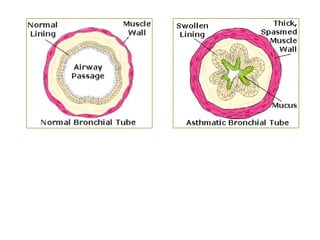
• Well recognized as an inflammatory
condition
– Chronic airway inflammation results in:
• increased smooth muscle cell proliferation and
hypertrophy leading to thickening of the airway wall
• increased mucous production
• airway edema
– End result is partial airway obstruction and
difficulty in airflow movement
Pathophysiology
• Other features:
– Presence of inflammatory mediators may
increase airway reactivity and induce
bronchospasm
• contraction of smooth muscle surrounding
medium-sized bronchi and bronchioles
Pathophysiology
• Inflammatory mediators include:
– histamine
– prostaglandins
– leukotrienes
– platelet-activating factors
– cytokines (interleukins)
Pathways Mediating Broncho-
constriction and Bronchodilation
• Bronchoconstriction:
– Cholinergic (vagal)
innervation
– Adenosine A1 receptors
 -Adrenergic pathways (not
well characterized)
– Irritant receptors
• Respond to noxious
chemicals, particulates, and
histamine
• Histamine is released by mast
cells in response to allergens
• Leukotrienes are most potent
bronchoconstrictors known
• Bronchodilation:
 -Adrenergic (2)
-Adrenergic
innervation of
bronchi is limited
• Noninnervated 2-
receptors are
prevalent on
bronchial smooth
muscle
– Adenosine A2 receptors
Traditional Asthma Theory
• Asthma was traditionally thought of as resulting from
altered adrenergic/cholinergic balance:
 2 Agonist drugs (albuterol, etc) give rapid, effective relief
in asthma attacks
– Cholinergic muscarinic antagonists also provide relief
(atropine, ipratropium bromide)
– Asthmatics appear to have partial blockade of -
adrenergic receptors (or a reduced or defective
population)
• Evidence against the -blockade theory of asthma
 -Blockade in normal subjects does not cause bronchial
hyperreactivity or asthma symptoms
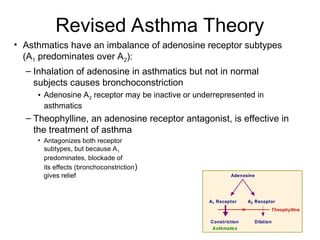
Revised Asthma Theory
• Asthmatics have an imbalance of adenosine receptor subtypes
(A1 predominates over A2):
– Inhalation of adenosine in asthmatics but not in normal
subjects causes bronchoconstriction
• Adenosine A2 receptor may be inactive or underrepresented in
asthmatics
– Theophylline, an adenosine receptor antagonist, is effective in
the treatment of asthma
• Antagonizes both receptor
subtypes, but because A1
predominates, blockade of
its effects (bronchoconstriction)
gives relief Adenosine
A1 Receptor A2 Receptor
Constriction Dilation
Asthmatics
Theophylline
Current Asthma Theory
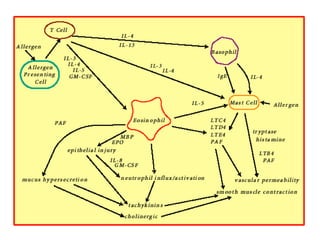
• Inflammatory mediators are responsible for
bronchoconstriction
– Leukotrienes, prostaglandins, cytokines (IL4, IL5)
• Released by macrophages, mast cells, T lymphocytes
• Promote the migration and activation of other inflammatory
cells, most notably eosinophils
• Eosinophils also release substances that damage tissue
and promote hyperreactivity
– Current and future therapies are directed at
interfering in these pathways
• Zafirlukast (Accolate) is LTD4 and LTE4 receptor blocker
• Zileuton (Zyflo) is a 5-lipoxygenase inhibitor that blocks LTD4
and LTE4 synthesis
Asthma: Diagnosis,
Classification and Goals of
Therapy
Diagnosis of Asthma
• Made on the basis of spirometry:
– Spirometry measurements (FEV 1 , FVC, FEV
1 /FVC) taken before and after the patient
inhales a short-acting bronchodilator
– Helps determine whether there is airflow obstruction
and whether it is reversible over the short term
– Generally valuable in children over age 4; however,
some children cannot conduct the maneuver
adequately until after age 7
Diagnosis of Asthma
• Made on the basis of spirometry:
– Measures the maximal volume of air forcibly exhaled from
the point of maximal inhalation (forced vital capacity,
FVC) and the volume of air exhaled during the first second
of the FVC (forced expiratory volume in 1 second, FEV 1 )
– Airflow obstruction is indicated by reduced FEV 1 and
FEV 1 /FVC values relative to reference or predicted values
– Significant reversibility is indicated by an increase of >12
percent and 200 mL in FEV 1 after inhaling a short-acting
bronchodilator
Diagnosis of Asthma
• Key indicators in patient history suggestive of
asthma and need for diagnostic spirometry
include:
– Wheezing—high-pitched whistling sounds when
breathing out—especially in children
– History of any of the following:
• Cough, worse particularly at night
• Recurrent wheeze; recurrent difficulty in breathing
• Recurrent chest tightness
• Reversible airflow limitation and diurnal variation as measured by
using a peak flow meter
Diagnosis of Asthma
• Key indicators in patient history suggestive of
asthma and need for diagnostic spirometry include:
– Symptoms occur or worsen in the presence of:
• Exercise; viral infection
• Animals with fur or feathers; house-dust mites (in mattresses, pillows,
upholstered furniture, carpets)
• Mold; pollen; smoke (tobacco, wood)
• Changes in weather; Strong emotional expression (laughing or crying hard)
• Airborne chemicals or dusts; Menses
– Symptoms occur or worsen at night, awakening the
patient
Classification of Asthma
• Based on severity:
– Step 1 = intermittent
– Step 2 = mild persistent
– Step 3 and 4 = moderate persistent
– Step 5 and 6 = severe persistent
• Refer to Tables in Asthma Guidelines
Goals of Therapy
• Prevent chronic symptoms
• Maintain normal/near normal pulmonary
function
• Maintain normal activity level
• Prevent recurrent exacerbations
• Minimize need of ER/hospital admissions
• Meet patients’ expectations of and
satisfaction with care
Management of Asthma
• 4 Components of Care:
– Environmental Control
– Objective monitoring of lung function
– Pharmacologic therapy
– Patient education
Environmental Control
• Identify and reduce exposure to allergens and
irritants
– cockroach antigens
– pet dander
– dust mites
– cigarette smoke
– Air Pollution
– Respiratory viral infections
– Chemical Irritants
Objective Monitoring
• Peak expiratory flow rate (PEFR):
– is the maximum flow rate that a person can generate during a
forced expiration
• measured in liters/minute
– three zones described
• green zone - asthma is under control
• yellow zone - warning of pending asthma exacerbation
• red zone - medical emergency
– monitoring recommended in all patients with step 3 and 4 asthma
– Refer to section on peak flow monitoring in Expert Panel III report
Objective Monitoring
• Peak expiratory flow rate (PEFR):
– Should record peak flow daily and determine
“zones” from personal best
– Use personal best and danger zones to guide self-
management of asthma exacerbations at home
– Use of peak flow and self-management plans has
been documented to decrease ER visits and
hospital admissions significantly
• See examples of self-management plans in Expert
Panel III report
Pharmacologic Therapy
• 3 goals of pharmacologic therapy
– prevent and control asthma symptoms
– decrease frequency/severity of
exacerbations
– reverse airflow obstruction
Pharmacologic Therapy
• 2 types of asthma medications:
– “quick relievers”
• short-acting beta 2 agonist inhalers
– “long-term “controllers”
• inhaled corticosteroids
• long acting beta 2 agonist inhalers
• oral beta 2 agonists
• Theophylline
• cromolyn/nedcromil
• leukotriene modifiers
Patient Education
• Key in helping patients control their asthma and
stay out of the hospital
• Should teach and reinforce at every
opportunity:
– Basic facts about asthma
– Roles of medications
– Skills: inhaler/spacer/holding chamber use, self-monitoring
– Environmental control measures
– When and how to take rescue actions

Unit_6_Asthma_Overview.ppt prevention diagnosis

  • 1.
  • 2.
    Introduction • Asthma Facts: –most common chronic disease in industrialized world – increasing in prevalence, incidence has doubled in US since 1980 – estimated 15 - 20 million in US affected – 5000 die each year from asthma exacerbations – average medical cost to manage a person with severe asthma = $18,000 annually – most common cause of lost work days and lost school days
  • 3.
    What is Asthma? •Definition of asthma (as defined in the NIH Expert Panel Report II) – a chronic inflammatory disease of the airways in which many cells/cellular elements play a role, including, mast cells eosinophils, T-lymphocytes, macrophages, neutrophils, and epithelial cells – airway inflammation causes recurrent episodes of wheezing, breathlessness, chest tightness, and coughing, particularly at night or in the early morning.
  • 4.
    What is asthma? •Asthma is a chronic inflammatory disorder of the airways causes recurrent episodes of coughing, wheezing, breathlessness, and chest tightness. • These episodes are usually associated with widespread but variable airflow obstruction that is often reversible either spontaneously or with treatment.
  • 5.
    Signs and Symptoms •Wheezing due to airstream turbulence and vibration of mucus • Rapid breathing and shortness of breath (dyspnea) • Coughing • Chest tightness • Hyperinflation of thorax, voluntary at first to dilate airways; secondarily as a result of incomplete emptying • Markedly reduced FEV1 (forced expiratory volume) • Attacks typically last from a few minutes to several hours and are often associated with exercise or sleep
  • 6.
    Etiology of Asthma •Two types of asthma have been described: – Extrinsic, or allergic asthma (aka atopic asthma) • Mediated by IgE • Usually begins in childhood, less common in adults • Usually associated with atopy • Sensitization to allergens is key feature – increased indoor play and exposure to indoor allergens? – Decreased childhood infections inhibits normal development of immune system leading to increases in allergic responses? – Intrinsic, or idiopathic asthma • More common in adults • Usually not associated with atopy • Patients may have nasal polyps, asprin sensitivity, sinusitis • Attacks may be precipitated by infection, exercise, inhaling cold air, emotional factors • Exercise-induced is most common form of intrinsic asthma
  • 7.
    Asthma Triggers • Canbe physical, chemical, environmental or pharmacologic in nature • Common triggers include: • mold • pollen • house dust mites • pet dander • cock roach antigens • cigarette smoke • perfume and other chemicals (e.g. cleaners) • viral infections • cold air • exercise • aspirin
  • 8.
    Pathophysiology • Well recognizedas an inflammatory condition – Chronic airway inflammation results in: • increased smooth muscle cell proliferation and hypertrophy leading to thickening of the airway wall • increased mucous production • airway edema – End result is partial airway obstruction and difficulty in airflow movement
  • 10.
    Pathophysiology • Other features: –Presence of inflammatory mediators may increase airway reactivity and induce bronchospasm • contraction of smooth muscle surrounding medium-sized bronchi and bronchioles
  • 11.
    Pathophysiology • Inflammatory mediatorsinclude: – histamine – prostaglandins – leukotrienes – platelet-activating factors – cytokines (interleukins)
  • 12.
    Pathways Mediating Broncho- constrictionand Bronchodilation • Bronchoconstriction: – Cholinergic (vagal) innervation – Adenosine A1 receptors  -Adrenergic pathways (not well characterized) – Irritant receptors • Respond to noxious chemicals, particulates, and histamine • Histamine is released by mast cells in response to allergens • Leukotrienes are most potent bronchoconstrictors known • Bronchodilation:  -Adrenergic (2) -Adrenergic innervation of bronchi is limited • Noninnervated 2- receptors are prevalent on bronchial smooth muscle – Adenosine A2 receptors
  • 13.
    Traditional Asthma Theory •Asthma was traditionally thought of as resulting from altered adrenergic/cholinergic balance:  2 Agonist drugs (albuterol, etc) give rapid, effective relief in asthma attacks – Cholinergic muscarinic antagonists also provide relief (atropine, ipratropium bromide) – Asthmatics appear to have partial blockade of - adrenergic receptors (or a reduced or defective population) • Evidence against the -blockade theory of asthma  -Blockade in normal subjects does not cause bronchial hyperreactivity or asthma symptoms
  • 14.
    Revised Asthma Theory •Asthmatics have an imbalance of adenosine receptor subtypes (A1 predominates over A2): – Inhalation of adenosine in asthmatics but not in normal subjects causes bronchoconstriction • Adenosine A2 receptor may be inactive or underrepresented in asthmatics – Theophylline, an adenosine receptor antagonist, is effective in the treatment of asthma • Antagonizes both receptor subtypes, but because A1 predominates, blockade of its effects (bronchoconstriction) gives relief Adenosine A1 Receptor A2 Receptor Constriction Dilation Asthmatics Theophylline
  • 15.
    Current Asthma Theory •Inflammatory mediators are responsible for bronchoconstriction – Leukotrienes, prostaglandins, cytokines (IL4, IL5) • Released by macrophages, mast cells, T lymphocytes • Promote the migration and activation of other inflammatory cells, most notably eosinophils • Eosinophils also release substances that damage tissue and promote hyperreactivity – Current and future therapies are directed at interfering in these pathways • Zafirlukast (Accolate) is LTD4 and LTE4 receptor blocker • Zileuton (Zyflo) is a 5-lipoxygenase inhibitor that blocks LTD4 and LTE4 synthesis
  • 17.
  • 18.
    Diagnosis of Asthma •Made on the basis of spirometry: – Spirometry measurements (FEV 1 , FVC, FEV 1 /FVC) taken before and after the patient inhales a short-acting bronchodilator – Helps determine whether there is airflow obstruction and whether it is reversible over the short term – Generally valuable in children over age 4; however, some children cannot conduct the maneuver adequately until after age 7
  • 19.
    Diagnosis of Asthma •Made on the basis of spirometry: – Measures the maximal volume of air forcibly exhaled from the point of maximal inhalation (forced vital capacity, FVC) and the volume of air exhaled during the first second of the FVC (forced expiratory volume in 1 second, FEV 1 ) – Airflow obstruction is indicated by reduced FEV 1 and FEV 1 /FVC values relative to reference or predicted values – Significant reversibility is indicated by an increase of >12 percent and 200 mL in FEV 1 after inhaling a short-acting bronchodilator
  • 20.
    Diagnosis of Asthma •Key indicators in patient history suggestive of asthma and need for diagnostic spirometry include: – Wheezing—high-pitched whistling sounds when breathing out—especially in children – History of any of the following: • Cough, worse particularly at night • Recurrent wheeze; recurrent difficulty in breathing • Recurrent chest tightness • Reversible airflow limitation and diurnal variation as measured by using a peak flow meter
  • 21.
    Diagnosis of Asthma •Key indicators in patient history suggestive of asthma and need for diagnostic spirometry include: – Symptoms occur or worsen in the presence of: • Exercise; viral infection • Animals with fur or feathers; house-dust mites (in mattresses, pillows, upholstered furniture, carpets) • Mold; pollen; smoke (tobacco, wood) • Changes in weather; Strong emotional expression (laughing or crying hard) • Airborne chemicals or dusts; Menses – Symptoms occur or worsen at night, awakening the patient
  • 22.
    Classification of Asthma •Based on severity: – Step 1 = intermittent – Step 2 = mild persistent – Step 3 and 4 = moderate persistent – Step 5 and 6 = severe persistent • Refer to Tables in Asthma Guidelines
  • 23.
    Goals of Therapy •Prevent chronic symptoms • Maintain normal/near normal pulmonary function • Maintain normal activity level • Prevent recurrent exacerbations • Minimize need of ER/hospital admissions • Meet patients’ expectations of and satisfaction with care
  • 24.
    Management of Asthma •4 Components of Care: – Environmental Control – Objective monitoring of lung function – Pharmacologic therapy – Patient education
  • 25.
    Environmental Control • Identifyand reduce exposure to allergens and irritants – cockroach antigens – pet dander – dust mites – cigarette smoke – Air Pollution – Respiratory viral infections – Chemical Irritants
  • 26.
    Objective Monitoring • Peakexpiratory flow rate (PEFR): – is the maximum flow rate that a person can generate during a forced expiration • measured in liters/minute – three zones described • green zone - asthma is under control • yellow zone - warning of pending asthma exacerbation • red zone - medical emergency – monitoring recommended in all patients with step 3 and 4 asthma – Refer to section on peak flow monitoring in Expert Panel III report
  • 27.
    Objective Monitoring • Peakexpiratory flow rate (PEFR): – Should record peak flow daily and determine “zones” from personal best – Use personal best and danger zones to guide self- management of asthma exacerbations at home – Use of peak flow and self-management plans has been documented to decrease ER visits and hospital admissions significantly • See examples of self-management plans in Expert Panel III report
  • 28.
    Pharmacologic Therapy • 3goals of pharmacologic therapy – prevent and control asthma symptoms – decrease frequency/severity of exacerbations – reverse airflow obstruction
  • 29.
    Pharmacologic Therapy • 2types of asthma medications: – “quick relievers” • short-acting beta 2 agonist inhalers – “long-term “controllers” • inhaled corticosteroids • long acting beta 2 agonist inhalers • oral beta 2 agonists • Theophylline • cromolyn/nedcromil • leukotriene modifiers
  • 30.
    Patient Education • Keyin helping patients control their asthma and stay out of the hospital • Should teach and reinforce at every opportunity: – Basic facts about asthma – Roles of medications – Skills: inhaler/spacer/holding chamber use, self-monitoring – Environmental control measures – When and how to take rescue actions