UNDERSTANDING
PRESENTED BY: JOEL P.
DANTE RN
OVERVIEW
Strokes occur due to problems with the blood
supply to the brain: either the blood supply is
blocked, or a blood vessel within the brain
ruptures, causing brain tissue to die. A stroke is
a medical emergency, and treatment must be
sought as quickly as possible.
Stroke is the 5th leading cause of death, with
one person dying every 4 minutes as a result.
For black people, stroke is the 3rd leading
cause of death.
Approximately 800,000 people have a stroke
each year; about one every 40 seconds. Only
heart diseases, chronic lower respiratory
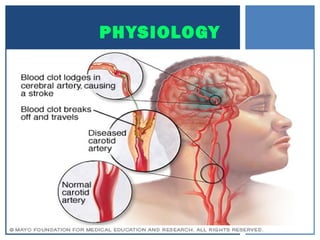
PHYSIOLOGY
WHAT IS STROKE?
Stroke occurs when the supply of
blood to the brain is either
interrupted or reduced. When this
happens, the brain does not get
enough oxygen or nutrients, which
causes brain cells to die.
TYPES OF STROKE
Ischemic strokes
Hemorrhagic strokes
Transient ischemic attacks
(TIAs), also referred to as mini-
strokes
CAUSES OF ISCHEMIC STROKE
Ischemic stroke is the most common
form, accounting for around 85
percent of strokes. This type of stroke
is caused by blockages or narrowing
of the arteries that provide blood to
the brain, resulting in ischemia -
severely reduced blood flow that
damages brain cells.
CAUSES OF HEMORRHAGIC
STROKE
Hemorrhagic strokes are caused by arteries
in the brain either leaking blood or
bursting open. The leaked blood puts
pressure on brain cells and damages them.
It also reduces the blood supply reaching
the brain tissue after the hemorrhage point.
Blood vessels can burst and spill blood
within the brain or near the surface of the
brain, sending blood into the space between
the brain and the skull.
CAUSES OF TIA's
TIAs are different from the kinds above
because the flow of blood to the brain is
only briefly interrupted. TIAs are similar
to ischemic strokes in that they are
often caused by blood clots or other
clots.
TIAs should be regarded as medical
emergencies just like the other kinds of
stroke, even if the blockage of the
artery and symptoms are temporary.
They serve as warning signs for future
SYMPTOMS OF STROKE
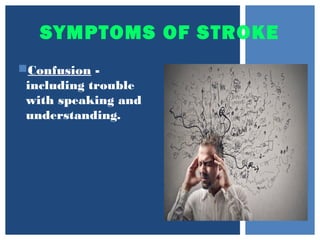
Confusion -
including trouble
with speaking and
understanding.
SYMPTOMS OF STROKE
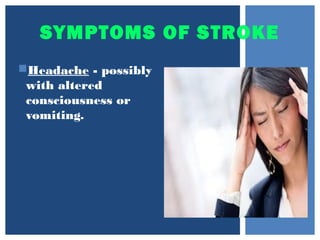
Headache - possibly
with altered
consciousness or
vomiting.
SYMPTOMS OF STROKE
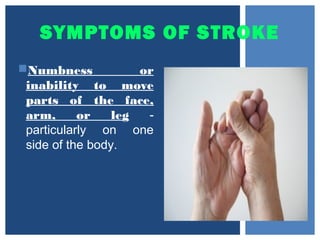
Numbness or
inability to move
parts of the face,
arm, or leg -
particularly on one
side of the body.
SYMPTOMS OF STROKE
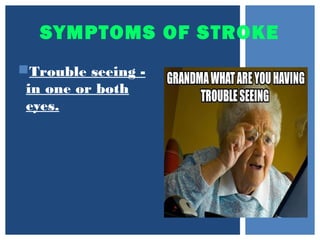
Trouble seeing -
in one or both
eyes.
SYMPTOMS OF STROKE
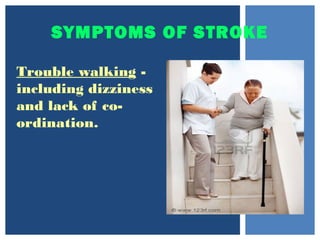
Trouble walking -
including dizziness
and lack of co-
ordination.
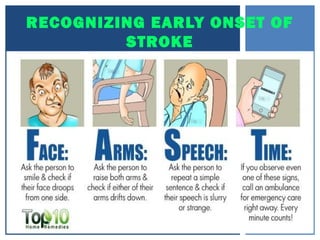
RECOGNIZING EARLY ONSET OF
STROKE
LIFESTYLE RISK FACTORS
Being overweight or obese
Physical inactivity
Heavy or binge drinking
Use of illicit drugs such as cocaine
and methamphetamines
MEDICAL RISK FACTORS
High blood pressure — the risk of stroke
begins to increase at blood pressure
readings higher than 120/80 millimeters
of mercury (mm Hg). Your doctor will
help you decide on a target blood
pressure based on your age, whether
you have diabetes and other factors.
Cigarette smoking or exposure to
secondhand smoke.
High cholesterol.
Diabetes.
MEDICAL RISK FACTORS
Obstructive sleep apnea — a sleep
disorder in which the oxygen level
intermittently drops during the night.
Cardiovascular disease, including heart
failure, heart defects, heart infection or
abnormal heart rhythm.Personal or
family history of stroke, heart attack or
transient ischemic attack.
Being age 55 or older.
Race — African-Americans have a higher
risk of stroke than do people of other
MEDICAL RISK FACTORS
Gender — Men have a higher risk of stroke
than women. Women are usually older when
they have strokes, and they're more likely to
die of strokes than are men. Also, they may
have some risk from some birth control pills or
hormone therapies that include estrogen, as
well as from pregnancy and childbirth.
DIAGNOSTIC TOOLS
Physical examination - a doctor will ask
about the patient's symptoms and medical
history. They may check blood pressures,
listen to the carotid arteries in the neck,
and examine the blood vessels at the back
of the eyes, all to check for indications of
clotting.
Blood tests - a doctor may perform blood
tests to find out how quickly the patient's
blood clots, the levels of particular
substances (including clotting factors) in
the blood, and whether or not the patient
DIANOSTIC TOOLS
MRI scan - radio waves and magnets create
an image of the brain to detect damaged
brain tissue.
Carotid ultrasound – an ultra sound scan to
check the blood flow in the carotid arteries
and to see if there is any plaque present.
Cerebral angiogram - dyes are injected into
the brain's blood vessels to make them
visible under X-ray, to give a detailed view
of the brain and neck blood vessels.
Echocardiogram - to check for any sources
of clots that could have traveled to the
TREATMENT
As the ischemic and hemorrhagic strokes
are caused by different factors, both
require different forms of treatment. It is
not only important that the type of stroke
is diagnosed quickly to reduce the damage
done to the brain, but also because
treatment suitable for one kind of stroke
can be harmful to someone who has had a
different kind.
DRUGS
SURGERY
ANGIOPLASTY
REHABILITATION
Strokes are life-changing events that can affect a
person both physically and emotionally,
temporarily or permanently. After a stroke,
successful recovery will often involve specific
rehabilitative activities. Rehabilitation is an
important and long part of treatment. With the
right help, rehabilitation to a normal quality of
life is possible, depending on the severity of the
stroke.
REHABILITATION
Speech therapy - to help with problems
producing or understanding speech.
Practice, relaxation, and changing
communication style, using gestures or
different tones for example, all help.
Physical therapy - to help a person
relearn movement and co-ordination. It
is important to get out and about, even
if it is difficult at first.
Occupational therapy - to help a person
to improve their ability to carry out
COMPLICATIONS
Paralysis or loss of muscle movement.
You may become paralyzed on one side
of your body, or lose control of certain
muscles, such as those on one side of
your face or one arm. Physical therapy
may help you return to activities
hampered by paralysis, such as walking,
eating and dressing.
COMPLICATIONS
Difficulty talking or swallowing. A stroke may
cause you to have less control over the way
the muscles in your mouth and throat move,
making it difficult for you to talk clearly
(dysarthria), swallow or eat (dysphagia). You
also may have difficulty with language
(aphasia), including speaking or
understanding speech, reading or writing.
Therapy with a speech and language
pathologist may help.
COMPLICATIONS
Memory loss or thinking difficulties.
Many people who have had strokes
experience some memory loss. Others
may have difficulty thinking, making
judgments, reasoning and
understanding concepts.
COMPLICATIONS
Emotional problems. People who have had
strokes may have more difficulty controlling
their emotions, or they may develop
depression.
Pain. People who have had strokes may have
pain, numbness or other strange sensations in
parts of their bodies affected by stroke. For
example, if a stroke causes you to lose feeling
in your left arm, you may develop an
uncomfortable tingling sensation in that arm.
COMPLICATIONS
People also may be sensitive to temperature
changes, especially extreme cold after a
stroke. This complication is known as central
stroke pain or central pain syndrome. This
condition generally develops several weeks
after a stroke, and it may improve over time.
But because the pain is caused by a problem
in your brain, rather than a physical injury,
there are few treatments.
COMPLICATIONS
Changes in behavior and self-care
ability. People who have had strokes
may become more withdrawn and less
social or more impulsive. They may need
help with grooming and daily chores.
REHABILITATION
Joining a support group - to help with
common problems such as depression
that can occur after a stroke. Many find
it useful to share common experiences
and exchange information.
Support from friends and family - to
provide practical support and comfort.
Letting friends and family know what
can be done to help is very important.
PREVENTION
Eating a healthy diet.
Maintaining a healthy weight.
Exercise regularly.
Don't smoke.
Avoiding alcohol or drink
moderately.Keeping blood pressure
under control.
Managing diabetis.
Treating obtructive sleep apnea (if
present).
RESOURCES
MEDICAL NEWS TODAY – JAMES MCINTOSH
NANCY CHOI MD
GOOGLE PICS
TOP10HOMEMEDS
MAYOCLINIC.ORG

Stroke

  • 1.
  • 2.
    OVERVIEW Strokes occur dueto problems with the blood supply to the brain: either the blood supply is blocked, or a blood vessel within the brain ruptures, causing brain tissue to die. A stroke is a medical emergency, and treatment must be sought as quickly as possible. Stroke is the 5th leading cause of death, with one person dying every 4 minutes as a result. For black people, stroke is the 3rd leading cause of death. Approximately 800,000 people have a stroke each year; about one every 40 seconds. Only heart diseases, chronic lower respiratory
  • 3.
  • 4.
    WHAT IS STROKE? Strokeoccurs when the supply of blood to the brain is either interrupted or reduced. When this happens, the brain does not get enough oxygen or nutrients, which causes brain cells to die.
  • 5.
    TYPES OF STROKE Ischemicstrokes Hemorrhagic strokes Transient ischemic attacks (TIAs), also referred to as mini- strokes
  • 6.
    CAUSES OF ISCHEMICSTROKE Ischemic stroke is the most common form, accounting for around 85 percent of strokes. This type of stroke is caused by blockages or narrowing of the arteries that provide blood to the brain, resulting in ischemia - severely reduced blood flow that damages brain cells.
  • 7.
    CAUSES OF HEMORRHAGIC STROKE Hemorrhagicstrokes are caused by arteries in the brain either leaking blood or bursting open. The leaked blood puts pressure on brain cells and damages them. It also reduces the blood supply reaching the brain tissue after the hemorrhage point. Blood vessels can burst and spill blood within the brain or near the surface of the brain, sending blood into the space between the brain and the skull.
  • 8.
    CAUSES OF TIA's TIAsare different from the kinds above because the flow of blood to the brain is only briefly interrupted. TIAs are similar to ischemic strokes in that they are often caused by blood clots or other clots. TIAs should be regarded as medical emergencies just like the other kinds of stroke, even if the blockage of the artery and symptoms are temporary. They serve as warning signs for future
  • 9.
    SYMPTOMS OF STROKE Confusion- including trouble with speaking and understanding.
  • 10.
    SYMPTOMS OF STROKE Headache- possibly with altered consciousness or vomiting.
  • 11.
    SYMPTOMS OF STROKE Numbnessor inability to move parts of the face, arm, or leg - particularly on one side of the body.
  • 12.
    SYMPTOMS OF STROKE Troubleseeing - in one or both eyes.
  • 13.
    SYMPTOMS OF STROKE Troublewalking - including dizziness and lack of co- ordination.
  • 14.
  • 15.
    LIFESTYLE RISK FACTORS Beingoverweight or obese Physical inactivity Heavy or binge drinking Use of illicit drugs such as cocaine and methamphetamines
  • 16.
    MEDICAL RISK FACTORS Highblood pressure — the risk of stroke begins to increase at blood pressure readings higher than 120/80 millimeters of mercury (mm Hg). Your doctor will help you decide on a target blood pressure based on your age, whether you have diabetes and other factors. Cigarette smoking or exposure to secondhand smoke. High cholesterol. Diabetes.
  • 17.
    MEDICAL RISK FACTORS Obstructivesleep apnea — a sleep disorder in which the oxygen level intermittently drops during the night. Cardiovascular disease, including heart failure, heart defects, heart infection or abnormal heart rhythm.Personal or family history of stroke, heart attack or transient ischemic attack. Being age 55 or older. Race — African-Americans have a higher risk of stroke than do people of other
  • 18.
    MEDICAL RISK FACTORS Gender— Men have a higher risk of stroke than women. Women are usually older when they have strokes, and they're more likely to die of strokes than are men. Also, they may have some risk from some birth control pills or hormone therapies that include estrogen, as well as from pregnancy and childbirth.
  • 19.
    DIAGNOSTIC TOOLS Physical examination- a doctor will ask about the patient's symptoms and medical history. They may check blood pressures, listen to the carotid arteries in the neck, and examine the blood vessels at the back of the eyes, all to check for indications of clotting. Blood tests - a doctor may perform blood tests to find out how quickly the patient's blood clots, the levels of particular substances (including clotting factors) in the blood, and whether or not the patient
  • 20.
    DIANOSTIC TOOLS MRI scan- radio waves and magnets create an image of the brain to detect damaged brain tissue. Carotid ultrasound – an ultra sound scan to check the blood flow in the carotid arteries and to see if there is any plaque present. Cerebral angiogram - dyes are injected into the brain's blood vessels to make them visible under X-ray, to give a detailed view of the brain and neck blood vessels. Echocardiogram - to check for any sources of clots that could have traveled to the
  • 21.
    TREATMENT As the ischemicand hemorrhagic strokes are caused by different factors, both require different forms of treatment. It is not only important that the type of stroke is diagnosed quickly to reduce the damage done to the brain, but also because treatment suitable for one kind of stroke can be harmful to someone who has had a different kind. DRUGS SURGERY ANGIOPLASTY
  • 22.
    REHABILITATION Strokes are life-changingevents that can affect a person both physically and emotionally, temporarily or permanently. After a stroke, successful recovery will often involve specific rehabilitative activities. Rehabilitation is an important and long part of treatment. With the right help, rehabilitation to a normal quality of life is possible, depending on the severity of the stroke.
  • 23.
    REHABILITATION Speech therapy -to help with problems producing or understanding speech. Practice, relaxation, and changing communication style, using gestures or different tones for example, all help. Physical therapy - to help a person relearn movement and co-ordination. It is important to get out and about, even if it is difficult at first. Occupational therapy - to help a person to improve their ability to carry out
  • 24.
    COMPLICATIONS Paralysis or lossof muscle movement. You may become paralyzed on one side of your body, or lose control of certain muscles, such as those on one side of your face or one arm. Physical therapy may help you return to activities hampered by paralysis, such as walking, eating and dressing.
  • 25.
    COMPLICATIONS Difficulty talking orswallowing. A stroke may cause you to have less control over the way the muscles in your mouth and throat move, making it difficult for you to talk clearly (dysarthria), swallow or eat (dysphagia). You also may have difficulty with language (aphasia), including speaking or understanding speech, reading or writing. Therapy with a speech and language pathologist may help.
  • 26.
    COMPLICATIONS Memory loss orthinking difficulties. Many people who have had strokes experience some memory loss. Others may have difficulty thinking, making judgments, reasoning and understanding concepts.
  • 27.
    COMPLICATIONS Emotional problems. Peoplewho have had strokes may have more difficulty controlling their emotions, or they may develop depression. Pain. People who have had strokes may have pain, numbness or other strange sensations in parts of their bodies affected by stroke. For example, if a stroke causes you to lose feeling in your left arm, you may develop an uncomfortable tingling sensation in that arm.
  • 28.
    COMPLICATIONS People also maybe sensitive to temperature changes, especially extreme cold after a stroke. This complication is known as central stroke pain or central pain syndrome. This condition generally develops several weeks after a stroke, and it may improve over time. But because the pain is caused by a problem in your brain, rather than a physical injury, there are few treatments.
  • 29.
    COMPLICATIONS Changes in behaviorand self-care ability. People who have had strokes may become more withdrawn and less social or more impulsive. They may need help with grooming and daily chores.
  • 30.
    REHABILITATION Joining a supportgroup - to help with common problems such as depression that can occur after a stroke. Many find it useful to share common experiences and exchange information. Support from friends and family - to provide practical support and comfort. Letting friends and family know what can be done to help is very important.
  • 31.
    PREVENTION Eating a healthydiet. Maintaining a healthy weight. Exercise regularly. Don't smoke. Avoiding alcohol or drink moderately.Keeping blood pressure under control. Managing diabetis. Treating obtructive sleep apnea (if present).
  • 32.
    RESOURCES MEDICAL NEWS TODAY– JAMES MCINTOSH NANCY CHOI MD GOOGLE PICS TOP10HOMEMEDS MAYOCLINIC.ORG