Group#: 5
Case 2, Week 3
Qussi J. Al-Rebh
TUESDAY 8/9/2016
Cerebrovascular disease!
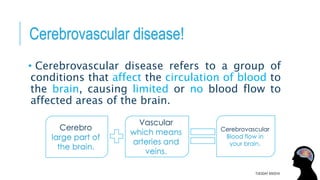
• Cerebrovascular disease refers to a group of
conditions that affect the circulation of blood to
the brain, causing limited or no blood flow to
affected areas of the brain.
TUESDAY 8/9/2016
Cerebrovascular
Blood flow in
your brain.
Vascular
which means
arteries and
veins.
Cerebro
large part of
the brain.
Case scenario
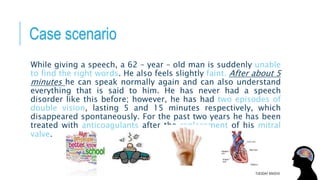
While giving a speech, a 62 – year – old man is suddenly unable
to find the right words. He also feels slightly faint. After about 5
minutes he can speak normally again and can also understand
everything that is said to him. He has never had a speech
disorder like this before; however, he has had two episodes of
double vision, lasting 5 and 15 minutes respectively, which
disappeared spontaneously. For the past two years he has been
treated with anticoagulants after the replacement of his mitral
valve.
TUESDAY 8/9/2016
Learning Objectives
• What are these Episodes called and what
is the probable cause in this patient?
• How can the episodes of double vision be
explained?
TUESDAY 8/9/2016
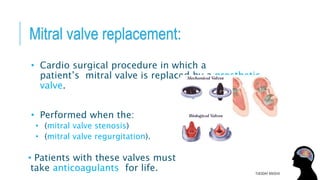
Mitral valve replacement:
• Cardio surgical procedure in which a
patient’s mitral valve is replaced by a prosthetic
valve.
• Performed when the:
• (mitral valve stenosis)
• (mitral valve regurgitation).
• Patients with these valves must
take anticoagulants for life. TUESDAY 8/9/2016
Anticoagulation drugs:
• Prevent blood clots from forming and growing
and reduce the risk for heart attack, stroke and
blockages in the arteries and veins
• Insufficient dosage of anticoagulant makes the
patient susceptible to embolic events
TUESDAY 8/9/2016
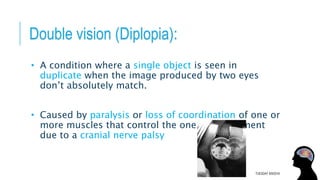
Double vision (Diplopia):
• A condition where a single object is seen in
duplicate when the image produced by two eyes
don’t absolutely match.
• Caused by paralysis or loss of coordination of one or
more muscles that control the one eye movement
due to a cranial nerve palsy
TUESDAY 8/9/2016
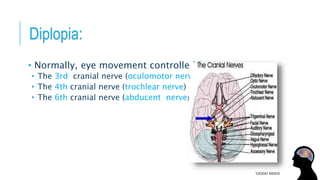
Diplopia:
• Normally, eye movement controlled by :
• The 3rd cranial nerve (oculomotor nerve)
• The 4th cranial nerve (trochlear nerve)
• The 6th cranial nerve (abducent nerve)
TUESDAY 8/9/2016
Pathophysiology of diplopia:
TUESDAY 8/9/2016
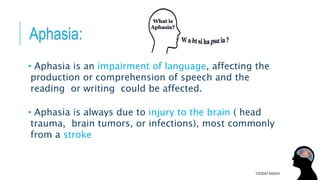
Aphasia:
• Aphasia is an impairment of language, affecting the
production or comprehension of speech and the
reading or writing could be affected.
• Aphasia is always due to injury to the brain ( head
trauma, brain tumors, or infections), most commonly
from a stroke
TUESDAY 8/9/2016
Aphasia:
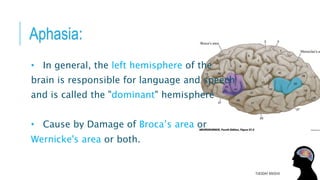
• In general, the left hemisphere of the
brain is responsible for language and speech
and is called the "dominant" hemisphere
• Cause by Damage of Broca’s area or
Wernicke's area or both.
TUESDAY 8/9/2016
Aphasia:
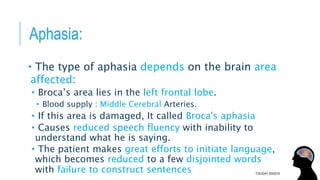
• The type of aphasia depends on the brain area
affected:
• Broca’s area lies in the left frontal lobe.
• Blood supply : Middle Cerebral Arteries.
• If this area is damaged, It called Broca's aphasia
• Causes reduced speech fluency with inability to
understand what he is saying.
• The patient makes great efforts to initiate language,
which becomes reduced to a few disjointed words
with failure to construct sentences TUESDAY 8/9/2016
Aphasia:
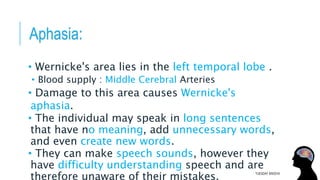
• Wernicke's area lies in the left temporal lobe .
• Blood supply : Middle Cerebral Arteries
• Damage to this area causes Wernicke's
aphasia.
• The individual may speak in long sentences
that have no meaning, add unnecessary words,
and even create new words.
• They can make speech sounds, however they
have difficulty understanding speech and are
therefore unaware of their mistakes. TUESDAY 8/9/2016
Aphasia:
• Global (central) aphasia:
• The combination of Broca’s comprehension of
Wernicke’s with loss of both language
production and understanding.
• aphasia and the loss of This is due to
widespread damage to speech areas
• And is the commonest aphasia
TUESDAY 8/9/2016
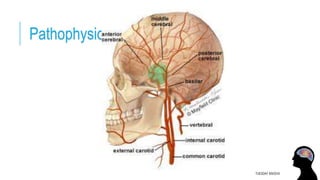
Aphasia Pathophysiology:
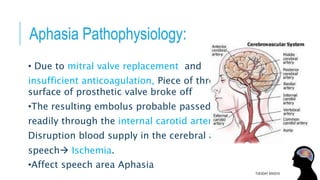
• Due to mitral valve replacement and
insufficient anticoagulation, Piece of thrombus on the
surface of prosthetic valve broke off
•The resulting embolus probable passed
readily through the internal carotid artery
Disruption blood supply in the cerebral area of
speech Ischemia.
•Affect speech area Aphasia
TUESDAY 8/9/2016
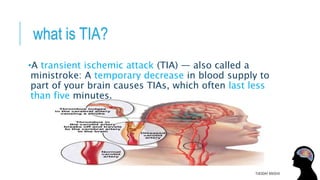
what is TIA?
•A transient ischemic attack (TIA) — also called a
ministroke: A temporary decrease in blood supply to
part of your brain causes TIAs, which often last less
than five minutes.
TUESDAY 8/9/2016
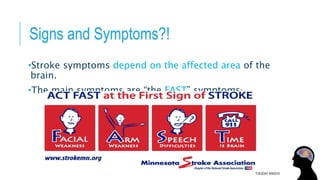
Signs and Symptoms?!
•Stroke symptoms depend on the affected area of the
brain.
•The main symptoms are “the FAST” symptoms:
TUESDAY 8/9/2016
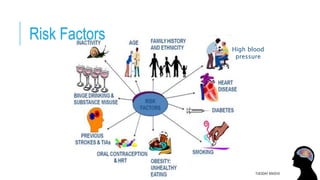
Risk Factors
TUESDAY 8/9/2016
High blood
pressure
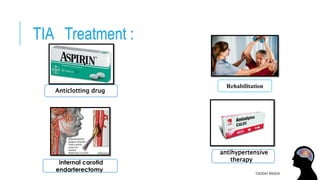
TIA Treatment :
TUESDAY 8/9/2016
Anticlotting drug
antihypertensive
therapyinternal carotid
endarterectomy
Rehabilitation
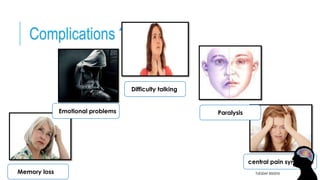
Complications ?!
TUESDAY 8/9/2016
ParalysisEmotional problems
Difficulty talking
central pain syndrome
Memory loss
summary
• When the single object duplicated, we call it diplopia.
• Inability to find the right words or to talk called
aphasia.
• Which has 3types: Broca’s aphasia, Wernicke aphasia, and
global apasia.
• TIA is a temporary decrease in the blood supply in the
brain.
• One of the main causes of TIA in the heart patients is
insufficient using of anticoagulation drugs.
• The signs and symptoms are “FACT symptoms”. TUESDAY 8/9/2016
References
• http://www.medicalnewstoday.com/articles/184601.php
• http://www.aans.org/Patient%20Information/Conditions%20and%20Tr
eatments/Cerebrovascular%20Disease.aspx
• http://www.stroke.org/site/PageServer?pagename=stroke
• http://www.nhlbi.nih.gov/health/health-
topics/topics/stroke/signs.html
• http://www.medicinenet.com/stroke_symptoms_and_treatment/page
6.htm
• http://www.mayoclinic.org/diseasesconditions/stroke/basics/definiti
on/con-20042884
• http://www.uptodate.com/contents/stroke-symptoms-and-
diagnosis-beyond-the-basics
• http://www.nhsggc.org.uk/content/default.asp?page=s1418_1_1
• http://en.wikipedia.org/wiki/Hypoglycemia
• Clinical medicine chapter 22 TUESDAY 8/9/2016
TUESDAY 8/9/2016

Cerebrovascular disease / KFU- 2.1

  • 1.
    Group#: 5 Case 2,Week 3 Qussi J. Al-Rebh TUESDAY 8/9/2016
  • 2.
    Cerebrovascular disease! • Cerebrovasculardisease refers to a group of conditions that affect the circulation of blood to the brain, causing limited or no blood flow to affected areas of the brain. TUESDAY 8/9/2016 Cerebrovascular Blood flow in your brain. Vascular which means arteries and veins. Cerebro large part of the brain.
  • 3.
    Case scenario While givinga speech, a 62 – year – old man is suddenly unable to find the right words. He also feels slightly faint. After about 5 minutes he can speak normally again and can also understand everything that is said to him. He has never had a speech disorder like this before; however, he has had two episodes of double vision, lasting 5 and 15 minutes respectively, which disappeared spontaneously. For the past two years he has been treated with anticoagulants after the replacement of his mitral valve. TUESDAY 8/9/2016
  • 4.
    Learning Objectives • Whatare these Episodes called and what is the probable cause in this patient? • How can the episodes of double vision be explained? TUESDAY 8/9/2016
  • 5.
    Mitral valve replacement: •Cardio surgical procedure in which a patient’s mitral valve is replaced by a prosthetic valve. • Performed when the: • (mitral valve stenosis) • (mitral valve regurgitation). • Patients with these valves must take anticoagulants for life. TUESDAY 8/9/2016
  • 6.
    Anticoagulation drugs: • Preventblood clots from forming and growing and reduce the risk for heart attack, stroke and blockages in the arteries and veins • Insufficient dosage of anticoagulant makes the patient susceptible to embolic events TUESDAY 8/9/2016
  • 7.
    Double vision (Diplopia): •A condition where a single object is seen in duplicate when the image produced by two eyes don’t absolutely match. • Caused by paralysis or loss of coordination of one or more muscles that control the one eye movement due to a cranial nerve palsy TUESDAY 8/9/2016
  • 8.
    Diplopia: • Normally, eyemovement controlled by : • The 3rd cranial nerve (oculomotor nerve) • The 4th cranial nerve (trochlear nerve) • The 6th cranial nerve (abducent nerve) TUESDAY 8/9/2016
  • 9.
  • 10.
    Aphasia: • Aphasia isan impairment of language, affecting the production or comprehension of speech and the reading or writing could be affected. • Aphasia is always due to injury to the brain ( head trauma, brain tumors, or infections), most commonly from a stroke TUESDAY 8/9/2016
  • 11.
    Aphasia: • In general,the left hemisphere of the brain is responsible for language and speech and is called the "dominant" hemisphere • Cause by Damage of Broca’s area or Wernicke's area or both. TUESDAY 8/9/2016
  • 12.
    Aphasia: • The typeof aphasia depends on the brain area affected: • Broca’s area lies in the left frontal lobe. • Blood supply : Middle Cerebral Arteries. • If this area is damaged, It called Broca's aphasia • Causes reduced speech fluency with inability to understand what he is saying. • The patient makes great efforts to initiate language, which becomes reduced to a few disjointed words with failure to construct sentences TUESDAY 8/9/2016
  • 13.
    Aphasia: • Wernicke's arealies in the left temporal lobe . • Blood supply : Middle Cerebral Arteries • Damage to this area causes Wernicke's aphasia. • The individual may speak in long sentences that have no meaning, add unnecessary words, and even create new words. • They can make speech sounds, however they have difficulty understanding speech and are therefore unaware of their mistakes. TUESDAY 8/9/2016
  • 14.
    Aphasia: • Global (central)aphasia: • The combination of Broca’s comprehension of Wernicke’s with loss of both language production and understanding. • aphasia and the loss of This is due to widespread damage to speech areas • And is the commonest aphasia TUESDAY 8/9/2016
  • 15.
    Aphasia Pathophysiology: • Dueto mitral valve replacement and insufficient anticoagulation, Piece of thrombus on the surface of prosthetic valve broke off •The resulting embolus probable passed readily through the internal carotid artery Disruption blood supply in the cerebral area of speech Ischemia. •Affect speech area Aphasia TUESDAY 8/9/2016
  • 16.
    what is TIA? •Atransient ischemic attack (TIA) — also called a ministroke: A temporary decrease in blood supply to part of your brain causes TIAs, which often last less than five minutes. TUESDAY 8/9/2016
  • 17.
    Signs and Symptoms?! •Strokesymptoms depend on the affected area of the brain. •The main symptoms are “the FAST” symptoms: TUESDAY 8/9/2016
  • 18.
  • 19.
    TIA Treatment : TUESDAY8/9/2016 Anticlotting drug antihypertensive therapyinternal carotid endarterectomy Rehabilitation
  • 20.
    Complications ?! TUESDAY 8/9/2016 ParalysisEmotionalproblems Difficulty talking central pain syndrome Memory loss
  • 21.
    summary • When thesingle object duplicated, we call it diplopia. • Inability to find the right words or to talk called aphasia. • Which has 3types: Broca’s aphasia, Wernicke aphasia, and global apasia. • TIA is a temporary decrease in the blood supply in the brain. • One of the main causes of TIA in the heart patients is insufficient using of anticoagulation drugs. • The signs and symptoms are “FACT symptoms”. TUESDAY 8/9/2016
  • 22.
    References • http://www.medicalnewstoday.com/articles/184601.php • http://www.aans.org/Patient%20Information/Conditions%20and%20Tr eatments/Cerebrovascular%20Disease.aspx •http://www.stroke.org/site/PageServer?pagename=stroke • http://www.nhlbi.nih.gov/health/health- topics/topics/stroke/signs.html • http://www.medicinenet.com/stroke_symptoms_and_treatment/page 6.htm • http://www.mayoclinic.org/diseasesconditions/stroke/basics/definiti on/con-20042884 • http://www.uptodate.com/contents/stroke-symptoms-and- diagnosis-beyond-the-basics • http://www.nhsggc.org.uk/content/default.asp?page=s1418_1_1 • http://en.wikipedia.org/wiki/Hypoglycemia • Clinical medicine chapter 22 TUESDAY 8/9/2016
  • 23.

Editor's Notes

  • #4 Faint: a sudden loss of consciousness
  • #9 Oculomotor nerve : origin from anterior surface of midbrain , action raises upper eyelid, turns eyeball upward, downward and medially . Trochlear nerve : origin posterior surface of midbrain, Action: turning eyeball downward and laterally. Abducens nerve : origin from groove between pons and medulla oblongata, Action :turns eyeball laterally.
  • #10 Due to mitral valve replacement and insufficient anticoagulation Piece of thrombus on the surface of prosthetic valve broke off Embolus traveled through posterior circulation disruption of brain stem blood flow either (mid brain, pons, or medulla) Brain stem ischemia Affect cranial nerves  responsible for eye movements III, IV, VI Diplopia
  • #11 Sometimes temporary episodes of aphasia can occur. These can be due to migraines, seizures or a transient ischemic attack (TIA
  • #12 Wernicke's area :It is involved in the production of written and spoken language, area 22- tempral Broca's area : Language processing has been linked to Broca's area , area 44+45=frontal
  • #18 5-Dizziness, trouble walking, loss of balance or coordination, and unexplained falls. 6-Loss of consciousness. 3-Trouble seeing in one or both eyes. 7-Sudden and severe headache. Problems breathing
  • #19 2-Smoking can damage blood vessels and raise blood pressure. 4- Heart diseases Coronary heart disease, cardiomyopathy, heart failure, and atrial fibrillation can cause blood clots that can lead to a stroke. 5- Age and gender. Your risk of stroke increases as you get older. Men are more likely than women to have strokes. High blood pressure is the main risk factor for stroke. 2-Smoking 3-Diabetes. 4- Heart diseases. 5- Age and gender. 6- Race and ethnicity. 7- Personal or family history of stroke. 8- Stress and depression. 9- Obesity.
  • #20  assess : airway , swallowing , BP , Oxygen and conscious Aspirin prevents blood clots from forming Antihypertensive : control BP Anticoaulative : prevent recreant stroke Internal carotid endarterectomy: with intirnal caroted stenosis and TIA reduce the risk of recreant stroke 75% . Angioplasty is alternative treatment
  • #21 stroke can sometimes cause temporary or permanent disabilities, depending on how long the brain lacks blood flow and which part was affected People also may be sensitive to temperature changes, especially extreme cold (central stroke pain or central pain syndrome). This complication generally develops several weeks after a stroke, and it may improve over time. But because the pain is caused by a problem in your brain, instead of a physical injury, there are few treatments