


BREEDING OF
POMEGRANATE
Lecture #8
•Botanical name: Punica granatum L.
•Family: Punicaceae
•Chromosome number : 2n = 2x =18
•Origin: Iran
• Centre of diversity
• Pomegranate is native of Iran and cultivated
extensively in the Mediterranean countries like
Spain, Morocco, Egypt, Iran, Afghanistan and
Baluchistan.
• It is also grown to some extent in Burma, China,
Japan, USA, USSR and India.
• Germplasm resources
• Being cross pollinated crop, a lot of variability exists
in seedling populations, which can be utilized in
further improvement programme.
• At present 150 genotypes of pomegranate have
been maintained at Central Institute of Arid
Horticulture, Bikaner.
• Out of these genotypes, 55 are deciduous and rest
95 are of evergreen in nature.
• Field gene banks of pomegranate are maintained at
Abohar, Rahuri, Bikaner, Bangalore, Allahabad,
Jodhpur and Ludhiana.
• Objectives
• To develop suitable types which produce small soft
seeds with attractive red (pink) aril.
• To develop easily manageable upright growth habit of
the tree.
• To develop thornlessness in the twigs, a desirable
character as it helps in cultural management of the
tree.
• To develop varieties resistant to fruit borer (Virachola
isocrates) and fruit rot (Phomopsis sp.)
• To develop varieties free from fruit cracking, aril
blackening.
• Identification and development of suitable varieties for
cold arid region.
• Varieties with longer steerage life.
• Breeding methods and achievements
• Some important cultivars including soft seeded ,
dark red grained types, viz. Wonderful from the
USA.
• A.Males, Be Hastah, A Alah, A Agha, Mohammed
Ali, A Post Sephid Sirin from Iran.
• Ranninj G-1-8-23, Rannyij G-1-3-34, Chereny,
Gulsha Red, JG-1-8-7 from USSR and few cultivars
from Tunisia have been introduced.
• At Hisar, cultivar Shirin Anar and Russian Seedling
were found resistant to bacterial leaf spot.
• A pomegranate line of Iranian origin has been
identified at Rahuri which has dark pink arils, soft
seeds and high TSS.
Selection:
• On the basis of yield and physico-chemical
characters of fruits, number of cultivars have been
recommended for commercial cultivation in
different states of India,viz.
• Ganesh, G-137,P-23,P-26 and Muscat in
Maharashtra,
• Bassein Seedless, Jyothi and Madhugiri in
Karnataka, Dholka in Gujarat,
• Jalore Seedless, Jodhpur Red , and Jodhpuri White
in Rajasthan and
• Kabul Red, Vellodu, Yercaud 1, and Co-1 in
TamilNadu.
• Clonal Selection
• G-137 is a superior clonal selection over Ganesh,
other clones are also superior i.e.G-107,G-132,G-
133.
• Hybridization
• In order to incorporate blood red color of Russian
types into Ganesh, several crosses were made at
Rahuri in 1976.
• seven had deep red aril color but the seeds were
hard and inferior in taste than Ganesh.
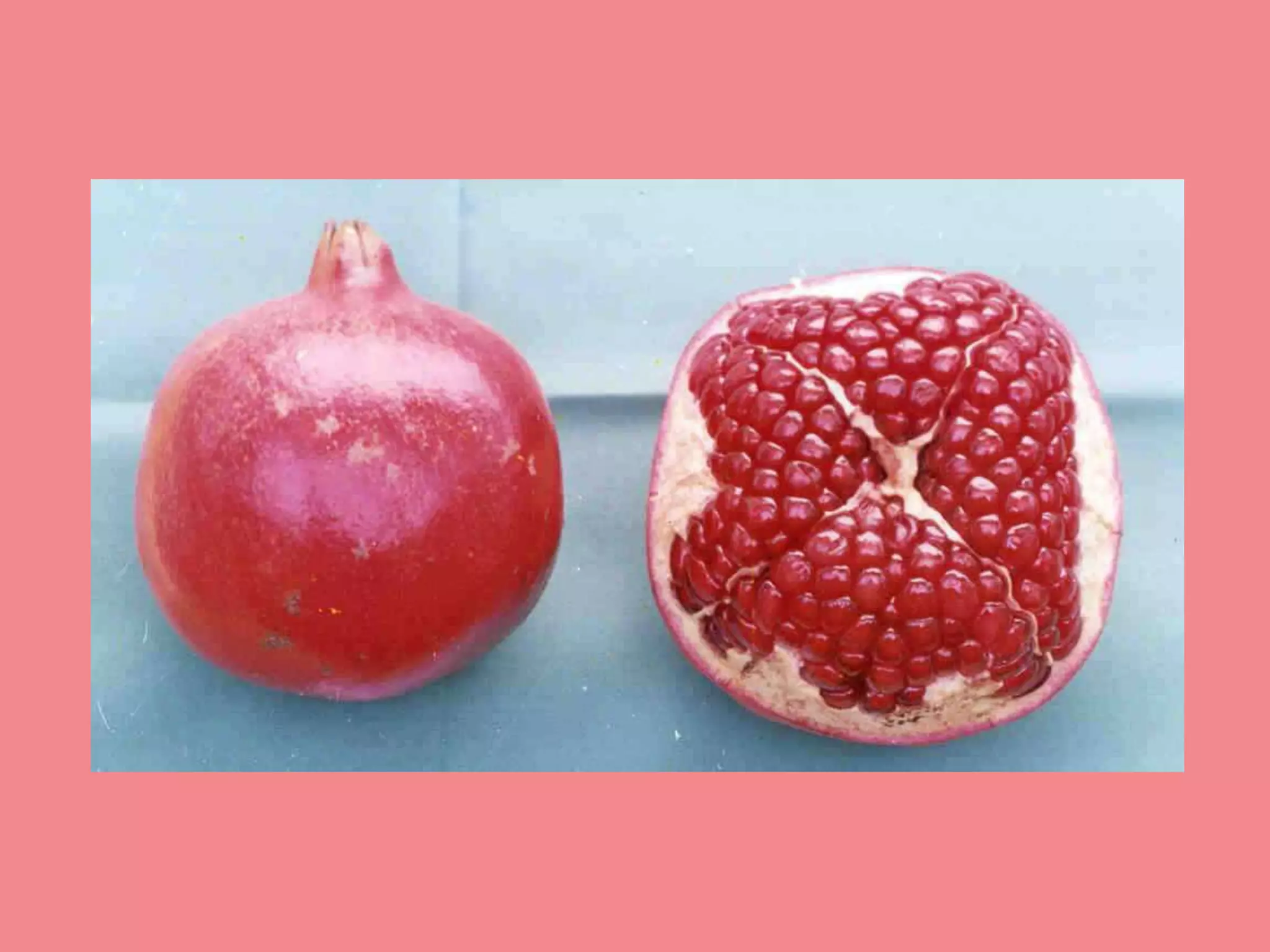
• A promising line from the F2 population (No.61)
combining desirable quality attributes has been
released by the name Mridula (Ganesh x Gulsha
Rose Pink).
Breeding of pomegranate

Breeding of pomegranate

  • 1.
  • 2.
    •Botanical name: Punicagranatum L. •Family: Punicaceae •Chromosome number : 2n = 2x =18 •Origin: Iran
  • 3.
    • Centre ofdiversity • Pomegranate is native of Iran and cultivated extensively in the Mediterranean countries like Spain, Morocco, Egypt, Iran, Afghanistan and Baluchistan. • It is also grown to some extent in Burma, China, Japan, USA, USSR and India.
  • 4.
    • Germplasm resources •Being cross pollinated crop, a lot of variability exists in seedling populations, which can be utilized in further improvement programme. • At present 150 genotypes of pomegranate have been maintained at Central Institute of Arid Horticulture, Bikaner. • Out of these genotypes, 55 are deciduous and rest 95 are of evergreen in nature. • Field gene banks of pomegranate are maintained at Abohar, Rahuri, Bikaner, Bangalore, Allahabad, Jodhpur and Ludhiana.
  • 5.
    • Objectives • Todevelop suitable types which produce small soft seeds with attractive red (pink) aril. • To develop easily manageable upright growth habit of the tree. • To develop thornlessness in the twigs, a desirable character as it helps in cultural management of the tree. • To develop varieties resistant to fruit borer (Virachola isocrates) and fruit rot (Phomopsis sp.) • To develop varieties free from fruit cracking, aril blackening. • Identification and development of suitable varieties for cold arid region. • Varieties with longer steerage life.
  • 6.
    • Breeding methodsand achievements • Some important cultivars including soft seeded , dark red grained types, viz. Wonderful from the USA. • A.Males, Be Hastah, A Alah, A Agha, Mohammed Ali, A Post Sephid Sirin from Iran. • Ranninj G-1-8-23, Rannyij G-1-3-34, Chereny, Gulsha Red, JG-1-8-7 from USSR and few cultivars from Tunisia have been introduced. • At Hisar, cultivar Shirin Anar and Russian Seedling were found resistant to bacterial leaf spot. • A pomegranate line of Iranian origin has been identified at Rahuri which has dark pink arils, soft seeds and high TSS.
  • 7.
    Selection: • On thebasis of yield and physico-chemical characters of fruits, number of cultivars have been recommended for commercial cultivation in different states of India,viz. • Ganesh, G-137,P-23,P-26 and Muscat in Maharashtra, • Bassein Seedless, Jyothi and Madhugiri in Karnataka, Dholka in Gujarat, • Jalore Seedless, Jodhpur Red , and Jodhpuri White in Rajasthan and • Kabul Red, Vellodu, Yercaud 1, and Co-1 in TamilNadu.
  • 8.
    • Clonal Selection •G-137 is a superior clonal selection over Ganesh, other clones are also superior i.e.G-107,G-132,G- 133. • Hybridization • In order to incorporate blood red color of Russian types into Ganesh, several crosses were made at Rahuri in 1976. • seven had deep red aril color but the seeds were hard and inferior in taste than Ganesh. • A promising line from the F2 population (No.61) combining desirable quality attributes has been released by the name Mridula (Ganesh x Gulsha Rose Pink).