BREEDING IN GRAPES
Lecture #10
• Botanical name: Vitis vinifera L.
• Family: Vitaceae
• Chromosome number: 2n=2x=38.
• Origin: Caspian and Black sea region.
• Germplasm resources
• Field gene banks of grapes are maintained at
Division of Fruits and Horticultural Technology, IARI,
New Delhi, Indian Institute of Horticulture
Research, Bangalore, Ganesh Khand Botanical
Garden, Pune etc.
• Further, 616 genotypes of grapes are maintained at
IIHR, Bangalore.
• Objectives
• Objectives of breeding for grapes are:
• To develop early maturing, seedless and sweet cultivars for
table purpose.
• To induce resistance to anthracnose, Phylloxera and
chaffer beetle.
• To develop varieties with medium vigor and productive
basal bud, which can be trained on head or pandal system
of training.
• For the tropics the objectives of breeding should be:
• To develop high yielding and high quality varieties with
increased fruitfulness of basal buds, less degree of apical
dominance, suitability for different purpose such as table,
raisin, wine and juice and resistance to diseases.
• To develop root stocks resistant to salinity, nematodes and
drought.
• Introduction
• Grapes are reported to have been introduced in
Tropical India about 2600 years ago in 620 BC
(Olmo, 1976).
• Commercial cultivation did not start until the
beginning of 20th Century. During 1930, Shree
R.S.Pillay, identified Anab-e-Shahi from the
collections of Nawab Baquer Ali Khan and
subsequently its commercial cultivation picked up
in South India.
• Bhokri and Cheema Sahebi in Maharashtra, Bhokri
and Muscat Hamberg in Tamil Nadu and Bangalore
Blue in Karnataka are the introductions.
• The commercial varieties of grapes were
introduced into India mostly by invaders
• of Iran and Afghanistan (Thaper, 1960).
Muhammed Bin Tughlaq introduced, Bhokri,Fakhri
and Sahebi cultivars in Aurangabad (Daulatabad) in
1338.
• Large scale introduction in a planned manner were
initiated at Lyallpur as early as 1928, when S.B.S.Lal
Singh, was Head of Department of Horticulture,
introduced as many as 116 grapes varieties from
different grape growing countries.
• The earlier promising introduction include,
Thompson Seedless, Perlette, Beauty Seedless,
from USA,
• Kishmish Beli and Kishmish Charni from USSR
• The cultivars like Ruby Seedless,Gordo
Blano,(Reisling, MS 18-55,MS 19-77,MS 16-
2,Wortly Hall hybrids from Australia.
• Totlocha from Brazil Flame Seedling
1281,Dogridge,Pride,Dixie,Wedor and Black
Cornith-2 from USA.
• Surnak Kitabiskij, Pozdrijwir and Shirajx-6 from
USSR.
• Malvasiafina (Douro), Boal De Alicante, Tinta Deira
Preta, Jampal, Tinta Roriz,from Portugal.
• 0912 Horizon (SW) , 0913 Leon Millet, Foch and
0912 Swanson Red from Canada for wine, raisin
and table purposes have been introduced and are
under evaluation.
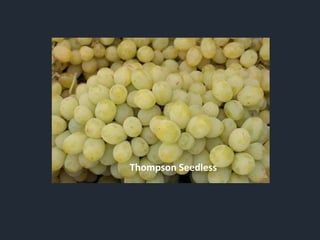
Thompson Seedless
• Selection:
• the population of seedlings from open pollinated
seeds is a potential source for selection of desirable
type e.g. Cheema Sahebi (Sel-7), Selection-49.
• Some promising seedlings from open pollinated
population of Pandhari Sahebi and Kabul Monukka
were also selected.
• Clonal selection:
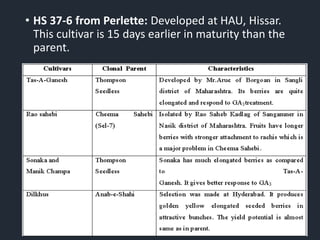
• Pusa Seedless from Thompson Seedless:
Developed at IARI, New Delhi. It differs from the
parent in respect of having more elongated berries.
Vine vigorous and heavy yielding. TSS 22-24%,
acidity 0.77% and juice content 65%. It ripens in the
middle of June.
• HS 37-6 from Perlette: Developed at HAU, Hissar.
This cultivar is 15 days earlier in maturity than the
parent.
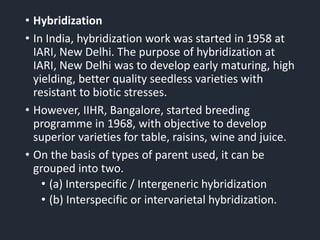
• Hybridization
• In India, hybridization work was started in 1958 at
IARI, New Delhi. The purpose of hybridization at
IARI, New Delhi was to develop early maturing, high
yielding, better quality seedless varieties with
resistant to biotic stresses.
• However, IIHR, Bangalore, started breeding
programme in 1968, with objective to develop
superior varieties for table, raisins, wine and juice.
• On the basis of types of parent used, it can be
grouped into two.
• (a) Interspecific / Intergeneric hybridization
• (b) Interspecific or intervarietal hybridization.
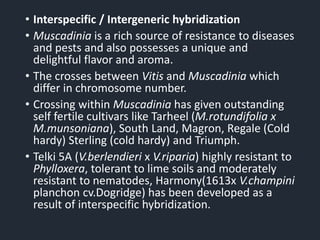
• Interspecific / Intergeneric hybridization
• Muscadinia is a rich source of resistance to diseases
and pests and also possesses a unique and
delightful flavor and aroma.
• The crosses between Vitis and Muscadinia which
differ in chromosome number.
• Crossing within Muscadinia has given outstanding
self fertile cultivars like Tarheel (M.rotundifolia x
M.munsoniana), South Land, Magron, Regale (Cold
hardy) Sterling (cold hardy) and Triumph.
• Telki 5A (V.berlendieri x V.riparia) highly resistant to
Phylloxera, tolerant to lime soils and moderately
resistant to nematodes, Harmony(1613x V.champini
planchon cv.Dogridge) has been developed as a
result of interspecific hybridization.
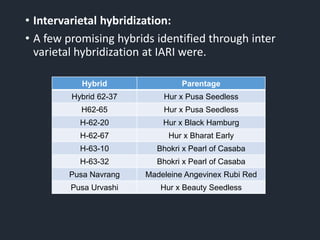
• Intervarietal hybridization:
• A few promising hybrids identified through inter
varietal hybridization at IARI were.
Hybrid Parentage
Hybrid 62-37 Hur x Pusa Seedless
H62-65 Hur x Pusa Seedless
H-62-20 Hur x Black Hamburg
H-62-67 Hur x Bharat Early
H-63-10 Bhokri x Pearl of Casaba
H-63-32 Bhokri x Pearl of Casaba
Pusa Navrang Madeleine Angevinex Rubi Red
Pusa Urvashi Hur x Beauty Seedless
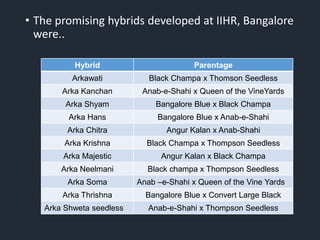
• The promising hybrids developed at IIHR, Bangalore
were..
Hybrid Parentage
Arkawati Black Champa x Thomson Seedless
Arka Kanchan Anab-e-Shahi x Queen of the VineYards
Arka Shyam Bangalore Blue x Black Champa
Arka Hans Bangalore Blue x Anab-e-Shahi
Arka Chitra Angur Kalan x Anab-Shahi
Arka Krishna Black Champa x Thompson Seedless
Arka Majestic Angur Kalan x Black Champa
Arka Neelmani Black champa x Thompson Seedless
Arka Soma Anab –e-Shahi x Queen of the Vine Yards
Arka Thrishna Bangalore Blue x Convert Large Black
Arka Shweta seedless Anab-e-Shahi x Thompson Seedless
• Hybridization technique:
• Emasculation of small flowers of grapes is a tedious
job. Since the grape is self fertile emasculation is
most essential for making desired crosses.
• Use of reflexed stamens and functionally female
cultivars like Hur, Angoor Kalan, Banquiabyad,
Katta, Kurgan as female parents can help in
eliminating the tedious task of emasculation.
• Aqueous solutions of maletic hydrazide (MH) at 400
to 750 ppm, 2,3,4 Tri iodo – benzoic acid (TIBA) at
400 to 500 ppm and 1,2 dichloro-isobutyrate (FW-
450) at 0.30% applied twice to 13 to 15 days old
inflorescence induced pollen sterility.
• Mutation breeding
• The important mutagens used in grape breeding
are physical mutagens (χ ray and γ rays ) and
chemical mutagens (Ethyl Methane Sulphonate
(EMS),N-Nitroso-N-Methyl Urethane (NMUT) and
N-Nitrose-N-Methyl-Urea (NMU).
• Further, induced mutations have resulted in a few
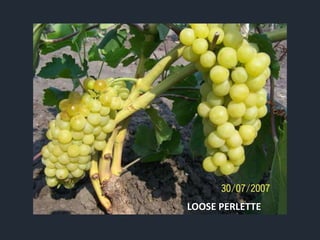
improved varieties, New Perlette (Loose Perlette)
with comparatively loose bunch has been evolved
with χ rays (2.5 KR) treatment.
• Red Niagara having red fruit from Niagara and
Robin Cardinal an early maturing variety from
Cardinal are other important induced mutants in
grapes.
LOOSE PERLETTE
• Polyploidy breeding:
• Polyploidy breeding has immense importance in
the improvement of table grapes.
• The chief benefit from polyploidy is the increase in
berry size.
• The crossing of diploid with induced tetraploids
may help in evolving new triploid seedless grapes.
• Marvel Seedless from Delight, Early Niable
(Campbell x Niagra), Lonetto, Early Giant from
Campbell, Muscat Common Hall from Muscat
Alexandria, Black King from Campbell etc. are
important examples of polyploidy

Breeding in grapes

  • 1.
  • 2.
    • Botanical name:Vitis vinifera L. • Family: Vitaceae • Chromosome number: 2n=2x=38. • Origin: Caspian and Black sea region.
  • 3.
    • Germplasm resources •Field gene banks of grapes are maintained at Division of Fruits and Horticultural Technology, IARI, New Delhi, Indian Institute of Horticulture Research, Bangalore, Ganesh Khand Botanical Garden, Pune etc. • Further, 616 genotypes of grapes are maintained at IIHR, Bangalore.
  • 4.
    • Objectives • Objectivesof breeding for grapes are: • To develop early maturing, seedless and sweet cultivars for table purpose. • To induce resistance to anthracnose, Phylloxera and chaffer beetle. • To develop varieties with medium vigor and productive basal bud, which can be trained on head or pandal system of training. • For the tropics the objectives of breeding should be: • To develop high yielding and high quality varieties with increased fruitfulness of basal buds, less degree of apical dominance, suitability for different purpose such as table, raisin, wine and juice and resistance to diseases. • To develop root stocks resistant to salinity, nematodes and drought.
  • 5.
    • Introduction • Grapesare reported to have been introduced in Tropical India about 2600 years ago in 620 BC (Olmo, 1976). • Commercial cultivation did not start until the beginning of 20th Century. During 1930, Shree R.S.Pillay, identified Anab-e-Shahi from the collections of Nawab Baquer Ali Khan and subsequently its commercial cultivation picked up in South India. • Bhokri and Cheema Sahebi in Maharashtra, Bhokri and Muscat Hamberg in Tamil Nadu and Bangalore Blue in Karnataka are the introductions.
  • 6.
    • The commercialvarieties of grapes were introduced into India mostly by invaders • of Iran and Afghanistan (Thaper, 1960). Muhammed Bin Tughlaq introduced, Bhokri,Fakhri and Sahebi cultivars in Aurangabad (Daulatabad) in 1338. • Large scale introduction in a planned manner were initiated at Lyallpur as early as 1928, when S.B.S.Lal Singh, was Head of Department of Horticulture, introduced as many as 116 grapes varieties from different grape growing countries. • The earlier promising introduction include, Thompson Seedless, Perlette, Beauty Seedless, from USA, • Kishmish Beli and Kishmish Charni from USSR
  • 7.
    • The cultivarslike Ruby Seedless,Gordo Blano,(Reisling, MS 18-55,MS 19-77,MS 16- 2,Wortly Hall hybrids from Australia. • Totlocha from Brazil Flame Seedling 1281,Dogridge,Pride,Dixie,Wedor and Black Cornith-2 from USA. • Surnak Kitabiskij, Pozdrijwir and Shirajx-6 from USSR. • Malvasiafina (Douro), Boal De Alicante, Tinta Deira Preta, Jampal, Tinta Roriz,from Portugal. • 0912 Horizon (SW) , 0913 Leon Millet, Foch and 0912 Swanson Red from Canada for wine, raisin and table purposes have been introduced and are under evaluation.
  • 8.
  • 9.
    • Selection: • thepopulation of seedlings from open pollinated seeds is a potential source for selection of desirable type e.g. Cheema Sahebi (Sel-7), Selection-49. • Some promising seedlings from open pollinated population of Pandhari Sahebi and Kabul Monukka were also selected. • Clonal selection: • Pusa Seedless from Thompson Seedless: Developed at IARI, New Delhi. It differs from the parent in respect of having more elongated berries. Vine vigorous and heavy yielding. TSS 22-24%, acidity 0.77% and juice content 65%. It ripens in the middle of June.
  • 10.
    • HS 37-6from Perlette: Developed at HAU, Hissar. This cultivar is 15 days earlier in maturity than the parent.
  • 11.
    • Hybridization • InIndia, hybridization work was started in 1958 at IARI, New Delhi. The purpose of hybridization at IARI, New Delhi was to develop early maturing, high yielding, better quality seedless varieties with resistant to biotic stresses. • However, IIHR, Bangalore, started breeding programme in 1968, with objective to develop superior varieties for table, raisins, wine and juice. • On the basis of types of parent used, it can be grouped into two. • (a) Interspecific / Intergeneric hybridization • (b) Interspecific or intervarietal hybridization.
  • 12.
    • Interspecific /Intergeneric hybridization • Muscadinia is a rich source of resistance to diseases and pests and also possesses a unique and delightful flavor and aroma. • The crosses between Vitis and Muscadinia which differ in chromosome number. • Crossing within Muscadinia has given outstanding self fertile cultivars like Tarheel (M.rotundifolia x M.munsoniana), South Land, Magron, Regale (Cold hardy) Sterling (cold hardy) and Triumph. • Telki 5A (V.berlendieri x V.riparia) highly resistant to Phylloxera, tolerant to lime soils and moderately resistant to nematodes, Harmony(1613x V.champini planchon cv.Dogridge) has been developed as a result of interspecific hybridization.
  • 13.
    • Intervarietal hybridization: •A few promising hybrids identified through inter varietal hybridization at IARI were. Hybrid Parentage Hybrid 62-37 Hur x Pusa Seedless H62-65 Hur x Pusa Seedless H-62-20 Hur x Black Hamburg H-62-67 Hur x Bharat Early H-63-10 Bhokri x Pearl of Casaba H-63-32 Bhokri x Pearl of Casaba Pusa Navrang Madeleine Angevinex Rubi Red Pusa Urvashi Hur x Beauty Seedless
  • 14.
    • The promisinghybrids developed at IIHR, Bangalore were.. Hybrid Parentage Arkawati Black Champa x Thomson Seedless Arka Kanchan Anab-e-Shahi x Queen of the VineYards Arka Shyam Bangalore Blue x Black Champa Arka Hans Bangalore Blue x Anab-e-Shahi Arka Chitra Angur Kalan x Anab-Shahi Arka Krishna Black Champa x Thompson Seedless Arka Majestic Angur Kalan x Black Champa Arka Neelmani Black champa x Thompson Seedless Arka Soma Anab –e-Shahi x Queen of the Vine Yards Arka Thrishna Bangalore Blue x Convert Large Black Arka Shweta seedless Anab-e-Shahi x Thompson Seedless
  • 15.
    • Hybridization technique: •Emasculation of small flowers of grapes is a tedious job. Since the grape is self fertile emasculation is most essential for making desired crosses. • Use of reflexed stamens and functionally female cultivars like Hur, Angoor Kalan, Banquiabyad, Katta, Kurgan as female parents can help in eliminating the tedious task of emasculation. • Aqueous solutions of maletic hydrazide (MH) at 400 to 750 ppm, 2,3,4 Tri iodo – benzoic acid (TIBA) at 400 to 500 ppm and 1,2 dichloro-isobutyrate (FW- 450) at 0.30% applied twice to 13 to 15 days old inflorescence induced pollen sterility.
  • 16.
    • Mutation breeding •The important mutagens used in grape breeding are physical mutagens (χ ray and γ rays ) and chemical mutagens (Ethyl Methane Sulphonate (EMS),N-Nitroso-N-Methyl Urethane (NMUT) and N-Nitrose-N-Methyl-Urea (NMU). • Further, induced mutations have resulted in a few improved varieties, New Perlette (Loose Perlette) with comparatively loose bunch has been evolved with χ rays (2.5 KR) treatment. • Red Niagara having red fruit from Niagara and Robin Cardinal an early maturing variety from Cardinal are other important induced mutants in grapes.
  • 17.
  • 18.
    • Polyploidy breeding: •Polyploidy breeding has immense importance in the improvement of table grapes. • The chief benefit from polyploidy is the increase in berry size. • The crossing of diploid with induced tetraploids may help in evolving new triploid seedless grapes. • Marvel Seedless from Delight, Early Niable (Campbell x Niagra), Lonetto, Early Giant from Campbell, Muscat Common Hall from Muscat Alexandria, Black King from Campbell etc. are important examples of polyploidy