BREAKWATERS
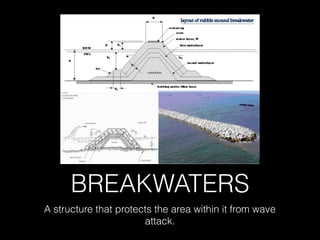
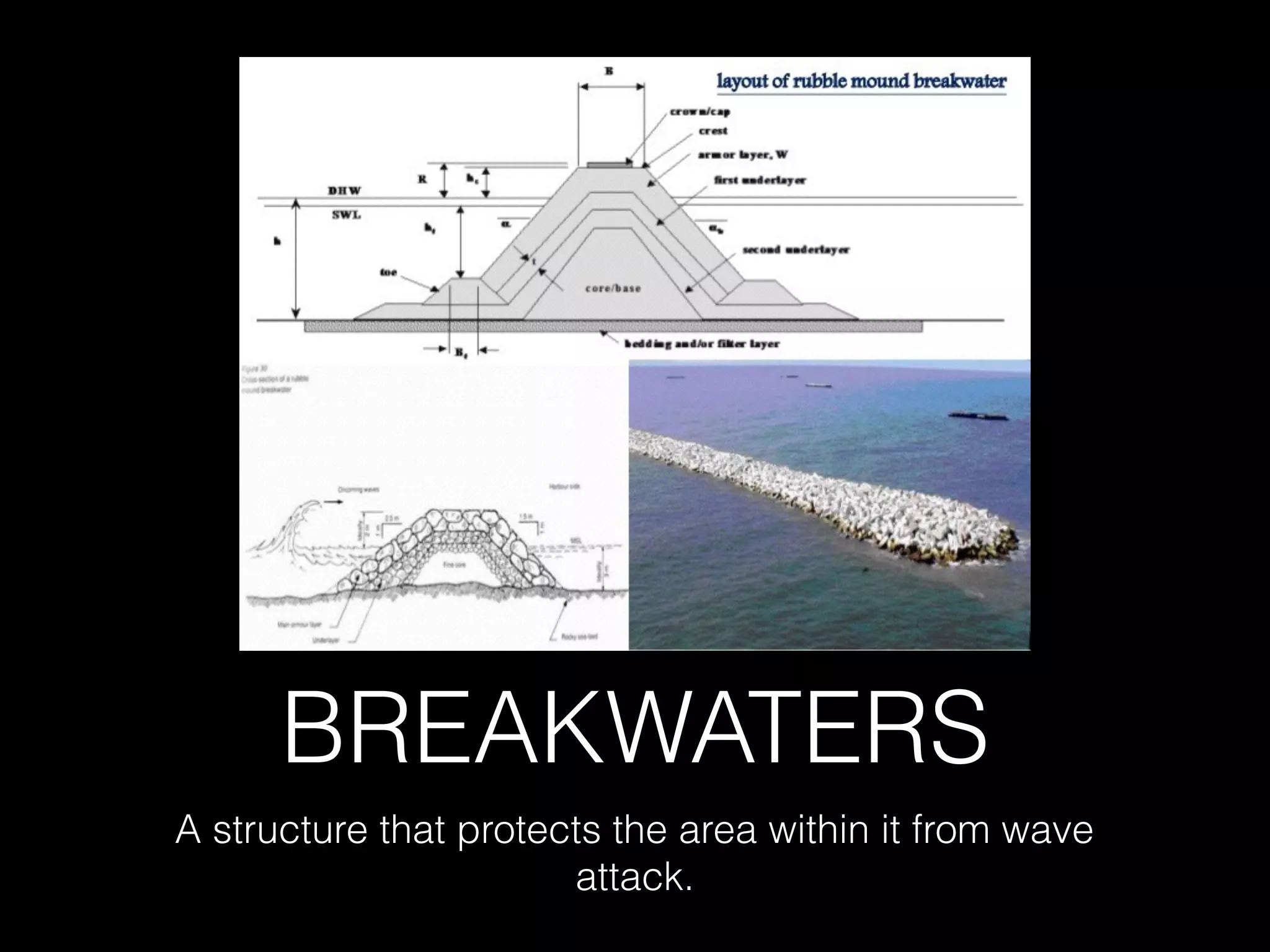
A structure that protects the area within it from wave
attack.
Breakwater
• What’s the need of Breakwater?
• To provide shelter from waves
• Through this shelter, to manipulate the littoral/
sand transport conditions and thereby to trap
some sand entrance inside the Anchorage
Area.
Basis in selecting a type of
breakwater.
• Availability of materials of constructions
• Depth of water at site of construction
• Nature of natural foundation
• Equipment available for construction
• Funds and time available for construction
Breakwater types
• Rubble Mound Breakwaters
• Vertical-Wall Breakwaters
• Floating Breakwaters
Rubble Mound Breakwater
• A breakwater constructed by a heterogeneous assemblage of natural
rubble or undressed stone.
• When water depths are large RBW may be uneconomical in view of huge
volume of rocks required.
• Built up to water depth of 50m.


• Not suitable when space is a problem. If the harbor side may have to be
used for berthing of ships, the RBW with its sloping faces is not suitable for
berthing.
• These type of breakwaters dissipate the incident wave energy by forcing
them to break on a slope and thus do not produce appreciable reflection.
STRUCTURAL COMPONENT
• Constructed by natural rubble or undressed stones.
• Comparatively safe.
• Has a broad base which helps in distributing the load on a wider area.
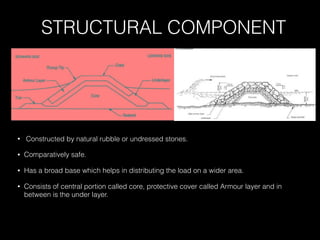
• Consists of central portion called core, protective cover called Armour layer and in
between is the under layer.
Advantages of RMBW
• Use of natural material
• Reduces material cost
• Use of small construction equipment
• Less environmental impact
• Most widely used in Indian ports
• Easy to construct
• Failure is mainly due to poor interlocking capacity
between individual blocks 

• Unavailability of large size natural rocks leads to
artificial armour blocks . 

Vertical Breakwater
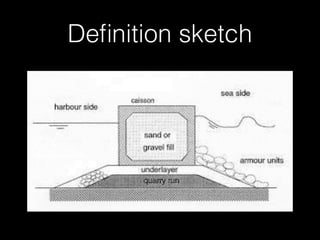
• A breakwater formed by the construction in a
regular and systematic manner of a vertical wall of
masonry concrete blocks or mass concrete, with
vertical and seaward face.
• Reflect the incident waves without dissipating
much wave energy.
• Normally it is constructed in locations where the
depth of the sea is greater than twice the design
wave height.
Preferred to VBW for
following reasons:
• Saving in material due to smaller body width.
• Rapidity in construction.
• Non availability of large quantities of stones.
• Occupies less space.
Definition sketch
Disadvantage of VWBW
• Sea bottom has to be levelled and prepared for
placements of large blocks or caissons. 

• Foundations made of fine sand may cause erosion and
settlement. 

• Erosion may cause tilting or displacement of large
monoliths. 

• Difficult and expensive to repair. 

• Building of caissons and launching or towing them into
position require special land and water areas beside
involvement of heavy construction equipments. 

• Require form work, quality concrete, skilled labour,
batching plants and floating crafts. 

Floating Breakwater
• A removable breakwater constructed by caissons
or pontoons with valves for trimming whilst afloat
and for sinking when is position and pump
connections for refloating, moored to the sea bed.
• inexpensive, easily moved from site to site, often
very quickly fabricated.
• ineffective to long waves, must be anchored.
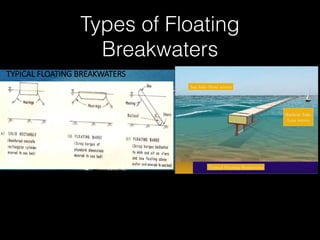
Types of Floating
Breakwaters
TYPICAL FLOATING BREAKWATERS
Advantage & Disadvantages
of Breakwaters
• Advantages:-
• Easy to repair.
• Protects the shore.
• Functions after minor damage.
• Don’t disturb the shoreline.
• Disadvantages:-
• Construction cost is high.
• Can be easily displaced by waves.
• Don’t absorb all energy due to the gaps
between breakwater.
• Aesthetically seems to be bad.
-Ernel Gonzaga
Thank you

Breakwaters ports and harbors report

  • 1.
    BREAKWATERS A structure thatprotects the area within it from wave attack.
  • 2.
    Breakwater • What’s theneed of Breakwater? • To provide shelter from waves • Through this shelter, to manipulate the littoral/ sand transport conditions and thereby to trap some sand entrance inside the Anchorage Area.
  • 3.
    Basis in selectinga type of breakwater. • Availability of materials of constructions • Depth of water at site of construction • Nature of natural foundation • Equipment available for construction • Funds and time available for construction
  • 4.
    Breakwater types • RubbleMound Breakwaters • Vertical-Wall Breakwaters • Floating Breakwaters
  • 5.
    Rubble Mound Breakwater •A breakwater constructed by a heterogeneous assemblage of natural rubble or undressed stone. • When water depths are large RBW may be uneconomical in view of huge volume of rocks required. • Built up to water depth of 50m. 
 • Not suitable when space is a problem. If the harbor side may have to be used for berthing of ships, the RBW with its sloping faces is not suitable for berthing. • These type of breakwaters dissipate the incident wave energy by forcing them to break on a slope and thus do not produce appreciable reflection.
  • 6.
    STRUCTURAL COMPONENT • Constructedby natural rubble or undressed stones. • Comparatively safe. • Has a broad base which helps in distributing the load on a wider area. • Consists of central portion called core, protective cover called Armour layer and in between is the under layer.
  • 7.
    Advantages of RMBW •Use of natural material • Reduces material cost • Use of small construction equipment • Less environmental impact • Most widely used in Indian ports • Easy to construct • Failure is mainly due to poor interlocking capacity between individual blocks 
 • Unavailability of large size natural rocks leads to artificial armour blocks . 

  • 8.
    Vertical Breakwater • Abreakwater formed by the construction in a regular and systematic manner of a vertical wall of masonry concrete blocks or mass concrete, with vertical and seaward face. • Reflect the incident waves without dissipating much wave energy. • Normally it is constructed in locations where the depth of the sea is greater than twice the design wave height.
  • 9.
    Preferred to VBWfor following reasons: • Saving in material due to smaller body width. • Rapidity in construction. • Non availability of large quantities of stones. • Occupies less space.
  • 10.
  • 11.
    Disadvantage of VWBW •Sea bottom has to be levelled and prepared for placements of large blocks or caissons. 
 • Foundations made of fine sand may cause erosion and settlement. 
 • Erosion may cause tilting or displacement of large monoliths. 
 • Difficult and expensive to repair. 
 • Building of caissons and launching or towing them into position require special land and water areas beside involvement of heavy construction equipments. 
 • Require form work, quality concrete, skilled labour, batching plants and floating crafts. 

  • 12.
    Floating Breakwater • Aremovable breakwater constructed by caissons or pontoons with valves for trimming whilst afloat and for sinking when is position and pump connections for refloating, moored to the sea bed. • inexpensive, easily moved from site to site, often very quickly fabricated. • ineffective to long waves, must be anchored.
  • 13.
  • 14.
    Advantage & Disadvantages ofBreakwaters • Advantages:- • Easy to repair. • Protects the shore. • Functions after minor damage. • Don’t disturb the shoreline. • Disadvantages:- • Construction cost is high. • Can be easily displaced by waves. • Don’t absorb all energy due to the gaps between breakwater. • Aesthetically seems to be bad.
  • 15.