
PEMP
RMD 2501
Steam TurbinesSteam Turbines
Session delivered by:Session delivered by:
Prof Q H NagpurwalaProf Q H NagpurwalaProf. Q.H. NagpurwalaProf. Q.H. Nagpurwala
© M.S. Ramaiah School of Advanced Studies13 1
PEMP
RMD 2501
Session Objectives
This session is intended to discuss the following:
Classification of steam turbines
Compounding of steam turbines
Forces, work done and efficiency of steam turbine
Numerical examplesp
© M.S. Ramaiah School of Advanced Studies13 2
PEMP
RMD 2501
Steam
Steam is a vapour used as a working substance in the operation of steam turbine.
Is steam a perfect gas?
Steam possess properties like those of gases: namely pressure, volume, temperature,
internal energy, enthalpy and entropy. But the pressure volume and temperature of
steam as a vapour are not connected by any simple relationship such as is expressed
by the characteristic equation for a perfect gas.
Sensible heat – The heat absorbed by water in attaining its boiling point.
h h h b b d b ili iLatent heat – The heat absorbed to convert boiling water into steam.
Wet steam – Steam containing some quantity of moisture.
Dry steam Steam that has no moisture contentDry steam – Steam that has no moisture content.
Superheated steam – Dry steam, when heated at constant pressure, attains superheat
The properties of steam are dependent on its pressure
© M.S. Ramaiah School of Advanced Studies13 3
The properties of steam are dependent on its pressure.
PEMP
RMD 2501
Steam Properties
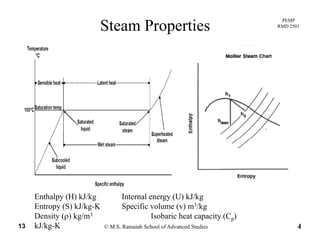
Enthalpy (H) kJ/kg Internal energy (U) kJ/kg
© M.S. Ramaiah School of Advanced Studies13 4
Entropy (S) kJ/kg-K Specific volume (v) m3/kg
Density (ρ) kg/m3 Isobaric heat capacity (Cp)
kJ/kg-K
PEMP
RMD 2501
Steam Power Plant Process
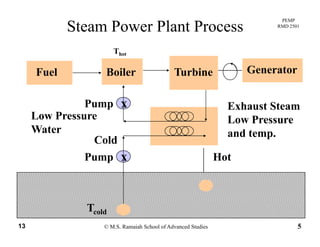
Fuel Boiler Turbine Generator
Thot
x Exhaust SteamPump Exhaust Steam
Low Pressure
and temp.
Low Pressure
Water
p
Cold
p
xPump
Cold
Hot
© M.S. Ramaiah School of Advanced Studies13 5
Tcold
PEMP
RMD 2501
Steam Turbine
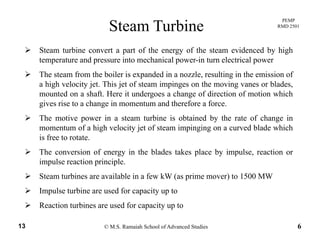
Steam turbine convert a part of the energy of the steam evidenced by high
temperature and pressure into mechanical power-in turn electrical power
The steam from the boiler is expanded in a nozzle, resulting in the emission ofThe steam from the boiler is expanded in a nozzle, resulting in the emission of
a high velocity jet. This jet of steam impinges on the moving vanes or blades,
mounted on a shaft. Here it undergoes a change of direction of motion which
gives rise to a change in momentum and therefore a force.
The motive power in a steam turbine is obtained by the rate of change in
momentum of a high velocity jet of steam impinging on a curved blade which
is free to rotateis free to rotate.
The conversion of energy in the blades takes place by impulse, reaction or
impulse reaction principle.
Steam turbines are available in a few kW (as prime mover) to 1500 MW
Impulse turbine are used for capacity up to
© M.S. Ramaiah School of Advanced Studies13 6
Reaction turbines are used for capacity up to
PEMP
RMD 2501
Steam, Gas and Hydraulic Turbines
The working substance differs for different types of turbines.
Steam turbines are axial flow machines (radial steam turbines are rarely used)
whereas gas turbines and hydraulic turbines of both axial and radial flow typewhereas gas turbines and hydraulic turbines of both axial and radial flow type
are used based on applications.
The pressure of working medium used in steam turbines is very high,
whereas the temperature of working medium used is gas turbine is highwhereas the temperature of working medium used is gas turbine is high
comparatively.
The pressure and temperature of working medium in hydraulic turbines is
lower than steam turbines.
Steam turbines of 1300 MW single units are available whereas largest gas
turbines unit is 530 MW and 815 MW
© M.S. Ramaiah School of Advanced Studies13 7
PEMP
RMD 2501
Merits and Demerits of Steam Turbine
Merits:
• Ability to utilize high pressure and high temperature steam.
Hi h ffi i• High component efficiency.
• High rotational speed.
• High capacity/weight ratio.
• Smooth, nearly vibration-free operation.
• No internal lubrication.
• Oil free exhaust steam.Oil free exhaust steam.
• Can be built in small or very large units (up to 1200 MW).
Demerits:
F l d li ti d ti i d• For slow speed application reduction gears are required.
• The steam turbine cannot be made reversible.
• The efficiency of small simple steam turbines is poor.
© M.S. Ramaiah School of Advanced Studies13 8
PEMP
RMD 2501Application
• Power generation
• Refinery PetrochemicalRefinery, Petrochemical,
• Pharmaceuticals,
• Food processing,
• Petroleum/Gas processing,
• Pulp & Paper mills,
• Waste to energy• Waste-to-energy
© M.S. Ramaiah School of Advanced Studies13 9
PEMP
RMD 2501
Turbine Selection
In all fields of application the competitiveness of a turbine is a
combination of several factors:
Efficiency
LifeLife
Power density (power to weight ratio)
i iDirect operation cost
Manufacturing and maintenance costs
© M.S. Ramaiah School of Advanced Studies13 10
PEMP
RMD 2501
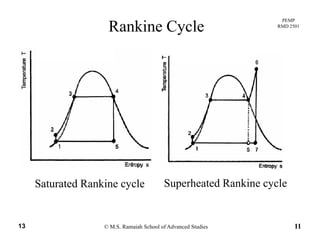
Rankine Cycle
Saturated Rankine cycle Superheated Rankine cycle
© M.S. Ramaiah School of Advanced Studies13 11
PEMP
RMD 2501
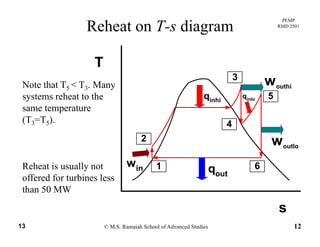
Reheat on T-s diagram
T
33
qinhi
wouthi
5qinlo
Note that T5 < T3. Many
systems reheat to the
same temperature
2
4
w
same temperature
(T3=T5).
1
2
win q
woutlo
6Reheat is usually not in qout
y
offered for turbines less
than 50 MW
© M.S. Ramaiah School of Advanced Studies13 12
s
PEMP
RMD 2501
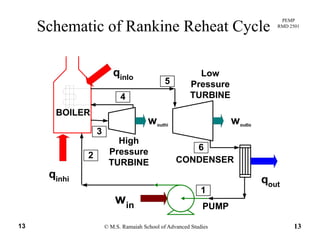
Schematic of Rankine Reheat Cycle
Lowqinlo
4
5 Pressure
TURBINE
qinlo
BOILER
High
wouthi
3
woutlo
High
Pressure
TURBINE CONDENSER2
6
qinhi qout
w
1
© M.S. Ramaiah School of Advanced Studies13 13
PUMP
win
PEMP
RMD 2501
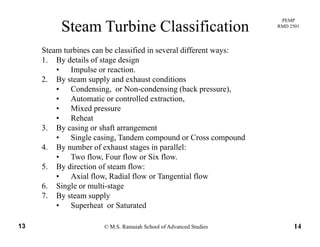
Steam Turbine Classification
Steam turbines can be classified in several different ways:
1. By details of stage design
• Impulse or reaction.
2 B l d h di i2. By steam supply and exhaust conditions
• Condensing, or Non-condensing (back pressure),
• Automatic or controlled extraction,
• Mixed pressure• Mixed pressure
• Reheat
3. By casing or shaft arrangement
• Single casing Tandem compound or Cross compoundSingle casing, Tandem compound or Cross compound
4. By number of exhaust stages in parallel:
• Two flow, Four flow or Six flow.
5. By direction of steam flow:y
• Axial flow, Radial flow or Tangential flow
6. Single or multi-stage
7. By steam supply
© M.S. Ramaiah School of Advanced Studies13 14
• Superheat or Saturated
PEMP
RMD 2501
Steam Turbine Stage
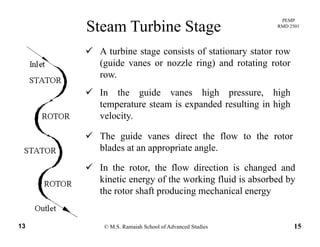
A turbine stage consists of stationary stator row
(guide vanes or nozzle ring) and rotating rotor
row.row.
In the guide vanes high pressure, high
temperature steam is expanded resulting in high
The guide vanes direct the flow to the rotor
p p g g
velocity.
The guide vanes direct the flow to the rotor
blades at an appropriate angle.
In the rotor, the flow direction is changed andIn the rotor, the flow direction is changed and
kinetic energy of the working fluid is absorbed by
the rotor shaft producing mechanical energy
© M.S. Ramaiah School of Advanced Studies13 15
PEMP
RMD 2501
Types of Steam Turbine
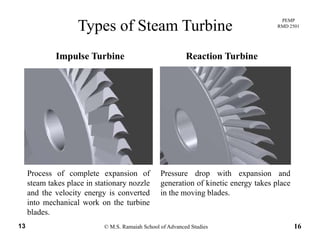
Impulse Turbine Reaction Turbine
Process of complete expansion of
steam takes place in stationary nozzle
and the velocity energy is converted
into mechanical ork on the t rbine
Pressure drop with expansion and
generation of kinetic energy takes place
in the moving blades.
© M.S. Ramaiah School of Advanced Studies13 16
into mechanical work on the turbine
blades.
PEMP
RMD 2501Types of Steam Turbine
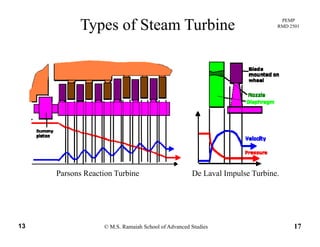
Parsons Reaction Turbine De Laval Impulse Turbine.
© M.S. Ramaiah School of Advanced Studies13 17
PEMP
RMD 2501Impulse Reaction Turbine
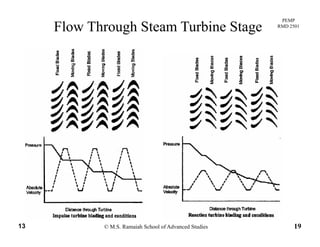
Modern turbines are neither purely impulse or reaction but a combination of
both.
Pressure drop is effected partly in nozzles and partly in moving bladesPressure drop is effected partly in nozzles and partly in moving blades
which are so designed that expansion of steam takes place in them.
High velocity jet from nozzles produce an impulse on the moving blade and
jet coming out from still higher velocity from moving blades produces ajet coming out from still higher velocity from moving blades produces a
reaction.
Impulse turbine began employing reaction of upto 20% at the root of the
moving blades in order to counteract the poor efficiency incurred from zeromoving blades in order to counteract the poor efficiency incurred from zero
or even negative reaction.
Reaction at the root of reaction turbines has come down to as little as 30%
to 40% resulting in the reduction of the number of stages required and theto 40% resulting in the reduction of the number of stages required and the
sustaining of 50% reaction at mid point.
It may be more accurate to describe the two design as
Disc and diaphragm turbine using low reaction blading
© M.S. Ramaiah School of Advanced Studies13 18
Disc and diaphragm turbine using low reaction blading
Drum rotor turbine using high reaction blading
PEMP
RMD 2501
Flow Through Steam Turbine Stage
© M.S. Ramaiah School of Advanced Studies13 19
PEMP
RMD 2501
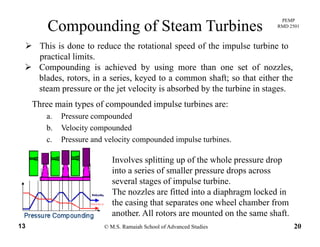
This is done to reduce the rotational speed of the impulse turbine to
Compounding of Steam Turbines
This is done to reduce the rotational speed of the impulse turbine to
practical limits.
Compounding is achieved by using more than one set of nozzles,
blades rotors in a series keyed to a common shaft; so that either the
Three main types of compounded impulse turbines are:
blades, rotors, in a series, keyed to a common shaft; so that either the
steam pressure or the jet velocity is absorbed by the turbine in stages.
yp p p
a. Pressure compounded
b. Velocity compounded
c Pressure and velocity compounded impulse turbinesc. Pressure and velocity compounded impulse turbines.
Involves splitting up of the whole pressure drop
into a series of smaller pressure drops acrossinto a series of smaller pressure drops across
several stages of impulse turbine.
The nozzles are fitted into a diaphragm locked in
the casing that separates one wheel chamber from
© M.S. Ramaiah School of Advanced Studies13 20
the casing that separates one wheel chamber from
another. All rotors are mounted on the same shaft.
PEMP
RMD 2501
Compounding of Steam Turbines
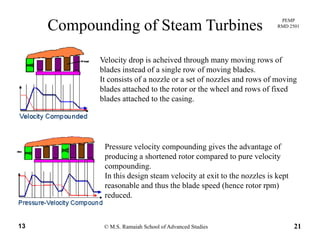
Velocity drop is acheived through many moving rows of
blades instead of a single row of moving blades.
I i f l f l d f iIt consists of a nozzle or a set of nozzles and rows of moving
blades attached to the rotor or the wheel and rows of fixed
blades attached to the casing.
Pressure velocity compounding gives the advantage of
producing a shortened rotor compared to pure velocity
compounding.p g
In this design steam velocity at exit to the nozzles is kept
reasonable and thus the blade speed (hence rotor rpm)
reduced.
© M.S. Ramaiah School of Advanced Studies13 21
PEMP
RMD 2501
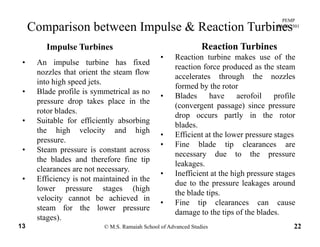
Comparison between Impulse & Reaction Turbines
Imp lse T rbines Reaction TurbinesImpulse Turbines
• Reaction turbine makes use of the
reaction force produced as the steam
accelerates through the nozzles
• An impulse turbine has fixed
nozzles that orient the steam flow
Reaction Turbines
accelerates through the nozzles
formed by the rotor
• Blades have aerofoil profile
(convergent passage) since pressure
into high speed jets.
• Blade profile is symmetrical as no
pressure drop takes place in the
bl d
(convergent passage) since pressure
drop occurs partly in the rotor
blades.
• Efficient at the lower pressure stages
rotor blades.
• Suitable for efficiently absorbing
the high velocity and high
pressure
• Fine blade tip clearances are
necessary due to the pressure
leakages.
pressure.
• Steam pressure is constant across
the blades and therefore fine tip
clearances are not necessary
• Inefficient at the high pressure stages
due to the pressure leakages around
the blade tips.
Fine tip clearances can ca se
clearances are not necessary.
• Efficiency is not maintained in the
lower pressure stages (high
velocity cannot be achieved in
© M.S. Ramaiah School of Advanced Studies13 22
• Fine tip clearances can cause
damage to the tips of the blades.
y
steam for the lower pressure
stages).
PEMP
RMD 2501
Losses in Steam Turbine
Profile loss: Due to formation of boundary layer on blade surfaces. Profile loss is a
boundary layer phenomenon and therefore subject to factors that influence
boundary layer development. These factors are Reynolds number, surfacey y p y ,
roughness, exit Mach number and trailing edge thickness.
Secondary loss: Due to friction on the casing wall and on the blade root and tip. It
is a boundary layer effect and dependent upon the same considerations as those ofis a boundary layer effect and dependent upon the same considerations as those of
profile loss.
Tip leakage loss: Due to steam passing through the small clearances required
b h i i d i b h i bl d i d ibetween the moving tip and casing or between the moving blade tip and rotating
shaft. The extend of leakage depends on the whether the turbine is impulse or
reaction. Due to pressure drop in moving blades of reaction turbine they are more
prone to leakagesprone to leakages.
Disc windage loss: Due to surface friction created on the discs of an impulse
turbine as the disc rotates in steam atmosphere. The result is the forfeiture of shaft
© M.S. Ramaiah School of Advanced Studies13 23
power for an increase in kinetic energy and heat energy of steam.
PEMP
RMD 2501
Losses in Steam Turbine
Lacing wire loss: Due to passage blockage created by the presence of lacing wires
in long blade of LP Stages.
Wetness loss: Due to moisture entrained in the low pressure steam at the exit of LPWetness loss: Due to moisture entrained in the low pressure steam at the exit of LP
turbine. The loss is a combination of two effects; firstly, reduction in efficiency due
to absorption of energy by the water droplets and secondly, erosion of final moving
blades leading edges.blades leading edges.
Annulus loss: Due to significant amount of diffusion between adjacent stages or
where wall cavities occur between the fixed and moving blades. The extent of loss
is greatly reduced at high annulus area ratios (inlet/outlet) if the expansion of theis greatly reduced at high annulus area ratios (inlet/outlet) if the expansion of the
steam is controlled by a flared casing wall.
Leaving loss: Due to kinetic energy available at the steam leaving from the last
stage of LP turbine. In practice steam does slow down after leaving the last blade,
but through the conversion of its kinetic energy to flow friction losses.
Partial admission loss: Due to partial filling of steam, flow between the blades is
© M.S. Ramaiah School of Advanced Studies13 24
p g ,
considerably accelerated causing a loss in power.
PEMP
RMD 2501
Nomenclature
V Absolute velocity of steam
U Blade velocity
l i l i fW Relative velocity of steam
Va=Vf = Vm Axial component or flow velocity
V Whirl or tangential componentVw Whirl or tangential component
α Nozzle angle
β Blade angleβ Blade angle
h enthalpy
Suffix
1 Inlet
© M.S. Ramaiah School of Advanced Studies13 25
2 Outlet
PEMP
RMD 2501
Velocity Triangles
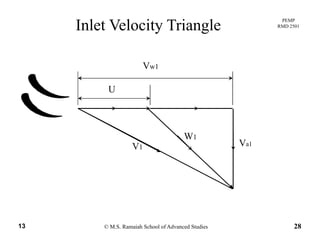
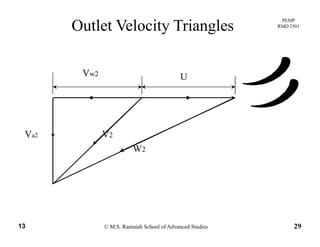
The three velocity vectors namely, blade speed, absolute velocity
and relative velocity in relation to the rotor are used to form a
triangle called velocity triangle.
Velocity triangles are used to illustrate the flow in the bladings of
turbomachineryturbomachinery.
Changes in the flow direction and velocity are easy to understand
with the help of the velocity triangles.p y g
Note that the velocity triangles are drawn for the inlet and outlet of
the rotor at certain radii.
© M.S. Ramaiah School of Advanced Studies13 26
PEMP
RMD 2501
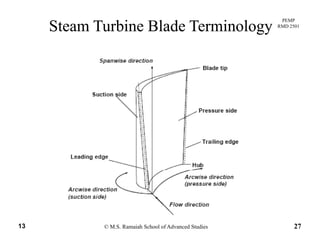
Steam Turbine Blade TerminologySteam Turbine Blade Terminology
© M.S. Ramaiah School of Advanced Studies13 27
PEMP
RMD 2501
Inlet Velocity Triangle
Vw1
U
W1
Va1
W1
V1
© M.S. Ramaiah School of Advanced Studies13 28
PEMP
RMD 2501
Outlet Velocity Triangles
Vw2 UU
V2Va2
W2
© M.S. Ramaiah School of Advanced Studies13 29
PEMP
RMD 2501
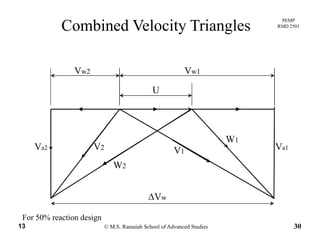
Combined Velocity Triangles
Vw2 Vw1
U
W1
Va1
W1
V1
V2
W2
Va2
ΔVw
© M.S. Ramaiah School of Advanced Studies13 30
For 50% reaction design
PEMP
RMD 2501
If th bl d i t i l th β β d l ti f i ti l ff t f th
Work Done – Impulse Steam Turbine
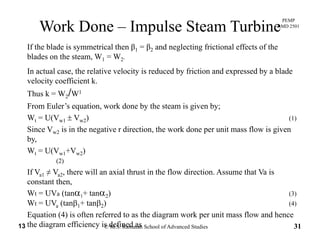
If the blade is symmetrical then β1 = β2 and neglecting frictional effects of the
blades on the steam, W1 = W2.
In actual case, the relative velocity is reduced by friction and expressed by a blade
velocity coefficient k.
Thus k = W2/W1
From Euler’s equation, work done by the steam is given by;From Euler s equation, work done by the steam is given by;
Wt = U(Vw1 ± Vw2) (1)
Since Vw2 is in the negative r direction, the work done per unit mass flow is given
byby,
Wt = U(Vw1+Vw2)
(2)
If V ≠ V th ill i l th t i th fl di ti A th t V iIf Va1 ≠ Va2, there will an axial thrust in the flow direction. Assume that Va is
constant then,
Wt = UVa (tanα1+ tanα2) (3)
W UV (t β + t β ) (4)
© M.S. Ramaiah School of Advanced Studies13 31
Wt = UVa (tanβ1+ tanβ2) (4)
Equation (4) is often referred to as the diagram work per unit mass flow and hence
the diagram efficiency is defined as
PEMP
RMD 2501
Work Done – Impulse Steam Turbine
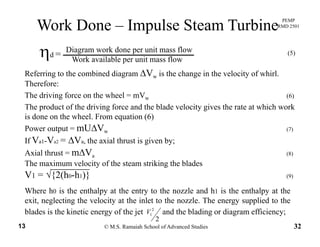
Diagram work done per unit mass flow
Work available per unit mass flow
ηd = (5)
Referring to the combined diagram ΔVw is the change in the velocity of whirl.g g w g y
Therefore:
The driving force on the wheel = mVw (6)
The product of the driving force and the blade velocity gives the rate at which workThe product of the driving force and the blade velocity gives the rate at which work
is done on the wheel. From equation (6)
Power output = mUΔVw (7)
If V V ΔV th i l th t i i bIf Va1-Va2 = ΔVa, the axial thrust is given by;
Axial thrust = mΔVa (8)
The maximum velocity of the steam striking the blades
√V1 = √{2(h0-h1)} (9)
Where h0 is the enthalpy at the entry to the nozzle and h1 is the enthalpy at the
exit neglecting the velocity at the inlet to the nozzle The energy supplied to the
© M.S. Ramaiah School of Advanced Studies13 32
2
2
1V
exit, neglecting the velocity at the inlet to the nozzle. The energy supplied to the
blades is the kinetic energy of the jet and the blading or diagram efficiency;
PEMP
RMD 2501
Work Done – Impulse Steam Turbine
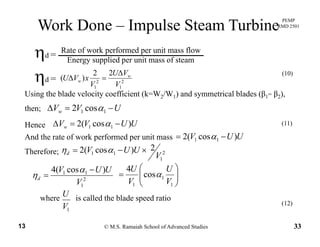
Rate of work performed per unit mass flow
Energy supplied per unit mass of steam
ηd =
(10)22
)(
VU
VU wΔ
Δη ( )
2
1
2
1
)(
VV
xVU w
w =Δηd =
Using the blade velocity coefficient (k=W2/W1) and symmetrical blades (β1= β2),
then; UVV =Δ cos2 αthen; UVVw −=Δ 11 cos2 α
Hence
And the rate of work performed per unit mass UUV )cos(2 11 −= α
UUVVw )cos(2 11 −=Δ α (11)
And the rate of work performed per unit mass
Therefore;
UUV )cos(2 11 α
2
1
11
2)cos(2
V
UUVd ×−= αη
)cos(4 UUV −α ⎟
⎞
⎜
⎛4 UU
2
1
11 )cos(4
V
UUV
d
−
=
α
η ⎟⎟
⎠
⎞
⎜⎜
⎝
⎛
=
1
1
1
cos
4
V
U
V
U
α
Uwhere is called the blade speed ratio
(12)
© M.S. Ramaiah School of Advanced Studies13 33
1V
p
(12)
PEMP
RMD 2501
Work Done – Impulse Steam Turbine
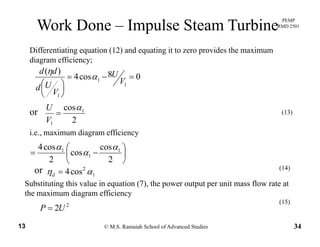
Differentiating equation (12) and equating it to zero provides the maximum
diagram efficiency;
08cos4
)(
== Udd
α
η
08cos4
1
1
1
=−=
⎟
⎠
⎞
⎜
⎝
⎛ V
U
V
Ud
α
cosαU
2
cos 1
1
α
=
V
U
or (13)
i.e., maximum diagram efficiency
⎟
⎠
⎞
⎜
⎝
⎛
−=
2
cos
cos
2
cos4 1
1
1 α
α
α
or 2
4 (14)or 1
2
cos4 αη =d
( )
Substituting this value in equation (7), the power output per unit mass flow rate at
the maximum diagram efficiency
(15)
© M.S. Ramaiah School of Advanced Studies13 34
2
2UP =
(15)
PEMP
RMD 2501
Degree of Reaction
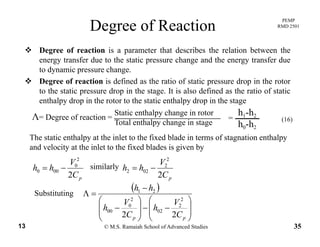
Degree of reaction is a parameter that describes the relation between the
energy transfer due to the static pressure change and the energy transfer due
to dynamic pressure change.
Degree of reaction is defined as the ratio of static pressure drop in the rotor
to the static pressure drop in the stage. It is also defined as the ratio of static
enthalpy drop in the rotor to the static enthalpy drop in the stage
Λ= Degree of reaction =
Static enthalpy change in rotor
Total enthalpy change in stage
=
h1-h2
h0-h2
The static enthalpy at the inlet to the fixed blade in terms of stagnation enthalpy
(16)
The static enthalpy at the inlet to the fixed blade in terms of stagnation enthalpy
and velocity at the inlet to the fixed blades is given by
V
hh
2
0
000 −= similarly
V
hh
2
2
022 −=
pC
hh
2
000
y
pC
hh
2
022
Substituting
( )
⎟
⎞
⎜
⎛
⎟
⎞
⎜
⎛
−
=Λ
VV
hh
22
21
© M.S. Ramaiah School of Advanced Studies13 35
⎟
⎟
⎠
⎞
⎜
⎜
⎝
⎛
−−
⎟
⎟
⎠
⎞
⎜
⎜
⎝
⎛
−
pp C
V
h
C
V
h
22
2
02
0
00
PEMP
RMD 2501
Degree of Reaction
( )
( )
21
hh
hh −
=Λ
But for a normal stage, V0 = V2 and since h00 = h01 in the nozzle, then;
(17)
( )0201 hh −
We know that (h01 – h02) = ( ) ( ) 0
2
2
2
2
1
21 =
−
+− ww VV
hh
Substituting for (h h ) in equation (17)Substituting for (h1- h2) in equation (17),
( )
( )[ ]
2
1
2
2
2 hh
VV ww −
=Λ
( )
( )[ ]
2
1
2
2
2
ww
VVU
VV
−
−
=
(18)
( )[ ]02012 hh − ( )[ ]212 ww VVU −
Assuming the axial velocity is constant through out the stage, then
( )VV − 22
(18)
( )
( )[ ]UVVUU
VV
ww
ww
−++
−
=Λ
21
12
2
( )( )VVVV +−
© M.S. Ramaiah School of Advanced Studies13 36
( )( )
( )[ ]21
1212
2 ww
wwww
VVU
VVVV
+
+−
=Λ (19)
PEMP
RMD 2501
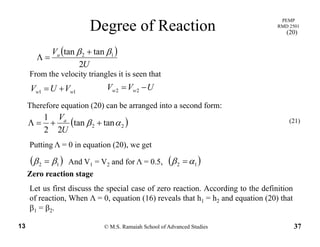
(20)
Degree of Reaction
( )
U
Va
2
tantan 12 ββ +
=Λ
From the velocity triangles it is seen thaty g
11 ww VUV += UVV ww −= 22
Therefore equation (20) can be arranged into a second form:Therefore equation (20) can be arranged into a second form:
( )22 tantan
22
1
αβ ++=Λ
U
Va (21)
Putting Λ = 0 in equation (20), we get
( )12 ββ = And V1 = V2 and for Λ = 0.5, ( )12 αβ =
Zero reaction stage
Let us first discuss the special case of zero reaction. According to the definition
of reaction, When Λ = 0, equation (16) reveals that h1 = h2 and equation (20) that
© M.S. Ramaiah School of Advanced Studies13 37
, , q ( ) 1 2 q ( )
β1 = β2.
PEMP
RMD 2501
Degree of Reaction
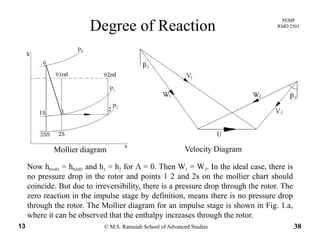
Now h01r01 = h02r02 and h1 = h2 for Λ = 0. Then W1 = W2. In the ideal case, there is
Mollier diagram Velocity Diagram
01r01 02r02 1 2 1 2 ,
no pressure drop in the rotor and points 1 2 and 2s on the mollier chart should
coincide. But due to irreversibility, there is a pressure drop through the rotor. The
zero reaction in the impulse stage by definition, means there is no pressure drop
© M.S. Ramaiah School of Advanced Studies13 38
through the rotor. The Mollier diagram for an impulse stage is shown in Fig. 1.a,
where it can be observed that the enthalpy increases through the rotor.
PEMP
RMD 2501
Degree of Reaction
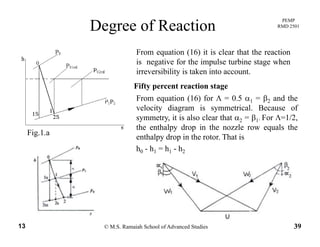
From equation (16) it is clear that the reaction
is negative for the impulse turbine stage when
irreversibility is taken into account.
Fifty percent reaction stage
From equation (16) for Λ = 0.5 α1 = β2 and the
velocity diagram is symmetrical Because of
Fig.1.a
velocity diagram is symmetrical. Because of
symmetry, it is also clear that α2 = β1. For Λ=1/2,
the enthalpy drop in the nozzle row equals the
enthalpy drop in the rotor. That isenthalpy drop in the rotor. That is
h0 - h1 = h1 - h2
© M.S. Ramaiah School of Advanced Studies13 39
PEMP
RMD 2501
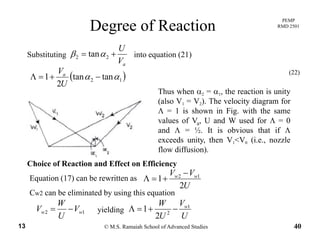
U
Degree of Reaction
aV
U
+= 22 tanαβSubstituting into equation (21)
( )tantan1 αα+=Λ
Va (22)
( )12 tantan
2
1 αα −+=Λ
U
Thus when α2 = α1, the reaction is unity
(also V1 = V2). The velocity diagram for
i h i i i h hΛ = 1 is shown in Fig. with the same
values of Va, U and W used for Λ = 0
and Λ = ½. It is obvious that if Λ
exceeds unity then V <V (i e nozzleexceeds unity, then V1<V0 (i.e., nozzle
flow diffusion).
Choice of Reaction and Effect on Efficiency
VV
Equation (17) can be rewritten as
U
VV ww
2
1 12 −
+=Λ
Cw2 can be eliminated by using this equation
W VW
© M.S. Ramaiah School of Advanced Studies13 40
12 ww V
U
W
V −= yielding
U
V
U
W w1
2
2
1 −+=Λ
PEMP
RMD 2501
Degree of Reaction
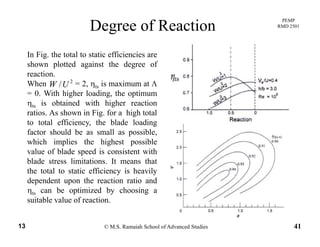
In Fig. the total to static efficiencies are
shown plotted against the degree of
reaction.
When = 2, ηts is maximum at Λ
= 0. With higher loading, the optimum
ηts is obtained with higher reaction
2
/UW
ratios. As shown in Fig. for a high total
to total efficiency, the blade loading
factor should be as small as possible,
hi h i li h hi h iblwhich implies the highest possible
value of blade speed is consistent with
blade stress limitations. It means that
the total to static efficiency is heavilythe total to static efficiency is heavily
dependent upon the reaction ratio and
ηts can be optimized by choosing a
suitable value of reaction
© M.S. Ramaiah School of Advanced Studies13 41
suitable value of reaction.
PEMP
RMD 2501
Blade Height in Axial Flow Machines
The continuity equation may be used to find the blade height ‘h’. The
annular area of flow = πDh. Thus the mass flow rate through an axial flow
turbine is
AVm ρ=
•
turbine is
aDhVm ρπ=
•
•
aDV
m
h
ρπ
=
Blade height will increase in the direction of flow in a turbine and decrease in
the direction of flow in a compressor.
aρ
© M.S. Ramaiah School of Advanced Studies13 42
PEMP
RMD 2501
Effect of Reheat Factor & Stage Efficiency
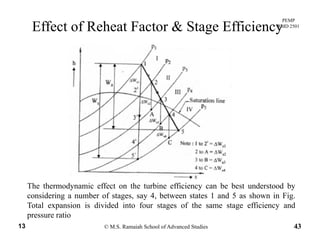
The thermodynamic effect on the turbine efficiency can be best understood by
considering a number of stages, say 4, between states 1 and 5 as shown in Fig.
© M.S. Ramaiah School of Advanced Studies13 43
Total expansion is divided into four stages of the same stage efficiency and
pressure ratio
PEMP
RMD 2501
PPPP
Effect of Reheat Factor & Stage Efficiency
5
4
4
3
3
2
2
1
.,.
P
P
P
P
P
P
P
P
ei ===
Let η0 is the overall efficiency of expansion and is defined as the ratio of actualLet η0 is the overall efficiency of expansion and is defined as the ratio of actual
work done per kg of steam to the isentropic work done per kg of steam between
1 and 5.
⎟
⎞
⎜
⎛W 51 hh −
⎟⎟
⎠
⎞
⎜⎜
⎝
⎛
=
s
a
W
W
ei 0.,. η '
51
51
0.,.
hh
hh
ei
−
=η
The actual work done per kg of steam Wa = η0 Ws
(22)
Isentropic or ideal values in each stages are ΔWs1, ΔWs2, ΔWs3, ΔWs4.
Therefore the total value of the actual work done in these stages is,
Wa = Σ(1-2)+(2-3)+(3-4)+(4-5)
Also stage efficiency for each stage is given by
actual work done/kg of steam W
© M.S. Ramaiah School of Advanced Studies13 44
ηs = actual work done/kg of steam
Isentropic work done in stage
1
1
s
a
W
W
=
PEMP
RMD 2501
F t 1
Effect of Reheat Factor & Stage Efficiency
For stage 1
111
1
1
'
21
21
1
1
1.,. ssa
s
a
s
a
s WWor
W
W
hh
hh
W
W
ei Δ=Δ
Δ
=
−
−
== ηη
[ ][ ]44332211 ssssssssaa WWWWWW Δ+Δ+Δ+ΔΣ=ΣΔ=Δ∴ ηηηη
For same stage efficiency in each stage 4321 ssss ηηηη ===
[ ][ ] sssssssa WWWWWW ΣΔ=Δ+Δ+Δ+ΔΣ= ηη 4321 (23)
From equation (22) and (23),
s
s
ss
W
W
WW
ΣΔ
=∴
ΣΔ=
ηη
ηη
0
00
(24)
s
s
W
ηη0
The slope of constant pressure lines on h-s plane is given by
T
h
⎟
⎞
⎜
⎛ ∂
© M.S. Ramaiah School of Advanced Studies13 45
T
s
h
p
=⎟
⎠
⎞
⎜
⎝
⎛
∂
∂
PEMP
RMD 2501
Effect of Reheat Factor & Stage Efficiency
This shows that the constant pressure lines must diverge towards the right.
Therefore
.
F i I i b i h h h l i h
1>
ΣΔ
s
s
W
W
For expansion process. It is obvious that the enthalpy increases when we move
towards right along the constant pressure line. Hence the summation of ΔWs1
ΔWs1 etc., is more than the total isentropic enthalpy drop Ws
Th ti f ti f i t i th l d f i di id l t t th t t l
[ ] [ ])4()3()2()21( ''''
4321 −+−+−+−Σ
=
Δ+Δ+Δ+ΔΣ
=
cbaWWWW
RF ssss
The ratio of summation of isentropic enthalpy drop for individual stage to the total
isentropic enthalpy drop as a whole is called Reheat factor. Thus
)51( −W
RF
s
s
s
W
W
RF
ΣΔ
=
Therefore the overall efficiency of the expansion process
(25)
As
Therefore the overall efficiency of the expansion process,
RFstage ×=ηη0
(26)
1)/( >ΣΔ= ss WWRF
th ll ffi i f th t bi i t th th t ffi i i
© M.S. Ramaiah School of Advanced Studies13 46
the overall efficiency of the turbine η0 is greater than than stage efficiencies ηs
sei ηη >0.,. for turbines (27)
PEMP
RMD 2501
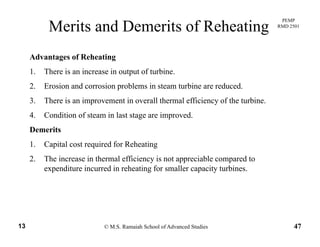
Merits and Demerits of Reheating
Advantages of Reheating
1. There is an increase in output of turbine.
2. Erosion and corrosion problems in steam turbine are reduced.
3. There is an improvement in overall thermal efficiency of the turbine.
4. Condition of steam in last stage are improved.
Demerits
1. Capital cost required for Reheating
2. The increase in thermal efficiency is not appreciable compared to
expenditure incurred in reheating for smaller capacity turbinesexpenditure incurred in reheating for smaller capacity turbines.
© M.S. Ramaiah School of Advanced Studies13 47
PEMP
RMD 2501
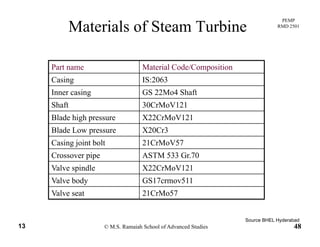
Materials of Steam Turbine
Part name Material Code/Composition
Casing IS:2063
Inner casing GS 22Mo4 Shaft
Shaft 30CrMoV121
Blade high pressure X22CrMoV121
Blade Low pressure X20Cr3
Casing joint bolt 21CrMoV57
Crossover pipe ASTM 533 Gr.70
Valve spindle X22CrMoV121Valve spindle X22CrMoV121
Valve body GS17crmov511
Valve seat 21CrMo57
© M.S. Ramaiah School of Advanced Studies13 48
Source BHEL Hyderabad
PEMP
RMD 2501
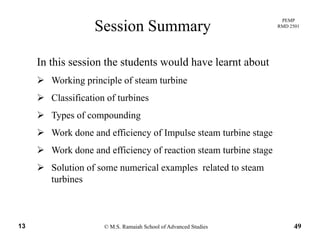
Session Summary
In this session the students would have learnt about
ki i i l f biWorking principle of steam turbine
Classification of turbines
Types of compounding
Work done and efficiency of Impulse steam turbine stage
Work done and efficiency of reaction steam turbine stage
Solution of some numerical examples related to steamSolution of some numerical examples related to steam
turbines
© M.S. Ramaiah School of Advanced Studies13 49
PEMP
RMD 2501
Thank you
© M.S. Ramaiah School of Advanced Studies13 50

Steam turbines

  • 1.
    PEMP RMD 2501 Steam TurbinesSteamTurbines Session delivered by:Session delivered by: Prof Q H NagpurwalaProf Q H NagpurwalaProf. Q.H. NagpurwalaProf. Q.H. Nagpurwala © M.S. Ramaiah School of Advanced Studies13 1
  • 2.
    PEMP RMD 2501 Session Objectives Thissession is intended to discuss the following: Classification of steam turbines Compounding of steam turbines Forces, work done and efficiency of steam turbine Numerical examplesp © M.S. Ramaiah School of Advanced Studies13 2
  • 3.
    PEMP RMD 2501 Steam Steam isa vapour used as a working substance in the operation of steam turbine. Is steam a perfect gas? Steam possess properties like those of gases: namely pressure, volume, temperature, internal energy, enthalpy and entropy. But the pressure volume and temperature of steam as a vapour are not connected by any simple relationship such as is expressed by the characteristic equation for a perfect gas. Sensible heat – The heat absorbed by water in attaining its boiling point. h h h b b d b ili iLatent heat – The heat absorbed to convert boiling water into steam. Wet steam – Steam containing some quantity of moisture. Dry steam Steam that has no moisture contentDry steam – Steam that has no moisture content. Superheated steam – Dry steam, when heated at constant pressure, attains superheat The properties of steam are dependent on its pressure © M.S. Ramaiah School of Advanced Studies13 3 The properties of steam are dependent on its pressure.
  • 4.
    PEMP RMD 2501 Steam Properties Enthalpy(H) kJ/kg Internal energy (U) kJ/kg © M.S. Ramaiah School of Advanced Studies13 4 Entropy (S) kJ/kg-K Specific volume (v) m3/kg Density (ρ) kg/m3 Isobaric heat capacity (Cp) kJ/kg-K
  • 5.
    PEMP RMD 2501 Steam PowerPlant Process Fuel Boiler Turbine Generator Thot x Exhaust SteamPump Exhaust Steam Low Pressure and temp. Low Pressure Water p Cold p xPump Cold Hot © M.S. Ramaiah School of Advanced Studies13 5 Tcold
  • 6.
    PEMP RMD 2501 Steam Turbine Steamturbine convert a part of the energy of the steam evidenced by high temperature and pressure into mechanical power-in turn electrical power The steam from the boiler is expanded in a nozzle, resulting in the emission ofThe steam from the boiler is expanded in a nozzle, resulting in the emission of a high velocity jet. This jet of steam impinges on the moving vanes or blades, mounted on a shaft. Here it undergoes a change of direction of motion which gives rise to a change in momentum and therefore a force. The motive power in a steam turbine is obtained by the rate of change in momentum of a high velocity jet of steam impinging on a curved blade which is free to rotateis free to rotate. The conversion of energy in the blades takes place by impulse, reaction or impulse reaction principle. Steam turbines are available in a few kW (as prime mover) to 1500 MW Impulse turbine are used for capacity up to © M.S. Ramaiah School of Advanced Studies13 6 Reaction turbines are used for capacity up to
  • 7.
    PEMP RMD 2501 Steam, Gasand Hydraulic Turbines The working substance differs for different types of turbines. Steam turbines are axial flow machines (radial steam turbines are rarely used) whereas gas turbines and hydraulic turbines of both axial and radial flow typewhereas gas turbines and hydraulic turbines of both axial and radial flow type are used based on applications. The pressure of working medium used in steam turbines is very high, whereas the temperature of working medium used is gas turbine is highwhereas the temperature of working medium used is gas turbine is high comparatively. The pressure and temperature of working medium in hydraulic turbines is lower than steam turbines. Steam turbines of 1300 MW single units are available whereas largest gas turbines unit is 530 MW and 815 MW © M.S. Ramaiah School of Advanced Studies13 7
  • 8.
    PEMP RMD 2501 Merits andDemerits of Steam Turbine Merits: • Ability to utilize high pressure and high temperature steam. Hi h ffi i• High component efficiency. • High rotational speed. • High capacity/weight ratio. • Smooth, nearly vibration-free operation. • No internal lubrication. • Oil free exhaust steam.Oil free exhaust steam. • Can be built in small or very large units (up to 1200 MW). Demerits: F l d li ti d ti i d• For slow speed application reduction gears are required. • The steam turbine cannot be made reversible. • The efficiency of small simple steam turbines is poor. © M.S. Ramaiah School of Advanced Studies13 8
  • 9.
    PEMP RMD 2501Application • Powergeneration • Refinery PetrochemicalRefinery, Petrochemical, • Pharmaceuticals, • Food processing, • Petroleum/Gas processing, • Pulp & Paper mills, • Waste to energy• Waste-to-energy © M.S. Ramaiah School of Advanced Studies13 9
  • 10.
    PEMP RMD 2501 Turbine Selection Inall fields of application the competitiveness of a turbine is a combination of several factors: Efficiency LifeLife Power density (power to weight ratio) i iDirect operation cost Manufacturing and maintenance costs © M.S. Ramaiah School of Advanced Studies13 10
  • 11.
    PEMP RMD 2501 Rankine Cycle SaturatedRankine cycle Superheated Rankine cycle © M.S. Ramaiah School of Advanced Studies13 11
  • 12.
    PEMP RMD 2501 Reheat onT-s diagram T 33 qinhi wouthi 5qinlo Note that T5 < T3. Many systems reheat to the same temperature 2 4 w same temperature (T3=T5). 1 2 win q woutlo 6Reheat is usually not in qout y offered for turbines less than 50 MW © M.S. Ramaiah School of Advanced Studies13 12 s
  • 13.
    PEMP RMD 2501 Schematic ofRankine Reheat Cycle Lowqinlo 4 5 Pressure TURBINE qinlo BOILER High wouthi 3 woutlo High Pressure TURBINE CONDENSER2 6 qinhi qout w 1 © M.S. Ramaiah School of Advanced Studies13 13 PUMP win
  • 14.
    PEMP RMD 2501 Steam TurbineClassification Steam turbines can be classified in several different ways: 1. By details of stage design • Impulse or reaction. 2 B l d h di i2. By steam supply and exhaust conditions • Condensing, or Non-condensing (back pressure), • Automatic or controlled extraction, • Mixed pressure• Mixed pressure • Reheat 3. By casing or shaft arrangement • Single casing Tandem compound or Cross compoundSingle casing, Tandem compound or Cross compound 4. By number of exhaust stages in parallel: • Two flow, Four flow or Six flow. 5. By direction of steam flow:y • Axial flow, Radial flow or Tangential flow 6. Single or multi-stage 7. By steam supply © M.S. Ramaiah School of Advanced Studies13 14 • Superheat or Saturated
  • 15.
    PEMP RMD 2501 Steam TurbineStage A turbine stage consists of stationary stator row (guide vanes or nozzle ring) and rotating rotor row.row. In the guide vanes high pressure, high temperature steam is expanded resulting in high The guide vanes direct the flow to the rotor p p g g velocity. The guide vanes direct the flow to the rotor blades at an appropriate angle. In the rotor, the flow direction is changed andIn the rotor, the flow direction is changed and kinetic energy of the working fluid is absorbed by the rotor shaft producing mechanical energy © M.S. Ramaiah School of Advanced Studies13 15
  • 16.
    PEMP RMD 2501 Types ofSteam Turbine Impulse Turbine Reaction Turbine Process of complete expansion of steam takes place in stationary nozzle and the velocity energy is converted into mechanical ork on the t rbine Pressure drop with expansion and generation of kinetic energy takes place in the moving blades. © M.S. Ramaiah School of Advanced Studies13 16 into mechanical work on the turbine blades.
  • 17.
    PEMP RMD 2501Types ofSteam Turbine Parsons Reaction Turbine De Laval Impulse Turbine. © M.S. Ramaiah School of Advanced Studies13 17
  • 18.
    PEMP RMD 2501Impulse ReactionTurbine Modern turbines are neither purely impulse or reaction but a combination of both. Pressure drop is effected partly in nozzles and partly in moving bladesPressure drop is effected partly in nozzles and partly in moving blades which are so designed that expansion of steam takes place in them. High velocity jet from nozzles produce an impulse on the moving blade and jet coming out from still higher velocity from moving blades produces ajet coming out from still higher velocity from moving blades produces a reaction. Impulse turbine began employing reaction of upto 20% at the root of the moving blades in order to counteract the poor efficiency incurred from zeromoving blades in order to counteract the poor efficiency incurred from zero or even negative reaction. Reaction at the root of reaction turbines has come down to as little as 30% to 40% resulting in the reduction of the number of stages required and theto 40% resulting in the reduction of the number of stages required and the sustaining of 50% reaction at mid point. It may be more accurate to describe the two design as Disc and diaphragm turbine using low reaction blading © M.S. Ramaiah School of Advanced Studies13 18 Disc and diaphragm turbine using low reaction blading Drum rotor turbine using high reaction blading
  • 19.
    PEMP RMD 2501 Flow ThroughSteam Turbine Stage © M.S. Ramaiah School of Advanced Studies13 19
  • 20.
    PEMP RMD 2501 This isdone to reduce the rotational speed of the impulse turbine to Compounding of Steam Turbines This is done to reduce the rotational speed of the impulse turbine to practical limits. Compounding is achieved by using more than one set of nozzles, blades rotors in a series keyed to a common shaft; so that either the Three main types of compounded impulse turbines are: blades, rotors, in a series, keyed to a common shaft; so that either the steam pressure or the jet velocity is absorbed by the turbine in stages. yp p p a. Pressure compounded b. Velocity compounded c Pressure and velocity compounded impulse turbinesc. Pressure and velocity compounded impulse turbines. Involves splitting up of the whole pressure drop into a series of smaller pressure drops acrossinto a series of smaller pressure drops across several stages of impulse turbine. The nozzles are fitted into a diaphragm locked in the casing that separates one wheel chamber from © M.S. Ramaiah School of Advanced Studies13 20 the casing that separates one wheel chamber from another. All rotors are mounted on the same shaft.
  • 21.
    PEMP RMD 2501 Compounding ofSteam Turbines Velocity drop is acheived through many moving rows of blades instead of a single row of moving blades. I i f l f l d f iIt consists of a nozzle or a set of nozzles and rows of moving blades attached to the rotor or the wheel and rows of fixed blades attached to the casing. Pressure velocity compounding gives the advantage of producing a shortened rotor compared to pure velocity compounding.p g In this design steam velocity at exit to the nozzles is kept reasonable and thus the blade speed (hence rotor rpm) reduced. © M.S. Ramaiah School of Advanced Studies13 21
  • 22.
    PEMP RMD 2501 Comparison betweenImpulse & Reaction Turbines Imp lse T rbines Reaction TurbinesImpulse Turbines • Reaction turbine makes use of the reaction force produced as the steam accelerates through the nozzles • An impulse turbine has fixed nozzles that orient the steam flow Reaction Turbines accelerates through the nozzles formed by the rotor • Blades have aerofoil profile (convergent passage) since pressure into high speed jets. • Blade profile is symmetrical as no pressure drop takes place in the bl d (convergent passage) since pressure drop occurs partly in the rotor blades. • Efficient at the lower pressure stages rotor blades. • Suitable for efficiently absorbing the high velocity and high pressure • Fine blade tip clearances are necessary due to the pressure leakages. pressure. • Steam pressure is constant across the blades and therefore fine tip clearances are not necessary • Inefficient at the high pressure stages due to the pressure leakages around the blade tips. Fine tip clearances can ca se clearances are not necessary. • Efficiency is not maintained in the lower pressure stages (high velocity cannot be achieved in © M.S. Ramaiah School of Advanced Studies13 22 • Fine tip clearances can cause damage to the tips of the blades. y steam for the lower pressure stages).
  • 23.
    PEMP RMD 2501 Losses inSteam Turbine Profile loss: Due to formation of boundary layer on blade surfaces. Profile loss is a boundary layer phenomenon and therefore subject to factors that influence boundary layer development. These factors are Reynolds number, surfacey y p y , roughness, exit Mach number and trailing edge thickness. Secondary loss: Due to friction on the casing wall and on the blade root and tip. It is a boundary layer effect and dependent upon the same considerations as those ofis a boundary layer effect and dependent upon the same considerations as those of profile loss. Tip leakage loss: Due to steam passing through the small clearances required b h i i d i b h i bl d i d ibetween the moving tip and casing or between the moving blade tip and rotating shaft. The extend of leakage depends on the whether the turbine is impulse or reaction. Due to pressure drop in moving blades of reaction turbine they are more prone to leakagesprone to leakages. Disc windage loss: Due to surface friction created on the discs of an impulse turbine as the disc rotates in steam atmosphere. The result is the forfeiture of shaft © M.S. Ramaiah School of Advanced Studies13 23 power for an increase in kinetic energy and heat energy of steam.
  • 24.
    PEMP RMD 2501 Losses inSteam Turbine Lacing wire loss: Due to passage blockage created by the presence of lacing wires in long blade of LP Stages. Wetness loss: Due to moisture entrained in the low pressure steam at the exit of LPWetness loss: Due to moisture entrained in the low pressure steam at the exit of LP turbine. The loss is a combination of two effects; firstly, reduction in efficiency due to absorption of energy by the water droplets and secondly, erosion of final moving blades leading edges.blades leading edges. Annulus loss: Due to significant amount of diffusion between adjacent stages or where wall cavities occur between the fixed and moving blades. The extent of loss is greatly reduced at high annulus area ratios (inlet/outlet) if the expansion of theis greatly reduced at high annulus area ratios (inlet/outlet) if the expansion of the steam is controlled by a flared casing wall. Leaving loss: Due to kinetic energy available at the steam leaving from the last stage of LP turbine. In practice steam does slow down after leaving the last blade, but through the conversion of its kinetic energy to flow friction losses. Partial admission loss: Due to partial filling of steam, flow between the blades is © M.S. Ramaiah School of Advanced Studies13 24 p g , considerably accelerated causing a loss in power.
  • 25.
    PEMP RMD 2501 Nomenclature V Absolutevelocity of steam U Blade velocity l i l i fW Relative velocity of steam Va=Vf = Vm Axial component or flow velocity V Whirl or tangential componentVw Whirl or tangential component α Nozzle angle β Blade angleβ Blade angle h enthalpy Suffix 1 Inlet © M.S. Ramaiah School of Advanced Studies13 25 2 Outlet
  • 26.
    PEMP RMD 2501 Velocity Triangles Thethree velocity vectors namely, blade speed, absolute velocity and relative velocity in relation to the rotor are used to form a triangle called velocity triangle. Velocity triangles are used to illustrate the flow in the bladings of turbomachineryturbomachinery. Changes in the flow direction and velocity are easy to understand with the help of the velocity triangles.p y g Note that the velocity triangles are drawn for the inlet and outlet of the rotor at certain radii. © M.S. Ramaiah School of Advanced Studies13 26
  • 27.
    PEMP RMD 2501 Steam TurbineBlade TerminologySteam Turbine Blade Terminology © M.S. Ramaiah School of Advanced Studies13 27
  • 28.
    PEMP RMD 2501 Inlet VelocityTriangle Vw1 U W1 Va1 W1 V1 © M.S. Ramaiah School of Advanced Studies13 28
  • 29.
    PEMP RMD 2501 Outlet VelocityTriangles Vw2 UU V2Va2 W2 © M.S. Ramaiah School of Advanced Studies13 29
  • 30.
    PEMP RMD 2501 Combined VelocityTriangles Vw2 Vw1 U W1 Va1 W1 V1 V2 W2 Va2 ΔVw © M.S. Ramaiah School of Advanced Studies13 30 For 50% reaction design
  • 31.
    PEMP RMD 2501 If thbl d i t i l th β β d l ti f i ti l ff t f th Work Done – Impulse Steam Turbine If the blade is symmetrical then β1 = β2 and neglecting frictional effects of the blades on the steam, W1 = W2. In actual case, the relative velocity is reduced by friction and expressed by a blade velocity coefficient k. Thus k = W2/W1 From Euler’s equation, work done by the steam is given by;From Euler s equation, work done by the steam is given by; Wt = U(Vw1 ± Vw2) (1) Since Vw2 is in the negative r direction, the work done per unit mass flow is given byby, Wt = U(Vw1+Vw2) (2) If V ≠ V th ill i l th t i th fl di ti A th t V iIf Va1 ≠ Va2, there will an axial thrust in the flow direction. Assume that Va is constant then, Wt = UVa (tanα1+ tanα2) (3) W UV (t β + t β ) (4) © M.S. Ramaiah School of Advanced Studies13 31 Wt = UVa (tanβ1+ tanβ2) (4) Equation (4) is often referred to as the diagram work per unit mass flow and hence the diagram efficiency is defined as
  • 32.
    PEMP RMD 2501 Work Done– Impulse Steam Turbine Diagram work done per unit mass flow Work available per unit mass flow ηd = (5) Referring to the combined diagram ΔVw is the change in the velocity of whirl.g g w g y Therefore: The driving force on the wheel = mVw (6) The product of the driving force and the blade velocity gives the rate at which workThe product of the driving force and the blade velocity gives the rate at which work is done on the wheel. From equation (6) Power output = mUΔVw (7) If V V ΔV th i l th t i i bIf Va1-Va2 = ΔVa, the axial thrust is given by; Axial thrust = mΔVa (8) The maximum velocity of the steam striking the blades √V1 = √{2(h0-h1)} (9) Where h0 is the enthalpy at the entry to the nozzle and h1 is the enthalpy at the exit neglecting the velocity at the inlet to the nozzle The energy supplied to the © M.S. Ramaiah School of Advanced Studies13 32 2 2 1V exit, neglecting the velocity at the inlet to the nozzle. The energy supplied to the blades is the kinetic energy of the jet and the blading or diagram efficiency;
  • 33.
    PEMP RMD 2501 Work Done– Impulse Steam Turbine Rate of work performed per unit mass flow Energy supplied per unit mass of steam ηd = (10)22 )( VU VU wΔ Δη ( ) 2 1 2 1 )( VV xVU w w =Δηd = Using the blade velocity coefficient (k=W2/W1) and symmetrical blades (β1= β2), then; UVV =Δ cos2 αthen; UVVw −=Δ 11 cos2 α Hence And the rate of work performed per unit mass UUV )cos(2 11 −= α UUVVw )cos(2 11 −=Δ α (11) And the rate of work performed per unit mass Therefore; UUV )cos(2 11 α 2 1 11 2)cos(2 V UUVd ×−= αη )cos(4 UUV −α ⎟ ⎞ ⎜ ⎛4 UU 2 1 11 )cos(4 V UUV d − = α η ⎟⎟ ⎠ ⎞ ⎜⎜ ⎝ ⎛ = 1 1 1 cos 4 V U V U α Uwhere is called the blade speed ratio (12) © M.S. Ramaiah School of Advanced Studies13 33 1V p (12)
  • 34.
    PEMP RMD 2501 Work Done– Impulse Steam Turbine Differentiating equation (12) and equating it to zero provides the maximum diagram efficiency; 08cos4 )( == Udd α η 08cos4 1 1 1 =−= ⎟ ⎠ ⎞ ⎜ ⎝ ⎛ V U V Ud α cosαU 2 cos 1 1 α = V U or (13) i.e., maximum diagram efficiency ⎟ ⎠ ⎞ ⎜ ⎝ ⎛ −= 2 cos cos 2 cos4 1 1 1 α α α or 2 4 (14)or 1 2 cos4 αη =d ( ) Substituting this value in equation (7), the power output per unit mass flow rate at the maximum diagram efficiency (15) © M.S. Ramaiah School of Advanced Studies13 34 2 2UP = (15)
  • 35.
    PEMP RMD 2501 Degree ofReaction Degree of reaction is a parameter that describes the relation between the energy transfer due to the static pressure change and the energy transfer due to dynamic pressure change. Degree of reaction is defined as the ratio of static pressure drop in the rotor to the static pressure drop in the stage. It is also defined as the ratio of static enthalpy drop in the rotor to the static enthalpy drop in the stage Λ= Degree of reaction = Static enthalpy change in rotor Total enthalpy change in stage = h1-h2 h0-h2 The static enthalpy at the inlet to the fixed blade in terms of stagnation enthalpy (16) The static enthalpy at the inlet to the fixed blade in terms of stagnation enthalpy and velocity at the inlet to the fixed blades is given by V hh 2 0 000 −= similarly V hh 2 2 022 −= pC hh 2 000 y pC hh 2 022 Substituting ( ) ⎟ ⎞ ⎜ ⎛ ⎟ ⎞ ⎜ ⎛ − =Λ VV hh 22 21 © M.S. Ramaiah School of Advanced Studies13 35 ⎟ ⎟ ⎠ ⎞ ⎜ ⎜ ⎝ ⎛ −− ⎟ ⎟ ⎠ ⎞ ⎜ ⎜ ⎝ ⎛ − pp C V h C V h 22 2 02 0 00
  • 36.
    PEMP RMD 2501 Degree ofReaction ( ) ( ) 21 hh hh − =Λ But for a normal stage, V0 = V2 and since h00 = h01 in the nozzle, then; (17) ( )0201 hh − We know that (h01 – h02) = ( ) ( ) 0 2 2 2 2 1 21 = − +− ww VV hh Substituting for (h h ) in equation (17)Substituting for (h1- h2) in equation (17), ( ) ( )[ ] 2 1 2 2 2 hh VV ww − =Λ ( ) ( )[ ] 2 1 2 2 2 ww VVU VV − − = (18) ( )[ ]02012 hh − ( )[ ]212 ww VVU − Assuming the axial velocity is constant through out the stage, then ( )VV − 22 (18) ( ) ( )[ ]UVVUU VV ww ww −++ − =Λ 21 12 2 ( )( )VVVV +− © M.S. Ramaiah School of Advanced Studies13 36 ( )( ) ( )[ ]21 1212 2 ww wwww VVU VVVV + +− =Λ (19)
  • 37.
    PEMP RMD 2501 (20) Degree ofReaction ( ) U Va 2 tantan 12 ββ + =Λ From the velocity triangles it is seen thaty g 11 ww VUV += UVV ww −= 22 Therefore equation (20) can be arranged into a second form:Therefore equation (20) can be arranged into a second form: ( )22 tantan 22 1 αβ ++=Λ U Va (21) Putting Λ = 0 in equation (20), we get ( )12 ββ = And V1 = V2 and for Λ = 0.5, ( )12 αβ = Zero reaction stage Let us first discuss the special case of zero reaction. According to the definition of reaction, When Λ = 0, equation (16) reveals that h1 = h2 and equation (20) that © M.S. Ramaiah School of Advanced Studies13 37 , , q ( ) 1 2 q ( ) β1 = β2.
  • 38.
    PEMP RMD 2501 Degree ofReaction Now h01r01 = h02r02 and h1 = h2 for Λ = 0. Then W1 = W2. In the ideal case, there is Mollier diagram Velocity Diagram 01r01 02r02 1 2 1 2 , no pressure drop in the rotor and points 1 2 and 2s on the mollier chart should coincide. But due to irreversibility, there is a pressure drop through the rotor. The zero reaction in the impulse stage by definition, means there is no pressure drop © M.S. Ramaiah School of Advanced Studies13 38 through the rotor. The Mollier diagram for an impulse stage is shown in Fig. 1.a, where it can be observed that the enthalpy increases through the rotor.
  • 39.
    PEMP RMD 2501 Degree ofReaction From equation (16) it is clear that the reaction is negative for the impulse turbine stage when irreversibility is taken into account. Fifty percent reaction stage From equation (16) for Λ = 0.5 α1 = β2 and the velocity diagram is symmetrical Because of Fig.1.a velocity diagram is symmetrical. Because of symmetry, it is also clear that α2 = β1. For Λ=1/2, the enthalpy drop in the nozzle row equals the enthalpy drop in the rotor. That isenthalpy drop in the rotor. That is h0 - h1 = h1 - h2 © M.S. Ramaiah School of Advanced Studies13 39
  • 40.
    PEMP RMD 2501 U Degree ofReaction aV U += 22 tanαβSubstituting into equation (21) ( )tantan1 αα+=Λ Va (22) ( )12 tantan 2 1 αα −+=Λ U Thus when α2 = α1, the reaction is unity (also V1 = V2). The velocity diagram for i h i i i h hΛ = 1 is shown in Fig. with the same values of Va, U and W used for Λ = 0 and Λ = ½. It is obvious that if Λ exceeds unity then V <V (i e nozzleexceeds unity, then V1<V0 (i.e., nozzle flow diffusion). Choice of Reaction and Effect on Efficiency VV Equation (17) can be rewritten as U VV ww 2 1 12 − +=Λ Cw2 can be eliminated by using this equation W VW © M.S. Ramaiah School of Advanced Studies13 40 12 ww V U W V −= yielding U V U W w1 2 2 1 −+=Λ
  • 41.
    PEMP RMD 2501 Degree ofReaction In Fig. the total to static efficiencies are shown plotted against the degree of reaction. When = 2, ηts is maximum at Λ = 0. With higher loading, the optimum ηts is obtained with higher reaction 2 /UW ratios. As shown in Fig. for a high total to total efficiency, the blade loading factor should be as small as possible, hi h i li h hi h iblwhich implies the highest possible value of blade speed is consistent with blade stress limitations. It means that the total to static efficiency is heavilythe total to static efficiency is heavily dependent upon the reaction ratio and ηts can be optimized by choosing a suitable value of reaction © M.S. Ramaiah School of Advanced Studies13 41 suitable value of reaction.
  • 42.
    PEMP RMD 2501 Blade Heightin Axial Flow Machines The continuity equation may be used to find the blade height ‘h’. The annular area of flow = πDh. Thus the mass flow rate through an axial flow turbine is AVm ρ= • turbine is aDhVm ρπ= • • aDV m h ρπ = Blade height will increase in the direction of flow in a turbine and decrease in the direction of flow in a compressor. aρ © M.S. Ramaiah School of Advanced Studies13 42
  • 43.
    PEMP RMD 2501 Effect ofReheat Factor & Stage Efficiency The thermodynamic effect on the turbine efficiency can be best understood by considering a number of stages, say 4, between states 1 and 5 as shown in Fig. © M.S. Ramaiah School of Advanced Studies13 43 Total expansion is divided into four stages of the same stage efficiency and pressure ratio
  • 44.
    PEMP RMD 2501 PPPP Effect ofReheat Factor & Stage Efficiency 5 4 4 3 3 2 2 1 .,. P P P P P P P P ei === Let η0 is the overall efficiency of expansion and is defined as the ratio of actualLet η0 is the overall efficiency of expansion and is defined as the ratio of actual work done per kg of steam to the isentropic work done per kg of steam between 1 and 5. ⎟ ⎞ ⎜ ⎛W 51 hh − ⎟⎟ ⎠ ⎞ ⎜⎜ ⎝ ⎛ = s a W W ei 0.,. η ' 51 51 0.,. hh hh ei − =η The actual work done per kg of steam Wa = η0 Ws (22) Isentropic or ideal values in each stages are ΔWs1, ΔWs2, ΔWs3, ΔWs4. Therefore the total value of the actual work done in these stages is, Wa = Σ(1-2)+(2-3)+(3-4)+(4-5) Also stage efficiency for each stage is given by actual work done/kg of steam W © M.S. Ramaiah School of Advanced Studies13 44 ηs = actual work done/kg of steam Isentropic work done in stage 1 1 s a W W =
  • 45.
    PEMP RMD 2501 F t1 Effect of Reheat Factor & Stage Efficiency For stage 1 111 1 1 ' 21 21 1 1 1.,. ssa s a s a s WWor W W hh hh W W ei Δ=Δ Δ = − − == ηη [ ][ ]44332211 ssssssssaa WWWWWW Δ+Δ+Δ+ΔΣ=ΣΔ=Δ∴ ηηηη For same stage efficiency in each stage 4321 ssss ηηηη === [ ][ ] sssssssa WWWWWW ΣΔ=Δ+Δ+Δ+ΔΣ= ηη 4321 (23) From equation (22) and (23), s s ss W W WW ΣΔ =∴ ΣΔ= ηη ηη 0 00 (24) s s W ηη0 The slope of constant pressure lines on h-s plane is given by T h ⎟ ⎞ ⎜ ⎛ ∂ © M.S. Ramaiah School of Advanced Studies13 45 T s h p =⎟ ⎠ ⎞ ⎜ ⎝ ⎛ ∂ ∂
  • 46.
    PEMP RMD 2501 Effect ofReheat Factor & Stage Efficiency This shows that the constant pressure lines must diverge towards the right. Therefore . F i I i b i h h h l i h 1> ΣΔ s s W W For expansion process. It is obvious that the enthalpy increases when we move towards right along the constant pressure line. Hence the summation of ΔWs1 ΔWs1 etc., is more than the total isentropic enthalpy drop Ws Th ti f ti f i t i th l d f i di id l t t th t t l [ ] [ ])4()3()2()21( '''' 4321 −+−+−+−Σ = Δ+Δ+Δ+ΔΣ = cbaWWWW RF ssss The ratio of summation of isentropic enthalpy drop for individual stage to the total isentropic enthalpy drop as a whole is called Reheat factor. Thus )51( −W RF s s s W W RF ΣΔ = Therefore the overall efficiency of the expansion process (25) As Therefore the overall efficiency of the expansion process, RFstage ×=ηη0 (26) 1)/( >ΣΔ= ss WWRF th ll ffi i f th t bi i t th th t ffi i i © M.S. Ramaiah School of Advanced Studies13 46 the overall efficiency of the turbine η0 is greater than than stage efficiencies ηs sei ηη >0.,. for turbines (27)
  • 47.
    PEMP RMD 2501 Merits andDemerits of Reheating Advantages of Reheating 1. There is an increase in output of turbine. 2. Erosion and corrosion problems in steam turbine are reduced. 3. There is an improvement in overall thermal efficiency of the turbine. 4. Condition of steam in last stage are improved. Demerits 1. Capital cost required for Reheating 2. The increase in thermal efficiency is not appreciable compared to expenditure incurred in reheating for smaller capacity turbinesexpenditure incurred in reheating for smaller capacity turbines. © M.S. Ramaiah School of Advanced Studies13 47
  • 48.
    PEMP RMD 2501 Materials ofSteam Turbine Part name Material Code/Composition Casing IS:2063 Inner casing GS 22Mo4 Shaft Shaft 30CrMoV121 Blade high pressure X22CrMoV121 Blade Low pressure X20Cr3 Casing joint bolt 21CrMoV57 Crossover pipe ASTM 533 Gr.70 Valve spindle X22CrMoV121Valve spindle X22CrMoV121 Valve body GS17crmov511 Valve seat 21CrMo57 © M.S. Ramaiah School of Advanced Studies13 48 Source BHEL Hyderabad
  • 49.
    PEMP RMD 2501 Session Summary Inthis session the students would have learnt about ki i i l f biWorking principle of steam turbine Classification of turbines Types of compounding Work done and efficiency of Impulse steam turbine stage Work done and efficiency of reaction steam turbine stage Solution of some numerical examples related to steamSolution of some numerical examples related to steam turbines © M.S. Ramaiah School of Advanced Studies13 49
  • 50.
    PEMP RMD 2501 Thank you ©M.S. Ramaiah School of Advanced Studies13 50