
Introduction to Branding
Course
Instructor:
Bipasha
Matin
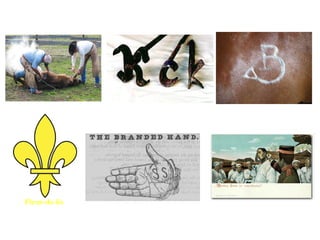
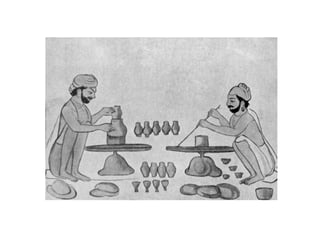
The word “brand” is derived from the Old Norse wordThe word “brand” is derived from the Old Norse word
“brandr,” which means “to burn” as brand were and still“brandr,” which means “to burn” as brand were and still
are the means by which owners of livestock mark theirare the means by which owners of livestock mark their
animals to identify them.animals to identify them.
Branding: Historical OriginBranding: Historical Origin
Fleur-de-lis
Maverick
• The term "maverick," originally meaning an
unbranded calf, comes from Texas rancher
Samuel Augustus Maverick who, following the
American Civil War, decided that since all
other cattle were branded, his would be
identified by having no markings at all.
• Even the signatures on paintings of famous
artists like Leonardo Da Vinci can be viewed as
an early branding tool.
Just How Old is Branding?
• Branding goes back even further. As far back
as 1300 BC, potter's marks were used on
pottery and porcelain in China, Greece, Rome
and India. Branding of cattle and livestock go
back as far as 2000 BC. And archaeologists
have found evidence of advertising among
Babylonians dating back to 3000 BC. So, how
far back does branding go? At least 5000
years.
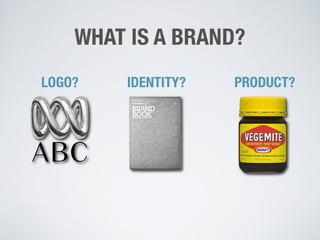
What is a brand?What is a brand?
 A name, term, sign, symbol or design, or aA name, term, sign, symbol or design, or a
combination of them, intended to identifycombination of them, intended to identify
the goods or services of sellers and tothe goods or services of sellers and to
differentiate them from those ofdifferentiate them from those of
competitors.competitors.
American Marketing AssociationAmerican Marketing Association
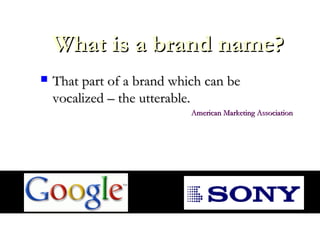
What is a brand name?What is a brand name?
 That part of a brand which can beThat part of a brand which can be
vocalized – the utterable.vocalized – the utterable.
American Marketing AssociationAmerican Marketing Association
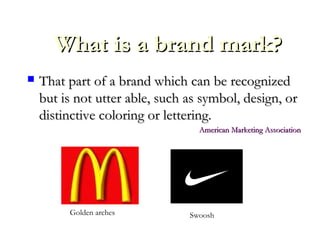
What is a brand mark?What is a brand mark?
 That part of a brand which can be recognizedThat part of a brand which can be recognized
but is not utter able, such as symbol, design, orbut is not utter able, such as symbol, design, or
distinctive coloring or lettering.distinctive coloring or lettering.
American Marketing AssociationAmerican Marketing Association
Golden arches Swoosh
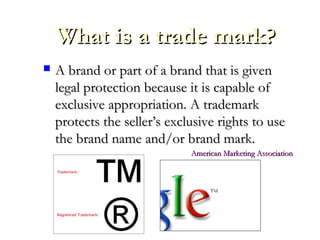
What is a trade mark?What is a trade mark?
 A brand or part of a brand that is givenA brand or part of a brand that is given
legal protection because it is capable oflegal protection because it is capable of
exclusive appropriation. A trademarkexclusive appropriation. A trademark
protects the seller’s exclusive rights to useprotects the seller’s exclusive rights to use
the brand name and/or brand mark.the brand name and/or brand mark.
American Marketing AssociationAmerican Marketing Association
A brand was name, term, sign, symbolA brand was name, term, sign, symbol
or design, or a combination of them,or design, or a combination of them,
intended to identify the goods orintended to identify the goods or
services of one seller or group ofservices of one seller or group of
sellers and to differentiate themsellers and to differentiate them
……(identity)(identity)
Day before yesterday…Day before yesterday…
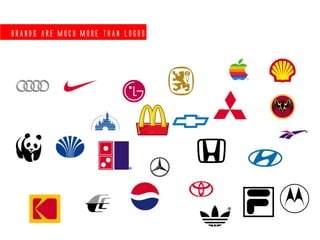
Brands are much more than logos
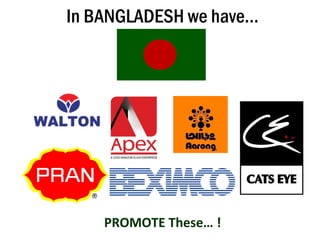
In BANGLADESH we have…
PROMOTE These… !
Yesterday…
A brand was a bundle of benefits
delivered by products/services to
consumers…(utility)
Today…
A brand is an experience that real
people enjoy (hopefully) everyday…
And it has a name and a personality
which fits with me.
Jayanta Sengupta
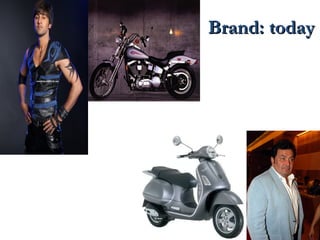
Brand: todayBrand: today
examples…
• Marlboro is ‘masculine’ while Virginia
Slims is ‘feminine’
• IBM is ‘older’ while Apple is ‘younger’
• India Today is ‘old-fashioned’ while
Outlook is ‘trendier’
More examples…
Axe
• Seduction, masculinity, individuality,
unconventionality
Marlboro
• Masculinity, freedom, adventure
Levi’s
• Rebellion, sensuality, being cool
• People are looking for experience:
67% of consumers say:
“Even though there are many things I would like
to own, I prefer spending my money on
experiences that will enrich my life.”
Lifestyle Link, May 2001, Yankelovich Monitor
Today…Today…
Branding Today
A brand is an intangible asset that
resides in people’s minds, which is
defined by the expectations people
have about the benefits they will
receive. These expectations of
benefits are developed over time
by communications and - moremore
importantly - by actions.importantly - by actions.
D. Semans,AMA Internal Branding
A brand is a reason
to choose.
Cheryl Burgess
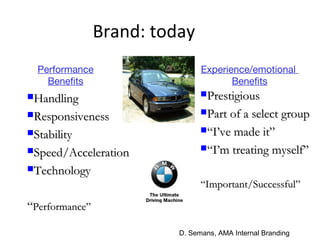
Brand: today
HandlingHandling
ResponsivenessResponsiveness
StabilityStability
Speed/AccelerationSpeed/Acceleration
TechnologyTechnology
““Performance”Performance”
Experience/emotional
Benefits
Performance
Benefits
PrestigiousPrestigious
Part of a select groupPart of a select group
““I’ve made it”I’ve made it”
““I’m treating myself”I’m treating myself”
““Important/Successful”Important/Successful”
D. Semans, AMA Internal Branding
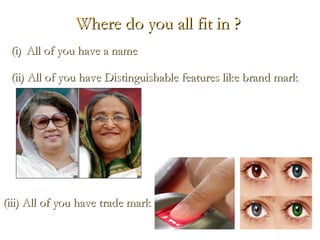
Where do you all fit in ?Where do you all fit in ?
(i)(i) All of you have a nameAll of you have a name
(ii) All of you have Distinguishable features like brand mark(ii) All of you have Distinguishable features like brand mark
(iii) All of you have trade mark(iii) All of you have trade mark
Can everything be branded?
• A brand resides in the minds of consumers.
• Consumers perceive differences among
brands in a product category.
• Even commodities can be branded:
– Coffee (Nestle), bath soap (Lux), flour (Fresh),
beer (Castle), salt (Molla), oatmeal (Jungle),
pickles (Pran), and even water (MUM), puffed rice
(ruchi), sugar
What is branded?
• Physical goods
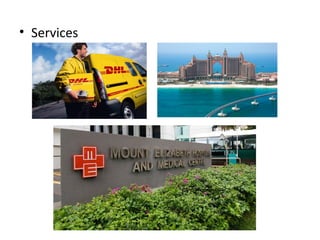
• Services
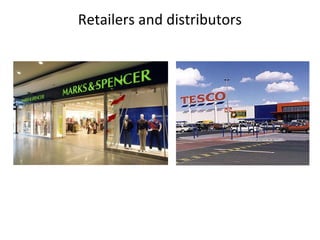
• Retailers and distributors
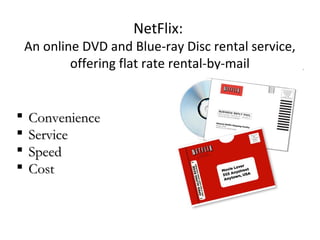
• Online products and services
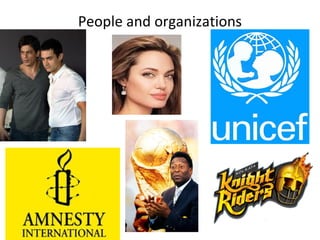
• People and organizations
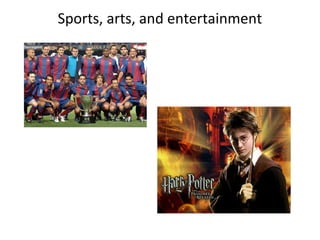
• Sports, arts, and entertainment
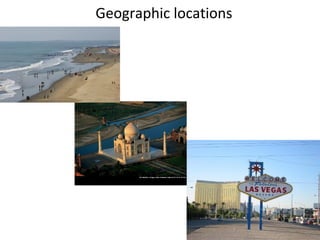
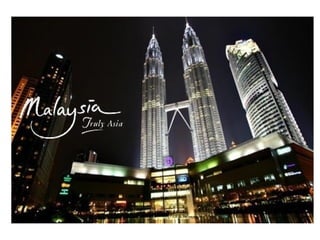
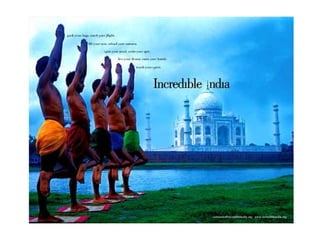
• Geographic locations
• Ideas and causes
26
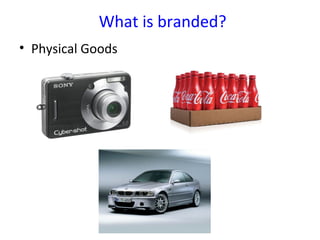
What is branded?
• Physical Goods
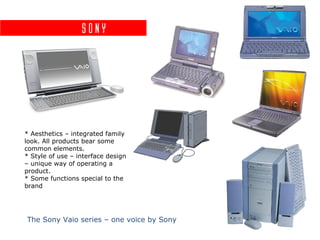
Sony
The Sony Vaio series – one voice by Sony
* Aesthetics – integrated family
look. All products bear some
common elements.
* Style of use – interface design
– unique way of operating a
product.
* Some functions special to the
brand
• Services
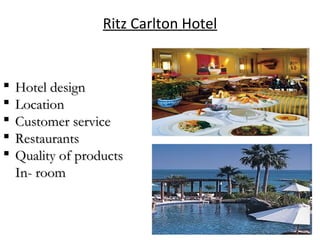
Ritz Carlton Hotel
 Hotel designHotel design
 LocationLocation
 Customer serviceCustomer service
 RestaurantsRestaurants
 Quality of productsQuality of products
In- roomIn- room
Retailers and distributors
Online products and services
 ConvenienceConvenience
 ServiceService
 SpeedSpeed
 CostCost
NetFlix:
An online DVD and Blue-ray Disc rental service,
offering flat rate rental-by-mail
People and organizations
Sports, arts, and entertainment
Geographic locations
Ideas and causes
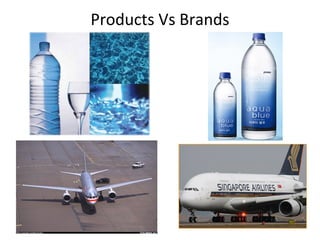
Products Vs Brands
PRODUCT
• Product: anything we can offer to a market for
attention, acquisition, use, or consumption that
might satisfy a need or want.
• May be a physical good, a service, a retail outlet, a
person, an organization, a place, or even an idea.
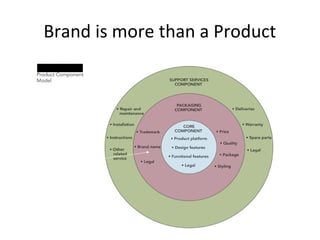
Brand is more than a Product
BRAND
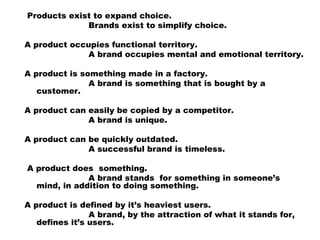
 Products exist to expand choice.
                        Brands exist to simplify choice.
 
A product occupies functional territory.
                        A brand occupies mental and emotional territory.
A product is something made in a factory.
                        A brand is something that is bought by a
customer.
 
A product can easily be copied by a competitor.
                        A brand is unique.
 
A product can be quickly outdated.
                        A successful brand is timeless.
 
 A product does  something.
                        A brand stands  for something in someone’s
mind, in addition to doing something.
 
A product is defined by it’s heaviest users.
                        A brand, by the attraction of what it stands for,
defines it’s users.
 
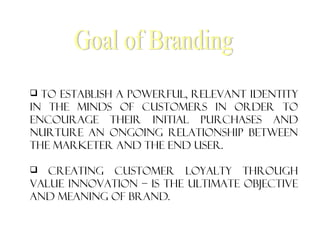
 To establish a powerful, relevant identity
in the minds of customers in order to
encourage their initial purchases and
nurture an ongoing relationship between
the marketer and the end user.
 Creating customer loyalty through
value innovation – is the ultimate objective
and meaning of brand.
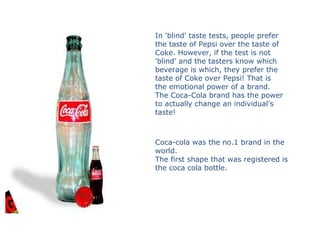
In 'blind' taste tests, people prefer
the taste of Pepsi over the taste of
Coke. However, if the test is not
'blind' and the tasters know which
beverage is which, they prefer the
taste of Coke over Pepsi! That is
the emotional power of a brand.
The Coca-Cola brand has the power
to actually change an individual's
taste!
Coca-cola was the no.1 brand in the
world.
The first shape that was registered is
the coca cola bottle.
Why do Brand matters?
To Consumer
• Help buyers identify the product that they like/dislike.
• Identify marketer
• Helps reduce the time needed for purchase.
• Helps buyers evaluate quality of products especially if unable
to judge a products characteristics.
• Helps reduce buyer’s perceived risk of purchase.
• Buyer may derive a psychological reward from owning the
brand, Rado or Ford.
Why do brand matter?
To Manufacturer
•Differentiate product offering from competitors
• Brand identifies the companies products making repeat
purchases easier for customers.
• Brand helps firm introduce a new product that carries the
name of one or more of its existing products...half as much as
using a new brand, lower co. designs, advertising and
promotional costs.
• Easier cooperation with intermediaries with well known
brands
• Facilitates promotional efforts.
• Helps foster brand loyalty helping to stabilize market share.
• Firms may be able to charge a premium for the brand.
•Legal Protection
•Financial returns
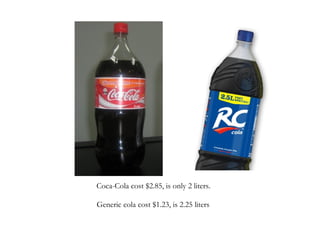
Coca-Cola cost $2.85, is only 2 liters.
Generic cola cost $1.23, is 2.25 liters
Importance of Brand Management
• Brands are vulnerable, and susceptible to poor
brand management.
53
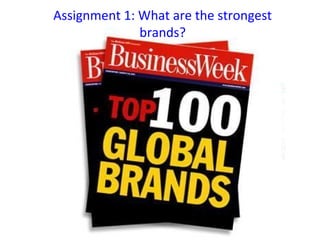
Assignment 1: What are the strongest
brands?
Branding Challenges and Opportunities
• Savvy customers
• Brand proliferation
• Media fragmentation
• Increased competition
• Increased costs
• Greater accountability
• Regulation
55
BRAND EQUITY
A brand's power derived from
the goodwill and name
recognition that it has earned
over time, which translates into
higher sales volume and higher
profit margins against
competing brands.
The Brand Equity Concept
• No common viewpoint on how it should be
conceptualized and measured
• It stresses the importance of brand role in
marketing strategies.
• Brand equity is defined in terms of the
marketing effects uniquely attributable to the
brand.
– Brand equity relates to the fact that different outcomes result in the
marketing of a product or service because of its brand name, as
compared to if the same product or service did not have that name.
57
They had a really good
brand equit y, which
meant t hey would sell
more due t o t he f act t hat
t hey were well known and
popular.
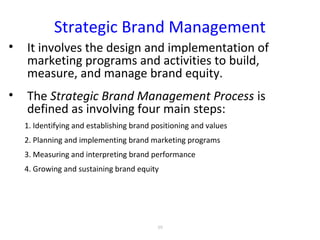
Strategic Brand Management
• It involves the design and implementation of
marketing programs and activities to build,
measure, and manage brand equity.
• The Strategic Brand Management Process is
defined as involving four main steps:
1. Identifying and establishing brand positioning and values
2. Planning and implementing brand marketing programs
3. Measuring and interpreting brand performance
4. Growing and sustaining brand equity
59
60
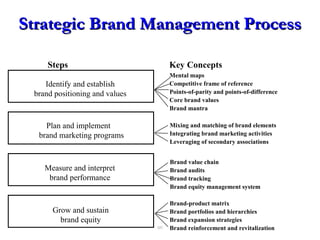
Strategic Brand Management ProcessStrategic Brand Management Process
Mental maps
Competitive frame of reference
Points-of-parity and points-of-difference
Core brand values
Brand mantra
Mixing and matching of brand elements
Integrating brand marketing activities
Leveraging of secondary associations
Brand value chain
Brand audits
Brand tracking
Brand equity management system
Brand-product matrix
Brand portfolios and hierarchies
Brand expansion strategies
Brand reinforcement and revitalization
Key ConceptsSteps
Grow and sustain
brand equity
Identify and establish
brand positioning and values
Plan and implement
brand marketing programs
Measure and interpret
brand performance
Group Assignment
Select your division and give a
creative and relevant BRAND
NAME.
Write a short description of it.
Submission Date: 25 May 2015

Branding chapter 1

  • 1.
  • 2.
    The word “brand”is derived from the Old Norse wordThe word “brand” is derived from the Old Norse word “brandr,” which means “to burn” as brand were and still“brandr,” which means “to burn” as brand were and still are the means by which owners of livestock mark theirare the means by which owners of livestock mark their animals to identify them.animals to identify them. Branding: Historical OriginBranding: Historical Origin
  • 3.
  • 4.
    Maverick • The term"maverick," originally meaning an unbranded calf, comes from Texas rancher Samuel Augustus Maverick who, following the American Civil War, decided that since all other cattle were branded, his would be identified by having no markings at all. • Even the signatures on paintings of famous artists like Leonardo Da Vinci can be viewed as an early branding tool.
  • 6.
    Just How Oldis Branding? • Branding goes back even further. As far back as 1300 BC, potter's marks were used on pottery and porcelain in China, Greece, Rome and India. Branding of cattle and livestock go back as far as 2000 BC. And archaeologists have found evidence of advertising among Babylonians dating back to 3000 BC. So, how far back does branding go? At least 5000 years.
  • 9.
    What is abrand?What is a brand?  A name, term, sign, symbol or design, or aA name, term, sign, symbol or design, or a combination of them, intended to identifycombination of them, intended to identify the goods or services of sellers and tothe goods or services of sellers and to differentiate them from those ofdifferentiate them from those of competitors.competitors. American Marketing AssociationAmerican Marketing Association
  • 10.
    What is abrand name?What is a brand name?  That part of a brand which can beThat part of a brand which can be vocalized – the utterable.vocalized – the utterable. American Marketing AssociationAmerican Marketing Association
  • 11.
    What is abrand mark?What is a brand mark?  That part of a brand which can be recognizedThat part of a brand which can be recognized but is not utter able, such as symbol, design, orbut is not utter able, such as symbol, design, or distinctive coloring or lettering.distinctive coloring or lettering. American Marketing AssociationAmerican Marketing Association Golden arches Swoosh
  • 12.
    What is atrade mark?What is a trade mark?  A brand or part of a brand that is givenA brand or part of a brand that is given legal protection because it is capable oflegal protection because it is capable of exclusive appropriation. A trademarkexclusive appropriation. A trademark protects the seller’s exclusive rights to useprotects the seller’s exclusive rights to use the brand name and/or brand mark.the brand name and/or brand mark. American Marketing AssociationAmerican Marketing Association
  • 13.
    A brand wasname, term, sign, symbolA brand was name, term, sign, symbol or design, or a combination of them,or design, or a combination of them, intended to identify the goods orintended to identify the goods or services of one seller or group ofservices of one seller or group of sellers and to differentiate themsellers and to differentiate them ……(identity)(identity) Day before yesterday…Day before yesterday…
  • 14.
    Brands are muchmore than logos
  • 15.
    In BANGLADESH wehave… PROMOTE These… !
  • 16.
    Yesterday… A brand wasa bundle of benefits delivered by products/services to consumers…(utility)
  • 17.
    Today… A brand isan experience that real people enjoy (hopefully) everyday… And it has a name and a personality which fits with me. Jayanta Sengupta
  • 18.
  • 19.
    examples… • Marlboro is‘masculine’ while Virginia Slims is ‘feminine’ • IBM is ‘older’ while Apple is ‘younger’ • India Today is ‘old-fashioned’ while Outlook is ‘trendier’
  • 20.
    More examples… Axe • Seduction,masculinity, individuality, unconventionality Marlboro • Masculinity, freedom, adventure Levi’s • Rebellion, sensuality, being cool
  • 21.
    • People arelooking for experience: 67% of consumers say: “Even though there are many things I would like to own, I prefer spending my money on experiences that will enrich my life.” Lifestyle Link, May 2001, Yankelovich Monitor Today…Today…
  • 22.
    Branding Today A brandis an intangible asset that resides in people’s minds, which is defined by the expectations people have about the benefits they will receive. These expectations of benefits are developed over time by communications and - moremore importantly - by actions.importantly - by actions. D. Semans,AMA Internal Branding A brand is a reason to choose. Cheryl Burgess
  • 23.
    Brand: today HandlingHandling ResponsivenessResponsiveness StabilityStability Speed/AccelerationSpeed/Acceleration TechnologyTechnology ““Performance”Performance” Experience/emotional Benefits Performance Benefits PrestigiousPrestigious Part ofa select groupPart of a select group ““I’ve made it”I’ve made it” ““I’m treating myself”I’m treating myself” ““Important/Successful”Important/Successful” D. Semans, AMA Internal Branding
  • 24.
    Where do youall fit in ?Where do you all fit in ? (i)(i) All of you have a nameAll of you have a name (ii) All of you have Distinguishable features like brand mark(ii) All of you have Distinguishable features like brand mark (iii) All of you have trade mark(iii) All of you have trade mark
  • 25.
    Can everything bebranded? • A brand resides in the minds of consumers. • Consumers perceive differences among brands in a product category. • Even commodities can be branded: – Coffee (Nestle), bath soap (Lux), flour (Fresh), beer (Castle), salt (Molla), oatmeal (Jungle), pickles (Pran), and even water (MUM), puffed rice (ruchi), sugar
  • 26.
    What is branded? •Physical goods • Services • Retailers and distributors • Online products and services • People and organizations • Sports, arts, and entertainment • Geographic locations • Ideas and causes 26
  • 27.
    What is branded? •Physical Goods
  • 28.
    Sony The Sony Vaioseries – one voice by Sony * Aesthetics – integrated family look. All products bear some common elements. * Style of use – interface design – unique way of operating a product. * Some functions special to the brand
  • 29.
  • 30.
    Ritz Carlton Hotel Hotel designHotel design  LocationLocation  Customer serviceCustomer service  RestaurantsRestaurants  Quality of productsQuality of products In- roomIn- room
  • 31.
  • 32.
  • 33.
     ConvenienceConvenience  ServiceService SpeedSpeed  CostCost NetFlix: An online DVD and Blue-ray Disc rental service, offering flat rate rental-by-mail
  • 34.
  • 35.
    Sports, arts, andentertainment
  • 37.
  • 41.
  • 42.
  • 43.
    PRODUCT • Product: anythingwe can offer to a market for attention, acquisition, use, or consumption that might satisfy a need or want. • May be a physical good, a service, a retail outlet, a person, an organization, a place, or even an idea.
  • 46.
    Brand is morethan a Product BRAND
  • 47.
     Products exist toexpand choice.                         Brands exist to simplify choice.   A product occupies functional territory.                         A brand occupies mental and emotional territory. A product is something made in a factory.                         A brand is something that is bought by a customer.   A product can easily be copied by a competitor.                         A brand is unique.   A product can be quickly outdated.                         A successful brand is timeless.    A product does  something.                         A brand stands  for something in someone’s mind, in addition to doing something.   A product is defined by it’s heaviest users.                         A brand, by the attraction of what it stands for, defines it’s users.  
  • 48.
     To establisha powerful, relevant identity in the minds of customers in order to encourage their initial purchases and nurture an ongoing relationship between the marketer and the end user.  Creating customer loyalty through value innovation – is the ultimate objective and meaning of brand.
  • 49.
    In 'blind' tastetests, people prefer the taste of Pepsi over the taste of Coke. However, if the test is not 'blind' and the tasters know which beverage is which, they prefer the taste of Coke over Pepsi! That is the emotional power of a brand. The Coca-Cola brand has the power to actually change an individual's taste! Coca-cola was the no.1 brand in the world. The first shape that was registered is the coca cola bottle.
  • 50.
    Why do Brandmatters? To Consumer • Help buyers identify the product that they like/dislike. • Identify marketer • Helps reduce the time needed for purchase. • Helps buyers evaluate quality of products especially if unable to judge a products characteristics. • Helps reduce buyer’s perceived risk of purchase. • Buyer may derive a psychological reward from owning the brand, Rado or Ford.
  • 51.
    Why do brandmatter? To Manufacturer •Differentiate product offering from competitors • Brand identifies the companies products making repeat purchases easier for customers. • Brand helps firm introduce a new product that carries the name of one or more of its existing products...half as much as using a new brand, lower co. designs, advertising and promotional costs. • Easier cooperation with intermediaries with well known brands • Facilitates promotional efforts. • Helps foster brand loyalty helping to stabilize market share. • Firms may be able to charge a premium for the brand. •Legal Protection •Financial returns
  • 52.
    Coca-Cola cost $2.85,is only 2 liters. Generic cola cost $1.23, is 2.25 liters
  • 53.
    Importance of BrandManagement • Brands are vulnerable, and susceptible to poor brand management. 53
  • 54.
    Assignment 1: Whatare the strongest brands?
  • 55.
    Branding Challenges andOpportunities • Savvy customers • Brand proliferation • Media fragmentation • Increased competition • Increased costs • Greater accountability • Regulation 55
  • 56.
    BRAND EQUITY A brand'spower derived from the goodwill and name recognition that it has earned over time, which translates into higher sales volume and higher profit margins against competing brands.
  • 57.
    The Brand EquityConcept • No common viewpoint on how it should be conceptualized and measured • It stresses the importance of brand role in marketing strategies. • Brand equity is defined in terms of the marketing effects uniquely attributable to the brand. – Brand equity relates to the fact that different outcomes result in the marketing of a product or service because of its brand name, as compared to if the same product or service did not have that name. 57
  • 58.
    They had areally good brand equit y, which meant t hey would sell more due t o t he f act t hat t hey were well known and popular.
  • 59.
    Strategic Brand Management •It involves the design and implementation of marketing programs and activities to build, measure, and manage brand equity. • The Strategic Brand Management Process is defined as involving four main steps: 1. Identifying and establishing brand positioning and values 2. Planning and implementing brand marketing programs 3. Measuring and interpreting brand performance 4. Growing and sustaining brand equity 59
  • 60.
    60 Strategic Brand ManagementProcessStrategic Brand Management Process Mental maps Competitive frame of reference Points-of-parity and points-of-difference Core brand values Brand mantra Mixing and matching of brand elements Integrating brand marketing activities Leveraging of secondary associations Brand value chain Brand audits Brand tracking Brand equity management system Brand-product matrix Brand portfolios and hierarchies Brand expansion strategies Brand reinforcement and revitalization Key ConceptsSteps Grow and sustain brand equity Identify and establish brand positioning and values Plan and implement brand marketing programs Measure and interpret brand performance
  • 61.
    Group Assignment Select yourdivision and give a creative and relevant BRAND NAME. Write a short description of it. Submission Date: 25 May 2015