Warming up to brands 7th August 2007
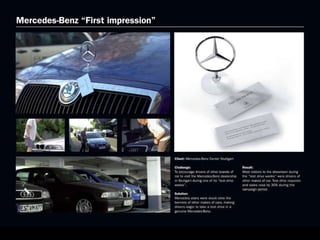
Let’s identify the brands associated with these visuals and slogans


Slogans Just do it! Kuch meetha ho jaye Impossible is nothing Connecting people Lagey raho Express yourself Keep walking! There are some things money can’t buy. For everything else there is …..
Slogans It’s hot! The world’s local bank The Citi never sleeps The power of knowledge The best a man can get God’s own country The taste of India Do you have it in you? Think different
Brands….The beginning
Roots Uniformity is the mother of branding Identity is lost due to homogeneity as there is no differentiation  Origin of the word ‘brand’ lies in the Norse word ‘brandr’ which means ‘to burn’ In early times, farmers used to identify their livestock with a burn mark or a symbol Distillers branded their casks
Roots The producers’ names identified the products - Smirnoff, Ford, Mercedes, Levi Strauss
Today…. Brands are an integral part of our life - products; services; people; places; football clubs; fictional characters; virtual worlds…. They are intangible assets that need to be exploited
Savour this Indian firms eye Jaguar, Land Rover - Tata - Mahindra & Mahindra World’s top 100 brands worth more than India’s total m-cap - $ 1.15 trillion - More than combined market value of over 4000 listed cos. in India
We work not for ourselves,  not for the company, not even for our clients. We work for Brands Brand Stewardship ( Ogilvy)
To be most valued by those who most value brands Brand Stewardship ( Ogilvy)
Brand A Brand is  a product which has  earned a place  in the consumer’s life through perception, experience, beliefs, feelings  ....... until a relationship is built It is the sum of how consumers feel about a product Brand Stewardship (Ogilvy)
Brand “ A brand is nothing more or less than the  sum of all the mental connections people have around the product.  Memories from childhood, something your mum said ... and in the case of newer brands, memories from ads.  The trick is to arrange things so that the mental connections around the brand are enhancing” Michael Perry   Former Chairman & CEO, Unilever
Brand “ Consumers build brands the way birds build nests...  from scraps and straws they chance upon”   Jeremy Bullmore     Former Chairman JWT
The ‘classic’ definition Keller: “A brand is a set of  mental associations,  held by the consumer, which add to the perceived value of a product or service”
Mental associations Unique (Exclusivity) Strong (Saliency) Positive (Desirable)
Mental associations What is the brand territory (perceived competence; typical products or services; specific know-how)? - Gillette - Apple - Virgin - Nokia - Dettol - Karim’s?
Mental associations What is its level of quality (low; medium; premium; luxury)? What are its qualities? What is its most discriminating quality or benefit (also called perceived positioning)? - Burnol is for burns - Marlboro is not just a cigarette; it’s about fierce independence; about being macho - Hummer: Like nothing else
Mental associations What typical buyer does the brand evoke? - Harley Davidson - Goa - Rolex  What is the brand personality and brand imagery?
Beyond mental associations…. The power of a name is also due to the specific nature of the emotional relationships it develops Patents and rights are of course a key asset. They provide competitive advantage over a period of time
Brand anatomy
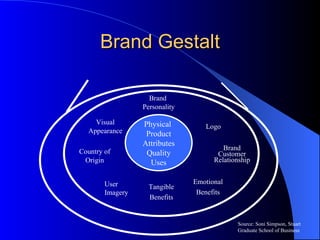
Brand Gestalt Physical  Product Attributes Quality Uses Brand  Personality Logo Visual Appearance Country of Origin User Imagery Tangible Benefits Emotional Benefits Brand Customer Relationship Source: Soni Simpson, Stuart Graduate School of Business
A synthesis of all elements, physical, aesthetic, rational AND emotional End result = appropriate differentiated relevant Brand
The Coca-Cola Brand Is… 1800s Heritage The Real Thing Americana Battles with Pepsi Sold Everywhere  Logo Brand
The McDonald’s Brand Is… The Big Mac Happy Meals French Fries Red and White  Restaurants Fun For Children Ronald McDonald Golden Arches Value for Money Brand
How do brands provide value?
Providing Value to Customers Short cut for interpreting, processing and storing information Gives confidence in the purchasing decision - reduces risk  Enhances use satisfaction
Providing Value to the Firm Enhance the effectiveness and efficiency of marketing programs - one of the rewards for risk- taking Decrease brand switching Higher prices and margins (Brand-involved consumers bargain less) Trade leverage Competitive advantage
The Product and the brand
Product Kotler: “A product is anything that can be offered to a market to satisfy a want or need”
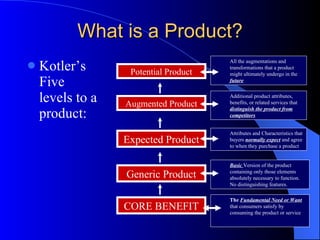
What is a Product? Kotler’s Five levels to a product: Potential Product The  Fundamental Need or Want  that consumers satisfy by consuming the product or service Basic  Version of the product containing only those elements absolutely necessary to function. No distinguishing features. Attributes and Characteristics that buyers  normally expect   and agree to when they purchase a product Additional product attributes, benefits, or related services that  distinguish the product from competitors Potential Product All the augmentations and transformations that a product might ultimately undergo in the  future Generic Product CORE BENEFIT Expected Product Augmented Product Generic Product Expected Product Augmented Product
Product and brand Product = Commodity A product is a produced item always possessing these characteristics: Tangibility Attributes and Features Brand = “Mind Set” The sum of all communications and experiences received by the consumer and customer resulting in a distinctive image in their “mind set” based on perceived emotional and functional benefits Source: Soni Simpson
Product and brand Products come to life, live and disappear, but brands endure e.g. Zen, Honda City, Bajaj A brand is the memory of the products A brand is less elastic than its product. Once created, like fast-setting concrete it is hard to change
Are leading brands the best products? Not necessary To be the ‘best’ means to compete in the premium tier which is rarely a large segment The brand with the best quality/price ratio is market leader
Are leading brands the best products? Most brands are born out of a product or service innovation (ipod; Sony walkman and discman) Later, as the product name evolves into a brand, customers’ reason for purchase may still be the brand’s “superior performance” image
Are leading brands the best products? It seems that brands alternate in their focus. They capitalise on their image, then innovate to recreate or nurture the belief of product superiority, then recapitalise on their image, and so on e.g. Gillette, Sony
Branding
Branding Transforming a commodity like product into customer satisfying value added propositions is the essence of branding
Brand Imposing One’s Will On  The Consumer Branding OLD SCHOOL  THINKING DIPLOMA
“  Pretty much everything today can be seen in relation to a love-respect axis. You can plot any relationship – with a person, with a brand – by whether it’s based on love or based on respect. It used to be that a high respect rating would win. But these days, a high love rating wins. If I don’t love what you’re offering me, I’m not even interested.”  Kevin Roberts, Saatchi and Saatchi Branding
“  Pretty much everything today can be seen in relation to a  love-respect axis.  You can plot any  relationship  – with a person, with a brand – by whether it’s  based on love or based on respect . It used to be that a high respect rating would win. But these days, a high love rating wins.  If I don’t love what you’re offering me, I’m not even interested.”  Kevin Roberts, Saatchi and Saatchi Branding
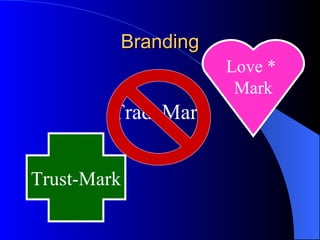
TradeMark Branding Love *  Mark Trust-Mark
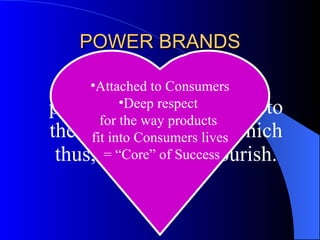
Those Brands which are particularly well adapted to the environment and which thus, survive and flourish. POWER BRANDS Attached to Consumers Deep respect  for the way products  fit into Consumers lives = “Core” of Success
4 components of branding Building the brand: Brand Identity is the first step; Brand positioning etc. Leveraging the brand: Line extensions; Brand extensions; Co-branding Identifying and measuring brand equity: consumer relationships; brand financial value etc. Protecting: Dilution; Legal aspects
Suggested reading Visit brandchannel.com and read the Interbrand 2007 report on global brands Case study  “Branding for President” “The New Strategic Brand Management” by J.N.Kapferer. Chapter 1 & 2
Suggested reading “Brand Management: Text & Cases” by Harsh Verma. Chapter 1 Strategic Brand Management by Kevin Lane Keller

branding

  • 1.
    Warming up tobrands 7th August 2007
  • 2.
    Let’s identify thebrands associated with these visuals and slogans
  • 3.
  • 4.
  • 5.
  • 6.
  • 7.
  • 8.
  • 9.
  • 10.
  • 11.
  • 12.
  • 13.
  • 14.
  • 15.
  • 16.
  • 17.
  • 18.
  • 19.
  • 20.
    Slogans Just doit! Kuch meetha ho jaye Impossible is nothing Connecting people Lagey raho Express yourself Keep walking! There are some things money can’t buy. For everything else there is …..
  • 21.
    Slogans It’s hot!The world’s local bank The Citi never sleeps The power of knowledge The best a man can get God’s own country The taste of India Do you have it in you? Think different
  • 22.
  • 23.
    Roots Uniformity isthe mother of branding Identity is lost due to homogeneity as there is no differentiation Origin of the word ‘brand’ lies in the Norse word ‘brandr’ which means ‘to burn’ In early times, farmers used to identify their livestock with a burn mark or a symbol Distillers branded their casks
  • 24.
    Roots The producers’names identified the products - Smirnoff, Ford, Mercedes, Levi Strauss
  • 25.
    Today…. Brands arean integral part of our life - products; services; people; places; football clubs; fictional characters; virtual worlds…. They are intangible assets that need to be exploited
  • 26.
    Savour this Indianfirms eye Jaguar, Land Rover - Tata - Mahindra & Mahindra World’s top 100 brands worth more than India’s total m-cap - $ 1.15 trillion - More than combined market value of over 4000 listed cos. in India
  • 27.
    We work notfor ourselves, not for the company, not even for our clients. We work for Brands Brand Stewardship ( Ogilvy)
  • 28.
    To be mostvalued by those who most value brands Brand Stewardship ( Ogilvy)
  • 29.
    Brand A Brandis a product which has earned a place in the consumer’s life through perception, experience, beliefs, feelings ....... until a relationship is built It is the sum of how consumers feel about a product Brand Stewardship (Ogilvy)
  • 30.
    Brand “ Abrand is nothing more or less than the sum of all the mental connections people have around the product. Memories from childhood, something your mum said ... and in the case of newer brands, memories from ads. The trick is to arrange things so that the mental connections around the brand are enhancing” Michael Perry Former Chairman & CEO, Unilever
  • 31.
    Brand “ Consumersbuild brands the way birds build nests... from scraps and straws they chance upon” Jeremy Bullmore Former Chairman JWT
  • 32.
    The ‘classic’ definitionKeller: “A brand is a set of mental associations, held by the consumer, which add to the perceived value of a product or service”
  • 33.
    Mental associations Unique(Exclusivity) Strong (Saliency) Positive (Desirable)
  • 34.
    Mental associations Whatis the brand territory (perceived competence; typical products or services; specific know-how)? - Gillette - Apple - Virgin - Nokia - Dettol - Karim’s?
  • 35.
    Mental associations Whatis its level of quality (low; medium; premium; luxury)? What are its qualities? What is its most discriminating quality or benefit (also called perceived positioning)? - Burnol is for burns - Marlboro is not just a cigarette; it’s about fierce independence; about being macho - Hummer: Like nothing else
  • 36.
    Mental associations Whattypical buyer does the brand evoke? - Harley Davidson - Goa - Rolex What is the brand personality and brand imagery?
  • 37.
    Beyond mental associations….The power of a name is also due to the specific nature of the emotional relationships it develops Patents and rights are of course a key asset. They provide competitive advantage over a period of time
  • 38.
  • 39.
    Brand Gestalt Physical Product Attributes Quality Uses Brand Personality Logo Visual Appearance Country of Origin User Imagery Tangible Benefits Emotional Benefits Brand Customer Relationship Source: Soni Simpson, Stuart Graduate School of Business
  • 40.
    A synthesis ofall elements, physical, aesthetic, rational AND emotional End result = appropriate differentiated relevant Brand
  • 41.
    The Coca-Cola BrandIs… 1800s Heritage The Real Thing Americana Battles with Pepsi Sold Everywhere Logo Brand
  • 42.
    The McDonald’s BrandIs… The Big Mac Happy Meals French Fries Red and White Restaurants Fun For Children Ronald McDonald Golden Arches Value for Money Brand
  • 43.
    How do brandsprovide value?
  • 44.
    Providing Value toCustomers Short cut for interpreting, processing and storing information Gives confidence in the purchasing decision - reduces risk Enhances use satisfaction
  • 45.
    Providing Value tothe Firm Enhance the effectiveness and efficiency of marketing programs - one of the rewards for risk- taking Decrease brand switching Higher prices and margins (Brand-involved consumers bargain less) Trade leverage Competitive advantage
  • 46.
    The Product andthe brand
  • 47.
    Product Kotler: “Aproduct is anything that can be offered to a market to satisfy a want or need”
  • 48.
    What is aProduct? Kotler’s Five levels to a product: Potential Product The Fundamental Need or Want that consumers satisfy by consuming the product or service Basic Version of the product containing only those elements absolutely necessary to function. No distinguishing features. Attributes and Characteristics that buyers normally expect and agree to when they purchase a product Additional product attributes, benefits, or related services that distinguish the product from competitors Potential Product All the augmentations and transformations that a product might ultimately undergo in the future Generic Product CORE BENEFIT Expected Product Augmented Product Generic Product Expected Product Augmented Product
  • 49.
    Product and brandProduct = Commodity A product is a produced item always possessing these characteristics: Tangibility Attributes and Features Brand = “Mind Set” The sum of all communications and experiences received by the consumer and customer resulting in a distinctive image in their “mind set” based on perceived emotional and functional benefits Source: Soni Simpson
  • 50.
    Product and brandProducts come to life, live and disappear, but brands endure e.g. Zen, Honda City, Bajaj A brand is the memory of the products A brand is less elastic than its product. Once created, like fast-setting concrete it is hard to change
  • 51.
    Are leading brandsthe best products? Not necessary To be the ‘best’ means to compete in the premium tier which is rarely a large segment The brand with the best quality/price ratio is market leader
  • 52.
    Are leading brandsthe best products? Most brands are born out of a product or service innovation (ipod; Sony walkman and discman) Later, as the product name evolves into a brand, customers’ reason for purchase may still be the brand’s “superior performance” image
  • 53.
    Are leading brandsthe best products? It seems that brands alternate in their focus. They capitalise on their image, then innovate to recreate or nurture the belief of product superiority, then recapitalise on their image, and so on e.g. Gillette, Sony
  • 54.
  • 55.
    Branding Transforming acommodity like product into customer satisfying value added propositions is the essence of branding
  • 56.
    Brand Imposing One’sWill On The Consumer Branding OLD SCHOOL THINKING DIPLOMA
  • 57.
    “ Prettymuch everything today can be seen in relation to a love-respect axis. You can plot any relationship – with a person, with a brand – by whether it’s based on love or based on respect. It used to be that a high respect rating would win. But these days, a high love rating wins. If I don’t love what you’re offering me, I’m not even interested.” Kevin Roberts, Saatchi and Saatchi Branding
  • 58.
    “ Prettymuch everything today can be seen in relation to a love-respect axis. You can plot any relationship – with a person, with a brand – by whether it’s based on love or based on respect . It used to be that a high respect rating would win. But these days, a high love rating wins. If I don’t love what you’re offering me, I’m not even interested.” Kevin Roberts, Saatchi and Saatchi Branding
  • 59.
    TradeMark Branding Love* Mark Trust-Mark
  • 60.
    Those Brands whichare particularly well adapted to the environment and which thus, survive and flourish. POWER BRANDS Attached to Consumers Deep respect for the way products fit into Consumers lives = “Core” of Success
  • 61.
    4 components ofbranding Building the brand: Brand Identity is the first step; Brand positioning etc. Leveraging the brand: Line extensions; Brand extensions; Co-branding Identifying and measuring brand equity: consumer relationships; brand financial value etc. Protecting: Dilution; Legal aspects
  • 62.
    Suggested reading Visitbrandchannel.com and read the Interbrand 2007 report on global brands Case study “Branding for President” “The New Strategic Brand Management” by J.N.Kapferer. Chapter 1 & 2
  • 63.
    Suggested reading “BrandManagement: Text & Cases” by Harsh Verma. Chapter 1 Strategic Brand Management by Kevin Lane Keller