B®ANDING
™
session 1
an introduction to branding
John Verhoeven
MSc. Brand management
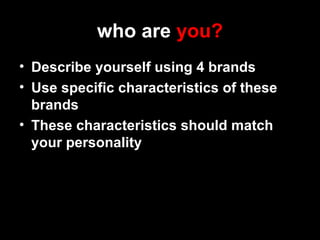
who are you?
• Describe yourself using 4 brands
• Use specific characteristics of these
brands
• These characteristics should match
your personality
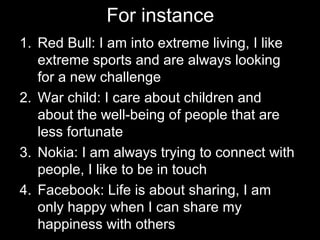
For instance
1. Red Bull: I am into extreme living, I like
extreme sports and are always looking
for a new challenge
2. War child: I care about children and
about the well-being of people that are
less fortunate
3. Nokia: I am always trying to connect with
people, I like to be in touch
4. Facebook: Life is about sharing, I am
only happy when I can share my
happiness with others
practical information
• be on time!
• slides are on portal / slideshare
• exam is at the end of the second term
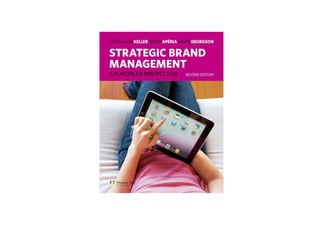
the book
ISBN: 978-90-430-1729-9
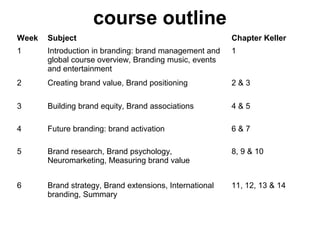
course outline
Week Subject Chapter Keller
1 Introduction in branding: brand management and
global course overview, Branding music, events
and entertainment
1
2 Creating brand value, Brand positioning 2 & 3
3 Building brand equity, Brand associations 4 & 5
4 Future branding: brand activation 6 & 7
5 Brand research, Brand psychology,
Neuromarketing, Measuring brand value
8, 9 & 10
6 Brand strategy, Brand extensions, International
branding, Summary
11, 12, 13 & 14
Lots of self study!
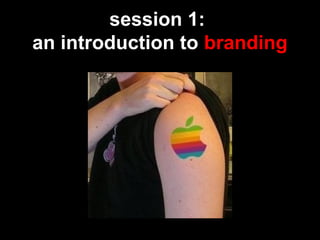
session 1:
an introduction to branding
Do you recognize it?
Do you know it?
Do you think it’s cool?
Do you like it?
Do you think it’s better?
Do you buy it?
Do you recommend it?
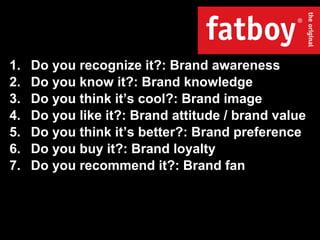
1. Do you recognize it?: Brand awareness
2. Do you know it?: Brand knowledge
3. Do you think it’s cool?: Brand image
4. Do you like it?: Brand attitude / brand value
5. Do you think it’s better?: Brand preference
6. Do you buy it?: Brand loyalty
7. Do you recommend it?: Brand fan
why this ‘branding’ course?
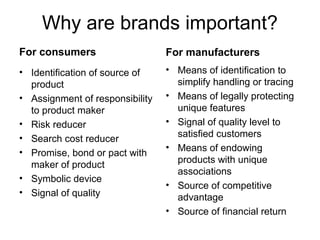
Why are brands important?
For consumers
• Identification of source of
product
• Assignment of responsibility
to product maker
• Risk reducer
• Search cost reducer
• Promise, bond or pact with
maker of product
• Symbolic device
• Signal of quality
For manufacturers
• Means of identification to
simplify handling or tracing
• Means of legally protecting
unique features
• Signal of quality level to
satisfied customers
• Means of endowing
products with unique
associations
• Source of competitive
advantage
• Source of financial return
“Brands provide consumers
with
a shorthand device
or
means of simplification
for their product decisions”
“..buying a brand
is avoiding risk..”
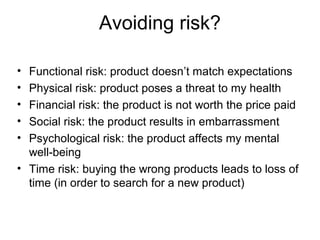
Avoiding risk?
• Functional risk: product doesn’t match expectations
• Physical risk: product poses a threat to my health
• Financial risk: the product is not worth the price paid
• Social risk: the product results in embarrassment
• Psychological risk: the product affects my mental
well-being
• Time risk: buying the wrong products leads to loss of
time (in order to search for a new product)
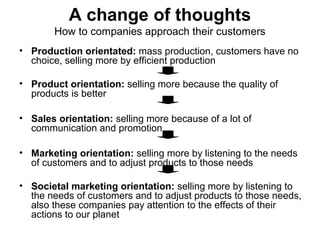
A change of thoughts
How to companies approach their customers
• Production orientated: mass production, customers have no
choice, selling more by efficient production
• Product orientation: selling more because the quality of
products is better
• Sales orientation: selling more because of a lot of
communication and promotion
• Marketing orientation: selling more by listening to the needs
of customers and to adjust products to those needs
• Societal marketing orientation: selling more by listening to
the needs of customers and to adjust products to those needs,
also these companies pay attention to the effects of their
actions to our planet
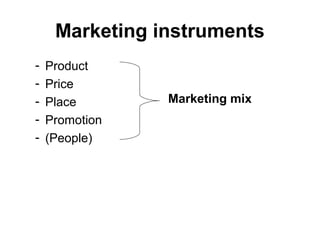
Marketing instruments
- Product
- Price
- Place
- Promotion
- (People)
Marketing mix
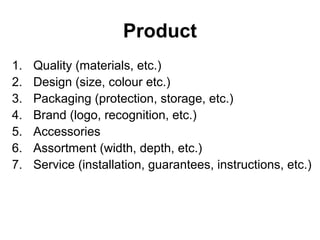
Product
1. Quality (materials, etc.)
2. Design (size, colour etc.)
3. Packaging (protection, storage, etc.)
4. Brand (logo, recognition, etc.)
5. Accessories
6. Assortment (width, depth, etc.)
7. Service (installation, guarantees, instructions, etc.)
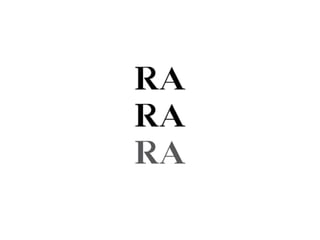
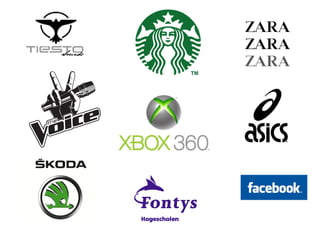
a brand vs. a product
a split second
“…brands take a
position inside your
memory, and stay there
until they’re needed…”
“…and you don’t have
to be old for that…”
link
what does this mean?
so what is a brand?
what comes to mind

when you see this logo?
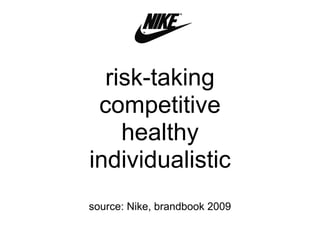
risk-taking
competitive
healthy
individualistic
source: Nike, brandbook 2009
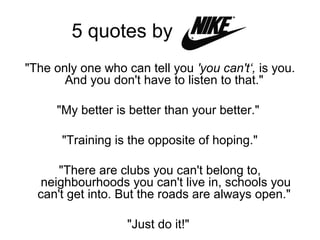
5 quotes by

"The only one who can tell you 'you can't‘, is you.

And you don't have to listen to that."
"My better is better than your better."
"Training is the opposite of hoping."
"There are clubs you can't belong to,
neighbourhoods you can't live in, schools you
can't get into. But the roads are always open."
"Just do it!"
what is a brand?
“…a brand is a name, term,
symbol, or design, or a
combination of them, intended
to identify goods and services
of one seller or group of sellers
and to differentiate them from
those of competition…”
source: American Marketing Association
definition (1)
“…een merk is een naam, logo,
symbool of ontwerp, of een
combinatie van deze
zogeheten merkelementen, dat
wordt toegevoegd aan een
product…”
source: Strategisch merkenmanagement
definition (2)
“…a brand is a intangible but
critical component of what an
organization stands for…”
source: Brand Asset Management,
Scott M. Davis
definition (2)
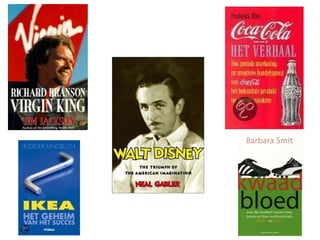
brands have
got their own stories
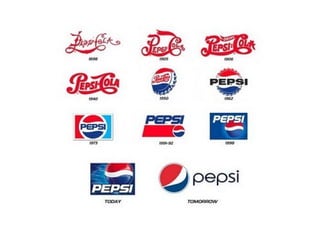
brands have
got their own life-cycle
brands have
got their own
personality
brands have
got their own
responsibility
brands have
got their
own theory
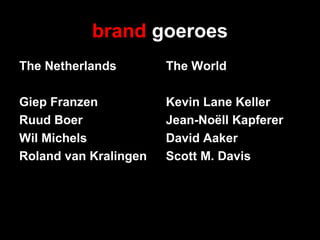
brand goeroes
The Netherlands
Giep Franzen
Ruud Boer
Wil Michels
Roland van Kralingen
The World
Kevin Lane Keller
Jean-Noëll Kapferer
David Aaker
Scott M. Davis
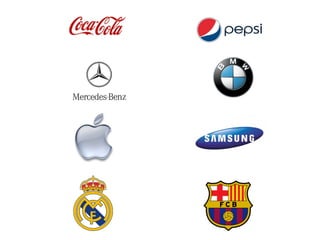
brands have
got their
own rivals
history of branding
link
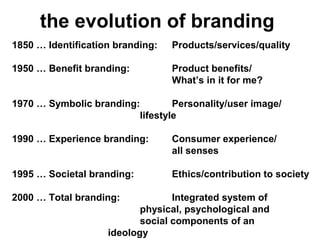
1850 … Identification branding: Products/services/quality
1950 … Benefit branding: Product benefits/
What’s in it for me?
1970 … Symbolic branding: Personality/user image/
lifestyle
1990 … Experience branding: Consumer experience/
all senses
1995 … Societal branding: Ethics/contribution to society
2000 … Total branding: Integrated system of
physical, psychological and
social components of an
ideology
the evolution of branding
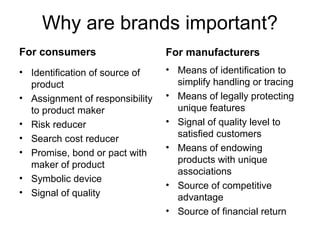
Why are brands important?
For consumers
• Identification of source of
product
• Assignment of responsibility
to product maker
• Risk reducer
• Search cost reducer
• Promise, bond or pact with
maker of product
• Symbolic device
• Signal of quality
For manufacturers
• Means of identification to
simplify handling or tracing
• Means of legally protecting
unique features
• Signal of quality level to
satisfied customers
• Means of endowing
products with unique
associations
• Source of competitive
advantage
• Source of financial return
what is branding?
“…branding is the blend of art and
science that manages associations
between a brand and memories in
the mind of the audience. It involves
focusing resources on selected
tangible and intangible attributes to
differentiate the brand in an
attractive, meaningful and compelling
way for the targeted audience. …”
source: Brandchannel.com
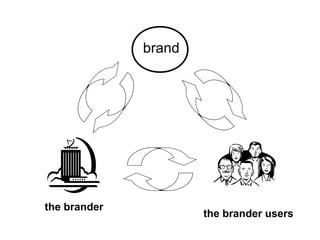
brand
the brander
the brander users
can everything
become a brand?
branding services
branding retailers
branding online products
branding people &
organisations
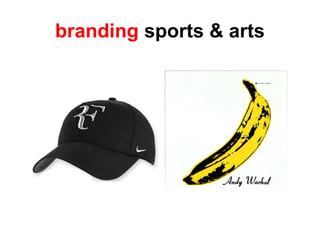
branding sports & arts
branding regions
branding entertainment
what can become a brand?
• Goods (b-to-c / b-to-b)
• Services
• Retailers
• Online products & services
• People & organisations
• Sports & arts
• Regions (city marketing)
• Entertainment
what is branded
entertainment?
“…the practice of tying
a brand name to an
entertainment property
with seamless integration
and a natural fit…”
why brands
become more important
in EME…
6 reasons why
1. people face a
dizzling array of
choices:
“..there is so much
to choose from!..”
2. entertainment
products drift towards
commoditization:
“…they’re on every street
corner!...”
3. a brand
differentiates the
entertainment product
from similar offerings:
“…standing out of the
crowd!...”
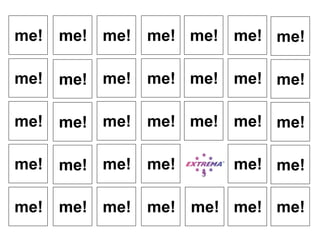
me!me!me!me!
me!
me!
me!
me!
me! me! me!
me!
me!
me!
me!
me!
me!
me!
me!
me!
me!
me!
me!
me!
me!
me!
me!
me!
me!
me!
me!
me!
me!
me!
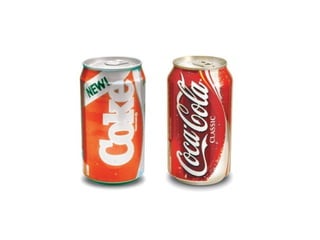
4. a brand reduces
the need to compete
on price or donations:
“…willing to pay for the
best!...”
“In 2009, 2010 & 2011 the
Lowlands festival sold out
without any bands or acts
being announced!”
5. a strong brand
gives employees
a focus and sense of
purpose:
“…what are we
doing here?...”
6. a strong brand can
help to identify a
certain community or
group of people:
“…we share the same
brands! (and values)...”
more about brands &
communities in another
session
next week
• Creating brand value & brand positioning
• Prepare chapter 1 till 3 ‘Strategic brand
management’
thank you!

Session 1, introduction to branding 2013 2014

  • 1.
  • 2.
  • 3.
  • 4.
    who are you? •Describe yourself using 4 brands • Use specific characteristics of these brands • These characteristics should match your personality
  • 5.
    For instance 1. RedBull: I am into extreme living, I like extreme sports and are always looking for a new challenge 2. War child: I care about children and about the well-being of people that are less fortunate 3. Nokia: I am always trying to connect with people, I like to be in touch 4. Facebook: Life is about sharing, I am only happy when I can share my happiness with others
  • 6.
    practical information • beon time! • slides are on portal / slideshare • exam is at the end of the second term
  • 7.
  • 8.
    course outline Week SubjectChapter Keller 1 Introduction in branding: brand management and global course overview, Branding music, events and entertainment 1 2 Creating brand value, Brand positioning 2 & 3 3 Building brand equity, Brand associations 4 & 5 4 Future branding: brand activation 6 & 7 5 Brand research, Brand psychology, Neuromarketing, Measuring brand value 8, 9 & 10 6 Brand strategy, Brand extensions, International branding, Summary 11, 12, 13 & 14
  • 9.
  • 10.
  • 12.
    Do you recognizeit? Do you know it? Do you think it’s cool? Do you like it? Do you think it’s better? Do you buy it? Do you recommend it?
  • 13.
    1. Do yourecognize it?: Brand awareness 2. Do you know it?: Brand knowledge 3. Do you think it’s cool?: Brand image 4. Do you like it?: Brand attitude / brand value 5. Do you think it’s better?: Brand preference 6. Do you buy it?: Brand loyalty 7. Do you recommend it?: Brand fan
  • 14.
  • 15.
    Why are brandsimportant? For consumers • Identification of source of product • Assignment of responsibility to product maker • Risk reducer • Search cost reducer • Promise, bond or pact with maker of product • Symbolic device • Signal of quality For manufacturers • Means of identification to simplify handling or tracing • Means of legally protecting unique features • Signal of quality level to satisfied customers • Means of endowing products with unique associations • Source of competitive advantage • Source of financial return
  • 16.
    “Brands provide consumers with ashorthand device or means of simplification for their product decisions”
  • 17.
    “..buying a brand isavoiding risk..”
  • 18.
    Avoiding risk? • Functionalrisk: product doesn’t match expectations • Physical risk: product poses a threat to my health • Financial risk: the product is not worth the price paid • Social risk: the product results in embarrassment • Psychological risk: the product affects my mental well-being • Time risk: buying the wrong products leads to loss of time (in order to search for a new product)
  • 19.
    A change ofthoughts How to companies approach their customers • Production orientated: mass production, customers have no choice, selling more by efficient production • Product orientation: selling more because the quality of products is better • Sales orientation: selling more because of a lot of communication and promotion • Marketing orientation: selling more by listening to the needs of customers and to adjust products to those needs • Societal marketing orientation: selling more by listening to the needs of customers and to adjust products to those needs, also these companies pay attention to the effects of their actions to our planet
  • 20.
    Marketing instruments - Product -Price - Place - Promotion - (People) Marketing mix
  • 21.
    Product 1. Quality (materials,etc.) 2. Design (size, colour etc.) 3. Packaging (protection, storage, etc.) 4. Brand (logo, recognition, etc.) 5. Accessories 6. Assortment (width, depth, etc.) 7. Service (installation, guarantees, instructions, etc.)
  • 22.
    a brand vs.a product
  • 23.
  • 42.
    “…brands take a positioninside your memory, and stay there until they’re needed…”
  • 43.
    “…and you don’thave to be old for that…”
  • 44.
  • 45.
  • 46.
    so what isa brand?
  • 48.
    what comes tomind when you see this logo?
  • 49.
  • 50.
    5 quotes by "Theonly one who can tell you 'you can't‘, is you. And you don't have to listen to that." "My better is better than your better." "Training is the opposite of hoping." "There are clubs you can't belong to, neighbourhoods you can't live in, schools you can't get into. But the roads are always open." "Just do it!"
  • 51.
    what is abrand?
  • 53.
    “…a brand isa name, term, symbol, or design, or a combination of them, intended to identify goods and services of one seller or group of sellers and to differentiate them from those of competition…” source: American Marketing Association definition (1)
  • 54.
    “…een merk iseen naam, logo, symbool of ontwerp, of een combinatie van deze zogeheten merkelementen, dat wordt toegevoegd aan een product…” source: Strategisch merkenmanagement definition (2)
  • 55.
    “…a brand isa intangible but critical component of what an organization stands for…” source: Brand Asset Management, Scott M. Davis definition (2)
  • 56.
  • 58.
    brands have got theirown life-cycle
  • 61.
    brands have got theirown personality
  • 64.
    brands have got theirown responsibility
  • 68.
  • 70.
    brand goeroes The Netherlands GiepFranzen Ruud Boer Wil Michels Roland van Kralingen The World Kevin Lane Keller Jean-Noëll Kapferer David Aaker Scott M. Davis
  • 71.
  • 73.
  • 75.
    1850 … Identificationbranding: Products/services/quality 1950 … Benefit branding: Product benefits/ What’s in it for me? 1970 … Symbolic branding: Personality/user image/ lifestyle 1990 … Experience branding: Consumer experience/ all senses 1995 … Societal branding: Ethics/contribution to society 2000 … Total branding: Integrated system of physical, psychological and social components of an ideology the evolution of branding
  • 76.
    Why are brandsimportant? For consumers • Identification of source of product • Assignment of responsibility to product maker • Risk reducer • Search cost reducer • Promise, bond or pact with maker of product • Symbolic device • Signal of quality For manufacturers • Means of identification to simplify handling or tracing • Means of legally protecting unique features • Signal of quality level to satisfied customers • Means of endowing products with unique associations • Source of competitive advantage • Source of financial return
  • 77.
  • 78.
    “…branding is theblend of art and science that manages associations between a brand and memories in the mind of the audience. It involves focusing resources on selected tangible and intangible attributes to differentiate the brand in an attractive, meaningful and compelling way for the targeted audience. …” source: Brandchannel.com
  • 79.
  • 80.
  • 81.
  • 82.
  • 83.
  • 84.
  • 85.
  • 86.
  • 87.
  • 88.
    what can becomea brand? • Goods (b-to-c / b-to-b) • Services • Retailers • Online products & services • People & organisations • Sports & arts • Regions (city marketing) • Entertainment
  • 89.
  • 91.
    “…the practice oftying a brand name to an entertainment property with seamless integration and a natural fit…”
  • 100.
    why brands become moreimportant in EME… 6 reasons why
  • 101.
    1. people facea dizzling array of choices: “..there is so much to choose from!..”
  • 103.
    2. entertainment products drifttowards commoditization: “…they’re on every street corner!...”
  • 106.
    3. a brand differentiatesthe entertainment product from similar offerings: “…standing out of the crowd!...”
  • 107.
  • 108.
    4. a brandreduces the need to compete on price or donations: “…willing to pay for the best!...”
  • 110.
    “In 2009, 2010& 2011 the Lowlands festival sold out without any bands or acts being announced!”
  • 111.
    5. a strongbrand gives employees a focus and sense of purpose: “…what are we doing here?...”
  • 113.
    6. a strongbrand can help to identify a certain community or group of people: “…we share the same brands! (and values)...”
  • 116.
    more about brands& communities in another session
  • 117.
    next week • Creatingbrand value & brand positioning • Prepare chapter 1 till 3 ‘Strategic brand management’
  • 118.