ASHISH KADAM
19
 Branding is the practice of giving a specified name to
a product or group of products from one seller.
 The specified name creates individuality in the
product hence ,it can be easily distinguished or
recognised in the market from the rival products.
 The sole purpose of branding is to distinguish your
branded product from those.
 Brand management begins with having a thorough
knowledge of the term “brand”. Strong brands
reduce customers’ perceived monetary, social and
safety risks in buying goods/services.
 The customers can better imagine the intangible
goods with the help of brand name. Strong brand
organizations have a high market share.
 A successful brand can only be created if the brand
management system is competent.
 Brand management is a communication function
that includes analysis and planning on how that
brand is positioned in the market, which target public
the brand is targeted at, and maintaining a desired
reputation of the brand. Developing a good
relationship with target publics is essential for brand
management
 According to Kotler and Amstrong,
“A brand is name, term, sign, symbol, or design or
a combination of these that identifies the maker
or seller of a product or services.”
 A Brand is defined as “a name, term, sign, symbol,
or special design or some combination of these
elements that is intended to identify the goods or
services of one seller or a group of sellers.” –
American Marketing Association.
Components of Brand
•Brand name
•Brand Mark
•Trade character :e.g. Gattu for Asian Paints
•Trademark : Legal designation indicating exclusive right
to use the brand.
•Trade Name
 A brand not only distinctly identify the product or
services but also covey following:
 Attributes:
Eg. Limca suggest lemon content.
 Benefits:
An attributes should eventually transform into
emotional and functional benefits.
Eg. Raymond suits convey emotional benefit of the
complete man.
 Values: Eg. TATA stands for quality
 Culture:
Eg. Coke is an icon of America culture
 Personality:
Eg. Sprite is clear thinking and rational
 Users:
 Significance of Branding:
Branding provides benefits to buyers and sellers
 TO BUYER:
 Helps buyers to identify the product that they
like/dislike.
 Identify marketer
 Helps to reduce the time needed got purchase.
 Helps buyers evaluate quality of products especially
if unable to judge a products characteristics.
 Helps to reduce buyers perceived risk of purchase.
 Buyers may derive a psychological reward from
owning the brand, for instances Rolex watches or
Mercedes.
 TO SELLER
 Differentiate product offering from competitors.
 Helps segment market by creating tailored images.
 Brand identifies the companies product making repeat
purchases easier for customers.
 Reduce price comparisons
 Brand helps firm introduce a new product that carries the
name of one or more of its existing products.
 Easier cooperation with intermediaries with well known
brands.
 Facilitates promotional efforts.
 Helps foster brand loyalty helping to stabilize market
share.
 Firms may be able to change a premium for the brand
Types of Brand
 Manufacturer Brand
 Private Brand
 Generic Brand
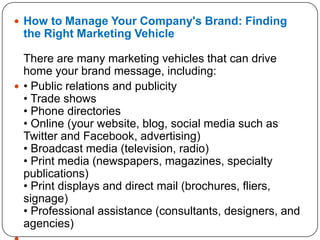
 How to Manage Your Company's Brand: Finding
the Right Marketing Vehicle
There are many marketing vehicles that can drive
home your brand message, including:
 • Public relations and publicity
• Trade shows
• Phone directories
• Online (your website, blog, social media such as
Twitter and Facebook, advertising)
• Broadcast media (television, radio)
• Print media (newspapers, magazines, specialty
publications)
• Print displays and direct mail (brochures, fliers,
signage)
• Professional assistance (consultants, designers, and
agencies)
Presentation 3
Presentation 3

Presentation 3

  • 4.
  • 7.
     Branding isthe practice of giving a specified name to a product or group of products from one seller.  The specified name creates individuality in the product hence ,it can be easily distinguished or recognised in the market from the rival products.  The sole purpose of branding is to distinguish your branded product from those.
  • 8.
     Brand managementbegins with having a thorough knowledge of the term “brand”. Strong brands reduce customers’ perceived monetary, social and safety risks in buying goods/services.  The customers can better imagine the intangible goods with the help of brand name. Strong brand organizations have a high market share.  A successful brand can only be created if the brand management system is competent.
  • 10.
     Brand managementis a communication function that includes analysis and planning on how that brand is positioned in the market, which target public the brand is targeted at, and maintaining a desired reputation of the brand. Developing a good relationship with target publics is essential for brand management
  • 12.
     According toKotler and Amstrong, “A brand is name, term, sign, symbol, or design or a combination of these that identifies the maker or seller of a product or services.”  A Brand is defined as “a name, term, sign, symbol, or special design or some combination of these elements that is intended to identify the goods or services of one seller or a group of sellers.” – American Marketing Association.
  • 13.
    Components of Brand •Brandname •Brand Mark •Trade character :e.g. Gattu for Asian Paints •Trademark : Legal designation indicating exclusive right to use the brand. •Trade Name
  • 14.
     A brandnot only distinctly identify the product or services but also covey following:  Attributes: Eg. Limca suggest lemon content.  Benefits: An attributes should eventually transform into emotional and functional benefits. Eg. Raymond suits convey emotional benefit of the complete man.  Values: Eg. TATA stands for quality
  • 15.
     Culture: Eg. Cokeis an icon of America culture  Personality: Eg. Sprite is clear thinking and rational  Users:
  • 16.
     Significance ofBranding: Branding provides benefits to buyers and sellers  TO BUYER:  Helps buyers to identify the product that they like/dislike.  Identify marketer  Helps to reduce the time needed got purchase.  Helps buyers evaluate quality of products especially if unable to judge a products characteristics.  Helps to reduce buyers perceived risk of purchase.  Buyers may derive a psychological reward from owning the brand, for instances Rolex watches or Mercedes.
  • 17.
     TO SELLER Differentiate product offering from competitors.  Helps segment market by creating tailored images.  Brand identifies the companies product making repeat purchases easier for customers.  Reduce price comparisons  Brand helps firm introduce a new product that carries the name of one or more of its existing products.  Easier cooperation with intermediaries with well known brands.  Facilitates promotional efforts.  Helps foster brand loyalty helping to stabilize market share.  Firms may be able to change a premium for the brand
  • 19.
    Types of Brand Manufacturer Brand  Private Brand  Generic Brand
  • 24.
     How toManage Your Company's Brand: Finding the Right Marketing Vehicle There are many marketing vehicles that can drive home your brand message, including:  • Public relations and publicity • Trade shows • Phone directories • Online (your website, blog, social media such as Twitter and Facebook, advertising) • Broadcast media (television, radio) • Print media (newspapers, magazines, specialty publications) • Print displays and direct mail (brochures, fliers, signage) • Professional assistance (consultants, designers, and agencies)