10.1
CHAPTER 10:
CHAPTER 10:
MEASURING OUTCOMES OF BRAND EQUITY:
CAPURING MARKET PERFORMANCE
Kevin Lane Keller
Kevin Lane Keller
Tuck School of Business
Dartmouth College
Dartmouth College
10.2
Measuring Brand Equity
 Multi-dimensional concept
Multi-dimensional concept
 Many different measures required
Many different measures required
 The ultimate value of a brand depends on the
The ultimate value of a brand depends on the
underlying components of brand knowledge and
sources of brand equity
10.3
Comparative Methods
Comparative Methods
 Brand-based comparative approaches
Brand-based comparative approaches
 Marketing-based comparative approaches
Marketing-based comparative approaches
 Conjoint analysis
Conjoint analysis
10.4
Brand-Based Approaches
 The marketing element under consideration is
The marketing element under consideration is
fixed.
fixed.
 Consumer response is examined based on changes
Consumer response is examined based on changes
in brand identification.
 Application example:
Application example: Blind testing
Blind testing
 Advantage:
Advantage: Isolates the value of the brand
Isolates the value of the brand
 Disadvantage:
Disadvantage: The totality of what is learned depends
The totality of what is learned depends
on how many applications are examined.
10.5
Marketing-Based Approaches
 The brand is held fixed and consumer response is
The brand is held fixed and consumer response is
examined based on changes in marketing programs.
 Applications:
Applications: Explore price premiums’ effect on
Explore price premiums’ effect on
switching, consumer evaluations of marketing
activities, brand extensions, etc.
 Advantage:
Advantage: Ease of implementation
Ease of implementation
 Disadvantage:
Disadvantage: Difficult to determine whether
Difficult to determine whether
consumer responses are caused by brand
knowledge or generic product knowledge
10.6
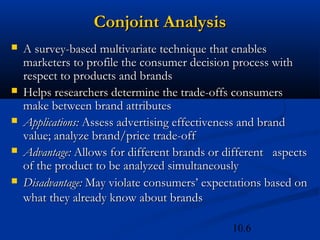
Conjoint Analysis
Conjoint Analysis
 A survey-based multivariate technique that enables
A survey-based multivariate technique that enables
marketers to profile the consumer decision process with
respect to products and brands
 Helps researchers determine the trade-offs consumers
Helps researchers determine the trade-offs consumers
make between brand attributes
 Applications:
Applications: Assess advertising effectiveness and brand
Assess advertising effectiveness and brand
value; analyze brand/price trade-off
 Advantage:
Advantage: Allows for different brands or different aspects
Allows for different brands or different aspects
of the product to be analyzed simultaneously
 Disadvantage:
Disadvantage: May violate consumers’ expectations based on
May violate consumers’ expectations based on
what they already know about brands
10.7
Holistic Methods
Holistic Methods
 Attempt to place an overall value on the brand
Attempt to place an overall value on the brand
in either abstract utility terms or concrete financial
terms
terms
 Net out various considerations to determine the
Net out various considerations to determine the
unique contribution of the brand
 Holistic methods:
Holistic methods:
 Residual approaches
Residual approaches
 Valuation approaches
Valuation approaches
10.8
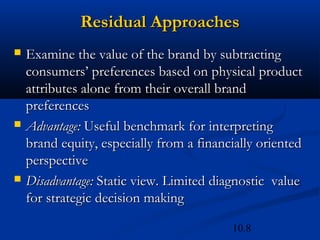
Residual Approaches
Residual Approaches
 Examine the value of the brand by subtracting
Examine the value of the brand by subtracting
consumers’ preferences based on physical product
attributes alone from their overall brand
preferences
preferences
 Advantage:
Advantage: Useful benchmark for interpreting
Useful benchmark for interpreting
brand equity, especially from a financially oriented
perspective
perspective
 Disadvantage:
Disadvantage: Static view. Limited diagnostic value
Static view. Limited diagnostic value
for strategic decision making
10.9
Valuation Approaches
 Attempt to place a financial value on brand equity
Attempt to place a financial value on brand equity
for accounting purposes
 Useful in cases of mergers and acquisitions, brand
Useful in cases of mergers and acquisitions, brand
licensing, fund raising, and brand management
decisions
decisions
 Valuation approaches:
Valuation approaches:
 Accounting background
Accounting background
 Historical perspectives
Historical perspectives
 General approaches
General approaches
 Interbrand’s brand valuation methodology
Interbrand’s brand valuation methodology
10.10
Accounting Background
 Intangible assets
Intangible assets are typically lumped under the
are typically lumped under the
heading of
heading of goodwill
goodwill and include things such as
and include things such as
patents, trademarks, and licensing agreements,
as well as “softer” considerations such as the
skill of the management and customer relations.
 In an acquisition, the goodwill item often
In an acquisition, the goodwill item often
includes a premium paid to gain control, which,
in certain instances, may even exceed the value
of tangible and intangible assets.
10.11
Historical Perspectives
 In Australia Rupert Murdoch’s News Corporation
In Australia Rupert Murdoch’s News Corporation
included a valuation of some of its magazines on its
balance sheets in 1984.
 British firms used brand values primarily to boost their
British firms used brand values primarily to boost their
balance sheets.
balance sheets.
 In the United States, generally accepted accounting
In the United States, generally accepted accounting
principles (blanket amortization principles) mean that
placing a brand on the balance sheet would require
amortization of that asset for up to 40 years. Such a
charge would severely hamper firm profitability; as a
result, firms avoid such accounting maneuvers.
10.12
General Approaches
General Approaches
 In determining the value of a brand in an acquisition or
In determining the value of a brand in an acquisition or
merger, firms can choose from three main approaches:
 Cost approach:
Cost approach: Brand equity is the amount of money that
Brand equity is the amount of money that
would be required to reproduce or replace the brand
 Market approach:
Market approach: The present value of the future economic
The present value of the future economic
benefits to be derived by the owner of the asset
 Income approach:
Income approach: The discounted future cash flow from the
The discounted future cash flow from the
future earnings stream for the brand
10.13
Interbrand’s Brand Valuation
 Assumes that brand value is the present worth of the
Assumes that brand value is the present worth of the
benefits of future ownership
 Follows five valuation steps:
Follows five valuation steps:
 Market segmentation
Market segmentation
 Financial (role of branding) analysis
Financial (role of branding) analysis
 Demand (brand strength) analysis
Demand (brand strength) analysis
 Competitive benchmarking
Competitive benchmarking
 Brand value calculation
Brand value calculation
 Brand value calculation : Calculate the brand value as the
Brand value calculation : Calculate the brand value as the
net present value (NPV) of the forecast brand earnings,
discounted by the brand discount rate

Brand management chapter 10

  • 1.
    10.1 CHAPTER 10: CHAPTER 10: MEASURINGOUTCOMES OF BRAND EQUITY: MEASURING OUTCOMES OF BRAND EQUITY: CAPURING MARKET PERFORMANCE CAPURING MARKET PERFORMANCE Kevin Lane Keller Kevin Lane Keller Tuck School of Business Tuck School of Business Dartmouth College Dartmouth College
  • 2.
    10.2 Measuring Brand Equity MeasuringBrand Equity  Multi-dimensional concept Multi-dimensional concept  Many different measures required Many different measures required  The ultimate value of a brand depends on the The ultimate value of a brand depends on the underlying components of brand knowledge and underlying components of brand knowledge and sources of brand equity sources of brand equity
  • 3.
    10.3 Comparative Methods Comparative Methods Brand-based comparative approaches Brand-based comparative approaches  Marketing-based comparative approaches Marketing-based comparative approaches  Conjoint analysis Conjoint analysis
  • 4.
    10.4 Brand-Based Approaches Brand-Based Approaches The marketing element under consideration is The marketing element under consideration is fixed. fixed.  Consumer response is examined based on changes Consumer response is examined based on changes in brand identification. in brand identification.  Application example: Application example: Blind testing Blind testing  Advantage: Advantage: Isolates the value of the brand Isolates the value of the brand  Disadvantage: Disadvantage: The totality of what is learned depends The totality of what is learned depends on how many applications are examined. on how many applications are examined.
  • 5.
    10.5 Marketing-Based Approaches Marketing-Based Approaches The brand is held fixed and consumer response is The brand is held fixed and consumer response is examined based on changes in marketing programs. examined based on changes in marketing programs.  Applications: Applications: Explore price premiums’ effect on Explore price premiums’ effect on switching, consumer evaluations of marketing switching, consumer evaluations of marketing activities, brand extensions, etc. activities, brand extensions, etc.  Advantage: Advantage: Ease of implementation Ease of implementation  Disadvantage: Disadvantage: Difficult to determine whether Difficult to determine whether consumer responses are caused by brand consumer responses are caused by brand knowledge or generic product knowledge knowledge or generic product knowledge
  • 6.
    10.6 Conjoint Analysis Conjoint Analysis A survey-based multivariate technique that enables A survey-based multivariate technique that enables marketers to profile the consumer decision process with marketers to profile the consumer decision process with respect to products and brands respect to products and brands  Helps researchers determine the trade-offs consumers Helps researchers determine the trade-offs consumers make between brand attributes make between brand attributes  Applications: Applications: Assess advertising effectiveness and brand Assess advertising effectiveness and brand value; analyze brand/price trade-off value; analyze brand/price trade-off  Advantage: Advantage: Allows for different brands or different aspects Allows for different brands or different aspects of the product to be analyzed simultaneously of the product to be analyzed simultaneously  Disadvantage: Disadvantage: May violate consumers’ expectations based on May violate consumers’ expectations based on what they already know about brands what they already know about brands
  • 7.
    10.7 Holistic Methods Holistic Methods Attempt to place an overall value on the brand Attempt to place an overall value on the brand in either abstract utility terms or concrete financial in either abstract utility terms or concrete financial terms terms  Net out various considerations to determine the Net out various considerations to determine the unique contribution of the brand unique contribution of the brand  Holistic methods: Holistic methods:  Residual approaches Residual approaches  Valuation approaches Valuation approaches
  • 8.
    10.8 Residual Approaches Residual Approaches Examine the value of the brand by subtracting Examine the value of the brand by subtracting consumers’ preferences based on physical product consumers’ preferences based on physical product attributes alone from their overall brand attributes alone from their overall brand preferences preferences  Advantage: Advantage: Useful benchmark for interpreting Useful benchmark for interpreting brand equity, especially from a financially oriented brand equity, especially from a financially oriented perspective perspective  Disadvantage: Disadvantage: Static view. Limited diagnostic value Static view. Limited diagnostic value for strategic decision making for strategic decision making
  • 9.
    10.9 Valuation Approaches Valuation Approaches Attempt to place a financial value on brand equity Attempt to place a financial value on brand equity for accounting purposes for accounting purposes  Useful in cases of mergers and acquisitions, brand Useful in cases of mergers and acquisitions, brand licensing, fund raising, and brand management licensing, fund raising, and brand management decisions decisions  Valuation approaches: Valuation approaches:  Accounting background Accounting background  Historical perspectives Historical perspectives  General approaches General approaches  Interbrand’s brand valuation methodology Interbrand’s brand valuation methodology
  • 10.
    10.10 Accounting Background Accounting Background Intangible assets Intangible assets are typically lumped under the are typically lumped under the heading of heading of goodwill goodwill and include things such as and include things such as patents, trademarks, and licensing agreements, patents, trademarks, and licensing agreements, as well as “softer” considerations such as the as well as “softer” considerations such as the skill of the management and customer relations. skill of the management and customer relations.  In an acquisition, the goodwill item often In an acquisition, the goodwill item often includes a premium paid to gain control, which, includes a premium paid to gain control, which, in certain instances, may even exceed the value in certain instances, may even exceed the value of tangible and intangible assets. of tangible and intangible assets.
  • 11.
    10.11 Historical Perspectives Historical Perspectives In Australia Rupert Murdoch’s News Corporation In Australia Rupert Murdoch’s News Corporation included a valuation of some of its magazines on its included a valuation of some of its magazines on its balance sheets in 1984. balance sheets in 1984.  British firms used brand values primarily to boost their British firms used brand values primarily to boost their balance sheets. balance sheets.  In the United States, generally accepted accounting In the United States, generally accepted accounting principles (blanket amortization principles) mean that principles (blanket amortization principles) mean that placing a brand on the balance sheet would require placing a brand on the balance sheet would require amortization of that asset for up to 40 years. Such a amortization of that asset for up to 40 years. Such a charge would severely hamper firm profitability; as a charge would severely hamper firm profitability; as a result, firms avoid such accounting maneuvers. result, firms avoid such accounting maneuvers.
  • 12.
    10.12 General Approaches General Approaches In determining the value of a brand in an acquisition or In determining the value of a brand in an acquisition or merger, firms can choose from three main approaches: merger, firms can choose from three main approaches:  Cost approach: Cost approach: Brand equity is the amount of money that Brand equity is the amount of money that would be required to reproduce or replace the brand would be required to reproduce or replace the brand  Market approach: Market approach: The present value of the future economic The present value of the future economic benefits to be derived by the owner of the asset benefits to be derived by the owner of the asset  Income approach: Income approach: The discounted future cash flow from the The discounted future cash flow from the future earnings stream for the brand future earnings stream for the brand
  • 13.
    10.13 Interbrand’s Brand Valuation Interbrand’sBrand Valuation  Assumes that brand value is the present worth of the Assumes that brand value is the present worth of the benefits of future ownership benefits of future ownership  Follows five valuation steps: Follows five valuation steps:  Market segmentation Market segmentation  Financial (role of branding) analysis Financial (role of branding) analysis  Demand (brand strength) analysis Demand (brand strength) analysis  Competitive benchmarking Competitive benchmarking  Brand value calculation Brand value calculation  Brand value calculation : Calculate the brand value as the Brand value calculation : Calculate the brand value as the net present value (NPV) of the forecast brand earnings, net present value (NPV) of the forecast brand earnings, discounted by the brand discount rate discounted by the brand discount rate