2.1
CHAPTER 2:
CUSTOMER-BASED BRAND EQUITY
Bushra Ahmad
Women University
Multan Campus
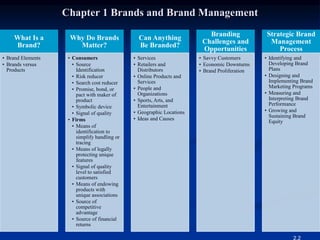
Chapter 1 Brands and Brand Management
What Is a
Brand?
• Brand Elements
• Brands versus
Products
Why Do Brands
Matter?
• Consumers
• Source
Identification
• Risk reducer
• Search cost reducer
• Promise, bond, or
pact with maker of
product
• Symbolic device
• Signal of quality
• Firms
• Means of
identification to
simplify handling or
tracing
• Means of legally
protecting unique
features
• Signal of quality
level to satisfied
customers
• Means of endowing
products with
unique associations
• Source of
competitive
advantage
• Source of financial
returns
Can Anything
Be Branded?
• Services
• Retailers and
Distributors
• Online Products and
Services
• People and
Organizations
• Sports, Arts, and
Entertainment
• Geographic Locations
• Ideas and Causes
Branding
Challenges and
Opportunities
• Savvy Customers
• Economic Downturns
• Brand Proliferation
Strategic Brand
Management
Process
• Identifying and
Developing Brand
Plans
• Designing and
Implementing Brand
Marketing Programs
• Measuring and
Interpreting Brand
Performance
• Growing and
Sustaining Brand
Equity
2.2
 What makes a brand strong?
 How do you build a strong brand?
2.3
2.4
Customer-Based Brand Equity
 “The differential effect that brand knowledge has
on consumer response to the marketing of that
brand.”
Keller, 1993
2.5
Customer-Based Brand Equity
 Differential effect
 Differences in consumer response
 Brand knowledge
 A result of consumers’ knowledge about the brand
 Consumer response to marketing
 Choice of a brand
 Recall of copy points from an ad
 Response to a sales promotion
 Evaluations of a proposed brand extension
2.6
Brand Equity as a “Bridge”
 Reflection of past investments in the marketing of
a brand
 Direction for future marketing actions or
programs
2.7
Making a Brand Strong:
Brand Knowledge
 Brand knowledge is the key to creating brand
equity.
 Brand knowledge consists of a brand node in
memory with a variety of associations linked to
it. (Associative network memory model)
 Brand knowledge has two components: brand
awareness and brand image.
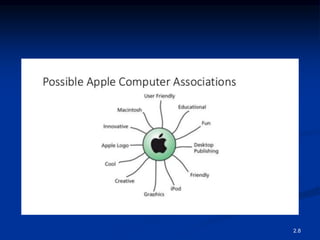
 e.g. what comes to your mind when asked about
APPLE computers?
2.8
2.9
Sources of Brand Equity
Customer-based brand equity occurs when the consumer has a high level of awareness
and familiarity with the brand and holds some strong, favorable, and unique brand
associations in memory.
 Brand awareness
 Brand recognition
 Brand recall
 Brand image
 Strong, favorable, and unique brand associations
2.10
Brand Awareness Advantages
 Learning advantages
 Register the brand in the minds of consumers
 Consideration advantages
 Likelihood that the brand will be a member of the
consideration set
 Choice advantages
 Affect choices among brands in the consideration
set
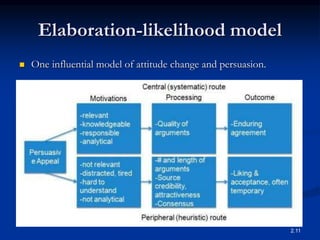
Elaboration-likelihood model
 One influential model of attitude change and persuasion.
2.11
2.12
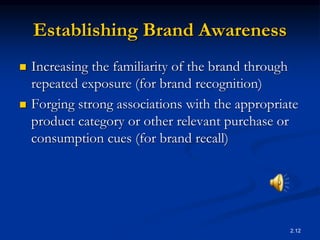
Establishing Brand Awareness
 Increasing the familiarity of the brand through
repeated exposure (for brand recognition)
 Forging strong associations with the appropriate
product category or other relevant purchase or
consumption cues (for brand recall)
2.13
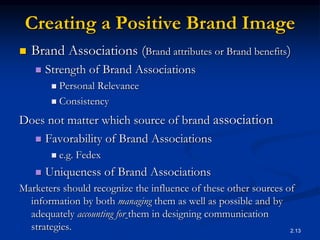
Creating a Positive Brand Image
 Brand Associations (Brand attributes or Brand benefits)
 Strength of Brand Associations
 Personal Relevance
 Consistency
Does not matter which source of brand association
 Favorability of Brand Associations
 e.g. Fedex
 Uniqueness of Brand Associations
Marketers should recognize the influence of these other sources of
information by both managing them as well as possible and by
adequately accounting for them in designing communication
strategies.
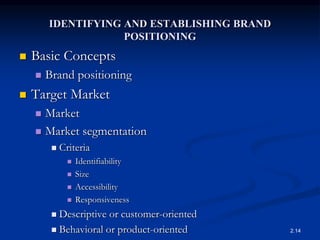
IDENTIFYING AND ESTABLISHING BRAND
POSITIONING
 Basic Concepts
 Brand positioning
 Target Market
 Market
 Market segmentation
 Criteria
 Identifiability
 Size
 Accessibility
 Responsiveness
 Descriptive or customer-oriented
 Behavioral or product-oriented 2.14
2.15
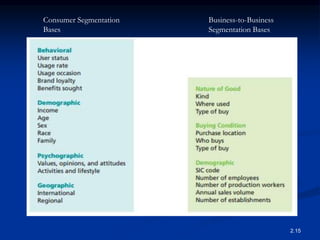
Consumer Segmentation
Bases
Business-to-Business
Segmentation Bases
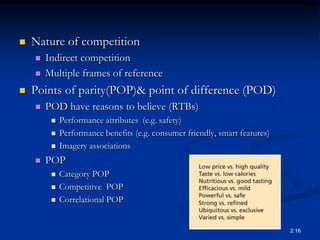
 Nature of competition
 Indirect competition
 Multiple frames of reference
 Points of parity(POP)& point of difference (POD)
 POD have reasons to believe (RTBs)
 Performance attributes (e.g. safety)
 Performance benefits (e.g. consumer friendly, smart features)
 Imagery associations
 POP
 Category POP
 Competitive POP
 Correlational POP
2.16
Positioning guidelines
 Defining and Communicating the Competitive
Frame of Reference (e.g. Coke-Asprin)
 Communicating Category Benefits (e.g. cake mix)
 Exemplars (e.g Tommy Hilfiger)
 Product Descriptor (e.g. USAIR)
 Choosing POP & POD
 Desirability Criteria (e.g. organic food)
 Deliverability Criteria
 Feasibility (e.g Mountain DEW)
 Communicability (100% pomegranate juice preventing
heart disease, prostate cancer & erectile dysfunction)
 Differentiation Criteria 2.17
 Establishing Points-of-Parity and Points-of-
Difference
Following are the ways to address the problem of
negatively correlated POPs and PODs.
 Separate the Attributes (e.g. Head & Shoulders )
 Leverage Equity of Another Entity ( e.g. P&G SK-II)
 Redefine the Relationship (e.g. Apple computers “user
friendly” to “The power to be your best )
 Straddle Positions (e.g. BMW luxury-POP & performance-POD.
The ultimate driving machine)
2.18
 Updating positioning over time
 Expansion (laddering) as explained by Maslow’s need hierarchy
 Competitive action (reacting)-do nothing, defensive, offensive
 Developing a good positioning
 First, a good positioning has a “foot in the present” and a “foot in the
future.”
 Second, a good positioning is careful to identify all relevant points-of-
parity.
 Third, a good positioning should reflect a consumer point of view in
terms of the benefits that consumers derive from the brand.
 Finally, as we will develop in greater detail with the brand resonance
model. that appeal both to the “head” and the “heart.”
2.19
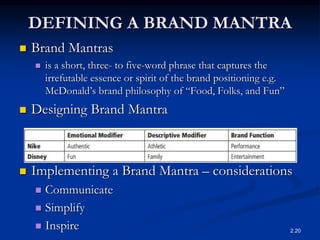
DEFINING A BRAND MANTRA
 Brand Mantras
 is a short, three- to five-word phrase that captures the
irrefutable essence or spirit of the brand positioning e.g.
McDonald’s brand philosophy of “Food, Folks, and Fun”
 Designing Brand Mantra
 Implementing a Brand Mantra – considerations
 Communicate
 Simplify
 Inspire 2.20
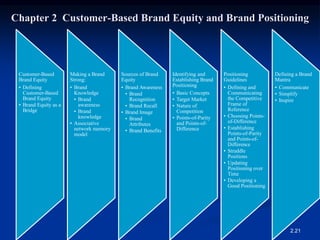
Chapter 2 Customer-Based Brand Equity and Brand Positioning
Customer-Based
Brand Equity
• Defining
Customer-Based
Brand Equity
• Brand Equity as a
Bridge
Making a Brand
Strong:
• Brand
Knowledge
• Brand
awareness
• Brand
knowledge
• Associative
network memory
model
Sources of Brand
Equity
• Brand Awareness
• Brand
Recognition
• Brand Recall
• Brand Image
• Brand
Attributes
• Brand Benefits
Identifying and
Establishing Brand
Positioning
• Basic Concepts
• Target Market
• Nature of
Competition
• Points-of-Parity
and Points-of-
Difference
Positioning
Guidelines
• Defining and
Communicating
the Competitive
Frame of
Reference
• Choosing Points-
of-Difference
• Establishing
Points-of-Parity
and Points-of-
Difference
• Straddle
Positions
• Updating
Positioning over
Time
• Developing a
Good Positioning
Defining a Brand
Mantra
• Communicate
• Simplify
• Inspire
2.21
2.22
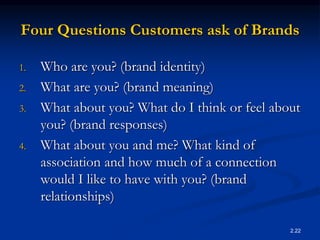
Four Questions Customers ask of Brands
1. Who are you? (brand identity)
2. What are you? (brand meaning)
3. What about you? What do I think or feel about
you? (brand responses)
4. What about you and me? What kind of
association and how much of a connection
would I like to have with you? (brand
relationships)
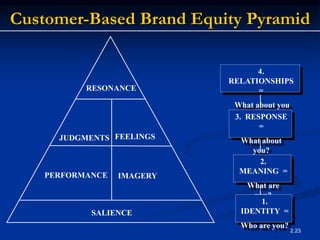
2.23
Customer-Based Brand Equity Pyramid
RESONANCE
SALIENCE
JUDGMENTS FEELINGS
PERFORMANCE IMAGERY
4.
RELATIONSHIPS
=
What about you
and me?
3. RESPONSE
=
What about
you?
2.
MEANING =
What are
you?
1.
IDENTITY =
Who are you?
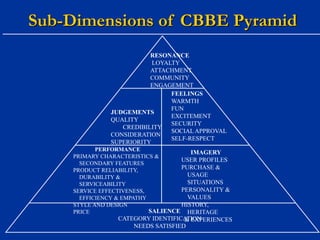
Sub-Dimensions of CBBE Pyramid
RESONANCE
LOYALTY
ATTACHMENT
COMMUNITY
ENGAGEMENT
JUDGEMENTS
QUALITY
CREDIBILITY
CONSIDERATION
SUPERIORITY
FEELINGS
WARMTH
FUN
EXCITEMENT
SECURITY
SOCIALAPPROVAL
SELF-RESPECT
SALIENCE
CATEGORY IDENTIFICATION
NEEDS SATISFIED
PERFORMANCE
PRIMARY CHARACTERISTICS &
SECONDARY FEATURES
PRODUCT RELIABILITY,
DURABILITY &
SERVICEABILITY
SERVICE EFFECTIVENESS,
EFFICIENCY & EMPATHY
STYLE AND DESIGN
PRICE
IMAGERY
USER PROFILES
PURCHASE &
USAGE
SITUATIONS
PERSONALITY &
VALUES
HISTORY,
HERITAGE
& EXPERIENCES
2.25
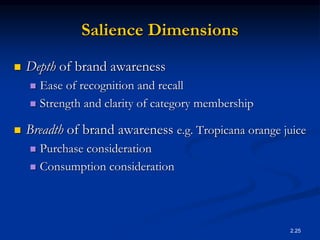
Salience Dimensions
 Depth of brand awareness
 Ease of recognition and recall
 Strength and clarity of category membership
 Breadth of brand awareness e.g. Tropicana orange juice
 Purchase consideration
 Consumption consideration
2.26
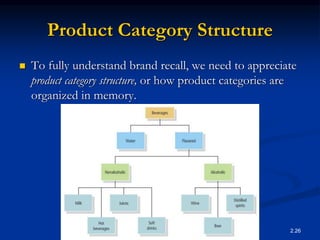
Product Category Structure
 To fully understand brand recall, we need to appreciate
product category structure, or how product categories are
organized in memory.
2.27
Depth and Breadth Importance
 The product category hierarchy shows us not
only the depth of awareness matters but also the
breadth.
 The brand must not only be top-of-mind and have
sufficient “mind share,” but it must also do so at
the right times and places.
2.28
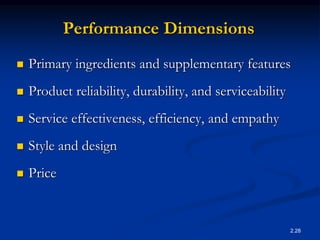
Performance Dimensions
 Primary ingredients and supplementary features
 Product reliability, durability, and serviceability
 Service effectiveness, efficiency, and empathy
 Style and design
 Price
2.29
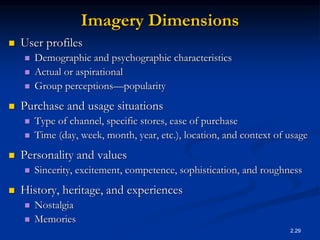
Imagery Dimensions
 User profiles
 Demographic and psychographic characteristics
 Actual or aspirational
 Group perceptions—popularity
 Purchase and usage situations
 Type of channel, specific stores, ease of purchase
 Time (day, week, month, year, etc.), location, and context of usage
 Personality and values
 Sincerity, excitement, competence, sophistication, and roughness
 History, heritage, and experiences
 Nostalgia
 Memories
2.30
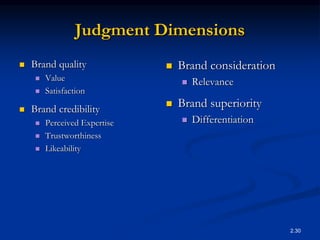
Judgment Dimensions
 Brand quality
 Value
 Satisfaction
 Brand credibility
 Perceived Expertise
 Trustworthiness
 Likeability
 Brand consideration
 Relevance
 Brand superiority
 Differentiation
2.31
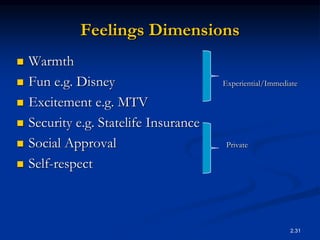
Feelings Dimensions
 Warmth
 Fun e.g. Disney Experiential/Immediate
 Excitement e.g. MTV
 Security e.g. Statelife Insurance
 Social Approval Private
 Self-respect
2.32
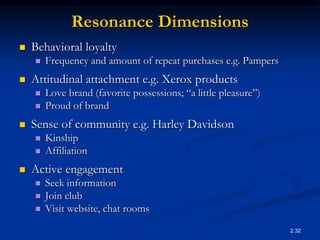
Resonance Dimensions
 Behavioral loyalty
 Frequency and amount of repeat purchases e.g. Pampers
 Attitudinal attachment e.g. Xerox products
 Love brand (favorite possessions; “a little pleasure”)
 Proud of brand
 Sense of community e.g. Harley Davidson
 Kinship
 Affiliation
 Active engagement
 Seek information
 Join club
 Visit website, chat rooms
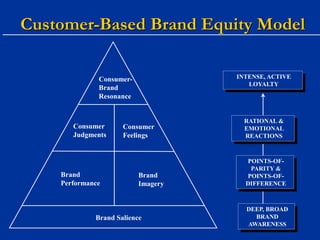
Customer-Based Brand Equity Model
Consumer-
Brand
Resonance
Brand Salience
Consumer
Judgments
Consumer
Feelings
Brand
Performance
Brand
Imagery
INTENSE, ACTIVE
LOYALTY
RATIONAL &
EMOTIONAL
REACTIONS
POINTS-OF-
PARITY &
POINTS-OF-
DIFFERENCE
DEEP, BROAD
BRAND
AWARENESS
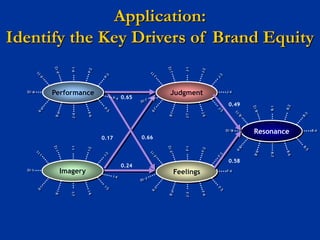
Application:
Identify the Key Drivers of Brand Equity
0.17 0.66
0.24
0.65
Performance
Imagery Feelings
Judgment
Resonance
0.58
0.49
2.35
Brand Building Implications
 Customers own brands.
 Don’t take shortcuts with brands.
 Brands should have a duality.
 Brands should have richness.
 Brand resonance provides important focus.
2.36
Creating Customer Value
 Customer-brand relationships are the
foundation of brand resonance and building a
strong brand.
 The customer-based brand equity model
certainly puts that notion front and center.
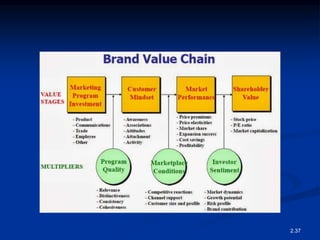
2.37
2.38
Is a company consumer-centric?
1. Is the company looking for ways to take care of
you?
2. Does the company know its customers well
enough to differentiate between them?
3. Is someone accountable for customers?
4. Is the company managed for shareholder value?
5. Is the company testing new customer offers and
learning from the results?
Sources: Larry Selden and Geoffrey Colvin, 2004.
2.39
Customer Relationship Management
(CRM)
 Uses a company’s data systems and applications
to track consumer activity and manage customer
interactions with the company
2.40
Customer Equity
 Blattberg and Deighton (1996) offer eight guidelines as a means
of maximizing customer equity:
 Invest in highest-value customers first
 Transform product management into customer management
 Consider how add-on sales and cross-selling can increase customer equity
 Look for ways to reduce acquisition costs
 Track customer equity gains and losses against marketing programs
 Relate branding to customer equity
 Monitor the intrinsic retain ability of your customer
 Consider writing separate marketing plans—or even building two
marketing organizations—for acquisition and retention efforts
2.41
Customer Equity
 The sum of lifetime values of all customers
 Customer lifetime value (CLV) is affected by
revenue and by the cost of customer acquisition,
retention, and cross-selling
 Consists of three components:
 Value equity
 Brand equity
 Relationship equity
Rust, Zeithamal & Lemon, 2004
2.42
Relationship of Customer Equity to
Brand Equity
 Customers drive the success of brands but
brands are the necessary touchpoint that firms
have to connect with their customers.
 Customer-based brand equity maintains that
brands create value by eliciting differential
customer response to marketing activities.
 The higher price premiums and increased levels
of loyalty engendered by brands generate
incremental cash flows.

chapter 2

  • 1.
    2.1 CHAPTER 2: CUSTOMER-BASED BRANDEQUITY Bushra Ahmad Women University Multan Campus
  • 2.
    Chapter 1 Brandsand Brand Management What Is a Brand? • Brand Elements • Brands versus Products Why Do Brands Matter? • Consumers • Source Identification • Risk reducer • Search cost reducer • Promise, bond, or pact with maker of product • Symbolic device • Signal of quality • Firms • Means of identification to simplify handling or tracing • Means of legally protecting unique features • Signal of quality level to satisfied customers • Means of endowing products with unique associations • Source of competitive advantage • Source of financial returns Can Anything Be Branded? • Services • Retailers and Distributors • Online Products and Services • People and Organizations • Sports, Arts, and Entertainment • Geographic Locations • Ideas and Causes Branding Challenges and Opportunities • Savvy Customers • Economic Downturns • Brand Proliferation Strategic Brand Management Process • Identifying and Developing Brand Plans • Designing and Implementing Brand Marketing Programs • Measuring and Interpreting Brand Performance • Growing and Sustaining Brand Equity 2.2
  • 3.
     What makesa brand strong?  How do you build a strong brand? 2.3
  • 4.
    2.4 Customer-Based Brand Equity “The differential effect that brand knowledge has on consumer response to the marketing of that brand.” Keller, 1993
  • 5.
    2.5 Customer-Based Brand Equity Differential effect  Differences in consumer response  Brand knowledge  A result of consumers’ knowledge about the brand  Consumer response to marketing  Choice of a brand  Recall of copy points from an ad  Response to a sales promotion  Evaluations of a proposed brand extension
  • 6.
    2.6 Brand Equity asa “Bridge”  Reflection of past investments in the marketing of a brand  Direction for future marketing actions or programs
  • 7.
    2.7 Making a BrandStrong: Brand Knowledge  Brand knowledge is the key to creating brand equity.  Brand knowledge consists of a brand node in memory with a variety of associations linked to it. (Associative network memory model)  Brand knowledge has two components: brand awareness and brand image.  e.g. what comes to your mind when asked about APPLE computers?
  • 8.
  • 9.
    2.9 Sources of BrandEquity Customer-based brand equity occurs when the consumer has a high level of awareness and familiarity with the brand and holds some strong, favorable, and unique brand associations in memory.  Brand awareness  Brand recognition  Brand recall  Brand image  Strong, favorable, and unique brand associations
  • 10.
    2.10 Brand Awareness Advantages Learning advantages  Register the brand in the minds of consumers  Consideration advantages  Likelihood that the brand will be a member of the consideration set  Choice advantages  Affect choices among brands in the consideration set
  • 11.
    Elaboration-likelihood model  Oneinfluential model of attitude change and persuasion. 2.11
  • 12.
    2.12 Establishing Brand Awareness Increasing the familiarity of the brand through repeated exposure (for brand recognition)  Forging strong associations with the appropriate product category or other relevant purchase or consumption cues (for brand recall)
  • 13.
    2.13 Creating a PositiveBrand Image  Brand Associations (Brand attributes or Brand benefits)  Strength of Brand Associations  Personal Relevance  Consistency Does not matter which source of brand association  Favorability of Brand Associations  e.g. Fedex  Uniqueness of Brand Associations Marketers should recognize the influence of these other sources of information by both managing them as well as possible and by adequately accounting for them in designing communication strategies.
  • 14.
    IDENTIFYING AND ESTABLISHINGBRAND POSITIONING  Basic Concepts  Brand positioning  Target Market  Market  Market segmentation  Criteria  Identifiability  Size  Accessibility  Responsiveness  Descriptive or customer-oriented  Behavioral or product-oriented 2.14
  • 15.
  • 16.
     Nature ofcompetition  Indirect competition  Multiple frames of reference  Points of parity(POP)& point of difference (POD)  POD have reasons to believe (RTBs)  Performance attributes (e.g. safety)  Performance benefits (e.g. consumer friendly, smart features)  Imagery associations  POP  Category POP  Competitive POP  Correlational POP 2.16
  • 17.
    Positioning guidelines  Definingand Communicating the Competitive Frame of Reference (e.g. Coke-Asprin)  Communicating Category Benefits (e.g. cake mix)  Exemplars (e.g Tommy Hilfiger)  Product Descriptor (e.g. USAIR)  Choosing POP & POD  Desirability Criteria (e.g. organic food)  Deliverability Criteria  Feasibility (e.g Mountain DEW)  Communicability (100% pomegranate juice preventing heart disease, prostate cancer & erectile dysfunction)  Differentiation Criteria 2.17
  • 18.
     Establishing Points-of-Parityand Points-of- Difference Following are the ways to address the problem of negatively correlated POPs and PODs.  Separate the Attributes (e.g. Head & Shoulders )  Leverage Equity of Another Entity ( e.g. P&G SK-II)  Redefine the Relationship (e.g. Apple computers “user friendly” to “The power to be your best )  Straddle Positions (e.g. BMW luxury-POP & performance-POD. The ultimate driving machine) 2.18
  • 19.
     Updating positioningover time  Expansion (laddering) as explained by Maslow’s need hierarchy  Competitive action (reacting)-do nothing, defensive, offensive  Developing a good positioning  First, a good positioning has a “foot in the present” and a “foot in the future.”  Second, a good positioning is careful to identify all relevant points-of- parity.  Third, a good positioning should reflect a consumer point of view in terms of the benefits that consumers derive from the brand.  Finally, as we will develop in greater detail with the brand resonance model. that appeal both to the “head” and the “heart.” 2.19
  • 20.
    DEFINING A BRANDMANTRA  Brand Mantras  is a short, three- to five-word phrase that captures the irrefutable essence or spirit of the brand positioning e.g. McDonald’s brand philosophy of “Food, Folks, and Fun”  Designing Brand Mantra  Implementing a Brand Mantra – considerations  Communicate  Simplify  Inspire 2.20
  • 21.
    Chapter 2 Customer-BasedBrand Equity and Brand Positioning Customer-Based Brand Equity • Defining Customer-Based Brand Equity • Brand Equity as a Bridge Making a Brand Strong: • Brand Knowledge • Brand awareness • Brand knowledge • Associative network memory model Sources of Brand Equity • Brand Awareness • Brand Recognition • Brand Recall • Brand Image • Brand Attributes • Brand Benefits Identifying and Establishing Brand Positioning • Basic Concepts • Target Market • Nature of Competition • Points-of-Parity and Points-of- Difference Positioning Guidelines • Defining and Communicating the Competitive Frame of Reference • Choosing Points- of-Difference • Establishing Points-of-Parity and Points-of- Difference • Straddle Positions • Updating Positioning over Time • Developing a Good Positioning Defining a Brand Mantra • Communicate • Simplify • Inspire 2.21
  • 22.
    2.22 Four Questions Customersask of Brands 1. Who are you? (brand identity) 2. What are you? (brand meaning) 3. What about you? What do I think or feel about you? (brand responses) 4. What about you and me? What kind of association and how much of a connection would I like to have with you? (brand relationships)
  • 23.
    2.23 Customer-Based Brand EquityPyramid RESONANCE SALIENCE JUDGMENTS FEELINGS PERFORMANCE IMAGERY 4. RELATIONSHIPS = What about you and me? 3. RESPONSE = What about you? 2. MEANING = What are you? 1. IDENTITY = Who are you?
  • 24.
    Sub-Dimensions of CBBEPyramid RESONANCE LOYALTY ATTACHMENT COMMUNITY ENGAGEMENT JUDGEMENTS QUALITY CREDIBILITY CONSIDERATION SUPERIORITY FEELINGS WARMTH FUN EXCITEMENT SECURITY SOCIALAPPROVAL SELF-RESPECT SALIENCE CATEGORY IDENTIFICATION NEEDS SATISFIED PERFORMANCE PRIMARY CHARACTERISTICS & SECONDARY FEATURES PRODUCT RELIABILITY, DURABILITY & SERVICEABILITY SERVICE EFFECTIVENESS, EFFICIENCY & EMPATHY STYLE AND DESIGN PRICE IMAGERY USER PROFILES PURCHASE & USAGE SITUATIONS PERSONALITY & VALUES HISTORY, HERITAGE & EXPERIENCES
  • 25.
    2.25 Salience Dimensions  Depthof brand awareness  Ease of recognition and recall  Strength and clarity of category membership  Breadth of brand awareness e.g. Tropicana orange juice  Purchase consideration  Consumption consideration
  • 26.
    2.26 Product Category Structure To fully understand brand recall, we need to appreciate product category structure, or how product categories are organized in memory.
  • 27.
    2.27 Depth and BreadthImportance  The product category hierarchy shows us not only the depth of awareness matters but also the breadth.  The brand must not only be top-of-mind and have sufficient “mind share,” but it must also do so at the right times and places.
  • 28.
    2.28 Performance Dimensions  Primaryingredients and supplementary features  Product reliability, durability, and serviceability  Service effectiveness, efficiency, and empathy  Style and design  Price
  • 29.
    2.29 Imagery Dimensions  Userprofiles  Demographic and psychographic characteristics  Actual or aspirational  Group perceptions—popularity  Purchase and usage situations  Type of channel, specific stores, ease of purchase  Time (day, week, month, year, etc.), location, and context of usage  Personality and values  Sincerity, excitement, competence, sophistication, and roughness  History, heritage, and experiences  Nostalgia  Memories
  • 30.
    2.30 Judgment Dimensions  Brandquality  Value  Satisfaction  Brand credibility  Perceived Expertise  Trustworthiness  Likeability  Brand consideration  Relevance  Brand superiority  Differentiation
  • 31.
    2.31 Feelings Dimensions  Warmth Fun e.g. Disney Experiential/Immediate  Excitement e.g. MTV  Security e.g. Statelife Insurance  Social Approval Private  Self-respect
  • 32.
    2.32 Resonance Dimensions  Behavioralloyalty  Frequency and amount of repeat purchases e.g. Pampers  Attitudinal attachment e.g. Xerox products  Love brand (favorite possessions; “a little pleasure”)  Proud of brand  Sense of community e.g. Harley Davidson  Kinship  Affiliation  Active engagement  Seek information  Join club  Visit website, chat rooms
  • 33.
    Customer-Based Brand EquityModel Consumer- Brand Resonance Brand Salience Consumer Judgments Consumer Feelings Brand Performance Brand Imagery INTENSE, ACTIVE LOYALTY RATIONAL & EMOTIONAL REACTIONS POINTS-OF- PARITY & POINTS-OF- DIFFERENCE DEEP, BROAD BRAND AWARENESS
  • 34.
    Application: Identify the KeyDrivers of Brand Equity 0.17 0.66 0.24 0.65 Performance Imagery Feelings Judgment Resonance 0.58 0.49
  • 35.
    2.35 Brand Building Implications Customers own brands.  Don’t take shortcuts with brands.  Brands should have a duality.  Brands should have richness.  Brand resonance provides important focus.
  • 36.
    2.36 Creating Customer Value Customer-brand relationships are the foundation of brand resonance and building a strong brand.  The customer-based brand equity model certainly puts that notion front and center.
  • 37.
  • 38.
    2.38 Is a companyconsumer-centric? 1. Is the company looking for ways to take care of you? 2. Does the company know its customers well enough to differentiate between them? 3. Is someone accountable for customers? 4. Is the company managed for shareholder value? 5. Is the company testing new customer offers and learning from the results? Sources: Larry Selden and Geoffrey Colvin, 2004.
  • 39.
    2.39 Customer Relationship Management (CRM) Uses a company’s data systems and applications to track consumer activity and manage customer interactions with the company
  • 40.
    2.40 Customer Equity  Blattbergand Deighton (1996) offer eight guidelines as a means of maximizing customer equity:  Invest in highest-value customers first  Transform product management into customer management  Consider how add-on sales and cross-selling can increase customer equity  Look for ways to reduce acquisition costs  Track customer equity gains and losses against marketing programs  Relate branding to customer equity  Monitor the intrinsic retain ability of your customer  Consider writing separate marketing plans—or even building two marketing organizations—for acquisition and retention efforts
  • 41.
    2.41 Customer Equity  Thesum of lifetime values of all customers  Customer lifetime value (CLV) is affected by revenue and by the cost of customer acquisition, retention, and cross-selling  Consists of three components:  Value equity  Brand equity  Relationship equity Rust, Zeithamal & Lemon, 2004
  • 42.
    2.42 Relationship of CustomerEquity to Brand Equity  Customers drive the success of brands but brands are the necessary touchpoint that firms have to connect with their customers.  Customer-based brand equity maintains that brands create value by eliciting differential customer response to marketing activities.  The higher price premiums and increased levels of loyalty engendered by brands generate incremental cash flows.

Editor's Notes