


CHAPTER 3:
BRAND POSITIONING & VALUES


       Kevin Lane Keller
     Tuck School of Business
       Dartmouth College


                               3.1
Brand Positioning
   Is at the heart of the marketing strategy

   “. . . the act of designing the company’s offer and
    image so that it occupies a distinct and valued
    place in the target customer’s minds.”
                                                Philip Kotler


                                                       3.2
Determining a frame of reference
   What are the ideal points-of-parity and points-
    of-difference brand associations vis-à-vis the
    competition?
   Marketers need to know:
     Who the target consumer is
     Who the main competitors are

     How the brand is similar to these competitors

     How the brand is different from them


                                                      3.3
Target Market
   A market is the set of all actual and potential
    buyers who have sufficient interest in, income
    for, and access to a product.
   Market segmentation divides the market into
    distinct groups of homogeneous consumers who
    have similar needs and consumer behavior, and
    who thus require similar marketing mixes.
   Market segmentation requires making tradeoffs
    between costs and benefits.

                                                 3.4
Example of the toothpaste
                 market
    Four main segments:
    1.   Sensory: Seeking flavor and product appearance
    2.   Sociables: Seeking brightness of teeth
    3.   Worriers: Seeking decay prevention
    4.   Independent: Seeking low price


                                                          3.5
Criteria for Segmentation
   Identifiability: Can we easily identify the segment?
   Size: Is there adequate sales potential in the
    segment?
   Accessibility: Are specialized distribution outlets
    and communication media available to reach the
    segment?
   Responsiveness: How favorably will the segment
    respond to a tailored marketing program?

                                                       3.6
Nature of Competition
   Deciding to target a certain type of consumer
    often defines the nature of competition
   Do not define competition too narrowly
       Ex: a luxury good with a strong hedonic benefit like
        stereo equipment may compete as much with a
        vacation as with other durable goods like furniture


                                                           3.7
Points-of-Parity
          and Points-of-Difference
   Points-of-difference (PODs) are attributes or
    benefits that consumers strongly associate with a
    brand, positively evaluate, and believe that they
    could not find to the same extent with a
    competitive brand.
   Points-of-parity associations (POPs), on the other
    hand, are not necessarily unique to the brand but
    may in fact be shared with other brands.

                                                    3.8
Brand Positioning Guidelines
   Two key issues in arriving at the optimal
    competitive brand positioning are:
       Defining and communicating the competitive
        frame of reference
       Choosing and establishing points-of-parity and
        points-of-difference


                                                         3.9
Defining and Communicating the
      Competitive Frame of Reference
   Defining a competitive frame of reference for a
    brand positioning is to determine category
    membership.
   The preferred approach to positioning is to
    inform consumers of a brand’s membership
    before stating its point of difference in
    relationship to other category members.


                                                  3.10
Choosing POP’ s & POD’ s
   Desirability criteria (consumer perspective)
     Personally relevant
     Distinctive and superior

     Believable and credible

   Deliverability criteria (firm perspective)
     Feasible
     Profitable

     Pre-emptive, defensible, and difficult to attack


                                                         3.11
Attribute and Benefit Trade-offs
   Price and quality
   Convenience and quality
   Taste and low calories
   Efficacy and mildness
   Power and safety
   Ubiquity and prestige
   Comprehensiveness (variety) and simplicity
   Strength and refinement
                                                 3.12
Strategies to Reconcile
      Attribute and Benefit Trade-offs
   Establish separate marketing programs
   Leverage secondary association (e.g., co-brand)
   Re-define the relationship from negative to
    positive


                                                      3.13
Core Brand Values
   Set of abstract concepts or phrases that
    characterize the five to ten most important
    dimensions of the mental map of a brand
   Relate to points-of-parity and points-of-
    difference
   Mental map  Core brand values  Brand mantra


                                                    3.14
Brand Mantras
   An articulation of the “heart and soul” of the brand
   similar to “brand essence” or “core brand promise”

   Short three- to five-word phrases that capture the
    irrefutable essence or spirit of the brand
    positioning and brand values
   Considerations
     Communicate
     Simplify
     Inspire

                                                    3.15
Designing the Brand Mantra
   The term brand functions describes the nature of
    the product or service or the type of experiences
    or benefits the brand provides.
   The descriptive modifier further clarifies its nature.
   The emotional modifier provides another qualifier
    —how exactly does the brand provide benefits,
    and in what way?


                                                        3.16
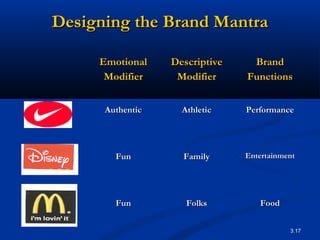
Designing the Brand Mantra

         Emotional    Descriptive    Brand
          Modifier     Modifier     Functions


          Authentic     Athletic    Performance
Nike


            Fun         Family      Entertainment
Disney


            Fun          Folks         Food


                                               3.17
Internal Branding
   Members of the organization are properly aligned
    with the brand and what it represents.
   Crucial for service companies


                                                  3.18
Brand Audit
   Externally, consumer-focused assessement
   A comprehensive examination of a brand
    involving activities to assess the health of the
    brand, uncover its sources of equity, and suggest
    ways to improve and leverage that equity
   It includes brand vision, mission, promise, values,
    position, personality, and performance


                                                    3.19
Importance of Brand Audits
   Understand sources of brand equity
       Firm perspective
       Consumer perspective
   Set strategic direction for the brand
   Recommend marketing programs to maximize
    long-term brand equity


                                               3.20
Brand Audit Steps

   Brand inventory (supply side)

   Brand exploratory (demand side)


                                      3.21
Brand Inventory
   A current comprehensive profile of how all the
    products and services sold by a company are
    branded and marketed:
     Brand elements
     Supporting marketing programs

     Profile of competitive brands

     POPs and PODs

     Brand mantra


                                                     3.22
Brand Inventory (Cont.)
   Suggests the bases for positioning the brand
   Offers insights to how brand equity may be better
    managed
   Assesses consistency in message among activities,
    brand extensions, and sub-brands in order to
    avoid redundancies, overlaps, and consumer
    confusion


                                                   3.23
Brand Exploratory
   Provides detailed information as to how
    consumers perceive the brand:
     Awareness
     Favorability

     Uniqueness of associations

   Helps identify sources of customer-based brand
    equity
   Uncovers knowledge structures for the core brand
    as well as its competitors
                                                3.24
Suggested Brand Audit Outline
   Brand audit objectives, scope, and approach
   Background about the brand (self-analysis)
   Background about the industries
   Consumer analysis (trends, motivation, perceptions, needs,
    segmentation, behavior)
   Brand inventory
       Elements, current marketing programs, POPs, PODs
       Branding strategies (extensions, sub-brands, etc.)
       Brand portfolio analysis
       Competitors’ brand inventory
       Strengths and weaknesses                             3.25
Brand Audit Outline (Cont.)
   Brand exploratory
       Brand associations
       Brand positioning analysis
       Consumer perceptions analysis (vs. competition)
   Summary of competitor analysis
   SWOT analysis
   Brand equity evaluation
   Strategic brand management recommendations


                                                          3.26

brand managament

  • 1.
    CHAPTER 3: BRAND POSITIONING& VALUES Kevin Lane Keller Tuck School of Business Dartmouth College 3.1
  • 2.
    Brand Positioning  Is at the heart of the marketing strategy  “. . . the act of designing the company’s offer and image so that it occupies a distinct and valued place in the target customer’s minds.” Philip Kotler 3.2
  • 3.
    Determining a frameof reference  What are the ideal points-of-parity and points- of-difference brand associations vis-à-vis the competition?  Marketers need to know:  Who the target consumer is  Who the main competitors are  How the brand is similar to these competitors  How the brand is different from them 3.3
  • 4.
    Target Market  A market is the set of all actual and potential buyers who have sufficient interest in, income for, and access to a product.  Market segmentation divides the market into distinct groups of homogeneous consumers who have similar needs and consumer behavior, and who thus require similar marketing mixes.  Market segmentation requires making tradeoffs between costs and benefits. 3.4
  • 5.
    Example of thetoothpaste market  Four main segments: 1. Sensory: Seeking flavor and product appearance 2. Sociables: Seeking brightness of teeth 3. Worriers: Seeking decay prevention 4. Independent: Seeking low price 3.5
  • 6.
    Criteria for Segmentation  Identifiability: Can we easily identify the segment?  Size: Is there adequate sales potential in the segment?  Accessibility: Are specialized distribution outlets and communication media available to reach the segment?  Responsiveness: How favorably will the segment respond to a tailored marketing program? 3.6
  • 7.
    Nature of Competition  Deciding to target a certain type of consumer often defines the nature of competition  Do not define competition too narrowly  Ex: a luxury good with a strong hedonic benefit like stereo equipment may compete as much with a vacation as with other durable goods like furniture 3.7
  • 8.
    Points-of-Parity and Points-of-Difference  Points-of-difference (PODs) are attributes or benefits that consumers strongly associate with a brand, positively evaluate, and believe that they could not find to the same extent with a competitive brand.  Points-of-parity associations (POPs), on the other hand, are not necessarily unique to the brand but may in fact be shared with other brands. 3.8
  • 9.
    Brand Positioning Guidelines  Two key issues in arriving at the optimal competitive brand positioning are:  Defining and communicating the competitive frame of reference  Choosing and establishing points-of-parity and points-of-difference 3.9
  • 10.
    Defining and Communicatingthe Competitive Frame of Reference  Defining a competitive frame of reference for a brand positioning is to determine category membership.  The preferred approach to positioning is to inform consumers of a brand’s membership before stating its point of difference in relationship to other category members. 3.10
  • 11.
    Choosing POP’ s& POD’ s  Desirability criteria (consumer perspective)  Personally relevant  Distinctive and superior  Believable and credible  Deliverability criteria (firm perspective)  Feasible  Profitable  Pre-emptive, defensible, and difficult to attack 3.11
  • 12.
    Attribute and BenefitTrade-offs  Price and quality  Convenience and quality  Taste and low calories  Efficacy and mildness  Power and safety  Ubiquity and prestige  Comprehensiveness (variety) and simplicity  Strength and refinement 3.12
  • 13.
    Strategies to Reconcile Attribute and Benefit Trade-offs  Establish separate marketing programs  Leverage secondary association (e.g., co-brand)  Re-define the relationship from negative to positive 3.13
  • 14.
    Core Brand Values  Set of abstract concepts or phrases that characterize the five to ten most important dimensions of the mental map of a brand  Relate to points-of-parity and points-of- difference  Mental map  Core brand values  Brand mantra 3.14
  • 15.
    Brand Mantras  An articulation of the “heart and soul” of the brand  similar to “brand essence” or “core brand promise”  Short three- to five-word phrases that capture the irrefutable essence or spirit of the brand positioning and brand values  Considerations  Communicate  Simplify  Inspire 3.15
  • 16.
    Designing the BrandMantra  The term brand functions describes the nature of the product or service or the type of experiences or benefits the brand provides.  The descriptive modifier further clarifies its nature.  The emotional modifier provides another qualifier —how exactly does the brand provide benefits, and in what way? 3.16
  • 17.
    Designing the BrandMantra Emotional Descriptive Brand Modifier Modifier Functions Authentic Athletic Performance Nike Fun Family Entertainment Disney Fun Folks Food 3.17
  • 18.
    Internal Branding  Members of the organization are properly aligned with the brand and what it represents.  Crucial for service companies 3.18
  • 19.
    Brand Audit  Externally, consumer-focused assessement  A comprehensive examination of a brand involving activities to assess the health of the brand, uncover its sources of equity, and suggest ways to improve and leverage that equity  It includes brand vision, mission, promise, values, position, personality, and performance 3.19
  • 20.
    Importance of BrandAudits  Understand sources of brand equity  Firm perspective  Consumer perspective  Set strategic direction for the brand  Recommend marketing programs to maximize long-term brand equity 3.20
  • 21.
    Brand Audit Steps  Brand inventory (supply side)  Brand exploratory (demand side) 3.21
  • 22.
    Brand Inventory  A current comprehensive profile of how all the products and services sold by a company are branded and marketed:  Brand elements  Supporting marketing programs  Profile of competitive brands  POPs and PODs  Brand mantra 3.22
  • 23.
    Brand Inventory (Cont.)  Suggests the bases for positioning the brand  Offers insights to how brand equity may be better managed  Assesses consistency in message among activities, brand extensions, and sub-brands in order to avoid redundancies, overlaps, and consumer confusion 3.23
  • 24.
    Brand Exploratory  Provides detailed information as to how consumers perceive the brand:  Awareness  Favorability  Uniqueness of associations  Helps identify sources of customer-based brand equity  Uncovers knowledge structures for the core brand as well as its competitors 3.24
  • 25.
    Suggested Brand AuditOutline  Brand audit objectives, scope, and approach  Background about the brand (self-analysis)  Background about the industries  Consumer analysis (trends, motivation, perceptions, needs, segmentation, behavior)  Brand inventory  Elements, current marketing programs, POPs, PODs  Branding strategies (extensions, sub-brands, etc.)  Brand portfolio analysis  Competitors’ brand inventory  Strengths and weaknesses 3.25
  • 26.
    Brand Audit Outline(Cont.)  Brand exploratory  Brand associations  Brand positioning analysis  Consumer perceptions analysis (vs. competition)  Summary of competitor analysis  SWOT analysis  Brand equity evaluation  Strategic brand management recommendations 3.26

Editor's Notes