WHAT IS A BRAND
A name, term, sign, symbol, design or a
combination of these that identifies the products
or services of one seller or group of sellers &
differentiates them from those of competitors.
• A brand represents everything that a product or service
means to consumers
• As such, brands are valuable assets to a company.
• Marketing is all about building brands that connect deeply
with customers.
• Brand becoming synonymous with generic product category.
e.g. what comes into your mind when you think Google? Or
“coca- cola”?
WHAT IS BRANDING DECISIONS
• Branding consists of a set of complex branding decisions.
• Major brand strategy decisions involve brand positioning,
brand name selection, brand sponsorship and brand
development.
• Before going into the four branding decisions, also called
brand strategy decisions, we should clarify what a brand
actually is.
• A brand is a company’s promise to deliver a specific set of
features, benefits, services and experiences consistently to
buyers. However, a brand should rather be understood as a
set of perceptions a consumer has about the products of a
particular firm. Therefore, all branding decisions focus on the
consumer.
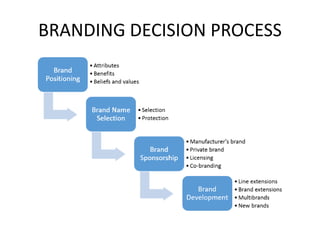
BRANDING DECISION PROCESS
BRAND POSITIONING
• Brand Positioning – Branding Decisions
• A brand must be positioned clearly in target customers’ minds. Brand
positioning can be done at any of three levels:
• on product attributes
• on benefits
• on beliefs and values.
• At the lowest level, marketers can position a brand on product attributes.
Marketing for a car brand may focus on attributes such as large engines,
fancy colours and sportive design. However, attributes are generally the
least desirable level for brand positioning. The reason is that competitors
can easily copy these attributes, taking away the uniqueness of the brand.
Also, customers are not interested in attributes as such. Rather, they are
interested in what these attributes will do for them. That leads us to the
next level: Benefits.
• A brand can be better positioned on basis of a
desirable benefit. The car brand could go beyond the
technical product attributes and promote the resulting
benefits for the customer: quick transportation,
lifestyle and so further.
• Yet, the strongest brands go beyond product attributes
and benefits. They are positioned on beliefs and
values. Successful brands engage customers on a deep,
emotional level. Examples include brands such as Mini
and Aston Martin. These brands rely less on products’
tangible attributes, but more on creating passion,
surprise and excitement surrounding the brand. They
have become “cool” brands.
• Brand positioning lays the foundation for the three
other branding decisions. Therefore, brand positioning
should also involve establishing a mission for the brand
and a vision of what the brand should be and do. The
brand’s promise must be simple and honest.
BRAND NAME SELECTION
• When talking about branding decisions, the brand name
decision may be the most obvious one. The name of the
brand is maybe what you think of first when imagining a
brand – it is the base of the brand. Therefore, the brand
name selection belongs to the most important branding
decisions. However, it is also quite a difficult task.
• We have to start with a careful review of the product and
its benefits, the target market and proposed marketing
strategies. Having that in mind, we have to find a brand
name matching these things. Naming a brand is part
science, part art, and certainly a measure of instinct.
• Although finding the right name for a brand can be a
challenging task, there are some guidelines to make it
easier. Desirable qualities for a brand name include:
• It should suggest something about a product’s benefits and qualities.
Think of the wadding polish “Nevr Dull”. The brand name indicates the
benefit of using this product: the treated metal will never be dull.
• It should be easy to pronounce, recognise, and remember. iPod and Nike
are certainly better than “Troglodyte Homonculus” – a clothing brand.
• The brand name should be distinctive, so that consumers don’t confuse it
with other brands. Rolex and Bugatti are good examples.
• It should also be extendable. Think of Amazon.com, which began as an
online bookseller but chose a name that would allow expansion into other
categories. If Amazon.com had chosen a different name, such as
books.com, it could not have extended its business that easily.
• The brand name should translate easily into foreign languages. The Ford
Pinto line had some struggles in Brazil, seeing as it translated into “tiny
male genitals”. Or the Mitsubishi Pajero, which means in Spanish “man
who plays with himself and enjoys it a bit too much”. More famous: Coca-
Cola reads in Chinese as “female horse stuffed with wax”.
• It should be capable of registration and legal protection. In other words, it
must not infringe on existing brand names.
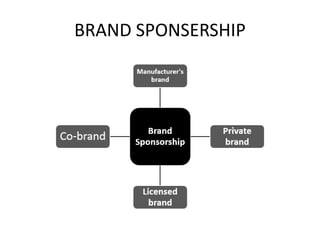
BRAND SPONSERSHIP
• A product may be launched as a manufacturer’s
brand. This is also called national brand.
Examples include Kellogg selling its output under
the own brand name (Kellog’s Frosties, for
instance) or Sony (Sony Bravia HDTV).
• The manufacturer could also sell to resellers who
give the product a private brand. This is also
called a store brand, a distributor brand or an
own-label. Recent tougher economic times have
created a real store-brand boom. As consumers
become more price-conscious, they also become
less brand-conscious, and are willing to choose
private brands instead of established and often
more expensive manufacturer’s brands.
• Also, manufacturers can choose licensed brands.
• Instead of spending millions to create own brand names,
some companies license names or symbols previously
created by other manufacturers.
• This can also involve names of well-known celebrities or
characters from popular movies and books. For a fee, they
can provide an instant and proven brand name. For
example, sellers of children’s products often attach
character names to clothing, toys and so on. These licensed
character names include Disney, Star Wars, Hello Kitty and
many more.
• Finally, two companies can join forces and co-brand a
product. Co-branding is the practice of using the
established brand names of two different companies on the
same product. This can offer many advantages, such as the
fact that the combined brands create broader consumer
appeal and larger brand equity. For instance, Nestlé uses
co-branding for its Nespresso coffee machines, which carry
the brand names of well-known kitchen equipment
manufacturers such as Krups, DeLonghi and Siemens.
BRAND DEVELOPMENT
• Line extension refers to extending an existing
brand name to new forms, sizes, colours,
ingredients or flavours of an existing product
category. This is a low-cost, low-risk way to
introduce new products. However, there are the
risks that the brand name becomes overextended
and loses its specific meaning. This may confuse
consumers. An example for line extension is
when Coca-Cola introduces a new flavour, such as
diet cola with vanilla, under the existing brand
name.
• Brand extension also assumes an existing brand name,
but combines it with a new product category. Thus, an
existing brand name is extended to a new product
category. This gives the new product instant
recognition and faster acceptance and can save
substantial advertising costs for establishing a new
brand. However, the risk that the extension may
confuse the image of the main brand should be kept in
mind. Also, if the extension fails, it may harm
consumer attitudes toward other products carrying the
same brand name. For this reason, a brand extension
such as Heinz pet food cannot survive. But other brand
extensions work well. For instance, Kellog’s has
extended its Special K healthy breakfast cereal brand
into a complete line of cereals plus a line of biscuits,
snacks and nutrition bars.
• Multibrands means marketing many different
brands in a given product category. P&G
(Procter & Gamble) and Unilever are the best
examples for this. In the USA, P&G sells six
brands of laundry detergent, five brands of
shampoo and four brands of dishwashing
detergent. Why? Multibranding offers a way
to establish distinct features that appeal to
different customer segments. Thereby, the
company can capture a larger market share.
However, each brand might obtain only a very
small market share and none may be very
profitable
• New brands are needed when the power of
existing brand names is waning. Also, a new
brand name is appropriate when the company
enters a new product category for which none
of its current brand names are appropriate.
• As you might have recognised, these four
branding decisions are all interrelated. In
order to build strong brands, brand
positioning, brand name, brand sponsorship
and brand development have to be in line
with each other.
brand

brand

  • 1.
    WHAT IS ABRAND A name, term, sign, symbol, design or a combination of these that identifies the products or services of one seller or group of sellers & differentiates them from those of competitors.
  • 2.
    • A brandrepresents everything that a product or service means to consumers • As such, brands are valuable assets to a company. • Marketing is all about building brands that connect deeply with customers. • Brand becoming synonymous with generic product category. e.g. what comes into your mind when you think Google? Or “coca- cola”?
  • 3.
    WHAT IS BRANDINGDECISIONS • Branding consists of a set of complex branding decisions. • Major brand strategy decisions involve brand positioning, brand name selection, brand sponsorship and brand development. • Before going into the four branding decisions, also called brand strategy decisions, we should clarify what a brand actually is. • A brand is a company’s promise to deliver a specific set of features, benefits, services and experiences consistently to buyers. However, a brand should rather be understood as a set of perceptions a consumer has about the products of a particular firm. Therefore, all branding decisions focus on the consumer.
  • 4.
  • 5.
    BRAND POSITIONING • BrandPositioning – Branding Decisions • A brand must be positioned clearly in target customers’ minds. Brand positioning can be done at any of three levels: • on product attributes • on benefits • on beliefs and values. • At the lowest level, marketers can position a brand on product attributes. Marketing for a car brand may focus on attributes such as large engines, fancy colours and sportive design. However, attributes are generally the least desirable level for brand positioning. The reason is that competitors can easily copy these attributes, taking away the uniqueness of the brand. Also, customers are not interested in attributes as such. Rather, they are interested in what these attributes will do for them. That leads us to the next level: Benefits.
  • 6.
    • A brandcan be better positioned on basis of a desirable benefit. The car brand could go beyond the technical product attributes and promote the resulting benefits for the customer: quick transportation, lifestyle and so further. • Yet, the strongest brands go beyond product attributes and benefits. They are positioned on beliefs and values. Successful brands engage customers on a deep, emotional level. Examples include brands such as Mini and Aston Martin. These brands rely less on products’ tangible attributes, but more on creating passion, surprise and excitement surrounding the brand. They have become “cool” brands. • Brand positioning lays the foundation for the three other branding decisions. Therefore, brand positioning should also involve establishing a mission for the brand and a vision of what the brand should be and do. The brand’s promise must be simple and honest.
  • 7.
    BRAND NAME SELECTION •When talking about branding decisions, the brand name decision may be the most obvious one. The name of the brand is maybe what you think of first when imagining a brand – it is the base of the brand. Therefore, the brand name selection belongs to the most important branding decisions. However, it is also quite a difficult task. • We have to start with a careful review of the product and its benefits, the target market and proposed marketing strategies. Having that in mind, we have to find a brand name matching these things. Naming a brand is part science, part art, and certainly a measure of instinct. • Although finding the right name for a brand can be a challenging task, there are some guidelines to make it easier. Desirable qualities for a brand name include:
  • 8.
    • It shouldsuggest something about a product’s benefits and qualities. Think of the wadding polish “Nevr Dull”. The brand name indicates the benefit of using this product: the treated metal will never be dull. • It should be easy to pronounce, recognise, and remember. iPod and Nike are certainly better than “Troglodyte Homonculus” – a clothing brand. • The brand name should be distinctive, so that consumers don’t confuse it with other brands. Rolex and Bugatti are good examples. • It should also be extendable. Think of Amazon.com, which began as an online bookseller but chose a name that would allow expansion into other categories. If Amazon.com had chosen a different name, such as books.com, it could not have extended its business that easily. • The brand name should translate easily into foreign languages. The Ford Pinto line had some struggles in Brazil, seeing as it translated into “tiny male genitals”. Or the Mitsubishi Pajero, which means in Spanish “man who plays with himself and enjoys it a bit too much”. More famous: Coca- Cola reads in Chinese as “female horse stuffed with wax”. • It should be capable of registration and legal protection. In other words, it must not infringe on existing brand names.
  • 9.
  • 10.
    • A productmay be launched as a manufacturer’s brand. This is also called national brand. Examples include Kellogg selling its output under the own brand name (Kellog’s Frosties, for instance) or Sony (Sony Bravia HDTV). • The manufacturer could also sell to resellers who give the product a private brand. This is also called a store brand, a distributor brand or an own-label. Recent tougher economic times have created a real store-brand boom. As consumers become more price-conscious, they also become less brand-conscious, and are willing to choose private brands instead of established and often more expensive manufacturer’s brands.
  • 11.
    • Also, manufacturerscan choose licensed brands. • Instead of spending millions to create own brand names, some companies license names or symbols previously created by other manufacturers. • This can also involve names of well-known celebrities or characters from popular movies and books. For a fee, they can provide an instant and proven brand name. For example, sellers of children’s products often attach character names to clothing, toys and so on. These licensed character names include Disney, Star Wars, Hello Kitty and many more. • Finally, two companies can join forces and co-brand a product. Co-branding is the practice of using the established brand names of two different companies on the same product. This can offer many advantages, such as the fact that the combined brands create broader consumer appeal and larger brand equity. For instance, Nestlé uses co-branding for its Nespresso coffee machines, which carry the brand names of well-known kitchen equipment manufacturers such as Krups, DeLonghi and Siemens.
  • 12.
    BRAND DEVELOPMENT • Lineextension refers to extending an existing brand name to new forms, sizes, colours, ingredients or flavours of an existing product category. This is a low-cost, low-risk way to introduce new products. However, there are the risks that the brand name becomes overextended and loses its specific meaning. This may confuse consumers. An example for line extension is when Coca-Cola introduces a new flavour, such as diet cola with vanilla, under the existing brand name.
  • 13.
    • Brand extensionalso assumes an existing brand name, but combines it with a new product category. Thus, an existing brand name is extended to a new product category. This gives the new product instant recognition and faster acceptance and can save substantial advertising costs for establishing a new brand. However, the risk that the extension may confuse the image of the main brand should be kept in mind. Also, if the extension fails, it may harm consumer attitudes toward other products carrying the same brand name. For this reason, a brand extension such as Heinz pet food cannot survive. But other brand extensions work well. For instance, Kellog’s has extended its Special K healthy breakfast cereal brand into a complete line of cereals plus a line of biscuits, snacks and nutrition bars.
  • 14.
    • Multibrands meansmarketing many different brands in a given product category. P&G (Procter & Gamble) and Unilever are the best examples for this. In the USA, P&G sells six brands of laundry detergent, five brands of shampoo and four brands of dishwashing detergent. Why? Multibranding offers a way to establish distinct features that appeal to different customer segments. Thereby, the company can capture a larger market share. However, each brand might obtain only a very small market share and none may be very profitable
  • 15.
    • New brandsare needed when the power of existing brand names is waning. Also, a new brand name is appropriate when the company enters a new product category for which none of its current brand names are appropriate. • As you might have recognised, these four branding decisions are all interrelated. In order to build strong brands, brand positioning, brand name, brand sponsorship and brand development have to be in line with each other.