CHARACTERISTICS OF CONSUMERS’ BRAND
RELATIONSHIPS WITH HOCKEY TEAMS
- COMMITTED RELATIONSHIPS FOR LIFE
purpose
to explore and understand
the special characteristics of consumers’ brand
relationships with sport teams
in the context of ice hockey.
methodology
data collection: 10 in-depth interviews, in which male participants
(29-55 years of age) were asked to tell their “life story” with their
favourite hockey team.
Data analysis: Thompson’s (1997) hermeneutic framework for
interpreting consumer stories.
intratext part, the researcher aims to make as sense of the whole /
understanding of the consumption meanings.
intertextual stage the researcher looks for similarities and
differences across the stories of different consumers.
theoretical lens
Fournier 1998 Brand Relationship Quality (BRQ) model:
“love and passion”
“self-connection”
“commitment”
“interdependence”
“intimacy”
“brand partner quality”
kim & trail 2011 (an adaptation to sport team relationships):
“trust”
“commitment”
“intimacy”
“self-connection”
“reciprocity
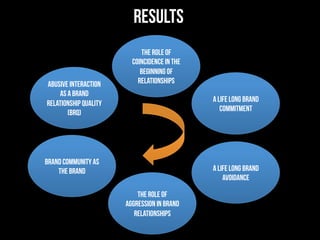
results
The role of
coincidence in the
beginning of
relationships
A life long brand
avoidance
Abusive interaction
as a brand
relationship quality
(BRQ)
The role of
aggression in brand
relationships
Brand community as
the brand
A life long brand
commitment
The role of coincidence in the beginning of
relationships
“I was in the army doing my military service at the time. Our
leisure time committee arranged tickets and trips to
different kinds of events. They had got discounted tickets
from IFK, but not from “Jokers”. The owner of Jokers had not
agreed on discounted ticket prices. So, I went to my first
hockey game and got hooked with IFK right away.”
(Henry, 39 years)
A life long brand commitment
“I chose my team when I was 7 years of age. That is something you
won’t change. You may have many women in your life, but you’ll only
have one team.”
(Tom, 33)
A life long brand avoidance
”I did not hate Jokers at the time, because the were not successful.
In the eighties they always among the two bottom teams in the
table. I hated Tappara (team from a city of Tampere), they won
many championships at the time. I said my mother no to a trip to
Tampere amusement park only, because Tappara was from
Tampere.”
(Brad, 39)
“Their (IFK fans) attitude pissed me off. They thought they were our
older brother, and that they were better people than we were.”
(Ridge, 55)
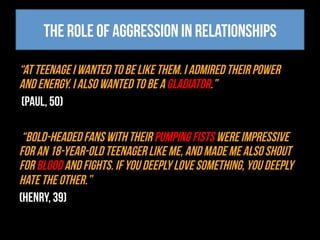
The role of aggression in relationships
“At teenage I wanted to be like them. I admired their power
and energy. I also wanted to be a gladiator.”
(Paul, 50)
“Bold-headed fans with their pumping fists were impressive
for an 18-year-old teenager like me, and made me also shout
for blood and fights. If you deeply love something, you deeply
hate the other.”
(Henry, 39)
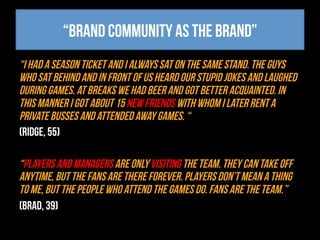
“Brand community as the brand”
“I had a season ticket and I always sat on the same stand. The guys
who sat behind and in front of us heard our stupid jokes and laughed
during games. At breaks we had beer and got better acquainted. In
this manner I got about 15 new friends with whom I later rent a
private busses and attended away games. “
(Ridge, 55)
“Players and managers are only visiting the team. They can take off
anytime, but the fans are there forever. Players don’t mean a thing
to me, but the people who attend the games do. Fans are the team.”
(Brad, 39)
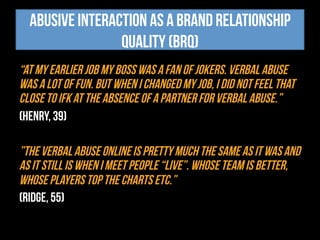
Abusive interaction as a brand relationship
quality (BRQ)
“At my earlier job my boss was a fan of Jokers. Verbal abuse
was a lot of fun. But when I changed my job, I did not feel that
close to IFK at the absence of a partner for verbal abuse.”
(Henry, 39)
”The verbal abuse online is pretty much the same as it was and
as it still is when I meet people “live”. Whose team is better,
whose players top the charts etc.”
(Ridge, 55)
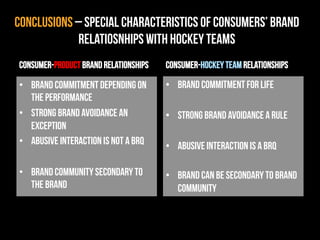
conclusions – special characteristics of consumers’ brand
relatiosnhips with hockey teams
Consumer-product brand Relationships
•  brand commitment depending on
the performance
•  Strong brand avoidance an
exception
•  abusive interaction is not a BRQ
•  brand community secondary to
the brand
Consumer-hockey team Relationships
•  brand commitment for life
•  strong brand avoidance a rule
•  abusive interaction is a brq
•  brand can be secondary to brand
community

CHARACTERISTICS OF CONSUMERS’ BRAND RELATIONSHIPS WITH HOCKEY TEAMS - COMMITTED RELATIONSHIPS FOR LIFE

  • 1.
    CHARACTERISTICS OF CONSUMERS’BRAND RELATIONSHIPS WITH HOCKEY TEAMS - COMMITTED RELATIONSHIPS FOR LIFE
  • 2.
    purpose to explore andunderstand the special characteristics of consumers’ brand relationships with sport teams in the context of ice hockey.
  • 3.
    methodology data collection: 10in-depth interviews, in which male participants (29-55 years of age) were asked to tell their “life story” with their favourite hockey team. Data analysis: Thompson’s (1997) hermeneutic framework for interpreting consumer stories. intratext part, the researcher aims to make as sense of the whole / understanding of the consumption meanings. intertextual stage the researcher looks for similarities and differences across the stories of different consumers.
  • 4.
    theoretical lens Fournier 1998Brand Relationship Quality (BRQ) model: “love and passion” “self-connection” “commitment” “interdependence” “intimacy” “brand partner quality” kim & trail 2011 (an adaptation to sport team relationships): “trust” “commitment” “intimacy” “self-connection” “reciprocity
  • 5.
    results The role of coincidencein the beginning of relationships A life long brand avoidance Abusive interaction as a brand relationship quality (BRQ) The role of aggression in brand relationships Brand community as the brand A life long brand commitment
  • 6.
    The role ofcoincidence in the beginning of relationships “I was in the army doing my military service at the time. Our leisure time committee arranged tickets and trips to different kinds of events. They had got discounted tickets from IFK, but not from “Jokers”. The owner of Jokers had not agreed on discounted ticket prices. So, I went to my first hockey game and got hooked with IFK right away.” (Henry, 39 years)
  • 7.
    A life longbrand commitment “I chose my team when I was 7 years of age. That is something you won’t change. You may have many women in your life, but you’ll only have one team.” (Tom, 33)
  • 8.
    A life longbrand avoidance ”I did not hate Jokers at the time, because the were not successful. In the eighties they always among the two bottom teams in the table. I hated Tappara (team from a city of Tampere), they won many championships at the time. I said my mother no to a trip to Tampere amusement park only, because Tappara was from Tampere.” (Brad, 39) “Their (IFK fans) attitude pissed me off. They thought they were our older brother, and that they were better people than we were.” (Ridge, 55)
  • 9.
    The role ofaggression in relationships “At teenage I wanted to be like them. I admired their power and energy. I also wanted to be a gladiator.” (Paul, 50) “Bold-headed fans with their pumping fists were impressive for an 18-year-old teenager like me, and made me also shout for blood and fights. If you deeply love something, you deeply hate the other.” (Henry, 39)
  • 10.
    “Brand community asthe brand” “I had a season ticket and I always sat on the same stand. The guys who sat behind and in front of us heard our stupid jokes and laughed during games. At breaks we had beer and got better acquainted. In this manner I got about 15 new friends with whom I later rent a private busses and attended away games. “ (Ridge, 55) “Players and managers are only visiting the team. They can take off anytime, but the fans are there forever. Players don’t mean a thing to me, but the people who attend the games do. Fans are the team.” (Brad, 39)
  • 11.
    Abusive interaction asa brand relationship quality (BRQ) “At my earlier job my boss was a fan of Jokers. Verbal abuse was a lot of fun. But when I changed my job, I did not feel that close to IFK at the absence of a partner for verbal abuse.” (Henry, 39) ”The verbal abuse online is pretty much the same as it was and as it still is when I meet people “live”. Whose team is better, whose players top the charts etc.” (Ridge, 55)
  • 12.
    conclusions – specialcharacteristics of consumers’ brand relatiosnhips with hockey teams Consumer-product brand Relationships •  brand commitment depending on the performance •  Strong brand avoidance an exception •  abusive interaction is not a BRQ •  brand community secondary to the brand Consumer-hockey team Relationships •  brand commitment for life •  strong brand avoidance a rule •  abusive interaction is a brq •  brand can be secondary to brand community