BRANDING DECISIONS
-SUBMITTED BY
DIKSHA VASHISHTH
WE WILL LEARN:
WHAT DOES A BRAND REPRESENT?
WHAT IS BRANDING?
WHAT ARE THE MAJOR BRANDING DECISIONS?
CONCLUSION
WHAT DOES A BRAND REPRESENT?
Company’s promise to deliver a specific set of:
features,
benefits,
services and
experiences consistently to buyers.
Brand should rather be understood as a set of perceptions a consumer has about the products
of a particular firm. Therefore, all branding decisions focus on the consumer.
BRANDING…
Branding is a combination of tangible and intangible attributes symbolized in a
trademark, which, if properly managed, creates influence and generates value. Brands
are a means of differentiating a company’s products and services from those of its
competitors. There is plenty of evidence to prove that customers will pay a substantial
price premium for a good brand and remain loyal to that brand. It is important,
therefore, to understand what brands are and why they are important.
MAJOR BRANDING DECISION
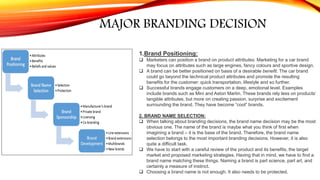
1.Brand Positioning:
 Marketers can position a brand on product attributes. Marketing for a car brand
may focus on attributes such as large engines, fancy colours and sportive design.
 A brand can be better positioned on basis of a desirable benefit. The car brand
could go beyond the technical product attributes and promote the resulting
benefits for the customer: quick transportation, lifestyle and so further.
 Successful brands engage customers on a deep, emotional level. Examples
include brands such as Mini and Aston Martin. These brands rely less on products’
tangible attributes, but more on creating passion, surprise and excitement
surrounding the brand. They have become “cool” brands.
2. BRAND NAME SELECTION:
 When talking about branding decisions, the brand name decision may be the most
obvious one. The name of the brand is maybe what you think of first when
imagining a brand – it is the base of the brand. Therefore, the brand name
selection belongs to the most important branding decisions. However, it is also
quite a difficult task.
 We have to start with a careful review of the product and its benefits, the target
market and proposed marketing strategies. Having that in mind, we have to find a
brand name matching these things. Naming a brand is part science, part art, and
certainly a measure of instinct.
 Choosing a brand name is not enough. It also needs to be protected.
MAJOR BRANDING DECISION
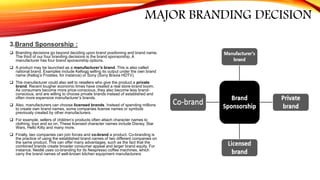
3.Brand Sponsorship :
 Branding decisions go beyond deciding upon brand positioning and brand name.
The third of our four branding decisions is the brand sponsorship. A
manufacturer has four brand sponsorship options.
 A product may be launched as a manufacturer’s brand. This is also called
national brand. Examples include Kellogg selling its output under the own brand
name (Kellog’s Frosties, for instance) or Sony (Sony Bravia HDTV).
 The manufacturer could also sell to resellers who give the product a private
brand. Recent tougher economic times have created a real store-brand boom.
As consumers become more price-conscious, they also become less brand-
conscious, and are willing to choose private brands instead of established and
often more expensive manufacturer’s brands.
 Also, manufacturers can choose licensed brands. Instead of spending millions
to create own brand names, some companies license names or symbols
previously created by other manufacturers.
 For example, sellers of children’s products often attach character names to
clothing, toys and so on. These licensed character names include Disney, Star
Wars, Hello Kitty and many more.
 Finally, two companies can join forces and co-brand a product. Co-branding is
the practice of using the established brand names of two different companies on
the same product. This can offer many advantages, such as the fact that the
combined brands create broader consumer appeal and larger brand equity. For
instance, Nestlé uses co-branding for its Nespresso coffee machines, which
carry the brand names of well-known kitchen equipment manufacturers
CONTINUED…
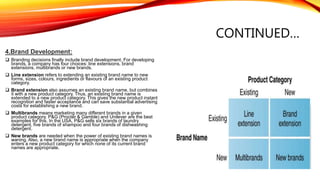
4.Brand Development:
 Branding decisions finally include brand development. For developing
brands, a company has four choices: line extensions, brand
extensions, multibrands or new brands.
 Line extension refers to extending an existing brand name to new
forms, sizes, colours, ingredients or flavours of an existing product
category.
 Brand extension also assumes an existing brand name, but combines
it with a new product category. Thus, an existing brand name is
extended to a new product category. This gives the new product instant
recognition and faster acceptance and can save substantial advertising
costs for establishing a new brand.
 Multibrands means marketing many different brands in a given
product category. P&G (Procter & Gamble) and Unilever are the best
examples for this. In the USA, P&G sells six brands of laundry
detergent, five brands of shampoo and four brands of dishwashing
detergent.
 New brands are needed when the power of existing brand names is
waning. Also, a new brand name is appropriate when the company
enters a new product category for which none of its current brand
names are appropriate.
CONCLUSION
As you might have recognised, these four branding
decisions are all interrelated. In order to build strong
brands, brand positioning, brand name, brand
sponsorship and brand development have to be in line
with each other.

Branding decisions

  • 1.
  • 2.
    WE WILL LEARN: WHATDOES A BRAND REPRESENT? WHAT IS BRANDING? WHAT ARE THE MAJOR BRANDING DECISIONS? CONCLUSION
  • 3.
    WHAT DOES ABRAND REPRESENT? Company’s promise to deliver a specific set of: features, benefits, services and experiences consistently to buyers. Brand should rather be understood as a set of perceptions a consumer has about the products of a particular firm. Therefore, all branding decisions focus on the consumer.
  • 4.
    BRANDING… Branding is acombination of tangible and intangible attributes symbolized in a trademark, which, if properly managed, creates influence and generates value. Brands are a means of differentiating a company’s products and services from those of its competitors. There is plenty of evidence to prove that customers will pay a substantial price premium for a good brand and remain loyal to that brand. It is important, therefore, to understand what brands are and why they are important.
  • 5.
    MAJOR BRANDING DECISION 1.BrandPositioning:  Marketers can position a brand on product attributes. Marketing for a car brand may focus on attributes such as large engines, fancy colours and sportive design.  A brand can be better positioned on basis of a desirable benefit. The car brand could go beyond the technical product attributes and promote the resulting benefits for the customer: quick transportation, lifestyle and so further.  Successful brands engage customers on a deep, emotional level. Examples include brands such as Mini and Aston Martin. These brands rely less on products’ tangible attributes, but more on creating passion, surprise and excitement surrounding the brand. They have become “cool” brands. 2. BRAND NAME SELECTION:  When talking about branding decisions, the brand name decision may be the most obvious one. The name of the brand is maybe what you think of first when imagining a brand – it is the base of the brand. Therefore, the brand name selection belongs to the most important branding decisions. However, it is also quite a difficult task.  We have to start with a careful review of the product and its benefits, the target market and proposed marketing strategies. Having that in mind, we have to find a brand name matching these things. Naming a brand is part science, part art, and certainly a measure of instinct.  Choosing a brand name is not enough. It also needs to be protected.
  • 6.
    MAJOR BRANDING DECISION 3.BrandSponsorship :  Branding decisions go beyond deciding upon brand positioning and brand name. The third of our four branding decisions is the brand sponsorship. A manufacturer has four brand sponsorship options.  A product may be launched as a manufacturer’s brand. This is also called national brand. Examples include Kellogg selling its output under the own brand name (Kellog’s Frosties, for instance) or Sony (Sony Bravia HDTV).  The manufacturer could also sell to resellers who give the product a private brand. Recent tougher economic times have created a real store-brand boom. As consumers become more price-conscious, they also become less brand- conscious, and are willing to choose private brands instead of established and often more expensive manufacturer’s brands.  Also, manufacturers can choose licensed brands. Instead of spending millions to create own brand names, some companies license names or symbols previously created by other manufacturers.  For example, sellers of children’s products often attach character names to clothing, toys and so on. These licensed character names include Disney, Star Wars, Hello Kitty and many more.  Finally, two companies can join forces and co-brand a product. Co-branding is the practice of using the established brand names of two different companies on the same product. This can offer many advantages, such as the fact that the combined brands create broader consumer appeal and larger brand equity. For instance, Nestlé uses co-branding for its Nespresso coffee machines, which carry the brand names of well-known kitchen equipment manufacturers
  • 7.
    CONTINUED… 4.Brand Development:  Brandingdecisions finally include brand development. For developing brands, a company has four choices: line extensions, brand extensions, multibrands or new brands.  Line extension refers to extending an existing brand name to new forms, sizes, colours, ingredients or flavours of an existing product category.  Brand extension also assumes an existing brand name, but combines it with a new product category. Thus, an existing brand name is extended to a new product category. This gives the new product instant recognition and faster acceptance and can save substantial advertising costs for establishing a new brand.  Multibrands means marketing many different brands in a given product category. P&G (Procter & Gamble) and Unilever are the best examples for this. In the USA, P&G sells six brands of laundry detergent, five brands of shampoo and four brands of dishwashing detergent.  New brands are needed when the power of existing brand names is waning. Also, a new brand name is appropriate when the company enters a new product category for which none of its current brand names are appropriate.
  • 8.
    CONCLUSION As you mighthave recognised, these four branding decisions are all interrelated. In order to build strong brands, brand positioning, brand name, brand sponsorship and brand development have to be in line with each other.