Brain Structures and their Functions
The nervous system is your body's decision and communication center. The central
nervous system (CNS) is made of the brain and the spinal cord and the peripheral nervous
system (PNS) is made of nerves. Together they control every part of your daily life, from
breathing and blinking to helping you memorize facts for a test. Nerves reach from your
brain to your face, ears, eyes, nose, and spinal cord... and from the spinal cord to the rest
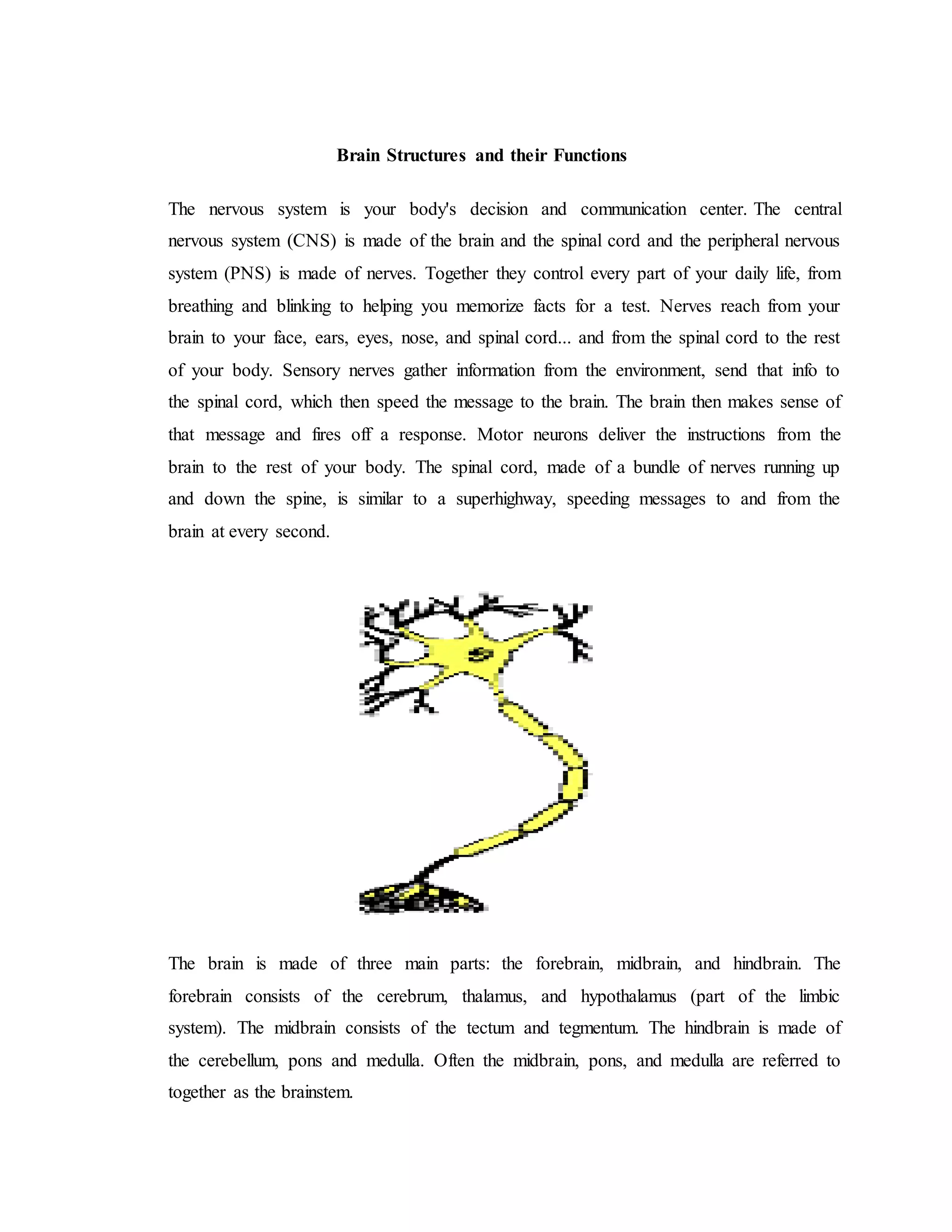
of your body. Sensory nerves gather information from the environment, send that info to
the spinal cord, which then speed the message to the brain. The brain then makes sense of
that message and fires off a response. Motor neurons deliver the instructions from the
brain to the rest of your body. The spinal cord, made of a bundle of nerves running up
and down the spine, is similar to a superhighway, speeding messages to and from the
brain at every second.
The brain is made of three main parts: the forebrain, midbrain, and hindbrain. The
forebrain consists of the cerebrum, thalamus, and hypothalamus (part of the limbic
system). The midbrain consists of the tectum and tegmentum. The hindbrain is made of
the cerebellum, pons and medulla. Often the midbrain, pons, and medulla are referred to
together as the brainstem.
Parts of the brain and functions
1. Cerebral Cortex
The outermost layer of the cerebral hemisphere which is
composed of gray matter. Cortices are asymmetrical. Both
hemispheres are able to analyze sensory data, perform
memory functions, learn new information, form thoughts and
make decisions.
2. Left Hemisphere
Sequential Analysis: systematic, logical interpretation of
information. Interpretation and production of symbolic
information language, mathematics, abstraction and reasoning.
Memory stored in a language format.
3. Right hemisphere
Holistic Functioning: processing multi-sensory input
simultaneously to provide "holistic" picture of one's
environment. Visual spatial skills. Holistic functions such as
dancing and gymnastics are coordinated by the right
hemisphere. Memory is stored in auditory, visual and spatial
modalities.
4. Corpus Collosum
communication between the two hemispheres
5. Frontal Lobe
Cognition and memory. Prefrontal area: The ability to
concentrate and attend, elaboration of thought. The
"Gatekeeper"; (judgment, inhibition). Personality and emotional
traits. Motor Cortex (Brodman's): voluntary motor activity.
Premotor Cortex: storage of motor patterns and voluntary
activities. Language: motor speech
6. Parietal Lobe
Processing of sensory input. Body orientation (proprioception)
7. Occipital Lobe
Primary visual reception and association
8. Temporal Lobe
Auditory reception and interpretation, expressed behavior,
receptive speech, information retrieval
9. Limbic System
Olfactory path ways, biologic rhythms, hypothalamus
10. Basal Ganglia
Subcortical gray matter nuclei. Processing link between
thalamus and motor cortex. Initiation and direction of voluntary
movement. Balance (inhibitory), Postural reflexes. Automatic
movement
11. Amygdala
Neural centers in the limbic system linked to emotion
12. Hippocampus
A structure in the limbic system linked to memory
13. Thalamus
Relays messages between lower brain centers and cerebral
cortex
14. Hypothalamus
Controls maintenance functions such as eating; helps govern
endocrine system; linked to emotion and reward
15. Pituitary gland
Master endocrine gland
16. Reticular formation
Helps control arousal
17. Medulla
Controls heartbeat and breathing
18. Spinal cord
Pathway for neural fibers traveling to and from the brain;
controls simple relfexes
19. cerebellum
Coordinates voluntary movement and balance
20. Pons
Relays information between the cerebrum and the cerebellum,
controls arousal and regulates respiration

Brain structures and their functions

  • 1.
    Brain Structures andtheir Functions The nervous system is your body's decision and communication center. The central nervous system (CNS) is made of the brain and the spinal cord and the peripheral nervous system (PNS) is made of nerves. Together they control every part of your daily life, from breathing and blinking to helping you memorize facts for a test. Nerves reach from your brain to your face, ears, eyes, nose, and spinal cord... and from the spinal cord to the rest of your body. Sensory nerves gather information from the environment, send that info to the spinal cord, which then speed the message to the brain. The brain then makes sense of that message and fires off a response. Motor neurons deliver the instructions from the brain to the rest of your body. The spinal cord, made of a bundle of nerves running up and down the spine, is similar to a superhighway, speeding messages to and from the brain at every second. The brain is made of three main parts: the forebrain, midbrain, and hindbrain. The forebrain consists of the cerebrum, thalamus, and hypothalamus (part of the limbic system). The midbrain consists of the tectum and tegmentum. The hindbrain is made of the cerebellum, pons and medulla. Often the midbrain, pons, and medulla are referred to together as the brainstem.
  • 2.
    Parts of thebrain and functions 1. Cerebral Cortex The outermost layer of the cerebral hemisphere which is composed of gray matter. Cortices are asymmetrical. Both hemispheres are able to analyze sensory data, perform memory functions, learn new information, form thoughts and make decisions. 2. Left Hemisphere Sequential Analysis: systematic, logical interpretation of information. Interpretation and production of symbolic information language, mathematics, abstraction and reasoning. Memory stored in a language format. 3. Right hemisphere Holistic Functioning: processing multi-sensory input simultaneously to provide "holistic" picture of one's environment. Visual spatial skills. Holistic functions such as dancing and gymnastics are coordinated by the right hemisphere. Memory is stored in auditory, visual and spatial modalities. 4. Corpus Collosum communication between the two hemispheres 5. Frontal Lobe Cognition and memory. Prefrontal area: The ability to concentrate and attend, elaboration of thought. The "Gatekeeper"; (judgment, inhibition). Personality and emotional traits. Motor Cortex (Brodman's): voluntary motor activity. Premotor Cortex: storage of motor patterns and voluntary activities. Language: motor speech 6. Parietal Lobe Processing of sensory input. Body orientation (proprioception)
  • 3.
    7. Occipital Lobe Primaryvisual reception and association 8. Temporal Lobe Auditory reception and interpretation, expressed behavior, receptive speech, information retrieval 9. Limbic System Olfactory path ways, biologic rhythms, hypothalamus 10. Basal Ganglia Subcortical gray matter nuclei. Processing link between thalamus and motor cortex. Initiation and direction of voluntary movement. Balance (inhibitory), Postural reflexes. Automatic movement 11. Amygdala Neural centers in the limbic system linked to emotion 12. Hippocampus A structure in the limbic system linked to memory 13. Thalamus Relays messages between lower brain centers and cerebral cortex 14. Hypothalamus Controls maintenance functions such as eating; helps govern endocrine system; linked to emotion and reward 15. Pituitary gland Master endocrine gland 16. Reticular formation Helps control arousal 17. Medulla Controls heartbeat and breathing 18. Spinal cord Pathway for neural fibers traveling to and from the brain; controls simple relfexes
  • 4.
    19. cerebellum Coordinates voluntarymovement and balance 20. Pons Relays information between the cerebrum and the cerebellum, controls arousal and regulates respiration