
![interference devices (SQUIDs). These measurements are commonly used in both
research and clinical settings. There are many uses for the MEG, including assisting
surgeons in localizing pathology, assisting researchers in determining the function of
various parts of the brain, neuro-feedback, and others.
3.4.Method
Scalp EEG, the recording is obtained by placing electrodes on the scalp. Each electrode
is connected to one input of a differential amplifier and a common system reference
electrode is connected to the other input of each differential amplifier.
These amplifiers amplify the voltage between the active electrode and the reference
(typically 1,000–100,000 times, or 60–100 dB of voltage gain). A typical adult human
EEG signal is about 10µV to 100 µV in amplitude when measured from the scalp [2]
and is about 10–20 mV when measured from subdural electrodes.
In digital EEG systems, the amplified signal is digitized via an analog-to-digital
converter, after being passed through an anti-aliasing filter.
Since an EEG voltage signal represents a difference between the voltages at two
electrodes, the display of the EEG for the reading encephalographer may be set up in one
of several ways.](https://image.slidesharecdn.com/seminarreportbfp-091005074541-phpapp02/85/Brain-Finger-Printing-9-320.jpg)
![The P300 signal is an aggregate recording from a great many neurons. Although
typically non-invasive, parts of the signal may be sampled more directly from certain
brain regions via electrode (hence, the medial temporal P300 or MTL-P300). This
methodology allows for isolation and local recording of one area without the noise from
other signals acquired through scalp electrodes [4]. In practice, the P300 waveform must
be evoked using a stimulus delivered by one of the sensory modalities. One typical
procedure is the 'oddball' paradigm, whereby a target stimulus is presented amongst
more frequent standard background stimuli. A distracter stimulus may also be used to
ensure that the response is due to the target rather than the change from a background
pattern. The classic oddball paradigm has seen many variations, but in the end most
protocols used to evoke the P300 involve some form of conscious realization or decision
making. Attention is required for such protocols. No subjects have been noted to have
fine control over their P300.
5. The Role of Brain Fingerprinting in Criminal Proceedings
The application of Brain Fingerprinting testing in a criminal case involves four phases:
investigation, interview, scientific testing, and adjudication. Of these four phases, only the
third one is in the domain of science. The first phase is undertaken by a skilled investigator,
the second by an interviewer who may be an investigator or a scientist, the third by a
scientist, and the fourth by a judge and jury.](https://image.slidesharecdn.com/seminarreportbfp-091005074541-phpapp02/85/Brain-Finger-Printing-11-320.jpg)














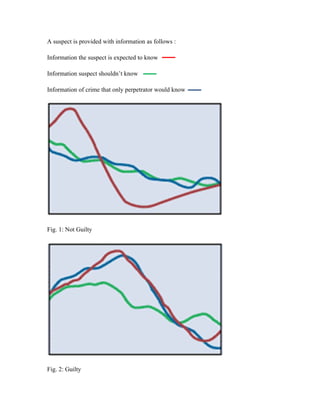
This document provides an overview of brain fingerprinting, including: 1. It describes brain fingerprinting as a technique that uses EEG to measure brain responses to relevant and irrelevant stimuli to determine if information about a crime is stored in a subject's brain. 2. The technique involves presenting subjects with targets they know, probes relevant to a crime they may know about, and irrelevant stimuli while measuring EEG responses like the P300 wave. 3. It discusses the role of brain fingerprinting in criminal investigations, which involves phases of investigation to identify relevant probes, interviewing the subject, conducting the scientific brain fingerprinting test, and adjudication of guilt or innocence.


