NARCOANALYSIS
Narcoanalysis
 The term Narcoanalysis is derived from
Greek word Narkco (meaning anesthetic)
 The term Narcoanalysis was coined by Hoeselley. The first
reported use in 1922
 It is also known as the truth serum test / drug hypnosis.
 Narcoanalysis is a part of Criminal Psychology and Forensic Science.
In Narcoanalysis test the subject’s imagination is neutralized by
making him semi - conscious. In this state, it becomes difficult for
him to lie.
Father of truth serum :- Robert Ernest
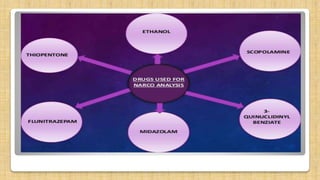
Drug
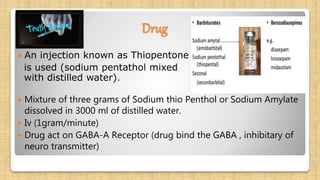
 An injection known as Thiopentone
is used (sodium pentathol mixed
with distilled water).
 Mixture of three grams of Sodium thio Penthol or Sodium Amylate
dissolved in 3000 ml of distilled water.
 Iv (1gram/minute)
 Drug act on GABA-A Receptor (drug bind the GABA , inhibitary of
neuro transmitter)
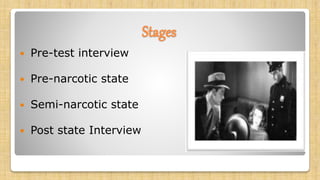
Stages
 Pre-test interview
 Pre-narcotic state
 Semi-narcotic state
 Post state Interview
Pre-test interview :-
In this stage, individual has given all the
test and procedure of the test and then consent
taken.
 Pre-narcotic state :-
Anesthetic induced drug and maintain
the Pre-narcotic and relax the person.
Semi-narcotic state:- After establishing this state,
the individuals appear to be-
 Flushed.
 Slow and Slurred speech
 Nystagmus observing by testing examinee’s eye, muscle, and finger.
 Finally interview is facilitated.
 Individual allow to sleep off and allow to wake up.
 Anesthetic checkup of body.
Post state Interview :- This is the stage where the subject
become free from interview, anxiety free ,memory check.
Team
In India , the narco analysis test is done by a team
comprising of an
 Anesthesiologist
 Psychiatrist
 Clinical forensic psychologist
 Audio –videographer
 Nursing staff
 Writer
Guidelines of Supreme Court, NHRC 2000
 The consent in presence of magistrate.
 Test should be administered except on the basis of consent of
the accused. If the accused volunteers for a test, he should be
should be given access to lawyer & the physical, emotional and
legal implications should be explained to him.
 During the hearing before the magistrate, the person alleged to
have agreed should be duly represented by a lawyer.
 The Magistrate shall consider all factors relating to the detention
including the length of detention and nature of interrogation.
 The actual recording of test shall be done by an independent
agency.
 A full medical and factual narration of the manner of the
information received must be taken on record.
Evidentiary value in court
 Section 45 of Indian Evidence Act, 1872 does allow experts opinions
in certain cases.
 A Narco-analysis test report has some validity but is not totally
admissible in court, which considers the circumstances under which
it was obtained and assessed its admissibility, can be collaborated
with other evidence or to support other evidence
legal aspects
 The constitution of India Article 20(3) , no individual might be a
witness against himself.
 Article 21, No person shall be deprived of his life or personal
liberty except according to procedures established by law.
 Section 25 of IEA, 1872 says, the confession made by a person
under police custody could not be admitted as evidence.
 Section 161(2) CrPC , Such person shall be bound to answer truly
all questions relating to such case put to him by such officer, other
than questions the answers to which would have a tendency to
expose him to a criminal charge or to a penalty or forfeiture.
Advantages
 Used as an interrogative technique by investigation agencies.
 Under the influence of the test the capacity of imagination is
blocked by leading the person into a semi conscious state they
cannot lie.
 Used in case of terrorism.
 Crimes that are well organized, serial killing.
 In cases where no evidence is available.
 96-97% success rate
Disadvantages :-
 The wrong measurement of synthetic may prompt a state extreme
lethargies or even passing of the individual.
 If the individual is medicate depending one on the other hand, the
procedure isn’t as much fruitful as required for gathering evidence.
NARCO ANALYSIS IN INDIA
 Narco analysis  Nacro interview for the purpose of
interview is conducted in forensic laboratory where facility
of minor operation threater is available.
 In India , at Bangalore & Gujrat test is conducted
CASES
 It was Ist used in 2002, in Godhra case.
 Recently
 Arushi Talwar Murder Case.
 Telgi Scam of Stamps.
Narco analysis Technique

Narco analysis Technique

  • 1.
  • 2.
    Narcoanalysis  The termNarcoanalysis is derived from Greek word Narkco (meaning anesthetic)  The term Narcoanalysis was coined by Hoeselley. The first reported use in 1922  It is also known as the truth serum test / drug hypnosis.  Narcoanalysis is a part of Criminal Psychology and Forensic Science. In Narcoanalysis test the subject’s imagination is neutralized by making him semi - conscious. In this state, it becomes difficult for him to lie. Father of truth serum :- Robert Ernest
  • 3.
    Drug  An injectionknown as Thiopentone is used (sodium pentathol mixed with distilled water).  Mixture of three grams of Sodium thio Penthol or Sodium Amylate dissolved in 3000 ml of distilled water.  Iv (1gram/minute)  Drug act on GABA-A Receptor (drug bind the GABA , inhibitary of neuro transmitter)
  • 5.
    Stages  Pre-test interview Pre-narcotic state  Semi-narcotic state  Post state Interview
  • 6.
    Pre-test interview :- Inthis stage, individual has given all the test and procedure of the test and then consent taken.  Pre-narcotic state :- Anesthetic induced drug and maintain the Pre-narcotic and relax the person.
  • 7.
    Semi-narcotic state:- Afterestablishing this state, the individuals appear to be-  Flushed.  Slow and Slurred speech  Nystagmus observing by testing examinee’s eye, muscle, and finger.  Finally interview is facilitated.  Individual allow to sleep off and allow to wake up.  Anesthetic checkup of body. Post state Interview :- This is the stage where the subject become free from interview, anxiety free ,memory check.
  • 8.
    Team In India ,the narco analysis test is done by a team comprising of an  Anesthesiologist  Psychiatrist  Clinical forensic psychologist  Audio –videographer  Nursing staff  Writer
  • 9.
    Guidelines of SupremeCourt, NHRC 2000  The consent in presence of magistrate.  Test should be administered except on the basis of consent of the accused. If the accused volunteers for a test, he should be should be given access to lawyer & the physical, emotional and legal implications should be explained to him.  During the hearing before the magistrate, the person alleged to have agreed should be duly represented by a lawyer.  The Magistrate shall consider all factors relating to the detention including the length of detention and nature of interrogation.  The actual recording of test shall be done by an independent agency.  A full medical and factual narration of the manner of the information received must be taken on record.
  • 10.
    Evidentiary value incourt  Section 45 of Indian Evidence Act, 1872 does allow experts opinions in certain cases.  A Narco-analysis test report has some validity but is not totally admissible in court, which considers the circumstances under which it was obtained and assessed its admissibility, can be collaborated with other evidence or to support other evidence
  • 11.
    legal aspects  Theconstitution of India Article 20(3) , no individual might be a witness against himself.  Article 21, No person shall be deprived of his life or personal liberty except according to procedures established by law.  Section 25 of IEA, 1872 says, the confession made by a person under police custody could not be admitted as evidence.  Section 161(2) CrPC , Such person shall be bound to answer truly all questions relating to such case put to him by such officer, other than questions the answers to which would have a tendency to expose him to a criminal charge or to a penalty or forfeiture.
  • 12.
    Advantages  Used asan interrogative technique by investigation agencies.  Under the influence of the test the capacity of imagination is blocked by leading the person into a semi conscious state they cannot lie.  Used in case of terrorism.  Crimes that are well organized, serial killing.  In cases where no evidence is available.  96-97% success rate
  • 13.
    Disadvantages :-  Thewrong measurement of synthetic may prompt a state extreme lethargies or even passing of the individual.  If the individual is medicate depending one on the other hand, the procedure isn’t as much fruitful as required for gathering evidence.
  • 14.
    NARCO ANALYSIS ININDIA  Narco analysis Nacro interview for the purpose of interview is conducted in forensic laboratory where facility of minor operation threater is available.  In India , at Bangalore & Gujrat test is conducted
  • 15.
    CASES  It wasIst used in 2002, in Godhra case.  Recently  Arushi Talwar Murder Case.  Telgi Scam of Stamps.

Editor's Notes

  • #3 This is the question that your experiment answers
  • #4 Summarize your research in three to five points.
  • #6 Establish hypothesis before you begin the experiment. This should be your best educated guess based on your research.