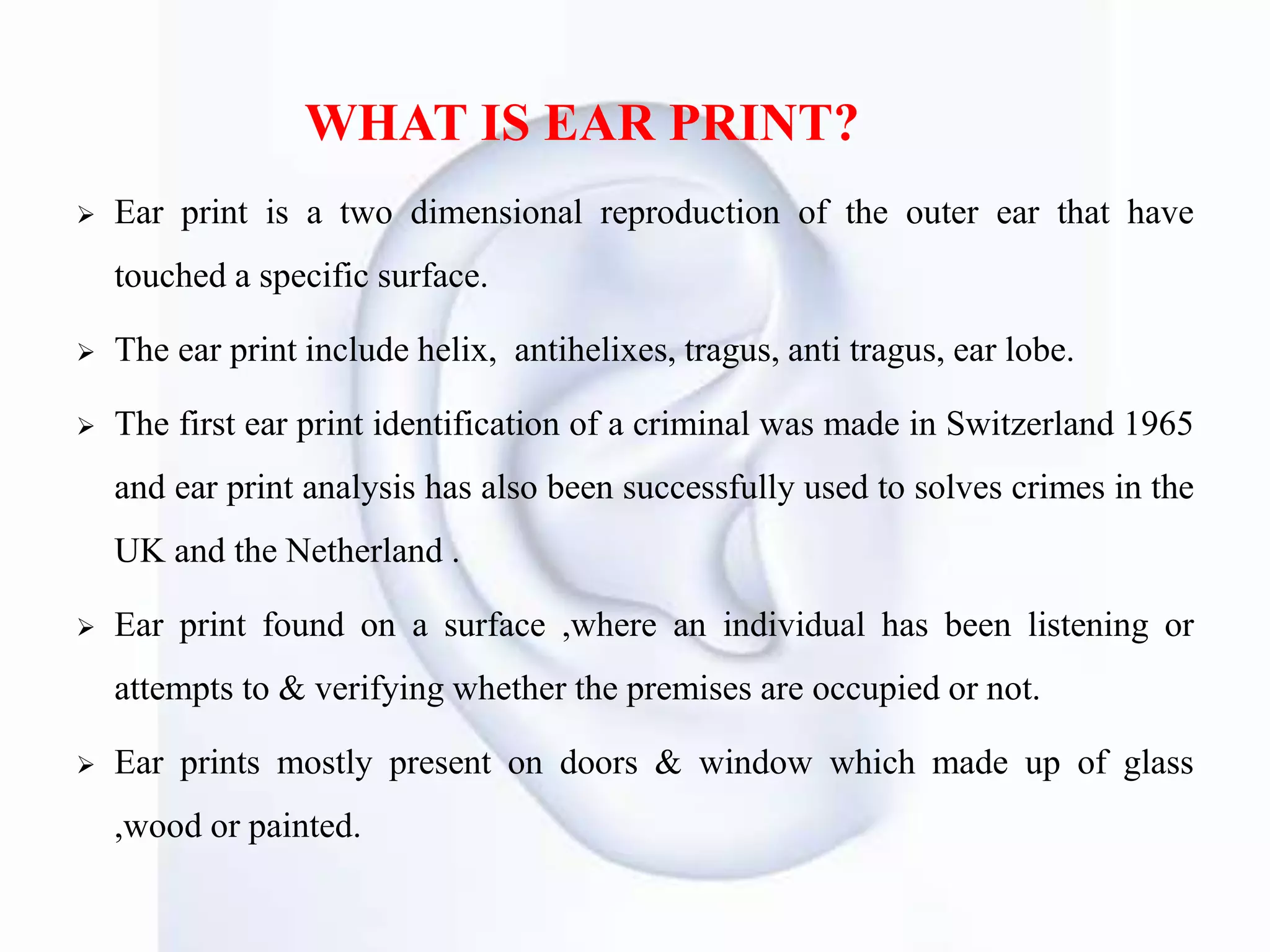
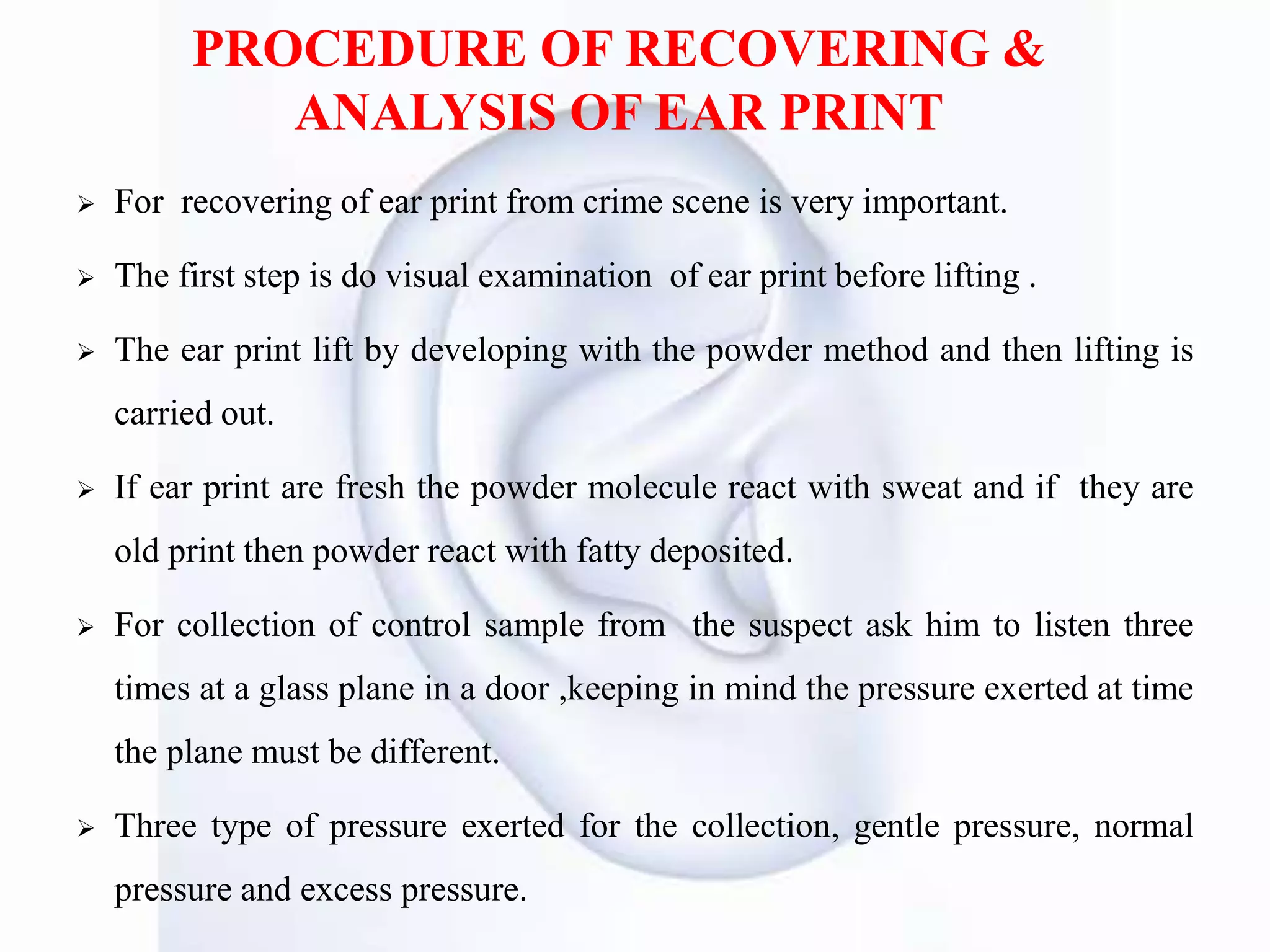
This document discusses ear prints and their use in criminal identification and solving crimes. It provides details on ear anatomy and development. Ear prints are 2D impressions of the outer ear that can be left on surfaces. The first successful ear print identification of a criminal was in 1965 in Switzerland. The document then describes a 1983 murder case in Brno, Czech Republic where the murderer was identified through an ear print left on the victim's front door. Jan Holub was convicted based on a match between the ear print from the crime scene and his ear print. His conviction was upheld, and he was executed in 1986.


![ANATOMY OF HUMAN EAR:
Human ear divided into three part :
1.] Outer ear
2.] Middle ear
3.] Inner ear
1.] OUTER EAR : The auricle or auricula is the visible part of the ear that
resides outside the head .Also called as the pinna.
2.] MIDDLE EAR : It include tympanic cavity and three ossicales. They are
called as Malleus, Incus, Stapes.
3.] INNER EAR : The inner ear sites the bony labyrinth & contains
structures which are key to several sense.](https://image.slidesharecdn.com/earprint-230301091742-fecd7d63/75/EAR-PRINT-pptx-3-2048.jpg)

![PROCEDURE OF COMPARISION
Comparison procedure divide into four steps :
1.] Analysis
2.] Analysis of control sample
3.] Preparation
4.] Comparison](https://image.slidesharecdn.com/earprint-230301091742-fecd7d63/75/EAR-PRINT-pptx-7-2048.jpg)


![ EVIDENCE:- There were several evidences police found at crime scene
,which were as follow,
Aurickle Print [Ear Print]
Knife with blood stain
Finger print
Glass containing finger print
Semen spots on body
Cigarette butt
Police got DNA from the blood and semen sample which matched with
DNA of Jan Holub.
The ear print which they found was also matched with Holub ear print.](https://image.slidesharecdn.com/earprint-230301091742-fecd7d63/75/EAR-PRINT-pptx-12-2048.jpg)
![ LEGAL OUTCOME:- First court gave judgement that he was mental
defect but the psychologist not found any mental disorder. It further ordered
that judgement was entered for plaintiff [Zdena Minarikova] against the
defendant [Jan Holub].For raped & murder of lady Brno Regional court
sentenced him to death. On the 10th April 1986 Jan Holub was executed.
REFLECTION:-The most interesting thing was just the Aurickle Print [Ear
Print].It was the first time in the Czech criminology history, when Brno
Regional Court had took the Aurickle Print [Ear Print]as evidence. And they
caught evidence criminal. And the case was solved.
BIBLIOGRAPHY:- -Jan Holub www.kriminalistika.eu](https://image.slidesharecdn.com/earprint-230301091742-fecd7d63/75/EAR-PRINT-pptx-13-2048.jpg)


