FORENSIC
HYPNOSIS
Presentation by: Shincy Nair
M.Phil. Forensic Psychology
GFSU, Gandhinagar
Contents
■ Introduction to hypnosis
■ Forensic hypnosis
■ Use and Aim of Forensic hypnosis
■ Methods and Procedures
■ Safeguards of Forensic hypnosis
■ Indian context
Hypnosis
■ James Braid, English physician coined the term ‘Hypnosis’
and tried to give scientific explanation for more acceptance
of this tool.
■ It is an altered state of consciousness characterized by relaxation,
a heightened responsiveness to suggestion and increase in
concentration i.e focused.(Goldenson, 1984)
■ Heightened state of consciousness is related to the
subconscious mind.
■ In Hypnosis brain switches to Alpha level (EEG), which is a
focused attention and aware of his surroundings.
■ Ultimately all hypnosis is a self hypnosis, subject’s
cooperation, imagination, and preconceived notions about
the hypnosis plays important role.
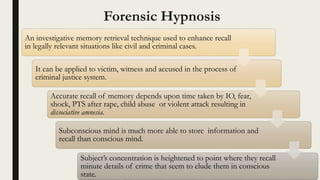
Forensic Hypnosis
An investigative memory retrieval technique used to enhance recall
in legally relevant situations like civil and criminal cases.
It can be applied to victim, witness and accused in the process of
criminal justice system.
Accurate recall of memory depends upon time taken by IO, fear,
shock, PTS after rape, child abuse or violent attack resulting in
dissociative amnesia.
Subconscious mind is much more able to store information and
recall than conscious mind.
Subject’s concentration is heightened to point where they recall
minute details of crime that seem to elude them in conscious
state.
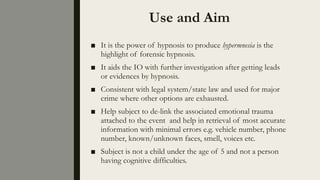
Use and Aim
■ It is the power of hypnosis to produce hypermnesia is the
highlight of forensic hypnosis.
■ It aids the IO with further investigation after getting leads
or evidences by hypnosis.
■ Consistent with legal system/state law and used for major
crime where other options are exhausted.
■ Help subject to de-link the associated emotional trauma
attached to the event and help in retrieval of most accurate
information with minimal errors e.g. vehicle number, phone
number, known/unknown faces, smell, voices etc.
■ Subject is not a child under the age of 5 and not a person
having cognitive difficulties.
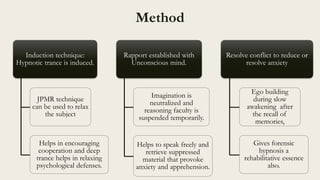
Method
Induction technique:
Hypnotic trance is induced.
JPMR technique
can be used to relax
the subject
Helps in encouraging
cooperation and deep
trance helps in relaxing
psychological defenses.
Rapport established with
Unconscious mind.
Imagination is
neutralized and
reasoning faculty is
suspended temporarily.
Helps to speak freely and
retrieve suppressed
material that provoke
anxiety and apprehension.
Resolve conflict to reduce or
resolve anxiety
Ego building
during slow
awakening after
the recall of
memories,
Gives forensic
hypnosis a
rehabilitative essence
also.
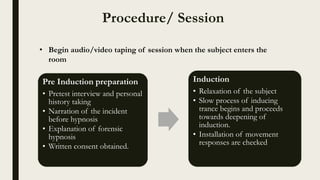
Procedure/ Session
Pre Induction preparation
• Pretest interview and personal
history taking
• Narration of the incident
before hypnosis
• Explanation of forensic
hypnosis
• Written consent obtained.
Induction
• Relaxation of the subject
• Slow process of inducing
trance begins and proceeds
towards deepening of
induction.
• Installation of movement
responses are checked
• Begin audio/video taping of session when the subject enters the
room
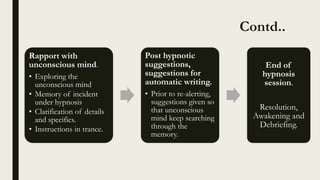
Contd..
Rapport with
unconscious mind.
• Exploring the
unconscious mind
• Memory of incident
under hypnosis
• Clarification of details
and specifics.
• Instructions in trance.
Post hypnotic
suggestions,
suggestions for
automatic writing.
• Prior to re-alerting,
suggestions given so
that unconscious
mind keep searching
through the
memory.
End of
hypnosis
session.
Resolution,
Awakening and
Debriefing.
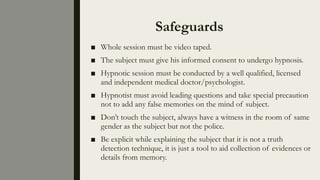
Safeguards
■ Whole session must be video taped.
■ The subject must give his informed consent to undergo hypnosis.
■ Hypnotic session must be conducted by a well qualified, licensed
and independent medical doctor/psychologist.
■ Hypnotist must avoid leading questions and take special precaution
not to add any false memories on the mind of subject.
■ Don’t touch the subject, always have a witness in the room of same
gender as the subject but not the police.
■ Be explicit while explaining the subject that it is not a truth
detection technique, it is just a tool to aid collection of evidences or
details from memory.
Indian Context
■ British Medical Association approved in 1955
■ American Medical Association approved in
1958
■ In India, Forensic hypnosis has not been used
in police investigation.
■ Indian Medical Association has not yet
recognized it inspite been used by doctors,
hypnotists and psychologists.
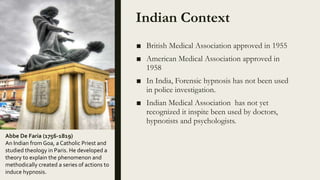
Abbe De Faria (1756-1819)
An Indian from Goa, a Catholic Priest and
studied theology in Paris. He developed a
theory to explain the phenomenon and
methodically created a series of actions to
induce hypnosis.
THANKYOU
shincyamin@gmail.com

Forensic hypnosis1

  • 1.
    FORENSIC HYPNOSIS Presentation by: ShincyNair M.Phil. Forensic Psychology GFSU, Gandhinagar
  • 2.
    Contents ■ Introduction tohypnosis ■ Forensic hypnosis ■ Use and Aim of Forensic hypnosis ■ Methods and Procedures ■ Safeguards of Forensic hypnosis ■ Indian context
  • 3.
    Hypnosis ■ James Braid,English physician coined the term ‘Hypnosis’ and tried to give scientific explanation for more acceptance of this tool. ■ It is an altered state of consciousness characterized by relaxation, a heightened responsiveness to suggestion and increase in concentration i.e focused.(Goldenson, 1984) ■ Heightened state of consciousness is related to the subconscious mind. ■ In Hypnosis brain switches to Alpha level (EEG), which is a focused attention and aware of his surroundings. ■ Ultimately all hypnosis is a self hypnosis, subject’s cooperation, imagination, and preconceived notions about the hypnosis plays important role.
  • 4.
    Forensic Hypnosis An investigativememory retrieval technique used to enhance recall in legally relevant situations like civil and criminal cases. It can be applied to victim, witness and accused in the process of criminal justice system. Accurate recall of memory depends upon time taken by IO, fear, shock, PTS after rape, child abuse or violent attack resulting in dissociative amnesia. Subconscious mind is much more able to store information and recall than conscious mind. Subject’s concentration is heightened to point where they recall minute details of crime that seem to elude them in conscious state.
  • 5.
    Use and Aim ■It is the power of hypnosis to produce hypermnesia is the highlight of forensic hypnosis. ■ It aids the IO with further investigation after getting leads or evidences by hypnosis. ■ Consistent with legal system/state law and used for major crime where other options are exhausted. ■ Help subject to de-link the associated emotional trauma attached to the event and help in retrieval of most accurate information with minimal errors e.g. vehicle number, phone number, known/unknown faces, smell, voices etc. ■ Subject is not a child under the age of 5 and not a person having cognitive difficulties.
  • 6.
    Method Induction technique: Hypnotic tranceis induced. JPMR technique can be used to relax the subject Helps in encouraging cooperation and deep trance helps in relaxing psychological defenses. Rapport established with Unconscious mind. Imagination is neutralized and reasoning faculty is suspended temporarily. Helps to speak freely and retrieve suppressed material that provoke anxiety and apprehension. Resolve conflict to reduce or resolve anxiety Ego building during slow awakening after the recall of memories, Gives forensic hypnosis a rehabilitative essence also.
  • 7.
    Procedure/ Session Pre Inductionpreparation • Pretest interview and personal history taking • Narration of the incident before hypnosis • Explanation of forensic hypnosis • Written consent obtained. Induction • Relaxation of the subject • Slow process of inducing trance begins and proceeds towards deepening of induction. • Installation of movement responses are checked • Begin audio/video taping of session when the subject enters the room
  • 8.
    Contd.. Rapport with unconscious mind. •Exploring the unconscious mind • Memory of incident under hypnosis • Clarification of details and specifics. • Instructions in trance. Post hypnotic suggestions, suggestions for automatic writing. • Prior to re-alerting, suggestions given so that unconscious mind keep searching through the memory. End of hypnosis session. Resolution, Awakening and Debriefing.
  • 9.
    Safeguards ■ Whole sessionmust be video taped. ■ The subject must give his informed consent to undergo hypnosis. ■ Hypnotic session must be conducted by a well qualified, licensed and independent medical doctor/psychologist. ■ Hypnotist must avoid leading questions and take special precaution not to add any false memories on the mind of subject. ■ Don’t touch the subject, always have a witness in the room of same gender as the subject but not the police. ■ Be explicit while explaining the subject that it is not a truth detection technique, it is just a tool to aid collection of evidences or details from memory.
  • 10.
    Indian Context ■ BritishMedical Association approved in 1955 ■ American Medical Association approved in 1958 ■ In India, Forensic hypnosis has not been used in police investigation. ■ Indian Medical Association has not yet recognized it inspite been used by doctors, hypnotists and psychologists. Abbe De Faria (1756-1819) An Indian from Goa, a Catholic Priest and studied theology in Paris. He developed a theory to explain the phenomenon and methodically created a series of actions to induce hypnosis.
  • 11.

Editor's Notes

  • #4 Existed since several ancient civilizations. Sleep temples of asclepius( asklepeous), son of Apollo . Raja Bhoj King of Malwa. Reign, c. 1010–1055 CE underwent surgery using ‘sammohini” method mentioned in ‘Bhoj Prabandh (600BC), also it is mentioned in Sushruta Samhita 527 AD . Mesmerism, Lucid sleep, Somnabulism, autosuggestion names given Alpha 8-13 hz USED in pain relief, stress management, removing phobia, self improvement, hypnotherapy.
  • #5 Forensic hypnosis means to investigate with hypnosis as the main tool. After 3rd point : person experiences the crime, and surroundings again and all sensory organs are involved in this process of observation.
  • #6 In hypnotic state, the path between concious(authoritative suggesstions ) and subconscious mind opens and memories become easily accessible. This power of producing hypermnesia is used in forensic hypnosis