Downloaded 192 times
![CHAPTER 1<br />INTRODUCTION TO BRAIN FINGERPRINTING<br />1.1 Introduction:<br />Brain Fingerprinting was developed and patented in 1995 by Lawrence A. Farwell, Ph.D., chairman of the Brain Wave Institute in Fairfield, Iowa, and former Harvard University research associate. Brain fingerprinting is based on the theory that throughout any action, the brain plans, records, and executes all of the actions. Such details, all concealed within the brain, can now be revealed through brain fingerprinting. This technique measures how brain waves respond to specific words or pictures flashed across a screen. Pictures, both relevant and irrelevant to the actions, are shown. The relevant images should trigger memories of subject.<br />1.2.Definition:<br />\"
Brain Fingerprinting\"
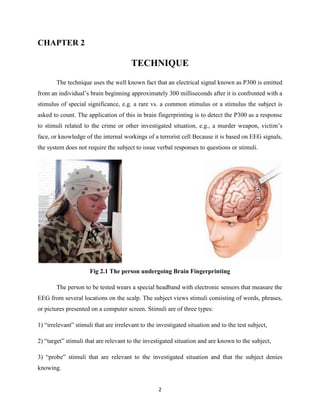
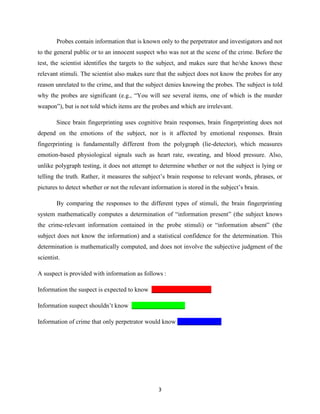
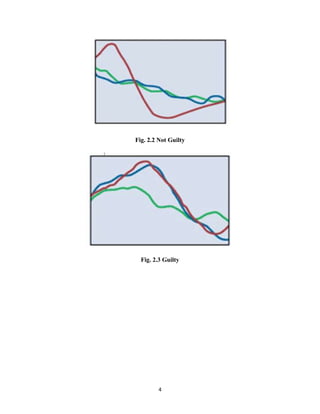
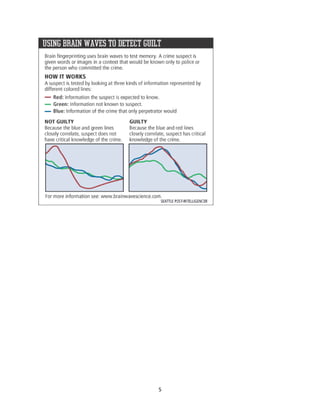
is a controversial forensic science technique that determines whether specific information is stored in a subject’s brain by measuring electrical brainwave responses to words, phrases, or pictures that are presented on a computer screen. Brain fingerprinting was invented by Lawrence Farwell. The theory is that the brain processes known, relevant information differently than it processes unknown or irrelevant information.<br />Brain fingerprinting involves measuring the MERMER paradigm EEG response during interrogation. MERMER is Memory and Encoding Related Multifaceted Electroencephalography Responses. The brain print is based on the P300 complex, a series of well-known brainwave components that can be measured. The technique is said to be more effective than a lie detector test.<br />CHAPTER 2<br />TECHNIQUE<br />The technique uses the well known fact that an electrical signal known as P300 is emitted from an individual’s brain beginning approximately 300 milliseconds after it is confronted with a stimulus of special significance, e.g. a rare vs. a common stimulus or a stimulus the subject is asked to count. The application of this in brain fingerprinting is to detect the P300 as a response to stimuli related to the crime or other investigated situation, e.g., a murder weapon, victim’s face, or knowledge of the internal workings of a terrorist cell Because it is based on EEG signals, the system does not require the subject to issue verbal responses to questions or stimuli.<br />19050-3810<br />Fig 2.1 The person undergoing Brain Fingerprinting<br />The person to be tested wears a special headband with electronic sensors that measure the EEG from several locations on the scalp. The subject views stimuli consisting of words, phrases, or pictures presented on a computer screen. Stimuli are of three types: <br />1) “irrelevant” stimuli that are irrelevant to the investigated situation and to the test subject, <br />2) “target” stimuli that are relevant to the investigated situation and are known to the subject, <br />3) “probe” stimuli that are relevant to the investigated situation and that the subject denies knowing. <br />Probes contain information that is known only to the perpetrator and investigators and not to the general public or to an innocent suspect who was not at the scene of the crime. Before the test, the scientist identifies the targets to the subject, and makes sure that he/she knows these relevant stimuli. The scientist also makes sure that the subject does not know the probes for any reason unrelated to the crime, and that the subject denies knowing the probes. The subject is told why the probes are significant (e.g., “You will see several items, one of which is the murder weapon”), but is not told which items are the probes and which are irrelevant.<br />Since brain fingerprinting uses cognitive brain responses, brain fingerprinting does not depend on the emotions of the subject, nor is it affected by emotional responses. Brain fingerprinting is fundamentally different from the polygraph (lie-detector), which measures emotion-based physiological signals such as heart rate, sweating, and blood pressure. Also, unlike polygraph testing, it does not attempt to determine whether or not the subject is lying or telling the truth. Rather, it measures the subject’s brain response to relevant words, phrases, or pictures to detect whether or not the relevant information is stored in the subject’s brain.<br />By comparing the responses to the different types of stimuli, the brain fingerprinting system mathematically computes a determination of “information present” (the subject knows the crime-relevant information contained in the probe stimuli) or “information absent” (the subject does not know the information) and a statistical confidence for the determination. This determination is mathematically computed, and does not involve the subjective judgment of the scientist.<br />A suspect is provided with information as follows :<br />Information the suspect is expected to know ___________________<br />Information suspect shouldn’t know _________________ <br />Information of crime that only perpetrator would know ______________<br />Fig. 2.2 Not Guilty<br />Fig. 2.3 Guilty<br />CHAPTER 3<br />ELECTROENCEPHALOGRAPHY<br />3.1 About:<br />Electroencephalography (EEG) is the measurement of electrical activity produced by the brain as recorded from electrodes placed on the scalp.<br />Just as the activity in a computer can be understood on multiple levels, from the activity of individual transistors to the function of applications, so can the electrical activity of the brain be described on relatively small to relatively large scales. At one end are action potentials in a single axon or currents within a single dendrite of a single neuron, and at the other end is the activity measured by the EEG which aggregates the electric voltage fields from millions of neurons. So-called scalp EEG is collected from tens to hundreds of electrodes positioned on different locations at the surface of the head. EEG signals (in the range of milli-volts) are amplified and digitalized for later processing. The data measured by the scalp EEG are used for clinical and research purposes.<br />3.2 Source of EEG Activity:<br />Scalp EEG activity oscillates at multiple frequencies having different characteristic spatial distributions associated with different states of brain functioning such as waking and sleeping. These oscillations represent synchronized activity over a network of neurons. The neuronal networks underlying some of these oscillations are understood (such as the thalamocortical resonance underlying sleep spindles) while many others are not (e.g. the system that generates the posterior basic rhythm).<br />3.3.EEG vs fMRI and PET<br />EEG has several strong sides as a tool of exploring brain activity; for example, its time resolution is very high (on the level of a single millisecond). Other methods of looking at brain activity, such as PET and fMRI have time resolution between seconds and minutes. <br />EEG measures the brain's electrical activity directly, while other methods record changes in blood flow (e.g., SPECT, fMRI) or metabolic activity (e.g., PET), which are indirect markers of brain electrical activity. <br />EEG can be used simultaneously with fMRI so that high-temporal-resolution data can be recorded at the same time as high-spatial-resolution data, however, since the data derived from each occurs over a different time course, the data sets do not necessarily represent the exact same brain activity. There are technical difficulties associated with combining these two modalities like currents can be induced in moving EEG electrode wires due to the magnetic field of the MRI.<br />EEG can be recorded at the same time as MEG so that data from these complimentary high-time-resolution techniques can be combined. Magneto-encephalography (MEG) is an imaging technique used to measure the magnetic fields produced by electrical activity in the brain via extremely sensitive devices such as superconducting quantum interference devices (SQUIDs), These measurements arc commonly used in both research and clinical settings. There are many uses for the MEG. including assisting surgeons in localizing pathology, assisting researchers in determining the junction of various parts of the brain. neuro-feedback. and others.<br />3.4 Method <br />Scalp EEC, the recording is obtained by placing electrodes on the scalp. Each electrode is connected to one input of a differential amplifier and a common system reference electrode is connected to the other input of each differential amplifier. These amplifiers amplify the voltage between the active electrode and the reference (typically l.000—100,000 times, or 60—100 dB of voltage gain). A typical adult human EEC signal is about 10µV to 100 µV in amplitude when measured from the scalp and is about 10—20 mV when measured from subdural electrodes. In digital EEC systems. the amplified signal is digitized via an analog-to-digital converter, after being passed through an anti-aliasing filter. Since an EEC voltage signal represents a difference between the voltages at two electrodes, the display of the EEC for the reading encephalographer may be set up in one of several ways. <br />CHAPTER 4<br />P300<br />4.1 About:<br />The P300 (P3) wave is an event related potential (ERP) which can be recorded via electroencephalography (EEG) as a positive deflection in voltage at a latency of roughly 300 ms in the EEG. The signal is typically measured most strongly by the electrodes covering the parietal lobe. The presence, magnitude, topography and time of this signal are often used as metrics of cognitive function in decision making processes. While the neural substrates of this ERP still remain hazy, the reproducibility of this signal makes it a common choice for psychological tests in both the clinic and laboratory.<br />The P300 signal is an aggregate recording from a great many neurons. Although typically non-invasive, parts of the signal may be sampled more directly from certain brain regions via electrode (hence, the medial temporal P300 or MTL-P300). This methodology allows for isolation and local recording of one area without the noise from other signals acquired through scalp electrodes [4]. In practice, the P300 waveform must be evoked using a stimulus delivered by one of the sensory modalities. One typical procedure is the 'oddball' paradigm, whereby a target stimulus is presented amongst more frequent standard background stimuli. A distracter stimulus may also be used to ensure that the response is due to the target rather than the change from a background pattern. The classic oddball paradigm has seen many variations, but in the end most protocols used to evoke the P300 involve some form of conscious realization or decision making. Attention is required for such protocols. No subjects have been noted to have from control over their P3000.<br />CHAPTER 5<br />THE ROLE OF BRAIN FINGERPRINTING <br />IN CRIMINAL PROCEEDINGS<br />The application of Brain Fingerprinting testing in a criminal case involves four phases: investigation, interview, scientific testing, and adjudication. Of these four phases, only the third one is in the domain of science. The first phase is undertaken by a skilled investigator, the second by an interviewer who may be an investigator or a scientist, the third by a scientist, and the fourth by a judge and jury.<br />This is similar to the forensic application of other sciences. For example, if a person is found dead of unknown causes, first there is an investigation to determine if there may have been foul play. If there is a suspect involved, the suspect is interviewed to determine what role, if any, he says he has had in the situation. If the investigation determines that the victim may have been poisoned using ricin or cadmium, two rare and powerful poisons, then scientific tests can be conducted to detect these specific substances in the body. Then the evidence accumulated through the test, the investigation, and the interview are presented to a judge and jury, who make the adjudication as to whether a particular suspect is guilty of a particular crime. <br />In such a case, the science of forensic toxicology reveals only whether or not specific toxins are in the body. It does not tell us when or where to look for toxins, or which toxins to look for. We must rely on investigation to provide the necessary guidance on these issues. The science of forensic toxicology also does not tell us whether a particular suspect is innocent or guilty of a crime. The question of guilt or innocence is a legal one, not a scientific one, and the adjudication is made by a judge and jury, and not by a scientist or a computer. <br />5.1 Phase 1: Investigation:<br />The first phase in applying Brain Fingerprinting testing in a criminal case is an investigation of the crime. Before a Brain Fingerprinting test can be applied, an investigation must be undertaken to discover information that can be used in the test. The is stored in a specific person’s brain. It detects the presence or absence of specific information in the brain. Before we can conduct this scientific test, we need to determine what information to test for. This investigation precedes and informs the scientific phase which constitutes the Brain Fingerprinting test itself.<br />The role of investigation is to find specific information that will be useful in a Brain Fingerprinting test. As with any scientific test, if the outcome of the Brain Fingerprinting test is to be useful evidence for a judge and jury to consider in reaching their verdict, then the information tested must have a bearing on the perpetration of the crime. The job of the investigator is to find features relevant to the crime that have the following attributes.<br />1. They are salient features that perpetrator almost certainly encountered in the course of committing the crime (e.g., the murder weapon or the escape route).<br />2. The suspect has not been exposed to them in some other context, i.e., interrogation or court proceedings.<br />These features of the crime will be used in the Brain Fingerprinting test as probe stimuli. If the suspect knows these specific features of the crime, and has had no access to this information other than through committing the crime, then this will provide evidence of his involvement in the crime. If the suspect lacks this knowledge, this will provide evidence supporting his innocence. Brain Fingerprinting tests for the presence or absence of this information stored in the suspect’s brain.<br />In some cases, the investigation will reveal no information about the crime that would be known only to the perpetrator and to investigators. For example, in the case of a disappearance, investigators may not even know if a crime has been committed, and if so, what were the specific details of the crime. In some sexual assault cases, there may be agreement between the alleged victim and the suspect as to all of the events that took place, but disagreement as to the intent of the parties. Investigators may have made the mistake of revealing to the suspect all that they know about a case. In such cases, no probe stimuli can be developed that will provide evidence relevant to the discrimination between a person who participated in the crime and one who did not, and no Brain Fingerprinting test will be conducted.<br />The investigator must use his skill and judgment in discovering and evaluating information to be used in the Brain Fingerprinting test, and any other evidence he uncovers. There is always a degree of uncertainty in this process. If the investigator finds a gun lying by the body of a person who apparently died of gunshot wounds, he may conclude that it is the murder weapon. There is always a possibility, however, that it is not. For example, perhaps the perpetrator shot the victim with one gun and planted another gun to frame someone else. Ultimately, the evidence accumulated by the investigator will need to be weighed by the judge and jury for its bearing on the guilt or innocence of the suspect. <br />Criminal investigation is not science. Investigation does involve a high degree of skill and expertise. The details uncovered by investigation are used as evidence in virtually every trial. Expert testimony by investigators in criminal trials is very common. When found to be relevant and based on reliable methodology, such evidence and testimony are universally accepted as a viable part of the proceedings in court. This still does not mean, however, that investigation is science. Unraveling the case and determining what is significant and relevant will always depend on the skill of the investigator. Each case is different, and there is an infinite variety of information that may be available to be discovered. There are no standardized algorithms or procedures that will solve every case. There will never be a time when we can simply feed all of the facts about a case into a computer, and the computer will tell us what is significant or how the case is to be solved. Although investigation is not science, investigation contributes substantially to legal proceedings, and the evidence and expert testimony provided by investigators will continue to be a valuable part of the process.<br />Some research scientists have expressed the view that if we just conduct enough research, and define and study a nearly infinite panoply of parameters, someday the process of investigation will become a scientific process that can be accomplished by applying a set algorithm which does not depend on the skill and judgment of the investigator. There is no reason to believe – or to hope – that this will ever happen. It is our view that science will not, and should not, take the place of skilled criminal investigation. The infinite variety of factors in a crime, and the intimate involvement of human beings in every aspect of the crime, insure that the judgment and skill of the investigator will always be a necessary ingredient in criminal investigations. Science will never make skilled investigators obsolete, and should not attempt to do so. <br />The process of determining which items to use as probe stimuli will always depend on the skill and judgment of the investigator, and will never be accomplished just by applying some set scientific algorithm in the absence of human judgment. Ultimately, the judge and jury will decide whether the evidence uncovered by the investigator and embodied in the probe stimuli is convincing regarding the guilt or innocence of the suspect.<br />5.2 Phase 2: Interview of Subject:<br />Once evidence has been accumulated through investigation, and before the Brain Fingerprinting test is conducted to determine if the evidence can be linked to the suspect, it can in some cases be very valuable to obtain the suspect’s account of the situation. For example, if an investigation shows that specific fingerprints are found at the scene of a murder, a suspect can be interviewed to determine if there may be some legitimate reason that his prints are there. If the suspect’s story is that he was never at the scene of the crime, then a match between his fingerprints and the fingerprints at that scene would be highly incriminating. If, on the other hand, the suspect’s story is that he was at the scene for some legitimate reason just before the crime, then fingerprints must be interpreted differently, particularly if there is corroborating evidence of the suspect’s presence at the scene before the crime.<br />The interview with the suspect may help to determine which scientific tests to conduct, or how to conduct the tests. For example, a suspect may say that he entered and then left the room where a murder was committed a short time before the murder, and that he never saw or handled the murder weapon. In this context, a finding that the suspect’s fingerprints matched the fingerprints on the doorknob would have little value, but a finding that his fingerprints matched those on the murder weapon would provide incriminating evidence.<br />Prior to a Brain Fingerprinting test, an interview of the suspect is conducted. The suspect is asked if he would have any legitimate reason for knowing any of the information that is contained in the potential probe stimuli. This information is described without revealing which stimuli are probes and which are irrelevants. For example, the suspect may be asked, “The newspaper reports, which you no doubt have read, say that the victim was struck with a blunt object. Do you have any way of knowing whether that murder weapon was a baseball bat, a broom handle, or a blackjack?” If the suspect answers “No,” then a test result indicating that his brain does indeed contain a record of which of these is the murder weapon can provide evidence relevant to the case. <br />The suspect may have been exposed to information about the crime through an error on the part of interrogators in previous interrogations, through familiarity with the scene or the victim that has nothing to do with the crime, through hearsay from people directly or indirectly involved, or through any number of other channels. It is vital that the suspect be given a chance before the Brain Fingerprinting test to disclose any familiarity he may have with the crime, so that any probes that he knows about for a legitimate reason can be eliminated from the test. Recall that the probes contain crime-relevant information that the suspect has no way of knowing except through having been present at the crime.<br />The targets are also discussed in the interview. Recall that the targets contain information about the crime that the suspect knows whether he committed the crime or not, and are used to establish a baseline brain response for information known to be significant to this subject in the context of the crime. For example, if media reports known to the suspect have disclosed the location of a murder (e.g., “behind Newton Stadium”), then the location of the murder could be used as a target stimulus. In the interview, the interviewer makes sure that the suspect does indeed know the information contained in the target stimuli.<br />In the interview, the suspect is also given a list of all of the stimuli to be presented in the test, without disclosing which stimuli are probes and which are irrelevants. The suspect is asked to identify any stimuli that are significant to him for reasons that have nothing to do with the crime. If any stimulus is significant to the suspect for reasons having nothing to do with the crime, then that stimulus is eliminated from the test. For example, if the suspect claims to know nothing about who committed the crime and to be unfamiliar with any of the other people who are suspected of being involved, one of the probe stimuli may be the name of a known accomplice. If that name also happens to be the name of the suspect’s brother-in-law, then the stimulus would be significant to the suspect for reasons unrelated to the crime, and this stimulus would be eliminated from the test. In this way, the interview sets the stage for later interpretation of the test. If the suspect has just told investigators that none of the stimuli are significant to him for any reason, and then the probe stimuli are revealed through Brain Fingerprinting to be significant to the suspect in the context of the crime, this scientific finding provides evidence relevant to the suspect’s involvement in the crime.<br />A frequently asked question is, “What if one of the probe stimuli is significant to the suspect for the wrong reason?” The interview serves to eliminate this potential confound, as described above.<br />Things are significant to a person in context. The context of the probe stimuli in relation to the crime is established in the interview, and prior to the Brain Fingerprinting test. Immediately before each test, the context of the probe stimuli is established, and the probe stimuli are described without being specifically named. For example, the subject is told, “In this test, you will see several items, one of which is the murder weapon.” Then several different stimuli are presented, including the murder weapon (e.g., “baseball bat”) and several other options that would be equally plausible for an innocent person not familiar with the crime (e.g., “broom handle”). We all have some familiarity with baseball bats and broom handles, but in the context of the murder in which the baseball bat was the murder weapon “baseball bat” will be significant for the perpetrator and not for an innocent suspect who does not know what the murder weapon was.<br />In some cases, the interview will reveal that the suspect is already familiar with all of the information that might be used to structure probe stimuli, for some reason unrelated to committing the crime. For example, interrogators may have mistakenly revealed to the suspect all that they know about the crime. In such a case, there is no remaining information to be used to structure probe stimuli, and a Brain Fingerprinting test is not conducted. If a Brain Fingerprinting test were conducted to test whether or not a suspect knew details of a crime that had been told to him by investigators, the test would result in an “information present” result, which would be correct. The probative value of such a result with respect to committing the crime, however, would be nil. Such a test would only reveal, correctly, that the suspect knows the information. Since the investigators already know for certain that the suspect knows the information – because they told it to him – this result would not provide any useful evidence with respect to solving the crime. This is why a test is not conducted under such circumstances. Note that this is a limitation only on when Brain Fingerprinting can be usefully applied, and not a limitation on the scientific accuracy or validity of the technique. As with DNA, fingerprints, and every other science, there are situations where a correct Brain Fingerprinting result is simply not useful in solving a particular crime.<br />In short, Brain Fingerprinting determines scientifically and accurately what information is stored in a person’s brain. It does not determine how that information got there. In order for Brain Fingerprinting to be useful in identifying a perpetrator – that is, in order for a correct “information present” Brain Fingerprinting result to be useful evidence regarding a suspect’s participation in a crime – investigators must first discover information that would be known to a perpetrator but not to an innocent suspect, and ensure that the subject in question has not obtained that information through some means other than participation in the crime. The interview contributes to this process.<br />Science is useful only when applied appropriately and intelligently. If the aim is solving a crime or informing a judicial decision, then it is not useful to conduct scientific testing in a vacuum, absent any consideration of what the results will mean in the context of the crime. A test must be structured that will provide relevant and useful results. Also, once the results have been obtained, they are useful only if they are interpreted in the light of the other available evidence, as in the above example regarding fingerprints. Brain Fingerprinting is like all other sciences in this regard. <br />The interview serves to refine the selection of stimuli so that the test results will provide useful and relevant information, to establish the relevance of the stimuli, to eliminate potential confounds in the scientific test, and to provide a background for interpretation of the test results once they are obtained. <br />5.3 Phase 3: Scientific Testing with Brain Fingerprinting:<br />It is in the Brain Fingerprinting test where science contributes to the process. Brain Fingerprinting determines scientifically whether or not specific information is stored in a specific person’s brain. <br />Brain Fingerprinting is a standardized scientific procedure. The input for this scientific procedure is the probe stimuli, which are formulated on the basis of the investigation and the interview. The output of this scientific procedure is a determination of “information present” or “information absent” for those specific probe stimuli, along with a statistical confidence for this determination. This determination is made according to a specific, scientific algorithm, and does not depend on the subjective judgment of the scientist. <br />Brain Fingerprinting tells us the following, no more and no less: “These specific details about this crime are (or are not) stored in this person’s brain.” On the basis of this and all of the other available evidence, a judge and jury make a determination of guilty or innocent.<br />It has been proven in the scientific arena, and also in court, that the science of Brain Fingerprinting has the following attributes:<br />This science is testable and has been tested;](https://image.slidesharecdn.com/1-110302020932-phpapp01/85/Brain-finger-printing-1-320.jpg)
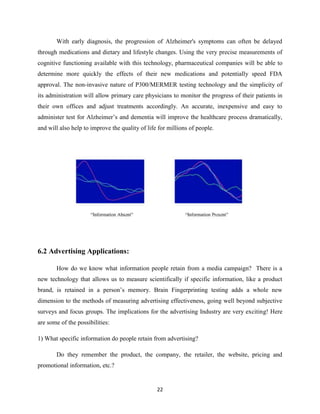

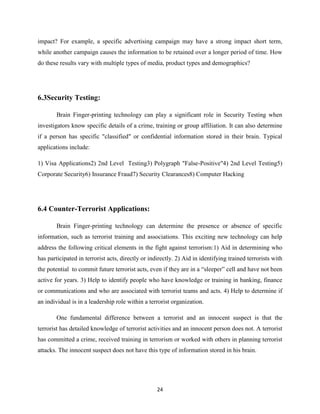
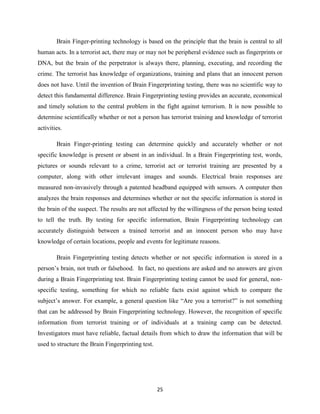
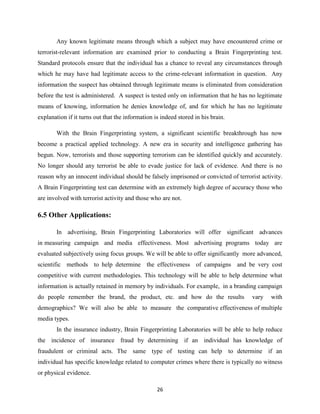

Brain fingerprinting is a forensic technique that uses electroencephalography (EEG) to detect electrical brainwave responses to stimuli related to a crime to determine if information about the crime is stored in the subject's brain. It involves measuring P300 brainwaves when the subject views probes, targets, and irrelevant stimuli. Probes contain crime-relevant information only the perpetrator would know. If probes elicit a P300, it indicates the information is stored in the subject's brain. Brain fingerprinting results do not determine guilt, but can guide further investigation and be considered as evidence in court along with other findings.


