Downloaded 1,593 times
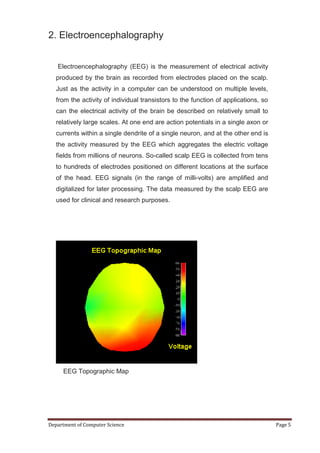
![2.1 SOURCE OF EEG ACTIVITY
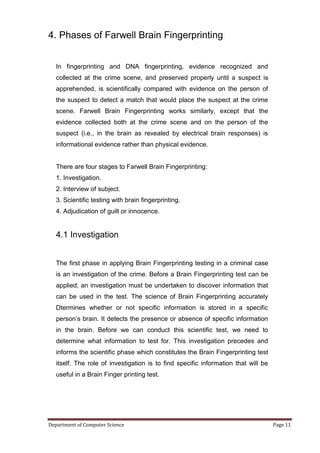
Scalp EEG activity oscillates at multiple frequencies having different
characteristic spatial distributions associated with different states of brain
functioning such as waking and sleeping. These oscillations represent
synchronized activity over a network of neurons. The neuronal networks
underlying some of these oscillations are understood (such as the
thalamocortical resonance underlying sleep spindles) while many others
are not (e.g. the system that generates the posterior basic rhythm).
voltage gain). A typical adult human EEG signal is about 10µV to 100 µV
in amplitude when measured from the scalp [2] and is about 10–20 mV
when measured from subdural electrodes. In digital EEG systems, the
amplified signal is digitized via an analog-to-digital converter, after being
passed through an anti-aliasing filter. Since an EEG voltage signal
represents a difference between the voltages at two electrodes, the
display of the EEG for the reading encephalographer may be set up in
one of several ways.
Department of Computer Science Page 6](https://image.slidesharecdn.com/brainfingerprinting-110326085605-phpapp01/85/Brain-fingerprinting-6-320.jpg)
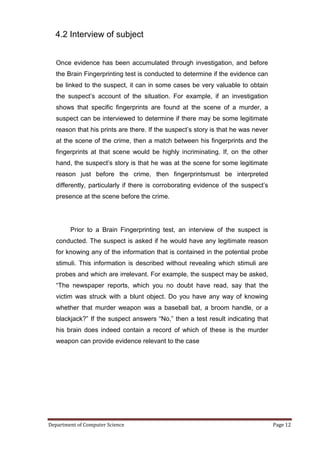
![A typical adult human EEG signal is about 10µV to 100 µV in
amplitude when measured from the scalp [2] and is about 10–20 mV
when measured from subdural electrodes. In digital EEG systems, the
amplified signal is digitized via an analog-to-digital converter, after being
passed through an anti-aliasing filter. Since an EEG voltage signal
represents a difference between the voltages at two electrodes, the
display of the EEG for the reading encephalographer may be set up in
one of several ways.
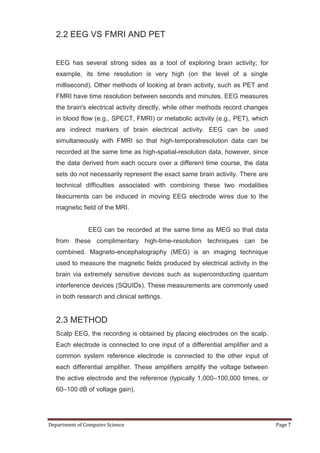
Computer waveform analysis: high-speed samples taken 200 times/second .
Department of Computer Science Page 8](https://image.slidesharecdn.com/brainfingerprinting-110326085605-phpapp01/85/Brain-fingerprinting-8-320.jpg)

![10.BIBLOGRAPHY:
[1] Farwell LA, Donchin E. The brain detector: P300 in the detection of
deception. Psychophysiology 1986; 24:434.
[2] Farwell LA, inventor. Method and apparatus for multifaceted
electroencephalographic response analysis (MERA). US patent
5,363,858. 1994 Nov 15.
[3] Picton TW. Handbook of electroencephalography and clinical
neurophysiology: human event- related potentials. Amsterdam.
[4] http://www.forensic-evidence.com
[5] http://www.brainwavescience.com
Department of Computer Science Page 21](https://image.slidesharecdn.com/brainfingerprinting-110326085605-phpapp01/85/Brain-fingerprinting-21-320.jpg)

Brain fingerprinting is a technique that uses electroencephalography (EEG) to measure electrical brain wave responses to words, phrases, or pictures presented on a computer screen. It is designed to determine if an individual recognizes specific crime-related information by detecting a P300 brain wave, which occurs when a person recognizes meaningful stimuli. The test presents targets the person is expected to recognize, irrelevant stimuli, and probes related to the crime. If probes elicit a P300, it indicates the person has knowledge of the crime. Brain fingerprinting claims to be more accurate than polygraph tests in detecting guilty knowledge. It has been used in over 120 tests, including for the FBI and US military.


