Introduction 
• An information system is a sociotechnical system, an arrangement of both 
technical and social elements 
• A sociotechnical system considers not only how inputs are transformed into 
outputs but also how interpersonal and social relationships can be 
developed for mutual gain by employees and the organization 
• In sociotechnical system approach, both technical and social elements 
receive high priority, and they are managed for the best possible integration. 
• The fundamental objective is to design the whole work system that satisfies 
employees, meet production requirements and serves the customer needs. 
• In the sociotechnical approach , one cannot install new information 
technology without considering the people who work with it.
• This requires redesigning the organization which includes 
redesigning organizational processes and structure to make 
effective utilization of resources and reshaping organizational 
culture to maintain a balance between IT and organizational culture. 
• For this the following 4 elements are important: 
1. Enterprise resource planning 
2. Business process reengineering 
3. Structural change 
4. Changing organizational culture
Enterprise resource planning 
• In today’s competitive business environment , organizations need to 
manage their resources in the most effective way to develop 
competitive advantage. 
• ERP enables the organization to achieve this integration. 
• ERP can be defined as a fully integrated business management that 
integrates the core business and management processes to provide 
an organization a structured environment in which decisions 
concerning demand, supply, operations , finance, logistics, etc are 
fully supported by accurate and reliable real-time information. 
• ERP encompasses all major valve points and consolidates these 
into single, enterprise-wide solution that ensures seamless interface 
within critical systems thereby allowing the organization to re-invent 
itself to changing business needs swiftly and efficiently.
• The major objectives of ERP are to 
1. Provide support for adopting best business practices 
2. Implement these practices with a view towards enhancing 
productivity and 
3. Empower the customers and suppliers to modify the implemented 
business processes to suit their need
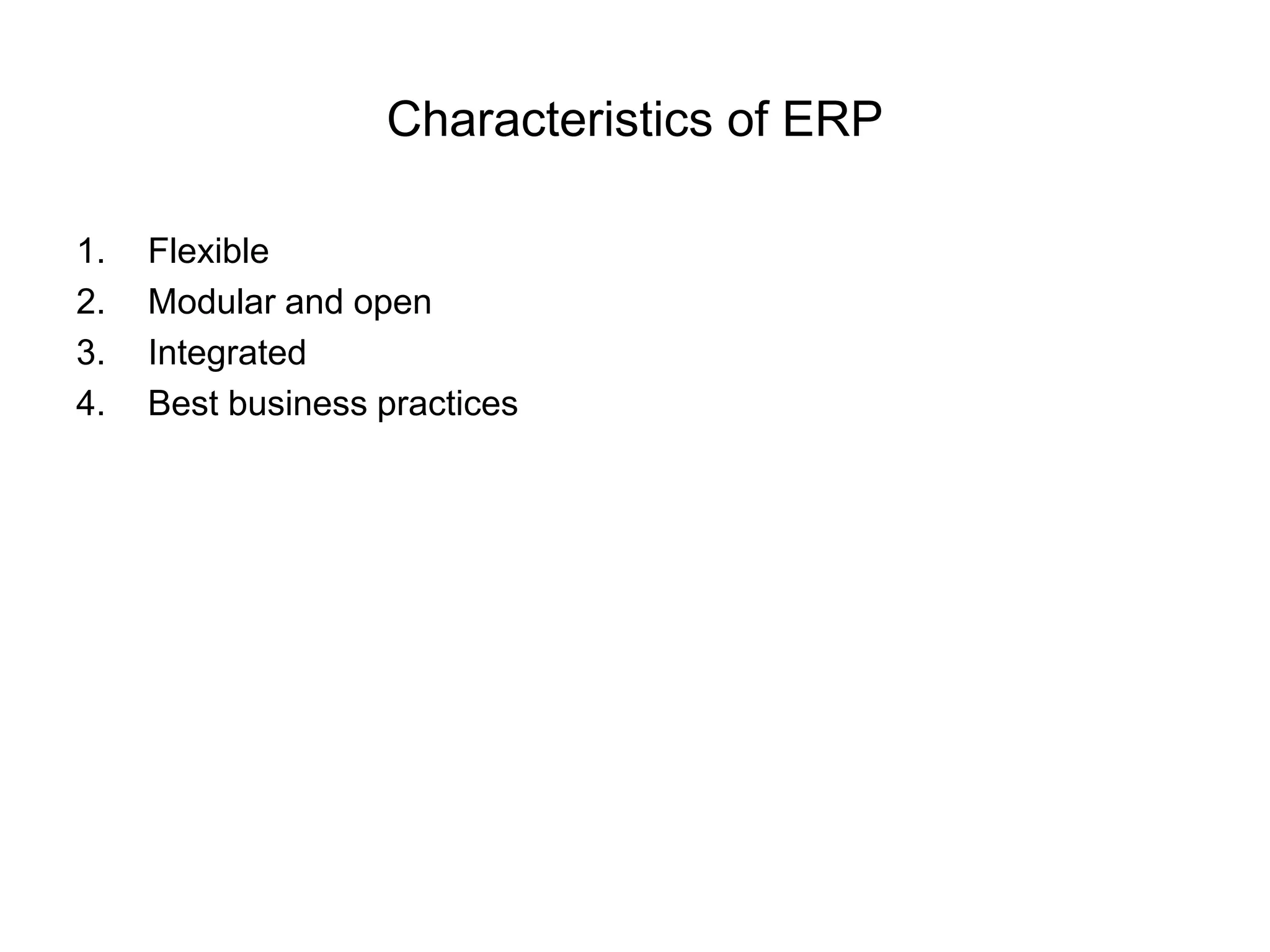
Characteristics of ERP 
1. Flexible 
2. Modular and open 
3. Integrated 
4. Best business practices
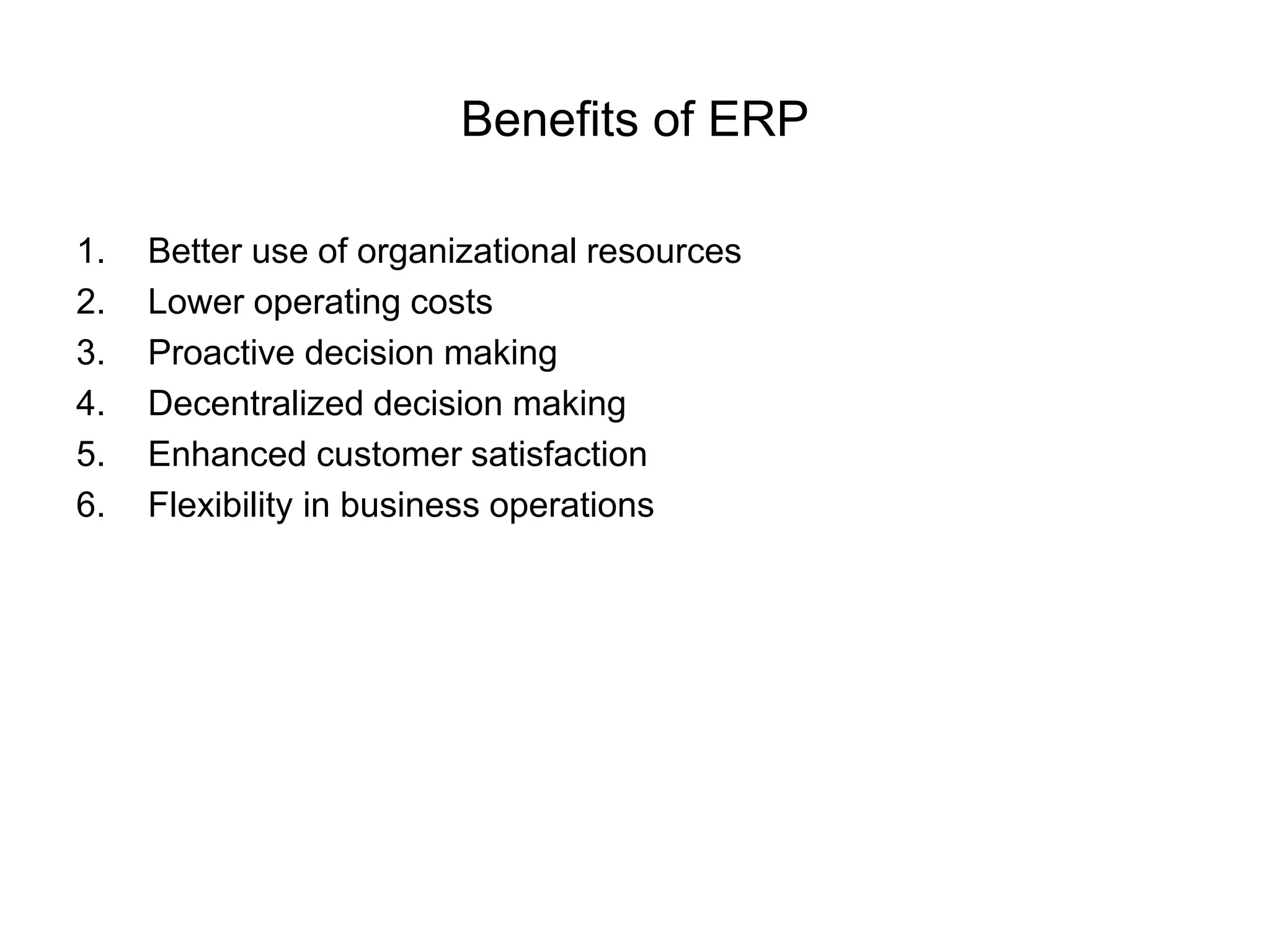
Benefits of ERP 
1. Better use of organizational resources 
2. Lower operating costs 
3. Proactive decision making 
4. Decentralized decision making 
5. Enhanced customer satisfaction 
6. Flexibility in business operations
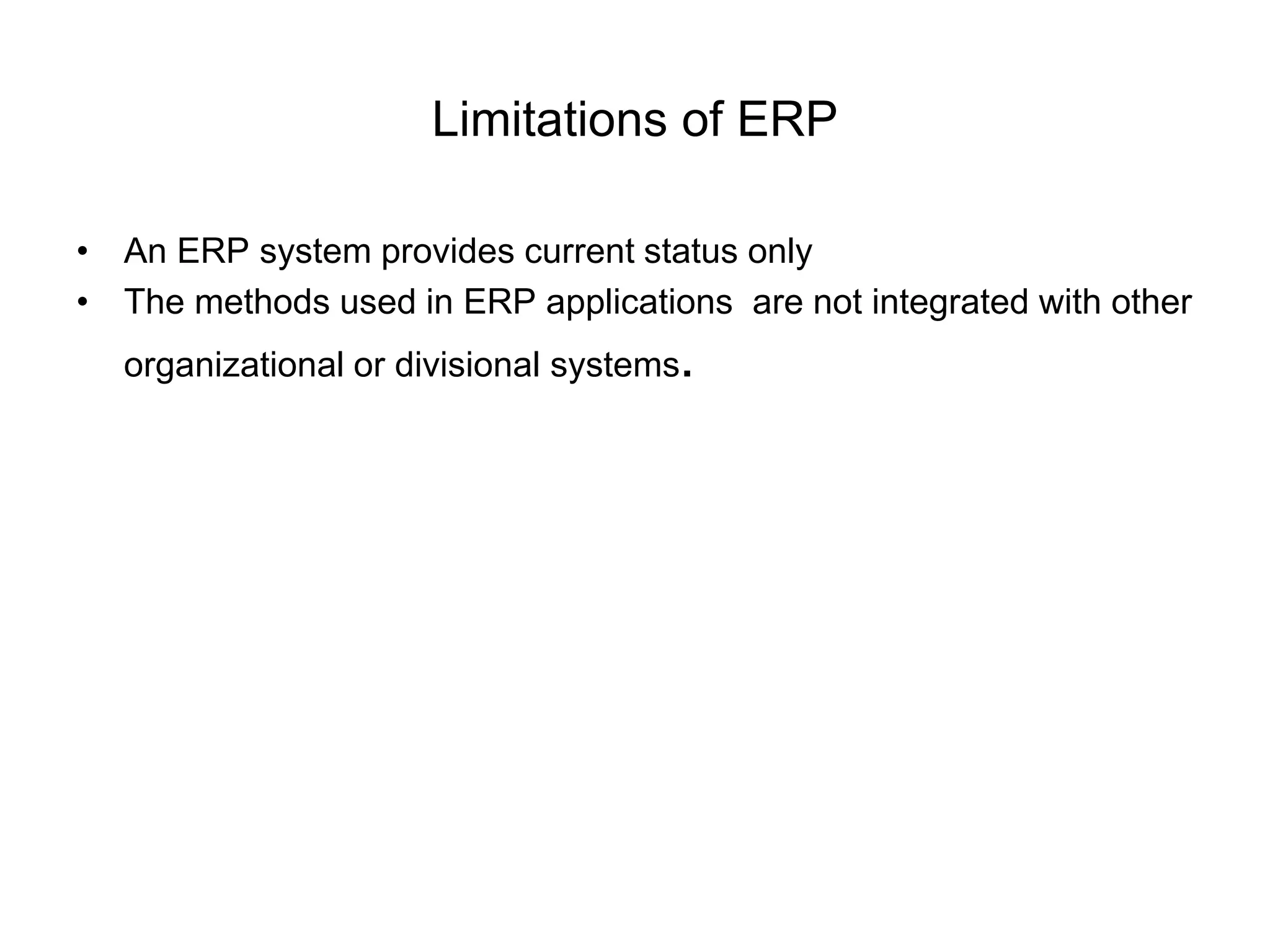
Limitations of ERP 
• An ERP system provides current status only 
• The methods used in ERP applications are not integrated with other 
organizational or divisional systems.
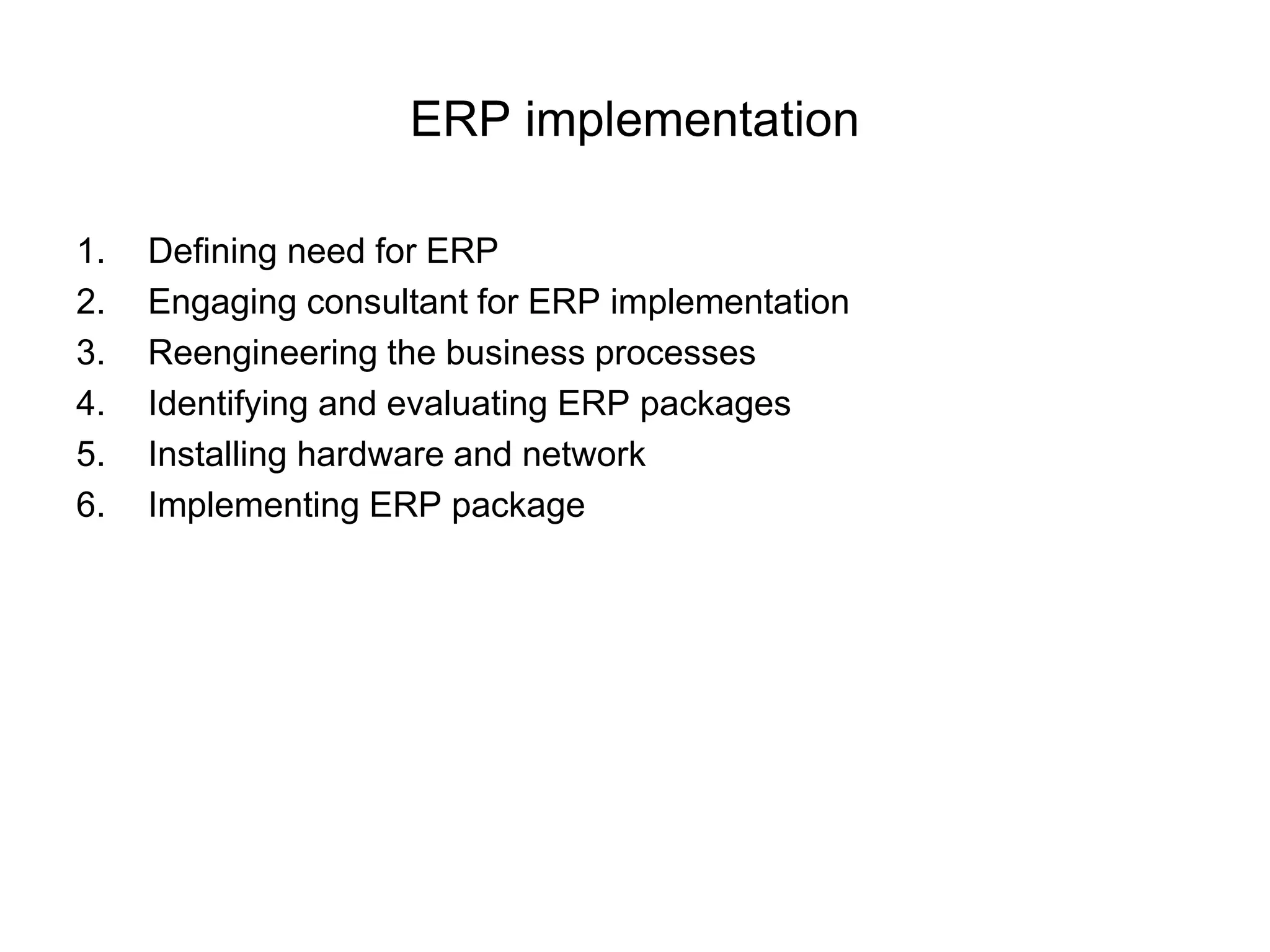
ERP implementation 
1. Defining need for ERP 
2. Engaging consultant for ERP implementation 
3. Reengineering the business processes 
4. Identifying and evaluating ERP packages 
5. Installing hardware and network 
6. Implementing ERP package
Requirements for effective ERP implementation 
• Focus on corporate goals 
• Commitment of top management 
• Involvement of entire organization 
• Quality of data 
• Commensurate training 
• Organizational change
BUSINESS PROCES REENGINEERING 
– The basic objective of any information system is to produce the best possible 
results by eliminating those processes which are not central to the 
organizational objectives and by changing those processes which are 
central. 
– This has led to emergence of BPR 
– It is basically a fundamental process of redesigning business processes so 
as to gain economy in performing these processes 
– It is the fundamental rethinking, and radical redesign of processes to achieve 
dramatic improvement in critical , contemporary measures of performance 
such as cost, quality and speed 
– It can be defined as radical scrutiny, questioning, redefinition and redesign of 
business processes with the aim of eliminating all activities not central to 
business goals.
OBJECTIVES OF BPR 
• Elimination of unnecessary processes 
• Reduced cycle time
PROCESS OF BPR 
1. Developing business vision and process objectives 
2. Identifying the processes to be designed 
3. Measuring the performance of existing processes 
4. Identifying the opportunity for applying information technology 
5. Building the prototype of new process
1. DEVELOPING BUSINESS VISION AND PROCESS OBJECTIVES: 
• Before going through the process of redesigning business processes, it is 
desirable that business vision is defined clearly so that business 
processes function in tune with vision. 
• Organizational vision represents the challenging portrait of what the 
organization would be in future. 
• It implies that the organization should create projections about where it 
should go, and what major challenges lie ahead. 
• Based on this the organization should define the objectives of business 
processes. 
• There may be different ways in which business process contribute to 
business vision like, lowering costs by shortening process cycle time, 
providing timely information to various stakeholders and so on.
IDENTIFYING THE PROCESSES TO BE DESIGNED 
• After defining business vision and process objectives, the 
organization should identify those processes that redesigning. 
• At the initial stage it is desirable to identify these processes that are 
performed repeatedly and have greatest potential payback such as 
manufacturing process, order receiving and execution product 
shipping, data entry, etc. 
• The analysis should identify which organizational group owns a 
process , which organizational functions/departments are involved in 
the process, and what changes are required.
MEASURING THE PERFORMANCE OF EXISTING PROCESSES 
• Before going through redesigning , performance of existing 
organizational processes should be measured to find out the type of 
reengineering needed. 
• Two commonly used methods are benchmarking and process 
evaluation.
Identifying the opportunity for applying information 
technology 
• With the development and widespread use of IT more emphasis is 
being placed on how IT can be used to support a process and 
redesign the process accordingly.
Building the prototype of new process 
• The organization should design a new process on an experimental 
basis , anticipating a series if revisions and improvements until the 
redesigned process is put into actual operation 
• the prototype must be tested to measure its performance and 
incorporate needed changes. 
• After the testing phase is over and necessary corrections are 
incorporated , the process can be put into operation.

Business Process Re-engineering

  • 1.
    Introduction • Aninformation system is a sociotechnical system, an arrangement of both technical and social elements • A sociotechnical system considers not only how inputs are transformed into outputs but also how interpersonal and social relationships can be developed for mutual gain by employees and the organization • In sociotechnical system approach, both technical and social elements receive high priority, and they are managed for the best possible integration. • The fundamental objective is to design the whole work system that satisfies employees, meet production requirements and serves the customer needs. • In the sociotechnical approach , one cannot install new information technology without considering the people who work with it.
  • 2.
    • This requiresredesigning the organization which includes redesigning organizational processes and structure to make effective utilization of resources and reshaping organizational culture to maintain a balance between IT and organizational culture. • For this the following 4 elements are important: 1. Enterprise resource planning 2. Business process reengineering 3. Structural change 4. Changing organizational culture
  • 3.
    Enterprise resource planning • In today’s competitive business environment , organizations need to manage their resources in the most effective way to develop competitive advantage. • ERP enables the organization to achieve this integration. • ERP can be defined as a fully integrated business management that integrates the core business and management processes to provide an organization a structured environment in which decisions concerning demand, supply, operations , finance, logistics, etc are fully supported by accurate and reliable real-time information. • ERP encompasses all major valve points and consolidates these into single, enterprise-wide solution that ensures seamless interface within critical systems thereby allowing the organization to re-invent itself to changing business needs swiftly and efficiently.
  • 4.
    • The majorobjectives of ERP are to 1. Provide support for adopting best business practices 2. Implement these practices with a view towards enhancing productivity and 3. Empower the customers and suppliers to modify the implemented business processes to suit their need
  • 5.
    Characteristics of ERP 1. Flexible 2. Modular and open 3. Integrated 4. Best business practices
  • 6.
    Benefits of ERP 1. Better use of organizational resources 2. Lower operating costs 3. Proactive decision making 4. Decentralized decision making 5. Enhanced customer satisfaction 6. Flexibility in business operations
  • 7.
    Limitations of ERP • An ERP system provides current status only • The methods used in ERP applications are not integrated with other organizational or divisional systems.
  • 8.
    ERP implementation 1.Defining need for ERP 2. Engaging consultant for ERP implementation 3. Reengineering the business processes 4. Identifying and evaluating ERP packages 5. Installing hardware and network 6. Implementing ERP package
  • 9.
    Requirements for effectiveERP implementation • Focus on corporate goals • Commitment of top management • Involvement of entire organization • Quality of data • Commensurate training • Organizational change
  • 10.
    BUSINESS PROCES REENGINEERING – The basic objective of any information system is to produce the best possible results by eliminating those processes which are not central to the organizational objectives and by changing those processes which are central. – This has led to emergence of BPR – It is basically a fundamental process of redesigning business processes so as to gain economy in performing these processes – It is the fundamental rethinking, and radical redesign of processes to achieve dramatic improvement in critical , contemporary measures of performance such as cost, quality and speed – It can be defined as radical scrutiny, questioning, redefinition and redesign of business processes with the aim of eliminating all activities not central to business goals.
  • 11.
    OBJECTIVES OF BPR • Elimination of unnecessary processes • Reduced cycle time
  • 12.
    PROCESS OF BPR 1. Developing business vision and process objectives 2. Identifying the processes to be designed 3. Measuring the performance of existing processes 4. Identifying the opportunity for applying information technology 5. Building the prototype of new process
  • 13.
    1. DEVELOPING BUSINESSVISION AND PROCESS OBJECTIVES: • Before going through the process of redesigning business processes, it is desirable that business vision is defined clearly so that business processes function in tune with vision. • Organizational vision represents the challenging portrait of what the organization would be in future. • It implies that the organization should create projections about where it should go, and what major challenges lie ahead. • Based on this the organization should define the objectives of business processes. • There may be different ways in which business process contribute to business vision like, lowering costs by shortening process cycle time, providing timely information to various stakeholders and so on.
  • 14.
    IDENTIFYING THE PROCESSESTO BE DESIGNED • After defining business vision and process objectives, the organization should identify those processes that redesigning. • At the initial stage it is desirable to identify these processes that are performed repeatedly and have greatest potential payback such as manufacturing process, order receiving and execution product shipping, data entry, etc. • The analysis should identify which organizational group owns a process , which organizational functions/departments are involved in the process, and what changes are required.
  • 15.
    MEASURING THE PERFORMANCEOF EXISTING PROCESSES • Before going through redesigning , performance of existing organizational processes should be measured to find out the type of reengineering needed. • Two commonly used methods are benchmarking and process evaluation.
  • 16.
    Identifying the opportunityfor applying information technology • With the development and widespread use of IT more emphasis is being placed on how IT can be used to support a process and redesign the process accordingly.
  • 17.
    Building the prototypeof new process • The organization should design a new process on an experimental basis , anticipating a series if revisions and improvements until the redesigned process is put into actual operation • the prototype must be tested to measure its performance and incorporate needed changes. • After the testing phase is over and necessary corrections are incorporated , the process can be put into operation.