
Prepared and presented by,
N. Ganesha Pandian,
Assistant professor,
Madurai School of management.
IIyearIIISemester
Academicyear2017-2018
1
 Overview of enterprise systems
 Evolution of ERP
 Risks and benefits
 Fundamental technology
 Issues to be consider in planning design
 And implementation of cross functional
integrated ERP systems
2
 Enterprise resembles a group of people with a
common goal. It has certain resources at its
disposal to achieve the goal.
 Enterprise system (ES) is an ideology of planning
and managing the resources of an entire
organization in an efficient, productive and
profitable manner, and is manifested in the form
of configurable information system packages.
3
 Information system is a set of people,
procedures and resources that collects,
transforms and disseminates information in an
organization.
 “An Information system (IS) can be organized
combination of people, hardware, software,
communication networks; and data resources
that stores and retrieves, transform and
disseminate information in an organization”
4
 People
 Procedure
 Data
5
 Collect data
 Store and process data
 Present information to
managers/users
6
7
 Business modeling is the activity of representing
processes of an enterprise, so that the current
process may be analyzed and improved
 Business modeling (creation of business model) is
considered as the first activity in any ERP project
 A business model describes the rationale of how
an organization creates, delivers and captures
value.
8
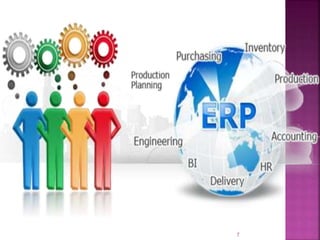
 Enterprise resource planning systems (ERP)
are management information systems that
integrate and automate many of the business
practices associated with the operations or
production aspects of a company
 These typically include manufacturing,
logistics, Distribution, inventory, shipping,
invoicing and accounting
9
 ERP is the technological backbone of e-
business, an enterprise-wide transaction
framework with links into sales order
processing, inventory management and
control, production and distribution planning
and finance.
10
 Before year 1960 : business has to depends
on classical inventory management of
scientific inventory control
 In Year 1960 : The concept of ERP was
limited to the fact that organizations want to
integrate functions and department s to
increase revenue
11
 Year 1970: the focus shifted to material
requirement – Material requirements planning
systems developed
 Year 1980: MRP II (materials requirement planning
II) included areas such as project management,
shop floor and distribution management
 Year 1990: Enterprise wide inter functional co-
ordination and integration
 Year 2000: Extended ERP came into market which
offers extended services
12
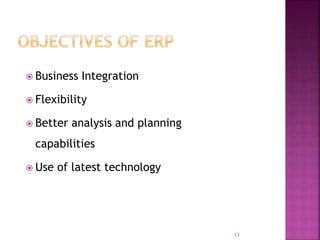
 Business Integration
 Flexibility
 Better analysis and planning
capabilities
 Use of latest technology
13
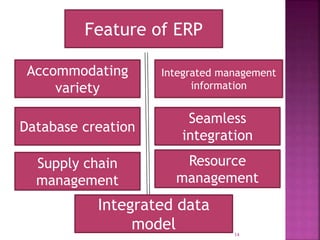
Feature of ERP
Accommodating
variety
Database creation
Supply chain
management
Resource
management
Seamless
integration
Integrated management
information
Integrated data
model 14
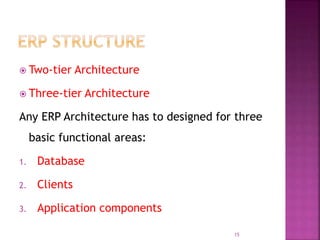
 Two-tier Architecture
 Three-tier Architecture
Any ERP Architecture has to designed for three
basic functional areas:
1. Database
2. Clients
3. Application components
15
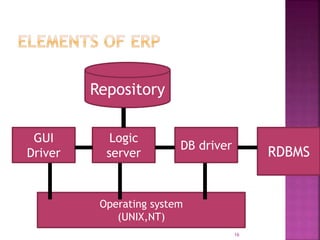
Repository
GUI
Driver RDBMS
Logic
server
DB driver
Operating system
(UNIX,NT)
16
 Risk is a problem that has not yet happened
but which could cause some loss or threaten
the success of project if it did
Types of risks:
1. People risks
2. Process risks
3. Technology risks
17
 People – employees, management, implementation
team, consultants and vendors
Risks related to people:
1. Change management
2. Internal staff adequacy
3. Training
4. Employee relocation and re-training
5. Top management support
6. Discipline
7. Resistance to change
18
 Programme management
 Business process reengineering
 Stage transition
 Benefit realization
19
 Software functionality
 Technological obsolescence
 Application portfolio management
 Enhancement /upgrades
20
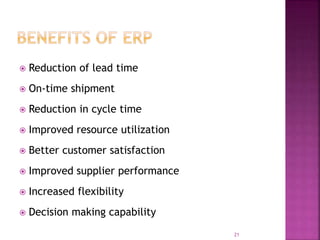
 Reduction of lead time
 On-time shipment
 Reduction in cycle time
 Improved resource utilization
 Better customer satisfaction
 Improved supplier performance
 Increased flexibility
 Decision making capability
21
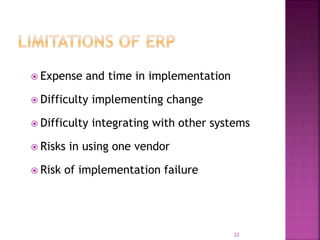
 Expense and time in implementation
 Difficulty implementing change
 Difficulty integrating with other systems
 Risks in using one vendor
 Risk of implementation failure
22
23
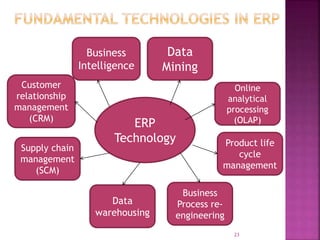
ERP
Technology
Customer
relationship
management
(CRM)
Business
Intelligence
Supply chain
management
(SCM)
Data
warehousing
Business
Process re-
engineering
Product life
cycle
management
Online
analytical
processing
(OLAP)
Data
Mining
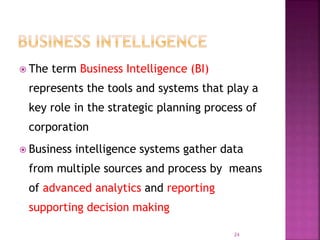
 The term Business Intelligence (BI)
represents the tools and systems that play a
key role in the strategic planning process of
corporation
 Business intelligence systems gather data
from multiple sources and process by means
of advanced analytics and reporting
supporting decision making
24
 “A data warehousing is subject oriented
integrated non-volatile, time varying collection
of data in support of its decision making
process”
Characteristics:
1. Subject oriented
2. Integrity
3. Time variant
4. Non - volatile
25
 Data mining or Knowledge Discovery in Database
(KDD), is the nontrivial extraction of implicit,
previously unknown and potentially useful
information from data.
 This encompasses a number of different
technical approaches, such as clustering, data
summarization, learning classification rules,
finding dependency networks, analyzing changes
and detecting anomalies
26
 Online analytical processing (OLAP) is a method
of analyzing data in a multi-dimensional format,
often across multiple time periods, with the aim
of uncovering the business information
concealed within the data
 OLAP defined as “The dynamic synthesis,
analysis and consolidation of large volumes of
multidimensional data”
27
 Business process re-engineering is a fundamental
rethinking and radical redesign of business
processes to achieve dramatic improvements in
cost, quality, speed and service.
 BRP defined as “ BRP encompasses the
envisioning of new work strategies, the actual
process design activity, and the implementation
of the change in all its complex technological,
human and organizational dimensions.
28
 PLM is a strategic business approach that
applies a consistent set of business solutions
in support of the collaborative creation,
management, dissemination and use of
product definition information across the
extended enterprise and spanning from
product concept to end of life
29
 Supply chain management is the systematic,
strategic co-ordination of the traditional
business functions and tactics across these
business functions within a particular
company and across business within the
supply chain, for the purpose of improving
the long-term performance of the individual
companies and the supply chain as whole.
30
 CRM (Customer relationship management) is
a comprehensive strategy and process of
acquiring, retaining and partnering with
selective customers to create value for the
company and the selective customers to
create superior value for the company and
the customers
31
1. Use of external consultants
2. Supplier relationship management
3. Business measures
4. User training
5. Project size
6. Length implementation time
32
7. High initial investment
8. Unreasonable deadlines
9. Insufficient funding
10. Interface
11. Organizational politics
12. Unexpected gaps
13. Configuration difficulties
33
 Expense and time in implementation
 Difficulty implementing change
 Customization
 Difficulty integrating with other systems
 Risks in using one vendor
 Risk of implementation failure
 Management reporting needs
 Technological challenges
34
35

Enterprise Resource planning unit 1 introduction

  • 1.
    Prepared and presentedby, N. Ganesha Pandian, Assistant professor, Madurai School of management. IIyearIIISemester Academicyear2017-2018 1
  • 2.
     Overview ofenterprise systems  Evolution of ERP  Risks and benefits  Fundamental technology  Issues to be consider in planning design  And implementation of cross functional integrated ERP systems 2
  • 3.
     Enterprise resemblesa group of people with a common goal. It has certain resources at its disposal to achieve the goal.  Enterprise system (ES) is an ideology of planning and managing the resources of an entire organization in an efficient, productive and profitable manner, and is manifested in the form of configurable information system packages. 3
  • 4.
     Information systemis a set of people, procedures and resources that collects, transforms and disseminates information in an organization.  “An Information system (IS) can be organized combination of people, hardware, software, communication networks; and data resources that stores and retrieves, transform and disseminate information in an organization” 4
  • 5.
  • 6.
     Collect data Store and process data  Present information to managers/users 6
  • 7.
  • 8.
     Business modelingis the activity of representing processes of an enterprise, so that the current process may be analyzed and improved  Business modeling (creation of business model) is considered as the first activity in any ERP project  A business model describes the rationale of how an organization creates, delivers and captures value. 8
  • 9.
     Enterprise resourceplanning systems (ERP) are management information systems that integrate and automate many of the business practices associated with the operations or production aspects of a company  These typically include manufacturing, logistics, Distribution, inventory, shipping, invoicing and accounting 9
  • 10.
     ERP isthe technological backbone of e- business, an enterprise-wide transaction framework with links into sales order processing, inventory management and control, production and distribution planning and finance. 10
  • 11.
     Before year1960 : business has to depends on classical inventory management of scientific inventory control  In Year 1960 : The concept of ERP was limited to the fact that organizations want to integrate functions and department s to increase revenue 11
  • 12.
     Year 1970:the focus shifted to material requirement – Material requirements planning systems developed  Year 1980: MRP II (materials requirement planning II) included areas such as project management, shop floor and distribution management  Year 1990: Enterprise wide inter functional co- ordination and integration  Year 2000: Extended ERP came into market which offers extended services 12
  • 13.
     Business Integration Flexibility  Better analysis and planning capabilities  Use of latest technology 13
  • 14.
    Feature of ERP Accommodating variety Databasecreation Supply chain management Resource management Seamless integration Integrated management information Integrated data model 14
  • 15.
     Two-tier Architecture Three-tier Architecture Any ERP Architecture has to designed for three basic functional areas: 1. Database 2. Clients 3. Application components 15
  • 16.
  • 17.
     Risk isa problem that has not yet happened but which could cause some loss or threaten the success of project if it did Types of risks: 1. People risks 2. Process risks 3. Technology risks 17
  • 18.
     People –employees, management, implementation team, consultants and vendors Risks related to people: 1. Change management 2. Internal staff adequacy 3. Training 4. Employee relocation and re-training 5. Top management support 6. Discipline 7. Resistance to change 18
  • 19.
     Programme management Business process reengineering  Stage transition  Benefit realization 19
  • 20.
     Software functionality Technological obsolescence  Application portfolio management  Enhancement /upgrades 20
  • 21.
     Reduction oflead time  On-time shipment  Reduction in cycle time  Improved resource utilization  Better customer satisfaction  Improved supplier performance  Increased flexibility  Decision making capability 21
  • 22.
     Expense andtime in implementation  Difficulty implementing change  Difficulty integrating with other systems  Risks in using one vendor  Risk of implementation failure 22
  • 23.
  • 24.
     The termBusiness Intelligence (BI) represents the tools and systems that play a key role in the strategic planning process of corporation  Business intelligence systems gather data from multiple sources and process by means of advanced analytics and reporting supporting decision making 24
  • 25.
     “A datawarehousing is subject oriented integrated non-volatile, time varying collection of data in support of its decision making process” Characteristics: 1. Subject oriented 2. Integrity 3. Time variant 4. Non - volatile 25
  • 26.
     Data miningor Knowledge Discovery in Database (KDD), is the nontrivial extraction of implicit, previously unknown and potentially useful information from data.  This encompasses a number of different technical approaches, such as clustering, data summarization, learning classification rules, finding dependency networks, analyzing changes and detecting anomalies 26
  • 27.
     Online analyticalprocessing (OLAP) is a method of analyzing data in a multi-dimensional format, often across multiple time periods, with the aim of uncovering the business information concealed within the data  OLAP defined as “The dynamic synthesis, analysis and consolidation of large volumes of multidimensional data” 27
  • 28.
     Business processre-engineering is a fundamental rethinking and radical redesign of business processes to achieve dramatic improvements in cost, quality, speed and service.  BRP defined as “ BRP encompasses the envisioning of new work strategies, the actual process design activity, and the implementation of the change in all its complex technological, human and organizational dimensions. 28
  • 29.
     PLM isa strategic business approach that applies a consistent set of business solutions in support of the collaborative creation, management, dissemination and use of product definition information across the extended enterprise and spanning from product concept to end of life 29
  • 30.
     Supply chainmanagement is the systematic, strategic co-ordination of the traditional business functions and tactics across these business functions within a particular company and across business within the supply chain, for the purpose of improving the long-term performance of the individual companies and the supply chain as whole. 30
  • 31.
     CRM (Customerrelationship management) is a comprehensive strategy and process of acquiring, retaining and partnering with selective customers to create value for the company and the selective customers to create superior value for the company and the customers 31
  • 32.
    1. Use ofexternal consultants 2. Supplier relationship management 3. Business measures 4. User training 5. Project size 6. Length implementation time 32
  • 33.
    7. High initialinvestment 8. Unreasonable deadlines 9. Insufficient funding 10. Interface 11. Organizational politics 12. Unexpected gaps 13. Configuration difficulties 33
  • 34.
     Expense andtime in implementation  Difficulty implementing change  Customization  Difficulty integrating with other systems  Risks in using one vendor  Risk of implementation failure  Management reporting needs  Technological challenges 34
  • 35.