Resource-Based View
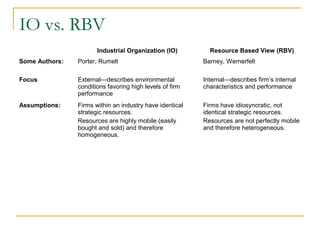
IO vs. RBV
                       Industrial Organization (IO)         Resource Based View (RBV)
Some Authors:   Porter, Rumelt                            Barney, Wernerfelt

Focus           External—describes environmental          Internal—describes firm’s internal
                conditions favoring high levels of firm   characteristics and performance
                performance
Assumptions:    Firms within an industry have identical   Firms have idiosyncratic, not
                strategic resources.                      identical strategic resources.
                Resources are highly mobile (easily       Resources are not perfectly mobile
                bought and sold) and therefore            and therefore heterogeneous.
                homogeneous.
Business Level Strategy
   How do we compete in a specific business
    arena?
   Four objectives of business-level strategy
       Generate sustainable competitive advantages
       Develop and nurture (potentially) valuable
        capabilities
       Respond to environmental changes
       Approval of functional level strategies
Business-Level Strategy
   The primary objective of business-level
    strategy is to create “sources of sustainable
    competitive advantage”.

   What is sustainable competitive advantage?
       There are many definitions, used by different
        people in different ways.
       What follows is a practical description. But first,
        we need to back up a bit…
Sustainable Competitive Advantage

   An asset is anything the firm owns or controls.
       Loosely, “Asset” is to Accounting as “Resource” is to
        Management.
   Types of assets:
       Physical: plant equipment, location, access to raw materials
       Human: training, experience, judgment, decision-making skills,
        intelligence, relationships, knowledge
       Organizational: Culture, formal reporting structures, control
        systems, coordinating systems, informal relationships
Sustainable Competitive Advantage
   A capability is usually considered a “bundle” of assets or resources
    to perform a business process (which is composed of individual
    activities)
     E.g. The product development process involves conceptualization,

       product design, pilot testing, new product launch in production,
       process debugging, etc.

   All firms have capabilities. However, a firm will usually focus on
    certain capabilities consistent with its strategy.
     For example, a firm pursuing a differentiation strategy would focus

       on new product development. A firm focusing on a low cost
       strategy would focus on improving manufacturing process
       efficiency.

   The firm’s most important capabilities are called competencies.
Competencies vs. Core Competencies vs.
    Distinctive Competencies
   A competency is an internal capability that a
    company performs better than other internal
    capabilities.
   A core competency is a well-performed internal
    capability that is central, not peripheral, to a
    company’s strategy, competitiveness, and
    profitability.
   A distinctive competence is a competitively
    valuable capability that a company performs
    better than its rivals.
Examples: Distinctive Competencies
   Toyota, Honda, Nissan
        Low-cost, high-quality manufacturing capability and short
         design-to-market cycles
   Intel
        Ability to design and manufacture ever more powerful
         microprocessors for PCs
   Motorola
        Defect-free manufacture (six-sigma quality) of cell phones
Where are we?
   We are discussing sustainable competitive
    advantage, and have defined Competencies:
       AssetsCapabilitiesCompetenciesCompetitive Advantage
   Next is competitive advantage.
       A competitive advantage is simply an advantage you have
        over your competitors.
       A competency will produce competitive advantage
        provided:
           A) it produces value for the organization, and
           B) it does this in a way that cannot easily be pursued by
              competitors.
Sustainable Competitive Advantage
        However, we said the primary objective of business-
         level strategy was to create sources of sustainable
         competitive advantage (SCA).

        How do we know SCA when we see it? What is it?
         When is it considered “sustainable”?

        To produce SCA, the capability must:
    1.    Produce value
    2.    Be rare
    3.    Imperfectly imitable, i.e. not be easily imitated or substituted
    4.    Be exploitable by the organization
Sustainable Competitive Advantage
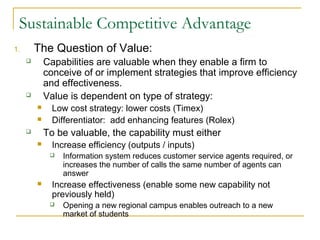
1.       The Question of Value:
            Capabilities are valuable when they enable a firm to
             conceive of or implement strategies that improve efficiency
             and effectiveness.
            Value is dependent on type of strategy:
              Low cost strategy: lower costs (Timex)
              Differentiator: add enhancing features (Rolex)
            To be valuable, the capability must either
              Increase efficiency (outputs / inputs)
                 Information system reduces customer service agents required, or
                  increases the number of calls the same number of agents can
                  answer
              Increase effectiveness (enable some new capability not
               previously held)
                 Opening a new regional campus enables outreach to a new
                  market of students
Sustainable Competitive Advantage
2.     The Question of Rareness:
       Valuable resources or capabilities that are shared
        by large numbers of firms in an industry are
        therefore not rare, and cannot be a source of
        SCA.
       Given the following, which are rare?
             A web server
             An MIS instructor
             A state-of-the-art stamping press
            None of these are rare. Some researchers think
             only organizational assets or resources are rare
             (such as culture). What do you think?
Sustainable Competitive Advantage
3.       The Question of Imitability
          Valuable, rare resources can only be sources of SCA if firms
           that do not possess them cannot obtain them. They must be
           “imperfectly imitable”, i.e. impossible to perfectly imitate
           them.
          Ways imitation can be avoided:
            Unique Historical Conditions (Caterpillar, e.g.)
            Causal Ambiguity (why resources create SCA is not
             understood, even by the firm owning them)
                Imitating firms cannot duplicate the strategy since they do not
                 understand why it is successful in the first place.
            Social Complexity (trust, teamwork, informal relationships,
             causal ambiguity where cause of effectiveness is uncertain)
              E.g. A competitor steals all the scientists in an R&D lab and
               relocates them to a new facility. But, the “dynamics”, “culture”
               and “atmosphere” are not the same.
Sustainable Competitive Advantage
4.   The Question of Substitutability
        There must be no equivalent resources that can be
         exploited to implement the same strategies.
        Forms of substitutability:
            Duplication: Although no two management teams are the
             same, they can be strategically equivalent, produce the
             same results.
            Substitution: Very different resources can be substitutes,
             e.g.
                 A charismatic leader with a clear vision vs. a strategic planning
                 dept.
                 A superior marketing strategy for a recognized brand name.
                 A superior technical support group for an intelligent diagnostic
                 software package
Sustainable Competitive Advantage

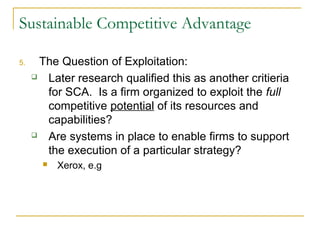
5.     The Question of Exploitation:
       Later research qualified this as another critieria
        for SCA. Is a firm organized to exploit the full
        competitive potential of its resources and
        capabilities?
       Are systems in place to enable firms to support
        the execution of a particular strategy?
          Xerox, e.g
Notes on “Sustainable”

   Sustainable is not measured in calendar time.
   Sustainable does not mean the advantage
    will last forever.
   Sustainable suggests the advantage lasts
    long enough that competitors stop trying to
    duplicate the strategy that makes the
    advantage sustained.
Economic Performance
                               Exploited by
                   Costly to
                               the             Competitive    Economic
Valuable           Imitate?
           Rare?               Organization?   Implications   Performance
?

                                               Competitive
No         --      --          --                             Below Normal
                                               Disadvantage

                                               Competitive
Yes        No      --          --                             Normal
                                               Parity

                                               Temporary
Yes        Yes     No          --              Competitive    Above Normal
                                               Advantage

                                               Sustained
Yes        Yes     Yes         Yes             Competitive    Above Normal
                                               Advantage

Rbv

  • 1.
  • 2.
    IO vs. RBV Industrial Organization (IO) Resource Based View (RBV) Some Authors: Porter, Rumelt Barney, Wernerfelt Focus External—describes environmental Internal—describes firm’s internal conditions favoring high levels of firm characteristics and performance performance Assumptions: Firms within an industry have identical Firms have idiosyncratic, not strategic resources. identical strategic resources. Resources are highly mobile (easily Resources are not perfectly mobile bought and sold) and therefore and therefore heterogeneous. homogeneous.
  • 3.
    Business Level Strategy  How do we compete in a specific business arena?  Four objectives of business-level strategy  Generate sustainable competitive advantages  Develop and nurture (potentially) valuable capabilities  Respond to environmental changes  Approval of functional level strategies
  • 4.
    Business-Level Strategy  The primary objective of business-level strategy is to create “sources of sustainable competitive advantage”.  What is sustainable competitive advantage?  There are many definitions, used by different people in different ways.  What follows is a practical description. But first, we need to back up a bit…
  • 5.
    Sustainable Competitive Advantage  An asset is anything the firm owns or controls.  Loosely, “Asset” is to Accounting as “Resource” is to Management.  Types of assets:  Physical: plant equipment, location, access to raw materials  Human: training, experience, judgment, decision-making skills, intelligence, relationships, knowledge  Organizational: Culture, formal reporting structures, control systems, coordinating systems, informal relationships
  • 6.
    Sustainable Competitive Advantage  A capability is usually considered a “bundle” of assets or resources to perform a business process (which is composed of individual activities)  E.g. The product development process involves conceptualization, product design, pilot testing, new product launch in production, process debugging, etc.  All firms have capabilities. However, a firm will usually focus on certain capabilities consistent with its strategy.  For example, a firm pursuing a differentiation strategy would focus on new product development. A firm focusing on a low cost strategy would focus on improving manufacturing process efficiency.  The firm’s most important capabilities are called competencies.
  • 7.
    Competencies vs. CoreCompetencies vs. Distinctive Competencies  A competency is an internal capability that a company performs better than other internal capabilities.  A core competency is a well-performed internal capability that is central, not peripheral, to a company’s strategy, competitiveness, and profitability.  A distinctive competence is a competitively valuable capability that a company performs better than its rivals.
  • 8.
    Examples: Distinctive Competencies  Toyota, Honda, Nissan  Low-cost, high-quality manufacturing capability and short design-to-market cycles  Intel  Ability to design and manufacture ever more powerful microprocessors for PCs  Motorola  Defect-free manufacture (six-sigma quality) of cell phones
  • 9.
    Where are we?  We are discussing sustainable competitive advantage, and have defined Competencies:  AssetsCapabilitiesCompetenciesCompetitive Advantage  Next is competitive advantage.  A competitive advantage is simply an advantage you have over your competitors.  A competency will produce competitive advantage provided: A) it produces value for the organization, and B) it does this in a way that cannot easily be pursued by competitors.
  • 10.
    Sustainable Competitive Advantage  However, we said the primary objective of business- level strategy was to create sources of sustainable competitive advantage (SCA).  How do we know SCA when we see it? What is it? When is it considered “sustainable”?  To produce SCA, the capability must: 1. Produce value 2. Be rare 3. Imperfectly imitable, i.e. not be easily imitated or substituted 4. Be exploitable by the organization
  • 11.
    Sustainable Competitive Advantage 1. The Question of Value:  Capabilities are valuable when they enable a firm to conceive of or implement strategies that improve efficiency and effectiveness.  Value is dependent on type of strategy:  Low cost strategy: lower costs (Timex)  Differentiator: add enhancing features (Rolex)  To be valuable, the capability must either  Increase efficiency (outputs / inputs)  Information system reduces customer service agents required, or increases the number of calls the same number of agents can answer  Increase effectiveness (enable some new capability not previously held)  Opening a new regional campus enables outreach to a new market of students
  • 12.
    Sustainable Competitive Advantage 2. The Question of Rareness:  Valuable resources or capabilities that are shared by large numbers of firms in an industry are therefore not rare, and cannot be a source of SCA.  Given the following, which are rare?  A web server  An MIS instructor  A state-of-the-art stamping press  None of these are rare. Some researchers think only organizational assets or resources are rare (such as culture). What do you think?
  • 13.
    Sustainable Competitive Advantage 3. The Question of Imitability  Valuable, rare resources can only be sources of SCA if firms that do not possess them cannot obtain them. They must be “imperfectly imitable”, i.e. impossible to perfectly imitate them.  Ways imitation can be avoided:  Unique Historical Conditions (Caterpillar, e.g.)  Causal Ambiguity (why resources create SCA is not understood, even by the firm owning them)  Imitating firms cannot duplicate the strategy since they do not understand why it is successful in the first place.  Social Complexity (trust, teamwork, informal relationships, causal ambiguity where cause of effectiveness is uncertain)  E.g. A competitor steals all the scientists in an R&D lab and relocates them to a new facility. But, the “dynamics”, “culture” and “atmosphere” are not the same.
  • 14.
    Sustainable Competitive Advantage 4. The Question of Substitutability  There must be no equivalent resources that can be exploited to implement the same strategies.  Forms of substitutability:  Duplication: Although no two management teams are the same, they can be strategically equivalent, produce the same results.  Substitution: Very different resources can be substitutes, e.g.  A charismatic leader with a clear vision vs. a strategic planning dept.  A superior marketing strategy for a recognized brand name.  A superior technical support group for an intelligent diagnostic software package
  • 15.
    Sustainable Competitive Advantage 5. The Question of Exploitation:  Later research qualified this as another critieria for SCA. Is a firm organized to exploit the full competitive potential of its resources and capabilities?  Are systems in place to enable firms to support the execution of a particular strategy?  Xerox, e.g
  • 16.
    Notes on “Sustainable”  Sustainable is not measured in calendar time.  Sustainable does not mean the advantage will last forever.  Sustainable suggests the advantage lasts long enough that competitors stop trying to duplicate the strategy that makes the advantage sustained.
  • 17.
    Economic Performance Exploited by Costly to the Competitive Economic Valuable Imitate? Rare? Organization? Implications Performance ? Competitive No -- -- -- Below Normal Disadvantage Competitive Yes No -- -- Normal Parity Temporary Yes Yes No -- Competitive Above Normal Advantage Sustained Yes Yes Yes Yes Competitive Above Normal Advantage