



VERTIGO & The Epley Manoeuvre Dr Colin Mitchell SpR Geriatrics / GIM MSc Geriatric Medicine  (Special Senses Module)
Objectives Differentiate the causes and clinical features of central and peripheral vertigo Review the pathophysiology of BPPV Explain the methods of the Hallpike and Epley Manoeuvres Examine the evidence for the Epley manoeuvre
Vertigo Illusion of motion Subjective / Objective Caused by vestibular system failure:  Inner ear Vestibular nerve (CN8) Brainstem Cerebellum
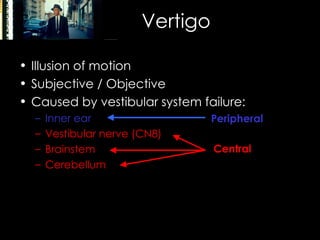
Vertigo Illusion of motion Subjective / Objective Caused by vestibular system failure:  Inner ear Vestibular nerve (CN8) Brainstem Cerebellum Peripheral Central
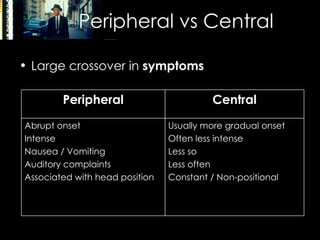
Peripheral vs Central Large crossover in  symptoms Peripheral Central Abrupt onset Intense Nausea / Vomiting Auditory complaints Associated with head position Usually more gradual onset Often less intense Less so Less often Constant / Non-positional
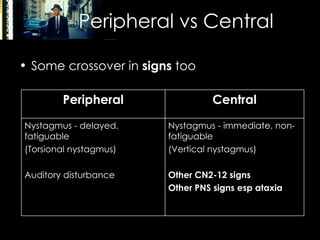
Peripheral vs Central Some crossover in  signs  too Peripheral Central Nystagmus - delayed, fatiguable (Torsional nystagmus) Auditory disturbance Nystagmus - immediate, non-fatiguable  (Vertical nystagmus) Other CN2-12 signs Other PNS signs esp ataxia
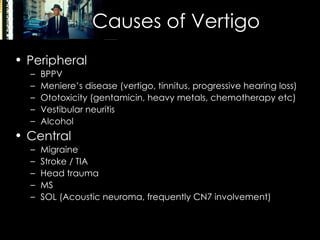
Causes of Vertigo Peripheral BPPV Meniere’s disease (vertigo, tinnitus, progressive hearing loss) Ototoxicity (gentamicin, heavy metals, chemotherapy etc) Vestibular neuritis Alcohol Central Migraine Stroke / TIA Head trauma MS SOL (Acoustic neuroma, frequently CN7 involvement)
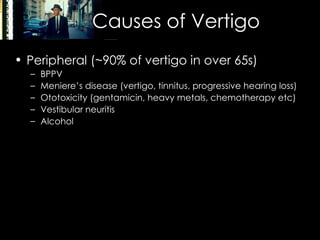
Causes of Vertigo Peripheral (~90% of vertigo in over 65s) BPPV Meniere’s disease (vertigo, tinnitus, progressive hearing loss) Ototoxicity (gentamicin, heavy metals, chemotherapy etc) Vestibular neuritis Alcohol Central (~10%) Migraine Stroke / TIA Head trauma MS SOL (Acoustic neuroma, frequently CN7 involvement)
Causes of Vertigo Peripheral (~90% of vertigo in over 65s) BPPV (~20-50% of vertigo in over 65s) Meniere’s disease (vertigo, tinnitus, progressive hearing loss) Ototoxicity (gentamicin, heavy metals, chemotherapy etc) Vestibular neuritis Alcohol Central (~10%) Migraine Stroke / TIA Head trauma MS SOL (Acoustic neuroma, frequently CN7 involvement)
“ Benign” Paroxysmal Positional Vertigo
BPPV Commonest cause of vertigo (20-50%) Accounts for ~8-9% of  all  mod/sev dizziness History taking up to 90% predictive Episodic, self limiting, assoc with nausea Occurs with head movement Hallpike test used to clinch diagnosis Neurological exam normal 30-50% resolve spontaneously 50% recurrent (no predictive indicators)
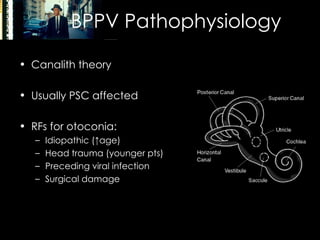
BPPV Pathophysiology Canalith theory Usually PSC affected RFs for otoconia: Idiopathic (↑age) Head trauma (younger pts) Preceding viral infection Surgical damage
Hallpike Test Hallpike’s test was developed in the 1950s Lay patient down with head below bed level Turn head 45 °  to one side, observe for nystagmus Repeat to other side,  note affected side In a positive test, nystagmus is  delayed  (usually 5-10s) torsional fatiguable
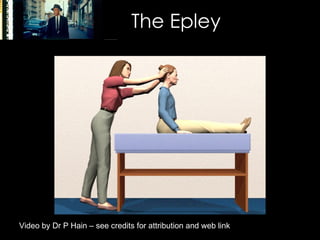
The Epley Manoeuvre Canalith repositioning (PSC) Developed in 1992 by Dr John Epley 40-80% improved after manoeuvre Better results with multiple treatments Controversy over when to repeat Avoid if limited neck mobility  No significant adverse effects ? Mastoid Vibration
The Epley Patient starts sitting up, head forward Turn head 45 °  to affected side (eg left) Lie flat, head below bed level Turn head 90 °, now  facing 45 °   to opposite side (right) Roll patient onto right side (face to the floor) Sit patient up (head still to the right) Lean head forward, chin down Advise patient to sleep upright for 2 days, and avoid provoking movements for 1 week
The Epley Video by Dr P Hain – see credits for attribution and web link
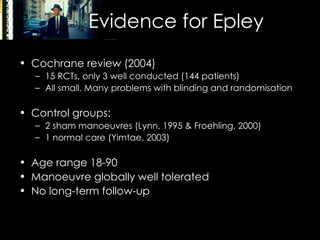
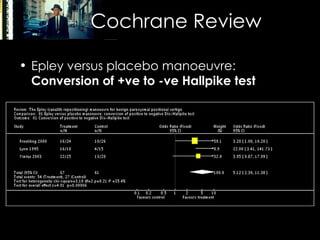
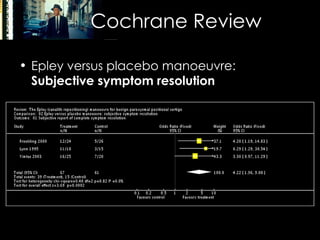
Evidence for Epley Cochrane review (2004) 15 RCTs, only 3 well conducted (144 patients) All small. Many problems with blinding and randomisation Control groups: 2 sham manoeuvres (Lynn, 1995 & Froehling, 2000) 1 normal care (Yimtae, 2003) Age range 18-90 Manoeuvre globally well tolerated No long-term follow-up
Cochrane Review Epley versus placebo manoeuvre:  Conversion of +ve to -ve Hallpike test
Cochrane Review Epley versus placebo manoeuvre:  Subjective symptom resolution
Non-specialists Munoz et al, 2007 Double blinded RCT by Canadian GPs 81 patients >18 yrs with positive Hallpike Epley vs sham manoeuvre After one treatment, 34.2% of treatment group hallpike resolved vs 14.6% in control RR 2.3 (CI 1.03 – 5.2, P=.04) Non-significant trend in symptom resolution also favoured Epley
Other Treatments Semont manoeuvre Brandt-Daroff exercises Dizzyfix Surgical Little pharmacological role
Summary Clinical differentiation of central vs peripheral vertigo is important: Central vertigo requires investigation Peripheral vertigo is often self limiting BPPV can be diagnosed and treated in the clinic by non-specialists The Epley manoeuvre works for BPPV But most need repeat treatment
Question Time
References Epidemiology of dizziness: Oghalai JS et al (2000), Unrecognized BPPV in elderly patients. Otolayngology and Head & Neck Surgery, 122(5): 630-634 Uneri A, Polat S (2008), Vertigo, dizziness and imbalance in the elderly. Jounral of Laryngology and Otology, 122(5): 466-469 Hansson EE et al (2005), BPPV among elderly patient in primary health care. Gerontology, 51(6): 386-389 Von Brevern et al (2006), Epidemiology of BPPV: a population based study. Journal of Neurology, Neurosurgery and Psychiatry, 78: 710-715 Epley maneouvre evidence: Hilton M, Pinder D (2004). The Epley (canalith repositioning) manoeuvre for benign paroxysmal positional vertigo. Cochrane Database of Systematic Reviews 2004, Issue 2. Art. No.: CD003162. DOI: 10.1002/14651858.CD003162.pub2   Munoz et al (2007). Canalith repositioning maneuver for BPPV – RCT in family practice. Canadian Family Physician 53:1048-1053 Semicircular canal picture (Public domain) from NIH website http://www.nidcd.nih.gov/health/balance/balance_disorders.asp Epley manoeuvre video (C) Dr P Hain (30/4/08) http://www.dizziness-and-balance.com/sitedvd.htm Vertigo Optical Illusion from  http://pos-psych.com/wp-content/uploads/2007/05/vertigo-new.jpg Screenshots from Vertigo are copyright Universal Pictures, reproduced under Fair Use as the film is a culturally significant demonstration of the effects of vertigo.

BPPV & The Epley Maneouvre / Maneuver

  • 1.
  • 2.
    VERTIGO & TheEpley Manoeuvre Dr Colin Mitchell SpR Geriatrics / GIM MSc Geriatric Medicine (Special Senses Module)
  • 3.
    Objectives Differentiate thecauses and clinical features of central and peripheral vertigo Review the pathophysiology of BPPV Explain the methods of the Hallpike and Epley Manoeuvres Examine the evidence for the Epley manoeuvre
  • 4.
    Vertigo Illusion ofmotion Subjective / Objective Caused by vestibular system failure: Inner ear Vestibular nerve (CN8) Brainstem Cerebellum
  • 5.
    Vertigo Illusion ofmotion Subjective / Objective Caused by vestibular system failure: Inner ear Vestibular nerve (CN8) Brainstem Cerebellum Peripheral Central
  • 6.
    Peripheral vs CentralLarge crossover in symptoms Peripheral Central Abrupt onset Intense Nausea / Vomiting Auditory complaints Associated with head position Usually more gradual onset Often less intense Less so Less often Constant / Non-positional
  • 7.
    Peripheral vs CentralSome crossover in signs too Peripheral Central Nystagmus - delayed, fatiguable (Torsional nystagmus) Auditory disturbance Nystagmus - immediate, non-fatiguable (Vertical nystagmus) Other CN2-12 signs Other PNS signs esp ataxia
  • 8.
    Causes of VertigoPeripheral BPPV Meniere’s disease (vertigo, tinnitus, progressive hearing loss) Ototoxicity (gentamicin, heavy metals, chemotherapy etc) Vestibular neuritis Alcohol Central Migraine Stroke / TIA Head trauma MS SOL (Acoustic neuroma, frequently CN7 involvement)
  • 9.
    Causes of VertigoPeripheral (~90% of vertigo in over 65s) BPPV Meniere’s disease (vertigo, tinnitus, progressive hearing loss) Ototoxicity (gentamicin, heavy metals, chemotherapy etc) Vestibular neuritis Alcohol Central (~10%) Migraine Stroke / TIA Head trauma MS SOL (Acoustic neuroma, frequently CN7 involvement)
  • 10.
    Causes of VertigoPeripheral (~90% of vertigo in over 65s) BPPV (~20-50% of vertigo in over 65s) Meniere’s disease (vertigo, tinnitus, progressive hearing loss) Ototoxicity (gentamicin, heavy metals, chemotherapy etc) Vestibular neuritis Alcohol Central (~10%) Migraine Stroke / TIA Head trauma MS SOL (Acoustic neuroma, frequently CN7 involvement)
  • 11.
    “ Benign” ParoxysmalPositional Vertigo
  • 12.
    BPPV Commonest causeof vertigo (20-50%) Accounts for ~8-9% of all mod/sev dizziness History taking up to 90% predictive Episodic, self limiting, assoc with nausea Occurs with head movement Hallpike test used to clinch diagnosis Neurological exam normal 30-50% resolve spontaneously 50% recurrent (no predictive indicators)
  • 13.
    BPPV Pathophysiology Canaliththeory Usually PSC affected RFs for otoconia: Idiopathic (↑age) Head trauma (younger pts) Preceding viral infection Surgical damage
  • 14.
    Hallpike Test Hallpike’stest was developed in the 1950s Lay patient down with head below bed level Turn head 45 ° to one side, observe for nystagmus Repeat to other side, note affected side In a positive test, nystagmus is delayed (usually 5-10s) torsional fatiguable
  • 15.
    The Epley ManoeuvreCanalith repositioning (PSC) Developed in 1992 by Dr John Epley 40-80% improved after manoeuvre Better results with multiple treatments Controversy over when to repeat Avoid if limited neck mobility No significant adverse effects ? Mastoid Vibration
  • 16.
    The Epley ManoeuvreCanalith repositioning (PSC) Developed in 1992 by Dr John Epley 40-80% improved after manoeuvre Better results with multiple treatments Controversy over when to repeat Avoid if limited neck mobility No significant adverse effects ? Mastoid Vibration
  • 17.
    The Epley Patientstarts sitting up, head forward Turn head 45 ° to affected side (eg left) Lie flat, head below bed level Turn head 90 °, now facing 45 ° to opposite side (right) Roll patient onto right side (face to the floor) Sit patient up (head still to the right) Lean head forward, chin down Advise patient to sleep upright for 2 days, and avoid provoking movements for 1 week
  • 18.
    The Epley Patientstarts sitting up, head forward Turn head 45 ° to affected side (eg left) Lie flat, head below bed level Turn head 90 °, now facing 45 ° to opposite side (right) Roll patient onto right side (face to the floor) Sit patient up (head still to the right) Lean head forward, chin down Advise patient to sleep upright for 2 days, and avoid provoking movements for 1 week
  • 19.
    The Epley Videoby Dr P Hain – see credits for attribution and web link
  • 20.
    Evidence for EpleyCochrane review (2004) 15 RCTs, only 3 well conducted (144 patients) All small. Many problems with blinding and randomisation Control groups: 2 sham manoeuvres (Lynn, 1995 & Froehling, 2000) 1 normal care (Yimtae, 2003) Age range 18-90 Manoeuvre globally well tolerated No long-term follow-up
  • 21.
    Cochrane Review Epleyversus placebo manoeuvre: Conversion of +ve to -ve Hallpike test
  • 22.
    Cochrane Review Epleyversus placebo manoeuvre: Subjective symptom resolution
  • 23.
    Non-specialists Munoz etal, 2007 Double blinded RCT by Canadian GPs 81 patients >18 yrs with positive Hallpike Epley vs sham manoeuvre After one treatment, 34.2% of treatment group hallpike resolved vs 14.6% in control RR 2.3 (CI 1.03 – 5.2, P=.04) Non-significant trend in symptom resolution also favoured Epley
  • 24.
    Other Treatments Semontmanoeuvre Brandt-Daroff exercises Dizzyfix Surgical Little pharmacological role
  • 25.
    Summary Clinical differentiationof central vs peripheral vertigo is important: Central vertigo requires investigation Peripheral vertigo is often self limiting BPPV can be diagnosed and treated in the clinic by non-specialists The Epley manoeuvre works for BPPV But most need repeat treatment
  • 26.
  • 27.
    References Epidemiology ofdizziness: Oghalai JS et al (2000), Unrecognized BPPV in elderly patients. Otolayngology and Head & Neck Surgery, 122(5): 630-634 Uneri A, Polat S (2008), Vertigo, dizziness and imbalance in the elderly. Jounral of Laryngology and Otology, 122(5): 466-469 Hansson EE et al (2005), BPPV among elderly patient in primary health care. Gerontology, 51(6): 386-389 Von Brevern et al (2006), Epidemiology of BPPV: a population based study. Journal of Neurology, Neurosurgery and Psychiatry, 78: 710-715 Epley maneouvre evidence: Hilton M, Pinder D (2004). The Epley (canalith repositioning) manoeuvre for benign paroxysmal positional vertigo. Cochrane Database of Systematic Reviews 2004, Issue 2. Art. No.: CD003162. DOI: 10.1002/14651858.CD003162.pub2 Munoz et al (2007). Canalith repositioning maneuver for BPPV – RCT in family practice. Canadian Family Physician 53:1048-1053 Semicircular canal picture (Public domain) from NIH website http://www.nidcd.nih.gov/health/balance/balance_disorders.asp Epley manoeuvre video (C) Dr P Hain (30/4/08) http://www.dizziness-and-balance.com/sitedvd.htm Vertigo Optical Illusion from http://pos-psych.com/wp-content/uploads/2007/05/vertigo-new.jpg Screenshots from Vertigo are copyright Universal Pictures, reproduced under Fair Use as the film is a culturally significant demonstration of the effects of vertigo.