BPH
ROMENA BEGUM
1ST YEAR MSC NURSING
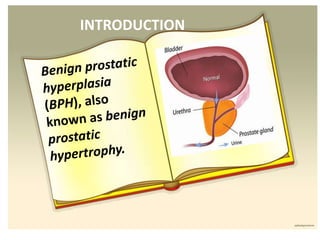
INTRODUCTION
BPH
ROMENA BEGUM
1ST YEAR MSC NURSING
DEFINITION
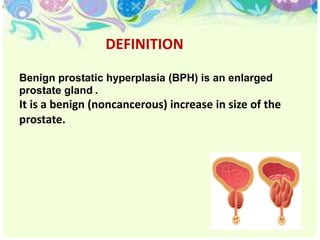
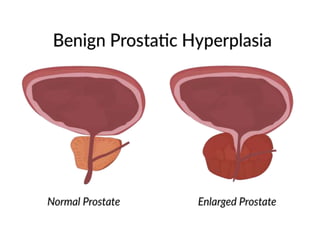
Benign prostatic hyperplasia (BPH) is an enlarged
prostate gland .
It is a benign (noncancerous) increase in size of the
prostate.
Etiology
Unknown
Old age above 50 yrs
Chronic infection
Hereditary
Hormonal alteration
Prolong obstruction
ETIOLOGY
Unknown
Old age above 50 years
Risk factors :
Chronic infection
Hereditary
Hormonal alteration
Prolonged obstruction
SIGNS AND SYMPTOMS
Frequency
 Nocturia
 Urgency
 Involuntary urination
 Incontinence
 Urinary hesitancy
 Involuntary interruption of voiding
 Straining to void
 Sensation of incomplete emptying
 Micturition dribbling
ETIOLOGY
Unknown
Old age above 50 years
Risk factors :
Chronic infection
Hereditary
Hormonal alteration
Prolonged obstruction
 Abdominal pain
 Dysuria
 Continuous feeling of a full bladder
 Acute urinary retention
 Slow urine flow
INVESTIGATION
Digital rectal examination
 Laboratory studies
 Urinalysis
 Urine culture
 Prostate-specific antigen
 Electrolytes, blood urea nitrogen (BUN),
 creatinine
MEDICAL MANAGEMENT
Alpha blockers :
•Alfuzosin
5-alpha-reductase inhibitor :
.Finasteride
.Dutasteride
Combination drug therapy
Antibiotics
Analgesics
Antispasmodic
SURGICAL MANAGEMENT
•Open prostatectomy
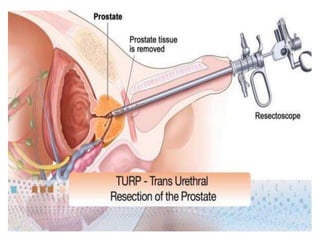
•Trans-urethral resection of the prostate
(TURP)
• Transurethral incision of the prostate
(TUIP)
•Holmium laser enucleation of the prostate
(HoLEP)
Provide medication as per order
Control and treat bladder spasm
Reduce anxiety
Relief discomfort
Restoration of urinary drainage
Treatment of UTI
Avoid prolong walking and sitting
Watch for hemorrhage
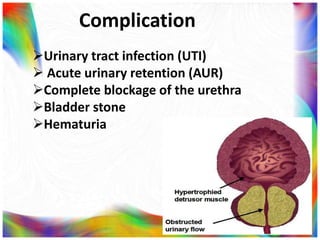
Complication
Urinary tract infection (UTI)
 Acute urinary retention (AUR)
Complete blockage of the urethra
Bladder stone
Hematuria
Introduction
Incidence
Definition
Etiology
Clinical manifestation
Diagnostic evaluation
Medical management
Surgical management
Nursing management
Complication
BPH
BPH

BPH