Prepared By:
Parth Desani
Civil – 3rd Year
Contents
 Open Channel Flow
 Types of Channels
 Types of Flow in open channel
 Point Velocity
 Velocity Distribution in Open Channel
Open Channel Flow
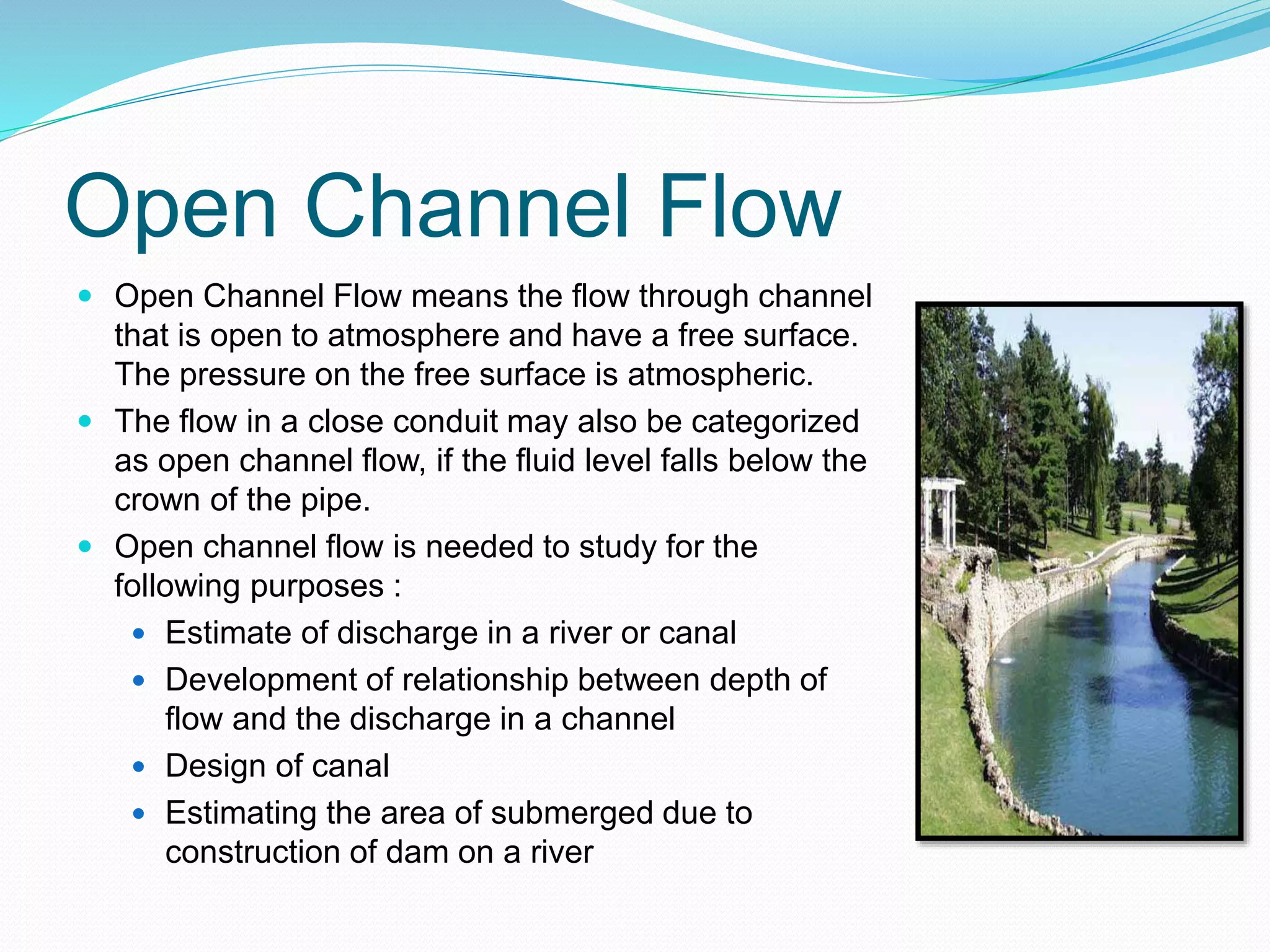
 Open Channel Flow means the flow through channel
that is open to atmosphere and have a free surface.
The pressure on the free surface is atmospheric.
 The flow in a close conduit may also be categorized
as open channel flow, if the fluid level falls below the
crown of the pipe.
 Open channel flow is needed to study for the
following purposes :
 Estimate of discharge in a river or canal
 Development of relationship between depth of
flow and the discharge in a channel
 Design of canal
 Estimating the area of submerged due to
construction of dam on a river
Types of flow channels
 The different different flow channels are categorized
into two categories based on shape :
Non – Prismatic ChannelPrismatic Channel
Types of flow in open channel
 The different flow types in open channels are as follows :
 Stead flow :
 A flow is said to be steady if the flow characteristics i.e.
depth, discharge or velocity at a section do not change with
respect to time.
 The flow in a prismatic channel at constant discharge is an
example of the steady flow.
 Unsteady flow :
 If the flow characteristics i.e. depth, discharge and velocity
change with respect to time, then it may termed as
unsteady flow.
 The flow of river during flood is an example of unsteady
flow.
 Uniform flow :
 If the flow characteristics, i.e. depth, discharge or velocity
remain constant along the length of channel, the flow is
termed as uniform flow.
 Non – uniform flow :
 The depth of flow varies along the length of channel at
various sections, the flow is termed as non-uniform flow.
 The non-uniform or varied also subdivided into two types :
 Gradually varied flow
 Rapidly varied flow
 Laminar flow & Turbulent flow :
 Laminar flow refers to flow in the form of thin sheet
(Lamina). This is only possible when velocity of flow is
very small of the order of the few centimeters per
seconds.
 In the most of the practical cases, the velocity of flow
is large therefore paths of each particles are crossing
each other. This type of flow is defined as turbulent
flow.
 Flow through open channel for all practical cases
would be turbulent flow.
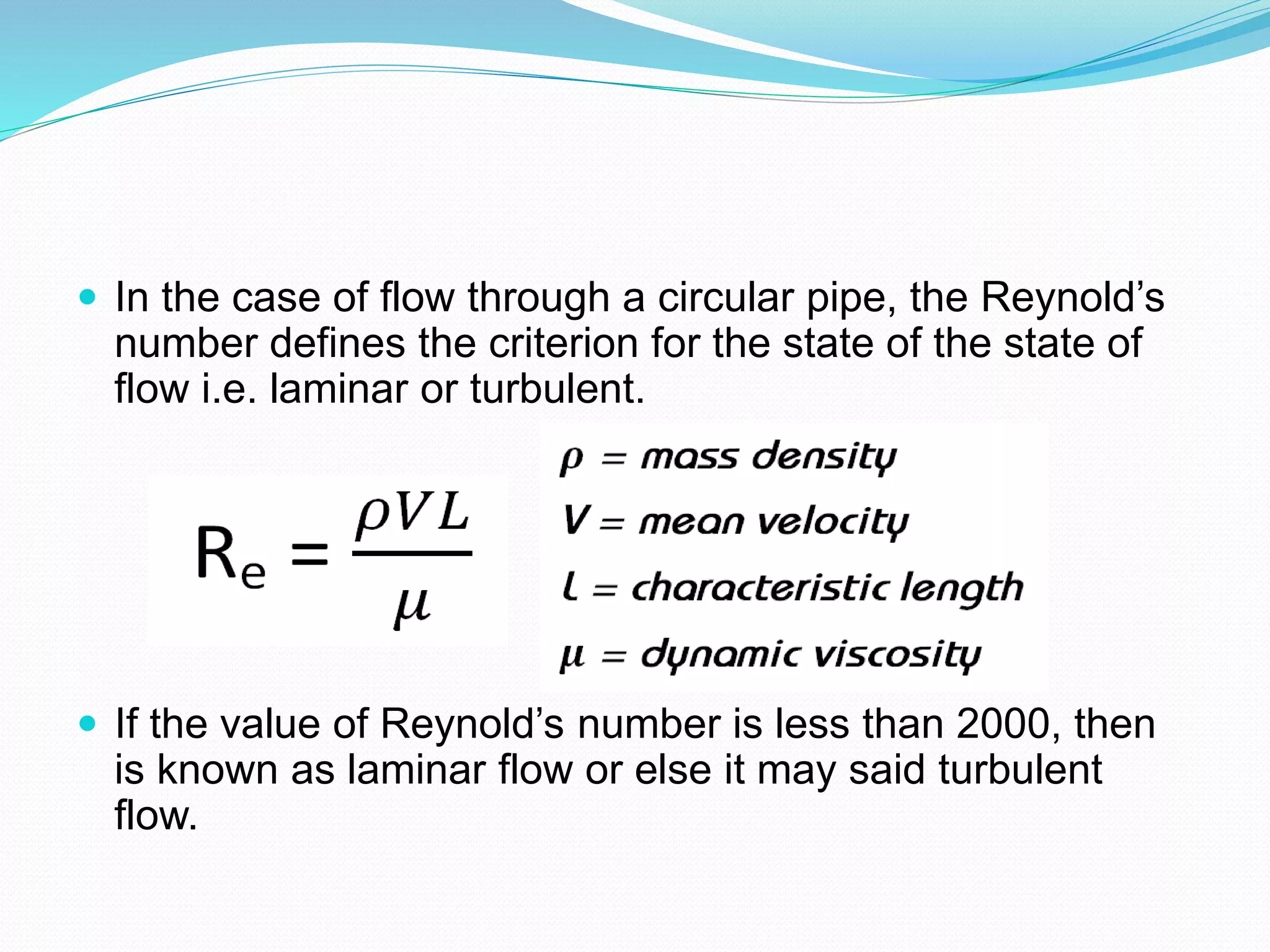
 In the case of flow through a circular pipe, the Reynold’s
number defines the criterion for the state of the state of
flow i.e. laminar or turbulent.
 If the value of Reynold’s number is less than 2000, then
is known as laminar flow or else it may said turbulent
flow.
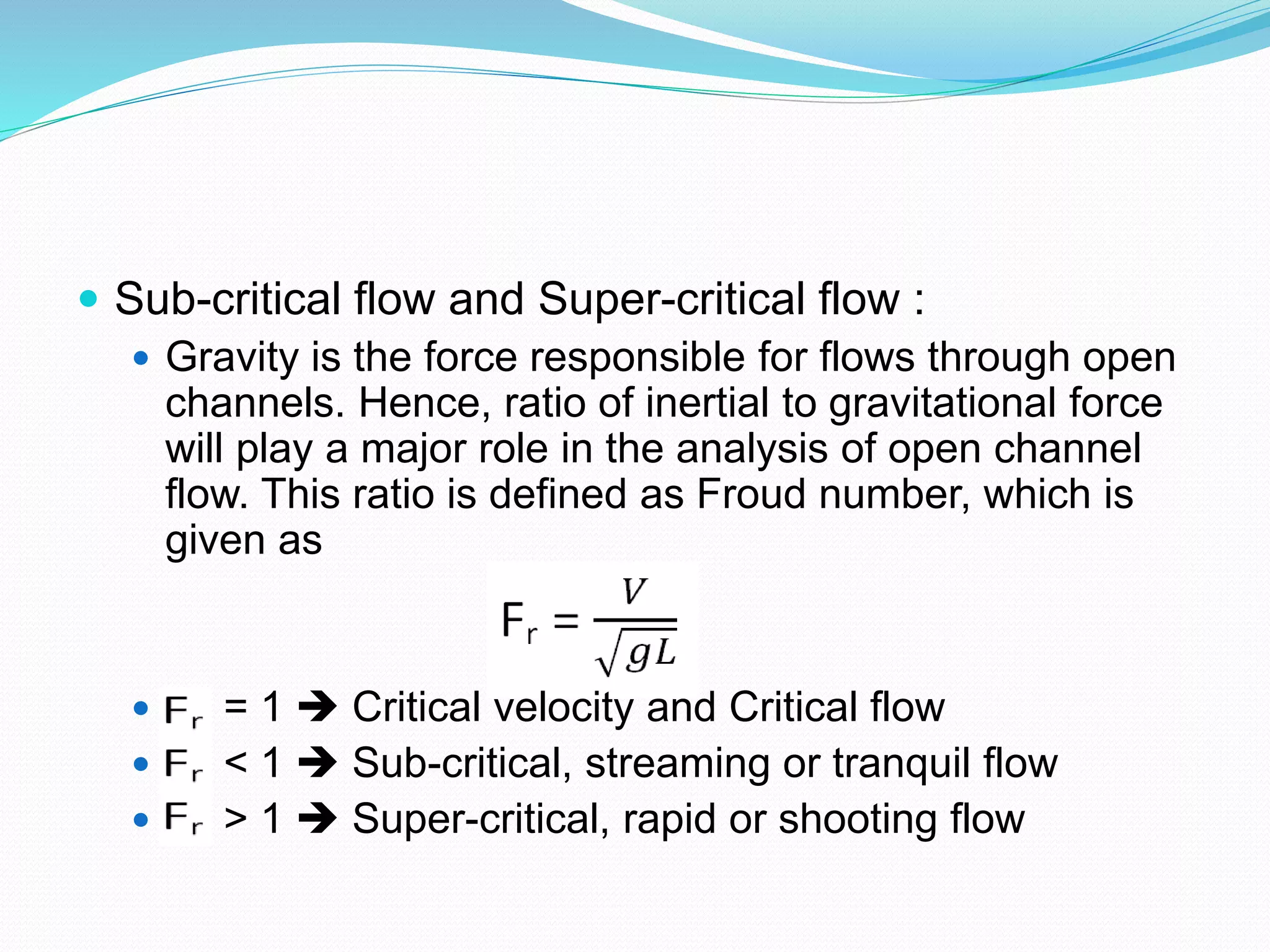
 Sub-critical flow and Super-critical flow :
 Gravity is the force responsible for flows through open
channels. Hence, ratio of inertial to gravitational force
will play a major role in the analysis of open channel
flow. This ratio is defined as Froud number, which is
given as
 = 1  Critical velocity and Critical flow
 < 1  Sub-critical, streaming or tranquil flow
 > 1  Super-critical, rapid or shooting flow
Point Velocity
 A flowing fluid contains any velocity at every different
points, that velocity at a particular point during
flowing and at particular cross-section, which velocity
is obtained, that velocity can be termed as point
velocity.
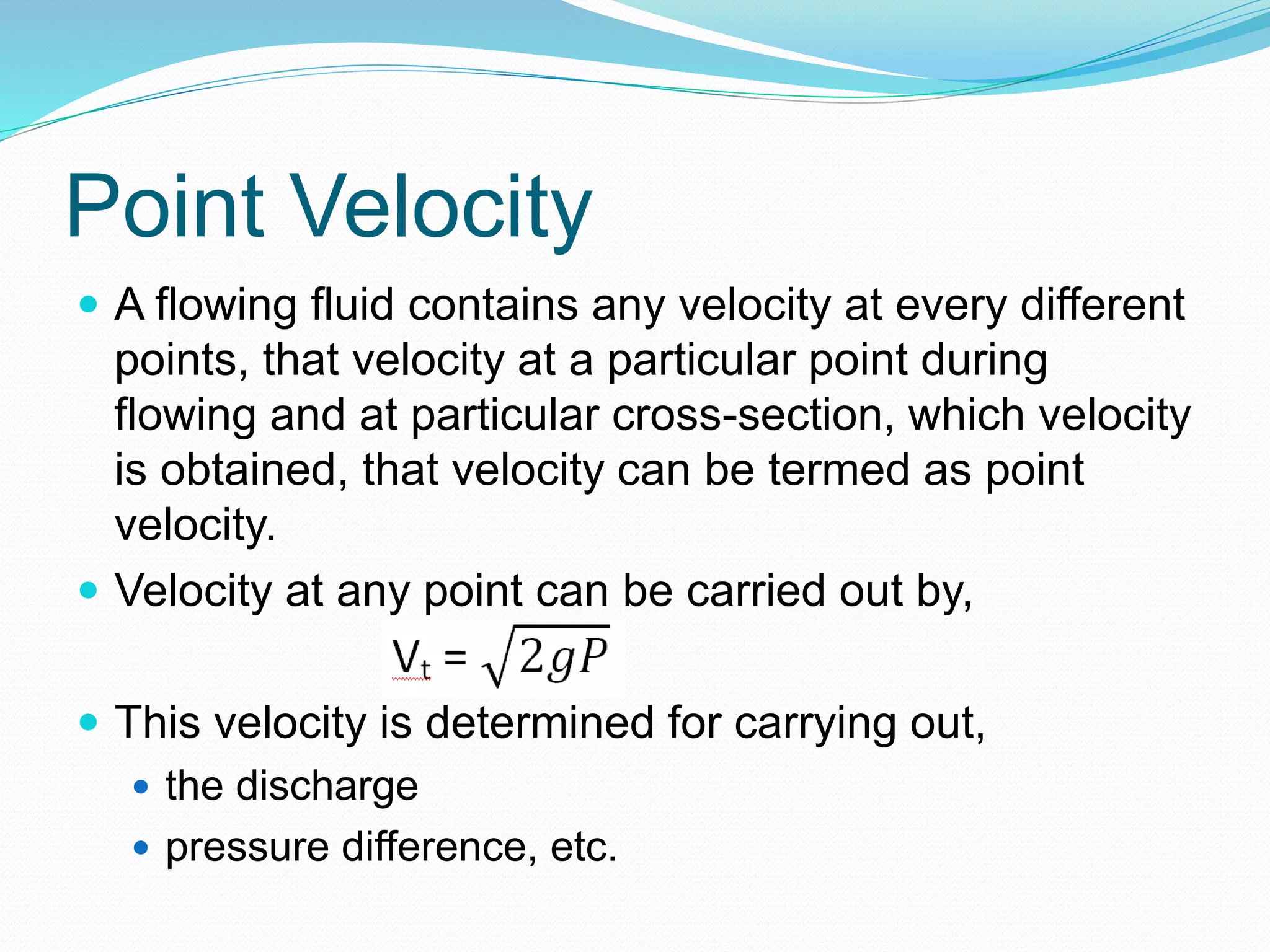
 Velocity at any point can be carried out by,
 This velocity is determined for carrying out,
 the discharge
 pressure difference, etc.
Velocity Distribution in open
channel
 Looking to the flow in a channel at
first instant, one can say that flow
is occurring in longitudinal direction
or there is a velocity component in
longitudinal direction only.
 But due to presence of corners and
boundaries in an open channel, the
velocity vectors are having three
components viz; Vx, Vy, Vz
(corresponding to longitudinal,
lateral and normal or perpendicular
to flow).
 Mostly Vx is only considered and
small vectors Vy and Vz ignored.
 Velocity distribution is dependent on
the geometry of channel. Here
Velocity is 0 at bottom and gradually
increases with distance.
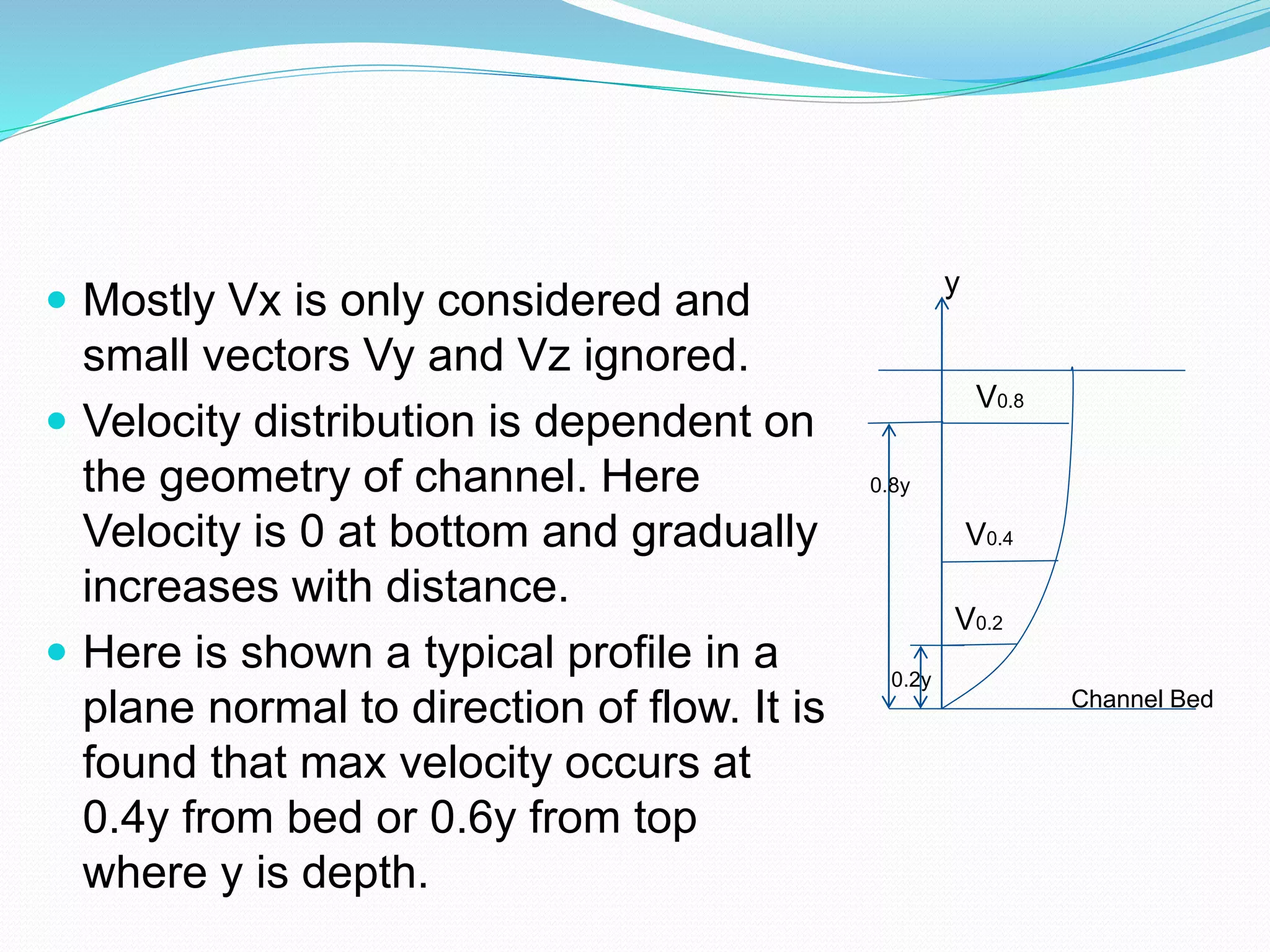
 Here is shown a typical profile in a
plane normal to direction of flow. It is
found that max velocity occurs at
0.4y from bed or 0.6y from top
where y is depth.
y
0.2y
0.8y
V0.8
V0.4
V0.2
Channel Bed
 Average velocity can be found by,
Vav = (V0.2 + V0.8) / 2
 Where V0.2 is velocity is at 0.2 y, V0.8 is velocity at
0.8y.
 This property of the velocity distribution commonly
used in the calculation of discharge of rivers and
canals using area-velocity method.
Open Channel Flow

Open Channel Flow

  • 1.
  • 2.
    Contents  Open ChannelFlow  Types of Channels  Types of Flow in open channel  Point Velocity  Velocity Distribution in Open Channel
  • 3.
    Open Channel Flow Open Channel Flow means the flow through channel that is open to atmosphere and have a free surface. The pressure on the free surface is atmospheric.  The flow in a close conduit may also be categorized as open channel flow, if the fluid level falls below the crown of the pipe.  Open channel flow is needed to study for the following purposes :  Estimate of discharge in a river or canal  Development of relationship between depth of flow and the discharge in a channel  Design of canal  Estimating the area of submerged due to construction of dam on a river
  • 4.
    Types of flowchannels  The different different flow channels are categorized into two categories based on shape : Non – Prismatic ChannelPrismatic Channel
  • 5.
    Types of flowin open channel  The different flow types in open channels are as follows :  Stead flow :  A flow is said to be steady if the flow characteristics i.e. depth, discharge or velocity at a section do not change with respect to time.  The flow in a prismatic channel at constant discharge is an example of the steady flow.  Unsteady flow :  If the flow characteristics i.e. depth, discharge and velocity change with respect to time, then it may termed as unsteady flow.  The flow of river during flood is an example of unsteady flow.
  • 6.
     Uniform flow:  If the flow characteristics, i.e. depth, discharge or velocity remain constant along the length of channel, the flow is termed as uniform flow.  Non – uniform flow :  The depth of flow varies along the length of channel at various sections, the flow is termed as non-uniform flow.  The non-uniform or varied also subdivided into two types :  Gradually varied flow  Rapidly varied flow
  • 7.
     Laminar flow& Turbulent flow :  Laminar flow refers to flow in the form of thin sheet (Lamina). This is only possible when velocity of flow is very small of the order of the few centimeters per seconds.  In the most of the practical cases, the velocity of flow is large therefore paths of each particles are crossing each other. This type of flow is defined as turbulent flow.  Flow through open channel for all practical cases would be turbulent flow.
  • 8.
     In thecase of flow through a circular pipe, the Reynold’s number defines the criterion for the state of the state of flow i.e. laminar or turbulent.  If the value of Reynold’s number is less than 2000, then is known as laminar flow or else it may said turbulent flow.
  • 9.
     Sub-critical flowand Super-critical flow :  Gravity is the force responsible for flows through open channels. Hence, ratio of inertial to gravitational force will play a major role in the analysis of open channel flow. This ratio is defined as Froud number, which is given as  = 1  Critical velocity and Critical flow  < 1  Sub-critical, streaming or tranquil flow  > 1  Super-critical, rapid or shooting flow
  • 10.
    Point Velocity  Aflowing fluid contains any velocity at every different points, that velocity at a particular point during flowing and at particular cross-section, which velocity is obtained, that velocity can be termed as point velocity.  Velocity at any point can be carried out by,  This velocity is determined for carrying out,  the discharge  pressure difference, etc.
  • 11.
    Velocity Distribution inopen channel  Looking to the flow in a channel at first instant, one can say that flow is occurring in longitudinal direction or there is a velocity component in longitudinal direction only.  But due to presence of corners and boundaries in an open channel, the velocity vectors are having three components viz; Vx, Vy, Vz (corresponding to longitudinal, lateral and normal or perpendicular to flow).
  • 12.
     Mostly Vxis only considered and small vectors Vy and Vz ignored.  Velocity distribution is dependent on the geometry of channel. Here Velocity is 0 at bottom and gradually increases with distance.  Here is shown a typical profile in a plane normal to direction of flow. It is found that max velocity occurs at 0.4y from bed or 0.6y from top where y is depth. y 0.2y 0.8y V0.8 V0.4 V0.2 Channel Bed
  • 13.
     Average velocitycan be found by, Vav = (V0.2 + V0.8) / 2  Where V0.2 is velocity is at 0.2 y, V0.8 is velocity at 0.8y.  This property of the velocity distribution commonly used in the calculation of discharge of rivers and canals using area-velocity method.