GOVERNMENT VIDARBHA INSTITUTE OF SCIENCE & HUMANITIES
(AUTONOMOUS), AMRAVATI
DEPARTMENTOFBOTANY
TOPIC NAME : CELLULAR TOTIPOTENCY AND CALLUS CULTURE
PRESENTED BY :
NAME : NEHA MOTIRAM KAKADE
CLASS : BSC IIIRD YEAR
2023-2024
BATCH : B1
SEM : VITH
SUB : BOTANY (PLANT BIOTECHNOLOGY AND TISSUE CULTURE)
TABLE OF CONTENT
• Plant tissueCulture
• HISTORY
• Cellular totipotency
• Factorsthataffect cellular totipotency
• Significance of cellular totipotency
• Callus culture
• Natureof Callus Tissue
• Steps of Callus Culture
• Stages ofcallus culture development
• Applicationsof callus cultures
• Significance Of callus culture
• Conclusion
• References
PLANT TISSUE CULTURE
• Plant tissue culture is defined as culturing plant seeds, organs, explants, tissues, cells, or
protoplasts on a chemically defined synthetic nutrient media under sterile and controlled
conditions of light, temperature, and humidity.
• G. Haberlandt is known as the father of plant tissue culture. He was an german botanist,
who was the first to separate and culture the plant cells on knop's salt solution.
• The basic key used in plant tissue culture is the totipotency of plant cells.
• With this characteristics, plant tissue culture is used to produce genetically identical plants
(clones) in the absence of fertilization, pollination or seeds.
1902 The idea of the totipotency of plant cell
was given by Haberlandt
1937 White first time established successful
root culture of tomato
1941 Vanoverbeek used coconut milk for
growth and development of young Datura
embryos
1957 Skoog and Miller demonstrated the role of
auxin and cytokinin on root and shoot
formation in tobacco - tissue
1962 Murashige and Skoog introduced the
medium for tobacco culture
1987 Isolation of Bt. gene form bacterium
Bacillus thuringiensis
HISTORY
Cellular totipotency
“The potential (totipotential) or inherent capacity of plant cell or tissue to develop
into an entire plant, if suitable stimulus is provided under favourable conditions”.
• In latin, “totus” means “entirely” and “potens” means “having power”.
• Prime examples of totipotent cells are spores and zygotes.
DIFFERENTIATION
The process of specializing cells functions is called cell differentiation . It
is accompanied by morphogenesis, the change of the cells morphology.
DEDIFFERENTIATION
The phenomenon of a mature cell reverting to the meristematic state and
forming undifferentiated callus tissue is termed 'dedifferentiation'.
REDIFFERENTIATION
A multicellular explant generally comprises cells of diverse types. As a
result the callus derived from it would be heterogeneous with respect to
the ability of its component cells to form a whole plant or plant organs i.e.
'redifferentiation’.
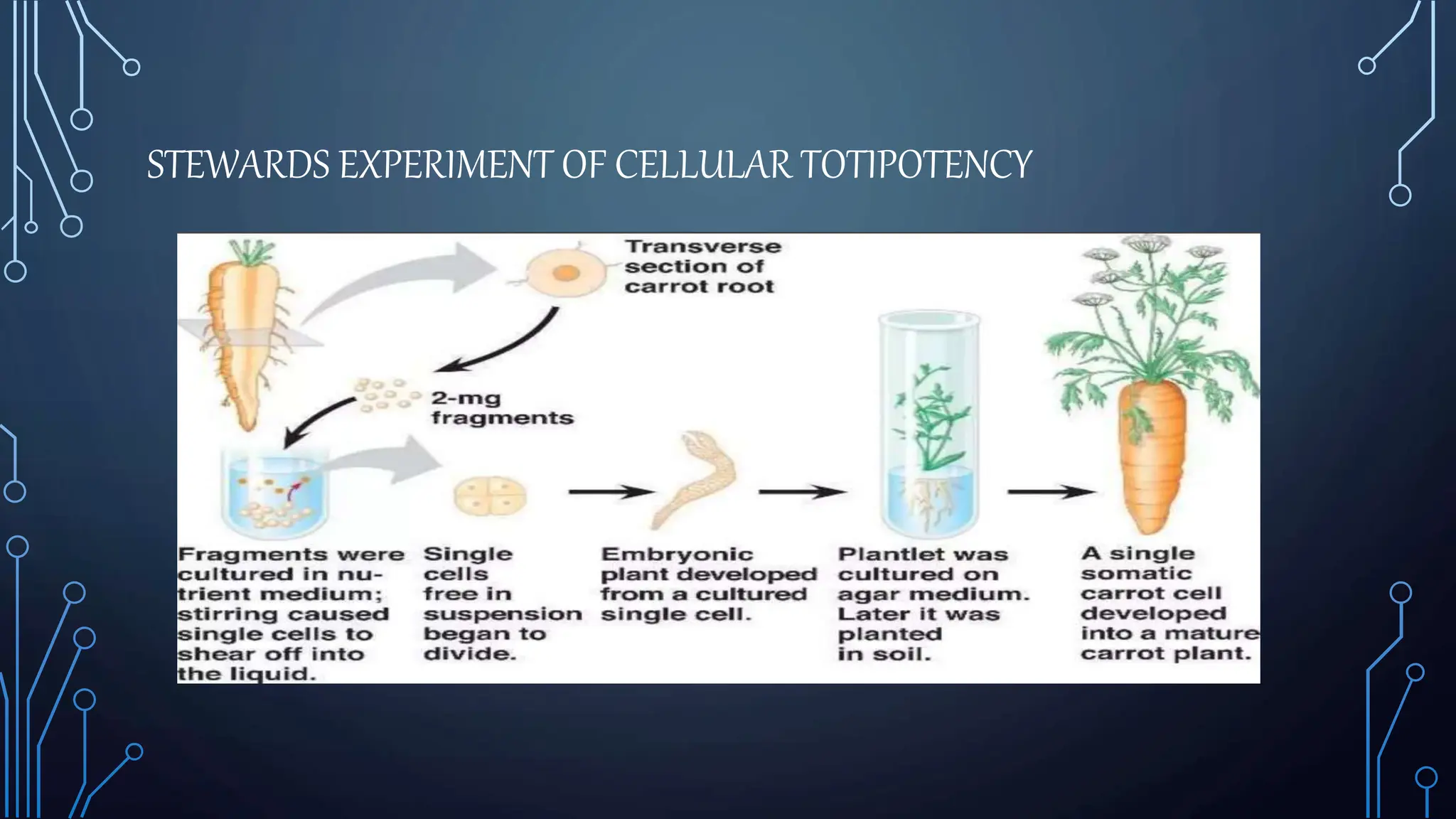
STEWARDS EXPERIMENT OF CELLULAR TOTIPOTENCY
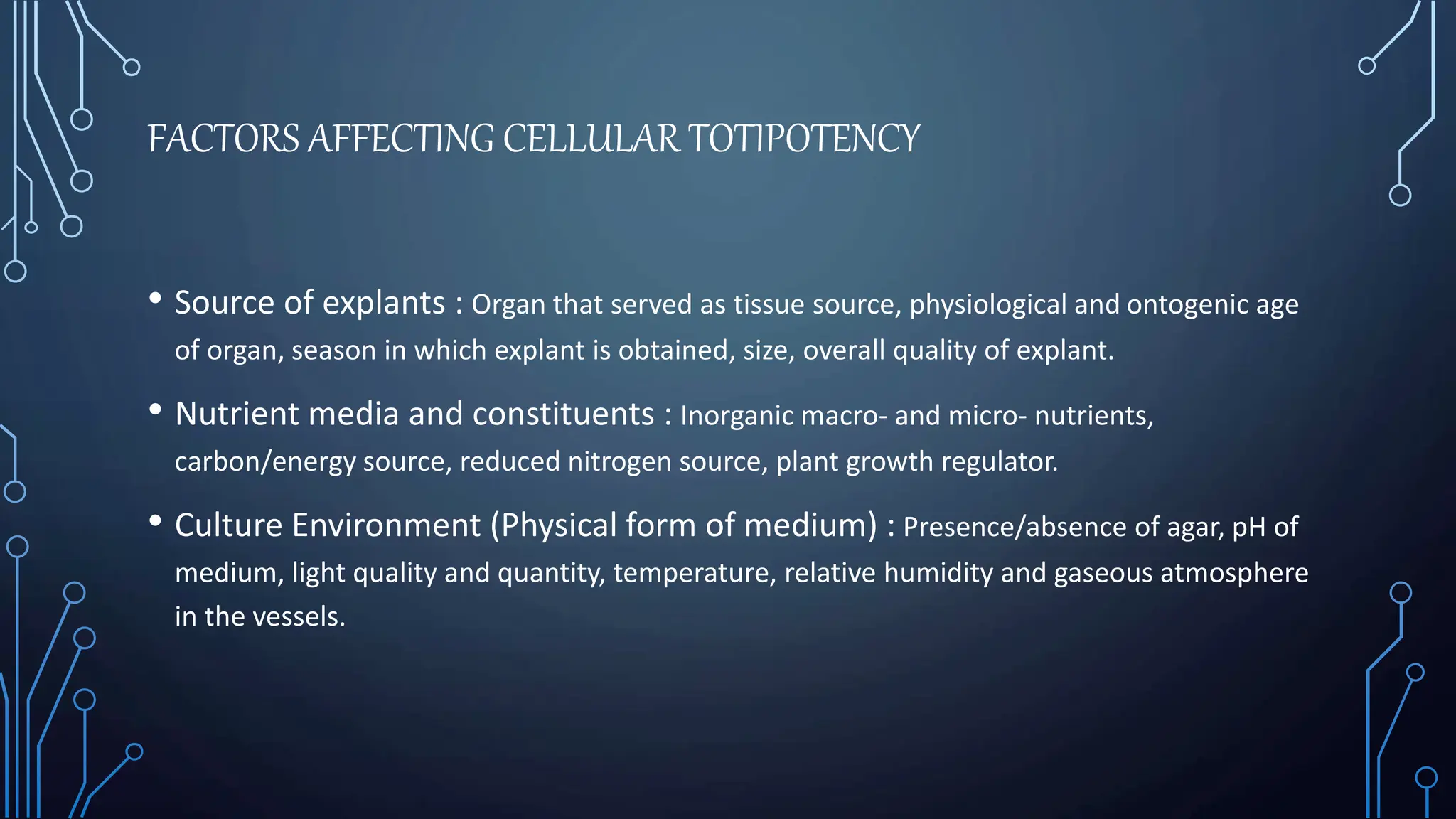
FACTORS AFFECTING CELLULAR TOTIPOTENCY
• Source of explants : Organ that served as tissue source, physiological and ontogenic age
of organ, season in which explant is obtained, size, overall quality of explant.
• Nutrient media and constituents : Inorganic macro- and micro- nutrients,
carbon/energy source, reduced nitrogen source, plant growth regulator.
• Culture Environment (Physical form of medium) : Presence/absence of agar, pH of
medium, light quality and quantity, temperature, relative humidity and gaseous atmosphere
in the vessels.
SIGNIFICANCE OF CELLULAR TOTIPOTENCY
1. Regeneration
2. Genetic Transformation
3. Conservation of Plant Germplasm
4. Micropropagation
5. Plant Breeding
6. Studying Plant Development and Differentiation
7. Phytoremediation
8. Medicinal plant protection
CALLUS CULTURE
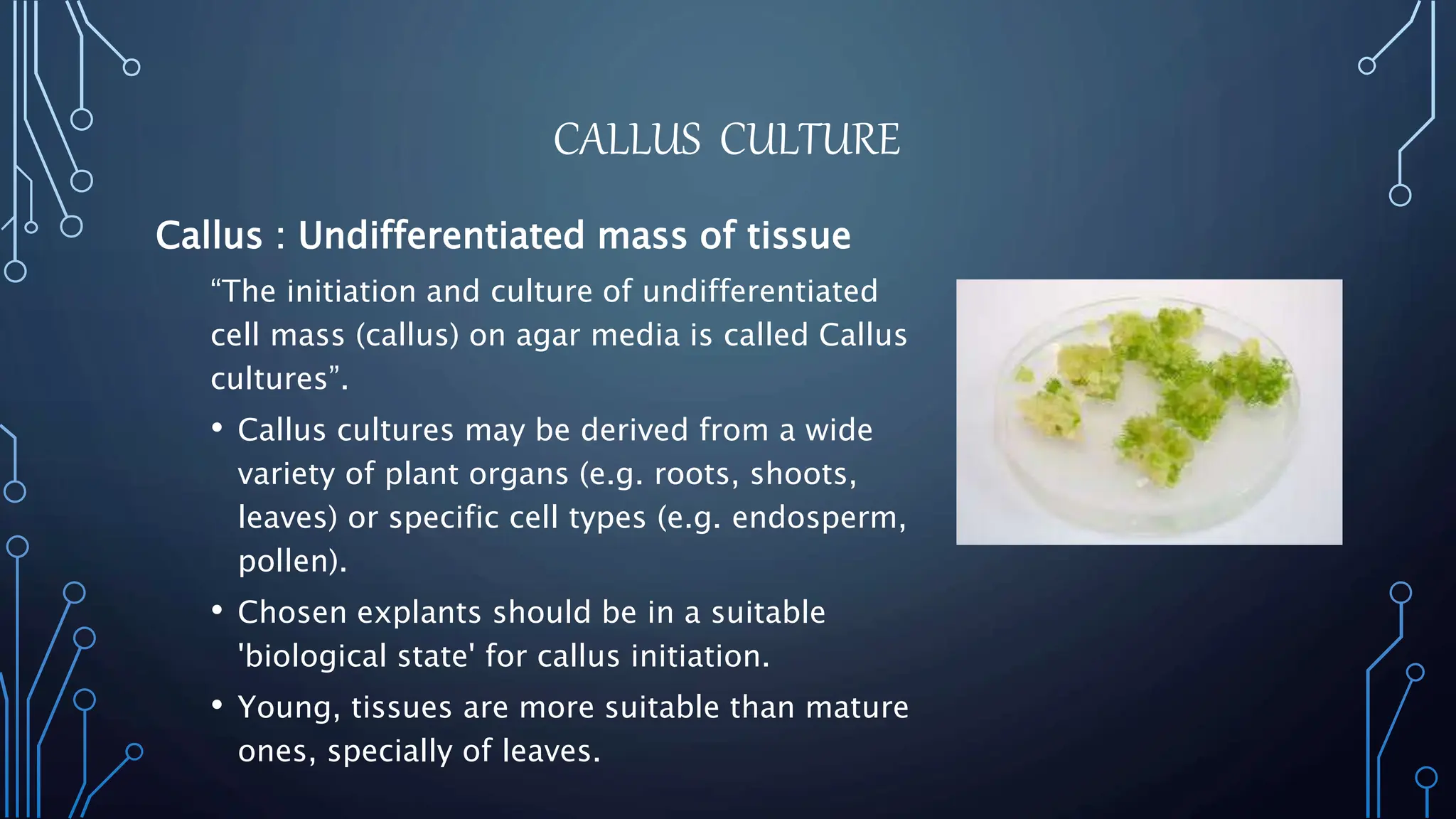
Callus : Undifferentiated mass of tissue
“The initiation and culture of undifferentiated
cell mass (callus) on agar media is called Callus
cultures”.
• Callus cultures may be derived from a wide
variety of plant organs (e.g. roots, shoots,
leaves) or specific cell types (e.g. endosperm,
pollen).
• Chosen explants should be in a suitable
'biological state' for callus initiation.
• Young, tissues are more suitable than mature
ones, specially of leaves.
NATURE OF CALLUS TISSUE
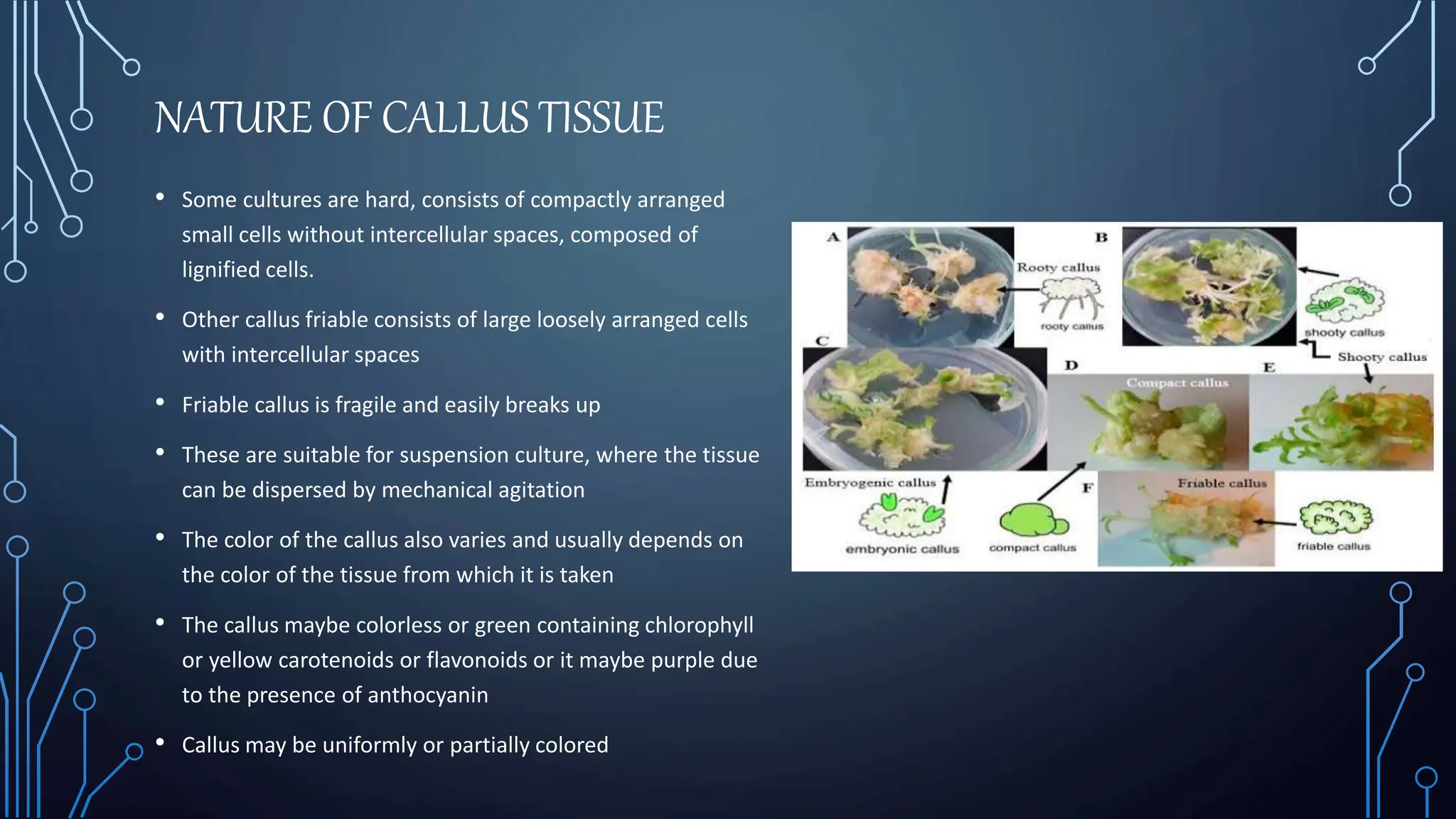
• Some cultures are hard, consists of compactly arranged
small cells without intercellular spaces, composed of
lignified cells.
• Other callus friable consists of large loosely arranged cells
with intercellular spaces
• Friable callus is fragile and easily breaks up
• These are suitable for suspension culture, where the tissue
can be dispersed by mechanical agitation
• The color of the callus also varies and usually depends on
the color of the tissue from which it is taken
• The callus maybe colorless or green containing chlorophyll
or yellow carotenoids or flavonoids or it maybe purple due
to the presence of anthocyanin
• Callus may be uniformly or partially colored
Steps of Callus Culture
1. Selection and collection of explant material
2. Selection and preparation of culture media
3. Surface sterilization of explant material
4. Preparation of explant
5. Inoculation (transfer) of explant in culture medium
6. Incubation of culture
7. Sub-culturing of culture
8. Regeneration of plant from callus (Organogenesis and
Embryogenesis method)
1. Selection and collection of explant material
• Callus may initiate from explants of any multicellular plant
• Explant from stem, root, leaf, flower, fruit or seed etc. may be taken for culture
2. Selection and preparation of culture media
• Suitable basal medium, such as Murashige and Skoog (MS) medium or Gamborg's B5
medium .
• These media provides essential nutrients and vitamins necessary for
plant tissue culture.
Media Composition:
The culture medium is composed of following
i) Major inorganic nutrients (Macronutrients)
ii) Minor inorganic nutrients (Micronutrients)
iii) Iron source - EDTA
iv) Organic supplement – Vitamin and Amino acid
v) Carbon source - Sucrose, glucose
vi) Plant growth regulators – Auxins, Cytokinins, Gibberellins
vii) pH regulators
viii) Antibiotics / antifungals
ix) Gelling agent- agar, gelrite Or agarose
3. Surface sterilization of explant material:
Explant is sterilized by using calcium hypochloride, hydrogen peroxide,
ethyl and isopropyl alcohol etc
4. Preparation for Explant Culture:
Pour the sterilized medium into sterile culture vessels, such as Petri dishes
or glass jars, to create a solidified layer. Place the vessels in a laminar flow
hood or clean environment to minimize contamination.
5. Inoculation (transfer) of explant in culture medium:
6. Incubation of culture:
Culture the explants under controlled environmental conditions including
temperature, light, and humidity. This encourages callus formation and growth.
7. Sub-culturing of culture:
Subculturing is done because:
Nutrient may be exhausted
Agar may be desiccated
Cell metabolites may accumulate and cause toxicity
8. Regeneration of plant from callus (Organogenesis and Embryogenesis
method):
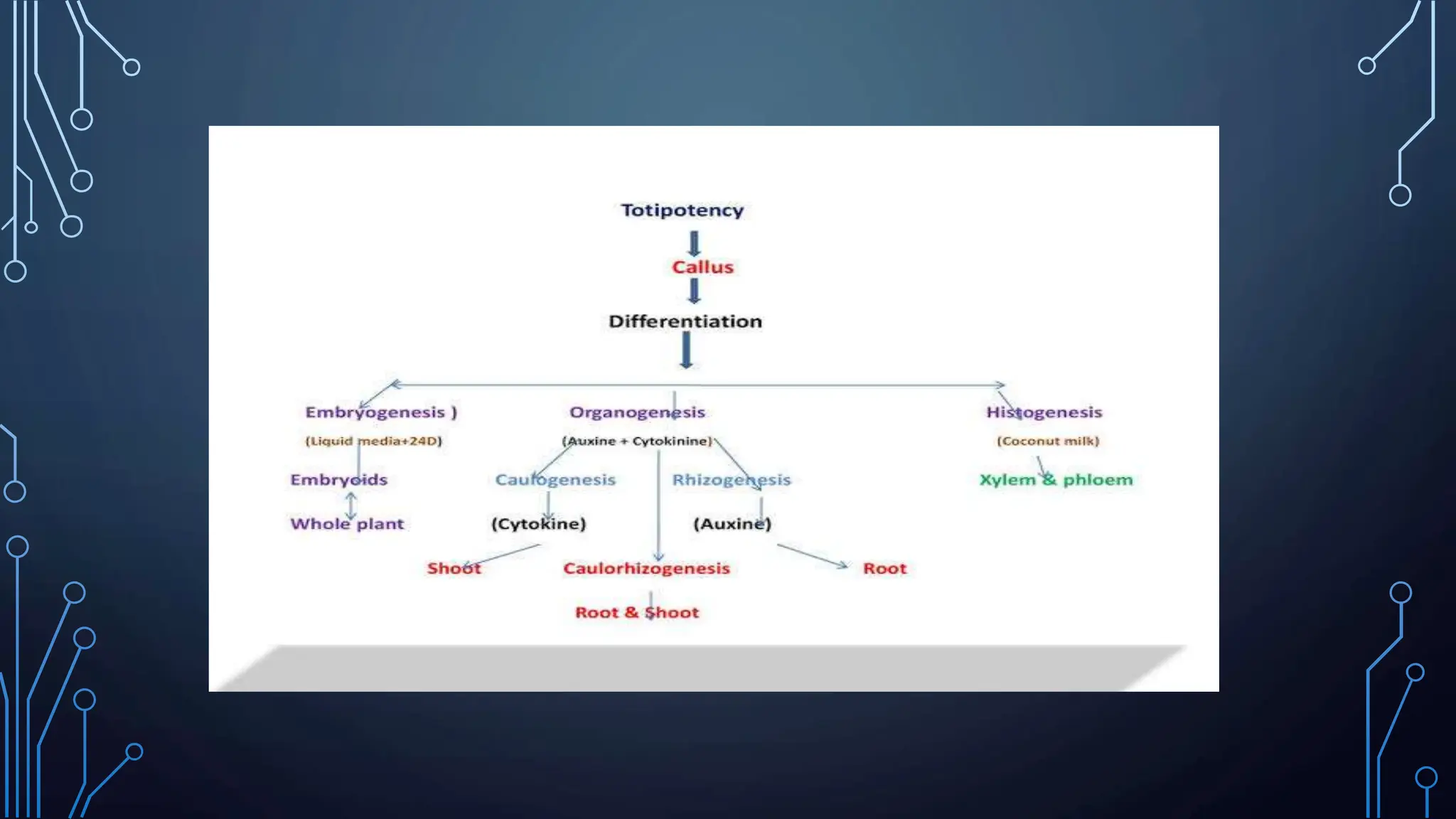
Callus can regenerate entire plants by 2 routes,
Somatic embryogenesis
Organogenesis
Organogenesis is the direct development of shoots and roots.
Somatic embryogenesis is the development of vegetative tissues to embryo.
STAGES OF CALLUS CULTURE DEVELOPMENT
1 Initiation / Induction stage:
• This stage involves the induction of callus formation from explants, typically plant
tissues such as leaves, stems, or roots, under controlled conditions like hormone
treatments and nutrient medium.
2.Multiplication / cell division stage:
• In this stage, the callus is subcultured onto fresh nutrient medium to promote its
growth and proliferation. This helps in increasing the biomass of the callus.
3. Differentiation stage:
• The callus is induced to differentiate into specific cell types or organs, such as roots,
shoots, or somatic embryos. This stage often involves altering the nutrient
composition and hormonal balance of the medium to promote the desired
differentiation pathways.
APPLICATIONS OF CALLUS CULTURE
Callus cultures are slow-growth plant culture in static medium. This
enables to conduct several studies related to many aspects of plants
(growth, differentiation and metabolism) as listed below.
• Nutritional requirements of plants.
• Cell and organ differentiation.
• Development of suspension and protoplast cultures.
• Somaclonal variations.
• Genetic transformations.
• Production of secondary metabolites and their regulation.
SIGNIFICANCE OF CALLUS CULTURE
1. Plant Propagation: Callus culture enables rapid multiplication of plants from small tissue samples.
2. Genetic Transformation: It serves as a platform for introducing foreign genes into plants for genetic
engineering purposes.
3. Phytochemical Production: Callus cultures can produce secondary metabolites, including pharmaceuticals
and flavors.
4. Stress Response Studies: Callus cultures provide a controlled environment for studying plant responses to
various stresses.
5. Crop Improvement: It facilitates the selection and breeding of plants with desirable traits, such as disease
resistance or increased yield.
6. Conservation of Endangered Species: Callus culture can help conserve endangered plant species by
preserving their genetic material.
7. Research Tool: It serves as a valuable tool for studying plant physiology, biochemistry, and molecular biology
CONCLUSION
• Callus culture works on the property of totipotency.
• It is important and basic procedure to all experiments in
plant tissue culture
• Sterilization, Hormone concentration, And Proper handling is an
important step in callus culture for successful results.
REFERENCES
• Biotechnology, By U Satyanarayan.
• Introduction to Plant Biotechnology, By H.S.Chawla.
• http://www.google.com
Thank you

cellular totipotency and callus culture

  • 1.
    GOVERNMENT VIDARBHA INSTITUTEOF SCIENCE & HUMANITIES (AUTONOMOUS), AMRAVATI DEPARTMENTOFBOTANY TOPIC NAME : CELLULAR TOTIPOTENCY AND CALLUS CULTURE PRESENTED BY : NAME : NEHA MOTIRAM KAKADE CLASS : BSC IIIRD YEAR 2023-2024 BATCH : B1 SEM : VITH SUB : BOTANY (PLANT BIOTECHNOLOGY AND TISSUE CULTURE)
  • 2.
    TABLE OF CONTENT •Plant tissueCulture • HISTORY • Cellular totipotency • Factorsthataffect cellular totipotency • Significance of cellular totipotency • Callus culture • Natureof Callus Tissue • Steps of Callus Culture • Stages ofcallus culture development • Applicationsof callus cultures • Significance Of callus culture • Conclusion • References
  • 3.
    PLANT TISSUE CULTURE •Plant tissue culture is defined as culturing plant seeds, organs, explants, tissues, cells, or protoplasts on a chemically defined synthetic nutrient media under sterile and controlled conditions of light, temperature, and humidity. • G. Haberlandt is known as the father of plant tissue culture. He was an german botanist, who was the first to separate and culture the plant cells on knop's salt solution. • The basic key used in plant tissue culture is the totipotency of plant cells. • With this characteristics, plant tissue culture is used to produce genetically identical plants (clones) in the absence of fertilization, pollination or seeds.
  • 4.
    1902 The ideaof the totipotency of plant cell was given by Haberlandt 1937 White first time established successful root culture of tomato 1941 Vanoverbeek used coconut milk for growth and development of young Datura embryos 1957 Skoog and Miller demonstrated the role of auxin and cytokinin on root and shoot formation in tobacco - tissue 1962 Murashige and Skoog introduced the medium for tobacco culture 1987 Isolation of Bt. gene form bacterium Bacillus thuringiensis HISTORY
  • 5.
    Cellular totipotency “The potential(totipotential) or inherent capacity of plant cell or tissue to develop into an entire plant, if suitable stimulus is provided under favourable conditions”. • In latin, “totus” means “entirely” and “potens” means “having power”. • Prime examples of totipotent cells are spores and zygotes.
  • 6.
    DIFFERENTIATION The process ofspecializing cells functions is called cell differentiation . It is accompanied by morphogenesis, the change of the cells morphology. DEDIFFERENTIATION The phenomenon of a mature cell reverting to the meristematic state and forming undifferentiated callus tissue is termed 'dedifferentiation'. REDIFFERENTIATION A multicellular explant generally comprises cells of diverse types. As a result the callus derived from it would be heterogeneous with respect to the ability of its component cells to form a whole plant or plant organs i.e. 'redifferentiation’.
  • 7.
    STEWARDS EXPERIMENT OFCELLULAR TOTIPOTENCY
  • 8.
    FACTORS AFFECTING CELLULARTOTIPOTENCY • Source of explants : Organ that served as tissue source, physiological and ontogenic age of organ, season in which explant is obtained, size, overall quality of explant. • Nutrient media and constituents : Inorganic macro- and micro- nutrients, carbon/energy source, reduced nitrogen source, plant growth regulator. • Culture Environment (Physical form of medium) : Presence/absence of agar, pH of medium, light quality and quantity, temperature, relative humidity and gaseous atmosphere in the vessels.
  • 9.
    SIGNIFICANCE OF CELLULARTOTIPOTENCY 1. Regeneration 2. Genetic Transformation 3. Conservation of Plant Germplasm 4. Micropropagation 5. Plant Breeding 6. Studying Plant Development and Differentiation 7. Phytoremediation 8. Medicinal plant protection
  • 10.
    CALLUS CULTURE Callus :Undifferentiated mass of tissue “The initiation and culture of undifferentiated cell mass (callus) on agar media is called Callus cultures”. • Callus cultures may be derived from a wide variety of plant organs (e.g. roots, shoots, leaves) or specific cell types (e.g. endosperm, pollen). • Chosen explants should be in a suitable 'biological state' for callus initiation. • Young, tissues are more suitable than mature ones, specially of leaves.
  • 11.
    NATURE OF CALLUSTISSUE • Some cultures are hard, consists of compactly arranged small cells without intercellular spaces, composed of lignified cells. • Other callus friable consists of large loosely arranged cells with intercellular spaces • Friable callus is fragile and easily breaks up • These are suitable for suspension culture, where the tissue can be dispersed by mechanical agitation • The color of the callus also varies and usually depends on the color of the tissue from which it is taken • The callus maybe colorless or green containing chlorophyll or yellow carotenoids or flavonoids or it maybe purple due to the presence of anthocyanin • Callus may be uniformly or partially colored
  • 12.
    Steps of CallusCulture 1. Selection and collection of explant material 2. Selection and preparation of culture media 3. Surface sterilization of explant material 4. Preparation of explant 5. Inoculation (transfer) of explant in culture medium 6. Incubation of culture 7. Sub-culturing of culture 8. Regeneration of plant from callus (Organogenesis and Embryogenesis method)
  • 13.
    1. Selection andcollection of explant material • Callus may initiate from explants of any multicellular plant • Explant from stem, root, leaf, flower, fruit or seed etc. may be taken for culture 2. Selection and preparation of culture media • Suitable basal medium, such as Murashige and Skoog (MS) medium or Gamborg's B5 medium . • These media provides essential nutrients and vitamins necessary for plant tissue culture.
  • 14.
    Media Composition: The culturemedium is composed of following i) Major inorganic nutrients (Macronutrients) ii) Minor inorganic nutrients (Micronutrients) iii) Iron source - EDTA iv) Organic supplement – Vitamin and Amino acid v) Carbon source - Sucrose, glucose vi) Plant growth regulators – Auxins, Cytokinins, Gibberellins vii) pH regulators viii) Antibiotics / antifungals ix) Gelling agent- agar, gelrite Or agarose
  • 15.
    3. Surface sterilizationof explant material: Explant is sterilized by using calcium hypochloride, hydrogen peroxide, ethyl and isopropyl alcohol etc 4. Preparation for Explant Culture: Pour the sterilized medium into sterile culture vessels, such as Petri dishes or glass jars, to create a solidified layer. Place the vessels in a laminar flow hood or clean environment to minimize contamination. 5. Inoculation (transfer) of explant in culture medium: 6. Incubation of culture: Culture the explants under controlled environmental conditions including temperature, light, and humidity. This encourages callus formation and growth.
  • 16.
    7. Sub-culturing ofculture: Subculturing is done because: Nutrient may be exhausted Agar may be desiccated Cell metabolites may accumulate and cause toxicity 8. Regeneration of plant from callus (Organogenesis and Embryogenesis method): Callus can regenerate entire plants by 2 routes, Somatic embryogenesis Organogenesis Organogenesis is the direct development of shoots and roots. Somatic embryogenesis is the development of vegetative tissues to embryo.
  • 18.
    STAGES OF CALLUSCULTURE DEVELOPMENT 1 Initiation / Induction stage: • This stage involves the induction of callus formation from explants, typically plant tissues such as leaves, stems, or roots, under controlled conditions like hormone treatments and nutrient medium. 2.Multiplication / cell division stage: • In this stage, the callus is subcultured onto fresh nutrient medium to promote its growth and proliferation. This helps in increasing the biomass of the callus. 3. Differentiation stage: • The callus is induced to differentiate into specific cell types or organs, such as roots, shoots, or somatic embryos. This stage often involves altering the nutrient composition and hormonal balance of the medium to promote the desired differentiation pathways.
  • 19.
    APPLICATIONS OF CALLUSCULTURE Callus cultures are slow-growth plant culture in static medium. This enables to conduct several studies related to many aspects of plants (growth, differentiation and metabolism) as listed below. • Nutritional requirements of plants. • Cell and organ differentiation. • Development of suspension and protoplast cultures. • Somaclonal variations. • Genetic transformations. • Production of secondary metabolites and their regulation.
  • 20.
    SIGNIFICANCE OF CALLUSCULTURE 1. Plant Propagation: Callus culture enables rapid multiplication of plants from small tissue samples. 2. Genetic Transformation: It serves as a platform for introducing foreign genes into plants for genetic engineering purposes. 3. Phytochemical Production: Callus cultures can produce secondary metabolites, including pharmaceuticals and flavors. 4. Stress Response Studies: Callus cultures provide a controlled environment for studying plant responses to various stresses. 5. Crop Improvement: It facilitates the selection and breeding of plants with desirable traits, such as disease resistance or increased yield. 6. Conservation of Endangered Species: Callus culture can help conserve endangered plant species by preserving their genetic material. 7. Research Tool: It serves as a valuable tool for studying plant physiology, biochemistry, and molecular biology
  • 21.
    CONCLUSION • Callus cultureworks on the property of totipotency. • It is important and basic procedure to all experiments in plant tissue culture • Sterilization, Hormone concentration, And Proper handling is an important step in callus culture for successful results.
  • 22.
    REFERENCES • Biotechnology, ByU Satyanarayan. • Introduction to Plant Biotechnology, By H.S.Chawla. • http://www.google.com
  • 23.