Elements of Computing Systems, Nisan & Schocken, MIT Press, www.nand2tetris.org , Chapter 2: Boolean Arithmetic slide 1
www.nand2tetris.org
Building a Modern Computer From First Principles
Boolean Arithmetic
Elements of Computing Systems, Nisan & Schocken, MIT Press, www.nand2tetris.org , Chapter 2: Boolean Arithmetic slide 2
Usage and Copyright Notice:
Copyright © Noam Nisan and Shimon Schocken
This presentation accompanies the textbook “The Elements of Computing Systems”
by Noam Nisan & Shimon Schocken, MIT Press, 2005.
We provide 13 such presentations.
Each presentation is designed to support about 3 hours of classroom or self-study instruction.
You are welcome to use or edit this presentation as you see fit for instructional and non-
commercial purposes.
If you use our book and course materials, please include a reference to www.nand2tetris.org
If you have any questions or comments, please write us at nand2tetris@gmail.com
This work is licensed under a
Creative Commons Attribution-NonCommercial-ShareAlike 3.0 Unported License.
Elements of Computing Systems, Nisan & Schocken, MIT Press, www.nand2tetris.org , Chapter 2: Boolean Arithmetic slide 3
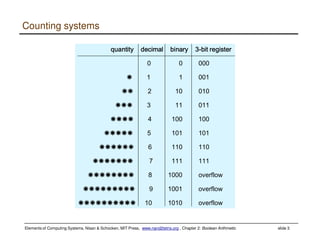
Counting systems
quantity decimal binaryquantity decimal binaryquantity decimal binaryquantity decimal binary 3333----bit registerbit registerbit registerbit register
0 0 000
1 1 001
2 10 010
3 11 011
4 100 100
5 101 101
6 110 110
7 111 111
8 1000 overflow
9 1001 overflow
10 1010 overflow
Elements of Computing Systems, Nisan & Schocken, MIT Press, www.nand2tetris.org , Chapter 2: Boolean Arithmetic slide 4
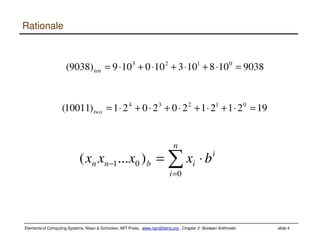
Rationale
192121202021)10011( 01234
=⋅+⋅+⋅+⋅+⋅=two
i
n
i
ibnn bxxxx ⋅= ∑=
−
0
01 )...(
9038018013010019)9038( 0123
=⋅+⋅+⋅+⋅=ten
Elements of Computing Systems, Nisan & Schocken, MIT Press, www.nand2tetris.org , Chapter 2: Boolean Arithmetic slide 5
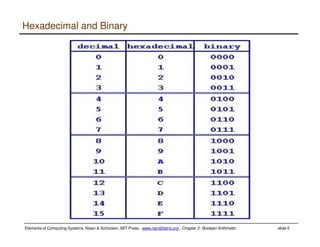
Hexadecimal and Binary
Elements of Computing Systems, Nisan & Schocken, MIT Press, www.nand2tetris.org , Chapter 2: Boolean Arithmetic slide 6
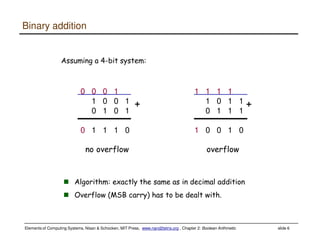
no overflow overflow
Algorithm: exactly the same as in decimal addition
Overflow (MSB carry) has to be dealt with.
Binary addition
Assuming a 4-bit system:
0 0 0 1
1 0 0 1
0 1 0 1
0 1 1 1 0
++++
1 1 1 1
1 0 1 1
0 1 1 1
1 0 0 1 0
++++
Elements of Computing Systems, Nisan & Schocken, MIT Press, www.nand2tetris.org , Chapter 2: Boolean Arithmetic slide 7
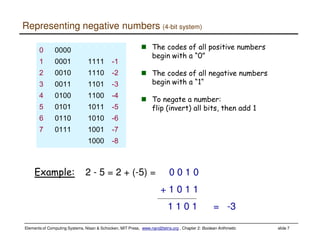
Representing negative numbers (4-bit system)
The codes of all positive numbers
begin with a “0”
The codes of all negative numbers
begin with a “1“
To negate a number:
flip (invert) all bits, then add 1
0 0000
1 0001 1111 -1
2 0010 1110 -2
3 0011 1101 -3
4 0100 1100 -4
5 0101 1011 -5
6 0110 1010 -6
7 0111 1001 -7
1000 -8
Example: 2 - 5 = 2 + (-5) = 0 0 1 0
+ 1 0 1 1
1 1 0 1 = -3
Elements of Computing Systems, Nisan & Schocken, MIT Press, www.nand2tetris.org , Chapter 2: Boolean Arithmetic slide 8
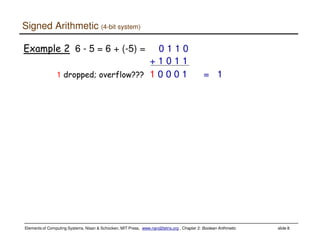
Signed Arithmetic (4-bit system)
Example 2 6 - 5 = 6 + (-5) = 0 1 1 0
+ 1 0 1 1
1 0 0 0 1 = 11 dropped; overflow???
Elements of Computing Systems, Nisan & Schocken, MIT Press, www.nand2tetris.org , Chapter 2: Boolean Arithmetic slide 9
Signed Arithmetic (4-bit system)
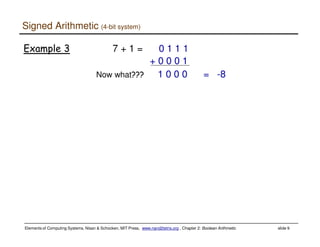
Example 3 7 + 1 = 0 1 1 1
+ 0 0 0 1
1 0 0 0 = -8Now what???
Elements of Computing Systems, Nisan & Schocken, MIT Press, www.nand2tetris.org , Chapter 2: Boolean Arithmetic slide 10
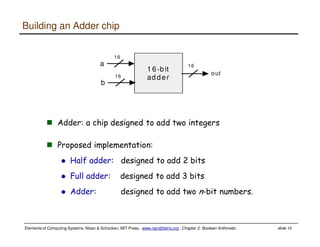
Building an Adder chip
Adder: a chip designed to add two integers
Proposed implementation:
Half adder: designed to add 2 bits
Full adder: designed to add 3 bits
Adder: designed to add two n-bit numbers.
out
a
16
1 6-b it
ad der
b
16
16
Elements of Computing Systems, Nisan & Schocken, MIT Press, www.nand2tetris.org , Chapter 2: Boolean Arithmetic slide 11
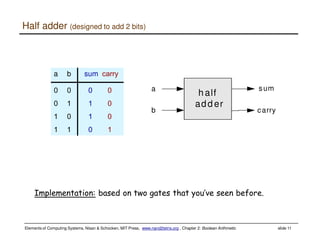
Half adder (designed to add 2 bits)
Implementation: based on two gates that you’ve seen before.
h alf
add er
a sum
b carry
a b sum carry
0 0 0 0
0 1 1 0
1 0 1 0
1 1 0 1
Elements of Computing Systems, Nisan & Schocken, MIT Press, www.nand2tetris.org , Chapter 2: Boolean Arithmetic slide 12
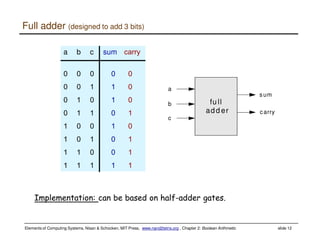
Full adder (designed to add 3 bits)
Implementation: can be based on half-adder gates.
a b c sum carry
0 0 0 0 0
0 0 1 1 0
0 1 0 1 0
0 1 1 0 1
1 0 0 1 0
1 0 1 0 1
1 1 0 0 1
1 1 1 1 1
fu ll
add er
a
sum
b
carry
c
Elements of Computing Systems, Nisan & Schocken, MIT Press, www.nand2tetris.org , Chapter 2: Boolean Arithmetic slide 13
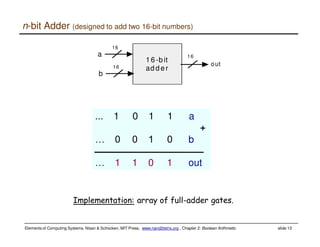
n-bit Adder (designed to add two 16-bit numbers)
Implementation: array of full-adder gates.
out
a
16
16-bit
ad der
b
16
16
... 1 0 1 1 a
… 0 0 1 0 b
… 1 1 0 1 out
++++
Elements of Computing Systems, Nisan & Schocken, MIT Press, www.nand2tetris.org , Chapter 2: Boolean Arithmetic slide 14
The ALU (of the Hack platform)
half
adder
a sum
b carry
full
adder
a
sum
b
carry
c
out
x
16
16-bit
adder
y
16
16
zx no
zr
nx zy ny f
ALU
ng
16 bits
16 bits
x
y 16 bits
out
out(x, y, control bits) =
x+y, x-y, y–x,
0, 1, -1,
x, y, -x, -y,
x!, y!,
x+1, y+1, x-1, y-1,
x&y, x|y
Elements of Computing Systems, Nisan & Schocken, MIT Press, www.nand2tetris.org , Chapter 2: Boolean Arithmetic slide 15
ALU logic (Hack platform)
Implementation: build a logic gate architecture
that “executes” the control bit “instructions”:
if zx==1 then set x to 0 (bit-wise), etc.
Elements of Computing Systems, Nisan & Schocken, MIT Press, www.nand2tetris.org , Chapter 2: Boolean Arithmetic slide 16
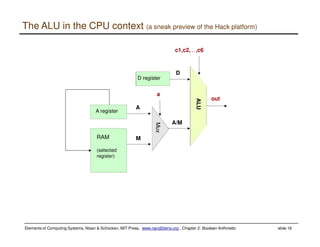
The ALU in the CPU context (a sneak preview of the Hack platform)
ALU
Mux
D
out
A/M
a
D register
A register
A
M
c1,c2, … ,c6
RAM
(selected
register)
Elements of Computing Systems, Nisan & Schocken, MIT Press, www.nand2tetris.org , Chapter 2: Boolean Arithmetic slide 17
Perspective
Combinational logic
Our adder design is very basic: no parallelism
It pays to optimize adders
Our ALU is also very basic: no multiplication, no division
Where is the seat of more advanced math operations?
a typical hardware/software tradeoff.

Boolean arithmetic

  • 1.
    Elements of ComputingSystems, Nisan & Schocken, MIT Press, www.nand2tetris.org , Chapter 2: Boolean Arithmetic slide 1 www.nand2tetris.org Building a Modern Computer From First Principles Boolean Arithmetic
  • 2.
    Elements of ComputingSystems, Nisan & Schocken, MIT Press, www.nand2tetris.org , Chapter 2: Boolean Arithmetic slide 2 Usage and Copyright Notice: Copyright © Noam Nisan and Shimon Schocken This presentation accompanies the textbook “The Elements of Computing Systems” by Noam Nisan & Shimon Schocken, MIT Press, 2005. We provide 13 such presentations. Each presentation is designed to support about 3 hours of classroom or self-study instruction. You are welcome to use or edit this presentation as you see fit for instructional and non- commercial purposes. If you use our book and course materials, please include a reference to www.nand2tetris.org If you have any questions or comments, please write us at nand2tetris@gmail.com This work is licensed under a Creative Commons Attribution-NonCommercial-ShareAlike 3.0 Unported License.
  • 3.
    Elements of ComputingSystems, Nisan & Schocken, MIT Press, www.nand2tetris.org , Chapter 2: Boolean Arithmetic slide 3 Counting systems quantity decimal binaryquantity decimal binaryquantity decimal binaryquantity decimal binary 3333----bit registerbit registerbit registerbit register 0 0 000 1 1 001 2 10 010 3 11 011 4 100 100 5 101 101 6 110 110 7 111 111 8 1000 overflow 9 1001 overflow 10 1010 overflow
  • 4.
    Elements of ComputingSystems, Nisan & Schocken, MIT Press, www.nand2tetris.org , Chapter 2: Boolean Arithmetic slide 4 Rationale 192121202021)10011( 01234 =⋅+⋅+⋅+⋅+⋅=two i n i ibnn bxxxx ⋅= ∑= − 0 01 )...( 9038018013010019)9038( 0123 =⋅+⋅+⋅+⋅=ten
  • 5.
    Elements of ComputingSystems, Nisan & Schocken, MIT Press, www.nand2tetris.org , Chapter 2: Boolean Arithmetic slide 5 Hexadecimal and Binary
  • 6.
    Elements of ComputingSystems, Nisan & Schocken, MIT Press, www.nand2tetris.org , Chapter 2: Boolean Arithmetic slide 6 no overflow overflow Algorithm: exactly the same as in decimal addition Overflow (MSB carry) has to be dealt with. Binary addition Assuming a 4-bit system: 0 0 0 1 1 0 0 1 0 1 0 1 0 1 1 1 0 ++++ 1 1 1 1 1 0 1 1 0 1 1 1 1 0 0 1 0 ++++
  • 7.
    Elements of ComputingSystems, Nisan & Schocken, MIT Press, www.nand2tetris.org , Chapter 2: Boolean Arithmetic slide 7 Representing negative numbers (4-bit system) The codes of all positive numbers begin with a “0” The codes of all negative numbers begin with a “1“ To negate a number: flip (invert) all bits, then add 1 0 0000 1 0001 1111 -1 2 0010 1110 -2 3 0011 1101 -3 4 0100 1100 -4 5 0101 1011 -5 6 0110 1010 -6 7 0111 1001 -7 1000 -8 Example: 2 - 5 = 2 + (-5) = 0 0 1 0 + 1 0 1 1 1 1 0 1 = -3
  • 8.
    Elements of ComputingSystems, Nisan & Schocken, MIT Press, www.nand2tetris.org , Chapter 2: Boolean Arithmetic slide 8 Signed Arithmetic (4-bit system) Example 2 6 - 5 = 6 + (-5) = 0 1 1 0 + 1 0 1 1 1 0 0 0 1 = 11 dropped; overflow???
  • 9.
    Elements of ComputingSystems, Nisan & Schocken, MIT Press, www.nand2tetris.org , Chapter 2: Boolean Arithmetic slide 9 Signed Arithmetic (4-bit system) Example 3 7 + 1 = 0 1 1 1 + 0 0 0 1 1 0 0 0 = -8Now what???
  • 10.
    Elements of ComputingSystems, Nisan & Schocken, MIT Press, www.nand2tetris.org , Chapter 2: Boolean Arithmetic slide 10 Building an Adder chip Adder: a chip designed to add two integers Proposed implementation: Half adder: designed to add 2 bits Full adder: designed to add 3 bits Adder: designed to add two n-bit numbers. out a 16 1 6-b it ad der b 16 16
  • 11.
    Elements of ComputingSystems, Nisan & Schocken, MIT Press, www.nand2tetris.org , Chapter 2: Boolean Arithmetic slide 11 Half adder (designed to add 2 bits) Implementation: based on two gates that you’ve seen before. h alf add er a sum b carry a b sum carry 0 0 0 0 0 1 1 0 1 0 1 0 1 1 0 1
  • 12.
    Elements of ComputingSystems, Nisan & Schocken, MIT Press, www.nand2tetris.org , Chapter 2: Boolean Arithmetic slide 12 Full adder (designed to add 3 bits) Implementation: can be based on half-adder gates. a b c sum carry 0 0 0 0 0 0 0 1 1 0 0 1 0 1 0 0 1 1 0 1 1 0 0 1 0 1 0 1 0 1 1 1 0 0 1 1 1 1 1 1 fu ll add er a sum b carry c
  • 13.
    Elements of ComputingSystems, Nisan & Schocken, MIT Press, www.nand2tetris.org , Chapter 2: Boolean Arithmetic slide 13 n-bit Adder (designed to add two 16-bit numbers) Implementation: array of full-adder gates. out a 16 16-bit ad der b 16 16 ... 1 0 1 1 a … 0 0 1 0 b … 1 1 0 1 out ++++
  • 14.
    Elements of ComputingSystems, Nisan & Schocken, MIT Press, www.nand2tetris.org , Chapter 2: Boolean Arithmetic slide 14 The ALU (of the Hack platform) half adder a sum b carry full adder a sum b carry c out x 16 16-bit adder y 16 16 zx no zr nx zy ny f ALU ng 16 bits 16 bits x y 16 bits out out(x, y, control bits) = x+y, x-y, y–x, 0, 1, -1, x, y, -x, -y, x!, y!, x+1, y+1, x-1, y-1, x&y, x|y
  • 15.
    Elements of ComputingSystems, Nisan & Schocken, MIT Press, www.nand2tetris.org , Chapter 2: Boolean Arithmetic slide 15 ALU logic (Hack platform) Implementation: build a logic gate architecture that “executes” the control bit “instructions”: if zx==1 then set x to 0 (bit-wise), etc.
  • 16.
    Elements of ComputingSystems, Nisan & Schocken, MIT Press, www.nand2tetris.org , Chapter 2: Boolean Arithmetic slide 16 The ALU in the CPU context (a sneak preview of the Hack platform) ALU Mux D out A/M a D register A register A M c1,c2, … ,c6 RAM (selected register)
  • 17.
    Elements of ComputingSystems, Nisan & Schocken, MIT Press, www.nand2tetris.org , Chapter 2: Boolean Arithmetic slide 17 Perspective Combinational logic Our adder design is very basic: no parallelism It pays to optimize adders Our ALU is also very basic: no multiplication, no division Where is the seat of more advanced math operations? a typical hardware/software tradeoff.