Elements of Computing Systems, Nisan & Schocken, MIT Press, www.nand2tetris.org , Chapter 1: Compiler II: Code Generation slide 1
www.nand2tetris.org
Building a Modern Computer From First Principles
Compiler II: Code Generation
Elements of Computing Systems, Nisan & Schocken, MIT Press, www.nand2tetris.org , Chapter 1: Compiler II: Code Generation slide 2
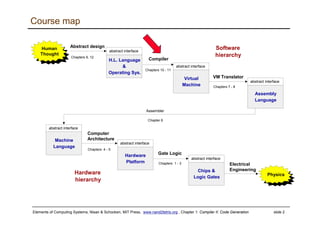
Course map
Assembler
Chapter 6
H.L. Language
&
Operating Sys.
abstract interface
Compiler
Chapters 10 - 11
VM Translator
Chapters 7 - 8
Computer
Architecture
Chapters 4 - 5
Gate Logic
Chapters 1 - 3 Electrical
Engineering
Physics
Virtual
Machine
abstract interface
Software
hierarchy
Assembly
Language
abstract interface
Hardware
hierarchy
Machine
Language
abstract interface
Hardware
Platform
abstract interface
Chips &
Logic Gates
abstract interface
Human
Thought
Abstract design
Chapters 9, 12
Elements of Computing Systems, Nisan & Schocken, MIT Press, www.nand2tetris.org , Chapter 1: Compiler II: Code Generation slide 3
The big picture
(Chapter 11)Jack
Program
Toke-
nizer
Parser
Code
Gene
-ration
Syntax Analyzer
Jack Compiler
VM
code
XML
code
(Chapter 10)
1. Syntax analysis: extracting the semantics from the source code
2. Code generation: expressing the semantics using the target language
this
lecture
previous
lecture
Elements of Computing Systems, Nisan & Schocken, MIT Press, www.nand2tetris.org , Chapter 1: Compiler II: Code Generation slide 4
Syntax analysis (review)
Class Bar {
method Fraction foo(int y) {
var int temp; // a variable
let temp = (xxx+12)*-63;
...
...
Class Bar {
method Fraction foo(int y) {
var int temp; // a variable
let temp = (xxx+12)*-63;
...
...
<varDec>
<keyword> var </keyword>
<keyword> int </keyword>
<identifier> temp </identifier>
<symbol> ; </symbol>
</varDec>
<statements>
<letStatement>
<keyword> let </keyword>
<identifier> temp </identifier>
<symbol> = </symbol>
<expression>
<term>
<symbol> ( </symbol>
<expression>
<term>
<identifier> xxx </identifier>
</term>
<symbol> + </symbol>
<term>
<int.Const.> 12 </int.Const.>
</term>
</expression>
...
<varDec>
<keyword> var </keyword>
<keyword> int </keyword>
<identifier> temp </identifier>
<symbol> ; </symbol>
</varDec>
<statements>
<letStatement>
<keyword> let </keyword>
<identifier> temp </identifier>
<symbol> = </symbol>
<expression>
<term>
<symbol> ( </symbol>
<expression>
<term>
<identifier> xxx </identifier>
</term>
<symbol> + </symbol>
<term>
<int.Const.> 12 </int.Const.>
</term>
</expression>
...
Syntax analyzer
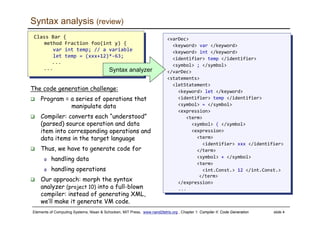
The code generation challenge:
Program = a series of operations that
manipulate data
Compiler: converts each “understood”
(parsed) source operation and data
item into corresponding operations and
data items in the target language
Thus, we have to generate code for
o handling data
o handling operations
Our approach: morph the syntax
analyzer (project 10) into a full-blown
compiler: instead of generating XML,
we’ll make it generate VM code.
Elements of Computing Systems, Nisan & Schocken, MIT Press, www.nand2tetris.org , Chapter 1: Compiler II: Code Generation slide 5
Memory segments (review)
Where i is a non-negative integer and segment is one of the following:
static: holds values of global variables, shared by all functions in the same class
argument: holds values of the argument variables of the current function
local: holds values of the local variables of the current function
this: holds values of the private (“object”) variables of the current object
that: holds array values (silly name, sorry)
constant: holds all the constants in the range 0 … 32767 (pseudo memory segment)
pointer: used to anchor this and that to various areas in the heap
temp: fixed 8-entry segment that holds temporary variables for general use;
Shared by all VM functions in the program.
VM memory Commands:
pop segment i
push segment i
VM memory Commands:
pop segment i
push segment i
Elements of Computing Systems, Nisan & Schocken, MIT Press, www.nand2tetris.org , Chapter 1: Compiler II: Code Generation slide 6
Code generation example
method int foo() {
var int x;
let x = x + 1;
...
method int foo() {
var int x;
let x = x + 1;
...
<letStatement>
<keyword> let </keyword>
<identifier> x </identifier>
<symbol> = </symbol>
<expression>
<term>
<identifier> x </identifier>
</term>
<symbol> + </symbol>
<term>
<constant> 1 </constant>
</term>
</expression>
</letStatement>
<letStatement>
<keyword> let </keyword>
<identifier> x </identifier>
<symbol> = </symbol>
<expression>
<term>
<identifier> x </identifier>
</term>
<symbol> + </symbol>
<term>
<constant> 1 </constant>
</term>
</expression>
</letStatement>
Syntax
analysis
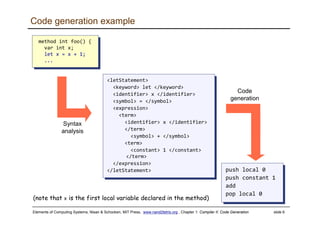
(note that x is the first local variable declared in the method)
push local 0
push constant 1
add
pop local 0
push local 0
push constant 1
add
pop local 0
Code
generation
Elements of Computing Systems, Nisan & Schocken, MIT Press, www.nand2tetris.org , Chapter 1: Compiler II: Code Generation slide 7
Handling variables
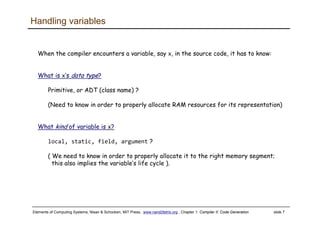
When the compiler encounters a variable, say x, in the source code, it has to know:
What is x’s data type?
Primitive, or ADT (class name) ?
(Need to know in order to properly allocate RAM resources for its representation)
What kind of variable is x?
local, static, field, argument ?
( We need to know in order to properly allocate it to the right memory segment;
this also implies the variable’s life cycle ).
Elements of Computing Systems, Nisan & Schocken, MIT Press, www.nand2tetris.org , Chapter 1: Compiler II: Code Generation slide 8
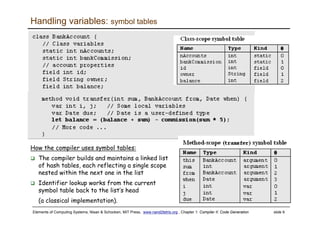
Handling variables: mapping them on memory segments (example)
When compiling this class, we have to create the following mappings:
The class variables nAccounts , bankCommission are mapped on static 0,1
The object fields id, owner, balance are mapped on this 0,1,2
The argument variables sum, bankAccount, when are mapped on arg 0,1,2
The local variables i, j, due are mapped on local 0,1,2.
The target language uses 8 memory segments
Each memory segment, e.g. static,
is an indexed sequence of 16-bit values
that can be referred to as
static 0, static 1, static 2, etc.
Elements of Computing Systems, Nisan & Schocken, MIT Press, www.nand2tetris.org , Chapter 1: Compiler II: Code Generation slide 9
Handling variables: symbol tables
How the compiler uses symbol tables:
The compiler builds and maintains a linked list
of hash tables, each reflecting a single scope
nested within the next one in the list
Identifier lookup works from the current
symbol table back to the list’s head
(a classical implementation).
Elements of Computing Systems, Nisan & Schocken, MIT Press, www.nand2tetris.org , Chapter 1: Compiler II: Code Generation slide 10
Handling variables: managing their life cycle
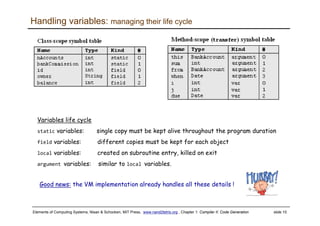
Variables life cycle
static variables: single copy must be kept alive throughout the program duration
field variables: different copies must be kept for each object
local variables: created on subroutine entry, killed on exit
argument variables: similar to local variables.
Good news: the VM implementation already handles all these details !
Elements of Computing Systems, Nisan & Schocken, MIT Press, www.nand2tetris.org , Chapter 1: Compiler II: Code Generation slide 11
class Complex {
// Fields (properties):
int re; // Real part
int im; // Imaginary part
...
/** Constructs a new Complex number */
public Complex (int re, int im) {
this.re = re;
this.im = im;
}
...
}
class Foo {
public void bla() {
Complex a, b, c;
...
a = new Complex(5,17);
b = new Complex(12,192);
...
c = a; // Only the reference is copied
...
}
class Complex {
// Fields (properties):
int re; // Real part
int im; // Imaginary part
...
/** Constructs a new Complex number */
public Complex (int re, int im) {
this.re = re;
this.im = im;
}
...
}
class Foo {
public void bla() {
Complex a, b, c;
...
a = new Complex(5,17);
b = new Complex(12,192);
...
c = a; // Only the reference is copied
...
}
Java code
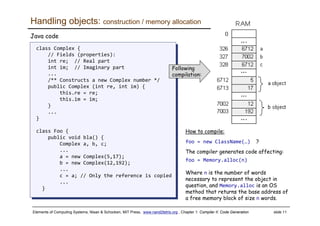
Handling objects: construction / memory allocation
How to compile:
foo = new ClassName(…) ?
The compiler generates code affecting:
foo = Memory.alloc(n)
Where n is the number of words
necessary to represent the object in
question, and Memory.alloc is an OS
method that returns the base address of
a free memory block of size n words.
Following
compilation:
Elements of Computing Systems, Nisan & Schocken, MIT Press, www.nand2tetris.org , Chapter 1: Compiler II: Code Generation slide 12
Handling objects: accessing fields
class Complex {
// Properties (fields):
int re; // Real part
int im; // Imaginary part
...
/** Constructs a new Complex number */
public Complex(int re, int im) {
this.re = re;
this.im = im;
}
...
/** Multiplies this Complex number
by the given scalar */
public void mult (int c) {
re = re * c;
im = im * c;
}
...
}
class Complex {
// Properties (fields):
int re; // Real part
int im; // Imaginary part
...
/** Constructs a new Complex number */
public Complex(int re, int im) {
this.re = re;
this.im = im;
}
...
/** Multiplies this Complex number
by the given scalar */
public void mult (int c) {
re = re * c;
im = im * c;
}
...
}
Java code
*(this + 1) = *(this + 1)
times
(argument 0)
*(this + 1) = *(this + 1)
times
(argument 0)
How to compile:
im = im * c ?
1. look up the two variables in
the symbol table
2. Generate the code:
This pseudo-code should be
expressed in the target
language.
Elements of Computing Systems, Nisan & Schocken, MIT Press, www.nand2tetris.org , Chapter 1: Compiler II: Code Generation slide 13
Assume that b and r were passed to the
function as its first two arguments.
How to compile (in Java):
b.radius = r ?
// Get b's base address:
push argument 0
// Point the this segment to b:
pop pointer 0
// Get r's value
push argument 1
// Set b's third field to r:
pop this 2
Assume that b and r were passed to the
function as its first two arguments.
How to compile (in Java):
b.radius = r ?
// Get b's base address:
push argument 0
// Point the this segment to b:
pop pointer 0
// Get r's value
push argument 1
// Set b's third field to r:
pop this 2
120
80
50radius:
x:
y:
3color:
120
80
50
3012
3013
3014
33015
412 3012
...
...
High level program view RAM view
0
...
b
following
compilation
b
object
b
object(Actual RAM locations of program variables are
run-time dependent, and thus the addresses shown
here are arbitrary examples.)
00
1
Virtual memory segments just before
the operation b.radius=17:
3012
17
0
1
...
...
120
80
17
0
1
2
30120
1
3
3012
17
0
1
argument pointer this
...
3
(this 0
is now
alligned with
RAM[3012])
...
Virtual memory segments just after
the operation b.radius=17:
argument pointer this
Handling objects: establishing access to the object’s fields
Background: Suppose we have an object
named b of type Ball. A Ball has x,y
coordinates, a radius, and a color.
Elements of Computing Systems, Nisan & Schocken, MIT Press, www.nand2tetris.org , Chapter 1: Compiler II: Code Generation slide 14
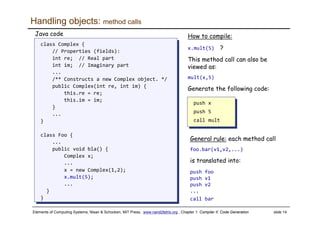
Handling objects: method calls
General rule: each method call
foo.bar(v1,v2,...)
is translated into:
push foo
push v1
push v2
...
call bar
class Complex {
// Properties (fields):
int re; // Real part
int im; // Imaginary part
...
/** Constructs a new Complex object. */
public Complex(int re, int im) {
this.re = re;
this.im = im;
}
...
}
class Foo {
...
public void bla() {
Complex x;
...
x = new Complex(1,2);
x.mult(5);
...
}
}
class Complex {
// Properties (fields):
int re; // Real part
int im; // Imaginary part
...
/** Constructs a new Complex object. */
public Complex(int re, int im) {
this.re = re;
this.im = im;
}
...
}
class Foo {
...
public void bla() {
Complex x;
...
x = new Complex(1,2);
x.mult(5);
...
}
}
Java code
push x
push 5
call mult
push x
push 5
call mult
How to compile:
x.mult(5) ?
This method call can also be
viewed as:
mult(x,5)
Generate the following code:
Elements of Computing Systems, Nisan & Schocken, MIT Press, www.nand2tetris.org , Chapter 1: Compiler II: Code Generation slide 15
class Bla {
...
void foo(int k) {
int x, y;
int[] bar; // declare an array
...
// Construct the array:
bar = new int[10];
...
bar[k]=19;
}
...
Main.foo(2); // Call the foo method
...
class Bla {
...
void foo(int k) {
int x, y;
int[] bar; // declare an array
...
// Construct the array:
bar = new int[10];
...
bar[k]=19;
}
...
Main.foo(2); // Call the foo method
...
Java code
How to compile:
bar = new int(n) ?
Generate code affecting:
bar = Memory.alloc(n)
Handling arrays: declaration / construction
19
4315
4316
4317
4324
(bar array)
...
4318
...
...
4315
...
0
bar
x
y
2 k
(local 0)
(local 1)
(local 2)
(argument 0)
275
276
277
504
RAM state
...
Following
compilation:
Elements of Computing Systems, Nisan & Schocken, MIT Press, www.nand2tetris.org , Chapter 1: Compiler II: Code Generation slide 16
class Bla {
...
void foo(int k) {
int x, y;
int[] bar; // declare an array
...
// Construct the array:
bar = new int[10];
...
bar[k]=19;
}
...
Main.foo(2); // Call the foo method
...
class Bla {
...
void foo(int k) {
int x, y;
int[] bar; // declare an array
...
// Construct the array:
bar = new int[10];
...
bar[k]=19;
}
...
Main.foo(2); // Call the foo method
...
Java code
How to compile: bar[k] = 19 ?
// bar[k]=19, or *(bar+k)=19
push bar
push k
add
// Use a pointer to access x[k]
pop addr // addr points to bar[k]
push 19
pop *addr // Set bar[k] to 19
// bar[k]=19, or *(bar+k)=19
push bar
push k
add
// Use a pointer to access x[k]
pop addr // addr points to bar[k]
push 19
pop *addr // Set bar[k] to 19
VM Code (pseudo)
// bar[k]=19, or *(bar+k)=19
push local 2
push argument 0
add
// Use the that segment to access x[k]
pop pointer 1
push constant 19
pop that 0
// bar[k]=19, or *(bar+k)=19
push local 2
push argument 0
add
// Use the that segment to access x[k]
pop pointer 1
push constant 19
pop that 0
VM Code (actual)
19
4315
4316
4317
4324
(bar array)
...
4318
...
...
4315
...
0
bar
x
y
2 k
(local 0)
(local 1)
(local 2)
(argument 0)
275
276
277
504
RAM state, just after executing bar[k] = 19
...
Following
compilation:
Handling arrays: accessing an array entry by its index
Elements of Computing Systems, Nisan & Schocken, MIT Press, www.nand2tetris.org , Chapter 1: Compiler II: Code Generation slide 17
syntax
analysis
parse tree
Handling expressions
((5+z)/-8)*(4^2)((5+z)/-8)*(4^2)
High-level code
push 5
push z
add
push 8
neg
call div
push 4
push 2
call power
call mult
push 5
push z
add
push 8
neg
call div
push 4
push 2
call power
call mult
code
generation
To generate VM code from a parse tree exp, use the following logic:
The codeWrite(exp) algorithm:
if exp is a constant n then output "push n"
if exp is a variable v then output "push v"
if exp is op(exp1) then codeWrite(exp1); output "op";
if exp is (exp1 op exp2) then codeWrite(exp1); codeWrite(exp2); output "op";
if exp is f (exp1, ..., expn) then codeWrite(exp1); ... codeWrite(exp1); output "call f";
VM code
Elements of Computing Systems, Nisan & Schocken, MIT Press, www.nand2tetris.org , Chapter 1: Compiler II: Code Generation slide 18
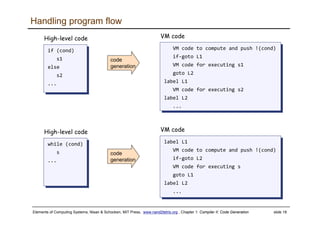
Handling program flow
if (cond)
s1
else
s2
...
if (cond)
s1
else
s2
...
High-level code
VM code to compute and push !(cond)
if-goto L1
VM code for executing s1
goto L2
label L1
VM code for executing s2
label L2
...
VM code to compute and push !(cond)
if-goto L1
VM code for executing s1
goto L2
label L1
VM code for executing s2
label L2
...
VM code
code
generation
while (cond)
s
...
while (cond)
s
...
High-level code
label L1
VM code to compute and push !(cond)
if-goto L2
VM code for executing s
goto L1
label L2
...
label L1
VM code to compute and push !(cond)
if-goto L2
VM code for executing s
goto L1
label L2
...
VM code
code
generation
Elements of Computing Systems, Nisan & Schocken, MIT Press, www.nand2tetris.org , Chapter 1: Compiler II: Code Generation slide 19
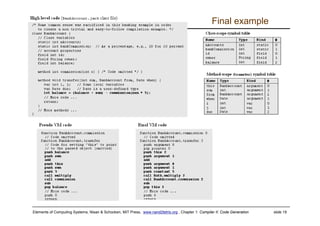
Final example
Elements of Computing Systems, Nisan & Schocken, MIT Press, www.nand2tetris.org , Chapter 1: Compiler II: Code Generation slide 20
Perspective
Jack simplifications that are challenging to extend:
Limited primitive type system
No inheritance
No public class fields, e.g. must use r = c.getRadius()
rather than r = c.radius
Jack simplifications that are easy to extend: :
Limited control structures, e.g. no for, switch, …
Cumbersome handling of char types, e.g. cannot use let x=‘c’
Optimization
For example, c=c+1 is translated inefficiently into push c, push 1, add, pop c.
Parallel processing
Many other examples of possible improvements …

Lecture 11 compiler ii

  • 1.
    Elements of ComputingSystems, Nisan & Schocken, MIT Press, www.nand2tetris.org , Chapter 1: Compiler II: Code Generation slide 1 www.nand2tetris.org Building a Modern Computer From First Principles Compiler II: Code Generation
  • 2.
    Elements of ComputingSystems, Nisan & Schocken, MIT Press, www.nand2tetris.org , Chapter 1: Compiler II: Code Generation slide 2 Course map Assembler Chapter 6 H.L. Language & Operating Sys. abstract interface Compiler Chapters 10 - 11 VM Translator Chapters 7 - 8 Computer Architecture Chapters 4 - 5 Gate Logic Chapters 1 - 3 Electrical Engineering Physics Virtual Machine abstract interface Software hierarchy Assembly Language abstract interface Hardware hierarchy Machine Language abstract interface Hardware Platform abstract interface Chips & Logic Gates abstract interface Human Thought Abstract design Chapters 9, 12
  • 3.
    Elements of ComputingSystems, Nisan & Schocken, MIT Press, www.nand2tetris.org , Chapter 1: Compiler II: Code Generation slide 3 The big picture (Chapter 11)Jack Program Toke- nizer Parser Code Gene -ration Syntax Analyzer Jack Compiler VM code XML code (Chapter 10) 1. Syntax analysis: extracting the semantics from the source code 2. Code generation: expressing the semantics using the target language this lecture previous lecture
  • 4.
    Elements of ComputingSystems, Nisan & Schocken, MIT Press, www.nand2tetris.org , Chapter 1: Compiler II: Code Generation slide 4 Syntax analysis (review) Class Bar { method Fraction foo(int y) { var int temp; // a variable let temp = (xxx+12)*-63; ... ... Class Bar { method Fraction foo(int y) { var int temp; // a variable let temp = (xxx+12)*-63; ... ... <varDec> <keyword> var </keyword> <keyword> int </keyword> <identifier> temp </identifier> <symbol> ; </symbol> </varDec> <statements> <letStatement> <keyword> let </keyword> <identifier> temp </identifier> <symbol> = </symbol> <expression> <term> <symbol> ( </symbol> <expression> <term> <identifier> xxx </identifier> </term> <symbol> + </symbol> <term> <int.Const.> 12 </int.Const.> </term> </expression> ... <varDec> <keyword> var </keyword> <keyword> int </keyword> <identifier> temp </identifier> <symbol> ; </symbol> </varDec> <statements> <letStatement> <keyword> let </keyword> <identifier> temp </identifier> <symbol> = </symbol> <expression> <term> <symbol> ( </symbol> <expression> <term> <identifier> xxx </identifier> </term> <symbol> + </symbol> <term> <int.Const.> 12 </int.Const.> </term> </expression> ... Syntax analyzer The code generation challenge: Program = a series of operations that manipulate data Compiler: converts each “understood” (parsed) source operation and data item into corresponding operations and data items in the target language Thus, we have to generate code for o handling data o handling operations Our approach: morph the syntax analyzer (project 10) into a full-blown compiler: instead of generating XML, we’ll make it generate VM code.
  • 5.
    Elements of ComputingSystems, Nisan & Schocken, MIT Press, www.nand2tetris.org , Chapter 1: Compiler II: Code Generation slide 5 Memory segments (review) Where i is a non-negative integer and segment is one of the following: static: holds values of global variables, shared by all functions in the same class argument: holds values of the argument variables of the current function local: holds values of the local variables of the current function this: holds values of the private (“object”) variables of the current object that: holds array values (silly name, sorry) constant: holds all the constants in the range 0 … 32767 (pseudo memory segment) pointer: used to anchor this and that to various areas in the heap temp: fixed 8-entry segment that holds temporary variables for general use; Shared by all VM functions in the program. VM memory Commands: pop segment i push segment i VM memory Commands: pop segment i push segment i
  • 6.
    Elements of ComputingSystems, Nisan & Schocken, MIT Press, www.nand2tetris.org , Chapter 1: Compiler II: Code Generation slide 6 Code generation example method int foo() { var int x; let x = x + 1; ... method int foo() { var int x; let x = x + 1; ... <letStatement> <keyword> let </keyword> <identifier> x </identifier> <symbol> = </symbol> <expression> <term> <identifier> x </identifier> </term> <symbol> + </symbol> <term> <constant> 1 </constant> </term> </expression> </letStatement> <letStatement> <keyword> let </keyword> <identifier> x </identifier> <symbol> = </symbol> <expression> <term> <identifier> x </identifier> </term> <symbol> + </symbol> <term> <constant> 1 </constant> </term> </expression> </letStatement> Syntax analysis (note that x is the first local variable declared in the method) push local 0 push constant 1 add pop local 0 push local 0 push constant 1 add pop local 0 Code generation
  • 7.
    Elements of ComputingSystems, Nisan & Schocken, MIT Press, www.nand2tetris.org , Chapter 1: Compiler II: Code Generation slide 7 Handling variables When the compiler encounters a variable, say x, in the source code, it has to know: What is x’s data type? Primitive, or ADT (class name) ? (Need to know in order to properly allocate RAM resources for its representation) What kind of variable is x? local, static, field, argument ? ( We need to know in order to properly allocate it to the right memory segment; this also implies the variable’s life cycle ).
  • 8.
    Elements of ComputingSystems, Nisan & Schocken, MIT Press, www.nand2tetris.org , Chapter 1: Compiler II: Code Generation slide 8 Handling variables: mapping them on memory segments (example) When compiling this class, we have to create the following mappings: The class variables nAccounts , bankCommission are mapped on static 0,1 The object fields id, owner, balance are mapped on this 0,1,2 The argument variables sum, bankAccount, when are mapped on arg 0,1,2 The local variables i, j, due are mapped on local 0,1,2. The target language uses 8 memory segments Each memory segment, e.g. static, is an indexed sequence of 16-bit values that can be referred to as static 0, static 1, static 2, etc.
  • 9.
    Elements of ComputingSystems, Nisan & Schocken, MIT Press, www.nand2tetris.org , Chapter 1: Compiler II: Code Generation slide 9 Handling variables: symbol tables How the compiler uses symbol tables: The compiler builds and maintains a linked list of hash tables, each reflecting a single scope nested within the next one in the list Identifier lookup works from the current symbol table back to the list’s head (a classical implementation).
  • 10.
    Elements of ComputingSystems, Nisan & Schocken, MIT Press, www.nand2tetris.org , Chapter 1: Compiler II: Code Generation slide 10 Handling variables: managing their life cycle Variables life cycle static variables: single copy must be kept alive throughout the program duration field variables: different copies must be kept for each object local variables: created on subroutine entry, killed on exit argument variables: similar to local variables. Good news: the VM implementation already handles all these details !
  • 11.
    Elements of ComputingSystems, Nisan & Schocken, MIT Press, www.nand2tetris.org , Chapter 1: Compiler II: Code Generation slide 11 class Complex { // Fields (properties): int re; // Real part int im; // Imaginary part ... /** Constructs a new Complex number */ public Complex (int re, int im) { this.re = re; this.im = im; } ... } class Foo { public void bla() { Complex a, b, c; ... a = new Complex(5,17); b = new Complex(12,192); ... c = a; // Only the reference is copied ... } class Complex { // Fields (properties): int re; // Real part int im; // Imaginary part ... /** Constructs a new Complex number */ public Complex (int re, int im) { this.re = re; this.im = im; } ... } class Foo { public void bla() { Complex a, b, c; ... a = new Complex(5,17); b = new Complex(12,192); ... c = a; // Only the reference is copied ... } Java code Handling objects: construction / memory allocation How to compile: foo = new ClassName(…) ? The compiler generates code affecting: foo = Memory.alloc(n) Where n is the number of words necessary to represent the object in question, and Memory.alloc is an OS method that returns the base address of a free memory block of size n words. Following compilation:
  • 12.
    Elements of ComputingSystems, Nisan & Schocken, MIT Press, www.nand2tetris.org , Chapter 1: Compiler II: Code Generation slide 12 Handling objects: accessing fields class Complex { // Properties (fields): int re; // Real part int im; // Imaginary part ... /** Constructs a new Complex number */ public Complex(int re, int im) { this.re = re; this.im = im; } ... /** Multiplies this Complex number by the given scalar */ public void mult (int c) { re = re * c; im = im * c; } ... } class Complex { // Properties (fields): int re; // Real part int im; // Imaginary part ... /** Constructs a new Complex number */ public Complex(int re, int im) { this.re = re; this.im = im; } ... /** Multiplies this Complex number by the given scalar */ public void mult (int c) { re = re * c; im = im * c; } ... } Java code *(this + 1) = *(this + 1) times (argument 0) *(this + 1) = *(this + 1) times (argument 0) How to compile: im = im * c ? 1. look up the two variables in the symbol table 2. Generate the code: This pseudo-code should be expressed in the target language.
  • 13.
    Elements of ComputingSystems, Nisan & Schocken, MIT Press, www.nand2tetris.org , Chapter 1: Compiler II: Code Generation slide 13 Assume that b and r were passed to the function as its first two arguments. How to compile (in Java): b.radius = r ? // Get b's base address: push argument 0 // Point the this segment to b: pop pointer 0 // Get r's value push argument 1 // Set b's third field to r: pop this 2 Assume that b and r were passed to the function as its first two arguments. How to compile (in Java): b.radius = r ? // Get b's base address: push argument 0 // Point the this segment to b: pop pointer 0 // Get r's value push argument 1 // Set b's third field to r: pop this 2 120 80 50radius: x: y: 3color: 120 80 50 3012 3013 3014 33015 412 3012 ... ... High level program view RAM view 0 ... b following compilation b object b object(Actual RAM locations of program variables are run-time dependent, and thus the addresses shown here are arbitrary examples.) 00 1 Virtual memory segments just before the operation b.radius=17: 3012 17 0 1 ... ... 120 80 17 0 1 2 30120 1 3 3012 17 0 1 argument pointer this ... 3 (this 0 is now alligned with RAM[3012]) ... Virtual memory segments just after the operation b.radius=17: argument pointer this Handling objects: establishing access to the object’s fields Background: Suppose we have an object named b of type Ball. A Ball has x,y coordinates, a radius, and a color.
  • 14.
    Elements of ComputingSystems, Nisan & Schocken, MIT Press, www.nand2tetris.org , Chapter 1: Compiler II: Code Generation slide 14 Handling objects: method calls General rule: each method call foo.bar(v1,v2,...) is translated into: push foo push v1 push v2 ... call bar class Complex { // Properties (fields): int re; // Real part int im; // Imaginary part ... /** Constructs a new Complex object. */ public Complex(int re, int im) { this.re = re; this.im = im; } ... } class Foo { ... public void bla() { Complex x; ... x = new Complex(1,2); x.mult(5); ... } } class Complex { // Properties (fields): int re; // Real part int im; // Imaginary part ... /** Constructs a new Complex object. */ public Complex(int re, int im) { this.re = re; this.im = im; } ... } class Foo { ... public void bla() { Complex x; ... x = new Complex(1,2); x.mult(5); ... } } Java code push x push 5 call mult push x push 5 call mult How to compile: x.mult(5) ? This method call can also be viewed as: mult(x,5) Generate the following code:
  • 15.
    Elements of ComputingSystems, Nisan & Schocken, MIT Press, www.nand2tetris.org , Chapter 1: Compiler II: Code Generation slide 15 class Bla { ... void foo(int k) { int x, y; int[] bar; // declare an array ... // Construct the array: bar = new int[10]; ... bar[k]=19; } ... Main.foo(2); // Call the foo method ... class Bla { ... void foo(int k) { int x, y; int[] bar; // declare an array ... // Construct the array: bar = new int[10]; ... bar[k]=19; } ... Main.foo(2); // Call the foo method ... Java code How to compile: bar = new int(n) ? Generate code affecting: bar = Memory.alloc(n) Handling arrays: declaration / construction 19 4315 4316 4317 4324 (bar array) ... 4318 ... ... 4315 ... 0 bar x y 2 k (local 0) (local 1) (local 2) (argument 0) 275 276 277 504 RAM state ... Following compilation:
  • 16.
    Elements of ComputingSystems, Nisan & Schocken, MIT Press, www.nand2tetris.org , Chapter 1: Compiler II: Code Generation slide 16 class Bla { ... void foo(int k) { int x, y; int[] bar; // declare an array ... // Construct the array: bar = new int[10]; ... bar[k]=19; } ... Main.foo(2); // Call the foo method ... class Bla { ... void foo(int k) { int x, y; int[] bar; // declare an array ... // Construct the array: bar = new int[10]; ... bar[k]=19; } ... Main.foo(2); // Call the foo method ... Java code How to compile: bar[k] = 19 ? // bar[k]=19, or *(bar+k)=19 push bar push k add // Use a pointer to access x[k] pop addr // addr points to bar[k] push 19 pop *addr // Set bar[k] to 19 // bar[k]=19, or *(bar+k)=19 push bar push k add // Use a pointer to access x[k] pop addr // addr points to bar[k] push 19 pop *addr // Set bar[k] to 19 VM Code (pseudo) // bar[k]=19, or *(bar+k)=19 push local 2 push argument 0 add // Use the that segment to access x[k] pop pointer 1 push constant 19 pop that 0 // bar[k]=19, or *(bar+k)=19 push local 2 push argument 0 add // Use the that segment to access x[k] pop pointer 1 push constant 19 pop that 0 VM Code (actual) 19 4315 4316 4317 4324 (bar array) ... 4318 ... ... 4315 ... 0 bar x y 2 k (local 0) (local 1) (local 2) (argument 0) 275 276 277 504 RAM state, just after executing bar[k] = 19 ... Following compilation: Handling arrays: accessing an array entry by its index
  • 17.
    Elements of ComputingSystems, Nisan & Schocken, MIT Press, www.nand2tetris.org , Chapter 1: Compiler II: Code Generation slide 17 syntax analysis parse tree Handling expressions ((5+z)/-8)*(4^2)((5+z)/-8)*(4^2) High-level code push 5 push z add push 8 neg call div push 4 push 2 call power call mult push 5 push z add push 8 neg call div push 4 push 2 call power call mult code generation To generate VM code from a parse tree exp, use the following logic: The codeWrite(exp) algorithm: if exp is a constant n then output "push n" if exp is a variable v then output "push v" if exp is op(exp1) then codeWrite(exp1); output "op"; if exp is (exp1 op exp2) then codeWrite(exp1); codeWrite(exp2); output "op"; if exp is f (exp1, ..., expn) then codeWrite(exp1); ... codeWrite(exp1); output "call f"; VM code
  • 18.
    Elements of ComputingSystems, Nisan & Schocken, MIT Press, www.nand2tetris.org , Chapter 1: Compiler II: Code Generation slide 18 Handling program flow if (cond) s1 else s2 ... if (cond) s1 else s2 ... High-level code VM code to compute and push !(cond) if-goto L1 VM code for executing s1 goto L2 label L1 VM code for executing s2 label L2 ... VM code to compute and push !(cond) if-goto L1 VM code for executing s1 goto L2 label L1 VM code for executing s2 label L2 ... VM code code generation while (cond) s ... while (cond) s ... High-level code label L1 VM code to compute and push !(cond) if-goto L2 VM code for executing s goto L1 label L2 ... label L1 VM code to compute and push !(cond) if-goto L2 VM code for executing s goto L1 label L2 ... VM code code generation
  • 19.
    Elements of ComputingSystems, Nisan & Schocken, MIT Press, www.nand2tetris.org , Chapter 1: Compiler II: Code Generation slide 19 Final example
  • 20.
    Elements of ComputingSystems, Nisan & Schocken, MIT Press, www.nand2tetris.org , Chapter 1: Compiler II: Code Generation slide 20 Perspective Jack simplifications that are challenging to extend: Limited primitive type system No inheritance No public class fields, e.g. must use r = c.getRadius() rather than r = c.radius Jack simplifications that are easy to extend: : Limited control structures, e.g. no for, switch, … Cumbersome handling of char types, e.g. cannot use let x=‘c’ Optimization For example, c=c+1 is translated inefficiently into push c, push 1, add, pop c. Parallel processing Many other examples of possible improvements …