Unit 5
COMBINATIONAL CIRCUITS-1
College of Computer and Information Sciences
Department of Computer Science
CSC 220: Computer Organization
Unit 5: Combinational Circuits-1
Overview
• Introduction to Combinational
Circuits
• Adder
• Ripple Carry Adder
• Subtraction
• Adder/Subtractor
Chapter-3
M. Morris Mano, Charles R. Kime and Tom Martin, Logic and Computer Design
Fundamentals, Global (5th) Edition, Pearson Education Limited, 2016. ISBN:
9781292096124
Adder
 Design an Adder for 1-bit numbers?
 1. Specification:
2 inputs (X,Y)
2 outputs (C,S)
Adder
 Design an Adder for 1-bit numbers?
 1. Specification:
2 inputs (X,Y)
2 outputs (C,S)
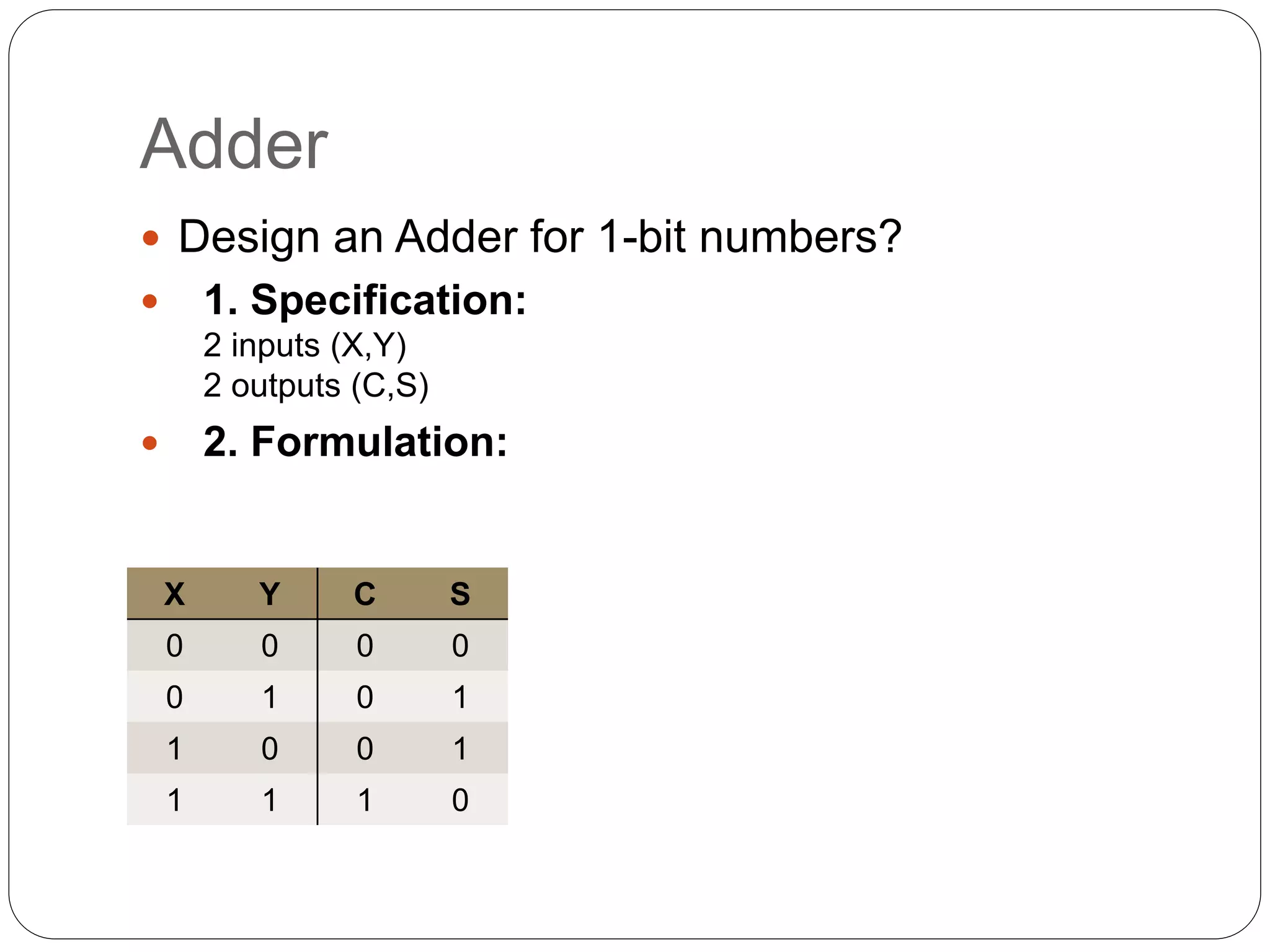
 2. Formulation:
X Y C S
0 0 0 0
0 1 0 1
1 0 0 1
1 1 1 0
Adder
 Design an Adder for 1-bit numbers?
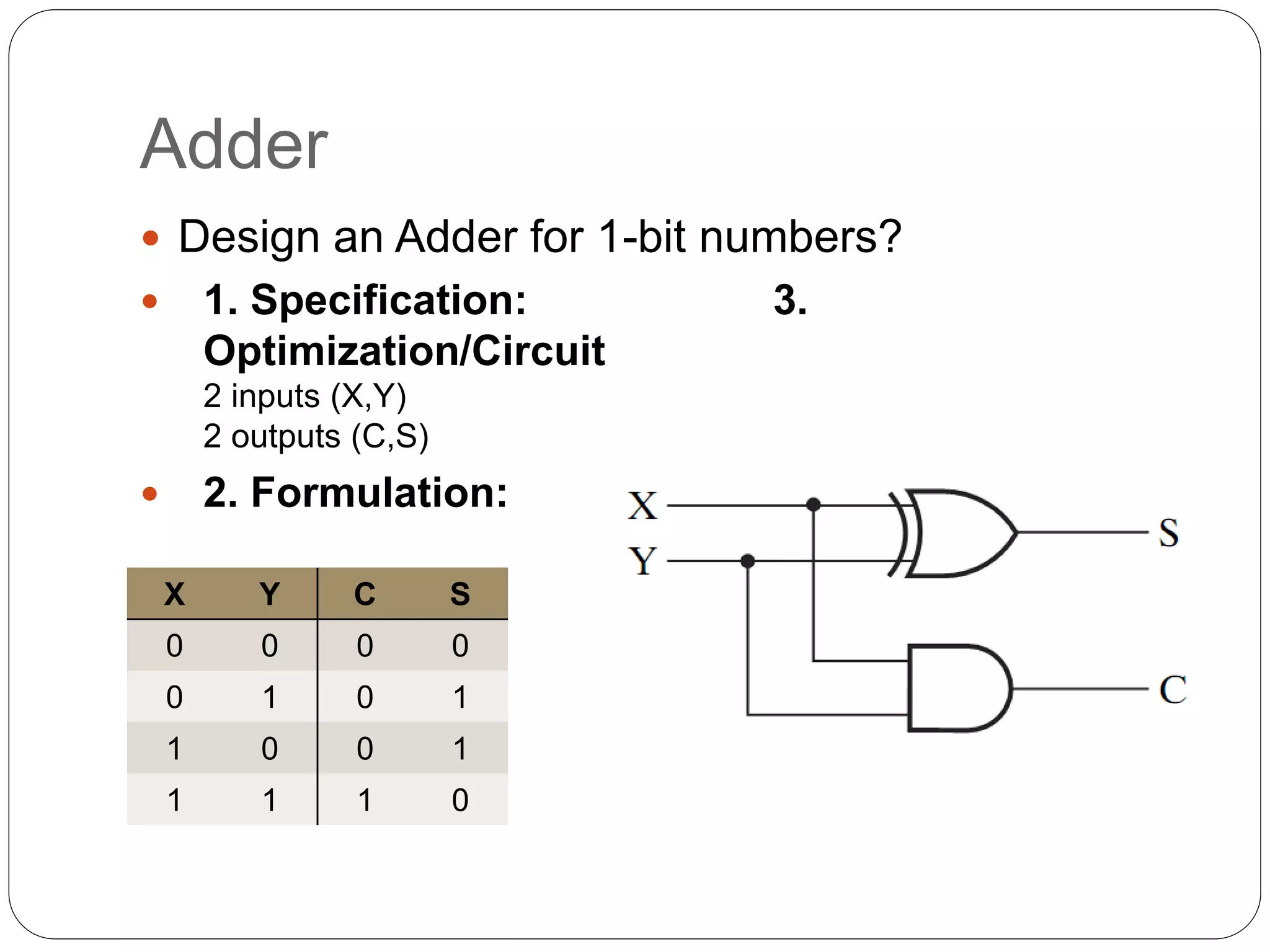
 1. Specification: 3.
Optimization/Circuit
2 inputs (X,Y)
2 outputs (C,S)
 2. Formulation:
X Y C S
0 0 0 0
0 1 0 1
1 0 0 1
1 1 1 0
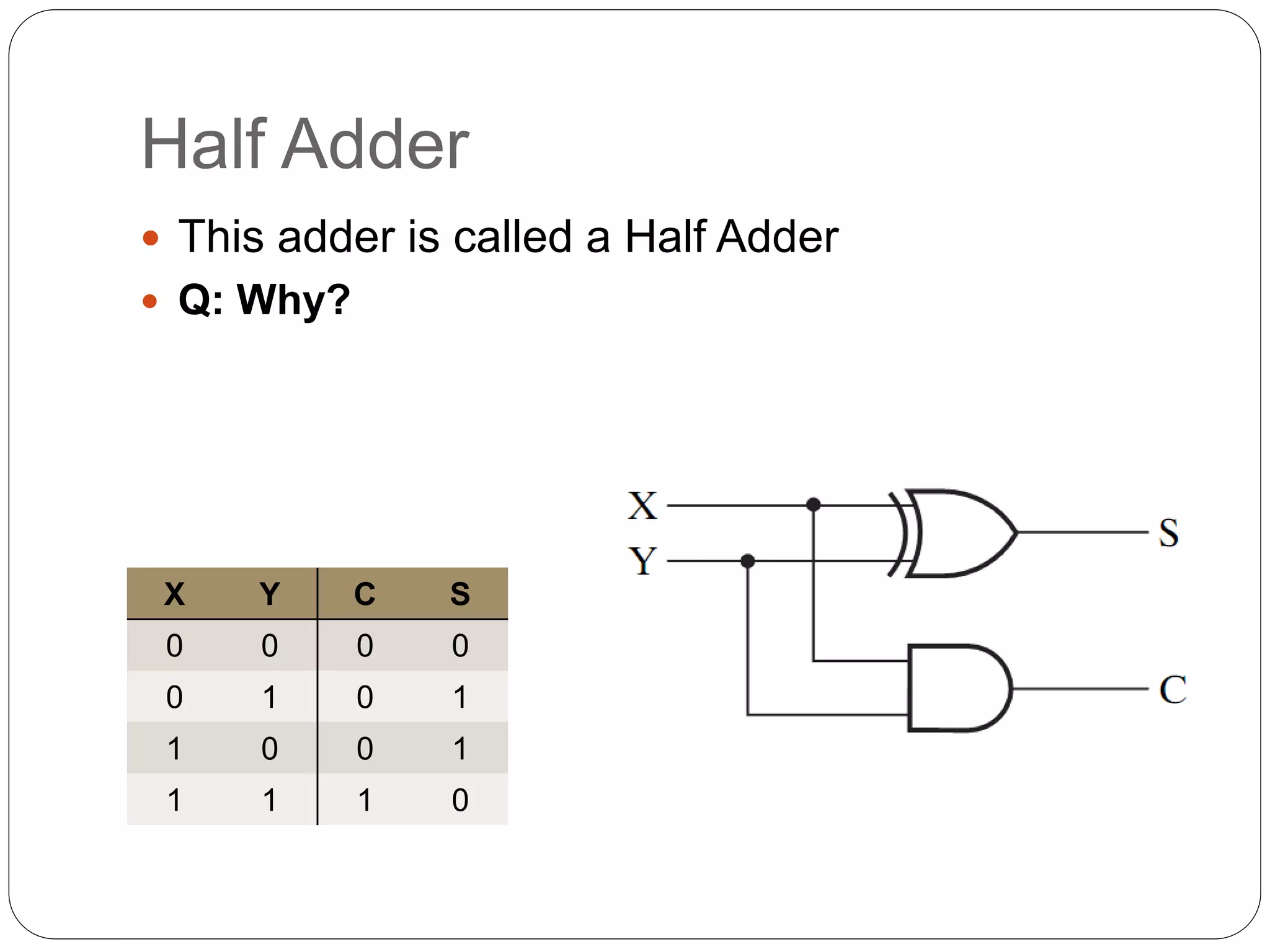
Half Adder
 This adder is called a Half Adder
 Q: Why?
X Y C S
0 0 0 0
0 1 0 1
1 0 0 1
1 1 1 0
Full Adder
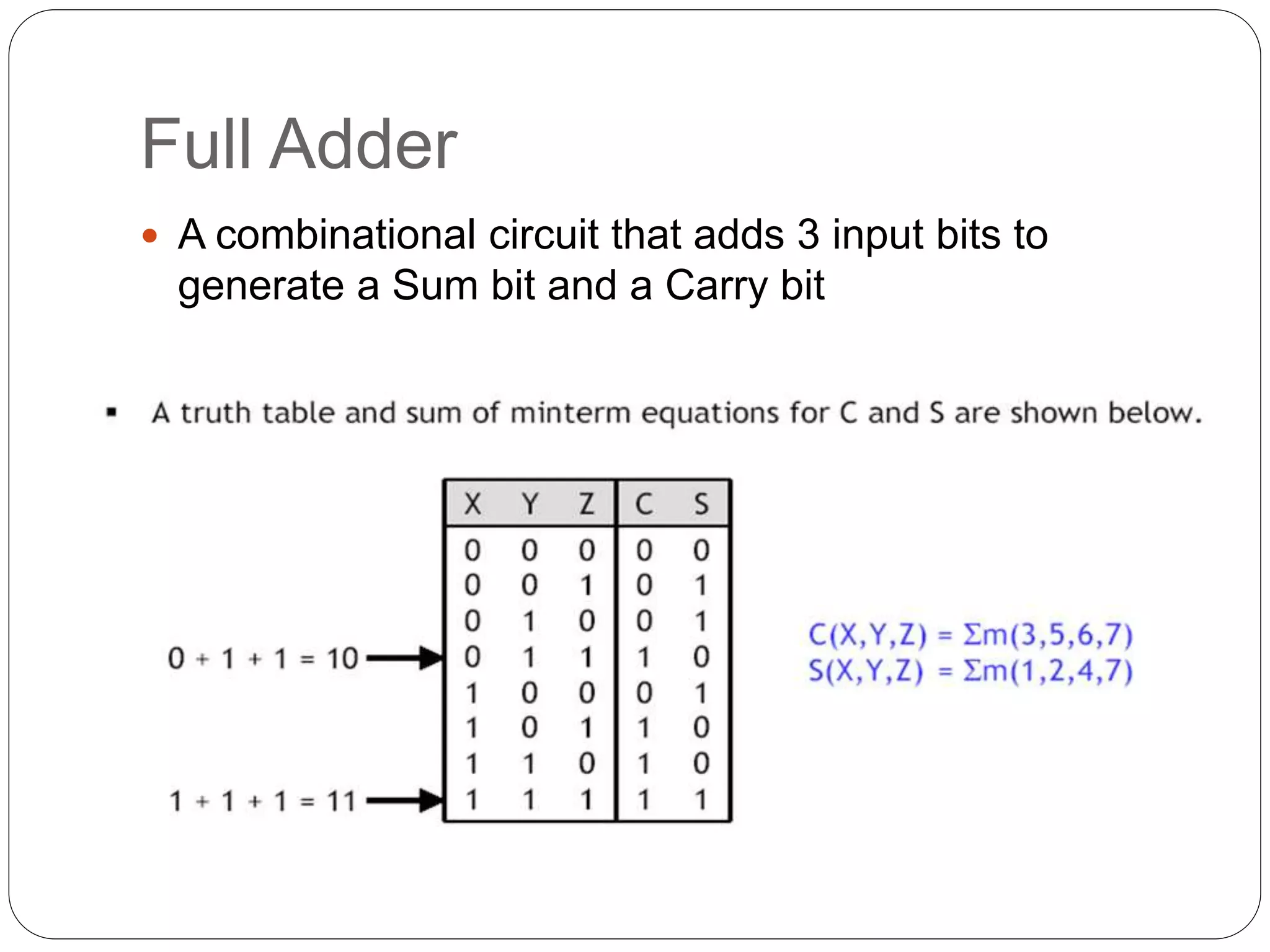
 A combinational circuit that adds 3 input bits to
generate a Sum bit and a Carry bit
Full Adder
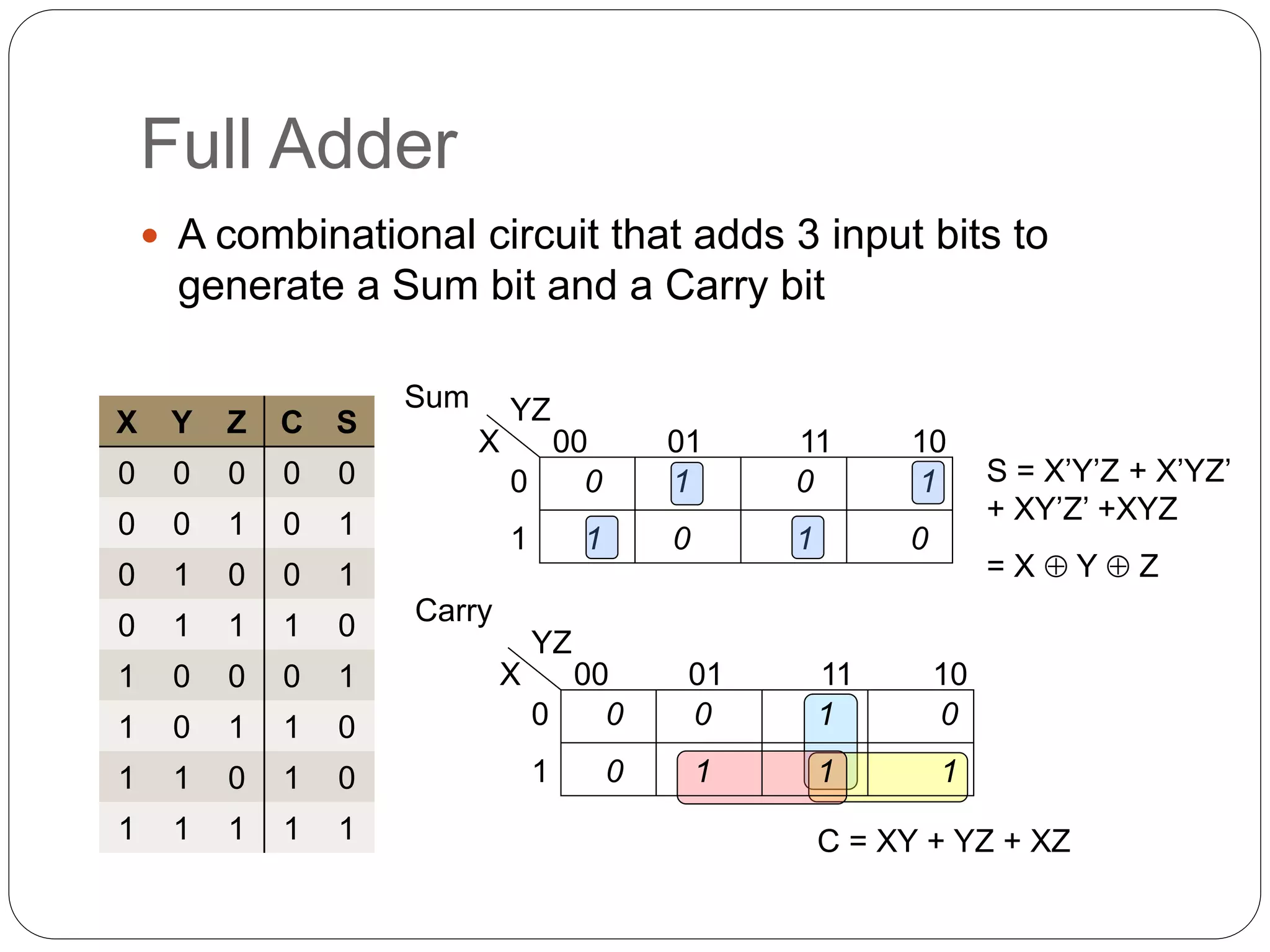
 A combinational circuit that adds 3 input bits to
generate a Sum bit and a Carry bit
X Y Z C S
0 0 0 0 0
0 0 1 0 1
0 1 0 0 1
0 1 1 1 0
1 0 0 0 1
1 0 1 1 0
1 1 0 1 0
1 1 1 1 1
X
YZ
0
1
00 01 11 10
0 1 0 1
1 0 1 0
X
YZ
0
1
00 01 11 10
0 0 1 0
0 1 1 1
Sum
Carry
S = X’Y’Z + X’YZ’
+ XY’Z’ +XYZ
= X  Y  Z
C = XY + YZ + XZ
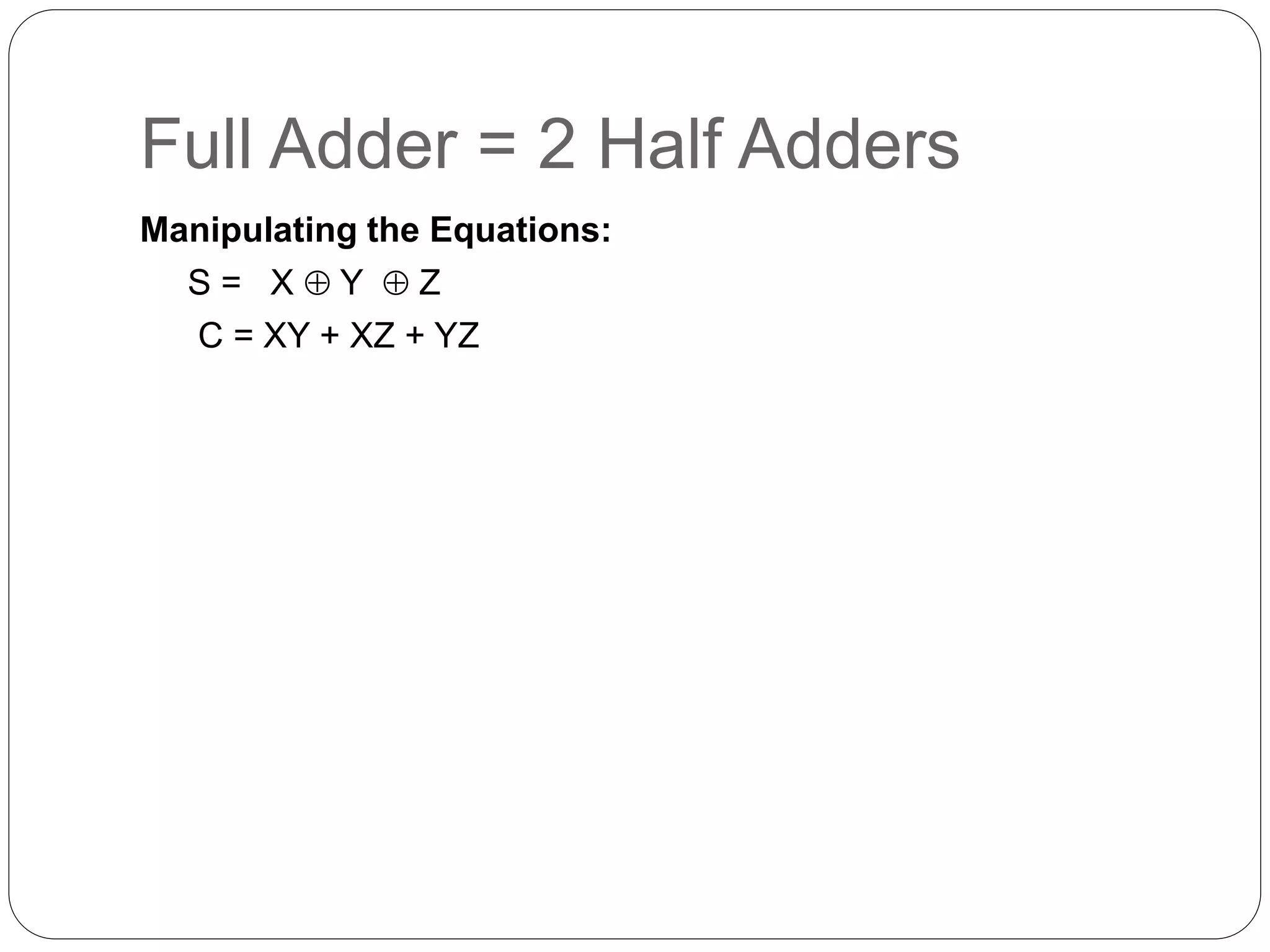
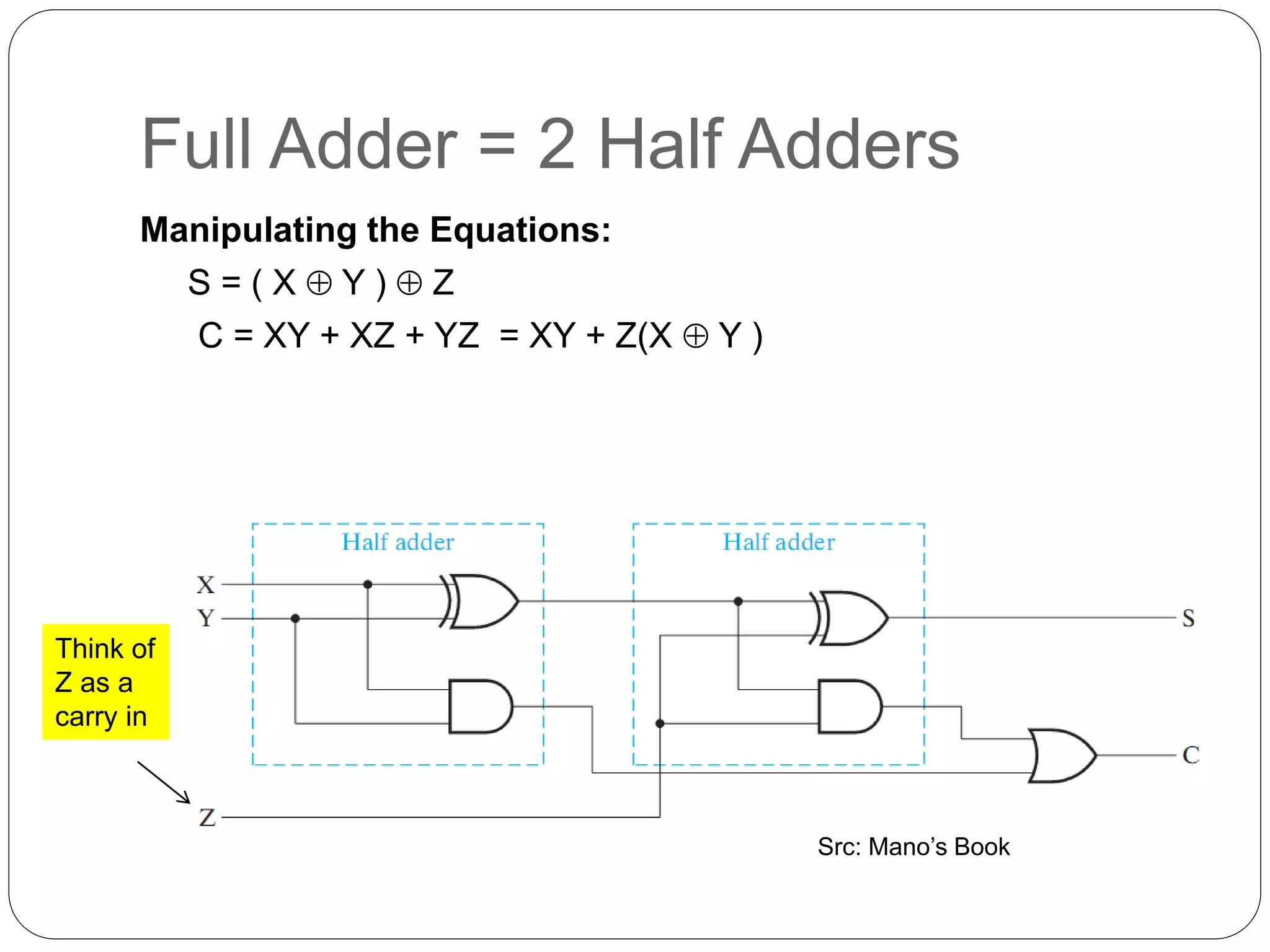
Full Adder = 2 Half Adders
Manipulating the Equations:
S = X  Y  Z
C = XY + XZ + YZ
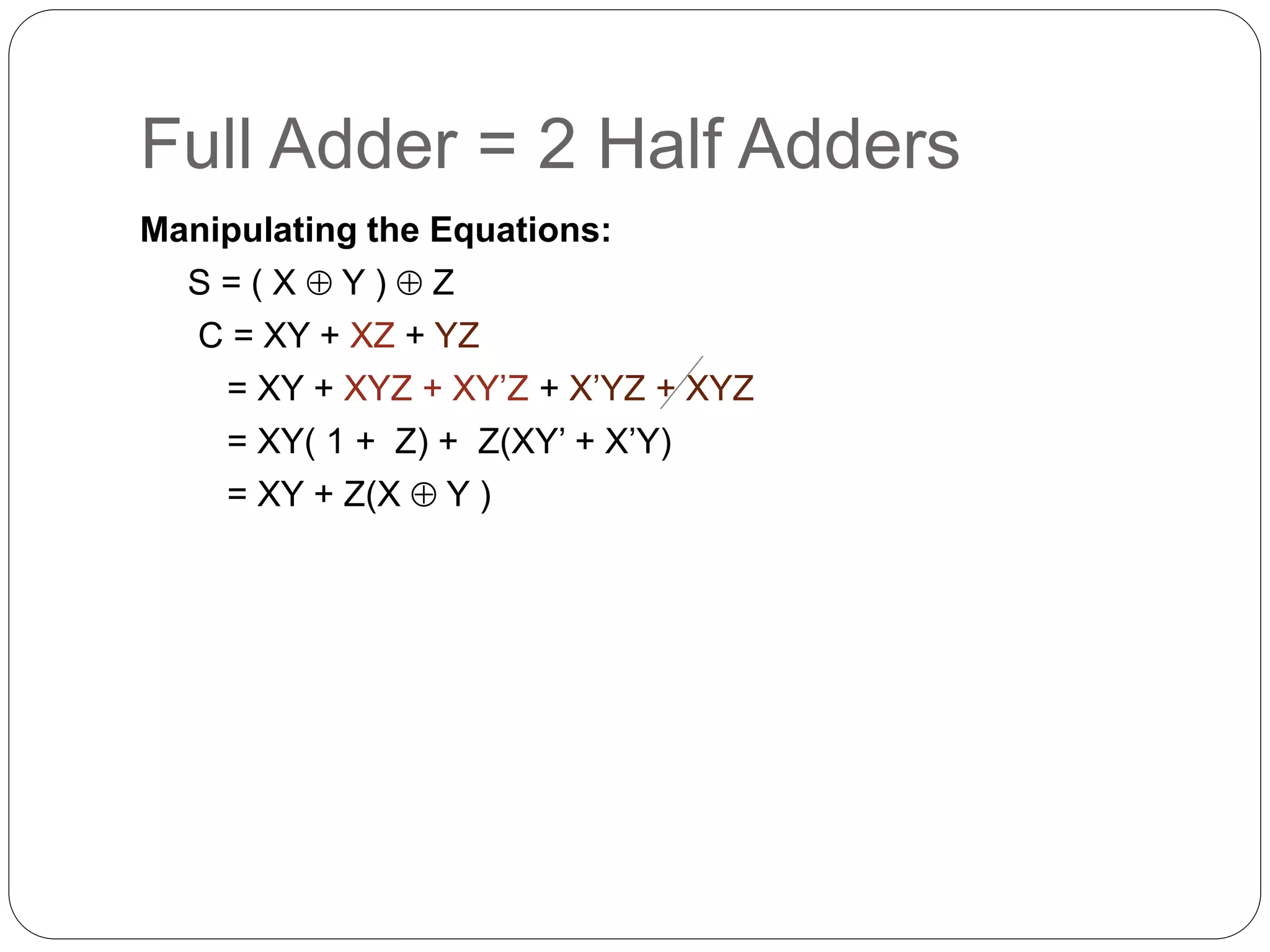
Full Adder = 2 Half Adders
Manipulating the Equations:
S = ( X  Y )  Z
C = XY + XZ + YZ
= XY + XYZ + XY’Z + X’YZ + XYZ
= XY( 1 + Z) + Z(XY’ + X’Y)
= XY + Z(X  Y )
Full Adder = 2 Half Adders
Manipulating the Equations:
S = ( X  Y )  Z
C = XY + XZ + YZ = XY + Z(X  Y )
Src: Mano’s Book
Think of
Z as a
carry in
Bigger Adders
• How to build an adder for n-bit numbers?
• Example: 4-Bit Adder
• Inputs ?
• Outputs ?
• What is the size of the truth table?
• How many functions to optimize?
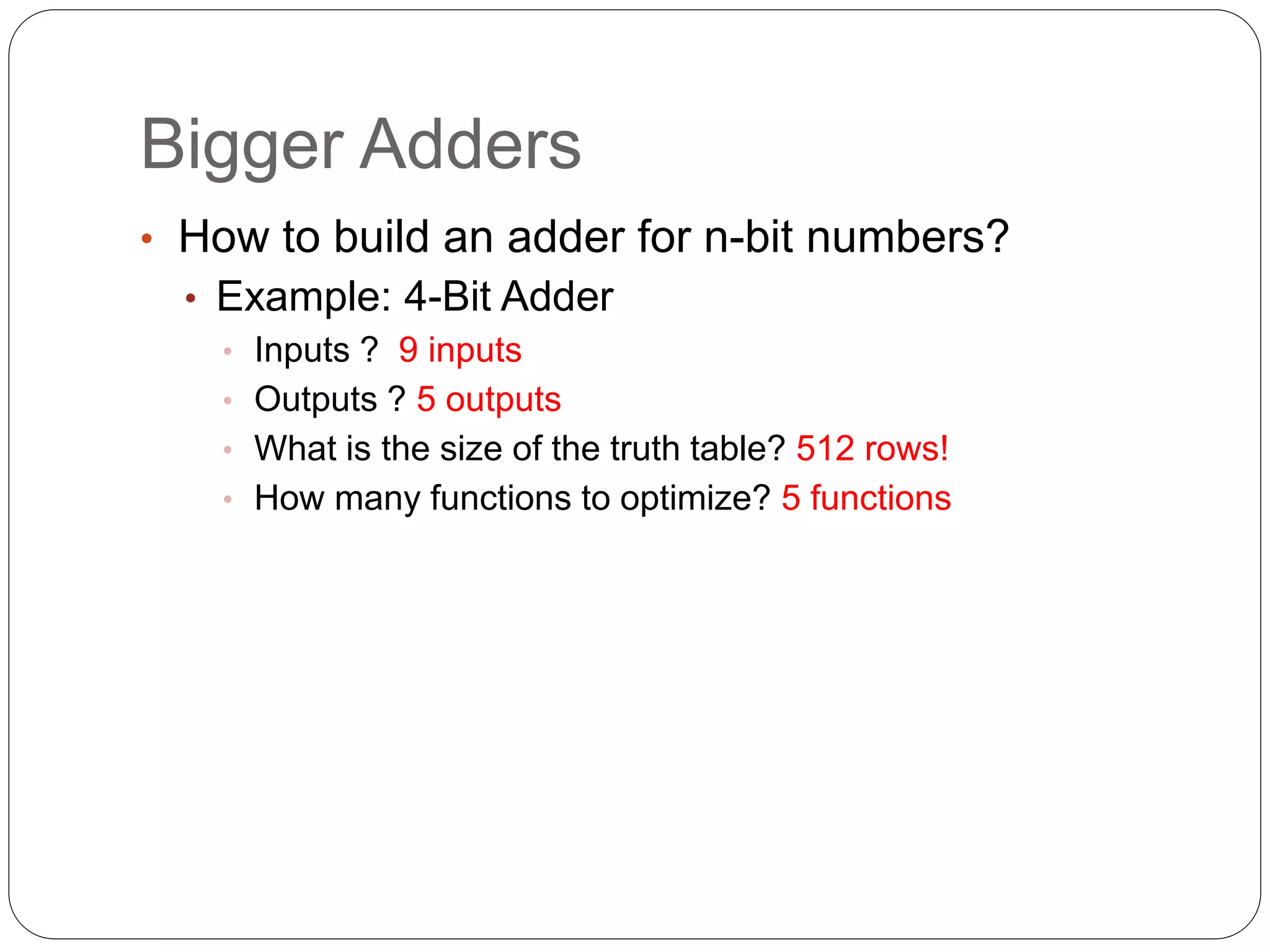
Bigger Adders
• How to build an adder for n-bit numbers?
• Example: 4-Bit Adder
• Inputs ? 9 inputs
• Outputs ? 5 outputs
• What is the size of the truth table? 512 rows!
• How many functions to optimize? 5 functions
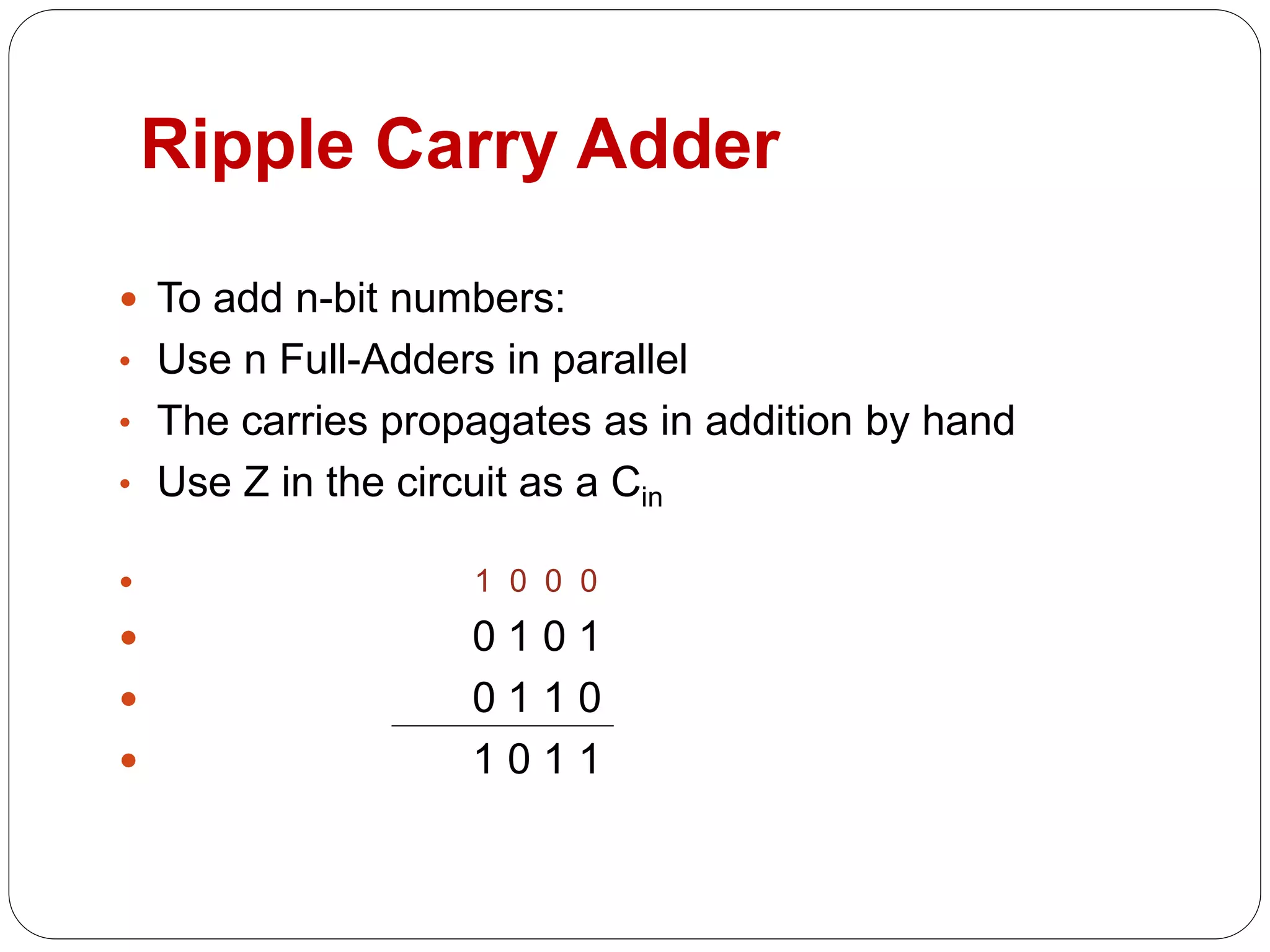
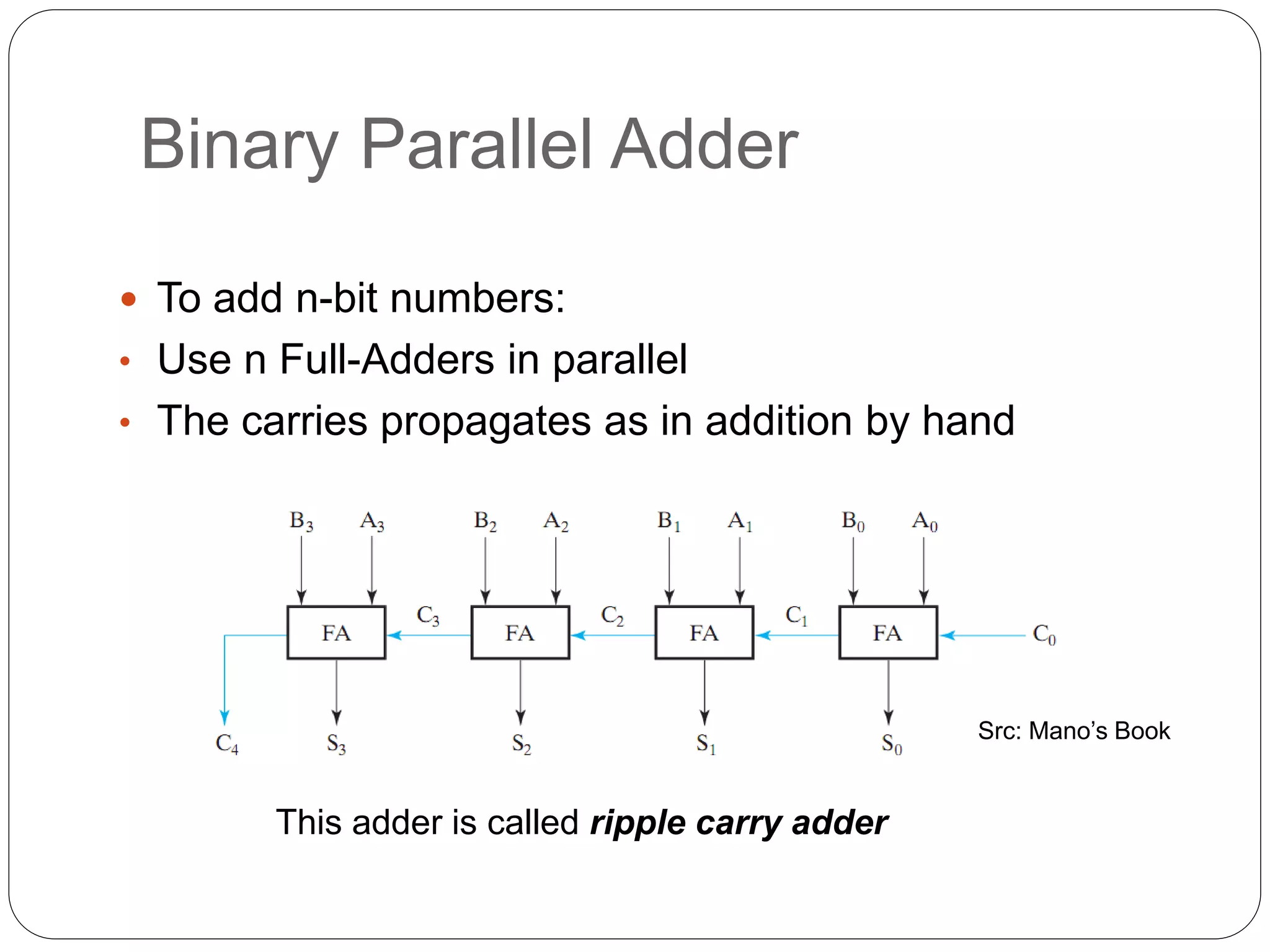
Ripple Carry Adder
 To add n-bit numbers:
• Use n Full-Adders in parallel
• The carries propagates as in addition by hand
• Use Z in the circuit as a Cin
 1 0 0 0
 0 1 0 1
 0 1 1 0
 1 0 1 1
Binary Parallel Adder
 To add n-bit numbers:
• Use n Full-Adders in parallel
• The carries propagates as in addition by hand
This adder is called ripple carry adder
Src: Mano’s Book
Subtraction (2’s Complement)
 How to build a subtractor using 2’s complement?
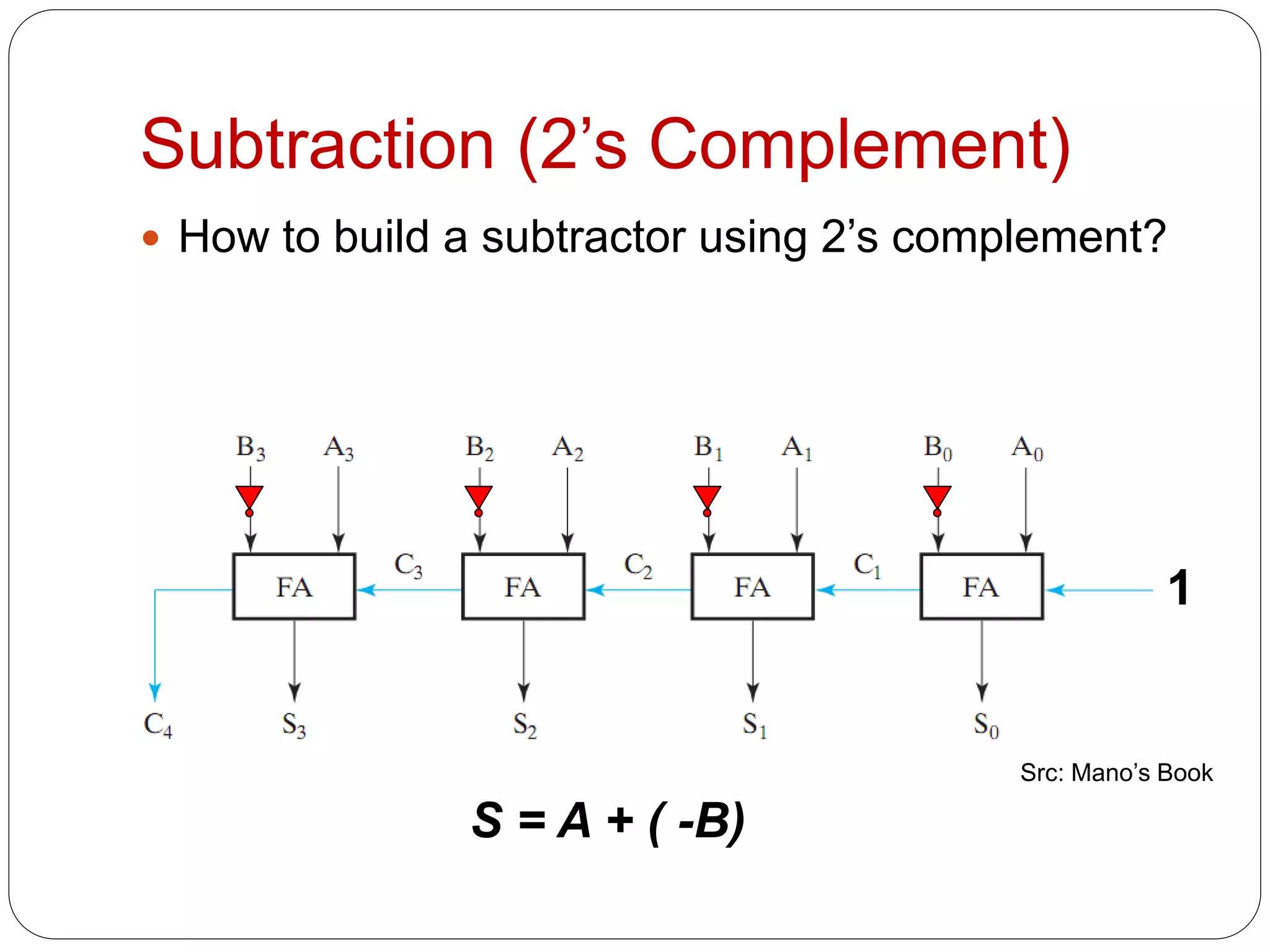
Subtraction (2’s Complement)
 How to build a subtractor using 2’s complement?
1
S = A + ( -B)
Src: Mano’s Book
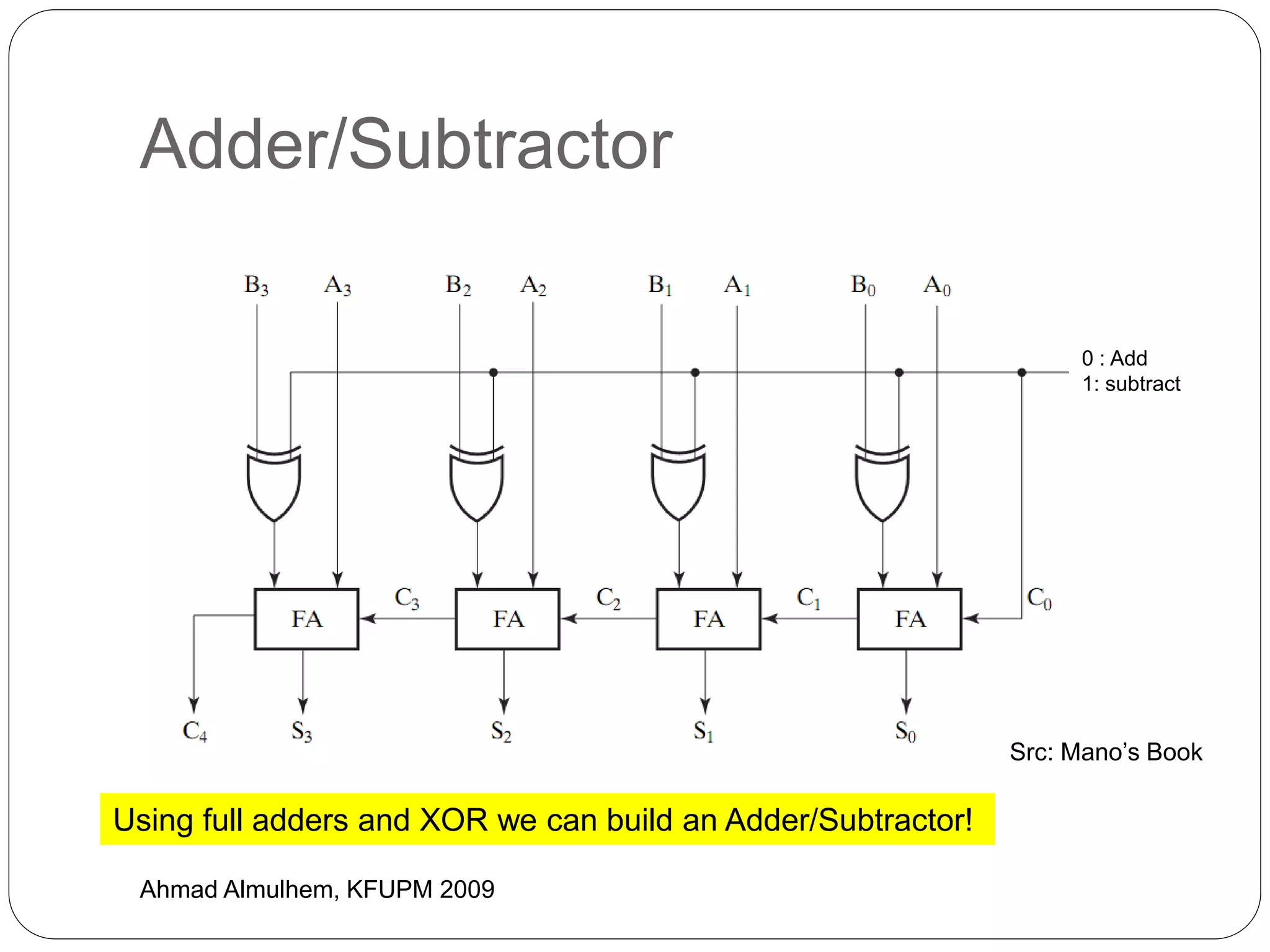
Adder/Subtractor
 How to build a circuit that performs both addition
and subtraction?
Adder/Subtractor
Ahmad Almulhem, KFUPM 2009
Src: Mano’s Book
Using full adders and XOR we can build an Adder/Subtractor!
0 : Add
1: subtract
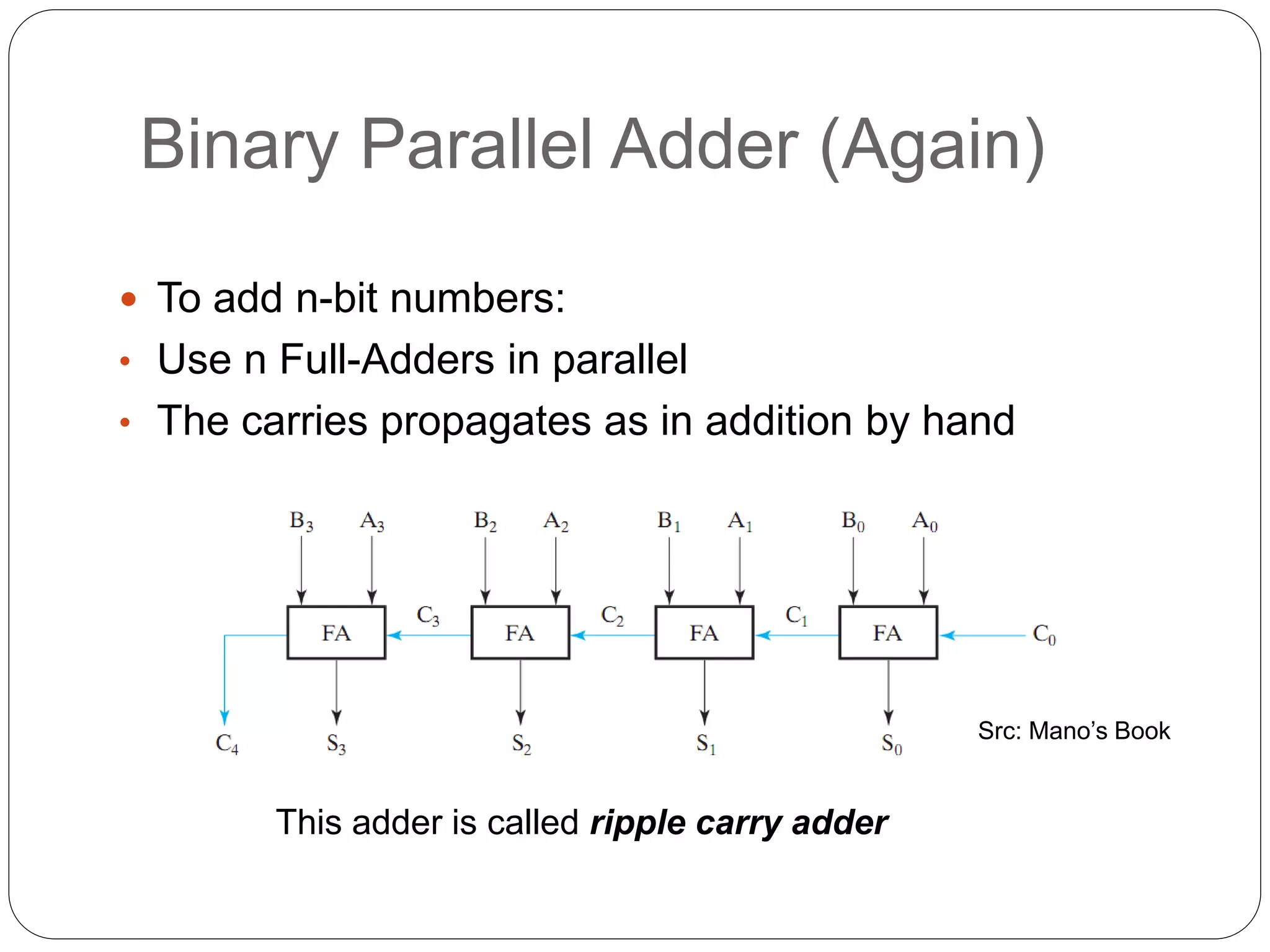
Binary Parallel Adder (Again)
 To add n-bit numbers:
• Use n Full-Adders in parallel
• The carries propagates as in addition by hand
This adder is called ripple carry adder
Src: Mano’s Book
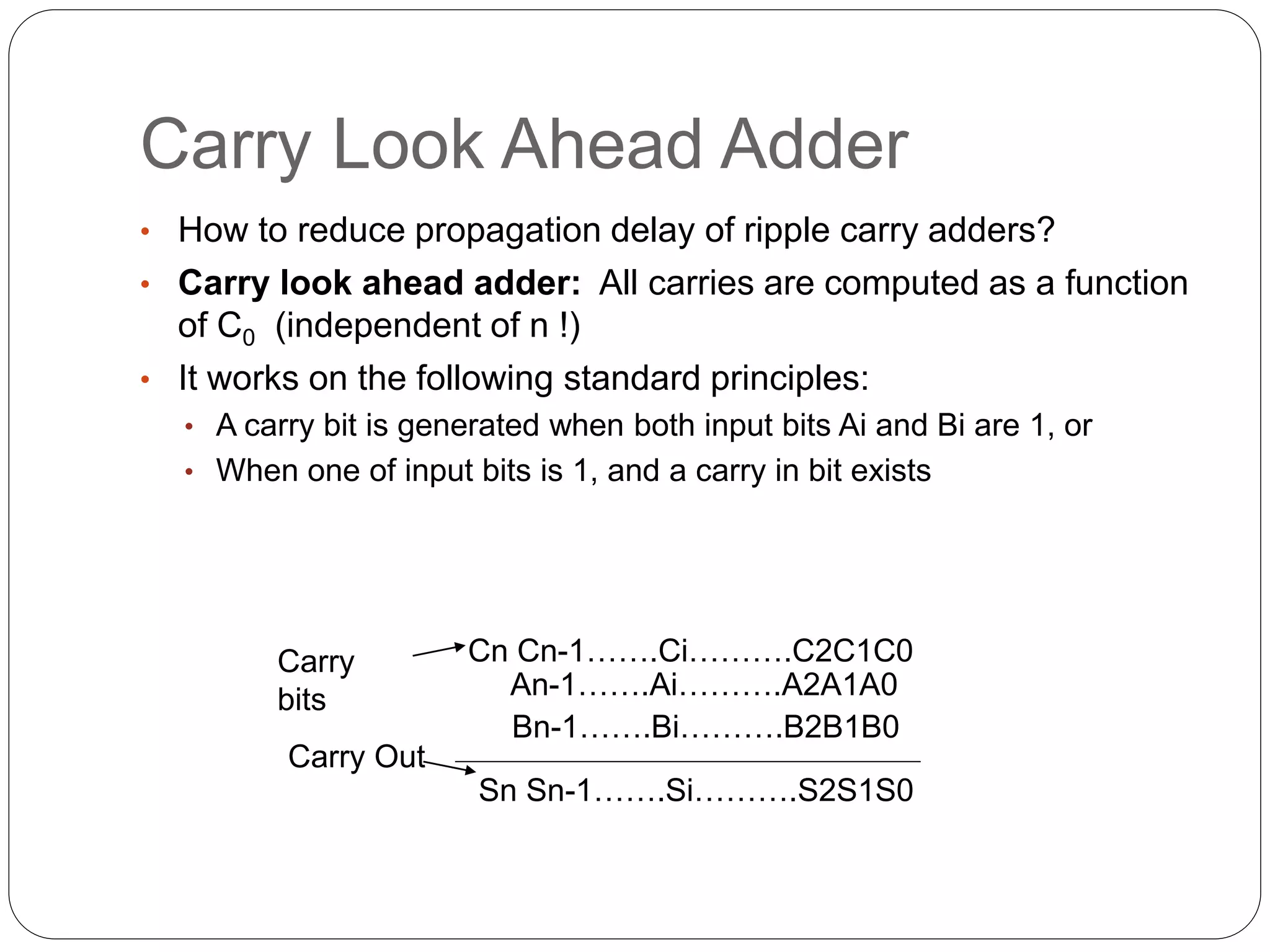
Carry Look Ahead Adder
• How to reduce propagation delay of ripple carry adders?
• Carry look ahead adder: All carries are computed as a function
of C0 (independent of n !)
• It works on the following standard principles:
• A carry bit is generated when both input bits Ai and Bi are 1, or
• When one of input bits is 1, and a carry in bit exists
Cn Cn-1…….Ci……….C2C1C0
An-1…….Ai……….A2A1A0
Bn-1…….Bi……….B2B1B0
Sn Sn-1…….Si……….S2S1S0
Carry Out
Carry
bits
For Review
24
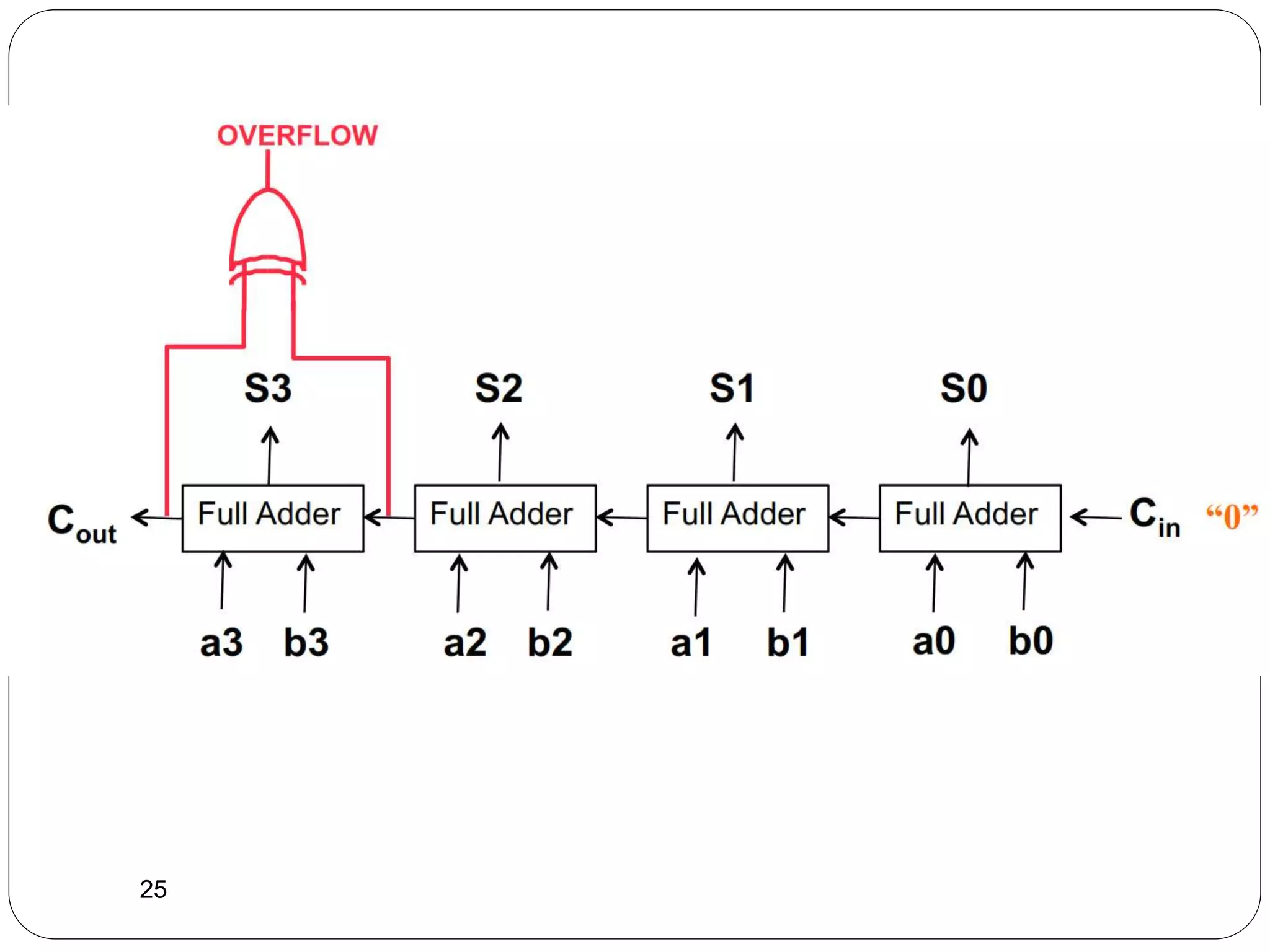
25

unit-5_combinational_circuit-1.pptx

  • 1.
    Unit 5 COMBINATIONAL CIRCUITS-1 Collegeof Computer and Information Sciences Department of Computer Science CSC 220: Computer Organization
  • 2.
    Unit 5: CombinationalCircuits-1 Overview • Introduction to Combinational Circuits • Adder • Ripple Carry Adder • Subtraction • Adder/Subtractor Chapter-3 M. Morris Mano, Charles R. Kime and Tom Martin, Logic and Computer Design Fundamentals, Global (5th) Edition, Pearson Education Limited, 2016. ISBN: 9781292096124
  • 5.
    Adder  Design anAdder for 1-bit numbers?  1. Specification: 2 inputs (X,Y) 2 outputs (C,S)
  • 6.
    Adder  Design anAdder for 1-bit numbers?  1. Specification: 2 inputs (X,Y) 2 outputs (C,S)  2. Formulation: X Y C S 0 0 0 0 0 1 0 1 1 0 0 1 1 1 1 0
  • 7.
    Adder  Design anAdder for 1-bit numbers?  1. Specification: 3. Optimization/Circuit 2 inputs (X,Y) 2 outputs (C,S)  2. Formulation: X Y C S 0 0 0 0 0 1 0 1 1 0 0 1 1 1 1 0
  • 8.
    Half Adder  Thisadder is called a Half Adder  Q: Why? X Y C S 0 0 0 0 0 1 0 1 1 0 0 1 1 1 1 0
  • 9.
    Full Adder  Acombinational circuit that adds 3 input bits to generate a Sum bit and a Carry bit
  • 10.
    Full Adder  Acombinational circuit that adds 3 input bits to generate a Sum bit and a Carry bit X Y Z C S 0 0 0 0 0 0 0 1 0 1 0 1 0 0 1 0 1 1 1 0 1 0 0 0 1 1 0 1 1 0 1 1 0 1 0 1 1 1 1 1 X YZ 0 1 00 01 11 10 0 1 0 1 1 0 1 0 X YZ 0 1 00 01 11 10 0 0 1 0 0 1 1 1 Sum Carry S = X’Y’Z + X’YZ’ + XY’Z’ +XYZ = X  Y  Z C = XY + YZ + XZ
  • 11.
    Full Adder =2 Half Adders Manipulating the Equations: S = X  Y  Z C = XY + XZ + YZ
  • 12.
    Full Adder =2 Half Adders Manipulating the Equations: S = ( X  Y )  Z C = XY + XZ + YZ = XY + XYZ + XY’Z + X’YZ + XYZ = XY( 1 + Z) + Z(XY’ + X’Y) = XY + Z(X  Y )
  • 13.
    Full Adder =2 Half Adders Manipulating the Equations: S = ( X  Y )  Z C = XY + XZ + YZ = XY + Z(X  Y ) Src: Mano’s Book Think of Z as a carry in
  • 14.
    Bigger Adders • Howto build an adder for n-bit numbers? • Example: 4-Bit Adder • Inputs ? • Outputs ? • What is the size of the truth table? • How many functions to optimize?
  • 15.
    Bigger Adders • Howto build an adder for n-bit numbers? • Example: 4-Bit Adder • Inputs ? 9 inputs • Outputs ? 5 outputs • What is the size of the truth table? 512 rows! • How many functions to optimize? 5 functions
  • 16.
    Ripple Carry Adder To add n-bit numbers: • Use n Full-Adders in parallel • The carries propagates as in addition by hand • Use Z in the circuit as a Cin  1 0 0 0  0 1 0 1  0 1 1 0  1 0 1 1
  • 17.
    Binary Parallel Adder To add n-bit numbers: • Use n Full-Adders in parallel • The carries propagates as in addition by hand This adder is called ripple carry adder Src: Mano’s Book
  • 18.
    Subtraction (2’s Complement) How to build a subtractor using 2’s complement?
  • 19.
    Subtraction (2’s Complement) How to build a subtractor using 2’s complement? 1 S = A + ( -B) Src: Mano’s Book
  • 20.
    Adder/Subtractor  How tobuild a circuit that performs both addition and subtraction?
  • 21.
    Adder/Subtractor Ahmad Almulhem, KFUPM2009 Src: Mano’s Book Using full adders and XOR we can build an Adder/Subtractor! 0 : Add 1: subtract
  • 22.
    Binary Parallel Adder(Again)  To add n-bit numbers: • Use n Full-Adders in parallel • The carries propagates as in addition by hand This adder is called ripple carry adder Src: Mano’s Book
  • 23.
    Carry Look AheadAdder • How to reduce propagation delay of ripple carry adders? • Carry look ahead adder: All carries are computed as a function of C0 (independent of n !) • It works on the following standard principles: • A carry bit is generated when both input bits Ai and Bi are 1, or • When one of input bits is 1, and a carry in bit exists Cn Cn-1…….Ci……….C2C1C0 An-1…….Ai……….A2A1A0 Bn-1…….Bi……….B2B1B0 Sn Sn-1…….Si……….S2S1S0 Carry Out Carry bits
  • 24.
  • 25.