Elements of Computing Systems, Nisan & Schocken, MIT Press, www.nand2tetris.org , Chapter 5: Computer Architecture slide 1
www.nand2tetris.org
Building a Modern Computer From First Principles
Computer Architecture
Elements of Computing Systems, Nisan & Schocken, MIT Press, www.nand2tetris.org , Chapter 5: Computer Architecture slide 2
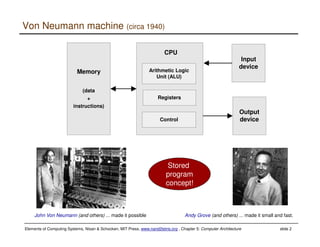
Von Neumann machine (circa 1940)
Arithmetic Logic
Unit (ALU)
CPU
Registers
Control
Memory
(data
+
instructions)
Input
device
Output
device
Andy Grove (and others) ... made it small and fast.John Von Neumann (and others) ... made it possible
Stored
program
concept!
Elements of Computing Systems, Nisan & Schocken, MIT Press, www.nand2tetris.org , Chapter 5: Computer Architecture slide 3
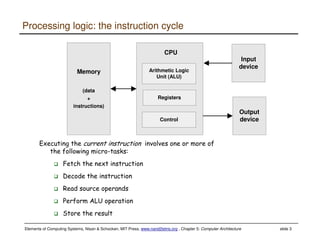
Arithmetic Logic
Unit (ALU)
CPU
Registers
Control
Memory
(data
+
instructions)
Input
device
Output
device
Processing logic: the instruction cycle
Executing the current instruction involves one or more of
the following micro-tasks:
Fetch the next instruction
Decode the instruction
Read source operands
Perform ALU operation
Store the result
Elements of Computing Systems, Nisan & Schocken, MIT Press, www.nand2tetris.org , Chapter 5: Computer Architecture slide 4
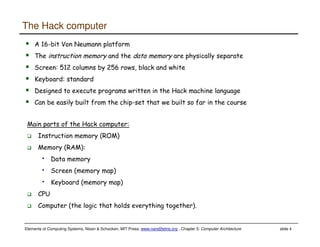
The Hack computer
Main parts of the Hack computer:
Instruction memory (ROM)
Memory (RAM):
• Data memory
• Screen (memory map)
• Keyboard (memory map)
CPU
Computer (the logic that holds everything together).
A 16-bit Von Neumann platform
The instruction memory and the data memory are physically separate
Screen: 512 columns by 256 rows, black and white
Keyboard: standard
Designed to execute programs written in the Hack machine language
Can be easily built from the chip-set that we built so far in the course
Elements of Computing Systems, Nisan & Schocken, MIT Press, www.nand2tetris.org , Chapter 5: Computer Architecture slide 5
Memory: conceptual / programmer’s view
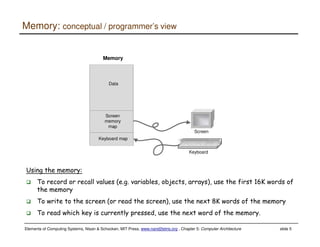
Using the memory:
To record or recall values (e.g. variables, objects, arrays), use the first 16K words of
the memory
To write to the screen (or read the screen), use the next 8K words of the memory
To read which key is currently pressed, use the next word of the memory.
Data
Screen
memory
map
Keyboard map
Memory
Keyboard
Screen
Elements of Computing Systems, Nisan & Schocken, MIT Press, www.nand2tetris.org , Chapter 5: Computer Architecture slide 6
Memory: physical implementation
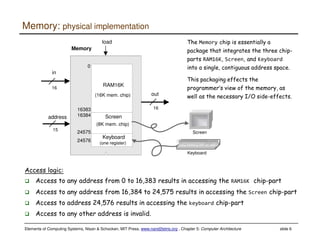
Access logic:
Access to any address from 0 to 16,383 results in accessing the RAM16K chip-part
Access to any address from 16,384 to 24,575 results in accessing the Screen chip-part
Access to address 24,576 results in accessing the keyboard chip-part
Access to any other address is invalid.
load
out
in
16
15
16
RAM16K
(16K mem. chip)
address
0
16383
Screen
(8K mem. chip)
16384
24575
24576
Keyboard
(one register)
Memory
Keyboard
Screen
The Memory chip is essentially a
package that integrates the three chip-
parts RAM16K, Screen, and Keyboard
into a single, contiguous address space.
This packaging effects the
programmer’s view of the memory, as
well as the necessary I/O side-effects.
Elements of Computing Systems, Nisan & Schocken, MIT Press, www.nand2tetris.org , Chapter 5: Computer Architecture slide 7
CPU
instruction
inM
16
1
15
15
16 outM
16
writeM
addressM
pc
reset
1
CPU
to data
memory
to instruction
memory
from
data memory
from
instruction
memory
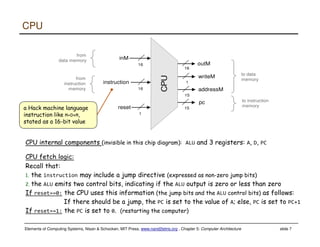
CPU internal components (invisible in this chip diagram): ALU and 3 registers: A, D, PC
CPU fetch logic:
Recall that:
1. the instruction may include a jump directive (expressed as non-zero jump bits)
2. the ALU emits two control bits, indicating if the ALU output is zero or less than zero
If reset==0: the CPU uses this information (the jump bits and the ALU control bits) as follows:
If there should be a jump, the PC is set to the value of A; else, PC is set to PC+1
If reset==1: the PC is set to 0. (restarting the computer)
a Hack machine language
instruction like M=D+M,
stated as a 16-bit value
Elements of Computing Systems, Nisan & Schocken, MIT Press, www.nand2tetris.org , Chapter 5: Computer Architecture slide 8
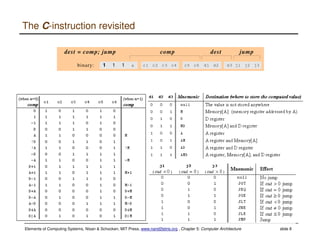
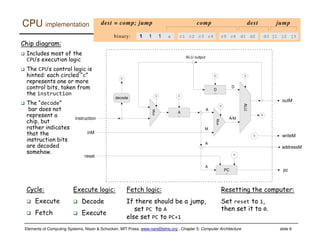
The C-instruction revisited
jumpdestcomp
1 1 1 a c1 c2 c3 c4 c5 c6 d1 d2 d3 j1 j2 j3binary:
dest = comp; jump
Elements of Computing Systems, Nisan & Schocken, MIT Press, www.nand2tetris.org , Chapter 5: Computer Architecture slide 9
Execute logic:
Decode
Execute
Fetch logic:
If there should be a jump,
set PC to A
else set PC to PC+1
ALU
Mux
D
Mux
reset
inM
addressM
pc
outM
A/Minstruction
decode
C
C
C
C
C
D
A
PC
C
C
A
A
A
M
ALU output
writeMC
C
jumpdestcomp
1 1 1 a c1 c2 c3 c4 c5 c6 d1 d2 d3 j1 j2 j3binary:
dest = comp; jumpCPU implementation
Cycle:
Execute
Fetch
Resetting the computer:
Set reset to 1,
then set it to 0.
Chip diagram:
Includes most of the
CPU’s execution logic
The CPU’s control logic is
hinted: each circled “c”
represents one or more
control bits, taken from
the instruction
The “decode”
bar does not
represent a
chip, but
rather indicates
that the
instruction bits
are decoded
somehow.
Elements of Computing Systems, Nisan & Schocken, MIT Press, www.nand2tetris.org , Chapter 5: Computer Architecture slide 10
Perspective: from here to a “real” computer
Pipelining
Caching
More I/O units
Special-purpose processors (I/O, graphics, communications, …)
Multi-core / parallelism; GPUs
Efficiency
Energy consumption considerations
And more ...
Elements of Computing Systems, Nisan & Schocken, MIT Press, www.nand2tetris.org , Chapter 5: Computer Architecture slide 11
Perspective: some issues we haven’t discussed (among many)
CISC / RISC (hardware / software trade-off)
Hardware diversity: desktop, laptop, mobile, game machines, …
General-purpose vs. embedded computers

Computer architecture

  • 1.
    Elements of ComputingSystems, Nisan & Schocken, MIT Press, www.nand2tetris.org , Chapter 5: Computer Architecture slide 1 www.nand2tetris.org Building a Modern Computer From First Principles Computer Architecture
  • 2.
    Elements of ComputingSystems, Nisan & Schocken, MIT Press, www.nand2tetris.org , Chapter 5: Computer Architecture slide 2 Von Neumann machine (circa 1940) Arithmetic Logic Unit (ALU) CPU Registers Control Memory (data + instructions) Input device Output device Andy Grove (and others) ... made it small and fast.John Von Neumann (and others) ... made it possible Stored program concept!
  • 3.
    Elements of ComputingSystems, Nisan & Schocken, MIT Press, www.nand2tetris.org , Chapter 5: Computer Architecture slide 3 Arithmetic Logic Unit (ALU) CPU Registers Control Memory (data + instructions) Input device Output device Processing logic: the instruction cycle Executing the current instruction involves one or more of the following micro-tasks: Fetch the next instruction Decode the instruction Read source operands Perform ALU operation Store the result
  • 4.
    Elements of ComputingSystems, Nisan & Schocken, MIT Press, www.nand2tetris.org , Chapter 5: Computer Architecture slide 4 The Hack computer Main parts of the Hack computer: Instruction memory (ROM) Memory (RAM): • Data memory • Screen (memory map) • Keyboard (memory map) CPU Computer (the logic that holds everything together). A 16-bit Von Neumann platform The instruction memory and the data memory are physically separate Screen: 512 columns by 256 rows, black and white Keyboard: standard Designed to execute programs written in the Hack machine language Can be easily built from the chip-set that we built so far in the course
  • 5.
    Elements of ComputingSystems, Nisan & Schocken, MIT Press, www.nand2tetris.org , Chapter 5: Computer Architecture slide 5 Memory: conceptual / programmer’s view Using the memory: To record or recall values (e.g. variables, objects, arrays), use the first 16K words of the memory To write to the screen (or read the screen), use the next 8K words of the memory To read which key is currently pressed, use the next word of the memory. Data Screen memory map Keyboard map Memory Keyboard Screen
  • 6.
    Elements of ComputingSystems, Nisan & Schocken, MIT Press, www.nand2tetris.org , Chapter 5: Computer Architecture slide 6 Memory: physical implementation Access logic: Access to any address from 0 to 16,383 results in accessing the RAM16K chip-part Access to any address from 16,384 to 24,575 results in accessing the Screen chip-part Access to address 24,576 results in accessing the keyboard chip-part Access to any other address is invalid. load out in 16 15 16 RAM16K (16K mem. chip) address 0 16383 Screen (8K mem. chip) 16384 24575 24576 Keyboard (one register) Memory Keyboard Screen The Memory chip is essentially a package that integrates the three chip- parts RAM16K, Screen, and Keyboard into a single, contiguous address space. This packaging effects the programmer’s view of the memory, as well as the necessary I/O side-effects.
  • 7.
    Elements of ComputingSystems, Nisan & Schocken, MIT Press, www.nand2tetris.org , Chapter 5: Computer Architecture slide 7 CPU instruction inM 16 1 15 15 16 outM 16 writeM addressM pc reset 1 CPU to data memory to instruction memory from data memory from instruction memory CPU internal components (invisible in this chip diagram): ALU and 3 registers: A, D, PC CPU fetch logic: Recall that: 1. the instruction may include a jump directive (expressed as non-zero jump bits) 2. the ALU emits two control bits, indicating if the ALU output is zero or less than zero If reset==0: the CPU uses this information (the jump bits and the ALU control bits) as follows: If there should be a jump, the PC is set to the value of A; else, PC is set to PC+1 If reset==1: the PC is set to 0. (restarting the computer) a Hack machine language instruction like M=D+M, stated as a 16-bit value
  • 8.
    Elements of ComputingSystems, Nisan & Schocken, MIT Press, www.nand2tetris.org , Chapter 5: Computer Architecture slide 8 The C-instruction revisited jumpdestcomp 1 1 1 a c1 c2 c3 c4 c5 c6 d1 d2 d3 j1 j2 j3binary: dest = comp; jump
  • 9.
    Elements of ComputingSystems, Nisan & Schocken, MIT Press, www.nand2tetris.org , Chapter 5: Computer Architecture slide 9 Execute logic: Decode Execute Fetch logic: If there should be a jump, set PC to A else set PC to PC+1 ALU Mux D Mux reset inM addressM pc outM A/Minstruction decode C C C C C D A PC C C A A A M ALU output writeMC C jumpdestcomp 1 1 1 a c1 c2 c3 c4 c5 c6 d1 d2 d3 j1 j2 j3binary: dest = comp; jumpCPU implementation Cycle: Execute Fetch Resetting the computer: Set reset to 1, then set it to 0. Chip diagram: Includes most of the CPU’s execution logic The CPU’s control logic is hinted: each circled “c” represents one or more control bits, taken from the instruction The “decode” bar does not represent a chip, but rather indicates that the instruction bits are decoded somehow.
  • 10.
    Elements of ComputingSystems, Nisan & Schocken, MIT Press, www.nand2tetris.org , Chapter 5: Computer Architecture slide 10 Perspective: from here to a “real” computer Pipelining Caching More I/O units Special-purpose processors (I/O, graphics, communications, …) Multi-core / parallelism; GPUs Efficiency Energy consumption considerations And more ...
  • 11.
    Elements of ComputingSystems, Nisan & Schocken, MIT Press, www.nand2tetris.org , Chapter 5: Computer Architecture slide 11 Perspective: some issues we haven’t discussed (among many) CISC / RISC (hardware / software trade-off) Hardware diversity: desktop, laptop, mobile, game machines, … General-purpose vs. embedded computers