Boolean Algebra Terminologies
There are various terminologies related to Boolean Algebra, which are used to explain
various parameters of Boolean Algebra. That includes,
 Boolean Algebra
 Boolean Variables
 Boolean Function
 Literal
 Complement
 Truth Table
Now, we will discuss the important terminologies of Boolean algebra in the article
below,
Boolean Algebra
The branch of algebra that deals with binary operations or logical operations is called
Boolean Algebra.
Boolean Variables
Variables used in Boolean algebra that store the logical value of 0 and 1 are called the
boolean variables. They are used to store either true or false values.
Boolean Function
A function of the Boolean Algebra that is formed by the use of Boolean variables and
Boolean operators is called the Boolean function.
Literal
A variable or the complement of the variable in Boolean Algebra is called the Literal.
Complement
The inverse of the boolean variable is called the complement of the variable. The
complement of 0 is 1 and the complement of 1 is 0. It is represented by ‘ over the
variable.
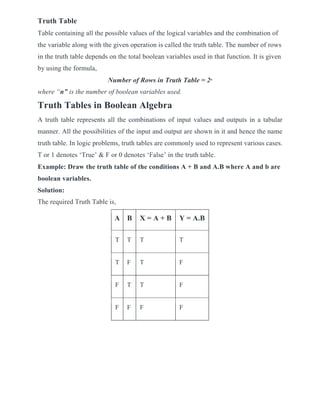
Truth Table
Table containing all the possible values of the logical variables and the combination of
the variable along with the given operation is called the truth table. The number of rows
in the truth table depends on the total boolean variables used in that function. It is given
by using the formula,
Number of Rows in Truth Table = 2n
where “n” is the number of boolean variables used.
Truth Tables in Boolean Algebra
A truth table represents all the combinations of input values and outputs in a tabular
manner. All the possibilities of the input and output are shown in it and hence the name
truth table. In logic problems, truth tables are commonly used to represent various cases.
T or 1 denotes ‘True’ & F or 0 denotes ‘False’ in the truth table.
Example: Draw the truth table of the conditions A + B and A.B where A and b are
boolean variables.
Solution:
The required Truth Table is,
A B X = A + B Y = A.B
T T T T
T F T F
F T T F
F F F F
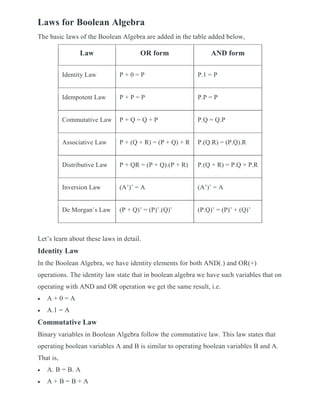
Laws for Boolean Algebra
The basic laws of the Boolean Algebra are added in the table added below,
Law OR form AND form
Identity Law P + 0 = P P.1 = P
Idempotent Law P + P = P P.P = P
Commutative Law P + Q = Q + P P.Q = Q.P
Associative Law P + (Q + R) = (P + Q) + R P.(Q.R) = (P.Q).R
Distributive Law P + QR = (P + Q).(P + R) P.(Q + R) = P.Q + P.R
Inversion Law (A’)’ = A (A’)’ = A
De Morgan’s Law (P + Q)’ = (P)’.(Q)’ (P.Q)’ = (P)’ + (Q)’
Let’s learn about these laws in detail.
Identity Law
In the Boolean Algebra, we have identity elements for both AND(.) and OR(+)
operations. The identity law state that in boolean algebra we have such variables that on
operating with AND and OR operation we get the same result, i.e.
 A + 0 = A
 A.1 = A
Commutative Law
Binary variables in Boolean Algebra follow the commutative law. This law states that
operating boolean variables A and B is similar to operating boolean variables B and A.
That is,
 A. B = B. A
 A + B = B + A
Associative Law
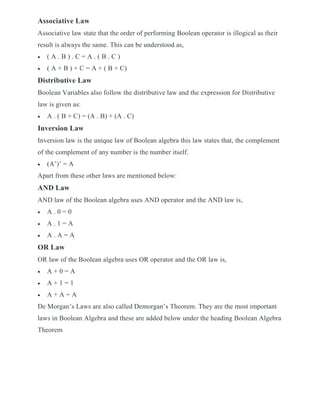
Associative law state that the order of performing Boolean operator is illogical as their
result is always the same. This can be understood as,
 ( A . B ) . C = A . ( B . C )
 ( A + B ) + C = A + ( B + C)
Distributive Law
Boolean Variables also follow the distributive law and the expression for Distributive
law is given as:
 A . ( B + C) = (A . B) + (A . C)
Inversion Law
Inversion law is the unique law of Boolean algebra this law states that, the complement
of the complement of any number is the number itself.
 (A’)’ = A
Apart from these other laws are mentioned below:
AND Law
AND law of the Boolean algebra uses AND operator and the AND law is,
 A . 0 = 0
 A . 1 = A
 A . A = A
OR Law
OR law of the Boolean algebra uses OR operator and the OR law is,
 A + 0 = A
 A + 1 = 1
 A + A = A
De Morgan’s Laws are also called Demorgan’s Theorem. They are the most important
laws in Boolean Algebra and these are added below under the heading Boolean Algebra
Theorem
Boolean Algebra Theorems
There are two basic theorems of great importance in Boolean Algebra, which are De
Morgan’s First Laws, and De Morgan’s Second Laws. These are also called De
Morgan’s Theorems. Now let’s learn about both in detail.
De Morgan’s First laws
De Morgan’s Law states that,
Statement: The complement of the product (AND) of two Boolean variables (or
expressions) is equal to the sum(OR) of the complement of each Boolean variable (or
expression).
(P.Q)’ = (P)’ + (Q)’
Boolean Algebra Theorems
There are two basic theorems of great importance in Boolean Algebra, which are De
Morgan’s First Laws, and De Morgan’s Second Laws. These are also called De
Morgan’s Theorems. Now let’s learn about both in detail.
De Morgan’s First laws
De Morgan’s Law states that,
Statement: The complement of the product (AND) of two Boolean variables (or
expressions) is equal to the sum(OR) of the complement of each Boolean variable (or
expression).
(P.Q)’ = (P)’ + (Q)’
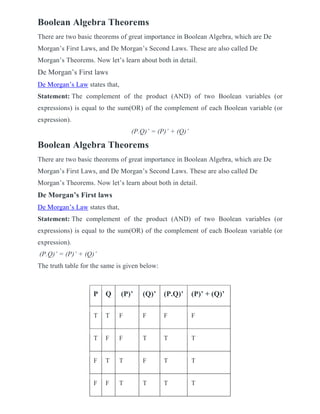
The truth table for the same is given below:
P Q (P)’ (Q)’ (P.Q)’ (P)’ + (Q)’
T T F F F F
T F F T T T
F T T F T T
F F T T T T
We can clearly see that truth values for (P.Q)’ are equal to truth values for (P)’ + (Q)’,
corresponding to the same input. Thus, De Morgan’s First Law is true.
De Morgan’s Second laws
Statement: The Complement of the sum (OR) of two Boolean variables (or expressions)
is equal to the product(AND) of the complement of each Boolean variable (or
expression).
(P + Q)’ = (P)’.(Q)’
Proof :
The truth table for the same is given below:
P Q (P)’ (Q)’ (P + Q)’ (P)’.(Q)’
T T F F F F
T F F T F F
F T T F F F
F F T T T T
We can clearly see that truth values for (P + Q)’ are equal to truth values for (P)’.(Q)’,
corresponding to the same input. Thus, De Morgan’s Second Law is true.
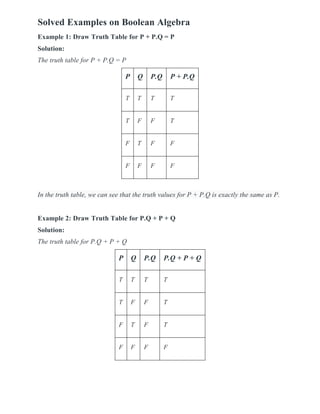
Solved Examples on Boolean Algebra
Example 1: Draw Truth Table for P + P.Q = P
Solution:
The truth table for P + P.Q = P
P Q P.Q P + P.Q
T T T T
T F F T
F T F F
F F F F
In the truth table, we can see that the truth values for P + P.Q is exactly the same as P.
Example 2: Draw Truth Table for P.Q + P + Q
Solution:
The truth table for P.Q + P + Q
P Q P.Q P.Q + P + Q
T T T T
T F F T
F T F T
F F F F

Boolean Algebra Terminologies.pdf

  • 1.
    Boolean Algebra Terminologies Thereare various terminologies related to Boolean Algebra, which are used to explain various parameters of Boolean Algebra. That includes,  Boolean Algebra  Boolean Variables  Boolean Function  Literal  Complement  Truth Table Now, we will discuss the important terminologies of Boolean algebra in the article below, Boolean Algebra The branch of algebra that deals with binary operations or logical operations is called Boolean Algebra. Boolean Variables Variables used in Boolean algebra that store the logical value of 0 and 1 are called the boolean variables. They are used to store either true or false values. Boolean Function A function of the Boolean Algebra that is formed by the use of Boolean variables and Boolean operators is called the Boolean function. Literal A variable or the complement of the variable in Boolean Algebra is called the Literal. Complement The inverse of the boolean variable is called the complement of the variable. The complement of 0 is 1 and the complement of 1 is 0. It is represented by ‘ over the variable.
  • 2.
    Truth Table Table containingall the possible values of the logical variables and the combination of the variable along with the given operation is called the truth table. The number of rows in the truth table depends on the total boolean variables used in that function. It is given by using the formula, Number of Rows in Truth Table = 2n where “n” is the number of boolean variables used. Truth Tables in Boolean Algebra A truth table represents all the combinations of input values and outputs in a tabular manner. All the possibilities of the input and output are shown in it and hence the name truth table. In logic problems, truth tables are commonly used to represent various cases. T or 1 denotes ‘True’ & F or 0 denotes ‘False’ in the truth table. Example: Draw the truth table of the conditions A + B and A.B where A and b are boolean variables. Solution: The required Truth Table is, A B X = A + B Y = A.B T T T T T F T F F T T F F F F F
  • 3.
    Laws for BooleanAlgebra The basic laws of the Boolean Algebra are added in the table added below, Law OR form AND form Identity Law P + 0 = P P.1 = P Idempotent Law P + P = P P.P = P Commutative Law P + Q = Q + P P.Q = Q.P Associative Law P + (Q + R) = (P + Q) + R P.(Q.R) = (P.Q).R Distributive Law P + QR = (P + Q).(P + R) P.(Q + R) = P.Q + P.R Inversion Law (A’)’ = A (A’)’ = A De Morgan’s Law (P + Q)’ = (P)’.(Q)’ (P.Q)’ = (P)’ + (Q)’ Let’s learn about these laws in detail. Identity Law In the Boolean Algebra, we have identity elements for both AND(.) and OR(+) operations. The identity law state that in boolean algebra we have such variables that on operating with AND and OR operation we get the same result, i.e.  A + 0 = A  A.1 = A Commutative Law Binary variables in Boolean Algebra follow the commutative law. This law states that operating boolean variables A and B is similar to operating boolean variables B and A. That is,  A. B = B. A  A + B = B + A
  • 4.
    Associative Law Associative lawstate that the order of performing Boolean operator is illogical as their result is always the same. This can be understood as,  ( A . B ) . C = A . ( B . C )  ( A + B ) + C = A + ( B + C) Distributive Law Boolean Variables also follow the distributive law and the expression for Distributive law is given as:  A . ( B + C) = (A . B) + (A . C) Inversion Law Inversion law is the unique law of Boolean algebra this law states that, the complement of the complement of any number is the number itself.  (A’)’ = A Apart from these other laws are mentioned below: AND Law AND law of the Boolean algebra uses AND operator and the AND law is,  A . 0 = 0  A . 1 = A  A . A = A OR Law OR law of the Boolean algebra uses OR operator and the OR law is,  A + 0 = A  A + 1 = 1  A + A = A De Morgan’s Laws are also called Demorgan’s Theorem. They are the most important laws in Boolean Algebra and these are added below under the heading Boolean Algebra Theorem
  • 5.
    Boolean Algebra Theorems Thereare two basic theorems of great importance in Boolean Algebra, which are De Morgan’s First Laws, and De Morgan’s Second Laws. These are also called De Morgan’s Theorems. Now let’s learn about both in detail. De Morgan’s First laws De Morgan’s Law states that, Statement: The complement of the product (AND) of two Boolean variables (or expressions) is equal to the sum(OR) of the complement of each Boolean variable (or expression). (P.Q)’ = (P)’ + (Q)’ Boolean Algebra Theorems There are two basic theorems of great importance in Boolean Algebra, which are De Morgan’s First Laws, and De Morgan’s Second Laws. These are also called De Morgan’s Theorems. Now let’s learn about both in detail. De Morgan’s First laws De Morgan’s Law states that, Statement: The complement of the product (AND) of two Boolean variables (or expressions) is equal to the sum(OR) of the complement of each Boolean variable (or expression). (P.Q)’ = (P)’ + (Q)’ The truth table for the same is given below: P Q (P)’ (Q)’ (P.Q)’ (P)’ + (Q)’ T T F F F F T F F T T T F T T F T T F F T T T T
  • 6.
    We can clearlysee that truth values for (P.Q)’ are equal to truth values for (P)’ + (Q)’, corresponding to the same input. Thus, De Morgan’s First Law is true. De Morgan’s Second laws Statement: The Complement of the sum (OR) of two Boolean variables (or expressions) is equal to the product(AND) of the complement of each Boolean variable (or expression). (P + Q)’ = (P)’.(Q)’ Proof : The truth table for the same is given below: P Q (P)’ (Q)’ (P + Q)’ (P)’.(Q)’ T T F F F F T F F T F F F T T F F F F F T T T T We can clearly see that truth values for (P + Q)’ are equal to truth values for (P)’.(Q)’, corresponding to the same input. Thus, De Morgan’s Second Law is true.
  • 7.
    Solved Examples onBoolean Algebra Example 1: Draw Truth Table for P + P.Q = P Solution: The truth table for P + P.Q = P P Q P.Q P + P.Q T T T T T F F T F T F F F F F F In the truth table, we can see that the truth values for P + P.Q is exactly the same as P. Example 2: Draw Truth Table for P.Q + P + Q Solution: The truth table for P.Q + P + Q P Q P.Q P.Q + P + Q T T T T T F F T F T F T F F F F