Sanjivani Rural Education Society’s
Sanjivani College of Engineering, Kopargaon-423 603
(An Autonomous Institute, Affiliated to Savitribai Phule Pune University, Pune)
NACC ‘A’ Grade Accredited, ISO 9001:2015 Certified
Department of Computer Engineering
(NBA Accredited)
Prof. S.A.Shivarkar
Assistant Professor
E-mail :
shivarkarsandipcomp@sanjivani.org.in
Contact No: 8275032712
Subject- Business Intelligence
Unit-II: Data Warehouse
Course Contents
DEPARTMENT OF COMPUTER ENGINEERING, Sanjivani COE, Kopargaon 2
Unit-III :Data Warehouse
Introduction: Data warehouse Modelling, data warehouse
design, data-ware-house technology, Distributed data
warehouse, and materialized view
Data Warehouse
 A data warehouse (DW) is a pool of data produced
to support decision making; it is also a repository
of current and historical data of potential interest
to managers throughout the organization.
 Data are usually structured to be available in a
form ready for analytical processing activities (i.e.,
online analytical processing [OLAP], data mining,
querying, reporting, and other decision support
applications). A data warehouse is a subject-
oriented, integrated, time-variant, nonvolatile
collection of data in support of management's
decision-making process.
Data Warehouse Characteristics
 Subject oriented
 Integrated
 Time variant (time series)
 Nonvolatile
 Web based
 Relational/multidimensional
 Client server
 Real time
 Include metadata
Data Marts
 A data mart is a subset of a data warehouse, typically
consisting of a single subject area (e.g., marketing,
operations).
 A dependent data mart is a subset that is created
directly from the data warehouse. It has the
advantages of using a consistent data model and
providing quality data.
 Dependent data marts support the concept of a
single enterprise-wide data model, but the data
warehouse must be constructed first.
 A dependent data mart ensures that the end user is
viewing the same version of the data that is accessed
Data Marts
 A dependent data mart ensures that the end user is
viewing the same version of the data that is accessed
by all other data warehouse users.
 The high cost of data warehouses limits their use to
large companies.
 As an alternative, many firms use a lower-cost,
scaled-down version of a data warehouse referred to
as an independent data mart. An independent data
mart is a small warehouse designed for a strategic
business unit (SBU) or a department, but its source
is not an EDW.
Operational Data Stores
 An operational data store (ODS) provides a fairly
recent form of customer information file (CIF).
 This type of database is often used as an interim
staging area for a data warehouse.
 Unlike the static contents of a data warehouse, the
contents of an ODS are updated throughout the
course of business operations.
 An ODS is used for short-term decisions involving
mission-critical applications rather than for the
medium- and long-term decisions associated with an
EDW. An ODS is similar to short-term memory in that
it stores only very recent information
Enterprise Data Warehouses (EDW)
 An enterprise data warehouse (EDW) is a large-scale
data warehouse that is used across the enterprise for
decision support.
 It is the type of data warehouse that Isle of Capri
developed, as described in the opening vignette.
 The large-scale nature provides integration of data
from many sources into a standard format for
effective BI and decision support applications.
 EDW are used to provide data for many types of DSS,
including CRM, supply chain management (SCM) etc.
Meta Data
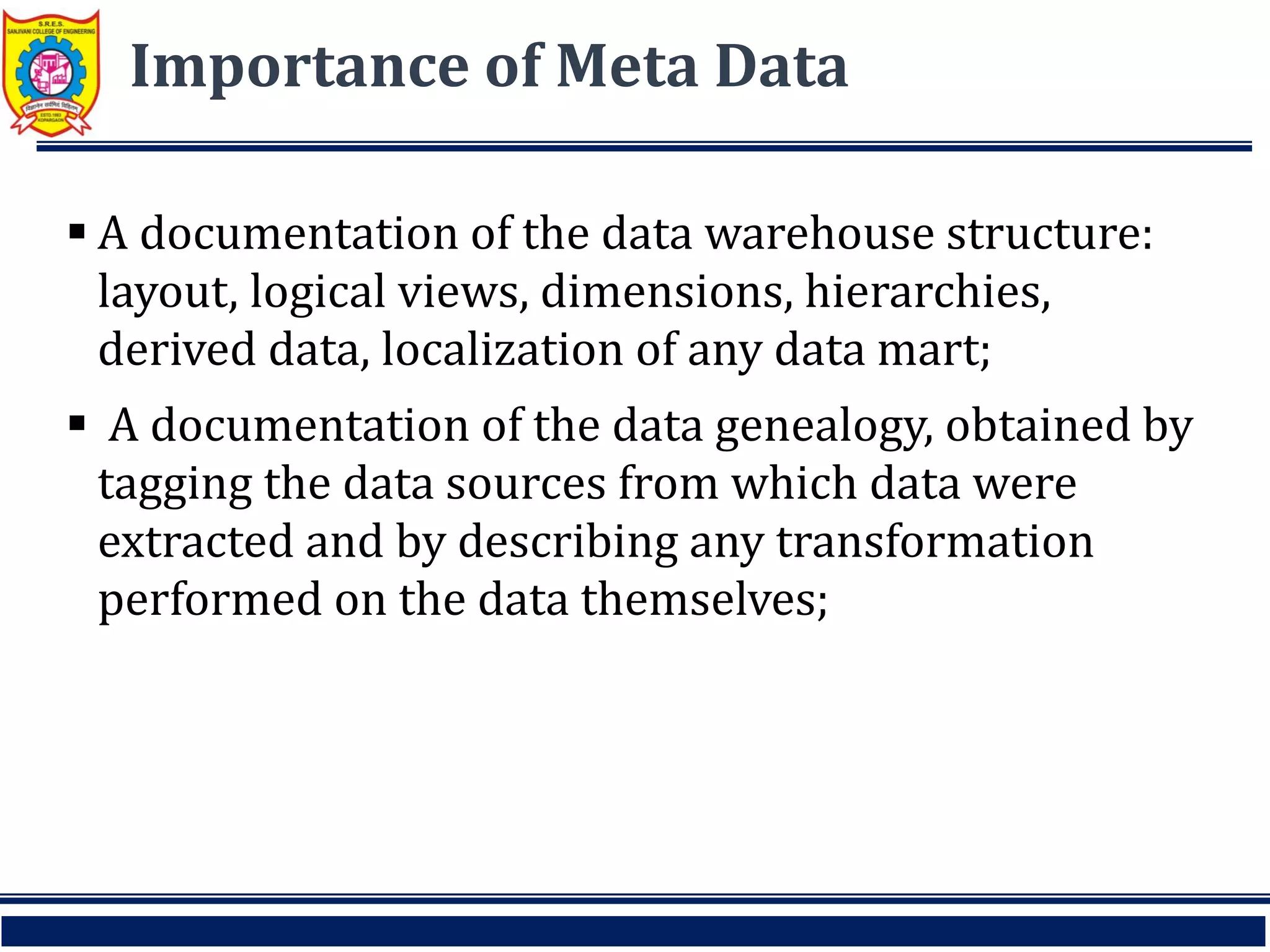
 Metadata are data about data.
 Metadata describe the structure of and some meaning
about data, thereby contributing to their effective or
ineffective use.
Importance of Meta Data
 A documentation of the data warehouse structure:
layout, logical views, dimensions, hierarchies,
derived data, localization of any data mart;
 A documentation of the data genealogy, obtained by
tagging the data sources from which data were
extracted and by describing any transformation
performed on the data themselves;
Importance of Meta Data
 A list keeping the usage statistics of the data
warehouse, by indicating how many accesses to a
field or to a logical view have been performed;
 A documentation of the general meaning of the
data warehouse with respect to the application
domain, by providing the definition of the terms
utilized, and fully describing data properties, data
ownership and loading policies.

Unit III Introduction to DWH.pdf

  • 1.
    Sanjivani Rural EducationSociety’s Sanjivani College of Engineering, Kopargaon-423 603 (An Autonomous Institute, Affiliated to Savitribai Phule Pune University, Pune) NACC ‘A’ Grade Accredited, ISO 9001:2015 Certified Department of Computer Engineering (NBA Accredited) Prof. S.A.Shivarkar Assistant Professor E-mail : shivarkarsandipcomp@sanjivani.org.in Contact No: 8275032712 Subject- Business Intelligence Unit-II: Data Warehouse
  • 2.
    Course Contents DEPARTMENT OFCOMPUTER ENGINEERING, Sanjivani COE, Kopargaon 2 Unit-III :Data Warehouse Introduction: Data warehouse Modelling, data warehouse design, data-ware-house technology, Distributed data warehouse, and materialized view
  • 3.
    Data Warehouse  Adata warehouse (DW) is a pool of data produced to support decision making; it is also a repository of current and historical data of potential interest to managers throughout the organization.  Data are usually structured to be available in a form ready for analytical processing activities (i.e., online analytical processing [OLAP], data mining, querying, reporting, and other decision support applications). A data warehouse is a subject- oriented, integrated, time-variant, nonvolatile collection of data in support of management's decision-making process.
  • 4.
    Data Warehouse Characteristics Subject oriented  Integrated  Time variant (time series)  Nonvolatile  Web based  Relational/multidimensional  Client server  Real time  Include metadata
  • 5.
    Data Marts  Adata mart is a subset of a data warehouse, typically consisting of a single subject area (e.g., marketing, operations).  A dependent data mart is a subset that is created directly from the data warehouse. It has the advantages of using a consistent data model and providing quality data.  Dependent data marts support the concept of a single enterprise-wide data model, but the data warehouse must be constructed first.  A dependent data mart ensures that the end user is viewing the same version of the data that is accessed
  • 6.
    Data Marts  Adependent data mart ensures that the end user is viewing the same version of the data that is accessed by all other data warehouse users.  The high cost of data warehouses limits their use to large companies.  As an alternative, many firms use a lower-cost, scaled-down version of a data warehouse referred to as an independent data mart. An independent data mart is a small warehouse designed for a strategic business unit (SBU) or a department, but its source is not an EDW.
  • 7.
    Operational Data Stores An operational data store (ODS) provides a fairly recent form of customer information file (CIF).  This type of database is often used as an interim staging area for a data warehouse.  Unlike the static contents of a data warehouse, the contents of an ODS are updated throughout the course of business operations.  An ODS is used for short-term decisions involving mission-critical applications rather than for the medium- and long-term decisions associated with an EDW. An ODS is similar to short-term memory in that it stores only very recent information
  • 8.
    Enterprise Data Warehouses(EDW)  An enterprise data warehouse (EDW) is a large-scale data warehouse that is used across the enterprise for decision support.  It is the type of data warehouse that Isle of Capri developed, as described in the opening vignette.  The large-scale nature provides integration of data from many sources into a standard format for effective BI and decision support applications.  EDW are used to provide data for many types of DSS, including CRM, supply chain management (SCM) etc.
  • 9.
    Meta Data  Metadataare data about data.  Metadata describe the structure of and some meaning about data, thereby contributing to their effective or ineffective use.
  • 10.
    Importance of MetaData  A documentation of the data warehouse structure: layout, logical views, dimensions, hierarchies, derived data, localization of any data mart;  A documentation of the data genealogy, obtained by tagging the data sources from which data were extracted and by describing any transformation performed on the data themselves;
  • 11.
    Importance of MetaData  A list keeping the usage statistics of the data warehouse, by indicating how many accesses to a field or to a logical view have been performed;  A documentation of the general meaning of the data warehouse with respect to the application domain, by providing the definition of the terms utilized, and fully describing data properties, data ownership and loading policies.