BONE MARROW
STRUCTURE &
HAEMOPOIETIC
MICROENVIROMENT
Prepared by:Halah O. Hassan
INTRODUCTION:
#B.M.(the site of effective haemopoiesis) is located in
the medullary cavity of bone
#produce about 6 billion cells per Kg of body weight
#Tow types of marrow:RED & YELLOW.depending on propotion of
adipocytes & hemopoietic cells. Red marrow (rich in
haemopoietic cells)& yellow marrow(composed of fat cells)
#Marrow cellularity vary according to age
#50% of marrow is fat in healthy adult human
#yellow marrow can revert to haemopoietically active marrow
according to body need
#red marrow can expand with in transit time from progenitor
to mature cells.
BONE MARROW CELLULARITY ACORDING TO AGE:
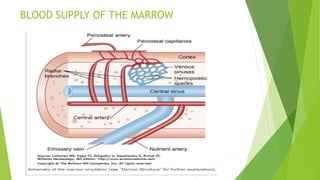
BLOOD SUPPLY OF THE MARROW
INNERVATION:
*myelinated , nonmyelinated nerve fibers are
present between the layers of the periarterial
adventitial cells or next to the smooth muscle celt
to regulate arterial vessel tone
• Non myelinated nerve fibers terminate in the
haemopoietic space to affect the haemopoiesis
through nerve growth factor that have either
stimulatory or inhibitory effect on the
haemopoietic cells throught direct interaction
between nervefibers and cells.
HISTOLOGY OF B.M.:
*It consist of stroma & haemopoietic tissue
The stroma consist of:-
1-a network of sinuses , arising from cortical capillaries at
the endosteum and terminate in the collecting vessels.
2-ADIPOCYTES (fibroblast).
3-extracellular matrix.
• The trilaminar sinus wall consist of stromal
cells(endothelial & adventitial reticular cells-fibroblast-
)with athin,under developed basement membrane in bt
*fibroblast can undergo lipogenesis &transformed to fat cells
*stromal cells are the source of growth factors and cytokines
Endothelial cells are flat,completely cover the
luminal surface of sinuses with some overlap to act
as abarrier
*
*
Controling the passage of molecules and chemicals
into and out of the hemopoietic space.
*overlapping & interdigitating union between them
allowing volume expansion of sinosoids.
*clathrin-coated pit,lysosomes phagosomes, transfer
tubules and diaphragmed fenestrae all have a role
in the endocytotic activity of endothelial cells.
*they express VWF antigen,collagen type four,
laminin and adhesion molecules(ICAM,VCAM).
*glycoprotien130 on the cell surface is a component
of IL-6 receptor(its loss lead to hypocellular marrow
due to its effect on progenitor rather than HSC
Lethal anemia,normal platelet &leukocytosis.
*endothelial cells influence both osteoprogenitors &
Heamopoiesis by elaborating cytokines as IL-5, B-
natriuretic peptides.
ADVENTITIAL RETICULAR CELLS;
Located on the abluminal surface of the marrow
sinosoids & coating it by extensive cytoplasmic
branches
These cells synthesize reticular fibers with their
cytoplasmic processes extend to hemopoietic
compartment to form a meshwork on which the
hemopoietic cells rest.
*contain high conc. Of ALP.
* Express CD10, CD13, HLA-I, and all neurotrophin
receptors.
*they are CD34 neg.
*can differentiate to smooth muscle pathway &
contain laminin, vimentin, fibronectin &collagens
I,III,IV
*Cell-cell contact via connexin 43-gap junction.
CXCL12-abundant reticular cells are located in close
association to sinusoidal endothelium,also some of
them are associated with endostium.
ADIPOCYTES:
They are formed by lipogenesis of some adventitial
reticular cells (fibroblasts).
*also can transform to fibroblast by lipolysis.
*they don’t undergo lipolysis due to starvation.
*have little concentration of saturated fatty acids as
compared to other body fat cells.
*their composition differ in red than in white
marrow.
They express lepitin, osteocalcin and prolactin
receptors,therefore promoting both haemopoiesis
and osteogenesis.
*also express adiponectin,has antiangiogenic
property,induce endothelial apoptosis, suppress
lymphocytosis and support myeloid progenitor cells.
EXTRACELLULAR MATRIX:
*mesenchymal cells forming the cellular stroma are
active in laying down extracellular matrix protein
which are:
1-proteoglycans:
group of macromolecules (heparin
sulfate,dermatan,chondroitin sulfate) distributed on
the surface of the adventitial cells.
They help in cell-cell interaction,cytokines
presentation,cell differentiation,interact with
laminin collagen IV.
2-FIBRONECTIN:
Located at the site of attachment of hemopoietic
cells (developing granulocytes &early erythroid
progenitor) and stromal cells.
*part of it is present in the marrow micro
environment to interact with integrin receptors on
HSC
*other part is present in the stroma
3-tenascin:
Family of glycoprotein consisting of 3 members:
tenascin-C,tenascin-R,tenascin-X.
*Tenacsin-C is expressed on the surface of stromal
cells in the marrow.
*they are found in the microenviroment surrounding
hematopoietic cells to improve lymphoid lineage
differentiation.
*they restore hemopoietic cell production
4-COLLAGENE:
*Type I,III present in the microvascular wall
*Type IV is present in basal lamina beneath
endothelial cells.
*inhibition of collagene synthesis reduces
hemopoiesis.
*it is synthesized by stromal cells & fibroblast.
5-LAMININ:
Glycoprotein with mitogenic & adhesive sites,it is a
major component of extracellular matrix &
basement membrane
*they interact with type IV collagene of basement
membrane so it can regulate leukocyte chemotaxis.
*laminin receptors include integrins 61 and 64 that
bind to CD34 positive CD38 negative progenitors
6-THROMBOSPONDIN:
*Small family of glycoproteins,initially identified in platelets
*modulate cell function by altering cell-matrix interactions
*has domains that interact with collagene and fibronectin so
it participate in stem cell lodgment (as in STEM CELL
TRANSPLANTATION)
*CD36 receptors on haemopoietic cell (as erythroid
precursors & megakaryocytes) interact with thromspondin
Resulting in enhanced maturation of erythrpid series and
release of functionally competent platelets from
megakaryocytes.
*stimulatory effect on NK cells by activation of transforming
growth factor
7-VITRONECTIN:
*major cytoadhesive glycoprotein, present in plasma,
platelets and connective tissues.
*interact with specific receptors (CD51) on fibroblast,
endothelial cells, mature haemopoietic cells( platelets
,megakaryocytes) and bone cells.
*mediate the transendothelial migration of neutrophils,
monocytes macrophages
*mediate adhesion of lymphoid cell line
*its receptor cooperate with thrombospondin receptors CD36
In the recognition & phagocytosis of apoptotic cells by
macroghage and neutrophil
*contribute to megakaryocytes maturation & plt.formation.
*a role in bone remodeling by stimulating osteoclastic
activity
THE HAEMOPOIETIC
MICROENVIROMENT
This microenviroment composed of cell (the
haemopoietic cells –progenitors &precursors-,mature
blood cells-macrophages,neutrophils,RBC,PLT…..) that
are embedded in specific sites in the intersinosoidal
spaces (suitable environment for cell survival)
*pluripotent stem cells are CD34 +ve,CD38 –ve,Lin-
*they are few in number in the bone marrow.
*SELF RENEWAL,can produce a new HSC.
other cell will divide to form myeloid & lymphoid multi
potent progenitor cells.
*the common lymphoid progenitor cells don’t undergo
proliferation & self renewal but undergo differentiation
and maturation to produce mature lymphocytes.
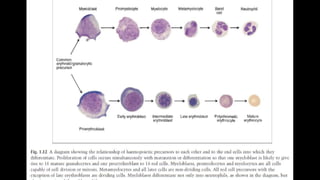
The common myeloid progenitor cell gives:-
1-CFUbaso mature basophils
2-CFUmeg platelet
3-BFUE CFUE RBC
4-CFUGMEO CFUEO eosinophil
CFUGM CFUG, CFUM
grnulocytes monocyte
CELLULAR ADHESION & HOMING:
The hemopoietic cells are located at specific sites with specific relation
to sinosoids in bone marrow.(e.g.megakaryocytes located directly outside
the sinusoidal wall ,erythroblast arranged in circles surrounding a
macrophage –erythroblastic islands- while granulocytes tend to mature
deeper away from sinosoids)
These cells contain different receptors & binding sites that allow agood
cell-cell contact,adhesion and interaction with extracellular matrix
protien which is important for replication differentiation & maturation
of cells(i.e All together form a suitable environment for cell survival)
HSC can pass through the sinosoids , leave the marrow and circulate in
peripheral blood to enter any type of tissues even the lymphatics then it
circulates again in the blood stream to re-enter the marrow to dived &
differentiate
Lymphocytes leave the marrow to differentiate further in
peripheral organs:
T-Lymphocytes mature in the thymus
B-Lymphocytes mature in yhe lymph nodes and spleen
After a period of residence in these secondary lymphoid
organs, these lymphocytes travel through lymph and blood
homing to the marrow as functioning mature cells.
HOMING has a role in egrafment of HSC in stem cell
transplantation
THANK YOU

Bone marrow structure & haemopoietic microenviroment

  • 1.
  • 2.
    INTRODUCTION: #B.M.(the site ofeffective haemopoiesis) is located in the medullary cavity of bone #produce about 6 billion cells per Kg of body weight #Tow types of marrow:RED & YELLOW.depending on propotion of adipocytes & hemopoietic cells. Red marrow (rich in haemopoietic cells)& yellow marrow(composed of fat cells) #Marrow cellularity vary according to age #50% of marrow is fat in healthy adult human #yellow marrow can revert to haemopoietically active marrow according to body need #red marrow can expand with in transit time from progenitor to mature cells.
  • 3.
    BONE MARROW CELLULARITYACORDING TO AGE:
  • 4.
    BLOOD SUPPLY OFTHE MARROW
  • 5.
    INNERVATION: *myelinated , nonmyelinatednerve fibers are present between the layers of the periarterial adventitial cells or next to the smooth muscle celt to regulate arterial vessel tone • Non myelinated nerve fibers terminate in the haemopoietic space to affect the haemopoiesis through nerve growth factor that have either stimulatory or inhibitory effect on the haemopoietic cells throught direct interaction between nervefibers and cells.
  • 6.
    HISTOLOGY OF B.M.: *Itconsist of stroma & haemopoietic tissue The stroma consist of:- 1-a network of sinuses , arising from cortical capillaries at the endosteum and terminate in the collecting vessels. 2-ADIPOCYTES (fibroblast). 3-extracellular matrix. • The trilaminar sinus wall consist of stromal cells(endothelial & adventitial reticular cells-fibroblast- )with athin,under developed basement membrane in bt *fibroblast can undergo lipogenesis &transformed to fat cells *stromal cells are the source of growth factors and cytokines
  • 8.
    Endothelial cells areflat,completely cover the luminal surface of sinuses with some overlap to act as abarrier * * Controling the passage of molecules and chemicals into and out of the hemopoietic space. *overlapping & interdigitating union between them allowing volume expansion of sinosoids. *clathrin-coated pit,lysosomes phagosomes, transfer tubules and diaphragmed fenestrae all have a role in the endocytotic activity of endothelial cells. *they express VWF antigen,collagen type four, laminin and adhesion molecules(ICAM,VCAM). *glycoprotien130 on the cell surface is a component of IL-6 receptor(its loss lead to hypocellular marrow
  • 9.
    due to itseffect on progenitor rather than HSC Lethal anemia,normal platelet &leukocytosis. *endothelial cells influence both osteoprogenitors & Heamopoiesis by elaborating cytokines as IL-5, B- natriuretic peptides. ADVENTITIAL RETICULAR CELLS; Located on the abluminal surface of the marrow sinosoids & coating it by extensive cytoplasmic branches
  • 10.
    These cells synthesizereticular fibers with their cytoplasmic processes extend to hemopoietic compartment to form a meshwork on which the hemopoietic cells rest. *contain high conc. Of ALP. * Express CD10, CD13, HLA-I, and all neurotrophin receptors. *they are CD34 neg. *can differentiate to smooth muscle pathway & contain laminin, vimentin, fibronectin &collagens I,III,IV *Cell-cell contact via connexin 43-gap junction.
  • 11.
    CXCL12-abundant reticular cellsare located in close association to sinusoidal endothelium,also some of them are associated with endostium. ADIPOCYTES: They are formed by lipogenesis of some adventitial reticular cells (fibroblasts). *also can transform to fibroblast by lipolysis. *they don’t undergo lipolysis due to starvation. *have little concentration of saturated fatty acids as compared to other body fat cells. *their composition differ in red than in white marrow.
  • 12.
    They express lepitin,osteocalcin and prolactin receptors,therefore promoting both haemopoiesis and osteogenesis. *also express adiponectin,has antiangiogenic property,induce endothelial apoptosis, suppress lymphocytosis and support myeloid progenitor cells.
  • 13.
    EXTRACELLULAR MATRIX: *mesenchymal cellsforming the cellular stroma are active in laying down extracellular matrix protein which are: 1-proteoglycans: group of macromolecules (heparin sulfate,dermatan,chondroitin sulfate) distributed on the surface of the adventitial cells. They help in cell-cell interaction,cytokines presentation,cell differentiation,interact with laminin collagen IV.
  • 14.
    2-FIBRONECTIN: Located at thesite of attachment of hemopoietic cells (developing granulocytes &early erythroid progenitor) and stromal cells. *part of it is present in the marrow micro environment to interact with integrin receptors on HSC *other part is present in the stroma
  • 15.
    3-tenascin: Family of glycoproteinconsisting of 3 members: tenascin-C,tenascin-R,tenascin-X. *Tenacsin-C is expressed on the surface of stromal cells in the marrow. *they are found in the microenviroment surrounding hematopoietic cells to improve lymphoid lineage differentiation. *they restore hemopoietic cell production
  • 16.
    4-COLLAGENE: *Type I,III presentin the microvascular wall *Type IV is present in basal lamina beneath endothelial cells. *inhibition of collagene synthesis reduces hemopoiesis. *it is synthesized by stromal cells & fibroblast.
  • 17.
    5-LAMININ: Glycoprotein with mitogenic& adhesive sites,it is a major component of extracellular matrix & basement membrane *they interact with type IV collagene of basement membrane so it can regulate leukocyte chemotaxis. *laminin receptors include integrins 61 and 64 that bind to CD34 positive CD38 negative progenitors
  • 18.
    6-THROMBOSPONDIN: *Small family ofglycoproteins,initially identified in platelets *modulate cell function by altering cell-matrix interactions *has domains that interact with collagene and fibronectin so it participate in stem cell lodgment (as in STEM CELL TRANSPLANTATION) *CD36 receptors on haemopoietic cell (as erythroid precursors & megakaryocytes) interact with thromspondin Resulting in enhanced maturation of erythrpid series and release of functionally competent platelets from megakaryocytes. *stimulatory effect on NK cells by activation of transforming growth factor
  • 19.
    7-VITRONECTIN: *major cytoadhesive glycoprotein,present in plasma, platelets and connective tissues. *interact with specific receptors (CD51) on fibroblast, endothelial cells, mature haemopoietic cells( platelets ,megakaryocytes) and bone cells. *mediate the transendothelial migration of neutrophils, monocytes macrophages *mediate adhesion of lymphoid cell line *its receptor cooperate with thrombospondin receptors CD36 In the recognition & phagocytosis of apoptotic cells by macroghage and neutrophil *contribute to megakaryocytes maturation & plt.formation. *a role in bone remodeling by stimulating osteoclastic activity
  • 20.
  • 21.
    This microenviroment composedof cell (the haemopoietic cells –progenitors &precursors-,mature blood cells-macrophages,neutrophils,RBC,PLT…..) that are embedded in specific sites in the intersinosoidal spaces (suitable environment for cell survival) *pluripotent stem cells are CD34 +ve,CD38 –ve,Lin- *they are few in number in the bone marrow. *SELF RENEWAL,can produce a new HSC. other cell will divide to form myeloid & lymphoid multi potent progenitor cells. *the common lymphoid progenitor cells don’t undergo proliferation & self renewal but undergo differentiation and maturation to produce mature lymphocytes.
  • 22.
    The common myeloidprogenitor cell gives:- 1-CFUbaso mature basophils 2-CFUmeg platelet 3-BFUE CFUE RBC 4-CFUGMEO CFUEO eosinophil CFUGM CFUG, CFUM grnulocytes monocyte
  • 24.
    CELLULAR ADHESION &HOMING: The hemopoietic cells are located at specific sites with specific relation to sinosoids in bone marrow.(e.g.megakaryocytes located directly outside the sinusoidal wall ,erythroblast arranged in circles surrounding a macrophage –erythroblastic islands- while granulocytes tend to mature deeper away from sinosoids) These cells contain different receptors & binding sites that allow agood cell-cell contact,adhesion and interaction with extracellular matrix protien which is important for replication differentiation & maturation of cells(i.e All together form a suitable environment for cell survival) HSC can pass through the sinosoids , leave the marrow and circulate in peripheral blood to enter any type of tissues even the lymphatics then it circulates again in the blood stream to re-enter the marrow to dived & differentiate
  • 25.
    Lymphocytes leave themarrow to differentiate further in peripheral organs: T-Lymphocytes mature in the thymus B-Lymphocytes mature in yhe lymph nodes and spleen After a period of residence in these secondary lymphoid organs, these lymphocytes travel through lymph and blood homing to the marrow as functioning mature cells. HOMING has a role in egrafment of HSC in stem cell transplantation
  • 26.