Bone Marrow
Procedures
and
Dr Richards Kakumanu
Moderators
Dr V Vijay Sreedhar (Prof & HOD)
Dr Manimekhala (Assoc. Prof)
Upgraded Department of Pathology
Marrow Specimen
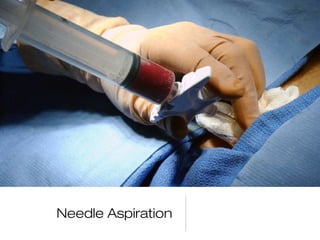
Needle Aspiration
Percutaneous
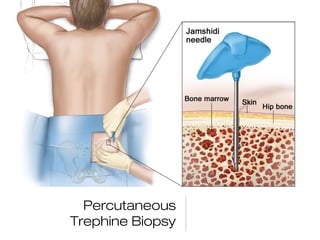
Trephine Biopsy
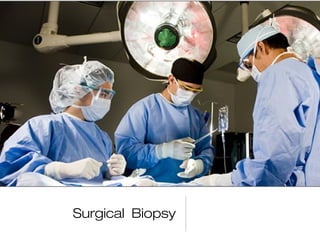
Surgical Biopsy
Why do we need to do bone marrow
studies?
Bone Marrow Aspiration
• Simple and safe
• Repeated many times
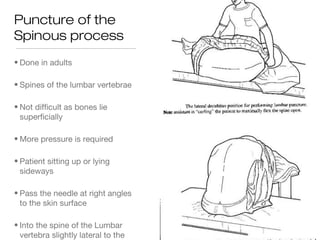
• Performed on outpatients
• Safe in almost circumstances
Advantages
• Individual cells are well preserved
• Subtle differences between the cells recognized
Disadvantages
• Arrangement of cells in the marrow
• Relationship between the cells
• Fibrotic marrows: aspiration of blood
General considerations
• Iliac spines: advantages of trephine biopsy
• Obese and immobile patients: technical difficulties
• Sternum should be avoided in children
• Danger of perforating inner cortical layer and
damage to the underlying large blood vessels and
right atrium
Important considerations
• Always wear surgical gloves
• Avoid needle stick injuries
• Local and oral analgesia
• Use only needles designed for the purpose
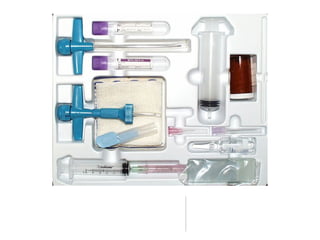
Marrow puncture needles
• Needles should be stout
• Hard stainless steel
• About 7-8 cm in length
• Well fitting stilette
• Adjustable guard
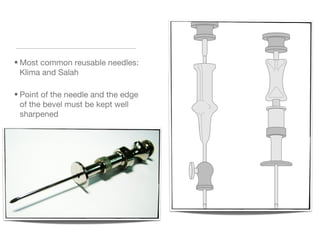
• Most common reusable needles:
Klima and Salah
• Point of the needle and the edge
of the bevel must be kept well
sharpened
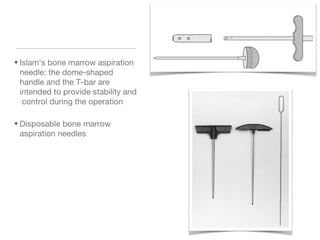
• Islam's bone marrow aspiration
needle: the dome-shaped
handle and the T-bar are
intended to provide stability and
control during the operation
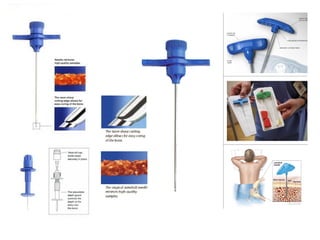
• Disposable bone marrow
aspiration needles
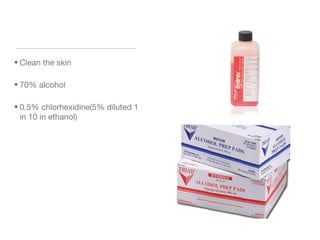
• Clean the skin
• 70% alcohol
• 0.5% chlorhexidine(5% diluted 1
in 10 in ethanol)
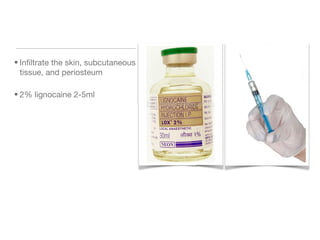
• Infiltrate the skin, subcutaneous
tissue, and periosteum
• 2% lignocaine 2-5ml
WAIT...
• Pass the needle with a boring movement
• Needle - perpendicular into the cavity
• Remove the stilette when bone has been
penetrated
• Attach a 1-2ml syringe
• Aspirate marrow contents
• Second sample: Attach a second 5-10 ml syringe
for cytogenetic and immunophenotypic analysis
• As a rule material can be sucked into the syringe
without difficulty
• If unable to aspirate: Insert the stilette, push the
needle and then Aspirate
• Dry tap: failure to Aspirate marrow suggests
fibrosis or infiltration
• Dry tap: insert the stilette, push any material in the
lumen onto a slide
• Obese patients: CT guided marrow sampling
• Ethylenediaminetetra-acetic acid(EDTA)
• Preservative free heparin: phenotyping and
cytogenetic analysis
• Preservative in fixative: histopathology
• Fixation in absolute methanol: romanosky method
or perls' stain or cytochemical staining
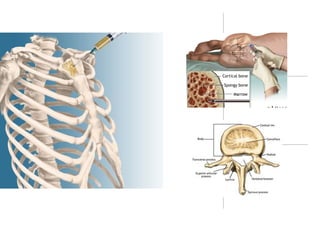
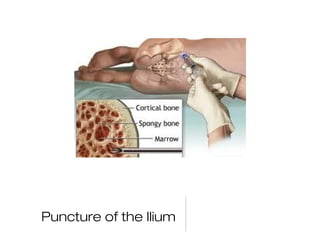
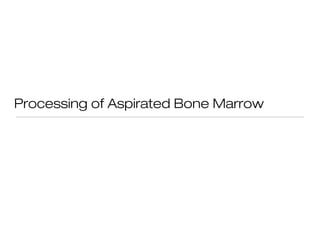
Puncture of the Ilium
Puncture of the ilium
• Usual sites: Posterior and anterior iliac spines
• Center of the oval posterior superior iliac spine
• 2cm posterior and 2cm inferior to anterior superior
iliac spine
• Posterior iliac spine: 1) overlies a large marrow
containing area. 2)relatively large volumes of
marrow can be aspirated
• Posture: 1)patient lying sideways or 2)prone
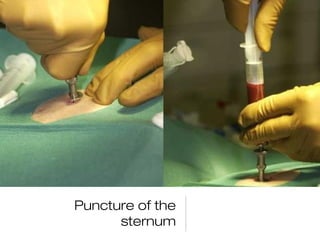
Puncture of the
sternum
Puncture of the sternum
• Avoid pushing the aspiration needle through the
bone
• Usual sites: 1) manubrium, 2) 1st or 2nd parts of
the body of sternum
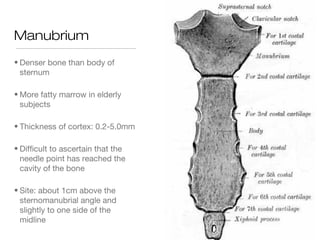
Manubrium
• Denser bone than body of
sternum
• More fatty marrow in elderly
subjects
• Thickness of cortex: 0.2-5.0mm
• Difficult to ascertain that the
needle point has reached the
cavity of the bone
• Site: about 1cm above the
sternomanubrial angle and
slightly to one side of the
midline
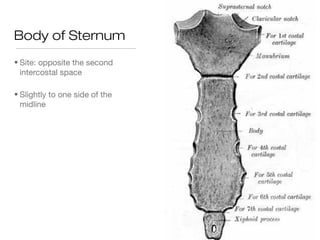
Body of Sternum
• Site: opposite the second
intercostal space
• Slightly to one side of the
midline
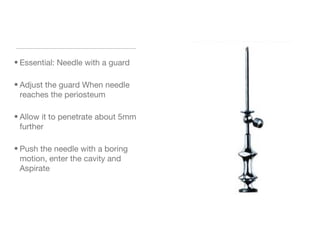
• Essential: Needle with a guard
• Adjust the guard When needle
reaches the periosteum
• Allow it to penetrate about 5mm
further
• Push the needle with a boring
motion, enter the cavity and
Aspirate
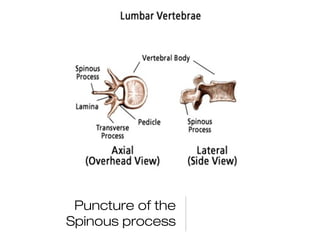
Puncture of the
Spinous process
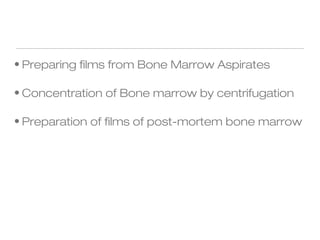
Puncture of the
Spinous process
• Done in adults
• Spines of the lumbar vertebrae
• Not difficult as bones lie
superficially
• More pressure is required
• Patient sitting up or lying
sideways
• Pass the needle at right angles
to the skin surface
• Into the spine of the Lumbar
vertebra slightly lateral to the
Comparison of different sites for marrow
puncture
• In general, the overall cellularity, the hemopoietic
maturation pathways, and the balance between
erythropoiesis and leucopoiesis are similar at all
sites
• Considerable variation in the composition of the
cellular marrow in certain conditions
• Aspiration from only one site may give misleading
information. Eg: aplastic anemia - patchily affected
• Dry tap/bloody tap: advantage in choice of several
sites
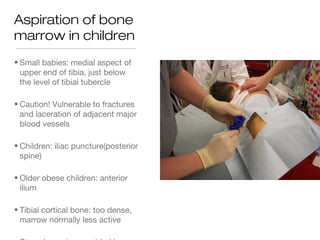
Aspiration of bone
marrow in children
• Small babies: medial aspect of
upper end of tibia, just below
the level of tibial tubercle
• Caution! Vulnerable to fractures
and laceration of adjacent major
blood vessels
• Children: iliac puncture(posterior
spine)
• Older obese children: anterior
ilium
• Tibial cortical bone: too dense,
marrow normally less active
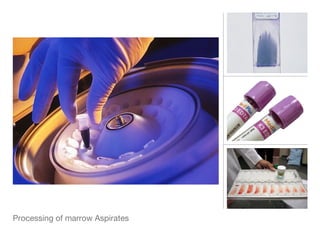
Processing of Aspirated Bone Marrow
• Preparing films from Bone Marrow Aspirates
• Concentration of Bone marrow by centrifugation
• Preparation of films of post-mortem bone marrow
Processing of marrow Aspirates
General considerations
• 0.3 ml of marrow fluid from a single site
• >0.3ml: little advantage - peripheral blood dilution
• A second syringe: 5-10 ml of marrow -
immunophenotyping, cytogenetics and molecular
studies
• Sample of peripheral blood: finger prick or
venepuncture
• Good practice: obtain full blood count and storage
Preparing films
from Bone Marrow
Aspirates
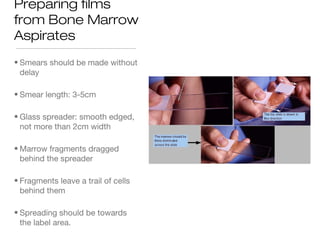
• Smears should be made without
delay
• Smear length: 3-5cm
• Glass spreader: smooth edged,
not more than 2cm width
• Marrow fragments dragged
behind the spreader
• Fragments leave a trail of cells
behind them
• Spreading should be towards
the label area.
• Insufficient fragments: can be concentrated
• Deliver single drops of Aspirate onto slides about
1cm from one end
• Most of the blood is quickly sucked off from the
edge of the drop using the marrow syringe or a
fine plastic pipette
• Irregularly shaped marrow fragments tend to be
left behind, can be lifted off with a spreader
• Smears can be made
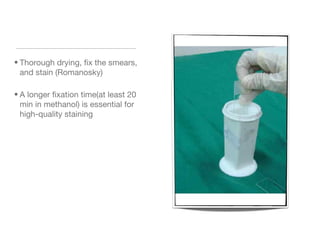
• Thorough drying, fix the smears,
and stain (Romanosky)
• A longer fixation time(at least 20
min in methanol) is essential for
high-quality staining
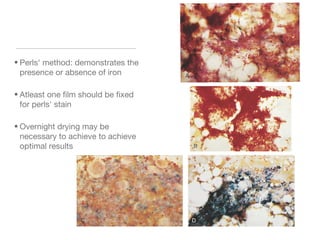
• Perls' method: demonstrates the
presence or absence of iron
• Atleast one film should be fixed
for perls' stain
• Overnight drying may be
necessary to achieve to achieve
optimal results
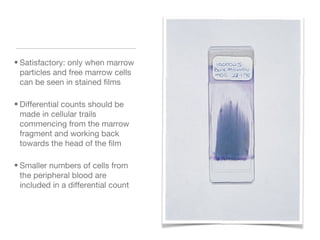
• Satisfactory: only when marrow
particles and free marrow cells
can be seen in stained films
• Differential counts should be
made in cellular trails
commencing from the marrow
fragment and working back
towards the head of the film
• Smaller numbers of cells from
the peripheral blood are
included in a differential count
• Appropriate amounts of
anticoagulant for the volume of
marrow to be anticoagulated are
used
• Gross excess of anticoagulant:
masses of pink-staining
amorphous material may be
seen
• Clumping of some erythroblasts
and reticulocytes may be seen
Concentration of bone marrow by
centrifugation
• To concentrate the marrow cells
• To assess the relative proportions of marrow cells,
peripheral blood and fat in aspirated material
• Useful in poorly cellular samples
Preparation of films of post-mortem bone
marrow
• Smears: Seldom satisfactory
• Satisfactory results: procedure must be Carried
out as soon after death as possible
• Majority of cells tend to break up when making
films
• Better preservation: a small piece of marrow is
suspended in 1-2ml of 5% bovine albumin( 1 vol.
30% albumin, 5 vol. 9 g/l NaCl)
• The suspension is then centrifuged
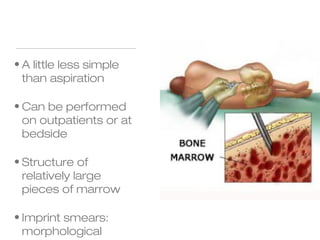
Trephine Biopsy
• A little less simple
than aspiration
• Can be performed
on outpatients or at
bedside
• Structure of
relatively large
pieces of marrow
• Imprint smears:
morphological
• Invaluable in the diagnosis of conditions that yield a
"dry tap".
• Hodgkin's disease, lymphoma: disrupted
architecture of the marrow is an important
diagnostic feature
• Usual site: posterior iliac spine
• Posterior iliac spine: longer, larger samples. Less
comfortable for the patient
• Anterior iliac spine can also be used
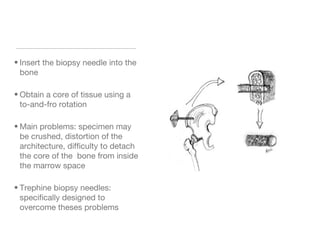
• Insert the biopsy needle into the
bone
• Obtain a core of tissue using a
to-and-fro rotation
• Main problems: specimen may
be crushed, distortion of the
architecture, difficulty to detach
the core of the bone from inside
the marrow space
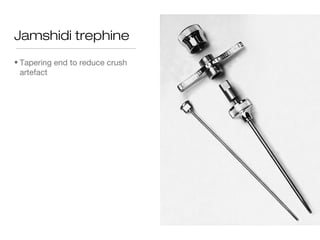
• Trephine biopsy needles:
specifically designed to
overcome theses problems
Jamshidi trephine
• Tapering end to reduce crush
artefact
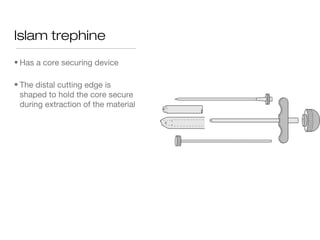
Islam trephine
• Has a core securing device
• The distal cutting edge is
shaped to hold the core secure
during extraction of the material
• Larger specimens: trephine needles with bores of
4-5mm
• Occasionally used needles: 2-mm bore
microtrephine, Vim-Silverman needle
• Smaller yield of marrow specimen that are prone
for fracturing
a and neutropenia
in small preterm
neonates
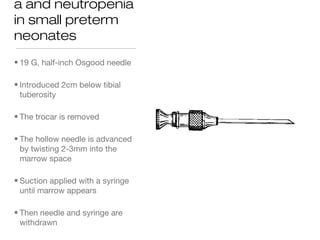
• 19 G, half-inch Osgood needle
• Introduced 2cm below tibial
tuberosity
• The trocar is removed
• The hollow needle is advanced
by twisting 2-3mm into the
marrow space
• Suction applied with a syringe
until marrow appears
• Then needle and syringe are
withdrawn
• The marrow clot is gently dislodged with the tip of
a needle and placed into fixative
• The specimen is processed
• Decalcification is not required
Complications of bone marrow biopsy
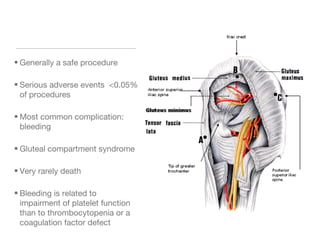
• Generally a safe procedure
• Serious adverse events <0.05%
of procedures
• Most common complication:
bleeding
• Gluteal compartment syndrome
• Very rarely death
• Bleeding is related to
impairment of platelet function
than to thrombocytopenia or a
coagulation factor defect
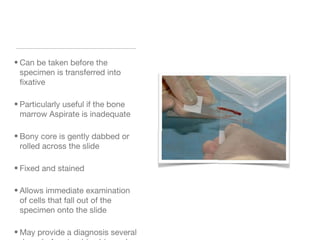
Imprints from bone marrow trephine biopsy
• Can be taken before the
specimen is transferred into
fixative
• Particularly useful if the bone
marrow Aspirate is inadequate
• Bony core is gently dabbed or
rolled across the slide
• Fixed and stained
• Allows immediate examination
of cells that fall out of the
specimen onto the slide
• May provide a diagnosis several
Processing of bone marrow trephine biopsy
specimens
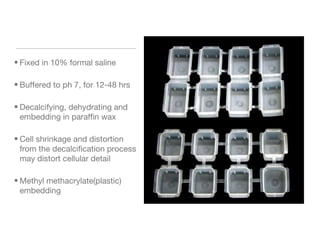
• Fixed in 10% formal saline
• Buffered to ph 7, for 12-48 hrs
• Decalcifying, dehydrating and
embedding in paraffin wax
• Cell shrinkage and distortion
from the decalcification process
may distort cellular detail
• Methyl methacrylate(plastic)
embedding
Staining of Sections of Bone Marrow
Trephine Biopsy Specimens
• Routinely stained for H& E
• Silver impregnation method for reticulin
• Romanosky dyes: MGG - hemopoietic cells may be more easily identified
• Perls' reaction for iron
• H&E staining: excellent for demonstrating the
cellularity and pattern of the marrow
• Pathological changes: fibrosis, granulomata,
carcinoma cells
• IHC: paraffin/plastic embedded specimens
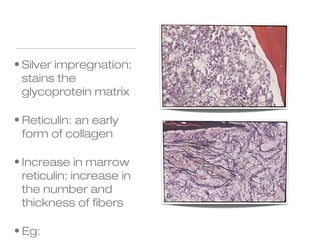
• Silver impregnation:
stains the
glycoprotein matrix
• Reticulin: an early
form of collagen
• Increase in marrow
reticulin: increase in
the number and
thickness of fibers
• Eg:
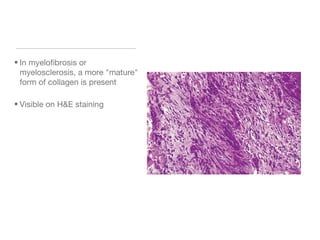
• In myelofibrosis or
myelosclerosis, a more "mature"
form of collagen is present
• Visible on H&E staining
References
• Dacie and Lewis practical hematology
• Bone Marrow Pathology - Barbara Bain - 4th
edition
• Wintrobe's clinical hematology
• Google images
Thank you

Bone marrow aspiration and biopsy

  • 1.
  • 2.
    Moderators Dr V VijaySreedhar (Prof & HOD) Dr Manimekhala (Assoc. Prof) Upgraded Department of Pathology
  • 3.
  • 4.
  • 5.
  • 6.
  • 7.
    Why do weneed to do bone marrow studies?
  • 8.
  • 9.
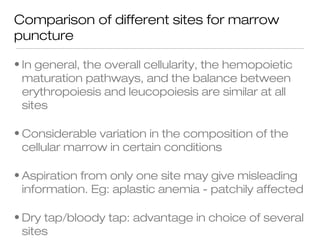
    • Simple andsafe • Repeated many times • Performed on outpatients • Safe in almost circumstances
  • 10.
    Advantages • Individual cellsare well preserved • Subtle differences between the cells recognized
  • 11.
    Disadvantages • Arrangement ofcells in the marrow • Relationship between the cells • Fibrotic marrows: aspiration of blood
  • 14.
    General considerations • Iliacspines: advantages of trephine biopsy • Obese and immobile patients: technical difficulties • Sternum should be avoided in children • Danger of perforating inner cortical layer and damage to the underlying large blood vessels and right atrium
  • 15.
    Important considerations • Alwayswear surgical gloves • Avoid needle stick injuries • Local and oral analgesia • Use only needles designed for the purpose
  • 16.
    Marrow puncture needles •Needles should be stout • Hard stainless steel • About 7-8 cm in length • Well fitting stilette • Adjustable guard
  • 17.
    • Most commonreusable needles: Klima and Salah • Point of the needle and the edge of the bevel must be kept well sharpened
  • 18.
    • Islam's bonemarrow aspiration needle: the dome-shaped handle and the T-bar are intended to provide stability and control during the operation • Disposable bone marrow aspiration needles
  • 19.
    • Clean theskin • 70% alcohol • 0.5% chlorhexidine(5% diluted 1 in 10 in ethanol)
  • 20.
    • Infiltrate theskin, subcutaneous tissue, and periosteum • 2% lignocaine 2-5ml
  • 21.
  • 22.
    • Pass theneedle with a boring movement • Needle - perpendicular into the cavity • Remove the stilette when bone has been penetrated • Attach a 1-2ml syringe • Aspirate marrow contents • Second sample: Attach a second 5-10 ml syringe for cytogenetic and immunophenotypic analysis
  • 23.
    • As arule material can be sucked into the syringe without difficulty • If unable to aspirate: Insert the stilette, push the needle and then Aspirate • Dry tap: failure to Aspirate marrow suggests fibrosis or infiltration • Dry tap: insert the stilette, push any material in the lumen onto a slide • Obese patients: CT guided marrow sampling
  • 24.
    • Ethylenediaminetetra-acetic acid(EDTA) •Preservative free heparin: phenotyping and cytogenetic analysis • Preservative in fixative: histopathology • Fixation in absolute methanol: romanosky method or perls' stain or cytochemical staining
  • 25.
  • 26.
    Puncture of theilium • Usual sites: Posterior and anterior iliac spines • Center of the oval posterior superior iliac spine • 2cm posterior and 2cm inferior to anterior superior iliac spine • Posterior iliac spine: 1) overlies a large marrow containing area. 2)relatively large volumes of marrow can be aspirated • Posture: 1)patient lying sideways or 2)prone
  • 27.
  • 28.
    Puncture of thesternum • Avoid pushing the aspiration needle through the bone • Usual sites: 1) manubrium, 2) 1st or 2nd parts of the body of sternum
  • 29.
    Manubrium • Denser bonethan body of sternum • More fatty marrow in elderly subjects • Thickness of cortex: 0.2-5.0mm • Difficult to ascertain that the needle point has reached the cavity of the bone • Site: about 1cm above the sternomanubrial angle and slightly to one side of the midline
  • 30.
    Body of Sternum •Site: opposite the second intercostal space • Slightly to one side of the midline
  • 31.
    • Essential: Needlewith a guard • Adjust the guard When needle reaches the periosteum • Allow it to penetrate about 5mm further • Push the needle with a boring motion, enter the cavity and Aspirate
  • 32.
  • 33.
    Puncture of the Spinousprocess • Done in adults • Spines of the lumbar vertebrae • Not difficult as bones lie superficially • More pressure is required • Patient sitting up or lying sideways • Pass the needle at right angles to the skin surface • Into the spine of the Lumbar vertebra slightly lateral to the
  • 34.
    Comparison of differentsites for marrow puncture • In general, the overall cellularity, the hemopoietic maturation pathways, and the balance between erythropoiesis and leucopoiesis are similar at all sites • Considerable variation in the composition of the cellular marrow in certain conditions • Aspiration from only one site may give misleading information. Eg: aplastic anemia - patchily affected • Dry tap/bloody tap: advantage in choice of several sites
  • 35.
    Aspiration of bone marrowin children • Small babies: medial aspect of upper end of tibia, just below the level of tibial tubercle • Caution! Vulnerable to fractures and laceration of adjacent major blood vessels • Children: iliac puncture(posterior spine) • Older obese children: anterior ilium • Tibial cortical bone: too dense, marrow normally less active
  • 36.
  • 37.
    • Preparing filmsfrom Bone Marrow Aspirates • Concentration of Bone marrow by centrifugation • Preparation of films of post-mortem bone marrow
  • 38.
  • 39.
    General considerations • 0.3ml of marrow fluid from a single site • >0.3ml: little advantage - peripheral blood dilution • A second syringe: 5-10 ml of marrow - immunophenotyping, cytogenetics and molecular studies • Sample of peripheral blood: finger prick or venepuncture • Good practice: obtain full blood count and storage
  • 40.
    Preparing films from BoneMarrow Aspirates • Smears should be made without delay • Smear length: 3-5cm • Glass spreader: smooth edged, not more than 2cm width • Marrow fragments dragged behind the spreader • Fragments leave a trail of cells behind them • Spreading should be towards the label area.
  • 41.
    • Insufficient fragments:can be concentrated • Deliver single drops of Aspirate onto slides about 1cm from one end • Most of the blood is quickly sucked off from the edge of the drop using the marrow syringe or a fine plastic pipette • Irregularly shaped marrow fragments tend to be left behind, can be lifted off with a spreader • Smears can be made
  • 42.
    • Thorough drying,fix the smears, and stain (Romanosky) • A longer fixation time(at least 20 min in methanol) is essential for high-quality staining
  • 43.
    • Perls' method:demonstrates the presence or absence of iron • Atleast one film should be fixed for perls' stain • Overnight drying may be necessary to achieve to achieve optimal results
  • 44.
    • Satisfactory: onlywhen marrow particles and free marrow cells can be seen in stained films • Differential counts should be made in cellular trails commencing from the marrow fragment and working back towards the head of the film • Smaller numbers of cells from the peripheral blood are included in a differential count
  • 45.
    • Appropriate amountsof anticoagulant for the volume of marrow to be anticoagulated are used • Gross excess of anticoagulant: masses of pink-staining amorphous material may be seen • Clumping of some erythroblasts and reticulocytes may be seen
  • 46.
    Concentration of bonemarrow by centrifugation • To concentrate the marrow cells • To assess the relative proportions of marrow cells, peripheral blood and fat in aspirated material • Useful in poorly cellular samples
  • 47.
    Preparation of filmsof post-mortem bone marrow • Smears: Seldom satisfactory • Satisfactory results: procedure must be Carried out as soon after death as possible • Majority of cells tend to break up when making films • Better preservation: a small piece of marrow is suspended in 1-2ml of 5% bovine albumin( 1 vol. 30% albumin, 5 vol. 9 g/l NaCl) • The suspension is then centrifuged
  • 48.
  • 49.
    • A littleless simple than aspiration • Can be performed on outpatients or at bedside • Structure of relatively large pieces of marrow • Imprint smears: morphological
  • 50.
    • Invaluable inthe diagnosis of conditions that yield a "dry tap". • Hodgkin's disease, lymphoma: disrupted architecture of the marrow is an important diagnostic feature • Usual site: posterior iliac spine • Posterior iliac spine: longer, larger samples. Less comfortable for the patient • Anterior iliac spine can also be used
  • 51.
    • Insert thebiopsy needle into the bone • Obtain a core of tissue using a to-and-fro rotation • Main problems: specimen may be crushed, distortion of the architecture, difficulty to detach the core of the bone from inside the marrow space • Trephine biopsy needles: specifically designed to overcome theses problems
  • 52.
    Jamshidi trephine • Taperingend to reduce crush artefact
  • 54.
    Islam trephine • Hasa core securing device • The distal cutting edge is shaped to hold the core secure during extraction of the material
  • 55.
    • Larger specimens:trephine needles with bores of 4-5mm • Occasionally used needles: 2-mm bore microtrephine, Vim-Silverman needle • Smaller yield of marrow specimen that are prone for fracturing
  • 56.
    a and neutropenia insmall preterm neonates • 19 G, half-inch Osgood needle • Introduced 2cm below tibial tuberosity • The trocar is removed • The hollow needle is advanced by twisting 2-3mm into the marrow space • Suction applied with a syringe until marrow appears • Then needle and syringe are withdrawn
  • 57.
    • The marrowclot is gently dislodged with the tip of a needle and placed into fixative • The specimen is processed • Decalcification is not required
  • 58.
    Complications of bonemarrow biopsy
  • 59.
    • Generally asafe procedure • Serious adverse events <0.05% of procedures • Most common complication: bleeding • Gluteal compartment syndrome • Very rarely death • Bleeding is related to impairment of platelet function than to thrombocytopenia or a coagulation factor defect
  • 60.
    Imprints from bonemarrow trephine biopsy
  • 61.
    • Can betaken before the specimen is transferred into fixative • Particularly useful if the bone marrow Aspirate is inadequate • Bony core is gently dabbed or rolled across the slide • Fixed and stained • Allows immediate examination of cells that fall out of the specimen onto the slide • May provide a diagnosis several
  • 62.
    Processing of bonemarrow trephine biopsy specimens
  • 63.
    • Fixed in10% formal saline • Buffered to ph 7, for 12-48 hrs • Decalcifying, dehydrating and embedding in paraffin wax • Cell shrinkage and distortion from the decalcification process may distort cellular detail • Methyl methacrylate(plastic) embedding
  • 64.
    Staining of Sectionsof Bone Marrow Trephine Biopsy Specimens
  • 65.
    • Routinely stainedfor H& E • Silver impregnation method for reticulin • Romanosky dyes: MGG - hemopoietic cells may be more easily identified • Perls' reaction for iron
  • 66.
    • H&E staining:excellent for demonstrating the cellularity and pattern of the marrow • Pathological changes: fibrosis, granulomata, carcinoma cells • IHC: paraffin/plastic embedded specimens
  • 67.
    • Silver impregnation: stainsthe glycoprotein matrix • Reticulin: an early form of collagen • Increase in marrow reticulin: increase in the number and thickness of fibers • Eg:
  • 68.
    • In myelofibrosisor myelosclerosis, a more "mature" form of collagen is present • Visible on H&E staining
  • 69.
    References • Dacie andLewis practical hematology • Bone Marrow Pathology - Barbara Bain - 4th edition • Wintrobe's clinical hematology • Google images
  • 70.